



Abstract
To influence school achievement, researchers investigate student academic help-seeking. However, a growing population of students of color combined with the risk of poorer academic performance yields attention toward African American student academic help-seeking. In this review, 13 studies analyzed sampling characteristics, theoretical frameworks, and designing methodologies. Results illustrated that samples varied in terms of data collection, settings, participant characteristics, and research purpose. Also, frameworks differed with the majority of the studies referencing culture or motivation-informed theory. The methodology focused on quantitative measures of help-seeking behavior, attitude, and influencing variables. Qualitative measures showed African American students experienced help-seeking challenges, family involvement, and assumed responsibility for seeking help. Implications for research and practice are provided.
Conceptualization of Help-Seeking
Help-seeking is a critical, adaptive learning skill. In an academic context, students may seek help for bullying or support for mental health needs (Biolcati et al., 2017; Eliot et al., 2010; Fox & Butler, 2007; Veenstra et al., 2014). In addition, students may need to ask for academic assistance (Calarco, 2011; Vredenburgh & Kushnir, 2015; White & Bembenutty, 2013). Literature has demonstrated that academic help-seeking is multifaceted and involves problem identification, a determination to pursue help, and an exploration of help sources (Defeo et al., 2017; Newman, 1998, 2002; Newman & Schwager, 1993; Ryan et al., 2005; White & Bembenutty, 2013). The literature has indicated that academic help-seeking is important because of its positive influence on student learning. For example, questioning helps students become more familiar with material (Newman & Goldin, 1990), pursuing help is related to students’ academic self-concept (Newman & Schwager, 1993), gathering information helps with retention (Vredenburgh & Kushnir, 2015), and obtaining help is associated with higher test scores (Ryan et al., 2005).
Academic help-seeking is shaped by both individual and environmental factors. With respect to individual factors, research has examined student demographics with help-seeking tendencies (Calarco, 2011; Coie et al., 1982; Nelson-Le Gall & Glor-Scheib, 1985; Newman & Goldin, 1990; Newman & Schwager, 1993). Also, literature has highlighted student classroom behaviors, including persistence, willingness, and appropriateness in help-seeking (Morris et al., 2008; Nelson-Le Gall, 1985). Also, attitudinal factors have been studied such as self-esteem, personal learning goals, and preference for helper (Bonner et al., 2017; Nelson-Le Gall, 1985; Newman, 2000; Newman & Schwager, 1993).
With respect to environmental factors, research has explored learning tasks in terms of type of task, academic subject, student grouping, and opportunity for reflection (Daley et al., 2014; Defeo et al., 2017; Nelson-Le Gall & Glor-Scheib, 1985; Newman, 2000; Webb & Farivar, 1994). Also, research has investigated the role of parents and the student’s home-life (Bong, 2008; Gonida et al., 2014; Holt, 2014), as well as contact and relationships with peers (Nelson-Le Gall, 1989; Newman, 2002; DeCooke & Gall, 1989). Research also examines instructor characteristics such as kindness, questioning style, and how help was presented to students (Daley et al., 2014; Newman, 2002; Webb & Farivar, 1994).
There are several bodies of theory that are useful in examining the academic help-seeking process. First, there are theories that highlight opportunities for students to seek assistance in the classroom. These theories often comprise active learning principles and involve students seeking help as part of the problem-solving process, inquiry-based learning that requires students to seek help to answer curriculum-related questions, and collaborative learning that is based on students providing and accepting assistance from peers (Almajed et al., 2016; Cattaneo, 2017; Ding & Er, 2017; Du et al., 2014).
Second, there are frameworks that consider what may motivate students to seek academic assistance. This includes Lazarus’s (1993) and Folkman’s (1984) appraisal models that may suggest that students seek help if a task is perceived as relevant and significant. Or, considering the self-determination model that explains how meeting psychological needs (autonomy, competence, and relatedness) motivates behavior (Ntoumanis et al., 2009). In other words, students may pursue help when doing so reflects a personal choice, allows for task accomplishment, or promotes meaningful interpersonal interactions. Also, cognitive models that underscore the ability to monitor performance (i.e., metacognition), understand level of competency (i.e., self-efficacy), and make decisions to appropriately navigate the learning process (i.e., self-regulation) may motivate students to seek help (Bandura, 1977; Flavell, 1979; Schraw et al., 2006).
Third, there are theoretical models addressing potential challenges associated with students seeking academic help. The literature provides multiple race or cultural-based theories useful in examining academic help-seeking barriers. For example, the critical race theory highlights how negative racial stereotypes and biased perceptions may oppress and deter the academic choices of Black students (Howard, 2008). Similarly, the culturally responsive model argues how a reliance on a traditional school curriculum (while ignoring student individual culture) is problematic for students of color and is linked to student disengagement, lower participation, and indifference (Ortiz et al., 2018). Also, the oppositional culture theory fuels the debate on the impact of differences in student–teacher ethnicity. The theory questions whether an ethnicity mismatch contributes to negative or strained teacher–student classroom interactions such as student resistance to teacher assistance or feedback (Ogbu, 2008; Kozlowski, 2014). Although in the educational realm the oppositional cultural theory focuses on the reactive experiences of Black students, there are other models, such as the cultural capital perspective, which shift the onus to non-minority teachers. Specifically, the cultural capital theory encourages non-minority teachers to critically reflect on how they may misinterpret the social practices of students of color (such as an avoidance of showing the vulnerability involved in seeking help) that are inconsistent or clash with their own White, middle-class, privileged norms (Carter, 2003; Goldenberg, 2014).
In addition to cultural-based theories, frameworks that focus on learning style may also provide insight into barriers. Learning style (as dictated by student’s culture) may be different than the learning methods prescribed by the academic tasks in the classroom (Boykin, 1978). As a result of the mismatch in learning style, asking for help may become an uncomfortable experience for a student of color. Also, ecological models which argue the impact of reciprocal interactions (exchanges between peers, teachers, family, community, etc.) may help shed light on relational or social challenges inside and outside the classroom that prevent students from seeking assistance (Bronfenbrenner, 2005; Epstein et al., 2002). Finally, the general system theory emphasizes the overwhelming need to adapt to change (with respect to help-seeking, this may include adjusting to a change in the perceived need for help or adjusting to a change in the amount of help required) and the need to identify mechanisms to encourage resilience (Masten, 2013; Masten et al., 1990).
Understanding the Need to Study African American Academic Help-Seeking
Although the literature is rich in explorations of help-seeking tendencies of non-minority students, studying race has been noted as an important direction for future research (Amemiya & Wang, 2016; Ryan et al., 2009; Zusho & Barnett, 2011). Why is the study of African American academic help-seeking relevant to educators and researchers? One reason is related to the changing classroom population. In 2014, the National Center of Education Statistics revealed, for the first time in U.S. public schools, the percentage of students of color exceeded the percentage of White students (Bonner et al., 2017; Wiggins et al., 2007). In addition, as the student population changes, the teacher population remains primarily White (Warren, 2013). It is becoming increasingly important for teacher preparation programs to include multicultural awareness curriculum for new teachers. With this in mind, exploring help-seeking data relevant to non-White students could become instrumental to inform culturally responsive classroom practices.
Another reason for studying African American academic help-seeking is due to the lower academic performance of African Americans when compared with other students. Causes for poorer performance or the achievement gap include both instructor variables (viewing African American students as exerting less effort, perceiving African American students as demonstrating less academic task persistence, and believing African American students are less eager to learn) and student variables (cultural differences in communication style, interaction style, and learning style) (Downey & Pribesh, 2004; Ogbu, 1987; Shouse et al., 1992; Tenenbaum & Ruck, 2007). Because help-seeking is associated with improving academic performance, building a better understanding of variables that encourage African American students to successfully pursue help in the classroom may be useful in narrowing the achievement gap.
A final reason for investigating help-seeking is due to the perceived stigma that some African American students reportedly attach to school achievement. Sadly, the literature revealed how adolescents may resist school achievement due to the fear of public praise and fear of the responsibility to a high performance (Ishiyama & Chabassol, 1984). Furthermore, African American students have been found to equate performing well in school with peer rejection and peer shame (Davis & Polite, 1999; Ford et al., 2008; Foster, 1990; Ford & Harris, 1996). Keep in mind that help-seeking behavior contributes to student success. Thus, it is reasonable that examining what influences students’ positive attitudes on help-seeking behaviors in general could apply in shifting African American students away from the damaged perception of other school achievement behaviors.
Despite the need for a better understanding, the author was unable to identify any literature reviews targeting African American academic help-seeking. Instead, there were overviews of help-seeking research discovered that were somewhat outdated and did not focus on African American students (Nelson-Le Gall, 1985; Newman, 2000, 2002).
A review of the literature would help build a greater understanding of African American academic help-seeking. A systematic review would address specific questions on the topic; unfortunately, the insight would be limited to the confines of the prescribed questions. Instead, a scoping review would focus on describing the extent of the research processes used and serve to inform future research needed in the area of African American student academic help-seeking (Arksey & Omalley, 2005; Mays et al., 2005). To this end, the current scoping review has two objectives. The first objective was to summarize the research activity concerning the academic help-seeking tendencies of African American students from early childhood to late adolescence, that is, to analyze samples, research purposes, guiding theories, and methodologies as provided in the research literature. The second objective was to explore future research opportunities to address the existing gaps in the study of African American student help-seeking.
Method
Search Strategy
Two databases were searched: Academic Search Complete and ProQuest. These databases were selected to find literature from education, psychology, and the social sciences. The current literature review examined the academic help-seeking tendencies of African American students from preschool to high school graduation. As such, synonyms for the terms academic, help-seeking, and African American were used. Synonyms related to academic included achievement and classroom. Synonyms related to help-seeking included support, assistance, and feedback. Synonyms related to African American included Black and urban. These related search terms were joined by utilizing the term or as well as the term and.
Five criteria to obtain studies were developed. The inclusion criteria were as follows: (a) studies that were published in peer review journals, (b) studies that targeted and separated out findings about African American students, (c) studies that identified African American students asking for academic help, (d) studies that included African American students enrolled in preschool to Grade 12, and (e) studies that included data collection and data analysis using qualitative or quantitative methods.
Search Results
An initial 4,074 studies were found using Academic Search Complete and ProQuest. A refined search for peer-reviewed, journal articles in education yielded 991 results. The abstracts were reviewed to rule out those not meeting inclusion criteria. This resulted in 427 eligible studies. Of the 427 studies found, 143 were duplicates and were eliminated, leaving 284 studies that were examined for inclusion. Of the 284 studies, 273 were excluded because they failed to meet the inclusion criteria: 146 focused on non-academic help-seeking, 97 did not target African American students, 22 focused on college students, five were dissertations, two combined African American student reports and other student reports into one measure, and one study used duplicate data (same pool of participants) as another study. This left a remainder of 11 eligible articles. The author then conducted a hand-search by examining reference lists and found two articles that met inclusion. In sum, a total of 13 articles met the search criteria because they described a peer-reviewed study that collected and analyzed data concerning African American pre-K through Grade 12 students seeking academic help.
Results
The results of the current analysis are divided into three sections, including sample characteristics, theoretical framework, and methodology type.
Sample Characteristics
Of the 13 included studies, publication dates ranged from 1990 to 2018 with 62% of the studies (N = 8) published in 2006 or later. The research designs used for the 13 studies were nine quantitative, three qualitative, and one mixed-method study. Of the quantitative designs, six relied on surveys (Amemiya & Wang, 2016; Brittian & Gray, 2014; Gutman & Midgley, 2000; Ryan et al., 1997, 2009; Zusho & Barnett, 2011) and four included observations (Nelson-Le Gall, 2006; Nelson-Le Gall & Jones, 1990; Watkins, 2002; Zusho & Barnett, 2011). Of the qualitative designs, two used semi-structured interviews (Murray & Naranjo, 2008; Pringle et al., 2010) and one included observation (Gast, 2018). One study utilized a mixed-method design, and thus included a survey and semi-structured interview (Sanders, 1998).
The frequency of data collected varied. A majority of researchers measured student help-seeking on one occasion (e.g., Nelson-Le Gall, 2006; Nelson-Le Gall & Jones, 1990; Sanders, 1998; Zusho & Barnett, 2011), whereas only four studies measured help-seeking tendencies across transitions from elementary, middle, and high school (Amemiya & Wang, 2017; Brittian & Gray, 2014; Gutman & Midgley, 2000; Ryan et al., 2009). Two studies collected data at 3 points across middle school (Amemiya & Wang, 2016; Ryan et al., 2009). Similarly, two studies collected data at 2 points as students transitioned from elementary to middle school (Brittian & Gray, 2014; Gutman & Midgley; add Amemiya, & Wang (2016).
The settings for 10 of the 13 studies were school-based and three of the studies included home visits in which interviews, surveys, or demographics were conducted (Amemiya & Wang, 2016; Brittian & Gray, 2014; Gutman & Midgley, 2000).
Participant characteristics varied. A majority of studies focused solely on students, but two studies included other participants such as families and teachers (Gast, 2018; Gutman & Midgley, 2000). Participant ethnicity varied as well. Although nine of the 13 included studies focus on African American participants, four studies expanded their participant pool and included Hispanic Americans, Latino American, and European American students (Amemiya & Wang, 2016; Ryan et al., 1997, 2009; Zusho & Barnett, 2011). The participant’s grade levels ranged from preschool to Grade 12 with one study targeting preschool (Watkins, 2002), three elementary school Grades 3 through 5 (Nelson-Le Gall, 2006; Nelson-Le Gall & Jones, 1990; Ryan et al., 1997), two middle school Grades 7 through 8 (Ryan et al., 2009; Sanders, 1998), and four high school Grades 9 to 12 (Gast, 2018; Murray & Naranjo, 2008; Pringle et al., 2010; Zusho & Barnett, 2011). One study examined students as they transitioned from elementary to middle school (Brittian & Gray, 2014). One study examined students at multiple points in middle school (Ryan et al., 2009). Two studies followed students from middle school to high school (Amemiya & Wang, 2016; Brittian & Gray, 2014).
The most common research purpose of the included studies was to explore help-seeking tendencies of African American students. Other purposes were indirectly related to help-seeking and included the role of protective factors in African American academic achievement (Brittian & Gray, 2014; Gutman & Midgley, 2000; Murray & Naranjo, 2008; Sanders, 1998) and African American student perception of teachers and instruction (Gast, 2018; Pringle et al., 2010).
Theoretical Framework
The theoretical frameworks identified in the included studies varied. Surprisingly, cultural informed theories, which highlight the influence of race and ethnicity, were only used in four of the 13 studies (Brittian & Gray, 2014; Gast, 2018; Pringle et al., 2010; Watkins, 2002). For instance, Gast (2018) relied on the Symbolic Violence and Misrecognition of Race Model that explores how race–class assumptions are reflected through language. In the study, Gast observed both middle- and working-class African American high school student conversations on academic behavior choices (classroom engagement, pursuit of help, and level of effort) to explore ways their dialogue served to stigmatize and perpetuate racial stereotypes concerning African American educational outcomes.
In a second study, Watkins (2002) built upon the previous research on African American development and learning style. Specifically, Watkins wished to explore how young African American students might demonstrate cooperative learning and communalistic principles as they interacted with teachers and peers in a early childhood academic setting.
In a third study, Brittian and Gray (2014) highlighted the cultural resource theory which upholds the notion that utilizing support from same-race peers (frequency of going to peers for schoolwork assistance), and connecting with ethnic heritage (believing people of similar race or ethnicity support one another), helps buffer the perceived differential treatment of African American students. Then, Pringle et al. (2010) referred to Obgu’s theory on school-related minority disengagement factors (school race relations, internalized White beliefs, culture, etc.) to provide context for African American student perception of teacher practices (such as offering instructional help).
In addition to cultural frameworks, motivation-informed theories helped to guide several help-seeking research studies. Four of the studies sought to test motivational variables (Amemiya & Wang, 2016; Nelson-Le Gall & Jones, 1990; Ryan et al., 1997; Zusho & Barnett, 2011). Amemiya and Wang (2016) examined how the perception of course ability (Math and English courses) motivated students to ask for help. Using the expectancy value, Zusho and Barnett examined how the perception of the expectancy of success and the perceived task value motivated student help-seeking. The work of Ryan et al. (1997) was driven by the vulnerability hypothesis in which students performing at lower levels were less motivated to seek help due to the negative judgments from peers and teacher. Nelson-Le Gall and Jones (1990) wished to study the role of cognitive-motivational factors (level of curiosity and level of assistance) in help-seeking behavior.
Outside of the cultural and motivational perspectives, a minimal number of studies ascribed to help-seeking as a protective mechanism. For example, the resilience theory, which postulates sets of variables that protect students from negative academic outcomes, was used in two of the studies (Gutman & Midgley, 2014; Murray & Naranjo, 2008). Gutman and Midgley (2000) explored how African American success in middle school was promoted by the role of parent-related protective factors (parents assisting with child’s homework) and teacher-related protective factors (teachers demonstrate that students can count on them for help). Similarly, Murray and Naranjo (2008) examined protective factors specific to contributing to the graduation of African American high schoolers with disabilities (willingness to seek help from teachers and asking teachers for help instead of the assignment answers).
Only one other framework, the ecological model, was used (Sanders, 1998). Specifically, the Overlapping Spheres of Influence theory was used to explain how the involvement of teachers, family, and church combine to affect the educational outcomes of African American students. No theory or conceptual framework was associated with two of the 13 studies (Nelson-Le Gall, 2006; Ryan et al., 2009).
Types of Research Methods
A variety of methods were used to measure academic help-seeking among African American students. Quantitative methods allowed measurement of behavior and attitude, whereas qualitative methods examined common experiences shared among African American students. The measurement processes are described below.
Quantitative
Quantitatively, academic help-seeking was measured in terms of behavior or attitude and the influence of student or classroom variables. In terms of behavior, five studies analyzed how often students sought help. For example, Watkins (2002) observed that African American preschool students approached peers for help more frequently than teachers.
When approaching peers, Nelson-Le Gall (2006) observed that more executive help requests, than instrumental help requests, were made (seeking answers without explanations and ready-made solutions). On the contrary, Amemiya and Wang’s (2016) student surveys revealed that students approached teachers more often than peers. In addition to exploring the helper source, Nelson-Le Gall and Jones (1990) investigated the role of self-assessment. With the combination of self-assessments and behavior ratings, Nelson-Le Gall and Jones found that African American children were found to seek help more frequently when they perceived items to be incorrect than correct. It should be acknowledged that although Zusho and Barnett (2011) noted the occurrence of students seeking help via after-school tutoring, no comparison behavior variable was included in the study.
In addition to behavior, measuring students’ attitude is valuable in understanding how students view the help-seeking process. Six studies examined student attitude toward help-seeking. In terms of perception of peers, students viewed popular peers more desirable as helpers (Nelson-Le Gall, 2006). In terms of self-perception, Sanders (1998) determined that student academic self-concept was not influenced by teacher support. In terms of perception of teachers, Zusho and Barnett (2011) determined that students who wanted to demonstrate their competence were more likely to attend tutoring. As well, Gutman and Midgley (2000) examined the degree to which perception of instructors contributed to student positive help-seeking attitudes. Other studies reported the degree to which students subscribed to help-avoidance behaviors (Ryan et al., 1997, 2009; Zusho & Barnett, 2011). For instance, students reported their level of agreement with resisting to ask questions, guessing intentionally, and hiding the need for help.
After analyzing behavior and attitude, researchers measured how individual student variables influenced help-seeking. Specifically, the influence of gender, age, ethnicity, social support, and student goals were measured. In respect to gender, four studies explored whether gender contributed to differences in help-seeking tendencies or attitudes (Nelson-Le Gall, 2006; Nelson-Le Gall & Jones, 1990; Ryan et al., 1997, 2009). Although Nelson-Le Gall (2006) found females made more help requests (M = 8.08) than males (M = 6.00), Ryan et al. (1997) determined that females were more likely to perceive help-seeking as a threat to self-worth (e.g., worrying if teacher and peers would view them as dumb). Other researchers found no significant gender differences (Nelson-Le Gall & Jones, 1990; Ryan et al., 2009).
In addition to gender, three studies examined age-related differences and help-seeking (Nelson-Le Gall & Jones, 1990; Ryan et al., 2009; Watkins, 2002). When comparing third graders to fifth graders, Nelson-Le Gall and Jones (1990) found that the type of help requested was associated with age, thus the fifth-grade students preferred indirect help (hints vs. answers), whereas the third-grade students showed no preference. Also, the quantity of help increased with age; thus, the fifth-grade students requested more help than the third graders. In comparing preschool students with toddlers, Watkins (2002) examined the quantity of help requested and found preschoolers sought less help than the younger children. In comparing the help-seeking patterns due to transition from sixth grade to seventh grade, Ryan et al. (2009) found that help avoidance increased over time. It should be noted, even though some studies were longitudinal in nature, the analysis did not include student age as a variable (Amemiya & Wang, 2016; Gutman & Midgley, 2000).
Next, the role of ethnicity was analyzed. Four studies compared help-seeking across ethnicities (Amemiya & Wang, 2016; Ryan et al., 1997, 2009; Zusho & Barnett, 2011). In comparison with European American students, Ryan et al. (2009) determined that African American students reported higher help-avoidance attitudes. Amemiya and Wang (2016) found that African American students sought teacher help at a higher frequency than other students.
Two studies found no significant ethnic differences (Ryan et al., 1997; Zusho & Barnett, 2011). Also, social support was an individual variable that was examined in three studies (Brittian & Gray, 2014; Gutman & Midgley, 2000; Sanders, 1998). Of these, two studies examined student attitudes toward parent and peer encouragement when academic help was required (Brittian & Gray, 2014; Sanders, 1998). In Sander’s (1998) study, parental support (such as the parent helping when the student did not do well in school) was reported more frequently than teacher or church support. In Brittian and Gray’s (2014) study, evidence suggested that peer support (such as seeking peer assistance when experiencing difficulty on schoolwork) allowed African American students to manage perceived differential teacher treatment (such as the teacher feeling the student was less smart than non-minority students). In addition to surveying students, Gutman and Midgley (2000) measured the social support and involvement of parents. For instance, parents were surveyed to determine the frequency for checking their child’s homework.
A final individual variable examined was student goals. Two studies highlighted individual student goals (Nelson-Le Gall & Jones, 1990; Ryan et al., 1997). Of these, the Nelson-Le Gall and Jones (1990) study explored the impact of learning goals on help-seeking. The researchers found that students with a high intrinsic orientation to mastery learning style showed a preference for a type of help that allowed them to figure out the solution on their own. In a study by Ryan et al. (1997) that focused on social goals, it was determined that the more concerned a student was with social image, the less likely the student was to ask for help.
Next, a total of four classroom-related variables were measured. In terms of academic task performance, Nelson-Le Gall and Jones (1990) determined that African American students pursued more help-seeking when they were less certain of an answer than when they had confidence in an answer. In terms of activity type, Watkins (2002) demonstrated that African American children sought more help during free time than during structured activity. In terms of instructional content, Zusho and Barnett (2011) found that the instructional subject had some impact on student help-seeking patterns. With respect to perceived teacher support, Gutman and Midgley (2000) suggested that classroom variables alone were insufficient. Instead, they argued that the combination of school factors (which included having teachers to count on for help when needed) plus parental involvement (which included having parents to check homework for accuracy) was more effective in African American students experiencing academic achievement (as evidenced by students earning higher grade point averages) across the transition from elementary to middle school (Gutman & Midgley, 2000). Also, Sanders (1998) determined that perceived teacher support (which included the student feeling comfortable seeking teacher help and the teacher helping the student comprehend the lesson) had a positive impact on African American students’ attitude toward school and behavior in school.
Qualitative
While most researches relied on a quantitative system, four studies utilized a qualitative procedure to measure help-seeking (Gast, 2018; Murray & Naranjo, 2008; Pringle et al., 2010; Sanders, 1998). A thematic analysis was used to examine the qualitative data. In using this approach, the author engaged in a series of decisions to aid in the analysis process (Aronson, 1994; Attride-Stirling, 2001; Braun & Clarke, 2006). First, the author repeatedly read the data (interviews and observation notations) with the intent to become as familiar with the data as possible. Specifically, the repeated readings allowed the author to focus on the frequency of phrases or ideas repeated via interview quotes and author mentions. Next, the author searched the data to explore potential themes related to the experience and tendencies of African American children and adolescents seeking help. This included an active, ongoing, questioning process to judge what was interesting, plausible, consistent, and inconsistent within the interview responses. To help enhance the trustworthiness of an inherently subjective process, the author explored the rationale behind making theme-development decisions . For example, when identifying the role of family as a theme, the author considered the source of her personal interest and how this may be due to the author’s experience in seeking academic help for her own teenagers (in the form of American College Testing (ACT) preparation courses, teacher conferences, homework help, etc.). Last, the author prepared to refine the themes. Particularly, the author considered the purpose of the themes (to describe and organize information from the interviews), the function of the themes (to shed light on a significant idea in relation to the research focus), and the substantiation of the themes (to provide evidence for ideas presented in terms of quotes or data excerpts).
After following the steps highlighted above, there were three common themes reported across the studies. First, all four of the qualitative studies addressed the challenges involved in seeking academic assistance. One challenge was for students to acknowledge when help was needed. For example, one high school Honors student discussed when his non-Honors peers did not ask questions about assignment expectations, teachers interpreted this as disengagement and assumed the students did not care (Gast, 2018). Another challenge was understanding the connection between a student’s classroom behavior and the help-seeking process. For example, an eighth-grade student described how peers who had school fights and suspensions did not perceive the same level of teacher support as the students who had not experienced discipline concerns (Sanders, 1998). Also, the studies mentioned challenges with receiving the appropriate level of support and scaffolding. For instance, Murray and Naranjo (2008) interviewed 12th-grade students’ frustration with working with teachers who provided solutions instead of the procedural steps. Also, Pringle et al. (2010) interviewed students who reported annoyance with teachers who seemed to “baby” the students as a means of providing help.
Second, most of the qualitative data mentioned the role of parent and family in the help-seeking process (Murray & Naranjo, 2008; Pringle et al., 2010; Sanders, 1998). Although the type of help varied, the involvement of parent and family was a common experience. Sometimes, a student relied on parents for emotional support. For example, in Sander’s (1998) study, a middle school student reported how his parent boosted his confidence as he sought help in improving his grade. Other times, a student required parents to intervene. For instance, in interviews for Pringle et al. (2010), a high school senior reported the need for his mother to advocate for learning supports when the student’s initial requests were not met. Interestingly, students hold parents and family responsible for teaching them how to ask for help at school. One high school senior, interviewed by Murray and Naranjo (2008), reported that he learned help-seeking from his family.
Third, half of the studies with qualitative data broached the idea of student responsibility in the help-seeking process. Murray and Naranjo’s (2008) interviews revealed that African American senior students believed it was their personal duty to seek instructor support. The students viewed seeking help as an act of self-advocacy. Likewise, Gast (2018) reported exchanges between African American high school Honors students that showed a need to “check-in” with the teacher and even a disbelief when other students were in need of lesson clarification and “don’t ask teachers for help.” Based on these views, Gast argued that not only was seeking assistance a responsibility, but help avoidance was an academic liability for African American students.
Discussion
Implications for Future Research
The 13 articles in the current review have offered details concerning sample characteristics, study purpose, theoretical framework, and research design in the study of African American student academic help-seeking (see Table 1). Given the details surrounding the designs and findings, several potential research opportunities emerge. In terms of research design across the studies, there are four areas for potential exploration. First, future research should consider the inclusion of more qualitative measures because the current review was dominated with nine of 13 studies relying solely on the quantitative method. Increased use of the qualitative approach would uncover more details concerning the help-seeking experience as well as assist in examining the “Why?” questions instead of only focusing on the “How much?” questions. Because the current review only included one mixed-method design, more opportunities to combine qualitative with quantitative approaches would allow for additional insight as data would be examined from multiple vantage points.
Summary of Research Studies on AA Student Academic Help-Seeking.
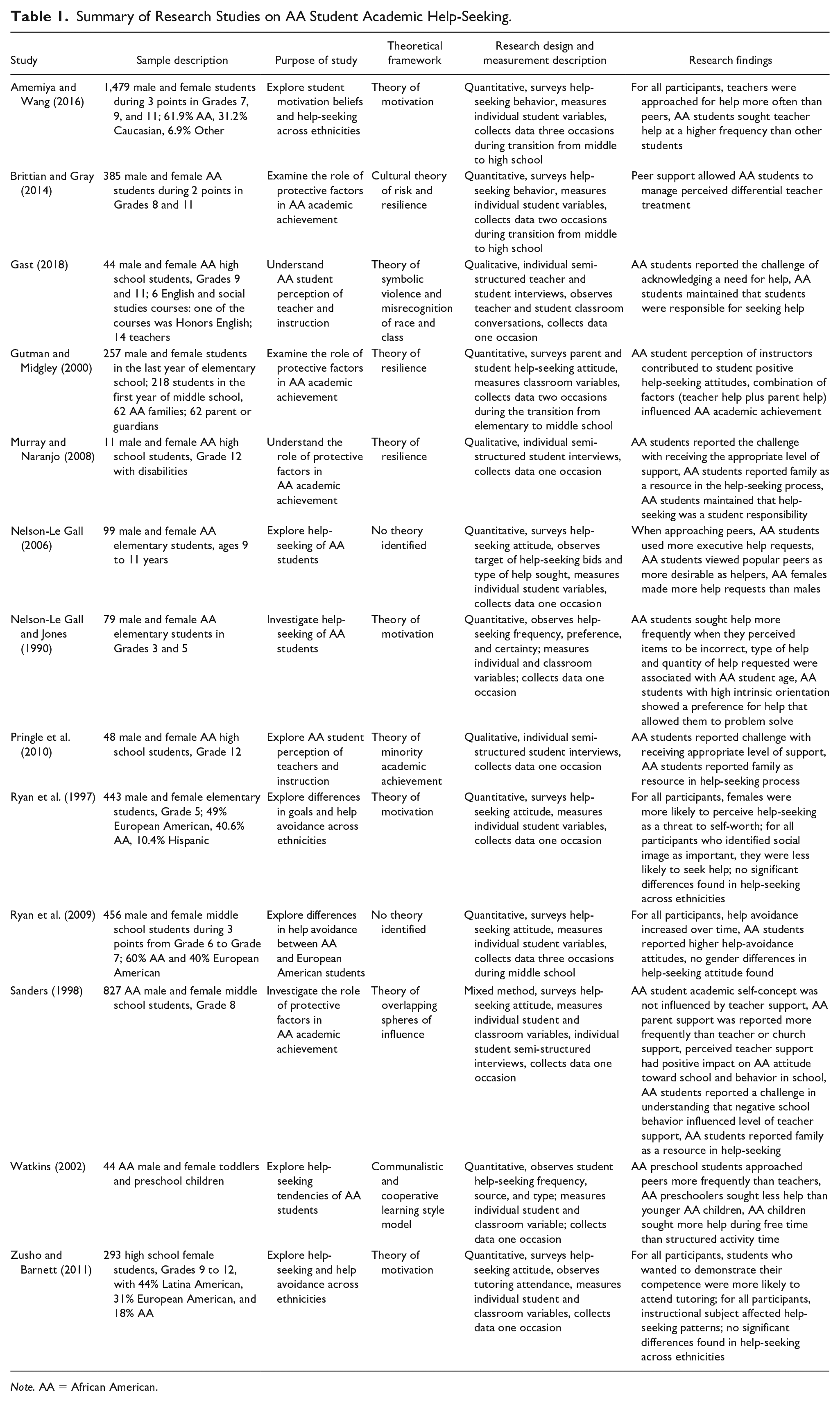
Note. AA = African American.
Second, all 13 studies in the current review utilized self-report as a primary means for data collection on student academic help-seeking. This is problematic because participants may exaggerate (in terms of help-seeking behavior frequency) or underreport (in terms of attitude toward help-avoiding behavior) in an attempt to respond in a more socially acceptable manner. Because only four studies included observations, future research should consider supplementing interview or survey data with observations to address validity concerns.
Third, based on the current review, nine of 13 studies examined the short-term variables associated with African American academic help-seeking. Because only four studies examined help-seeking over time, additional analysis with longitudinal research would create opportunities to determine African American academic help-seeking patterns missed when only observing data on one occasion.
Fourth, most of the articles were informed through cultural, motivational, and resilience-based theoretical perspectives. Interestingly, 11 of 13 articles were theory-driven. Although theory-driven research is standard due to its reliance on the scientific method, this approach potentially introduces researcher bias (with the desire to prove or disprove a hypothesis). With most of the articles in the review informed by theory, it seems there is an opportunity for future researchers to consider a grounded theory approach when examining the African American academic help-seeking experience. The use of grounded theory may add a richness to data description (Hussein et al., 2014). For example, a grounded theory may provide a greater level of context concerning conditions and consequences for concepts (challenges with help-seeking, role of family in help-seeking, and taking ownership for seeking help). Similarly, a grounded theory may add depth to an analysis by highlighting overarching relationships and relevance of the emerging themes (Hussein et al., 2014).
Implications for Practice
Beyond design, the research findings offer four important considerations. First, the existence of conflicting research findings concerning the impact of individual student variables offers an area for further clarification. For example, some researchers demonstrated that gender made a difference in terms of the rate and perceived threat associated with African American student help-seeking (Nelson-Le Gall, 2006; Ryan et al., 1997). Others argue that gender differences made no contribution to help-seeking behavior (Amemiya & Wang, 2016; Nelson-Le, Gall, & Jones, 1990; Ryan et al., 2009). Also, some researchers illustrated that ethnicity made a difference in terms of African American student help-avoidance attitude and teacher help-seeking (Amemiya & Wang, 2017; Ryan et al., 2009). Others found no difference when comparing academic help-seeking tendencies and attitudes across ethnicities (Ryan et al., 1997; Zusho & Barnett, 2011). To explore the impact of individual variables, teachers could require students to document help-seeking attitudes and tendencies (such as help sources approached, help-seeking and help-avoidance comfort levels experienced) for teachers to become aware of individual preferences. Such information could be used to inform classroom help-seeking expectations and procedures.
Second, the findings indicate that schools should continue to examine specific classroom variables that could potentially affect African American student academic help-seeking. Because only four classroom variables were investigated in 13 studies, this is an area that should be further explored. Moreover, research in this area could help address questions concerning ways classroom activities and lesson content encourage or discourage students from seeking academic help.
Third, because the findings reflected the impact of parents and family, schools should not minimize their role in African American student help-seeking. Often, the research focus remains with supporting educators in creating an environment conducive to help-seeking. However, the current review points toward understanding the role of parent and family support in African American student academic help-seeking. The type of parent support reported in the studies ranged from emotional encouragement to parent intervention to skill development. With this wide range of parent support, schools may address questions pertaining to the types of parent involvement strategies that would improve student academic help-seeking efforts.
Although it was common for African American students to discuss a perceived obligation to seek help, schools could strive to build a shared responsibility between teachers and all students. Specifically, teachers could evaluate the effectiveness of methods for reaching out and responding to students in academic need. Furthermore, teachers could consistently embed helping opportunities into the lesson plan.
Limitations
This review has three limitations that should be acknowledged. First, every attempt was made to collect all the studies focused on the tendencies and experiences of African American preschool through Grade 12 students, but some research may have been overlooked. For instance, books, empirical articles written after May 2018, and research generated via different search are all possible ways relevant research may not have been identified. Second, help-seeking was not the purpose for some of the studies included in the review. The utilization of studies with a different purpose may have introduced a level of error in the interpretation of data. Finally, this review did not include studies focused on other academic contexts, including private tutoring, learning centers, or summer math or literacy programming.
Conclusion
Literature shows that students of color are at academic risk and that public schools include more students of color than ever before. As such, factors that contribute to African American student academic achievement such as asking for help become an important topic of study. The existing 13 study reviews shed light on how African American academic help-seeking has been investigated. In conducting the review, it was found that samples varied in terms of data collection, settings, participant characteristics, and research purpose. Also, guiding theoretical frameworks differed with the majority of the studies referencing culture-informed or motivation-informed theory. In addition, research methodology relied heavily on quantitative methods to measure help-seeking behavior, attitude, and influence of variables related to student and classroom characteristics. However, when qualitative measures were implemented, African American student perceptions included experiencing help-seeking challenges, involving family, and assuming responsibility for seeking help. As a result, a series of implications were presented. In terms of future research, design considerations should include greater qualitative data collection, increased use of mixed-method design, and additional inclusion of longitudinal reports. In terms of professional practice, including student self-monitoring, involving parents, and developing a shared sense of help-seeking accountability were discussed. Acknowledging these considerations may work to better support African American academic student help-seeking and in turn affect the academic achievement of African American students.
Footnotes
Declaration of Conflicting Interests
The author(s) declared no potential conflicts of interest with respect to the research, authorship, and/or publication of this article.
Funding
The author(s) received no financial support for the research, authorship, and/or publication of this article.
