



Abstract

Keywords
Policy Implementation Research for City and Transportation Planning
The 2015 Active Living Research (ALR) Conference highlighted the theme of policy implementation because many policies are recommended to enhance active living, and policy adoption is becoming more common, but policies cannot be effective until they are implemented. A better understanding of active living policy implementation will assist researchers and practitioners in improving their policy recommendations and implementation practice.
In response to the Surgeon General’s call to action to promote walking and walkable communities (U.S. Department of Health and Human Services, 2015), increasing understanding of how physical activity policies get implemented, or how policies become action, should become a greater research priority. The field of active living has developed rapidly. We now have substantial evidence about how built environments can act as barriers and supports for physical activity. As the evidence grows, recommendations for policies to improve, retrofit, and redevelop built environments to make them more walking-friendly are also emerging. By policies we mean the broad set of guidelines, principles, directives, or statements of intent (including laws, agency regulations, and court decisions) regarding future actions that affect walkability (Schmid, Pratt, & Witmer, 2006). Zoning, traffic management, greenway plans, and programming around physical activity are all examples of community level policies that can affect physical activity.
The Surgeon General’s call to increase walking and improve communities is a welcome consequence of steps taken by researchers and advocacy groups to communicate research in appropriate and timely ways to influence policy. But research translation to achieve policy adoption is not enough. As suggested by the physical activity policy research framework from Schmid et al. (2006), translating research into policy recommendations is just one of many steps toward effective action. Policies need to be implemented through specific actions by multiple players to achieve their aim of making communities more walkable and health-promoting. Implementation is not automatic, and poor implementation is common, so implementation is a worthy topic of study.
The challenge is that we know much less about effective policy implementation than we do about policy development and adoption. Policy implementation research is an interdisciplinary field of research that emerged in the second half of the 20th century from the confluence of political science (Kaufmann, 1960; Lipsky, 1980), public administration (Pressman & Wildavsky, 1984), and law (Melnick, 1994). Policy implementation research questions are concerned with what was implemented, by whom, how, and when. Answering these questions can provide insight into the role of implementation in determining the success of policies. Answers to these questions can also contribute to determining whether policies (a) apply to other geographic levels (e.g., Can a policy adopted at a school-level be effective if it is not adopted at the state-level?), (b) share similar outcomes (e.g., If funding is critical for implementing a greenways plan, is it related to the success or failure of implementation plans for parks?), (c) are effective for different outcomes (e.g., The policy increased walking to school, but did it increase total physical activity?), or (d) can be generalized to different settings (e.g., If a policy worked in School District A, could it work in School District B?).
Turning to “what,” “by whom,” “how,” and “when” questions, there is often sufficient variegation in policy implementation to allow inferences about their role in shaping policy success. For example, more than 28 states have approved a complete streets policy (Moreland-Russell, Eyler, Barbero, Hipp, & Walsh, 2013). The policies themselves are different, with some being more prescriptive about what should be done, and others allowing more local discretion in identifying street-level actions to pursue. These differences are crucial in the examination of policy implementation and ultimate success. An analogous example is provided by the Texas Childhood Obesity Prevention Policy Evaluation study reported in this issue (Hoelscher et al., 2016). The study reports an evaluation of safe routes to school funding awarded via infrastructure projects around schools and non-infrastructure school-based projects. The authors showed that both funding options, infrastructure and non-infrastructure, were similarly effective in increasing active commuting to school and student self-efficacy relative to non-intervention schools. Results suggest that there are many policy paths to the same destination, a finding reported by others for similar policies (Rothman, To, Buliung, Macarthur, & Howard, 2014). Whether those paths—the “whats”—can complement and strengthen each other is a matter of future research, with some researchers arguing for important synergistic effects between infrastructure and non-infrastructure strategies (Pucher, Dill, & Handy, 2010).
Who implements policy is also a likely explanatory factor for policy success. Handy and McCann (2011) persuasively show that states that encourage metropolitan areas to play an active role in determining the fate of pedestrian and bicycle funding are more likely to invest in projects that favor pedestrian and bicycle transportation. Metropolitan and local transportation planners are more likely to be aware of and synchronized with local priorities regarding investments.
Municipal zoning codes provide an example of the importance of how policy is implemented. These codes are often viewed as the tool through which comprehensive plans are implemented (Berke, Godschalk, Kaiser, & Rodriguez, 2006). In some states, by law, zoning codes have to be consistent with the comprehensive plan adopted by the locality. In others, however, zoning can be inconsistent with the comprehensive plan. Thus, the impact of comprehensive plans on a community’s active travel is likely to differ substantially from state to state. In this vein, the article by Chriqui, Nicholson, Thrun, Leider, and Slater (2016) in this issue breaks new ground as it is the first large-scale study to provide a systematic understanding of the association between municipal codes and physical activity.
Finally, the timing of implementation for policies is relevant for policy success. Whether the timing of adoption and implementation is the result of internal or external factors, the alignment of when policies are adopted with other “windows of opportunity” is likely to play a role in their ultimate success.
School Physical Activity Policy Implementation Research
Schools are important settings for providing and promoting physical activity because they reach nearly all children for a substantial proportion of the waking day and for over 12 years (Centers for Disease Control and Prevention, 2011). School physical activity policies target school physical activity practices and environments, and for this reason, policies are regarded as important strategies to increase children’s physical activity. School physical activity policies can relate to classroom physical activity breaks; physical education; recess; before, during, and after school programs; staff training; active transport to school; and school facilities design, use, and maintenance. Although school physical activity policy recommendations have been developed and promoted (e.g., Institute of Medicine [IOM], 2013), the relations among various school physical activity policies, actual school practices, and objectively measured student physical activity remain unclear.
School physical activity policy research is in its infancy, and in terms of understanding policy implementation, most studies have only described policies or related them to school practices or estimates of physical activity participation. Some evidence, although limited, suggests that having multiple school physical activity practices in place, consistent with the IOM’s “whole-of-school” approach (IOM, 2013), is related to higher objectively measured student moderate to vigorous physical activity (Carlson et al., 2013). Nonetheless, no study has examined school physical activity policy implementation and children’s physical activity. There is a clear need for the development of valid and reliable measures of the full range of school physical activity practice indicators for specific school physical activity policies. Only by doing so can distinctions between strength of the adopted policy and degree of policy implementation be made and subsequently related to children’s physical activity.
A major limitation of most existing school physical activity policy studies is that the sources of both policy and practice data are heavily dependent on the self-reports of state or school district officials, and these respondents are distally located from the day to day functioning of schools and may be unaware of physical activity practices (Lounsbery, McKenzie, Trost, & Smith, 2011). Assessment of school physical activity practices should rely on data sources collected on the school site and incorporate the use of mixed methodologies, including direct observation of physical activity programs (e.g., physical education, recess, and before, during, and after school programs), school records, and interviews with those directly responsible for delivering the programs (e.g., physical education teachers).
As Figure 1 shows, school physical activity policy implementation is complex because school policies can be enacted at various levels (e.g., state, district, school), and within each level, there can be a number of policy makers with responsibility for enacting policies in different contexts (e.g., state statute vs. state board of education policy). Hence, implementation studies should consider policy level and context.
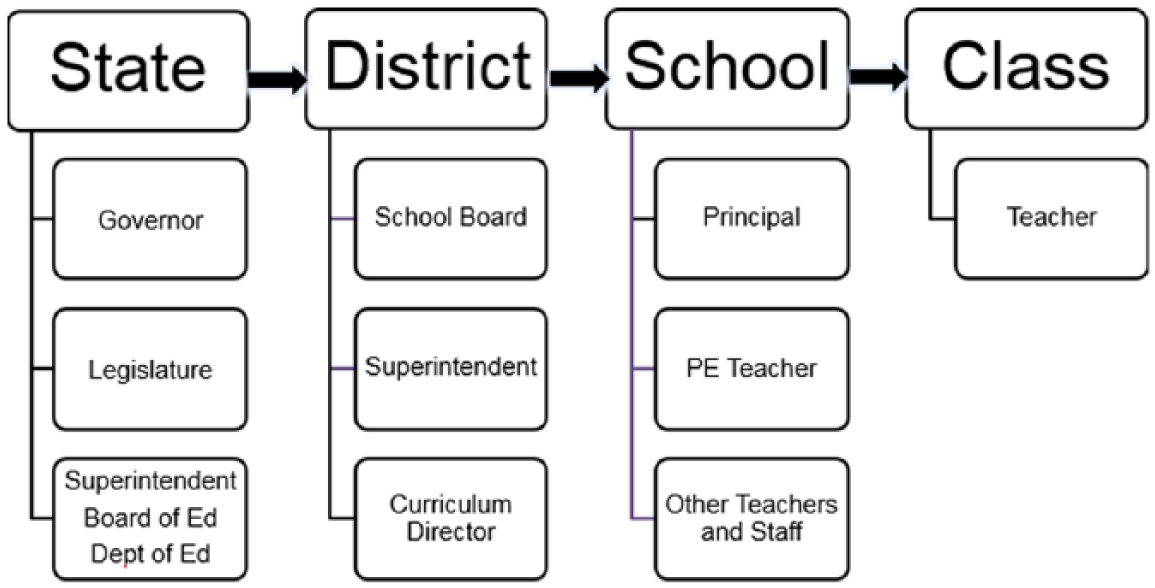
Complexity of school physical activity policy making.
Studies that examine policy dissemination and their implementation to other levels may help identify interventions that improve policy implementation. In this regard, additional research is needed to identify specific dissemination actors and targets as well as frequency of dissemination of policy information and effective methods promoting implementation at all policy levels.
Other school physical activity policy adoption and implementation diffusion studies might examine associations of internal factors such as community demographics, composition of political aspects, and technical capacity, or external factors such as outside pressures, networks, or geographic contiguity (Graham, Shipan, & Volden, 2012).
Recommendations to promote and provide physical activity in schools are longstanding. However, given that even institutionalized physical activity–producing programs such as physical education and recess have been reduced and in some cases eliminated (McKenzie & Lounsbery, 2009), schools have not responded well. In the context of increased pressures related to academic achievement and limited financial and time resources, health outcomes are not highly prioritized within schools. Hence, research on school physical activity policy and practices that also address their potential contributions to academic outcomes may help elevate the adoption and implementation of school physical activity policies to a higher priority.
Highlights of the 2015 ALR Conference
The 2015 ALR Conference began by requiring attendees to make difficult choices among many excellent workshops selected to interest researchers and practitioners. Two themes were evident. The first theme was the large number of sessions relevant to translating research to policy and ensuring policies are implemented. The second theme was the wide range of uses of technology in ALR and practice.
The 2015 ALR Conference was the third year with abstracts submitted in both research and practice/policy tracks. The goal was to create a forum where researchers learn about evaluation opportunities and research questions of interest to practitioners, and practitioners learn about new findings and methods that can be applied in their work.
The keynote speaker was Gil Penalosa who provided examples from all over the world about how active living policies are being implemented, sometimes on a grand scale. Gil has dedicated his career to improving quality of life through transforming built environments, large and small. He was a city official in Bogota, Colombia, where he led major expansions in their famous Ciclovia program and created a huge city park designed for physical activity. Gil now directs “8-80 Cities,” a non-profit with the goal of designing cities so they serve the needs of all residents. He drew on his worldwide advocacy efforts to promote active mobility and active recreation to derive principles of policy change that can be applied in many situations. He made his visit to San Diego more valuable by meeting with city leaders and community groups.
The policy implementation theme was explored further in an international panel with teams of presenters from Australia and the United Kingdom, with international program components made possible by support from the Robert Wood Johnson Foundation’s global health initiative. Michael Pratt from the Centers for Disease Control and Prevention moderated the session. Billie Giles-Corti and Peter McCue represented a researcher and practitioner, respectively, who explained how policy implementation is informed by research in Australia. U.K. representatives Charlie Foster and Nick Cavill are both engaged in research and advocacy, and they presented examples of how they are achieving progress in active living in their country. The tight coupling between research and practice demonstrated by the Australian and U.K. examples were helpful models to encourage other investigators and practitioners to join together in informing and supporting each other’s work.
A second international panel focused on research advances. The panel informed the audience about methods and results from collaborative international studies, and presenters were Peter Katzmarzyk, Jacqueline Kerr, and Rodrigo Reis. Nalini Anand from the Fogarty International Center of the National Institutes of Health was the discussant, and she reported on a Fogarty workshop on lessons learned from, and next steps for, obesity prevention in Latin America.
A special “Translating Research Into Policy” Award recognized the preeminent advocate in the active living field. Deb Hubsmith was honored for her amazing accomplishments as the prime mover behind Safe Routes to Schools. Beginning with a personal commitment to active transportation, she dedicated her career to reversing the dramatic decline in children walking and bicycling to school. She started advocating in her backyard of Marin County, California. Significantly, one of her first actions was to partner with the Centers for Disease Control and Prevention on an evaluation of programs in early-adopter schools. That initial study was a prescient beginning to a scientific literature that is now substantial. She continued to use research in her advocacy that led to the first ongoing state funding for Safe Routes to School through the California Department of Transportation. This success emboldened her to set her sights on a national program, and remarkably, she achieved that goal through federal legislation. Unsatisfied with this achievement, she and her team set their sights on working with each state to succeed in implementing the law. Thus, she was an inspiration for the 2015 ALR Conference theme of policy implementation. Deb was not able to accept the award in person because she was fighting cancer. Sadly, she passed away a few months later. With the Translating Research Into Policy Award, we celebrate the vision, drive, leadership, and successes of the extraordinary Deb Hubsmith.
The ALR Conference continued its tradition in making the meeting active through Instant Recess breaks during plenaries and a broad menu of physical activities during the day so attendees could enjoy the beautiful setting of Mission Bay Park. Several dozen attendees participated in a multi-cultural evening of dance. We had three engaging instructors who shared Indian, Latin American, and Hip Hop culture through dance. Accusplit donated pedometers so we could document that the average dancer had over 7,000 steps during the dance classes.
The remainder of this special issue of Environment and Behavior provides a cross section of the wide range of topics, diversity of methods, and quality of research on active living. There are research papers, practice reports, and a commentary based on one of the international panels. These papers were selected from among the most highly rated abstracts, but there were many other strong studies and practice reports presented at the conference. We thank Editor-in-Chief Barbara Brown for her support of this Special Issue and collaborative spirit. We thank Amanda Wilson for her expert management of the process and the peer reviewers who made important contributions to the high quality of papers in this Special Issue. All papers are freely available on the ALR website: http://activelivingresearch.org/resourcesearch/journalspecialissues.
Footnotes
Declaration of Conflicting Interests
The author(s) declared no potential conflicts of interest with respect to the research, authorship, and/or publication of this article.
Funding
The author(s) received no financial support for the research, authorship, and/or publication of this article.