



Abstract
A number of review studies document associations between the perceived and objectively measured neighborhood environment and physical activity. However, current evidence does not discern whether perceived or objective variables more consistently predict physical activity. A review is needed to examine the comparability of these variables and the consistency of their respective associations with the same physical activity outcome. We systematically searched three databases for studies that examined agreement between perceived and objective measures and/or associations between comparable variables and physical activity. We abstracted 85 relevant peer-reviewed studies published between 1990 and 2015, synthesized agreement coefficients, and compared these variables’ associations with physical activity. Perceived neighborhood environment variables were significantly associated with physical activity (p < .05) at slightly higher rates than objective neighborhood environment variables (20.1% and 13.7%). Comparably defined variables exhibited low agreement and only 8.2% were associated with the same outcome. The perceived neighborhood environment and objectively measured neighborhood environment are related but distinct constructs that account for unique variance in physical activity.
Keywords
Higher rates of physical activity are associated with lower risk of preventable death, obesity, cardiovascular disease, hypertension, and certain cancers (Buchner et al., 2008; Haskell et al., 2007). However, it is estimated that only 31% of adults globally report that they meet recommendations for moderate-to-vigorous intensity physical activity (MVPA; World Health Organization, 2011). To address this public health issue, physical activity promotion has expanded its scope from individual exercise prescriptions and education to include changes to the physical or built environment (Dishman & Sallis, 1985; Sallis, Bauman, & Pratt, 1998). These approaches include improving park and trail access, planning mixed use neighborhoods, and developing connected street networks, which can positively influence physical activity in communities (Heath et al., 2006; Kahn et al., 2002).
Ecological models of health promotion suggest that individual, interpersonal, environmental, and policy factors influence health and physical activity behavior (McLeroy, Bibeau, Steckler, & Glanz, 1988; Sallis et al., 2006; Stokols, 1992). Environmental features such as access to recreation facilities, aesthetics, and pedestrian infrastructure consistently predict physical activity overall and for recreation, whereas neighborhood walkability and street connectivity consistently predict physical activity for transportation (Bauman et al., 2012). Despite this theoretical framework and a growing evidence base, debate continues about how best to conceptualize and measure the neighborhood environment for physical activity research (Brownson, Hoehner, Day, Forsyth, & Sallis, 2009; Nasar, 2008; Nelson, Wright, Lowry, & Mutrie, 2008; Spence & Lee, 2003).
Researchers use several methods to measure characteristics of the neighborhood environment. Self-report instruments assess individuals’ perceptions of their neighborhood. Observational techniques such as neighborhood and street audits and technology such as geographic information systems (GIS) assess neighborhood features more directly (Brownson et al., 2009). Perceived and objective measures may or may not reflect similar features of the environment. For example, self-reported distance to the nearest trail access point may seem conceptually similar to the measured distance to the nearest trail access point (Troped et al., 2001). However, researchers have reported low levels of agreement between perceived and objective measures of the neighborhood environment (Boehmer, Hoehner, Wyrwich, Ramirez, & Brownson, 2006; Brownson et al., 2009; Kirtland et al., 2003). It is unclear the extent to which perceived and objective measures assess similar constructs and can be used interchangeably, at least to the degree that they have adequate concurrent validity (Adams et al., 2009; Duncan et al., 2010), or whether they capture distinct constructs that potentially explain unique variance in physical activity behaviors.
Sallis and colleagues (2006) distinguish between perceptions of the environment and the objectively measured environment by placing them at different levels of influence within the ecological model of active living. Perceptions of the environment develop through an ongoing evaluative, interactive process that is social, cognitive, and/or affective (Bandura, 1978; Nasar, 2008); whereas, objective measures are assumed to capture a less biased and less fluctuating view of the environment. Through the process of environmental perception, the information captured through the five senses is integrated to form a cognitive representation of the environment. This representation is largely influenced by the physical characteristics of our surroundings; however, personal factors such as gender, values, attachment, and past training and experiences influence individual perceptions (Gifford, 2007). Social factors such as economic conditions, cultural influences, and social norms can also influence these subjective appraisals (Winkel, Saegert, & Evans, 2009). Therefore, cognitive representations of the same neighborhood likely differ between individuals (Davies, 2009), even if the objective and perceived definitions are precisely matched. Also, environmental perceptions may be conceptualized as being more proximal to health (Weden, Carpiano, & Robert, 2008) and health behavior (Caspi, Kawachi, Subramanian, Adamkiewicz, & Sorensen, 2012) than the objectively measured environment.
A number of review studies to date have documented associations between the perceived and objectively measured built environment and various physical activity outcomes (Ding & Gebel, 2012; Handy, Boarnet, Ewing, & Killingsworth, 2002; Owen, Humpel, Leslie, Bauman, & Sallis, 2004). However, current evidence does not discern whether perceived or objective environment variables more consistently predict physical activity. A review is needed to examine the comparability of perceived and objective environment variables and the consistency of their respective associations with the same physical activity outcome. These findings have important implications for physical activity research and interventions. Data-driven descriptions of the similarities and differences between perceived and objective measures can assist researchers in making decisions about measurement approaches. Also, effective physical activity promotion depends on knowing whether and when it is important to intervene at the level of residents’ perceptions and when to facilitate changes to the physical environment (Panter & Ogilvie, 2015).
This review focused on studies in which at least one conceptually comparable feature of the perceived and objectively measured neighborhood environment was examined for agreement and/or associations with physical activity. The first aim was to synthesize evidence on agreement between perceived and objective neighborhood environment measures, and whether demographic, psychosocial, behavioral, and/or environmental factors explain the level of agreement between measures. The second aim was to examine evidence on associations between comparable perceived and objective neighborhood environment variables and physical activity.
Method
Search Methods
The search protocol modeled the Preferred Reporting Items for Systematic Reviews and Meta-Analyses (PRISMA) guidelines (Moher, Liberati, Tetzlaff, & Altman, 2009). The first author conducted a comprehensive search of quantitative studies published in English-language, peer-reviewed journals between January 1980 and December 2015. The databases searched included Web of Science Social Sciences Citation Index, Science Direct, and PubMed. The following string of terms defined the searches: (physical activity or exercise) and (environment or setting or neighborhood) and (perceived or self-report) and (objective or audit or GIS).
Studies met the inclusion criteria if they (a) included physical activity as a study variable, (b) included objective and perceived neighborhood environment variables with comparable definitions, and (c) tested comparable variables for agreement and/or for associations with physical activity. We considered a perceived and an objective variable comparable if they both represented a similar aspect of the same neighborhood feature (e.g., perceived heavy traffic in an individual’s neighborhood and observed traffic volume within a 1-km buffer around a geocoded home address). If a study defined a perceived or objectively measured variable in more than one way (e.g., using 1- and 2-km buffers), each definition was reflected in a separate pair of variables.
Sample Derivation
Initially, the searches yielded 4,942 studies from the three databases. For each citation retrieved, the first author reviewed the title and abstract for relevance. After the title and abstract review, 205 articles remained. After excluding 89 duplicate articles, the first author evaluated 116 full-text manuscripts and seven additional studies from reference lists. Thirty-eight of these 123 studies did not meet inclusion criteria, leaving 85 studies in the final sample (see Online Appendix A). Each study in the final sample is indicated by an asterisk in the “References” section.
Data Abstraction
We developed an abstraction protocol to standardize data collection based on the Task Force on Community and Preventive Service’s procedure for systematic reviews (Zaza et al., 2000). Two authors (i.e., the first and third or fourth) abstracted the following information from each study: study aims, theoretical framework, setting and sample characteristics, sampling approach, data collection methods, perceived and objective environment and physical activity measures, statistical analysis, key findings relevant to the aims of the review, study strengths and limitations, and implications for practice. The authors compared data abstractions for accuracy and resolved discrepancies by discussing them until reaching a consensus or by consulting with the last author.
Data Synthesis
We grouped the pairs of comparable perceived and objective variables identified from data abstraction by environmental attributes conceptualized as reflecting the same or similar construct(s) in previous physical activity and built environment literature (Brownson et al., 2009; Cerin, Saelens, Sallis, & Frank, 2006). We found 15 attributes and organized them under five broad environmental categories or domains, the framework for which we adapted from previous reviews (Bauman et al., 2012; Ding, Sallis, Kerr, Lee, & Rosenberg, 2011). The neighborhood design domain included destinations/land use mix (e.g., restaurants, shops, and services), residential density, street connectivity, and walkability (typically defined as a sum of the previous three attributes). The transportation domain included sidewalks/trails/bike lanes (i.e., infrastructure that supports walking and cycling), public transit, and traffic (e.g., busy streets, traffic speed, and volume). The recreation domain included recreation facilities (e.g., access to gyms, pools, and courts) and parks/green space. The social domain included safety from crime (e.g., property crime, violence, and street lighting) and other people or dogs. “Other” included aesthetics (e.g., attractiveness, sights, and trees), hills, maintenance (e.g., cleanliness, trash, and vandalism), and weather. We synthesized the results of this review by these 15 environmental attributes and five domains.
To address the first aim of this review, we examined kappa statistics, percent agreement, and correlations and/or beta coefficients for each pair of comparable perceived and objective environment variables. We calculated frequencies for significant coefficients and for kappa scores (Cohen, 1968) based on the following agreement classifications (Landis & Koch, 1977): “poor” (κ < .00), “slight” (κ = .00-.20), “fair” (κ = .21-.40), “moderate” (κ = .41-.60), “substantial” (κ = .61-.80), and “almost perfect” (κ = .81-1.0). To examine whether various demographic, psychosocial, behavioral, and/or environmental factors were associated with agreement between perceived and objective variables, we summarized the factors by whether they significantly explained varying levels of agreement based on tests of chi-square, Wilcoxon signed-rank, odds ratio, ANOVA or ANCOVA, Fisher r-to-z transformation, or parameter estimates for interaction terms.
To address the second aim, we examined paired perceived and objective environment variables tested in separate but parallel statistical models (i.e., examined in separate models, but with the same covariates in each model) to determine whether the perceived and objective variables were associated with the same physical activity outcome. We also examined paired variables tested in a single statistical model to determine whether the perceived and objective environment variables remained associated with the physical activity outcome. We considered statistical significance p < .05.
Results
Methodological Characteristics of Studies
Study design, setting, and sample characteristics
Seventy-four of the 85 studies (87.1%) were cross-sectional. Only two studies (Forde, 1993; Sallis et al., 1990) were published prior to 2000, 33 studies (38.8%) were published between 2000 and 2009, and 50 studies (58.8%) were published between 2010 and 2015. More than half (57.6%) were conducted in the United States and Canada, followed by 18 in Australia and New Zealand (21.2%), 12 in Europe (14.1%), and six in Asia (i.e., Japan, China, and Taiwan; 7.1%). Thirteen studies (15.3%) included at least some residents of rural communities. Most studies (71.8%) included participants 18 years of age or older, 19 (22.4%) consisted of parents of youth or youth participants (children aged 5-10 years and adolescents 10-18 years old), and five (5.9%) sampled participants 65 years of age or older. Nine studies (10.6%) consisted of only women (i.e., adolescent females, adult, and older adult women). Among the 32 of 85 studies (37.6%) that specified the race/ethnicity of participants, Whites were the predominant racial/ethnic group in 21 studies (65.6%), followed by African Americans in eight (25.0%), and Hispanics/Latinos in two (6.3%).
Theoretical framework
Among the 47 of 85 studies (55.3%) that were informed by or applied a theory or theoretical framework, most (95.7%) cited social ecological models and/or identified constructs from individual- or interpersonal-level theories, including social cognitive theory, the theory of planned behavior, the transtheoretical model, social cohesion, and social support. Two studies mentioned theories or frameworks from the field of transportation.
Physical activity assessment
Among the 69 of 85 studies (81.2%) that assessed physical activity by survey, 23 studies (33.3%) used the International Physical Activity Questionnaire (IPAQ; Craig et al., 2003), 24 (34.8%) utilized other surveys, and 26 (37.7%) did not specify the source of the survey items. Participants wore accelerometers in 18 of 85 studies (21.2%) and completed physical activity logs in two. Physical activity was defined in one of five ways: (a) overall physical activity behaviors, such as meeting recommendations for MVPA (43.5% of studies); (b) overall physical activity, walking, or bicycling for recreation purposes (28.2%); (c) overall physical activity, walking, or bicycling for transportation purposes (34.1%); (d) walking or bicycling without a specified purpose (28.2%); and (e) sports participation or recreational facility use, including use of parks and trails (22.4%).
Neighborhood environment measures
For the purposes of this review, environmental measures created through audits and GIS data sources comprised objective neighborhood environment measures. Among the 69 of 85 studies (81.2%) that incorporated GIS measures, 49 studies (71.0%) used GIS only, eight (11.6%) used a combination of GIS and audit measures, and 12 (17.4%) used a combination of GIS and other measures, such as crime or climate data. Six of 85 studies (7.1%) used audit measures only, and 10 studies (11.8%) used other measures only. Among the 40 of 85 studies (47.1%) that specified a perceived environmental instrument, 26 studies (65.0%) used the Neighborhood Environment Walkability Scale (NEWS; Saelens, Sallis, Black, & Chen, 2003) and 14 (35.0%) specified another survey. In more than half (61.2%) of the studies in this review, investigators measured perceived or objective access to recreation facilities and/or destinations (e.g., stores, restaurants, and schools) in participants’ neighborhoods.
Primary aims of studies
Regarding Aim 1 of this review, 47 of 85 studies (55.3%) examined agreement between perceived and objective neighborhood environment variables. Nineteen of the 47 studies examining agreement (40.4%) tested whether demographic, psychosocial, behavioral, and/or environmental factors were associated with level of agreement between measures. Regarding Aim 2, 65 of 85 studies (76.5%) examined associations between perceived and objective neighborhood environment variables and physical activity. Forty-eight of these 65 studies (73.8%) examined these associations in separate models and 35 studies (53.8%) examined associations in a single model. Overall, 28 of 85 studies (32.9%) examined both agreement and associations with physical activity. Please refer to Online Appendix B for the aims addressed by each of the studies in this review. Each study in the review has been assigned a number in Online Appendix B. The study numbers appear in superscript in the article and tables to indicate which studies contributed to the key findings.
Agreement Between Perceived and Objective Environment Variables
Level of agreement
Table 1 summarizes level of agreement between perceived and objective neighborhood environment variables. Among the 47 studies that examined agreement between variables, 19 (40.4%) used the kappa statistic. None of the 165 pairs of perceived and objective neighborhood environment variables examined by kappa exhibited almost perfect (κ = .81-1.0) or substantial agreement (κ = .61-.80). Only six pairs (3.6%) showed moderate agreement (κ = .41-.60) and 41 pairs (24.8%) showed fair agreement (κ = .21-.40). The remaining 119 pairs (72.1%) exhibited slight (κ = .00-.20) or poor agreement (κ < .00). Also shown in Table 1, most environmental attributes that were examined in multiple studies, such as destinations and recreational facilities, demonstrated a wide range of kappa and percent agreement scores. In addition, 26 of the 47 studies (55.3%) examining agreement reported a Pearson, Spearman, or intraclass correlation, regression coefficient, or odds ratio as a measure of agreement. In these 26 studies, 33 pairs (26.6%) of perceived and objective environment variables were not significantly correlated. In general, the correlation coefficients reported (e.g., Pearson, Spearman, and intraclass) ranged from −.40 to .69.
Agreement Between Perceived and Objective Neighborhood Environment Variables Examined by Three Statistical Approaches.
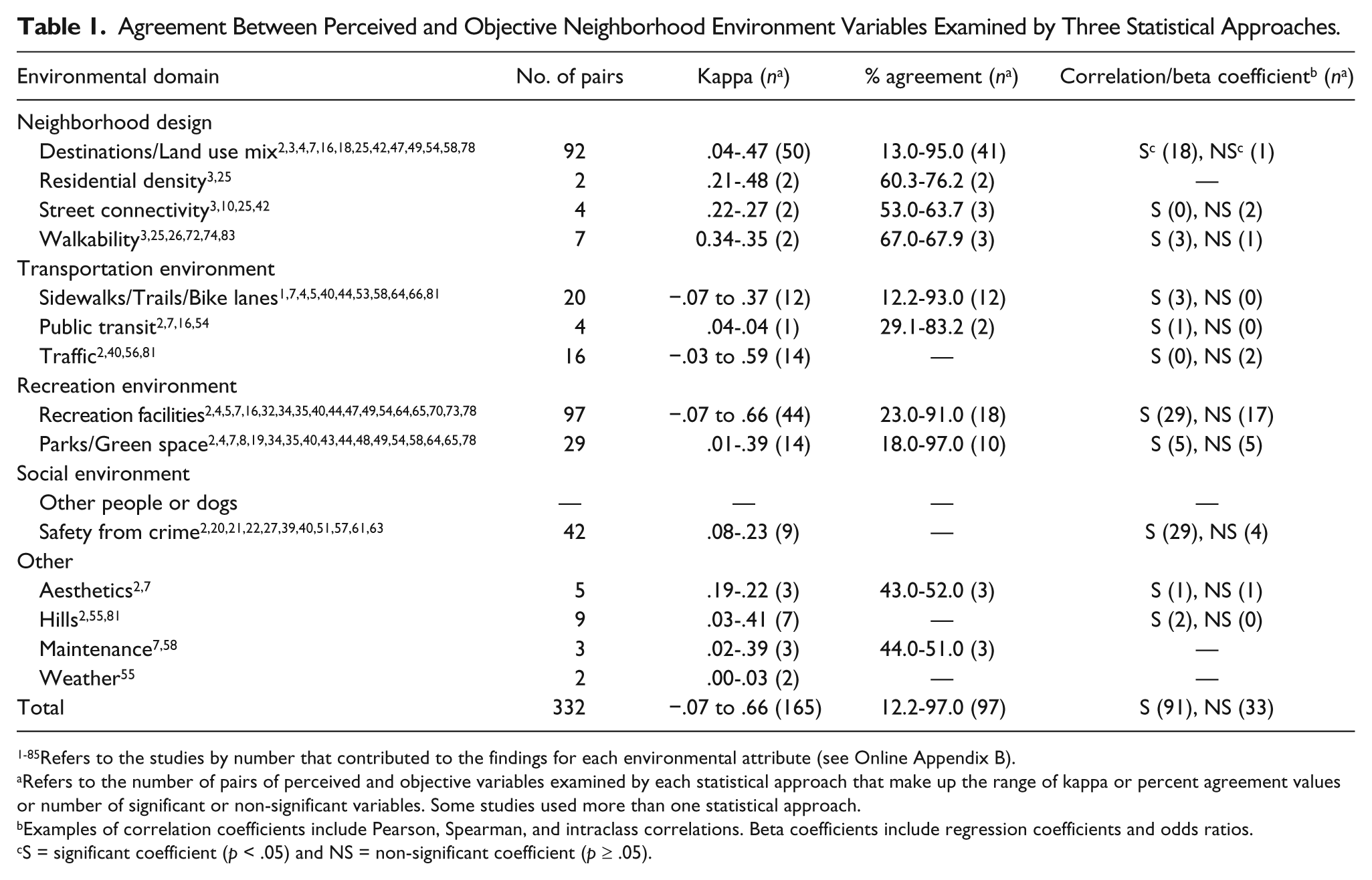
Refers to the studies by number that contributed to the findings for each environmental attribute (see Online Appendix B).
Refers to the number of pairs of perceived and objective variables examined by each statistical approach that make up the range of kappa or percent agreement values or number of significant or non-significant variables. Some studies used more than one statistical approach.
Examples of correlation coefficients include Pearson, Spearman, and intraclass correlations. Beta coefficients include regression coefficients and odds ratios.
S = significant coefficient (p < .05) and NS = non-significant coefficient (p ≥ .05).
Factors associated with level of agreement
Table 2 summarizes factors associated with level of agreement between perceived and objective environment variables. The most commonly examined factors were age, gender, education, physical activity level, body mass index (BMI), and perceptions of the neighborhood. With the exception of marital status and household income/socioeconomic status (SES), which were significantly associated with agreement 6 and 5 times, respectively (>50.0% of the times they were examined), most demographic factors were not consistently associated with agreement. Environmental factors (i.e., neighborhood SES, length of residence, perceived and objective measures of the neighborhood) demonstrated more consistent associations with agreement than did demographic or psychosocial factors. For example, 25 (67.6%) of the times residents’ perceptions of walkability and other features of their neighborhood (e.g., scenery, traffic, or sidewalks) were examined, they were associated with agreement between perceived and objective measures of proximity to destinations and recreational facilities. Participants’ physical activity level and BMI were associated with agreement between variables less than 20% of the time they were examined.
Factors Associated With Agreement Between Perceived and Objective Neighborhood Environment Variables.
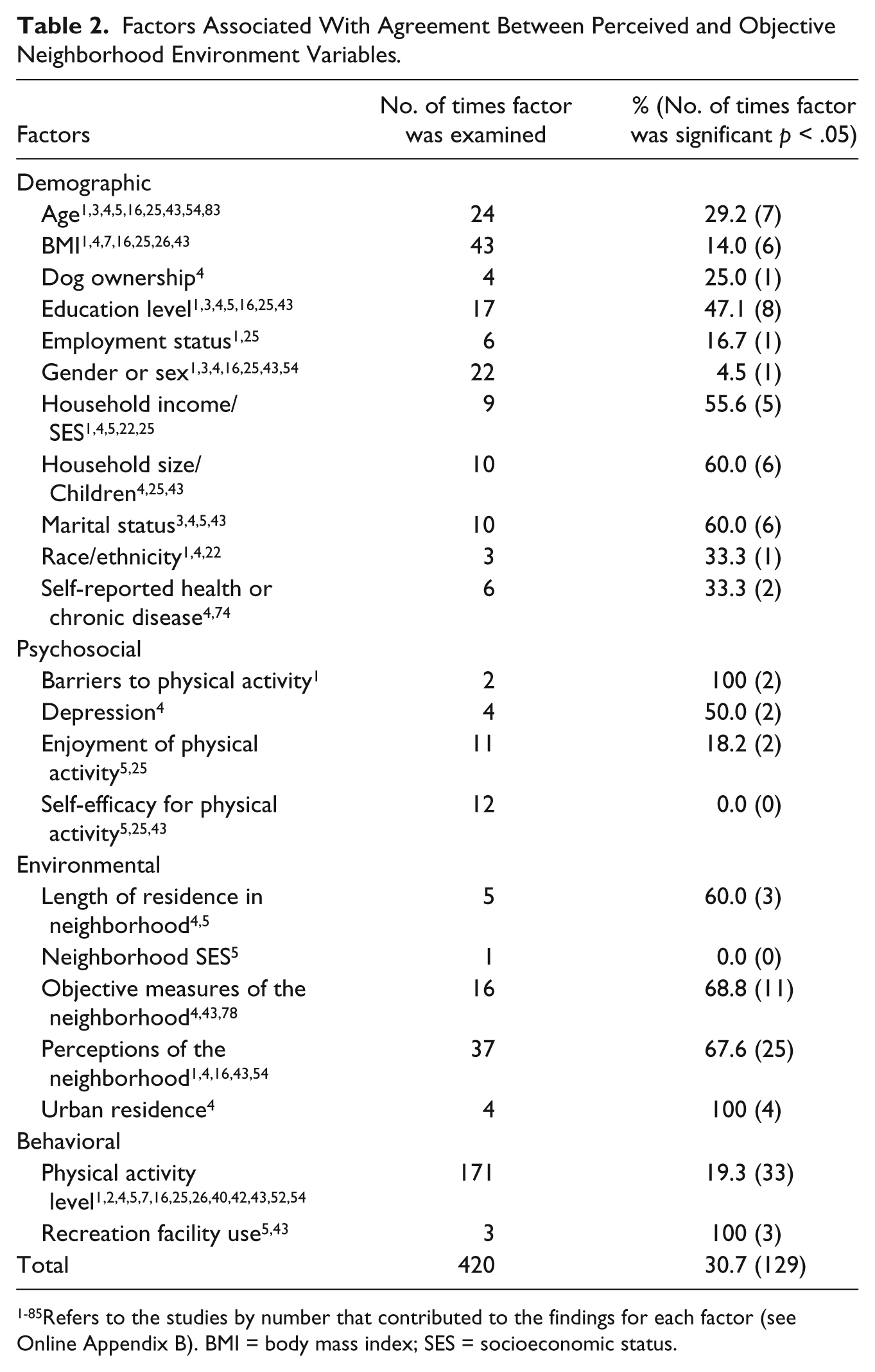
Refers to the studies by number that contributed to the findings for each factor (see Online Appendix B). BMI = body mass index; SES = socioeconomic status.
Associations With Physical Activity
As shown in Table 3, the overall results from 364 comparable perceived and objective environment variables (i.e., pairs) examined in separate models show that the perceived variables were significantly associated with physical activity at slightly higher rates than the objective variables (20.1%9,11,12,13,20,32,33,34,36,37,38,41,44,46,54,55,58,62,64,68,69,70,73,76,77,78,81,82,85 and 13.7%,9,20,29,33,38,39,41,43,44,46,49,54,56,57,58,75,79,81,84 respectively). One pattern in associations between perceived and objective variables and physical activity was evident with regard to specific environmental domains. Considering the results for the recreation environment domain (i.e., recreation facilities and parks/green space), the proportion of significant perceived variables (31.4%) was higher than the proportion of significant objective variables (7.0%).
Associations Between Perceived and Objective Neighborhood Environment Variables and PA in Separate Models.
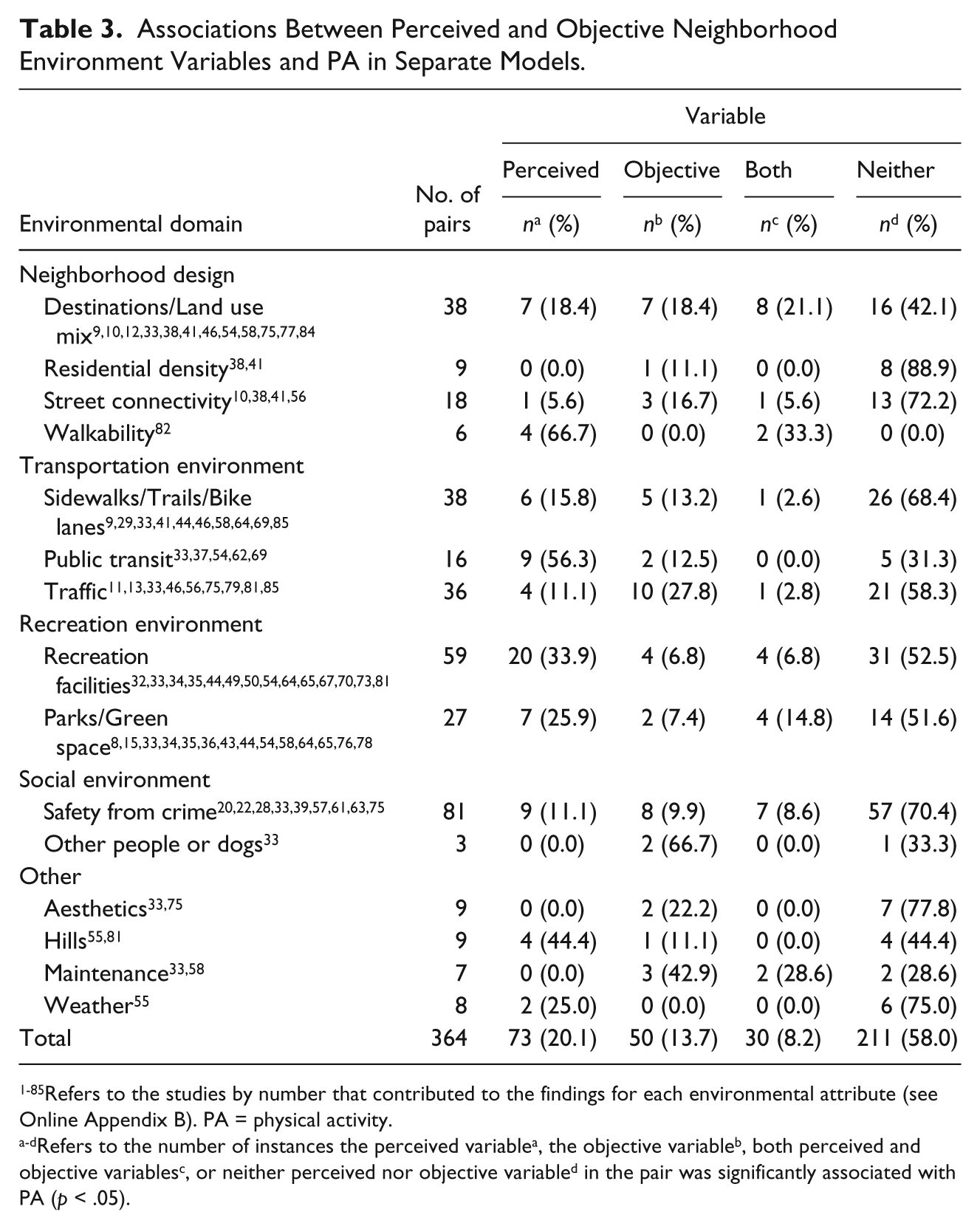
Refers to the studies by number that contributed to the findings for each environmental attribute (see Online Appendix B). PA = physical activity.
Refers to the number of instances the perceived variablea, the objective variableb, both perceived and objective variablesc, or neither perceived nor objective variabled in the pair was significantly associated with PA (p < .05).
Another pattern in associations emerged with regard to the specific types of physical activity. Aggregating the results across associations with physical activity overall and for recreation, walking and bicycling for recreation, and sports participation/recreational facility use, the proportion of significant perceived variables (22.2%) was higher than the proportion of significant objective variables (9.2%). For associations with overall physical activity, walking, and bicycling for transportation, the proportion of significant objective variables (22.7%) was slightly higher than the proportion of significant perceived variables (16.8%).
Also shown in Table 3, the proportion of pairs overall in which both the perceived and objective environment variables were significantly associated with physical activity was low (8.2%8,9,10,12,15,20,33,44,46,57,58,63,70,73,75,76,81,82). In addition, among the 30 pairs in which both the perceived and objective variables were associated with physical activity, six of the associations (20.0%) were in opposite directions. For example, adults walked more for transport when the objective distance to the nearest post office was shorter, but walked less for transport when the perceived distance to the nearest post office was shorter (McCormack, Cerin, Leslie, du Toit, & Owen, 2008). In 211 of 364 pairs (58.0%8,10,11,12,13,20,22,28,33,35,38,39,41,43,44,46,49,50,54,55,56,57,58,61,62,64,65,68,69,73,75,77,85), neither the perceived nor objective variable was associated with physical activity.
The overall results from comparable perceived and objective variables examined in single models varied slightly from the overall results from variables examined in separate models (data shown in Online Appendix C). Across all 196 pairs of perceived and objective variables examined in the same model, the perceived and objective variables were significantly associated with physical activity at similar rates. The perceived variable was significant in 31 pairs (15.8%3,15,20,31,32,35,46,51,55,62,63,67,69,71,73,74,80) and the objective variable was significant in 27 pairs (13.8%6,14,15,17,20,24,35,39,45,46,57,59,60,63,69,74,84). In eight pairs (4.1%15,27,30,44,45,46), both the perceived and objective variables were significant. In the remaining 130 pairs (66.3%3,14,15,17,20,22,23,27,28,30,31,35,39,45,46,50,51,55,57,59,60,62,71,61,67,69,80), neither the perceived nor objective environment variable was significantly associated with physical activity.
Discussion
In this review, we examined agreement between and the extent to which similarly defined perceived and objective neighborhood environment variables differed in their associations with physical activity. Overall, results revealed low to moderate agreement between perceived and objective environment variables and few factors that were consistently associated with level of agreement. Only a small percentage of comparable perceived and objective environment variables were associated with the same physical activity outcome in either separate or single statistical models. These results have several implications for physical activity and neighborhood environment research.
The results of this review demonstrate that perceived and objective environment measures may be less comparable than their definitions suggest. The majority of perceived and objective variables demonstrated slight to poor kappa scores. In addition, the features that exhibited relatively high agreement in some studies, such as schools (Bailey et al., 2014), sidewalks (Brownson et al., 2009), steep hills (Troped et al., 2001), and coastlines (Ball et al., 2008), exhibited low agreement in other studies (Maddison et al., 2010; McGinn, Evenson, Herring, & Huston, 2007; Prins, Oenema, Van der Horst, & Brug, 2009; Tilt, Unfried, & Roca, 2007). Low agreement may suggest that perceived measures have not yet been developed to adequately reflect the objectively measured neighborhood environment. An alternative explanation is that perceived and objective measures cannot closely approximate one another and should not be used interchangeably because they may capture different sources of variability in behavior (Leslie, Sugiyama, Ierodiaconou, & Kremer, 2010; Moore, Diez Roux, & Brines, 2008). Also, because few demographic factors were consistently correlated with agreement, this issue seems to be at play equally across many subgroups of the population (e.g., men vs. women). Therefore, caution should be taken to avoid drawing conclusions about the objectively measured neighborhood environment based on perceived measures or vice versa. It may also be unsound to assume that a match between the perceived and objectively measured environment is a requisite for physical activity behavior (Koohsari et al., 2015; Van Lenthe & Kamphuis, 2011). Instead of treating perceptions as a proxy for the objectively measured environment, future physical activity research might examine how perceptions of neighborhoods form, how they can best be defined and measured, how they differ among individuals and groups (Roosa, White, Zeiders, & Tein, 2009), and how they are influenced by the objectively measured environment.
Not surprisingly, given the low concordance and conceptual differences between perceived and objective environment variables, similarly defined perceived and objective variables predicted distinct proportions of variance in physical activity behaviors. Few comparable perceived and objective variables were associated with the same physical activity outcome, and one fifth were associated in contradictory ways (Carlson et al., 2014; Lin & Moudon, 2010; McCormack et al., 2008). Investigating the respective contributions of perceived and objective neighborhood environment variables is an important consideration in future research. A limited number of studies in this review considered the potentially unique influences of comparable perceived and objective variables and examined them in the same model. For instance, models with both perceived and objective neighborhood crime accounted for more of the variance in outdoor physical activity than did models with only perceived (McGinn, Evenson, Herring, Huston, & Rodriguez, 2008) or objective (Gomez, Johnson, Selva, & Sallis, 2004) measures of crime. Among rural-dwelling women, perceived distance to gyms was inversely associated with MVPA but only when objective distance was also accounted for in the model (Jilcott, Evenson, Laraia, & Ammerman, 2007). Also, because both perceived and objective neighborhood environment variables predicted physical activity at similar rates, these variables working in concert may produce a different and perhaps more complete picture of the influences on physical activity behavior.
Slightly higher proportions of objective versus perceived neighborhood environment variables were associated with physical activity for transportation when examined in separate models. However, higher proportions of perceived versus objective recreation environment variables were associated with physical activity, particularly physical activity for recreation, when examined in separate models. Findings of this review are consistent with previous conclusions that perceived and objective neighborhood walkability predict physical activity for transportation, and perceived and objective access to recreation facilities predict physical activity overall and for recreation (Bauman et al., 2012). The findings of this review add to the literature by specifying the relative contributions of perceived and objective neighborhood environment variables to predicting physical activity for these purposes.
In approximately three fifths of the pairs examined, neither the perceived nor objective environment variable was associated with physical activity. The high frequency of mixed and non-significant associations may reflect study quality and design. It may also reflect the need for improved conceptualization and measurement of the neighborhood environment (Wendel-Vos, Droomers, Kremers, Brug, & Van Lenthe, 2007). A theoretical framework did not provide a basis for a large proportion of the studies included in this review. In addition, available theories may not adequately provide conceptual definitions of the neighborhood environment for physical activity (Humpel, Owen, & Leslie, 2002). Further conceptualization of the perceived and the objective neighborhood environment needs to precede or accompany advances in measurement to guide definitions of neighborhood environment variables (Crawford et al., 2010; Nasar, 2008; Nelson et al., 2008). These improvements, combined with well-designed and adequately powered studies, may better detect the extent of significant associations between the neighborhood environment and physical activity.
The results of this review confirm several existing limitations in the literature. First, the majority of the studies employed cross-sectional designs and utilized data that may have been collected previously for other studies, which can limit the type of research questions and the availability of the variables needed to answer them. Second, considering how infrequently studies specified the source or validity of survey items, particularly when assessing the neighborhood environment, these results demonstrate continued measurement limitations (Brownson et al., 2009). Also, although a third of the studies measured physical activity for a specific purpose (i.e., recreation or transportation), future research may further examine these behaviors and the contexts in which they occur, such as neighborhood leisure walking or trail use for transportation (Ding & Gebel, 2012; Giles-Corti, Timperio, Bull, & Pikora, 2005). In addition, as noted in previous reviews, studies more heavily represented adults from urban and suburban areas than older adults and residents of rural areas (Clarke & Nieuwenhuijsen, 2009; Ferdinand, Sen, Rahurkar, Engler, & Menachemi, 2012).
Additional physical activity and neighborhood environment studies might incorporate technologies such as ecological momentary assessment, which better capture stable physical environment attributes in individuals’ immediate surroundings in conjunction with their more rapidly changing perceptions of those surroundings (Liao, Intille, & Dunton, 2015; Stone & Shiffman, 1994). Because some factors (e.g., marital status and SES) were consistently associated with agreement between comparable variables in this study, future research should test for moderation of associations between objective and perceived neighborhood environment variables to better understand how the neighborhood context influences perceptions (Ding & Gebel, 2012; King, Stokols, Talen, Brassington, & Killingsworth, 2002).
Future research should also consider that the objective neighborhood environment may influence physical activity both directly and indirectly through perceptions of the neighborhood environment. A theoretical causal sequence in which the objective neighborhood environment influences perceptions, which in turn influence behavior is suggested by the Stimulus-Organism-Response (SOR) theory and conceptual frameworks proposed by Ewing and Handy (2009) and Kremers and colleagues (2006). Therefore, it may be theoretically unsound to include both the objective and perceived neighborhood environment in a single statistical model predicting physical activity. Future research should develop statistical models testing indirect effects to capture this causal sequence (e.g., structural equation modeling or regression-based mediation analysis).
The findings of the present study also support recommendations that changing the physical features of neighborhoods may not be enough to influence physical activity levels in communities, particularly physical activity for recreation; however, prospective and quasi-experimental studies are needed. Future research should test interventions that not only modify the built environment but also enhance perceptions of the neighborhood for physical activity (Kelly, Hoehner, Baker, Ramirez, & Brownson, 2006), such as through informational outreach (Kahn et al., 2002), signage (Koohsari et al., 2015), and/or social marketing campaigns (McGinn et al., 2008; Reed, Ainsworth, Wilson, Mixon, & Cook, 2004; Ries, Yan, & Voorhees, 2011; Zoellner, Hill, Zynda, Sample, & Yadrick, 2012).
Several limitations of this review exist. Due to resource limitations, one author reviewed the studies for inclusion rather than the recommended two. This approach presents the limitation of possible incomplete retrieval of relevant studies. The inconsistency across the studies’ descriptions, operationalization of variables, statistical analysis, and reporting of results posed challenges to systematically making comparisons and drawing conclusions about this area of research. Authors minimized limitations through adherence to the established methodological recommendations of dual abstraction. Also, a limited number of studies examined certain perceived and objective environmental attributes, especially in the same model. Many of the environmental constructs that were examined lacked common theoretical grounding and agreed upon definitions, which compounded the issue of authors’ subjectivity intruding when making a determination about the conceptual comparability of environment variables. We did not examine the degree of comparability between perceptually and geographically defined neighborhood boundaries as a qualification for comparability of perceived and objective environment variables. Therefore, some pairs may have better agreement than others based on how precisely measured and well paired the neighborhood definitions were. A few studies in this review that examined agreement operationalized the perceived or objective variable using multiple neighborhood boundaries or buffers. In one study, objectively measured 1,000-m buffers had slightly higher kappa scores with the perceived distance measure than 800-m buffers (Macdonald, Kearns, & Ellaway, 2013), whereas in other studies, there was little or no difference in kappa scores based on buffer size (Jilcott et al., 2007; Macintyre, Macdonald, & Ellaway, 2008; McGinn, Evenson, Herring, & Huston, 2007). Perceived destinations defined within a 20-min walking distance of home had slightly better agreement with objectively measured distance than 10- or 30-min definitions (Adams et al., 2009; Dunton, Almanza, Jerrett, Wolch, & Pentz, 2014); however, further research is needed in this area. Discussion and consensus among multiple authors helped to mitigate comparability concerns to the extent possible, as will continued debate of the conceptual and measurement limitations in this literature.
Conclusion
This review of the literature presents differences between perceived and objective measures of the neighborhood environment and differences in their associations with physical activity. Current measures may capture different constructs, and seemingly comparable variables may be conceptually distinct. Results of this review suggest that although perceived and objective measures predict physical activity at similar rates, they account for unique variance in physical activity behaviors. To achieve a more complete picture of the influences of the neighborhood environment on physical activity, future studies are needed that improve the conceptualization of and include both the perceived and objectively measured neighborhood environment.
Supplemental Material
EB_Online_appendices_Tables_Revised_8-15-16 – Supplemental material for A Systematic Review of Agreement Between Perceived and Objective Neighborhood Environment Measures and Associations With Physical Activity Outcomes
Supplemental material, EB_Online_appendices_Tables_Revised_8-15-16 for A Systematic Review of Agreement Between Perceived and Objective Neighborhood Environment Measures and Associations With Physical Activity Outcomes by Stephanie L. Orstad, Meghan H. McDonough, Shauna Stapleton, Ceren Altincekic, and Philip J. Troped in Environment and Behavior
Footnotes
Declaration of Conflicting Interests
The author(s) declared no potential conflicts of interest with respect to the research, authorship, and/or publication of this article.
Funding
The author(s) received no financial support for the research, authorship, and/or publication of this article.
Author Biographies
References
Supplementary Material
Please find the following supplemental material available below.
For Open Access articles published under a Creative Commons License, all supplemental material carries the same license as the article it is associated with.
For non-Open Access articles published, all supplemental material carries a non-exclusive license, and permission requests for re-use of supplemental material or any part of supplemental material shall be sent directly to the copyright owner as specified in the copyright notice associated with the article.
