



Abstract
This article examines the connection between a nation’s level of civil society organizational openness and the number of domestic terrorist attacks across 167 countries from 1970 to 2010. Following the contentious politics approach, we conceptualize terrorist organizations as engaged in high-risk movement activity and sensitive to organizational opportunities that make contention more likely. Panel fixed-effects negative binomial regression models support our hypothesis that a nation’s level of civil society openness increases exposure to domestic terrorist attacks. This work connects social movement theory with the cross-disciplinary literature working to understand terrorism by offering an explanation for terrorist attacks that are rooted in the organizational opportunity paradigm. It provides us a useful tool for future work on cross-national social movements in a cross-national perspective, as well as further work on terrorist organizations.
Introduction
Why do some countries experience more domestic terrorist attacks than others? For more than two decades, a veritable academic industry has sought to address this important question. One of the key findings of this research is that national-level characteristics, such as a nation’s level of democratization or a its level of economic development can either incentivize terrorists or deter them (Choi and Piazza, 2016; Wilson and Piazza, 2013; Young and Findley, 2011). The most robust findings show that democracies are the most likely targets of contemporary terrorist activities. There is little consensus as to why these findings routinely emerge, although broad mechanisms have been proposed to explain a general relationship between democracy and terrorism (Chenoweth, 2010, 2013). The “civil liberties” explanation states that democracies incubate political dissent by providing institutional avenues that are largely tolerant of opposition, making terrorism more likely—(Chenoweth, 2013). Meanwhile, autocratic regimes can effectively counter terrorism activities through repression, making terrorism less likely (Wilson and Piazza, 2013). To better specify this “civil liberties” explanation, scholars argue that institutional indicators of free societies, such as constraints on the executive branch, should provide a more precise explanation for the relationship between democracy and terrorism (Li, 2005; Young and Findley, 2011). However, much work remains to be done to adequately address the specific institutional characteristics that invite terrorism in democratic regimes.
We contribute to this literature by conceptualizing terrorist organizations as radical social movements and using social movement theories to account for why some countries experience more terrorist attacks than others (Beck, 2008). Following the contentious politics approach that conceptualizes social movements as challengers to the state, terrorist organizations can be thought of as radical social movements, taking on a broad range of potential tactics (Beck, 2008; McAdam, 1982; Tilly, 2004). Building upon the political process model (McAdam, 1982; Meyer, 2004), social movement theorists argue that open institutional and legal environments can co-opt or radicalize organizations toward particular social movement goals (Almeida, 2003; Kurzman, 1998). Previous empirical studies show that the levels of freedom afforded to civic associations can serve as “organizational opportunities” that provide a base from which activism, particularly radical activism might emerge (Almeida, 2003).
In this article, we explore the extent to which a nation’s level of openness with regard to civil society is associated with greater exposure to domestic terrorist attacks, net of other important national-level characteristics found in the extant literature on terrorism. Using a combined data set featuring measures from the Varieties of Democracy Project Version 8.0 (V-DEM, V8) data set (Coppedge et al., 2018; Pemstein et al., 2018) and the Global Terrorism Database (GTD), we take into consideration 167 countries and a temporal trend ranging from 1970 to 2010. This research design allows us to address two major shortcomings of the previous research: (1) overreliance on single case studies and (2) too often centering on low-risk social movement activity that may not be generalizable to more risky forms of activism such as terrorism (McAdam, 1986).
The findings of our analysis revealed a positive relationship between a nation’s level of civil society openness and the number of domestic terrorist attacks it experiences in a given year. This study helps us to better understand the conditions under which regimes are more likely to experience terrorist attacks, offering an institutional avenue to terrorist activity that is missing from the literature. Our research also speaks directly about the debate on democracy and terrorism that it is a set of competing explanations, a particular aspect common to democratic regimes, and that a high level of openness for civil society organizations (CSOs) is associated with higher levels of terrorism. Moreover, it extends social movement theory by lending cross-national evidence to the organizational opportunity paradigm, even related to a form of extremely high-risk social movement activity.
Background: terrorist organization and civil society
Scholars and military analysts focusing on terrorism argue that terrorist organizations may use CSOs for mobilization. For instance, Sageman (2004) provides some historical evidence that Al-Qaeda leadership initially organized and propagated within religiously based civic organizations and mosques, and later joined social movement organizations such as the Society of Muslims who engaged in political activism and charitable work. In addition, CSOs are described as vulnerable to extortion and are at times targets of terrorist organizations seeking front organizations for funding (Hayes, 2013). These are examples of a more general trend observed by scholars of social movements that terrorists use civil society and the associated freedoms of speech and organization to radicalize would-be terrorists.
A laissez-faire political environment in terms of political control over civil society often creates what is known as an external “organizational opportunity” for social movement actors to build radical social movement organizations, largely through the cooptation of seemingly neutral organizations already existing in a nation’s civil sphere, such as religious organizations (Kurzman, 1998; Tilly et al., 1975). Organizations need not be completely neutral to provide an opportunity, which is defined by the state’s propensity to allow organizations to exist without interference and is based on the openness of a political system (McAdam, 1996). Using a comparative case study approach, Kurzman (1998) argues that religious organizations saw social movement activity spurred on by opportunities at the organizational level—for example, Kurzman points to the development of liberation theology in the Latin American Catholic Church enabled by friendly Vatican II policies (42). Here, activists within an organization perceive an opening or atmosphere that they might take advantage of to mobilize toward a specific social movement goal.
This argument can be seen as a corollary to the well-established line of research suggesting that democracies are more likely than non-democracies to experience terrorist attacks (Chenoweth, 2010, 2013; Eubank and Weinberg, 1994, 1998, 2001; Savun and Phillips, 2009). This finding is routinely explained by referring to the broad political opportunities afforded to would-be terrorist actors in terms of civil liberties granted to various actors (Chenoweth, 2013; Eubank and Weinberg, 1994). According to this perspective, democracies incubate violent dissent by providing open avenues for political mobilization and contestation. Organizations become a space for mobilization in this type of political environment, as organizational leaders cannot refer to legal authority to heavy-handedly regulate the types of behavior going on in their specific organization—nor will such states intervene to closely monitor organizations.
The notion that the freedoms that allow a robust and unrestricted civil society to operate also promote radical social movement activity, including terrorist activity, is a common refrain in the empirical literature on the determinants of terrorism. Scholars often test the extent to which the levels of democracy are associated with various terrorism-related outcomes (Chenoweth, 2013). Other recent work on the topic tests the extent to which higher levels of other forms of civil liberties, aside from levels of democracy, are associated with more terrorist attacks (Chenoweth, 2013; Eubank and Weinberg, 1994; Li, 2005; Walsh and Piazza, 2010; Young and Findley, 2011). Exemplars in this line of work, Li (2005) and Young and Findley (2011) find that robust constraints on the executive branch are associated with more terrorist attacks. Checks on executive power are an important component of liberal governance and are routinely included as components to indices of liberal democracy such as Polity IV (Marshall et al., 2011).
Despite this evidence regarding executive constraint and the number of terrorist attacks, other empirical studies present generally negative associations, as well as problematic theoretical assumptions undergirding the conflation of “executive constraint” with “civil liberties” (Chenoweth, 2013). To the latter point, Epifanio (2011) argues that civil liberties restrictions, broadly writ, vary considerably in recent years, while constraints on the executive branch do not. To the former point, empirical work testing other components of civil liberties finds opposite associations—that in fact, nations with more civil liberties tend to experience fewer terrorist attacks (Chenoweth, 2013; Choi, 2010; Kurrild-Klitgaard et al., 2006). Additional work testing related dependent variables such as suicide terrorism likewise fails to detect a relationship between regime type and terrorism (Wade and Reiter, 2007). These studies are strong exemplars in providing reasons one might question the general relationship between democracy, and related institutions, and terrorism.
In line with this work on civil liberties, a free and robust civil society is viewed as a key component to liberal-democratic development and theorized as a possible safeguard against radical politics (Putnam et al., 1994; Tocqueville, 2003). For scholars of social capital and civil society, a vibrant civil space links with the development of robust democratic institutions over time. The essential relationship is as follows: social capital reduces transaction costs and provides a higher level of trust among individuals, as well as accountable democratic governance to states (Putnam et al., 1994). For Putnam and colleagues (1994), who compared northern Italian states with their southern Italian counterparts, a powerful and independent civil society was associated with high levels of trust, prosperity, and the development of democratic institutions that had long-standing effects. One might expect that the trust associated with a robust civil society will decrease terrorist activity since previous research argued that higher levels of trust are negatively related to levels of terrorist activity, thus providing a buffer against terrorism (Hosking, 2009). Here, trust in social and political institutions may prevent organizations from engaging in radical, extra-systemic political behavior, including terrorism, as change is enabled through institutional channels.
Civil society as organizational opportunity
The political process model in social movement research broadly suggests that certain configurations of institutional openness might foster an escalation in social movement activity (McAdam, 1982; Meyer, 2004). A precursor to this escalation is the development of organizations that serve as resource base from which to more effectively mobilize (McCarthy and Zald, 1977). Such organizations include civic organizations that provide a base from which groups might foster higher levels of civic engagement (Putnam et al., 1994) and mobilization of people toward various social movement goals (Mische and Pattison, 2000; Walker, 2009). These civic organizations are shown to be important factors in understanding social movement activity in both democratic, as well as autocratic contexts (Almeida, 2003; Walker, 2009).
Political opportunities such as institutional access, free elections, and a lack of state-repression are linked to the foundation and stable operation of civic organizations, a key to the mobilization of social movement activity (Almeida, 2003). These organizations, when placed under particular circumstances, become spaces of radicalization, leading to waves of increased protest activity (Almeida, 2003). Empirically tested using a case study of an autocratic environment in El Salvador from the 1930s to the 1980s, Almeida argues that civic organizations can act as vehicles to radicalization for social movements responding to organizational opportunities that make mobilization possible. Such opportunities that might lead to radical social movement activity are a nation’s civil society participatory environment, the level of repression of civil society, and the freedom of association (Almeida, 2003). While much important and useful work explores the role of civil society in promoting social movement activity (Minkoff, 2016), studies often focus on a particular nation’s institutional environment, rather than undertaking a cross-national comparative analysis.
The contentious politics approach in social movement theory suggests that movements can be thought of as forms of contention originating from below aimed at effecting political, religious, economic, or social change using a range of tactics from nonviolent to violent (Beck, 2008; McAdam et al., 1996; Tarrow, 1998). The benefits of this approach allow for the incorporation of movements traditionally excluded from social movement analysis, such as insurgencies and terrorist organizations, while distinguishing movements from top-down activity originating from the state, economic elites, or state-aligned counter-movements (Beck, 2008). Social movement theory suggests such organizations should be more active under political opportunity structures that emphasize more open organizational environments (McCarthy and Zald, 1977).
Terrorist organizations, theorized as social movements following the contentious politics paradigm (Beck, 2008; McAdam et al., 1996; Tarrow, 1998), should similarly be activated by a favorable political opportunity structure that emphasizes robust organizational development. While not framed explicitly in terms of a political opportunity structure, political scientists for over two decades find that higher levels of democracy lead to more terrorist activities (Chenoweth, 2013; Young and Findley, 2011), though the mechanisms for this relationship remain evasive (Li, 2005; Young and Findley, 2011). Others show that terrorist organizations embed themselves in communities, taking advantage of social support and responding to openings offered by state actors to take action (Sánchez-Cuenca and de la Calle, 2009).
This theoretical framing helps us to propose our focal hypothesis:
Hypothesis 1: Nations with a stronger and voluntary civil sphere are expected to experience more terrorist attacks than those with a weaker and state-sponsored civil sphere.
Data, variables, and analytic strategy
Data
We compiled integrated time-series cross-sectional data across 167 countries from 1970 to 2010. Most variables are drawn from (1) the Study of Terrorism and Responses to Terrorism (START) center at the University of Maryland, College Park, in the GTD, (2) the multidisciplinary V-DEM, V8 (2018) based at the Department of Political Science, University of Gothenburg, Sweden, (3) the Ethnic Power Relation Database 3.0 developed by researchers at the ETH Zürich and University of California, Los Angeles (UCLA; Wimmer et al., 2009), and (4) the Polity IV project on political regime characteristics and transitions by the Center for Systemic Peace (CSP). After merging different data sets, we obtained our final sample with 6102 country-years. Table 1 provides a detailed discussion of all the data sources. This range, both temporally and in terms of geography, allows us to make claims about the relationship between the strength of the civil sphere in a given country, and their likelihood of experiencing domestic terrorist attacks. Descriptive statistics for all variables included in our analyses are also presented in Table 1.
Variables, technical definitions, data sources, and descriptive statistics for GTD, 1970–2010.
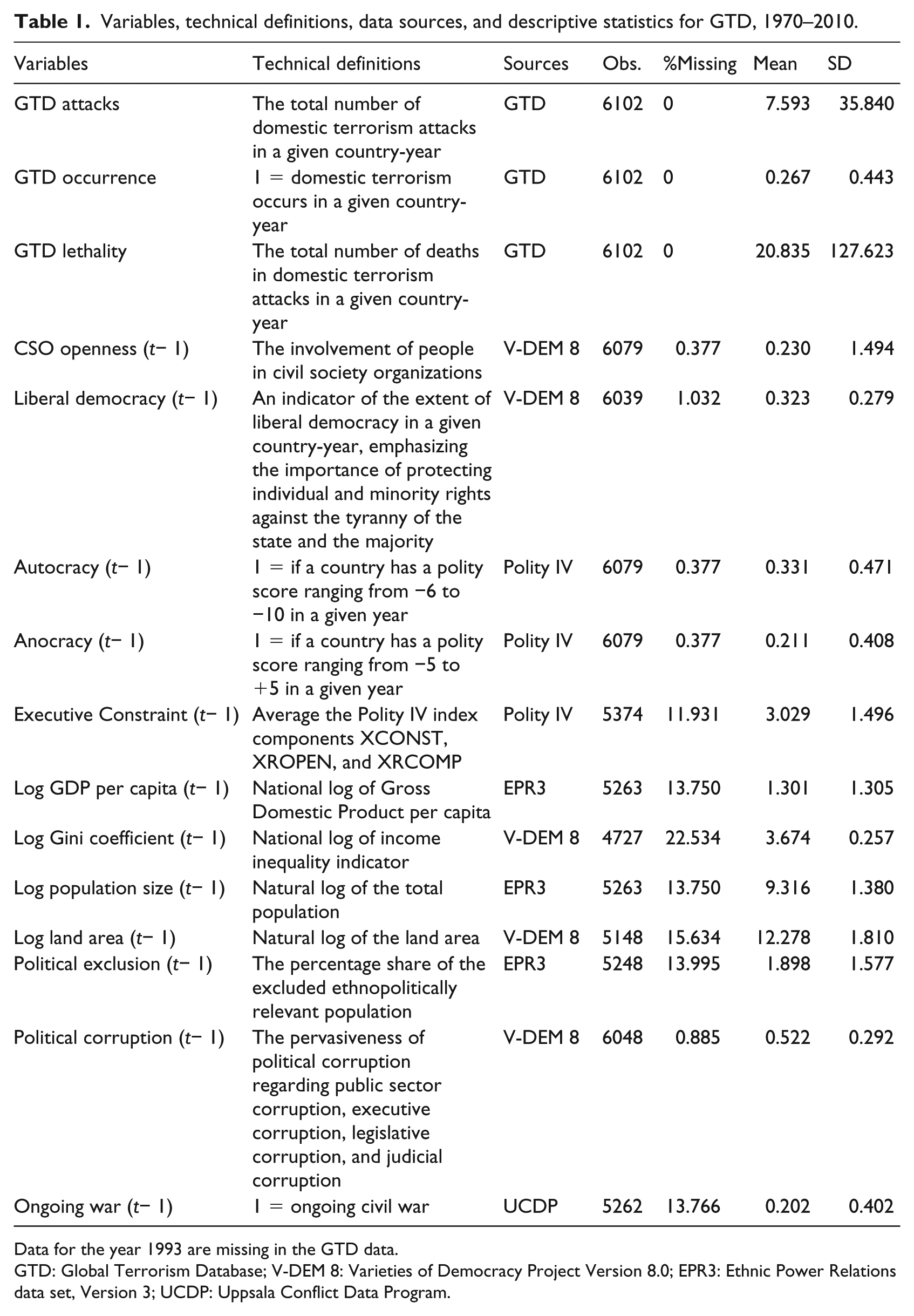
Data for the year 1993 are missing in the GTD data.
GTD: Global Terrorism Database; V-DEM 8: Varieties of Democracy Project Version 8.0; EPR3: Ethnic Power Relations data set, Version 3; UCDP: Uppsala Conflict Data Program.
Dependent variable
We use the total number of domestic terrorist attacks in a given country-year from the GTD as our focal dependent variable (LaFree and Dugan, 2007). We focus on domestic terrorism rather than international terrorism for several important reasons. First, most terrorism occurs domestically, although many studies focus squarely on high profile transnational events (Young and Findley, 2011). Second, different processes may be at work in predicting each type of terrorism. For instance, transnational terror events might have state-level causes that span two or more nations in relation to one another, while domestic terror events more likely have causes that are unique to the nation that experiences the attack (Young and Findley, 2011).
For an event to be coded as a terrorist attack in GTD by the START center, the event must be characterized by “the threatened or actual use of illegal force and violence by a non-state actor to attain a political, economic, religious, or social goal through fear, coercion, or intimidation” (LaFree and Dugan, 2007). In other words, the event must be intentional, contain some violence or threat of violence against property or people, and not have been perpetrated by the state actors (LaFree and Dugan, 2007). We use GTD’s INT_LOG as an identifier to obtain all domestic terrorist attacks by comparing the location of the attack and the nationality of the perpetrator group. We then aggregate all domestic terrorist incidents into country-year units from 1970 to 2010. Moreover, we also use the total number of terrorist attacks, the number of killings caused by domestic attacks, and the occurrence of domestic terrorist attacks from GTD as robustness checks, and results are consistent across these specifications.
We also use data set from Enders, Sandler, and Gaibulloev (ESG) to conduct additional robustness checks (Enders et al., 2011). Enders and colleagues (2011) undertook multiple steps to decompose terrorist attacks in the GTD into domestic and international attacks, adjusted by the ITERATE database (International Terrorism: Attributes of Events database; Mickolus et al., 2009). The ESG data set is widely considered to have accurate measures of domestic and international terrorist attacks. Following Piazza’s (2011) approach, we aggregate the ESG measures of domestic terrorist incidents into country-year units for the period from 1970 to 2006.
Independent variables
To explore the relationship between terrorism and democracy, we first use a composite index of liberal democracy from V-DEM, V8 (Coppedge et al., 2018; Pemstein et al. 2018). We also make use of the widely used Polity2 score as our robustness check for democracy (Chenoweth, 2013; Findley and Young, 2011; Li, 2005). Polity2 is a revised combined polity score from Polity IV project, which captures the regime authority spectrum on a discrete scale ranging from −10 (strongly autocratic) to +10 (strongly democratic; Marshall et al., 2011), and include measures of anocracy (−5 to +5 on the scale), and autocracy (−6 to −10 on the scale) to explore this relationship. We also include another indicator related to constraints on the executive in a nation. This is theoretically relevant as nations with many checks on the executive should be less effective in combating terrorism (Li, 2005). This variable is also from the Polity IV project, summarizing components XCONST, XROPEN, and XRCOMP (Marshall et al., 2011).
CSO Openness, our focal independent variable, is part of the multidisciplinary V-DEM, V8 (Coppedge et al., 2018; Pemstein et al. 2018). This original measure is formed as an ordinal scale ranging from “0” to “3” with “3” indicating the highest level of civil society involvement with a great diversity of CSOs featuring voluntary membership, while “0” indicates a civil society in which associations are state-sponsored and membership is involuntary. This measure captures the extent to which a state has a powerful and active civil society. We use the recommended posterior Bayesian estimation as our CSO openness measure. It is a continuous variable with a high score indicating a higher level of CSO openness.
Control variables
We also added several control variables that commonly appear in other studies that could confound the relationship between CSO openness and terrorism in our models. Choi and Piazza (2016) demonstrate that the political exclusion of minority groups should be a significant predictor of domestic terrorism. Theoretical mechanisms suggested that a lack of access to institutional political channels creates frustration for minority ethnic groups who then turn to terrorist violence to ameliorate this frustration (Choi and Piazza, 2016: 1). The ethnopolitical exclusion variable is “the percentage share of the excluded population in the total population that is ethno-politically relevant” (Choi and Piazza, 2016) from the Ethnic Power Relations (EPR) data set (Wimmer et al., 2009). In their comprehensive study focusing on the likelihood of an onset of civil war in a particular nation, Wimmer and colleagues (2009) argued that ethnic political contestation was more than simply the number of ethnic groups in a nation, or what is commonly referred to as ethnolinguistic fractionalization, or the exclusion of particular groups from the political process (Bruk and Apenchenko, 1964). We control for this factor by including the relevant variable for ethnopolitical exclusion from the data set.
Previous work tested the connection between state failure and terrorism (Choi and Piazza, 2016; LaFree and Dugan, 2007; Lai, 2007). Piazza (2008) found that failed states are more likely to experience terrorist attacks. Thus, we include an additional control variable that captures whether or not a nation is experiencing an ongoing civil war aggregated in the EPR data set (Wimmer et al., 2009), but originally sourced from the widely used Uppsala/PRIO Armed Conflicts Data Set (ACD; Gleditsch et al., 2002). Other variables related to state capacity are also included in the models. For instance, countries with large population and territory area are more likely to experience domestic terrorism attacks (Savun and Phillips, 2009). Countries with higher levels of political corruption are also more likely to experience terrorist attacks (Choi and Piazza, 2016; Piazza 2008). Variables are included to account for the possible confluence of these factors, both presented in the V-DEM data set, but originally sourced from the World Bank’s (2013) World Development Indicators in the case of population size and as an original indicator from V-DEM in the case of political corruption.
Previous studies also show that inequality and economic development have strong impacts on the amount of terrorism a country experiences (Piazza, 2011). Some studies suggest that the most economically developed nations are less likely to experience terrorist attacks (Bravo and Dias, 2006; Li and Schaub, 2004), and other research suggests the inverse (Blomberg and Hess, 2008). We use the variable gross domestic product (GDP) per capita (The World Bank, 2013) and a widely used measure of inequality, a Gini coefficient (The World Bank, 2013), to control the effects of inequality and economic development that may influence our results.
Analytic strategy
In the following empirical analysis, we test our hypothesis using fixed-effects panel models for count data. Given that our dependent variable of interest is overdispersed, following the literature, we adopt the commonly used negative binomial regression as our primary model to analyze the unbalanced country-year terrorism panel data. After running Hausman tests, which rejected the null hypothesis of no systematic difference between random and fixed-effects models, we consider fixed-effects negative binomial models as our preferred specification in the main analysis. The fixed-effects model allows us to account for the time stable unobserved country-specific factors.
For the fixed-effects negative binomial model, please see Hausman, Hall, and Griliches (HHG, 1984) and Cameron and Trivedi (2013) for more technical details. Here we briefly summarize the model specification. We begin with the model by

For a fixed-effects overdispersion model, we condition the joint probability of the counts for each country on the sum of the counts for the certain country (HHG, 1984). The fixed-effects models are less restrictive in model specifications but yield less efficient estimates. Note that HHG’s conditional negative binomial model for panel data is not a true fixed-effects method and an alternative approach is to estimate an unconditional negative binomial model with dummy variables for each country and year (Allison and Waterman, 2002). We report the unconditional negative binomial model results as our main result. We also use HHG’s conditional negative binomial model results as a robustness check and all results are consistent. To better attend to temporal effects, we lag all independent and control variables 1 year. We also impute missing covariates using chained equations with predictive mean matching, creating 20 imputed data sets before performing the analysis (Von Hippel, 2007).
Results
Table 2 reports coefficients from our unconditional negative binomial fixed-effects models. We estimate the results by adding dichotomous variables for both country and year in our negative binomial models. We begin by testing the relationship between democracy and domestic terror attacks. Model 1 shows that there is no statistically significant relationship between V-DEM’s liberal democracy indicator and domestic terrorist attacks (Coef. = −0.830; p > .05). Model 2 tests our focal hypothesis on CSO openness and domestic terror attacks. We find that the openness of a nation’s civil society is positively related to the count of domestic terrorist attacks that a nation experiences (Coef. = 0.403; p < .01). This is consistent with another model specification only with CSO openness and country-year dummies (Coef. = 0.401; p < .01). Model 3 reports the full model that incorporates both liberal democracy and CSO openness. As expected, after controlling for other factors, CSO openness is still positively associated with domestic terror attacks in a statistically significant way (Coef. = 0.594; p < .001). This result supports the argument that nations with more open civil societies will experience more domestic terrorist attacks. This may be read as evidence that the effect of democracy on terrorist attacks routinely found in the literature is driven by the openness of civil society, rather than democracy broadly writ.
Unconditional negative binomial regression fixed-effects estimates for the number of domestic terrorist attacks, 1970–2010.
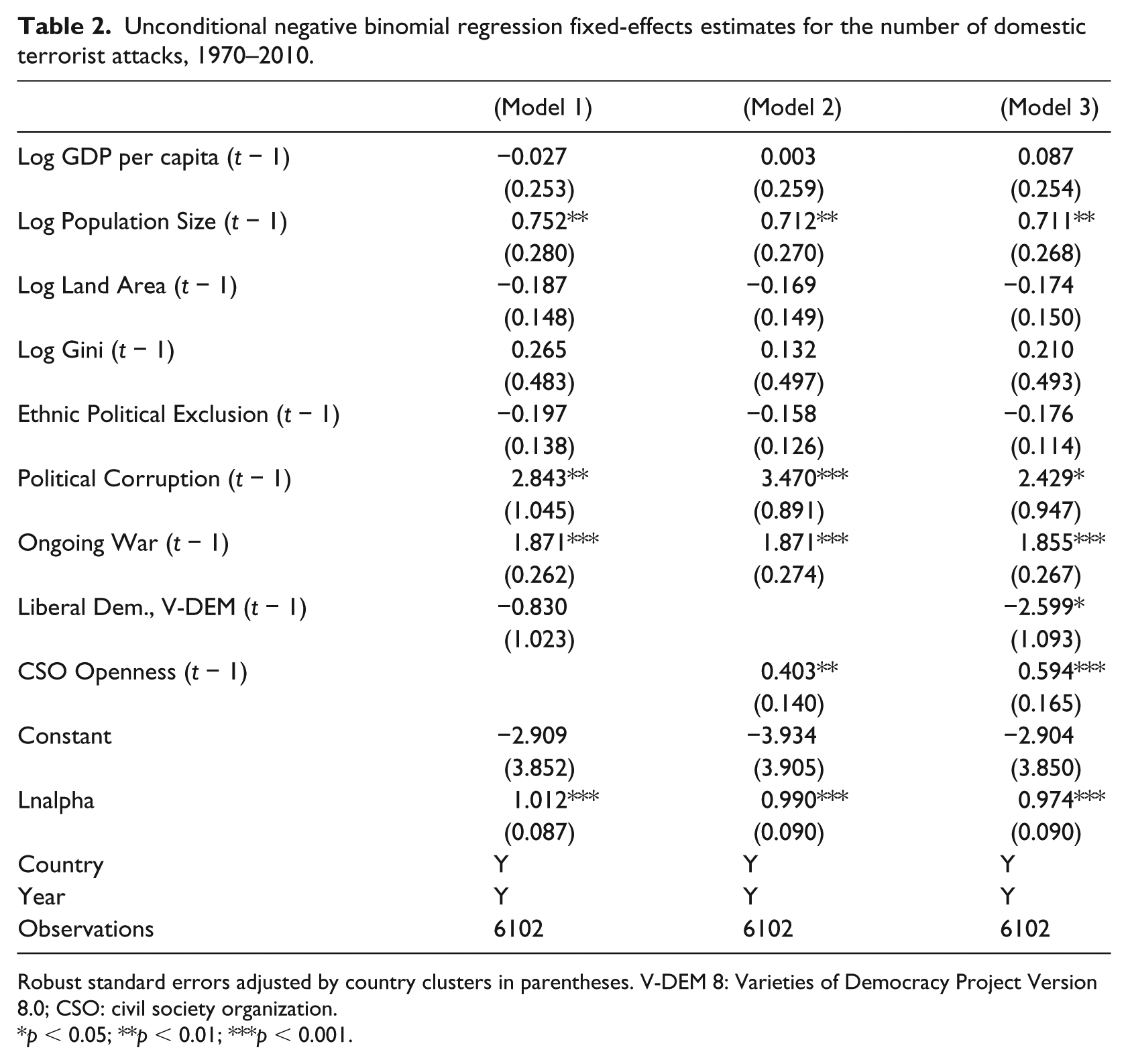
Robust standard errors adjusted by country clusters in parentheses. V-DEM 8: Varieties of Democracy Project Version 8.0; CSO: civil society organization.
p < 0.05; **p < 0.01; ***p < 0.001.
In addition to our focal hypothesis, several of our relevant control variables yield quite robust and interpretable results, which might inform future studies. Here we focus on control variables that achieved statistical significance across multiple models. First, earlier studies have shown that a nation that experiences political instability should have higher counts of domestic terrorist attacks than those countries that did not undergo a war. We do find a statistically significant relationship between ongoing war and domestic terror attacks. Second, unlike Choi and Piazza (2016), we do not find a positive relationship between political exclusion and domestic terrorist attacks. Third, as expected in previous literature, we do find population size and political corruption to be positively associated with higher counts of terrorist attacks.
Robustness checks
To check the robustness of our major finding on the positive relationship between CSO openness and terror attacks, we run a series of robustness checks using 20 imputed data sets. Table 3 reports raw coefficients across different models and data sets. Models 4 to 8 report different model specifications using GTD data. Model 4 shows the conditional negative binomial fixed-effects model estimated from Stata’s xtnbreg. The coefficient of CSO openness (Coef. = 0.211; p < .001) is slightly smaller but still statistically significant compared to the unconditional negative binomial model (Model 2). Model 5 reports the results from the unconditional negative binomial model using lethality as the dependent variable. It shows that CSO openness is statistically significantly and positively associated with the number of killings caused by domestic terror attacks. Model 6 reports the results after controlling for anocratic and autocratic regimes, rather than the liberal democracy index. It suggests that there is no statistically significant relationship between polity score and terrorism, but CSO is still positively associated with terrorist attacks. Model 7 reports the results of the unconditional negative binomial model after controlling for executive constraints. In contrast to previous literature (Li, 2005; Young and Findley, 2011), executive constraints cannot predict terror attacks. Finally, we also report results using a binary variable on the terror attack in a given country-year. Model 8 presents the result of the rare event logistic regression model. It shows that CSO openness has a positive influence on the likelihood of the occurrence of a terror attack (Coef. = 0.151; p < .001). To briefly summarize, results in Models 4 and 8 show that the link between CSO openness and terrorism holds across different models in GTD data.
Robustness check for CSO and terrorism across Models using GTD and ESG data.
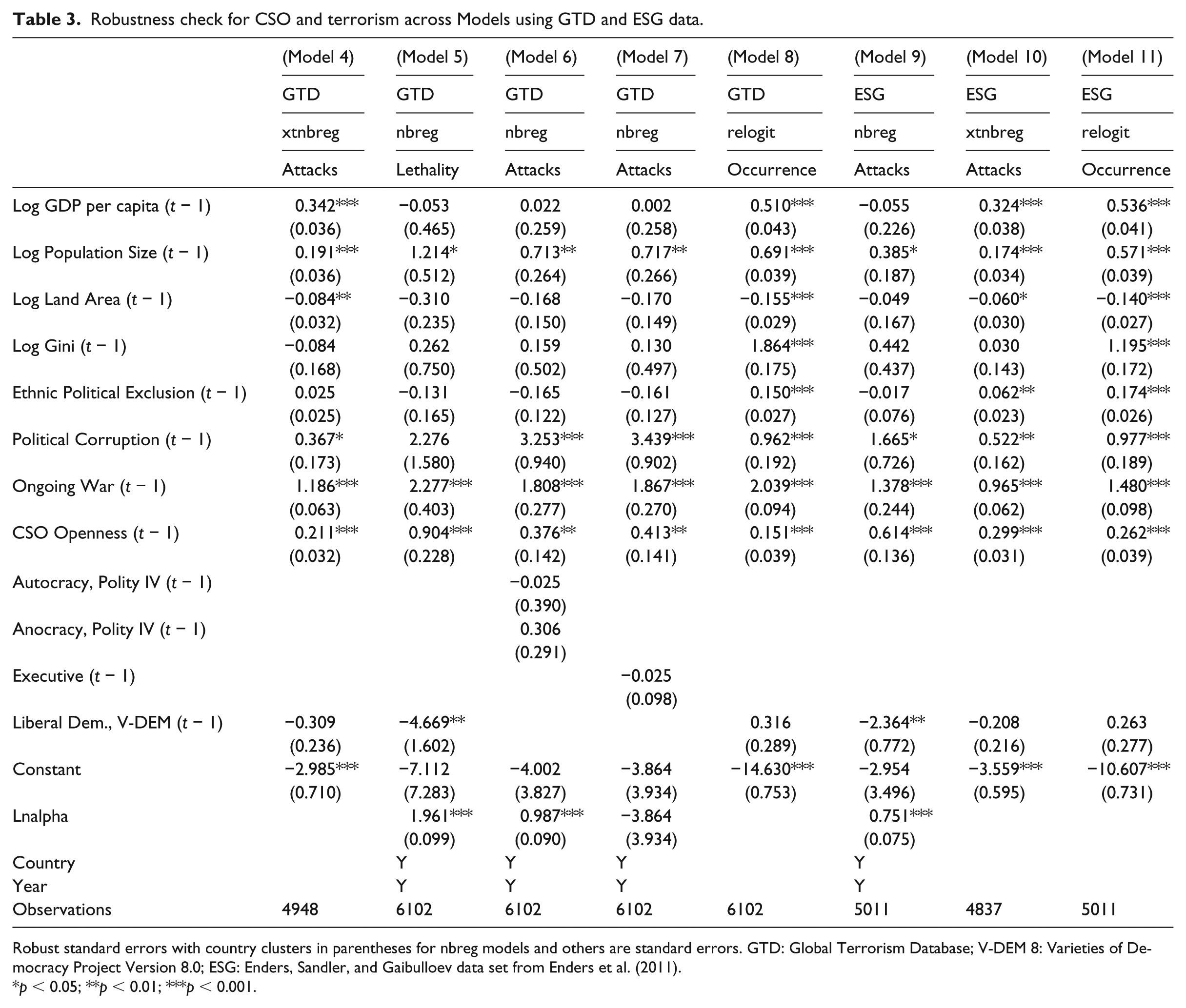
Robust standard errors with country clusters in parentheses for nbreg models and others are standard errors. GTD: Global Terrorism Database; V-DEM 8: Varieties of Democracy Project Version 8.0; ESG: Enders, Sandler, and Gaibulloev data set from Enders et al. (2011).
p < 0.05; **p < 0.01; ***p < 0.001.
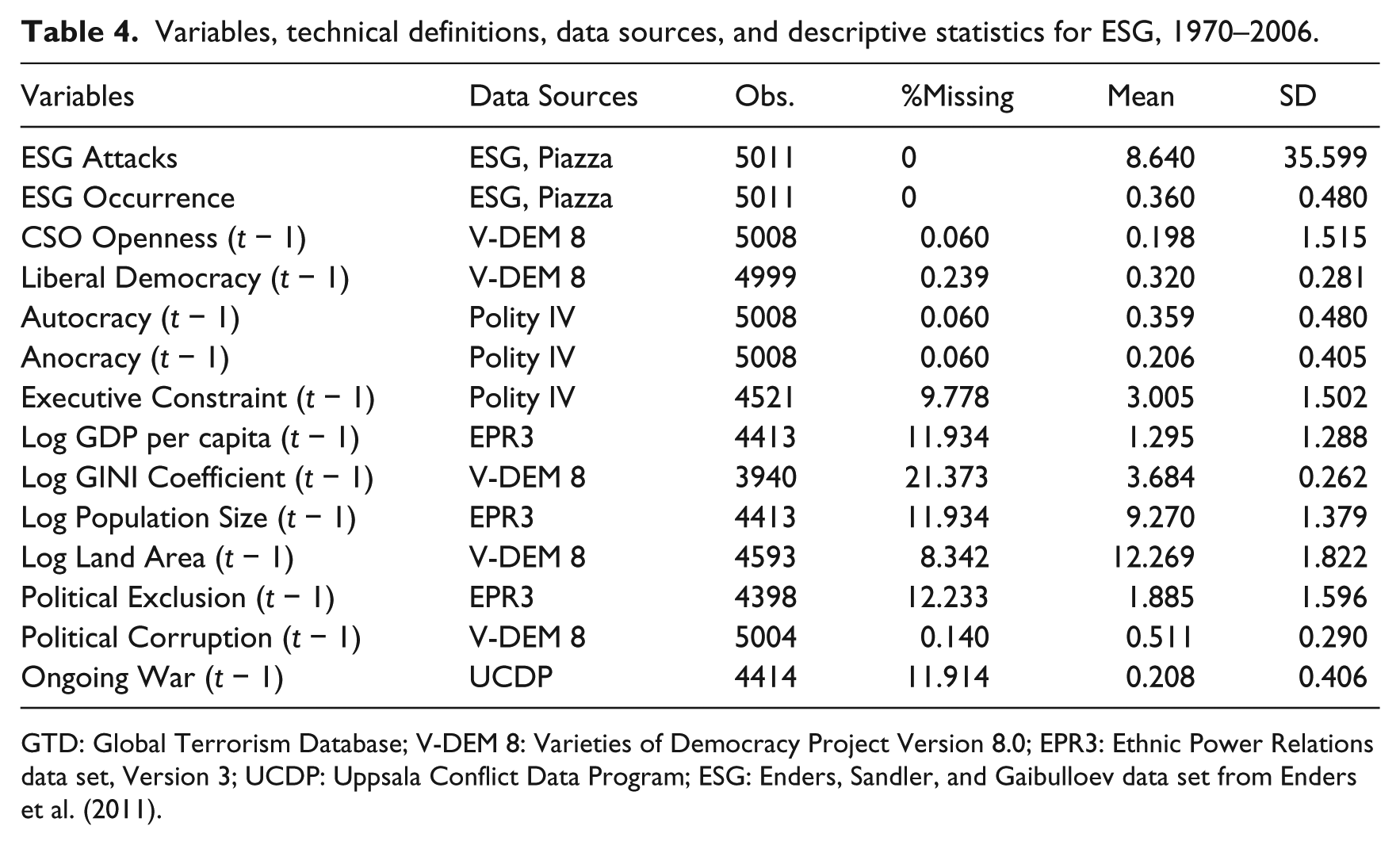
Models 9 to 11 report results from ESG data. Given that ESG data only cover domestic terror attacks in 1970–2006, we provide an additional descriptive statistics table in Appendix 1 (see Table 4). Model 9 in Table 3 reports the finding corresponding to our major results in GTD data. Compared to Model 3 in Table 2, ESG results show a very similar positive association between CSO openness and terror attacks (Coef. = 0.614; p < .001). Model 10 shows a smaller, yet still positive association between CSO openness and terror attacks based on the conditional negative binomial model (Coef. = 0.299; p < .001). We further report a statistically significant relationship between CSO openness and the occurrence of domestic terror attacks in Model 11 (Coef. = 0.262; p < .001). The rare events logistic regression model also reports a positive association between CSO openness and the occurrence of a terror attack. To summarize, our major findings in this article derived from GTD data are consistent in ESG data. These findings across data sets lend more confidence to our conclusion regarding the positive association of CSO openness with domestic terrorism.
Conclusion and discussion
This article argues that terrorist organizations take advantage of openings in the organizational opportunity structure in nations across the world, using the freedom associated with open societies to make attacks happen. We find that there is a positive relationship between the level of openness of a nation’s civil society and the number of domestic terrorist attacks a nation experiences. Building upon previous literature, we argue that terrorist organizations co-opt and radicalize existing CSOs (Almeida, 2003; Kurzman, 1998). In free societies, these organizations operate uninhibited by the state realizing an “organizational opportunity” to create radical social movement activity and terrorism domestically (Almeida, 2003; Kurzman, 1998; Minkoff, 2016). This argument builds on a growing line of literature seeking to more precisely explain the mechanisms that underlie the commonly found association between democracy and terrorism (Li, 2005; Young and Findley, 2011). In sum, it connects social movement theory to the cross-national research on terrorism in a way that contributes to an important emerging area of research on terrorism.
Further, this article lends cross-national evidence related to contentious politics to the organizational opportunity paradigm, where much of the previous research focuses on single case studies. In this sense, it lends strong empirical support for Almeida (2003)’s claim that CSOs become vehicles for radical social movement activity as radical movement activity is fostered in organizations that operate when the state is not intervening in their affairs. Research on organizational opportunity often focuses on internal mechanisms of cooptation within organizations (Kurzman, 1998), while the argument and empirical support in this article address aspects of what Kurzman (1998) calls “external factors” relating to organizational opportunity (p. 23). This approach connects factors such as a state’s level of political liberalization toward CSOs to a cross-national outcome, a novel approach and outcome to this literature.
While this article makes novel contributions to the literature on the organizational opportunity, civil society, and terrorism, it still has some limitations. First, while we are relatively content in our choice for the dependent variable, domestic terrorist attacks, other dependent variables related to this, such as international attacks, suicide bombings, large scale attacks, and even insurgency, should likewise be predicted by our key independent variable. Future work should take on the challenge of testing these related, but oftentimes distinct, phenomena. We rely on theoretical mechanisms suggested by previous work in order to theorize our empirical findings. Future work should continue to elaborate upon these mechanisms, specifically with a focus on CSOs.
We recognize an essential normative dilemma here—how might governments effectively manage interest groups, some intent on violence, while maintaining the freedom for such groups to emerge, interact, and otherwise go about the business of civic life freely without the interference of the state. We suggest that contemporary terrorist organizations are in a unique position to take advantage of openings in an organizational opportunity structure that leads to an open civil society. Although this organizational opportunity for terrorist activity exists in free societies, the risks associated with higher levels of terrorism in our mind do not outweigh the enduring general good provided by a free civil society. Moreover, scholars claim that specific waves of terrorist activity have different characteristics (Bergesen and Lizardo, 2004), and the current wave of terrorist activity could well be only a temporary problem for open societies—a problem that is curtailed by trading essential liberties but is not worth the exchange.
In addition to this normative dilemma regarding the role of the state in civil society, there are good reasons to believe that repressive means of managing organizations will be counterproductive. Eran Shor (2016), for instance, finds that counterterrorist legislation such as the USA PATRIOT Act does not reduce the number of terrorist attacks in the short term, and are rather associated with higher numbers of attacks in the long term. Other research on more extensive forms of repressive activity beyond legislative activity finds that more repression can boost group-level grievances and stimulate violent activity (Piazza, 2017). Taken in total, the normative gravity of repression combined with its apparent ineffectiveness leads us to suggest that states should avoid the practice while seeking creative and cooperative solutions that enable civic groups to achieve political change peacefully.
Footnotes
Appendix 1
Variables, technical definitions, data sources, and descriptive statistics for ESG, 1970–2006.
| Variables | Data Sources | Obs. | %Missing | Mean | SD |
|---|---|---|---|---|---|
| ESG Attacks | ESG, Piazza | 5011 | 0 | 8.640 | 35.599 |
| ESG Occurrence | ESG, Piazza | 5011 | 0 | 0.360 | 0.480 |
| CSO Openness (t − 1) | V-DEM 8 | 5008 | 0.060 | 0.198 | 1.515 |
| Liberal Democracy (t − 1) | V-DEM 8 | 4999 | 0.239 | 0.320 | 0.281 |
| Autocracy (t − 1) | Polity IV | 5008 | 0.060 | 0.359 | 0.480 |
| Anocracy (t − 1) | Polity IV | 5008 | 0.060 | 0.206 | 0.405 |
| Executive Constraint (t − 1) | Polity IV | 4521 | 9.778 | 3.005 | 1.502 |
| Log GDP per capita (t − 1) | EPR3 | 4413 | 11.934 | 1.295 | 1.288 |
| Log GINI Coefficient (t − 1) | V-DEM 8 | 3940 | 21.373 | 3.684 | 0.262 |
| Log Population Size (t − 1) | EPR3 | 4413 | 11.934 | 9.270 | 1.379 |
| Log Land Area (t − 1) | V-DEM 8 | 4593 | 8.342 | 12.269 | 1.822 |
| Political Exclusion (t − 1) | EPR3 | 4398 | 12.233 | 1.885 | 1.596 |
| Political Corruption (t − 1) | V-DEM 8 | 5004 | 0.140 | 0.511 | 0.290 |
| Ongoing War (t − 1) | UCDP | 4414 | 11.914 | 0.208 | 0.406 |
GTD: Global Terrorism Database; V-DEM 8: Varieties of Democracy Project Version 8.0; EPR3: Ethnic Power Relations data set, Version 3; UCDP: Uppsala Conflict Data Program; ESG: Enders, Sandler, and Gaibulloev data set from Enders et al. (2011).
Acknowledgements
Both A.P.D. and Y.Z. contributed equally to the article.
Declaration of conflicting interests
The author(s) declared no potential conflicts of interest with respect to the research, authorship, and/or publication of this article.
Funding
The author(s) received no financial support for the research, authorship, and/or publication of this article.
