




Abstract
Governments have increased their collaboration with the private sector regarding public service delivery, and their propensities to do so are largely shaped by their own in-house capacities. In this article, we theorize and analyze whether governments with an extremely low or extremely high technological capacity are more likely to collaborate with third-party platforms in order to jointly provide digital services. We expect there to be a U-shaped relationship between the technological capacity of those governments and their public–private partnership choices. An empirical analysis of digital service delivery across 290 prefecture-level cities in China corroborates this hypothesis. These results deepen our understanding of the competing motivations that drive the public–private partnership process.
Points for practitioners
Public–private collaboration has been widely adopted to promote digital service delivery. This article confirms the U-shaped relationship between government technological capacity and public–private collaboration in digital service delivery at the city level. To encourage the collaboration, it is crucial to target governments with varying capacities, which seems to be easier in large cities with high administrative rank and that are overall technologically mature and in a competitive environment technologically.
Keywords
Introduction
Historically, governments around the world have, in various ways, been collaborating with the private sector to initiate, decide on, and implement public policy – in modern terms, often called “governance features” (Osborne, 2010). Such arrangements vary across different countries according to structural, cultural, economic, and other factors (Hood, 1996). Our knowledge of cross-country governance features, in all respects, is far more advanced for developed rather than developing countries like China, which is the focus of this article.
Governments are increasingly working with the private sector and nonprofit organizations to deliver public services (Savas, 2000). One of the best-established emergent form of such collaborations is the public–private partnership (PPP) (Hodge and Greve, 2013; Wang et al., 2018). Thanks to the revolution in and penetration of information and communication technologies (ICTs), public services around the world are increasingly being delivered via digital means. However, given the cybersecurity and privacy concerns, digital services are mainly delivered by the public sector. Although the technological role played by the private sector is pivotal and PPP in this field is of paramount importance, its adoption has been relatively limited. Thus, it is theoretically interesting and empirically relevant to examine the antecedents of PPP regarding digital service delivery.
In the field of e-government, the application of ICTs is rapidly evolving, but few studies have examined them through the lens of PPP. In this article, the case of Alipay City Services in China reveals the PPP practices underlying digital service delivery. Accordingly, our research questions are:
What characterizes the coverage and diversity of digital service delivery through PPP in China? How does a city’s technological capacity influence its digital service delivery through PPP in China? What other factors influence digital service delivery through PPP in China?
This article draws on archival data and quantitative analyses to identify the key characteristics of PPP regarding digital service delivery and the explanatory factors related to its diversity. After discussing the concept of PPP, we theorize about the relationship between technological capacity and the online delivery of public services. Then, we describe the context of e-government in China and the development of third-party mobile services. The method, main results, and implications follow thereafter.
Theory
PPPs and digital service delivery
PPP has been broadly defined as cooperation between public and private actors as they jointly develop products and services (Hodge and Greve, 2017; Van Ham and Koppenjan, 2001). As mutually beneficial arrangements, PPPs have gained interest globally since the 1990s (Hodge and Greve, 2013) and been widely adopted within infrastructure and public facilities (Liu et al., 2020). Currently, PPPs are expanding into a variety of fields, emphasizing particularly the bundled, long-term partnerships established by the public and private sectors (Wang et al., 2018).
Osborne (2001) emphasized that PPPs may result in many possible outcomes, like service provision reforms, more accessible and responsive government, and so on. Supporters argue that PPPs bring efficiency, innovation, and finance as a win–win resolution to the gap existing between public demand and service delivery, while critics point to the high costs, the long-term and rigid nature of the contracts, the difficulties related to assessing performance, and so on (Bayliss and Van Waeyenberge, 2018; Trebilcock and Rosenstock, 2015). Having reviewed the studies that have been published in top-tier journals during the period from 1990 to 2013, Osei-Kyei and Chan (2015) identified the critical success factors for PPP as being risk allocation and sharing, strong private consortia, political support, community/public support, and transparent procurement.
E-government involves governments’ use of ICTs to enhance user access to, and the delivery of, government information and services (Layne and Lee, 2001). There has been enormous progress regarding e-government implementation worldwide over the past two decades (Chen et al., 2009), focusing on the promotion of public service delivery through digital platforms and channels, like government portals, mobile apps, and so on. Compared with the traditional pathways, digital services are more “user-orientated,” with various advantages, such as convenience, transparency, and effectiveness, which contribute to the promotion of citizen-initiated contact with the government (Reddick and Zheng, 2017). However, along with the progress, several challenges exist, such as the digital divide, inadequate e-infrastructure, and a lack of skills and competencies related to the design, implementation, use, and management of e-government systems (Twizeyimana, 2017; Twizeyimana and Andersson, 2019). E-government outcomes are being questioned; they have even failed to meet citizens’ expectations (Anthopoulos et al., 2016), which causes great distress and increased costs (Twizeyimana and Andersson, 2019).
As consistently demonstrated in the literature, a lack of the related capacity and resources, like technological capacity and financial support, constrains governments’ progress regarding digital service delivery (Zheng and Manoharan, 2016). The tension between citizens’ demands and a government’s limited capacity drive governments to seek collaboration with the private sector, which thereby contributes to the application of PPPs. The ideology of market efficiency creates an expectation that public agencies should contract everything out (Gantman, 2011). The World Bank Private Participation in Infrastructure (PPI) data show that ICT accounted for 41% of total private investment between 1990 and 2015 (Bayliss and Van Waeyenberge, 2018), reflecting the rapid growth of private sector involvement in ICT infrastructure and service delivery.
PPPs facilitate digital service delivery in various aspects. As public services become increasingly supplied in digital forms, PPPs help governments to build and maintain their digital platforms, reduce their technical and financial pressure, and encourage innovation (Zhang and Wang, 2008). As e-government progresses into the higher stages, like vertical and horizontal integration, PPPs promote service delivery by facilitating data resource sharing and exchange to support the integration of government services across different levels and functions (Layne and Lee, 2001), for instance, the city of Liverpool collaborated with UK Telecom to provide one-stop services. When collaborating with the private sector, especially large ICT companies, governments perform better regarding the adoption of the latest smart technologies in digital services, like intelligent voice interaction and face recognition, making digital services more innovative and convenient. With the assistance of Alibaba, the Chinese city of Hangzhou built a “city brain” to promote urban management. In addition, PPPs help governments to optimize the management system, promote related managerial and institutional reforms (Alawadhi et al., 2012; Nam and Pardo, 2011), and facilitate citizen engagement (Hui and Hayllar, 2010).
Meanwhile, involving PPPs in digital service delivery creates various problems. These are similar to those in other fields, as mentioned in previous studies, like inefficient collaboration, immature cooperation mechanisms and performance evaluation systems, distrust, and even increased corruption (Fleta-Asín et al., 2020). Duhamel et al. (2014) proposed a theoretical model to explain the performance of a partnership, arguing that organizational factors (like mutual trust and shared knowledge), institutional arrangements (like laws and regulations), and objective technology affect PPP. Moreover, the uncertainty caused by short-term budgets, the “procurement paradigm” (viewing outsourcing or PPPs as procurement), poor contract management, and a lack of collaborative relationships all impede the successful implementation of information technology (IT) outsourcing and PPP projects (Gantman, 2011).
Reviewing the partnerships that have been formed to promote Chinese e-government development over the past two decades, Liu et al. (2020) identify four distinct stages for understanding the evolution of PPP: outsourcing, service co-delivery, joint management, and collaborative governance. These four stages vary with regard to the perceptions of added value, depth of engagement, nature of the partnership, maturity of the collaboration mechanism, and outcomes achieved, reflecting the equality, depth, and maturity of the relationship. In the higher stages, the private sector becomes a co-manager and co-decision-maker, and participates in organizational and institutional reforms, instead of being merely an IT supplier or supporter (Liu et al., 2020).
Is there a U-shaped relationship between the government’s technological capacity and digital PPP?
As governments adopted digital technologies to provide services, PPPs became increasingly popular, which contributed to the development of public service delivery. However, huge variations exist at both the city and country levels. Whether and to what extent governments apply PPPs to deliver digital services may depend on several factors related to their capacity, among which technological capacity is crucial.
From the perspective of Kim and Bretschneider (2004), it is the capacity to allow local governments to apply ICT effectively in order to achieve the desired results. A recent study (Lember et al., 2018) defined it as an ability to explore, develop, and/or adapt new technological solutions regarding public service design, delivery, and evaluation. It refers not only to IT equipment, facilities, and integration (Kim and Bretschneider, 2004), but also to “human capacity,” emphasizing its management and use (Zheng, 2015). Moreover, while Zheng and Manoharan (2016) view it as parallel to administrative capacity, Lember et al. (2018) treat it as a critical element of administrative capacity.
Although there is no widely accepted definition of technological capacity, its importance has been fully recognized in the existing literature. Through conducting a survey of 146 municipalities in New Jersey, Zheng and Manoharan (2016) found that technological capacity affected government performance regarding e-services provision. A recent study of US cities revealed that technological capacity is an important antecedent of government data sharing across different sectors (Welch et al., 2016) and open government (Grimmelikhuijsen and Feeney, 2017).
The lack of technological capacity was the original driving force behind involving the private sector. Once the partnership is strengthened, the private sector is not only an IT supplier, but also involved in service co-design and co-delivery (Belachew and Shyamasundar, 2013), cloud platform construction and data governance (Liu et al., 2020; Nam and Pardo, 2011), policy and regulation design, and so on. This deeper involvement is accompanied by increasing risks in terms of information security and privacy protection (Reddick and Zheng, 2017). Moreover, without a mature mechanism and regulations, the active role of the private sector may blur boundaries and responsibilities (Liu et al., 2020), thereby acting as a policy entrepreneur (Kaliannan et al., 2010; Ruuska and Teigland, 2009). All of these factors serve to break the traditional balance between the government and private sector, reshaping their “power” and roles in the collaboration. Moreover, the new equilibrium depends on the capacity of the two stakeholders, especially their technological capacity, which is the key capacity with regard to developing e-government.
Governments with a weak technological capacity are more likely to adopt PPPs because seeking technological support is their key driver (Allen et al., 2001). To them, PPP is a “cost-effective” choice to supplement their weakness in terms of launching new initiatives, though a greater reliance on the private sector entails potential risks. These governments usually have a weak bargaining power when collaborating with big IT companies, making the PPPs more likely to be “demand driven.”
Governments that score well on technological capacity would promote PPPs too. Their sufficient technological capacities, including clear strategic goals, knowledgeable project leaders, effective performance management, and so on (Ni and Ho, 2005; Ruuska and Teigland, 2009), serve as an important base for ensuring their success in achieving the goals, as they could build a two-way beneficial relationship with higher equality and mutual trust, and better address the potential risks in security and privacy (Liu et al., 2020). They have strong motivation for the collaboration too, as they are keen to pursue cutting-edge technologies to keep their leading role in digital government innovations.
However, governments with a moderate technological capacity might be ambivalent in this regard. They have high sunk costs related to updating their software and facilities (Zheng and Schachter, 2018), as well as optimizing managerial systems to operate jointly with private partners or third-party platforms. The marginal benefits appear unpromising but the “real” and opportunity costs are clear. Moreover, their moderate technological capacity cannot guarantee that the PPPs will operate sufficiently well to enable them to meet demands.
Thus, considering the benefits, costs, and risks, governments with either a strong or weak technological capacity are more likely to adopt PPPs, while governments with moderate technological capacity are more hesitant. That is to say, the relationship between governments’ technological capacity and digital PPP is not linear, but U-shaped. Based on these observations, we present our first hypothesis: H1: A U-shaped relationship exists between governments’ technological capacity and digital PPP.
Context
E-government’s development in China
We tested the aforementioned hypotheses in the context of e-government in China. After almost two decades of development, e-government in China has gradually emerged as two popular forms: traditional e-government (the government website) and mobile e-government, or “m-government” (government smartphone applications, the government’s social media accounts, etc.) (Zheng and Ma, 2021). The former began in the late 1990s, relying on the traditional Internet and PCs, while the latter became popular in the 2010s, supported by mobile Internet and smartphones. Both have their own related advantages and serve as important platforms for digital service delivery.
The performance of the government agencies’ official web portals, that is traditional e-government, at various tiers, remains at a relatively low level, though clear progress has been made. Driven by the national information strategies, the total number of government websites in China had reached 81,725 by the end of April 2011 (Wang, 2014). However, a mismatch between the huge investment made in e-government and the low utilization of the government’s websites has existed for years, as these websites suffer from various problems and deficiencies (Wang, 2014). Above all, these portals are not “user-orientated”; they emphasize the circulation of information and strengthening of propaganda rather than effective service delivery. Fragmentation is also a serious issue. Different departments have their own official portals, and the degree of data sharing is inadequate due to organizational, contextual, and technical barriers (Welch et al., 2016). These defects harm both service convenience and efficiency. In addition, these websites are poorly maintained and not regularly updated (Karkin and Janssen, 2014). Many parts of the government’s websites have even become “ghost” or “zombie” pages, occupied by hackers or completely neglected. All of this results in low levels of citizen use, satisfaction, and trust. The State Council initiated the national government website census in 2015, and quarterly random inspections thereafter, to ensure that these official web portals are well maintained.
The development of the mobile Internet and smartphones created a new form of e-government, that is, m-government. Citizens can access public services through their smartphone, which is more convenient and efficient than using traditional face-to-face interactions and web portals (Reddick and Zheng, 2017). Liu et al. (2014) summarized the advantages of e-government, including affordability, reachability, ubiquity, on-time information delivery, a low technology literacy requirement, personalized information delivery, and emergency management. Although Facebook and Twitter are banned in China, the domestic versions (Sina Weibo and WeChat) are substantially equivalent. Taking WeChat as an example, it had attracted 700 million daily users by April 2016 (Zhang et al., 2017). The services provided cover various aspects of daily life, like paying traffic fines, handling immigration issues, registering a marriage, and so on, enabling them to serve as open, convenient, and comprehensive service platforms. These advantages have prompted local government agencies to launch their e-services through these platforms, allowing citizens to interact with local authorities in order to complete administrative tasks.
Digital service delivery through PPP
Since 2015, driven by the “Internet Plus Strategy,” coined by the Chinese Premier Li Keqiang, Alipay and Tencent WeChat, the two dominant IT companies in China, have been instrumental in helping local governments to set up universal platforms, similar to social media, which, of course, also provide them with good business opportunities. These mobile platforms are “one-stop shops” where the citizens can access a variety of governmental services, for example, paying taxes and fines, requesting healthcare, and obtaining ID, to name but a few. These so-called “City Services” help local governments to catch up and even outperform their counterparts in developed countries with regard to delivering e-services conveniently (Huang and Yu, 2019). Unlike the isolated applications, developed by government agencies in silos, “City Services” integrate all public service applications into a single platform, which citizens can then navigate. According to recent estimates, the “City Services” embedded in these mobile platforms attracted more than 400 million users by the end of 2017, accounting for about two-thirds of all netizens in China.
This innovative third-party mobile service is a hybrid e-government application, that is, a special type of PPP, which distinguishes it from contracting out or outsourcing. This new form of collaboration makes better use of both advantages. Local governments synchronize with the platform and exchange data across different agencies. The IT companies (like Alipay and WeChat) provide technical support, maintain the platform, and ensure data security. During the pilot stage, the service is totally free to both the government and the users. They can choose either the traditional government approaches (online, mobile applications, and offline) or this new platform, which means that these channels compete with each other. In other words, it is a form of concurrent sourcing (Hefetz et al., 2014).
Private sector actors, especially IT giants like Alibaba and Tencent, play a dominant role in initiating change within the bureaucratic machinery. These IT companies cooperate with local governments to digitalize their formerly offline services, thereby making them more accessible, transparent, and convenient. They also collaborate to launch innovative services across different sectors, which was difficult to achieve previously due to poor data sharing (He and Ma, 2020). For instance, citizens can authorize the platform to interoperate their personal data (e.g. ID) across different sectors, thereby enabling them to have their applications approved quickly. The platforms, supported by advanced technologies, help to break down the barriers across the public sector and redesign the processes of service delivery.
Both the private and public sectors benefit from such collaboration, which has given rise to an unprecedented diffusion and penetration of mobile services. IT companies aim to occupy the user base of public services and cultivate a habit among their users of using their mobile platforms, which helps companies to maximize their market share (He and Ma, 2020). Public services are characterized by low-frequency, albeit compulsory, consumption. IT companies can obtain many loyal clients and nudge them toward purchasing other, more profitable, products. As governments increasingly rely on these mobile platforms, IT companies can also expand their collaboration to include public agencies in other domains (like cloud computing, artificial intelligence, etc.), thereby consolidating their commercial power and potential.
Local governments benefit from such partnerships by updating and integrating their information systems and e-services, which have now become affordable. By collaborating with third parties, governments can also streamline their business processes and promote data sharing across agencies. Moreover, they can easily present themselves as user-friendly, transparent, and responsible. Furthermore, governments can use the system and big data analytics to strengthen their political and social control, that is, through digital surveillance and censorship (Ma, 2020). The analysis of these data could also contribute to government policymaking and smart city development.
Methods
Units of analysis
The units of analysis are the 290 cities at the prefecture level and above in China. The government in China is structured into five tiers. We focus on cities at the prefecture level and above (excluding the municipalities) because they have the discretion to deliver digital services through mobile channels. The prefecture-level cities are comparable in terms of their socioeconomic development, and are usually targeted in quantitative analyses of local governments in China (Ma, 2013, 2014).
Dependent variable
Referring to the four-stage development model of PPP evolution in Chinese e-government (Liu et al., 2020), the collaboration between local governments and Alipay could be viewed as the second stage—“services co-delivery.” Alipay, as a professional supporter, serves as a service co-designer and co-provider (Belachew and Shyamasundar, 2013), supporting the delivery of various public services, like transportation, social welfare, public safety, and education (Liu et al., 2020; Reddick and Zheng, 2017). The more services that are co-delivered, the higher the level of partnership, which means deeper engagement, greater mutual trust, a more equal and transparent relationship, and a more mature collaboration mechanism. Thus, we used the total number of services available via Alipay’s mobile public service platform in each city to measure the dependent variable (“digital PPP”).
The data were collected in 2018 and reflect the coverage and diversity of public services delivered through PPP in a collaborative way (for the measures of this and the other variables, see Supplementary Table A1). Higher values indicate higher levels of collaboration between the government and Alipay. The data are not publicly available, but were requested from Alipay. The platform covers 12 categories with over 100 different services, and the total number of services available could be used to gauge the width of collaboration between the government and Alipay. WeChat has a similar platform for catering for the government’s demands. We find that our Alipay measure is highly correlated with the WeChat index (r = 0.704, p < 0.01), which was developed based on a group of indicators that are used to measure the penetration of the WeChat platform in each city, suggesting that our measure is valid and reliable.
Independent variable
Technological capacity is our main independent variable. In this study, we refer to the viewpoint of Kim and Bretschneider (2004), emphasizing it as the capacity to enable local governments effectively to achieve the desired results with ICTs. We measure it using the “outcome-orientated” approach, based on the performance of local governments in realizing the goals of delivering digital services and engaging citizens.
We applied the total score of municipal e-government assessment to measure the technological capacity at the local level, which was developed by the China Software Testing Center (CSTC), a nonprofit organization specializing in conducting performance assessments of government websites in China. CSTC uses metrics and methods similar to that of the United Nations (UN) E-government Survey, covering the availability of online information, services, and participation channels through government websites. The index ranges from 0 to 1; larger values denote higher performance regarding e-government. The CSTC index is highly correlated with an alternative e-government index that has been developed by a team at Tsinghua University, suggesting that it is valid for assessing the technological capacity of municipal governments.
Several other internal capabilities are expected to influence PPP adoption regarding digital services, including fiscal pressure, administrative autonomy, and innovativeness. Fiscal pressure is measured by the budgetary deficit (the budgetary spending minus the budgetary revenue) as the share of total budgetary revenue; a larger value means that the municipal government is under stronger fiscal pressure. The data were obtained from the China City Statistical Yearbook (CCSY). Administrative autonomy is measured using two dummies: provincial capital cities and sub-provincial cities. We use prefecture-level cities as the reference category. Innovativeness is gauged by an index developed by CSTC. It captures the number of innovative features used on government websites. CSTC invited e-government experts to rate the innovativeness of these features, and their evaluations were integrated into the innovativeness index.
For the “inter-government relationship” dimension, both the top-down mandate and inter-city competition are included. A top-down mandate is gauged by a dummy variable. A city is coded as 1 if its provincial government signed a strategic agreement with Alipay, and 0 otherwise. In provinces with strategic agreements with Alipay, the municipal governments are incentivized to collaborate promptly with Alipay. These agreements are milestones that are widely covered by the public media. We collected the agreement dates by means of a mainstream online media search engine. Inter-city competition is measured in reference to the average number of public services available through Alipay that are offered by other cities within the same province, since the cities primarily compete with their peers in the same province, both politically and economically (Li et al., 2017).
Two variables (citizens’ ICT use and population size) are included to reflect public demand. Citizens’ ICT use is measured by two indicators from CCSY: the number of mobile phone users and broadband subscribers as a share of total population, respectively. These two indicators are highly correlated (r = 0.76, p < 0.01) and thus reduced to a factor analytical score (Cronbach ɑ = 0.506, Eigenvalue = 1.760, 88.02% explained). Population size is measured by the total number of inhabitants; these data were collected from CCSY.
Results
Descriptive statistics
As shown in Supplementary Figure A1, the Alipay municipal service platform has been rapidly adopted across many cities in China. It was first piloted in December 2014 in Hangzhou, where Alipay’s headquarters are located. The first group of 117 cities joined the program in 2015, followed by the remaining 172 cities in 2016.
Supplementary Table A2 reports the descriptive statistics for the key variables. The cities included in the analysis vary substantially with regard to the number of public services available via the Alipay municipal service platform. Some cities only make 23 universal public services (e.g. weather forecasts and traffic conditions) available via the platform. Wuhan (75), Shenzhen (69), and Guangzhou (64), among others, have customized the public services for local residents.
Regression model estimates
The regressions reported in Table 1 suggest that about 82% of the total variance of the dependent variable can be explained by the variables included in the model, suggesting that the selection of the independent variables was reasonable. The results reveal that technological capacity is negatively and statistically significantly related to the total number of public services offered through Alipay (β = –12.82, p < 0.05), while the coefficient of its squared term is positive and significant (β = 17.47, p < 0.05). The results suggest that there exists a U-shaped relationship between technological capacity and the number of public services, which supports our key hypothesis (H1).
Regression model estimates.
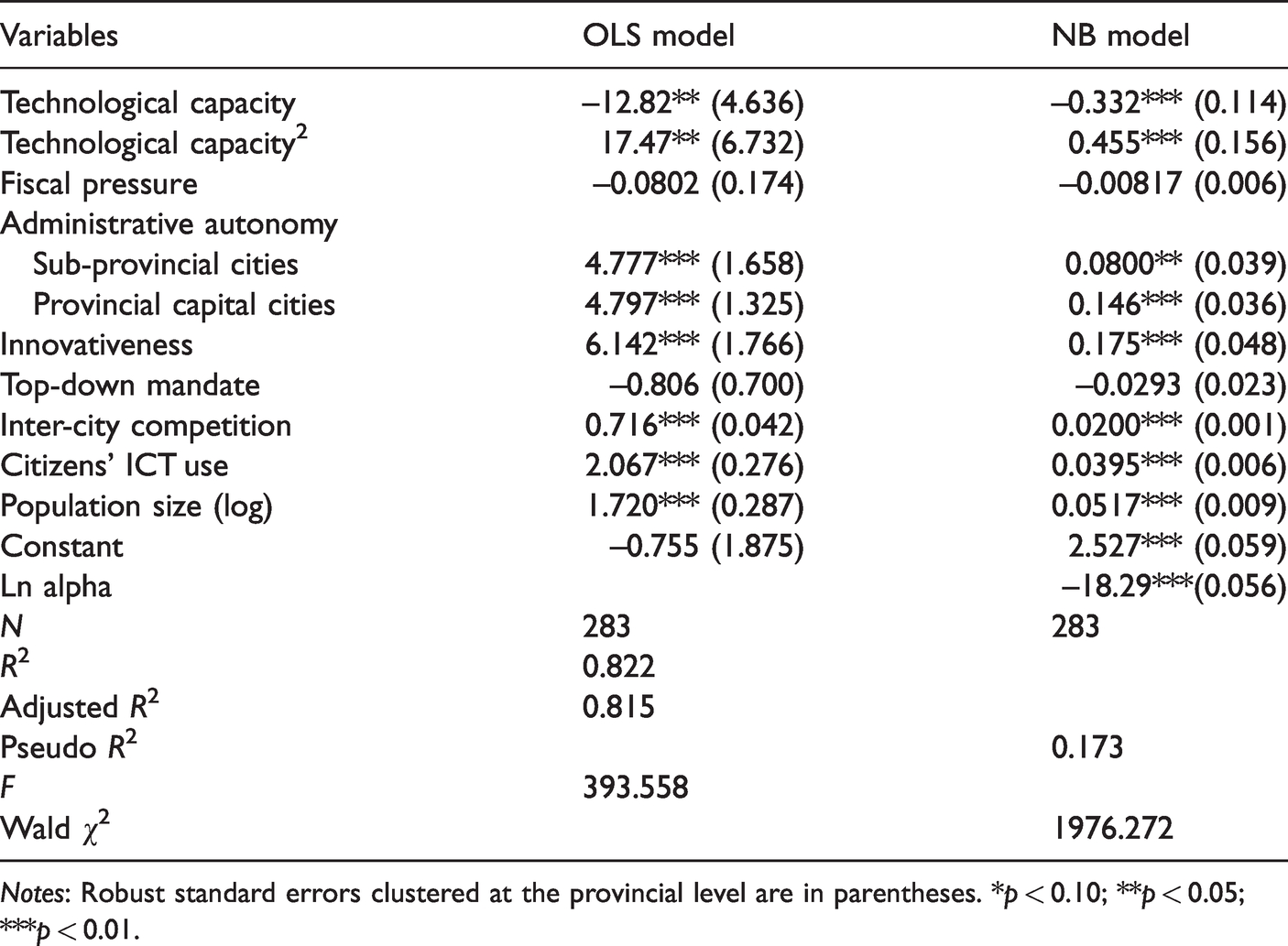
Notes: Robust standard errors clustered at the provincial level are in parentheses. *p < 0.10; **p < 0.05; ***p < 0.01.
As shown in Figure 1, technological capacity is first negatively and then positively related to the total number of available public services. We formally tested the existence of a U-shaped relationship between technological capacity and digital PPP (Thori and Halvor, 2010). The overall result for the presence of a U-shaped relationship is statistically significant (t = 2.33, p < 0.05), which means that we must reject the null hypothesis that the relationship is either monotone or inversed U shaped (H1). The results show that the turning point in the U-shaped relationship is 0.367, and its 95% Fieller interval ranges from 0.255 to 0.634. Technological capacity varies from 0 to 0.89, with a mean of 0.266 and a standard deviation (SD) of 0.305.
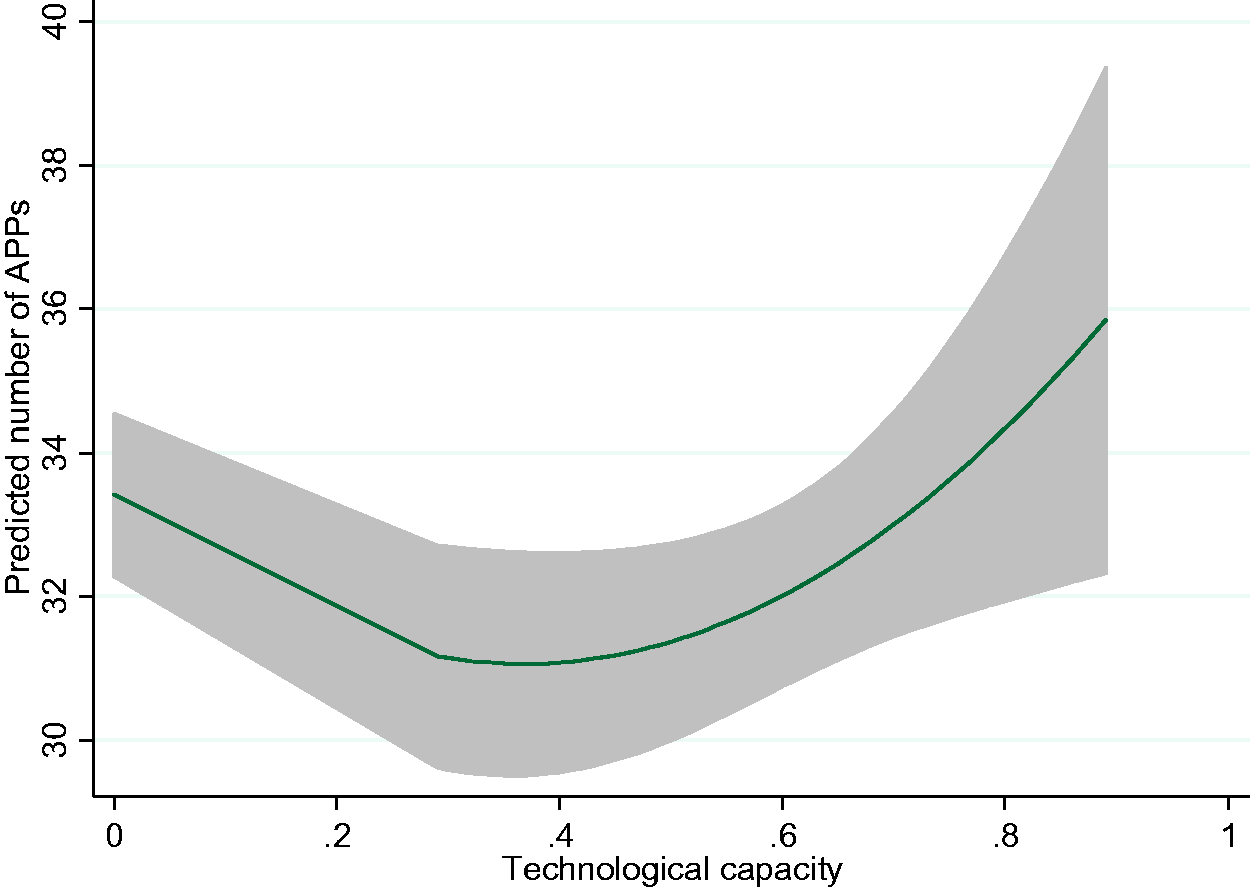
The U-shaped relationship between technological capacity and the predicted number of digital services through PPP (with a 95% confidence interval).
Discussion and conclusion
In this study, we theoretically developed and empirically corroborated the U-shaped relationship between technological capacity and digital PPP. The findings help to disaggregate governments’ underlying motivations to collaborate with third-party platforms. The U-shaped relationship indicates that the types of motivations are related to their level of technological capacity (H1). Governments with strong or weak technological capacity benefit more from collaboration and are more willing to adopt PPPs to promote digital service delivery, while governments with moderate levels are more hesitant to do so. Supplementary Appendix 1 and Supplementary Table A3 display the hypotheses connected to the remaining independent variables and whether our results confirm them or not.
Our findings reveal that the relationship between technological capacity and digital PPP is not linear, but a U-shaped curve. One policy implication is that to encourage public–private collaboration regarding digital service delivery, it is crucial to target governments with various degrees of capacity, which seems to be easier in those large cities with high administrative rank and that are technologically mature and in a competitive technological environment. Fully considering the benefits, costs, and risks, measures need to be taken to motivate governments with a moderate technological capacity to collaborate. The adoption of PPP is more “demand-driven” and “competition-driven.” Citizens are growing to expect digital services, and peer pressure from other cities drives governments to adopt PPP to promote digital service delivery, even when the innovation is not mandated and governments lack the related resources and capability. In addition, greater administrative autonomy is needed to help to push PPP adoption. Digital service delivery is an innovation, and there are a variety of risks associated with it. Administrative autonomy and discretion are important in assisting local governments to try and explore which methods are most suitable for them.
This study is limited in three ways. First, the data are cross-sectional and we cannot generate causal inferences from correlational estimates, despite the lag in the time-variant independent variables by one year. Second, the measures of some of our variables (e.g. competition) are proxies and could be improved in future research. For instance, the digital services available via Alipay differ in terms of their technological sophistication and use. Future studies might weigh and aggregate these into indexes. Lastly, Alipay and Tencent are Internet titans, with a virtual monopoly over the fields of mobile payments and social media in China. This novel circumstance should not be assumed to be the case in other countries. In contexts in which there exist multiple, competing vendors, the motivation and capacity of governments will differ and merit further study. Despite these limitations, our findings reveal that a linear interpretation of PPP is oversimplified, and so we should examine its dynamics from a more balanced perspective.
Supplemental Material
sj-pdf-1-ras-10.1177_00208523211018849 - Supplemental material for Government technological capacity and public–private partnerships regarding digital service delivery: evidence from Chinese cities
Supplemental material, sj-pdf-1-ras-10.1177_00208523211018849 for Government technological capacity and public–private partnerships regarding digital service delivery: evidence from Chinese cities by Liang Ma, Tom Christensen and Yueping Zheng in International Review of Administrative Sciences
Footnotes
Acknowledgement
An earlier version of this article was presented at the IPSA 2018 World Congress, Brisbane, and the authors would like to thank participants for helpful comments.
Declaration of conflicting interests
The author(s) declared no potential conflicts of interest with respect to the research, authorship, and/or publication of this article.
Funding
The author(s) disclosed receipt of the following financial support for the research, authorship, and/or publication of this article: This research received funding from National Natural Science Foundation of China (NSFC) (No.: 71774164).

Supplemental material
References
Supplementary Material
Please find the following supplemental material available below.
For Open Access articles published under a Creative Commons License, all supplemental material carries the same license as the article it is associated with.
For non-Open Access articles published, all supplemental material carries a non-exclusive license, and permission requests for re-use of supplemental material or any part of supplemental material shall be sent directly to the copyright owner as specified in the copyright notice associated with the article.
