




Abstract
This essay presents an introduction to the field of Jewish biblical theology. Following a brief survey of major works in the field, it treats a number of key issues: the need for Jewish biblical theology; the distinctive form of the Jewish Bible; constructive questions of G-d, covenant, the nation of Israel, and the conceptualization of the temple and the monarchy; and questions raised when the ideal conceptualization of these issues are challenged by destruction and exile. The relation of the Bible to subsequent Jewish tradition is a concern throughout. Altogether, the essay demonstrates the inherent dialogical character of Jewish biblical theology, both within the Bible itself and among its interpreters within the Jewish tradition.
Keywords
Introduction
Jewish biblical theology has established itself as an important force in the larger field of biblical studies. Although biblical theology is a normative Christian discipline, the widespread emergence of Jewish biblical scholars in colleges, universities, and even in Christian theological schools during the latter half of the twentieth century and beyond has enabled Jews to interact constructively with both their Christian and Jewish colleagues in interpreting the Hebrew Bible. 1
There is extensive debate among Jewish scholars concerning the necessity, scope, and character of biblical theology when engaged by Jews. Jon D. Levenson maintains that Jews are not interested in biblical theology in large measure because of its Christian character and its frequently anti-Semitic tendencies, but he has nevertheless produced groundbreaking studies on the interrelationship between Sinai and Zion, the problem of theodicy, the interrelationship between resurrection and national restoration, and others. 2 Michael Fishbane focuses on the mythological poesis of biblical exegesis, both within the Bible and beyond, in midrashic, Talmudic, and kabbalistic literature, as Jews continue to develop the teachings of the Bible for later times. 3 Tikva Frymer-Kensky views Jewish biblical theology as a means to reengage and rethink the rabbinic tradition. 4 Marc Brettler calls for literary-historical study of the Bible in an effort to understand its ideas in historical context. 5 Benjamin Sommer calls especially for intertextual study of the Bible, both within the biblical canon and in relation to later rabbinic literature, in an effort to see the Bible as part of a larger Jewish theology. 6 Tamar Kamionkowski challenges readers to rethink their assumptions concerning gender when reading biblical literature. 7 Isaac Kalimi stresses that there is no true center to the Bible, prompting interpreters to take account of the diverse viewpoints of the Bible’s authors, redactors, and its later tradents. 8 The present writer stresses the need to understand the distinctive form of the Jewish Bible, viz., the Tanak (Torah/Instruction; Nevi’im/Prophets; Ketuvim/Writings), in both its synchronic and diachronic dimensions as the basis for constructing a distinctive Jewish biblical theology at the foundation of Jewish thought. 9 He also raises important issues concerning how the Shoah influences our reading of the Bible, 10 among other issues. 11
Even this brief survey demonstrates the wide variety of viewpoints and issues that are represented in current discussion concerning Jewish biblical theology. This essay therefore treats a number of key issues as a means to introduce readers to the field. Issues discussed here include the need for Jewish biblical theology; the distinctive form of the Jewish Bible; constructive questions of G-d, covenant, the nation Israel, and the conceptualization of the temple and the monarchy; and questions raised when the ideal conceptualizations of these issues are challenged by destruction and exile. The relation of the Bible to subsequent Jewish tradition is a concern throughout. Altogether, the essay demonstrates the inherently dialogical character of Jewish biblical theology, both within the Bible itself and among its interpreters within the Jewish tradition.
Jewish Tradition
Because biblical theology has been a Christian theological discipline, many Jewish scholars question the propriety and value of Jews engaging the field. Biblical theology in Christian contexts is often concerned with the systematic interpretation of the Bible, viz., the interrelationship between the Bible (as conceived in Christianity) and systematic theology as the basis for formulating the doctrines or theologies that guide Christianity in its understanding of G-d, human beings, the anticipated salvation of the world, and other issues. Judaism, however, is more concerned with the exegetical interpretation of the Bible and the development of its ideas in later rabbinic thought to support Jewish efforts to sanctify life and creation at large. In contrast to Christianity and its attempts to define G-d in relation to Jesus Christ, Judaism largely eschews efforts to define G-d and focuses instead on human beings as the partners with G-d in completing and sanctifying creation.
Jews have traditionally read the Bible through the lens of rabbinic tradition. Talmudic tradition briefly considers the form of the Jewish Bible and the general viewpoints of the books that comprise it. The Targums translate the biblical books into Aramaic, although they frequently work rabbinic traditions and viewpoints into the Aramaic translation of the Hebrew text. The midrashic, medieval, and more recent traditional commentators generally provide full commentaries on the books of the Bible, always from the standpoint of rabbinic tradition. Nevertheless, scholars recognize that the talmudic and subsequent rabbinic literature generally approaches the Bible in a piecemeal fashion by citing specific texts that address the concerns of the issue at hand and often arriving at interpretations that are quite at variance with the surface reading of the biblical text.
An example would be the discussion of the lex talionis in the Torah, which calls for an eye for an eye, a tooth for a tooth, a life for a life, etc., in determining the punishment of a criminal who has injured another party (Exod 21:22–25; Lev 24:19–21; Deut 19:16–21). But the rabbinic discussion of this issue in the Babylonian Talmud arrives at a very different conclusion in its efforts to discern the Oral Torah that lies within the written text of the Torah, viz., that the Torah calls for a perpetrator to compensate the injured party in order to ensure that a greater punishment is not imposed on the perpetrator and that the needs of the injured party are addressed (b. B. Qam. 83b–-84a). Such a decision is clearly more pragmatic, merciful, and just than the Torah’s initial statements, but most contemporary Jews lack a full rabbinic education that would help them fully to understand the issue. Although Oral Torah does indeed represent the fullest expression of the Jewish tradition, the Written Torah of the Bible is the entry point for Jews to learn what the tradition has to teach.
Emergence of Modern Jewish Biblical Study
Much of Jewish life and thought from late antiquity through the early modern period was defined by the rabbinic literature and its understanding of the Bible, but the modern period from the eighteenth–nineteenth century Haskalah (Enlightenment) on has seen the increasing prominence of the Bible in both diaspora and Israeli Jewish life. American Judaism was profoundly influenced by the Bible because ordained rabbis were relative late-comers to the New World of the Americas and because the Bible was the predominant influence in the lives of their largely Protestant counterparts. 12 Israeli culture is also heavily influenced by the Bible because the early Zionist pioneers were largely secular in orientation, but they found that the Bible, with its accounts of Jewish life in the land of Israel, offered a much better foundation for their efforts to rebuild Jewish culture in the land than the Talmudic literature, which portrays Jewish life in the land of Israel retrospectively. 13 Although both the contemporary Jewish diaspora and Israeli culture have seen increasing influence from more traditional Orthodox movements, the Bible continues to exert tremendous influence in modern Jewish life.
Indeed, the virtual explosion of knowledge concerning the Bible from contemporary historical-critical scholarship, archeology, and literary and theological studies has made the Bible more accessible to readers, regardless of their religious identities, than ever before. The years following World War II have seen a tremendous increase in interest in the Bible, both in popular culture and in higher education. Jews have become increasingly interested in studying the Bible, and publishers have rushed to provide them with resources for study. The same can be said for Christians. Given the tremendous interest in biblical studies among Jews, Christians, secularists, and others, the time is ripe for Jewish biblical theology. Systematic interpretation of the Bible from a Jewish standpoint enables Jews to have a more complete entrée into the study of the Bible as the foundation for Jewish identity and for the study of post-biblical Jewish traditions. Overall, Jewish biblical theology facilitates the study of the post-biblical Jewish tradition as well.
Jewish biblical theology also facilitates interreligious dialog, especially between Jews and Christians, on the interpretation of the Bible and better understanding of the distinctive viewpoints of our respective religious traditions. One of the major impediments in relations between Christians and Jews has been the inability to understand the other, especially on the part of Christians who do not easily understand Jewish interpretative approaches to the Bible. Jewish biblical theology can play a major role in clarifying Jewish viewpoints concerning the Bible.
The Distinctive Form of the Tanak
One of the key issues in a Jewish biblical theology is the distinctive form—and thus the distinctive hermeneutical construction—of the Jewish Bible. 14 Many people presume that the Jewish form of the Bible, known as the Tanak, and the Christian Old Testament are one and the same. In the Protestant tradition, the Old Testament includes the same books as the Tanak, but they are organized very differently, and their distinctive organizations point to the distinctive theological viewpoints from which the Tanak and the Old Testament are read in their respective traditions.
The Linear Structure of Christian Bible
The Christian Old Testament is part of the larger structure of the Christian Bible, which includes both the Old Testament and the New Testament. Indeed, the term “Old Testament” is a theologically-loaded term insofar as it points to Christianity’s understanding of the larger linear structure of the history of revelation in the world at large and the ultimate coming of Jesus as the Christ or Messiah. The term “testament” means “covenant,” and the terms Old Testament and New Testament refer to the two covenants that have defined Christianity’s view of world history. The Old Testament relates the history of the world from creation through the late-Second Temple period or Hellenistic period prior to the emergence of Christianity. The Old Testament therefore focuses especially on the “old covenant” or the Mosaic covenant between G-d and Israel established at Mt. Sinai. Christian tradition views this “old covenant” as a covenant based on law, and it views this law-based covenant as inadequate, in part because it charges that Israel failed to observe its covenant with G-d, resulting in the destruction of Solomon’s Temple and the Babylonian exile in 587
The internal organization of the Old Testament is derived from an early organizational pattern of the Greek Septuagint, a translation of the Hebrew Bible that served the early church as a witness to sacred Scripture. The internal organization of the Old Testament points to Christianity’s interest in portraying world history as a linear process that would ultimately understand Jesus Christ as the Messiah of humankind. The Old Testament comprises four major elements. The first is the Pentateuch or Five Books of Moses (Genesis, Exodus, Leviticus, Numbers, and Deuteronomy), which relate the earliest history of the world and humanity from creation through the early history of the ancestors of Israel, the exodus from Egypt, the revelation of the law at Mt. Sinai, and the wilderness wandering that led the people of Israel to the borders of the promised land. The second major element is the historical books, including Joshua, Judges, Ruth, 1–2 Samuel, 1–2 Kings, 1–2 Chronicles, Ezra, Nehemiah, Esther, and in Roman Catholic Bibles, 1–2 Maccabees. These books relate the later history of Israel from the time of the initial conquest of the land under Joshua, through the destruction of Solomon’s Temple and the Babylonian exile, and the history of Jews up to the advent of Christianity. The third element is the hymnic and Wisdom books, including Job, Psalms, Proverbs, Ecclesiastes, Song of Songs, and in Roman Catholic Bibles, the Wisdom of Solomon and Ecclesiasticus, which address questions of faith and meaning pertinent to the present of any given generation. Finally, the fourth element is the Prophets, including Isaiah, Jeremiah, Lamentations, Ezekiel, Daniel, and the Minor Prophets, which look forward to an ideal future restoration. Insofar as the New Testament then follows the Prophets, the New Testament is read in Christianity as the fulfillment of the Prophets.
The New Testament employs a similar four-part linear structure for the presentation of history. The Gospels present the four accounts of Jesus’s life and significance as the earliest history of the revelation of the new covenant in Christianity. The Acts of the Apostles present the later history of the early church as it spread from Jerusalem to Rome, the new center of the Christian world. The third element is the Epistles, which address questions of faith, theology, and Christian life. Finally, the Apocalypse or Revelation of John points to the future or second coming of Jesus that will inaugurate the messianic age, when the entire world will recognize Christ as the Messiah of the world.
The Cyclical Structure of the Jewish Bible
The Jewish Tanak is structured very differently to articulate a cyclical understanding of history from the time of creation through the postexilic restoration and beyond. Indeed, the structure is rabbinic, and it is discussed in b. B. Bat. 14b–15a. Although there are some variations in the sequence of books, the basic structure is dependent upon the talmudic order. The three elements form the acronym “Tanak” in Hebrew. The first element is the Torah, often mistranslated as “Law,” based on Paul’s rendition of the term in the New Testament. Torah actually means “instruction” in Hebrew, and the Torah expresses the ideals of Israel. It includes Genesis, Exodus, Leviticus, Numbers, and Deuteronomy, and it provides instruction concerning the early history of Israel from the creation of the world, including the Berit Olam or eternal covenant beginning with Noah and Abraham and Sarah, as well as the revelation of divine torah at Sinai, which provides the basis for the establishment of a just and holy society in the land of Israel.
The second major portion of the Tanak is the Nevi’im, Prophets, including both the Nevi’im Rishonim, or Former Prophets, and the Nevi’im Aḥronim, or Latter Prophets. Both recount the disruption of the ideal Israel through the destruction of Solomon’s Temple and the Babylonian exile. The Former Prophets (Joshua, Judges, Samuel, and Kings), relate a theological account of Israel’s history from Joshua through the Babylonian exile, which argues that Israel and Judah were exiled because they failed to observe divine torah. The Latter Prophets (Isaiah, Jeremiah, Ezekiel, and the Book of the Twelve Prophets) likewise explain the exile as a result of Israel’s and Judah’s failure to observe divine torah, but they also point forward to a restoration once the period of punishment comes to an end.
The third segment of the Tanak is the Ketuvim, or Writings, which portrays the attempt to restore the ideal Israel in the aftermath of the Babylonian exile. It includes Psalms, Job, Proverbs, the Five Megilloth (Song of Songs, Ruth, Lamentations, Qohelet, and Esther), Daniel, Ezra-Nehemiah, and Chronicles. Psalms recounts Israel’s dialog with G-d; Job and Proverbs explore wisdom in creation; each of the Five Megilloth is read on a specific Jewish holiday to give expression to the unique teaching of the holiday in question; Daniel points forward to the restoration of the temple in Ezra-Nehemiah; and Chronicles recounts the history of Israel from creation through Cyrus’s decree that allowed Jews to rebuild the temple in Jerusalem.
Prohibition against Describing G-d
Judaism proscribes any attempt to portray G-d in finite terms. G-d is holy and wholly other and is therefore conceived as an infinite presence that cannot be portrayed in any finite form—human, animal, or otherwise. It is therefore impossible to follow Christian examples of biblical or Old Testament theology that describe G-d appearing in the human form of Jesus Christ. To do so would be considered idolatry and would suggest that G-d must be understood much like a human being, with all the strengths and weaknesses that such a depiction would entail. Indeed, the Ten Commandments specify that G-d is not to be depicted in any sculpted image or likeness of anything or anyone in the world of creation (Exod 20:4). The commandments also specify that the holy name of G-d,
Consequently, even visionary texts that depict the divine presence focus on imagery surrounding G-d rather than on a finite image of G-d. Theophanies, such as the appearance of G-d at Mt. Sinai in Exodus 19, emphasize elements of nature, such as thunder and lightning, as descriptors of the divine presence. Alternatively, the narrative concerning Elijah’s vision of G-d in 1 Kings 19 denies that the divine presence can be equated with wind, fire, or earthquake, and instead finds the divine presence in “the absolutely silent voice” of G-d that instructs Elijah on what he should do. Isaiah’s vision of
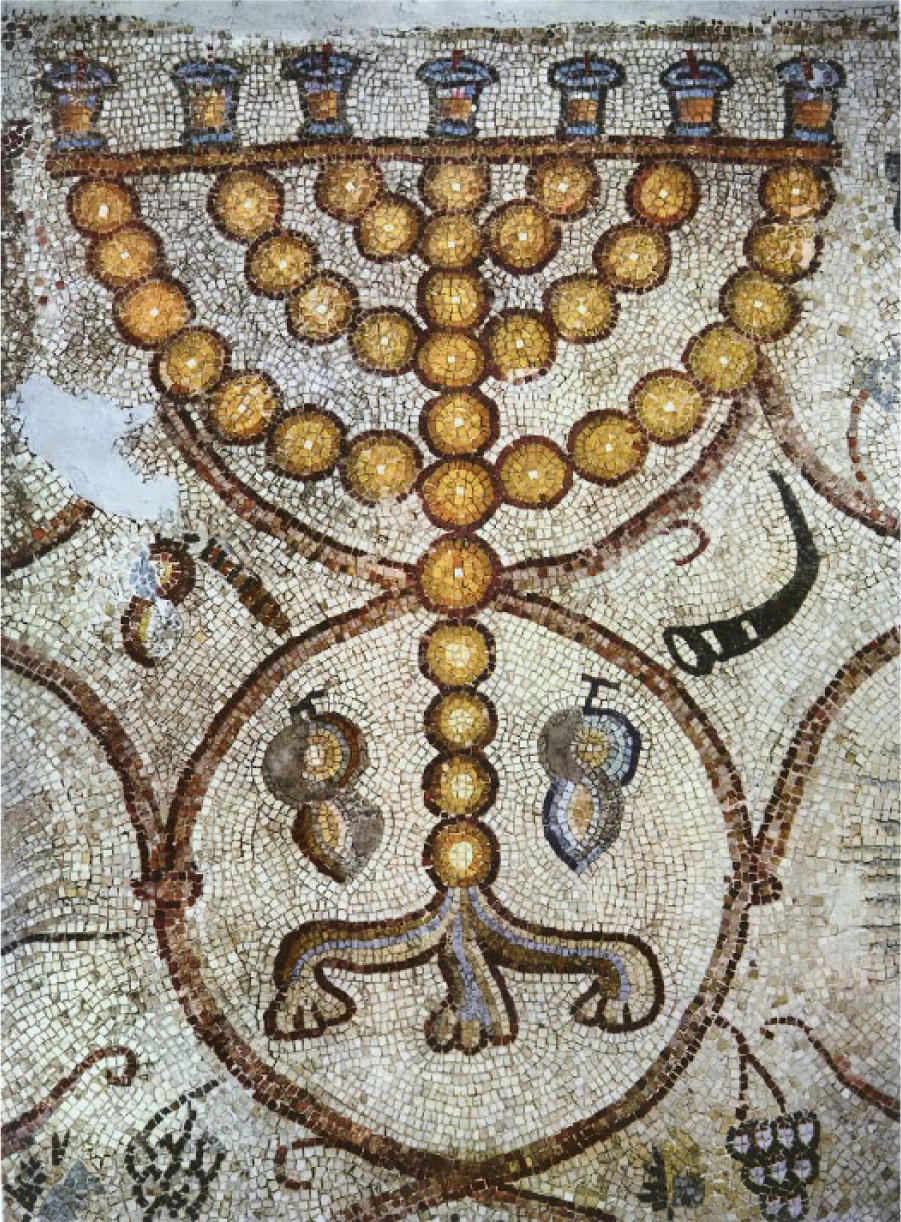
Menorah, 4th cent. CE. Mosaic from the synagogue in Hammath, Israel. Photo Credit: Erich Lessing/Art Resource, NY
The prohibition of defining G-d also entails that divine qualities tend to be very abstract. Exodus 34:6–7 combines attributes of mercy and justice in describing G-d as “
Covenant: G-d’s Interaction with Human Beings
Throughout the Hebrew Bible, G-d is known through interaction with human beings, particularly the people of Israel, who are chosen to have a special relationship in covenant with G-d.
15
The Hebrew Bible makes it clear that Israel has no special merit that makes it superior to other nations. To be chosen means simply that Israel is obligated to serve G-d as a means to ensure divine sanctity that ultimately will be revealed when
Covenantal Relationship Illustrated through Temple and Monarchy
Two major institutions in ancient Israel and Judah symbolize the covenant with G-d, viz., the temple and the monarchy. The temple is the holy sanctuary through which
The monarchy also serves as a key institution related to the covenant.
18
The monarch is
The Theological Challenge of Destruction and Exile
When threats to the integrity of Israel’s covenant with
Indeed, the Prophets attempt to explain the reversals in Israelite and Judean history, not as failures of G-d to abide by the covenant with Israel and Judah, but as failures by Israel and Judah to abide by their obligations to G-d. 20 The Former Prophets, known in scholarly circles as the Deuteronomistic History, attempt to explain the destruction of the northern kingdom of Israel and the southern kingdom of Judah as the result of the failures of their kings. The founding king of northern Israel, Jeroboam ben Nebat, is said to have erected idolatrous golden calves at the sanctuaries at Beth El and Dan, prompting all of his successor kings to emulate him in leading the nation to sin, ultimately resulting in its destruction as a punishment for idolatry (1 Kings 12–13; 2 Kings 17). Jerusalem was destroyed because of the sins of King Manasseh of Judah (2 Kings 21), so that even the righteous King Josiah, arguably the ideal monarch of the Davidic line, could not save the city (2 Kings 22–23). The Chronicler has a different view, however. The northern kingdom is not an issue for the Chronicler; rather, in keeping with his priestly outlook (like that of Ezekiel), later generations do not suffer for the sins of their ancestors; they suffer for their own sins. Manasseh, who reigned for fifty-five years, longer than any other Davidic monarch, repents in 2 Chronicles 33 and becomes a righteous monarch. Josiah dies in 2 Chronicles34–35 because he defies the will of G-d in his attempts to resist Pharaoh Neco of Egypt, and Jerusalem is destroyed because the people, priests, and officers of Jerusalem corrupted the temple (2 Chron 36:15).
The Latter Prophets (Isaiah, Jeremiah, Ezekiel, and the Twelve), all attempt to explain the destruction of northern Israel and southern Judah as well, but each does so from a distinctive theological framework. Isaiah is rooted in the royal Davidic tradition that posits
Although the Ketuvim (Writings) anticipate the restoration of Israel, Jerusalem, and the temple, many of the books found within examine the difficult questions concerning the morality, fidelity, and presence of G-d, the integrity of the covenant, and the ultimate meaning of life that follow from the experience of destruction and exile.
21
The book of Psalms is an important text in which the people of Israel and Judah give voice to their concerns. Although many psalms emphasize the praise of G-d, the lament or complaint genre is the most widely represented literary type in the book of Psalms, as the people ask when
Conclusion: Tanak and Tradition
Although the Bible or Tanak has its own literary and theological integrity, it can never stand alone as the sole sacred Scripture of Judaism. As we saw before, the Bible serves as the basis on which the Jewish people engage in dialog with, reflect upon, and continue to develop the tradition of Judaism, adapting it to the needs of newer times and continuing to probe the written text of the tradition in an effort to discern the Oral Torah which represents the fullest form of divine instruction. 22 Thus, the targumim, the Mishnah, the midrashim, and the two forms of the Talmud interpret the Bible and provide the foundations for Jewish life in exile following the destruction of the Second Temple in 70 CE and the defeat of the Bar Kochba revolt against Rome in 132–135 CE. The Heikhalot literature, developed from apocalyptic traditions, and the kabbalist literature began to probe divine action and character in an effort to discern how both justice and mercy, often reconfigured as evil and good, could coexist in the divine personality as well as the world at large. The philosophical literature and the medieval commentaries began to apply the tools of philosophical reason and philological study in an effort to respond to the challenges posed by Islam and Christianity and to expand Judaism’s understanding of its own tradition. The Hasidic literature developed Jewish spirituality for the masses in modern times, and the Zionist movement worked to rebuild Jewish life in the homeland of Israel.
Although Zionism was originally the product of Jewish secularism in the Haskalah, modern Zionism has become religious in an effort to reinstitute the ideals of the Torah. Diaspora religious movements, such as Reform, Conservative, Orthodoxy, Reconstructionist, Transdenominational, and other forms of Judaism, seek to develop forms of Judaism relevant to contemporary life. Altogether, Judaism is an ongoing tradition, founded on the Tanak or the Bible. Jewish biblical theology facilitates understanding of the foundations of Jewish tradition so that it might continue to develop for the future. 23
Footnotes
1
See Marvin A. Sweeney, “Biblical Theology, HB/OT,” Encyclopedia of the Bible and Its Reception (EBR), ed. Dale C. Allison, Jr., et al., 30 vols. (Berlin: De Gruyter, 2009— ) 3:1137–49; Benjamin D. Sommer, “Biblical Theology, Judaism,” EBR 3:1159–69.
2
Jon D. Levenson, “Why Jews are Not Interested in Biblical Theology,” in The Hebrew Bible, The Old Testament, and Historical Criticism: Jews and Christians in Biblical Studies (Louisville: Westminster John Knox, 1993), 287–307; idem, Sinai and Zion: An Entry into the Jewish Bible (Minneapolis: Winston, 1985); idem, Creation and the Persistence of Evil: The Jewish Drama of Divine Impotence (Princeton: Princeton University Press, 1988); idem, Resurrection and the Restoration of Israel: The Ultimate Victory of the G-d of Life (New Haven: Yale University Press, 2006).
3
Michael Fishbane, Biblical Myth and Rabbinic Mythmaking (Oxford: Oxford University Press, 2003).
4
Tikva Frymer-Kensky, “The Emergence of Jewish Biblical Theologies,” in Jews, Christians, and the Theology of the Hebrew Scriptures, ed. A. Ogden Bellis and Joel S. Kaminsky, SBLSym 8 (Atlanta: Society of Biblical Literature, 2000) 109–121; Tikva Frymer-Kensky and Tamara Cohn Eskenazi, Ruth, JPS Bible Commentary (Philadelphia: Jewish Publication Society, 2011).
5
Marc Z. Brettler, How to Read the Bible (Philadelphia: Jewish Publication Society, 2005); cf. idem, “My Bible—A Jew’s Perspective,” in The Bible and the Believer: How to Read the Bible Critically and Religiously, ed. M. Z. Brettler et al. (Oxford: Oxford University Press, 2012), 21–66.
6
Benjamin D. Sommer, “Dialogical Biblical Theology: A Jewish Approach to Reading Scripture Theologically,” in Biblical Theology: Introducing the Conversation, ed. Leo G. Perdue (Nashville: Abingdon, 2009), 1–53; idem, Revelation and Authority: Sinai in Jewish Scripture and Tradition (New Haven: Yale University Press, 2015).
7
Tamar Kamionkowski, Gender Reversal and Cosmic Chaos: A Study on the Book of Ezekiel, LBHBOTS 368 (London: T&T Clark, 2003).
8
Isaac Kalimi, “History of Israelite Religion or Hebrew Bible/Old Testament Theology? Jewish Interest in Biblical Theology?” in Early Jewish Exegesis and Theological Controversies: Studies in Scripture in the Shadow of Internal and External Controversies (Assen: Van Gorcum, 2002) 107–134.
9
Marvin A. Sweeney, Tanak: A Theological and Critical Introduction to the Jewish Bible (Minneapolis: Fortress, 2012).
10
Marvin A. Sweeney, Reading the Hebrew Bible after the Shoah: Engaging Holocaust Theology (Minneapolis: Fortress, 2008).
11
E.g., Isaac Kalimi, ed., Jewish Bible Theology: Perspectives and Case Studies (Winona Lake, IN: Eisenbrauns, 2012).
12
Jonathan Sarna, American Judaism: A History (New Haven: Yale University Press, 2004).
13
Shlomo Avineri, The Making of Modern Zionism: The Intellectual Origins of the Jewish State (New York: Basic Books, 1981).
14
Sweeney, Tanak, 20–41.
15
Joel S. Kaminsky, Yet I Loved Jacob: Reclaiming the Biblical Concept of Election (Nashville: Abingdon, 2007).
16
E.g., David Frankel, The Land of Canaan and the Destiny of Israel: Theologies of Territory in the Hebrew Bible, Siphrut 4 (Winona Lake, IN: Eisenbrauns, 2011).
17
Jon D. Levenson, “The Temple and the World,” JR 64 (1984): 275–98.
18
Marvin A. Sweeney, “Historical and Ideal Davidic Kingship,” The Jewish Study Bible, 2nd ed., ed. Adele Berlin and Marc Zvi Brettler (Oxford: Oxford University Press, 2014), 2035–41.
19
Jack Shechter, The Land of Israel: Its Theological Dimensions. A Study in the Promise and of a Land’s Holiness (Lanham, MD: University Press of America, 2010).
20
Sweeney, Tanak, 171–368; idem, Reading, 64–166.
21
Sweeney, Tanak, 371–483; idem, Reading, 167–227.
22
Sommer, Revelation and Authority.
23
I am indebted to my research assistant, Dr. Pamela Nourse, for her meticulous reading of my manuscript. All remaining errors are my own.