




Abstract
Building on the main tenets of labor process theory, this study introduces perceived location autonomy (PLA)—the autonomy to generate, evaluate, and choose where to perform one’s work tasks—and tests the relationships between PLA and worker productivity and well-being. Using a sample of academic knowledge workers (n = 319), our results suggest that workers experiencing higher PLA choose work environments to enhance both their productivity and their well-being through increased intrinsic motivation. Consistent with labor process theory, PLA acts as a form of empowerment that aligns knowledge worker and organizational goals to realize productivity gains while simultaneously allowing workers to enhance well-being. Together, these results suggest that managers may wish to consider integrating PLA into job and organizational design, as an alternative to control, as an effective strategy for boosting knowledge worker productivity and well-being.
Volatile and unforgiving environments today (Davis, Eisenhardt, & Bingham, 2009; Smith & Lewis, 2011) require organizations to move away from rigid bureaucracies focused on alignment and top-down control and instead toward autonomy and natural hierarchies capable of continuous adaptation (Davis et al., 2009; Uhl-Bien & Arena, 2018). The changes in the nature of work have also reinforced this need for more flexible and adaptable structures. Work has shifted from relatively routine tasks, grounded in established procedures, to work that increasingly embodies elements of new knowledge creation—or knowledge work—as a way to foster organizational adaptability (Florida, 2002; Kauppila & Tempelaar, 2016; Uhl-Bien & Marion, 2009). Knowledge work generates the novel solutions that enable an organization to remain adaptable and respond to both external and internal disruptions (Davis et al., 2009; Milosevic, Bass, & Combs, 2018; Salvato, 2009).
Despite heightened interest in the intricacies of knowledge work (Kauppila & Tempelaar, 2016; Williamson & Cable, 2003), there are still many questions regarding its creation and enactment. The questions remain because knowledge work is particularly complex, as it embodies intangible work products and an invisible production process. Hence, it involves a stream of activities that are less likely to be managed through direct oversight and control, typical of traditional bureaucracies (e.g., Alvesson, 2001; Frenkel, Korczynski, Donohue, & Shire, 1995; Hislop, 2008). In response, organizations are embracing managerial tools that emphasize autonomy and self-direction as a way to empower knowledge workers to generate the novelty needed for organizational adaptation (Uhl-Bien & Arena, 2018). As such, these employees tend to experience a higher level of job (how to perform the work) and schedule (when to perform the work) autonomy, which facilitates creativity and knowledge creation (see, e.g., Amabile, 1989; Andriopoulos, 2001; Daniels & Guppy, 1994; Madjar & Shalley, 2008).
A new form of autonomy, location autonomy, has emerged following the introduction of mobile technologies and the increasing availability of Wi-Fi. These tools have enabled knowledge workers to take their work with them to locations extending beyond traditional office or home locations (Bailey & Kurland, 2002; Daniels, Lamond, & Standen, 2001; Feldman & Gainey, 1997). However, unlike other forms of autonomy, such as job or schedule autonomy, autonomy to choose where to perform one’s work may be a bit more complex. First, as direct visual surveillance has been a long-held managerial practice to ensure worker compliance and productivity, managers may be reluctant to rescind it and so prohibit off-site working arrangements (Daniels et al., 2001; Johnson, 2004; Richardson, 2010). Second, perceptions of which locations are appropriate for work performance are likely to vary across individuals, based on the degree to which each person is willing to challenge traditionally held notions of what constitutes a “work environment” (Spivack, 2012). These variable perceptions of appropriate work locations may lead to conflicting ideas about viable alternatives to traditional work locations. Relatedly, and finally, other individuals both within and beyond the work domain may exert pressure through norms regarding which environments are perceived as legitimate (Hylmö & Buzzanell, 2002; Spivack, 2012).
These contradicting pressures make the decision of where to work complex, yet important, because of its considerable impact on individual work, in general, and knowledge work, in particular. More specifically, previous research has indicated that the use of teleworking arrangements, as a proxy for location autonomy, functions similarly as other forms of autonomy—it positively affects the attitudes and mental health of virtual workers required to be creative on the job (Rubin & Spivack, 2012). Based on this line of research, we suggest that as workers make work location choices, they are demonstrating some degree of perceived location autonomy (PLA)—the autonomy to generate, evaluate, and choose optimal locations for performing their work.
While it is related to other forms of autonomy, like job (Karasek, 1979) and schedule (Schieman, Milkie, & Glavin, 2009) autonomy, PLA is distinct in that it specifically emphasizes the freedom to choose a work location. More specifically, PLA enables individuals to generate diverse options for work locations, evaluate them based on their appropriateness in the context of the aforementioned pressures, and choose the optimal one to meet their current needs. The distinctiveness of the location dimension of autonomy becomes further apparent in a context where individuals have considerable job or schedule autonomy but do not have meaningful PLA, and vice versa.
The degree to which, and how, PLA affects the productivity and individual well-being of knowledge workers is less clear. For example, one critical question is to what extent knowledge workers make work environment choices that support organizational interests, like improved productivity, versus their individual interests, like improved well-being. Furthermore, it is less clear how PLA may influence these outcomes. What is the mechanism though which PLA may increase the productivity and well-being of knowledge workers? As organizations are pursuing reduced costs and the enhancement of individual well-being (Grant, Christianson, & Price, 2007; Luthans, Youssef, Sweetman, & Harms, 2013) by changing work arrangements (e.g., IBM was able to reduce costs by $200 million when it incorporated telecommuting), an increase in the availability of work locations has resulted in the need to understand how individuals leverage PLA to advance personal and organizational goals.
To this end, this study examines the relationships between PLA and knowledge worker productivity and well-being. We draw on labor process theory to build a theoretical model of PLA and its outcomes. Labor process theory highlights the ongoing tensions between control and empowerment of workers in enhancing organizational productivity (Braverman, 1974). Here, labor process theory offers a framework for studying the tensions between the constraints to PLA that can stem from long-standing managerial control traditions (Braverman, 1974) and the use of PLA as a form of empowerment to engender worker cooperation with organizational goals (Mir & Mir, 2005). Specifically, labor process theory may be used to examine how and why empowering workers through PLA may yield benefits such as improved productivity (Mir & Mir, 2005). We theorize that PLA increases individual intrinsic motivation (Thomas & Velthouse, 1990; Zhang & Bartol, 2010), which in turn influences individual choice of environments that will increase both productivity and well-being. The overall proposed model is presented in Figure 1.

Proposed model of relationships between location autonomy, intrinsic motivation, and work environment choices.
Our results make three important contributions to theory and practice. First, we contribute to the extant literature on organizational goals (Davis et al., 2009; Uhl-Bien & Marion, 2009) and job design (Grant, Fried, & Juillerat, 2011; Oldham & Fried, 2016) by suggesting that organizations should offer novel work arrangements that embody PLA as a key aspect of modern job design. In particular, we use labor process theory to discuss PLA as a mechanism of empowerment through which employees may become more agentic in their work by actively choosing the location that will maximize the desired outcome under particular circumstances. Here, we see knowledge workers make location choices likely to enhance both well-being and productivity. By highlighting these individual-level choices, this research contributes to the recent insights into increasing organizational-level adaptability via a bottom-up process (Milosevic et al., 2018; Salvato, 2009; Sekiguchi, Li, & Hosomi, 2017). The result of incorporating considerations of PLA into job design is an enhanced ability of organizations, through individual actions, to respond to shifts in the external environment (Uhl-Bien, Marion, & McKelvey, 2007).
Second, we answer calls to study the mechanisms through which job design characteristics, like forms of autonomy, may lead to positive organizational and individual outcomes beyond improved job satisfaction (Oldham & Fried, 2016). Here, we highlight how PLA aligns individual and organizational interests and positively affects both productivity and well-being. Given that formal managerial controls tend to stifle knowledge work and thus reduce organizational adaptability (Uhl-Bien & Arena, 2018; Uhl-Bien et al., 2007), it is critically important to find another mechanism to align individual and organizational interests. We show that PLA in job design is one viable solution. We also add to labor process theory by showing how empowerment through PLA aligns individual and organizational goals via intrinsic motivation. As individuals experience more PLA in their work, their intrinsic motivation to work is enhanced, thus decreasing the need for external controls by traditional bureaucracy. In this view, intrinsic motivation stemming from PLA facilitates alignment between individual and organizational goals and allows for the simultaneous pursuit of increased productivity and well-being.
Finally, our results illustrate an important opportunity for organizations to consider—incorporating PLA into their work arrangements as a way to increase both employee well-being and organizational productivity. Recent research on and insights from the practice of telecommuting have claimed mixed results (Gajendran & Harrison, 2007). On one hand, telecommuting is linked to better work–life balance and the ability to retreat to a home space offering fewer interruptions. On the other, the nature of work has changed, requiring more live interaction. As a result, the “working from home” option became less optimal for many employees, especially in the context of team-based structures. By increasing PLA, the range of locations expands beyond the binary choice between the solitude of home and the more trafficked work office location. It enables the consideration of alternative venues that offer a wider variety of characteristics and benefits useful for work performance. This flexibility allows the worker to optimize location through ongoing choices to reflect changing needs.
Theoretical Background
Labor Process Theory
Organizing requires the alignment of the efforts of individuals possessing differing motivations toward a shared goal. Labor process theory (LPT) emphasizes control in bringing order and productivity to such a group. LPT posits that management’s primary concern is to institute mechanisms of control and surveillance in order to extract maximal effort from workers in the pursuit of organizational goals (Braverman, 1974). In early work arrangements, workers were like the cogs of a machine, fixed in space, whereby output could be objectively measured, making the worker “a fully observable entity” (Mir & Mir, 2005, p. 57). Braverman’s (1974) original conceptualization of the labor process was criticized for its emphasis on the use of coercive power and neglect of the role that employees may play in subjecting themselves to managerial control (Mir & Mir, 2005).
Empowerment in Labor Process Theory
To remedy this gap in labor process theory, scholars revised it to consider conflict, agency, and resistance on the part of the worker (Burawoy, 1979; Knights & Willmott, 1989). In doing so, attention was drawn to the necessity of maintaining individual workers’ willingness to subject themselves to managerial control—cooperation from employees must be engendered (Mir & Mir, 2005). This revision of LPT highlights opposing philosophies in the pursuit of organizational objectives—overt managerial control of versus engendering cooperation from workers (Burawoy, 1979; Mir & Mir, 2005). One of the most common ways of engendering cooperation is through employee empowerment—workplace practices that offer greater decision-making latitude, a sense of ownership, and responsibility in organizational activities (Eccles, 1993; Lawler, 1992).
In contrast to authoritarian managerial strategies, empowerment marks an important change in organizational design by offering employees rewards for functioning as partners to the organization through granting them autonomy to act in the best interest of the organization. Specifically, through empowerment, employees take an active role in the production process and engage in decision making aimed at improvement of organizational performance from the bottom up (Piderit, 2000; Spreitzer, 1995; Sonenshein, 2010). Consequently, empowerment generates an opportunity for employees to feel a sense of ownership and align their personal identity with the goals and outputs of the organization, thus acting in line with organizational expectations without formal managerial controls (Mir & Mir, 2005).
In recent times, the preference for engendered cooperation over control is apparent. For example, in the context of organizational change, Piderit (2000) argues that managers have to engender employees’ support and active participation in the change process via empowerment rather than coercion and suppression of resistance. Similarly, to ensure that individuals are acting to advance organizational goals such as adaptability (Salvato, 2009; Uhl-Bien & Arena, 2018) necessitates psychological alignment between the worker and the organization that goes beyond coercion or compliance—the outcomes commonly tied to control. Furthermore, Uhl-Bien and Arena (2018) argue that leadership for organizational adaptability “addresses how leaders can position organizations and the people within them to be adaptive in the face of complex challenges” (p. 89). Empowerment becomes especially important in the context of knowledge work, where individuals often have to deviate from established procedures to generate novel insight (McIver, Lengnick-Hall, Lengnick-Hall, & Ramachandran, 2013; Milosevic et al., 2018). Indeed, previous research suggests that empowerment through autonomy is required to enable the experimentation and errors through which individuals catalyze knowledge generation (Anand, Gardner, & Morris, 2007; Edmondson, 1999; McIver et al., 2013; Schulz, 2001). In sum, empowerment leads individuals to engage in knowledge work aligned with the organizational goals of enhancing innovation and adaptability.
The relationship between PLA and work productivity
An important aspect of redesigning organizations to be more empowering and facilitate individual agency, needed for knowledge work (Anand et al., 2007), includes incorporation of flexible working arrangements, which translates into employees’ experience of PLA. This is a relatively new form of employee empowerment and grants knowledge workers discretion over, and responsibility for, where they choose to perform their work tasks (Rubin & Spivack, 2012). Research has indicated that workers who are empowered with greater autonomy regarding how to perform their work (job autonomy) have realized gains in productivity, quality, and financial performance (e.g., Appelbaum, Bailey, Berg, & Kalleberg, 2000; Arthur, 1994; Gajendran & Harrison, 2007; Huselid, 1995; Wood & de Menezes, 1998), as well as lower levels of employee absenteeism, lower turnover, and higher organizational citizenship behavior (Kehoe & Wright, 2010). Based on these results, it seems that workers utilize the autonomy granted to them to make choices that benefit the organization. Consequently, in line with LPT, when employees feel that they are more empowered than controlled—such as empowered to make choices about where to perform their work—they are likely to make choices that maximize their performance and are thus in line with organizational goals. Therefore, we present the following hypothesis:
The relationship between PLA and well-being
Worker autonomy, or discretion regarding how and whether to perform a particular work activity, is considered one of the key components required for people’s self-motivation, well-being, and social functioning (Ryan & Deci, 2000). Indeed, researchers have found that employees experience greater affective and organizational commitment (Berg, Kalleberg, & Appelbaum, 2003), work–family balance (Berg et al., 2003; Gajendran & Harrison, 2007), improved job satisfaction (Gajendran & Harrison, 2007), and reduced role stress (Gajendran & Harrison, 2007)—all contributing to their overall well-being—when they experience higher levels of autonomy in their work.
From this line of research, it follows that not only do empowered workers act to benefit their organization via increased performance (Salvato, 2009) but they also realize personal benefits. That is, individuals granted autonomy to make choices about their work are also more empowered to make choices to benefit their personal well-being, such as through managing role conflict or the demands of both work and family domains. Therefore, workers perceiving higher levels of location autonomy are expected to select environments that enhance their personal well-being in addition to their performance. Thus, we present the following hypothesis:
The mediating role of intrinsic motivation
Motivation embodies psychological processes that are critical for sustaining individual action (Latham & Pinder, 2005) or “an inner desire to make an effort” (Dowling & Sayles, 1978, p. 16). In addition to external motivators of individual action like rewards and recognition (Steers, Mowday, & Shapiro, 2004), the work itself may be a source of meaning for the individual and therefore interesting and motivating (Deci & Ryan, 1985). Intrinsic motivation is defined as “‘the desire to engage in an activity because one enjoys, or is interested in, the activity”’ (Sheldon, Turban, Brown, Barrick, & Judge, 2003, p. 359), and it is related to activities that are rewarding in and of themselves (Deci & Ryan, 1985).
When organizations empower workers by granting PLA, they are likely to induce a state of meaning, competence, self-determination, and impact (Spreitzer, 1995). For example, Thomas and Velthouse (1990) discussed empowerment as “a proximal cause of intrinsic task motivation and satisfaction” (p. 668). Similarly, Gagné, Sénécal, and Koestner (1997) found a positive relationship between empowerment and intrinsic motivation. Building on these results, we argue that granting PLA through empowerment will be related to higher levels of intrinsic motivation, and thus we present the following hypothesis:
As a consequence of PLA, knowledge workers become more intrinsically motivated, such that their goals become aligned with those of the organization (Mir & Mir, 2005). Intrinsic motivation often stimulates individuals to explore and create novel solutions (Ryan & Deci, 2000)—outputs critical to both knowledge work and organizational adaptability (Uhl-Bien & Arena, 2018; Uhl-Bien et al., 2007). Similarly, Zhang and Bartol (2010) found that intrinsic motivation stemming from empowerment is positively related to individual creative engagement. And intrinsically motivated individuals sustain their efforts even when encountering difficulties (Shalley, Gilson, & Blum, 2000). Furthermore, intrinsic motivation has been associated with job satisfaction, well-being, and more effective performance, especially for tasks that are complex, creative, and interesting, or tasks that are less complex but require discipline to complete (Gagné & Deci, 2005). Hence, knowledge workers, who are tasked with the production of complex, creative, intellectual outputs (Florida, 2002), are likely to use their discretion to select environments that provide both positive productivity outcomes for the organization and well-being outcomes for themselves. Therefore, we present the following hypotheses:
Method
Participants and Procedure
The participants of this study were members of the academic community at a large university in the southeastern United States, including undergraduate students, graduate students, and faculty. Faculty and graduate students are knowledge workers as they are involved in creating and disseminating new knowledge, via papers and presentations (Williamson & Cable, 2003). Undergraduate students are also involved in knowledge work tasks (i.e., creative problem solving, generating and sharing knowledge in team settings, etc.) as modern curricula train them for knowledge work positions (Aasheim, Williams, Rutner, & Gardiner, 2015). Although student samples are often used and criticized as convenience samples in psychological and management research (see, e.g., Peterson & Merunka, 2014), here they represent individuals with the characteristics of particular interest for this study—knowledge workers granted meaningful autonomy about where their work is completed and typically having access to information technologies that afford work mobility. In addition, these workers may be less subject to a variety of organization-specific constraints (e.g., data security risks, organizational culture incompatibility).
A link to the online survey, hosted by QuestionPro, was sent to a random subsample (n = 1,500) of faculty (n = 540), undergraduate students (n = 420), and graduate students (n = 540). The total campuswide population of each group was 980 faculty, 18,839 undergraduate students, and 4,780 graduate students. On clicking the link to access the survey, respondents had the opportunity to agree to participate after reading an informed consent statement. Most of measures used in this study were taken or adapted from published scales; however, two scales were created to meet the needs of this study: (1) choice of location to enhance productivity and (2) choice of location to enhance well-being. The process used to demonstrate support for these measures is presented in the measures section.
From the 1,500 individuals solicited through an email invitation to participate in the survey, there were 319 usable responses, yielding a 21% response rate. This response rate is in line with previous email survey studies conducted at this university, but it is still higher than the 10% response rate typical of web-based surveys today (Mol, 2017). As the university frequently issues surveys via email, survey fatigue among email recipients is likely. Also, the survey’s design was such that participants were unable to return to the survey to complete it across multiple sessions, to protect anonymity. Thus, if they were unable to complete the survey in one session, it may have led to higher levels of missing data and unusable responses.
The sample was composed of 59.2% faculty, 32.5% graduate students, and 8.4% undergraduate students. The gender of the participants was 43% male and 57% female. Age was fairly evenly distributed, with 16.6% being 18- to 24 years old, 17.5% of 25- to 34-year-olds, 24% of 35- to 44-year-olds, 20.1% of 45- to 54-year-olds, and 21.8% being 55 years and older. Ethnicity was predominantly white or Caucasian (79.7%), with 7.2% being Asian, 6.6% black or African American, 3.0% Hispanic or Latino, and 3.6% other. Three variables were controlled for: gender, age, and position. Gender was controlled for because previous research demonstrated gender differences in perceptions of autonomy in knowledge-intensive firms (Truss et al., 2012). Age was controlled for in response to previous research that indicated age can influence the pattern of engagement with flexible work options (Loretto & Vickerstaff, 2015). Position (i.e., faculty, graduate student, or undergraduate student) was also used as a control variable to avoid the influence of position differences on the relationships between autonomy, motivation, and environment choices.
Measures
Perceived Location Autonomy
PLA was measured using seven items with a 5-point Likert-type scale adapted from Schieman et al. (2009) to reflect feeling free to decide where to work. The Cronbach alpha of the scale was .83. Sample items included the following: “I have the freedom to decide where to complete my work, “It is basically my own responsibility to find or create an environment that allows me to get my work done,” and “I feel free to work off-site.”
Job Autonomy
Job autonomy was measured using three items with a 5-point Likert-type scale from Schieman et al.’s (2009) measure of job autonomy to reflect feeling free to decide how to work. The Cronbach alpha of the scale was .72. Sample items included “I have the freedom to decide what I do on my job” and “It is basically my own responsibility to decide how my job gets done.”
Schedule Autonomy
Schedule autonomy was measured via five items on a 5-point Likert-type scale, including a single item measuring schedule control (Schieman et al., 2009) and four additional items adapted from Schieman et al.’s (2009) scale to reflect feeling free to decide when to work. The Cronbach’s alpha of the scale was .81. Sample items included the following: “It is my responsibility to decide how many hours I work,” “I have a lot of say about how I use my work hours,” and “I can be unavailable to others during hours I have designated as nonwork hours.”
Intrinsic Motivation
Intrinsic motivation was measured using the Work Extrinsic and Intrinsic Motivation Scale (Tremblay, Blanchard, Taylor, Pelletier, & Villeneuve, 2009), including three items for each of six subscales on a 7-point scale: intrinsic motivation, integrated regulation, identified regulation, introjected regulation, external regulation, and amotivation. The Cronbach alpha of each subscale was .86, .85, .70, .75, .77, and .83, respectively. Sample items included “Because I chose this type of work to attain my career goals” and “Because it allows me to earn money.” Each subscale score was used to create an overall index of intrinsic motivation, called the work self-determination index, following the procedure used by Tremblay and colleagues (2009); the subscales were multiplied by weight factors. The controlled subscales, referring to external motivation, are weighted negatively, and the intrinsic subscales, referring to internal motivation, are weighted positively. The more controlled the regulatory style represented by a subscale, the larger is its negative weight; and the more intrinsic the regulatory style represented by a subscale, the larger is its positive weight. The overall intrinsic motivation score was computed using the following formula: (3 × intrinsic motivation + 2 × integrated motivation + identified regulation) − (introjected regulation + 2 × external regulation + 3 × amotivation).
Environment Choices
Because there were no previously published scales that measured the choice of work environment’s relationship to productivity, or the choice of work environment’s relationship to well-being, items were developed to test these two outcome variables. These items were originally developed through interviews with graduate students and faculty as part of another study, based on the language used by the interviewees to explain how they make work environment choices. Emerging from these interviews were insights with regard to work environment choices that were made to enhance productivity related to the task at hand and environment choices that were made to enhance the personal well-being of the individual. To reflect those two aspects of choice, five items rated on a 5-point Likert scale were created to measure choice of task-focused, productivity-enhancing environments, and choice of environments that enrich worker well-being was evaluated using seven items measured on a 5-point Likert-type scale.
We followed established procedures for measure development (Hinkin, 1995). First, the data file was split to test the new scales for how many latent variables underlie the outcome items. The first subsample (n = 109) was used for exploratory factor analysis of the 12 items. This subsample size was used because the recommended size for an initial exploratory factor analysis should be about 5 to10 responses per item (DeVellis, 2003), while still allowing for sufficient sample size for the other analyses in this study. Maximum likelihood estimation with oblimin rotation was used to allow for the factors to be correlated. Two factors were extracted with an eigenvalue greater than 1.0, explaining a total of 67% of the variance in the items, and the items aligned with these two factors as anticipated. All items had loadings on their respective factor above the recommended 0.40 threshold (DeVellis, 2003).
Sample items reflecting choice of environments enhancing productivity included the following: “This environment is the optimal environment for these tasks,” “This environment puts me in the right frame of mind to work on these tasks,” and “After working in this environment, I usually feel that I have been productive.” Sample items reflecting choice of environments enhancing worker well-being included the following: “The environments I work in contribute positively to my work life satisfaction,” “The environments I work in contribute positively to my work–life balance,” and “The environments I work in make me feel mentally healthy.” The responses for each scale were averaged; Cronbach’s alpha was .93 and .90, respectively, for the two scales.
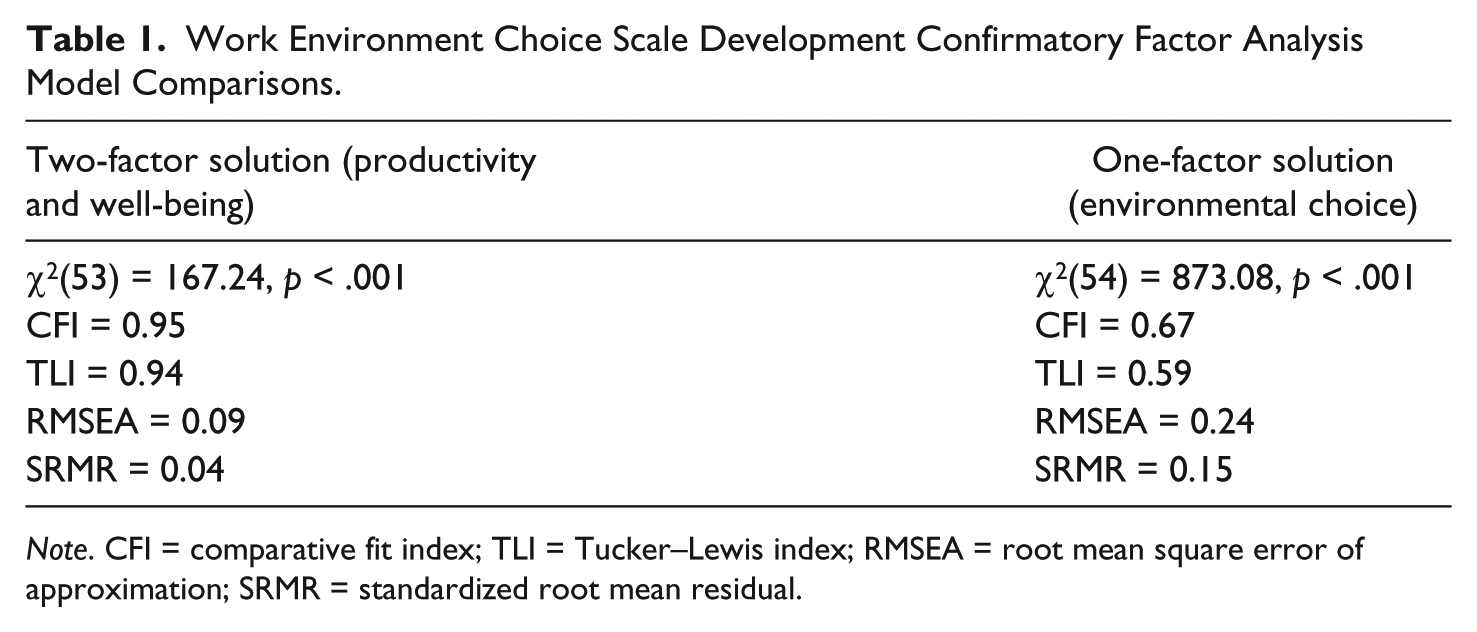
Next, the second subsample (n = 210) was used in confirmatory factor analysis (CFA) to test the structure of the outcome variables for model fit. As recommended with CFA, the theoretical two-factor model was compared with a one-factor model to demonstrate support for the model (Hinkin, 1995). As expected, the fit indices showed much stronger support for the two-factor model, representing the choice of environments to enhance productivity and the choice of environments to enhance well-being. See Table 1 for the fit indices. Estimates of reliability (Cronbach’s alpha) from this second subsample were .93 and .93 for productivity and well-being, respectively.
Work Environment Choice Scale Development Confirmatory Factor Analysis Model Comparisons.
Note. CFI = comparative fit index; TLI = Tucker–Lewis index; RMSEA = root mean square error of approximation; SRMR = standardized root mean residual.
In addition, the determination of location autonomy as a related but distinct form of workplace autonomy, separate from both job and schedule autonomy, was tested through CFA using MPlus 6.11. The hypothesized model fit the data reasonably well. The CFA results showed that the three-factor model (i.e., job, schedule, and location autonomy) fit the data better than the standard alternative model test of a one-factor model (Hinkin, 1995). See Table 2 for the fit indices.
Location Autonomy Versus General Autonomy Confirmatory Factor Analysis Model Comparisons.

Note. CFI = comparative fit index; TLI = Tucker-Lewis index; RMSEA = root mean square error of approximation; SRMR = standardized root mean residual.
Analysis
Following the procedures of Edwards and Lambert (2007) and Shoss, Eisenberger, Restubog, and Zagenczyk (2013), the hypotheses were tested through mediation analyses using Hayes’s (2013) PROCESS macro (Model 4). The SPSS PROCESS macro provided by Hayes (2013) calculates both separate path coefficients (e.g., path a and path b) and the bootstrapped confidence interval (CI) of the indirect effect a × b. Effects are recognized as significant when the upper and lower bounds of the bias-corrected 95% CIs do not contain zero (Hayes, 2013). Using bootstrapped CIs, power problems introduced by asymmetric and other nonnormal sampling distributions of an indirect effect can be avoided. Also, researchers have explained that to demonstrate mediation, it is unnecessary to establish a direct effect between the independent variable and the dependent variable, which makes bootstrapping a more appropriate approach than the Sobel (1982) test (see, e.g., Zhao, Lynch, & Chen, 2010, pp. 199-201). Here, mediation is assessed by the indirect effect of X (independent variable) on Y (dependent variable) through M (the mediator), which can be significant regardless of the significance of the total effect (the effect of X on Y) and the direct effect (the effect on Y when both X and M are included as predictors).
Common Method Variance
Because we collected the data from a single source at a single point in time, we need to address the concern of common method variance (Podsakoff, MacKenzie, & Podsakoff, 2012). In the design of the survey, we paid attention to best practices to minimize common method variance, as suggested by Podsakoff et al. (2012), including through the writing of items to enhance clarity and readability, including some reverse-worded items, and only including individuals who would have the interest and motivation to complete the survey honestly. We also ran pilot testing of the survey with individuals similar in background to the targeted group. This process helped us ensure that its overall length was manageable. After the data collection was completed, we needed to assess the degree to which the data were subject to common method variance. Toward this end, we used the post hoc common latent factor test (Podsakoff et al., 2012; Williams, 2017). By adding a common latent factor to a CFA of all the study variables, we can capture any unmeasured shared variance across all of the study items, which would reflect method-related variance (Williams, 2017). If there is significant unmeasured shared variance, the addition of a common latent factor to the CFA model of all the study variables will lead to substantial changes in the correlations between the latent variables in the model. Comparing the correlations between the latent factors before and after we added the unmeasured latent measure construct, all changes in the standardized correlations were below the 0.2 threshold (ranging from −0.127 to 0.139), indicating that the systematic variance due to measurement did not seem to change the pattern of relationships in the overall model (Williams, 2017).
Results
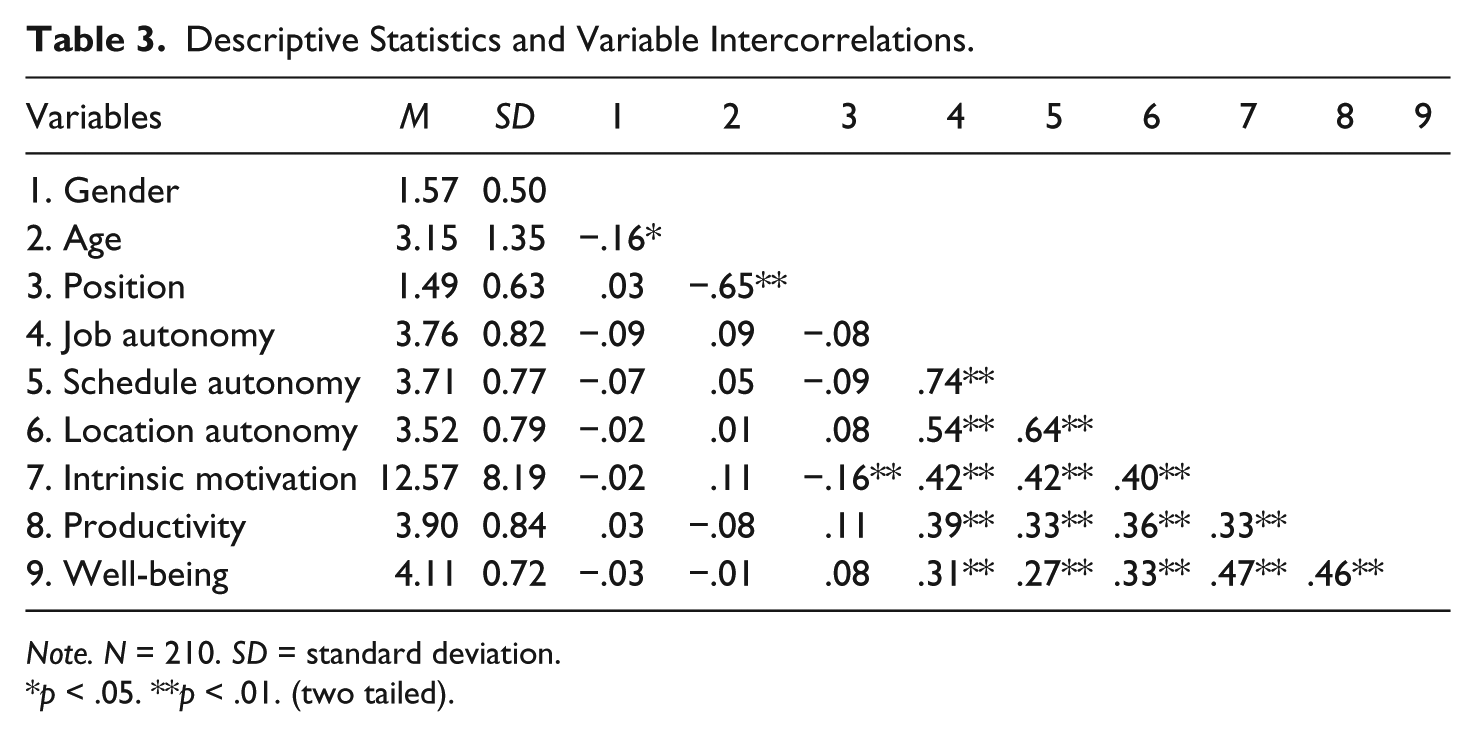
Descriptive statistics and zero-order correlations among the study variables are shown in Table 3. The mean (12.57) and standard deviation (8.19) for autonomous motivation suggest a degree of variability in the degree of intrinsic motivation. As anticipated, intrinsic motivation is positively related to all forms of autonomy as well as to choice of environment to enhance productivity and choice of environment to enhance well-being.
Descriptive Statistics and Variable Intercorrelations.
Note. N = 210. SD = standard deviation.
p < .05. **p < .01. (two tailed).
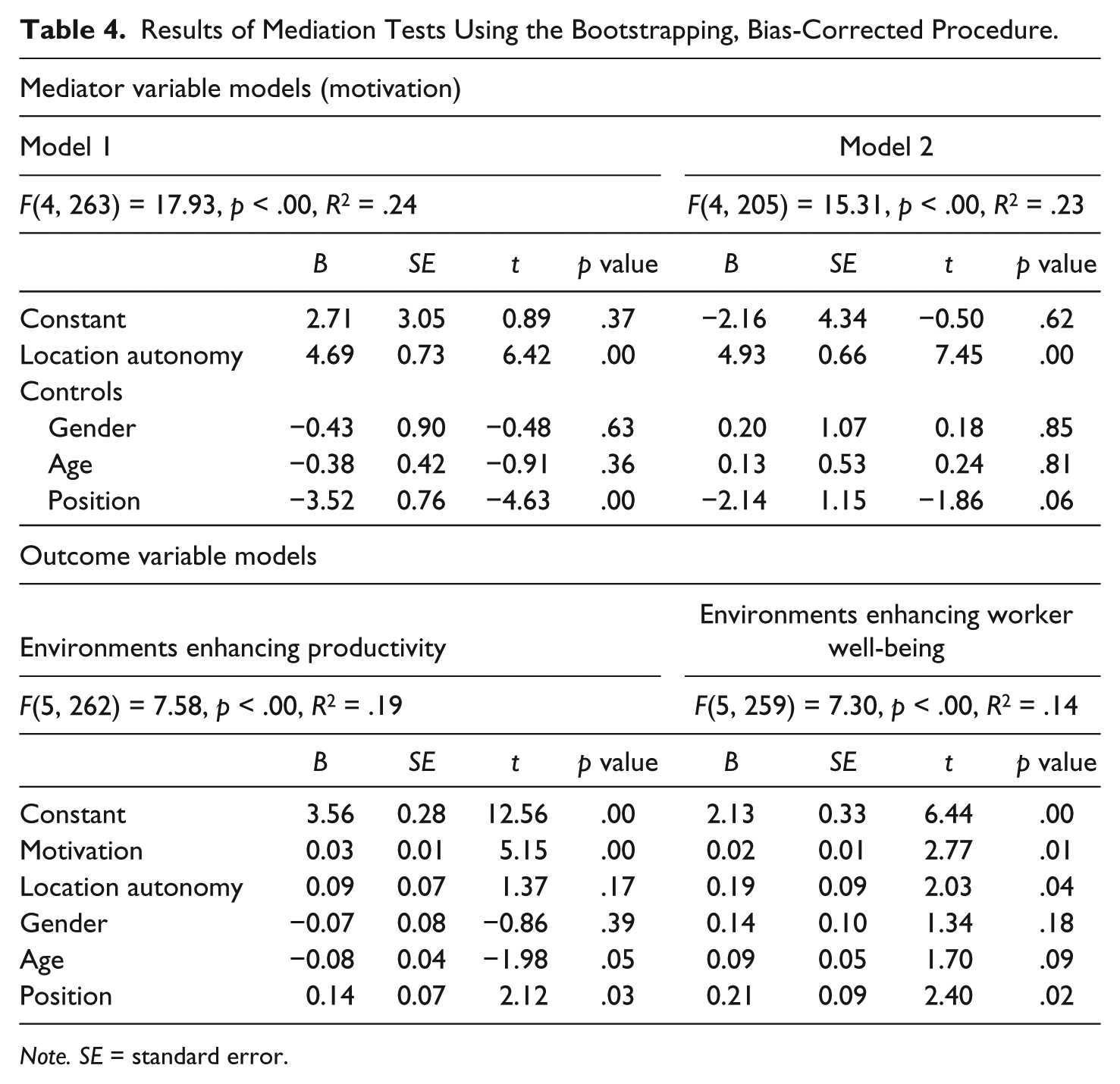
The results of the mediation analyses are presented in Table 4, and the relationships tested are presented in Figure 2. The results demonstrate support for Hypotheses 1 and 2; individuals with higher perceived location autonomy were more likely to choose work environments that enhanced their productivity and well-being. As individuals perceived higher levels of location autonomy, they became more intrinsically motivated, providing support for Hypothesis 3. Hypotheses 4 and 5 were also supported; as perceived location autonomy increased, individuals became more intrinsically motivated, which accounted for their choosing environments that enhanced productivity and well-being. Intrinsic motivation partially mediated the relationship between PLA and choice of environments to enhance productivity but fully mediated the relationship between PLA and choice of environments to enhance well-being.
Results of Mediation Tests Using the Bootstrapping, Bias-Corrected Procedure.
Note. SE = standard error.
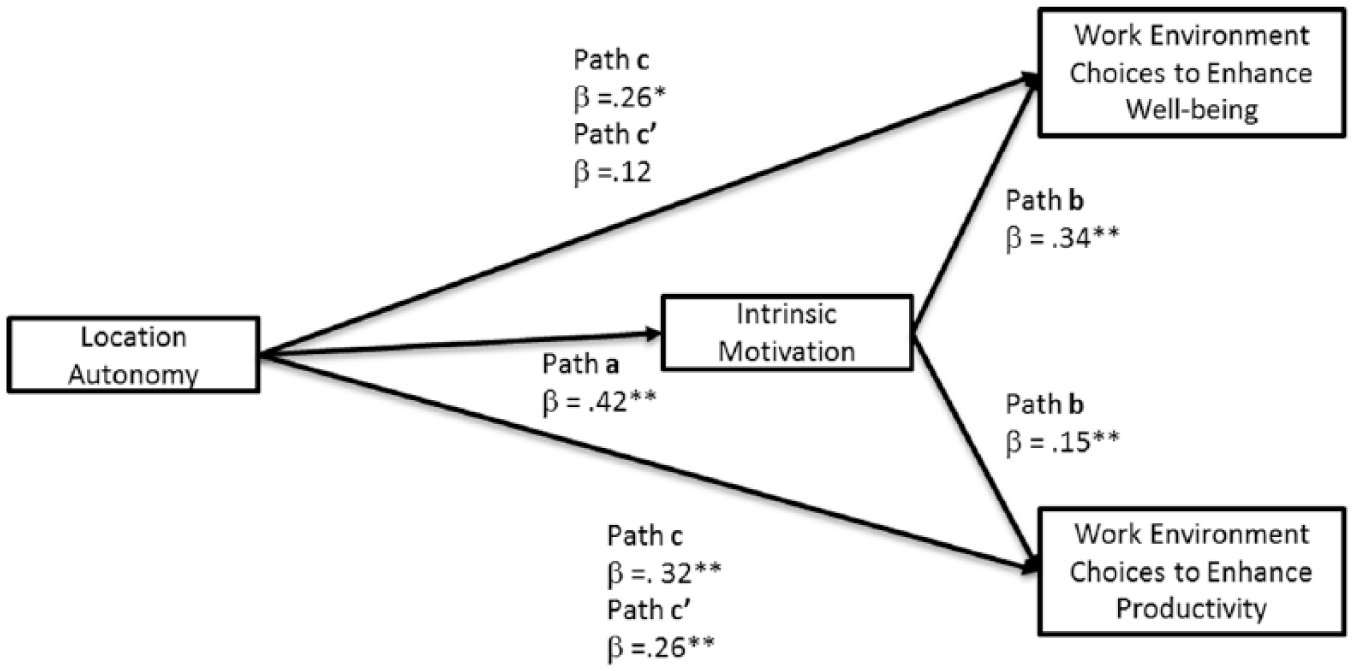
Hypothesis testing through mediation models presented as statistical diagrams.
To evaluate the significance of the conditional effect, 95% bias-corrected, bootstrapped CIs (using 1,000 bootstrap samples) were generated. The effect of PLA on choice of environments enhancing worker well-being is significantly mediated by intrinsic motivation: B = 0.15 (0.04), 95% CI [0.08, 0.26]. Similarly, the effect of PLA on choice of environments enhancing productivity is significantly mediated by intrinsic motivation: B = 0.11 (0.05) 95% CI [0.03, 0.21].
Discussion
The ability to adapt to continuously changing circumstances is critical for contemporary organizations (Brown & Eisenhardt, 1997; Farjoun, 2010; Miller, Pentland, & Choi, 2012). Continuously changing circumstances are fueled by technological advancements and increased global connectivity, which together have intensified interdependencies and competition between organizations (Garud, Tuertscher, & Van de Ven, 2013). To respond optimally requires consideration of both organizational products and processes, specifically those related to knowledge generation and innovation (D’Aveni, Dagnino, & Smith, 2010; Garud et al., 2013; Uhl-Bien & Arena, 2018). Accordingly, greater emphasis is placed on a job design that enables individuals to deviate from established, and often rigid, procedures in order to facilitate the desired creative thinking and knowledge production that enhances an organization’s adaptability (Davis et al., 2009; Milosevic et al., 2018). This also includes the flexibility of allowing workers to discover, through ad hoc experimentation (i.e., microadaptations; Turner & Rindova, 2012), the best ways to perform their work in the current, but changing, landscape. In this way, not only are work practices made more adaptable, but so too is the organization (Garud et al., 2013; Grant & Parker, 2009; Milosevic et al., 2018; Uhl-Bien et al., 2007). Despite growing interest in the microfoundations of organizational adaptability (Dionysiou & Tsoukas, 2013; Uhl-Bien & Arena, 2018), limited insights exist regarding the mechanism through which autonomy, including different types of autonomy, may affect knowledge work. To this end, our findings make three important contributions. We will elaborate on each in more detail below.
First, our study contributes to the literature on organizational goals (Davis et al., 2009; Uhl-Bien & Marion, 2009) and job design (Grant et al., 2011; Oldham & Fried, 2016) by introducing PLA, an emerging form of workplace empowerment that has created new opportunities in working practices. We illustrate how PLA, when built into work arrangements, provides a source for bottom-up responsiveness to changing circumstances (Grant & Parker, 2009; Turner & Rindova, 2012). Put simply, at the individual level, PLA creates opportunities for knowledge workers to proactively manage their work and their personal well-being. Specifically, knowledge workers are able to select work environments that best meet their immediate work performance needs given current circumstances, leading to positive individual and organizational outcomes. In other words, knowledge workers who take advantage of the opportunity to proactively craft their jobs are more likely to have a stronger desire to engage in their work and have stronger cognitive involvement with their work (Sheldon et al, 2003). By granting PLA, organizations enable individuals to make micro-adaptations in their work processes that increase their productivity and aid in organizational adaptability (Uhl-Bien et al., 2007).
Second, our results answer the call to explicate the mechanisms through which aspects of job design, such as PLA, lead to positive organizational and individual outcomes (Grant & Parker, 2009; Oldham & Fried, 2016). Drawing from recent findings on the role of intrinsic motivation in psychological empowerment (Thomas & Velthouse, 1990; Zhang & Bartol, 2010), we tested and found support for intrinsic motivation as a mediator between PLA and the seeking of enhanced productivity and well-being through optimal work environment choices. Specifically, and consistent with labor process theory, our results indicate that PLA operates as a form of empowerment that aids in aligning organizational and individual goals (Burawoy, 1979; Mir & Mir, 2005). This finding is particularly relevant in the current environment, where organizations are moving away from rigid bureaucracies focused on alignment and top-down control toward natural hierarchies capable of optimal adaptability (Davis et al., 2009; Hamel, 2009; Uhl-Bien et al., 2007). As these changes occur, traditional managerial tools of control are of limited use. Instead, greater emphasis must be placed on how organizations may nurture individual self-direction and autonomy to advance organizational objectives (Salvato, 2009) such as adaptability (Uhl-Bien & Arena, 2018), innovation (Garud et al., 2013), and overall performance (Uhl-Bien et al., 2007). Our results contribute to this line of research by illustrating the important role intrinsic motivation may play in channeling PLA toward positive outcomes.
Third, we contribute to the discussion of how job design may enhance organizational adaptability in terms of internal processes of the organization itself. Particularly, by building PLA into work arrangements, employees become empowered to make optimal work environment decisions in an ad hoc manner. This is especially relevant given the rapid pace of change and the emergence of perhaps unforeseen options for work environments. In other words, PLA, like other forms of work autonomy, contributes to the flexibility and adaptability of the organization overall by allowing workers to continually experiment with an expanding and changing variety of work process options. As knowledge workers experiment with and uncover new environments that lead to desirable organizational and individual outcomes, these bottom-up choices (Grant & Parker, 2009; Turner & Rindova, 2012) and micro-adaptations (Uhl-Bien et al., 2007) will become part of the routine practices of the organization. In this way, PLA may be another important element in the development of natural hierarchies capable of the optimal adaptability needed in today’s environment (Uhl-Bien & Arena, 2018).
Implications for Managers
Finally, our results offer multiple implications for managers. First, our results challenge the long-standing belief that reduced productivity will result from flexible work arrangements that confer PLA because of the lack of control and increased difficulty employing surveillance over workers. Instead, we presented evidence suggesting that such arrangements create opportunities for knowledge workers to select environments that optimize their productivity and well-being. Thus, organizational leaders may want to consider increasing the freedom granted to knowledge workers to choose work sites, given the attractive potential outcomes, including enhanced intrinsic motivation, productivity, and well-being. For example, managers could engage in PLA-supportive job redesign by offering knowledge workers technology tools to support remote work, as well as shifting from face time as an indicator of productivity to an outcome-based approach.
In addition, our results suggest that organizational leaders may also wish to identify any potential constraints to PLA (e.g., organizational norms that may artificially limit the potential choices), as well as where those constraints to PLA may originate, even if organizational policies suggest that workers should feel autonomous to choose their work environments. For instance, it seems important for organizational leaders to foster a unified culture supportive of the policies regarding work arrangements (Cañibano, 2013; Johnson, 2004). To do this, managers could offer training about variability in individual working preferences and how these policies may result in better work outputs.
Limitations and Future Research
Although this study provides important insight into the dynamics of PLA in knowledge work, there are several limitations that should be noted. First, we utilized a cross-sectional design in this study, requiring some caution in the interpretation of the results. Although it appears from the analysis and theoretical arguments that intrinsic motivation is a strong mediator between location autonomy and work environment choices, causality cannot be demonstrated between the variables using this study design. Future research should consider longitudinal study and experimental design to explicate some of the dynamics suggested here.
Second, the data in this study were collected using self-reports from knowledge workers in an academic setting, raising the possibility that same source bias was present. Although the nature of most of our constructs required us to use the knowledge workers as a source (i.e., their experience of PLA and intrinsic motivation), and subsequent tests indicated that same source bias is not likely present to the extent that the findings are affected, this limitation has to be acknowledged. Relatedly, given that the data were collected in a single academic institution, generalizability of the results is limited. For example, university campuses typically offer a wide variety of work environments that are easy for academic knowledge workers to access and use. Therefore, readers should use extreme caution when applying these results to other organizational contexts and other populations of knowledge workers. So, although this research showed support for offering academic knowledge workers location autonomy to realize gains in productivity and well-being, these results should be tested for applicability to other populations.
Although the results suggest support for location autonomy as a new form of employee empowerment that aligns worker and organizational interests, as presented above, the discussion of the results would be incomplete without also considering an alternative interpretation, especially in light of the evidence that intrinsic motivation only partially mediated the relationship between PLA and choices of environment to enhance productivity. This suggests that another mechanism, apart from transforming a worker’s motivation to more intrinsic forms, may explain the pursuit of environments to enhance productivity. For example, it may be that workers have some PLA but they are only using it in ways that conform to managerial practices of control and surveillance. Driven by organizational norms, workers may be selecting traditional work environments on-site in an effort to demonstrate organizational commitment and avoid perceptions of shirking.
In addition, PLA may result in consequences other than those related to increased productivity or well-being. These consequences may include impacts on employee reputation, such as through perceptions of commitment, legitimacy, being a team player, and availability, as well as potential access to promotion opportunities. Unintended consequences have been tied to workers using alternative work arrangements, such as part-time work (e.g., Epstein, Seron, Oglensky, & Sauté, 1999). Suggesting the salience of some of these concerns, previous work has demonstrated cases of low willingness to telework even among younger, tech savvy workers (Wicks, 2002). Similarly, a variety of other control mechanisms may be dictating the decisions of workers, including, but not limited to, normative pressures stemming from the organization’s culture and connections to colleagues and others in the profession (e.g., Kunda, 1992; Spivack & Rubin, 2011). In other words, it may be that a variety of other factors may affect the enactment of PLA, requiring future study.
In addition to addressing the above limitations, future research may expand on this study in several important ways. First, studies should examine other variables that may influence the relationship between PLA and work environment choices, such as personality characteristics that have previously been studied in relation to adaptive performance (i.e., Le Pine, Colquitt, & Erez, 2000). For example, individuals scoring high in openness to experience may have a higher propensity to try nontraditional work environments and thus be more apt to discover those that offer enhanced productivity or well-being; the way they enact PLA may lead to better work location optimization. Workers high in conscientiousness may be more likely to become intrinsically motivated and thus more likely to choose productivity-enhancing environments. Second, other outcome variables could be tested, including organizational commitment (Ng, Butts, Vandenberg, DeJoy, & Wilson, 2006) and creativity (Amabile, 1996), for workers who take advantage of location autonomy. Third, it is likely that there are other factors, beyond motivation, that influence productivity-minded work environment choices that were not considered here. For example, researchers could incorporate other moderating and mediating variables, such as those that have been studied related to schedule autonomy—management communication and opportunity for learning (Ng et al., 2006)—or other variables including job values, social support, or the convenience and availability of diverse work environments. There are thus many avenues for future research.
Conclusion
How organizations maintain natural hierarchies capable of optimal adaptation has long eluded scholars. Part of the challenge is in understanding how microlevel activities such as individual self-direction and productivity can enhance organizational capabilities without, or in spite of, traditional top-down controls. The findings of this study provide preliminary insights into how flexible work arrangements, specifically those that confer location autonomy, may be used to align individual and organizational goals, thus decreasing the need for formal control. Particularly, our findings show that when organizations empower knowledge workers through PLA, they create opportunities for them to engage in micro-adaptations that increase their productivity and well-being. The micro-adaptations take place as knowledge workers evaluate different work locales and make decisions as to which ones will be the most optimal for their work. Via a bottom-up approach, knowledge workers proactively and continually evaluate and incorporate effective work environments into their work practices, thus contributing to organizational adaptability.
Footnotes
Declaration of Conflicting Interests
The author(s) declared no potential conflicts of interest with respect to the research, authorship, and/or publication of this article.
Funding
The author(s) received no financial support for the research, authorship, and/or publication of this article.