



Abstract
Based to a considerable extent on Margaret Archer’s approach to reflexive agency, we discuss a multi-year insider/outsider research collaboration that has taken place in a University-based Centre designed to bring academics and management practitioners together to conduct applied research and learn from each other. We focus in particular on the experiences of the insider researcher, showing how, based on her reflexive practice, the collaboration has led to both scholarly contributions and changes in practice in the Centre and her University. In doing so, we flesh out the importance of reflexivity and its important impacts on academic-practitioner collaborations. In long-term insider/outsider collaborations that provide psychologically safe places, outsider researchers can metaphorically hold a mirror up to insider researchers that foster their reflexivity and its subsequent impacts.
Keywords
Collaborative inquiry, in all its modalities, (Coghlan, 2011), involves co-researchers conducting complex research projects that also purposefully change praxis (MacIntosh et al., 2017; MacIntosh et al., 2021). Working together, insiders to a setting and those who ‘visit’ as outsiders (often from a position of semi-detached objectivity [Bartunek & Louis, 1996]) study activities in a setting in a way that is intended to contribute to both scholarly knowledge and praxis.
What is less recognized, though nonetheless very important, is the recursive potential of an insider/outsider collaboration for impact on insider researchers, and, through them, for change in their settings. This may happen if, over time, in safe relationships (Edmondson, 1999) and marginal positions, sometimes labelled liminal spaces (Beech, 2011; Empson, 2013), insider and outsider researchers “work through” (Lüscher & Lewis, 2008, p. 232) similarities and differences in their perspectives to make their joint contribution. Such relationally reflexive activities (Hibbert et al., 2010; MacIntosh et al., 2017) encourage learning from tensions and contradictions in such settings in ways that are meant to be generative (Putnam et al., 2016).
There are multiple examples of insider/outsider research teams contributing to scholarly knowledge and practice (e.g., Bartunek, Foster-Fishman, et al., 1996; Bartunek, Trullen, et al., 2007; Bartunek, Walsh, et al., 2000; Gioia et al., 2010; Khanna et al., 2021; Sawyer & Clair, 2022). Such collaborative inquiries may draw heavily on philosophies of practical knowing (Coghlan, 2011) as the basis for research because these are particularly effective for transcending semantic and pragmatic differences (Carlile, 2004: Van de Ven, 2007) between people whose praxis evolves in substantively different contexts.
Cassell, Radcliffe and Malik (2020, p. 752) recognize “a burgeoning literature within organization studies that highlight the role and contribution of (external) researcher reflexivity.” These benefits include enabling (external) researchers to be aware of their own thinking, question their taken-for-granted assumptions, and enable “more imaginative, nuanced and richer interpretations” of their data (Cunliffe, 2011, p. 409). However, there is virtually no literature on the possible impacts of insider researchers’ reflexivity in a setting. Though MacIntosh et al. (2017; 2021) recognize the importance of reflexivity for impact, insider researchers’ reflexivity, especially when it arises from collaborative research, has been neglected.
This lack is unfortunate, since the experience-based reflection of insider researchers is key both to understanding a setting intellectually and implementing potential changes that might arise due to the research. When an insider is simultaneously a participant within the setting being studied and a researcher herself, collaborating with an outsider to study the context, there is much to learn from the insider researcher's reflexive practice and what emerges as a result of it (Hibbert et al., 2014). Thus, the purpose of this paper is to utilize the reflexivity of an insider researcher working within a particular structural and cultural setting (in Archer's, 2007, p. 43 terms “entangled” in its influence) to understand the impacts of collaborative insider/outsider collaboration upon the insider researcher's self, scholarly practice, and work setting.
To accomplish our purpose, we explore a particular collaborative inquiry that has been ongoing for approximately ten years to this point. At the time it began, the insider researcher was an academic leading a UK University-based Centre designed to bring academics and management practitioners together to conduct applied research and learn from each other. Her academic career has been dedicated to producing knowledge for theory and practice (Van de Ven & Johnson, 2006), despite the fact that this type of work is undervalued in most institutions in which academics work (Bartunek & Rynes, 2014). Van de Ven (2007) suggests that this is sometimes the case because researchers engaged with practitioners are not seen as sufficiently detached from stakeholders in the setting they are studying, thus giving rise to concerns that their investigation is distorted.
In contrast, the outsider researcher is a senior professor in a University outside the UK. She has followed a more traditional research career, but has long valued collaboration with practitioners in conducting research.
In response to an invitation from the leader of the Centre, the outsider researcher made a presentation at a Centre conference. She found herself very impressed with the leader, the conference, and the Centre itself. She was impressed with the purpose of the Centre and its ability to accomplish research/practice collaboration much more effectively than she had seen in other settings, and, thus, to have a positive impact on participants. In addition, it was clear to her that Centre leadership had a very effective strategy for accomplishing the Centre's aims. For example, based on this strategy, the leader had given her very helpful feedback as she had prepared her presentation.
Given this experience, the outsider researcher expressed interest in collaborating with the leader of the Centre, the insider researcher, to study the way the Centre operated. Our collaboration has continued since then, including in our co-authorship of this paper.
Conceptual Foundations
The Role of Reflexivity in Impact
MacIntosh et al. (2021, p. 21) define impact “as evidenced change occurring as a result of the purposeful application of co-developed knowledge.” They emphasize that one of the practices necessary for impact is reflexivity, which they describe as (p. 10) “the process of critical self-questioning which facilitates the production of the self as the impactful research instrument.”
Reflexivity is an important concept for social science inquiry and practice. Archer (2007) considers it to be an important mediating process operating at the interface between the structural conditions of a setting and human agency within it. Corlett (2012, p. 455) added that “Self-reflexivity is more than reflecting …. on an experience; it involves questioning the bases of our interpretations, our ways of doing and, thus, of self …. The process has ‘epistemological consequences’ … in the ways we construct different knowledge, different ways of knowing and change our selves or ‘become otherwise’ to some degree.”
Reflexivity cannot take place without emotion. Archer (2000) argues that emotions regulate our relationships with our social world. Further, emotions work through our reflexivity to “convey the import of different situations to us” (Archer, 2006, p. 268). Hibbert et al. (2019, p. 188) argue that our reflexivity may well be “emotionally entangled.”
While the importance of reflexivity and its accompanying emotion is recognized, there has not been systematic scholarly attention paid to their variations over time during collaborative research, how these might occur and what specific impacts they have on those involved. In this case, however, the insider researcher, inspired by the scholarship of Margaret Archer, has engaged in reflexive practice throughout our collaboration, and this practice has had important impacts on her and on the setting in which she works. Thus, building on the insider researcher's reflexivity and accompanying emotion, we seek to understand the impact of our collaboration on the insider researcher, and, through her agency, on scholarship, on the Centre and its programs, and the teaching and research in which she has been involved.
The Importance of Reflexivity for Insider Researchers
As researchers we both shape and are shaped by the formative experience of journeying into the unknown. As insights and findings emerge from our studies of managing and organizing, our theories, models, explanations and advice grow and change. Reflexivity affects how this happens.
Inevitably, if we also seek to change the world of practice, some change is likely to occur for us too. Cunliffe and Locke (2020, p. 1095) suggest that change might take place particularly during difficult processes of working with differences and similarities in ‘responsive dialogue’. Such processes may be particularly likely to occur in response to working through insider-outsider differences, and from new learnings on the part of the insider based on the joint research. In a collaboration between two researchers experiencing very different career trajectories, their similarities and differences may support a form of relational reflexive practice, in which it is possible to draw on both the otherness of their different academic orientations and the connectedness of their scholarly selves and shared context (Hibbert et al., 2019).
Changes to self- knowledge, especially for insider researchers, may have an impact on their practice and within the setting in which the co-developed knowledge is applied. This is spelled out in Archer's (2000) discussion of the reality of social structures as well as her recognition that as individuals we have the capacity for reflexivity, and that our reflexivity may give us agency to change the social structures in which we are involved. Thus, how the practice and scholarly activities in an insider/outsider relationship trigger awareness and change in the insider researcher as a consequence of the collaboration is important for both scholarship and impact. This recognition makes evident the importance of utilizing the reflexivity of an insider researcher to understand the impacts of collaborative insider/outsider relationships upon an insider researcher's self and scholarly practice, and on her work setting.
Reflexivity in the Present Study
In this study we use a type of narrative approach to examine the insider researcher's reflexivity during particular critical incidents, ‘moments of “being struck”’ (Hibbert et al., 2019, p. 188), that have arisen during our joint collaboration. We address how the insider researcher engaged with these incidents and the outcomes that resulted from her engagement. We do so by presenting vignettes of the insider researcher dealing with the critical incidents. As Humphreys (2005, p. 840) notes, “autoethnographic vignettes” are an important “means of enhancing the representation richness and reflexivity of qualitative research.” They invite readers to relive experiences of the story-teller.
Then, more formally, we make use of an analytic device chosen to provide a way of categorizing the components of the vignettes in a way consistent with our analytical purposes. This is the conceptual framework developed by Hibbert et al. (2019). The Hibbert et al. framework uses modes of reflexive practices and targets of change to categorize resulting actions, which we take to indicate the presence or absence of types of agency. Its approach is consistent with and develops Archer's (2007) work in that it enables understanding of the form of agency an individual may take (or not) in a setting, and elaborates some of the possible contours of that agency.
This framework enables us to examine the impact of the insider researcher's reflexivity on the self and the structural context. It also enables us to explore different orientations of reflexive practice. Figure 1 summarizes the Hibbert et al. (2019) framework of reflexive practices and targets of change.
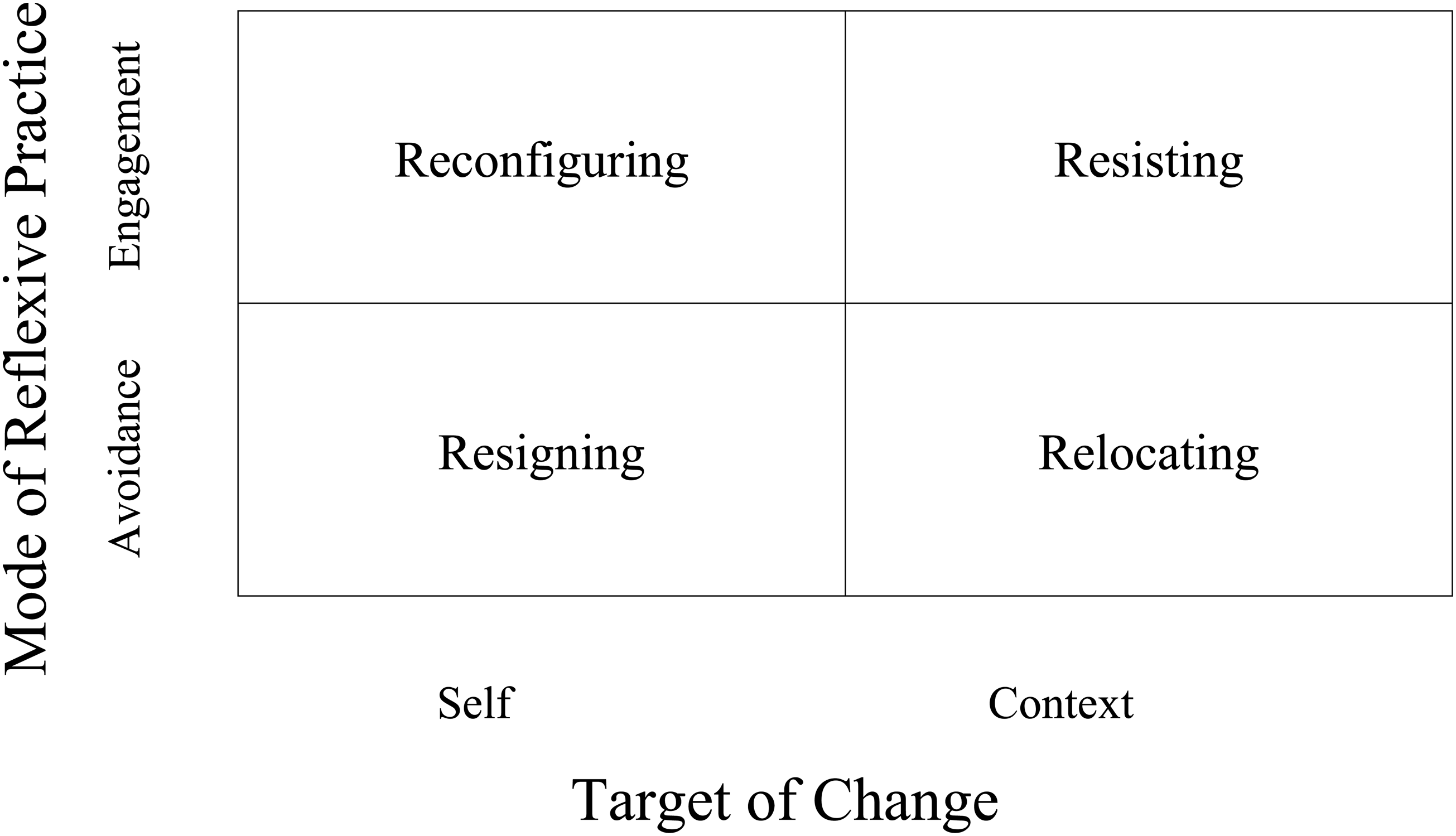
Modes of reflexive practice and targets of change, taken from Hibbert et al. (2019).
The Figure uses vertical and horizontal axes to distinguish between modes of reflexive practice and targets of change respectively. The vertical axis addresses avoidance and/or engagement with change. This categorization considers “the ways in which individuals deploy reflexive practices in order to avoid or engage with a call to change either themself or the social context.” (Hibbert et al., 2019, p. 187). It relies on two primary modes of reflexive practice, critical and self-reflexivity. The former “focuses on one's external environment and one's place and constitutive role within it” (p. 188), while the latter ‘focuses on surfacing and questioning one's values and assumptions.” Hibbert and his collaborators recognize that, when it comes to critical moments of “being struck,” there is a symbiotic relationship between the two reflexive practices that prompts questioning of both the social order and one's personal agency within it. Further, these moments contain a powerful emotional content that may, in combination with the perceived freedom to address these emotions, affect processes of avoiding or engaging with change.
On the horizontal axis of Figure 1, the target of change may be either internally oriented, towards the self, or externally oriented, towards the context. This axis exposes the places where reflexivity may have an impact.
In combination, these targets and modes of reflexivity lead to four types of action. The first is resigning oneself to the issues in the setting (avoiding change to self) and continuing on as before by reflecting in ways that ‘diminish one's sense of responsibility’ (p. 190) to alleviate the discomfort. The second is relocating (p. 191), “in which one seeks to place oneself at some physical or mental distance to the issues that create discomfort.” A third, resisting, actively engages with the change challenge, and the reflexive response is to enact change in the setting, by doing something to address problematic issues. Finally, reconfiguring involves awareness of one's own flaws, the misfit with a desired model of self and a move to changing oneself in order to better fit a situation. In contrast to resisting, reconfiguring leads to a different way of being. It is not just a reframing of one's perspective on how to participate in the context more effectively.
This framework is important as a backdrop for exploring what reflexivity means, quite literally, in practice. It also enables us to explore the types of agency that reflexivity might foster. Thus, it helps us accomplish our purpose of utilizing the reflexivity of an insider researcher working within a particular structural and cultural setting to understand the impacts that collaborative insider/outsider relationships have upon an insider researcher's self, scholarly practice, and work setting.
Method
We first provide some historical background to the Centre and our collaboration. This background suggests the embedded contextual forces shaping the insider researcher's work. We will then describe the vignettes as our data sources and the approach we took to analysing them.
Background: History of the Centre 1
The Centre is a membership-based organization housed in a UK business school. It brings together business practitioners, industry thought leaders, experts and academics to help member organisations build the capabilities needed to tackle the knowledge, learning and change related challenges of the contemporary world.
From its start, the Centre has pursued an aim of creating the space and place for academics and practitioners to think and research together in order to generate impact through engaged scholarship (Van de Ven, 2007) and Mode 2 knowledge (Gibbons et al., 1994) that is distributed, application-oriented, and transdisciplinary, and thus makes a difference to organisational practice. Applied research often draws heavily on philosophies of practical knowing (Coghlan, 2011) and the academics adopting these tend to conduct their practice with practitioners. Such methods are often under-valued in traditional University settings and hard to get published in top journals.
When our collaboration began, Centre members had completed 45 collaborative research projects, resulting in multiple academic and practitioner publications, and all of them including an intent to improve practice. There have been 23 more since then.
At the time of writing this paper the Centre has been active for more than 20 years, despite multiple structural changes in Centre leadership, host University structure and the nature of its practitioner membership, as well as developments in the substantive researcher/practitioner interests of both participants and academics affiliated with the Centre. The host University has expected the Centre to be largely self-funding from revenue generated via an annual membership fee that organizations pay for participation. Even during economic downturns, the Centre has adapted and remained financially self-sufficient, whilst contributing to University funds. Sustaining financial contribution was a responsibility of the insider and thus an important structural influence on the choices associated with her activities.
Our Collaboration
At the start of our joint insider/outsider collaboration, the outsider researcher's broad goal was to understand what processes have taken place at the Centre, their impacts and how the Centre processes contributed to those impacts, and to make scholarly contributions based on this understanding. For the insider researcher, the main aim was to evaluate what mattered for sustaining the Centre as a vibrant space for public, private and third sector managers working in the Centre's member organisations; what motivated them to participate and work with academics to address issues of organisational development, knowledge and learning.
Through the years, the researchers have been involved in several joint projects. The outsider researcher has been instrumental in establishing various opportunities to share the work of the Centre at scholarly gatherings. The insider researcher has contributed to some of the scholarly presentations the outsider gave, a factor which has consistently promoted reflexivity. The insider researcher has also undertaken several initiatives related to the Centre and its host University, and the outsider has participated in Centre activities at different points.
The development of shared research interests has led to some joint presentations and publications as well as to some research that has not yet succeeded in being published. Our collaboration has also made evident the ways in which our perspectives are consistent with each other as well as ways they differ.
Data Sources: Autoethnographic Vignettes
To accomplish our purposes in this paper, the insider researcher has composed several autoethnographic vignettes based on critical incidents that have taken place during the time of our collaboration. These are taken from her personal reflections of “striking moments” (Corlett, 2012, p. 453), using her notes of events and records of our conversations during the course of the collaborative relationship. We present these vignettes below, in the researcher's own voice.
The vignettes operate on two levels. On the surface they illustrate how a series of events and interactions during the collaborative relationship have impacted the Centre, her University and the insider researcher herself. On a deeper level, the insider researcher presents her contemporaneous personal reflexions, her feelings on ways those shaped her subsequent actions.
To a considerable extent this approach follows the format of Archer's (2000, 2007, 2010a, 2010b) critical realist examination of reflexive agency in relation to change. The vignette/ reflection presentation allows for a process which Archer calls ‘analytical dualism’. This acknowledges the inherent duality of structure and agency but argues that to understand deeper reality, it is necessary to separate the prior influence of historically established structures from agency for change. It also recognizes the ways that processes of reflexivity and its accompanying emotion may play in re-enforcing and/or changing structures.
Analytic Approach
There are multiple models for presenting autoethnographic vignettes (e.g., Humphreys, 2005; Jarzabkowski et al., 2014; Nesse & Stensaker, 2022; Plester et al., 2022), depending at least in part on the analytical purpose of the research. In this case, given our focus on analytical dualism, we use multiple textual formats to present the vignettes. That is, we use plain text for descriptions of events that formed the structural context. We use italics for the insider researcher's reflexivity, feelings, and agency. Finally, because we are particularly interested in experiences associated with the collaboration between the outsider and insider researchers, we use
We follow the presentation of the vignettes with Table 1. In this table, we flesh out several dimensions of each vignette based on our analytic intent. In particular, based on Archer's (2007) work, we provide a sense of the structural context (including, when appropriate, dimensions of our collaboration), and the insider researcher's reflexivity and emotion. We also present the agentic actions the insider researcher took based on the Hibbert et al. (2019) categories we discussed above.
Vignette, Structure, Insider Reflexivity and Affective Response, and Agency Taken. a

Materials in the column on structural context and events that are pertinent to our collaboration are presented using a bold font face.
Findings and Analysis
Five Vignettes in Order of Occurrence
Vignette 1. An Annual Conference
At the time of this vignette, the Centre had been in existence for twelve years. Each year, the Centre offers organizational members the option to attend quarterly workshops, and participate in action learning sets and several collaborative inquiry research projects in various formats. However, not every member can attend all events. Therefore, each year, the Centre has run a 2-day annual conference. Centre leaders have always seen this conference as a critical milestone in the year. It brings all the members together, gives them priority access to the output of the collaborative research projects that were conducted in the previous year and a chance to consult about potential topics of interest that would form a basis for the following year's research projects.
I had been a faculty member at the University and involved with the Centre, especially its collaborative research projects, since its beginning. At the time of this conference, I had been the leader of the Centre for three years, and, as such, I had designed the conference and chosen all the speakers.
Earlier in the year, I had decided that leadership of the Centre should move from an historical partnership between two University academics to an extended management team, primarily because I had an uneasy sense that organisational members saw me as too conceptual, too academic and not sufficiently in touch with the practical world of business and management This change had taken place, and having wider stakeholder involvement in directing the Centre had produced some beneficial outcomes.
Throughout the first day of the conference, I had been feeling a sense of frustration in my leadership role.
I listened to the outsider researcher's key note presentation and put two and two together about my own position. I was leading a Centre that got little support within the University; what we achieved was not well understood or valued, because the research was Mode 2 and applied; the Centre's focus on knowledge and learning was considered peripheral from a research perspective, and, surprisingly, even from a teaching perspective within programmes. I was feeling distinctly de-energized by the challenges of working through the University's structures.
Listening to the outsider researcher talk, I suddenly realised that rather than banging my head against a brick wall (a picture used in her presentation) I could personally bring the elephant into the room (another symbol in the presentation) with the management team now leading the Centre and use my uneasiness and frustration to take a different tack on the next few years of Centre activities.
I was re-energized by this insight, because I could see many avenues to pursue for a future research agenda that might be attractive to a much wider audience than just the knowledge management and organisational learning practitioners who presently were the main participants in Centre activities.
Vignette 2. The Sabbatical Project
The analysis of the data ended up being very impactful, for me, for the outsider researcher, and for a fellow academic who had previously been leader of the Centre and was still actively involved in it. All of us were aware of supposed differences in priorities between academics and practitioners (e.g., differing interests and activities, different reward systems, rigor vs. relevance) and the tension they can cause in the process of communication and translation of academic knowledge into practice ( Bartunek & Rynes, 2014 ). Yet what became clear was that the epistemologies of the different participants in the Centre – all of them practitioners rather than academics – varied considerably as well, on several key dimensions.
One illustrative distinction was differences between members who prioritised and valued similarity or difference as a source of learning. Some wanted the inspiration and challenge that differences in perspective generated, while others wanted to work with like-minded peers and learn from people with a similar pragmatic practice-oriented view of the world. A second illustrative distinction was in the desire for immediate or future knowledge utility. Some wanted quick take aways from events and projects; others considered that any new perspective had inspirational potential that they might return to at some opportunity. There were other distinctions as well.
As we analysed the data, we realized that the multiple differences reflected essentially two different sets of expectations of the Centre. One was that that the Centre was a “partner in exploration” that plays a largely facilitative role by providing space for dialogue, new knowledge creation and thinking with others. The other was that the Centre was a “trusted advisor” that passed on immediately helpful knowledge.
No wonder I was feeling uncomfortable about my position of leadership and contribution to the Centre! Ever since I did a training course early in my academic career I had recognised that for me, novelty and difference are what energize me; routine, similarity and exploiting existing knowledge bore me, which is why I always describe my mid-career move into academia from a financial controller role in industry as ‘coming home’. I was relieved that some of the participants in the Centre shared my epistemology. At the same time, clearly, I had to develop ways that the Centre could satisfy the different sets of epistemological priorities if I was going to keep everyone happy; that would mean focusing not only on those people in the Centre who conceived of it as a ‘partner in exploration’ but also those who wanted it to be a ‘trusted advisor’, providing reliable academic knowledge.
Vignette 3. Co-Editing a Book
Through working on the book, I found a new aspect of ‘self’ emerging. I had suddenly found a whole new ‘tribe’ that would understand my trials and tribulations in a University setting that appeared to trivialise the value of applied research.
The conversations during the collaborative process of editing the book boosted my confidence in the worth of the Centre and the importance of its work. In addition, as a direct result of reading and editing the book chapters, I began learning more about liminality (
Beech, 2011
), which helped me understand why
Vignette 4. Next Steps in Centre Governance and Our Collaboration
At about the same time the book editing project began, the scholarly paper and presentation as an artefact around which to organise future Centre activities to address differing epistemologies led to changes in the division of labour within the Centre. We revised our delivery of our materials so that those who were better at delivering outputs of practical tools from research projects that could be completed in one year concentrated their efforts there, whilst I worked on more abstract conceptual research projects that might straddle more than one year. The insights about the divide in member epistemologies also led me to have a discussion with someone from an organisational development background, whose doctorate I had recently examined, with a view to contracting her to do market research to extend our understanding of member and non-member future interests in engaging with Centre activities.
My reflexions to date were highlighting the discrepancy between my internal self and my social self, which started to ring alarm bells. I decided that, come the advent of my 60th birthday, I would signal my intent to hand over the Centre leadership to someone else, and take flexible retirement the next year. This would allow me to focus all my attention on Doctoral supervision and teaching, which I was finding more satisfying.
After her work investigating what would make the Centre attractive going forward, the woman who did the market research seemed an ideal successor to lead the Centre. She would be well positioned to move the focus of Centre research activity into a new and interesting direction. We offered her the position and she accepted.
After each leadership transition the prior leader stayed involved in the Centre to ensure knowledge was not lost and organisational memory was transferred through doing rather than telling. The outgoing leader simply withdrew from active leadership, but found ways to continue contributing to events or research, or providing guidance when needed. This handover followed the same practice. Withdrawing from the day to day running of the Centre gave me time to edit the book.
Learning about the practical experiences of other academics who were concerned about how theory translates into better practice gave me time for further reflection on the epistemological and ontological tensions that plague anyone learning to operate successfully in domains where practice and theory have equal priority in terms of their potential to contribute to organisation and wider society. Clearly the experiences of tension and discomfort about the worth of practical forms of knowing that I had experienced could also arise in post graduate classrooms, such as for part time PhD students or those studying for professional doctorates like the DBA.
This led me to get involved with a project to design a personal development module for the DBA program at my University to formalise the professional development of such scholar practitioners. I highlighted potentially relevant readings to prompt the students’ diary reflections and revised my teaching sessions on the introductory module of the DBA in order to contextualise and support the personal development activities as an integral part of the early stage of a DBA research apprenticeship. My aim was to bring to the fore the tensions that apprentice scholars would need to navigate during their doctorate.
Vignette 5. Participating in an Academy of Management Professional Development Workshop
The Professional Development Workshop made me feel quite alienated and dissatisfied with my academic identity. I was listening to several academics and journal editors talk about publishing research at the interface of theory and practice, but the word publishing still seemed to them to mean predominantly publishing work in top tier academic journals, primarily for other academics to read, a cycle of knowledge development detached from the world of business practice. My negative emotional experiences here prompted me to reflect on the academic community as a whole, particularly that part to which the outsider clearly belonged. I felt very frustrated with my inability to communicate in this context, and this led to a search for an alternative philosophical perspective on the problem of impact when people from different communities try to understand each others' world views.
The result of this rather depressing experience coincided with my growing interest in philosophical paradigms and their implications for social science research. I became immersed in reflection on the implications of researchers’ philosophical orientations for evaluating what is justifiable as valid knowledge that can be relied to guide societal decisions. In particular, I discovered critical realism, especially as discussed by Bhaskar (1979) ; Bhaskar and Hartwig (2016) , which seemed to offer a path to transcend the dichotomies of thinking that separate those who take a more positivist view of the world and social science research and those who assume that occurrences in the social world require totally different research approaches than do natural science inquiries.
Bhaskar's philosophy led me to the work of another Critical Realist, Margaret Archer, whose views on reflexivity and the importance of historical structure in conditioning the way we think and act in society became vital strands in thinking about my academic self as well as my activities and practices as an educator and a researcher. Archer's work examines the mechanisms, powers and tendencies of structures that condition reflexive social interaction over time and that encourage the system of structures and agents either to remain stable or change ( Archer, 1995 , 2010a , 2010b ). Her work has guided much of my scholarship since then and guides the analytic approach we are taking in this paper.
Vignette Analysis
We categorized the vignettes according to the framework presented in Table 1. For each vignette, the categories include the structural contexts in which the insider author was operating, including those arising from our collaboration. Next, they include the insider researcher's reflexivity and accompanying emotion. Finally, they include the categories developed by Hibbert et al. (2019) that reflect engagement and/or avoidance towards self and/or context. We discuss each of these categories below.
Starting Structure and Events
As Table 1 shows, and consistent with Archer's (2007) work, the vignettes indicate that the insider researcher's reflexivity has arisen out of particular structural conditions, including the format of the Centre, the support of her University for its work, the types of participants the Centre attracts, and the activities associated with our collaboration. These conditions have all affected her agency. As the bold text in the vignettes also illustrates, structural starting conditions directly pertinent to our insider/outsider collaboration including characteristics of conference presentations, joint research endeavours, and the history of a particular setting, have also affected her agency.
Reflexivity
As is evident in the Table, the insider researcher has used reflexion in ways that involve both self and critical reflexivity. Among other examples, she “put two and two together” about her own position. Based on analysing interview responses, she came to “a sudden realization” that Centre participants operated out of differing epistemologies. Dialogue with the outsider researcher led her to find a new aspect of self and “a whole new tribe.” She learned more about the “epistemological and ontological tensions” that plague people interested in both research and practice. She came to realize that academic journal editors often operate out of a very different perspective on academic-practitioner collaboration than she did.
Emotion
As the Table shows, the insider researcher often had strong emotional responses to the events on which she was reflecting. Early on, for example, she felt discomfort about her role at the Centre, but was re-energized by the insight that she could change her approach. She was relieved that the epistemology out of which she was operating was shared by at least some of the participants in the Centre, and more confident when she became aware that there was a new “tribe” that shared her interest in theory and practice. Later some of her feelings were more negative. She felt tension and discomfort about some of her forms of knowing, and frustrated, alienated and dissatisfied with her academic identity, especially after participating in the PDW session.
Agency
Finally, the Table also shows that the insider researcher's reflexivity and its accompanying emotion have led her to several forms of agency during the course of our collaboration. Sometimes her agency has been expressed in reconfiguring, when she found herself energized by new learnings. Sometimes her agency has been expressed in resisting, which has meant in practice taking steps to make changes in the Centre. Eventually it was expressed in relocating, as she found that she didn’t quite seem to fit either into a complete practice role or a purely academic researcher role.
The only approach described by Hibbert et al. that the insider researcher has not taken is “resigning.” In all cases, her reflexive practice has resulted in her taking action of some kind. This may be related to her researcher capacity (noted above) to notice and hold the tension in liminal space. Further, unlike the implicit boundaries between self and context within the Hibbert et al. framework, she has shown that taking action to foster change in a particular practice setting does not necessarily mean not taking action with regard to the self. In addition, some of her reflexivity, such as turning over Centre governance and co-editing a book simultaneously, has had consequences for both setting and self, thus illustrating the symbiotic relationships between critical and self-reflexivity.
The insider researcher's tension and emotion surrounding these changes, and her ease (or unease) with the fit between self and social identity within the various settings inside the Centre and outside in wider academia, resonates with Empson's (2018) experience of liminality. Understanding of this experience of liminality is further developed by Beech (2011, p. 286), who, drawing on Ybema et al. (2009) likens it to “a version of the structure-agency dialectic in action, i.e., the process through which the individual constitutes and is constituted by their social setting.” Persistent tension and experience in a liminal space can promote reflexive internal dialogue that shapes agency, unless of course the tension is too great and the agent resigns themselves to the status quo. Potentially this liminal experience is more recognisable to the insider researcher because she is used to carrying out research. It may not be recognisable to a practitioner insider.
Impacts Deriving from Our Joint Insider/Outsider Collaboration
As is evident from our depiction, our joint insider/outsider collaboration has had important impacts on the insider researcher's reflexivity. More specifically, her early experiences deriving from our collaboration have led her to take several steps to make generative changes in the Centre. These have included, for example, expanding its leadership beyond a comparatively academic focus to include those who could respond to Centre members operating out of different interests and epistemologies, and ultimately handing over her leadership role in order to change the direction of the Centre.
Her reflexivity deriving from our joint work also led her to take personal initiatives that drew her into different connections in the academic world that were more or less positive. Co-editing the book was a positive experience for her that opened up different avenues of interaction, but engaging with those, especially though not only in the external community who did not value practical knowing, was depressing. Nevertheless, it did lead to reflection on her own authorial agency. This led over time, to greater awareness of and responsibility for what she did particularly care about and an increased recognition of her strengths in areas that supported teaching and reflection in research development (such as through the DBA program) and a particular creative approach to academic inquiry (critical realism).
In the long run, her reflexion arising out of our collaboration has led her to the awareness that not only did not she not quite “fit” in the Centre and its activities, she also did not quite “fit” in the academic world the outsider researcher inhabited (Jansen & Shipp, 2019). However, this awareness has produced active changes in her practice (such as approaches she developed for DBA students) and has had epistemological impacts on her academic self. Her discovery of some true scholarly interests in an area of inquiry – critical realism – that was unique to her – has led quite authentically to the reflexivity approach we are using in this paper.
Finally, our work has also led her to recognize in herself what Cunliffe (2018), p. 10) refers to as alterity, which can simply be described as “doing research that is different.” Cunliffe adds to this characterization the recognition that alterity leads to “being constituted as ‘the Other’ and as the Other there are practical consequences in terms of getting published, gaining tenure, building a career and being seen as a credible scholar,” and that has been the case for the insider researcher.
Discussion
In response to the call for papers for this special issue, we have set out to explore the impacts of reflexivity on the insider researcher and her setting which have emerged from our long-term insider/outsider collaboration. We have shown, through moments of being struck by difference and otherness between herself and the outsider researcher, as well as by connectedness between them, that the insider researcher's reflexivity prompted by our collaboration has led to substantial change, not only in the Centre, but also in the insider researcher herself. We discuss below the benefits of the approach we have taken and the importance of researcher reflexivity, especially as evoked by collaboration, for scholarship and practice.
Benefits of Our Analytic Approach
The analytic approach we have used enables us to see much more in what might appear to be a simple plain text “description” of events than what appears to be on the surface. When leaders take initiatives, it might not be clear to others how these initiatives are affected by the structural features of their setting. But we have shown that several apparently mundane structural features may be have impacts on reflexivity.
In addition, we have shown some forms that reflexivity may take, along with the emotions that necessarily accompany it. When leaders act, it may not be clear to others what reflexivity and emotion went into the action. But we have shown how important these are, whether recognized or not. Further, we have shown that actions that leaders take likely reflect one or more types of agency. Thus, any particular actions that are taken are not inevitable, but arise due to reflexivity and its accompanying emotion.
Further, through the history presented in the vignette at each time point we have illustrated (cf. Archer, 2010a) how the insider researcher's reflexivity was shaped by the weight of structure and norms prevailing in the academic setting in which she sits. Then, through the mechanism of analytical dualism, which effectively separates structure and agency in progressive time slices, we have shown how the insider researcher has over time changed her perspective on her scholarly self even as her actions have impacted the institutional context. Our narrative approach has also allowed us to demonstrate the accumulating impact of different types of reflexivity on a practice setting over time, and thus illustrate considerations of path dependency, including on the insider researcher's recognition of herself as other.
As our analysis makes evident, the outcomes of particular episodes of reflexivity, especially forms of reflexivity that are superficial or that are blocked by intense emotion, may not be simple and straightforward. In our case, the insider researcher faced complicated issues head on, and then took very proactive steps both in her setting and with regard to herself. Of course, insiders may sometimes avoid taking any action (Hibbert et al., 2019), and resign themselves to their fate, which considerably limits the intended impacts their reflexivity might otherwise have had.
The Mediating Role of Reflexivity in Impact
MacIntosh and colleagues (2017, 2021) argued that the process of carrying out research itself generates reflexive and recursive tendencies that may change researchers’ sense of self. We have suggested a variety of research-related events that may affect this. Such events might include, among many others, listening to academic presentations, analysing data for an evaluation, presenting papers at a scholarly conference, editing a book and presenting in an academic setting, as well as the day to day work of the insider researcher.
Of course, it is likely that some insider researchers are not as interested in or as capable of reflexivity as the insider researcher has been in this collaboration. Her own scholarly practice as a qualitative researcher likely contributed to this. It is particularly meaningful when an insider researcher is willing to learn and take purposeful initiative to create change in a setting due to the research events that are pertinent to the collaborative inquiry. There is no one else who is in a position quite like this.
The Importance of the Insider/Outsider Collaboration for Fostering Insider Reflexivity
We have shown that one value of insider/outsider collaboration for insider researchers lies in prompting the insider to challenge current assumptions simply by presenting differences, and, in so doing, see far beyond the face value of surface activities in a setting. Further, relational reflexivity that takes place in extended collaborative relationships may, over time, lead to substantial insight beyond what could originally have been imagined.
Since reflexivity is not an inherent ability, but a dynamic relational process which can be avoided or carried out superficially when the process of questioning assumptions becomes too uncomfortable, the quality of the relationship between the parties plays an important part in triggering engagement with more than superficial reflection. Thus, in essence, the outsider researcher plays an important role in holding a mirror up to the insider. But how the outsider does this is consequential.
Under the best of circumstances, which we hope is the case in this collaboration, the mirror the outsider holds up may generate the conditions in liminal space that encourage and enable the insider researcher to work through contradictions and use generatively the doubt that contrast can produce (Klag & Langley, 2013; Locke et al., 2008). The mirror would then be a support for reframing ideas in ways that might alter insider agency by creating change to self and/or context.
This will not happen, of course, if the contrast is unproductive either because the outsider's mirror only offers an obscured representation of the insider researcher's own view of the world, or is so extreme that the outsider cannot recognise any common ground, so ignores the reflection or walks away. In other words, an outsider's approach to the relationship in an insider/outsider collaboration may foster and/or hinder the insider researcher's reflexivity and actions. To put it another way, prevailing conditions in the setting and in the relationship between the researchers likely act somewhat like a refracting ‘mirror’ to condition the type of reflexive processes that arise within the insider.
Archer (2000, p. 267) claimed that “social interaction is the sole mechanism governing stability and change.” In simple terms this suggests that relationships involving insider and outsider researchers might be transformative of their potential to create impact. One reason for this may be that for the insider researcher, the tension inherent in the structure/agency duality is brought into sharper focus as a result of encountering the different perspective of the outsider, thus making it particularly salient for stimulating reflexivity. A related reason might be the juxtaposition of the insider researcher's social interaction with (hopefully) an increasingly trusted companion in the form of an external researcher and, the simultaneous involvement in the practice setting being studied. This is important, because it is the insider researcher more than anyone else who has the capacity to make changes in the setting that result from the research through the mediation of changing her practice.
Reflections of the Outsider Researcher
While this is not the focus of our paper, it is of value to note that the outsider researcher has, ever since her first contact with the insider researcher, been very impressed with what the Centre was doing, and has learned a great deal from the insider researcher about ways of linking with practitioner concerns. Certainly, the research itself has had less of a personal impact on the outsider (other than the very positive experience of getting to know the insider researcher and the setting) than on the insider researcher. Nevertheless, the outsider researcher has continued to learn from the insider researcher throughout our collaboration, including about critical realism. Further, the research she helped to conduct that revealed differing epistemologies among Centre participants was impactful in the setting.
The outsider researcher began collaborating with insider researchers long ago (Louis & Bartunek, 1992) in the hopes that such collaboration would enable insiders to a setting to have some say over publications about their settings, rather than have their experiences described entirely by outsiders. She has had considerable experience in conducting such research. However, she was not aware, until we had the opportunity to work together on this paper, of the depth and quality of the potential reflexive and affective experiences of insider co-authors with whom she has collaborated. She has also learned from our work on this paper that an insider/outsider collaboration, at least as experienced by the insider researcher, is much more complex than it appears on the surface, and that what might seem like a positive from an outside researcher's approach might not be so from the insider researcher's perspective.
Outside researchers may not adequately appreciate what processes of joint inquiry mean to those inside an organization with whom they are collaborating. They may also not appreciate the magnitude of differences between epistemological approaches that support practical knowing and the epistemological approaches more frequently employed in academic scholarship.
Practical Implications
While MacIntosh and his collaborators (2017, 2021) focus on the importance of reflexivity and dialogue for impact, they do not discuss the kinds of characteristics that foster productive reflexivity, especially those that lead to positive effects on a setting. Further, they do not explore what reflexivity might mean in practice, the emotion that necessarily accompanies it, and the kinds of capacities that must develop in participants in a setting for the reflexivity to be productive for the setting. But these are all critical dimensions. They make evident that, if reflexivity is to foster agency and accomplish impact well, it is necessary to develop insider researchers’ and other participants’ capacity for reflexivity, to provide occasions that both encourage and provide a safe place for it and its accompanying emotion.
As we have shown, interactions with outsiders, especially through insider/outsider collaborative efforts, may have a substantial impact on insiders’ reflexivity. Having someone “other” to bounce experiences against is important, as long as the “other” is trustworthy. It is also important that both the insider researcher and outsider researcher must be able to recognize, manage and “hold” the tensions that will inevitably arise, something that is not at all easy to do (Putnam et al., 2016; Van de Ven, 2007). This takes considerable cognitive and emotional capacity and courage, especially when complications arise in a setting.
Despite its difficulty, the ability of researchers to hold tensions is consequential for the type of impact that may arise in a setting due to collaborative work, especially how generative the impact will be. The processes we have described here are not simply techniques that can be applied. They require profound personal and interpersonal development.
Conclusion
Through an exploration of the impact on self and scholarship of an insider/outsider collaborative relationship, we have suggested the importance of reflexivity and its accompanying emotions for appreciating the impacts of research with and on an insider researcher. We have illustrated such reflexivity by means of the reflections of an insider researcher over several years. These impacts may be profound, especially if they continue over time, if the insider has the capacity to reflect deeply, and if the outsider can hold up a mirror to the insider that fosters the ability to work with differences. Our work opens up recognition that there is much more going on in collaborative organizational interventions than has been appreciated.
Footnotes
Acknowledgments
We are grateful to Christine Van Winkleman for her collaboration during some of the Centre events we describe here. We are also grateful to David Coghlan and the reviewers of this paper.
Declaration of Conflicting Interests
The author(s) declared no potential conflicts of interest with respect to the research, authorship, and/or publication of this article.
Funding
The author(s) received no financial support for the research, authorship, and/or publication of this article.
