



Abstract
Africa has struggled to counteract the negative images (ranging from diseases to war, terrorism, poverty, and crime) that it evokes in the eyes of the global audience. This has punctured Africa’s soft power potential and undermined its influence in the global arena, creating the need for the development of a strong and acceptable normative and strategic framework. In this regard, Agenda 2063’s strong commitment to the African Renaissance and a different and better Africa is critical. The article thus examines the potential of Agenda 2063’s Aspirations 3, 4, and 5 to enhance the continent’s soft power and boost its standing in the international system.
Introduction
This article examines the soft power that could possibly arise from Agenda 2063’s Aspirations 3, 4, and 5. With the exception of modest analysis of the European Union (EU), previous investigations of soft power have been state-centric and no studies have focused on the African Union’s (AU) soft power. This article seeks to address this gap in light of negative perceptions of this region.
Soft power refers to an actor’s ability to determine the preferences of other actors through intangible resources such as attractive culture, political values, institutions, and policies (Nye, 2004). This implies that in lieu of deploying hard power resources, predominantly economic and military, to coerce other actors into obtaining the desired results, an actor can deploy its attractive arsenal (soft power) for this end. In simple terms, hard power is the power of coercion and soft power is that of attraction. The major sources of hard power are economic and military capabilities and those of soft power are culture, political values, and foreign policy (Nye, 2004). The bottom line is that soft power actors are able to influence other actors due to the attractiveness embedded in the former’s values, culture, and policies. The increasing importance of non-state actors, including international organizations, multinational corporations, nongovernmental organizations, terrorist organizations, and eminent individuals dictates that analysis of soft power can no longer be confined to states. Thus, scholars have examined the significance of soft power in non-state actors’ activities including individuals, civil society organizations (CSOs), multinational corporations, terrorist organizations, and international organizations (April, 2009; Ogunnubi & Tella, 2017; Tella, 2017a). While European scholars such as Rutkowski and Engel (2010) and Jones (2010) have analyzed the place of soft power in the EU’s foreign policy, studies on the AU have neglected soft power analysis.
The AU boasts of soft power-laced instruments including the AU Constitutive Act; the African Charter on Democracy, Elections and Governance; African Governance Architecture (AGA) Framework; African Charter of Human and People’s Rights; the African Peer-Review Mechanism (APRM) Statute; Declaration on Unconstitutional Changes of Government; the Declaration Governing Democratic Elections; and the principle of non-indifference. However, effective generation of soft power through these instruments leaves much to be desired.
Against this background, Agenda 2063 that sets out an action plan toward the African Renaissance and a region that can take its rightful place in the global arena presents an opportunity to evaluate Africa’s long-term soft power strategy. As Nye (2011) notes, it often takes a long time to accrue results from soft power; hence, an assessment of the 50-year plan is important.
Agenda 2063: An Overview
Agenda 2063 was mooted at the celebration of the Organisation of African Unity (OAU)/AU 50th anniversary in 2013 and adopted at the 24th Ordinary Session of the African Heads of State and Government in 2015 in Addis Ababa. In doing so, there was acknowledgment of the continent’s past successes and challenges and the need for it to take its rightful place in the international system (African Union Commission [AUC], 2013). The framework thus seeks to draw on the lessons of the past 50 years to put Africa in a development path over the next 50 years with the ultimate objective of a prosperous and vibrant Africa by 2063. DeGhetto, Gray, and Kiggundu (2016, p. 94) note that the strategic plan “is aimed at getting Africa to do things differently (people-centered), bigger (scaling and scoping up), and better (governance, performance outcomes, impact on citizens, etc.).” Agenda 2063 is a normative and strategic framework that aims to put Africa on the path of growth and development to become a global force over the next 50 years. It represents “a call to action to all Africans and people of African descent, to take personal responsibility for the destiny of the continent and as the primary agents of change and transformation” (AUC, 2015a, p. 13). It also emphasizes the need for “commitment from citizens, leadership, governments and institutions at national, regional and continental levels to act, coordinate, and cooperate for the realization of this vision” (AUC, 2015a, p. 13).
While the Millennium Development Goals (MDGs) were crafted outside the continent with little or no consultation with the African people, Agenda 2063 presents Africans with the opportunity to take ownership of their development agenda (Slavova & Okwechime, 2016). The framework has benefited from wide consultation with African stakeholders in its formulation and the past development agenda including the Lagos Plan of Action 1980, the Abuja Treaty 1991, and the New Partnership for Africa’s Development (NEPAD 2001) (AUC, 2015c). Involvement of stakeholders including the youth, women, CSOs, research institutes, governments, the private sector, religious leaders, the media, and so on creates a sense of ownership and acceptance of the program. Drawing on past development agendas reduces the danger of repeating past mistakes. The road map has short- (10 years), medium- (10-25 years), and long-term (25-50 years) goals and parts: the strategic plan, the implementation plan, and the Monitoring and Evaluation Framework (DeGhetto et al., 2016). The focus of the first 10 years includes Sustainable and Inclusive Economic Growth; Human Capital Development; Agriculture/Value Addition Agro-Business; Industrialization/Manufacturing and Value Additions to Natural Resources; Employment Generation; Social Protection; Gender/Women’s Development and Youth Empowerment; Good Governance, including capable institutions; Infrastructural Development; Science, Technology and Innovation; Peace and Security; and Culture, Arts and Sports (AUC, 2015b). To ensure that states take practical steps to achieve these goals, Agenda 2063 provides for a monitoring and evaluation framework that seeks to stimulate the management of development results, promote accountability, encourage comprehensive integration, and enhance participation and ownership (AUC, 2015b).
The blueprint aims to mobilize the African people and instill a sense of ownership of the programs; encourage self-reliance and self-financing of developmental initiatives; ensure responsible, responsive, and accountable states and institutions on the continent; and emphasize the significance of Regional Economic Communities in fast-tracking the continent’s unity. In sum, the agenda identifies the following as enablers of African transformation: the people’s ownership and mobilization; African resources to finance its development; accountable leadership and responsive institutions; capable and democratic developmental states and institutions; changed attitudes and mind-sets; a Pan-African perspective; ownership of the African narrative and brand; and an African approach to development and transformation (AUC, 2015a). The blueprint is all encompassing; this is evident in the attention paid to issues such as gender, the youth, agriculture, technology, education, climate, and environment to mention but a few. It has the following flagship programs: the Integrated High Speed Train Network; a Pan-African E-University; formulation of a commodities strategy; establishment of an annual African forum; fast track the establishment of the Continental Free Trade Area by 2017; the African Passport and free movement of people; silencing the guns by 2020; implementation of the Grand Inga Dam Project; the Pan-African E-Network; outer space; a Single African Airspace; and Continental Financial Institutions (AUC, 2015c).
The agenda is guided by the AU vision and has clear aspirations. It is a call for the Pan-African vision of “an integrated, prosperous and peaceful Africa, driven by its own citizens and representing a dynamic force in the international arena” (AUC, 2015a, p. 1). The seven aspirations of Agenda 2063 include the following:
A prosperous Africa based on inclusive growth and sustainable development
An integrated continent, politically united and based on the ideals of Pan-Africanism and the vision of Africa’s Renaissance
An Africa of good governance, democracy, respect for human rights, justice, and the rule of law
A peaceful and secure Africa
An Africa with a strong cultural identity, common heritage, shared values, and ethics
An Africa whose development is people-driven, relying on the potential of African people, especially its women and youth, and caring for children
Africa as a strong, united, and influential global player and partner
All these aspirations are arguably significant for Africa’s soft power. For brevity, I analyze those that are potentially the most significant boosters of such power. These include Aspirations 3, 4, and 5. Clearly, these aspirations speak to the major sources of an actor’s soft power. Aspirations 3 and 5 engage the continent’s political values and culture, respectively, while Aspiration 4 sets out the programs and policies that can facilitate a peaceful and secure continent. The following sections examine the soft power potential of these aspirations.
Aspiration 3: An Africa of Good Governance, Democracy, Respect for Human Rights, Justice, and the Rule of Law
Given the impediments to democratization in Africa including vote rigging, vote buying, violent electoral processes, the power of incumbency, the low level of individual and press freedom, political corruption, and a weak civil society, and the attendant global ignominy that has befallen the continent, Aspiration 3 is vital. It stresses the need for a culture of good governance, democracy, human rights, justice, gender equality, and the rule of law in Africa by 2063 (AUC, 2015a). It also calls for efficient institutions and credible leadership to guarantee these globally admired values. It is expected that by 2063, the African people will have access to an independent judiciary and a corrupt-free society. Agenda 2063 aspires that Africa will be characterized by free, fair, and credible elections; multi-party systems and transparent electoral systems; and a free, vibrant, and effective press that acts as a watchdog on the government and citizens’ freedom to access information, while safeguarding privacy (AUC, 2015c).
A state that embraces these values is accorded respect and admiration in the international system. The AGA and the African Charter on Human and People’s Rights are deemed crucial in this regard. The first 10-year implementation plan (2014-2023) clearly states that the “democratic values and culture as enshrined in the AGA would have become entrenched in all Africa by 2023.” It is expected that this will be so entrenched that seven in every 10 people will be convinced that democracy in Africa is embedded in relevance and accountability (AUC, 2015b: 23). The AGA provides an overarching framework for the promotion of democracy, human rights, and good governance in Africa that will enable stakeholders to engage in dialogue to achieve the objectives of the AU. These stakeholders or platform members include the AU Peace and Security Council (PSC); AU Commission; regional economic communities; the African Commission on Human and Peoples’ Rights; African Court on Human and Peoples’ Rights; Pan-African Parliament; APRM; the Economic, Social and Cultural Council; AU Advisory Board on Corruption; African Committee of Experts on the Rights and Welfare of the Child; AU Commission on International Law; and the NEPAD Planning and Coordination Agency. The platform offers an avenue for coordination, complementarity, and collaboration of the activities of platform members. Their activities are guided by the AGA’s guiding principles as outlined in the AGA Framework. These include the following:
a. Effective participation of the African peoples in strengthening and consolidating democratic governance in Member States and continental affairs;
b. Respect for democratic principles, human rights, the rule of law, and good governance;
c. Holding of regular, transparent, free, and fair elections;
d. Promotion of the principle of separation of powers;
e. Promotion of gender equality and youth empowerment;
f. Promotion of transparency and fairness in the management of public affairs;
g. Condemnation and rejection of acts of corruption, related offenses, and impunity;
h. Condemnation and rejection of unconstitutional changes of governments;
i. Strengthening political pluralism and recognizing the role, rights, and responsibilities of legally constituted political parties, including opposition political parties. 1
It is clear that the AGA and its platform members are fundamental to the achievement of Aspiration 3 of Agenda 2063. If African countries could achieve this aspiration by the target year, this would enhance Africa’s moral standing and authority in the international arena. For a continent that is notorious for sit-tight governments, illiberal regimes, corruption, and human right abuses, the attainment of Aspiration 3 would elevate its global profile. Despite the fact that countries like Botswana, Cape Verde, and Mauritius are small, they command respect in the international arena evident in various indices such as the Democracy Index, Freedom House, and the Mo Ibrahim Governance Index that measure good governance. Aspiration 3 offers other African states the opportunity to achieve similar status. Reaching this goal would give Africa the moral authority to promote democracy and human rights across the globe. Given the location of states such as Egypt, Morocco, Tunisia, and Libya, successful achievement of Aspiration 3 could have a snowball effect in the entire Middle East. The Arab Spring that started in Tunisia and reverberated across the Middle East serves as a reminder of this potential. While the United States struggled to promote democracy and increased public participation in the region, it took the Tunisian inspired Arab Spring for its citizens to demand more participation in domestic political processes. Thus, success with regard to Aspiration 3 would likely have positive impact beyond Africa and consequently reinforce the continent’s soft power across the world. However, it is instructive to note that inadequate financial capability presents a possible challenge for Africa to effectively promote democracy beyond the continent. The AU is noted for its reliance on foreign partners to finance its programs. To mitigate this challenge, the continent would need to devise means to ensure it is self-financing. While recent developments such as the AU’s decision that mandated all member states to impose 0.2% levy on their imports to finance the organization’s activities is commendable, more needs to be done to guarantee that AU can fund its programs.
Entrenchment of democratic values, human rights, good governance, gender equality, justice, and the rule of law would also enable Africa to emerge as a model for the international community on many levels. South Africa and Rwanda are already role models in terms of the constitution and gender equality in politics, respectively. Indeed, South Africa’s constitution is considered as one of the most liberal in the world and this has garnered the country significant international prestige. It is for this reason that Sidiropoulos (2014) argues that South Africa’s soft power is derived from its post-apartheid political settlement and its liberal constitution. The South African experience could well serve as a template for other African countries, and if well imbibed by 2063, Africa would offer the world lessons on constitutional order and human rights. The case of Rwanda is also instructive. Women occupy 64% of the seats in this East African country’s parliament, the highest level in the world (The Guardian, 2015). Seychelles, Senegal, and South Africa also fare well with 44%, 43%, and 42% respectively (The Guardian, 2015). While most countries, including those in Europe and the Americas, have struggled to meet the United Nations’s threshold of 30%, Rwanda, Seychelles, Senegal, and South Africa have surpassed this. Rwanda has taken advantage of the benefits that accrue to it in this regard. It has hosted many global events on women’s issues such as the 2014 Women in Parliament (WIP) Global Summit; the 2014 forum on Gender Dialogue on Democracy, Human Rights and Governance; the 2016 Global Women’s Summit; and the 2017 Advancing Women in Leadership Forum in Africa and Asia. Thus, Rwanda provides a template for Africa in respect of gender equality and justice, and if well imbibed by 2063, Africa could emerge as the undisputable champion of gender equality in the international arena. This will enhance the region’s soft power.
Aspiration 3 also provides the platform for Africa to emerge as a significant global player. This stems from the fact that the values of this aspiration are well admired across the globe. The global isolation that Nigeria suffered during its military regime only subsided after the emergence of democracy in the country in 1999. Nigeria’s embrace of democracy enhanced its soft power with the benefits including its engagement in world affairs, an influx of foreign direct investment, and cancelation of its debt by the Paris Club (Fawole, 2003). Similarly, South Africa’s post-apartheid democratic era offered the country the opportunity to exercise its soft power that was overshadowed by the erstwhile apartheid administration. It has benefited from its soft power on many levels such as its status as the sole African state in global governance architecture such as BRICS, IBSA, and the G20. In the light of this, Aspiration 3 positions Africa to accrue meaningful soft power and thus significant influence in the international arena. The continent would cease to be at the margins of international affairs and would play a major role in determining issues of regional and global importance. This would also make Africa credible in the eyes of its Western partners that often link aid and assistance to democracy and human rights and debilitating conditionalities.
Aspiration 4: A Peaceful and Secure Africa
The significance of Aspiration 4 can be understood against the backdrop of pervasive conflict and instability that range from ethnic to religious, political-electoral, and resource-centered conflict and terrorism. While there are various ways to counteract this situation including soft and hard power stratagems, Aspiration 4 of Agenda 2063 stresses a soft power approach, illustrated by its call for peaceful prevention and resolution of conflict and its aim to silence the guns by 2020. Aspiration 4 emphasizes dialogue in conflict prevention and resolution and advocates for peace education to cultivate a culture of peace and tolerance among African youth and children (AUC, 2015a). It is hoped that Africa’s ethnic, religious, and cultural diversity that has hitherto been flashpoints for conflict would become a source of wealth and prosperity by 2063 (AUC, 2015c). The blueprint recognizes that good governance, democracy, human rights, and the rule of law are prerequisites for a peaceful continent and therefore calls on the AGA and its platform members to entrench these values. Aspiration 4 aims to ensure that conflicts ranging from terrorism to extremism, armed conflict, and gender-based violence become things of the past by 2063. It also aims to eradicate drugs, human trafficking, the illegal arms trade, piracy, and other forms of illicit trade in Africa (AUC, 2015a). The first 10-year implementation plan (2014-2023) stresses the need to silence all guns and end domestic and inter-state conflict on the continent by 2023. To this end, Agenda 2063 reiterates the need to strengthen Africa’s peace and security capacity (AUC, 2015b). Alternative dispute resolution, and the African Peace and Security Architecture (APSA) and its pillars are deemed critical to achieve these objectives. These pillars include the PSC, the Panel of the Wise (PoW), the Continental Early Warning System (CEWS), the African Standby Force (ASF), and the Peace Fund (PF). To guarantee peace and security in Africa, the APSA (n.d.) is committed to the following:
1) early warning and conflict prevention;
2) peace-making, peace support operations, peace-building and post-conflict reconstruction and development;
3) promotion of democratic practices, good governance and respect for human rights; and
4) humanitarian action and disaster management.
Among the afore-mentioned pillars of the APSA, the PoW arguably exercises the most soft power. This can be distilled from, first, its resolve to draw on the African tradition of using the elders to promote conflict prevention and resolution and, second, its non-coercive approach to conflict resolution on the continent. In terms of the former, the PoW has elevated the African traditional practice of elders’ pre-eminent role in conflict resolution. This is an important soft power approach that is worthy of emulation in the international arena. The panel is made up of five elderly individuals that have made remarkable contributions to the cause of peace, conflict resolution, and development in Africa. The fact that they are elderly coupled with their significant contribution to peace on the continent bestows on them a moral authority that enables them to have a significant impact in promoting peace. Eminent personalities such as Ahmed Ben Bella (Algeria), Salim Ahmed Salim (Tanzania), Kenneth Kaunda (Zambia), and Luisa Diogo (Mozambique) have served on the panel. In terms of the latter, rather than deploying coercive means to promote peace, the panel embraces dialogue, negotiation, and mediation. It thus deploys fact finding missions in states where conflict appears to be imminent, engages in shuttle diplomacy between the parties involved in the conflict situation, oversees political dialogue between parties, and provides recommendations on the attainment of peace and stability (AU, 2007). Mediation has been adopted and has recorded success to varying degrees in countries such as Burundi, Kenya, Sudan, and Zimbabwe over the past 20 years (The African Centre for the Constructive Resolution of Disputes, 2013). This implies that the PoW provides the platform for non-coercive means or a soft power approach to achieve Aspiration 4.
Activities such as peace-keeping and peace-building are important sources of soft power. Nye (2004) observes that some states exercise political influence that is not commensurate with their economic and military strength because their foreign policies are embedded in attractive activities such as peace-making or economic aid. Aspiration 4’s objectives of achieving a peaceful and secure Africa through peace-making and peace-building fit this context. Peace education is another soft power approach to conflict resolution on the continent and globally. For example, the war against terrorism in Africa not only requires war against terror but also a war of ideas (Tella, 2017a). As Nye (2011) observes, narratives have become an important attribute of soft power that cannot be ignored in today’s world because what matters is whose story wins the hearts and minds of the public. Peace education aims to counteract the direct, structural, and cultural dimensions of violence through the transformation of the content, structure, and pedagogy of the educational curriculum (Bajaj, 2010). While it pays attention to direct violence such as terrorism and issues such as nuclear disarmament, peace education also seeks to combat structural and cultural violence that manifest in social inequalities and unfair cultural practices. As Table 1 below shows, many African countries have already embraced peace education.
National Peace Education Policies and Formal Programs in Africa.
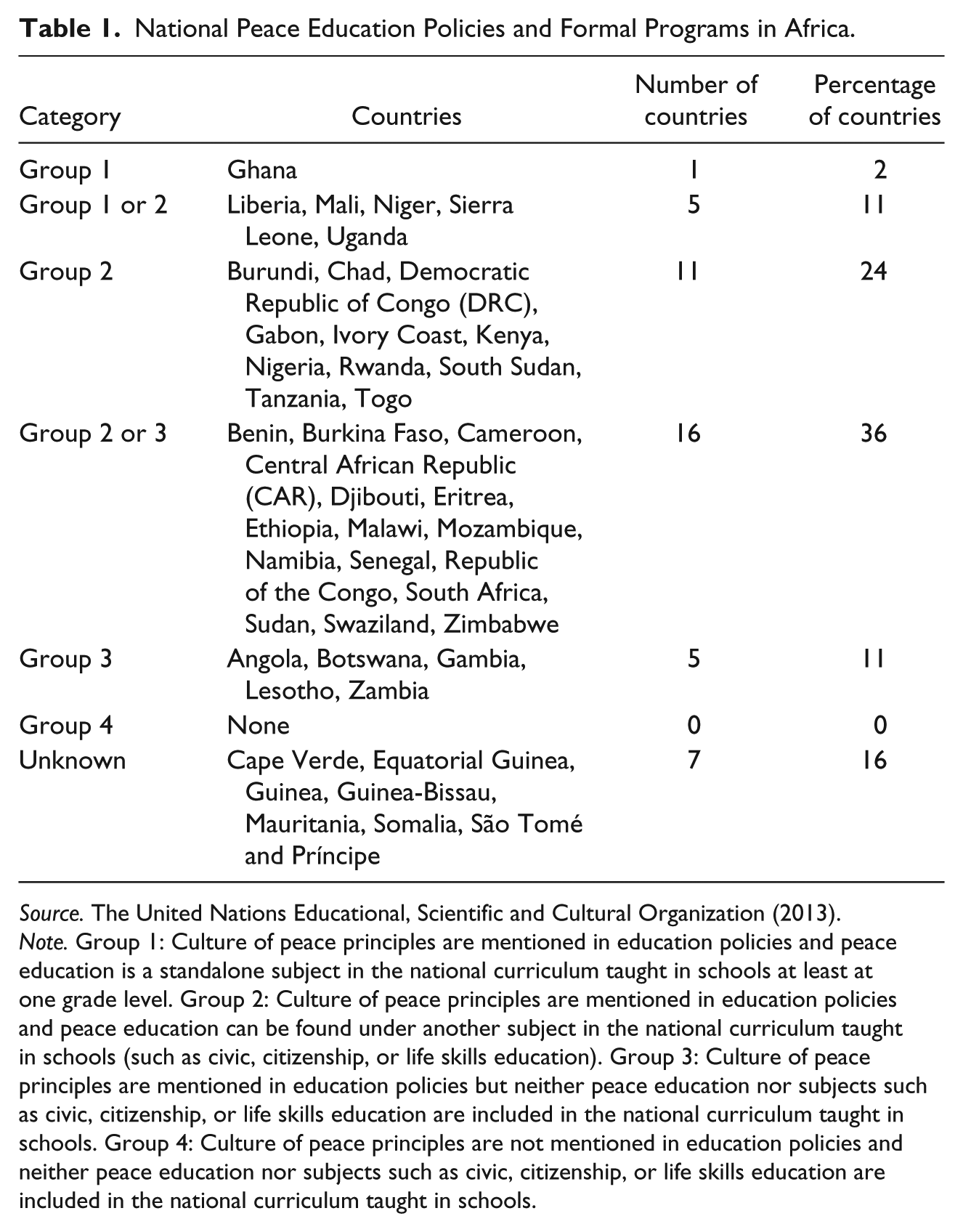
Note. Group 1: Culture of peace principles are mentioned in education policies and peace education is a standalone subject in the national curriculum taught in schools at least at one grade level. Group 2: Culture of peace principles are mentioned in education policies and peace education can be found under another subject in the national curriculum taught in schools (such as civic, citizenship, or life skills education). Group 3: Culture of peace principles are mentioned in education policies but neither peace education nor subjects such as civic, citizenship, or life skills education are included in the national curriculum taught in schools. Group 4: Culture of peace principles are not mentioned in education policies and neither peace education nor subjects such as civic, citizenship, or life skills education are included in the national curriculum taught in schools.
Table 1 reveals that the culture of peace values is visible in African countries’ education policies. However, what remains unclear is the translation of these policies to school curricula across Africa and the impact they could have on the culture of peace. Full implementation of these policies could dissuade many Africans from resorting to violence. In terms of silencing the guns by 2020, Alulasa and Paneras (2018) note that the vision is an ambitious one that faces challenges such as funding, disarming conflict-ridden states, and guaranteeing justice and rule of law. However, in light of the ubiquity of conflicts on the continent, a modest success might have meaningful impact. Africa must be peaceful and secure to exercise meaningful soft power in the international arena. A peaceful and secure Africa will attract more foreign direct investment and foreign partners (both state and non-state) as well as more international events including major international conferences and mega sporting events. This is the ultimate exercise of soft power.
Aspiration 5: An Africa With a Strong Cultural Identity, Common Heritage, Values, and Ethics
Aspiration 5 is important in light of Western cultural hegemony in the international arena. This aspiration calls for cultural pan-Africanism and projects an Africa that is conscious of its shared history, identity, heritage, and destiny. It calls for an African Renaissance and a continent whose diverse culture, languages, and religions is a source of strength (AUC, 2015a). School curricula should significantly reflect cultural pan-Africanism including heritage, languages, religions, festivals, films, music, and literature (AUC, 2015a). In sum, the aspiration seeks to achieve two main objectives by 2063: fully entrenched pan-Africanism and an African cultural Renaissance (AUC, 2015c).
Agenda 2063 seeks to preserve African cultural heritage and ensure that traditional African values that uphold respect for the family and community and social cohesion are promoted and serve as a model in the international arena. Biennial pan-African cultural festivals are proposed and African cultural output, including literature, films, music, and fashion, should contribute at least 15% to global output (AUC, 2015c).
It is believed that Africa’s cultural heritage is critical to the region’s socio-economic and political development and the eradication of conflict. African cultures embrace hard work, prudence, and care for families and the less privileged. However, opprobrious aspects of African cultures are noted, including practices that subordinate women. Agenda 2063 envisages that those practices would be eradicated (AUC, 2015c). It also recognizes the significance of the diaspora in transmitting African culture and thus emphasizes the need to solidify diaspora relations across African states and create dual citizenship programs (AUC, 2015b).
Ubuntu represents the African culture that advocates humanistic values such as reciprocity, humanness, caring, and forgiveness. It places primacy on the community rather than on an individual. This contradicts the Western culture that privileges the individual. Thus, Africa possesses human values to offer the world and the West in particular where there seems to be a moral vacuum (Tella, 2017b). This implies that Africa could well serve as a model in terms of humanness and placing community over individualism. Despite the fact that South Africa is often characterized as a violent state (ranging from high levels of domestic violence to violent service delivery protests, xenophobic, and racial attacks), it demonstrated the principle of Ubuntu in its post-apartheid Truth and Reconciliation Commission in which apartheid administration offenders were forgiven for their gross violation of the human rights of the Black majority. This prompts Nussbaum (2003) to assert that “. . . ubuntu could enrich the range of new paradigms emerging worldwide that are currently inspiring business, political and civic leaders to transform organizations. Finally the spirit of ubuntu, if taken seriously, could influence and change relationships between nations” (p. 2).
In terms of films, Africa has continued to make its presence felt globally. Due to the extent of its reach, Nollywood has provided the platform for Africans to transmit their culture across the globe and tell their own stories. It attracts significant numbers of viewers from countries such as the United States, the United Kingdom, Germany, Italy, Spain, and the Caribbean countries (Miller, 2012). Its increasing appeal is best captured by its eclipsing of Hollywood as the second largest producer of movies. Nollywood is thus well placed to provide a pan-African cinema that celebrates African heritage and achievement and counteracts negative perceptions of Africa.
Similarly, Africa has had a significant impact in the literary world. Literary figures such as Chinua Achebe, Yvonne Vera, Ayi Kwei Armah, Nuruddin Farah, Ngugi wa Thiong’o, Wole Soyinka, Chimamanda Adichie, Ousmane Sembene, Bessie Head, Mariama Ba, Albert Camus, and J. M. Coetzee and their works such as Things Fall Apart, No Longer at Ease, Butterfly Burning, The Beautyful Ones Are Not Yet Born, Half of a Yellow Sun, Maps, A Grain of Wheat, Purple Hibiscus, A Question of Power, and So Long a Letter are well admired across the globe, and Wole Soyinka, Albert Camus, and J. M. Coetzee have been awarded the Nobel Prize for Literature. Like Nollywood, this is a veritable platform to portray Africa in positive light.
African music has also been making waves globally. Popular African artists in the diaspora such as Senegalese Akon and Nigerian Jidenna have identified with their respective countries in particular and Africa in general in their dress, lyrics, and aura. Their counterparts based in Africa have also had a significant impact. Top artists Wizkid, Davido, Dbanj, AKA, P Square, DJ Maphorisa and Diamond have collaborated with renowned American artists such as Drake, Neyo, Meek Mill, Rick Ross, and Snoop Dog. This has enhanced African artists’ profile and put African music on the global map.
In the realm of fashion, there has been growing demand for African apparel in recent years. This has enhanced the popularity of African designers such as Ghanaian Oswald Boateng, South African David Tlale, and Nigerian Lisa Folawiyo who have gained followers in Europe and America (Bright & Hruby, 2015). The increased appeal of African fashion is perhaps best captured in New York Fashion Week (NYFW). While African designers had a slot for just one show in 2009, in 2014, they mounted nine individual shows (Bright & Hruby, 2015). Western designers such as Louis Vuitton, Yves Saint Laurent, and Paul Smith are using African textiles for their designs (African Fashion Breaks With “Tradition,” 2012; Ngubane, 2010) and celebrities and personalities such as Michelle Obama, Beyonce Knowles, Rihanna, Gwen Stefani, Alicia Keys, Kim Kardashian, and Nicki Minaj wear African prints.
It is thus clear that Africa’s cultural output is gaining pre-eminence in the global arena. While this has yielded valuable economic gains, deliberate efforts need to be made to ensure that it reaches the target of 15% of global output as envisaged in Aspiration 5 of Agenda 2063.
It is also important to ensure that African cultural exports not only are driven by the need to achieve targets but are also motivated by the desire to transmit African culture across the globe with the ultimate objective of counteracting negative perceptions of the continent. Only when African cultural outputs begin to make significant impact on the positive portrayal of Africa in the hearts and minds of people across the world will one begin to appreciate its soft power potential. Aspiration 5’s call for pan-Africanism and a cultural African Renaissance is essential in this regard. For African cultural exports to make a meaningful contribution, Africans must own and appreciate their heritage and cultural output. African people’s obsession with foreign cultures and values, especially Western literature, films, music, and fashion, must be curtailed. This requires that pan-Africanism not only feature at the policy level but is also taught from cradle to grave through both formal and informal education across African countries. As Africans, we must learn to appreciate and showcase authentic African values, languages, and culture.
Conclusion
Agenda 2063 provides a strategic framework to transform Africa, put the continent on the path of growth and development, and enable it to take its rightful place in the international system by 2063. The blueprint identifies the aspirations and goals that Africa must achieve by 2063. Increasing exercise of soft power by state and non-state actors in pursuit of their objectives dictates that Agenda 2063 must be embedded in a soft power strategy. Focusing on Aspirations 3, 4, and 5, this article examined the question of soft power in Agenda 2063.
Aspiration 3 represents the African values of democracy, human rights, justice, and the rule of law that the blueprint envisages will be entrenched in Africa by 2063. As this article has shown, while South Africa’s and Rwanda’s liberal constitution and gender equality, respectively, offer the continent templates that can be built on, successful achievement of this aspiration and its impact on Africa’s soft power will depend on African states’ commitment to its values in the face of corruption, human rights abuses, and democracy deficits.
Aspiration 4 aspires for a peaceful and secure Africa by 2063. It calls for the guns to be silenced and hopes to achieve a peaceful continent through dialogue, negotiations, and alternative dispute resolution. The APSA is critical in this regard. This implies that there is a need to strengthen the framework and its pillars, especially the PoW that serves as the most important soft power generator of the framework.
Aspiration 5 calls for cultural pan-Africanism and an African Renaissance. This is aimed at increasing the impact of the continent’s cultural output in the global arena. As this article has shown, African cultural output in the form of Ubuntu, literature, films, music, and fashion is already making headway in the global arena. However, much remains to be done to ensure that these cultural outputs go beyond their commercial value and make significant inroads into counteracting negative perceptions of Africa.
It is thus clear that Agenda 2063 is laced with soft power attributes. What remains to be seen is the extent to which this blueprint will enhance and reinforce Africa’s soft power by 2063.
Footnotes
Declaration of Conflicting Interests
The author declared no potential conflicts of interest with respect to the research, authorship, and/or publication of this article.
Funding
The author received no financial support for the research, authorship, and/or publication of this article.
