



Abstract
This article examines the impact that rebel and state leaders have on civil war duration. It argues that leaders’ incentives to avoid punishment at the hands of internal audiences and opponents influence their strategic decision-making during war. Specifically, leaders who bear responsibility for involvement in the war have a higher expectation of punishment should they perform poorly, particularly for rebel and high-risk state leaders. As a result, these leaders have incentives to gamble for resurrection, extending ongoing wars in the hope of turning the tide and avoiding punishment. This suggests that civil wars are less likely to end when responsible leaders hold power, especially if the responsible leader is highly vulnerable to punishment. These propositions are tested using original data on all rebel and state leaders involved in civil conflicts between 1980 and 2011. Results support the hypothesized relationship between leader responsibility and war duration.
In 1991 and 1994, the Angolan government and the National Union for the Total Independence of Angola (UNITA) signed peace agreements intended to end nearly two decades of conflict. Both the 1991 Bicesse Accords and the 1994 Lusaka Protocol included power-sharing and third-party security provisions, elements scholars suggest are key to the success of negotiated settlements (Walter 2002; Hartzell and Hoddie 2007). Despite these robust arrangements, both agreements failed. UNITA leader Jonas Savimbi remained wary of the Angolan government and refused to take up a governmental post after both settlement attempts. Ultimately, Savimbi’s reticence spelled disaster for both Bicesse and Lusaka, and conflict continued throughout the 1990s. Only after Savimbi’s death in 2002 did the warring parties sign a final accord, reaffirming many of the previous failed pacts’ terms. This time, despite a lack of third-party guarantees, the agreement held under UNITA’s new leader, Paulo Lukamba Gato, and decades of conflict came to an end.
Why did peace fail in Angola in 1991 and 1994 under Savimbi, while Gato’s 2002 agreement ended the war despite terms that were arguably less favorable for peace? Did Savimbi personally undermine peace in Angola, and does this reflect a broader pattern of leaders critically influencing the trajectory of civil war? Existing scholarship focuses primarily on country- and dyad-level determinants of civil war termination, such as strength of combatants, economic incentives, and design of settlement agreements (Collier, Hoeffler, and Söderbom 2004; Cunningham, Gleditsch, and Salehyan 2009; Lujala 2010; Walter 2002). It therefore tells us little about whether or how leaders affect conflict dynamics. Given the demonstrated importance of leaders for understanding interstate conflict (Colaresi 2004; Croco 2011; Debs and Goemans 2010; Goemans 2000; Wolford 2007), and the possibility that similar dynamics are at play in civil war, this is a potentially critical oversight in existing literature.
This article, therefore, develops a theory of civil conflict termination focused explicitly on leaders. Moving beyond the unitary actor assumption that characterizes most civil war research, I argue that a leader’s decision-making during civil war is driven largely by the goal of avoiding conflict-related punishment in the form of loss of power, exile, imprisonment, or even death. The risk of punishment, in turn, is a function of the leader’s responsibility for involvement in the conflict: internal audiences and opponents are more likely to punish a leader who bears responsibility for the war than one who does not. 1 As a result, responsible leaders have incentives to “gamble for resurrection” (Downs and Rocke 1994), extending the war in the hope of turning the tide and avoiding punishment. This is particularly likely for rebel leaders, whose baseline vulnerability to punishment is higher than that for state leaders. However, a subset of state leaders with an elevated risk of punishment is also expected to exhibit gambling behavior. Just like rebel leaders, these high-risk state leaders will be less likely to terminate when they bear responsibility for the conflict.
The study’s hypotheses are tested on a monthly data set of all civil conflict dyads active between 1980 and 2011, including original data on the identity of all leaders, each leader’s responsibility for the war, and each leader’s postconflict fate. Results demonstrate that civil wars are less likely to terminate when responsible leaders hold power, particularly if those responsible leaders are rebels or high-risk state leaders. Additional analyses show that this is especially true when responsible leaders fail to perform favorably and that responsible leaders are more likely to be punished than their nonresponsible counterparts, as the underlying mechanism suggests. The results are also robust to alternative specifications of leader responsibility and the dependent variable, alternative model and sample specifications, and tests for endogeneity.
This project has important scholarly and policy implications. First, by identifying conditions under which leaders’ incentives overshadow conflict-level factors and drive termination behavior, this study demonstrates that existing civil war scholarship at the dyad/country level is incomplete. Focusing on leaders not only identifies a novel factor influencing termination but also adds nuance to existing explanations. This article also advances emerging work on leadership in civil conflict by recognizing that variation in leaders’ risks of punishment, not just changes in leadership, influence conflict dynamics (Thyne 2012; Tiernay 2015), and by developing original data on rebel and state leaders in civil war.
This article also contributes to research on leaders in conflict more generally. In particular, it advances recent research on leader culpability by demonstrating that, for state leaders in civil war, responsibility’s impact depends upon the leader’s baseline vulnerability to punishment. It thus identifies important conditionalities in the relationship between leader responsibility and conflict behavior that previous studies have overlooked (Croco 2011; Prorok 2016). Finally, the project has important implications for policy makers. In particular, mediators and other third parties should be hesitant to expend significant resources or political capital trying to get warring parties to negotiate when responsible leaders hold power, as conflict is not “ripe” for resolution under these conditions.
This article proceeds as follows: first, it briefly examines existing research on civil war termination, focusing on gaps in the literature. Second, I develop a theory of civil war termination, focusing on leader incentives to avoid internal and opponent-based punishment. Third, I provide information on the data set developed for this project. Fourth, empirical results are presented and discussed. Finally, I conclude by examining the project’s implications for scholarship on civil war and for policy makers seeking to end ongoing conflicts.
Existing Literature
Existing research provides several important insights into the determinants of civil war duration. The majority of this literature focuses on country- and dyad-level factors that influence termination. The presence of “lootable resources,” for example, prolongs civil war by making conflict profitable (Collier 2000; Lujala 2010; Ross 2004). The complexity of conflict also influences duration; conflicts involving multiple rebel groups last longer overall, as all actors with the capacity to continue fighting unilaterally must be satisfied in any settlement deal (Cunningham 2011). 2 Building upon the bargaining model, scholars have also found that commitment problems tend to prolong civil wars, as fear of exploitation undermines agreement and implementation of settlement deals (Fearon 1994, 2004; Walter 2002). Third-party monitoring and enforcement (Walter 2002) and the inclusion of power-sharing provisions in settlements (Hartzell and Hoddie 2003, 2007; Mattes and Savun 2009) are two ways combatants overcome commitment problems and reach lasting peace.
This existing research provides important insights into the country- and dyad-level determinants of civil war duration. However, because it treats combatants as unitary actors, it provides little insight into whether, and how, rebel and state leaders influence conflict termination. This is a potentially important weakness in existing literature, given what we know about leaders’ impact on the trajectory of interstate conflict, combined with the fact that the risks to rebel and state leaders may be even greater during civil war. 3 This suggests that an accurate understanding of civil conflict termination must account for the influence of leaders.
Two recent studies investigate leaders’ impact on civil war duration. Thyne (2012) demonstrates that longer-serving state leaders are better able to end civil wars, while Tiernay (2015) shows that rebel leadership change increases the chances of conflict termination while state leadership turnover has the opposite effect. By focusing on leadership change rather than the incentives of the leaders who take power, however, these studies miss important variation in leaders’ willingness to terminate, which depends upon their vulnerability to punishment. This project, therefore, moves beyond existing studies that treat all new leaders as equivalent, instead examining variation in leaders’ expectations of punishment and their consequent willingness to end civil war.
This study also builds upon recent research showing that responsible, or culpable, leaders are less likely to settle for unfavorable outcomes in interstate and civil war (Croco 2011; Prorok 2016). It moves beyond this research, however, in two important ways. First, it identifies differences in responsibility’s impact on rebel versus state leaders. State leaders are, on average, less vulnerable to punishment in civil war than rebel leaders. As a result, responsibility for the war has less impact on state leaders’ willingness to terminate. Second, it identifies specific conditions under which responsible state leaders will be at “high risk” for punishment, leading them to behave like responsible rebels and gamble for resurrection. Identifying these conditions further advances existing literature by specifying key conditionalities in leader responsibility’s impact.
Theory
The theoretical argument developed herein recognizes that leaders’ interests often differ from those of the groups they represent (Bueno de Mesquita et al. 1999; Chiozza and Goemans 2004). It thus relaxes the unitary actor assumption that traditionally characterizes civil war research. It further assumes rebel and state leaders are rational, self-interested actors whose primary goal is to avoid punishment (Bueno de Mesquita et al. 1999; Colaresi 2004; Croco 2011). Punishment can take many forms, including not only loss of political power but also exile, assassination, and imprisonment (Debs and Goemans 2010; Goemans 2008; Prorok 2016).
In the civil war context, punishment is inflicted by one of two actors: the leader’s internal audience or his wartime adversary. Internal audiences, or constituencies, include individuals and groups within the government or rebel organization who can coordinate to hold the leader accountable (Gandhi and Przeworski 2007; Weeks 2008). Punishment by internal audiences occurs when group or regime elites can decouple their own fates from that of the leader and coordinate to hold him accountable for poor wartime decisions (Geddes 2003; Weeks 2008, 2012). For example, Pol Pot was removed from his position as leader of the Khmer Rouge by Senior Commander Ta Mok who deposed the long-time leader as the tide of war turned in favor of the Cambodian regime (Szajkowski 2004). Similarly, Ahmad Dini Ahmad, leader of the Front for the Restoration of Unity and Democracy (FRUD) in Djibouti, was marginalized and ultimately deposed by moderate elements within FRUD led by Ali Mohamed Daoud (Szajkowski 2004).
Leaders may also be punished by their wartime opponents. The adversary elite, comprised of the political/military leadership of the wartime opponent, decides whether to pursue a leadership-targeting strategy involving attempts to kill, capture, or imprison top opposition members during or after the war. Unlike leaders involved in interstate conflicts, civil war leaders cannot rely upon national borders to protect them from their opponent; civil wars are generally fought within a single state, and, barring secession or partition, former combatants must coexist within one political entity at conflict’s end. Thus, the risk of opponent-based punishment is much greater in civil war than in the interstate context. President Najibullah of Afghanistan, for example, was forced to step down by rebel advances, taking refuge in a United Nations compound in 1992 (Braithwaite 2011), while Antar Zouabri, leader of the Armed Islamic Group (GIA), was killed by Algerian security forces in 2002 (Szajkowski 2004).
As rational actors, leaders take these threats of punishment into consideration when making strategic decisions during war. In other words, internal audiences and opponents influence leaders’ policy decisions through the credible threat of punishment. As I argue below, leaders’ incentives to minimize the personal risk of punishment ultimately affect their strategic decisions and prospects for conflict termination.
Internal Punishment and Gambling for Resurrection
To understand how the threat of internal punishment affects leaders’ willingness to terminate their conflicts, it is necessary to explore the relationship between leader and constituency as well as the constituency’s decision to inflict punishment. Building upon existing research (Downs and Rocke 1994; Richards et al. 1993), I assume that constituents prefer a competent leader who faithfully pursues the group’s goals and interests. Internal audiences have incentives to punish leaders who act incompetently because removal of an incompetent leader improves prospects for victory and deters future leaders from exploiting their positions of power to pursue their own interests at the group’s expense (Downs and Rocke 1994).
Leader removal can be dangerous, however, because it disrupts communication, command structures, and cohesion, which may benefit the opponent militarily. After Felix Doh of the Ivorian Popular Movement for the Great West (MPIGO) in Cote D’Ivoire was killed, for example, the group lacked effective leadership, lost its ability to mount attacks on opponent targets, and was subsumed into the Forces Nouvelles, an umbrella group dominated by the Ivory Coast Patriotic Movement (MPCI). Given the inherent dangers associated with leader removal, internal audience members will prefer to punish only incompetent leaders, as the benefits of removal outweigh the potential costs. Internal audiences, however, are uncertain of the leader’s type; leaders enjoy an informational advantage in this respect. Richards et al. (1993) and Downs and Rocke (1994) suggest that policy/battlefield outcomes help constituencies assess a leader’s competence; internal audiences are more likely to punish leaders who perform poorly, as poor war performance implies incompetence. 4 A variety of other intervening factors also impact outcomes, however, many of which are beyond the leader’s control. Competence and faithfulness, therefore, cannot be easily deduced by war outcomes alone.
Instead, internal audiences will condition their attributions of blame for poor war performance upon the leader’s responsibility for the war. Responsibility for the war, or culpability, is determined by whether or not the leader is connected to the original decision to go to war (Croco 2011). Leaders in power at the war’s start (first leaders) and replacement leaders who share political or familial connections with the first leader will be viewed as responsible for the war by both internal audiences and adversary elites. First leaders are attributed responsibility because they directly preside over conflict initiation. 5 Replacement leaders with political or familial links to the first leader, furthermore, will be viewed as responsible because the connections they share with the first leader imply knowledge of and influence over the decision-making process that led to war. Only replacement leaders who share no ties with the first leader can concretely avoid attributions of responsibility for the war. Because these leaders held no high-ranking position at the conflict’s start nor were they connected to the first leader by blood or politics, they can avoid blame for the war and association with the first leader’s original war aims.
Ultimately, a leader’s responsibility for the war shapes the internal audience’s assessment of his competence. Along with war performance, leader responsibility provides information to internal audiences regarding the leader’s type (i.e., competent vs. incompetent). Linking blame for war outcomes to responsibility for war involvement allows internal audiences to distinguish leaders they would like to maintain in power from those deserving of punishment.
This has important implications for leaders’ expectations of punishment and their subsequent conflict behavior. Because responsible leaders face a higher likelihood of punishment than nonresponsible leaders, they will be less likely to terminate, particularly, on unfavorable terms. Responsibility for the war makes concessions and settlement costly on a personal level, thus lowering the leader’s expected utility of termination for anything other than victory. Leaders who bear responsibility for the war, therefore, have incentives to continue fighting in the hope of turning the tide, defeating the opponent, and preventing punishment. That is, responsible leaders, faced with the prospect of punishment, will gamble for resurrection (Downs and Rocke 1994; Goemans 2000).
Adversary Elites and Punishment
In addition to internal audiences, adversary elites often have incentives to remove or punish the opposing leader. To understand why, consider the political costs elites face when their enemy reneges on negotiations or settlement because they are unable to credibly commit to peace. 6 The leader’s internal detractors will blame him for this policy failure, portraying him as weak, ineffective, or incompetent (Huth and Allee 2002). Thus, making unsuccessful settlement overtures or agreeing to settlement plans that break down during implementation can be politically costly for leaders.
As a result, elites will prefer to face an opposing leader who can make credible commitments to peace if and when the opportunity to terminate on acceptable terms arises. Recall, however, that leaders who bear responsibility for the war are more vulnerable to internal punishment if they settle on compromise or losing terms. This suggests that responsible leaders will have more difficulty making credible commitments to peace than their nonresponsible counterparts, as they have incentives to gamble to avoid internal punishment. This has important implications for the threat of opponent-inflicted punishment: opponent elites will have incentives to try to remove responsible adversary leaders in the hope that a nonresponsible leader who can credibly commit takes power. 7
Somewhat counterintuitively, the opponent’s attempts to remove the responsible leader are likely to reinforce his incentive to continue the fight. Negotiation and settlement processes become rife with distrust and suspicion when leaders fear punishment, as any contact with the adversary provides an opportunity for double crossing and leader targeting (Prorok 2017). This largely explains the dynamics surrounding the failed Bicesse and Lusaka agreements in Angola. The Popular Movement for the Liberation of Angola (MPLA) government targeted Savimbi directly beginning as early as the 1970s, pursuing the rebel leader both militarily and politically (James 1992, 134). Several attempts were made on his life by military and police forces, and the government consistently excluded him from amnesty deals (Anstee 1996; Weigert 2011). In response, Savimbi refused to attend negotiations and signing ceremonies for the Bicesse and Lusaka accords, citing fear for his personal safety as reason for his absence (James 2004; Weigert 2011). Even after receiving a security detail and vice presidential post in 1997, Savimbi skipped his own swearing-in ceremony, instead remaining in a stronghold at Bailundo (“Jonas Savimbi Absent Despite Special Status” 1997). 8
Nonresponsible leaders, on the other hand, are less likely to be targeted by opponent forces because they are more trustworthy negotiating partners. Distance from the original decision to go to war affords these leaders greater flexibility to negotiate and settle with the opponent on compromise terms without the imminent threat of imprisonment, assassination, or exile imposed by the adversary. Thus, Savimbi’s replacement, nonresponsible Paulo Gato, terminated the conflict on compromise terms without facing government reprisal, despite having been a hardliner within UNITA before his ascension. In fact, Gato was included in a blanket amnesty passed by the Angolan government on April 2, 2002, and remained an important political leader as UNITA transitioned into politics. This change of course by the Angolan government demonstrates the different strategies employed against responsible versus nonresponsible leaders, and how these policies reinforce incentives for responsible leaders to gamble for resurrection in the hope of avoiding punishment.
This discussion suggests that leaders’ expectations of punishment vary by their responsibility for the war. As the likelihood of victory decreases, a nonresponsible leader’s utility for termination exceeds his utility for fighting, and termination is possible. Responsible leaders, however, derive greater utility from continuing the fight rather than terminating as the likelihood of victory dwindles and the risk of punishment increases. Leaders who bear responsibility for the war, therefore, will continue the fight rather than terminating on unfavorable or compromise terms, and war will drag on.
9
Importantly, it takes only one responsible leader with incentives to gamble to extend a war; termination cannot be achieved if at least one combatant refuses to lay down arms.
Certainty of Punishment
While the above discussion treats rebel and state leaders as equivalent, it is important to address potential differences in responsibility’s impact across these two groups. Specifically, rebel and state leaders likely vary in their expectation of the certainty of punishment. Research in the criminology literature suggests that certainty, or the likelihood that the individual will be punished, is the most crucial determinant of punishment’s impact on behavior (Bailey and Smith 1972; Howe and Loftus 1996; Kleiman 2009; Levitt and Miles 2007). 10 If punishment is unlikely, leaders will not adjust their behavior in order to avoid it (Ku and Nzelibe 2006).
Data on the frequency of punishment indicate that rebels are, indeed, more often punished than state leaders: 51 percent of rebel leaders but only 25 percent of state leaders are punished as a result of civil conflict. A similar pattern emerges when examining severe punishment (exile, imprisonment, and death): rebel leaders are punished severely 39 percent of the time while state leaders are punished severely only 11 percent of the time.
This variation in the certainty of punishment is attributable to two main factors. First, state leaders generally have a larger portfolio of issues over which their domestic constituency judges them, whereas rebel leaders are primarily single-issue leaders whose internal support is highly dependent upon the outcome of the conflict (Prorok 2013). This suggests that while responsible state leaders may be able to offset poor performance in the war with a strong showing on other issues (e.g., economic growth), responsible rebel leaders who fail to make gains in the conflict will be unable to justify their continued hold on power. Second, rebel groups tend to be weaker than their government foes. In fact, rebels are weaker or much weaker than the state 94 percent of the time in the current data. This means that responsible state leaders are more secure against punishment by the opponent than their rebel counterparts.
Therefore, responsible state leaders may not be as concerned as responsible rebel leaders with the threat of punishment because their baseline risk is lower. As a result, they will have less incentive to gamble for resurrection. Thus, the leader responsibility’s effect may be limited to rebels.
Not all state leaders are invulnerable, however. While on average their risk is lower than that of rebels, state leaders vary in their relative vulnerability. Thus, while many responsible state leaders have little incentive to gamble for resurrection because they face a low certainty of punishment, for a subset of high-risk state leaders whose internal audiences and opponents can credibly threaten punishment, responsibility for the war will generate incentives to gamble and extend the conflict.
Put differently, while responsibility for the war provides the motivation for internal and opponent-based audiences to punish a state leader, these audiences also require the opportunity to punish. Opportunity is a function of two conditions: regime type and relative strength. First, research shows that personalist state leaders can avoid internal punishment because elites in personalist regimes lack autonomy. Their fates are tied to the leader’s, and as a result they cannot credibly threaten punishment because doing so would jeopardize their own positions (Weeks 2008, 2012). This means that personalist state leaders have a low likelihood, or certainty, of internal punishment relative to nonpersonalist leaders.
Second, the combatants’ relative strength influences the risk of punishment by the opponent. State leaders who face stronger rebels, or rebels who receive external military support to offset their capabilities, are at higher risk than those whose opponents are weaker and do not receive external support. This is because, all else equal, stronger opponents are more capable of successfully targeting the leader: they can more easily penetrate enemy strongholds and are better at identifying targets, for example (Johnston 2012; Salehyan, Gleditsch, and Cunningham 2011). Thus, when the opponent is stronger or receives external support, state leaders face a heightened baseline risk.
This suggests that responsibility for the war will significantly lengthen conflict among high-risk state leaders: those (1) whose regimes are nonpersonalist and (2) who face an opponent that is stronger or is backed by a third-party state.
11
Under these conditions, internal and opponent-based audiences have the opportunity to punish, while responsibility for the war provides the motivation for punishment. Thus, high-risk, responsible state leaders will have incentives to gamble for resurrection, extending conflict.
12
Research Design
The hypotheses developed above are tested using original data on state and rebel leaders involved in all civil conflict dyads between 1980 and 2011 included in the Non-State Actor (NSA) Dataset, version 3.4 (Cunningham, Gleditsch, and Salehyan 2013). 13 The data set includes information on the identity of all leaders of each combatant group, each leader’s time in power, each leader’s responsibility for the war, and each leader’s postconflict fate. The unit of analysis is the civil conflict dyad month; using monthly rather than yearly observations allows me to more precisely measure each conflict’s duration and mid-year changes in leadership.
Dependent Variable
The dependent variable is a dummy variable coded 1 in the month conflict ends, based on the NSA data set’s start/end dates (Cunningham, Gleditsch, and Salehyan 2013). The variable equals 0 for all ongoing conflict months. Following standard convention in existing literature, a conflict is treated as ongoing if the termination of one episode of violence is followed, within two calendar years, by the reemergence of fighting between the same pair of combatants (Cunningham, Gleditsch, and Salehyan 2009). Of the 360 dyad episodes included in the analysis, 318 terminated by December 2011, the final observation month. 14 The other 42 are ongoing and treated as right censored. Conflict episodes range in duration from 1 to 576 months, with the average conflict duration equaling 95.5 months or about eight years.
Identifying Leaders
State leaders are identified using the ARCHIGOS data set, version 4.1 (Goemans, Gleditsch, and Chiozza 2009). ARCHIGOS identifies as leader the individual who exerts real decision-making authority over domestic and foreign policy. Original data are used to identify rebel leaders. Similar to archigos, these data identify the individual with final decision-making authority over group policy and strategy as leader of the organization. In most cases, identifying leaders was straightforward, as a single individual with clear decision-making power was identifiable. In other cases, however, coding decisions were complicated by leaders being exiled or imprisoned, groups merging/splitting, multiple individuals claiming leadership, or similar issues. In these cases, additional research was done to determine which individual exerted control over strategic decisions. For example, sources indicate that Abdullah Ocalan of the PKK in Turkey retained control over the group even after his capture and imprisonment in 1999 (Ergil 2007; Jenkins 2008). A full discussion of coding rules and sources is included in the Supplemental Material. Based upon extensive original research, 1,237 wartime leaders were identified, including 727 state and 510 rebel leaders. The number of leaders per combatant group in the data set ranges from one to twelve, with just under two-thirds of combatants experiencing no leadership changes. 15
Leader Responsibility
The primary independent variable is leader responsibility for the war. Responsibility depends upon what position a leader held at conflict’s start. It is therefore necessary to precisely identify each conflict’s start date in order to code responsibility. Existing data sets commonly use the date when a conflict reaches twenty-five battle deaths as its start date. However, there is significant variation across conflicts (from one day to several years) in the time it takes for 25 deaths to accumulate, time during which leadership might change hands. Because internal and opposition-based audiences are unlikely to draw a distinction between peace and war at the twenty-fifth battle death, it is more appropriate to use the date of the first battle-related fatality, as identified by the Uppsala Conflict Data Program (UCDP) conflict encyclopedia, to code responsibility. The first battle death date more precisely identifies the conflict’s beginning, while still being an objective, measureable point at which to denote the onset of hostilities.
Therefore, all leaders who held power when the first battle death occurred are responsible. Importantly, the first battle death date is used only to code leader responsibility; conflicts still enter the data set upon reaching twenty-five battle deaths to ensure comparability with existing analyses and to avoid problems of missing data on several controls. In practice, this means that the leader in power when a conflict enters the data set is not necessarily coded as responsible; if leadership changes hands between the first and twenty-fifth battle deaths, and the new leader shares no connections to the previous leader, he or she is coded as nonresponsible, despite holding power when the conflict becomes “active.” This occurs in thirty-five dyads for state leaders (9.9 percent) and fifteen dyads for rebel leaders (4.4 percent).
More generally, replacement leaders—those that come to power after the conflict’s start—are assigned a responsibility coding depending upon their connections to the first leader. Specifically, replacement leaders with political or familial connections to the first leader are coded as responsible. In democratic states, such connections include membership in the first leader’s political party or cabinet at conflict’s start. In nondemocracies, replacement leaders are coded as responsible if they were members of the first leader’s political inner circle, the ruling family, or the military elite at the conflict’s start. In Sudan’s conflict against the Sudan People’s Liberation Movement (SPLM), for example, the second leader Abdul Rahman Swaredahab is coded as responsible because he was defense minister and commander in chief of the Sudanese armed forces at conflict’s start.
Similarly, responsibility in rebel groups transfers to replacement leaders who are connected to the decision to fight by virtue of their positions within the organization at conflict’s start and their connections to the first leader. Cofounders of the rebel organization, family members of the first leader, and replacement leaders who hold high-level positions when the conflict begins inherit the first leader’s responsibility for the war. For example, replacement leader Jyotirindra Bodhipriya (Santu) Larma is coded responsible for the Shanti Bahini conflict against Bangladesh, as he was brother to first leader Manobendro Narayon Larma. Finally, replacement leaders are coded as nonresponsible (0) if they share no political or familial ties with the first leader and held no high-ranking position within the rebel group or government at the conflict’s start.
Based upon these coding rules, leader responsibility is coded 1 if at least one leader (rebel or state) in a given month is responsible, and 0 otherwise. This variable is used to test Hypothesis 1 and is coded 1 in 19,464 of the 21,200 monthly observations (91.8 percent). 16 To test Hypothesis 2, two dummy variables are created. State-leader responsibility is coded 1 if the state leader in power in a given month bears responsibility for the war, and 0 otherwise, while rebel-leader responsibility is coded 1 if the rebel leader in a given month bears responsibility, 0 otherwise. The former is coded 1 in 14,541 observations (68.6 percent), while the latter is coded 1 in 18,182 monthly observations (85.8 percent).
Finally, I test Hypothesis 3 by incorporating information on state leaders’ vulnerability to punishment. A state leader is considered high risk if he or she is (1) nonpersonalist and (2) the rebels are stronger than the state or receive explicit external military support. Data on regime type come from Geddes, Wright, and Frantz (2014), who code all autocratic regimes from 1946 to 2010. 17 Data on the relative strength of combatants and external military support come from the NSA data set. State leaders are coded high risk if they receive a 0 on the Geddes et al.’s personalist regime variable, and the rebels are coded as stronger or as receiving explicit military support from a third-party state by NSA. After identifying high-risk leaders, I created two dummy variables that incorporate both responsibility and relative risk: high-risk responsible state leader is coded 1 if the state leader is responsible and deemed high risk (3,381 of the 21,117 observations or 16 percent), while low-risk responsible state leader is coded 1 if the state leader is responsible but is not considered high risk (11,123 observations or 52.7 percent). The comparison category includes all nonresponsible state leaders. The expectation (Hypothesis 3) is that only the former will significantly decrease the hazard of termination.
Control Variables
The analysis includes several controls based upon existing literature. First, I control for leadership change with two dummies—rebel leadership change and state leadership change that are coded 1 in the first three months following changes in rebel and state leadership, respectively. 18 Research shows that rebel leadership change shortens war duration, while state leadership change has the opposite effect (Thyne 2012; Tiernay 2015). It is important to control for leadership change, furthermore, because changes in responsibility cannot occur without leadership also changing hands. Responsibility and change can be thought of as distinct, however, for two main reasons. First, theoretically, change captures leaders’ “newness” while responsibility captures leaders’ connections to the decision to go to war. This is important because while newness may facilitate termination, particularly for rebels (Tiernay 2015), responsibility incentivizes gambling behavior, regardless of how long the leader has held power. Second, changes in leadership do not always bring nonresponsible leaders to power: for governments, leadership change results in a responsible leader 46 percent of the time, while for rebels, change brings a responsible leader to power 73 percent of the time. 19
Next, I control for external military support with two variables—rebel support and state support—coded 1 if the respective combatant group receives explicit military support from a third-party state. External support is expected to lengthen conflict by offsetting deficiencies in capabilities and adding veto players to settlement processes (Balch-Lindsay, Enterline, and Joyce 2008; Cunningham 2011). 20 Third, I control for the natural log of the number of ongoing conflicts in the state. While some argue that conflict is more difficult to terminate as the number of combatants increases, others show that individual dyads are more likely to terminate as the number of warring parties increases (Nilsson 2010). I expect this variable to increase the hazard of termination.
Fourth, I control for the combatants’ relative strength with two dummy variables, rebels much weaker and rebels stronger, with rebels at parity/weaker as the baseline category. Consistent with previous research, I expect conflict to last longest when rebels are much weaker and to end most quickly when rebels are stronger. Conflicts with much weaker rebels generally involve irregular fighting in which rebels can evade detection and avoid defeat, while those with stronger rebels are more likely fought conventionally, reaching a quick, decisive outcome (Balcells and Kalyvas 2014). I also control for whether the rebels have effective territorial control, which is expected to allow the group to avoid defeat, thereby lengthening conflict (Cunningham, Gleditsch, and Salehyan 2009). Finally, I control for characteristics of the state, including democracy, gross domestic product (GDP) per capita, and population. I expect democracy and increasing GDP to improve prospects for termination, while more populous states will have more difficulty ending war (Cunningham, Gleditsch, and Salehyan 2009; Tiernay 2015). 21 Measurement details for all controls are presented in the Supplemental Material. 22
Results and Discussion
The hypotheses developed above are tested using Cox proportional hazards (PHs) regression. Cox models estimate the time to an event, in this case conflict termination, without assumptions about the shape of the baseline hazard. Robust standard errors are clustered on the dyadic conflict episode. Hazard ratios are reported; values under 1 indicate that the variable decreases the hazard of termination (i.e., increases duration), whereas values greater than 1 indicate that the variable increases the hazard of termination. Variables that violate the PH assumption, based on Schoenfeld residuals, are interacted with analysis time in the models below.
Results for model 1 in Table 1 indicate that leader responsibility significantly increases conflict duration. As predicted, conflicts with at least one responsible leader in power are significantly less likely to terminate than those with two nonresponsible leaders. The hazard ratio of .607 indicates that moving from no responsible leaders to at least one responsible leader decreases the likelihood of termination, on average, by 39 percent.
Cox Proportional Hazards Results.

Note: Hazard ratios reported. Standard errors in parentheses, clustered on dyadic conflict episode.
*p < .10.
**p < .05.
***p < .01. Two-tailed tests.
Model 2 tests the impact of responsibility separately for states versus rebels. As predicted (Hypothesis 2), the overall impact of responsibility, observed in model 1, is driven by rebels: rebel responsibility significantly decreases the hazard of conflict termination, while state-leader responsibility has no significant effect. Finally, model 3 tests the argument that state-leader responsibility’s impact is limited to high-risk leaders whose internal and opponent-based audiences have the opportunity to punish (Hypothesis 3). 23 As expected, high-risk, responsible state leadership significantly decreases the hazard of conflict termination, by about 37 percent relative to the baseline. 24 Low-risk, responsible state leaders, on the other hand, have no significant impact on the hazard of termination. Furthermore, a Wald test indicates that the impact of high-risk responsible state leader is significantly different from that of low-risk responsible state leader (χ2 = 14.67, p value = .0001). 25
To demonstrate the substantive impact of these results, Figure 1 graphs the survivor function for different levels of the responsibility variables. These figures are based on model 3 and are calculated holding all control variables at mean or modal values. 26 The first panel graphs the survivor function for nonresponsible versus responsible rebels, while the second panel graphs the survivor function for nonresponsible versus low- and high-risk responsible state leaders. As expected, the probability that a conflict continues is substantially higher when a responsible rebel leader holds power: a conflict that has lasted twelve years, for example, has a 25 percent chance of continuing if the rebel leader is responsible versus just an 11 percent chance of continuation if a nonresponsible rebel leader holds power. Similarly, a twelve-year-old conflict has a 50 percent probability of continuing when the state leader is at high risk and responsible versus just a 35 percent probability of continuation when the state leader is nonresponsible and only a 25 percent chance of continuation when the state leader is at low risk and responsible.
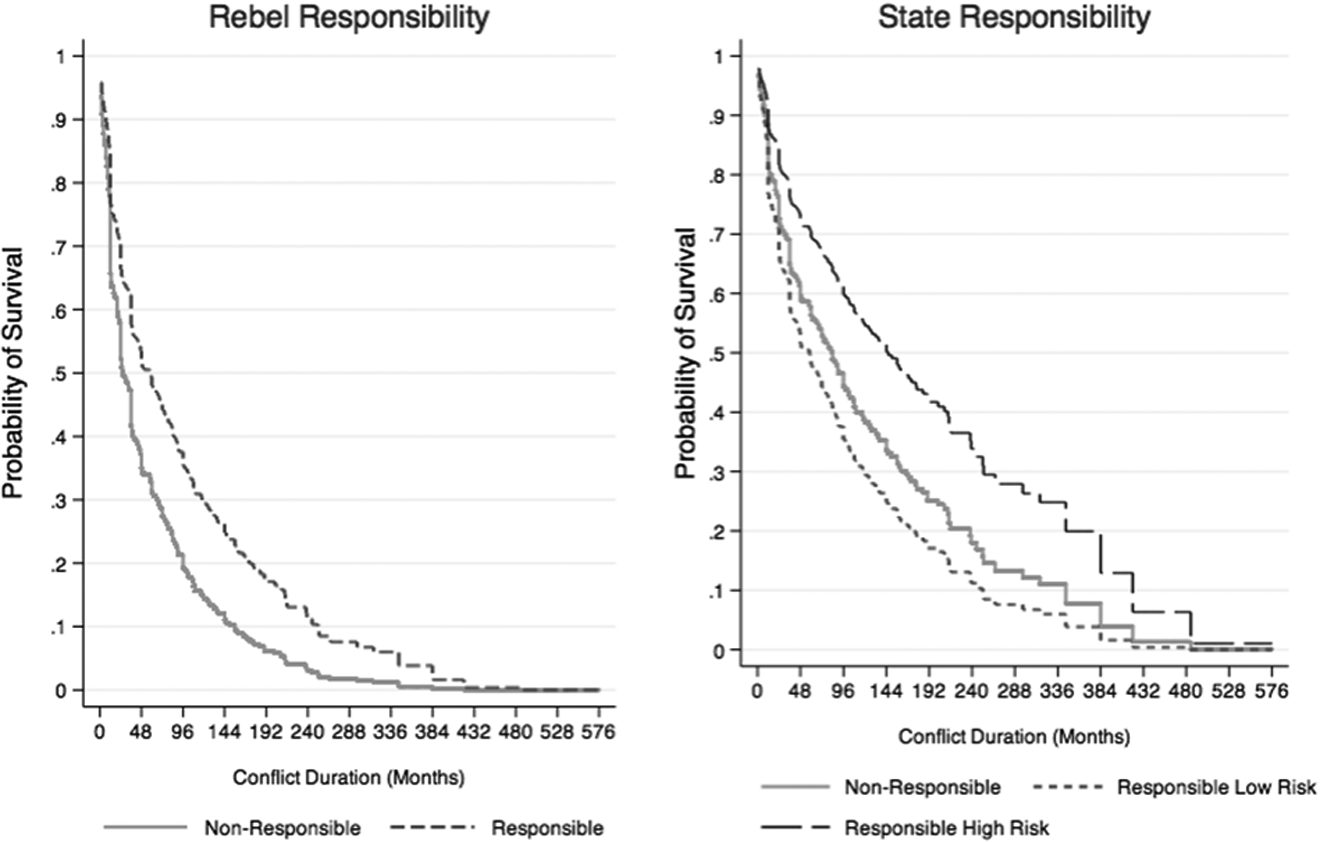
Conflict survival by leader responsibility (model 3).
Results for the control variables largely confirm expectations. First, rebel leadership change significantly increases the hazard of termination, as expected. Rebel and state-military support, on the other hand, both significantly increase conflict duration, though the impact of rebel support diminishes over time, as evidenced by the result for rebel support interacted with analysis time. Population size also decreases the hazard of termination, in line with expectations. Increasing the number of active conflict dyads in the country increases the hazard of termination, as expected, though the effect is substantively small and is not statistically significant. As expected, much weaker rebels significantly lengthen conflict relative to rebels that are weaker/at parity, while stronger rebels have the opposite effect. Effective territorial control also lengthens conflict as expected, though not significantly. Finally, GDP per capita, democracy, and state leadership change have no significant effect on conflict duration.
Additional Analyses
The results discussed above provide strong initial support for the paper’s theoretical expectations. Below, I briefly discuss several robustness checks that provide additional support for the main results. The results for these additional models are presented in the Supplemental Material due to space limitations.
First, I test the possibility that rebel responsibility is conditional on risk level. As discussed above, rebel leaders are more frequently punished than state leaders during civil war. I therefore expect that the vast majority have a nontrivial expectation of punishment and that the impact of responsibility is not conditional (i.e., all rebels are essentially high risk). However, it is possible that some subset of rebel leaders is secure enough against punishment that they will not extend conflict due to responsibility. To test this possibility, I create a measure of rebel leaders’ risk of internal- and opponent-based punishment that is based upon the rebel group’s organizational structure (i.e., level of centralized command/control) and the leader’s location and the availability of external bases (see Supplemental Material for more details). I then create two dummy variables: high-risk responsible rebel leader and low-risk responsible rebel leader, with nonresponsible rebel leaders constituting the comparison category. The results in Table S1 in the Supplemental Material indicate, as expected, that while low-risk responsibility’s impact is somewhat weaker, both high- and low-risk responsible rebels significantly increase conflict duration. A Wald test, furthermore, indicates that there is no significant difference in the impact of these two categories (χ2 = 0.23, p value = .628). Therefore, it is more appropriate to treat all rebel leaders as vulnerable to punishment, as done in the main analysis, and not to condition the impact of leader responsibility on risk level for rebels. See the Supplemental Material for further discussion of this result.
The second set of robustness checks tests two alternative specifications of leader responsibility. The first recodes responsibility to account for the possibility that leaders might acquire responsibility through their actions rather than solely through their relationship to the first leader. Specifically, leaders may “gain” responsibility if they escalate upon taking power. Escalation early in a leader’s tenure, while he or she is still building and solidifying his or her reputation, may change constituents’ and opponents’ perceptions, leading them to judge a nonresponsible leader as responsible. Table S2 in the Supplemental Material tests this possibility with the recoded responsibility variables. The results are consistent with the main analysis.
Second, in the main coding of state-leader responsibility, I did not code co-party members in nondemocracies as responsible unless they were high-ranking officials when the conflict started. This coding rule differs from existing research on leader culpability, which codes all co-party members as responsible, even in nondemocracies (Croco 2011). While research suggests that the public does indeed judge leaders along party lines (Cotton 1986; Erikson 1988), this finding applies only to the (relatively uninformed) public in democracies. In nondemocracies, the relevant constituency is not the general public, but a more select, well-informed group of regime elites. These elites will be capable of distinguishing between a party member who was low ranking at the time the war started and one who was an inner-circle member when fighting began and will assign responsibility accordingly. Therefore, the original coding decision to restrict state-leader responsibility in nondemocracies to replacement leaders who were members of the first leader’s inner circle is theoretically more appropriate. In practice, the distinction is relatively unimportant: only 11 of the 728 (1.5 percent) state leaders were nondemocratic, co-party members of the first leader but were not also members of that first leader’s inner circle. Despite this, I recoded state-leader responsibility to include all co-party members and reran the main analyses. The results remain consistent (Supplemental Material Table S2).
The third additional analysis accounts for leaders’ performance in the war. Responsible leaders may only have incentives to gamble for resurrection when they fail to perform favorably in war, as war performance is a key metric by which audiences judge the leader’s competence and whether he deserves punishment. Unfortunately, no existing data sets provide time-varying, cross-national information on combatant performance in war, making it difficult to directly test this aspect of the theoretical argument. However, using original data collected on leaders’ performance at the end of their tenures, I test the expectation that conflict is less likely to end when responsible leaders whose war performance is not favorable hold power. The results of this analysis, presented in Table S3, are suggestive rather than definitive, given data limitations (see discussion in Supplemental Material). However, they provide some initial support for the argument that leader responsibility’s impact is conditional on war performance. Responsible rebel leaders with status quo/poor performance in war significantly reduce the hazard of conflict termination, while responsible leaders who have performed favorably have no significant effect. Similarly, high-risk responsible state leaders whose performance was not favorable significantly decrease the probability of termination, while responsible state leaders who performed favorably in the war actually increase the hazard of termination.
The fourth additional analysis tests the underlying causal mechanism. The plausibility of the theoretical argument rests upon whether or not responsible leaders actually are more likely to be punished than nonresponsible leaders. I test this underlying causal mechanism in secondary analyses presented in Tables S4 and S5 in the Supplemental Material. Model 1 in these tables tests the expectation, for states and rebels, respectively, that responsible leaders are more likely to face punishment than nonresponsible leaders. Model 2 in each table accounts for responsible leaders’ risk level. Particularly for state leaders, I expect high-risk, responsible leaders to be more likely to face punishment than low-risk responsible leaders or nonresponsible leaders. Finally, model 3 in each table accounts for leaders’ war performance, with the expectation that responsible leaders who perform poorly in war will be most prone to punishment. The results provide strong support for the punishment mechanism. Rebel leaders who bear responsibility for the war are significantly more likely to be punished than nonresponsible rebels, and high-risk responsible state leaders are more punishment-prone than low-risk or nonresponsible state leaders. These effects are particularly pronounced for leaders who have performed unfavorably in the war. A full discussion of these analyses is provided in the Supplemental Material.
Fifth, it is necessary to consider potential endogeneity issues. Nonresponsible leaders may simply appear to end their conflicts more frequently because they are more likely to be in power under circumstances that favor termination, such as poor performance or high costs of war. While this is an important potential issue that warrants investigation, evidence suggests that endogeneity is likely not a serious threat to inference in this case. Poor performance in war may increase the chances of leader change, but the link between performance and the new leader’s responsibility is less clear. Indeed, empirical evidence shows that replacement leaders who take power under poor conditions are equally likely to be responsible (49 percent) as those who take power under status quo or favorable conditions (48 percent). There is, therefore, no obvious systematic relationship between war performance and the new leader’s responsibility.
The relationship between high costs of war and leader responsibility, furthermore, is addressed in Table S6 in the Supplemental Material, which presents additional analyses using data from the UCDP GED data set (Melander and Sundberg 2013). Combatant-level battle deaths data are used to create a monthly measure of war costs. This variable is then used to predict whether nonresponsible leaders are more likely to come to power when that combatant is suffering high costs, with the expectation that if endogeneity is a concern, high costs will predict nonresponsible leaders coming to power. Results demonstrate that increasing war costs does not significantly impact the likelihood that a nonresponsible leader takes power. These null results hold for both state and rebel combatants, suggesting that neither nonresponsible state nor nonresponsible rebel leaders are systematically more likely to come to power under conditions that would make conflict termination more likely, and thus that endogeneity is unlikely to be a serious concern. These results are discussed further in the Supplemental Material.
Finally, several additional robustness checks are presented in the Supplemental Material. These include analyses using alternative specifications of controls for leadership change (Table S8), external support (Table S9), and territorial control (Table S10) and additional controls for natural resources and rebel political wing (Table S10). Also included are analyses using subsamples of the data that include only observations after at least one leadership change has occurred and exclude coups (Table S10). A competing risks model that separates victories from other types of outcomes is also presented. Responsibility for the war generates incentives to avoid most outcomes but may have no effect on military victory because victorious leaders should not anticipate punishment (Prorok 2016). Including victories in the main dependent variable, therefore, may bias the results against a significant finding. The results demonstrate, as expected, that leader responsibility has no significant effect on the likelihood of victory relative to conflict continuation, but that it does significantly decrease the likelihood of other outcomes (Table S7). Taken together, all of these additional analyses and robustness checks provide substantial additional support for the main findings and the paper’s theoretical argument about leaders in war.
Conclusion
This article has argued that a leader’s responsibility for involvement in civil war critically affects his/her expectations of punishment and therefore his/her willingness to terminate an ongoing conflict. This argument has important implications for our understanding of when civil wars end: conflict is likely to continue when individuals with control over policy fear that termination would threaten their political or physical survival. Responsible leaders will gamble for resurrection in the hope of achieving victory and avoiding punishment. This is particularly true for rebel leaders, whose baseline vulnerability to punishment is higher than that for the average state leader and for a subset of high-risk state leaders who also face an elevated risk of punishment. The prospects for conflict termination, therefore, are significantly higher only after nonresponsible rebel leaders or nonresponsible/low-risk state leaders take power, as they can end the war without fear of personal consequences. Thus, in Algeria’s conflict with the FIS, peaceful settlement was achieved only after two nonresponsible leaders, Liamine Zeroual (state) and Madani Mezrag (rebels), came to power.
Empirical analyses provide strong support for this theoretical argument. Ongoing conflicts with at least one responsible leader in power are significantly less likely to end than those with two nonresponsible leaders, and conflicts with responsible rebels or high-risk responsible state leaders in power are particularly less likely to end than those with nonresponsible rebel/state leaders. In addition, secondary tests suggest that the effect of responsibility may be conditional on war performance and that the results are robust to alternative specifications of leader responsibility and the dependent variable, alternative model and sample specifications, and tests for endogeneity.
Secondary tests also demonstrate that responsible rebel leaders and high-risk responsible state leaders are more likely to be punished than their nonresponsible counterparts, as the underlying mechanism suggests. While the rate of punishment is very similar across sources (internal punishment occurs in 19.8 percent of cases while opponent-based punishment occurs in 18.1 percent of cases), there is interesting variation in the severity of punishment across internal and opponent sources. Specifically, internal punishment involves imprisonment or death in only 11 percent of cases, whereas opponent-based punishment involves imprisonment or death 65 percent of the time. While accounting for variation in the severity of punishment is beyond the scope of the current project, this variation raises interesting questions for future research. It is possible, for example, that when leaders are vulnerable to both internal- and opponent-based punishment, they will be more wary of the external threat, as they may expect internal punishment to be more lenient. This could impact conflict behavior in interesting ways and represents an important avenue for future research.
Finally, this study has important implications for existing scholarship. First, it demonstrates that existing dyad- and country-level explanations are incomplete and that the burgeoning literature on leaders in civil war must look beyond simple leadership change, instead investigating variation in leaders’ incentives. Recognizing that leaders’ incentives often differ from those of the groups they represent, this study identifies the type of leader whose interests are most likely to diverge from those of his constituents, and who is therefore most likely to continue a conflict when termination is in the group’s best interest. Second, this study brings new theoretical insights to the civil war literature by drawing upon theories of leader culpability in interstate conflict, while simultaneously adding nuance to those theories by identifying specific conditions under which responsibility for the war will impact state leaders’ behavior.
Ultimately, this project suggests that the trajectory of civil war is affected not only by factors such as the strength of combatants and external support but is also significantly influenced by the incentives of the leaders involved. This insight has important implications for policy makers seeking to facilitate the peaceful resolution of ongoing civil conflicts. In particular, mediators and other third parties should be hesitant to expend significant resources or political capital trying to get warring parties to negotiate when responsible leaders hold power, as conflict is likely not ripe for resolution under these conditions, and efforts to resolve conflict may fail. If the international community attempts to resolve these intractable conflicts anyway, mediators and the broader policy community should be particularly sensitive to the political and physical vulnerability of responsible leaders, understanding that these leaders may require personal security guarantees before agreeing to settlement deals, possibly even when those deals are facilitated and guaranteed by outside actors.
Supplemental Material
Supplemental Material, 10-2016_final_supplement - Led Astray: Leaders and the Duration of Civil War
Supplemental Material, 10-2016_final_supplement for Led Astray: Leaders and the Duration of Civil War by Alyssa K. Prorok in Journal of Conflict Resolution
Footnotes
Declaration of Conflicting Interests
The author(s) declared no potential conflicts of interest with respect to the research, authorship, and/or publication of this article.
Funding
The author(s) received no financial support for the research, authorship, and/or publication of this article.
Supplemental Material
Supplementary material is available for this article online.
Notes
References
Supplementary Material
Please find the following supplemental material available below.
For Open Access articles published under a Creative Commons License, all supplemental material carries the same license as the article it is associated with.
For non-Open Access articles published, all supplemental material carries a non-exclusive license, and permission requests for re-use of supplemental material or any part of supplemental material shall be sent directly to the copyright owner as specified in the copyright notice associated with the article.
