



Abstract
Science education motivates students to be problem solvers who utilize scientific knowledge for the social problems that they encounter in their lives. However, for better solutions for the problem, just knowledge of scientific concepts would not be enough because students need to approach problems aesthetically also. Understanding social, cultural, and sociological bases of the problem and the values of people who own the problem should be considered in the solution. Therefore, that brings the need for aesthetic experiences in science education as well as cognitive experiences. From the Deweyan approach, an experience is an experience when it is supported by human values. The main characteristics of aesthetic experiences are that they transform abstract concepts into living ideas because the process makes people make sense of the parts, link to the whole, and perceive the world from different perspectives. Because they are not an absolute must, artworks are essential elements for the aesthetic experiences. With the use of artworks in instruction, students can have aesthetic experiences by transforming abstract concepts into living ideas and solve social problems more effectively. The study aims to connect the cognitive and aesthetic aspects of science and promote aesthetic experiences by using an artwork. A framework based on Deweyan aesthetic was used for pedagogical suggestions. With the use of the framework both cognitive and aesthetic perspectives were emphasized for social problems, and the concept of electrostatics and the interaction between science and society is underlined for the instruction.
Introduction
Aikenhead (1996) takes science as a culture and defines that the aim of science education is to facilitate the way of students to cross the bridge between their own culture and the culture of science. In a situation where the cultural connections of science are emphasized, the students should be interested in the aesthetic and affective aspects as well as the conceptual aspect of science (Lemke, 2001).
The term aesthetics, which has been handled by many philosophers, was first described by the German philosopher Baumgarten as the science of perception; although it was not kept apart from cognition, it was placed at a lower level. Concerning education, Dewey’s aesthetic view takes learning as cognition, action, and emotion (Girod et al., 2003). Dewey (1934) states that experience must be supported by human values to be expressed as an aesthetic experience. According to the Deweyan approach, aesthetic experiences have three main characteristics: compelling, unifying, and transforming. The aesthetic experiences are compelling because the aim is not reaching the end, they force one to learn more and more; they are unifying because they allow the person to make sense of the different parts of a whole and make links to understand the big picture, and they are transforming because they allow the person to perceive and understand the world differently (Girod & Wong, 2002). Wickman (2006) supports these ideas and states that if the aesthetics of science are kept in the background, science cannot continue because aesthetic experiences are relevant to the values of science and are influential in important stages of research, such as the selection of scientific problems and the determination of methods.
In this context, aesthetic experiences can help students understand the sociocultural values and importance of science, so it may be possible to achieve the goals of science education—cultural connections between student and science.
Problem Statement
The 21st-century skills or science, technology, engineering, and mathematics (STEM) education focuses on transforming each student into a problem solver. Students should use scientific knowledge in creating solutions for social problems. However, the context of the programs is generally concept-based. The expectation is to use content knowledge in social problems. Beforehand, it is important to remind that social problems have their own sociocultural, economic, and sociological bases. To understand the problem, to think about and create solutions for the problem, problem solver should review the base of the problem and should consider the values of the society whom they present the solution. For this, science education curricula should focus on aesthetics as much as cognition.
The Aim of the Study
The main aim of the study is to blend cognitive and aesthetic aspects of science and to support aesthetic experiences in science education by using art objects in teaching. The second aim is to provide a proposal for instruction to help students understand social problems and how science is used to solve them, and also to develop students’ problem-solving abilities with aesthetic experiences. Concerning the aim, this study includes pedagogical recommendations on the use of artworks in science teaching.
The study focuses on the social effects of scientific knowledge and how science meets the problems of society. To present the context, a painting called Dispensing of Medical Electricity (1824) by Edmund Bristow was used. The social problem pictured in the artwork is a health problem—rheumatism—and demonstrates how science affects health problems. Pedagogical suggestions based on the painting cover the concept of electrostatics, effects of science on society by focusing on how people value science, interdisciplinary nature of science by focusing on the role of physics in medicine. The framework by Pugh and Girod (2007) that transforms concepts into living ideas shapes the pedagogical suggestions of the study.
Aesthetics and Science Education
In this study, artworks play an important role in aesthetic experiences. Artworks are not crucial for aesthetic experiences, as Dewey (1934) says, but provide rich presentation to stimulate perceptions, to help considering values of others, to link past–present–future within the frame of our perceptions and values, to understand sociocultural contexts, and therefore to transform perceptions (Dewey, 1934).
Science education puts the spotlight on the cognitive aspects of science (e.g., Girod et al., 2003) and pays little attention to aesthetic aspects of science (Flannery, 1991). But the point is that aesthetic experience is the fundamental part of science and science education (Davis, 2008; Eisner, 2005; Wickman, 2006). Wickman (2006) says, When we realize that aesthetic experience has this integral role in learning science, it becomes meaningless to ask if science education should be made more aesthetic. Such a question would be like asking whether students should learn any science in science education. p.148
He believes that science education should proceed parallel to students’ lives and without aesthetic experiences they would not realize and perceive anything from science class so they would choose to do something else (Wickman, 2006).
From a curricular approach, content knowledge, students’ communication through their content knowledge—such as asking questions, discussing, or explaining pieces of evidence—and interest are important aspects of a curriculum (Cross, 2014). Aesthetic approach and integrating artworks into education have the potential to balance these three aspects. From the third to the first, art-based aesthetic experiences can reach more students—even nonscience students in science classes (Flannery, 1992)—by making learning enjoyable (Noblit et al., 2008). Art is a way of communication that can be used in science education because aesthetic experiences through art-based experiences provide students more room to use language, ask questions, discuss concepts or objects, and explain themselves (Jakobson, 2008). Therefore, more interest in lessons and more opportunities to communicate would provide more engagement in learning content knowledge (Wickman, 2006).
Besides theoretical studies, the role of aesthetics in learning both cognitively and aesthetically (Caiman & Jakobson, 2019; Jakobson & Wickman, 2008a, 2008b, 2015), in active learning (de Leon, 2007), in communication linguistically (Jakobson & Wickman, 2008a), in creativity and learning (Adu-Agyem & Enti, 2009), in imagination (Caiman & Jakobson, 2019), in interest and enjoyment (de Leon, 2007), and in science, technology, engineering, arts, and mathematics (STEAM) curriculum (Mun & Hwang, 2019) were reported as a result of studies with students in educational settings.
Aesthetics Experiences and Pedagogy
Although artworks and aesthetics provide opportunities to facilitate learning, communicating, and interest, that is not sufficient. Teachers who plan and moderate the instruction would have an important role to create educational tools from artworks (Galili, 2013). To make students have aesthetic experiences, teachers should help students transform the abstract concepts into living experiences and help them think differently from different perspectives (Pugh & Girod, 2007). In the frame of the concept of aesthetic experience and the light of Dewey’s aesthetic experience theories, Pugh and Girod (2007) developed a framework for the use of aesthetic experiences in education.
This framework stands on five main pedagogical ideas in two groups of methods: (a) methods of crafting ideas out of concepts and (b) methods of modeling and scaffolding transformative and aesthetic experiences. This study covers the first group of methods which are (a) restore concepts to the experience in which their origins and significance are embedded, (b) foster anticipation and personal experience, and (c) re-see the object to expand perception (Pugh & Girod, 2007). For the method (a), pedagogical idea is to handle scientific concept in original form and discuss how science works, and how scientific studies affect science and society. The use of the history of science matches this idea because the history of science is a strong source that can present how science works and interaction between science and society while it presents the origin of the concepts. For the method (b), pedagogical idea is to select and gather up the effective elements of a concept to provide students opportunities to explore the concept. Being enthusiastic and creative is expected from students in this method to perceive the world and understand how ideas in science change the perception of the world. Using artworks solely fulfills the expectation of the method because the characteristic of art is to bring the forefront of the main themes (Dewey, 1934). Selecting an artwork on a concept would show effective elements about the concept, by its nature. On this basis, the use of inquiry in exploring these elements and linking each element with the whole can match with this idea. The method (c)’s pedagogical idea is to use different perspectives to perceive the concept. Asking about details, taking the role of different characters, and comparing different situations can correspond to this idea.
Aesthetic experiences based on this framework have the potential to promote students’ inquiry skills as well as their understanding of science. Therefore, integrating aesthetic understanding and aesthetic experiences into science education can help the recent aims of science education such as problem solving and understanding the sociocultural nature of science.
Aesthetics and Problem Solving
The 21st-century skills on problem solving focus on using various types of reasoning; analyzing the interaction among parts and the whole; making judgments as a result of effective analysis, evaluations, and synthesis; asking significant questions to present better solutions; and solving nonfamiliar problems (Partnership for 21st Century Learning, 2019).
Borrowing from engineering design and STEM education, the term problem scoping can be applied to aesthetic experiences for problem solving. Problem scoping means defining the nature and limits of the problems, and has three features as follows: naming, setting the context, and reflecting. For naming, students should identify the information in the problem, perspectives of players of the problem situation. For setting context, students should consider interactions among the aspects of the problem and balance these interactions and then should develop a sense of the problem. For reflecting, students should evaluate the problem and make decisions (Watkins et al., 2014).
Aesthetics, problem, and problem scoping have much in common. The history of science presents instances that present the relationship between aesthetics and problem solving. Scientists’ aesthetic approaches—for example, values, taste, or style—have effects on their scientific inquiry and problem-solving process. Scientific taste, as Beveridge (1957, pp. 78–79) discussed, takes part in answering questions such as “Which subject should I choose to investigate?”; “What are the clues for the problem?”; “How should I design the research process?”; “How should I evaluate the hypothesis?”; and “How should I make decisions?” The beauty and values of scientists have an important role in their judgments as well. Therefore, focusing on aesthetic values in science can be defined as a fruitful way to process problem scoping and problem-solving activities.
Considering Dewey’s approach to aesthetics from an educational perspective, aesthetic knowledge is a need in defining and solving problems because it presents the characteristics of the problems via feelings (Dewey, 1934). Characteristics of aesthetics experience in the Deweyan approach cover compelling, unifying, and transformative aspects. Therefore, one who has aesthetic experience should question to learn more, unite the parts of the whole to discover and transform the concepts to living ideas (Pugh & Girod, 2007). Thereby, aesthetic understanding adds more to problem-solving understanding. With the integration of aesthetics dimensions into problem solving, problem solvers can see beyond the appearance of the problems (Barturek & Carbari, 2006, in Stephens & Boland, 2015).
Not just for science and scientific problems but also for mathematical problems, the importance of aesthetic understanding is stressed. Aesthetic monitoring and aesthetic evaluations of mathematicians during the problem-solving process play a crucial role in their approaches to the problem and their satisfaction with the solutions (Silver & Metzger, 1989).
Proposal for an Instruction: A Lesson Based on an Artwork
Aligned with the aim of the study and the framework for the use of aesthetic experiences by Pugh and Girod (2007), following sections cover a brief history of electrostatics, science and society interaction in the context of health issues, a brief information and explanation about the artwork that the lesson will be planned on, and pedagogical suggestions to plan a lesson to promote aesthetic experiences in a science lesson on electrostatics based on the artwork.
A Brief History of Electrostatics
The history of static electricity dates back to Thales (lived between BC 624 and 546). He observed that a piece of amber attracts light objects when it rubs with dry wool which we call electrification by friction. A long time after Thales, in 16th century, Gilbert compared the magnet and amber, and he classified objects as electrical which can electrify and as nonelectrical objects which cannot electrify (Priestley, 1775).
The first electric generator, which was constructed by Otto von Guericke in 1660, was working on the principle of electrification by friction. It was a large sulfur ball that was rotated by a rotating handle which causes it to rub against a pad and therefore this rotation was producing sparks (Keithley, 1999; Priestley, 1775).
It was the beginning of the first half of the 18th century that scientists began to discover the properties of static electricity. Stephan Gray systematically examined the conduction of electricity (Priestley, 1775). As a result of his studies with numerous experiments, he discovered that not all materials are capable of receiving electricity. Although Gray introduces the distinction between insulators and conductors in 1729, terms were applied after a while by another scientist (Priestley, 1775).
Du Fay re-conducted Gray’s experiments and had the same results. However, his contribution to the history of electricity was classifying objects as vitreous (electrified by rubbing silk with glass) and resinous (electrified by rubbing wool with resin), therefore proposing two different kinds of electricity (Priestley, 1775).
Franklin also studied the origin of electricity. He introduced the terms positive and negative for two kinds of electricity concerning rubbing the material. Although it is not clear why but he named positive for vitreous and negative for resinous (Franklin, 1769, Letter 8).
Until 1745 and 1746, the storage of electric charges was not possible. The need for storing electric charges was fulfilled by Ewald G. von Kleist from Germany in 1745 and by Pieter van Musschenbroek from Holland in 1746 with the invention of Leyden jar. They worked independently, but they invent the same thing. A Leyden jar is a glass jar filled with water. The jar has an inner and outer tin foil coat. A thick brass wire on the top of the cover and a metallic chain with a brass ball surmounted connected to a brass wire that passes through the interior coating of the jar forms the Leyden jar. To charge the jar, one needs to connect the top brass ball with the conductor and ground the outside coat (Bakewell, 1853).
The next step was connecting Leyden jars and constructing Leyden battery which provided higher tension and stronger shocks. As well as Leyden jars, Leyden batteries were in the spotlight in the 18th century because people were curious about experiencing an electric shock for entertainment (Priestley, 1775, Part 7) and hoping a cure for diseases (Althaus, 1873).
Franklin was also interested in Leyden jars. He enriched his studies by using jars and batteries in experiments. Furthermore, he is named as a constructor of the electric motor or electrical wheel as Franklin (1769) calls by combining Leyden jar and electrostatic generator. This apparatus was giving sparks and was used for shock treatments (Jefimenko & Walker, 1971).
Various forms of electric machines combining electrostatic generators and Leyden jars (e.g., John Wesley’s apparatus for medical treatment) were used by various scientists. One of the scientists using the electric machine can be shown as a physician and physicist Galvani because he said, concerning his famous study on animal electricity, “I dissected and prepared a frog and placed it on a table on which was an electrical machine widely removed from its conductor and separated by no brief interval” (Galvani, 1953, in Geddes & Hoff, 1971). Galvani was observing contractions on dead frog’s muscles. He conducted several experiments in various states of the atmosphere with different muscles to explain the contractions. He could not find a reasonable fact to explain the phenomenon, but he noted that contractions vary due to the diversity of the metals he used in experiments (Geddes & Hoff, 1971).
Although Galvani could not explain the existence of bioelectricity, his investigations gave rise to studies on this kind of muscular contractions. One of the scientists who was thinking about the phenomenon was Alessandro Volta. After thinking over Galvani’s reports and re-conducting experiments, he concluded that the reason of the contractions were two different metals that join at one end and free ends touching the muscle. (Geddes & Hoff, 1971). Electric charges were known to exist in all bodies. Then, the two metal touches on the frog should have electric charges. Volta thought that each tool made of metal attracted electricity from animal tissue according to the tendency to be electrified. Thus, different metals were charged differently and caused an electrical imbalance. When the two metals came into contact, a voltage was generated due to the electrical difference (Pancaldi, 2003).
This investigation led Volta to construct the pile with dissimilar metals an electrolyte. Volta batteries, which can be considered as a turning point in the history of electricity, provided opportunities for scientists to develop ways to store and use electricity more effectively and conduct more fruitful experiments. The following discoveries in electrical science lead to developmental steps in science and society. Interaction among electrical science, medical treatments, and society can be seen through the history of electricity.
How to Solve Health Issues With Electricity: Past and Today
Pain is a common aspect, without differentiating social stratum, which leads people to try various methods to obtund their pain. Electricity is one of the methods which people consulted since the 18th century. For the first half of the 18th century, Leyden bottles and some other electrostatic generators were popular for medical treatments. In his book, Nollet Abbé (1749, in Duck, 2014) included experiments and conclusions about how cats and birds are affected by electricity from Leyden jar. Another treatment tool was the electrostatic generator, and a 15-min spark exposition was recommended to cure pain (Paets van Troostwyk & Krayenhoff, 1788).
In the mid-18th century, interest was focused on the effect of electricity on the nervous system (Roberts, 1999) and gave rise to the developing field of electrotherapy. Late 18th-century studies presented ways—how and when—to use electricity in health issues (e.g., Barneveld, 1785, in Roberts, 1999; Paets van Troostwyk & Krayenhoff, 1788). For example, Barneveld (1785, in Roberts, 1999) suggested three types of treatment which were the electric bath, spark treatment, and spark stream. Even from 1900 to 1930s, facilities offered service with the claim of cure by electric baths (Spellen, 2015).
Although frequently not being implemented by medicals, reported use of electricity in health issues was covering the cure of gout, rheumatism (Venice in 1747), blindness (Edinburgh in 1751), epilepsy, deafness, stiffened joints (Sweden in 1755) (Rowbottom & Susskind, 1984). Results were reported as successful; however, failures also existed, such as a girl with a lame arm became paralyzed after the treatment (Roberts, 1999).
The last decades of the 18th century witnessed the controlled use of electricity in medicine. In 1767, to standardize electrical shocks in treatment, electrometers were designed because measuring or comparing the quantities of electricity was needed. In 1770s, hospitals in Britain obtained electrical machines to be used in cases that were not cured by other treatments. In the late 1770s, electricity was suggested to be used for resuscitation, and the related study was awarded by the Royal Humane Society of London in 1778 (Rowbottom & Susskind, 1984).
By the 19th century, with the development of the field of electricity and neurology, healing based on electricity was encouraged. Studies on the utility of galvanic current were stepped up (Koehler & Boes, 2010).
By the beginning of the 20th century, studies and discoveries in science led steps forward in electrotherapy. Works on the structure of the nervous system in 1906, the discovery of the mechanism of the electrocardiogram (ECG) in 1924, discoveries relating to the chemical transmission of nerve impulses in 1934, and development of voltage-clamp technique in 1946 were some of these studies (Schwarz et al., 2016).
The use of electricity in medical treatment is very common in the modern-day. Electrocardiogram (ECG), electroconvulsive therapy (ECT), cardiopulmonary resuscitation (CPR), transcutaneous electrical nerve stimulation (TENS), percutaneous electrical nerve stimulation (PENS), and spinal cord stimulation (SCS) are some of the abbreviations in medicine, which nonmedicine people may also be familiar with. These are some techniques and instruments based on the electric current which links the history of electricity in medicine with contemporary uses. We can mention these initialisms in chronological order as following.
Although resuscitation by electricity dates back to 1770 and was applied in various ways through the time, by the 1920s, ECG was used for diagnosing arrhythmias in humans, and defibrillation was rediscovered which would become CPR (Akselrod et al., 2009).
ECT, which involves sending an electric current through the brain for mental health problems, was reported for the treatment of schizophrenia in the 1930s and the 1940s for the treatment of psychiatric disorders (Wright & Bruce, 1990).
In the 1970s, TENS, PENS, and SCS were developed for pain management (Heidland et al., 2013), which we still use in medical physiotherapy.
Examples of the use of electricity in medicine can be expanded, but they are beyond the scope of the study.
About the Painting
Dispensing of Medical Electricity (1824) by Edmund Bristow is an oil canvas with 44 cm in height and 34.3 cm in width and under the protection of the London Wellcome Collection (Figure 1). The main characters of the painting are a man in the middle, possibly a doctor or a physician, a patient on the right side, and an assistant on the left side. There is an electrostatic generator on a table on the left side of the painting. The assistant is activating the generator and watching the doctor and the patient. The doctor in the middle of the room has U-shaped material touching the knee of the patient. A patient with a nervous and frightened face is sitting on a chair. The chair stands on glass legged stand. Next to the chair which the patient is sitting on, there is a box of jars—Leyden jars. If we go through the painting in detail we can see that “medical electricity for the poor gratis from 8 till 10 in the morning” is written on the window. On the top shelf, there are apothecary jars which were commonly used between the 18th and 19th centuries in Britain. There is a woman outside of the room and watching the process from the glass part of the door.
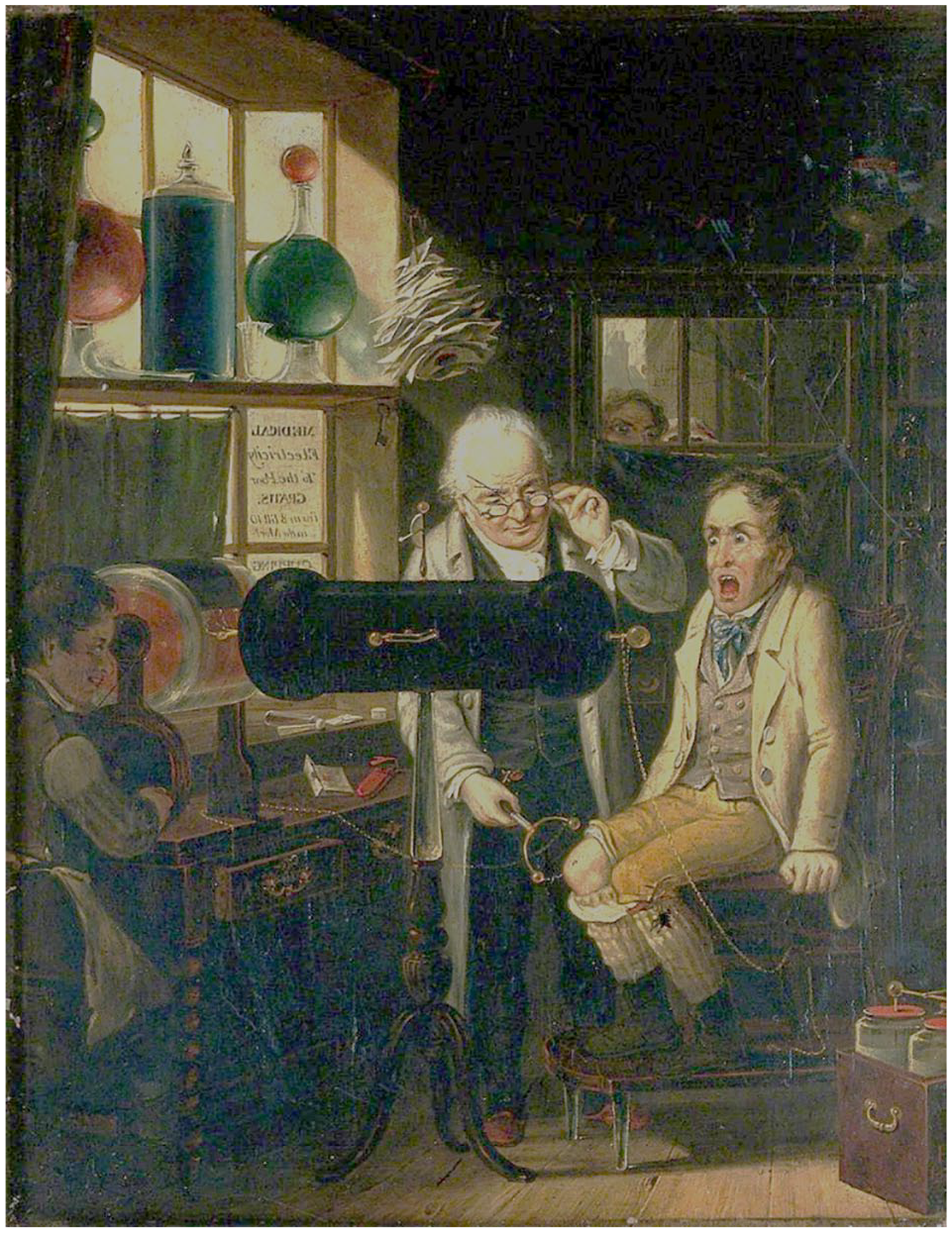
Dispensing of Medical Electricity (1824) by Edmund Bristow.
Pedagogical Suggestions
To use the painting in instruction to provide aesthetic experiences for students, a teacher can design her lesson as following concerning the pedagogical ideas by Pugh and Girod (2007).
The first step in the framework is to restore concepts to the experiences in which their origins are embedded hence a teacher can build the lesson history of electrostatics (see “A Brief History of Electrostatics” section). Instructing the concept of electrostatics demonstrates how a scientific concept was developed, how a scientist works or scientists work, and overall how science works. After instructing the concept of electrostatics based on the history of science, the teacher can focus on the effects of the concepts on society—both scientific society and the public. Scientifically, discoveries on electrostatics led to the development of technology such as the electrostatic generator and batteries. These discoveries also had effects on other disciplines such as medicine which can show the interdisciplinary nature of science. Electrotherapy was developed after the studies on electrostatics and gave people hope for incurable health issues. These aspects meet the first step of the framework by facilitating students to understand the concept of electrostatics within their origins and to perceive them aesthetically.
The second step is to foster anticipation and personal experience. This step includes more questions to detail the painting and to dig down deep for combining the content knowledge with the details of the painting. A simple question such as “What do you see in this painting?” can be used as a lead-in. With the answers from the students, the teacher can deepen the discussion by why and how questions. Questions such as “How can you utilize science for health issues?” or “How can one solve problems about health by using science concepts?” can help students to handle daily problems both scientifically and aesthetically. The historical process from Leyden jars to Galvani’s studies that opens the way of bioelectricity and the use of electricity for medical treatments through time can be used as a base for the discussions. The teacher also can direct the discussion to the concepts of the lesson with the questions such as “Why does the patient sit on glass legged stand?” to discuss electrical insulating or “What are the jars at the right side of the painting for?” to discuss conservation of electricity and the Leyden jars. Gray’s studies on conduction and the history of Leyden jar can help teachers during such instruction.
Considering the technology aspect of the painting, students can be asked how they would produce electricity by using only the principles of electrification. Research projects with groups can be given to develop a device that can produce electricity. With such activities, students can revise the concept, investigate the previous generators, and discuss with friends on methods to develop an electrostatic generator. Through the activity, students also can be promoted to use problem scoping features which can support their problem-solving skills. Depending on their projects and the samples in the history such as Otto’s electrostatic generator and Leyden jar, the usability of the devices can be discussed. Comparing with the contemporary electric generator, students can realize the developmental nature of science and value the studies in the history of science, and thus students can develop personal experiences and take a step toward transforming the concept into living ideas.
The last step of the framework is re-seeing the objects to expand perception. Seeing more details and linking them with the whole picture is the key element for the aesthetic experiences because aesthetic experiences are unifying and transforming. Therefore, students should be motivated to re-see the objects and expand their perceptions. For such a re-seeing activity, questions such as “How does the patient feel? Why?” can be asked. The effects of the electrostatic generator on medicine and thus on the people can be a discussion point in classrooms.
“How do we use electricity in solving health problems today?” and “Do you know the places where electrostatic is used in health?” can be asked and a research problem on the use of electricity in modern medicine can be posed to students. The teacher can create a classroom discussion based on students’ research results and the information in the section “How to Solve Health Issues With Electricity: Past and Today.” With such a discussion, students can compare and contrast the utilization of scientific information in medicine throughout time, and understand the developmental and the interdisciplinary nature of science.
Understanding attitudes on the sciences is also an aesthetic perspective that can help expand perception. Hence, discussing how people used electric charges to cure diseases in history, how true/wrong was this behavior, how people approach scientific or nonscientific methods to cure diseases today can help students to understand people’s attitudes on science. Such an aesthetic approach can help students to view problems holistically in scientific and sociocultural frames because they could have the opportunity to review the environment of the problem, the solving process, and the results.
Conclusion and Discussion
This study aimed to present a proposal for instruction to blend the cognitive and aesthetic aspects of science and to promote aesthetic experiences in science education with the use of artworks in instruction. Aligned with the aim, a painting that demonstrates the 1800s Britain local medical office and focuses on how science affects health issues was presented, and pedagogical suggestions were proposed with respect to Pugh and Girod’s (2007) framework of transformative aesthetic experiences. For a better understanding of proposed suggestions, related information (history of electrostatics, the use of electricity in medical treatment) was presented in the article.
As mentioned above, figures in the painting can provide opportunities for classroom discussions on how science works and on the interaction among science–technology–society. Considering the figures such as the electrostatic generator and Leyden jars and their use in medicine, students can discuss the interdisciplinary nature of science. Discoveries in physics led to innovations in medicine, and people had an opportunity to be cured and it is a continuing process. Focusing on the interdisciplinary nature of science, students can realize that interaction among different disciplines is important for developing solutions for social problems.
Based on the figures of the painting, a comparison of the applications of medicine with the use of electricity can help students to expand their perspectives on the sociocultural dynamics of scientific studies. The doctor using the electrical instruments and the patient looking for a cure with the help of the electrostatics can form a basis for a discussion on the sociocultural dynamics of science as for how science affects society and how society affects science. Therefore, they can make the meaning of the concepts which they are learning and take them beyond the abstractness. Such transformation can also promote an understanding that science has opportunities to solve social problems and encourage students to utilize scientific concepts in solving their daily life problems.
Suggested questions and activities based on the painting can facilitate students’ reasoning process on authentic facts by also considering the aesthetic aspects of science. Research projects or hands-on activities considering the discussions and the activities can also be supportive of students’ problem-solving processes. With the help of re-seeing activities, students can focus on the aesthetic aspects of science and the values behind the problems. Therefore, they can develop more awareness on social issues which is an important characteristic of a social problem solver. By an aesthetic touch to the problem scoping features, students can name the problem by identifying information about the problem from different perspectives, can set the context by relating details to the whole, and can reflect by making cognitive and aesthetic decisions.
Pedagogical suggestions on the use of the artwork in science instruction are commonly based on classroom discussions. As Dewey (1934) says art is the most effective form of communication. Communication by using scientific language is an important aspect of science education (Chan, 2011): as well as learning scientific concepts, internalizing them as utilizing the concepts in both communication and action should be a part of science education. The aesthetic approach with the use of artworks in science classrooms provides opportunities to talk about science. In this study, suggested questions on analyzing the details and on connecting to the whole can promote students to express their ideas, opinions, and understandings in their own words.
Integrating aesthetic aspects of science into science instruction and supporting aesthetic experiences in science education can be a way to welcome nonscience students because it covers humanities (Galili & Zinn, 2007). Discussing scientific concepts, science–society interaction, and nature of science-based artwork can make room for all students. More details connected to the whole lead to more understanding about the concept in cognitive, affective, and social aspects; therefore, any view or any idea—scientific, social, artistic, technologic, or politic—about the painting can enrich the classroom discussion. Such science instruction can help students and teachers to turn concepts into living ideas and can provide rich experiences beyond the classroom walls (Girod et al., 2003). Furthermore, these enriched experiences can support students’ problem-solving skills because they can view problems from various perspectives and can utilize their living ideas effectively in solutions.
This study theoretically frames the role of aesthetic experiences through the integration of artworks into science lessons. With the support of related literature, it can be stated that the instruction proposed in this study has the potential to combine cognitive and aesthetic aspects of science, to help students make meaning of scientific concepts and to value science and society, and to communicate by using scientific concepts. On this basis, the potential of the instruction to promote problem-solving skills and facilitate fulfilling aims of science education can be inferred.
By taking into consideration the pedagogical aspects of teaching, the need for instructional materials and guidebooks for teaching should not be underestimated for moving from the theory to the action. To use artworks in science classes effectively, detailed studies should be conducted. For instance, considering the pedagogical framework employed in this study, instructional material for teachers should include artwork, the story behind the artwork, historical information about the concept and its sociocultural setting, questions to foster personal experiences and activities, possible answers, and directions. Thus, teachers can effectively create and manage discussions, and help students to learn cognitively and aesthetically.
Although it is not much hard to access historical information in the 21st century, related literature underlines the obstacles in using historical information in science education because it is not easy to simplify for instruction (Leite, 2002). Each scientific concept has a huge pile of historical information such as original writings, letters, books, or articles. Therefore, historical information about the concept(s) which artworks focus should be simplified pedagogically for teachers’ use, and appropriate directions should be included in teacher materials to facilitate the effective use of historical information in art-based science instructions.
Further studies that take into account recent studies on the role of aesthetics in education and the recommendations of these studies for aesthetically enriched classrooms may provide fruitful outcomes to meet the educational objectives.
Footnotes
Declaration of Conflicting Interests
The author(s) declared no potential conflicts of interest with respect to the research, authorship, and/or publication of this article.
Funding
The author(s) received no financial support for the research, authorship, and/or publication of this article.
Ethical Approval
This article does not contain any studies with human participants or animals performed by any of the authors.
