



Abstract
The authors study the phenomenon of strategic group polarization, in which members take more extreme actions than their preferences. The analysis is relevant for a broad range of formal and informal group settings, including social media, online platforms, sales teams, corporate and academic committees, and political action committees. In the model, agents with private preferences choose a public action (voice opinions), and the mean of their actions represents the group’s realized outcome. The agents face a trade-off between influencing the group decision and truth-telling. In a simultaneous-move game, agents strategically shade their actions toward the extreme. The strategic group influence motive can create substantial polarization in actions and group decisions even when the preferences are relatively moderate. Compared with a simultaneous game, a randomized-sequential-actions game lowers polarization when agents’ preferences are relatively similar. Sequential actions can even lead to moderation if the later agents have moderate preferences. Endogenizing the order of moves (through a first-price sealed-bid auction) always increases polarization, but it is also welfare enhancing. These findings can help group leaders, firms, and platforms design mechanisms that moderate polarization, such as the choice of speaking order, the group size, and the knowledge members have of others’ preferences and actions.
Many business and organizational settings involve group interactions and decisions. We observe formal and informal group discussions in contexts ranging from social media groups to sales teams, corporate personnel committees, academic committees, community groups, and political action committees. The overarching premise and goal of group interactions is to allow agents to exchange opinions, increase the alignment of their views, and reduce conflict (Rawls 1971). However, we often see the opposite: individuals engaged in group interactions often become more divergent in their views and behaviors. Indeed, a large body of experimental work shows that group deliberations often lead to more polarized behavior instead of enabling greater alignment (Isenberg 1986). This kind of polarized behavior is especially common when group members’ actions impact their joint decision or group verdict.
We study the phenomenon of polarization of agents’ observed actions in group settings; that is, where members of a group take actions (or voice opinions) that are more extreme than their true preferences (Sunstein 2002). Consider the following examples that illustrate relevant aspects of the phenomenon studied in this article:
Common Themes
Some common themes emerge from these examples, and these are the focus of our analysis. First, they represent contexts in which agents have strongly held preferences. For instance, in hiring decisions, agents often have strong preferences on the role of diversity or the importance of research areas. Similarly, consumers may have strong political preferences that shape their reactions to brands’ sociopolitical stances in their advertising campaigns. Issues that dominate our public policy discussions also fall under this category (e.g., abortion, immigration, the size of government). Across the spectrum of these cases, when participating in a group discussion, an agent’s motivation is to achieve a group outcome that closely aligns with her preferences. This is distinct from settings where agents care about some true underlying state of the world and have uncertainty about this state. In those settings, agents typically try to aggregate their information from the group to uncover the uncertainty and condition their decision on it. In contrast, our research captures settings where the actions/voiced opinions represent agents’ stated preferences rather than beliefs/information about an unknown true state of the world.
Second, unlike standard voting models, individuals’ actions or voiced opinions are not necessarily binary/discrete. Rather, they are typically a choice of the extent or the magnitude of an action (i.e., continuous choice). 2 In the faculty hiring example, it could be the strength and the number of arguments presented by group members to make a behavioral versus quantitative faculty hire. In the campus carry example, the choice was not a simple “Should guns be allowed on campus or not?” Rather, it was a nuanced decision on issues such as where guns would be allowed (classrooms), where they should not be allowed (child-care units), where they should be allowed with discretion (single-user offices), where they can be stored (in-person or locked vehicle), and who would be allowed to bring guns (those over 21 years old, with license).
Third, in many of these cases, agents voice their opinions sequentially and can be influenced by prior opinions in the system. For example, in online reviews on digital platforms, earlier reviews can influence (and can be influenced by 3 ) future reviews. Similarly, in social media discussions, users often respond to prior comments, and this sequential voicing of opinions can shape the overall tendency of the group (De-Wit, Van der Linden, and Brick 2019).
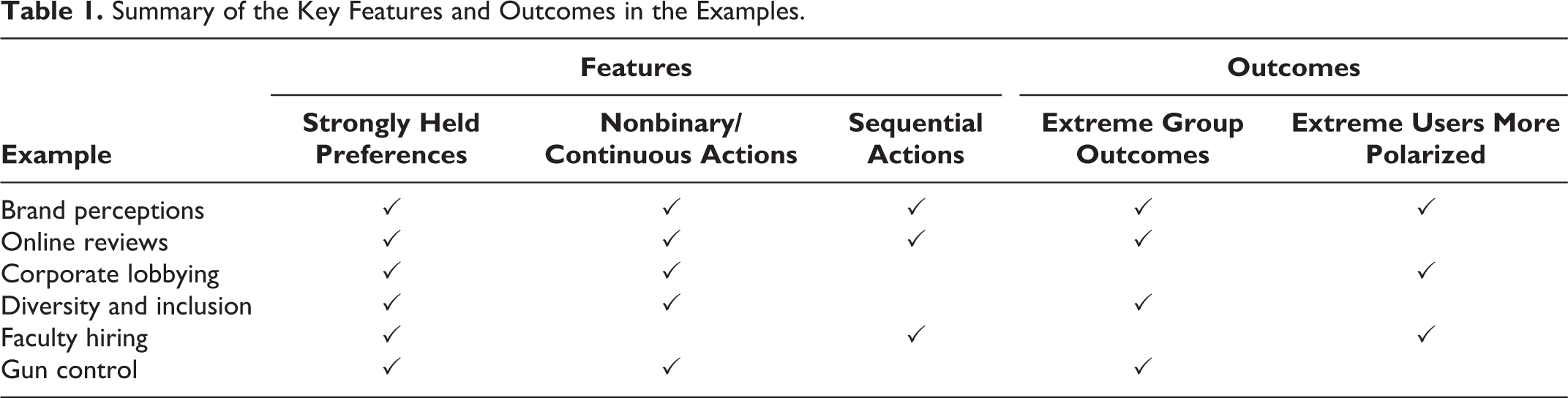
Further, note that the outcomes in these examples share two key characteristics. First, both individual opinions and the group’s joint decision/outcome end up being more extreme than one would expect a priori based on the initial distribution of the group members’ preferences. This pattern is not unique to the examples discussed previously. Indeed, it is prevalent in many sociopolitical discussions. Even a cursory reading of current news suggests that discussions of social and political issues show evidence of polarization (Cohn 2014). Second, the more extreme individuals often exhibit more polarized actions. For example, in the case of the corporate lobbying example, we saw that the firms with more extreme positions invested the most in lobbying. Table 1 presents an overview of the common features of setup and outcomes in the aforementioned examples and summarizes the main takeaways.
Summary of the Key Features and Outcomes in the Examples.
Research Agenda and Approach
Previous research in economics mainly attributes polarization to imperfect information aggregation and polarization of agents’ beliefs in group settings (for details, see the “Related Literature” section). A parallel stream of literature in psychology attributes polarization of group decisions to behavioral biases stemming from social comparison and persuasive argumentation (Baron 2005; Zuber, Crott, and Werner 1992). Our idea is distinct from these prior theories based on either imperfect information aggregation or behavioral biases. We ask, “Can polarization of group decisions stem from strategic interactions between agents, even if the agents are rational and there is no imperfect information on some true state of the world?” Our analysis then links agents’ preferences to the resulting polarization in their observed actions in group settings.
We propose a theory of group polarization with two related objectives. First, our theory connects the emergence of polarized group outcomes to individuals’ strategic motives for group influence. We develop a model of group decision making, where agents have heterogeneous preferences over an issue. The basic analysis starts with a group of two agents. Each agent’s utility function has two components: First, an agent incurs disutility if she chooses an action (or voices an opinion) that is different from her true preference. This is represented as a convex cost, which is increasing in the extent of the misalignment between her action and her true preference. This can be interpreted as a reputational (or even a psychological) cost of misreporting her true preference. Second, an agent cares about the distance of the group’s decision/outcome from her true preference. This represents the group influence motive: individuals would like to move the group’s eventual outcome toward their true preference. The game consists of each agent privately observing her true preference and choosing a publicly observable action (opinion). The mean of their public actions represents the group’s decision or outcome, and all the agents’ actions influence this outcome. Our model thus connects the trade-off between the desire for group influence and truth-telling to the polarization of actions at the individual and group level (i.e., where individuals take actions that are more extreme than their true preferences and the aggregate group outcome is more extreme than the mean of the group’s true preferences).
Next, we examine some key variables that can influence the existence and extent of polarization: group size, subgroup interactions, partial knowledge of the other agents’ types, and the game structure. With respect to the last variable, we investigate the timing of actions or the order in which agents voice opinions. In a simultaneous game, each agent chooses an action without observing the actions of other group members. Alternatively, agents can express their opinions sequentially, in which case those who speak/act later can observe the actions of those who spoke before. Thus, the main difference between these two timings is the “observability” of others’ actions. We examine whether group decisions are more polarized when agents speak simultaneously or when they speak sequentially. If individuals were to speak sequentially, who has a greater incentive to speak first—those with more extreme preferences or the moderates?
Questions pertaining to the timing and observability of actions are important because we see examples of both models in practice. Standard secret ballot models, where each agent submits their opinion without observing others’ actions, can be interpreted as a simultaneous-actions model. For example, a department chair can survey everyone’s opinion simultaneously (e.g., through online survey tools) and aggregate their opinions to make a decision. However, on a social media site, the opinions posted by previous members are visible to everyone and can affect the actions of later members. A recent study on Twitter finds that when individuals express their opinions in sequence, exposure to opposing views leads users to become more entrenched (extreme) in their views when compared with their original positions (Bail et al. 2018). 4 Indeed, with the advent of online ballots and opinion-sharing forums, both timing formats are equally easy to design and implement. However, we do not have good answers to which of these models lead to more polarized decisions.
Further, we ask whether endogenizing the timing of actions by allowing agents to influence the speaking order affects polarization, and if so, how? We consider a game in which agents can participate in a first-stage auction to bid on the right to decide when they speak. The first-stage auction can be interpreted as agents lobbying with a principal (e.g., a department chair, a policy maker) to influence the speaking order. There is a long history in economics of modeling lobbying activities as auctions (Che and Gale 1998). Our endogenous choice model follows this tradition, and we capture agents’ costs to influence the game rules through lobbying (Harstad and Svensson 2006; Potters and Van Winden 1992). Within this context, we examine which agents will have higher incentives to bid for the right to mandate the speaking order and when they will prefer to speak. Finally, we aim to compare social welfare under different game forms and derive the relationship between the extent of polarization in the system and overall welfare.
Results and Contribution
First, we show that in a simultaneous game, agents engage in strategic shading toward the extremes (i.e., take actions [voice opinions] that are more extreme than their true preferences). Moreover, agents with extreme preferences shade more than moderates because they expect the equilibrium outcome to be further away from their preference (as highlighted in the example on the electrical utility industry). Notably, an agent’s incentive to shade and the extent of polarization in the group outcome are independent of the preference distribution. In other words, we show that polarized actions or behavior in group interactions do not necessarily stem from polarized preferences. Instead, they result from the strategic motivations of the agents that come into play in group settings. We also see that shading at the individual level causes the joint group decision to be more extreme (compared with the average preference of group members).
Extending the analysis to many players shows that the extent of shading goes down with group size, which suggests that group size can be a mechanism to control polarization. We also examine the interaction between subgroups in which agents within a subgroup have homogeneous preferences while there is heterogeneity across subgroups to show that smaller subgroups have the incentive to become even more extreme.
The analysis and comparison of simultaneous- and sequential-choice games establishes some of our main results. In an exogenous sequential speaking setting, polarization occurs if the agent who moves later is relatively more extreme than the first agent. In contrast, moderation occurs if the agent who moves later has less extreme preferences. The second agent’s motivation looms larger on the joint outcome because she can condition her action on the first agent’s observed action and pull the group decision closer to her preference. Indeed, this pattern is often visible in online forums, where agents who come later tend to express progressively more extreme opinions (Bail et al. 2018). Thus, given the group influence motive, the informational benefit of waiting and responding to others’ actions is more attractive than moving first and setting the agenda. We then show that if agents’ preferences are relatively similar, then the group decision is more moderate in the sequential actions game. In contrast, the simultaneous actions game leads to more moderate group outcomes when agents’ preferences are dissimilar.
Next, we discuss the findings from the endogenous choice game, where agents participate in a first-price sealed-bid auction for the right to determine the speaking order. Here, we find that agents with more extreme preferences bid more for the right to decide the speaking order, and upon winning, all agents, regardless of their preferences, prefer to wait. More importantly, because the more extreme agents bid more and speak second, the group outcome is always polarized in this game format. However, the extent of polarization can be greater or lower compared with the simultaneous game. We find that when players’ preferences are relatively similar, endogenizing the speaking order leads to less polarization compared with the simultaneous game. This implies that in settings where players are similarly inclined, endogenizing the speaking order can mitigate group polarization. Interestingly, we also find that the endogenous sequential game has the highest total welfare even though it can lead to more polarized decisions because it allocates the right to decide the speaking order more efficiently.
To summarize, our article makes three key contributions to the literature on group polarization. First, we propose a theory of strategic polarization based on users’ incentive to influence the group decision. Our theory provides a rational explanation for the polarization of observed actions and is distinct from prior research that has focused on the polarization of beliefs arising either from imperfect updating or from behavioral biases. We show that the group influence motive can polarize users’ actions even when their preferences are moderate. Second, we quantify the role of speaking order and observability of actions on polarization. We show that the observability of prior agents’ actions mitigates polarization when agents’ preferences are similar, but allowing agents to influence the speaking order always exacerbates polarization. Third, we identify levers that a group coordinator can employ to moderate polarization: group size, the speaking order, and the amount of knowledge that agents have about others. Finally, we show that game formats that lead to more polarized outcomes do not necessarily lead to lower welfare.
Related Research
Research in psychology starting with Stoner (1961) shows evidence that group deliberation can make both individuals and the overall group decision extreme in the direction of their original proclivities. Polarization has been demonstrated in a variety of contexts including jury decisions (Main and Walker 1973), faculty evaluations and pay, attitudes toward women (Myers 1975), and judgments of attractiveness (Myers 1982), to name a few. This stream of work has described polarization using psychological explanations. In contrast, we identify a strategic rationale for group polarization that can accommodate and explain the different studies in this literature.
A more recent stream of literature focuses on providing different economic explanations for polarization of “beliefs” in group interactions. Dixit and Weibull (2007) analyze a model of Bayesian updating by agents with heterogeneous normally distributed priors about a true (policy) state and a common noise. In this setup, while the mean belief of the group may diverge under Bayesian updating after observing the common signal, individual-level polarization does not occur. Nevertheless, Baliga, Hanany, and Klibanoff (2013) show that polarization of individual beliefs can occur if individuals who observe a common signal are ambiguity averse. Similarly, Zimper and Ludwig (2009) consider a model of Bayesian learning with psychological bias in a setting where agents have ambiguous beliefs and show that this can lead to diverging posterior beliefs even if agents receive identical information. Acemoglu, Chernozhukov, and Yildiz (2009) consider a Bayesian learning problem for agents with different priors about the distribution of signals and show that even a tiny amount of signal uncertainty leads to significant disagreement in asymptotic beliefs. 5 More recently, Nielsen and Stewart (2020) show that polarization can occur in a Bayesian setting where two rational agents learn a finite amount of shared evidence. In contrast to this literature, our analysis is about the polarization of observed actions resulting from the strategic incentives of agents rather than opinions or beliefs. This allows us to establish a rationale for the polarization of group actions even in circumstances where preferences and beliefs of the agents are relatively moderate.
A parallel stream of research examines the role of behavioral biases or non-Bayesian updating on polarization. An early article by Rabin and Schrag (1999) formalizes a model of confirmatory bias where agents ignore signals that do not confirm with their initial impression and update in the direction of their current beliefs, generating polarization. 6 Bénabou (2012) investigates the emergence of collective denial in groups as agents form overoptimistic beliefs by ignoring negative signals. Glaeser and Sunstein (2009) analyze non-Bayesian behavior in which agents fail to account for the common sources of information of others’ opinions. We complement this literature by identifying the role of a general group influence motive and how it interacts with the timing and the observability of actions in determining the extent of polarization. Whether the outcome of the group is more or less polarized depends on strength of the group influence motive as well as whether agents who move later are relatively more or less extreme.
There is also a related literature on strategic communication and cheap talk in persuasion games with multiple senders (experts) who try to influence a decision maker. Early research by Gilligan and Krehbiel (1989) and Austen-Smith (1990) model debates as cheap talk messages from multiple senders with different interests to show that such debates will only affect the outcome if the agents’ preferences are not too dissimilar. Within this stream, Krishna and Morgan (2001) show that consulting two perfectly informed experts rather than one is beneficial when the experts are biased in opposite directions. A group of extremists does not have informational value in this framework. However, Bhattacharya and Mukherjee (2013) show that if the experts are uncertain about their information, then a decision maker may indeed prefer to hear from more extreme experts. Our article does not deal with strategic information transmission but, rather, with the strategic effect of the group influence motive in creating an incentive for polarized actions.
Our research is also related to the literature in marketing on group decision making that focuses on linking group behavior to that of individual members. Rao and Steckel (1991) develop an empirical model where group preferences are a weighted linear model of individual preferences. Their model attempts to account for observed group polarization in the data. Eliashberg and Winkler (1981) study group decision making and examine how uncertain group payoffs should be divided among the members in a Pareto optimal manner, given their risk attitudes and preferences. More broadly, our research also adds to the literature on social effects in marketing. A stream of empirical research documents the existence of social effects (for an overview, see Hartmann et al. [2008]; for a recent documentation of social effects using data from field experiments, see Sun, Zhang, and Zhu [2019]). A related stream considers the impact of these social effects on firms’ strategies: For example, Amaldoss and Jain (2005) analyze competitive pricing strategies of conspicuous goods when consumers have preferences for uniqueness and conformity, and Yoganarasimhan (2012) analyzes a monopolist’s advertising decisions in a market where consumers engage in social signaling. Similarly, Iyer and Soberman (2016) analyze the role of social comparison preferences in the context of socially responsible innovations.
Model
We first present the basic model of group interactions, where the mean of actions of the agents is considered the group outcome. Consider a group of two agents
Agent
The utility of agent

where
Agents obtain disutility from two sources. First, their utility is decreasing in the distance between their action and their preference (i.e., they prefer to voice opinions close to their true preference). This could stem from a disinclination to misreport their preferences (cost of lying) or a reduced form representation of credibility of actions arising from potential reputational concerns.
8
Second, their utility is decreasing in the distance between the group outcome (
Our main results are not dependent on this assumption of the mean as the group outcome. They hold qualitatively for any decision rule that uses a linear combination of agents’ preferences and puts nonzero weights on the actions of all players (for details, see Web Appendix A.1).
9
What is necessary for our results to qualitatively hold is that the outcome measure is a function of the actions of all the agents in the group. In other words, agents have a taste for influencing the group’s outcome. A greater value of
We consider a game in which nature first draws the preferences
Benchmark Cases
Before we analyze the private information game, it is useful to derive two benchmark cases: (1) the first-best socially optimal solution and (2) the perfect information case. In the first case, a social planner chooses actions to maximize the joint surplus of the two agents:

The welfare-maximizing choices are
Simultaneous Actions
Equilibrium
Consider the game in which agents choose their actions without observing the other agent’s type and actions. We proceed to derive the Bayesian Nash equilibrium of this game and focus without loss of generality on agent
By differentiating

In obtaining the first-order condition, we can set

Integrating

Because
An implication of Proposition 1 is that agents’ actions are more extreme than their true preferences (the multiplier
Next, recall that group polarization is defined as the tendency of the joint outcome to move toward a more extreme point in the direction indicated by the members’ original preferences. The equilibrium derived previously satisfies this definition. The mean predeliberation preference of the group is
Comparative Statics
To investigate the comparative statics, we denote the extent to which an agent

Equilibrium actions and shading in a two-player simultaneous game with

Equilibrium actions in unconstrained and constrained
The result also implies that the overall group shift is proportional to the initial tendency of the group. The mean shift of a group is given by
An interesting point is that the extent of shading,
Extensions and Robustness
Next, we consider several extensions of the main model to illustrate the robustness of the results and to develop a comprehensive theoretical account by examining how polarization is influenced by the game structure, group size and characteristics, preference characteristics, and the informational endowment of the agents.
Group size effects (m > 2)
We first extend the game to interactions between
In the Bayesian Nash equilibrium of this game, agent
The
Subgroup interactions
In many situations, interactions occur between subgroups, where each subgroup consists of many agents having the same preferences over an issue, but different from that of the other subgroup. For example, academic marketing departments consist of quantitative and behavioral subgroups, political deliberations in the United States (e.g., in the Senate) occur between multi-agent Democratic and Republican subgroups. On issues such as abortion rights, gun control, and taxation, conservatives groups have different preferences than liberals, but citizens within each subgroup tend to have similar preferences.
Consider an extension of the basic model with a population of

In Web Appendix A.3, we present the solution for the symmetric (for agents within a subgroup) Bayesian Nash equilibrium and show that the equilibrium actions are
The main point of this analysis is to understand the role of the subgroup size on actions. Specifically, for a given population size
Constrained-choice model
So far, we have allowed agents to choose actions beyond the range of types. However, this may not always be feasible. For example, if the public action is supposed to be a revelation of private type, then it is impossible for agents to proffer a type that does not exist. Thus, we now consider a model where agents’ actions are bounded within a credible range. This model can be interpreted as a setting where agents’ actions are truncated or discounted if they are too extreme. In particular, voicing opinions outside the range of agent types can be inferred as lacking in credibility (or lying about one’s type) and therefore discounted.
Specifically, consider a scenario in which agents’ preferences are drawn from a uniform distribution bounded at −1 and 1 (i.e.,
In Web Appendix A.4, we show that in an m-player game constrained-choice model, the optimal response function continues to be
In summary, expanding the number of players, constraining the choice set, or considering subgroups does not affect the key results. Thus, moving forward, we retain the two-player, unconstrained-choice model and focus our attention on other interesting modifications such as information revelation and sequential choices.
Asymmetric type distribution
Next, we consider a situation in which the distribution of types,
Partial knowledge
In many instances, players may have some knowledge about the preferences of their rivals. This may especially be the case in smaller groups such as faculty groups or corporate teams, in which members have a history of prior interactions. For example, suppose that each agent
Given the setup, there are two possible cases of partial knowledge: First, the case in which each agent knows that the other player’s preference is on the opposite side (i.e., opposite leaning). The alternative case is one in which each agent knows that the other is on the same side (i.e., similar leaning). The equilibrium analysis is in Web Appendix A.6.
Opposite-leaning agents: Suppose, without loss of generality, that


Recall from Proposition 1 that in the full private information case, each agent’s actions are a function of only their own preferences. With partial knowledge, the equilibrium actions of agent
Note that
Similar-leaning agents: Next, consider the alternative case in which both agents know that they are on the same side of zero (i.e., they are similar leaning). Without loss of generality, let


where
Thus, in general, partial knowledge induces agents to consider the available information about the other player, and this can be a force for moderation of group actions when agents end up being similar leaning. More generally, suppose that each agent has a noisy (but better than the prior) information signal about the private information of the other agent. Then, as the precision of the signal improves, the other player’s preferences will have a greater effect in moderating actions. At the extreme, with perfect information, we will get the aforementioned benchmark case in which agents have full information. The availability of information about group members’ private preferences can thus be used as a strategic instrument by the principal to moderate group behavior.
Incentive to disclose preferences
If agents had the opportunity to verifiably communicate their preference, would they have the incentive to do so? Communication that makes preferences common knowledge has the potential to reduce polarization in actions. Accordingly, consider an ex ante disclosure game in which each agent
Alternative preferences
To have a better perspective of the role of the group influence motive in our model, we compare it with some alternative preference formulations to understand what types of preferences may counter the polarization of actions.
Consider first an alternative formulation in which each agent’s social preference is to minimize the distance between their actions and the true mean preference of the group. This can be seen as a taste for conformity with group preferences. Might this help reduce the extent of polarization in actions? Specifically, suppose that agent
As another alternative formulation, consider the case when agents care about minimizing the distance between their public actions and the group’s outcome. In other words, the agent cares about how closely their actions or voiced opinions conform to the mean outcome of the group. Specifically, suppose that the agent
Together, these two extensions with alternative preferences highlight the importance and role of the group influence motive (i.e., the agent’s desire to move the group’s outcome closer to her true preferences) in driving polarization. Finally, note that we have assumed that the weight on the truth-telling (
Sequential Actions
Next, we consider the case in which players may voice their opinions in sequence. On Yelp, consumers see past reviews while providing their ratings. Similarly, in social media groups, individuals may express opinions in sequence. In a department meeting, the chair may mandate the order in which different faculty members may speak. Indeed, in many institutional settings, members typically take turns to speak. In Federal Open Market Committee meetings, committee members express their preferred policy position sequentially in an order that varies across meetings. The committee chair summarizes these positions into an overall group directive on the federal short-term interest rates. Similarly, in juries and legislative bodies, the order of speaking is often predetermined by the institutional rules.
Accordingly, we consider a two-period model in which one of the agents is randomly picked to speak in the first period and the other follows in the second period upon observing the action taken by the first. We refer to this model as the “exogenous”-sequential-choice model, where the order of agent actions is exogenously determined and is uncorrelated to the agents’ preferences. The speaking order can be interpreted as being determined by either institutional rules or a third party. Then, we consider the case in which the agents bid to endogenously choose the speaking order.
Equilibrium in the Sequential Game
Let

Taking the first-order condition of Equation 11 and following a similar analysis to that in the simultaneous equilibrium case gives us the equilibrium action of
Characterizing the Group Outcome
Having derived the individual equilibrium actions, we proceed to characterize the mean equilibrium outcome. For a given
Polarization:
Reverse polarization:
Moderation:
The following proposition summarizes the equilibrium extent of shading as measured by the relationship between the mean actions and preferences:
Polarization occurs if
Reverse polarization occurs if
Moderation occurs if
Proof: See the Web Appendix.
Figure 3 summarizes the effect of sequential actions on group polarization. Polarization occurs whenever the second player’s preference is relatively extreme or comparable to that of the first player (i.e.,
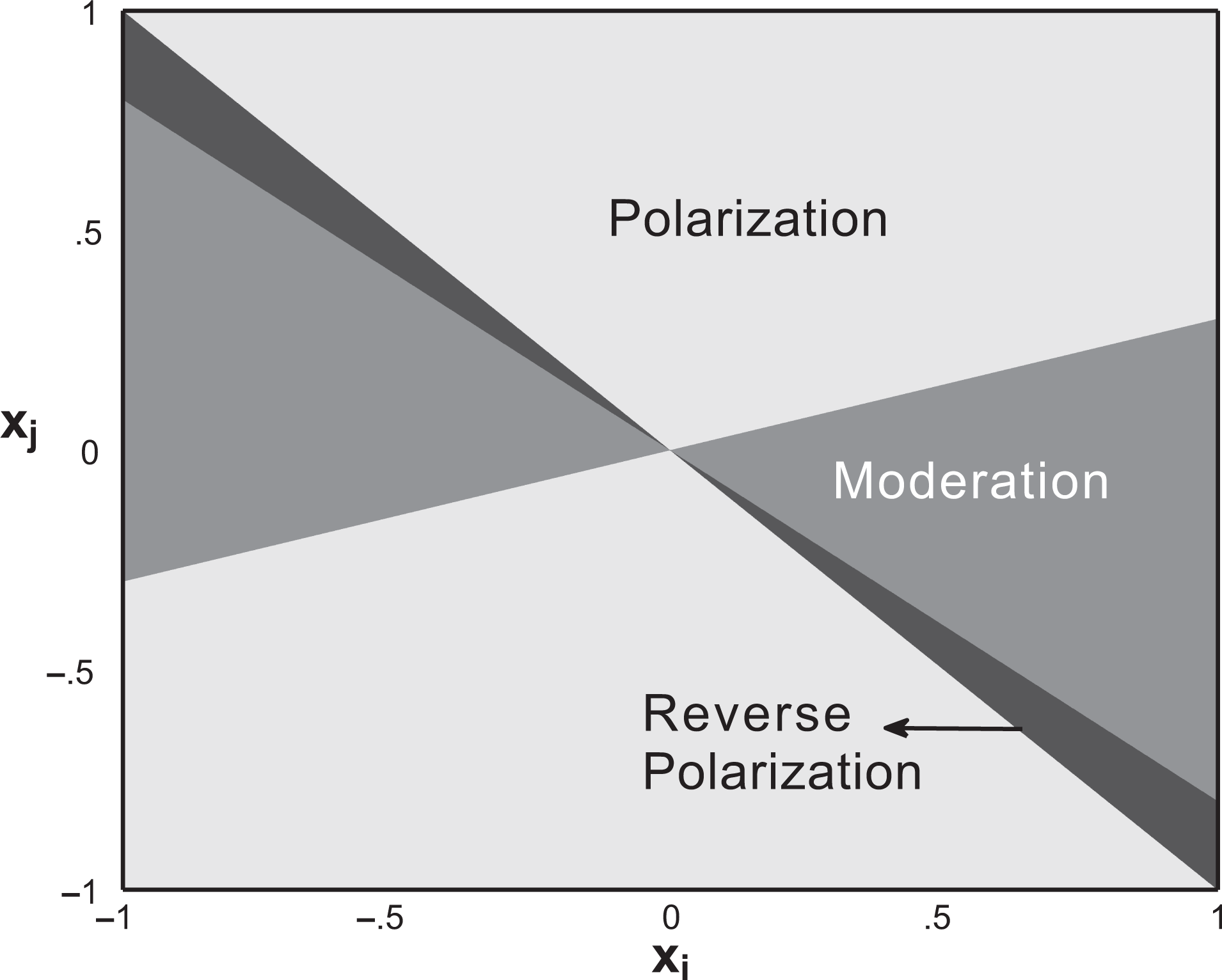
Regions of polarization, reverse polarization, and moderation in an exogenous-sequential-choice game; shown for
In contrast, when the second mover
Comparing Simultaneous and Sequential Games
We compare the simultaneous and sequential action games to understand how the extent of group polarization is affected by the timing of actions.
Proof: See the Web Appendix.
Consider first the action of the second player
In contrast, the first player
Next, we compare the equilibrium outcomes in the two game formats.
Proof: See the Web Appendix.
If

Comparison of mean outcome in the exogenous sequential game with that in the simultaneous game; shown for

Players’ expected utilities in the exogenous-sequential-choice game; shown for
Value of the Speaking Order
Next, we analyze the relative value of the speaking order for the players by comparing the ex ante expected utilities from speaking in the first and second periods. Agent

Similarly, we can calculate

See Figure 5 for a pictorial illustration of these expected utilities. The following proposition compares the equilibrium expected utilities of speaking in the first and second periods, for a player
(a)
(b)
Proof: See the Web Appendix.
The proposition highlights an important trade-off in incentives: moving first allows an agent to “set the agenda” by committing to an observable action, whereas moving second allows the agent the flexibility to optimally adjust to the first period actions. The analysis indicates a rationale for why agents would wait to react to the actions of other agents, rather than to act first and set the group’s agenda. The general point is that, irrespective of the type of the agent, the social influence motive makes the value of flexibility that comes from speaking second to be higher than the commitment value of speaking first and setting the agenda. A player who speaks second observes the first player’s action and has the opportunity, if needed, to compensate for it. This works to the second player’s advantage irrespective of whether the first player’s action was close to her preference. If the first player chose an action very different from the second player’s preference, then she can compensate by picking a more extreme action in the opposite direction. But if the first player were to choose an action that is already close to her own preference, then the second player can also choose an action close to her preference and thereby not incur the cost of exaggerating.
Because the second player can adjust her action on the basis of the observed actions of the first player, the first player, in anticipation of this behavior, has the incentive to be more extreme, which in turn reduces her utility even more. Thus, when agents care about influencing the overall group outcome toward their true preference, they prefer to wait and delay their actions. The benefit of speaking second is higher for players who are more extreme; moderates have less to lose from speaking first. In general, moderates suffer less from decisions that are away from the middle. However, a player whose preference is more extreme on the right suffers a lot if the final outcome is more extreme to the left (and vice versa). In summary, the analysis suggests that there are inherent advantages to waiting, especially for agents with more extreme preferences.
Endogenous Sequential Actions: Bidding to Speak
As described previously, the trade-off faced between truth-telling and group influence leads to a preference among agents to wait and speak in the second period and further such a strategy is more beneficial for players with extreme preferences. The natural question is what would happen in a group where the speaking order is endogenous. Given that speaking second is the dominant choice, there would exist a market for the order of speaking that may be characterized by allowing agents to endogenously bid for the right to determine the speaking order. In reality, such an endogenous choice game implies that group members may be willing to take costly actions to determine whether they are able to speak in the most favorable position.
Consider then an extension to the game where, in a prior period 1, both agents participate in a first-price sealed bid auction for the opportunity to decide the speaking order. This first-stage auction can also be seen as agents lobbying to influence the speaking order. A neutral organizer/auctioneer receives agents’ bids and announces the winner: if
We derive the symmetric equilibrium bidding strategies of this game where the equilibrium bidding functions
Agent i has a bidding strategy
If agent
Proof: See Web Appendix F.
Note that the equilibrium actions of the agents in this endogenous game end up being the same as that in the exogenous sequential game. Clearly, the agent who moves second faces the same game as the agent in the exogenous sequential game because she always chooses her response
In a symmetric PBE, the region (say,

The last term vanishes because
Players’ equilibrium beliefs are that upon losing, they will forfeit the right to decide the speaking order and the right to move second. Given this, the equilibrium bidding strategy can be specified. In deriving the equilibrium bidding strategy, note that a player’s value from winning the auction is endogenous, unlike a traditional first-price sealed-bid auction, where players’ valuations are exogenously given. The approach to deriving the equilibrium is to show that equilibrium bidding strategies are increasing strictly monotonically in
Consider the mean equilibrium outcome of the endogenous sequential actions game. For a given
If
If
Allowing the agents to compete for the right to speak always leads to the polarization of actions. When the speaking order is endogenous, the agent who wins the right to speak always prefers to wait. Further, it is the agents with more extreme preferences who have the incentive to bid more for the right to determine the speaking order. This leads to the important point that if agents were to bid for the right to speak, then the agents’ actions and the group outcome are always polarized. Thus, unlike in the exogenous sequential game, where moderation is a possibility, allowing agents to choose the speaking order always leads to polarization.
It is also useful to compare the outcome of the endogenous sequential actions game with that of the simultaneous game. If the two players lie on opposite sides of zero, then the endogenous sequential actions game produces more polarization than the simultaneous actions game. On the other hand, if both players lie on the same side of zero, the outcome is less polarized than that in the simultaneous game. The basic mechanism at play is that the second player in the sequential actions game can condition her action to that of the first player and accordingly pull the group outcome closer to her own preference. Recall that the first player’s action in the sequential case is always more extreme than in the simultaneous case because of a compensation effect: that is, she knows that the second player can observe and compensate for her action. In the endogenous sequential actions game, it is the more extreme player who ends up winning the right to be the second player. Given this, the player who loses the auction and speaks first can infer that the other player has more extreme preferences. This inference induces her to be even more extreme. When the two players’ preferences are on opposite sides of zero then not only does the second player have the incentive to be more extreme (after observing the first player’s actions) in order to pull the joint outcome toward her preference, but the inference effect also induces the first player to be more extreme. Consequently, the group becomes more polarized than in the simultaneous actions game. In contrast, when the players’ preferences are on the same side of zero, the second player’s knowledge of the first’s actions implies that she does not need to shade and take too-extreme actions. The implication is that when the players are similarly inclined, endogenizing the speaking order can help reduce polarization.
Welfare Comparisons
We start with the planner’s problem to understand how a principal would design the group interaction to maximize social welfare. The welfare in the two-player system for any
Figure 6 shows the relationship between expected welfare functions as a function of

Expected social welfare for the four game forms; shown for
Conclusion, Marketing Implications, and Future Research
Many formal and informal forums in business, organizational, and sociopolitical settings facilitate group interactions that shape our views and decisions on issues ranging from brand choices to faculty hiring, diversity, and gun control. We might expect such interactions to help users to exchange information and align their opinions. However, even a cursory glance at the current sociopolitical landscape in the United States suggests otherwise. Indeed, group deliberations seem to increase polarization rather than reducing it. Although we show that polarization can lead to higher social welfare, it can also create conflict and lead to other social problems (Esteban and Schneider 2008). Policy makers may therefore put positive weight on both reducing polarization and increasing welfare. Because these two objectives are not necessarily aligned, it is critical to pin down the mechanisms that make actions and opinions more polarized.
We develop a theory that links the polarization of agents’ actions to a fundamental trade-off agents face between influencing others in a deliberation and expressing their true preferences. When agents’ actions affect the group’s outcome, deliberations can lead to polarization. Further, we show that the more extreme agents end up becoming more polarized in their actions. Next, we analyze and compare the role of two types of speaking orders: simultaneous versus exogenous sequential. In sequential-choice settings, polarization occurs when the agent who moves later is more extreme than the first mover. In this context, we also highlight the trade-off between the commitment value of moving first versus the value of the flexibility (to respond to other user’s actions) that comes from moving second. We find that the group influence incentive makes flexibility valuable and induces agents to wait. Further, we see that if agents’ preferences are dissimilar, the sequential actions game produces less polarization compared with the simultaneous game (whereas the opposite is true if agents have similar preferences).
Next, we endogenize speaking order by allowing agents to bid for the right to choose the speaking order. We show that the agent with more extreme preferences bids more, and the winning agent always chooses to speak later. In addition, we examine the role of the group size and the presence of subgroups on polarization. We find that larger groups show less polarization, and smaller subgroups tend to go to extremes. Finally, we investigate alternative preference distributions and information structure to expand and clarify the role of the group influence motive in causing polarization.
Our findings have important implications for the marketing examples discussed previously. For example, Nike’s “Believe in Something” ad campaign featuring Colin Kaepernick evoked highly polarized reactions, with younger (18–34 years) individuals strongly approving the ad and older individuals disapproving. Similar reaction disparities were seen across racial and political affiliations. These results are consistent with our model, where we find that users express opinions that are more extreme in the direction of their original preference in public discourses. In the branding context, this suggests that polarization can be a mechanism to increase brand differentiation, as articulated by Phil Knight: “It does not matter how many people hate your brand as long as enough people love it” (Stoll 2019). An implication for brand strategy is that firms can design advertising strategies that take a stand on important social, political, or environmental issues prevalent in society to create strong brand differentiation in competitive markets.
Our analysis is also relevant to the design of review systems in recommendation platforms. Many e-commerce platforms (e.g., Amazon, Tripadvisor, Yelp) display the mean ratings received by a product/seller on their websites. Prior research has suggested that consumers pay attention to these aggregate ratings and that this affects platform demand and revenues (Chevalier and Mayzlin 2006). However, if later reviewers react to earlier reviews and bias their ratings, then the aggregate rating measure can become biased (i.e., no longer representing the mean of consumer preferences). In turn, this can have adverse consequences for consumers’ postpurchase satisfaction on a platform, thereby affecting its future reputation. Thus, an important design question for platforms is, “What are the optimal weights for early versus later consumer reviews in aggregation and recommendation algorithms?″
Finally, our article suggests several avenues for future research. First, our model captures credibility concerns in a reduced-form way. While this suffices for our purpose, future researchers might want to develop a complete model of reputation. Combining the dynamics of reputational concerns with polarization can help answer whether reputation systems can improve/exacerbate polarization. Another possible direction is to use data on group decisions to identify and isolate the different sources of polarization (e.g., strategic incentives, polarization of beliefs, behavioral biases). Field experiments or observational data with exogenous variation in these sources can improve our understanding of how these factors contribute. It would also be valuable to empirically investigate the extent and the nature of the divergence between the polarization of actions and preferences/beliefs. Finally, it may also be useful to tie polarized group decisions/outcomes to broader firm-level decisions or societal decisions.
Supplemental Material
Supplemental Material, sj-pdf-1-mrj-10.1177_00222437211016389 - Strategic Polarization in Group Interactions
Supplemental Material, sj-pdf-1-mrj-10.1177_00222437211016389 for Strategic Polarization in Group Interactions by Ganesh Iyer and Hema Yoganarasimhan in Journal of Marketing Research
Footnotes
Acknowledgments
The authors thank Przemek Jeziorski, Yuichiro Kamada, Sridhar Moorthy, Jiwoong Shin, Jidong Zhou, and seminar participants at Carnegie-Mellon University, Columbia University, Harvard University, MIT, University of Toronto, and Yale University.
Author Contributions
Ganesh Iyer and Hema Yoganarasimhan contributed equally and are listed alphabetically.
Associate Editor
Anthony Dukes
Declaration of Conflicting Interests
The author(s) declared no potential conflicts of interest with respect to the research, authorship, and/or publication of this article.
Funding
The author(s) received no financial support for the research, authorship, and/or publication of this article.

Notes
References
Supplementary Material
Please find the following supplemental material available below.
For Open Access articles published under a Creative Commons License, all supplemental material carries the same license as the article it is associated with.
For non-Open Access articles published, all supplemental material carries a non-exclusive license, and permission requests for re-use of supplemental material or any part of supplemental material shall be sent directly to the copyright owner as specified in the copyright notice associated with the article.
