



Abstract
In-store communication delivered through technological formats (e.g., kiosk, digital display) and nontechnological formats (e.g., magazine cover, flyer) can help retailers enhance sales by delivering relevant content to consumers. Although prior research has examined the effects of deal-oriented content that primarily offers promotions for a single product on shopper spending, the effects of inspirational content that sparks ideas (e.g., ways to use products) on spending are unclear. Inspirational content can affect spending differently from deal-oriented content as it activates stronger motivation for consumption goal completion. This article proposes that inspirational content activates stronger motivations for the consumer’s goal completion and therefore increases spending more than deal-oriented content does. The authors propose and empirically test the hypotheses using data from a set of experimental studies, a field experiment, and an eye-tracking study. The results show that inspirational content increases spending more than deal-oriented content or no content does. This effect is mediated by consumption goal completion, such that it is attenuated when consumers already have consumption goals or when the content detracts from inspiration-induced goals. These results suggest that retailers can increase sales by using clear, inspirational content in their communications.
Keywords
In-store communication such as information displayed on kiosks, digital screens, and other types of in-store signage (e.g., flyers, nondigital signage) can influence shoppers’ path to purchase. Shoppers exhibit a high level of engagement with relevant in-store content (Roggeveen, Nordfält, and Grewal 2015). 1 To influence consumers, retailers typically use deal-oriented (or monetary) content in their communications, including discounts, rebates, and special event price promotions (Shankar 2011). However, we posit that retailers might benefit more from using inspirational (or nonmonetary) content, such as cooking recipes, home decoration ideas, and clothing combinations. We investigate and explain the relative effects of these different types of in-store communication content (inspirational vs. deal-oriented) on overall spending.
Inspiration, defined by the Merriam-Webster dictionary, is “something that makes someone want to do something or that gives someone an idea about what to do or create” (Merriam-Webster 2022). Psychologists conceptualize inspiration as triggered or evoked by a stimulus, such that an “individual is moved by the … trigger object and is motivated to transmit, actualize, or emulate those transcendent qualities” (Thrash and Elliot 2003, p. 873). This conceptualization suggests that inspiration involves two components: a cognitive component whereby consumers are inspired by something (i.e., a trigger such as communication content) and a motivational component whereby consumers are inspired to do something and act on this new idea (Thrash and Elliot 2003, 2004).
Shoppers can be inspired by inspirational content when their imagination and creative ideas are stimulated (Hutchinson 2017). Inspirational content activates consumption thoughts, attitudes, or actions, such as those related to cooking a recipe, gardening, taking a vacation, undertaking a project, or enrolling in a program. It motivates approach behaviors (Elliot and Thrash 2002; Liang, Chen, and Lei 2016) by highlighting solutions to problems (Sarantopoulos et al. 2019), sparking ideas, and showcasing product uses. Such content is common on social media platforms (e.g., home decor ideas on Pinterest; Hutchinson 2017).
Despite the potential of inspiration content, deal content displayed on digital in-store signs (e.g., Fong, Fang, and Luo 2015; Hui et al. 2013) or in-store flyers (e.g., Gijsbrechts, Campo, and Goossens 2003) is predominant in both practice and research. To get a sense of retailers’ use of these two types of content, we interviewed key informants from different retailers. Key insights from these interviews appear in the Appendix. Most retailers regularly use deal-oriented content but sometimes experiment with inspirational content. For example, the retail chain Coop hosts in-store cooking demonstrations to offer consumers inspirational dinner ideas, H&M uses an app to show how individual pieces fit together for a complete outfit, and both Moschino fashions and IKEA use in-store visual merchandising to offer inspiration. However, these executives are unclear about their implementation and effects on spending.
The goal of our research is to examine the effects of inspirational (vs. deal-oriented) communication content on spending by altering the content displayed in stores. This alteration is a simple and low-cost in-store intervention for managers relative to altering the display of products. 2 We also examine the mechanisms underlying the effects of inspirational (vs. deal-oriented) communication content. We anticipate that consumption goal completion can theoretically explain the influence of inspirational content relative to deal-oriented content on spending (Bagozzi and Dholakia 1999; Baumgartner and Pieters 2008). We identify two factors related to consumption goal completion (i.e., shoppers’ existing consumption goals and content that detracts from inspiration-induced goals) that can influence the effectiveness of inspirational content (see Figure 1). To test our predictions about the main, mediation, and moderation effects on spending, we conduct a set of controlled studies across multiple contexts, a field experiment, and a field eye-tracking study.

Conceptual Model.
Our research makes important contributions. First, we identify inspirational content as an important but often overlooked way to increase sales. Second, we uncover a mechanism by which this type of content leads to greater spending. In line with consumption goal completion, we find that inspirational content activates stronger motivations for consumption goal completion, as well as more focal (advertised in the content) and substitute (same product, different brand from the one advertised in the content) product purchases in pursuit of goal completion. Third, we identify two key boundary conditions of this mechanism: whether consumers already have consumption goals and whether the content detracts from their inspiration-induced goals. Fourth, we establish generalizable results by demonstrating the effects across different contexts (i.e., baking, gardening), different types of inspirational content (i.e., product use ideas), and different methodologies. Fifth, our findings show retailers that they can boost sales through inspirational in-store content rather than costly deals by using clear, inspirational content in their communications and not mixing deal-oriented content with inspirational content.
Related Literature and Research Gaps
Our contribution relative to previous research on inspirational and deal-oriented communication content appears in Table 1. The table highlights four important gaps that our research addresses. Prior communication research has mainly focused on monetary or deal-related content, such as coupons (Danaher et al. 2015; Fong, Fang, and Luo 2015; Hui et al. 2013), rebates, cashback offers (e.g., Vana, Lambrecht, and Bertini 2018), and event-related price promotions (e.g., introductory offers, promotions during sporting events (Keller, Deleersnyder, and Geden 2019; Lowe and Barnes 2012). While research has explored some forms of nonmonetary communication content such as sweepstakes, contests (Kalra and Shi 2010), and gifts (Lowe and Barnes 2012), the role of in-store inspirational communication has largely been ignored.
Our Contribution Relative to Selected Studies of Inspirational and Deal-Oriented Communication Content.

We note some pertinent exceptions in Table 1. Roggeveen, Nordfält, and Grewal (2016) compare pricing content with nonpricing content on digital displays; however, it is unclear whether the nonpricing content was inspirational in nature to consumers. Böttger et al. (2017) note that inspirational communication can affect purchase intentions but do not make any comparisons with deal-oriented communication. Similarly, Bezawada et al. (2009) and Sarantopoulos et al. (2019) both find that placing products consumed together (e.g., snacks and drinks) physically closer increases demand for all the included items but make no comparisons with deal-oriented strategies. As retailers can use different types of content to inform and persuade consumers, the first gap highlights the need for research to assess how inspirational in-store content performs relative to traditional deal-oriented content.
The second gap points to a better understanding of the mechanism by which in-store inspirational content generates greater overall sales than traditional deal-oriented content. Deal content and inspirational content reflect two communication alternatives that can be compared at higher levels of abstraction (Johnson 1984) on their ability to motivate consumption goal completion. We theorize that inspirational content activates stronger motivations for consumption goal completion, leading to the purchase of both focal (advertised in the content) and substitute (same product, different brand from the one advertised in the content) products in pursuit of actualizing these goals. Although several studies have explored whether a focal product displayed was purchased (or intended to be purchased) (e.g., Danaher et al. 2015; Sarantopoulos et al. 2019), an investigation of substitute product purchases is absent.
Consistent with our goal-completion framework, we identify two boundary conditions that attenuate goals motivated by inspirational content (i.e., deal content that detracts from inspiration-induced goals and from goals that consumers already held). As shown in Table 1, goal-oriented moderators have been largely overlooked, which represents the third gap. A few notable exceptions are found in the work of Böttger et al. (2017), who primed consumers with inspirational goals and found a positive effect on purchase intentions, and Sarantopoulos et al. (2019), who show that ease of visualization of complement-based assortments was enhanced for less involved consumers and for those who did not have specific purchasing goals. We aim to expand these findings by showing when and how inspiration-induced goals affect focal and substitute product purchases and overall spending.
Finally, the limited number of studies that take a multimethod approach to triangulate results represents the fourth gap in this literature stream. We use a field experiment, an eye-tracking study, and a series of online studies to examine the effects of deal-oriented and inspirational content on spending, along with the underlying mechanisms (i.e., consumption goal completion). The combination of methodologies enhances the internal and external validity of our findings.
Hypothesis Development
Inspirational Communication Content Effect
Communication content influences sales (e.g., Mulhern and Leone 1990), but we predict that different types of content influence sales differently. Inspirational content highlights creative ideas, solutions to problems, or novel ways to use a product and related products, so it should spark consumers’ imagination, broaden their consumption horizons, and trigger their motivation to realize their consumption goal. For example, looking at a recipe for scones typically leads people to think about the final product, but looking at a package of flour does not, so the recipe is more inspirational than the flour package. Inspirational content in turn may motivate consumers to purchase the focal product(s) in the recipe (e.g., King Arthur Flour) or suitable substitute products (e.g., Gold Medal Flour) not mentioned in the recipe. In this approach-motivational state, marketing-induced perceptions can mentally stimulate ideas (Thrash and Elliot 2003) and evoke goal-completion mindsets (Elliot and Thrash 2002). Actual consumption of a product or completion of the idea is not necessary when a shopper is motivated by consumption goal completion. Rather, the content of the inspirational communication should trigger consumers’ intentions to actualize the idea (Thrash and Elliot 2004).
In contrast, deal-oriented content is typically specific to one product or a limited number of products and highlights the immediacy or urgency of availing oneself of the offer (e.g., “temporary price cut,” “24-hour sale,” “today's special”). The highlighted products are also usually intended to be used in isolation (Bezawada et al. 2009). Therefore, deal-oriented content will induce shopper spending only on the promoted product(s), in sharp contrast to inspirational content that facilitates overall spending. This reasoning leads to our first hypothesis.
Overall spending can be decomposed into spending for (1) focal products, advertised in inspirational or deal-oriented content; (2) substitute products, products that are substitutes for the focal products; and (3) other products, products that are not advertised in either type of content. H1a highlights that inspirational content will increase overall spending relative to deal-oriented content. Moreover, it also means that, relative to deal-oriented content, inspirational content will increase focal and substitute product spending, explained in greater detail subsequently.
Communication content type can activate goals for shoppers and influence their purchases of advertised (focal) products. We expect shoppers to purchase less in response to deal-oriented content relative to inspirational content because they have fewer incentives to purchase all the focal products displayed in a deal-oriented message. With inspirational content, the shopper's goal can be completed only if most (or all) of the focal products are purchased. In contrast, deal-oriented content is less likely to trigger imagination or spark ideas, and more likely to prompt consumers to focus only on the products highlighted in the deal content. Thus, we expect:
In the process of pursuing a goal, shoppers actively search their existing mental representations for ways to achieve the goal. Because goal pursuit is not a rigid process (Barsalou 1991), shoppers may use substitute products to complete their goals (Anderson 1983; Barsalou 1985; Collins and Loftus 1975). For example, in pursuing a camping trip goal, a person might believe sunscreen, hats, tents, bug spray, bathing suits, cameras, and backpacks are crucial. However, the brand of bug spray might be unimportant, especially if the camper regards other forms of bug protection, such as long-sleeve shirts and pants, as acceptable substitutes. The potential products used to complete the goal thus extend beyond one type of bug spray to substitute products, offering broader routes to goal completion. In contrast, deal-oriented communication content is unlikely to initiate alternative pathways to goal achievement using substitute purchases or imaginative consumption activities; shoppers cannot get the deal unless they buy the exact item advertised. Therefore, deal-oriented communication content encourages shoppers to focus on advertised brands and products and their prices rather than on other product categories or substitute products, narrowing the options for goal completion. Thus, we advance the next hypothesis.
Underlying Mechanism
We theorize that the mechanism behind the difference in the effects of inspirational versus deal-oriented content on spending is related to the motivation for consumption goal completion triggered by the two types of content. Conceptually, inspiration comprises the “inspired by” and “inspired to” dimensions (Böttger et al. 2017; Thrash and Elliot 2003, 2004). According to this conceptualization, shoppers are first inspired by an inspirational content message to think about and imagine different consumption activities (e.g., vacationing, cooking, gardening). Through such imagination, they may become intrigued by a new idea (e.g., spring break vacation), which could lead to the formation of a goal (e.g., go camping, go skiing) (Bagozzi and Dholakia 1999; Baumgartner and Pieters 2008).
Once consumers are “inspired by” communication content, they are “inspired to” achieve their goals, because inspirational content acts as a motivating force to actualize the goal (Böttger et al. 2017; Thrash and Elliot 2003, 2004). Consumers develop an approach motivation because they are inspired (Elliot and Thrash 2002), which includes increased interest, desire, and goal achievement results. Thus, motivation for consumption goal completion will be stronger for inspirational content than for deal-oriented content.
Compared with deal-oriented communication content, inspirational communication content motivates greater consumption goal completion.
If goal completion influences spending by inducing a strong approach motivation (Elliot and Thrash 2002) among consumers seeking to actualize the idea (Bagozzi and Dholakia 1999; Baumgartner and Pieters 2008), it might also create the sense that the goal can be completed only if all or most of the focal (or substitute) products in the actualized idea are purchased. Therefore, consumption goal completion should mediate the effects of content type on spending. This logic leads to a mediation hypothesis:
Consumption goal completion mediates the relationship between content type and spending, such that inspirational content influences consumption goal completion more than deal-oriented content does, leading to greater overall spending.
Apart from the main hypotheses, we also examine potential boundary conditions in this research. Two boundary conditions might mitigate the effects of inspirational content on shopper spending: when consumers already have consumption goals (Study 3) and when communication content detracts from inspiration-induced goals (Study 4). We discuss each of these boundary conditions in the corresponding studies in which we test them, while also illustrating their theoretical links to consumption goal completion.
Study 1: Behavioral Goal Completion
The purpose of Study 1 is to test the effect of inspirational content relative to deal-oriented content on consumer spending (H1a–H1c). We also examine the process mechanism underlying this effect (H2, H3), measured both attitudinally and behaviorally. In Study 1, we examine the process mechanism behaviorally using the proportion of focal or substitute items purchased, whereas in Study 1a, we attitudinally measure the construct at an aggregate level using a scale. To enhance robustness, we also included two control conditions to compare against the inspirational and deal-oriented conditions. We preregistered the study (see https://aspredicted.org/f4m69.pdf for details).
Method
To create a realistic shopping situation but still impose tight controls, we used an online simulation of a shopping trip. We recruited participants from Amazon Mechanical Turk (MTurk), through the TurkPrime interface, screened as described in Web Appendix A and in the preregistration. In line with the preregistration plan, we collected data until at least 1,200 participants had submitted a successful survey code to confirm their participation. Four participants did not submit a survey code within the time limit (one hour) but completed the survey, so the sample size is 1,204 respondents, of whom 29 made no product selections at all and therefore were excluded from the analysis, consistent with the preregistration plan. Thus, our analysis includes 1,175 participants.
These participants were assigned randomly to one of four treatment groups, featuring either inspirational content, deal-oriented content, a control condition with filler information (some generic store photos and a few store history bullet points), and a second control condition with a blank screen. After an introduction to the study's purpose, the participants were told that they were on a shopping trip. Participants in the inspirational, deal, and control with filler information conditions were also told: “When entering the store, you notice that the retailer has installed new interactive shopping assistant terminals offering (among other functions) [recipes/information on the store's promotions/some store information].” In the control condition with no information, they instead were told: “When entering the store, you notice that the retailer has installed new interactive shopping assistant terminals, but you choose not to engage with it.” They then viewed a 20-second video that showed a shopper entering a grocery store and walking up to the in-store kiosk. They were automatically forwarded to a page that contained a graphical representation of the kiosk, with content that reflected their randomly assigned manipulation (see Figure 2). The inspirational condition featured a chocolate chip cookie recipe with nine ingredients (i.e., butter, chocolate chips, eggs, sugar, vanilla, brown sugar, baking soda, salt, flour), some of which were branded products, as is common in online recipes (see Web Appendix B for examples). The deal-oriented condition featured the same nine items under the title “promotions”; keeping the items the same across conditions eliminated the number/type of items confounding the results. The price listed on the deal-oriented content communication was 20% off those listed at Walmart.com at the time of the study, a discount level noted as realistic for the grocery retailer we partnered with for the field experiments. 3 No price information was shown in the inspirational content, as is typical of recipes. The control condition with filler information featured three photos of the store (the warehouse, shopping carts, and a checkout) and two store history points. The control condition with no information featured a blank screen.

Study Stimuli for Shopping Simulation Studies.
All participants were next exposed to the same product purchase page with 24 products (Figure 3) and were told: “Please choose the products you would like to purchase during a shopping trip like this. You may choose as few or as many as you wish by clicking on them.” Products listed on the 24-product page included those used for baking (e.g., flour, sugar, baking soda, spices) and cooking needs (e.g., balsamic vinegar), among other items (e.g., soda, tomato sauce). The actual prices listed on this purchase page were consistent in both conditions. However, while products were explicitly noted to be on discount in the deals condition, no such deal- or discount-related cues were shown in the inspiration condition. For example, in the deal-oriented condition, consumers saw a set of nine products on the shopping assistant terminal, one of which was Domino Premium Baking Sugar, listed on promotion at $3.37. The same product was shown in the inspirational (recipe) condition without any price information. Next, when consumers were presented with the 24 products on the purchase page, Domino Premium Baking Sugar was listed as one of the products, and all respondents (regardless of condition) saw $3.37 as the price for this product; however, no reference was made to this price being a discounted or promotional price so that those in the inspirational condition were not exposed to any deal-related information. 4

Product Selection Page: Studies 1, 1a, 2, and 3.
Of the 24 products, two, Domino Premium Baking Sugar and Hershey's Milk Chocolate Chips, were advertised in the communication content (the same two were featured in both the inspirational and deal-oriented content) and were available for purchase (i.e., focal products). These exact products also appeared on the 24-product purchase page. Another pair of products, substitutes for the advertised products (i.e., different brand, same function), also were available. That is, we listed Arm & Hammer Baking Soda and King Arthur All-Purpose Flour in both the recipe and the deal-oriented conditions, but instead of these brands, the 24-product purchase page contained substitute brands (Hospitality Pure Baking Soda and Gold Medal Premium Quality Flour). The focal products are indicated by solid lines and the substitute products by dashed lines in Figure 3.
To verify that no confounds arose from the location where the products of interest appeared on the product page, we randomized the order of the six categories and the order of the products within the categories. We used overall (total) spending as the dependent variable, operationalized by summing the dollar value of all items selected from the product purchase page. 5 Finally, we collected demographic information but find no major differences across the treatment groups for age (F(3, 1,171) = 1.21, p = .31) or gender (χ(3) = 2.81, p = .42), so the randomization appears to have been successful.
Results
Overall spending
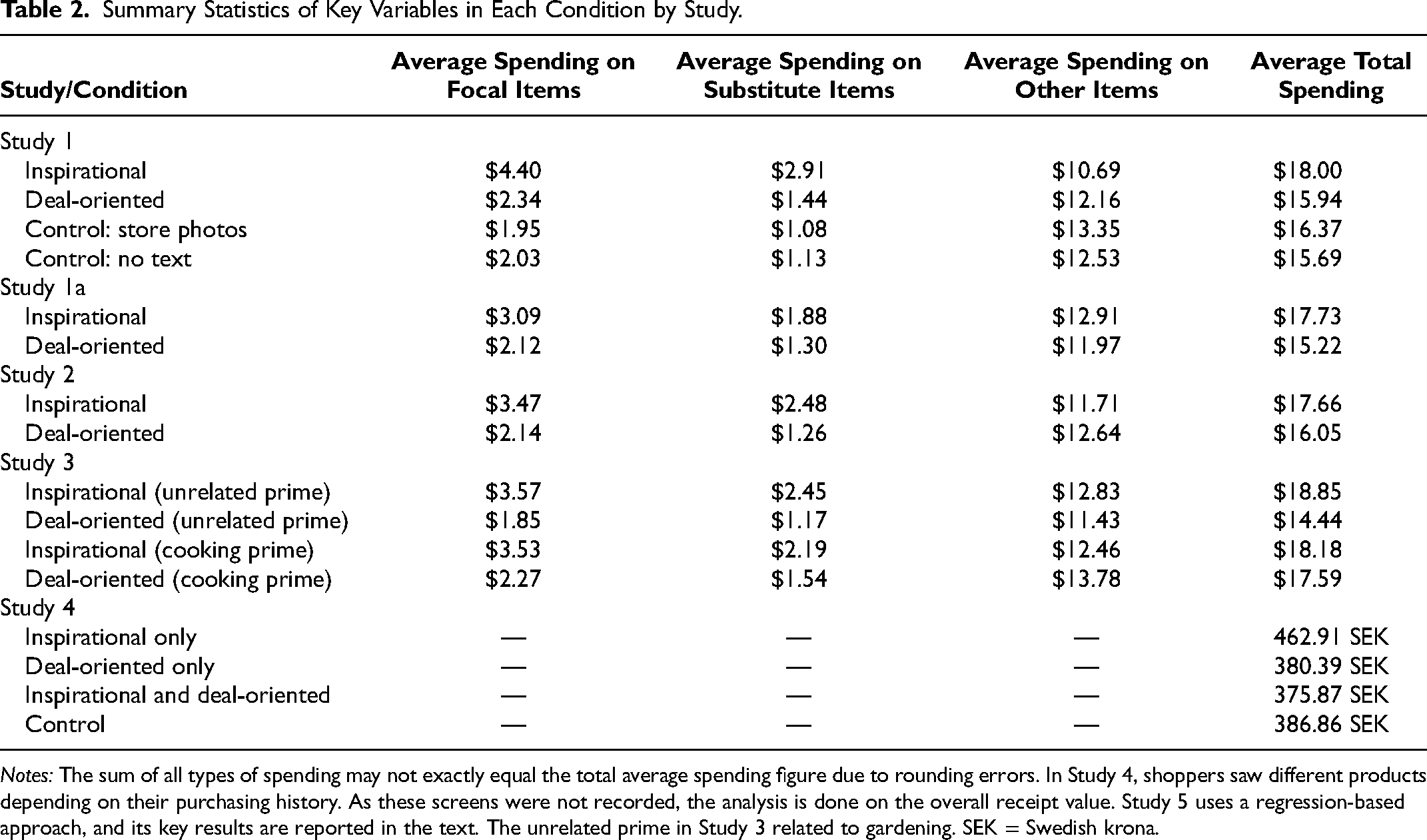
The summary statistics for the four experimental conditions for the key outcome variables (i.e., overall spending and spending on focal, substitute, and other products) appear in Table 2. To test for differences in spending, we used a between-subjects analysis of variance, through which we find a significant difference between the four conditions (F(3, 1,171) = 3.64, p = .01). Planned contrasts reveal that inspirational content prompts higher spending than deal-oriented content (Minspiration = 18.00, Mdeal = 15.94; F(1, 1,171) = 7.18, p < .01), in support of H1a (i.e., inspirational content increases spending more than deal-oriented content does). Inspirational content also prompts higher spending than in the control condition with filler text (Mcontrolfiller = 16.37; F(1, 1,171) = 4.46, p = .03), as well as in the control condition with no information (Mcontrolempty = 15.69; F(1, 1,171) = 8.94, p < .01). There was no difference between deal-oriented content and the control condition with filler text (F(1, 1,171) = .32, p = .57) and between deal-oriented content and the control condition with no text (F(1, 1,171) = .11, p = .74), and there was no difference between the two control conditions (F(1, 1,171) = .79, p = .37).
Summary Statistics of Key Variables in Each Condition by Study.
Notes: The sum of all types of spending may not exactly equal the total average spending figure due to rounding errors. In Study 4, shoppers saw different products depending on their purchasing history. As these screens were not recorded, the analysis is done on the overall receipt value. Study 5 uses a regression-based approach, and its key results are reported in the text. The unrelated prime in Study 3 related to gardening. SEK = Swedish krona.
Focal and substitute products
While there was an overall positive effect on spending, with analyses of variance, we confirm that there is a difference between the conditions with respect to spending on focal products (F(3, 1,171) = 64.67, p < .001), substitute products (F(3, 1,171) = 69.39, p < .001), and other products (F(3, 1,171) = 5.41, p = .001). Planned contrasts reveal that the inspirational content leads to higher spending than the deal-oriented condition for both focal (Minspiration = 4.40, Mdeal = 2.34; F(1, 1,171) = 102.52, p < .001) and substitute (Minspiration = 2.91, Mdeal = 1.44; F(1, 1,171) = 100.71, p < .001) product purchases, in support of H1b and H1c, respectively.
The inspirational condition also leads to higher spending on focal items relative to the control condition with text (Mcontrolfiller = 1.95; F(1, 1,171) = 144.34, p < .001) and the control condition with no information (Mcontrolempty = 2.03 F(1, 1,171) = 134.23, p < .001), as well as higher spending on substitute items relative to the control condition with text (Mcontrolfiller = 1.08; F(1, 1,171) = 157.06, p < .001) and the control condition with no information (Mcontrolempty = 1.13; F(1, 1,171) = 146.71, p < .001). 6
Spending on other products
To ensure that the differential effect in spending across conditions is being driven by increased purchases of focal and substitute purchases rather than by other types of purchases (e.g., tomato sauce, soda), we also compared the spending on other (neither focal nor substitute) products in the inspiration versus deal-oriented conditions. The results show significantly more “other” purchases for the deal-oriented condition than for the inspirational condition (spending: Mdeal = 12.16 vs. Minspirational = 10.69; F(1, 1,171) = 4.74, p = .030). 7 The results thus do not suggest that other, nonrelated product purchases are driving the positive effect of inspirational content. Instead, the positive effect on spending of products related to the communication content overcomes this negative effect in the inspirational condition (Δfocal = $2.06 or 88%; Δsubstitute = $1.47 or 102%; Δother = −$1.47 or −12%; Δtotal = $2.06 or 13%).
Exploratory analysis
The results for focal and substitute product spending provide some evidence of goal completion since the inspirational content enhanced spending on focal and substitute products but not the spending on other products. We created an item to represent the proportion of goal completion: the percentage of focal and substitute items (up to two focal and two substitute items) purchased. We then used bootstrapping mediation methods (PROCESS Model 4; Hayes 2018), with 10,000 bootstrap iterations. We coded the deal-oriented condition as the reference group relative to the other conditions, used the goal completion proportion variable as the mediator, and used the monetary value of intended purchases as the dependent variable. The indirect effect through goal completion (4.26; 95% CI: [3.36, 5.24]) is significantly higher in the inspirational condition than in the deal-oriented condition, supporting H3. The remaining relative direct effect was significantly negative (cʹ = −2.21, p < .01). The full set of coefficients appears in Web Appendix E.
In a follow-up study (Study 1a), the same procedures as in Study 1 were used (see Web Appendix F). In addition, after respondents finished this shopping task, they completed two consumption goal-related questions to attitudinally measure their motivation for consumption goal completion: “How much effort did you devote toward finding items to make something specific?” (1 = “Very little effort,” and 7 = “A lot of effort”) and “How committed are you to pursuing goals related to cooking something specific with your products?” (1 = “Not at all committed,” and 7 = “Very committed”); r = .74.
The results of Study 1a showed that there were significant differences in the intent to spend between the two treatment conditions. Specifically, a t-test of mean differences revealed that the total amount consumers intended to spend (in U.S. dollars) was higher in the inspirational content condition than in the deal-oriented content condition (Minspirational = 17.92, Mdeal = 15.53; t(768) = 2.97, p < .01), replicating H1a. To test whether focal and substitute items were driving higher overall spending, as a replication of H1b and H1c, we ran two independent t-tests, through which we confirm that the inspirational content leads to higher spending on both focal items (Minspiration = .98, Mdeal = .40; t(630) = 9.30, p < .001) and substitute items (Minspiration = .75, Mdeal = .35; t(630) = 6.84, p < .001). Thus, this study revealed that inspirational content evokes intentions to spend more than the deal-oriented content does. These results are consistent with those from Study 1 and provide additional support for H1a–H1c. Furthermore, participants in the inspirational condition also experienced a higher sense of motivation for consumption goal completion (Minspirational = 4.78, Mdeal = 4.53; t(768) = 2.06, p = .04), supporting our hypothesis (H2) that inspirational content influences consumption goal completion more than deal-oriented content does.
To test whether the effect of the inspirational content on spending is mediated by shoppers’ consumption goal completion, we conducted a mediation analysis (PROCESS, Model 4). We used consumption goal completion as the mediator, content type as the independent variable, and intended spending as the dependent variable. We find a positive, indirect effect of inspirational content, through consumption goal completion, on intended purchases (indirect effect = .30; 95% CI: [.01, .65]). Inspirational content triggers more motivation for consumption goal completion (relative to deal-oriented content), which in turn increases intended purchases, consistent with H3. 8
Study 2: Ruling Out Alternative Mechanisms
The goal of Study 2 is to replicate that inspirational content leads to greater focal, substitute, and overall spending, while controlling for and ruling out several alternative mechanisms. For parsimony, we use a two-cell design, using the same inspirational and deal-oriented conditions from Study 1. To ensure the robustness of the results, we preregistered the study design and analysis plan (see https://aspredicted.org/iw5td.pdf).
Method
We used the same online simulation of a shopping trip and directions used in Study 1. We recruited participants from MTurk, through the TurkPrime interface, screened as described in Web Appendix A and in the preregistration. In line with the preregistration plan, we collected data until at least 1,200 participants had submitted a successful survey code to confirm their participation. One participant did not submit a survey code within the time limit (one hour) but completed the survey, making the sample size 1,201 respondents, three of whom experienced technical issues and were unable to complete the full survey. Furthermore, 47 made no product selections at all, so they were excluded from the analysis, consistent with the preregistered plan. Thus, we ended up with 1,154 participants in the final analysis.
These participants were assigned randomly to one of two treatment groups, featuring either the inspirational or deal-oriented content used in the prior study. All the participants received the directions and product purchase page and were told: “Please choose the products you would like to purchase during a shopping trip like this. You may choose as few or as many as you wish by clicking on them.” We used total spending (in U.S. dollars) as the dependent variable and spending (in U.S. dollars) on focal products and substitute products as the mediating mechanism variables. To rule out other process mechanisms, we also considered potential alternative explanations, which we discuss subsequently. Finally, we collected demographic information on the participants (Mage = 42.3 years; 57.6% women, 42.4% men). We find no major differences across the treatment groups for age (t(1,152) = .75, p = .46) or gender (χ(1) = .03, p = .87), so the sample randomization appears to have been successful.
Results
The summary statistics for the key outcome variables (i.e., overall spending; spending on focal, substitute, and other products) appear in Table 2. To test for differences in spending, we used independent-sample t-tests. We find that inspirational content prompts higher overall spending than deal-oriented content does (Minspiration = 17.66, Mdeal = 16.05; t(1,152) = 2.91, p = .004), in further support of our prediction in H1a that inspirational content increases overall spending more than deal-oriented content does. With t-tests, we confirm that the inspirational content leads to higher spending on both focal items (Minspiration = 3.47, Mdeal = 2.14; t(1,152) = 8.53, p < .001) and substitute items (Minspiration = 2.48, Mdeal = 1.26; t(1,152) = 10.84, p < .001), in support of H1b and H1c, respectively. We do not find any difference in spending for other items (Minspiration = 11.71, Mdeal = 12.64; t(1,152) = 1.84, p = .07). 9
Ruling Out Alternative Mechanisms
We collected data to test a series of potential alternative explanations and process mechanisms, including differences across content types in terms of perceptions of the content (vividness, information load, educational and storytelling nature, loss–gain beliefs, novelty of the content, realism), perceptions of stores that use this type of communication content (pleasantness, high-end image), and engagement with the content. The specific questions are detailed in Web Appendix F.
We find no difference between the inspirational and deal-oriented communication content in relation to vividness (Minspiration = 6.20, Mdeal = 6.19; p = .95), loss–gain perceptions (Minspiration = 4.30, Mdeal = 4.40; p = .26), information load (Minspiration = 5.38, Mdeal = 5.33; p = .52), realism (Minspiration = 6.20, Mdeal = 6.23; p = .64), engagement (Minspiration = 5.48, Mdeal = 5.41; p = .36), or high-end store perceptions (Minspiration = 5.63, Mdeal = 5.54; p = .24). However, differences arise when we consider storytelling (Minspiration = 4.32, Mdeal = 3.65; p < .001), education (Minspiration = 5.05, Mdeal = 4.25; p < .001), store pleasantness (Minspiration = 5.90, Mdeal = 5.76; p = .03), and store novelty (Minspiration = 7.23, Mdeal = 7.06; p < .05). In four separate mediation models, with these four variables as possible process mechanisms (PROCESS Model 4; 10,000 bootstrapping iterations), we determine that all of them are significant mediators (see Web Appendix G). Finally, we estimated four models with the same exploratory goal completion proportion noted in Study 1, each with an alternative mechanism (storytelling, education, store pleasantness, novelty) to compare the strengths of their indirect effects. In all cases, the goal completion proportion exerted greater effects, providing additional support for H2 and H3.
Study 3: Activation of Consumption Goal Completion
Often consumers encounter more than one piece of communication content. In Study 3, we examine the role of two different pieces of communication content. As in Studies 1 and 2, we examine the role of inspirational recipes versus deal-oriented communication content. In addition, we examine the role of a second communication content item delivered through magazine covers that would also activate cooking inspiration. If the activation of consumption goal completion through inspirational recipes is responsible for increased spending, we should also be able to activate consumption goal completion through an alternative communication content (i.e., cooking magazine covers). Such a design allows us to assess whether inspirational content has an additive effect, that is, whether the two inspirational content conditions enhance spending or whether the presence of the cooking magazine cover results in the inspirational recipe content not driving any additional spending. If the latter result holds, it means that the cooking magazine cover already activates consumption goal completion, attenuating the spending differences between the inspirational content and the deal-oriented content. This design serves as moderation-by-process (Spencer, Zanna, and Fong 2005) as the magazine covers serve to activate consumption goal completion.
Method
This 2 (communication content type: inspirational vs. deal) × 2 (magazine covers: cooking goals vs. unrelated category [i.e., gardening] goals) design involves an online simulation of a real shopping trip. We prescreened the 804 participants recruited through MTurk as described in Web Appendix A (Mage = 38.4 years; 56.0% women, 44.0% men). No significant demographic differences arise across treatment groups for age (F(3, 800) = 2.15, p = .09) or gender (χ(3) = 2.43, p = .49). The stimuli are similar to those in Studies 2, except that before viewing the 20-second video of the shopper entering the grocery store and approaching the in-store interactive shopping assistant terminal, participants were randomly assigned to look at either cooking or gardening magazine covers (available in Web Appendix H) and assess them with three filler questions. Prior research has established the strong effects of magazine covers to activate goals through exposure to food cues on these covers (Van Koningsbruggen, Stroebe, and Aarts 2011). Moreover, by using magazine covers, we illustrate that inspirational content can be presented in both technological (e.g., kiosk) and nontechnological (e.g., flyer) formats, underscoring the generalizability of the effects to nontechnological formats.
Pretest
To confirm the suitability of the magazine material to activate consumption goals (un)related to cooking, we recruited 51 respondents from MTurk, reportedly to assess the aesthetic appeal of different magazine covers. These pretest respondents were randomly allocated to two groups: one that evaluated two cooking covers and one that evaluated two gardening covers. After finishing this task, participants indicated to what extent they agreed that they were thinking about cooking and gardening on two nine-point Likert scales (1 = “do not agree at all,” and 9 = “completely agree”). Participants in the cooking condition thought more about cooking than those in the gardening condition did (Mcooking = 7.04, Mgardening = 4.00; t(49) = 4.44, p < .001); participants in the gardening condition thought more about gardening than those in the cooking condition did (Mcooking = 2.23, Mgardening = 5.68; t(49) = 4.77, p < .001). However, they did not differ in how much they were thinking about a nonprimed subject (sports) (p = .59).
Procedure
At the beginning of the study, participants saw two magazine covers with pictures of either cooking (priming condition) 10 or gardening (control condition), just as in the pretest. Following the completion of the rating of the magazine covers, the instructions indicated that they had completed the first of two separate studies and that a second study was about to commence. After watching the 20-second shopper video, participants were automatically forwarded to a page that contained a graphical representation of the kiosk. The content was the same as in Study 2, according to their randomly assigned condition. The products in the inspirational and deal-oriented conditions again were the same, and participants then saw the list of 24 products, from which they could choose as few or as many products to purchase as they wanted. Finally, as in the pretest, three nine-point Likert scale manipulation check questions (1 = “do not agree at all,” and 9 = “completely agree”) measured how much they agreed that they were thinking about cooking, gardening, and sports.
Results
As in Studies 1 and 2, the summary statistics for the experimental conditions for the key outcome variables (i.e., overall spending and spending on focal, substitute, and other products) appear in Table 2. We applied a 2 × 2 between-subjects design with the priming condition (cooking goals vs. gardening goals) and communication content (inspirational vs. deal-oriented) as the independent variables. We find a significant direct effect of communication content type on the total amount respondents intended to spend (U.S. dollars; F(1, 800) = 9.19, p < .01); the inspirational recipe conditions showed the highest intended spending.
Priming has no significant direct effect on intended purchases (F(1, 800) = 2.27, p = .13). Instead, we uncover a significant interaction effect between the priming condition and communication content on intended spending (F(1, 800) = 5.38, p = .02). The contrast analyses reveal a significant difference in the gardening priming (i.e., control) conditions: inspirational content prompts more intended purchases (Mgardening&inspirational = 18.85, Mgardening&deal = 14.44; F(1, 800) = 14.46, p < .001) than deal-oriented content, consistent with H1a. Consistent with our theorizing, these effects are attenuated in the cooking goal completion condition, with no significant difference in intended spending (Mcooking&inspirational = 18.18, Mcooking&deal = 17.59; F(1, 800) = .25, p = .62) between the two groups (Figure 4).

Comparison of Average Shopper Spending for Inspirational Versus Deal-Oriented Condition for Gardening and Cooking Goals: Study 3.
We do not find any differences in spending on other 11 products between the inspiration and deal-oriented conditions (Mcooking&inspirational = 12.46, Mcooking&deal = 13.78; F(1, 800) = 1.61, p = .20; Mgardening&inspirational = 12.83, Mgardening&deal = 11.43; F(1, 800) = 1.83, p = .18). Thus, the results support the argument that the effect of inspirational content relative to deal-oriented content is attenuated when participants are primed with goal-oriented ideas (e.g., cooking), because both groups of respondents already are thinking about their (cooking) goals in response to the prime. Conversely, if participants are primed with something unrelated (e.g., gardening), the effect of the inspirational content persists. Thus, inspirational content can have a crucial influence on shoppers who enter the store without a clear sense of which items they need to buy. Providing goal-completion ideas creates value for these shoppers and retailers.
Study 4: Field Evidence for Inspirational Versus Deal-Oriented Content
In Study 4, we have three objectives. First, we aim to replicate the finding that inspirational content influences overall spending more positively than deal-oriented content (H1a) in a field setting to establish the ecological validity of our results. Second, any difference in spending behaviors could result from increased spending in the inspirational condition, decreased spending in the deal-oriented condition, or both. Therefore, we compare inspirational and deal-oriented content conditions with a control condition in a field setting to delineate spending differences. Third, we assess whether the presence of deal-oriented content detracts from the presence of inspirational content.
Method
For Study 4, in-store technology served as the medium for content dissemination. A research assistant approached shoppers in the grocery store randomly and asked them to participate in a study of shopping behaviors. Those who agreed first provided an estimate of how much money they planned to spend in the store that day. Next, participants were randomly assigned to one of four conditions in a 2 (inspirational content: absent or present) × 2 (deal: absent or present) design.
Shoppers in the condition where both inspirational content and deal content were absent comprised our control group. They were asked not to use the in-store technology and did not see its content during their shopping trip. It is possible that these consumers came to the store with some prior knowledge of weekly deals due to promotional material mailed to homes. Shoppers assigned to the three treatment conditions were asked to try the in-store technology, positioned at the entrance of the store. This technology performs multiple functions, including displaying monetary deals, recipes, ways to find items in the store, and prices. Shoppers were asked to use only certain functions, depending on their randomly assigned condition. Those assigned to the inspirational content absent, deal present condition (i.e., “deal” condition) saw both personalized deals (depending on their purchase history) and general deals (same for all customers) displayed in categories such as bread, pantry, frozen, dairy, and beauty. Those in the inspirational content present, deal absent condition (i.e., “inspirational” condition) saw recipes categorized into various areas. Finally, shoppers in the inspirational content present, deal present condition (i.e., “combined” condition) could see both the deal and recipe content. The number of inspirational recipes and deals that shoppers saw across conditions was not limited or standardized. 12 Shoppers did not face any time constraints for using the technology but were asked to use it only for the assigned purpose. After interacting with the in-store technology, they continued their normal shopping trip, completed a short questionnaire that included demographic items, and provided information on how much they spent.
We approached 149 shoppers in total, 16 of whom did not comply with the instructions and one of whom did not fill out the survey, leaving us with 132 participants (Mage = 54 years; 67.2% women, 32.8% men). Initial analyses across the four conditions reveal no statistical differences by age (F(3, 124) = .34, p = .80), gender (χ2(3) = 2.40, p = .49), or planned spending at the start of the trip (F(3, 128) = .31, p = .82). Thus, the randomization worked well.
Results
We used the receipt value (in Swedish krona [SEK]) as a measure of spending as a dependent variable, and we performed a two-way analysis of covariance, in which we controlled for shoppers’ planned spending. 13 We find a marginal main effect of deal-oriented content (F(1, 127) = 3.71, p = .06) but not of inspirational content (F(1, 127) = 2.17, p = .14). We also find a significant impact of planned spending (F(1, 127) = 659.52, p < .001). Notably, we identify a marginal two-way interaction effect between inspirational and deal-oriented content (F(1, 127) = 2.76, p < .10). In line with H1a, contrast analyses reveal significantly higher overall spending in the inspiration-only condition (Minspiration_nodeal = 462.91) than in the deal-only condition (Mnoinspiration_deal = 380.39; F(1, 127) = 5.71, p = .02). Simple contrasts also indicate that spending increases among shoppers in the inspiration-only condition (Minspiration_nodeal = 462.91) versus the control condition (Mnoinspiration_nodeal = 386.86; F(1, 127) = 5.14, p = .03) or the combined inspirational and deal-oriented condition (Minspiration_deal = 375.87; F(1, 127) = 6.45, p = .01). Finally, when shoppers interact with deal-oriented content, the effect of the inspirational content on spending is attenuated (Minspiration_deal = 375.87; Mnoinspiration_deal = 380.39; F(1, 127) = .02, p = .90). An overview of the results appears in Figure 5.

Comparison of Shopper Spending Between Deal Present and Absent Conditions When Inspiration Is Present and Absent: Study 4.
These results highlight that inspirational content leads to greater spending than deal-oriented content does, in support of H1a, but only when shoppers are not also exposed to deal-oriented content. The combined (i.e., inspirational content present, deal present) condition evokes lower spending than the inspiration-only (i.e., inspirational content present, deal absent) condition. According to our theorizing, this result occurs because the exposure to deal-oriented content distracts consumers from goal completion. That is, pure inspirational content inspires consumers’ imaginations and helps them visualize goals; any content that draws consumers away from these actualization goals hinders the impact of inspirational content on spending. Adding deal-oriented content to inspirational content should detract from inspiration-induced goal completion and mitigate the impact of inspirational content. For goals to be achieved, they need to be protected from distracting content (Bagozzi and Dholakia 1999). Thus, these results are consistent with our goal-completion framework.
Finally, as with the controlled experiment in Study 1, the results from the field study suggest that the differential effect of inspirational content over deal-oriented content is due to increased spending in the inspirational (vs. control) condition, rather than decreased spending in the deal-oriented condition.
Study 5: Generalizing the Results Using Eye-Tracking Data
In Study 5, we seek to generalize our results using correlational eye-tracking data by displaying several types of inspirational content throughout a digital store.
Method
For this study, we used an eye-tracking data set that consists of 597 complete shopping trips, conducted in four different stores in Sweden by a private research institute over four months in 2017. 14
The participants received 100 SEK to participate and were asked to shop as they would normally do, while equipped with Tobii Pro Glasses 2 eye-tracking equipment that recorded their visual fields and what their eyes fixated on at any given time. Before the shopping trip, they indicated how much they had planned to spend in the store (in SEK; M = 353.58, SD = 344.18) and what they planned to buy. After the shopping trip, we obtained the total spending per person (M = 375.96, SD = 374.12) through photos of purchase receipts. Next, participants were handed a short survey with various questions relevant to the collaborating research institute (e.g., interest in private label products and organic products, whether they used a smartphone, determinants of their choice of store) that fall outside of the scope of our present research, as well as some demographic items. The research institute also coded whether the participant had looked at any digital displays. For the purposes of this research, we use replays of the raw eye-tracking video materials.
In reviewing the eye-tracking videos, we manually coded when shoppers fixated on digital displays during their shopping trip and the type of content shown on each display. The full shopping trip is the unit of observation. The content on the digital displays changed over the course of the day, so each interaction with a digital display underwent manual review. One of the researchers and a second coder, unaware of the purpose of the study, independently dummy-coded the digital display content along four dimensions based on whether they (1) contained any inspirational content (e.g., cooking videos, recipe ideas, vivid videos, product demonstrations); (2) showed any price content for a product; (3) represented an advertisement for a product, service, or other retailers; and (4) contained any store-related information, such as maps or store information. The Tobii Pro I-VT filter summed smaller fixations in the videos, such that we defined active attention as the act of actively looking at a display rather than just accidentally viewing it. The Tobii Pro Lab software provided indications of attention using the applied filter. In addition, the coders decided whether the fixation actually represented attention. Furthermore, we coded any displays the shopper saw, so if a particular shopper looked at a screen that contained both an advertisement and price information and later saw a display with an inspirational recipe, the coding for this shopper would be 1 for advertisement content, 1 for price content, and 1 for inspiration content, but 0 for store information content. Because the data were collected during different days over several months and since the content on the screens often changed, most participants that noticed the screens saw different content. Of the key price content and inspiration content screens, no one message was seen by more than five respondents. The two coders agreed on 94% of the coding decisions and resolved any discrepancies through mutual discussion with only two exceptions (less than 1%). For the two exceptions, a third coder, unaware of the previous coding, made the final decision. Examples of different displays appear in Web Appendix J.
Results
To assess the effects of shoppers’ interactions with different digital display content, we use a conventional ordinary least squares regression that includes the dummy-coded independent variables (i.e., advertisement, price content, inspiration, and store information) and a control variable for how much money the shopper planned to spend prior to entering the store. The dependent variable is money spent during the shopping trip (in SEK). We find a significant and positive relationship between inspirational digital display content and spending (b = 76.80, β = .06, t(591) = 2.40, p = .02), consistent with our other studies. We do not find a significant relationship of price (b = 65.09, β = .04, t(591) = 1.27, p = .20) or advertising content (b = −12.74, β = −.01, t(591) = −.37, p = .71) with spending. Store-related information had a significant relationship with spending (b = 129.30, β = .05, t(591) = 2.30, p = .02). 15 The overall model was significant (F(5, 591) = 300.79, p < .001; r2 = .72), and as expected, we find a significant relationship between planned and actual spending (b = .91, β = .83, t(591) = 37.80, p < .001).
Considering that neither advertising content nor price-oriented content enhances spending, but inspirational content does, the results provide additional support for H1a in another in-store context (i.e., communication on digital displays), using a different methodology (correlational rather than experimental), and with several types of inspirational content. As in our prior studies, inspirational content is more positively correlated with spending than deal-oriented content is.
As a further exploratory analysis, we also examined the spending receipts for those 70 shoppers who had seen at least one screen with either price content (n = 26) or inspirational content (n = 48). Of these, four shoppers saw both types of content and were excluded from further analysis. Consistent with our theorizing, the idea was to understand whether the advertised products were indeed contributing to higher spending in the inspirational condition. As the content of the digital displays was dynamic and changed over different times and days, we coded the products or categories that were advertised on them (e.g., “Mutti Tinned Tomatoes 4 pack” or “Barbeque items”) by looking at the eye-tracking video recordings. Two independent coders went through each row on the receipts for each corresponding shopper and coded each purchased item as either an advertised item or a nonadvertised item. 16 The coders were consistent in categorizing 97% of the products. The coding for the remaining 3% of the products was resolved after discussion. We then determined the absolute shopper spending (in SEK) on the advertised products (M = 47.89, SD = 70.92) and the relative spending on advertised products (relative to the total spending; M = 10%, SD = 16%).
We used Welch's t-tests to assess the spending effects on advertised products as the variances were unequal between the groups. The independent variables were whether shoppers had looked at a screen with inspirational content (1) or with other information such as price (0). The results indicate that shoppers who saw inspirational content bought more advertised products than those who saw the price-oriented communication, in both monetary value (Minspirational = 56.37; Mprice = 30.92; t(64.00) = 1.71, p = .09) and in fraction of total spending (Minspirational = 12%; Mprice = 6%; t(63.68) = 2.00, p < .05). These results provide additional support for H1b and H1c.
General Discussion
The purpose of this research was to investigate and explain the effect of communication content type on shopper spending. We structure our discussion of the findings according to the research questions and gaps that motivated this study.
Relative to Deal-Oriented Content, Does Inspirational Content Increase Shopper Spending (Gaps 1 and 4)?
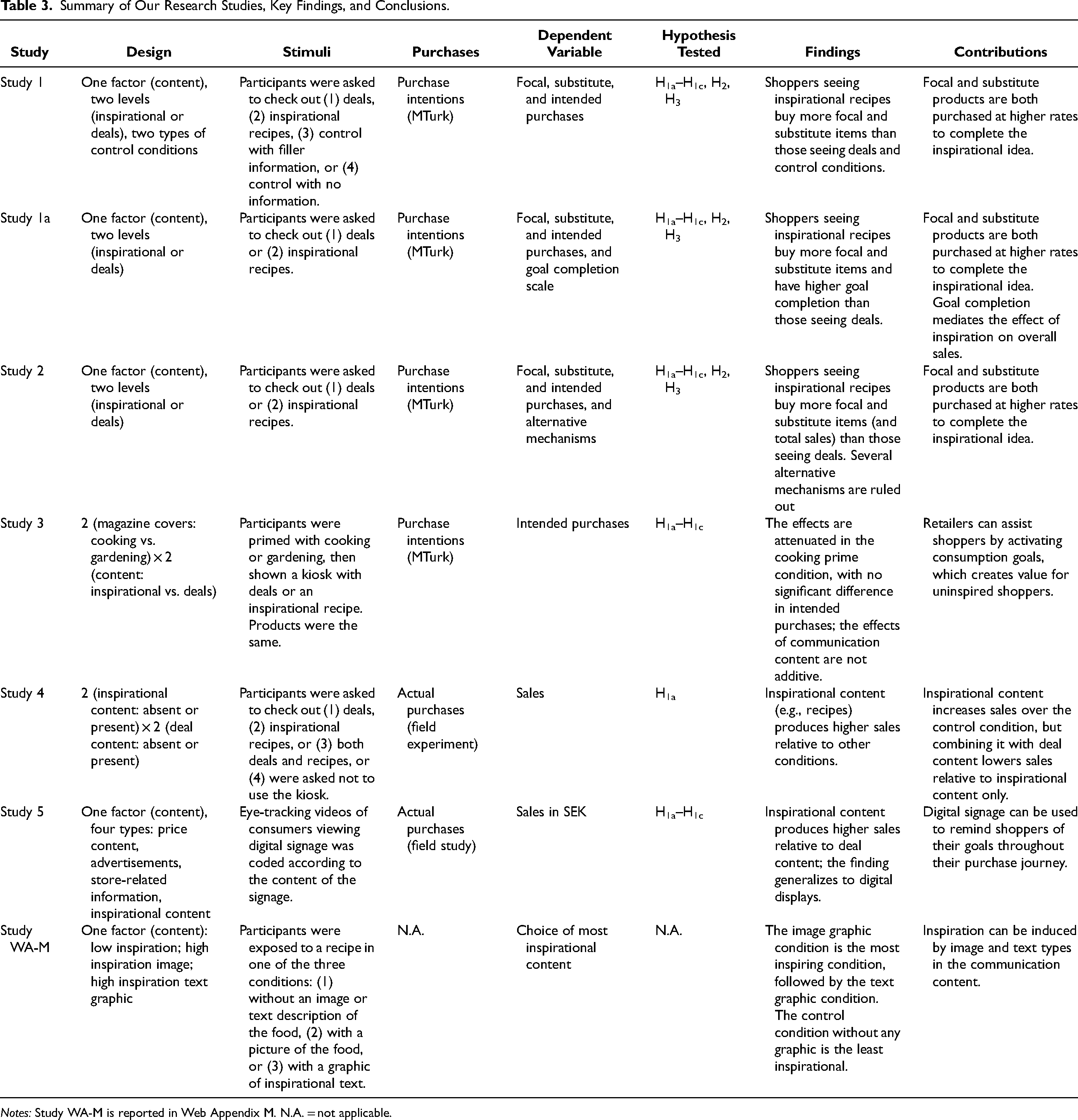
Across multiple studies, including a series of controlled experiments, a field study, and eye-tracking data, the results consistently show that in-store inspirational content increases consumer spending more than deal-oriented content does (see Table 3 for a summary of each study). In an internal meta-analysis reported in Web Appendix K, we confirm that the average effect sizes of inspirational content relative to deal-oriented content (η) are .11 and .13 (p < .001). These effects are similar for seven additional unpublished studies. 17 The fail-safe N test (Rosenthal 1979) indicates that 348 studies with null effects would be needed to bring the overall effect size p-value to less than .05. The lift from inspirational content relative to deal-oriented content ranges from 13% to 31%. We also conducted an additional internal meta-analysis comparing inspirational content with our control conditions in the three studies and found the overall pooled effect to be positive (ηfixed&random = .09, p < .001). Relative to a more traditional control condition, inspirational content enhances spending by 10% to 20%.
Summary of Our Research Studies, Key Findings, and Conclusions.
Notes: Study WA-M is reported in Web Appendix M. N.A. = not applicable.
What Mechanisms Are Responsible for Increased Shopper Spending (Gap 2)?
Consistent with a motivation for consumption goal completion (Bagozzi and Dholakia 1999; Baumgartner and Pieters 2008), we find that inspirational communication content activates a stronger motivation for consumption goal completion, which ultimately influences overall spending, as well as increased focal and substitute product purchases. Thus, our research uncovers the process mechanism responsible for increased spending (see Web Appendix L) and contributes to a better theoretical understanding of how inspirational content enhances shoppers’ purchases relative to deal-oriented (or no) content.
More specifically, inspirational messages, such as recipes, home decor tips, and gardening ideas, induce consumers to imagine the end results of the consumption activities (e.g., cooking, camping, vacationing, gardening), get them intrigued about new ideas or goals (e.g., spring break vacation), help them crystallize these consumption goals (e.g., bake a cake, go camping, go skiing), broaden their horizon (e.g., not just envisioning the focal product category, but expanding to goal-derived categories such as items to pack, travel procedures, and camp activities, and also extending to superordinate categories such as leisure), and allow them to discover new information (e.g., about products and brands relating to the goal-derived categories). All these “inspired by” activities result in consumers being motivated to achieve these goals (i.e., activate consumption goal completion), which in turn enhances their spending.
What Boundary Conditions Constrain These Effects (Gap 3)?
We identify two boundary conditions that mitigate the effects of inspirational content on spending. First, when consumers already have consumption goal completion motivation (e.g., when cooking goals are primed), the difference between deal-oriented and inspirational content is attenuated because consumers already are inspired and depend less on inspirational content. Therefore, the inspirational content should be targeted primarily at customers who are less inspired or involved.
Second, content that detracts from inspirational content has an adverse effect on shopper spending (Study 4: a field study). Specifically, the effect of inspirational content on spending is weaker when inspirational content is combined with deal-oriented communication because this combined content detracts from inspiration-induced goals. In an unreported online study, where we manipulated both inspirational content using more or less inspirational recipes (inspirational pictures present or absent) and deal-oriented content (price promotions present or absent), we replicated these findings. 18 High inspirational communication led to higher spending, but these effects diminished when a deal-oriented condition was added to the high inspirational condition. These insights underscore the importance of maintaining inspirational content without mixing deal-oriented content to activate stronger motivations for goal completion and to drive higher spending.
Implications for Theory
Theoretically, our study advances research on promotional communications, in-store paths to purchase, and shopper behavior. First, we provide an in-depth inquiry into the effects of inspirational content. Inspirational content communicated by retailers is an important but underresearched type of nonmonetary communication in marketing; most studies focus on monetary, deal-oriented content (e.g., coupons, promotions). One might argue that inspirational communication content (e.g., a particular type of cake recipe) would be relevant to fewer people than deal-oriented content (e.g., a particular brand of flour) and, therefore, deal-oriented content should lead to greater spending across all people. However, we consistently demonstrate across diverse field and online studies that inspirational content outperforms deal-oriented content in effectiveness of driving shopper spending. Thus, our results are somewhat counterintuitive and help resolve managerial uncertainty about the effect of inspirational communication content (Web Appendix A).
Second, we extend the notion of consumption goal completion to the important context of in-store inspirational content. In-store inspirational content activates stronger consumption goals (Barsalou 1991; Bezawada et al. 2009), including increased intentions to purchase focal and substitute products (Anderson 1983; Barsalou 1985; Collins and Loftus 1975). We confirm these differences for focal and substitute product purchases and for overall spending across multiple studies, methodologies, and shopping contexts, illustrating the robustness of our theoretical arguments.
Finally, we identify two boundary conditions that mitigate the effects of inspirational content: (1) when consumers already have consumption goals and (2) when the content detracts from inspiration-induced goals. These boundary conditions have implications for a deeper understanding of the interaction of consumption goals and communication content and the complex relationship between inspirational content and deal-oriented content.
Implications for Practice
From a managerial perspective, our results offer several implications. First, the findings regarding the superior effects of inspirational (vs. deal-oriented) content underscore the potential economic benefits to retailers who use in-store communications with inspirational content. Although other strategies can evoke inspirational responses in a store (e.g., physically organizing the store to be complement-based), signage and in-store technologies (e.g., kiosks, digital displays) represent operationally more viable options. Our research demonstrates the effectiveness of a low-cost, easy-to-implement communication content strategy for retailers to boost their revenues.
Second, our results suggest that inspirational content shared through in-store signage can spark creative ideas and activate motivations for consumption goal completion, which leads to greater intentions to purchase items and increased spending. Therefore, our findings imply that retailers should carefully think through their merchandise buying strategies as well as their store planograms. These results suggest that retailers can benefit by displaying substitute items for products suggested by the inspirational content so that consumers can substitute items to actualize ideas or complete their goals in slightly altered ways from those suggested by the inspirational communication.
Third, we find a strong mediating effect of consumption goal completion for the positive effect of inspirational content on spending. Additionally, when we primed shoppers with consumption goal completion, their sensitivity to their purchase goals rose. Thus, retailers can push content through other forms of in-store communication and prime various consumption goals to influence shoppers directly in stores. For example, messaging shoppers on their mobile devices might remind them of goal-related categories throughout the store; digital signage with beacon technology, used in conjunction with kiosks, could also remind shoppers in various locations about a goal stimulated previously by the inspirational content available from a kiosk at the entrance.
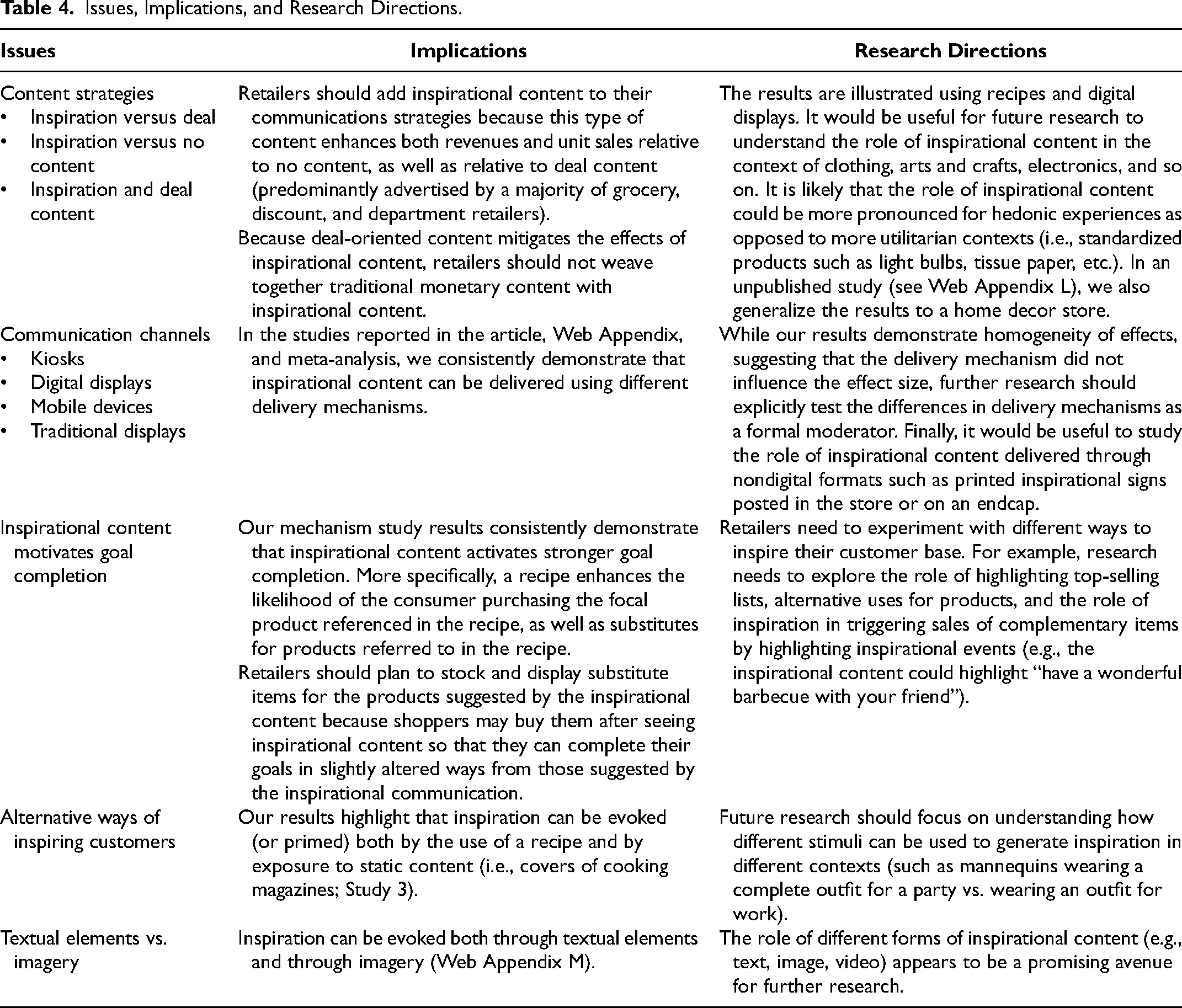
Fourth, we identify an interesting, counterproductive pattern of effects that results from mixing deal-oriented content with inspirational content. Specifically, content that detracts from the inspirational nature of the broader communication is less effective in driving shopper spending. This result has an important implication for retailers, who often include various types of content in the same communication. Instead, according to our results, retailers should avoid weaving together traditional deal-oriented content with inspirational content. We summarize managerial implications (and future research directions) in Table 4.
Issues, Implications, and Research Directions.
Limitations and Conclusions
Our research contains some limitations that additional studies could address. We mainly used recipes to represent inspirational content; research in other retail settings might investigate displays of products, mannequins, or 3D content that shows a complete outfit. Research in a home decor store might explore the role of inspirational content aimed at redesigning a given room (e.g., living room, bedroom, kitchen).
We note that some of our studies do not have a traditional control condition, precluding us from making inferences regarding how inspirational content enhances spending relative to no content or shallow deal content. Furthermore, we take a retailer perspective rather than a manufacturer view, but manufacturers’ goals differ from those of retailers. Retailers strive to increase sales within the store, across the chain, and for private label brands. Manufacturers work to enhance their own brand sales. Continued research should explore how communication content might benefit both retailers and manufacturers.
Our results also suggest that communication content that sparks educational or storytelling aspects might increase retailers’ sales, as could content that enhances consumers’ perceptions of the pleasantness or novelty of the store. Inspirational content stimulates imagination, creative ideas, or solutions (Hutchinson 2017), and there are multiple ways to achieve this inspiration with communication content. Our inspirational conditions involved visual imagery; they can be extended to conditions featuring textual graphics. In Web Appendix M, we present a preregistered study to show that inspiration can be evoked by different image types (visual and textual) and that the effects of inspirational content without appropriate imagery can be low.
Overall, our research shows that in-store communication with inspirational content leads to higher spending than communication with deal-oriented content; we also identify and explain the underlying mechanism through mediating and moderating effects. We hope these results stimulate further research on inspirational communication content.
Supplemental Material
sj-pdf-1-mrj-10.1177_00222437221149508 - Supplemental material for The Impact of In-Store Inspirational (vs. Deal-Oriented) Communication on Spending: The Importance of Activating Consumption Goal Completion
Supplemental material, sj-pdf-1-mrj-10.1177_00222437221149508 for The Impact of In-Store Inspirational (vs. Deal-Oriented) Communication on Spending: The Importance of Activating Consumption Goal Completion by Dhruv Grewal, Carl-Philip Ahlbom, Stephanie M. Noble, Venkatesh Shankar, Unnati Narang and Jens Nordfält in Journal of Marketing Research
Footnotes
Appendix: Key Informants’ Explanations of How or Why Inspirational Communication Is Used by Their Companies

| Position | Company | Gist of Interview Responses |
|---|---|---|
| Visual merchandiser | Moschino | We offer inspiration primarily with the merchandise in our displays. All displays exhibit irony and fun. For instance, we often use examples of garments rather than mannequins or other props. We use no digital techniques whatsoever in the customer interface in our stores; rather we use our displays to offer solutions and inspiration. |
| Manager, Inter IKEA Systems | IKEA | IKEA retailers never show a product without a price. Nor do they strive to attain short-term sales successes based on temporary price reductions. Doing so would be fundamentally wrong because the IKEA pricing principle is to provide genuinely and consistently low prices over the whole year or longer. Price reductions often send the wrong signals. They may increase traffic to the store in the short run, but in the long run this can damage our brand. Rather than highlight deals, we try to offer inspiration to our consumers through our room settings in our showrooms. Each home area within the store provides room settings to inspire visitors with a range of opportunities before they encounter the total breadth and depth of the products offered in that area. IKEA room settings are a unique and very competitive store medium. They present functional, realistic, and inspiring home furnishing solutions for a variety of living situations and style preferences. The solutions offer new ideas and reflect living conditions in the local market. Room settings are used to help visitors understand the breadth or range, by showing that there are different solutions for different people and that there is something for everyone. |
| Manager, customer insights | Coop | We have the concept of “Taste at Coop,” which is a store concept whereby customers are offered a taste of a dish cooked and demonstrated in the store. The tasting comes with an associated recipe folder. Our CEO often refers to the fact that 80% of our customers enter our stores looking for inspiration about what to get for dinner and we need to do what we can to help them. “Taste at Coop” is one way to help. |
| Head of test and insights | H&M | We design the store layout to enhance shoppers’ understanding of which items fit well together. In the media, we work with different models to show what fits well together. We also have an app that helps the shopper find whole outfits. For instance, if a shopper is looking at a polo shirt in the app, we serve suggestions of pants, shoes, and jackets that would fit with the polo. We also have various app features that allow shoppers and staff to show how different outfits look on them. To some extent, discounts and other promotions can be seen as ways to capture shoppers’ attention and get them to the store or the website, but it is the inspirations that help shoppers find something they want. Therefore, affordable prices and inspiration are two important sides of our marketing, but they serve different roles. |
| Store manager | ICA | We try to deliver in-store solutions to consumers in multiple ways. We have a digital station that contains ICA's recipe bank, allowing the shopper to print recipes on the site (which includes offers; i.e., it also contains product/price information). We have in-store TV screens that show inspirational content as well as products and prices. Endcaps also try to offer solutions. For example, different meal components on the same endcap could be used to make a meal. On social media, we post on Instagram and Facebook with inspirational content. We are still testing different ideas. |
| Store manager | ICA | We have our own newspaper that goes out to the households in the area, which also has a local newspaper. The content is editorial (not promotional), with tips, ideas, interviews, and inspirations. |
| Head of media | ICA | Most of the customers are undecided about what to buy when they enter the store, and just over half of the shoppers have a shopping list. Using just price-oriented communication undermines the brand. Inspirational ideas build brands. |
| Store owner | ICA | As a store it is difficult to work just with product prices. Customers expect and demand more. That is why trying different things to satisfy their needs is very important. Inspiring our customers is important for a variety of reasons: • Make customers happy and help them enjoy shopping at our store • Make customers feel that we are inspiring them to create better and easier daily lives • Have customers choose us as their main store • Get customers to shop with us more often • Get customers to spend more when they visit us |
| Store manager | ICA | We are a store that is not run by the price, which means we often communicate without focusing on commodity or price. We offer many tips and ideas about cooking from the staff, for example, “Did you know …” and “This cheese fits perfectly with …” We also have two demo kitchens four days a week, where we inspire new ideas and hand out recipes. |
| Store owner | ICA | We are a smaller store, and the difference between smaller and larger stores is that larger stores often are better at cross-merchandising displays for idea inspirations, while smaller stores, due to space and inventory constraints, verbally communicate recipes to the customers. The ideal cross-merchandising practice combines the cross-merchandising displays used by the large stores with the personal selling used by the smaller stores. For instance, two ICA stores have a central department that produces new recipes every week. One of the stores has a store kitchen, a display area where chefs cook, sample, and serve meals that they offer together with recipes. These are some effective ways for stores to cater to their customers’ everyday inspirational needs. |
Notes: Interviews were conducted by phone and through email.
Acknowledgments
The authors acknowledge helpful comments from participants at the Wharton Retailing Conference and the AMA Winter Conference as well as help with the coding of receipts from Axel Nordfält.
Author Contributions
The second and sixth authors handled the field and eye-tracking studies in conjunction with a professional research company. The experiments on MTurk were conducted by the second author. The second author and the fifth author handled the data analysis.
Associate Editor
Mary Frances Luce
Declaration of Conflicting Interests
The author(s) declared no potential conflicts of interest with respect to the research, authorship, and/or publication of this article.
Funding
The author(s) received no financial support for the research, authorship, and/or publication of this article.

Notes
References
Supplementary Material
Please find the following supplemental material available below.
For Open Access articles published under a Creative Commons License, all supplemental material carries the same license as the article it is associated with.
For non-Open Access articles published, all supplemental material carries a non-exclusive license, and permission requests for re-use of supplemental material or any part of supplemental material shall be sent directly to the copyright owner as specified in the copyright notice associated with the article.
