



Abstract
Studies of public support for war highlight the importance of context. Most people do not simply support or oppose the use of force but instead assess its merits depending on various aspects of the situation. One such aspect is the extent of international backing – whether from individual states or supranational organizations – for military action. This backing may be active, notably through the contribution of troops, or more a passive matter of endorsement or authorization of action. In this article, a survey experiment embedded in a major internet survey of British foreign policy attitudes (N = 2,205) is used to explore how international backing affects public support for military action. Britain’s military potential and recent history make it an obvious case study here. Both active and endorsement backing prove to have separate and significant positive effects on support. Importantly, the absolute number of troops involved matters far less than the proportion of total troop numbers to be contributed. And the perceived strength of the enemy predicts support only when the British are to contribute a large proportion of total forces. Predispositional variables are used to investigate the sources of the experimental effects but with little success: the impact of international backing proves remarkably consistent across the sample.
Recent debates about possible Western military action in Libya and Syria were dominated by the question of the breadth of the international coalition needed to legitimize such action, with heavy emphasis on the need to obtain UN Security Council resolutions authorizing intervention. In Britain as elsewhere, the background – indeed, the foreground – to those debates was the Iraq war, in which the UK was junior partner to the USA in a ‘coalition of the willing’ that took action without explicit UN authorization and in the face of considerable international opposition. This was an example of the brand of ‘liberal internationalism’ pursued by former Prime Minister Tony Blair in which military intervention on humanitarian grounds was deemed justified even in the absence of authorization from international organizations. That doctrine, in general, and its application in Iraq, in particular, have come under close scrutiny. Meanwhile, British forces have been in Afghanistan for over a decade as part of a NATO mission which has seen simmering disagreements about whether some allies are not shouldering their fair share of the military burden. In short, the nature and extent of international support is a prominent element in elite debates about military action, in Britain as elsewhere.
This article is about whether and how British public support for war is also influenced by the international backing for military action. Numerous academic studies have demonstrated the importance of public backing to governments considering the use of force (e.g. Gartzke, 2000; Reiter, 2003; Sullivan, 2008), and popular support – or the lack of it – was a prominent topic in elite discussion and media coverage of recent military action, potential and actual, in the Middle East. So this question about mass opinion is well worth asking. It is also worth asking about publics beyond the United States, where the large majority of academic research on public support for war has been conducted. The USA is obviously atypical in its capacity for unilateral action and so it is useful to broaden the evidence base to a country like Britain which, while retaining the potential for acting alone, is more obviously in need of international backing.
There is another important respect in which we advance the literature in this field. Previous work on international backing has tended to blur or neglect the distinction between endorsement – that is, some kind of authorization or approval of the use of force – and active support in the form of a tangible contribution to military action. Existing research cannot readily indicate which of these weighs more heavily in public judgements about military action, and whether there are individual differences in that relative importance. By priming the two types separately, we gain insight into whether international support matters more because of the legitimizing effects of endorsement or because it increases the chances of success and reduces the costs of action.
Our primary means of addressing these questions is a survey experiment in which we manipulate the degree of international backing and record the effects on support for the use of force. The experimental approach is increasingly used in this broader field but has only recently featured in the specific literature on international backing and support for war (Brooks & Valentino, 2011). We begin by reviewing that literature, identifying the reasons why – and conditions under which – we would expect international support to translate into public support. Having set out the data, measures and experimental design to be used, we report results showing that the British public is broadly multilateralist and that even those sceptical about military action can be persuaded to support it as part of a wider force. We conclude by discussing the validity and implications of our findings.
International backing and public support for war
One prominent strand of research into public support for war has been concerned with individuals’ predispositions to support military action. Scholars have specified a range of values and ideological principles that citizens can use to lead them to decisions on foreign policy issues. Prominent among these ideological dimensions are internationalism versus isolationism (Wittkopf, 1990), militarism versus accommodation (Holsti, 2004; Alvarez & Brehm, 2002: ch. 9), national chauvinism (Herrmann, Isernia & Segatti, 2009) and broader political ideology (Russett, Hartley & Murray, 1994). While most of this research has been based on the US public, there seems no reason to doubt that the basic point holds in Britain and elsewhere. Core beliefs and values leave some people strongly predisposed against military action, but others far readier to support the use of force.
However, predispositions are only part of the story. A huge range of specific contextual or situational factors can affect public support for military action. Examples include the objective of military action (Jentleson, 1992; Oneal, Lian & Joyner, 1996), the extent of domestic elite consensus (Zaller, 1992; Dixon, 2000), casualty rates (Gartner & Segura, 1998; Karol & Miguel, 2007), and the extent of international backing, from other states or supranational organizations (Kull & Destler, 1999; Holsti, 2004; Smith, 2005).The last of these is our central focus in this article.
There are several reasons why international support for a military intervention might translate into greater public support, and the relative importance of these depends on whether that international backing comes from supranational bodies or from one or more other single-actor states. A first possibility, suggested by Isernia & Everts (2004: 253), is ‘that over the years people have internalized, as it were, the rules of international law’ – which prohibit the use of force unless in self-defence or with the authorization of the UN Security Council. Few citizens are likely to know the precise legal position but many more will have grasped that unilateral action is less legitimate. Applying a ‘domestic analogy’ would lead citizens to a similar conclusion, unilateral action failing to meet democratic criteria of deliberation and consent (Russett, 1993). These points apply particularly to the authorization of force by international organizations (IOs). In models formalizing the relationship between IO backing and public support for military action (Chapman, 2007; Fang, 2008), citizens read signals from these organizations to determine whether they should reward or punish leaders for the use of force. Such signals are doubly useful for a rational public that knows little about foreign affairs but is called upon to consider the wisdom of military action. Even if support from IOs is lacking, support from other states – in ‘coalitions of the willing’ – can also boost public approval. It also serves as a heuristic for judging the extrinsic characteristics of a military intervention, notably its justifiability and effectiveness. Difficulties in attracting international support are likely to spark public doubt not only about the worthiness of the cause but also about the success of any military campaign.
The distinction between supranational and multinational support cross-cuts another important distinction, between what might be called endorsement and active support. This might be crudely summarized as the difference between words (that is, statements approving the use of force) and deeds (which might take various forms – sending in troops, giving permission to use air space, providing financial backing, and so on). 1 For present purposes, the key difference between endorsement and active backing lies in how they might convince the public to support military action. Endorsement is more about legitimacy and hence about normative persuasion: that is, the approval of other international authorities or actors helps to convince the public that the use of force is justified. Active backing, by contrast, is more about the probability of success – wars fought alone are harder to win – and hence is factored into more rationalistic assessments of the costs and benefits of military action. We should acknowledge that the two are not wholly independent: citizens might reason that greater international legitimacy boosts the long-term chances of success, or wonder whether action that has to be taken alone is as legitimate as their government claims. Nonetheless, endorsement remains a stronger cue about the legitimacy than about the effectiveness of the use of force, while the reverse is true of active backing. 2
The endorsement/active support distinction has been underplayed in the existing literature. One exception is Eichenberg’s major cross-national analysis of polling data which showed that support for military intervention was boosted by both ‘the endorsement of the international community through formal mandates and the deployment of international forces’ (2006: 56). We build on that basic finding, not only by bringing individual-level data to bear on the matter but also looking in more detail at the relative importance of the two types of support, at whether they operate additively or in interaction, and at whether their power to persuade depends on citizens’ general views of the legitimacy and effectiveness of military action.
In these areas, as in most spheres of foreign policy opinion, it is the US public that has been most thoroughly surveyed. Yet this is anything but a typical case. Since the USA’s military power and global role give it unparalleled capacity to act unilaterally, we might expect international backing not to weigh heavily in its citizens’ judgements about military action. It is therefore striking that the US public in fact takes a strongly multilateral view of the use of force. 3 The results of a 1998 survey, in which only 23% of respondents said that ‘in international crises the United States should “take action alone” it if does not have the support of its allies’ (Page & Barabas, 2000: 358), are illustrative of a more general rejection of unilateral action (Holsti, 2004; Kull & Destler, 1999). International backing is valued particularly when it comes from supranational organizations. Grieco et al. (2011) use a survey experiment similar to our own to show that US public support for a hypothetical military engagement in East Timor was strengthened where force was endorsed by international institutions. In line with the formal models cited earlier, the public uses IO backing as a heuristic, or ‘second opinion’, in judging military action. Turning to aggregate-level studies of public opinion, Chapman (2009; see also Chapman & Reiter, 2004) finds that ‘rally-round-the-flag’ effects on US presidential support are stronger where the UN Security Council has sanctioned the use of force and, in particular, when traditional international adversaries have also supported the action. Similar and intriguing results are reported by Hayes & Guardino (2011), whose combination of content analysis and polling data suggests that US public opposition to the invasion of Iraq was driven by sceptical cues from foreign actors in the face of permissive elite consensus at home.
To date, there has been no systematic study of the impact of international backing on British popular support for war. But existing evidence bearing on this issue points to a British public that is still more multilateralist than its US counterpart. This difference between the two countries is predictable given Britain’s much more limited capacity for acting alone. If the difference is also rather narrow, then this has more to do with the perhaps surprisingly multilateral approach of the US public than with any strong strain of unilateralism in Britain. The 2002 Transatlantic Trends project included both survey questions and an embedded experiment concerning possible action in Iraq and, in both cases, ‘the legitimacy conferred by a UN mandate had an even greater importance for the British public than for French or German respondents’ (Isernia & Everts, 2004: 249). In a later (2008) survey reported by Reifler, Scotto & Clarke (2011), a majority of respondents agreed (and only a quarter disagreed) that ‘Britain should not use its armed forces abroad unless it gets approval from the United Nations’. Such multilateral instincts also show up in longitudinal studies of mass support for war: Bronski & Way’s (2003) analysis shows that in Britain, as in the USA, the public is more inclined to rally round the flag in cases of joint military action. 4 Finally, Younger (1964) suggests that, even in the decades following World War II, when the public might be expected to have been more confident in Britain’s capacity to act alone, there was nonetheless widespread internationalism and support for the UN.
These consistently multilateral attitudes are noteworthy given that, twice in the last 30 years, British governments have taken what was basically unilateral action – in the Falkland Islands (in 1982) and in Sierra Leone (2000). Moreover, in the former case, the UN explicitly opposed that action. 5 Yet both interventions were largely successful and the Falklands action, in particular, enjoyed strong public support (Clarke, Mishler & Whiteley, 1990; Price & Sanders, 1993). If anything, it is more recent joint actions, especially those in Iraq and Afghanistan, whose justification and effectiveness has been called into question by the public. This is not necessarily out of line with the notion of a multilateralist British public. For one thing, much of the controversy over the Iraq War concerned lack of support from the international community and legal wrangling over whether action was UN-authorized. For another, it may be that those interventions enjoyed the ‘wrong kind’ of multilateral support. The (dominant) presence of the United States in those ‘coalitions of the willing’ may now send a less powerful signal about the likely effectiveness of action, and could even have a delegitimizing effect, too. The speculative tone of this discussion reinforces the case for systematic analysis of the conditions under which international backing boosts British public support for military action. Such analysis needs both to distinguish supranational organizations from other states as providers of support and to consider the particular impact of key potential allies.
In the upcoming methods section, we describe how the various aspects of international backing were operationalized. For now, we cast hypotheses in general terms. The first two are straightforward and concern the main dimensions of international support:
H1: The wider the international endorsement backing, the greater the public support for military action.
H2: The greater the international active backing, the greater the public support for military action.
The two dimensions are obviously related: contributions of troops and equipment will presumably only come from states or organizations that are committed to the cause, and the public might well expect that vocal backing for the use of force will translate into active contributions. Our experimental method allows us to prime the two separately but not to enforce the distinction in respondents’ minds. Therefore, there is highly likely to be what Sher & McKenzie (2006) call ‘information leakage’, whereby respondents infer additional information beyond that which is explicitly cued in the manipulation. In this case, respondents may infer one dimension of backing from the other. That possible leakage makes it difficult in particular to predict the nature of any interaction between active and endorsement backing. Such interaction could be positive, the public deeming both necessary in order for a mission to be legitimate and likely to succeed, or negative, the public seeing little benefit in wider moral support provided that extensive active backing is available. Hence, while we can test for that interaction, we do not specify a directional hypothesis about its nature.
However, we do specify two further hypotheses about the impact of active backing. The first emphasizes that public dissatisfaction at a lack of active support does not simply reflect strategic calculations about the greater risk to Britain’s troops. There is also a normative point that the public is likely to resent having to do more than its perceived fair share (Smith, 2005: 500). It may therefore be that the public would prefer a mission in which a major deployment of British troops forms a small proportion of the total force over a mission in which, while the overall burden carried by the British is lighter, its share of the effort is greater. We therefore hypothesize:
H3: Public support depends more on Britain’s relative than absolute contribution to military action.
This is not to say that strategic considerations play no part in these judgements. Numerous situational factors could interact with international backing in shaping public support. Examples include the purpose of the war, the weight of national interests at stake, and the strength of the enemy. To keep the design simple and maintain statistical power, we focused only on the last of these since it raises the particularly immediate question of the threat posed to British forces. The hypothesized interaction is:
H4: International backing has a greater impact on public support for military action when the adversary is stronger.
Who will go it alone? Predispositions and reactions to international backing
Herrmann, Tetlock & Visser (1999) use a series of survey experiments to demonstrate the impact of both predispositions and situational factors on the US public’s support for military action. They also highlight the interaction between predispositions and context: that is, the way in which people respond to a specific situation depends on their general values and attitudes. For instance, while respondents were on the whole readier to use force when US interests were clearly at stake, this difference was narrower among internationalist respondents who were generally willing to get involved anyway; it was isolationists that needed a compelling national interest to be coaxed into supporting action (Herrmann, Tetlock & Visser, 1999: 563). So we should bear in mind the likelihood that the British public will not react homogeneously to our key variable, international backing, when considering military action.
Various predispositions are potentially relevant in this context. The first is the internationalism/isolationism variable mentioned in the example just above. We might expect internationalists – especially cooperative internationalists (Wittkopf, 1990) – to be particularly responsive to the extent of foreign backing for action while, almost by definition, isolationists are unlikely to be coaxed into action overseas simply because other nations or supranational organizations are also involved.
Another relevant set of predispositions is citizens’ prior attitudes to those international actors that might lend support to military action. Grieco et al. (2011) found exactly this moderating effect in their US experiment: the more respect that people had for an international institution, the more swayed they were by its endorsement. This effect could result from quite detailed cognitive processing, as citizens update their judgements about the likely justification or effectiveness of military action based on their perceptions of the records, capacities and motivations of the international actors involved. Or it could be a very simple application of what Sniderman, Brody & Tetlock (1991) call the ‘likability heuristic’: the mere association of military action with a disliked object is enough to turn someone against that action.
This leads us to two hypotheses about the moderating effect of those predispositions:
H5(a): The impact of international backing on public support for military action is stronger on those scoring higher on internationalism.
H5(b): The impact of international backing on public support for military action is stronger on those favourably disposed towards the international actor giving endorsement.
Herrmann, Tetlock & Visser (1999: 563–564) also found that militarist predispositions moderated the effect of situational factors. If our results show the same pattern of interaction, then international backing could persuade those already disposed to consider the use of force but would not convert those sceptical about military action. (The reverse interaction would imply that militarists need no such persuasion but that international backing can temper pacifist instincts.) In line with a distinction drawn earlier, we examine two strands of militarist predispositions: whether the use of force is regarded as generally justifiable and as generally effective. This enables us to assess whether the different dimensions of international backing tend to convince citizens of the moral or of the practical case for military action. We would anticipate endorsement to interact more strongly with perceived justifiability – normative persuasion being unable to move those who reject military action on normative grounds anyway – and, for parallel reasons, active backing to interact more strongly with perceived effectiveness. Our hypotheses are therefore:
H6(a): The impact of endorsement backing on public support for military action is stronger on those predisposed to regard military action as justified.
H6(b): The impact of active backing on public support for military action is stronger on those predisposed to regard military action as effective.
Methods, data and measures
The main empirical basis for this study is a survey experiment. Using a design similar to that reported by Brooks & Valentino (2011), we presented respondents with a vignette concerning potential military action and aspects of that vignette – notably the degree of international backing for action – are manipulated. We describe the experiment in detail shortly. It is first worth briefly noting the key advantage of an experimental design. This centres on internal validity and, specifically, the power of experimental control and random assignment to permit causal inference. Studies of aggregate opinion, investigating the covariation of public support and the degree of international backing, are useful (see especially Eichenberg, 2006) but suffer from a ‘too many variables, too few cases’ problem. Researchers not only lack control over other situational factors but are also unsure about whether and how the extent of international backing was perceived by the public.
An experiment also offers an external validity advantage over the alternative most prominent in the literature, namely the priming survey question in which respondents are asked – either about military action in general or about a particular war – whether they would be more likely to approve of action were a given international actor to support it. Such a question is available in the survey analysed here and the responses provide a useful scene-setter in our results section. However, the strength and blatancy of the cues in such priming questions means that they are liable to overstate effect sizes. Hence we turn to the experiment for a more valid test of our hypotheses. Of course, experiments come with their own external validity problems – a point to which we return in the concluding section – and so it is advisable to take a multimethods approach to research questions like these. Our study does not supplant but supplements previous research.
Data
This experiment was included in a major three-wave survey study of foreign policy attitudes among the British public. 6 The surveys were fielded on the internet by YouGov, whose approximately 300,000 panel members formed the sampling frame. 7 The company has an impressive track record of sampling and weighting to achieve representative samples of the British electorate – as measured by their accuracy in predicting election results. 8 Several recent analyses of British foreign policy attitudes have been conducted using YouGov survey data (e.g. Reifler, Scotto & Clarke, 2011; Johns & Davies, 2012; Clements, 2013).
The study was not a traditional panel. The aim was rather to divide a long instrument into manageable chunks and to field these at brief intervals so that the entire process of data collection took less than a month. The key methodological details of the three waves of fieldwork are set out in Table I, which also indicates the waves from which the questions used in this article are taken. The core experiment was fielded in the second wave of data collection while the survey measures used come from various points in the survey.
Survey experiment and situational variables
Methodological details of the surveys

a Since members of the opt-in YouGov panel do not have a known probability of selection, we cannot calculate a response rate taking into account all sources of non-response, including panel recruitment and retention. Response rates are, in effect, completion rates, representing the proportion of those asked to take part in that survey that agreed to do so.
Next, here is a question about a situation in which Britain might take military action. Please read the following short newspaper story and then answer the question.
‘Today the British government announced that it will send troops to Country A to defend it against threats from its larger neighbour, Country B. This mission, which has
Four situational features of the story were thus subject to random manipulation: the extent of endorsement (from the UN, NATO, the USA or non-significant); active support, that is, the proportion of total troop numbers contributed by Britain (10% or 90%); troop numbers (1,000 or 10,000); and adversary strength (large and well-trained or small and not very well-trained military). The relative complexity of this 4 x 2 x 2 x 2 design means that the large total sample size (of well over 2,000) is particularly important. It also means that some of the experimental manipulations, having just two conditions, are rather unsubtle. In particular, we would ideally have been able to vary Britain’s share of troop deployments beyond a simple ‘nearly all’ versus ‘hardly any’. As it was, we sought roughly to replicate with percentages the extremes of the endorsement backing variable – with Britain fighting either more or less alone or as part of a major international force – and thus to allow for at least broad comparison of the effects of endorsement and active support. For similar reasons, we specified two conditions for troop numbers that varied by roughly the same order of magnitude as the troop percentages. 10
The newspaper story is followed by two questions – shown below – providing dependent variables for the upcoming analyses. The second question is included partly to force respondents to come down on one side of the fence and partly to provide a simple ‘percentage support’ figure to ease comparisons. □ On a scale from 0 (‘strongly oppose’) to 6 (‘strongly support’), how do you feel about the decision to send British troops to Country A? □ And if you had to choose ‘oppose’ or ‘support’, which would you go for?
Additional variables
We hypothesized interactions between international backing and three predispositional variables: militarism, internationalism and attitudes to international actors. As noted, we measure two variants of militarism, concerning the justification and effectiveness of military action: □ Next, some questions about the use of military force. The first asks: do you think the use of force can be morally justified? On a scale from 0 to 6, where 0 means ‘definitely cannot be justified’ and 6 means ‘definitely can be justified’, which number best represents your view? □ In general, how effective do you think the use of military force is? On a scale from 0 to 6, where 0 means ‘not at all effective’ and 6 means ‘very effective’, which number best represents your view about the use of force?
Internationalism is measured with a short battery of three Likert items using the standard five-point agree–disagree format. (Asterisked items are reverse-scored.) The items are adapted from measures used by Hurwitz & Peffley (1987). □ Britain shouldn’t worry about world affairs but just concentrate on taking care of problems at home.* □ Britain needs to play an active role in solving conflicts around the world. □ Britain is too small a country to be out policing the world.*
While an alpha coefficient of 0.71 means that this scale meets conventional reliability criteria, it does not allow us to distinguish cooperative from militant internationalism but is instead a more general measure of internationalist–isolationist orientations.
The questions measuring attitudes to the UN and NATO were worded as follows: □ Thinking now about international organisations, how much respect – on a scale from 0 (‘no respect at all’) to 6 (‘a great deal of respect’) – do you have for the following?
The question measuring attitudes to the USA was slightly different: □ Now we would like to know how you feel about particular countries these days. Please rate your feelings about each one on a scale from 0 to 6, where 0 means you ‘strongly dislike’ and 6 means you ‘strongly like’ that country.
Finally, as noted, the survey also included a directly priming question about military action under different circumstances in terms of international backing or alliances: □ Military action could be undertaken by Britain alone or in coalition with other countries. Under which of the following circumstances do you think it would be acceptable for Britain to take military action? (Please tick all that apply or, if you think military action would never be acceptable, choose ‘none of these’.) As part of a United Nations operation As part of a European Union operation As part of a NATO operation (that is, with our closest North American and European allies) Along with the USA and its partners Acting alone None of these
Results
We present the results in three sections. First, we report responses to the survey question about support for action under different conditions of international backing. Then, turning to the experiment, we analyse whether and how support depended on the manipulated factors. In the third section, we estimate more complex models testing for interactions between situational variables and predispositions.
Survey question on international backing
This question, about the conditions under which military action would be acceptable, was in a ‘tick all that apply’ format. The mean number of boxes ticked was 2.45 – roughly half of the five possible options. And less than a quarter of respondents ticked either all (15%) or none (8%) of those options, indicating that outright militarism or pacifism was much less common than was responsiveness to the international backing primes. The first column of data in Table II reports the percentages of respondents deeming action as acceptable in that case. These describe broadly the anticipated pattern: the wider the international coalition, the greater the support for action. The scale of the difference, a gap of around 40 points between a UN coalition and acting alone, is consistent with results from other polls and surveys in which international backing is primed (e.g. Isernia & Everts, 2004). There is an obvious exception to this ‘wider coalition equals stronger support’ rule, however, which is that support from the USA does nothing to increase the perceived acceptability of the use of force. Respondents’ reasoning can only be inferred but it seems highly likely that this reflects popular doubts about the legitimacy of recent US-led coalition action, notably in Iraq.
Acceptability of military action with different levels of international backing (N = 2,202)

This highlights a more general point that these responses are not hierarchically ordered as in a Guttman scale. Aside from the European Union (included in Table II for comparative purposes but not included in the experiment and therefore not of primary interest for this article), each option listed in the question is ‘nested’ in the previous option: that is, components are successively removed from the coalition but new elements are not added. It might be expected that everyone supporting action in a given circumstance would also support action under a wider coalition. That this is not the case is demonstrated by the matrix to the right of the table, in which we report the percentage of those saying ‘yes’ on the row variable that also said ‘yes’ on the column variable. If these responses approximated a Guttman scale, many of the proportions below the diagonal should approach 100%. Most fall some way short. The most obvious case is that mentioned earlier concerning US support: not much more than half of those who support acting alone would also support participating in a US-led coalition. And one in six (17%) of those who would act alone would actually reject participation in UN or NATO operations – these look like militant rather than cooperative internationalists. In addition, and belying the impression given by the basic percentages, support for UN and NATO missions does not come from more or less the same people. Only three-quarters (76%) of those endorsing UN missions were also happy to see Britain working with NATO. These patterns do not imply any irrationality (of the kind sometimes inferred from intransitive preferences) on the part of respondents. Rather, they are testament to the complexity of the relationship between international backing and approval for military action. Public judgements are driven by the sources as well as the extent of support.
Experimental results: (i) Situational factors
In Table III we show how approval of military action in defence of Country A differs across subgroups on the first three experimental variables. We use the dichotomous dependent variable in order to obtain simple percentages of support and use χ 2 tests to identify any significant effects. The first column of data reports the overall breakdown while the panel to the right illustrates how these effects are moderated by the fourth experimental variable, the military strength of the adversary. 11
The experiment offers clear support for H1 about endorsement. Public support declines significantly along with international backing and the pattern of decline is quite similar. Although these results suggest that US involvement has at least some scope to boost public approval, the difference between the bottom two categories is not statistically significant. 12 The most notable contrast between these results and those in Table II is that the overall effect of international support is weaker. This is consistent with the earlier argument that the strength of cues in priming survey questions tends to magnify the effect of the variable in question. Even this brief vignette introduces other contextual details that make endorsement backing just one consideration in respondents’ judgements.
Support for action by international backing: overall and by adversary military strength

There is also clear support for H2 about active backing. When British troops were a relatively small part of the total fighting force, respondents were markedly and significantly more supportive of action than when British forces were more or less acting alone. These results suggest that endorsement and active backing have similar impacts, with a 12- or 13-point gap between unilateral action and the most multilateral option. Of course, whether the effect sizes can be compared in this way depends on whether we achieved our aim in calibrating the two manipulations in parallel. Calibration is an inexact business but the similarity is noteworthy, as is the contrast between the strong and significant effect of troop percentages (relative contribution) and the non-significant effect of troop numbers (absolute contribution). This strong support for H3 looks unlikely to be a mere artefact of calibration. Finally, turning to the right-hand panel, we find some support for H4 – that international support is more important when the enemy is stronger – but only in the case of active support. Adversary strength has a predictable main effect – there is less public support for fighting a large and well-trained enemy – but does not appear to interact with endorsement backing. The general reluctance to undertake unilateral action did not melt away at the prospect of a relatively simple operation. However, there was a noticeable and significant interaction with relative troop contribution. If Britain was to supply only 10% of forces, the strength of the adversary had no appreciable impact on public approval, but the enemy’s military capacity had quite a strong influence where Britain was to be fighting more or less alone. This is consistent with our argument that endorsement backing influences the justifiability while active support largely concerns the effectiveness of military action. It makes sense that adversary strength would be factored into calculations of the latter but not the former. 13
Experimental results: (ii) Introducing predispositions
Analyses of variance in support for action by situational manipulations and predispositions

* p < 0.05, ** p < 0.01.
Model 1 confirms the results from Table III. The only conclusion that needs any modifying is the suggestion that endorsement and active support have roughly equal impact. With the more refined measure of support and a more formal measurement of effect size, active support appears to matter rather more. One other point worth noting about the effects of situational factors is the lack of any further significant interactions. In particular, there is no sign of any interaction between endorsement and active support. Rather than being either a sufficient or a necessary condition for public support, their effects seem to be purely additive.
Turning to Model 2, we should first note that many of the attitudinal variables added have substantial main effects (and so R2 increases sharply). Not surprisingly, general orientations towards international intervention in general, and military action in particular, were powerful predictors of support for action in our experiment. The influence of internationalism is particularly clear. However, since these predispositional effects are firmly established in the support-for-war literature, our main interest is in how they connect to the international backing manipulations. And it should first be noted that controlling for predispositions leaves the core findings from the experiment unaffected. Moreover, it is striking that the impact of active backing is as strong as that of respondents’ beliefs about the justifiability of military action. Public judgements in this case were shaped principally by predispositions but aspects of the situation also played a significant role.
Interactions between international backing and predispositions in ANOVA models of support for action

* p < 0.05, ** p < 0.01.
The key results here are the shortage of significant interactions and the minimal impact on R2 of adding each in turn to the model. The impact of international backing on support for war is surprisingly consistent across the public. More specifically, there is no support for either part of H5. Internationalists were more likely than isolationists to favour intervention, regardless of the circumstances. But both groups reacted in the same ways to international backing, either endorsement or active, showing the same relative reluctance to act alone but much greater willingness to intervene with support from the UN or NATO.
The lack of support for H5(b) is even more striking. Not only the results of Grieco et al. (2011) but also a vast amount of research in social and cognitive psychology leads us to expect that those with a positive view of an international actor should be disproportionately ready to take action alongside that organization or state. Instead, even if respondents entered the experiment with a sharply critical view of the UN, they were just as likely to be prompted by UN backing into supporting military action. The same applies to NATO and the USA, the latter case particularly striking because it undermines any ‘nonattitude’ explanation for the null findings. Maybe prior attitudes to the international organizations had little moderating effect because they were top-of-the-head evaluations of unfamiliar organizations, but it is harder to believe that is true of the like–dislike ratings of the USA. We discuss this counter-intuitive finding further in concluding the article.
Finally, there was mixed support for H6. We hypothesized that endorsement backing would only influence those already inclined to believe that military action was justified, but in fact there was no interaction between endorsement and militarism of either kind. The accumulation of moral support from partner states or organizations was able to convince respondents across the board – that is, including some of those initially resistant to the use of force – of the case for military action. However, while H6(a) can thus be rejected, there was some support for H6(b). Active backing did indeed interact significantly with predispositions about the effectiveness of military action. Yet, going beyond our hypothesis, active backing also interacted with justifiability. This may indicate that the extent of active backing gives signals about the legitimacy as well as the likely success of military action.
The two interactions are graphed in Figure 1 which shows how the effect of Britain’s share of troop contributions depends on prior beliefs about war. For the purposes of illustration, we separate groups ‘low’ and ‘high’ on each strand of militarism – justifiability and effectiveness – by dividing the two scales around their midpoint (and omitting those respondents choosing that midpoint). The columns in the chart represent estimated marginal means in support for action. Error bars, denoting the 95% confidence interval for each estimated mean, are also included.
The two interactions are not especially strong – neither has a partial eta reaching 0.1 – and so it is not surprising that, in Figure 1, they are overshadowed by the main effects of both variables (especially effectiveness) on support for force. Nonetheless, there is a discernible and consistent pattern. The extent of active support has only limited impact on those who regard force as hard to justify or not particularly effective anyway. It weighs more heavily in the judgements of those who are already more open to the military option. We can therefore echo the conclusion drawn by Herrmann, Tetlock & Visser from their parallel analysis of militarism as a moderator of reactions to the context of war: ‘militarists are not Mean support for action by active support and prior beliefs about war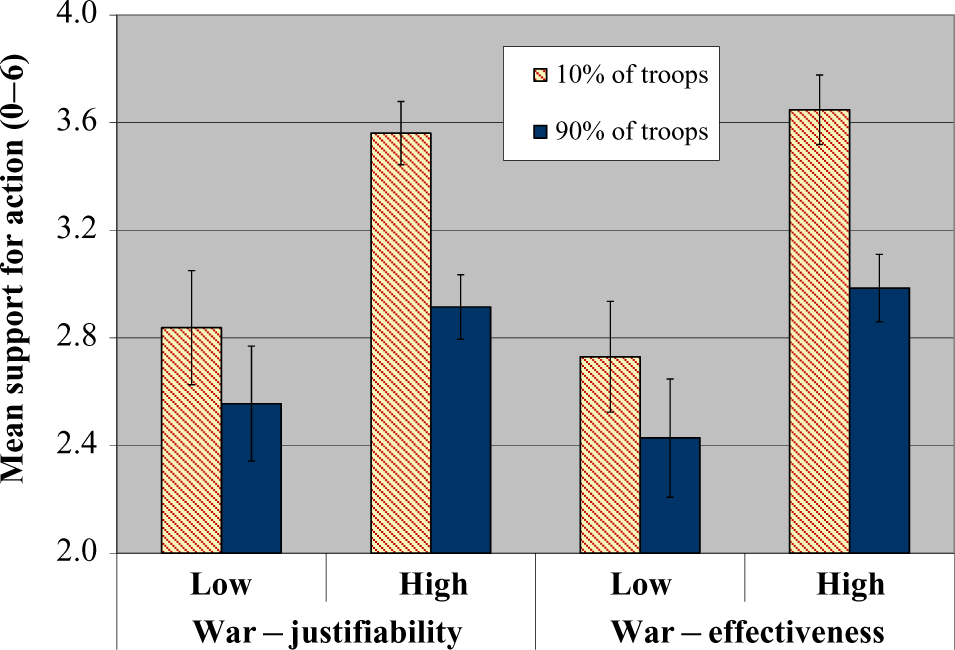
Conclusions
Our primary aim in this study was to test whether the British people are happier for their government to take military action when such action has international backing. The point had so far mostly been assumed or inferred – here, we provide direct evidence that international support does translate into greater public support. This is not an especially surprising finding. Many other Western publics, notably in the United States, have also been shown to favour multilateral action. In addition, our data were collected in the shadow of the Iraq war, by that point a highly unpopular engagement often criticized for a lack of international consensus and legitimacy. Indeed, perhaps the more surprising aspect of the results is the weakness of the international backing effects in our experiment. While our survey question which primed international support found – in line with other polls – a huge gap of 41 points between support for participating in a UN operation and support for acting alone, the corresponding experimental difference was just 13 points. Almost half of the sample approved unilateral action in the case described in the vignette. Perhaps, in practice, the British public might turn out to be rather less multilateral than has been supposed.
This conjecture raises the question of the external validity of the experimental results. We argue strongly that they are more valid than priming survey questions in which international backing is the only cue provided. Indeed, since our vignette includes only a fraction of the contextual detail that would be involved in a real-world situation, it could be argued that even those subtler cues are still unrealistically prominent. The impact of international backing could in practice be even weaker. On the other hand, in public discourse about military action, the extent of international support will be not just mentioned but thoroughly discussed. It may be that, once the reasons for and implications of a lack of backing are threshed out, the public becomes more responsive to that aspect of the situation.
That point, about the implications of (a lack of) international backing, in turn raises an issue of internal validity – the point noted earlier about ‘information leakage’. In that event, we do not know whether it is international backing or the inferences drawn from it that drive the dependent variable. Where British troops were to make up 90% of the total, for example, respondents may have turned against action not because the lack of support made it appear unjustified or futile, but because they resented the ‘free riding’ by the rest of the international community. In a similar vein, the experiment cannot fully elucidate why respondents – many of whom will have only a hazy idea of what the UN and NATO are and do – were nonetheless influenced by support from these organizations. This raises a broader limitation on the scope of experimental studies, especially when experiments are embedded into larger surveys and so space for additional questions is tight. Future studies could very usefully follow up an experiment like ours with questions designed to identify the reasoning chains (Sniderman et al., 1986) by which international backing does – and often does not – convince someone to support military action. Most obviously, they could more cleanly distinguish than was possible in our design between normative persuasion about legitimacy and more rationalist considerations about the chances of success.
Such information about reasoning chains would usefully complement but would not undermine our core findings, however. While it would be interesting to identify the routes via which the public goes from international backing to support for military action, it would not alter our conclusion about the initial cause and ultimate effect. Moreover, our design, with manipulations of both active and endorsement backing, will have helped to plug what would otherwise have been substantial leakage between the two. Respondents would doubtless have inferred active support from endorsement or vice versa had they been told only about that one type of backing, but there was no need for such inference since the extent of both was specified in the vignette. This is crucial for distinguishing the effect of the two and, in particular, it gives us more confidence in the conclusion that active backing had a somewhat stronger effect on public support. It seems that some respondents wondered what the use was of moral support if British troops were still left to take action almost single-handed. The point should not be overstated, since both dimensions of international backing influenced opinion – an experimental corroboration of Eichenberg’s (2006) aggregate poll analysis. Nonetheless, these results suggest a ‘pretty prudent’ public, seeking multilateralism less for its own sake and more for what it implies about the costs and benefits of British participation.
Probably the most surprising aspect of the results was the consistency of international backing effects. The effect of endorsement was uniform across people with widely different prior attitudes to military action, international engagement and the particular international actors involved. Herrmann, Tetlock & Visser (1999), while more successful in identifying predispositional moderators of contextual effects, also note that a number of such interactions did not emerge. They concluded that there are certain key features of a military scenario that weigh in public judgements across the board. Judging by our results, international backing – and endorsement in particular – can be added to the list of such features. Even active backing, although it had less power to sway those who were predisposed against military action, did at least cause some softening of opposition. All of this only goes to reinforce the point that very few people are staunchly pacifist or zealously militarist. The powerful main effect of predispositions confirms that they do much to shape public judgements about the use of force in a given situation. Nonetheless, for most people, such judgements are also a matter of balancing those predispositions with strategic calculations based on the context.
Footnotes
Acknowledgements
The data analysed in this article come from surveys funded by the Economic and Social Research Council (RES-062-23-1952) as part of a project to investigate ‘Foreign policy attitudes and support for war among the British public’. We gratefully acknowledge the Council’s support, and the support and advice we received from colleagues in designing the surveys. The paper was presented at the Annual Convention of the International Studies Association, Montreal, March 2011, and we thank panel participants for their comments.
