




Abstract
The international community often calls for negotiations in civil wars. Yet, we have limited understanding of when and why specific rebels enter into negotiations. The emergence of a new leader in a rebel group can provide an opportunity for the state seeking to end war, but this is conditional on how leaders take power. Rebel leaders who come to power through a local selection process (such as an election) provide information to the state about the likely cohesion of the rebel group. This affects state perceptions of the viability of a rebel group as a bargaining partner in civil war negotiations. Using original data on rebel leaders in civil wars, we show that new leaders coming to power through a local selection process are more likely to get to the negotiating table than leaders coming to power in other ways. We find that the election of a rebel group leader has a particularly strong and positive effect on the chance of getting to the table. Rebel leaders that founded their own group or brought together disparate rebels to create a single group are less likely to get to the negotiating table. This article advances our understanding of conflict dynamics by offering a novel argument of rebel leader ascension and its impact on conflict bargaining and has critical implications for parties external to the conflict interested in conflict resolution. External actors seeking to facilitate lasting peace may benefit from observing patterns of rebel leadership.
As the Syrian civil war enters its seventh year, the international community continues to call for a negotiated settlement to the conflict. The question of who will be at the table in any process designed to end the war is a critical one. The Syrian opposition is incredibly fragmented and international actors have diverging preferences about who should participate in negotiations. 1 Despite the critical role that getting to the table plays in the negotiated settlement of civil conflicts, only recently has scholarly attention begun to turn to the question of which rebels get negotiated with in the first place (particularly in the extensive quantitative literature on civil war). 2
In addition to the normative significance often placed on the process of negotiation, this choice is important because which rebels sit at the table has substantial implications for post-conflict politics. Rebels that participate in negotiations are poised to reap key benefits that emerge in postwar politics. The vast majority of negotiated settlements include provisions for political power-sharing among former combatants: approximately 80% of settled civil wars from 1945 to 1998 included an explicit division of political authority (Hoddie & Hartzell, 2005). Postwar regimes also divide up positions in the security sector, as well as territorial autonomy – both of which are negotiated over at the war’s end. 3 The process of negotiations can also impact conflict dynamics in substantial ways (Nilsson, 2008), including sparking the splintering of a rebel group.
Which rebel groups enter into negotiations and when? Increasingly, we have come to understand that ‘rebel’ actors are not homogenous but have key differences in their recruitment and retention practices (Gates, 2002; Cohen, 2013), resources (Weinstein, 2006), links to civilians (Staniland, 2014), the degree to which they enter into conventional politics (Cunningham, Gleditsch & Salehyan, 2009), and whether they provide public goods (Mampilly, 2011). While we often acknowledge the role that individual leaders might play in conflict dynamics (Stedman, 1991), little attention has been paid to rebel leadership as a political process of coming to power that has consequences for conflict negotiations. This is in contrast to work on interstate conflict, where leader selection processes underpin key theories of conflict initiation and resolution (Doyle & Sambanis, 2006; Goemans, Gleditsch & Chiozza, 2009; Weeks, 2014; Horowitz, McDermott & Stam, 2005; Croco, 2011).
We argue that the way rebel leaders come to power influences the incentives states have to invite rebels to the table. 4 We identify different paths to power, differentiating between those that are based on a local selection process (such as elections, selection by rebel officers, or inheriting power) and those that reflect orientation toward other actors (such as founding a group, splitting from an existing group, the merger of multiple groups, or via a third party). These different processes of taking power provide key information to states about whether the conflict is ‘ripe’ for negotiations. Zartman suggests that assessing the right conditions for negotiation is perceptual by nature; actors must work to ‘identify the objective and subjective elements’ that create such conditions (1989, 2008: 24). Leadership ascension within a rebel group through a local selection process can provide a strong signal of rebel cohesion to the state.
Election of a rebel leader most strongly demonstrates this group cohesion. This occurs whether voting is done by civilians (such as for Meles Zenawi of the Ethiopian People’s Revolutionary Democratic Front) or by rebel group members (such as the election of Abdul Rahman Ghassemlou by the third Congress of the Democratic Party of Iranian Kurdistan). Competition over leadership is a natural point for splintering of a rebel group, as multiple individuals work to fill a vacuum of power. The continued integrity of the group through an electoral selection process shows the group is likely to be relatively cohesive and supportive of the new leader. 5 Information conveyed about the leader’s support within the group and, consequently, about rebel group cohesion, clarify how likely it is that the rebel group will be able to follow through on a peace deal and makes the potential for conflict settlement less ambiguous for the state. In short, the electoral selection of a rebel leader can decrease uncertainty about the likely success of a settlement.
We hypothesize that states are more likely to negotiate with rebel leaders that come to power through local selection processes as opposed to those that gain power in other ways. These leaders demonstrate the greatest potential as successful bargaining partners to the state because the rebel group appears more cohesive. We evaluate this expectation using new data on the way rebel leaders came to power in all civil wars from 1989 to 2011. We find that, while leadership change within a rebel group alone does not necessarily lead to negotiations, instances of rebel leaders coming to power through local selection processes (and electoral processes in particular) increase the likelihood of getting to the negotiating table. The argument and findings in this article have implications for our understanding of the role of rebel leaders in civil war and the conditions under which wars are amenable to negotiation.
Negotiations in civil war
Negotiations to resolve civil wars are heavily favored by the international community but are not costless to states or international facilitators. 6 When states negotiate with rebels, they publicly recognize that an opposition is making claims that need to be addressed and, in doing so, can legitimize these actors (Toros, 2008; Kaplow, 2016). Moreover, the government can look inept if negotiations fail. Failed negotiations can provide an opening for criticism and potentially substantial challenges to the government.
Existing literatures propose several factors that affect the likelihood that negotiations lead to a successful resolution of civil wars. The ‘bargaining and war’ approach examines the conditions under which states and rebels are able to reach compromise agreements that resolve the fundamental issues under dispute. 7 Because fighting is costly, war should be resolvable if the issues under dispute are divisible, and if each side can identify and commit credibly to abide by a settlement into the future. The challenge to making a dispute-resolving agreement is that neither states nor rebel groups know with certainty the capabilities and resolve of their opponent, and there are incentives to misrepresent this information to get a better negotiated outcome. Even if both sides are able to overcome information problems and see a deal they would agree to, concerns about credible commitments by the state or rebels not to renege on that deal can prevent settlement.
Many of these models assume bargaining with unitary actors or in some cases two-level actors (Putnam, 1998). 8 Yet, the structural integrity of the rebel actors is a central concern for successful bargaining in civil wars (Blattman & Miguel, 2010). Splintering of actors and the potential for spoiling can undermine the ability of rebel groups to negotiate an end to the conflict and to enforce any deal they make. Rebel groups can splinter at the point of potential settlement to shift the balance of power within the rebel movement (Pearlman, 2009), or because one or more factions earnestly oppose the settlement process.
Even when a potential settlement has been identified, a key challenge for rebels in following through on peace deals is whether the group maintains cohesion during the peace process. For example, the Sudanese Justice and Equality Movement (JEM) split in 2004 during negotiations with the state, with some factions decidedly against settlement, preferring instead to escalate the conflict. Similarly, Liberians United for Reconciliation and Democracy (LURD) split over a dispute regarding strategy during the 2003 peace negotiations (Hazen, 2013). Our argument addresses this key part of conflict resolution processes – emphasizing how the differential emergence of leaders in rebellion provides information about the likely cohesion and support within the group, which in turn affects the prospects for successful negotiation with the state.
Rebel leader change
Negotiating with rebels can be costly and, on average, states should be more likely to negotiate with rebel groups they perceive to be credible bargaining partners. The emergence of new opposition leaders (whether they replace the leader in an existing rebel group or form a new group) can provide a critical opportunity for states that want to end insurgency (Stedman, 1997; Urlacher, 2013). Yet, not all emerging rebel leaders provide the same potential for conflict settlement.
State actors must make an ex ante assessment of the rebel leader’s ability to maintain the integrity of the group and to gain sufficient compliance among rebel members and supporters for the implementation of a peace deal. Splintering plagues a number of rebel groups and can be directly triggered by the settlement process. Fissures within fracturing rebel groups can lead to persistent conflict if splinter factions continue to fight or prevent implementation of a peace agreement. Failed settlement attempts that result in more rebel groups lead to even longer disputes. 9
Governments attempt to discern the likely cohesion of rebel actors and factor this into the decision to negotiate. For example, the Philippine government focused directly on rebel cohesion in its dealing with the Mindanao opposition. Government negotiator Marvic Leonen stated that ‘[t]he government […] views the reported resignation of a known commander of the (rebels) with serious concern, [and that] the government would ask about the status of [splinter leader] Kato in the Malaysia talks’. 10 The emergence of a new rebel leader can be an opportunity for states to broker peace.
While our argument centers primarily on the perceptions of the government, rebel leaders may also favor negotiations when they are relatively strongly supported within their group. Incumbent rebel leaders do not want to see their organization fracture. Both governments and rebel leaders that seek a settlement should favor negotiations when the rebel group is likely to maintain cohesion, yet this can be hard to identify ex ante. 11 Even for a well-established strong rebel movement, support can be uncertain. Staniland highlights the fact that the Tamil Tigers’ ability to garner popular support vis-à-vis the competing Eelam People’s Revolutionary Liberation Front was uncertain: there were ‘no clear signals about which way popular support would go’ (2014: 166).
While other factors may also work to signal rebel cohesion (such as institutionalizing local rule, providing social services, holding rallies, or publicizing support for the group), conveying this can be difficult in the absence of events such as leadership change. This is in part because rebels can and do coerce support, and states may have a difficult time assessing the veracity of reports about rebel cohesion. A central challenge in negotiations to end the Syrian conflict has been identification of key leaders and their positions within the dynamic and fragmented opposition. The ability of rebel groups to provide clear information about their likely cohesion under the stress of conflict is limited. While warfare itself is thought to reveal information (Filson & Werner, 2002), Walter (2009: 253) argues that uncertainty persists because information is ‘not likely to be revealed at the same rate in all conflicts’. Findley (2013) suggests that the type of information revealed during conflict and negotiation processes has differential impacts on settlement. 12 The period of leadership turnover provides a unique window of time in which the state will be evaluating the change in the group.
Leader ascension types
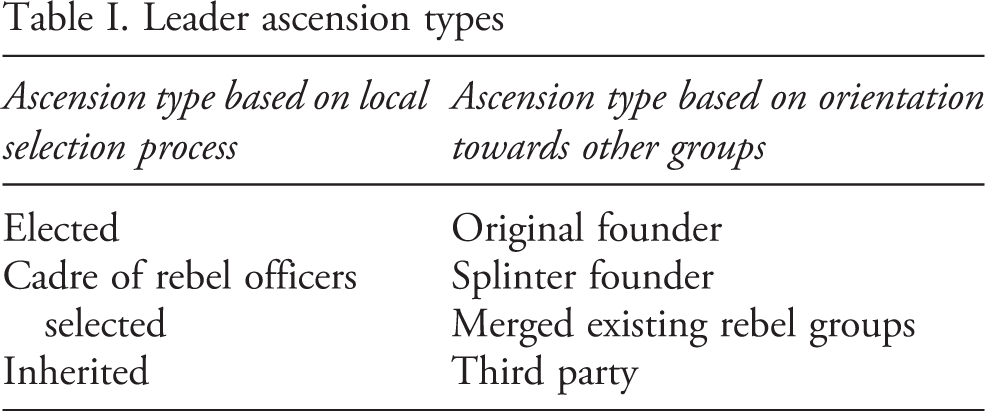
A first set of ascension types reflect a local selection process. These include selection through some type of electoral process, selection by a cadre of rebel officers, or inheritance of some type of the leadership position. The first two categories indicate selection by a set of individuals within the rebel group or the constituency the rebel group purports to represent. We define electoral selection as any process through which a set of individuals openly selects the rebel leader through voting. For example, Upendra Nath Brahma was elected to head the All Bodo Student Union, which challenged India (Sinha, 2007). Electoral selection can occur at the time of a rebel group’s founding or when there is a change in leadership. 13 The election of a rebel leader provides information to the government about the likely cohesion of the group, particularly in comparison to groups where leaders come to power through alternative means. Even if these elections are not fully democratic, electoral processes can reveal information (Brownlee, 2007; Gandhi & Lust-Okar, 2009). 14
Gaining power through an election signals information about the relationship between the leader and the opposition movement more generally. 15 Successful leader change through elections poses some risk for the group because it can engender splintering in existing groups. By introducing competition into the succession process, an election can exacerbate underlying divisions in a rebel group (or its support base), forcing individuals to declare allegiances, and potentially facilitate a split. 16
If the election of a new leader does not split the group, the successful leadership transition reveals to the government that a period of acute risk for splintering has occurred and passed. This provides information to the government about group cohesion. If the group was at high risk of splintering, the competition provided by an electoral selection creates a window of opportunity for doing so. 17 Moreover, a public election process can demonstrate broad support for the new rebel leader and the group, bolstering perceptions of group cohesion in the eyes of the government. Looking more broadly at whether rebel groups ever held an election, Huang (2016) finds that rebel groups relied extensively on civilian support in cases where they used electoral process, suggesting broad constituent support. Electoral selection is unique in providing clear information about cohesion. As we explicate next, cadre selection provides a weaker signal of cohesion, but other types provide little information about cohesion (e.g. inheriting leaders, original, splinter, or merger founders, and leaders chosen by a third party).
Selection by a cadre of officers includes situations where a small group of individuals with positions of power in the rebel group choose a leader. For example, Gerry Adams became a leader of the Provisional Irish Republican Army following a meeting of high-level officers (Moloney, 2002). Public selection by a set of officers can signal that there is support for the new leadership among key individuals in the group. However, in the absence of knowledge about the inner workings and structure of the rebels, the information provided about group cohesion can be weak. If a set of rebel officers hold equal positions rather than a clear hierarchy, this may lead to competition among them, which Asal, Brown & Dalton (2012) show to be associated with organizational splintering. Reported selection of a new leader from among a small group of officers could be the product of coercion that may or may not be visible to outsiders. While cadre selection should reflect the cohesion of the group, the strength of the signal may be compromised by a lack of transparency about the internal structure of the group.
In some rebel groups, an incumbent leader has a clear second who essentially inherits leadership upon the death of the previous leader; for example, Pau Yuchang came to power in the United Wa State Army after the former leader suffered a stroke (Mackerras, 2003: 186). At minimum, tacit agreement from within the group must exist for the turnover to occur. The incoming leader may have had the opportunity to shore up support before taking power. However, we cannot assume that all leaders that inherit power simply through the death or arrest of the incumbent will have such durable support. The previous leader may not have allowed others to accumulate power, even if they had a clear second-in-command. Thus, inheritance will not necessarily signal information about the cohesion of the group.
The second set of categories reference the orientation vis-à-vis other groups in the conflict. The first category is ‘original founders’; these are leaders that occupy the position of power from the beginning of the civil war. Many groups are founded by a leader that retains power, such as Pol Pot, Cambodia’s longstanding leader of Khmer Rouge. These leaders play a role in building up the rebel movements and are often referred to as ‘charismatic’ leaders. Downton (1973) argues that charismatic leaders of rebel groups tend to generate personal loyalty but that soldiers are not necessarily loyal to the cause. We do not assume all founders are charismatic per se, as rebel groups do punish founding leaders (Prorok, 2016). 18 While the ability of a leader to mobilize many individuals in support of the cause from scratch could suggest a strong core within a movement, Lewis’s (2017) study of early rebel mobilization finds that rebel founders fail more often than they succeed in building durable organizations. Even among rebel groups that overcome hurdles to formation, roughly one-third fail in the first year of insurgency (Cunningham, 2011). The founding of a rebel group, then, will not necessarily provide information suggesting a future of cohesion for the group.
Leaders can also start a new rebel group by splintering off an existing group, that is, assuming power of a splinter faction to form their own rebel group. In doing so, the leader brings along a subset of rebel members that defect from the original group. A faction of the Sudanese Liberation Army (SLA), the G-19, split from SLA in 2006 (Tanner & Tubiana, 2007). Otto (2018) argues that splinter groups are actually more cohesive in their preferences and finds that such groups are more capable of defecting to become pro-government militias. However, the splintering process is often conflict ridden for rebel groups and suggests to other actors that deep divisions will persist over time.
In contrast to splintering, some leaders bring together multiple groups to create a new rebel group. These are ‘merge founders’, and this entails the reconstitution of a group that includes multiple opposition actors. For example, in January 2009, eight rebel groups in Chad, collectively known as the Union of Forces of Resistance, banded together to fight a unified insurgency against the government (UCDP). Merging is an attempt to generate unity among opposition groups. Yet, the fate of such unions is often disintegration. Soldiers have different experiences and backgrounds which Schubiger (2015) argues are detrimental for maintaining cohesion. Splintering and merging, which both constitute significant changes in rebel group structure and underlying preferences, can both provide information about the group, but neither is likely to be perceived as a clear indication of cohesion.
Finally, leaders can be selected by an actor outside the dispute (such as a foreign government), although empirically this is rare. Sekou Conneh was appointed chairman of Liberians United for Reconciliation and Democracy in 2000, mainly because Conneh was the Guinean president’s son-in-law (Call, 2012: 77). Leaders installed by a third party are likely to be more beholden to the external actor than any local constituency in the rebel group, and the continuation of external support may be uncertain. Of the four types based on orientation toward other actors, none are likely to provide specific information to the state suggesting that the rebel group is likely to remain cohesive.
In sum, the emergence of a rebel leader can provide an opportunity for governments to negotiate with the group, but this effect depends on how leaders take power. When the ascension process entails selection by a local constituent population, the emergence of a new leader can provide critical information to the government about the leader’s degree of support and the internal cohesion of the rebels. Successfully assuming power through an electoral process, in particular, is likely to demonstrate rebel cohesion to the government and suggests that the rebel group is unlikely to fracture under the stress of conflict resolution.
Empirical implications
Rebel leaders come to power and sometimes change during the course of conflict. The nature of how rebel leaders gain power influences government perceptions about a rebel group’s viability as a bargaining partner. The expectation of response by governments highlights the temporal dimension of conflict bargaining that Zartman (1989) centered on with the concept of ripeness. Rebel leaders change at specific points in time and the information that new selection can provide about the group’s potential as a bargaining partner is relevant in that window of opportunity for negotiations. We derive the following hypotheses related to how rebel leaders come to power and the likelihood that they will enter into negotiations with the state: H1: Rebel leaders coming to power through a local selection process will be more likely to participate in negotiations than those coming to power through an orientation-focused process or when there is no change in leadership.
We expect this effect to be strongest for leaders that come to power through electoral processes because this more clearly reflects a local constituency. H2: Rebel leaders elected into leadership will be more likely to participate in negotiations than those coming to power through other processes or when there is no change in leadership.
Which leaders are more likely to see negotiations?
Between 1989 and 2011, there were 133 civil wars around the globe. Including multiparty and two-party civil wars, 287 rebel groups have fought their state. Among these rebel groups, we have identified the leader of the group about 97% of the time. 19
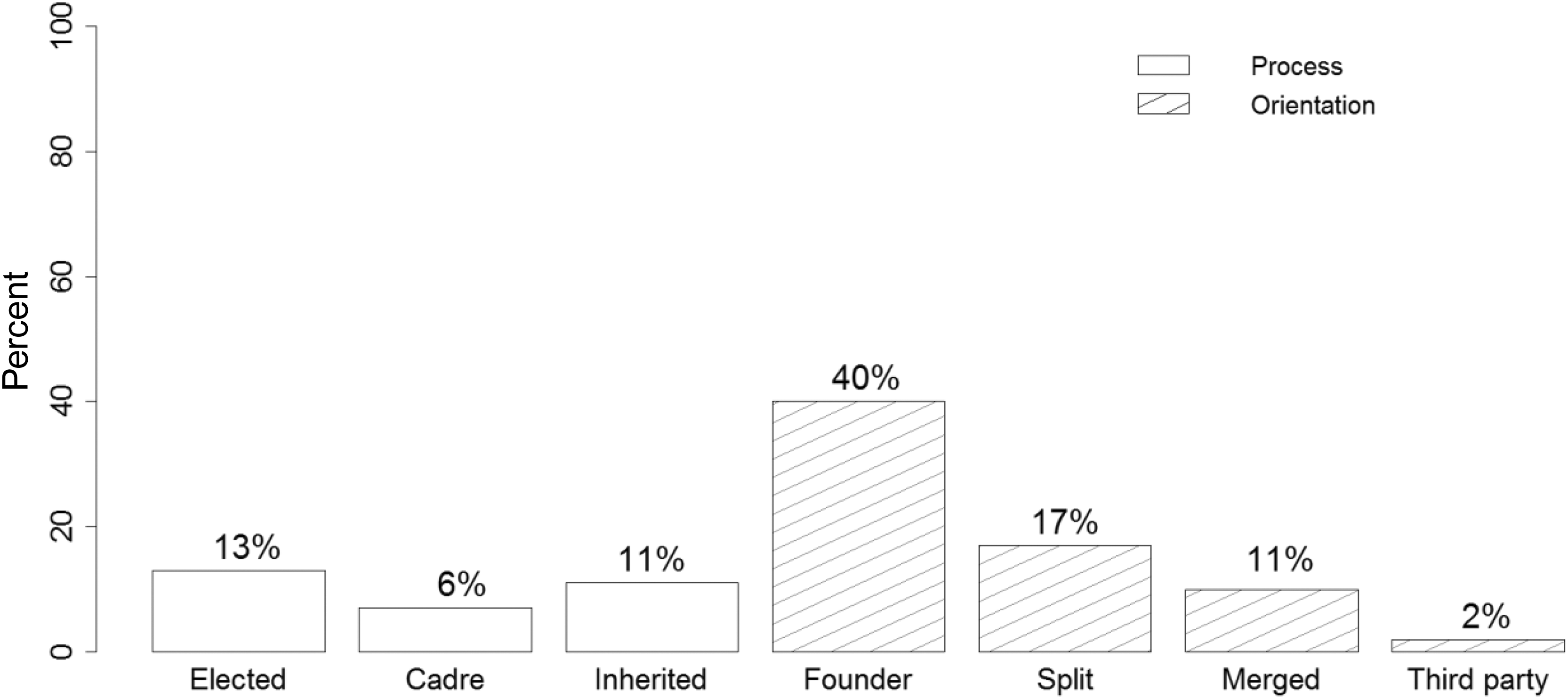
Distribution of rebel leadership by ascension type
Rebel leader ascension
The Rebel Leader Ascension Dataset builds on the Uppsala Conflict Data Project (UCDP) dataset of internal conflicts that reach a yearly 25 battle-death threshold. 20 The unit of analysis is conflict dyad-year following the UCDP inclusion criteria. The independent variables on ascension type are coded for the year the leader comes to power. Subsequent dyad-years in the conflict are coded zero. 21 The dataset covers rebel groups in conflicts active between 1989 and 2011. 22
As Table I indicates, each broad category of ascension types includes several subcategories. Local selection process rebel leaders include those that came to power through elections, cadre selection or identified as inherited. Orientation focused leaders are coded as 1 if they were the original founder, came to power through splintering or merging, or were selected by a third party. For each rebel group, we collected data on the history of the leadership of the group over the duration of its existence as a warring party in the UCDP data. We leveraged a variety of sources, including secondary academic sources and news sources found in LexisNexis Academic and Keesing’s Record of World Events. The process was conducted chronologically from the founding year of the group forward, so that the founding leader was identified and the year of their subsequent exit from power was noted. Information on the newly ascendant leader was recorded, including the date and method of ascension.
Based on the case histories of the leadership in these groups, we categorized leader ascension into the categories identified in Table I. Figure 1 shows the distribution of these types of ascension. 23
Elected leaders
There are 42 leaders in the dataset that were elected in some fashion. To code them as elected, we had to find evidence of some voting process surrounding the leadership change. In more than half of these, we find some indications about the size of the selectorate or whether we might consider the election ‘popular’ (i.e. the selectorate was a large proportion of the population the group claimed to represent). In about 30% of these cases, we find a selectorate between 88 and 200 group members. The largest selectorate we had clear information on was about 700,000 for Meles Zenawi in the Ethiopian People’s Revolutionary Democratic Front in 1989. In other instances, we found information about the percentage of votes received by rebel leaders, such as Eduard Kokoity’s election to lead the breakaway South Ossetia territory in 2001, where he won with 53% of the vote (Illarianov, 2009). In all cases (regardless of whether a selectorate size was identified), there had to be clear reports of an electoral selection process to be coded as an elected leader. We explicitly distinguish the process of electoral ascension from leaders who are chosen by a group of rebel elites, which may be less representative of the rebel group’s interests as a whole.
Cadre selection
Cadre selection represents leaders chosen by a rebel council or rebel ‘politburo’ in communist groups. To be coded as cadre selection, we had to find evidence that a group of rebel officers chose the new leader together. For example, Ramadan Abdullah Shallah was selected to be leader by a cadre within the Palestinian Islamic Jihad (Kushner, 1996). Twenty-one leaders in our dataset were chosen by a rebel cadre and these groups are widely geographically dispersed.
Inherited
Inherited selection includes all replacement leaders whose predecessor marked them for ascension prior to their death (or prior to or during imprisonment), where we found no evidence of any other process for the selection of the subsequent leader. Thirty-six leaders came to power in this manner. A majority of those who inherited their position did so following the death of the former leader (approximately 78% of inherited leaders) as opposed to the imprisonment of the former leader (approximately 22%). For example, Rodolfo Salas followed Jose Maria Sison, 24 who appointed him as the Commander of the Communist Party of the Philippines from prison.
Original founder
The most frequent form of ascension into a position of power (130 leaders in our dataset) is founding a rebel group. These leaders are coded as 1 if they were in the leadership position at the start of the armed conflict (as defined by UCDP). We distinguish this from leaders who either come to power by breaking away from an existing rebel group (splinter) or consolidate power among existing groups (merger). For example, Iyad Ag Ghaly founded the Mouvement Populaire de Libération de l’Azawad, MPLA, to fight on behalf of the Tuareg people in Mali. 25
Splinter founder
Leaders that come to power following the splintering of an existing rebel movement are the second most frequent type of ascension into a position of power; 55 rebel leaders in our dataset took power following the split of an existing group. These are the leaders at the start of armed conflict (as defined by UCDP) in cases where the rebel group emerged directly from another rebel group. For example, after breaking away from the Front for the Restoration of Unity and Democracy (FRUD) in 1994, Ahmed Dini Ahmed led the radical faction FRUD-D. 26
Merger founder
Thirty-seven leaders in our dataset come to power following the consolidation of two or more rebel groups. Merger founders are coded as 1 when a leader is the first leader of a rebel group that was formed by two or more previously existing groups. For example, the Mong Tai Army was formed in 1985 through the merger of the Shan United Army and the Moh Heng-faction of SURA, with Khun Sa leading the combined armies.
Third-party selection
Eight leaders in our dataset were selected by third parties. These are coded as 1 if we find evidence that a party outside the conflict played a direct role in the selection process. For example, Adolfo Calero was installed as the leader of the contra army, Fuerza Democrática Nicaragüense (FDN), under the direction of the Central Intelligence Agency in 1983. 27
Negotiations
We use the UCDP conflict profiles to identify when and with whom negotiations occurred during civil war. 28 The measure is dyadic, meaning we identify negotiations occurring between the rebel group and the state involved in the conflict. 29 The subject of the talks must concern an issue related to the conflict, for example the type of incompatibility, ceasefires, or exchange of prisoners. We exclude negotiations that were purely about the process, such as initial talks to outline parameters for negotiations to occur. Negotiations occurred between the government and rebels in about 20% of all dispute dyad-years. Almost half of all rebel groups (46.34%) enter into negotiations with the government at some point in the dispute. Approximately one-quarter of all groups enter into negotiations with the state multiple times (24.74%).
Control variables
We include covariates that are likely to influence the likelihood of negotiations and our main independent variables of theoretical interest: how leaders come to power. First, we include a variable for armed strength (the number of state and rebel troops, log transformed) from UCDP. Existing research suggests that balanced forces make conflict termination less likely, and others have demonstrated that civil wars with relatively strong rebels are shorter (Cunningham et al., 2009). Stronger groups may also be less likely to see leader change.
The literature on intervention and external support suggests several key factors. Regan (2002) and Cunningham (2010) show that intervention can impact conflict dynamics, including negotiations, particularly when the intervening party has its own agenda. External support or intervention may help incumbent leaders to maintain power. We add a dichotomous measure of intervention to our models. 30 Ghosn (2010) finds that when interstate conflict becomes costlier, particularly with respect to battle fatalities, states are more likely to come to the bargaining table to resolve the dispute. High costs can also increase disaffection with opposition leaders (DeNardo, 1985) and impact desire for negotiations. We include a measure of the number of battle-deaths (natural log transformed) from UCDP. 31
In additional robustness checks (presented in Models 2, 4, and 6 of Table II), we include controls for a number of factors commonly included in civil conflict studies: ethnic fractionalization (Fearon, 2003), the size of the state’s population (natural log transformed), 32 GDP per capita (natural log transformed), 33 whether the group has a legal political wing (Cunningham et al., 2009), and whether the state is democratic (Gleditsch, 2013).
Effect of rebel leadership ascension on negotiations
Our central argument is that the emergence of a new rebel leader through a local selection process provides new information to the state about the suitability of the group as a negotiating partner. All else equal, we expect that leaders who come to power through a local selection process that reflects some degree of constituent support (as opposed to leaders who come to power in other ways) will be more likely to enter into negotiations with the state. These changes provide a window of opportunity for states and rebels to come to the table.
To evaluate these arguments, we use a logistic model with a cubic polynomial approximation following Carter & Signorino (2010), to model time to negotiations. We first evaluate the likelihood of negotiations based on our two larger conceptualizations of leadership change: local selection process and orientation toward other rebels (Models 1 and 2; the reference category is no leader change). We further disaggregate the effect of selection process ascension into its subcategories: whether the leader is elected into power, whether the leader is chosen by rebel cadre, or whether the leader inherits power following the death/imprisonment of a former leader (Models 3 and 4, reference category is all observations of orientation selection processes and no change in leadership). Then we disaggregate the subcategories of orientation: whether the leader founded the organization, whether the leader came to power following the split of the former rebel group, whether the leader consolidated power following the merger of two or more rebel groups, or whether the leader was installed by a third party (Models 5 and 6; the reference category is all observations of local selection processes and no change in leadership).
The results reported in Table II demonstrate substantial support for our argument that the means by which rebel leaders come to power have significant effects on the likelihood of negotiations. Changing rebel leadership can create opportunity for negotiations, particularly when that change is indicative of high levels of constituent support and group cohesion, as is the case for elected leader change. The logistic coefficients for local selection process are positive and significant at the 0.10 and 0.05 levels in Models 1 and 2. In contrast, the orientation focused ascension processes are negatively associated with negotiations (at the 0.10 and 0.05 levels) in Models 1 and 2.
Logistic models of negotiations
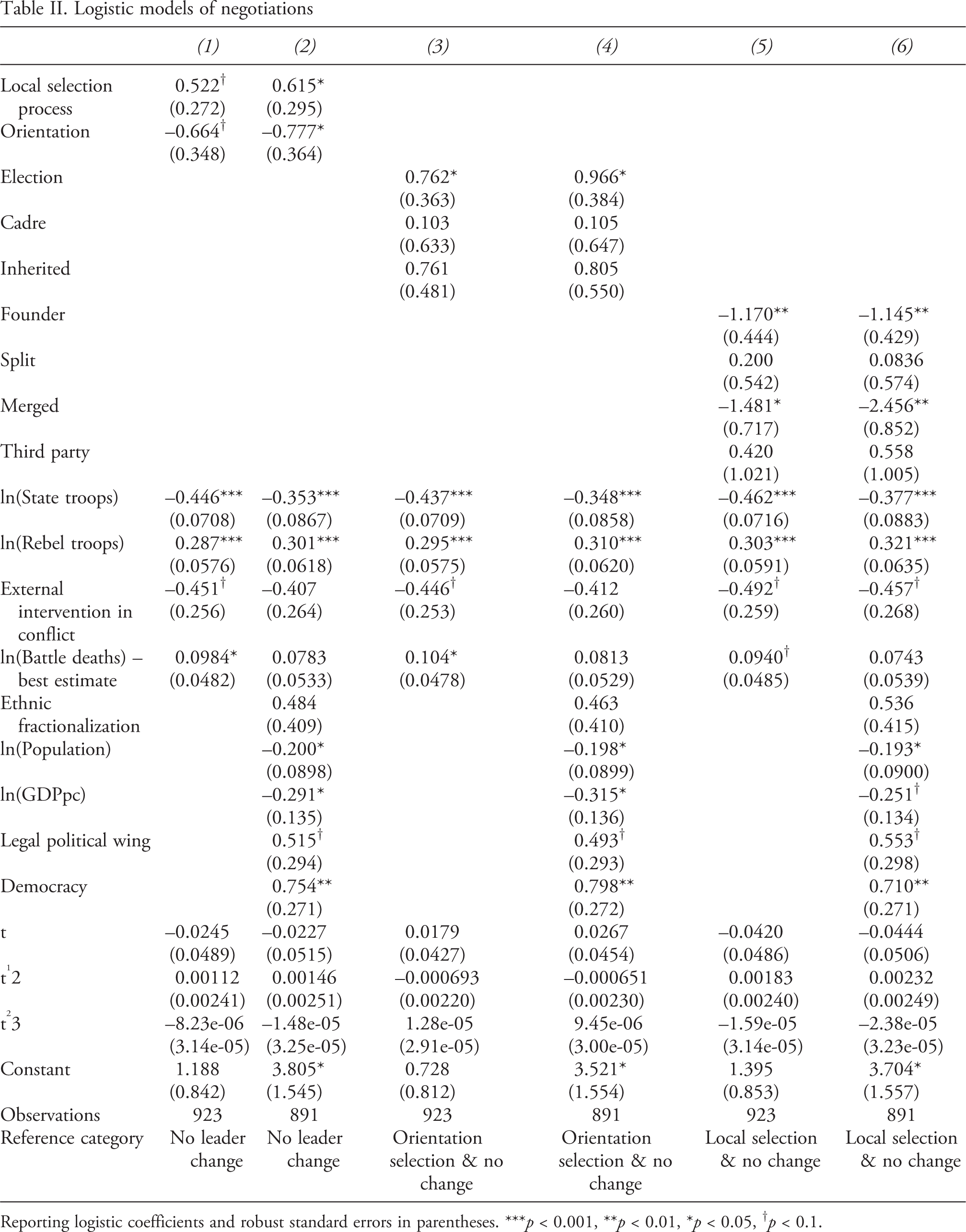
Reporting logistic coefficients and robust standard errors in parentheses. ***p < 0.001, **p < 0.01, *p < 0.05, †p < 0.1.
Several other factors also influence the probability of negotiations. Consistent with much of the work on norms that suggests such governments are likely to pursue conflict resolution through negotiation, we find that democratic governments enter into negotiations more than non-democracies. More powerful states with larger armies do not enter into negotiations as swiftly as states with smaller forces, while increasing the size of the rebels’ troops increases the chance of negotiations. 34 Wealthier and more populous states enter into negotiations less readily as well. This suggests that stronger and undemocratic states are less likely to negotiate. As conflict severity increases, the likelihood of negotiations increases, suggesting that actors are more likely to seek a negotiated resolution to fighting (or at least a temporary reprieve at the bargaining table) when the costs of conflict become high. Neither intervention nor the existence of a legal political wing has a significant effect on negotiations, though both return positive coefficients. 35
Our analysis in Table II is driven by our theoretical argument concerning the role that the rebel leader ascension process plays in conflict resolution. As negotiations take place between state and rebel actors, changes in state leaders may also increase the likelihood of negotiations (Tiernay, 2015; Ryckman & Braithwaite, 2018). We control for state leader change in Table 9 in the Online appendix and our central findings remain robust to this inclusion. Similarly, we control for the number of rebel actors in Online appendix Table 12, and our findings remain robust.
To compare the effects of different ascension types substantively, we explicitly compare each disaggregated type of leader change – elected, cadre, inherited, founder, split, merged, third party – to no leader change in Table III, and use these coefficients to generated predicted effects.
Logistic model of negotiations
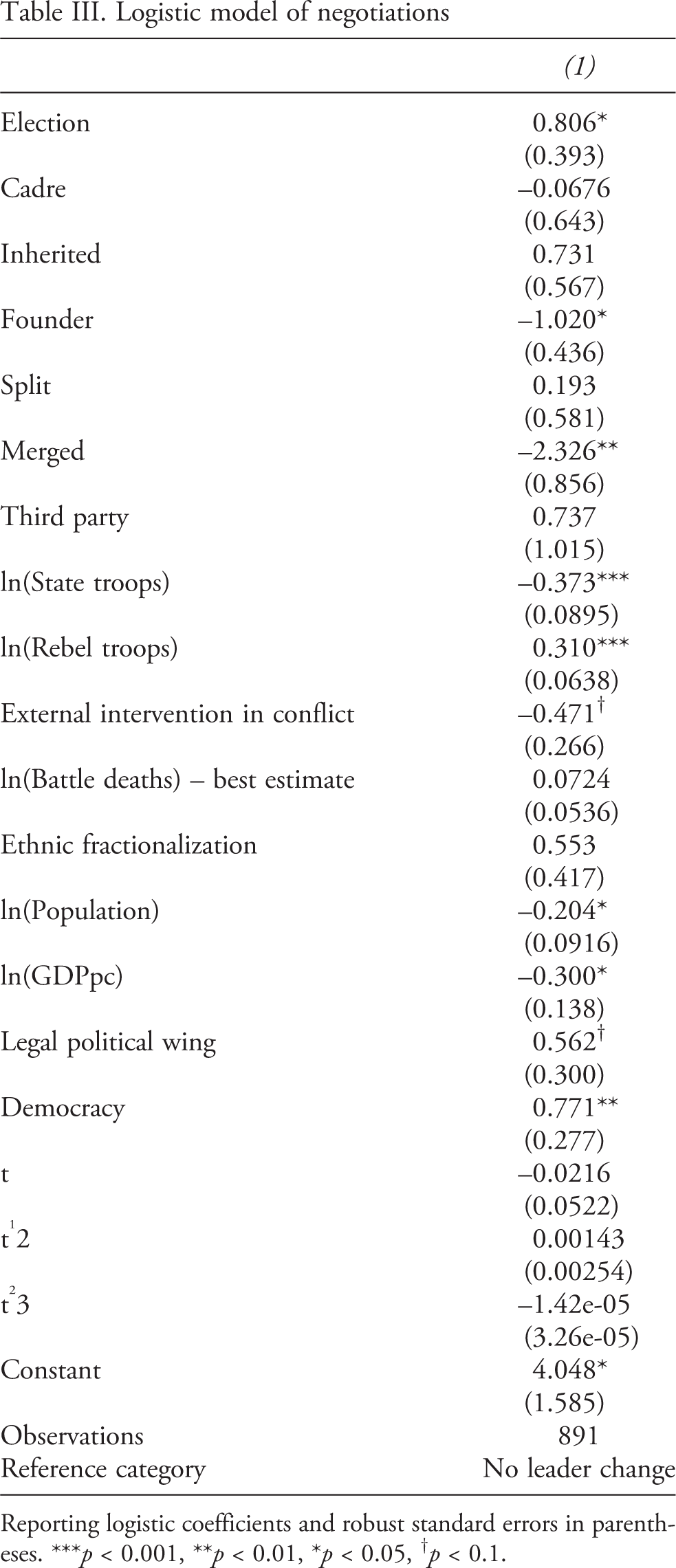
Reporting logistic coefficients and robust standard errors in parentheses. ***p < 0.001, **p < 0.01, *p < 0.05, †p < 0.1.
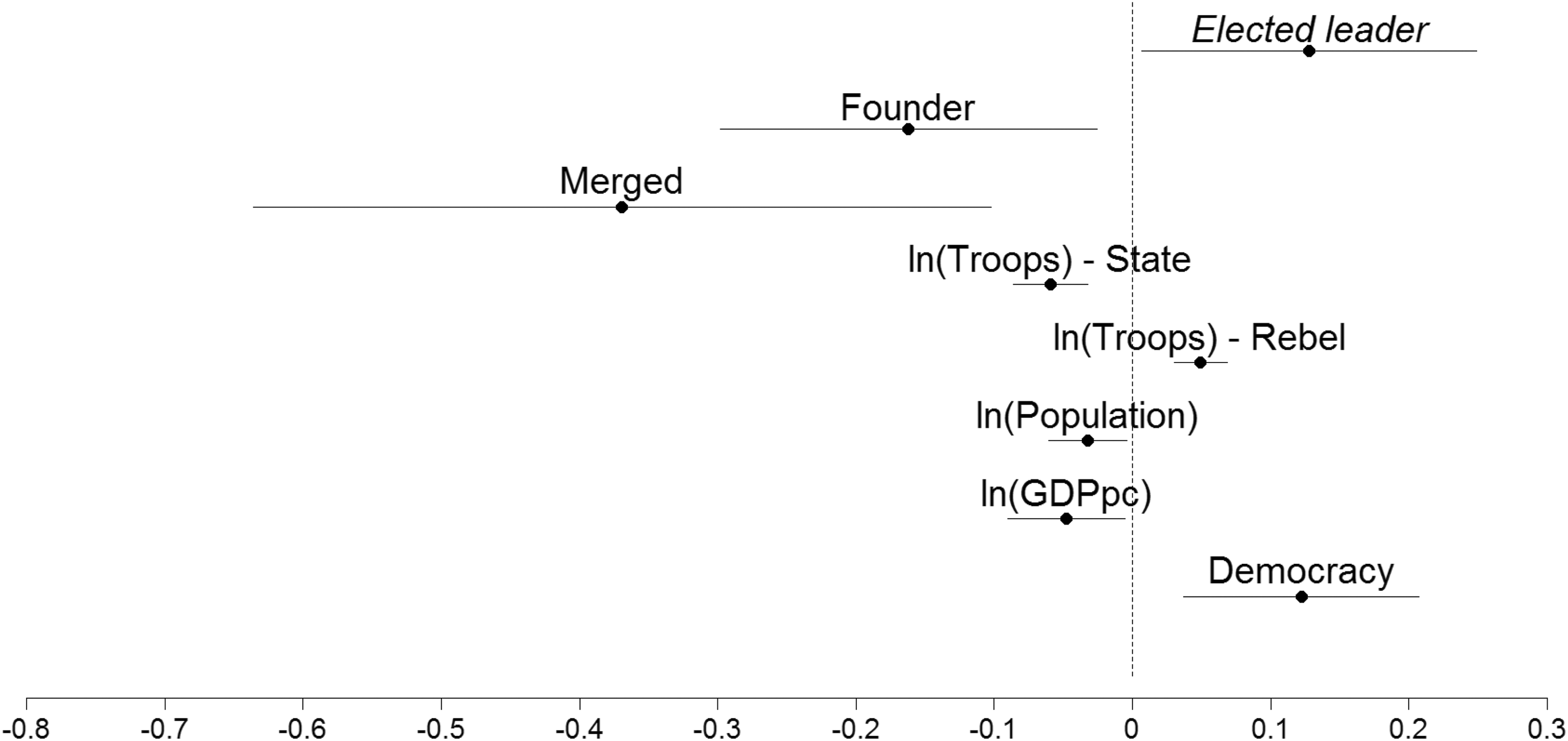
Marginal effects: Probability of negotiations
The impact of an elected rebel leader is among the strongest positive effects. Similarly, rebels in democratic states are 12.24 percentage points more likely to be in negotiations than rebels in non-democracies. Stronger rebels are more likely to get negotiated with: an increase in rebel troop size from the first to third quartile increases the mean predicted probability of negotiations by 4.92 percentage points. On the other hand, increases in state power decrease the probability of negotiations: an increase in state troop size from the first to the third quartile decreases the mean predicted probability of negotiations by approximately 5.93 percentage points. Increases in the size and wealth of a country both decrease the probability of negotiations: increases from the first to third quartiles with respect to population and GDP per capita (natural log transformed) decrease the mean predicted probability of negotiations by 3.24 and 4.77 percentage points, respectively.
The results of these models provide substantial empirical support for the importance of the process of leadership ascension in determining which rebels enter into negotiations with the state. We argue that leadership ascension processes that are highly indicative of constituent support and group cohesion, such as electoral ascension, increase the likelihood of negotiations and decrease the time it takes to come to the bargaining table. The type of ascension can provide key information to the state about the viability of a rebel group as a bargaining partner that can make and stick to a settlement deal.
Is leader ascension type strategic?
A possible concern for our analysis relates to the timing of rebel leader changes and a potentially ongoing process of negotiations with the state. Specifically, if rebel groups engage in different means of ascension strategically and in direct response to a perception of imminent negotiations, then we may find an association between types of ascension and negotiations and errantly interpret this relationship.
This may be particularly problematic for local selection processes, such as elections. Based on the structure of the study, in particular our focus on changes in leadership as part of an electoral ascension process, it is unlikely that elections are being used strategically. Specifically, we account for elections only as part of the process through which a new leader comes to power, and do not include instances of rebel leaders calling for elections during their tenure. Thus, there needs to be some precipitating event that leads to new leader selection, such as the death or capture of a leader or the internal removal of an incumbent leader, or the election occurs at the time of group formation (which we include as new leadership). The process is not akin to parliamentary leaders strategically calling elections to shore up support and, in this case, signal legitimacy and cohesion. 37 Moreover, it is not just the change that matters – further analysis examining any change in leadership does not indicate that leader change alone decreases time to negotiations (Online appendix Table 10).
To address the concern that the occurrence of elections of new rebel leaders was precipitated by negotiations (even if not strategic per se), we employ a logistic regression model to predict changes in leaders due to local process as well as specifically newly elected rebel leaders (Online appendix Table 11). There is no obvious pattern on which rebel groups select new leaders locally (or through elections). Negotiations in the previous year do not predict a local process for change in rebel leadership. It may be that elections within rebel groups are a function of organizational culture or reflect different contexts in which the rebel groups operate. These additional analyses suggest that the occurrence of elected leaders is not solely driven by the negotiations process, or by factors such as the presence of a legal political wing within the group or whether or not the state has democratic institutions. Moreover, the nature of the conflict itself does not seem to drive occurrence of new leader elections; whether or not the conflict is ethnic in nature and the intensity of the battle itself (measured as conflict fatalities) has no significant bearing on whether groups elect new leaders. 38
Conclusion
The role of individual rebel leaders and how they come into positions of power has a substantial effect in determining when rebels get to the negotiating table. There are many possible ways to categorize rebel groups and their leaders. Our focus here centers on two factors shown to be critical for conflict processes: the link between the head of a rebel group and its followers, and the dynamic relationships among rebel actors in a conflict. This article advances our understanding of conflict dynamics by offering a novel argument of rebel leader ascension and its impact on conflict bargaining. Using new data on how rebel leaders come to power, we demonstrate that a rebel leader’s path to power is a significant factor in determining which rebels get to the bargaining table, a vital first step in conflict resolution that can have lasting consequences for postwar politics. By bringing new data on rebel leadership to bear on the questions of bargaining, this research traces a key political process in conflict – the path of the rebel leader’s ascension to power to negotiations with the state.
Rebel leaders do not typically come to power in regularized fashion; the most common paths to leading a rebellion are to start a rebel group from scratch or to splinter off an existing group. Yet, many rebel groups see changes in leadership, and leaders of a number of groups are selected by local populations or rebels. The way that leaders come to power affects the trajectory of the group in conflict and groups with elected leaders are more likely to get to the negotiating table.
This finding suggests that rebel groups with elected leaders are likely to be better bargaining partners from a conflict resolution perspective. We see empirically that very few rebels splinter just after elections: this occurred in only three cases. Two splits occurred two years after the election, one occurred 13 years later. Moreover, further analyses suggest that these negotiations actually have a higher rate of success. Rebel groups that select their leaders through local processes – particularly the use of elections – are significantly more likely to see conflict termination than those whose leaders are selected through any other process (Online appendix Table 14). Together these analyses suggest that rebel leader change alone does not create a sufficient opportunity to end conflict. States are more likely to negotiate with and settle conflicts with rebel leaders that come to power with the support of their local population. The international community appears to be attuned to the challenges of bargaining for rebels. We have seen a variety of actors struggling to assist in the generation of a cohesive and legitimate opposition in Syria. In this article, we have examined elections in the context of rebel leader ascension, but not taken an in-depth look at the nature and process of these elections (similar to Huang, 2016). Future work can address this with a more nuanced examination of variation in the process of how elections occur in rebel groups.
A direct implication from the theory and our findings is that parties interested in conflict resolution should be sensitive to the ways that rebel leaders gain power. Considering the role states and groups external to the conflict have played in civil conflict, external actors may benefit from observing patterns of leadership. This may mean strategically backing rebels that have higher degrees of constituent support during negotiation processes, as these are the rebels that seem best able to come to the bargaining table and successfully negotiate termination of the conflict.
Footnotes
Replication data
The dataset and code used for all the empirical analyses in this article and the Online appendix are available online at https://www.prio.org/JPR/Datasets/ and  .
.
Acknowledgements
The authors would like to thank the following for their helpful comments and suggestions: Bridget Coggins, David Cunningham, Page Fortna, Jessica Maves-Braithwaite, Alyssa Prorok, Jakana Thomas.
Notes
References
Supplementary Material
Please find the following supplemental material available below.
For Open Access articles published under a Creative Commons License, all supplemental material carries the same license as the article it is associated with.
For non-Open Access articles published, all supplemental material carries a non-exclusive license, and permission requests for re-use of supplemental material or any part of supplemental material shall be sent directly to the copyright owner as specified in the copyright notice associated with the article.
