




Abstract
Does public opinion act as a constraint on military action, are ordinary citizens the easily manipulated targets of the public relations efforts of their governments, or does the general public react as assertively to threats as decisionmakers? This article examines the causal connection between military action, public opinion and threats. Empirically, it focuses on the pattern of EU member state participation in two recent military operations: the 2011 intervention in Libya and the operation against the self-proclaimed Islamic State (IS). Three competing causal models on the relationship between threats, public opinion and military action were derived from the scholarly literature and tested with coincidence analysis. The results of the analysis show that public opinion acted as a constraint on executives during the Libya operation. However, there was no direct causal link between public opinion and military participation in the operation against IS, in which both military action and public support were an effect of threat. More generally, the results suggest that the context of the intervention is decisive for the relation between threat, military action and public support. More specifically, whether public opinion constitutes a constraint on military action or is an effect of threats to national interests depends on whether these threats are clear and tangible.
Introduction
Does public opinion act as a constraint on military action, are ordinary citizens the easily manipulated targets of the public relations efforts of their governments, or does the general public react as assertively to threats as decisionmakers? There exists an extensive body of academic literature on the public opinion/foreign policy nexus, in which two lines of work can be distinguished. The first line of work, which is inspired by democratic peace theory, examines public opinion as an independent variable to explain the use of military force in international relations. The second line of work examines public opinion as a dependent variable and, inter alia, tests whether it is influenced by the interests at stake in the operation or public relation efforts of governments following military deployment decisions. These lines of work present competing theoretical expectations and conclusions on the relationship between military deployment and the use of force. So far, no empirical study has bridged the gap between these two schools by testing these competing theoretical expectations in a single analysis.
This study aims to fill this gap in academic research by summarizing the main conclusions of these different strands of scholarship into three competing theoretical models, which are tested with coincidence analysis (CNA). CNA is a recently introduced Boolean method that does not require us to identify which variables are effects and which are causes prior to the analysis. Hereby, the method allows us to test expectations from the two strands of scholarship on the link between public opinion and military deployment in a single analysis. Moreover, CNA is capable of uncovering the complex causal structures suggested by the academic work on the link between the use of force and public opinion.
The article aims to make a theoretical, empirical and methodological contribution. Theoretically, it summarizes the research on the link between military deployments and public opinion into three causal models, which clearly show that the conclusions of different lines of work induce competing expectations on the causal relationship between public opinion and military deployment. Empirically, the article examines the 2011 intervention in Libya and the operation against the self-proclaimed Islamic State, resulting in a better understanding of the pattern of participation in both operations. The results of the analysis show that public opinion acted as a constraint on executives during the Libya operation. In contrast, the analysis indicates that there was no direct causal link between public opinion and military action in the operation against IS. Instead, both military action and public support were an effect of threat in the latter operation. Methodologically, this study applies CNA to test causal models that correspond to the complex causal structures, like causal chains and common cause structures. Although the method has a distinct advantage over alternative techniques for examining these types of causal structures and many causal structures in the social sciences are characterized by this type of complexity, CNA has rarely been used in applied research.
This article is structured as follows. The first section derives three competing causal models from scholarly literature on the public opinion/foreign policy nexus. The second section introduces the research design. The third section presents the results of the analysis, which are interpreted in the fourth section. Lastly, the conclusions recapitulate the study’s major findings.
Military deployment, public opinion and threats
While there is strong evidence that states are more likely to resort to the use of military force when their national interests are threatened, significant controversies exist on the link between public opinion and the deployment of military force. Scholars not only disagree on whether there is a connection between public opinion and military action, but also on how public opinion, the use of force and threats are linked. Scholarship that examines public opinion as a dependent variable is inconclusive. Some studies indicate that public opinion and military deployment are not directly connected, but rather are the effects of the national interests that are at stake in the operation, while other studies suggest that public opinion is the effect of the public relations efforts of governments following the decision to deploy military force. Research that examines public opinion as an independent variable, however, suggests that the causal relationship between public preferences and military deployment is actually in the opposite direction, with public opinion acting as a constraint on military action. This section summarizes these competing expectations from the extensive literature on the public opinion/foreign policy nexus into three causal models.
Public opinion as constraint on military deployment
The idea that public opinion can act as a constraint against the use of force goes back to Kant’s original formulation of the democratic peace theory in Perpetual Peace. More specifically, Kant argues that the reason why democracies are more peaceful is that: ‘If the consent of the citizens is required in order to decide that war should be declared […] nothing is more natural than that they would be very cautious in commencing such a poor game, decreeing for themselves all the calamities of war’ (Kant, 1917: 122). Structural models of democratic peace echo this proposition by arguing that democratic leaders are reluctant to resort to the use of force because this requires the mobilization of the general public (Maoz & Russett, 1993: 626). This argument builds on two assumptions: (1) the general public is less likely to support the use of force than political leaders and (2) public opinion is taken into account in democratic political systems (Morgan & Campbell, 1991: 189–190).
Although responsiveness to popular sentiments is a central feature of democratic political systems, whether public opinion has a direct impact on the use of force by democracies remains disputed. Several studies suggest that public opinion had a very limited impact on democratic participation in military operations. Kreps (2010: 191), for example, contends that ‘public opinion hardly matters for NATO-led Operations in Afghanistan’, while Auerswald & Saideman (2014: 21, 213) conclude that public support does not co-vary with the pattern of participation in the operations in Afghanistan and Libya. In contrast, the studies of Ostrom & Job (1986: 556–557) and James & Oneal (1991) show that public aversion to war is negatively related to the probability of the use of force.
A more nuanced understanding of the impact of public opinion on the use of force is provided by a specific strand of democratic peace research, which focuses on the varying conflict involvement of established democracies. Several studies in this line of work examine how democratic institutions transform the public preferences Model 1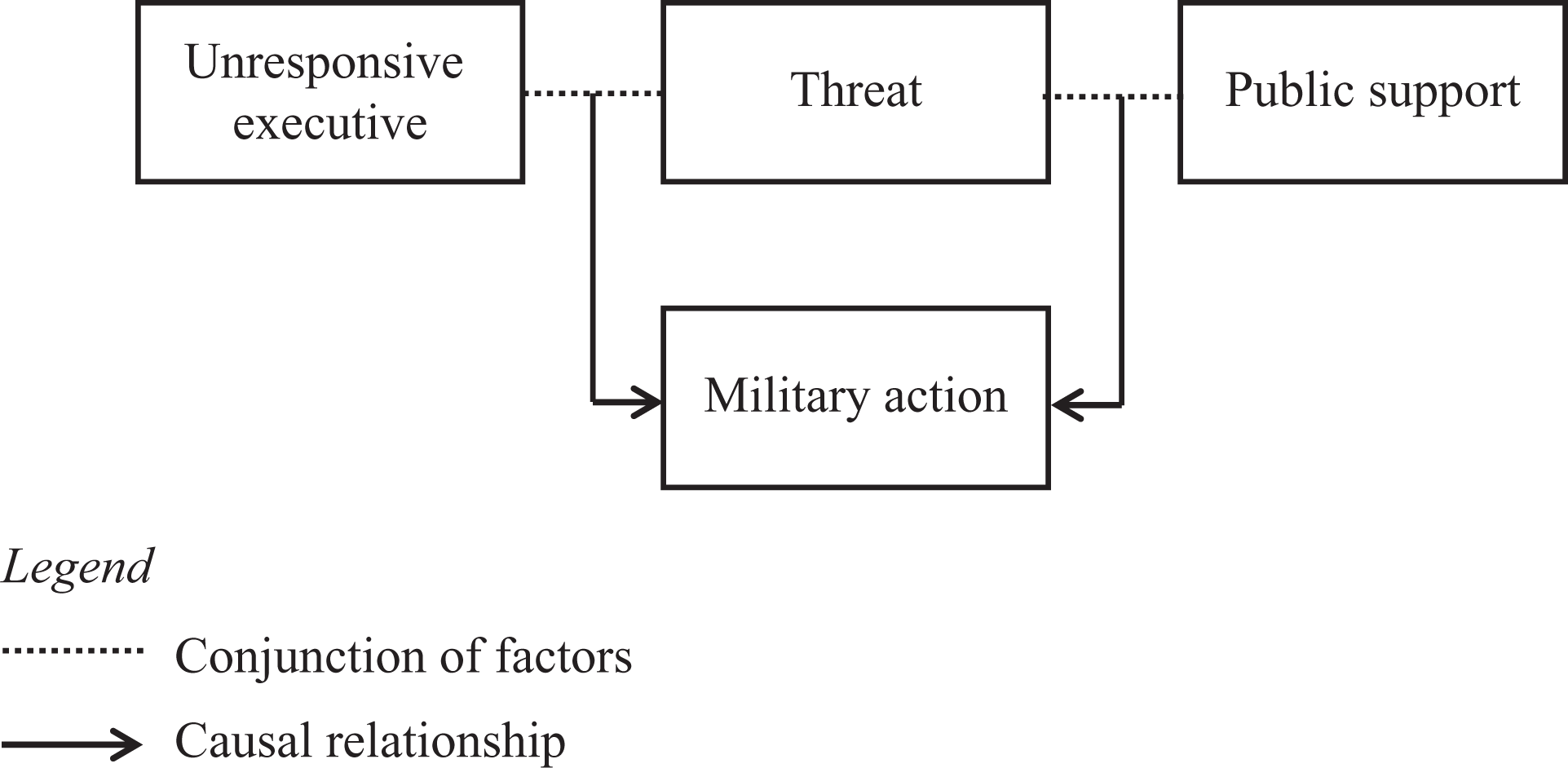
Empirical tests of these propositions produce mixed results. Leblang & Chan (2003: 394), for example, do not find significant correlation between pending elections and war involvement. In contrast, Tago (2009) shows that democracies were more likely to withdraw from the ‘coalition of the willing’ in Iraq during election months, while Gaubatz’s (1991) study suggests that democratic leaders that face imminent elections are reluctant to enter a war. Dieterich, Hummel & Marschall (2015), in turn, show that countries with comprehensive parliamentary war powers generally did not provide more than logistical support to the Iraq War, although several cases did not comply with this general finding.
In line with democratic peace theory, the first model assumes that public opinion constitutes a potential restraint against the use of force, but only if the domestic institutional system and electoral cycle renders political leaders unresponsive to public opinion. Figure 1 summarizes these causal links.
Hypothesis 1: The combination of threats with either public support or an unresponsive executive causes military deployment.
Public support as effect of military deployment decisions
Rather than examining public opinion as an explanatory variable for the use of force, a substantial body of literature studies the formation of public preferences. One strand in this literature agrees that public opinion is relevant for political decisions. However, rather than considering political leaders the ‘defenceless victims of the ever-changing mood of a volatile electorate’, this line of work suggests that political leaders can also shape public opinion towards the use of force (Ringsmose & Børgesen, 2011: 512). This top-down perspective on the link between public opinion and military action expects that the public can be easily manipulated by political leaders because ordinary citizens care less about foreign policy than about domestic issues and do not have a lot of knowledge about the issues involved (Risse-Kappen, 1991: 481). While agreeing that there is a causal link between public opinion and military intervention decisions, the direction of this link is expected to run from the government to the general public (Holsti, 1992: 453).
The basic logic behind this ‘followership model’ is captured in the following quote from Seymour Lipset (1966: 20): ‘national policy-makers, particularly the President, have an almost free hand to pursue any policy they think correct and get public support for it’. However, a comprehensive review of the literature on the public opinion/foreign policy nexus by Powlick & Katz (1998: 38) suggests that the impact of the executive on public opinion is more limited. A number of recent studies formulate more sophisticated expectations regarding the ability of elites to shape public opinion. Baum & Groeling (2010) argue that early in a conflict, elites can use the informational advantage they have over the general public to rally support for military interventions. More specifically, their theory suggests that elites have the capacity to successfully frame reality distinctly from the true state of affairs on the ground. However, this ‘elasticity of reality’ declines over time, as the general public gets more information about events on the ground. Their analysis confirms that elite rhetoric is a better predictor of public support for the Iraq War than the facts on the ground, but only at the beginning of the conflict (Baum & Groeling, 2010: 474). Similarly, Berinsky (2007) argues that a large share of the population does not have the information that is necessary to make rational calculations on the costs and benefits of a military operation. His elite cue theory suggests that elite discourse determines popular opinion on military intervention. Drury et al. (2010) and Ringsmose & Børgesen (2011), in turn, suggest that public opinion can be driven by the government rhetoric.
An increasing number of studies, thus, provide support for the proposition that governments can influence Model 2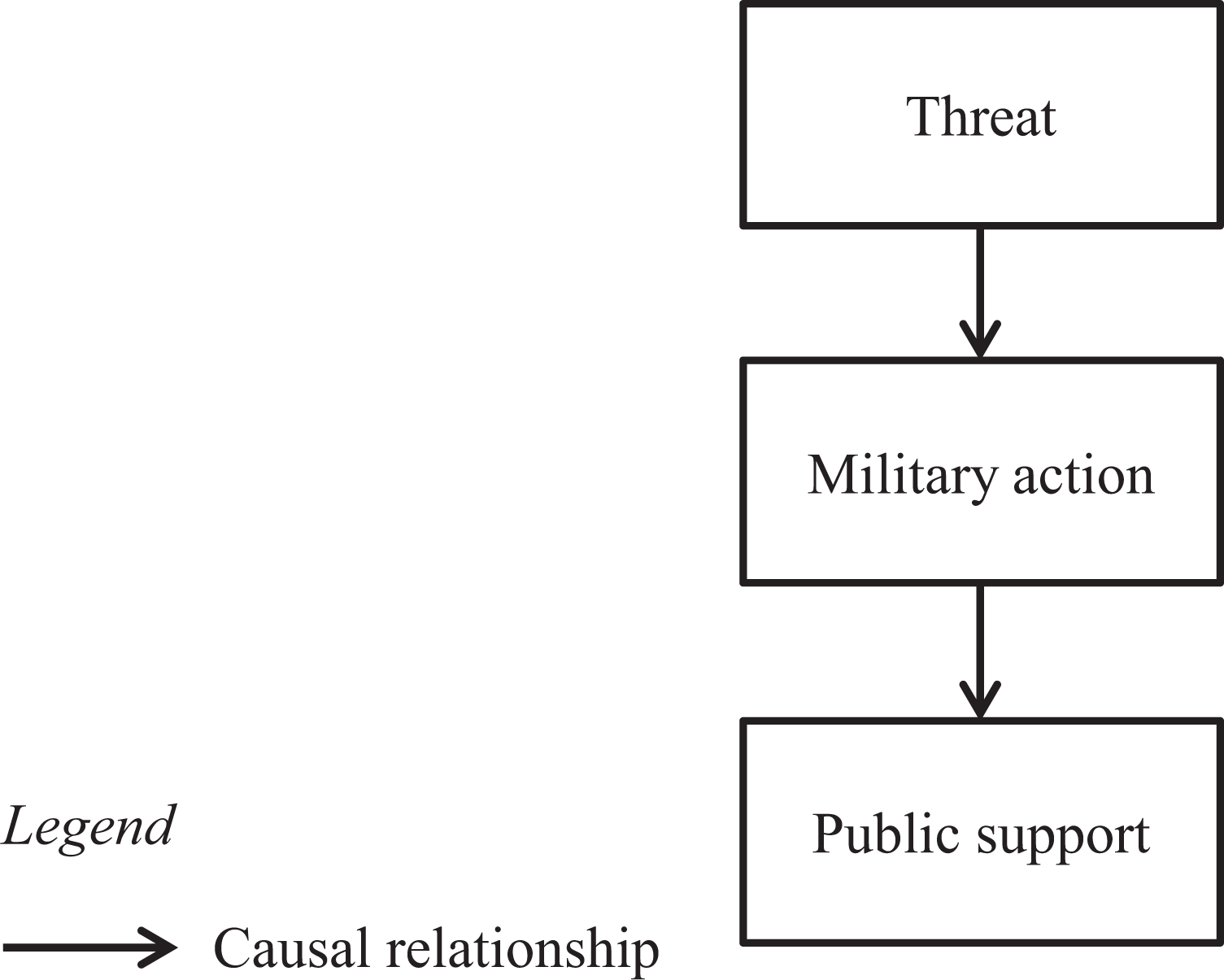
Hypothesis 2: Military deployment decisions are the cause of public support and the effect of threats to national interests.
Public support and military deployment as the effect of threats
Another strand in the literature that examines the sources of public opinion on the use of force suggests that public opinion is determined by events outside the control of political leaders, such as the interests that are at stake in a military operation, the objective of the operation, the probability of success and the number of casualties (Jakobsen & Ringsmose, 2015: 215; Klarevas, 2002). This corresponds to ‘event-response theories’, which contend that public opinion on military action is the result of ‘a constant rebalancing of the benefits and prospects for success against the likely and actual costs – and a determination of whether the outcome is judged worth the costs’ (Berinsky, 2007: 976; Larson, 1996: 12). This school of thought, thus, assumes that the mass public has sufficient knowledge to make cost/benefits calculations and can therefore not be easily manipulated by its government.
The level of threat to the national interest might be an important determinant of the general public’s perception of the benefits of an operation. Russett & Nincic (1976) were among the first to provide evidence for the link between interests and public support for military action by showing that the US public is more ready to provide military support to countries that are geographically closer to the USA and, thus, pose a greater threat to the United States. Likewise, Kohut & Toth (1994) conclude from three case studies that the US public will be clearly disposed towards military action if it feels the USA’s vital interests are at stake. More recently, the study of Everts & Isernia (2015: 212) shows that respondents were more supportive of the use of force if a survey question referred to national goals, although the impact of national interests was not statistically significant for respondents from European countries.
In a study on the determinants of US public opinion on the use of force, Jentleson (1992) suggests that the primary policy objective of an operation is a more important determinant for public support than the interests that are at stake. More specifically, his study shows that the US public was prepared to support the use of military force if the goal was to restrain an adversary that posed a threat against US interests or its citizens. Subsequent studies by Jentleson & Britton (1998) and Eichenberg (2005) confirm the importance of an operation’s primary policy objective. The study by Mader (2015) somewhat qualifies these conclusions by showing that the perceived mission objectives only played a minor role in German public support for the ISAF mission in Afghanistan. However, Germany, whose foreign policy culture is characterized by strong antimilitarism, seems to be a least-likely case for the link between public support and the objective of an operation.
Given that the present study primarily focuses on explaining differences between countries rather than differences between operations, the primary policy objective of an operation is not included in the theoretical models. Although Jentleson (1992) presents his hypothesis on the importance of the principal policy objective of an operation as competing with hypotheses on the impact of interests, the fact that the use of force to restrain adversaries that threaten interests enjoys the highest level of support does suggest that the public is responsive to threats to national security interests, which is included in the third theoretical model. Moreover, examining two operations with a different objective Model 3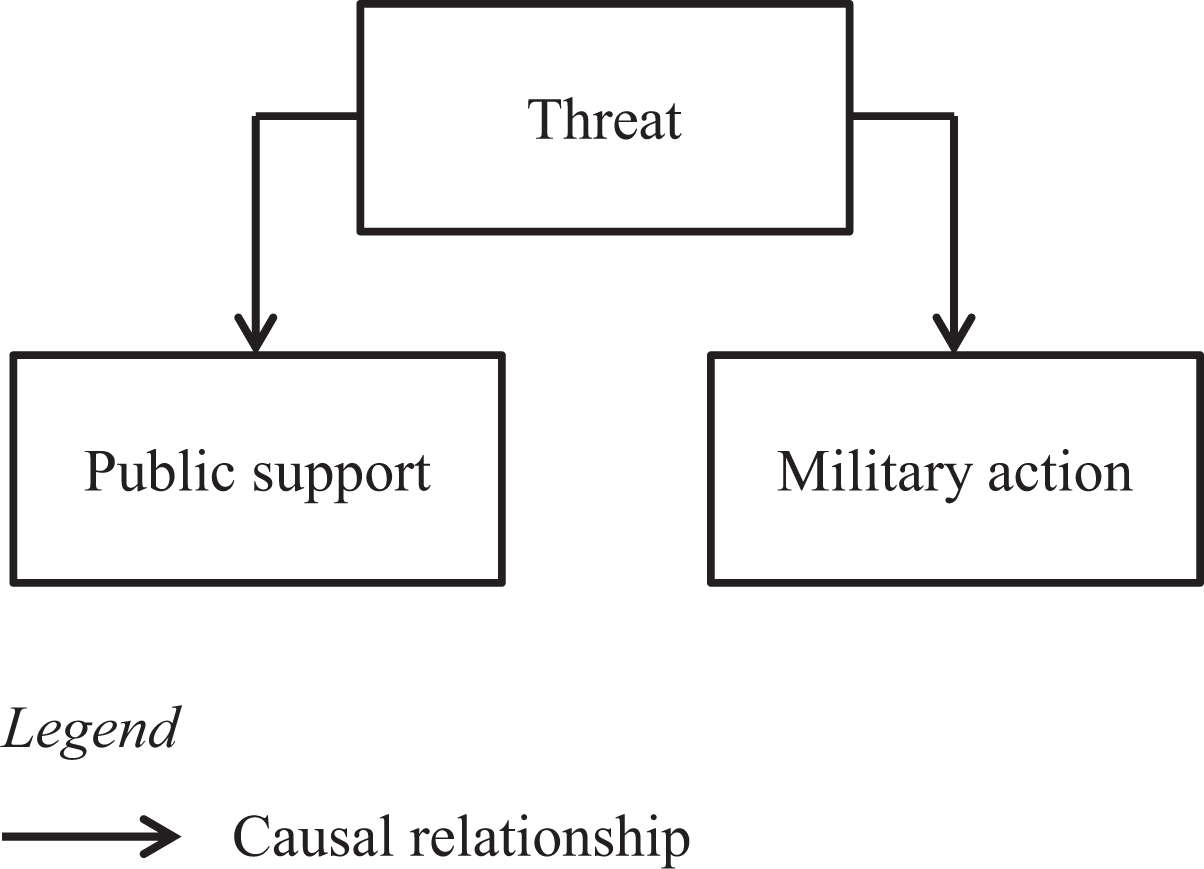
In line with this literature, the third causal model assumes that the general population and executive decisionmakers react equally assertively to threats to national interests. More specifically, the model posits that threats both cause the executive to decide to deploy military force and cause the public to support the use of force. Figure 3 summarizes the third causal model.
Hypothesis 3: Military deployment and public support are the effects of threats to national interests.
Research design
This section introduces the methodological approach, justifies the case selection and discusses the operationalization and dichotomization of the factors.
Coincidence analysis
Methodologically, this article builds on coincidence analysis (CNA) (Baumgartner, 2009a). This Boolean method of causal analysis is related to the more established method of qualitative comparative analysis (QCA). CNA and QCA are both configurational comparative methods and, thus, allow for ‘systematic cross-case comparisons, while at the same time doing justice to within-case complexity’ (Rihoux & Ragin, 2009: xviii). This is accomplished by transforming cases into configurations, specific combinations of factors. In addition, the methods both aim to identify minimally sufficient and necessary conditions and establish causal relationships with small-N and intermediate-N data.
CNA was preferred over other methods for two main reasons. First, it is capable of uncovering the complex causal structures depicted in the theoretical models (Baumgartner, 2009a: 72–73, 2013: 5–13). Like QCA, it is capable of capturing a more complex form of causality, generally captured under the expression ‘multiple conjunctural causation’. Conjunctural causation implies that a phenomenon is produced by a combination of conditions – multiple causation, when several (combinations of) conditions can produce the same outcome. The first causal model corresponds to such a causal relationship. Unlike QCA however, CNA is also capable of identifying causal chains and common cause structures. Model 2 corresponds to a causal chain, a causal structure that includes at least one factor that is both a cause and an effect. Model 3, in turn, corresponds to a common cause structure. Second, CNA does not presuppose that it is known prior to the analysis which variables are causes and which variables are effects. As argued above, different strands of research on the link between public opinion and military intervention offer competing expectations about the causal direction of the relationship between the two variables. One of the major benefits of CNA is that it allows us to causally interpret data without prior knowledge about this direction (Baumgartner, 2009a: 74).
CNA builds on ideas that are located in the regularity theoretic tradition of the philosophy of causation going back to Mackie’s (1974) theory of INUS-conditions (Baumgartner, 2009b: 72). Regularity theories of causation define causes as difference-makers of their effects (Baumgartner, 2015: 841). A factor is a cause if its presence (or absence) makes a difference to the presence (or absence) of the effect. More specifically, a factor is considered causally relevant if it is an indispensable (i.e. necessary) element in a combination of factors that guarantees (i.e. is sufficient for) an effect. This implies a deterministic view of causation: a factor is only causally relevant if it is part of a combination that is always associated with (i.e. is sufficient for) the effect (Baumgartner, 2009a: 74). However, a factor is only causally relevant if this sufficient combination no longer guarantees the occurrence of the effect without the factor (Baumgartner, 2015: 842). If this is the case, the factor makes a difference for whether the effect occurs or not. Because of the fundamental problem of causal inference, according to which the cause of an individual outcome cannot be determined because a counterfactual situation in which the cause is absent cannot be directly observed, difference-makers are observed in similar but different cases. Inferring causation requires a fixed context of background conditions, in which there are two cases, one in which the effect occurs and one case in which it does not occur, that are similar on every single aspect except for one.
CNA provides a rigorous and replicable procedure to identify differences between such most similar cases. More specifically, the CNA-procedure starts with identifying the combinations of factors that are consistently associated with (i.e. sufficient for) a potential effect. Subsequently, factors that are not essential parts of sufficient combinations are systematically eliminated from their respective combinations by CNA’s minimization algorithm. This algorithm removes factors from sufficient combinations to check whether the resulting combination guarantees the presence of the effect without this factor. If this is the case, the factor is not essential and is removed from the combination. If the combination no longer guarantees the effect without this factor (i.e. if the combination characterizes cases of the absence of the outcome), the factor is essential and causally relevant. This procedure is repeated until only essential factors remain in the combination.
The above procedure allows us to identify the factors that are difference-makers for an effect. CNA, thus, deals in a similar way with the fundamental problem of causal inference as matching methods that build on the potential outcome framework. However, unlike these methods, CNA does not aim to measure average treatment effects but rather searches for which combinations of causally relevant factors consistently lead to an effect (Schneider & Rohlfing, 2012). Because difference-makers are observed by comparing similar but different cases, causal homogeneity must be assumed. More specifically, it is assumed that unmeasured causes, that can confound the data, are constant.
Empirical domain
The empirical focus of this study is on the EU member states’ contributions to the 2011 military intervention in Libya and the anti-IS coalition. 1 These two operations were selected because they share a sufficient number of similarities to allow for coherent cross-case conclusion. However, a number of relevant differences between the operations should allow us to establish the scope conditions of the theoretical models. Most importantly, while the operation in Libya primarily had a humanitarian goal, the anti-IS coalition was deployed to protect more narrow national interests: avoiding its target becoming a safe haven for international terrorism. Moreover, the Libya operation was authorized by the UN Security Council and came under NATO command. In contrast, there was no UN endorsement for the operation against IS, which was carried out by an ad hoc coalition of the willing. These important differences between the operations allows us to examine whether the primary policy objective of an operation, the involvement of international organizations and legitimacy under international law have an impact on the relationship between threats, public opinion and military deployment (cf. e.g. Eichenberg, 2005; Jentleson, 1992).
A second case-selection decision concerns the (non-) participants in both operations. Given that both missions were air operations, states that do not have fighter jets capable of attacking ground targets were excluded from the analysis. 2 This study exclusively focuses on EU member states. These countries share a number of background characteristics, which reduces the risk that the relationship between the factors under investigation is confounded. Most importantly, because of the political and economic interdependence within the EU, a threat to one member state inevitably threatens all member states (Haesebrouck, 2017b). Although this does not imply that all member states are affected equally if threats against their national interests arise, it does suggest that each member state had an incentive to participate in the operations under investigation.
A number of differences between the EU member states can have an impact on the relationship between threats, public opinion and military deployment decisions. As discussed in the theory section, elite responsiveness to public opinion can be expected to vary across different states. First, the link between public opinion and military action might be confounded by the variation in institutional constraints on military deployment decisions and the temporal distance to the next election (see above). Given the variation in parliamentary war powers and electoral calendars across the EU member states, it is accepted that elite responsiveness varies considerably between the cases (Haesebrouck, 2015a). The relation between public opinion, threat and military action might also be confounded by a more structural and rigid constraint on executives: constitutional restrictions on military deployment (Mello, 2014: 34–37). The pattern of participation in the operations under investigation might also depend on the value the potential participants accord to their relationship with the USA. Finally, in line with collective-action-based explanations of military burden sharing, the variation in the military capabilities of the EU member states might also confound the causal relationship between the factors of interest (Haesebrouck, 2017b). To arrive at a more complete explanation for the pattern of participation in the two operations, the electoral distance to the next election, military capabilities and constitutional restrictions are included in the analyses presented in the main text, while the alternative analyses presented in Online appendix 2 include parliamentary veto power and alliance value.
Not all potentially relevant factors were included in the analysis. First and foremost, literature on strategic culture has shown that there are important differences between the EU member states’ norms, beliefs and ideas regarding the use of force (Biehl, Giegerich & Jonas, 2013). The latter, in turn, has an impact on their military commitments, as well as on public opinion on the use of military force. Many cultural theorists, however, do not seek to establish generalizations, but rather aim to explain or understand particular events or foreign policy decisions (Desch, 1998: 152–155). Perspectives on strategic culture that do attempt to produce general explanations for state behaviour still tend to focus on the particularities of different strategic cultures, which makes it difficult to operationalize and systematically compare cultural variables. Given that this study aims to arrive at general and parsimonious conclusions, strategic culture is not included in the analysis. In addition, variables that only have an impact on public opinion, like elite consensus and media coverage, are not included in the analysis (Berinsky, 2007; Jakobsen & Ringsmose, 2015). Not only is it not feasible within the scope of this research to operationalize these variables for all cases, only a limited number of factors can be included in a single analysis without risking that the results become so ambiguous that they cannot be causally interpreted (Baumgartner, 2009a: 82; Baumgartner & Thiem, 2015b). Because the primary aim of this study is to shed light on the dynamics behind the use of military force in international relations, it was decided not to include conditions that can only be expected to have an impact on public opinion.
Operationalization and dichotomization
CNA requires the cases to be dichotomized. 3 A score of 0 indicates that a factor is absent in a given case, a score of 1 that it is present. The dichotomization of the factors is discussed below; the raw and binary data are presented in Online appendix 2.
Cases are assigned a score of 1 on the condition Public support (PS) if over 50% of the population supports the operation. The coding of Public support is based on the most comprehensive opinion polls on the Libya intervention and the operations against IS, respectively the German Marshal Fund’s 2011 Transatlantic Trends Survey and a survey conducted by Ipsos for the Halifax International Security Forum (German Marshall Fund, 2011; Ipsos, 2014). The former provides data for 12 of the 19 member states with fighter jets, the latter for ten member states. Because public opinion on participation can be expected to be volatile and dependent on the formulation of the survey questions, other surveys cannot be expected to provide comparable data. Therefore, it was decided not to increase the number of cases by supplementing the data by using other opinion polls. The sample of cases can be expected to be representative for the population of EU member states. The data, for example, include member states from East, Central, West and Southern Europe, new and old EU members, large and small member states and NATO members and non-members. 4
Cases are assigned a score of 1 on Military participation (MP) if they participated in the air campaign. 5 A number of cases contributed to the operations under investigation in other ways, for example, by contributing naval assets to the Libya operation or sending arms, ammunition or military instructors to reinforce local forces in the battle against IS. However, the financial and political costs of these contributions fall far below the cost of participating in air operations. 6
Threat (TH) is operationalized differently in the two operations, given that the targets of each intervention posed a different type of threat. Gleditsch & Ward’s (2001) minimum distance measure is used to operationalize Threat in the Libya operation, given that the states that are situated the closest to Libya are most vulnerable to the conflict’s negative externalities – such as increased refugee flows and the disruption of supply lines (Davidson, 2013: 312). In line with Gleditsch & Ward (2001: 745), the dichotomization threshold was fixed at 1,000 km. As shown in Saideman (2016: 296) and Haesebrouck (2018), a state’s concern with the rise of IS is connected to the number of nationals that joined IS in Syria and Iraq. 7 Countries that ‘contributed’ more than 100 foreign fighters are assigned a score of 1 on Threat in the anti-IS coalition. 8
Finally, three additional factors were added to the analysis to avoid the results being confounded by non-included factors that are causally relevant. 9 First, electoral proximity is used to operationalize elite responsiveness to public opinion. Elite responsiveness depends on a wide range of factors, most importantly electoral cycles and domestic institutions. However, to keep the number of factors limited, the analysis presented in the main text only includes electoral proximity. A score of 1 on Proximate elections (PE) is assigned if the next general election is less than one year away (Gaubatz, 1991). 10 Second, Constitutional restrictions (CR) reflects whether a country’s domestic legal rules could keep it from participating in the operation. None of the cases faced constitutional restrictions in the Libya operation. Sweden and Germany did face restrictions in the air operations against IS. While Sweden is not allowed to participate in an operation that is not authorized by the UN Security Council, Germany can only contribute to operations within the ‘institutional framework of systems of “mutual collective security”’ (Mello, 2014: 80). Lastly, Military capabilities (MC) is operationalized as the average military expenditures of the two decades preceding the operation. 11 The dichotomization threshold is fixed at 38,000, in the large gap in the raw data between Spain and Italy. Four states are hereby assigned a score of 1: France, the UK, Germany and Italy.
Analysis and results
The CNA procedure involves eight steps, which are preceded by a step 0: the identification of the potential effects (Baumgartner, 2009a: 85–97). Two factors are potential effects in this research: Public support and Military participation. Once the effects are identified, ‘CNA proper sets in’ (Baumgartner, 2009a: 85). First, a potential effect is selected (1), for which sufficient conditions are identified (2) and minimized (3). Subsequently, these first three steps are repeated for every potential effect (4), after which necessary conditions are identified (5) and minimized (6) for every potential effect. This last step results in a number of minimally necessary disjunctions of minimally sufficient conditions for each potential effect, which are assembled in minimal theories (7) and causally interpreted (8). CNA makes use of two measures that were developed to deal with data that are confounded by uncontrolled causes of the analysed outcomes: consistency and coverage (Haesebrouck, 2015b). Consistency indicates the degree to which the empirical data correspond to a perfect sufficient or necessary condition; coverage indicates the extent to which the data account for the variation in the outcome.
The different stages were carried out with the CNA package for R, version 1.0.3 (Ambuehl et al., 2015; Baumgartner & Thiem, 2015a; R Development Core Team, 2015). 12 The following subsections discuss the results of this procedure for the operation in Libya and the air strikes against IS.
Libya operation
Table I presents the truth table of the analysis of the Libya operation. This table presents the different configurations of the included factors and the cases to which these apply. First, the presence of both potential effects was analysed. The analysis starts with a consistency and coverage threshold of 1. This results in two solution formulas that fit the data equally well.


Truth table: Libya intervention
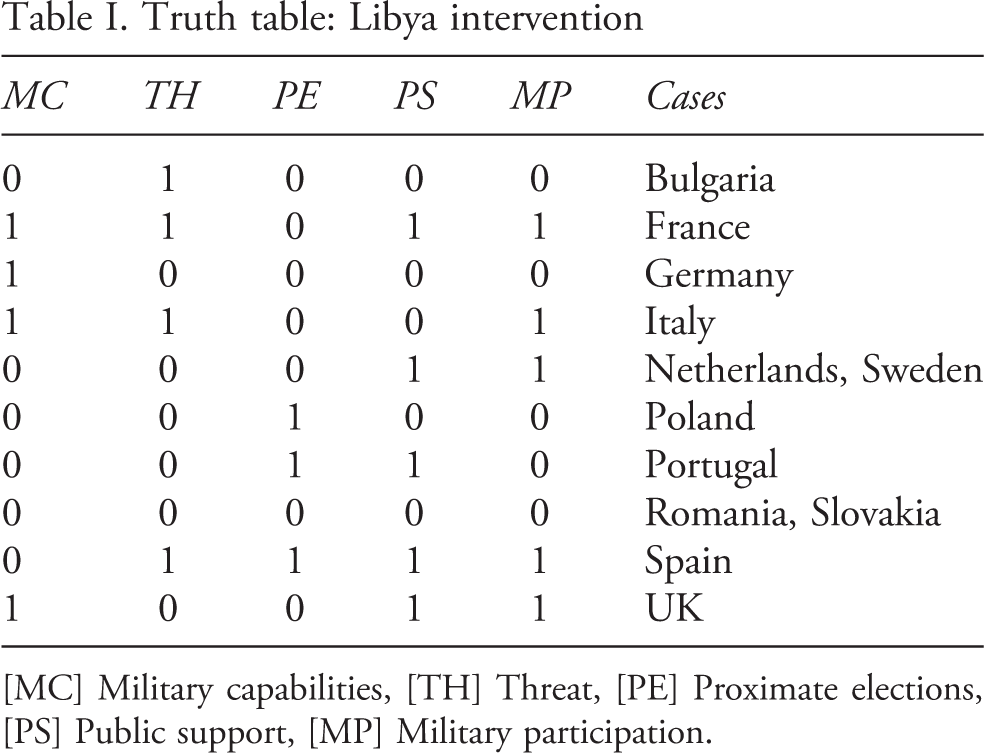
[MC] Military capabilities, [TH] Threat, [PE] Proximate elections, [PS] Public support, [MP] Military participation.
The two solutions, thus, include three sufficient combinations for one outcome factor: Military participation. Two sufficient combinations are the same in both formulas: Military capabilities combined with Threat and the absence of Proximate elections combined with Public support. The last sufficient combination of both solutions includes the presence of Threat, which is combined with Proximate elections in the first solution and with Public support in the second. In the interpretation of the results, the focus is on the second formula because theory suggests that Military participation is less likely if elections are imminent, and not more likely as suggested by solution (1).
Subsequently, the absence of the potential effects was analysed. The consistency and coverage thresholds were fixed at 1, resulting in solution formulas (3) and (4).


Truth table: Anti-IS coalition

[MC] Military capabilities, [TH] Threat, [PE] Proximate elections, [PS] Public support, [CR] Constitutional restrictions, [MP] Military participation.
Anti-IS coalition
Table II presents the truth table of analysis of the anti-IS coalition. First, the presence of the two potential effects was analysed with consistency and coverage thresholds of 1. This results in solution formulas (5) and (6).


Solution (5) includes two sufficient combinations for Military participation. The first combines the absence of Constitutional restrictions with Military capabilities and Public support, the second the absence of Military capabilities with the absence of Proximate elections and the presence of Threat. Formula (6) includes one minimally sufficient combination, which combines the absence of Constitutional restrictions with the presence of Threat. Given that it is highly unlikely that the absence of Military capabilities causes Military participation, solution (6) is a more probable explanation for Military participation. However, this solution suggests that there is no link between participation in the air strikes against IS and public opinion.
To further examine a possible connection between public support and the other factors, the consistency and coverage cutoff points were gradually decreased in steps of 0.05 (Ambuehl et al., 2015: 4). With a cutoff point of 0.8, CNA found two solutions that represent sufficient combinations for Public support.


Both solutions have a consistency of 1 and a coverage of 0.83. Formula (7) includes two sufficient conditions: the presence of Constitutional restrictions and the presence of Military participation, formula (8) one sufficient condition: Threat. Because the presence of Constitutional restrictions is unlikely to be causally connected to the presence of Public support, it seems more probable that the second formula represents the causal structure that accounts for the data.
Formulas (6) and (8) can be assembled into the minimal theory presented in formula (9), in which Threat is a minimally sufficient condition for Military participation in combination with the absence of Constitutional restrictions and is a minimally sufficient condition for Public support by itself.

Subsequently, the absence of the potential effects was analysed. The consistency and coverage thresholds were fixed at 1, resulting in solution formula (10).

The formula indicates that there are two minimally sufficient conditions for the absence of Military participation: the presence of Constitutional restrictions and the absence of Threat. To further examine any possible connection between Public support and the other factors, the consistency and coverage cutoff points were gradually decreased in steps of 0.05. With a minimal cutoff point that was fixed of 0.8, two formulas for the absence of Public support result:


Both solutions have a consistency of 0.8 and a coverage of 1. Solution (11) indicates that the combination of the absence of Constitutional restrictions and the absence of Military participation is sufficient for the absence of Public support, while formula (12) indicates that the absence of Threat is sufficient. Because the absence of Constitutional restrictions is unlikely to be causally connected to the presence of Public support, it is more probable that the second formula represents the causal structure that accounts for the data.
Formulas (11) and (12) can be assembled into the minimal theory expressed in solution (13). This solution suggests that Constitutional restrictions cause the absence of Military participation, while the absence of Threat causes both the absence of Public support and the absence of Military participation.

Interpretation
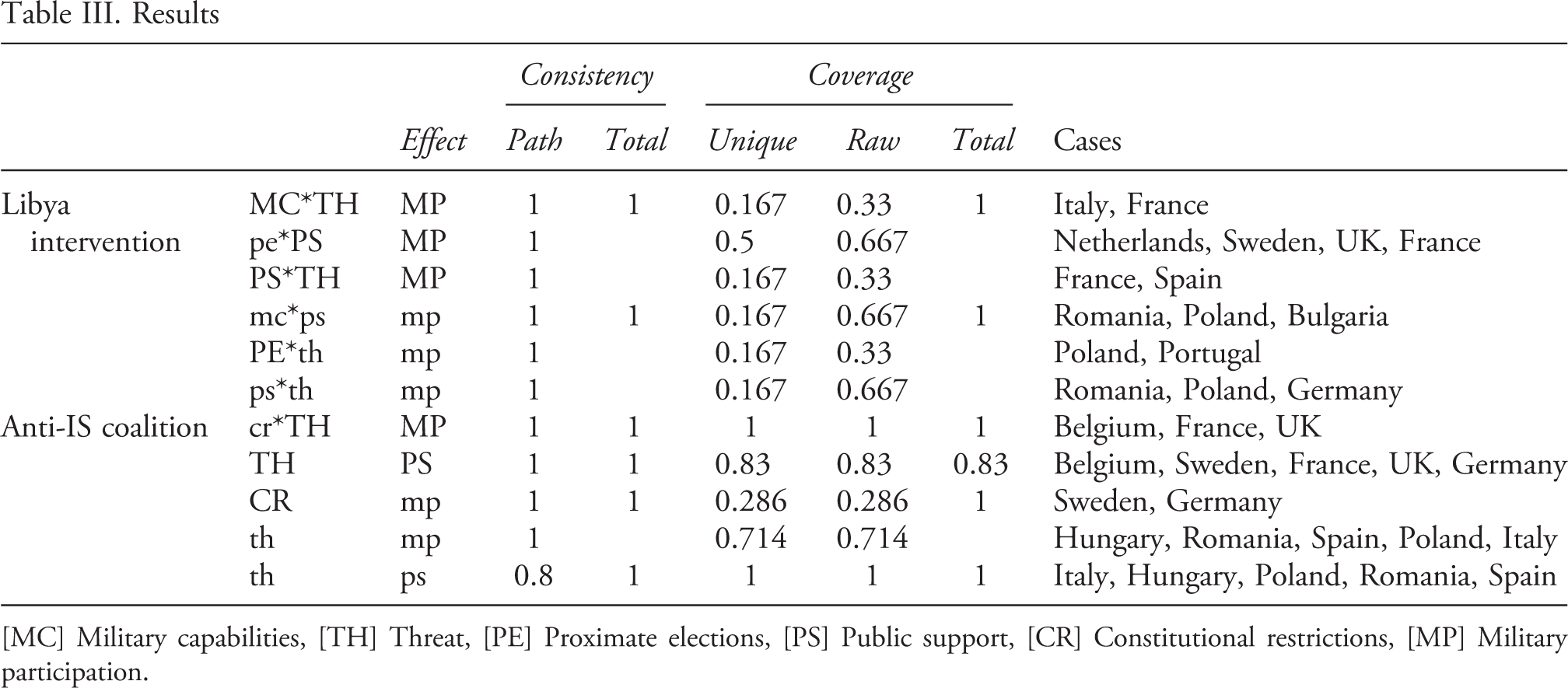
Arriving at minimal solution terms is not the ultimate goal of configurational comparative methods (Schneider & Wagemann, 2012: 280). Instead, solutions must be related back to the cases and theoretical expectations. This section discusses the results of the CNA against the backdrop of the three competing theoretical models. Table III summarizes the results and presents the consistency and coverage values of the solutions, as well as the cases that are covered by each sufficient combination. The raw coverage values indicate the total share of the cases explained by a sufficient condition, while the unique coverage values indicate the share that is exclusively explained by a sufficient condition.
The results of the Libya operation largely confirm the first causal model. Two of the three minimally sufficient conditions for military participation include public support, which suggests that the latter was a cause rather than an effect of participation in the Libya operation. The solution for the absence of participation supports this conclusion: two of the three sufficient combinations for non-participation include the absence of public support. The pattern of participation in the Libya operation thus confirms the central claim of the democratic peace theory that the general public is capable of constraining governments that contemplate deploying military force.
Results
[MC] Military capabilities, [TH] Threat, [PE] Proximate elections, [PS] Public support, [CR] Constitutional restrictions, [MP] Military participation.
While the results of the analysis provide strong support for the proposition that public opinion is part of the cause rather than the effect of military action, they do not fully confirm the first causal model. The latter suggests that executives become more responsive to public opinion at the end of an electoral cycle, whereas the results suggest that public support only leads to participation at the beginning of an electoral cycle or in combination with threats. Proximate elections, in turn, only lead to non-participation in combination with the absence of threats, not in combination with public opposition. This suggests that executives do not become more responsive to public opinion when faced with proximate elections, but instead are more reluctant to deploy military force at the end of an electoral cycle if no clear interests are at stake.
The results of the analysis of the operation against IS lead to different conclusions on the relationship between threat, military action and public opinion. Rather than suggesting that public support is part of the cause of military action, the solutions indicate that both public support and military action are caused by threats. The analysis of the anti-IS coalition, thus, confirms the third rather than the first model. In line with event-response theories, the results indicate that public support for the operation against IS was dependent on whether a country had clear interests at stake in the operation.
First, the results show that the potential threat posed by returning foreign fighters consistently led to participation in the operation against IS if constitutional restrictions were absent. This confirms the conclusion of Saideman (2016) and Haesebrouck (2018) on the importance of foreign fighters for contributions to the anti-IS coalition, as well as the general conclusions of Mello (2014: 186) on the impact of constitutional restrictions. Second, the solution indicates that the threat posed by foreign fighters has a very strong impact on public opinion on the operation. More specifically, a large number of foreign fighters is sufficient, although not perfectly necessary, for public support. Only one case does not confirm the decisive impact of threat on public support for participation the anti-IS coalition: although there is no documentation of Polish nationals joining IS, the Polish public did support the operation. Theories of strategic culture offer a plausible explanation for this high level of support. Following a comprehensive review of the strategic cultures of the EU member states, Biehl, Giegerich & Jonas (2013: 394) conclude that the general willingness to use military force is high in Poland, while it is low in the other states that did not face a high level of threat in the operation against IS.
The differences between the results of the two operations indicate that the relationship between threat, public opinion and military participation depends on the context of the intervention. The rise of IS posed a clear threat to the interests of some of the EU member states. This was sufficient for military participation irrespective of all domestic-level factors, except for the structural constraints imposed by constitutional restrictions. In addition, the results are in line with literature on the impact of primary policy objectives on public support. The solutions indicate that threats had an impact on public support for the operation against IS, but do not show that this was the case for the Libya operation. The former operation aimed to constrain an adversary that posed a clear and present danger to some of the participating states, which the literature on primary policy objectives expects to enjoy most support (Jentleson, 1992: 73). The presence of foreign fighters made the threat and aggressive intentions tangible to the population of the member states, which might explain the strong connection with public support. In contrast, the Libya intervention was not framed as an operation that aimed to restrain an aggressive adversary. Instead, the threats posed by the Libya crisis were more diffuse and caused by the negative externalities of the conflict, not by aggressive intentions of the Libyan regime. In consequence, the interests at stake in the military intervention in Libya were more diffuse and less tangible, as well as less directly linked to the intervention. This might explain why threats had less impact on public opinion and why domestic conditions were more important for the pattern of participation.
Conclusion
What is the causal relationship between military action, threat and public opinion? This article derived three competing causal models from the scholarly literature on the public opinion/foreign policy nexus. The first model assumed that public opinion is a constraint on the use of force, the second that public support is the result of public relations efforts following military intervention decisions and the third that the public will support military action when national interests are threatened. CNA was used to test which of these models provides the best explanation for EU member state behaviour in the 2011 military intervention in Libya and the anti-IS coalition. In line with the first model, the results of the analysis show that public opinion acted as a constraint on executives during the Libya operation. In the operation against IS, however, the analysis indicates that there was no direct causal link between military participation and public opinion. Instead, both military action and public support were an effect of threats. The differences between the two operations suggest that the context of the intervention has an impact on the relation between threat, military action and public support. Most importantly, whether public opinion is a constraint on military action or an effect of threats strongly depends on the primary objective of the military operation and whether or not the threats to a state’s national interests are clear and tangible.
Given that the context of the intervention has an impact on the relation between military deployment and public support, the results of this study cannot easily be generalized beyond the anti-IS coalition and the Libya operation. A fruitful avenue for future research would thus be to test the models in the context of other operations, in order to further examine in which types of missions public opinion constrains military participation and in which operations threats constitute a cause of public support. Moreover, the hypothesis that public support is an effect of military action cannot be entirely discarded. Especially in cases where military deployment is not spurred by either humanitarian concerns or threats to national interests, but rather by alliance politics, public relations efforts of governments might be necessary to gain public support. Prospective research could focus on examining the relation between public opinion and military action in operations in which alliance value was the most important incentive to participate.
CNA will undoubtedly be a useful method to further explore these issues, given its unique ability to capture the type of complex causal structures that explain military deployment. Strikingly, this method had so far only been applied in an introductory article in a methods journal. This study shows that CNA is a powerful tool for applied research and hopes to encourage social scientists to make use of its distinctive strengths for unravelling the complex causal structures that are behind many phenomena that are of interest to social scientists.
Supplemental Material
Supplemental Material, jpr854787_appendix - Who follows whom? A coincidence analysis of military action, public opinion and threats
Supplemental Material, jpr854787_appendix for Who follows whom? A coincidence analysis of military action, public opinion and threats by Tim Haesebrouck in Journal of Peace Research
Footnotes

References
Supplementary Material
Please find the following supplemental material available below.
For Open Access articles published under a Creative Commons License, all supplemental material carries the same license as the article it is associated with.
For non-Open Access articles published, all supplemental material carries a non-exclusive license, and permission requests for re-use of supplemental material or any part of supplemental material shall be sent directly to the copyright owner as specified in the copyright notice associated with the article.
