



Abstract
The purpose of this study was to examine the relationship between time spent in nonperformance and critical thinking activities in high school choral rehearsals. Eighteen rehearsal observations were collected from public school music programs. Observed rehearsal behaviors were coded into three categories of nonperformance activity: lower-order thinking, critical thinking, and nonspecific activity. Results indicated that the mean rehearsal time spent in all nonperformance activities was 53.89%, with 45.96% focused on lower-order thinking skills, 6.36% in critical thinking skills, and 1.57% in nonspecific activities, including off-task behavior and silence. A significant positive correlation was found between the amount of time spent in nonperformance activities and time spent engaged in critical thinking skills. No significant correlation was found between the level of ensemble in which students were enrolled and percentage of time spent in activities that required the use of critical thinking skills. Findings suggest that amount of time spent using critical thinking skills in high school choral rehearsals may be influenced by a variety of factors, including rehearsal techniques and learning objectives used by master teachers.
Critical thinking is a foundational goal within educational practice. Advocacy for development of students’ critical thinking skills has cycled through educational literature, particularly since reform in the 1950s. Yet, current research indicates critical thinking remains an enigma to a vast majority of society (Foundation for Critical Thinking, n.d.). While critical thinking has existed in the context of general educational research for decades, studies of critical thinking in music education did not surface until the 1980s, and studies in music classrooms are extremely limited. Additional research is needed to explore the relationships between teacher behaviors and the development of student critical thinking skills.
Creating a common definition for critical thinking derived from broad educational research literature is challenging. Researchers discussing critical thinking have frequently cited philosophers John Dewey, John McPeck, Robert Ennis, and Richard Paul (Field, 1997; Richardson & Whitaker, 1992; Stevens, 2001; Younker, 2002). In How We Think, Dewey (1910/1997) defined the idea of reflective thinking, in part, as the careful examination of knowledge through the lens of information supporting that knowledge. McPeck (1990) described critical thinking as a set of skills utilized while focused on specific subject matter. Ennis’s proposed definition of critical thinking was “reasonable reflective thinking that is focused on deciding what to believe or do” (Richardson & Whitaker, 1992, p. 548). Additionally, Paul (1984) presented his own two concepts of critical thinking skills based on previous experience and cognitive abilities. While distinctive to the philosophers who created them, many of these ideas can be broadly traced back to Dewey’s concept of reflective thinking.
Development of classification systems for thinking skills helped provide researchers and educators with a common vocabulary. References to Bloom’s (1956) Taxonomy of Educational Objectives have been made for more than 50 years in the area of cognitive skill development. Paul (1985) confirmed that indeed, educators accepted and used the taxonomy as a standard. The upper three levels of the taxonomy served to identify higher-order thinking skills for teachers. Music education researchers also have used Bloom’s taxonomy as a common source for reference or as a means to operationally define critical thinking (Pogonowski, 1987, 1989; Small, 1987). For teachers who valued higher-order thinking and critical thinking, terms used synonymously by Paul, the taxonomy provided support to the argument that these skills were essential to students of all ages.
As educational pedagogy changed, Bloom and his team thought that their work would also continue to evolve. However, revision of the original taxonomy did not occur for many years. A Taxonomy for Learning, Teaching, and Assessing (Anderson et al., 2001) incorporated cognitive process with categories of knowledge. The categories of cognitive processes from the original Bloom’s taxonomy were retained with three major modifications. First, category names were changed from nouns into verbs to reflect increased emphasis on active thinking skills. The second modification placed emphasis on the subcategories of the six cognitive processes, which helped to clarify their descriptions. Another change switched create (formerly synthesis) to the top of the hierarchy, a move that had ramifications for music and arts education (Hanna, 2007). Perhaps the most significant alteration in the revised taxonomy was not the change in nomenclature but the addition of a knowledge dimension of cognition. Factual, conceptual, procedural, and metacognitive knowledge was introduced to aid in the identification of student learning objectives and in the development of appropriate assessment tools.
Education reformers place emphasis on accountability, often in the form of assessment. Over the past two decades, music educators and researchers have produced new ideas for the assessment of advanced cognitive behaviors in music. Gardner’s (1989) ARTS PROPEL model and the Comprehensive Musicianship Project (Sindberg, 1998) advocated the use of portfolio assessment to measure students’ critical thinking abilities. Similar models followed, requiring some form of written evaluation to measure critical thinking (DeTurk, 1989, 2002; Field, 1997; Stevens, 2001). However, other studies incorporated direct teacher–student interaction, in the form of classroom discussion, as a means to ascertain students’ cognitive behavior (Holden, 2008; Jarmon, 2009; Napoles, 2007; Snow & Apfelstadt, 2002). Students’ academic achievement and use of critical thinking skills benefit from teacher–student verbal interaction. Further examination of the content and means to assess these interactions could provide insight as to how choral directors effectively use their rehearsal time.
Student-centered learning is considered vital to the development of independent musicians. Results from a recent survey of the National Art Education Association membership revealed that student learning was the highest-ranking concern (National Art Education Association, 2008). A music education learning environment provides infinite opportunities for the development of critical thinking skills, measurable through performance assessment, written assessment, and direct behavioral observation. The need for understanding advanced cognitive processes in music has been expressed (Taylor, 1993). Music education researchers have suggested that additional descriptive studies focused on critical thinking are needed (Yarbrough, Price, & Bowers, 1991). However, discussion of teachers’ and students’ use of critical thinking in the choral rehearsal environment has been sporadic over the past two decades (Field, 1997; Gardner, 1989; Jarmon, 2009; Stevens, 2001). Additionally, studies investigating the direct observation of critical thinking behaviors in choral music education are scarce.
Music educators consider critical thinking as essential to developing independent musicianship, based on a review of relevant literature (Garrett, 2009). In two similar studies, R. C. Watkins (1993, 1996) examined critical thinking from the perspective of nonperformance activity in a rehearsal setting. R. C. Watkins (1993) first investigated the use of nonperformance time in middle and junior high school choral rehearsals. She found that only 0.84% of nonperformance time was used in exercises that demonstrated what she defined as higher-order thinking. Of additional interest was that no significant correlation existed between number of years of teaching experience and the percentage of time spent attempting to develop higher-order thinking skills. In a follow-up study, R. C. Watkins (1996) used similar procedures, with high school teachers as participants. She indicated that only 1.3% of nonperformance time was used in activities that encouraged higher-order thinking. For the purposes of both studies, the operational definition of higher-order thinking included the analysis, synthesis, and evaluation of both musical content and performance.
Strauser (2008) expanded upon R. C. Watkins’s approach by incorporating the two dimensions of knowledge and cognitive processes described in the revised Bloom’s taxonomy (Anderson et al., 2001). Strauser used the two-dimensional scale created by Anderson et al. (2001) to identify three possibilities of classifying higher-order cognitive skills. He indicated that teacher talk, which included both teacher talk and student nonperformance responses, accounted for 47% of rehearsal time. This result was slightly higher than R. C. Watkins’s (1993, 1996) descriptions of nonperformance activities. Strauser also found that of the 31.27% of cognitive language used by directors, 15.06% of teacher talk comprised activities that incorporated higher-order thinking skills as defined using the cognitive dimension of the revised taxonomy. While this percentage is much higher than results from either of R. C. Watkins’s studies, it is important to note that Strauser defined modeling as an interactive process incorporating analysis and included that behavior in the category of higher-order thinking.
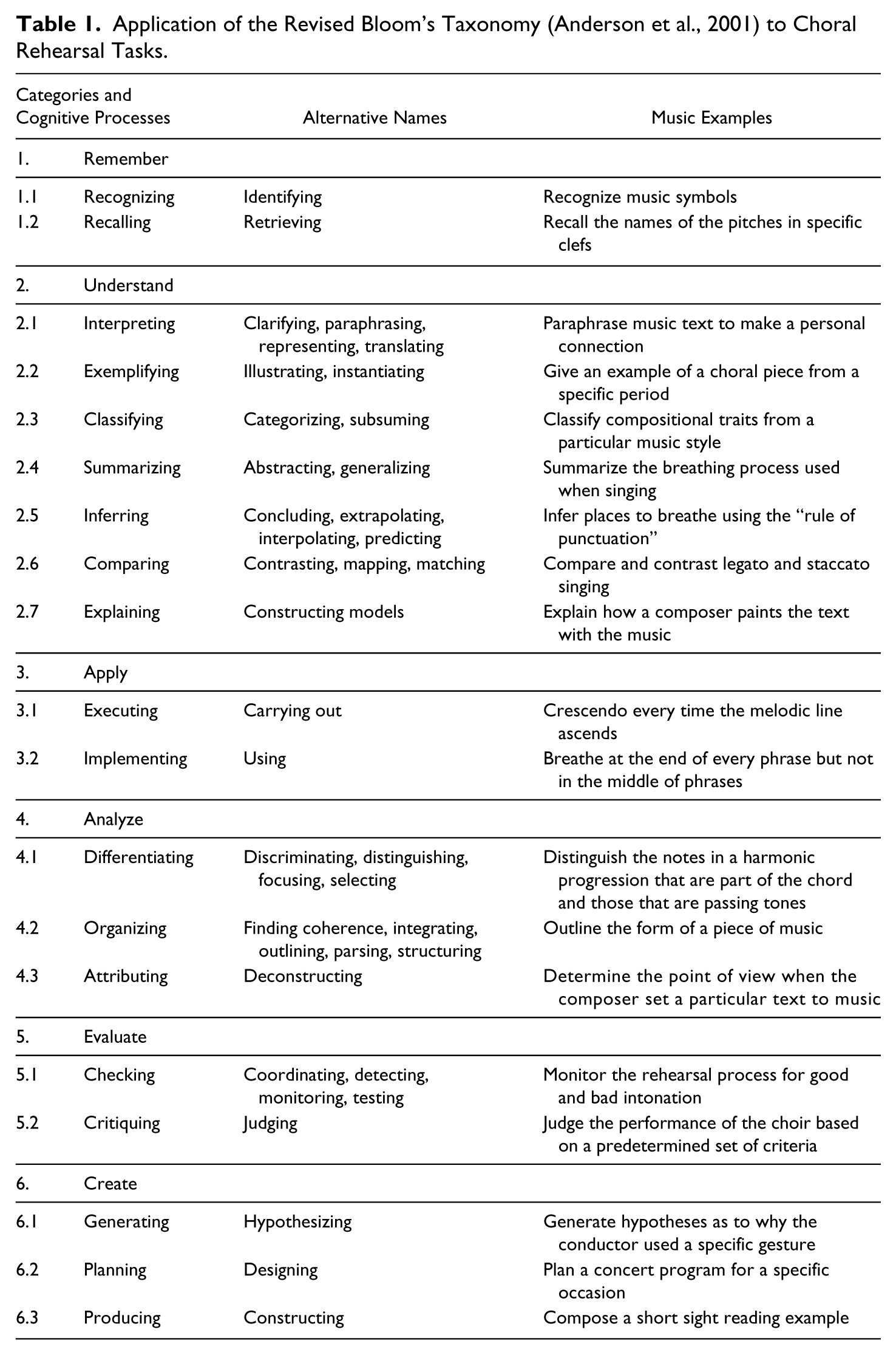
While results from R. C. Watkins’s (1993, 1996) and Strauser’s (2008) studies confirm the findings of other research in the area of critical thinking—that music teachers appear to spend little time developing critical thinking skills in the classroom—they also provide a model for continuing research within the area of choral music education. With the present descriptive study, I sought to bridge the work of R. C. Watkins and that of Strauser by combining previous research methodology with the use of contemporary terminology. For this study, critical thinking was defined as teacher–student verbal interactions focused on the upper three levels of cognitive processes: analyze, evaluate, and create, as identified in the revised Bloom’s taxonomy (Anderson et al., 2001). Sample tasks and corresponding cognitive process categories from the revised taxonomy are illustrated in Table 1. The purpose of this study was to examine the relationship between time spent in nonperformance and critical thinking activities in high school choral rehearsals. Specific research questions addressed included the following: (1) What percentage of rehearsal time is spent on student performance? (2) What percentage of nonperformance rehearsal time is spent by directors and students in activities focused on lower-order thinking skills, critical thinking skills, and noninstructional activities? (3) What relationship exists between the total amount of time spent in nonperformance activity and the amount of time spent developing students’ critical thinking skills? (4) What relationship exists between students’ level of school music experience, as indicated by their enrollment in either a beginning- or advanced-level choir, and the percentage of time spent in developing students’ critical thinking skills?
Application of the Revised Bloom’s Taxonomy (Anderson et al., 2001) to Choral Rehearsal Tasks.
Method
Based on descriptive research methodology used by R. C. Watkins (1993, 1996), observed rehearsal behaviors were recorded and coded into three categories of nonperformance activity: lower-order thinking, critical thinking, and nonspecific activity. Time spent in student performance also was recorded. Anderson et al. (2001) revised Bloom’s taxonomy served as the basis for defining cognitive processes. Video data were analyzed to ascertain percentage of rehearsal time spent in performance and nonperformance behaviors.
Eighteen rehearsal observations were collected from three public high school choral music programs in a large southern state, six observations from each. Choral programs were selected because of relative proximity to my location and agreement with teachers and school administrators to participate in the study. In addition, I attempted to select choral programs that were representative of the considerable geographic diversity of the large southern state. The participant pool was representative of master teachers as defined by the following criteria: (a) minimum of 5 years public school teaching experience, (b) high performance ratings on a consistent basis at district-level chorus festivals, (c) high performance ratings on a consistent basis at state-level chorus festivals, (d) consistent student participation in district solo and ensemble festivals, and (e) consistent student participation in all-state choruses.
Directors initially were told that the study was examining effective rehearsal techniques, so that they would not alter their rehearsal behaviors based on knowledge of the true purpose of the study. Each participant was videotaped teaching two different choirs, a beginning-level choral ensemble and an advanced choral ensemble, for a total of three recorded observations per participant ensemble. Beginning-level ensembles consisted primarily of freshmen and sophomores (M = 89.4%), while advanced ensembles contained a larger percentage of juniors and seniors (M = 84.2%).
I conducted a pilot study in order to test procedures and to examine the analysis template before collecting data for the present study. One high school teacher was videotaped working with a choral ensemble. Recorded footage was converted to a video format for use with SCRIBE observation software (Duke & Stammen, 2007). After examining the video data, I altered the analysis template slightly; additional details identifying the cognitive processes from the revised Bloom’s taxonomy (Anderson et al., 2001) were added to behavior descriptions for clarity.
I recorded participants while they were teaching during the end of the first academic semester of the 2008–2009 school year. Participants were given no specific instructions other than to conduct their rehearsal as planned. Observations were scheduled so that data collection would occur approximately in the middle of performance preparation: between initial note and rhythm learning and the week of performance. In an effort to reduce the effects of formal observation on the rehearsals, I set up the camera before the rehearsal began and focused the recording angle on the teacher. Recording began as students entered the classroom and stopped after students had been dismissed. Rehearsal periods for each class observed lasted approximately 50 min. I made no direct contact with students at any time during the recording process. Following procedures established in R. C. Watkins’s (1993, 1996) research, digital video footage was then trimmed to one 15-min segment per rehearsal, which began immediately after administrative business (i.e., attendance, announcements), warm-up, and sight-reading. Total time of recorded material from the 18 rehearsal samples was approximately 270 min.
I used the revised Bloom’s taxonomy (Anderson et al., 2001) to establish criteria for identifying critical thinking. The teacher’s use of activities contributing to the development of students’ critical thinking skills was observed during on-task nonperformance activities. Categories of nonperformance behavior included the following:
A = Nonperformance activity by teacher or student that exemplifies lower-order thinking. For the teacher, an expository verbal mode using technical language, academic or social instruction (including student questioning), and feedback on student participation. For the student, response to teacher questioning that exemplifies remember, understand, or apply from the lower cognitive behaviors of the revised Bloom’s taxonomy (Anderson et al., 2001).
B = Nonperformance activity by teacher or student that exemplifies critical thinking. For the teacher, a questioning mode that presents students with issues within the cognitive behaviors of analyze, evaluate, or create. Student interactions demonstrated reflective response to teacher questioning.
O = Nonspecific nonperformance activity by teacher or student, including silence. A behavioral category that includes noninstructional interaction between teacher and students and off-task behavior not related to performance or instruction, such as administrative business and transition between instructional tasks.
Data from each of the 18 video samples were grouped into time spent in student performance and teacher–student behavior categories of nonperformance activity. Time spent in performance and nonperformance activities was measured in seconds. I analyzed each of the 15-min video samples in real time using a self-designed observation template (see Appendix A, available online at http://jrme.sagepub.com/supplemental).
Two graduate students with prior high school choral music teaching experience were selected as reliability observers. These individuals received an explanation of the revised Bloom’s taxonomy (Anderson et al., 2001) and training in observation protocol. Each trained observer analyzed 20% of randomly selected data. Percentage of reliability was calculated using Cronbach’s alpha coefficients to measure internal consistency between each reliability observer and me (Pallant, 2007). Results ranged from .91 to .99, suggesting excellent internal consistency for each category of observed behavior and clarity of the operational definition for critical thinking among observers.
Results
Mean scores from observed rehearsals indicated that the amount of time spent in performance and nonperformance activities were very similar. Students performed for an average of 45.94% (SD = 11.47) of each 15-min rehearsal sample. The amount of time each ensemble spent performing was within 20 percentage points from one school to the next. See Table 2 for mean percentages and standard deviations of rehearsal time spent in specific behavior categories.
Mean Percentages and Standard Deviations of Rehearsal Time Spent in Selected Behaviors.
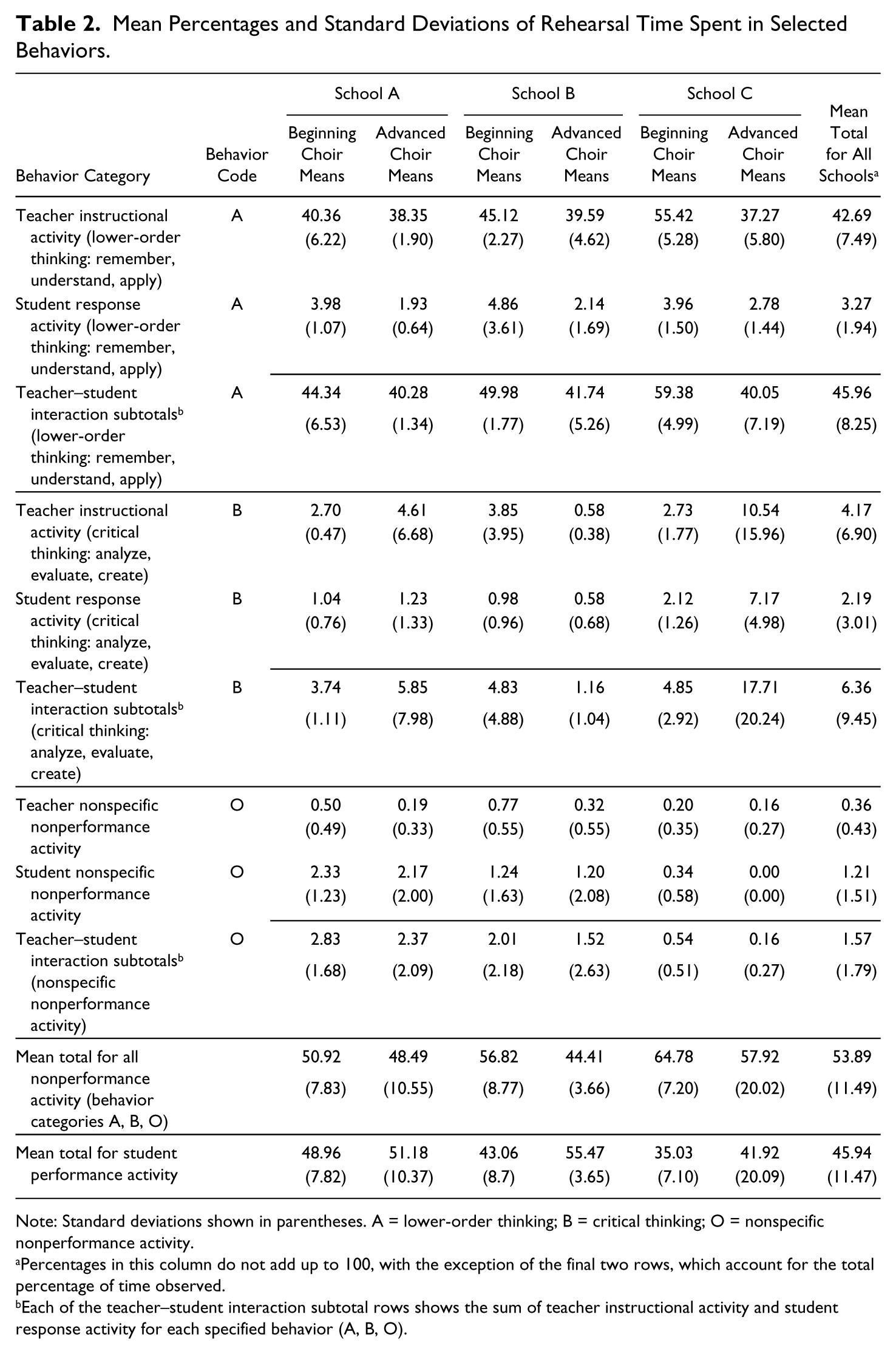
Note: Standard deviations shown in parentheses. A = lower-order thinking; B = critical thinking; O = nonspecific nonperformance activity.
Percentages in this column do not add up to 100, with the exception of the final two rows, which account for the total percentage of time observed.
Each of the teacher–student interaction subtotal rows shows the sum of teacher instructional activity and student response activity for each specified behavior (A, B, O).
The total percentage of all nonperformance activity, including lower-order thinking activities, critical thinking activities, and noninstructional activities, averaged 53.89% (SD = 11.49). Teacher talk accounted for the majority of nonperformance teacher–student interactions (see Table 2).
Lower-order thinking (i.e., remember, understand, apply) accounted for a mean of 45.96% (SD = 8.25) of observed nonperformance rehearsal time. A minimum of 40% of nonperformance rehearsal time for each ensemble was spent in teacher–student interactions focused on lower-order thinking (see Table 2). Further, the beginning-level choirs exhibited a larger percentage of lower-order thinking interaction than did the advanced choirs. Examples of instructional activities used to elicit lower-order thinking included “How many sharps are in the key of G major?” and “Somebody tell me what happens when you breathe correctly.”
Time spent in nonperformance activity that exemplifies critical thinking averaged 6.36% (SD = 9.45) among ensembles from participating schools (see Table 2). However, the percentage range of rehearsal time spent by teachers and students using critical thinking skills varied from 0.37% to 40.65%. Teacher–student interactions included formal analysis of the work being performed, such as “Where has the composer done something different that tells you we are in a new section of this piece?”; reflective thinking about style, “What are some ways we can perform in a connected way as an ensemble that fits the style of this piece?”; and audiation exercises, “I’m going to play a triad and you find and sing the third of the chord.”
Teachers and students spent an average of 1.57% (SD = 1.79) of rehearsal time in nonspecific nonperformance activities. Three ensembles exhibited lower mean percentages for nonspecific activities than the mean for all schools: the advanced ensemble from School B (M = 1.52%, SD = 2.63), the advanced ensemble from School C (M = 0.16%, SD = 0.27), and the beginning ensemble from School C (M = 0.54%, SD = 0.51). In examining the mean percentage differences among the beginning and advanced choirs, it is apparent that the beginning-level choirs yielded consistently higher percentages of nonspecific nonperformance behaviors than did their advanced-level counterparts from each participant school. However, the total amount of time in seconds spent in this behavior category was very low for all participant schools (see Appendix B, available online at http://jrme.sagepub.com/supplemental).
The relationship of total time spent by each choir in nonperformance activities and engaged in critical thinking skills was examined by calculating a Pearson product-moment correlation coefficient. A moderately strong positive correlation was found, r(16) = .71, p < .01, between the two variables.
Performance-based music programs often have a hierarchical structure among ensembles. I sought to examine the relationship between students’ level of school music experience, defined as enrollment in a beginning- or advanced-level ensemble, and the percentage of time spent using critical thinking skills. A point-biserial correlation coefficient was used to estimate the degree of relationship between the dichotomous variable of ensemble level and the continuous variable of rehearsal time (Coolidge, 2006). No significant correlation was found between these two variables. The amount of time participants spent in critical thinking activities varied among the 18 recorded observations (see Appendix B, available online at http://jrme.sagepub.com/supplemental).
Discussion
The purpose of this study was to examine the relationship between time spent in nonperformance and critical thinking activities in high school choral rehearsals. Results from the statistical analysis indicated a moderate positive correlation between time spent in nonperformance activities by teachers and students and time spent using critical thinking skills, although the amount of time spent engaged in critical thinking activities was relatively low. Isolating critical thinking time across separate categories for teachers and students showed that teachers spent more time instructing than students did responding (see Appendix B, available online at http://jrme.sagepub.com/supplemental). The relationship between ensemble level and the percentage of time spent developing students’ critical thinking skills also was investigated. No significant correlation was found between these two variables, suggesting that teachers spend similar amounts of time in critical thinking activities, regardless of ensemble ability levels.
The examination of time spent by teachers and students in selected rehearsal behaviors yielded results similar to the research literature. Results from this study indicated that participants spent approximately half of their rehearsal time in student performance and half in nonperformance activities. Large standard deviations in some instances may be due, in part, to differentiated rehearsal activities between participant teachers. Mean percentages from the present descriptive study are slightly higher than those reported in a number of studies in which researchers found approximately 35% to 43% of rehearsal time spent in verbal communication behaviors (Arthur, 2004; Blocher, Greenwood, & Shellahamer 1997; Caldwell, 1980; Pence, 1999; Thurman, 1977; R. C. Watkins, 1993, 1996). However, results from other studies yielded means of approximately 50% of rehearsal time in nonperformance activities and slightly less in student performance (Davis, 1998; Gunderson & Williams, 1998; Strauser, 2008; R. E. Watkins, 1986).
Another interesting finding from the present study was that participants spent more time in student performance with their advanced choirs than with their beginning-level ensembles. This is consistent with results from studies that reported heightened performance time means with advanced ensembles (Cox, 1986; Davis, 1998; Witt, 1986; Yarbrough & Madsen, 1998; Yarbrough & Price, 1989). Perhaps teachers are free to conduct extended rehearsal segments when students independently are making performance decisions, self-assessing and correcting, or simply succeeding more often, due to a more advanced skill set. It is also a possibility that advanced groups might have a greater number of performance obligations and that the rehearsal structure is designed to adequately prepare these groups in a short time.
Relatively few studies have addressed the amount of time spent using lower-order thinking and critical thinking skills in music rehearsals (Strauser, 2008; R. C. Watkins, 1993, 1996). Participants in the present study spent about 46% of nonperformance rehearsal activity using lower-order thinking skills. The focus on lower-order thinking activities in the beginning-level choirs (see Table 2) could indicate that teachers were developing a knowledge base on which students could build. Two studies by R. C. Watkins (1993, 1996) found mean percentages for lower-order thinking at 33.86% and 34.3%, respectively. Strauser (2008) found participants spent only 16.21% of rehearsal time using lower-order cognitive tasks. However, Strauser included all teacher modeling behavior in higher-order thinking activity, which would have had an adverse effect on the mean percentage of lower-order thinking activity.
Participants spent a relatively small mean amount of rehearsal time (M = 1.57%,SD = 1.79) in noninstructional interactions between teacher and student. This finding is very similar to Strauser’s (2008) results of 3% time in off-task behaviors and 1.3% time in social activities. Results from similar studies by R. C. Watkins (1993, 1996) were higher in the area of nonspecific verbal behavior and silence, 5.7% and 3.0%, respectively. However, these results still indicate a very limited amount of time in nonspecific, nonperformance behaviors. Varying results among participant schools in the present study suggest that objectives and activities in these rehearsals were diverse among teachers and ensembles. Additionally, these variations in behavior could indicate that individual teacher affect may have played a role in the amount of time spent in nonspecific, nonperformance activities. These percentages of how time was spent are consistent with the findings of Arthur (2004), who examined rehearsal pacing. Arthur suggested that pacing might be affected by personality, instructional strategies, and individual teacher affect. The limited time spent by participants in the present study in nonspecific nonperformance behaviors likely indicates the strongly individual affects developed by master teachers.
Participants spent a relatively small amount of nonperformance rehearsal time (M = 6.36%, SD = 9.45) engaged in critical thinking interactions. Current percentages were higher than the 0.84% and 1.3% means, respectively, for time spent in higher-order thinking that R. C. Watkins (1993, 1996) reported. Strauser measured critical thinking at 15.06%, but his inclusion of vocal modeling as an analysis activity may have increased those results. In the present study, teacher modeling behavior was classified as lower-order thinking to coincide with behavior categories used by R. C. Watkins. Review of mean times for cognitive behaviors indicates that teachers spent little time in rehearsal activities that use or develop critical thinking. Results from this study are consistent with research that purports music directors tend to lead rehearsal activities primarily from the podium and without the involvement of students (Carpenter, 1988; Goodlad, 1983; Reahm, 1986). It appears that a disconnect might exist between the value that teachers place on critical thinking as reported in the research literature and the observed function of critical thinking in the classroom.
An interesting result of this study was the lack of any significant relationship between students’ level of choir enrollment and the percentage of time spent by the teacher in developing students’ critical thinking skills. These results are consistent with findings from an earlier study (Davis, 1998). Davis found the quality of rehearsal instruction among participants in her study remained consistent between beginning and advanced ensembles. Based on results from this study, it is possible to conclude that the participant teachers use similar approaches with all of their ensembles, regardless of previous experience or ability level.
Findings from the present descriptive study were limited to observation and coding of nonperformance behaviors during choral rehearsals. It is possible that critical thinking occurs during performance activity as well; however, it would be more effective to assess performance-based thinking behavior through student interviews or written descriptions of students’ perception of learning than by means of direct observation (Wittrock, 1986). Completion of case studies focused on student performance activities may yield more accurate assessment as to what types of cognitive processes occur during rehearsal activities. While averaging time spent in selected behaviors provides a broad idea of participant teachers’ rehearsal activities, the large standard deviations found in this study indicate that a great deal of variability existed from one observation to the next. Perhaps these differences highlight a level of individuality among master teacher participants in this study. Postobservation interviews with participants may provide additional insight into the structure and sequence of rehearsal activities. Results from this study should not be generalized to populations outside the small, geographically unique group of participants. Enlarging the participant pool with a team of researchers would provide additional opportunities for observation of master teachers. Another element to be considered is the short time frame during which observations occurred. It may be helpful to conduct a longitudinal version of this research to understand more fully how and when teachers choose to engage students in critical thinking activities while maintaining a high-quality choral performance program.
Further research to examine current practices and generate possible methodologies would be useful to help music teachers with strategies for developing students’ critical thinking skills. The National Standards can serve as a blueprint for incorporating Bloom’s cognitive processes necessary for the development of critical thinking into music instruction (Allsup & Baxter, 2004; Hanna, 2007). Music educators could incorporate improvisation and composition activities in general music and performance-based classroom environments. Opportunities for musical creativity would allow students to develop what the authors of the revised Bloom’s taxonomy label as the highest level of their cognitive processing hierarchy (Anderson et al., 2001). Teacher–student dialogue could include reflective questioning, designed to stimulate musical analysis and/or evaluation. Rehearsal environments could be structured to incorporate student self-evaluation of performance, furthering the development of independent musicianship. Music educators have begun modeling classroom activities designed to provide opportunities for students’ critical thinking at state and regional conferences (Garrett, 2011; Holden, 2008; Thompson, 2009). An implication for music teacher educators might be to provide preservice teachers with specific instructional strategies to develop and foster critical thinking skills with their students. Additional research may include pre- and post-training measurement of time spent developing students’ critical thinking skills after teachers have participated in in-service sessions designed to make them aware of effective pedagogy toward this goal.
Development of critical thinking skills in choral students can shape dramatically the independence of musicians. Having music independence enables individuals to participate, whether amateur or professional, in music settings throughout life. Because lifelong opportunities for aesthetic experiences contribute to overall quality of life, this seems to be a very important goal. Continued research in this area will allow music educators to observe and work with one another toward the successful implementation of methodology for use in the choral rehearsal.
Footnotes
Author’s Note
This manuscript is based on the author’s doctoral dissertation, “An Examination of Critical Thinking Skills in the High School Choral Rehearsal,” completed at Florida State University in August 2009.
Declaration of Conflicting Interests
The author declared no potential conflicts of interest with respect to the research, authorship, and/or publication of this article.
Funding
The author received no financial support for the research, authorship, and/or publication of this article.
Author Biography
References
Supplementary Material
Please find the following supplemental material available below.
For Open Access articles published under a Creative Commons License, all supplemental material carries the same license as the article it is associated with.
For non-Open Access articles published, all supplemental material carries a non-exclusive license, and permission requests for re-use of supplemental material or any part of supplemental material shall be sent directly to the copyright owner as specified in the copyright notice associated with the article.
