




Abstract
This study investigated how an online community of teachers engaged in professional development using collaborative Web (Web 2.0) technologies. This community of practice (CoP) consisted of world language (WL) teachers using the microblogging platform, Twitter. The study approached teacher learning from a sociocultural perspective. Its central questions were as follows: What are the characteristics of this CoP of WL educators on Twitter? How do those characteristics relate to or reflect teacher learning? With a qualitative, netnographic approach, data sources included over a year of participant observation, nine interviews with community members, and numerous online documents from blogs, wikis, and other sources. Findings demonstrated how the domain, community, and practice characteristics of this online CoP could also be linked to sustained and significant teacher learning. The study concludes with considerations for the future of similar online communities.
Collaborative Web technologies, often referred to with the term Web 2.0, are interactive, read-and-write Internet technologies, encompassing social networking, blogging, microblogging, media sharing, and other forms of connecting via the Internet (Greenhow, Robelia, & Hughes, 2009). Online and distance education, available since computers were first networked, have adapted quickly to this technological advance, with the adoption of restructured formats and synchronous as well as asynchronous environments that have reflected the increasing capabilities of communicating online. Many of these formal networks for learning have focused on teacher education in the form of inservice professional development, defined by the National Staff Development Council as “a comprehensive, sustained, and intensive approach to improving teachers’ and principals’ effectiveness in raising student achievement” (Wei, Darling-Hammond, & Adamson, 2010, p. 4). Lieberman and Mace, in this publication in 2010, outlined the need for researchers and professional development experts to consider not just these formal online networks for learning, but also to reexamine the possibilities inherent in “professional learning from the ground up” and the “important directive power emerging from participating teachers” (Lieberman & Mace, 2010, p. 86). Burns and Richards (2009) posited, “professional development is . . . increasingly viewed as something which is self-directed, inquiry-based, and directly relevant to teacher’s professional lives” (Burns & Richards, 2009, p. 6). The present study investigated one such “ground up” community of teachers engaging in online professional development (Lieberman & Mace, 2010, p. 86). This community of practice (CoP; Wenger, 1998) was formed around world language (WL) teachers who connected on the popular microblogging site, Twitter. The central questions to this study were as follows: What are the characteristics of this CoP of WL educators on Twitter? How do those characteristics relate to or reflect teacher learning?
Review of the Literature
A Sociocultural Perspective on Teacher Learning
The present study considers learning as a sociocultural process, which assumes that interaction leads to learning when structured appropriately. More precisely, approaching teacher learning from a sociocultural perspective requires a focus on the process of internalization, whereby there is a movement from external, socially mediated activities to internal mediation that is controlled by the individual teacher. In this movement, learning is not just a replacement of skills, but rather a dialogic process of transformation (K. E. Johnson, 2009). In line with this perspective, other scholars have identified teacher learning as “any ongoing work-related process that leads to a change of cognition and/or behavior” (Zwart, Wubbels, Bergen, & Bolhuis, 2009, p. 246), and suggested that the encouragement of reflective dialogue and collaboration leads to deep learning (Avalos, 2011; Butler & Schnellert, 2012; Chapman, Ramondt, & Smiley, 2005; Jurasaite-Harbison & Rex, 2010; Wilson, Rozelle, & Mikeska, 2011; Wright, 2010). Note, however, that reports based on national data have offered evidence that teachers see little cooperative effort in their schools, and that the United States in comparison with other nations is reported to have a notable lack of opportunities for collaboration (Wei et al., 2010; Wei, Darling-Hammond, Andree, Richardson, & Orphanos, 2009).
This sociocultural definition of teacher learning is thus juxtaposed with the notion that teaching can be improved by mere “dissemination of good practice” (Hargreaves, 1999, p. 123), also described as distributing models without context (Wilson et al., 2011), knowing “what works” (Douglas & Ellis, 2011, p. 466), logging learning activities (Henze, van Driel, & Verloop, 2009), or displaying and sharing knowledge (Zhang, 2009). Indeed, research defining teacher learning has often been just as concerned with what it is not, as with what it is. Several researchers have called into question whether teacher learning can truly occur in the online context, given a lack of connection or progression that some argue is endemic to Web-mediated interactions (Zhang, 2009). The next sections of this review address what we know about teacher learning in the online context, and what important questions still remain.
Learning, Expertise, and Other Benefits in the Online Context for Teacher Learning
The discussions over how to best support teacher learning have focused increasingly on online contexts for professional development as a new opportunity in the face of traditional models of teacher learning. In this new focus, researchers have interrogated the ways in which teachers learn and provide evidence of learning in online contexts. Foremost in this has been a questioning of the assumption that only clearly deep and meaningful conversations with documented evidence of change can be classified as teacher learning. This assumption has been challenged in recent years in research on face-to-face programs, where researchers have suggested that teacher learning can be “a short-term, ad hoc, and highly situated endeavor” (Zwart et al., 2009, p. 254; see also Doppenberg, den Brok, & Bakx, 2012) and a process that does not adhere to the limited time frames of professional development programs (Clayton, 2007). Examining an online network for teacher induction, Zuidema (2012) offered evidence that short question-and-answer sessions, although classified as superficial or lacking critical engagement in some research studies, were actually real sites of change and inquiry for teachers (see also Vratulis & Dobson, 2008). The collaborative and dialogue-oriented nature of these online communities has been frequently cited as being more suited to the way that individuals actually learn, that is, not in a linear and sequential series of steps but rather in an iterative and complex fashion that mimics the interconnectivity of other academic pursuits, particularly those related to developing multiliteracies (Greenhow & Gleason, 2012; Nakamaru, 2011), and, in the case of teachers, that shifts between the professional development and the classroom experiences (Chapman et al., 2005; W.-C. Chen, 2012; Owston, 2009). Evidence of learning is thus connected with the sociocultural definition of learning in these studies, wherein teachers demonstrate change through shifting stances, engaging in sustained collaboration and group inquiry, and interacting creatively on projects.
Researchers have also suggested that the role of the expert in these online professional development opportunities has changed considerably. Indeed, Lomicka and Lord (2009) observed that the Web 2.0 phenomenon can be defined as an “attitude rather than the technology,” with the attitude being that social interaction in a collective whole, rather than the expertise of an elite few, is the most important thing (Lomicka & Lord, 2009, p. 4). A how-to about creating online professional development networks for teachers suggested that developers attempt to decentralize decision making, leading to a “shared commitment and distributed ownership among developers, facilitators, and participants in the program” (Vrasidas & Zembylas, 2004, p. 330). In online learning contexts where a designated instructor guided discussion, several studies identified a gradual stepping-back of the instructor, in that self-reliance and peer relationships replaced reliance on the instructor as the gatekeeper of knowledge (Casey & Evans, 2011; Chapman et al., 2005; Vratulis & Dobson, 2008). Teacher learning, these studies suggested, was successfully shifting from being the responsibility of the instructor to being the responsibility of the teacher learners.
Finally, researchers and teacher educators have also been careful to note the ancillary benefits to online learning opportunities, including the opportunity to develop a rich repository of knowledge “as public good versus as private good” (Wasko & Faraj, 2000, p. 156). In addition, online professional development has been depicted by some as a way to circumvent the most common obstacles to teacher learning: time and money (Demski, 2010; Koning, 2012; Rasulo, 2009; see Wei et al., 2009 and Wei et al., 2010, for evidence of the importance of this issue in the United States).
Challenges in the Online Context for Teacher Learning
Scholars and educators have indicated that sustained learning in online contexts can be difficult, and that even when present, it can be difficult to measure. The most pervasive critique of online professional development, as suggested above, is that online educational contexts are well suited for supporting knowledge sharing, but that they do not actually support learning. As Zhang wrote in 2009, “Media objects are almost never connected and indexed in a way that shows how they build on one another to address progressively deeper issues, or contradict one another, calling for further examination and conceptual rising above” (p. 275). Indeed, in tracing knowledge flows in an online CoP, Lin, Lin, and Huang (2008) were able to clearly identify miscommunications, inaccuracies, and a lack of follow-up in selected online interactions. Furthermore, microblogging, the collaborative Web technology of interest in this study, has been criticized for its ephemeral nature, as well as its tendency to fall prey to “pollution or noise information” (excessive spamming and unrelated messages) and unexplained moments of “inertia” (where the community falls silent for periods of time; Hotolescu & Grosseck, 2009, pp. 3-4). These critiques cannot be disregarded.
The second notable challenge identified by scholars in these online communities for learning has been the difficulty in creating sustainable member relationships. Before the rise of easily accessible collaborative Web technologies, several influential pieces identified participant attrition as one of the major challenges to the success of online communities (C. M. Johnson, 2001; Lieberman, 2000). Lieberman’s (2000) words can be applied to online communities for teachers using contemporary technologies. She stated, Although educators are attracted to networks that seek to promote important and lofty goals (e.g., literacy, student-centered education), high moral and/or educational purposes are not sufficient when teachers need to solve immediate and pressing problems. Networks that last, that hold their members, and continue to attract new teachers understand that they must account for the daily pressures of teaching, even as they seek to advance larger ideals. (Lieberman, 2000, p. 223)
Lin et al.’s 2008 study on communication and knowledge paths in an online learning network of teachers in Taiwan identified the same issue, suggesting furthermore that relationships could be threatened when individuals did not feel like they understood the community (Lin et al., 2008). Brass and Mecoli’s (2011) study of a failed collaborative wiki for educators demonstrated that reluctance still exists for teachers to position themselves as experts online in a collaborative way; in that, the website was designed to challenge No Child Left Behind (NCLB), the teachers were unsure of how to proceed, unclear on the privacy that they were afforded, and more (Brass & Mecoli, 2011; see also Y. Chen, Chen & Tsai, 2009). Similarly, a study about a collaborative Web community for teachers designed to encourage them to adopt collaborative Web technologies found that they were passive in the virtual classroom, despite the emphasis on collaboration (Drexler, Baralt, & Dawson, 2008). These studies offer evidence that collaboration, interaction, and learning do not occur automatically in online environments.
Research findings thus have identified some significant potential difficulties in implementing online teacher professional development that sustains learning. Understanding the challenges that have been identified by other researchers can help one to be aware of their presence or absence in the community in question in the present study. In the final section, we will shift to an examination of the conceptual framework for this study, the notion of communities of practice.
Teacher Learning Situated in a CoP
Communities of practice have served as a conceptual framework for the study of many networks of teacher learning, both online and off-line; the present study relies on this concept for its conceptual framing as well. First emerging in the 1990s, the term stemmed from the work of Wenger and Lave in studies of apprenticeship as a learning model (Wenger, 2006). A constituent element of a broader social theory of learning, the notion of communities of practice has been defined as “groups of people who share a concern or a passion for something they do and learn how to do it better as they interact regularly” (Wenger, 1998; Wenger, 2006, p. 1). Wenger and his colleagues have been clear that a CoP can take many forms, in terms of different group sizes, locations, statuses of the individuals involved, and formats for interaction (Wenger, 2006). Three primary characteristics of a CoP set it apart from other types of communities. First, members of a given CoP have a common domain, indicating some type of shared commitment and competence among the community members, so much so that there is an identity defined by this shared domain. Second, these members comprise a community, in that the members have built relationships with one another, and they regularly interact and learn together. Finally, members of a CoP have a shared practice, which connotes doing; in this, they must create and contribute to a knowledge base built on time and sustained interaction, such that a shared repertoire of resources can be one result (Wenger, 1998, 2006). Note also that Wenger and his colleagues have suggested that online social networks can often be identified as communities of practice (Wenger, 2006; Wenger, White, & Smith, 2009; Wenger, White, Smith, & Rowe, 2005).
The research literature has clearly identified a relationship between the participation of diverse groups of inservice and preservice teachers in communities of practice, and the process of teacher learning (e.g., Clarke & Clarke, 2009; Cuddapah & Clayton, 2011; Flint, Zisook, & Fisher, 2011; Niesz, 2010; Takahashi, 2011). Research looking at teacher learning in communities of practice has relied exclusively on a sociocultural perspective, connected loosely with the broader social theory of learning associated with the notion by Wenger and colleagues (Wenger, 2006). These studies have connected the teachers’ participation in communities of practice with their transformation and change on a variety of levels, including concretely in their classroom practice and ideologically in their identities as teachers. For instance, an ethnographic study by Niesz (2010) about inservice teachers working in an “educator network” outside of their everyday school practices demonstrated that “meanings made and identities constructed in communities are the creators of possibility” (p. 44). Takahashi (2011), again examining inservice teachers, but this time in a school-based context, suggested that participation in a CoP helped teachers to co-construct and reinforce their beliefs. The promising line of inquiry in examining teacher learning in communities of practice will continue with the present study.
The Role of the Present Study
The body of scholarship thus strongly suggests a potential for teacher learning in online communities of practice, although difficulties and challenges exist as well. Some important gaps in the research remain. Notably, the focus of the research until this point has been on programs and communities that operate under some institutional oversight. Given the shifting role of the expert and the increasing access to collaborative Web technologies, this suggests that potential insights might be provided by a study on grassroots or “ground up” communities that were created by the teachers who comprise their membership (Lieberman & Mace, 2010, p. 86). If we want, as teacher educators, to understand our craft, we have to look not only at what we do to educate teachers but also at what the teachers do to educate themselves. The present study has aimed to fill this gap.
Method
This qualitative study is an investigation of an online community, and as such, was conducted almost entirely using computer-mediated data collection techniques. Although many aspects of the research process adhered to the standard procedures associated with ethnographic research—for example, identifying a field of study, ensuring ethical practices, finding a role and managing entry, finding informants, developing and maintaining relations in the field, arranging data collection in situ (Cohen, Manion, & Morrison, 2011)—certain characteristics of those procedures were altered due to the nature of online data collection, as the unique environment dictated (see also Dede, 2009; Schlager, Farooq, Fusco, Schank, & Dwyer, 2009). Therefore, this study is in fact a netnography, a type of virtual ethnography that uses participant-observational research based exclusively on online fieldwork. As defined by Kozinets (2010), netnography “uses computer-mediated communications as a source of data to arrive at the ethnographic understanding and representation of a cultural or communal phenomenon” (p. 60). The cultural or communal phenomenon at issue here was that of the online CoP of WL teachers on Twitter. It is also important to note that one major purpose of this study was to go beyond the tweets themselves to, as Greenhow and Gleason (2012), “attend to how participants understand their experiences and place within the Twitter community and beyond” (p. 473).
Site
To understand the site of this study, one must first understand Twitter. Twitter is a free messaging service, and a platform for what is often called microblogging. Messages that are sent and received on Twitter (called “tweets”) are no more than 140 characters, and they are public on the Internet. 1 Tweets can include links to web addresses (URLs), which are often shortened automatically to adhere to the 140-character limit. Twitter members can choose to follow one another, effectively opting in to get all of another person’s tweets and to get a message every time he or she updates. Twitter members can also search for hashtags (e.g., #langchat, #edchat), which facilitate finding tweets in a search. Using hashtags can also connect Twitter users to a variety of specialized resources. Of note in the present study are hashtag chats, which are scheduled, public discussions taking place at a specific time on Twitter (like #langchat, currently taking place 8 to 9 p.m. EST every Thursday). These chats are publicized to the appropriate community on Twitter (with #langchat, WL instructors), and often address a specific topic (an example from #langchat: “How to enhance language acquisition and make class relevant to students with authentic media”). During the designated period of time, participants in the hashtag chat use the hashtag to participate in a conversation that can then be followed using a search function. Other resources that can be accessed using hashtags include events (like professional conferences, #aera13), and, of course, topics in common (#wlteach, #newteacher; see O’Reilly & Milstein, 2009, for more background on Twitter).
This study is an investigation of a CoP of WL teachers who use Twitter in a professional capacity. At the time of data collection (October, 2010 to the present), active members in this community lived all over the world, although the majority of the individuals with whom I came in contact communicated in English and lived and worked in the United States. I began to identify members of this community by following a few individuals on Twitter whose names I knew through conferences and professional enterprises. This group grew to include most of the frequent contributors on the topic of WL education who are on Twitter. During my most intense period of writing this manuscript, I followed about 500 individuals, had about 500 individuals who followed me, and had myself written around 1,000 tweets. My own role and position in the community has been as a participant observer, with no attempt to disguise my identity, background, or position as an educational researcher. Other aspects of my professional background have emerged as I have participated in the community, particularly my experiences as a former K-12 WL educator and author of WL textbooks for K-12 students. I have also engaged frequently with the community in my current professional role as a WL teacher educator at the K-12 level, discussing how important issues should be presented to and discussed with preservice teachers.
The messiness of conducting a netnography on a community without a set membership can be seen as a drawback to this study, but these permeable boundaries are a hallmark of this type of online community in collaborative Web technologies and cannot be altered for research purposes for fear of changing the community irrevocably.
Participants
All of the members of this CoP whom I followed on Twitter, who have participated in #langchat or #edchat, and/or whose tweets had otherwise come to my attention, can be considered as secondary informants in this study. The primary informants were the nine individuals whom I interviewed in April and May, 2011.
Convenience sampling was primarily used to identify the nine interviewees. I tweeted a message in early April, 2011, to all of my followers, asking for K-12 WL teachers in the United States who might be interested in being interviewed about being a WL teacher on Twitter. Three of the nine interviewees responded to this general call for participants and followed through after corresponding with me in more detail. I directly invited the other six of the nine interviewees via Twitter’s direct, private messaging. These six individuals met the criteria of being frequent participants in the online community, and a minor amount of sampling stratification was used to be sure that the invited participants represented a variety of years of experience, years on Twitter, location, and languages taught. The direct invitations were necessary as the general announcement was not receiving sufficient responses, something that I believe can be attributed largely to the volume of tweets read by most community members on a daily basis.
Table 1 outlines important characteristics about each of these interview participants. Note the mix of geographic location, 2 years of experience teaching, and Twitter experience. It can also be noted that most of these teachers were at the secondary level, and taught either Spanish or French. In these ways, the teachers were representative of the majority of current K-12 WL teachers in the United States (Rhodes & Pufahl, 2010).
Characteristics of Interview Participants at the Time of the Interview (May 2011).
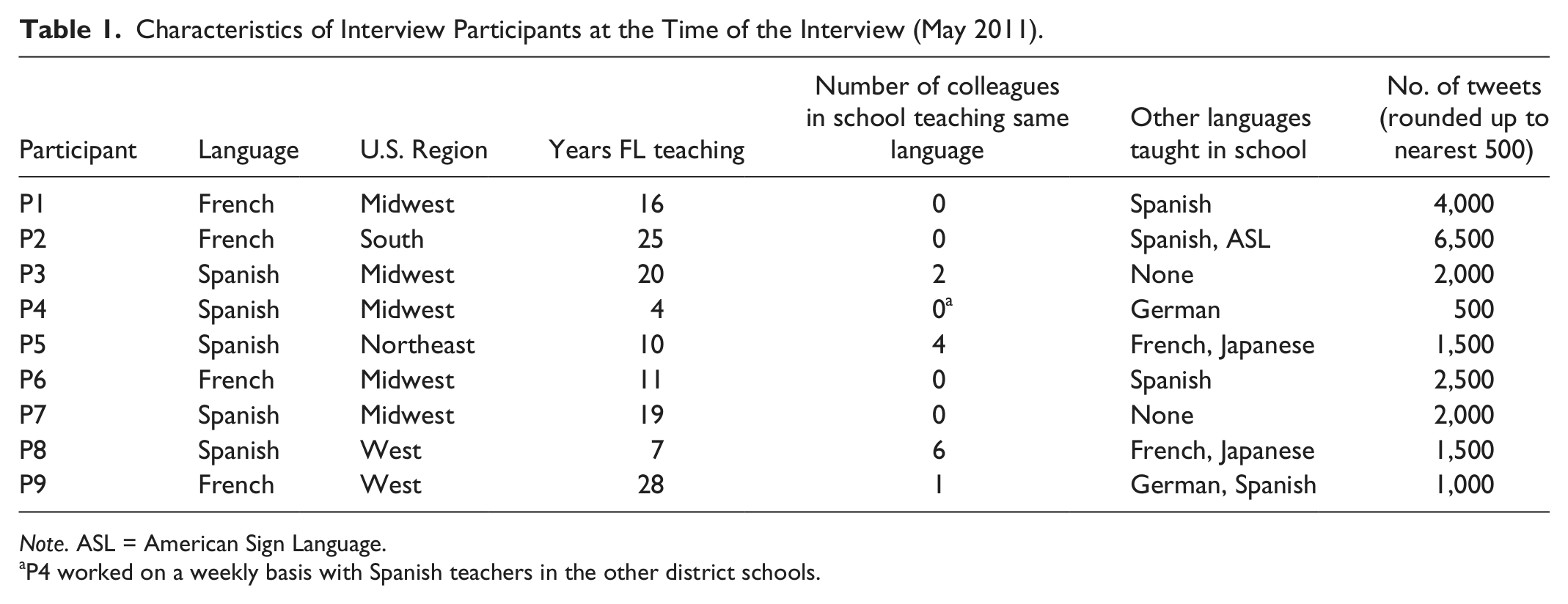
Note. ASL = American Sign Language.
P4 worked on a weekly basis with Spanish teachers in the other district schools.
Data Collection
The interviews with the nine primary informants were a key data source. Conducted via Skype video conferencing (six interviews) and Skype audio conferencing or telephone (three interviews), these semistructured interviews focused on four primary topics: the teachers’ background and teaching experience (e.g., “What type of training or education did you have in foreign language education?”), how they had used online resources to connect with other teachers (e.g., “Describe to me some of your online relationships in your professional community.”), how their participation in the online communities had or had not affected their teaching and their students’ learning (e.g., “Have you noticed any changes in how you teach language since communicating in this online professional community, like what?”), and advice that they would give teacher educators and other teachers about their online communities. I audiorecorded all of the interviews. These interviews lasted anywhere from 30 to 70 min. I then transcribed the interviews verbatim, and the transcripts were analyzed as outlined below.
Two other data sources involved researcher participant observation. The first was my participant observation in the daily interactions of WL teachers on Twitter from October 2010 to the present. This included regularly (at least three times a week) reading and, on occasion, transcribing or logging tweets from individuals in the community in a written document. In selecting the tweets to log, I focused on interactions among community members where there was clear collaboration, conflict, or evidence of change (e.g., differing viewpoints expressed followed by new, shared understandings) or, alternately and quite rarely, interactions where I saw an active avoidance of collaboration or change (e.g., differing viewpoints expressed followed by an individual refusing to continue to respond). I additionally logged tweets wherein community members tweeted about how they felt about the Twitter community, how they experienced this community, and how it was changing or affecting them as teachers. My participant observation also included responding to or retweeting tweets, and contributing to the community by tweeting my own thoughts and links related to WL teaching. As I did this, I kept an informal record of my thoughts and themes, which, prior to the interviews, then served to shape some of my interview questions. The second form of participant observation took the form of my frequent participation in two hashtag chats, #langchat and #edchat, on a weekly or biweekly basis starting in January, 2011. During these hashtag chats, I read what others had written, and I wrote my own responses. These chats were all archived and summarized online, and I used those transcripts and summaries as data sources.
The final data source was written documentation available online that related to this community of WL educators. As I participated in these communities, I collected and catalogued links through an online bookmarking website (Diigo). I linked to online documents like blog posts, teacher websites, wikis, commentary on the hashtag chat summaries, videos, slideshow presentations, and other work created or shared by the participants in this online CoP. Other widely shared documents also informed my knowledge of the community, including published articles available online about teachers and Twitter.
Data Analysis
Data analysis took place in several different phases. Throughout all phases, my field experiences as a participant observer served as a basis for a constant comparison with other elements of the analysis (Cohen et al., 2011). As new data were generated from additional observations, interviews, and online documents, they were compared with previously established categories in a repeated, consistent examination of the findings.
The first phase of analysis was pure participant observation as someone interested in WL education in the Twitter community of WL teachers. During this phase, I familiarized myself with the field and compared my field experiences with the scholarly literature on online communities of teacher education. I reflected, wrote notes on my experiences, logged tweets according to the preestablished criteria described above, and catalogued links. It was at the end of this first phase of analysis that I began to consider the notion of communities of practice as my theoretical framework.
After arranging and conducting the interviews, the second phase of analysis began. I coded the interviews using open coding during transcription (Cohen et al., 2011), identifying emergent themes. In coding manually, I rejected the notion that frequency solely indicated importance, instead focusing on intensity and uniqueness of expression in equal measure. In that I was conducting constant comparison with my field experiences as a participant observer, the codes also reflected what I had experienced personally as important aspects of the community.
After this initial open coding, in the third phase of analysis, those codes were set aside to create a conceptually clustered matrix (Miles & Huberman, 1994), with one row for each participant, and one column for each of the three main characteristics of communities of practice: domain, community, and practice. As I organized the interviewees’ statements into each of the columns, I noted which open codes fell in each column, thus beginning a process of more selective (or axial) coding (Cohen et al., 2011). Because most open codes did fall into one of the three columns, I was able at this point to verify my own adherence to the notion of communities of practice as a theoretical framework.
My fourth phase of analysis involved triangulating the conceptually clustered matrix with data from the other data sources, namely, documents and notes from participant observation, including logged tweets. Because this phase was a return to the data sources that grounded the first phase of the analysis, it represented an important verification of the themes that had developed in the coding and analysis of the interviews, requiring me to refine the explanations such that the final findings could embrace all data.
My fifth phase of analysis, a member check with the interviewees, served as another verification of my codes and themes (Miles & Huberman, 1994) of the results. Each of the nine interviewees examined a document that contained the primary themes identified through this coding (including all selective codes, as well as other open codes that did not qualify as selective codes). Each theme was supported by direct interviewee quotes, other observations and evidence, and interpretive statements of the themes. Interviewees were asked to comment on the themes, to add themes that they thought were relevant, and/or to suggest changes. None of the nine interviewees had any changes to suggest, and they all emphatically agreed with the descriptive themes as well as the interpretive statements.
My sixth phase of analysis took place after an initial draft of the manuscript was written, when it became clear that an important element of this study involved teacher learning. In this phase, I reread all of the transcripts to identify instances where the participants suggested that they had learned something, either indirectly or directly, and in a way connected to the sociocultural definition of learning. I then connected these statements with the previously established framework of communities of practice, so as to more explicitly address the issue of teacher learning in the manuscript itself.
Findings and Discussion
Several key characteristics can offer a preliminary overview of the culture of this CoP. The CoP of WL educators targeted in this study was a nonhierarchical, democratic community of educators, focused on their online relationships and yet similarly devoted to their classroom practice. Community members often overtly eschewed more conventional forms of professional development, with frequent tweets like “Twitter provides me with the best PD [professional development]!” Although self-promotion (tweet: “See my new blog post”) and a certain renegade spirit (tweet: “Teachers need the power to tell an admin to go fly a kite when an admin dumps his/her agenda on them”) were also aspects of the community, a more pervasive feeling was that of a supportive, friendly, knowledgeable, and ever-present network.
To best examine teacher learning in this CoP, the findings are organized according to the three primary characteristics of a CoP as outlined by Wenger (2006): domain, community, and practice. Each will, in turn, be connected with the notion of teacher learning. Table 2 is an edited version of the conceptually clustered matrix created during the initial analysis procedures, and its contents are explained in more detail throughout this section.
Matrix of Selective Codes Corresponding With the Notion of Communities of Practice.

Note. WL = world language; CoP = community of practice; PD = professional development.
Domain
The domain characteristic of a CoP suggests that members of that community have a shared commitment and competence (Wenger, 2006). Two different aspects of a shared domain of these teachers could be easily and immediately identified in this CoP. The members of the CoP in the present study identified themselves as experts in WL education. The members used Twitter as a way to share resources related to language teaching, the target culture(s), and other WL education tips and tricks. The level of discourse in the community was clearly one of experienced, connected WL educators, as evidenced by some of the topics of the #langchat chats, including differentiated instruction in the language classroom, teaching WLs without a textbook, and standards-based grading in the WL classroom. The #langchat interactions, as a result, were punctuated by frequent references to classroom practices, links to online curricula, and other evidence that the participants were experienced and knowledgeable WL educators. The second aspect of the community members’ domain was their expertise and competence in technology. As evidenced by their mere presence on Twitter, members of this CoP clearly sought technological innovation in a number of ways. Popular #langchat topics involved identifying the best Web 2.0 resources (#langchat, August 18, 2011) and best apps (#langchat August 25, 2011) for teaching WL. One telling statement was made by P5: “I love the Internet and looking around and exploring . . . I saw this Twitter business, so I checked it out, signed up. I couldn’t tell you how many [websites and web-based technologies] I’m signed up for, I sign up for almost everything.” P1 agreed: “My tech coordinator in our district has described me like a puppy—I’m one of those [teachers] where I need always more [technology]. I’m always looking to the next step and the next step and the next step.” The teachers who participated in the interviews all readily admitted that they were exceptionally interested in technology, due to personal interest and inclination.
The Domain As a Reflection of Learning
The idea of being learners was embraced actively by these participants, many of whom self-identified not just as educators and technology fans but also individuals who liked to learn. In fact, some teachers who participated in the hashtag chats like #edchat and #langchat made a clear distinction between the teachers who were engaged online in Twitter and their school colleagues who did not participate. This juxtaposition meant that the teachers in the online CoP distinguished themselves from others due to their shared domain as online teacher-learners (Wenger, 2006). Part of this was implicated in the community members’ dependence on decentralized decision making and distributed ownership (Vrasidas & Zembylas, 2004), as well as self-reliance and peer relationships rather than knowledge that was governed by an instructor-gatekeeper (Casey & Evans, 2011; Chapman et al., 2005; Vratulis & Dobson, 2008). P9 described one of his favorite aspects of being in the CoP as the following: “You get to collaborate [with others on Twitter] who love being students as well, and just be lifelong learners and enjoy [being learners] together, in [the online] community.” Other interviewees gave vivid explanations of why they considered the community to be a group of active learners like themselves. “For me, a lot of [being in the Twitter community] is about just the learning, and a lot of it is about the lessons as well, seeing other WL educators sharing ideas” (P8). P2 stated, “I love to learn stuff, so I’m always finding information [on the Internet via Twitter].” Note that we can only accept the CoP members’ self-identification as learners as partial evidence that learning was actually occurring in these communities, however. Simply because they identified themselves as interested in learning does not necessarily indicate that learning was occurring, although it is certainly an important factor in identifying their openness and inclination. For more direct evidence and examples, we must consider the other characteristics of this CoP.
Community
The community characteristic of a CoP, Wenger (2006) specified, requires that its members must “engage in joint activities and discussions” and “share information” (Wenger, 2006, p. 2). Since this dispersed online community connected primarily through its joint discussions, it certainly had this characteristic on the most basic level. In addition, Wenger specified that community members “[helped] each other” and “[built] relationships that [enabled] them to learn from each other” (Wenger, 2006, p. 2). This characteristic can be seen in how the teachers in this CoP depicted joining Twitter as a move from isolation to community.
Multiple data sources revealed that many CoP members had a profound feeling of professional isolation in their school environment. Many of the community members were objectively isolated, as either the only foreign language instructor in the district or the region, or the only teacher of a specific language in the school (see Table 1). One of the most markedly isolated teachers was P7, the only FL teacher in her rural Midwestern district, who also stated that, prior to the prevalence of online communities, “being able to reach out to things, places, people outside of my district has always been very hard.” Other forms of isolation among the interviewees included isolation because of being the only instructor of a particular language, or simply being in what P8 called “a one-room schoolhouse situation” where teachers of similar topics simply did not collaborate. Other data sources like #langchat conversations about the lack of administrative support and interdisciplinary collaboration supported the idea that many CoP members were experiencing isolation in their schools.
When these teachers described joining the CoP of WL teachers on Twitter, many depicted it as a transformation from working in isolation to finding a community. This is illustrated in the evidence about the domain of learners, wherein the participants tweeted and talked about finding their community. The relationships in this community were meaningful, explicit, and important to them. For instance, P6 described being “in this little cave” before Twitter, and then moving to a community of “people that reinforce and help me every day look forward to work, and look forward to teaching.” P2 identified her favorite community members as “he’s got [technology or ideas] I can use anywhere”; “she’s brilliant, her ideas are always the spark”; “that woman is all over the board, but . . . it seems always to hit the mark.” As a participant observer, I could see that I, too, was creating relationships with some of the other community members. We greeted one another regularly on Twitter; we recalled and referenced previous conversations, contexts, and experiences during our interactions; and we interacted with one another in a variety of formats, including email and even face to face. This CoP was certainly a community of learners who engaged regularly in dialogue and created meaningful relationships.
The Community As a Site of Learning
As outlined in the review of the literature, several scholars have argued that reflective dialogue and collaboration leads to deep learning (Avalos, 2011; Butler & Schnellert, 2012; Chapman et al., 2005; Jurasaite-Harbison & Rex, 2010; Wilson et al., 2011; Wright, 2010). Recall also that Wenger’s (2006) definition of community includes the notion that the participants “learn from one another” (p. 2). Unsurprisingly, as teachers testified to their transformation in joining and participating in this community, they also identified moments when they learned. One aspect of their learning occurred through the process of sharing and being made aware of new resources by other community members. As P1 stated, “If I want resources, I’ll go with Twitter” (P1); P9 similarly said “Twitter’s been a really helpful resource for me to find good stuff all over the place because people are really good about sharing [online resources] they’ve come across [on Twitter].” All nine interview participants mentioned the resources that they found in their Twitter community. In an interview with the New York Times, leaders of the #edchat team stated that the most useful contributions in the community came from those individuals willing to share resources (Schulten, 2011), a fact supported by my observations. Individuals in these communities maintained wikis of resources, public classroom blogs, and GoogleDocs for their students to use in collaboration.
Recall, however, that the scholarship on learning from a sociocultural perspective challenges the notion that sharing resources automatically equates with learning. Scholars have argued that, without evidence that communication goes beyond dissemination of good practice into advancing community knowledge and/or internalizing information so as to change behavior, very little can be claimed about learning (Hargreaves, 1999; Zhang, 2009). It was clear from the interviews and observations, however, that the teachers did indeed change their behavior based on their interactions with their fellow community members. Evidence from the interviews and the conversations on Twitter suggested that the teachers’ dialogue and interaction in the online community introduced them to ways of conducting class that were materially different from before; one interesting indication of this was the documented move that many had made from using paper in class to being essentially paperless (“I pretty much don’t touch paper any more” [P7]). Note also that the teachers who mentioned this shift also stated that they were not adhering to a new school policy on digital documents; they were simply making the shift due to their conversations about these ideas in the Twitter CoP. On another level, P1 described how she “stepped up” in integrating the resources into her class through mimicking a statement that she might make to her students: “Let me try to make [the new activity from my PLN] right for you.” P4 stated, “I can really dig deeper into materials and ideas of other teachers [in this Twitter CoP] and how they have presented information or different things they have done.” She then followed this with a description of changing an activity to be more accessible to kinesthetic learners based on a suggestion from her Twitter community, saying, “Twitter allows you to differentiate.” Accessing the community-generated resources was not just a matter of exposure to resources but rather a conscious, iterative process of participating in a dialogue with trusted colleagues, then integrating, revisiting, and even returning to share results about those practices. After my interview with P8, he sent me a follow-up email in which he expounded on the idea that the community was “opt-in,” stating that, “we see people spending hours each week [on Twitter] immersing themselves in topics and conversations . . . they are pursuing their own passions and benefiting as a result. It doesn’t feel like work.”
The community as a site of learning, therefore, went beyond giving teachers access to resources through their relationships. Joining this CoP, often from a position of isolation, led to teachers revisiting their assumptions about teaching, and then changing their behavior in a continuously transformative manner. This certainly suggests that learning was occurring as a by-product of their participation.
Practice
The practice characteristic of Wenger’s notion of communities of practice involves sustained interaction, sharing of ideas, debate, and contributions to a knowledge base (Wenger, 1998, 2006). In looking at this CoP, I found clear evidence of this characteristic in how individuals collaborated on projects, and sustained frequent dialogue and debate.
Community members collaborated formally on a variety of initiatives, including curriculum initiatives and regular online hashtag chats on specific topics. A notable instance of this was P4’s experience in creating and revising curriculum. She described her professional relationship with another individual in the CoP that eventually resulted in regularly scheduled video conference meetings about Standards-based reporting. This type of regular, sustained interaction leading to curriculum development and enhancement was common in this CoP (five out of the nine interviewees mentioned it directly), and clearly had a strong relationship with changing practice in the classroom. The highest profile collaborative effort in this CoP was the #langchat chats. The volunteer facilitators organized the crowdsourcing of the weekly topics, moderated the discussion, and maintained the #langchat wiki. The #langchat hashtag also provided a direct line to accessing and growing that knowledge base during times when the chat itself is not occurring. As P4 stated, [I like] being able to ask [on the #langchat hashtag]: “Hey maybe I don’t know how to present –ar verbs or something, I need help with this?” You can ask, and then put in the [#langchat] hashtag, so then the different foreign language teachers will look at it. And you instantly get [tweets] back of, “Well have you thought of this?”
My own experiences with this phenomenon were similar; I myself frequently answered and asked questions of the community. These questions were not simple information-accessing, either; as with P4’s situation, I answered questions about ways to teach certain concepts, what the research might say about other concepts, and the like.
Given the variety of methods that can exist in any one field of education, it should not be surprising that discussion, disagreement, and conflict were parts of the practice in this CoP; as Wenger, McDermott, and Snyder (2002) wrote, reconciling multiple agendas is an inherent challenge in cultivating a CoP. Some types of debate occurred naturally in the course of the #langchat chat sessions, such as in the following example, during a chat on the topic of assessing language proficiency 3 :
And students can always earn back half the points they lost by correcting afterward, with no limit on chances.
How are “points” a valid assessment? Points have nothing to do with proficiency in a language.
[B’s statement was retweeted several times, essentially echoed by other participants.]
Grades do not reflect anything.
I understand the sentiment, but it’s counterproductive in the way classrooms are forced to work.
Listen, I would love more than anyone to eliminate grades altogether. I have the most relaxed grading and late policy in school.
But the fact is I teach at a college-prep school and I have to assign points for production regardless of what I wish I could do.
No reason to defend, I think we can all agree that proficiency and grades don’t mesh.
I understand, really, but I also need to keep students and parents on my side.
Regarding parent/student expectations—it weighs very heavy in some contexts—not at all in others. That’s been my experience.
In advanced electives when all the potential valedictorians are in my class, VERY heavily.
Clearly, through this debate, the participants in this exchange reached an agreement about the fact that both of these ideas can and must coexist in our field. One blog post identified how one #langchat participant envisioned these interactions: Teachers should not feel attacked by people who (at least think they) already have the answers. They should be guided, shown what focusing on the [WL professional standards] instead of conjugation and precision can do for their students. They should not be sidelined until they agree to cooperate: They should be incorporated in the movement.
These different examples offered evidence that conflict and dialogue can and did occur within the framework of the #langchat discussions, and that it was a welcome part of contributing to the knowledge base.
The Close Relationship Between Learning and Practice
More than the domain and community components of CoPs, practice inherently implicates learning from the sociocultural perspective, primarily in that it challenges the notion that “media objects are almost never connected and indexed in a way that shows how they build on one another to address progressively deeper issues” (Zhang, 2009, p. 275). The process of indexing, reorganizing, explaining, and reframing resources was a key activity for many of the individuals involved in this CoP. Those who did not create these resources were consumers of them, looking at what others had created and responding to them. As such, this practice was closely linked to the movement from external, socially mediated activities to internal mediation that is controlled by the individual teacher, one of the most common definitions of learning from a sociocultural perspective.
This was done in part through participants contributing reflections and lessons on their public blogs. For instance, P2, who maintained a substantial classroom blog that she referenced regularly on Twitter, stated as follows: I like to share things that work well for me [on my blog], so that teachers don’t have to reinvent the wheel, and I decided to create a blog because I want other teachers to be able to have access to that. You know if I found something that was useful for me then why shouldn’t I share it with other teachers, and allow them to benefit from that, and tweak it, and make it theirs.
P9 similarly spoke about his blog, stating, “I started [the blog] as a place to be able to post things that I was telling people about and be able to get that information out there.” In this case, P9 was working on an innovative method for developing curriculum and teaching WL courses that can indeed be used by teachers in a variety of content areas. I personally have used his wikispace and several teacher blogs to supplement and enhance my own work with preservice teachers. I have also observed P9 fielding numerous questions on Twitter about the method described on his wiki.
Another way of developing the knowledge base was through the creation of wikis that summarized, processed, and sorted resources in a collaborative way. P3 referenced the #langchat wiki, which included summaries of all of the #langchat conversations, as one such contribution to the knowledge base. His reasons for doing so were closely linked with trying to contribute to a knowledge base: “When I started connecting [online] with these teachers and I started to collect resources, I was like, ‘Gosh, this is so fast, I cannot keep up writing down all different sources.’ And that’s when I created the wiki.” A third way that the individuals contributed to the knowledge base was through sorting and processing Tweets through the creation of public lists of individuals to follow. P8 stated as follows: For me, a lot of it is about reading . . . it’s like having this personalized referral service where I have people who I respect, and if they are tweeting out articles that I think are going to benefit me as a learner, I’m going to click on them . . . And so for me, a lot of [participating in the community] is just about the learning.
It is clear that these materials being provided are not just a process of learning for the creators but also for the other members of the CoP.
An important aspect of the practice characteristic of this CoP, as evidenced above, was the presence of debate and discussion in the face of multiple agendas and perspectives among the CoP members. The presence of this debate also strongly supports the notion that teachers were learning in this CoP. Chapman et al. (2005), in an investigation of deep learning in online communities, stated, “online professional discussions and debates between professional colleagues were rarely as divisive as the terms debate and discussion suggest,” and the authors maintained that they still could be taken as evidence that deep learning had taken place (p. 222).
These findings have shown that the community of WL educators on Twitter manifested the three characteristics of how Wenger defined a CoP: domain, community, and practice. In addition, despite the fact that this was an essentially dispersed online community, there was ample evidence to show that learning was taking place.
Considerations for the Future
Having established the potential for learning in this online CoP, we can now turn to the issue of expansion and development. It is clear that, among the devoted participants who elected to join this community, some measure of learning occurred. Due to the public nature of the interactions in this CoP, I would also suggest that other individuals more peripheral to the central conversations could have been learning from the CoP as well (see Wenger, 1998, for a further discussion of peripheral participation in CoPs). However, it does not necessarily follow that the same outcomes would occur for all WL teachers when faced with the opportunity of joining this community. Any expansion, development, or improvement of this CoP relies on the resolution of two interrelated issues: access and engagement.
With the access to the Internet in schools reported as 94% in 2005 (National Science Board, 2010) and widely assumed to be 100% today, it is clear that participating in this online CoP could be a viable cost-fee alternative for many teachers. Access, therefore, is not an issue of the physical or digital process of sitting before a computer, creating a Twitter account, and logging on. It is rather an issue of support and time. Researchers have noted a passivity and even resistance in teachers who were required to join communities grounded in collaborative web technologies (Brass & Mecoli, 2011; Y. Chen et al., 2009; Drexler et al., 2008). Thus, promoting participation in online professional development communities like the CoP outlined in this study must focus not on basic physical/digital access issues but rather on the social psychological factors that might act as barriers to teachers’ participation. One-on-one mentoring, multiple exposures to the community, low-stakes introductory sessions (e.g., one-time participation in a hashtag chat with a temporary Twitter account), and combining the CoP with established forms of professional development delivery might all serve to help teachers overcome their reservations. Based on the data generated in this study, it is advisable that collaborative Web technologies not be presented as a time-saver or a way to reach a specific goal, but rather as a way for teachers to find community and collaborators.
Relatedly, the issue of engagement is also important to consider when contextualizing this opportunity in the larger knowledge base about teacher professional development. Although seen by many participants in the CoP as a benefit, the lack of oversight, either by a university or by the teacher’s school, is commensurate with a lack of accountability. That is, this CoP presented learning opportunities to the community members only insofar as they chose to participate. This leads to the question of what happened when teachers did not feel dedicated and confident in this community; it must be assumed that there have been WL teachers who joined this Twitter community, but who then left due to some dissatisfaction. In this, the informal, self-directed, and ground up community for professional development referenced at the start of this article (Burns & Richards, 2009; Lieberman & Mace, 2010) resists being fully examined from the perspective of those who are not engaged or who have not learned. Although studies in institution-led online environments have been able to trace areas of discontinuity and problems for the participants (Brass & Mecoli, 2011; Y. Chen et al., 2009; Drexler et al., 2008), the present study simply did not generate these data due in large part to the dispersed, fluid nature of the CoP. Follow-up studies that address how learning occurred with individuals who either participated sporadically in the community or left the community would be very beneficial.
Conclusion
This study has demonstrated how collaborative web technologies facilitated the learning of WL teachers with a new and progressive form of professional development (Lieberman & Mace, 2010). Although there is a need to expand the study to other groups of teachers who participate in online CoPs, the community described in this study offers evidence that an online, dispersed CoP focused on professional development for teachers can successfully support learning in a variety of ways. In addition, this study reinforces the connections between the theoretical framework of CoPs, teacher professional development, and a sociocultural perspective on learning that have been established in previous work (Clarke & Clarke, 2009; Cuddapah & Clayton, 2011; Flint et al., 2011; Niesz, 2010; Takahashi, 2011), while also offering empirical evidence that this also applies to grassroots CoPs grounded in collaborative web technologies like Twitter. It is clear that the characteristics of having shared domains and ample resources did a great deal toward helping the teachers collaborate and learn, and designers of professional development for teachers can use this information to consider more hybrid forms of grassroots and externally imposed forms of professional development in the future. However, this study falls short of being able to facilitate “causal inferences about the impact of particular [professional development] designs on teaching and student learning” (Wei et al., 2010, p. 2). This study has laid the foundation to answer this question, and future research would be well advised to follow this important line of inquiry.
Footnotes
Acknowledgements
The author would like to offer her thanks to the anonymous reviewers and the editors of the journal for their extraordinarily helpful comments. Thanks also to administration and colleagues at the University of Iowa for their support of this research.
Declaration of Conflicting Interests
The author(s) declared no potential conflicts of interest with respect to the research, authorship, and/or publication of this article.
Funding
The author(s) disclosed receipt of the following financial support for the research, authorship, and/or publication of this article: The author appreciates the support of the Old Gold Summer Fellowship from the University of Iowa.