



Abstract
A major affordance of one-on-one mathematics coaching is its potential to provide individualized, contextualized support for mathematics teachers’ learning. Coaches can adjust their work to individual teachers by focusing on instructional improvement goals that take account of teachers’ current knowledge, practice, and classroom contexts. It is, however, essential that coaches and teachers work to attain productive instructional improvement goals that are both feasible for teachers to attain and likely to result in immediate improvements in students’ learning, if attained. In this article, we describe how coaches can identify productive goals for individual teachers and then, on that basis, negotiate goals successfully with teachers, thereby supporting teachers in seeing productive goals as worthwhile. By describing these two processes, we further clarify the forms of coaching-specific expertise central to effective one-on-one mathematics coaching.
Introduction
States across the United States are implementing standards that outline rigorous goals for students’ mathematical learning (e.g., Peterson et al., 2016). Educational researchers have identified the types of ambitious, inquiry-oriented mathematics lessons that can enable students to attain such goals. These lessons are organized around cognitively demanding tasks (Stein et al., 1996; Stein & Lane, 1996) and typically feature three phases: introducing cognitively demanding tasks, engaging students in small group or independent work time, and facilitating a concluding whole-class discussion (e.g., Lappan et al., 2009; Van de Walle, 1998). Mathematics education researchers have also reached consensus on the ambitious and equitable instructional practices that are central to teachers’ effective enactment of such lessons (Lampert et al., 2010; Lampert & Graziani, 2009; National Council of Teachers of Mathematics, 2014). These practices include, among others, introducing tasks so that all students can begin working productively without lowering the cognitive demand (Jackson et al., 2013) and facilitating mathematics discussions in which teachers press and support students to explain their reasoning in ways that other students can understand and make connections between solution strategies (Stein et al., 2008).
Ambitious mathematics lessons are, however, not typical of most U.S. mathematics classrooms (Stigler & Hiebert, 2009). Enacting such lessons effectively will therefore require many mathematics teachers to reorganize their current ways of teaching. Doing so involves significant professional learning and thus sustained, job-embedded support (Cohen & Hill, 2001; Darling-Hammond & Richardson, 2009). In this article, we focus on one-on-one mathematics coaching as a key means of supporting mathematics teachers in learning to design and enact ambitious mathematics lessons effectively (Hull et al., 2009).
A major affordance of one-on-one mathematics coaching is its potential to provide individualized support for mathematics teachers’ learning that is grounded in their classroom contexts and practices (Bengo, 2016; Saclarides & Munson, 2021). In many ways, the rationale for one-on-one coaching parallels that for teachers working one-on-one with individual students. When working with individual students, for example, it is essential for teachers to keep in mind immediate next steps for a student’s learning, as those next steps orient the decisions a teacher makes when working with that student. It is similarly important for coaches to keep in mind next steps for a teacher’s improvement in their knowledge and practices, as those next steps constitute instructional improvement goals that can inform coaches’ decisions about how best to support the teacher (Gibbons & Cobb, 2016).
Coaches can adjust their work to specific teachers by focusing on improvement goals that take account of individual teachers’ current knowledge and practice, their classroom contexts, and their students’ learning (Gibbons & Cobb, 2016; Olson & Barrett, 2004). It is, however, important that these improvement goals focus on feasible instructional changes that build directly from teachers’ current knowledge and practices and are thus within reach, given adequate support. In addition, it is essential that instructional improvement goals focus on instructional changes that are likely to immediately enhance students’ learning in future lessons. As we clarify below, we use the term productive instructional improvement goals to refer to goals that are both feasible for a teacher to attain and likely to improve students’ learning in future lessons.
Furthermore, it is important that teachers have a voice in and contribute to the goal-setting process. Thus, although coaches might identify productive improvement goals for individual teachers (Gibbons & Cobb, 2016), it is crucial that they also explicitly negotiate possible goals with teachers (Robertson et al., 2020; Saclarides, 2022). This aspect of one-on-one coaching work is essential because teachers are unlikely to engage in the challenging work of improving their instruction if they do not see the changes they are attempting to make as both reasonable and worth pursuing (Atteberry & Bryk, 2011; Olson & Barrett, 2004).
Although identifying productive improvement goals for individual teachers and then negotiating those goals with teachers are important aspects of effective one-on-one coaching, the current coaching literature provides only limited guidance regarding how coaches can accomplish these tasks effectively. The primary goal of the study on which we report was to address this gap in the literature by investigating how coaches can enact these two important aspects of one-on-one mathematics coaching effectively. In what follows, we further explain and justify the two criteria we have proposed for productive instructional improvement goals and then review the current literature related to identifying and negotiating instructional improvement goals in one-on-one coaching.
Criteria for Productive Instructional Improvement Goals
We consider an instructional improvement goal to be productive if it specifies a change in an individual mathematics teacher’s instruction that is (a) feasible for the teacher to attain provided the teacher receives adequate support and is (b) likely to result in improvements in students’ learning in subsequent lessons. We consider an improvement goal to be feasible if it focuses on an instructional change that builds directly on the teacher’s current knowledge and instructional practices and thus constitutes a next step in the teacher’s development (Gibbons & Cobb, 2016). For example, it might be feasible for a teacher who is already conducting whole-class discussions in which students share their reasoning to focus on supporting students to explain their reasoning in ways that other students can understand. In contrast, this instructional improvement goal is probably not feasible for teachers unless they have already begun to conduct such discussions and are at least somewhat accomplished at eliciting their students’ reasoning. As we discuss later in the article, this criterion assumes that a teacher receives the support and resources necessary for the teacher to make the instructional change.
The second criterion for productive goals follows directly from the observation that students’ learning opportunities in any phase of a lesson depend, in part, on the quality of prior phases. As outlined previously, ambitious mathematics lessons are organized around cognitively demanding tasks and typically have three phases: the teacher introduces the task(s), students work on the tasks(s) individually or in small groups, and the teacher leads a concluding whole-class discussion. The quality of each of these phases has implications for the quality of subsequent phases and thus for students’ learning opportunities. For example, teachers can enhance students’ learning opportunities in whole-class discussions by supporting them to explain their reasoning and by pressing students to make connections between different solution strategies (Stein et al., 2008). However, it is almost impossible for teachers to facilitate high-quality discussions of this type unless students have solved tasks in a range of different ways during independent or small group work time. This, in turn, depends on whether teachers select cognitively demanding tasks that afford a range of solution strategies (Smith & Stein, 2011) and on whether teachers introduce tasks in ways that enable all students to begin working productively without prescribing a solution strategy (Jackson et al., 2013).
Given the interdependence of lesson phases, making instructional changes in later phases of lessons will likely not improve students’ learning in subsequent lessons unless the teacher’s enactment of prior phases is relatively accomplished. It is therefore essential for coaches to focus instructional improvement goals on the phase of the lesson in which students’ learning first breaks down. For example, if a coach were to look at the range of students’ solutions during individual or small group work time and see that the range was such that the teacher could lead a productive discussion, then the coach might focus an instructional improvement goal on the discussion phase of the lesson. If not, then the coach might look to earlier phases of the lesson to understand why there was limited potential for a productive discussion. If students were able to work meaningfully but the range of solution strategies was still limited, then the coach might look to see whether the teacher prescribed a solution strategy for the task(s) in the launch or whether the selected task(s) limited the range of strategies. If students were unable to work meaningfully, then the coach might choose to focus on launching tasks in such a way as to enable broad and active student engagement.
Literature Review
Identifying Instructional Improvement Goals
Findings of prior studies indicate that identifying goals for teachers’ improvement in their instructional practices is a key aspect of one-on-one coaching (e.g., Gibbons & Cobb, 2016; Olson & Barrett, 2004). However, prior research provides only limited guidance regarding the processes by which coaches can identify productive instructional improvement goals that satisfy the two criteria we have proposed. Several scholars describe coaching programs in which coaches identify goals based on teachers’ assessments of their current instruction and their students’ learning (Knight, 2007; Sailors & Price, 2015). In general, this approach is justified on the grounds that teachers are professionals, and they thus have specialized knowledge of their classroom and students.
However, identifying instructional improvement goals based solely on teachers’ perspectives runs the risk of ignoring coaches’ intended role as more accomplished others, and thus a key aspect of the rationale for one-on-one coaching. Furthermore, this approach assumes it is reasonable to expect teachers to identify the instructional changes that are most pressing based on self-assessments of their current practices and perspectives on teaching and learning. This kind of self-assessment is challenging and, as Valoyes-Chávez (2019) observes, requires teachers to coordinate their own perspectives on mathematics teaching and learning with other perspectives, including both those rooted in their local contexts and those that have been more broadly articulated by professional organizations such as the National Council of Teachers of Mathematics (NCTM). While some teachers may be prepared to engage in such self-assessment, they are often the exception rather than the rule in most schools and districts (Cobb et al., 2020). Consequently, many teachers will require support to identify productive instructional improvement goals. However, we note that it is important for coaches to ensure that teachers have a voice in the goal-setting process by eliciting their perspectives on the goals they aspire to attain, what counts as high-quality instruction, their students’ current capabilities, and their school contexts (Bengo, 2016; Knight, 2007; Robertson et al., 2020).
In contrast to approaches that prioritize teachers’ self-assessments, other researchers suggest that coaches should identify instructional improvement goals based on school-wide, district-wide, or program-specific priorities (e.g., Haneda et al., 2017; Killion, 2010; Teemant et al., 2011). However, this approach does not take account of teachers’ current practices, knowledge, and perspectives and thus their students’ current learning opportunities. It therefore overlooks an important affordance of one-on-one coaching, that coaches can tailor improvement goals to teachers’ current practices and classroom contexts. As such, the extent to which this approach results in the identification of productive instructional improvement goals relies on a fortuitous match between district priorities and a teacher’s current development.
An alternative to these two approaches involves identifying improvement goals specific to teachers’ current knowledge, perspectives, and practices. Our review of the coaching literature found only one empirical study that closely examined how mathematics coaches can identify personalized goals for individual teachers’ improvement in their instructional practices (Gibbons & Cobb, 2016). In this study, the authors analyzed the planning practices of an accomplished mathematics coach who routinely engaged individual teachers in potentially productive coaching activities. As part of their analysis, the authors found that the focal coach identified teacher learning goals by (a) observing and relating individual teachers’ current instructional practices and their students’ learning and (b) locating individual teachers’ practices on trajectories that she had “delineated for novice and veteran teachers’ learning” (p. 251). These findings clarify how mathematics coaches can identify feasible instructional improvement goals that are justifiable, given teachers’ current knowledge and practices.
Looking beyond this contribution, it is important to note that this study relied on interviews with the focal coach and did not include observations of the focal coach attempting to support individual teachers’ learning. Thus, although the authors described the focal coach’s self-reported process for identifying goals, they were unable to examine the processes by which the coach identified improvement goals for teachers. Furthermore, this study did not examine whether and how the focal mathematics coach identified goals that were not only feasible but that would result in improvements in students’ learning. There is thus a need to better understand how mathematics coaches can identify improvement goals that meet both criteria we have proposed.
Negotiating Instructional Improvement Goals
In addition to identifying goals for teachers’ improvement of their instructional practices, it is essential that coaches support teachers in coming to see productive instructional improvement goals as worth pursuing (Olson & Barrett, 2004). Coaches can accomplish this by negotiating instructional improvement goals with teachers and thus engaging teachers in multivocal conversations in which the teacher and the coach each have a say in the establishment of an improvement goal. Multivocal conversations contrast with univocal goal-setting conversations in which the coach either accepts the improvement goals the teacher has identified at face value or prescribes an improvement goal without attending to the teacher’s views on the matter. Like identifying productive instructional improvement goals, the current coaching literature provides only limited guidance regarding the process by which coaches can negotiate goals effectively with teachers.
In a large-scale analysis of literacy coaching, Atteberry and Bryk (2011) acknowledged that the effectiveness of one-on-one coaching depends, in part, on the extent to which coaches foster teachers’ will and agency to improve specific aspects of their instruction. This speaks to the underlying aims of effective negotiations. However, Atteberry and Bryk did not clarify how coaches can support teachers in developing the will and agency to develop ambitious instructional practices. At the same time, a small but increasing number of scholars have proposed that coaches should determine improvement goals in collaboration with teachers (e.g., Haneda et al., 2017; Robertson et al., 2020; Saclarides, 2022; Teemant et al., 2011), indicating the importance of ascribing agency to teachers and fostering their commitment to improvement efforts. However, of these scholars, only Haneda et al. (2017) and Robertson et al. (2020) closely examined the processes by which coaches and teachers determined goals together.
In their study, Haneda and colleagues described how an accomplished literacy coach supported an individual teacher in coming to see specific improvements as worth pursuing over time. They reported that the coach engaged the teacher in ongoing “dialogues” that appeared to be multivocal in which the coach elicited and then reframed (rather than challenged or accepted) the teacher’s current ways of thinking about instruction. Over the course of these ongoing exchanges, the coach supported the teacher in coming to see the value of the goals the coach had identified. This study contributes to our understanding of goal-setting negotiations by indicating that effective negotiations are multivocal and involve eliciting and pressing on teachers’ current problems of practice, thereby giving the teacher a voice in determining instructional improvement goals. However, the coaching program that Haneda and colleagues studied aimed to support teachers in incorporating a predetermined set of practices into their current instructional routines. Consequently, the authors did not consider the extent to which the coach-teacher dialogues resulted in improvement goals that were feasible for the participating teachers to attain and would improve students’ learning, if attained.
Similarly, Robertson and colleagues (2020) examined the ways in which five literacy coaches established improvement goals with teachers. In this study, the authors identified “discourse actions” that characterized the goal-setting interactions that resulted in teachers acting on (or taking up) the agreed-upon goals, including “opening the floor through elicitations and affirmations, seeking further clarification, noticing and naming existing teaching behaviors as the foundation for new or refined behaviors, and providing expansions of strategic pedagogical knowledge” (p. 16). This study further clarifies key characteristics of effective goal-setting conversations. However, the authors did not address whether attaining the agreed-upon goals would result in improvements in students’ learning.
Research Questions
As discussed earlier, there are gaps in the existing literature regarding how coaches can identify productive instructional improvement goals and then negotiate productive goals with teachers. Addressing these gaps was the primary aim of the study on which we report. The following research questions guided this work:
Research Context: Coach Professional Development Design Study
The literature indicates that only a small minority of mathematics coaches are currently identifying and negotiating productive instructional improvement goals with teachers. We therefore addressed our two research questions in a context in which coaches were receiving support for identifying and negotiating productive goals effectively, thereby increasing the likelihood we would be able to investigate the phenomena of interest (Cobb et al., 2003). The context was a coach professional development (PD) design study that aimed to support 15 middle-grade and secondary mathematics coaches in learning to enact one-on-one coaching cycles effectively with teachers. The findings of several prior studies indicate that enacting coaching cycles effectively involves setting improvement goals with teachers (Robertson et al., 2020; Russell et al., 2020; Saclarides, 2022; Teemant et al., 2011). The coach PD therefore included an intentional effort to support the participating coaches in identifying and negotiating productive instructional improvement goals, making it an appropriate context for our study.
Overview of Coach Professional Development Design Study
In the design study, researchers collaborated with the mathematics instructional leaders of a large urban school district to design and facilitate a sequence of eight monthly coach PD sessions across a school year. Each session focused on a key aspect of coaching practice central to enacting one-on-one coaching cycles effectively, including identifying productive instructional improvement goals (second PD session) and negotiating productive goals (third PD session). We revisited both issues in subsequent sessions and supported the participating mathematics coaches in connecting them to other key aspects of one-on-one coaching cycles.
As part of the PD, we asked all 15 participating coaches to enact a coaching cycle with the same teacher after each of the eight sessions so that they could try out the ideas addressed in the PD sessions. We collected data to document the coaching cycles enacted by seven of the 15 coaches across the school year. We selected these seven coaches to be representative of the entire group in terms of coaching experience, thus enabling us to make inferences about whether and how the PD supported the learning of coaches with different levels of experience. Four of the seven focal coaches were in their first year of coaching, two had extensive coaching experience in the district, and one had multiple years of coaching experience but was new to the district. Although we documented the coaches’ learning and the means of supporting that learning as part of the larger design study, this was not the focus of this particular study. Instead, we will focus on coaches’ learning in a separate analysis that builds on this study. Below, we discuss one-on-one coaching cycles in detail and illustrate how identifying and negotiating instructional improvement goals are central to their effective enactment.
One-on-One Coaching Cycles
As typically described in the literature (e.g., West & Staub, 2003), one-on-one coaching cycles consist of three phases: (a) a lesson planning phase, (b) a lesson enactment phase, and (c) a lesson debrief phase. It is essential that the coach and teacher identify and agree upon an instructional improvement goal prior to beginning a cycle, as the agreed-upon goal orients their work in each of the three phases (Russell et al., 2020). Preparing for the first coaching cycle with a teacher therefore involves identifying and negotiating productive instructional improvement goals prior to beginning the cycle (see Figure 1).
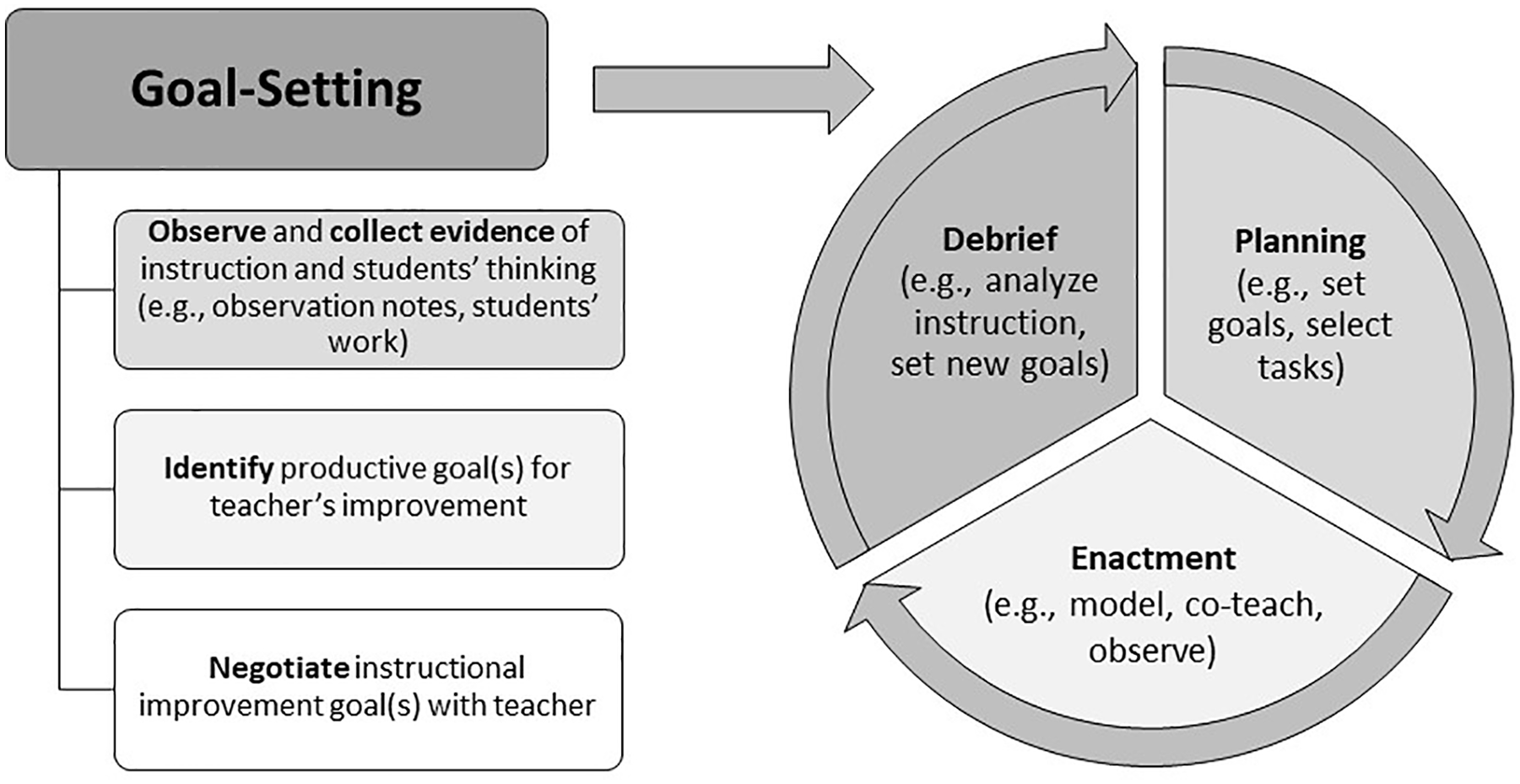
Goal-Setting Process and One-on-One Coaching Cycle.
In the lesson planning phase, coaches revisit the previously agreed upon instructional improvement goals, determine student learning goals for the focal lesson, select instructional tasks consistent with those learning goals, and then work together to plan for the teacher’s enactment of the lesson while paying particular attention to the instructional changes necessary to make progress toward the agreed upon instructional improvement goal (Russell et al., 2020). Russell et al.’s (2020) findings indicate that facilitating planning conversations effectively involves engaging teachers in “deep and specific discussions” that link mathematical learning goals, students’ thinking, and instruction (p. 9). The aspects of instruction on which coaches and teachers focus during these deep and specific discussions is informed by previously agreed upon instructional improvement goals.
The role typically attributed to the coach during the enactment phase of a coaching cycle is to observe the focal lesson and collect evidence of students’ thinking and instruction (West & Staub, 2003). However, recent work on coaching indicates that it can be productive for coaches to model instruction for the teacher or co-teach with the teacher during this phase (Campbell & Malkus, 2014; Saclarides & Munson, 2021). The PD therefore aimed to support the participating coaches in determining when it would be useful to model, co-teach, or observe instruction. This determination depends, in part, on the instructional improvement goal that the coach and the teacher have agreed to pursue.
Finally, in the debriefing phase, the coach and teacher analyze the enactment of the co-planned lesson. In a study of literacy coaches’ practices, Matsumura and colleagues (2019) argue that facilitating debriefing conversations effectively involves supporting teachers to analyze students’ learning and instruction in relation to the goals of the lesson. In line with effective formative assessment practices, the coach and teacher analyze instruction to explain why students learned what they learned in the lesson, in the process identifying instructional strengths and weaknesses (Saclarides, 2022). As part of this analysis, the coach and teacher revisit the agreed upon instructional improvement goal to determine whether the teacher has made progress. If this is the case, the coach initiates a negotiation of a new instructional improvement goal that then orients the next coaching cycle.
Thus, debriefing the lesson effectively can involve negotiating instructional improvement goals with teachers. It is therefore important that coaches prepare for the debrief phase by identifying a productive instructional improvement goal after the classroom instruction phase. For the purposes of this analysis, this means that the initial goal-setting processes prior to the first coaching cycle conducted with a teacher and the subsequent coaching cycles with that teacher are both feasible contexts in which to investigate our research questions.
Method
Data Collection
Over the course of the design study, we collected data to document seven focal coaches’ practices as they enacted coaching cycles with teachers. Three trained data collectors, the project coordinator for the research study, and the first author collected the data. In total, we documented 28 coaching cycles. Figure 2 outlines the data collection process and highlights the data collected in each of the three phases of a coaching cycle.
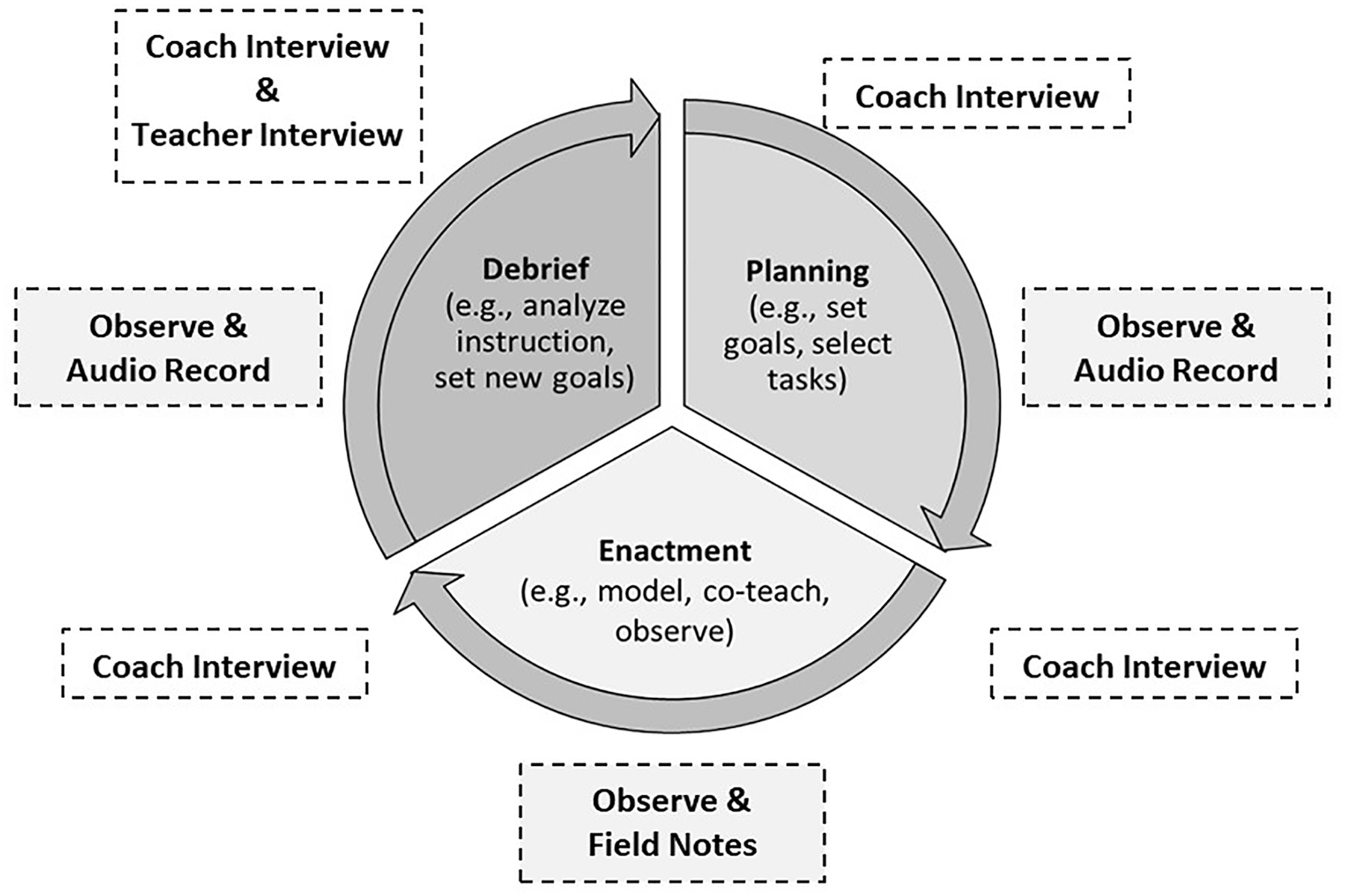
Data Collection Process.
At the beginning of each cycle, data collectors conducted an audio-recorded, semi-structured interview with the coaches to understand what they intended to accomplish in the planning phase of the coaching cycle. The data collectors asked coaches to describe their plans for the upcoming planning conversation, including the issues the coaches intended to raise with the teachers and how those issues related to the instructional improvement goals identified either during an initial goal-setting process or in the prior cycle. Data collectors then observed and audio-recorded the co-planning conversations and conducted a follow-up interview with coaches. The goal of this second interview was coaches’ interpretations of the co-planning conversation and what coaches perceived to be their role in the upcoming lesson enactment phase.
Data collectors observed the enactment of the lesson using a structured observation protocol. The goal of the structured lesson observation protocol was to collect data that would enable us to determine where in the lesson students’ learning broke down, and thus enable us to determine (a) whether the teacher was making progress toward the current improvement goal and (b) whether the next improvement goal was productive. Specifically, the observation protocol oriented observers to collect the task(s) used in the lesson and document the level of rigor of the task(s); document how the teacher (or coach) launched the task and whether the launch enabled all students begin working productively on the task(s); document the range of students’ solution strategies during group or individual work by taking notes on students’ strategies and taking pictures of students’ work to represent the range of strategies; and documenting whether and how the teacher (or coach) elicited students’ reasoning and supported them to make connections between solution strategies during the whole class discussion.
After the lesson enactment phase, data collectors conducted a third semi-structured interview with coaches. The aim of these interviews was to determine whether coaches thought teachers had made progress toward previously identified improvement goals, what coaches saw as new improvement goals for the next cycle if teachers had made progress, and how coaches determined the new goals. Data collectors, therefore, asked coaches questions related to each of these three issues.
Next, the data collectors observed and audio-recorded the debriefing conversations and then conducted a fourth interview with the coaches. The intent of these interviews was to clarify coaches’ interpretations of the debriefing conversation. In the concluding interviews, we asked coaches to explain whether they had discussed and agreed upon an improvement goal for the next cycle with their partner teacher, and, if so, what the goal was. Data collectors also conducted semi-structured interviews with the participating teachers after the debrief conversation. In the teacher interviews, data collectors asked teachers to share what they understood to be the instructional improvement goals that resulted from the debrief conversation in which they had just engaged, with the idea that this goal would then inform the next cycle. Data collectors also asked the teachers to explain why they had agreed to the improvement goals.
Data Analysis
We conducted two separate analyses to answer our two research questions.
Analysis 1: Identifying Productive Instructional Improvement Goals
To determine how coaches can identify productive instructional improvement goals, we analyzed (a) the interviews conducted with the coaches following the classroom instruction phase of the coaching cycle and (b) our structured observation notes from the focal lesson. We focused on these data because the interviews with coaches included an explicit focus on coaches’ goal identification processes. The observation notes provided us with information against which we could compare the coach’s determinations. We conducted our analysis in three phases.
Phase 1: Classifying Cycles
We analyzed each of the 28 cycles to determine whether the coach identified an instructional improvement goal that was (a) feasible for the teacher to attain and (b) would improve students’ learning, if attained, thereby satisfying our criteria for productive instructional improvement goals. To make this determination, we first listened to the coach interviews following the lesson observation and recorded the goals the coaches identified for their individual teachers. We then compared the goals the coaches identified with the structured lesson observation notes and students’ work from the corresponding lesson.
We considered an improvement goal to be feasible if it focused on a specific instructional change in a phase of lessons that the teacher was already implementing, as this indicated the teacher could attempt to make the proposed change. For example, working to strategically sequence students’ strategies during a whole class discussion would constitute a feasible goal for a teacher if the structured lesson observation notes indicated that the teacher was already attempting to facilitate whole class discussions. In contrast, this would not be a feasible goal if the teacher was yet to engage students in discussions in which they shared their strategies. We also considered an improvement goal to be feasible if it involved implementing a phase of a lesson for the first time. For example, in the contrasting example above, it would be feasible for the teacher to try out a whole class discussion for the first time.
We determined whether attaining the improvement goal the coach identified would enhance students’ learning by comparing it with the improvement goal we identified based on our analysis of the structured lesson observation notes and the students’ work. This comparison involved several steps. First, we analyzed the structured lesson observation notes and students’ work to determine in which phase of the lesson students’ learning initially broke down, and thus which phase, if improved, would enhance students’ learning opportunities in subsequent lessons. In one case, for example, the structured lesson observation notes and students’ work indicated that almost all students solved the task by using a strategy the teacher proposed when launching the task, thereby limiting the range of possible solution strategies. In the concluding discussion, the teacher called on a single student to share how he had used the teacher’s strategy. Based on the structured lesson observation notes, we determined that students’ learning initially broke down during the launch phase of the lesson because the teacher demonstrated a specific method for solving the task(s), and the subsequent phases of the lesson depend on students using a range of strategies to solve tasks. We therefore concluded that students’ learning would be enhanced if the coach supported the teacher in improving how she launched tasks.
Here, it is worth noting that both authors have extensive experience analyzing students’ learning opportunities in mathematics lessons and relating those opportunities to teachers’ instruction. To check our findings, both authors independently analyzed seven of the 28 cases and compared the phases of the lessons in which we determined that students’ learning first broke down. We found that we agreed in all seven cases.
We next compared the results of our analysis with the improvement goals the coaches identified. We identified 13 cases in which the coach proposed a goal that focused on the same phase of the lesson as the goal we identified. We took this as an indication that attaining the goal the coach proposed would enhance students’ learning. In the remaining 15 cases, the coaches identified goals that focused on different phases of the lessons than the goals we identified. For these 15 cases, we conducted a second review of the structured lesson observation notes, students’ work, and coach interviews to see if the goals the coaches proposed were justifiable. This second analysis confirmed our initial assessment in all but one case. In this case, the coach’s proposed goal focused on the design and implementation of exit tickets at the end of the lesson, whereas our analysis indicated that it would be productive to focus on the whole class discussion. However, in reviewing the structured lesson observation notes alongside the coach’s rationale for her proposed goal, we realized that designing and implementing exit tickets would enable the teacher to better understand what students learned in the whole class discussion phase of lessons. We therefore determined that the coach’s proposed goal might enhance students’ learning in subsequent lessons.
Phase 2: Delineating Coaches’ Strategies for Identifying Goals
Next, we delineated how the coaches identified instructional improvement goals in each of the 28 coaching cycles by analyzing the coach interviews conducted after the classroom instruction phase. We identified episodes in each interview in which coaches responded to direct or implied questions about how they had identified goals for teachers’ improvement of their instructional practices. Because there is limited prior research on this topic, we developed inductive codes to account for the different goal identification strategies that the coaches described (Corbin & Strauss, 2015), although we drew upon ideas in the coaching literature to define these codes when possible. The coding scheme included codes that indicated whether the coaches analyzed the lesson in detail to identify an instructional improvement goal, and, if they did, how they analyzed the lesson. For example, in cases where coaches analyzed a lesson to identify a goal and did so by focusing on teachers’ actions, we coded for whether the coaches focused on the teacher’s actions that supported students’ learning, whether the coaches focused on teachers’ actions that delimited students’ learning, or whether they focused on the teacher’s actions with no link to students’ learning. We also coded for instances in which coaches determined improvement goals without analyzing a lesson, as well as how they did so.
Phase 3: Comparing Strategies for Goal Identification
In the final phase of the analysis, we compared the 14 cycles in which coaches identified productive goals with the 14 in which they did not. We did so to identify differences in the coaches’ strategies for identifying goals that explained why they did or did not identify productive goals. The first author created a matrix displaying the relationship between the coaches’ strategies and the outcome and then wrote a memo detailing possible relationships. We then discussed the memo and the matrix, reaching consensus on our conclusions.
Analysis 2: Negotiating Productive Instructional Improvement Goals
In the second analysis, we examined the 14 cycles in which the coaches identified productive instructional improvement goals to determine how coaches can negotiate goals successfully with teachers, such that teachers come to see a productive goal as worthwhile. We focused only on these cycles because identifying productive goals is a prerequisite to negotiating productive goals successfully with teachers, as the goals coaches identify serve as the basis for their negotiations with teachers. This analysis consisted of three phases.
Phase 1: Comparing Coach and Teacher Instructional Improvement Goals
In the first phase of our analysis, we reviewed the coach and teacher interviews conducted at the end of each of the 14 coaching cycles to determine whether the coach successfully negotiated a productive goal with the teacher. Operationally, we characterized successful negotiations as those that resulted in the coach and teacher stating compatible, productive instructional improvement goals and in the teacher indicating this goal was worth pursuing. To determine whether coaches and teachers stated compatible goals, we first analyzed the coach and teacher interviews separately, recording the goals they each indicated using their own language. Next, we compared their goals to determine whether they referenced the same phase of lessons, such as the whole class discussion, and whether they referenced the same change in instruction within that phase, such as improving the sequencing of student solutions during whole class discussions. Finally, we reviewed the teacher interviews to infer whether they considered the goals to be worthwhile. In all cases, this was relatively straightforward, as the teachers offered reasons why they wanted to pursue the improvement goals they proposed.
Phase 2: Confirm Whether Agreed-Upon Goals Were Productive
We then analyzed the cases in which the coach and teacher agreed on a goal to confirm whether the agreed-upon goal was productive. We did so because it is possible for a coach and teacher to agree upon a different goal than the one the coach identified prior to the negotiation. For cases in which the coach and teacher agreed to a different goal than the one the coach had initially identified, we determined whether the new goal was productive by following the process we used to address our first research question.
Phase 3: Comparing Successful and Unsuccessful Negotiations
In the third and final phase of our analysis, we compared the cases in which the coach and teacher agreed on a productive goal to those in which the coach and teacher either agreed to an unproductive goal or did not agree upon a goal. Our intent was to understand why some negotiations were successful and others were not.
To accomplish this, we segmented the debrief conversations into distinct episodes that began when the coach or teacher initiated a new topic of conversation and ended when the coach or teacher initiated a shift to a different topic. We then developed inductive codes to characterize the topics for each segment (e.g., what students learned in the lesson, whether the teacher has made progress on past improvement goals, explicit discussion of future improvement goals) as well as who initiated each topic (e.g., coach prompted, teacher prompted). In one debrief conversation, for example, the coach asked the teacher to look at student work from the lesson and consider what students learned. We applied the codes “coach prompted” and “what students learned in the lesson” to this episode. At another point in this debrief conversation, the coach asked the teacher to respond to the question, “What do you think your next steps are?” We applied the codes “coach prompted” and “explicit discussion of future improvement goals.”
Finally, we identified episodes in which the coach and teacher explicitly discussed future improvement goals and conducted a follow-up analysis that focused on the coach’s actions during these episodes. We again developed inductive codes to describe what coaches did during these debriefs. We compared the coaches’ actions during the relevant episodes to clarify distinctions in what coaches did that explained why they were successful or unsuccessful in negotiating goals.
Findings
Analysis 1: Identifying Productive Goals for Teachers’ Improvement of Their Instructional Practices
There was evidence that coaches identified productive goals in 14 of the 28 cycles. The ways in which coaches identified instructional improvement goals fell into three broad categories: (a) identify a goal based on either district priorities or the teacher’s preferences, (b) identify a goal based on an analysis of the teacher’s instruction in the focal lesson, and (c) identify a goal based on an analysis of the focal lesson in which coaches connected the teacher’s instruction with students’ learning. Table 1 shows that, in all cycles in which the coach identified a productive goal, the coach analyzed the teacher’s instruction in relation to students’ learning. In other words, in these cycles, the coaches explicitly linked students’ learning in the lesson with instruction by considering the consequences of particular instructional decisions or actions for students’ learning. In most cases, the coaches related students’ work collected during the lesson or their notes on the range of student strategies to either their notes on or their recollections of the teacher’s actions during the lesson.
Case Count for Goal Identification Strategy by Type of Goal.

In contrast, none of the 14 cycles in which coaches identified unproductive goals involved this process. In 10 of these 14 cycles, coaches identified goals by focusing solely on teacher’s actions without considering the consequences of those actions for students’ learning. In the remaining four cycles, coaches did not analyze the lesson in any detail but instead identified goals based solely on either the district priorities or on the teacher’s preferences as discussed in earlier coaching cycles. This latter strategy for goal identification is consistent with two of the common approaches for identifying instructional improvement goals described in the current coaching literature, foregrounding either school-wide, district-wide, or program-specific priorities (e.g., Haneda et al., 2017; Killion, 2010; Teemant et al., 2011) or teachers’ self-assessments of their instructional practices (Knight, 2007; Sailors & Price, 2015). Next, we describe representative examples of each strategy and explain how the different strategies contributed to the type of goal the coach identified.
Identifying Goals Based on District Priority or the Teacher’s Stated Preferences
In four of the 28 cycles, coaches identified goals based on either their interpretations of district-wide priorities or teachers’ stated preferences. For example, one coach explained that she planned to help her partner teacher “do more [cognitively demanding] mathematics tasks” because that was “the district expectation.” The coach did not provide any further justification for the goal, nor did she explicate her process for coming to that conclusion, beyond citing the district expectation. As a second example, another coach explained that she intended to work on “questioning” with the teacher because the teacher had said she wanted to improve this aspect of her instruction in a previous meeting. Like the first example, the coach did not provide further justification for this goal beyond referencing the teacher’s desire to focus on questioning.
In all four of the cycles in which the coach took this approach, the goals identified were classified as unproductive. It is therefore important to clarify that acceptance of a district’s priorities could result in the identification of productive goals for a particular teacher. However, this outcome would be a consequence of happenstance. Similarly, and as discussed previously when reviewing the literature, it is possible that teachers might identify productive goals for their own development, but this would be a result of happenstance or individual teachers’ sophisticated self-assessment of their own practices.
Identifying Goals Based on an Analysis of the Teacher’s Current Instruction
In 10 of the 28 cycles, coaches analyzed the lesson by focusing on specific aspects of the teacher’s instruction during the lesson, without considering their impact on students’ learning. In all 10 cases, coaches analyzed their partner teachers’ instruction in the following manner. They first described the specific actions the teacher took in the lesson, without explicitly considering the consequences of those actions for students’ learning. They then identified strengths or weaknesses in the teacher’s instruction by either implicitly or explicitly comparing the teacher’s actions in the lesson to the coach’s own view of effective instruction. Consequently, the coaches’ visions of effective instruction rather than students’ learning served as the primary point of reference in this approach to identifying instructional improvement goals.
In each of these 10 cases, the coach identified a feasible instructional change that was rooted in the teacher’s practices but that was not directly relevant to the phase of the lesson in which students’ learning initially broke down. In one case, for example, the coach focused on the number and type of questions the teacher asked in the whole-class discussion without explicitly considering why students might have struggled in the observed lesson or whether improving the teacher’s questioning in the discussion would have better supported students’ learning. Specifically, in the interview after the lesson enactment phase of the cycle, the coach noted that the teacher asked “a lot of questions” during the whole-class discussion, but that the majority were “lower-level questions.” The coach then concluded that working to support the teacher in asking more open-ended questions during the whole-class discussion would constitute a worthwhile improvement goal. The coach did not elaborate on how this instructional change would aid students’ learning.
Our analysis of the structured lesson observation notes for this case indicated that it was feasible for the teacher to improve her questioning; however, doing so was unlikely to significantly improve students’ learning in subsequent lessons. This was because students’ learning opportunities appeared to initially break down during the launch of the task and not the whole-class discussion. Specifically, the teacher handed out a printed copy of the task to students and then asked them to begin working individually without providing any additional support for their engagement, resulting in a limited number of students who engaged meaningfully with the task. In the other nine cases, there were similar discrepancies between our analysis of the focal lessons and the goals that the coaches identified.
Identifying Goals Based on an Analysis of the Teacher’s Instruction and Students’ Learning
In 14 cycles, coaches analyzed the lesson by explicitly linking the teacher’s instruction during the lesson to students’ learning. Coaches conducted this type of analysis by identifying instances in the lesson where students learned or did not learn as intended, and then explaining why those instances occurred by referencing specific aspects of the teacher’s instruction. By engaging in this type of analysis, coaches determined whether the identified aspects of instruction constituted strengths or weaknesses. Coaches then concluded their analysis of the lesson by pointing out either (a) specific instructional strengths in the lesson that they intended to encourage teachers to continue doing or (b) specific changes the teacher might make to address instructional weaknesses. Importantly, and in contrast to the second approach described earlier, this approach frames students’ learning as the primary reference point for determining instructional strengths and weaknesses, and thus instructional improvement goals.
To illustrate this third strategy, we focus on a representative case in which the coach determined that the teacher had missed an opportunity to support students’ learning during the whole-class discussion. In the interview conducted with the coach after the lesson enactment phase, she explained that the teacher had highlighted one of two types of student solution strategies in the whole-class discussion. The coach then noted that the other type of solution strategy was more intuitive for students to understand and would have served as a productive starting point for the whole-class discussion. On this basis, the coach determined that it would be beneficial to work with the teacher on improving how she selects and sequences students’ solution strategies for whole-class discussions.
Importantly, the coach explained that she wanted to focus on the whole-class discussion because all students had engaged meaningfully with the task and likely could have understood both solution strategies if the teacher had sequenced them effectively. In other words, the coach had determined that the students’ learning did not break down prior to the whole-class discussion phase of the lesson. The structured lesson observation notes corroborated this assessment, indicating that the goal was both feasible and likely to enhance students’ learning.
Analysis 2: Negotiating Instructional Improvement Goals With Teachers
As a reminder, we conducted this second analysis by examining the 14 cases in which a coach had identified a productive instructional improvement goal prior to negotiating a goal with the partner teacher. However, four of the 14 cases proved to be less useful for answering our research question. In three of these cases, the coach asked the teacher to share a goal and then immediately agreed to the teacher’s goal. In the remaining case, the teacher asked the coach to propose a goal and then immediately agreed to the productive goal the coach proposed. As we were primarily interested in cases in which the coach and teacher initially disagree on an improvement goal and then engaged in an extended negotiation, we focus here on the remaining 10 cases.
In seven of the 10 extended negotiations, the coaches supported the teachers in agreeing to a productive goal, as indicated by the coaches and teachers stating compatible productive improvement goals in subsequent interviews. Furthermore, in all seven cases, teachers explained why the agreed-upon goal would benefit their students, indicating they saw the goal as worthwhile. In the remaining three extended negotiations, the coaches and teachers stated incompatible goals, indicating that the negotiations were unsuccessful.
Regardless of the outcome, all 10 extended negotiations began in the same way. The coaches initiated the negotiation process by asking their partner teachers to propose potential “next steps” for their improvement. In one case, for example, the coach asked the teacher, “What do you think our next steps are? Where do you want to go from here?” In all ten cases, the instructional changes the teachers initially proposed were incompatible with the productive goals the coaches had identified prior to the debrief. We also classified the instructional changes that the teacher proposed as unproductive because the structured lesson observation notes indicated that the changes did not focus on the phase of the lesson in which students’ learning first broke down. How coaches responded to the unproductive goals the teachers proposed differentiated successful and unsuccessful negotiations.
In all seven successful negotiations, the coaches then elicited their partner teacher’s rationale for the instructional change. This usually involved asking the teachers to explain why they wanted to make the proposed change. Importantly, in all seven successful cases, the teachers explained that the proposed instructional change was, for them, a means of supporting their students in making a specific development that they valued. The coaches acknowledged and validated the student developments but suggested an alternative instructional change consistent with the productive goal the coaches had identified when analyzing the lesson prior to the negotiation. In all seven cases, coaches went on to clarify how the alternative productive goal could support students in making the development the teacher valued. The teacher then accepted the alternate improvement goal and, in their subsequent interviews, indicated they saw this goal as beneficial to their students, and thus worthwhile.
In one of the seven successful negotiations, for example, the teacher proposed an unproductive improvement goal that involved breaking cognitively demanding tasks down into smaller, less challenging problems. This coach’s interview responses indicated that she viewed this goal as unproductive because it makes it almost impossible to support students in attaining rigorous learning goals and because she determined that students’ learning did not break down until the discussion phase of the lesson. The coach responded to the teacher’s proposal by asking the teacher to explain his rationale for lowering the rigor of tasks. He explained that he saw this as means to improve students’ confidence in mathematics, which he viewed as crucial to students’ success. The coach agreed that confidence is important for success, and then asked, “And what do you think the discussion added [to students’ confidence]?” In making this suggestion, the coach further validated the teacher’s desire to increase students’ confidence while also orienting him to consider changes to the phase of the lesson in which students’ learning first broke down. The coach then went on to clarify that opportunities for students to explain their ideas effectively can “[make] a huge difference” for students’ mathematical confidence and their learning. To conclude the debrief, the coach and teacher agreed to identify places in future lessons where the teacher might engage students in whole-class discussions and, in those discussions, position student explanations as significant contributions to the class. The teacher’s response in the interview conducted shortly after this debrief conversation indicated that he saw the improvement goal as worthwhile.
By way of contrast, in the three unsuccessful negotiations, the coaches did not elicit their partner teachers’ rationales for the instructional improvement goals they proposed but instead proposed alternative productive instructional changes immediately. Because the coaches did not surface the student developments that their partner teachers sought to support, there appeared to be little reason why the teachers would see the productive goals the coaches suggested as more worthwhile than those the teachers had proposed.
In one of the unsuccessful negotiations, for example, the teacher initially suggested an unproductive goal that focused on a change in the student work phase of the lesson rather than a change in the whole-class discussion phase in which students’ learning had first broken down. Instead of asking the teacher to explain why she thought the instructional change she proposed was important, the coach immediately proposed an alternate goal that focused on asking questions during whole-class discussions that would support students in making connections between different solution strategies. In the interviews conducted shortly after this negotiation, the coach and teacher stated different instructional improvement goals, with the teacher stating the goal she had proposed and the coach indicating that the teacher intended to work toward the goal focused on whole-class discussions.
It is clearly important that coaches ensure their partner teachers have a voice in setting instructional improvement goals by asking them to share the goals they want to pursue. However, our findings indicate that if teachers propose unproductive goals, it is essential that coaches next elicit teachers’ rationales for the goals, as doing so enables coaches to understand and validate the student developments that motivate the teacher’s proposals. Doing so positions coaches to then justify alternative productive improvement goals by explaining how pursuing a productive goal would support the student developments that a teacher values and also enhance students’ mathematical learning.
Discussion
In this study, we sought to clarify how mathematics coaches can identify productive instructional improvement goals for individual teachers and then negotiate improvement goals successfully with teachers. We found that it is important for coaches to link students’ learning with instruction when analyzing lessons if they are to identify productive goals. In making this connection, coaches can determine where students’ learning first broke down in their partner teacher’s lesson and thus identify the phase of the lesson that, if improved, would directly enhance students’ learning.
Regarding the negotiation process, our findings indicate that coaches can negotiate instructional improvement goals successfully by first asking their partner teacher to propose a goal and then by eliciting the teacher’s rationale for the proposed goal. It appears essential that coaches validate the intended student development that constitutes the teacher’s rationale before proposing an alternative instructional change that is both productive and likely to support this development. This process appears to support teachers in coming to see the productive improvement goal proposed by the coach as worthwhile because it links the productive goal to the student development that the teacher values.
The results of our analyses make significant contributions to research on mathematics coaching. First, our findings delineate in some detail how coaches can identify productive improvement goals for individual teachers, thereby clarifying an important aspect of effective one-on-one coaching. Second, our findings concerning the negotiation of productive instructional improvement goals are consistent with but add nuance to the generally accepted notion that teachers should have a voice in the goal-setting process (e.g., Knight, 2007; Robertson et al., 2020). Specifically, we identified a process for setting improvement goals that resolves the tension between either simply accepting a teacher’s goal regardless of whether it is productive or imposing a goal on teachers. By delineating critical coach actions in this process, we clarify a second highly important aspect of effective one-on-one coaching.
Our findings also have implications for practice. In clarifying two important aspects of one-on-one coaching, we further specify in some detail what coaches should aim to do if they are to support teachers in improving their instruction and thus students’ learning. These two aspects of one-on-one coaching therefore constitute goals for coaches’ learning. The findings from this article can thus orient the design of supports for coaches’ learning that include a focus on identifying and negotiating instructional improvement goals.
Turning now to implications for future research, we again note that the focus of the study we have reported was limited to how coaches can identify and negotiate productive instructional improvement goals. There is a pressing need to investigate the process of coaches’ learning as they develop these two important coaching practices, and how that learning can be supported. In a future analysis, we intend to analyze additional data from the coach professional development design study to investigate these two closely related issues.
A second issue that merits additional research concerns what it means for an instructional improvement goal to be feasible for teachers to attain. As noted previously, our treatment of the feasibility of a goal centered on whether teachers could attain the goal by building directly on their current practices, perspectives, and knowledge. This view of feasibility implicitly assumes that teachers have access to adequate support for their learning. This appeared to be the case for the district in which we worked. For example, the district director of mathematics was highly capable and had both implemented a screening process for teachers who wanted to become coaches and instituted curricular frameworks that provided coaches and teachers with access to rigorous, standards-aligned mathematics tasks and activities. However, these resources and supports may not be in place in other districts. Finally, future research might also investigate the extent to which these and other conditions are necessary for efforts aimed at supporting coaches in learning to work one-on-one with teachers effectively.
Footnotes
Declaration of Conflicting Interests
The author(s) declared no potential conflicts of interest with respect to the research, authorship, and/or publication of this article.
Funding
The author(s) disclosed receipt of the following financial support for the research, authorship, and/or publication of this article: The work described and the writing of this manuscript was supported by the Spencer Foundation’s Research-Practice Partnership Program and the National Science Foundation (DRL – 1620863). The opinions expressed do not necessarily reflect the views of either foundation.
Informed Consent
This study was approved by the Vanderbilt University Institutional Review Board (IRB # 161111), and all participants provided written informed consent prior to their participation.
