



Abstract
The purpose of this analog study was to determine if increased access to information about a hypothetical English Language Learner (ELL) students’ language proficiency increased preservice teachers’ recognition that limited English proficiency is the likely cause of student difficulties. We find that the provision of increasing levels of information about the student’s English proficiency was associated with preservice teachers’ recognition that limited English proficiency was the likely cause of the student’s classroom difficulties. We also find no differences between groups based on preservice teachers’ education major. This study has implications for avoiding inappropriate referrals for special education evaluation and appropriately meeting ELL students’ instructional needs.
Introduction and Literature Review
Students in U.S. schools are increasingly coming from diverse cultural and linguistic backgrounds. Current estimates by the U.S. Department of Education show that approximately 11% of all K-12 students are English Language Learners (ELLs). Of students who are ELLs, 7% participate in special education programs—accounting for about a one-half million ELL students with disabilities (National Clearinghouse for English Language Acquisition and Language Instruction Programs, 2011a, 2011b). Moreover, a larger number of students speak a language other than English at home (i.e., 21% of all students; National Clearinghouse for English Language Acquisition and Language Instruction Programs, 2011a, 2011b). As the number of ELL students in K-12 general and special education programs increases, there comes a continued imperative to view these students positively and recognize that they bring multiple strengths to the learning context without denying them, when appropriate, special services to which they are entitled. That is, it is important for educators to accurately identify and meet the multifaceted academic and social learning needs of ELL students. Unfortunately, teachers may discount the role of language acquisition and its impacts on student learning (de Jong & Harper, 2005). The purpose of this analog study (i.e., a study that emulates real-life conditions; Heyman, Malik, & Smith Slep, 2010) was to determine if increased access to information about a hypothetical ELL students’ language proficiency increased preservice teachers’ recognition that limited English proficiency is the likely cause of the student’s difficulties.
Identifying Student Difficulties
Teachers can harbor a variety of concerns about ELL students in their classrooms, including those regarding academic skills, background academic preparation, and English language proficiency (Gándara, Maxwell-Jolly, & Driscoll, 2005). Research indicates that students who are ELLs can be at risk of overrepresentation in special education programs depending on their grade level and disability label (Artiles, Rueda, Salazar, & Higareda, 2005; Sullivan, 2011). Teachers are important to the identification of students with disabilities. Indeed, before the wide-spread use of tiered-service delivery and response to intervention (RtI) models, most referrals for special education evaluation were completed by classroom teachers (Lloyd, Kauffman, Landrum, & Roe, 1991). When traditional referral processes are used, referral reasons of students who are not ELLs are primarily academic and achievement, and secondarily behavioral (Dunn, 2006; Gottlieb, Gottlieb, & Trongone, 1991; Leftwich & Montague, 2005; Lloyd et al., 1991). Similar findings have been reported for referral of ELL students for special education evaluation and RtI (Klingner & Harry, 2006; Orozco & Klingner, 2010).
In the contemporary world of tiered-services, when RtI might be used to determine which students need a detailed evaluation to determine eligibility for special education services, research suggests that teachers continue to be challenged regarding ELL students’ potential need for special education services (Orozco & Klingner, 2010; Ortiz, Robertson, Wilkinson, Liu, & Kushner, 2011). In the aggregate, this suggests that when teachers have concerns about ELL students and fail to appreciate that the students’ presenting difficulty might derive from limited English language proficiency rather than from more intractable difficulties (e.g., learning, developmental, or emotional) then inappropriate referrals for special education may occur. Thus, appropriate identification of classroom difficulties associated with students’ second language acquisition, as well as means to appropriately educate these students, logically requires detailed information about students’ English language proficiency in addition to other individual, family, and school contextual information (Santos, Cheatham, & Durán, 2012; Wong Fillmore & Snow, 2000). Indeed, regarding other student characteristics (i.e., nonlinguistic characteristics), research illustrates that providing educators with greater information about student challenges (e.g., diabetes, epilepsy) can result in educators’ correct attribution of student problems and then creating necessary accommodations (Cunningham & Wodrich, 2006; Wodrich, 2005).
Some teachers may hold deficit views of ELLs. Studies have illustrated that preservice and practicing teachers may be reluctant to teach ELLs, have misconceptions about ELLs, view instruction of ELLs as outside their responsibility, and hold low expectations for ELLs (Harklau, 2000; Sharkey & Layzer, 2000; Walker, Shafer, & Liams, 2004). These negative perspectives appear likely to impact teachers’ judgments about causes for ELL’s learning difficulties (e.g., assuming ELL student motivation rather than second language acquisition process are the root of students’ learning difficulties). One may speculate that teachers’ negative attitudes toward ELLs could be more prevalent in states with known anti-immigrant feelings and legislation. Various media outlets in such states may portray immigrants, many of whom are ELLs, in ways that influence the general public’s attitudes and beliefs about immigrants (Brown, 2013; Fujiwara, 2008; Steinberg, 2004). A recent national poll (National Hispanic Media Coalition, 2012) reported that indeed, media portrayals of immigrants are fueling negative stereotypes among the general population. The pollsters found that after viewing just 1 minute of negative news media content, poll respondents were much more likely to rate Latinos as unintelligent.
Teachers’ concerns about ELL students’ academic and behavioral skills may actually be a reflection of their ability to meet ELL students’ particular instructional needs. For example, a common critique of teacher preparation programs is that knowledge of how to teach ELL students is rarely provided (Gándara, Rumberger, Maxwell-Jolly, & Callahan, 2003; Wong Fillmore & Snow, 2000). Moreover, preservice teachers may claim knowledge about ELL students and presume a capability to meet their needs but in reality be unable to do so within classrooms (Durgunoglu & Hughes, 2010). For example, teachers may not actually understand the processes by which a second language is acquired nor the length of time needed for students to become proficient in English (de Jong & Harper, 2005; Reeves, 2006).
It then stands to reason that, ELL students’ academic and behavioral characteristics can be difficult to interpret. Indeed, ELL students can exhibit specific behaviors that may mislead teachers into missing their bases in second language acquisition (e.g., difficulties in academic achievement, language, literacy, classroom behavior, socialization, motivation; Abedi, 2002; Baker, 2011; Cho & Reich, 2008; Dawson & Williams, 2008; Hoover, Klingner, & Baca, 2008; Karabenick & Noda, 2004; Lee & Walsh, 2003; Trueba, 1988; Tsai & Garcia, 2000; Wong Fillmore, 1979). Furthermore, ELL students’ behavior may erroneously suggest low intelligence (Artiles & Trent, 1994).
State-Level Teacher Education and English Proficiency Assessment
Within the southwestern state in which this study was conducted, there is a large ELL population. At the state level, policies regarding appropriate and effective instruction for ELLs have been considered. For example, subsequent to passage of an English-only instruction mandate in this state, Structured English Immersion (SEI) was the only instructional approach allowable for ELL students. Whereas previously teachers with specific training were the only authorized (and presumably knowledgeable) instructors of ELL students, state-level mandates now meant that all teachers had to know methods to instruct ELL students. In response to a lack of teacher training to meet ELL students’ needs and a court order mandating the improvement of instructional practices and services for ELL students (i.e., Arizona Revised Statute § 15-751-755), the state Department of Education instituted a SEI training policy for all teachers. This policy requires that all preservice teachers receive 6 semester credit hours (90 clock hours) of SEI training. Typically, this training is provided, in part, by universities within the state through teacher preparation and continuing education programs.
In response to these ELL policy mandates, the State Department of Education partnered with a for-profit company to develop a state-level English proficiency assessment for English language learners (Arizona Department of Education & Harcourt Assessments, Inc., 2007). The test is administered to all K-12 students whose parents indicate on a Home Language Survey, provided by the school, a language other than English to any of the following three questions: (a) What is the primary language used in the home regardless of the language spoken by the student? (b) What is the language most often spoken by the student? (c) What is the language that the student first acquired? Results from this state-level assessment are used to determine if children are proficient in English or possess English language skills in one of four pre-proficient categories (pre-emergent, emergent, basic, intermediate). The test assesses English language listening, speaking, reading, writing, and writing conventions; results are provided to educators in the form of a student report with scores as well as a text description of the student’s English language strengths and weaknesses.
Rationale and Research Questions
Understanding the role of limited English language proficiency is crucial whenever an ELL student presents with academic difficulties. To date, however, few empirical studies have assessed whether assisting teachers by providing them increasing access to information about a student’s English proficiency in fact improves their understanding of ELL students. In this study, we respond to the following research questions: (a) Does increased access to information (i.e., about a hypothetical student’s English language proficiency) increase preservice teachers’ recognition that limited English proficiency is the likely cause of the student’s difficulties? and (b) Do these findings occur for general education and special education preservice teachers?
Methods
Participants
Two hundred and fourteen preservice teachers at a large southwestern, urban university participated in this study. Preservice teachers were college juniors and seniors enrolled in the second of two required courses to fulfill the requirements of their state-level SEI endorsement. In addition, all students completed or were in the process of completing an introductory course in special education. The preservice teachers mirrored the demographics of their professional program cohort with the following characteristics: Seventy-nine percent were female, 50% were 25 years of age or younger, 28% were between 26 and 35 years, 15% were between 36 and 45 years, and the remaining 7% were over the age of 46 years. Furthermore, 62.7% of the preservice teachers identified themselves as White, 20.5% as Hispanic/Latino, 4.5% as American Indian/Alaska Native, 3.2% as Black or African American, 2.4% as Asian/Pacific Islander, 1.7% as Other, and the remaining 5% not reporting an ethnicity. Of the 214 preservice teachers, 42% were pursuing elementary education certification, 23% were pursuing secondary education certification, 21% were pursuing special education certification, and the remaining 14% were pursuing early childhood education certification.
Procedures
All preservice teachers received an explanation of this study, were given an opportunity to ask questions, asked to voluntarily participate in this study, and asked to sign informed consent. As an analog study, it was designed to understand preservice teachers’ decision making based on evidence that teachers would have, such as their own classroom observations, in-class performance, and information contained within students’ cumulative folders. Each study participant was given facts about a hypothetical, struggling student, “Chris Duran,” as described in a mock cumulative folder. This folder summarized information about the hypothetical student’s family (e.g., Spanish is the primary language at home), health (e.g., immunization information, hearing and vision screening results), education background (e.g., years at present school), education records (e.g., standardized test outcomes, as discussed below), and educational environment (e.g., class size). All preservice teachers received identical folder information, except reading information about Chris Duran’s English language proficiency (the independent variable in this study).
Regarding English language proficiency, preservice teachers were randomly assigned to one of three experimental levels: Home Language Only (HL Only), Home Language + Proficiency Level (HL + PL), or Home Language + Proficiency Level + Description (HL + PL + D). Preservice teachers assigned to the HL Only condition were provided only with the information that Spanish was the primary language spoken in the child’s home. In the HL + PL condition, preservice teachers were additionally provided results of the student’s English language proficiency assessment outcomes (e.g., Listening “Proficient”). In the HL + PL + D condition, preservice teachers were additionally provided with a description of each of the English language proficiency assessment descriptors (i.e., description of English proficiency levels; see Appendix A).
Importantly, only information regarding Chris’ English language proficiency varied across the three conditions. However, student descriptions in the three conditions were equal in length with distractor information (e.g., information about educational context) provided in place of the increasing information about student English language proficiency. None of the information provided within the three conditions directly linked Chris’ classroom difficulties to limited English proficiency.
Dependent Measures
After reading the description of the student, preservice teachers were asked to rank, from most to least likely, seven possible causes of the student’s classroom difficulties: limited English proficiency, lack of motivation, low basic skills, social problems, anxiety, behavioral problems, and low intelligence (see Appendix B). These broad categories of potential ELL student difficulties were selected based on a review of research regarding classroom academic and behavior difficulties that students may exhibit as they learn English as a second language. Moreover, the selection of the state-level English language proficiency assessment outcomes placed the preservice teachers in a real-world-like situation of interpreting a student’s second language assessment outcomes with classroom-based information.
This study centered on the extent to which limited English proficiency was identified by preservice teachers as the most credible explanation for Chris’ classroom difficulties. Preservice teachers’ selection of limited English proficiency was deemed most appropriate because the description of Chris was a typical example of a student encountering difficulties most likely attributable to limited English proficiency.
Results
A χ2 test of independence between levels of English language proficiency information and causal attributions was conducted based only on the preservice teachers’ number-one ranked selection. It is assumed that the selection of limited English proficiency as the prime cause of Chris’ classroom difficulties constitutes the most likely correct attribution, whereas selection of any other factor as the prime cause was not as likely to be correct.
Regarding the entire sample of preservice teachers, the χ2 test of independence between amount of information accessed and number of first-choices of Limited English proficiency was significant (χ2 = 46.0; df = 2, p <.01). Cramer’s V = 0.46, which can be interpreted as the equivalent of a correlation coefficient concerning of information accessed and first-choice selection of Limited English proficiency, indicated a moderate association. When provided with more information about Chris’ English language proficiency, we find that preservice teachers increasingly attributed Chris’ classroom difficulties to limited English proficiency (i.e., the response most likely to be correct).
As illustrated in Table 1, increased disclosure of information resulted in greater likelihood of preservice teachers selecting limited English proficiency as the reason for Chris’ classroom difficulties. We calculated the χ2 test of independence to assess whether responses were associated with preservice teachers’ academic discipline (i.e., general education vs. special education). The value of χ2 was .12 with one degree of freedom (p = 0.73), Cramer’s V = .02. This indicated that responses were not dependent on the teachers’ discipline. Across the entire sample, preservice teachers in the HL Only condition selected Limited English proficiency as the most important factor only 11.7% of the time while preservice teachers in the HL + P condition and HL + P + D conditions selected Limited English proficiency as the most important factor 35.8% and 65.7% of the time, respectively.
Number and Percentage of Preservice Teachers Selecting Limited English Proficiency as First Choice.

Note. HL = home Language; PL = proficiency level; D = description.
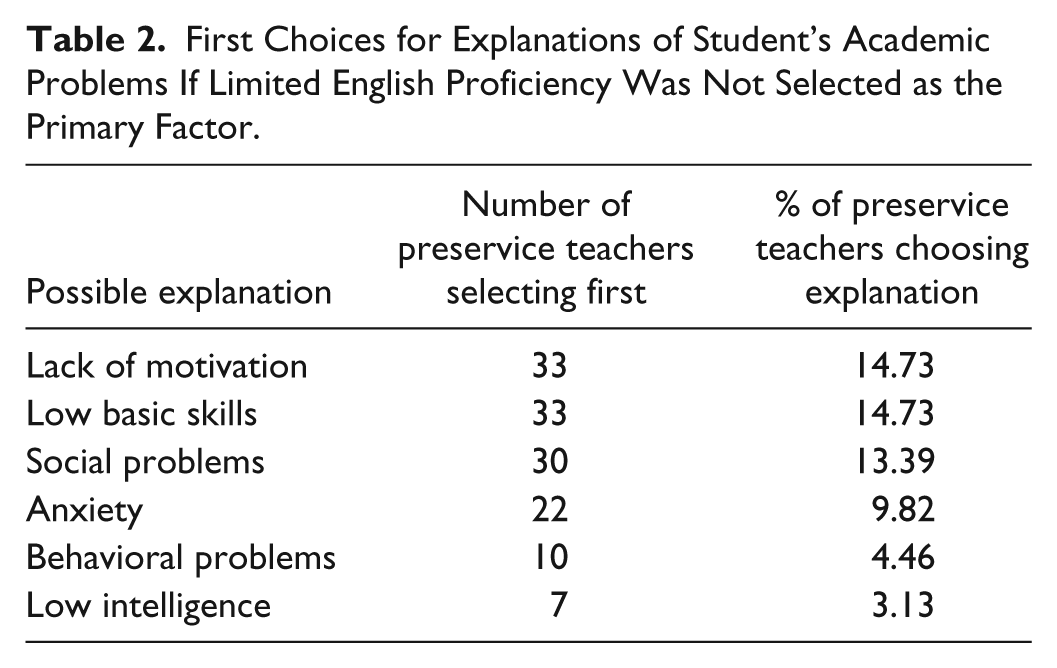
Finally, we were interested in the different attributions that preservice teachers selected as the primary reason—other than Limited English proficiency—for the student’s academic difficulties. Table 2 lists the various attributions selected as first choices by preservice teachers not selecting Limited English proficiency as their first choice. Lack of motivation (n = 33), low basic skills (n = 33), and social problems (n = 30) were the most frequently selected attributions related to the presence of academic problems while low intelligence (n = 7) and behavioral problems (n = 10) were the least frequently chosen attributions.
First Choices for Explanations of Student’s Academic Problems If Limited English Proficiency Was Not Selected as the Primary Factor.
Discussion
Discussion of Results
This study has several important findings that apply across the two groups of preservice teachers, regardless of their self-reported education major. First, preservice teachers who were provided the most information about a fictional students’ language proficiency (i.e., HL + P + D condition) were more likely to attribute that students’ classroom difficulties to limited English proficiency rather than to alternative explanations (e.g., low motivation, low basic academic skills). However, even when provided with the most detailed information about the fictional student’s English proficiency, roughly 35% of preservice teachers did not attribute classroom difficulties to limited English proficiency. Instead, they simply assumed that the student was not motivated or had not yet acquired basic academic skills.
Moreover, preservice teachers provided with a fictional student’s test outcomes (i.e., HL + P condition) were more likely to attribute the student’s difficulties to limited English proficiency than those preservice educators who were deprived of any information about the student’s language other than the home language (i.e., HL Only condition). These findings are similar to those of Cunningham and Wodrich (2006) and Wodrich (2005) who found that increased information about health conditions led to more correct attributions of student difficulties. Interestingly, in this study, we find that nearly one-quarter of preservice special education teachers relied only on the student’s home language designation to determine that limited English proficiency was the source of the student’s difficulties. This finding may in part explain overrepresentation of ELLs in special education programs, because simply having a home language other than English does not necessarily explain a student’s learning difficulties.
Given the prevalence of ELL students in special and general education programs (National Clearinghouse for English Language Acquisition and Language Instruction Programs, 2011a, 2011b), special and general educators are likely to be in a position similar to the one depicted in this analog study. That is, teachers may find themselves knowing little about some students’ language status beyond the fact that their student’s language background is not monolingual English.
This study illustrated that when more information about a student’s language proficiency was provided, preservice teachers were better able to identify the most likely problem; approximately two-thirds of preservice teachers assigned to the HL + P + D condition correctly identified limited English proficiency as the source of the problem. With more accurate identification of the problem, educators can pursue the correct intervention (e.g., implementing evidence-based instructional strategies for ELLs); they are arguably less disposed to pursue other courses of action that are based on erroneous understanding of the students’ difficulties.
Equally important, disclosure in the HL + P condition resulted in only about one-third of preservice teachers identifying limited English proficiency as the source of classroom difficulties. This finding suggests that providing a base level of facts about students’ language proficiency may be insufficient to enable teachers to accurately attribute classroom difficulties to second language proficiency. Indeed, preservice teachers in the current study had already participated in a university Structure English Immersion endorsement course. Thus, educators may need more details about specific language domains (i.e., listening, speaking, reading, writing, and writing conventions) for accurate problem identification. Detailed information regarding students’ English language proficiency for teachers has been suggested by researchers as important (Wong Fillmore & Snow, 2000) and could be provided (not necessarily in the form provided by the state-level English proficiency assessment) for all students who have been considered for, placed in, and exited from bilingual or English language learner programs.
Furthermore, when preservice educators did not attribute the fictional student’s difficulties to limited English proficiency, they identified lack of motivation or low basic academic skills as their first choices for the source of his classroom difficulties. These and other student difficulties have been associated with second language acquisition (Abedi, 2002; Baker, 2011; Cho & Reich, 2008; Dawson & Williams, 2008; Karabenick & Noda, 2004; Lee & Walsh, 2003; Trueba, 1988; Tsai & Garcia, 2000; Wong Fillmore, 1979) and may lead to requests for special education evaluation (Dunn, 2006; Gottlieb et al., 1991; Leftwich & Montague, 2005; Lloyd et al., 1991). Moreover, teachers’ deficit perspectives on ELLs may contribute to teachers attributing the student’s difficulties to lack of motivation or low basic skills. Thus, educators’ accurate appraisal of student behaviors and acknowledgment of bias may be important in preventing unnecessary evaluations and, at times, inappropriate special education placements. Although not demonstrated directly by this study, disproportionate rates of special education placement of ELL students might be partially redressed by assuring all decisions are bias-free as possible and made in the presence of full and accurate information about English language proficiency.
Finally, no significant differences were identified between the groups by education major. One might speculate about differences among majors. For example, special education preservice teachers might be anticipated to better recognize reasons for classroom difficulties given their curricular emphasis on individual differences and problem solving when students encounter learning difficulties. Perhaps university training up to the point at which these participants were recruited is not sufficiently different to yet instill different skills and perceptions between special and general education majors. In addition, it may be that special educators focus on language learning from a disability rather than a second language acquisition perspective.
Limitations
Several limitations might impact the generalizability of findings from the current study. This study was conducted in one geographic area (the Southwestern United States) where educators could be expected to be especially sensitized to ELL issues given the area’s large proportions of ELL students. It is unknown whether similar results would occur in other areas of the United States in which fewer ELLs are enrolled and where teachers-in-training may be less attuned to experiences of second language learners. It also included participants from only one university. Still, this study is valuable because teacher educators (regardless of geographic location) are likely to support their college students who will be facing the challenging task of discerning the origin of classroom difficulties for a student like the hypothetical ELL student discussed in this study.
Another limitation is that participants’ attributions of the student’s difficulties (i.e., limited English proficiency) even when considered “most likely correct” do not reflect the reality of information needed to determine whether limited English proficiency is at the root of a student’s difficulties. In fact, teachers need other information, such as a students’ progress over time and in response to specific instructional strategies as well as other background information.
Similarly, it is unknown whether comparable results would occur after the preservice teachers took teaching positions. Given the study’s analog approach, it is unknown whether equivalent results would have occurred in real world practice where other factors not contained in our case vignette contribute to teachers’ understanding of students, including their language background. Finally, general information about students’ educational context was provided as distractor information to participants in the HL + PL and HL + PL + D experimental conditions; the extent to which this information impacted the results of this study is unknown. Nonetheless, analog studies have the advantage of presenting participants with real-world situations under tightly controlled conditions, thus potentially shedding light on otherwise difficult to investigate topics. Furthermore, the use of random assignment of participants to experimental conditions avoids some of the threats to internal validity that exist in many educational studies.
Implications for Practice
Outcomes of the current study lead to several practice recommendations. First, it appears that in everyday situations in which there is concern about an ELL, teachers benefit from learning more about that student’s English proficiency. Special and general educators need timely and comprehensive understandings of their students’ second language acquisition. It appears that information can help avoid inappropriate attributions about students’ difficulties; it may also be true that information prevents the use of misdirected instructional approaches or even constrains referrals for special education. To appropriately instruct students like Chris, the root of the trouble must be accurately identified.
Teachers require detailed information about their students to make judgments regarding sources of classroom difficulties. More specifically, teachers should be supplied with not only home language status information and English language proficiency outcomes but also with detailed descriptors of students’ English language proficiency and means to interpret this information in a way that also takes other information about individual students into account. When provided in this study, this information enhanced preservice teachers’ ability to distinguish a student’s limited English proficiency from other competing possibilities.
Second, preservice teachers would seem to benefit from learning more about possible student-level academic and social behaviors that arise frequently among ELL’s. More second language acquisition preparation, including instruction in how to differentiate second language acquisition from a disability or from a generic academic problem, seems needed. For example, instruction during teacher preparation might address the common bases by which teachers-in-training attribute students’ difficulties to students’ lack of basic academic skills or to lack of motivation. Indeed, researchers have advocated teacher expertise regarding ELLs and bilingualism for differentiating ELL issues from other academic and behavior problems (Orozco & Klingner, 2010; Ortiz et al., 2011). Similarly, focusing on ELL student strengths rather than deficits appears important to teachers’ ability to accurately determine reasons for their learning difficulties.
Third, ELL students continue to be at risk of disproportional representation in special education (Artiles et al., 2005; Sullivan, 2011). Special and general educators play a critical role as consultants and members of student assistance teams in schools’ and families’ decisions regarding whether to refer students for special education evaluation. Because sharing information about students’ English language proficiency could help avoid teachers’ inaccurate attributions regarding difficulties students exhibit in class, inappropriate referrals for special education evaluation consequently may be avoided. Placing students in special education programs who do not have disabilities puts students in the position of acquiring a potentially stigmatizing label, which may result in rejection by peers, lowered self-esteem, lowered teacher expectations, and other harmful outcomes (Heward, 2013). With maximum training and knowledge about second language acquisition, teachers are in a strong position to suggest non–special interventions and to help teams differentiate between problems due a disability and second language acquisition. Moreover, the outcomes of the current study suggest that ELL/bilingual specialists and ELL teachers who know individual children and understand second language acquisition are a necessary part of teams making educational decisions about English language learners.
Implications for Research
Results of the current study also hold research implications. First, a follow-up study might use practicing educators as participants. Participants sampled across disciplines (e.g., special education, elementary education) could better determine if the general finding established here holds up. For instance, we would expect teachers who are certified, have classroom experience, and are fully socialized into the teaching professions to have different perspectives regarding ELLs learning difficulties. Other follow-up studies might address the topic of inappropriate referrals for special education evaluation. For example, an analog study similar to this one with preservice or practicing teachers might discern what types of information and levels of information disclosure lead educators to appropriate special education referrals for ELLs.
Moreover, this study was conducted in a southwestern state with a large number of ELLs. Educators in this state may be more familiar with ELLs and Spanish-speaking students in general. In follow-up studies, we could also investigate how the geographic locations’ immigration policies and media portrayal of immigrants influence teachers’ attitudes about working with ELLs. In addition, preservice and practicing teachers within other geographic locations with student populations with less linguistic diversity may need even more information regarding students’ second language acquisition to make appropriate attributions regarding ELLs learning difficulties. Another study could determine if this were the case.
Finally, a study using other indicators of English proficiency seems in order. The state-level English proficiency assessment, used in this study, represents just one source of information about students’ English proficiency. The assessment is specific to the state in which this study was conducted, although every state mandates use of standardized tests to determine language proficiency. Consequently, researchers may wish to explore results of other assessments to test the effect found in this study.
Footnotes
Appendix A
Information Provided in the Language Proficiency Section of Chris’ Cumulative Folder for the Three Conditions
| Condition (Abbreviation) | Information provided about Chris |
|---|---|
| Home language Only (HL Only) | Spanish is the primary language spoken at home. |
| Home Language + Proficiency Level (HL + PL) | Spanish is the primary language spoken at home. |
| The following were Chris’s AZELLA (Arizona English Language Learner Assessment) scores: Listening–Proficient, Speaking–Pre-emergent, Comprehension- Basic, Oral (Listening and Speaking)–Basic, Reading–Emergent, and Total Writing (Writing and Writing Conventions)–Basic. | |
| Home Language + Proficiency Level + Description (HL + PL + D) | Spanish is the primary language spoken at home. |
| The AZELLA (Arizona English Language Learner Assessment) measures the general ability levels of students in critical English language skills as is administered to children whose parents have indicated that English is not the child’s dominant language. | |
| The following were Chris’s AZELLA (Arizona English Language Learner Assessment) scores: Listening–Proficient, Speaking–Pre-emergent, Comprehension: Basic, Oral (Listening and Speaking)–Basic, Reading–Emergent, and Total Writing (Writing and Writing Conventions)–Basic. | |
| Chris’s AZELLA performance is as follows: | |
| Listening–Proficient: This student’s Listening Performance Level is Proficient. This student is able to identify the factual details, key words and expressions, and overall gist of read-aloud stories and content area presentations with the assistance of contextual support and repetitions. Sometimes, this student comprehends and follows multiple-step instructions (4 or more steps) for familiar processes or procedures. This student can comprehend many content-area words, including grade-level math and science vocabulary. | |
| Speaking–Pre-emergent: This student’s Speaking Performance is Pre-emergent. This student made very few or no responses. This student may try to communicate with gestures and other nonverbal methods or may use a language other than English. This student has very limited or no ability to speak in English. | |
| Comprehension- Basic: This student’s Comprehension Performance is Basic. This student is able to comprehend and follow 3- to 4-step oral directions related to the position of one’s movements in space. This student can comprehend a few content-area words, including grade-level math and science vocabulary. This student is able to understand a few words that indicate mathematics operations. This student is able to comprehend some simple grade-level math word problems. This student comprehends and follows up to 5-step written directions for classroom activities. | |
| Oral (Listening and Speaking)–Basic: This student’s Oral Language Performance Level is Basic. This student is able to speak using below-grade English grammatical structures and linguistic forms, errors and pronunciation difficulties may impede communication. This student uses accurate but limited vocabulary. This student is able to participate in social conversations on topics of personal relevance and familiar events. This student is able to give and receive invitations and apologies, and express ability and inability to do or not do something. | |
| Reading–Emergent: This student’s Reading Performance is Emergent. This student is able to understand a few common high frequency sight words and simple sentences in English. This student is able to comprehend with the aid of picture cues a few simple content-area words. This student is able to indicate the meaning of some common signs, graphics, and symbols. | |
| Total Writing (Writing and Writing Conventions)–Basic. This student’s Total Writing Performance Level is Basic. This student is able to produce independent writing that demonstrates satisfactory control over rudimentary grammatical structures. This student is able to write short, single paragraph personal narratives or friendly letters about topics and ideas that are broad and simplistic. This student is able to write with a voice that reads more like a report, and uses words choices that are nonspecific and limited. This students’ writing has little variation in sentence types and marginally recognizable internal structures or organization (proficiency descriptors quoted from Arizona Department of Education & Harcourt Assessments, Inc., 2007). |

Appendix B
Declaration of Conflicting Interests
The author(s) declared no potential conflicts of interest with respect to the research, authorship, and/or publication of this article.
Funding
The author(s) received no financial support for the research, authorship, and/or publication of this article.