




Abstract
This study explores teachers’ reflections on their learning to compose with new technologies in the context of teacher education and/or teacher professional development. English language arts (ELA) teachers (n = 240) in 15 courses learned to use digital video (DV), completed at least one DV group project, and responded to open-ended survey questions. The data examined connections they made between print and DV composing, the best and most frustrating aspects of DV, content they still wanted to learn, and its relevance in their classrooms. The findings demonstrate high engagement with DV, the use of transmediation in making connections between print and DV, the reporting of both enjoyment and frustration with DV, and perceived curricular value with DV in the classroom. Implications include the need for teachers to have practical experiences with DV and opportunities to reflect on content and pedagogical applications.
Keywords
Introduction
One powerful technology that has been slowly integrating into educational settings is digital video (DV). DV has flexible applications, can be used in a variety of classroom settings, and is embedded within the broader terms of new literacies, multimodal literacies, and Web 2.0. Composing with DV allows students to create a wide variety of projects—including video poems, short films, advertisements, public service announcements, narratives, and documentaries—using visual, audio, and kinesthetic ways to represent their ideas. As a result, educators have called DV a literacy tool (Beach, Campano, Edmiston, & Borgmann, 2010), one of the tools of new learning (Kalantzis & Cope, 2008), and even a supertool for learning (Miller & Borowicz, 2005).
Given the potential educational possibilities, researchers have advocated that DV be included in teacher education programs (Dreon, Kerper, & Landis, 2011; Fralinger & Owens, 2009; Hughes & Robertson, 2010; Kearney, 2011; Young, Long, & Myers, 2010) and in teacher professional development (Miller, 2007; Young, Hicks, & Kajder, 2008). This research contributes to the growing literature of DV research with teachers in both of those settings.
The data from this study were compiled over an 8-year period, and address teachers’ responses to learning both the technical and creative aspects of DV in the context of student learning. The guiding question for this research was, “How do English language arts (ELA) teachers describe their experiences of learning to compose with DV in the context of teacher education and/or professional development?” More specifically, we ask, What explicit connections do teachers make between print and DV composing? What do teachers perceive as the best parts of learning DV versus the most frustrating parts of learning DV? If the teachers were to continue their instruction, what else would they like to learn? And, what relevance does DV have in the ELA classroom for the teaching of reading and writing?
Review of the Literature
The review of the literature is divided into two sections. The first explores how teachers currently use DV with students in educational settings. The second reviews teacher education and professional development related to teachers’ uses of learning technology.
DV Use in Classrooms
DV has the potential to be a compositional tool that fits within the context of teacher and professional organizations’ appeals for effective uses of emergent technologies to help students learn, particularly through new modes of teaching writing (Swenson, Young, McGrail, Rozema, & Whitlin, 2006; New Media Consortium & EDUCAUSE Learning Initiative, 2008; International Reading Association [IRA], 2009; National Council of Teachers of English [NCTE], 2003, 2007; Yancey, 2009). DV is a valuable 21st century writing tool in the classroom in three ways: high levels of student engagement, multiple layers of experiential learning, and authentic social collaborations. In addition, DV and print share analogous composition processes allowing parallel learning opportunities.
First, students readily engage with DV. The strong connection to youth-media culture attracts and sustains student interest, drawing on their explicit and implicit out-of-school knowledge of media (Hull & Katz, 2006). Both high- and low-achieving students engage in DV both inside and outside school (Brass, 2008; Bruce, 2009; Goodman, 2003; Hull & Schultz, 2002; Miller, 2011). When working with DV, students remain engaged even after the novelty of working with the new technology wears off (Brass, 2008; Bruce, 2009; Goodman, 2003; Goulah, 2007; Miller, 2010). Thus, a wide range of learners in a variety of educational settings benefit when working with DV.
Students are engaged in composing with DV in part because they enjoy experiential learning through visual, audio, and kinesthetic modalities (Bruce, 2008a; Dreon et al., 2011; Leander, 2009; Miller & Borowicz, 2005). When working on projects, students draw from their own life-worlds and experiences to compose their DVs (Brass, 2008; Bruce, 2010; Goodman, 2003). In addition, they use their sensory perceptions and embodied actions when composing with DV (Miller, Knips, & Goss, 2013). For example, when students used DV to interact with class texts, it changed the ways they experienced, and thus understood, the material (Miller, 2011). In another study, students demonstrated greater command of larger composition processes such as their planning, drafting, and revising with DV even though they struggled with those same processes with print (Bruce, 2008b). DV’s affordances allow students to interact, experience, and compose curricular materials in a variety of ways.
As composing with DV involves attending to a number of multimodal variables, groups of people working together—at least initially—can often compose better DVs and do so more efficiently than an individual. Not surprisingly, 29 of 34 peer-reviewed studies in which students composed with DV involved them working in groups (Bruce, 2015). When groups of students plan, draft, and revise their videos, their discussions support their composing processes to help create new ideas, evaluate them, recognize problems, raise questions, and justify their views, typically with an eye for the needs of their audience (Bruce, 2010; Miller, 2008, 2011). Thus, DV tends to be a highly social technology.
The many similarities between composing with DV and with print situate video composing especially suitable for use in classrooms. According to the National Commission on Writing (2006), “Thinking on the screen” is as important as “thinking on paper” in the 21st century (p. 15), so understanding analogous composition processes between print and DV composing is essential. Although the modalities of representation differ, print and DV share congruent elements of composing.
Written and DV composing share common rhetorical situations (see Table 1). Composing with either medium requires authors to consider the purpose of writing their texts, such as narrating, describing, or presenting an argument. In addition, writers need to consider how audiences might perceive their topic, stance, and presentation of their content. Print and DV also share similar composition processes. For example, both involve discreet stages of planning, drafting, and editing. The stages for both print and DV, however, do not occur in a linear manner, but are complex and recursive acts (Bruce, 2009; Flower & Hayes, 1981) with those stages being frequently interrupted by other composing processes (Hillocks, 1986).
Congruency Between DV and Writing.
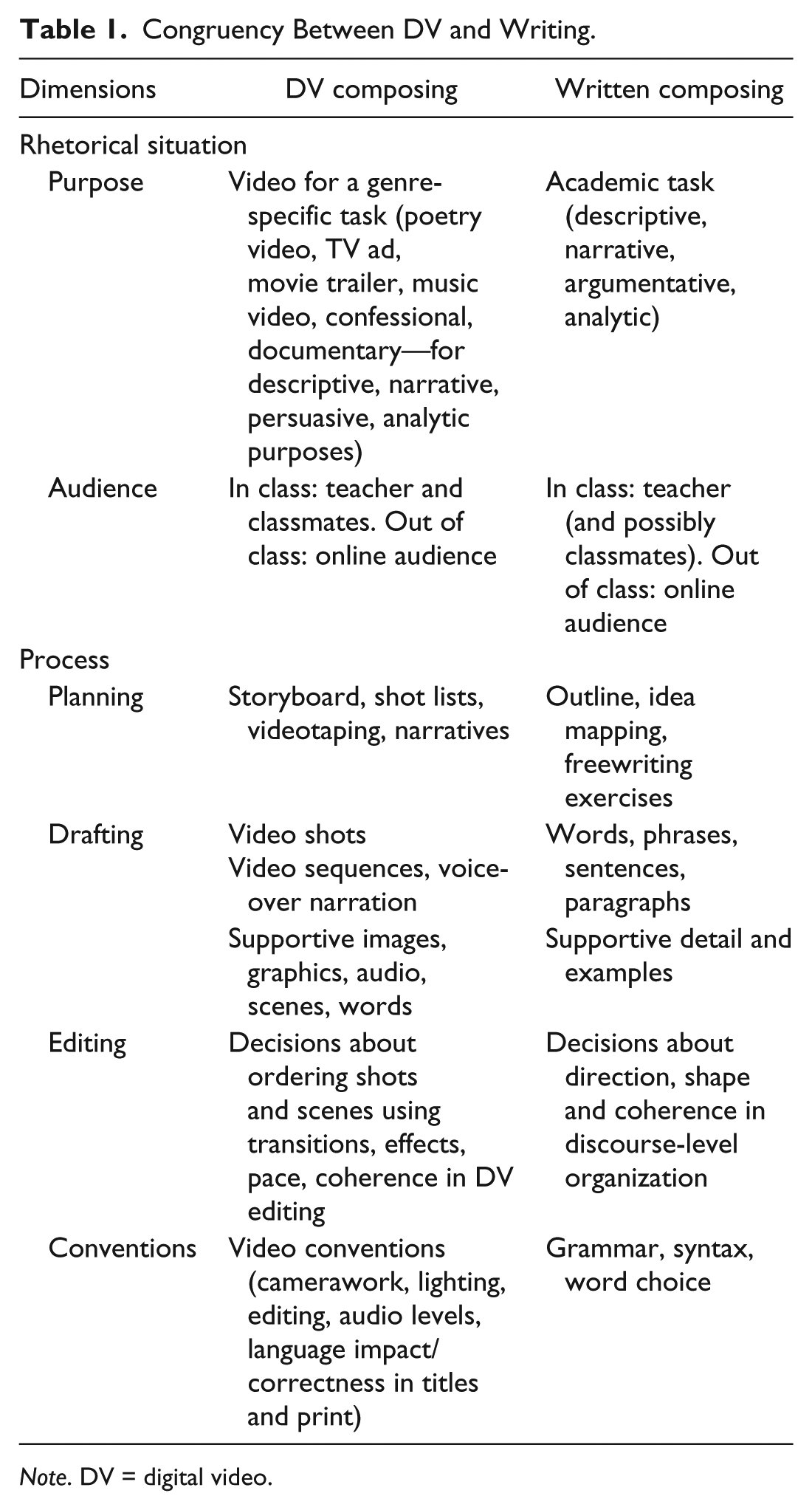
Note. DV = digital video.
Although they do share similar features, the representative modalities of print and DV differ with specific conventions and practices (Fulwiler & Middleton, 2012; Messaris, 1994). However, it is the emphasis on commonalities that allows for a broadened concept of composition, the focus being on “a way of producing texts, rather than a way of producing a particular kind of text” (Smagorinsky, 2002, p. 10). By emphasizing elements that various modalities of composition have in common, the process becomes “complimentary, not competing” (Bruce, 2008a, p. 17) and their instruction can be framed in what Leander (2009) terms a “parallel pedagogy” (p. 149). For example, the compositional element, transition, is used in both video and print. Its role is to link one point with another. With DV, the transition is visual and provides sequences between images. With print, transitions are combinations of words that provide connections between two ideas. Thus, in a parallel pedagogy, students learn the function of a transition and how to use it with print and DV.
One lens through which to view the commonalities and differences between print and DV is transmediation (Suhor, 1984). Albers (2006) defines transmediation as “a literacy strategy in which learners retranslate their understanding of an idea, concept, or text through another medium” (p. 90). For example, Bailey and Van Harken (2014) described how preservice teachers used visual images to transmediate their knowledge of researching classroom practices. Writing and DV are two different sign systems sharing similarities and differences between their respective modal affordances. Siegel (1995) states, “The tension between the contrast and commonality is the very heart of transmediation” (p. 472, emphasis added). In navigating between the different modes, the learner creates analogies, which produce “generative potential through the juxtapositioning of contrast and commonality” (Siegel, 1995, p. 472).
Specifically with print and DV, learners can use their knowledge of one to transmediate their understanding of the other. For example, struggling adolescent writers used their knowledge of DV to transmediate their understanding of print composing (Bruce, 2008b) whereas preservice teachers used their knowledge of print literacy to transmediate their understanding of creating a DV project (Bruce, 2010). As DV and print are both composing tools, their differing modalities provide opportunities for learners to explore their similarities and differences.
In summary, composing with DV has high levels of student engagement, multiple layers of experiential learning, and authentic social collaborations. In addition, DV and writing share analogous compositional elements allowing them to be taught in a parallel manner.
Teachers Learning to Use Technology
Although technologies such as DV engage students educationally, socially, and experientially, teachers often do not use them because the “complexity and multi-layered challenge of designing and implementing any type of technology project in the classroom” is often outside of their comfort level or expertise (Hofer & Swan, 2008, p. 196). Even as technology becomes more available and accessible in classrooms, teachers find themselves navigating the continuum between agents of change and gatekeepers for their use and application. Okojie (2011) lists various roles that teachers are expected to play: instructional method and integration specialists, technology education researchers, mentors, information providers, and life-long learners, all in the context that motivates learning in students. However, research has long demonstrated that teachers have a disparity of technological expertise (Cuban, 2001; Fralinger & Owens, 2009; Henderson et al., 2010; Leu, Kinzer, Coiro, & Cammack, 2004; Young et al., 2008). Even teachers who can be categorized as digital natives—those who have grown up using a variety of computer mediated technologies—may have facility with social networking but do not tend to have adequate Web 2.0 skills (Lei, 2009). Thus, teachers with more technological experience will tend toward consumptive rather than productive computer abilities. Teachers typically do not successfully integrate technology into their instructional activities (Lawless & Pellegrino, 2007).
Given the high student engagement with DV and the likelihood that many teachers are unfamiliar with such technologies, it is necessary to examine how teachers can be assisted with appropriating technologies in their classrooms. The research on integrating technology into teacher education and professional development identifies three clear threads: the importance of intrinsic factors such as attitude while learning technology, the necessity of engaging in meaningful technology experiences, and the importance of learning technology in collaborative settings.
Teachers with positive attitudes toward technology are more likely than other teachers to have greater facility with it (Christensen & Knezek, 2008; Ertmer, Ottenbreit-Leftwich, & York, 2006-2007). Teachers with positive attitudes toward technology are more likely to enjoy learning it, spend more time doing so, and hence become more skilled at it, compared with other teachers. Preservice teacher education (Ertmer et al., 2006-2007) and teacher professional development (Agyei & Voogt, 2011) play a role in making teachers less anxious and more confident about the use of computers in instruction. Learning the technology increased their skills, enhanced their confidence in using it, and thus reduced their anxiety about using technology.
As competencies and attitudes are related, technology expertise may also be framed in terms of a teacher’s technology trajectory. One way in which researchers have examined this problem is to identify and situate the range of a teacher’s technological skills (see Table 2).
Trajectory Models of Teacher Technology Learning.

Both of these models present a series of stages, from a novice initiation level with the technology to a mastery level where the technology is used in innovative ways. It is doubtful that teachers progress through these stages in a linear manner (Windschitl & Sahl, 2002). Another way to consider these stages would be as a broader learning continuum, representing a potential range of expertise—from initiative to generative—of teacher technological skills. Although a trajectory approach may help to examine how teachers are situated in a spectrum of technology proficiencies, how to move teachers out of the novice stage to become more familiar with technology remains an open question.
Thus, the second trend in the research deals with the need for teachers to have real experiences working with the technology. Researchers say that these experiences should happen through “playfulness and exploration” (Phelps & Graham, 2008, p. 129); not only attend to the creative considerations but also provide familiarity with the technical processes (McVee, Bailey, & Shanahan, 2008; Miller, 2007, 2008; Miller & Borowicz, 2005; Pearson, 2005; Rice, 2008; Snyder & Bulfin, 2008); have practical, theoretical, and reflective components (Grabill & Hicks, 2005; Stein, Ginns, & McDonald, 2007); be integrated within the context of discipline-based teaching referred to as Technological Pedagogical Content Knowledge (TPACK; Harris, Mishra, & Koehler, 2009); and be spread out over time with follow-up learning and feedback (Lawless & Pellegrino, 2007; Miller & Borowicz, 2005).
In short, teachers need engaged, significant, and sustained experiences with the technology.
In the final thread of the review on teachers learning technology, collaboration supports meaningful learning. All of the studies involved teachers learning and using technology in group settings. Some of the professional development has phrased the communal work with specific terminology such as technology together (Phelps & Graham, 2008) or collaborative apprenticeships (Glazer, Hannafin, & Polly, 2009). Other research phrased the collaborative nature in which the technology instruction took place as communities of practice around technology (Kopcha, 2012), cultural ecology (Hawisher, Selfe, Moraski, & Pearson, 2004), or learner-centered constructivist learning environments (Ertmer et al., 2006-2007). No matter what the name of the program was or what the group work was called, the research indicates that teachers learning technology in meaningful ways happens in collaborative rather than isolated or individualized settings.
Only one of the studies reviewed reported a drawback with group work: Group unity can compromise individual ownership of the project (Glazer et al., 2009). Despite the downside, most professional development and teacher education involving technology occur in collaborative settings. Particularly noteworthy are the clear parallels between the way students and teachers learn to use classroom technology, especially as it engaged both sets of learners in meaningful curricular and communal settings.
Methodology
Context
The first author taught undergraduate and graduate English education courses at two universities during 2003 to 2010. In these classes, he used DV to introduce a traditional English education assignment, composing a response to a literary text (see Appendix A). Instead of an essay, however, he asked the teachers to compose a video poem of the text. He introduced these teachers to examples of video poems, demonstrating both a range of production techniques (such as how the poetic text was presented, through voice-over, text, recorded voice, or various combinations) as well as literal and figurative interpretive options.
Participants self-selected their working groups and then chose a poem that they would represent through DV. They used a combination of still and/or moving images, text, audio, and special effects to compose an interpretation of a poem. 1 These videos were a required class project.
Participants
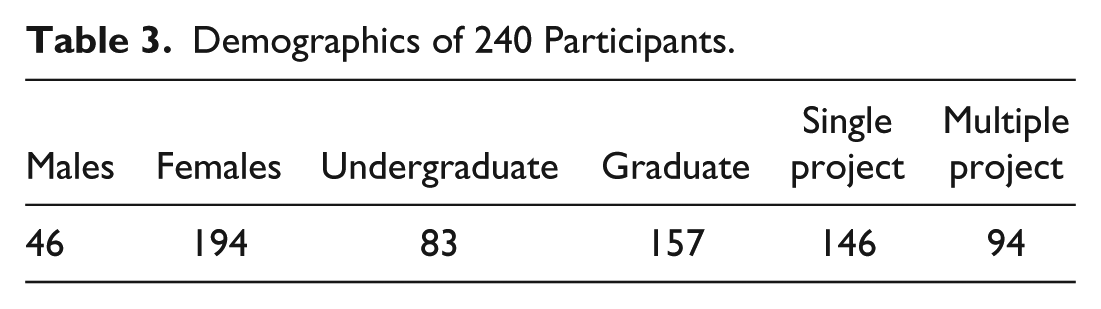
A total of 240 preservice and professional teachers attended 15 different courses during 2003 to 2010 (see Table 3). There were five undergraduate courses, seven graduate courses, and three extended workshops (taken for 2 hr of either undergraduate or graduate credit). Eight of those classes had a single DV project; the other seven courses had multiple DV projects. Although the study included both preservice and practicing teachers, we use the term teachers to address all participants as our multilevel analysis found no significant differences in responses between undergraduate and graduate teachers. For a sample size of 240, statistical power exceeded 0.99 for an effect size of 0.3 (Cohen, West, Aiken, & Cohen, 2003).
Demographics of 240 Participants.
Procedure
Most of these projects were done on readily accessible DV editing software—iMovie on the Mac or Windows MovieMaker on the PC platform—depending on the availability of a computer lab for the scheduled course. The single project assignments were completed in small groups that facilitated learning the DV editing software. The multiple projects started with groups and then moved toward individual assignments. In this way, everyone learned the equipment collaboratively before doing individual projects. All teachers in the various classes completed a similar video project.
In addition to the video poem, teachers who completed multiple projects created several other video-based projects. One was a video theme, which used combinations of images, text, and/or audio to explore connotations of a word with definitional complexity such as “justice,” “beauty,” and “power.” In addition, teachers created narrative sequences, videos comprised of different perspectives and camera angles to make a vignette look as if the events were happening in real time.
The finished projects were premiered via a large screen projector for the teachers’ communal responses to the videos. Completed projects were published to a class DVD or—when the technology became feasible—published to websites or iTunes U. Teachers were encouraged to use these compilations as teaching tools by sharing examples with their own classes.
When the course was finished, the teachers completed an anonymous open-ended questionnaire, in which they described their DV-composing experiences (see Appendix B).
Data Analysis
This study used qualitative and quantitative methods to analyze the data. The responses were first analyzed qualitatively using first and second cycle coding (Saldana, 2011), and then, multilevel, multivariate outcome logit analysis was applied to the data (Goldstein, 1995). There was an iterative process between the qualitative and quantitative analyses.
All teacher responses were entered into the data analysis and management program, NVivo8. During first cycle coding of the data, descriptive codes—designated by NVivo as free nodes—were assigned. During second cycle coding, free nodes were reconfigured into more inclusive categories, called tree nodes. These pattern codes identify emergent themes or explanations of how teachers responded to the various questions. Various queries—word, text, count, coding, and compound—were run for various analyses of the data. All categories and nodes were agreed on by two researchers. Some participants provided multiple categories of responses to a question.
Explanatory model
Our data have a two-level nested structure (students within classes) and several outcome variables. As ordinary least square regressions do not model this structure adequately, they yield biased results (Chiu & Khoo, 2005). To model these data correctly, we used sequential sets of multilevel, multivariate outcome logit analysis (Goldstein, 1995). We entered the variables according to time constraints, expected causal relationships, and likely importance:

The probability of outcome variable y (frustration with videotaping) of student i in class j is a logit function (F) of the grand mean intercept β
y
and the class and student residuals (
First, we entered a student’s gender. Next, we entered whether a student did multiple projects (vs. only one project). Then, we entered a vector of students’ reported composing processes (brainstorm, framework, develop ideas, organize, visuals, arrange, cohesion, edit;

An alpha level of .05 was used. Testing many hypotheses increases the likelihood that at least one of them incorrectly rejects a null hypothesis (false positive, Type I error). To control for this false discovery rate, we used the two-stage linear step-up procedure, which outperformed 13 other methods in computer simulations (Benjamini, Krieger, & Yekutieli, 2006). To facilitate interpretation of these results, the odds ratio of each variable’s total effect (E, direct plus indirect) was reported as the percentage increase or decrease (+E% or −E%) in the outcome variable (Kennedy, 2008; see Appendix C).
Findings
In the following section, the results are organized by teachers’ responses regarding connections they made between print and DV composing, aspects of composing with DV that they liked best, aspects of composing with DV that they found most frustrating, aspects of composing with DV with which they would like continued instruction, and their perceived relevance of DV in curricular contexts. Where applicable, the explanatory models showing differences among teachers are discussed at the end of each subsection.
Connections Between Print and DV Composing
Teachers in this study made clear associations between larger compositional processes of print and DV. The following sections detail their responses to the question, “What connections did you make to the writing process with prewriting, drafting, editing, and publishing?”
Prewriting
When prompted to make associations between DV and writing during the prewriting process, teachers’ responses were categorized in two main areas: brainstorming (62%) and framework (38%). Brainstorming comprised the generative ways in which they planned their DV. These responses included working with images, conceptualizing ideas, analyzing and/or developing their theme, and selecting their literary text. The second category, framework, detailed the ways in which they structured their DV. Responses included using storyboards, outlines, and audience considerations. In planning their DV composition, teachers demonstrated a number of conceptual strategies and organization approaches.
Drafting
Teachers made connections between DV and writing during the drafting phase through idea development (41%), composing with visuals (32%), and organizing their composition (26%). Idea development involved substantive designing of their DV. Responses included considering their purpose and task, doing appropriate research for the project, considering the audience, using appropriate verbal conventions, making suitable textual selections, and freewriting the development of their ideas.
Composing with visuals entailed the use of images as the building blocks of the project. Teachers’ responses were categorized by their use of specific visuals, the process by which they did their videotaping, and their use of the camera to create multiple perspectives of their visuals.
The final category of drafting their DV was organizing their composition, which involved the way they purposefully structured and arranged their project. Teachers’ responses included reviewing their footage for appropriate selections, and making pragmatic choices that balanced the vision of their project with the footage and materials they were able to obtain.
Teachers’ responses about the drafting stage involved a number of strategies and approaches to the generative work of composing their DV.
Revision
When prompted to make connections between DV and writing during the revision stage, teachers responded with editing choices (35%), creating cohesion throughout the video (34%), and arrangement decisions (31%).
The category, editing choices, involved the teachers’ deliberative decisions in the refining of their DV. Responses included cutting footage into smaller segments, selecting the appropriate visuals from the available footage, adding appropriate special effects, making decisions that would “finalize” their videos, choosing appropriate audio effects/choices, and manipulating text features within the video.
Creating cohesion describes integrating the various elements of the video to create a unified composition. Teacher replies were categorized into ensuring a flow to the video, clarifying those sections of the video that seemed disjointed, checking the clarity of their video thesis, revising during videotaping to ensure that their footage turned out as envisioned, and reviewing the edited footage as they proceeded to ensure continuity.
Arrangement addressed the organizational choices teachers made to their DV. Responses included making effective choices for the sequence of the video and considering how the structural elements of the DV would be perceived by an audience.
Similar to prewriting and drafting, the revision stage involved a number of plans and methods in the intentional shaping and refining of their DV project.
Publishing
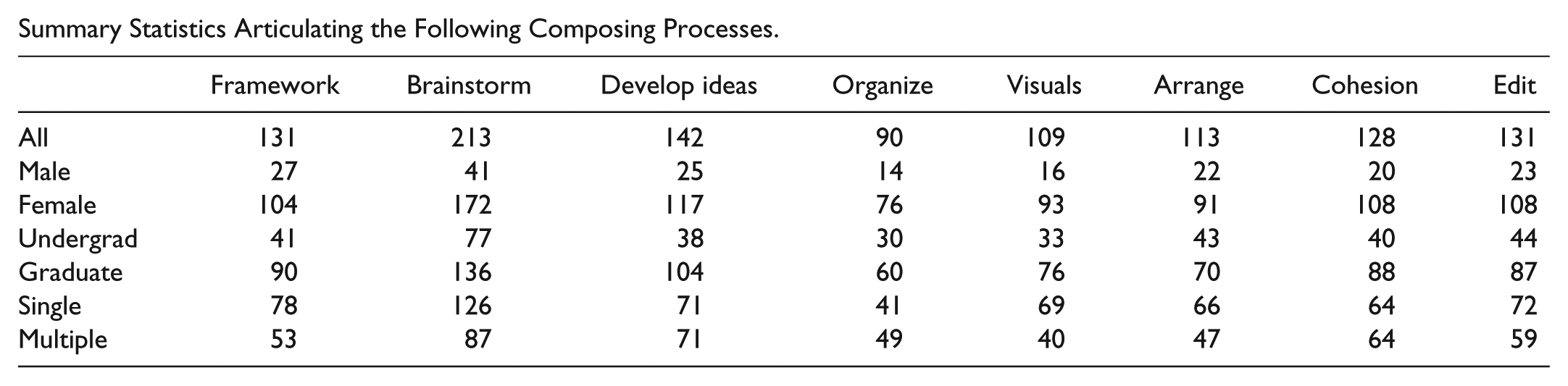
Teachers responded to connections they made with the publishing aspect of the writing process. Their answers included completing a tangible, final product (31%), viewing the finished videos in a public setting (22%), connecting to the composition process (19%), anticipating audience reactions to their video (19%), and fine-tuning their product through editing (11%). (See Appendix D for summary statistics for teachers’ responses to composition processes.)
For a majority of the teachers, this assignment was the first time they had ever worked with DV. Many of the teachers’ comments revealed the use of transmediation to use what they knew about print composing in helping them learn DV composing (see Table 4). Over half of the respondents (58%) specifically named shared print and DV composing connections for at least one of the categories of prewriting, drafting, revising, and publishing.
Teachers’ Transmediation Between Print and Digital Video.
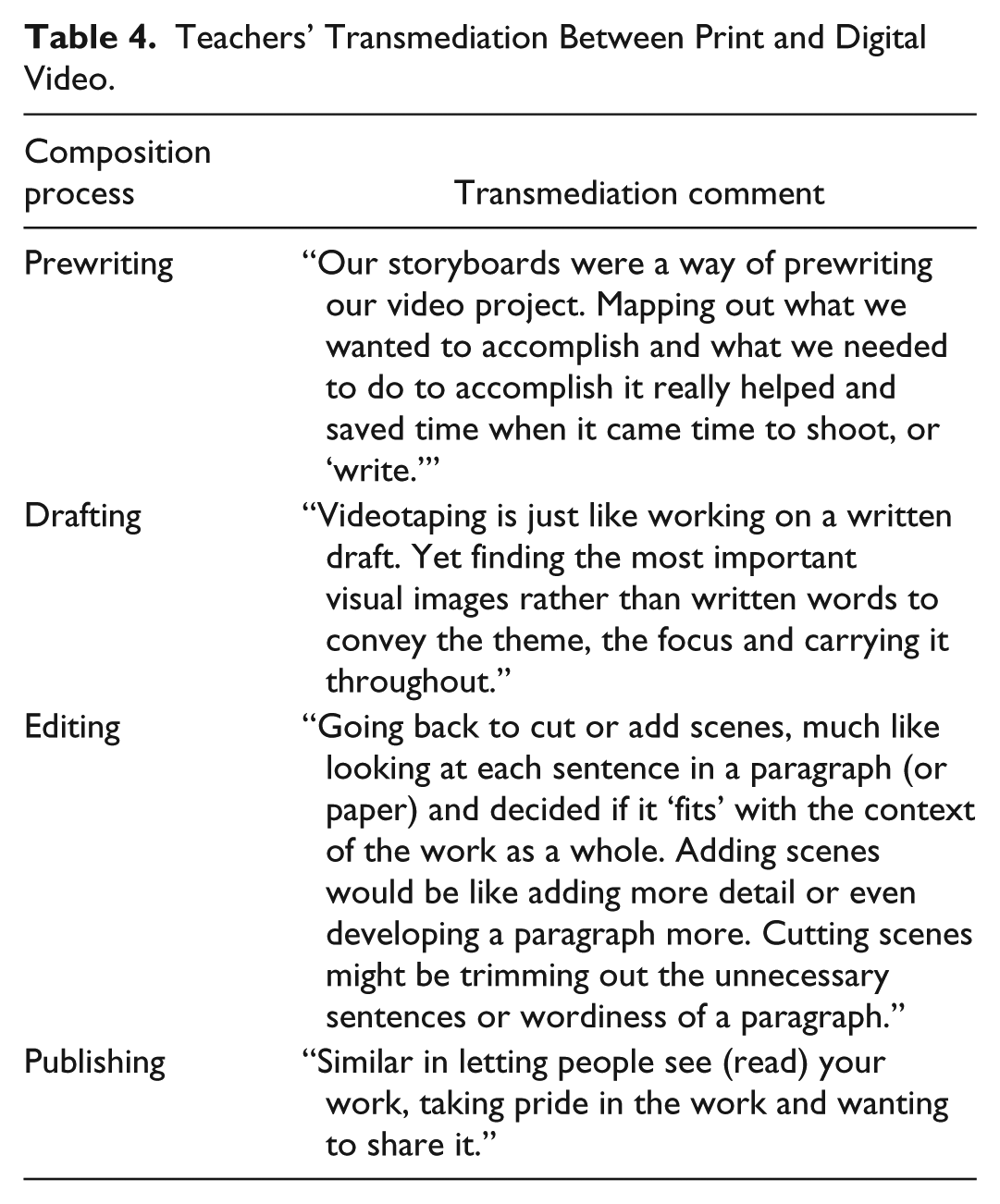
Teachers’ comments indicated that they used what they knew about print composing to help make sense of the less familiar DV composing. Specifically, their knowledge of print helped them “retranslate their understanding of an idea, concept, or text through another medium” (Albers, 2006, p. 90). The comments teachers made show how they created analogies between print and DV. Identifying a familiar concept, such as using words to create a written essay, teachers connected to parallel composition processes in DV, namely, using visuals to create their video.
Best Aspects of DV Composing
Teachers generally responded favorably to the video project. The classroom atmosphere was charged with active engagement in the composition of their videos. A keyword search through all the responses to what teachers enjoyed best about the project yielded play (n = 128), enjoy (n = 93), fun (n = 89), engaging (n = 59), accomplishment (n = 54), and rewarding (n = 29). In the words of one teacher, the DV project “did not feel like schoolwork!” When asked what they liked best about the DV composition, teacher reported enjoying a variety of aspects (see Table 5).
Findings—Best.
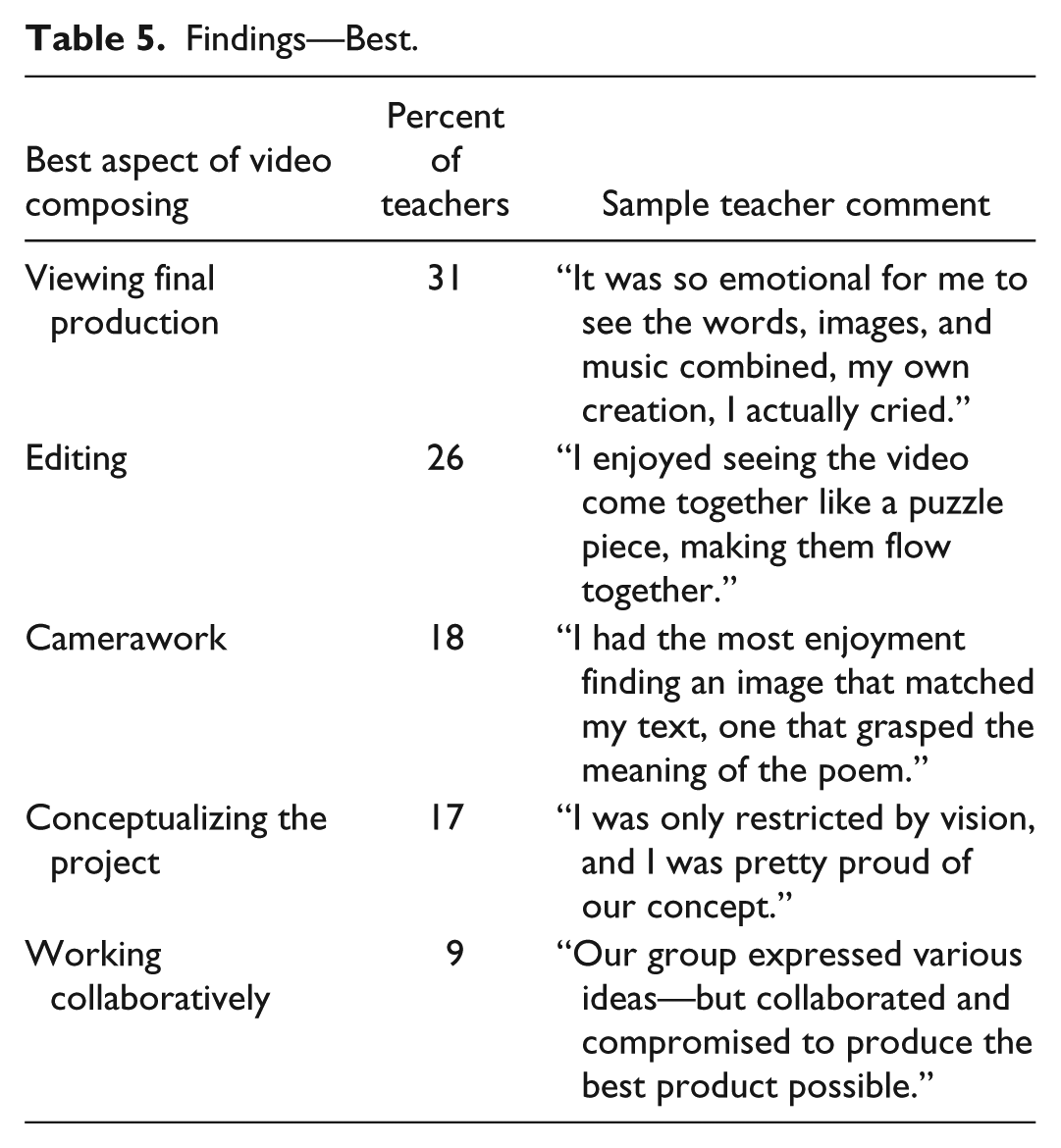
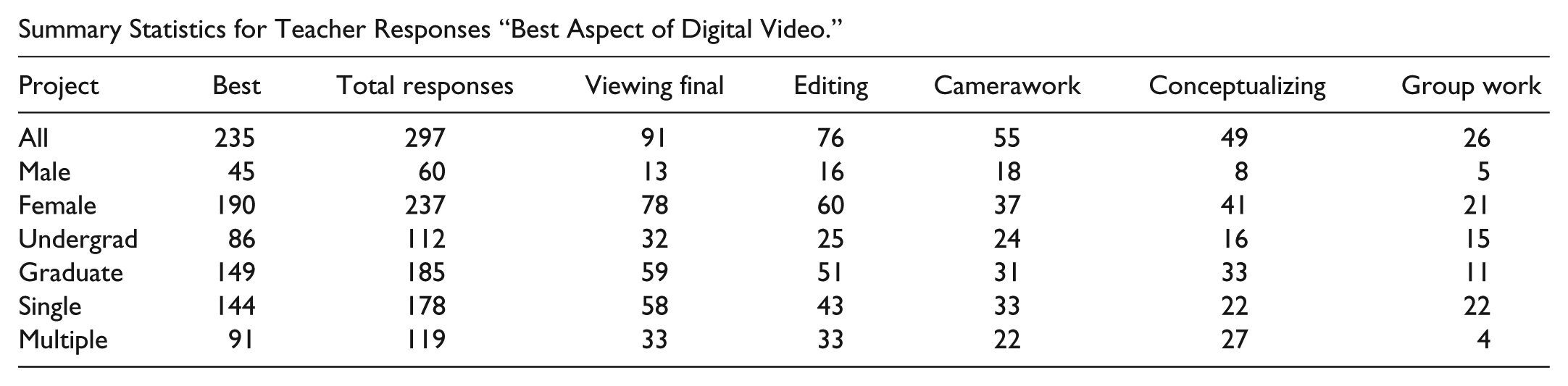
The effort teachers put into the work, the atmosphere of class during the projects, and the excitement in the final viewings attest to how absorbed they were throughout the process of composing with DV. Some teachers gave responses in more than one category (see summary statistics in Appendix E). There were no significant demographic differences among these responses.
Most Frustrating Aspects of DV
Although cameras and editing programs contain user-friendly features, composing with DV is a complex process with many technical and creative considerations. Thus, despite the amount of engagement and enjoyment the teachers experienced with the project, there were aspects of working with DV that they found problematic (see Table 6).
Findings—Most Frustrating Part of Creating the Video Project.
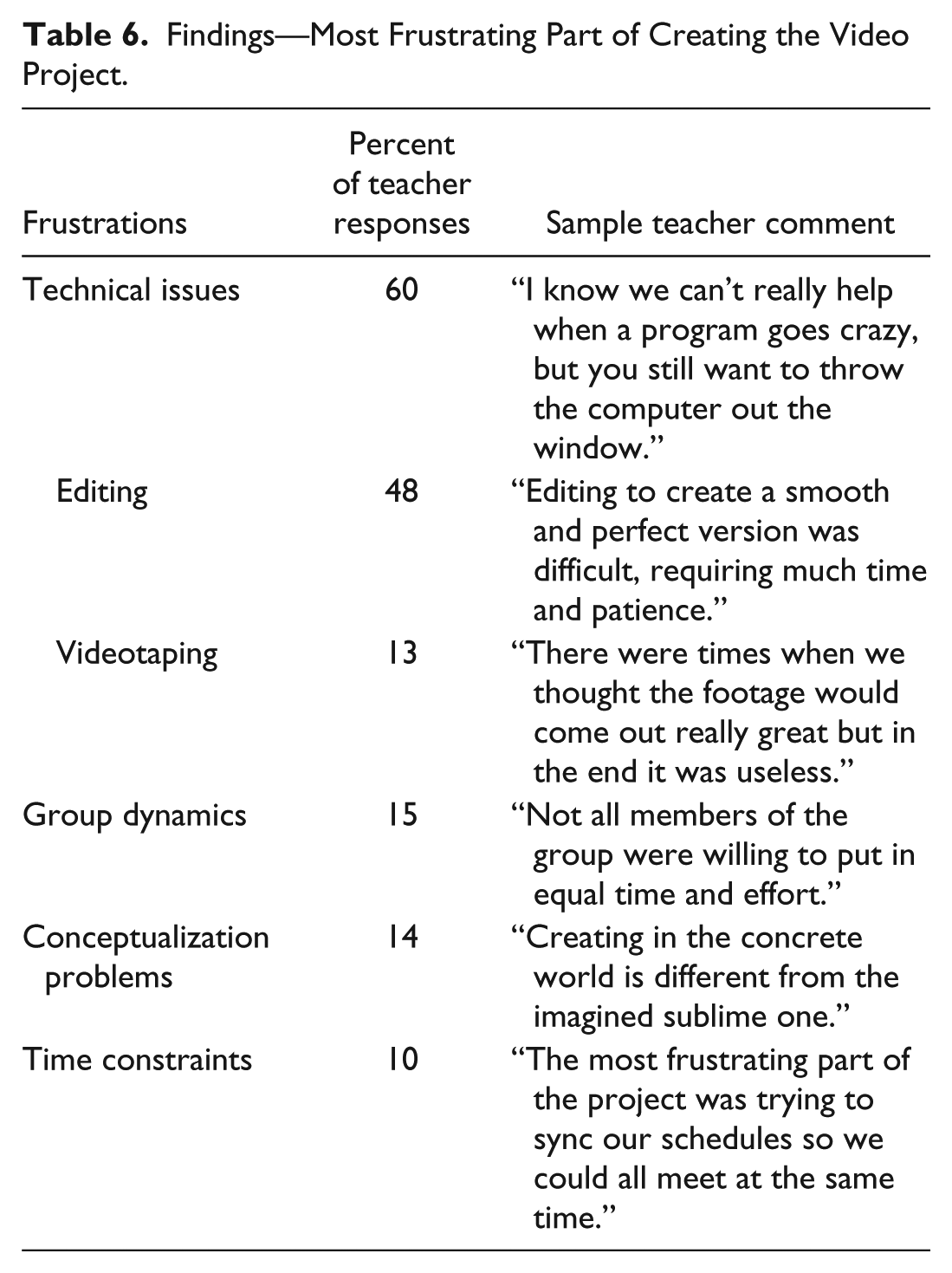
Some teachers gave responses in more than one category (see summary statistics in Appendix F).
Teachers’ demographics and preferences were linked to frustration with videotaping (see Appendix G, Figure 1, top row, right column). Female teachers were 22% less likely than male teachers to be frustrated with videotaping (computed from the odds ratio of β = −0.93). Moreover, teachers who liked conceptualization best were 24% more likely to be frustrated with videotaping (β = +1.02). These variables accounted for about 5% of the variance in teachers’ frustration with videotaping. Teachers who worked on multiple projects (rather than single projects) were 22% less likely to be frustrated with group dynamics (see Appendix G, Figure 1, fifth row; β = −0.96). Teachers’ projects accounted for about 3% of the variance in teachers’ frustration with group dynamics.
Teachers who worked on multiple projects (rather than single projects) were 33% more likely to be frustrated with conceptualizations (see Appendix G, Figure 1, fourth row; β = +1.61). Teachers’ projects accounted for about 7% of the variance in teachers’ frustration with conceptualizations.
Continued Instruction
In response to the question “If we could continue with this instruction, what do you feel like you still need to know (or want instruction/practice in/with)?,” the 240 teachers in this study represented a continuum of experience and comfort level in using DV. Whether their responses indicated that they felt like novices or experts with the technology, they all indicated that there was more to learn (see Table 7).
Findings—Continued Instruction.
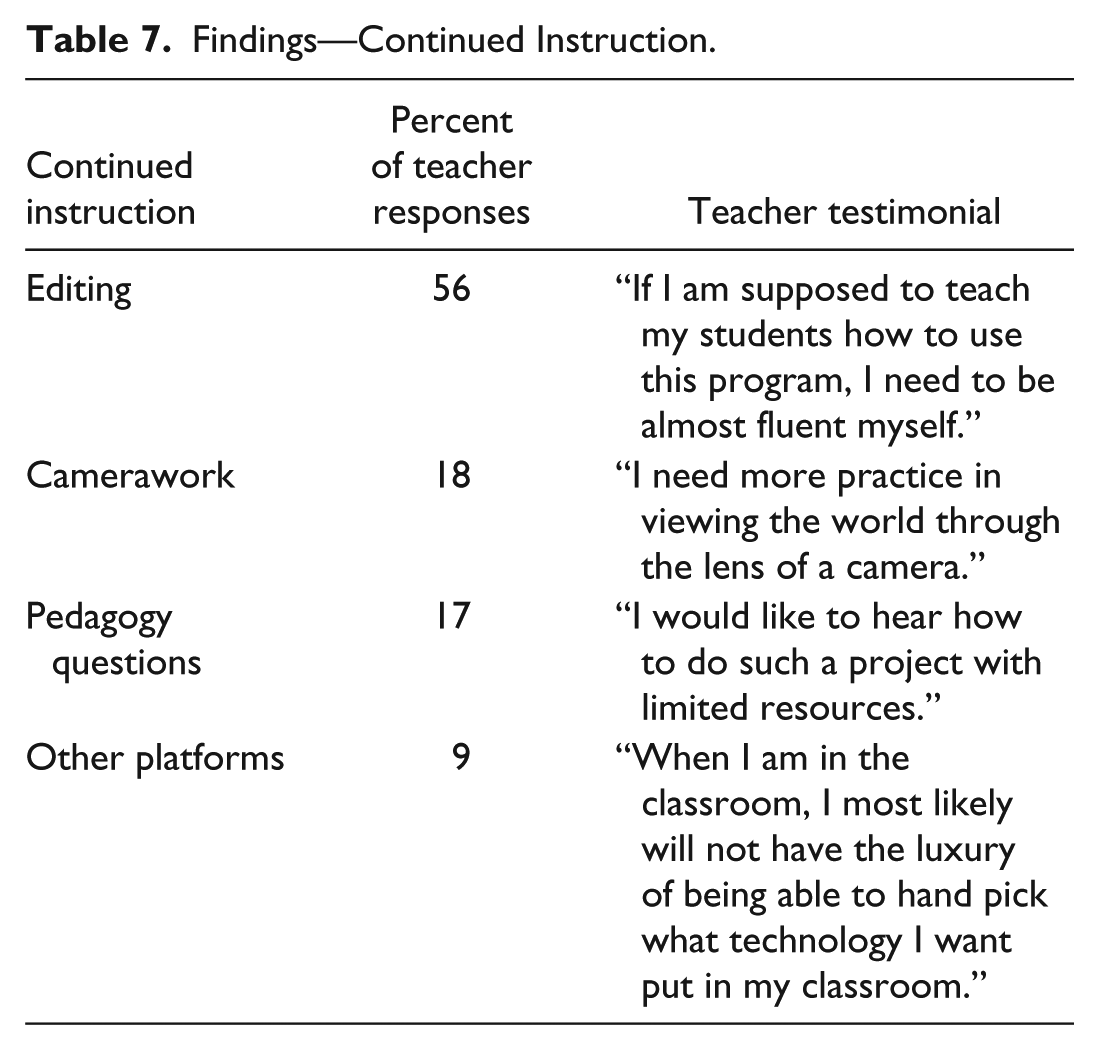
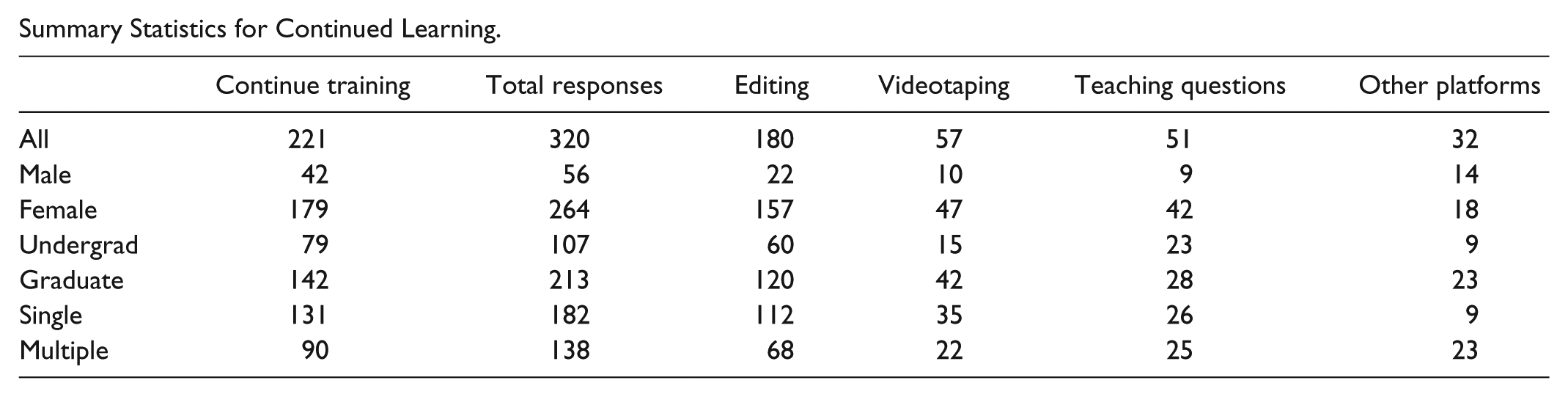
It was not surprising that over half of the teachers wanted more time learning the editing program. Although these programs allow for flexibility for simple editing, they are powerful enough to allow for multiple layers of fine-tuned work. Some teachers made more than one comment for this section. (See Appendix H for summary statistics of “Continued Learning.”)
Teachers’ demographics were linked to desire for continued instruction on editing (see Appendix G, Figure 1, second row). Female teachers were 30% more likely than male teachers to want continued instruction on editing (β = +1.38). Teachers’ demographics accounted for about 7% of the variance in teachers’ continued training on editing. Teachers who liked editing the best were 25% more likely to want continued instruction on videotaping (Appendix G, Figure 1, last row; β = +1.10). Teachers’ preference accounted for about 5% of the variance in teachers’ continued training on videotaping.
Teachers’ demographics and projects were linked to the desire for instruction on other platforms (Appendix G, Figure 1, third row). Female teachers were 32% less likely than male teachers to want to train on other platforms (β = −1.50). Also, teachers who worked on multiple projects (rather than single projects) were 35% more likely to want continued training on other platforms (β = +1.63). These variables accounted for about 12% of the variance in teachers’ continued instruction on other platforms.
Relevance in the Classroom
Teachers indicated clear connections between the use of video and the content area. The following section details their responses to the questions, “After having gone through this production experience, so what? What relevance does this have to do in the teaching of reading and writing? Should this be in the English Language Arts classroom? Why or why not?” Every teacher who responded to this question saw educational value in using DV (see Table 8).
Findings—Should DV be Included in the Classroom?
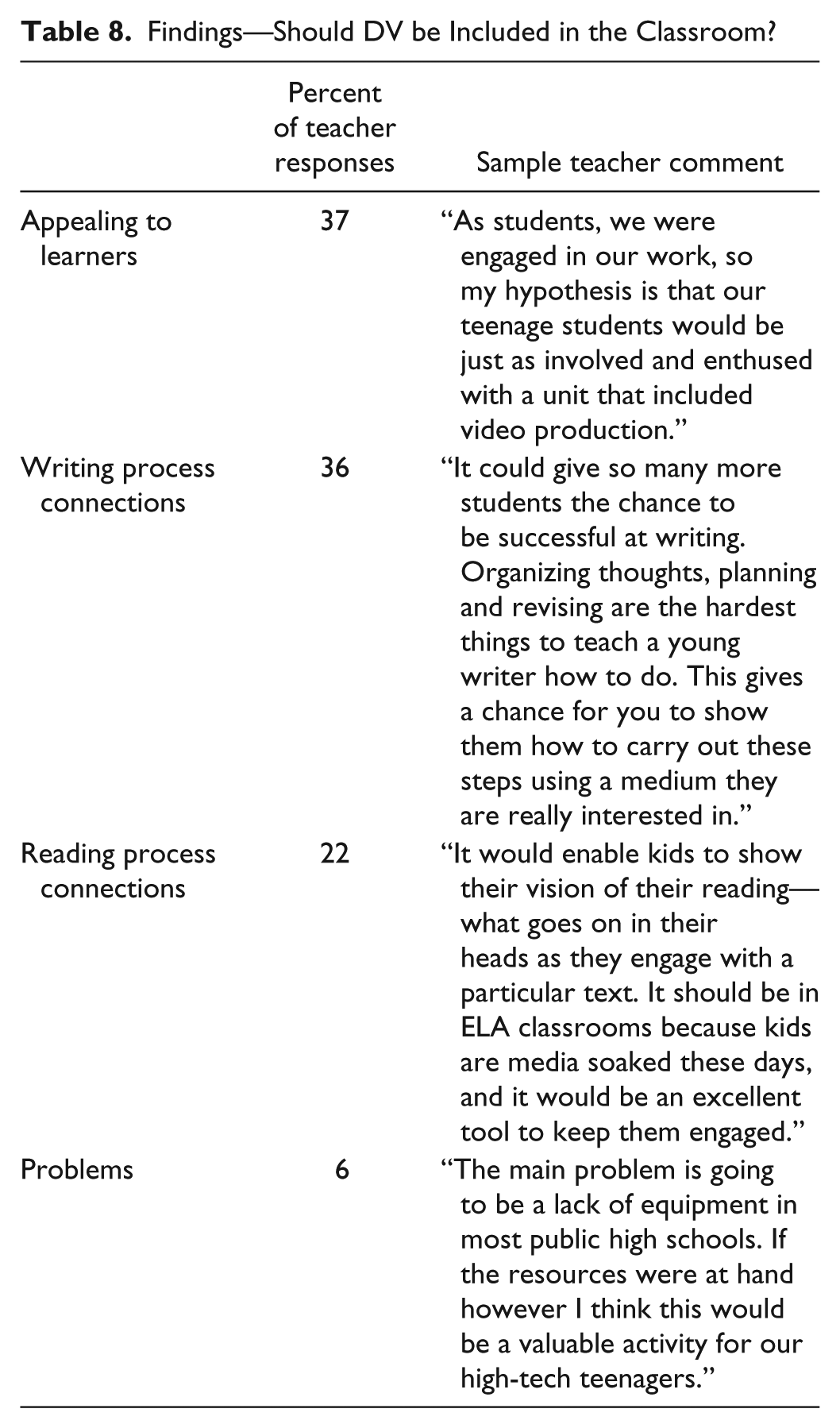
Despite the efforts of learning a new composition tool, the frustrations of dealing with equipment issues, and the potential problems entailing group work, these teachers supported using DV in the ELA classroom. Their largest responses identified ways in which learners would connect with DV in the classroom. In particular, teachers said that DV composing could engage students in meaningful group work, connect to students’ various learning styles, scaffold their understanding of curricular concepts and content, and foster critical thinking.
Nearly one in four teachers connected DV and reading, which is surprising as this skill was emphasized less than the compositional aspects. As they used DV to respond to a text, teachers reported interacting with the text differently than they did with print. Their textual stance changed because they were using visual and auditory conventions, rather than print, to represent their thinking. Moreover, teachers articulated how DV could be an important tool for students to read texts in a more interactive way in their class.
Discussion
This research contributes to the growing literature on teachers learning technology and how to integrate new literacies into teacher education courses and professional development. This study explored the responses of 240 teachers in 15 teacher education courses who learned and used an emerging technology in the context of subject-related content. These teachers indicated clear connections with the composing processes of print and DV. They also demonstrated high engagement with DV composition. Teachers found the creative and technical aspects of the productions as well as group work to be both rewarding and frustrating. In addition, teachers wanted to become more familiar with the process and products of DV as they considered how this technology could be integrated into their own classrooms. The rest of this section discusses three aspects related to the review of the literature: intrinsic factors/attitudes toward technology, the kinds of experiences teachers need when engaging with technology, and learning technology in collaborative settings.
Intrinsic Factors With Technology
The research pertaining to teachers’ attitudes toward technology indicated that there is a clear connection between a teacher’s attitude toward technology and his or her facility with it (Agyei & Voogt, 2011; Christensen & Knezek, 2008; Ertmer et al., 2006-2007). A positive attitude toward technology correlated with a teacher’s familiarity and ability with it.
As predicted in the literature, teachers in this study did not have developed Web 2.0 skills or experience integrating technologies such as DV into their classroom (Cuban, 2001; Lawless & Pellegrino, 2007; Lei, 2009; Leu et al., 2004; Young et al., 2008). These teachers had majored in English or English education and had strong backgrounds in print literacy but little to no formal instruction in film studies or video production. Despite their lack of familiarity with DV, the teachers found the technology highly interesting and engaging. This finding is indicated in the research that meaningful experiences with technology should happen “through playfulness and exploration” (Phelps & Graham, 2008, p. 129). Teachers in this study readily took to the DV projects and described their involvement with the technology in enthusiastic terms, using words such as play, enjoy, fun, engaging, accomplishment, and rewarding. Although a number of the 240 teachers involved with this study indicated a variety of frustrations with learning DV, not one of their responses mentioned being bored or uninterested with the projects. These teachers also considered how their students could compose DVs. They saw many pedagogical benefits and DV’s curricular connections with both writing and reading. They perceived the value in using DV despite problematic issues with equipment and groups.
Teachers’ high level of engagement is also consistent with research on students’ high interest in DV (Brass, 2008; Goodman, 2003; Hull & Katz, 2006; Kearney & Schuck, 2006; Miller, 2010; Miller & Borowicz, 2005; Ranker, 2008), demonstrating that this multimodal form of composition can engage both teachers and students in meaningful curricular ways.
Teacher Technology Experience
Reflecting the findings from the literature review, these teachers attended to the creative aspects of the project such as brainstorming, videotaping, and editing, but they also learned the technical aspects of creating a DV such as how to operate a camera and editing program (Bruce, 2009; Miller, 2007; Pearson, 2005; Rice, 2008; Snyder & Bulfin, 2008). These teachers composed a video poem, connected their technology application to their content and pedagogy (Harris et al., 2009), and engaged in practical, theoretical, and reflective components (Grabil & Hicks, 2005; Stein et al., 2007). These teachers demonstrated connecting print and DV components through their use of transmediation (Albers, 2006; Suhor, 1984). In using this literacy strategy, over half of the teachers made explicit associations with ways in which prewriting, drafting, editing, and publishing in print connected to those similar composition processes with DV. As detailed in Table 1, print and DV composing share many analogous processes.
Nearly all teachers who demonstrated transmediation in this study used print to help them understand DV. Conversely, students—particularly struggling writers—tend to use DV to help them better understand print (Bruce, 2008b; Miller et al., 2013). To address the different compositional modalities, teachers can enact a parallel pedagogy (Leander, 2009) to help students make overt connections between the content area and the technology.
These finding support the research advocating spreading out teachers’ technological experiences over time with follow-up learning and feedback (Lawless & Pellegrino, 2007; Miller & Borowicz, 2005). Teachers who completed multiple projects felt more comfortable with the technology and demonstrated more sophisticated usage than the single user groups. For example, problems with technology were the largest frustration reported among participants (60% of responses). However, the kinds of problems reported differed in kind depending on whether or not they completed single versus multiple projects. Single project teachers reported problems such as being unfamiliar with the equipment or needing more practice to understand technical procedures, suggesting a lower stage of technology adoption such as entry, awareness, and/or learning the process (Russell, 1995; Sandholtz, Ringstaff, & Dwyer, 1997). In contrast, the multiple project teachers reported different frustrations: wanting greater sophistication with the programs and equipment and wanting to better understand the technology to have more control over the compositions. Their responses suggest a higher stage of technological integration—such as familiarity, adaptation, and/or appropriation—possibly due to the follow-up and feedback they received on their projects (Russell, 1995; Sandholtz et al., 1997). This is not to argue that single projects should be abandoned in lieu of no experience with technology whatsoever. The findings from this study indicate that those teachers who completed stand-alone projects still found value in the process and product. However, when it is feasible, multiple projects appear to offer a better experience with the technology than single projects.
Teachers Learn Technology in Collaborative Settings
In the literature describing teachers learning technology in collaborative settings, most studies focused on the positive aspects of group work (Ertmer et al., 2006-2007; Hawisher et al., 2004; Kopcha, 2012; Phelps & Graham, 2008) with only one drawing attention to potential downsides of group projects (Glazer et al., 2009). However, in this study, collaboration proved both beneficial and problematic. Teachers reported that the best aspects of group work were the multiple perspectives and interpretations of the topic, collaboration in problem solving, and the learning they acquired from each other. Conversely, difficulties in collaborative work involved inequality among group members, tensions within the group, scheduling issues, and difficulty balancing individual and group goals. Although the problematic issues with groups were relatively small (one in six), they were consistent over time and thus warrant further attention.
The single project groups had significantly higher levels of frustration with group dynamics than multiple project groups. It is noteworthy that this was the highest difference we found in the research. We believe that those high levels of frustration experienced by single project groups occurred due to the dual tensions of learning a new technology while trying to navigate difficult group dynamics. As they only had one chance to work with a group and learn the technology, when a group experienced discord, those tensions overshadowed all other issues. Multiple project groups knew they could switch members after their first project, so group dynamics appeared to become secondary to focusing on completing their project. The findings from this study suggest that though working in groups has tremendous benefits, remedial attention to difficulties with group interactions—particularly when learning in the context of single projects—may need to be addressed.
Implications
In the previous section, we addressed how our findings were situated within the literature related to teachers learning technology. In this section, we offer specific suggestions for integrating DV into teacher education and professional development. These involve (a) practical experience, (b) opportunities for reflection, and (c) research considerations.
First, when learning DV, teachers need to have practical experience with the technology. One aspect, consistent with the previous research (Phelps & Graham, 2008) and in the findings of this study, is to allow for creative play with the technology. The projects should be grounded in the teachers’ content areas and be designed to allow sufficient time to explore the various affordances of DV. Another aspect is providing support for the technical process as teachers learn to navigate an unfamiliar technology. As stated in the literature (Fulwiler & Middleton, 2012; Miller, 2007) and in this research, DV is a sophisticated technology involving multiple modalities. Teachers need time and technical support to learn DV. Thus, those who work with teacher education and professional development should design their instruction to allow teachers to have sustained practical experience with DV, attending to both creative expression and technical skills.
Second, teachers should be provided opportunities to reflect on their technology learning (Grabill & Hicks, 2005; Stein et al., 2007). The findings in this study suggest several ways. Those involved in teacher education and professional development can ask questions addressing the teachers’ own learning, such as their best and most frustrating instances working with the technology, and their experiences with group work. Another way is to provide written prompts asking teachers to identify explicit connections they made between their content area and the technology. Specifically, they could encourage the development of teachers’ TPACK by asking them to consider curricular implications, identify ways they could use this technology in their own classrooms, or to articulate the relevance of DV in their content area (Harris et al., 2009). Finally, prompting specific connections to student learning can allow teachers to consider using DV as a means to integrate technology into meaningful, content-based ways with their students. Providing opportunities to reflect on specific learning, curricular, and student considerations allows teachers to contextualize their own experiences with DV and create potential connections to curricular and pedagogical applications.
Third, researchers indicated the need to consider different methodological considerations in studying how teachers reflected on learning a new technology (Lawless & Pellegrino, 2007; Polly, 2011). This study represents the use of both qualitative and quantitative methodologies, which allowed us to perform more nuanced analysis of the data not possible with a single method. The detailed qualitative categories provided clear patterns of teacher responses throughout the data. The quantitative analysis allowed us to find connections among and within those responses. Issues surrounding group work are an example. The qualitative data revealed concerns involving group dynamics. However, statistical analyses of the data showed specific and significant differences among the demographics, particularly when comparing single- versus multiple project groups. After identifying these significant differences, we returned to the qualitative data for explanations. This iterative approach to the data allowed us to refine our interpretations of the findings. Researchers may want to continue pursuing ways in which combining analytical approaches can inform our understandings of the ways teachers learn and use new technologies.
Limitations and Related Suggestions for Further Research
There are several limitations of this study. The first is that this research focused on ELA teachers only, paying particular attention to their compositional uses of DV. Future studies can explore how other content area teachers learn to use DV and make curricular connections with DV as well. Second, the focal technology was limited to DV. This is only one of many emergent technologies available for classroom use. Teachers’ descriptions of their learning experiences with other Web 2.0 technologies could be venues for further research. The final limitation is that the review of the literature suggests following up the teachers to see how they used technology over time. Although this study never intended to follow up the participants in the study, it would be of interest to see how many of the teachers have included DV in their classroom practice, particularly to see what impact their technology instruction had on student learning. Researches may want to consider those outcomes when designing future studies.
Conclusion
To date, this study involves the largest teacher population learning to use DV documented in the literature. This research examined how 240 teachers in 15 classrooms described their experiences of their learning to compose with DV. The findings described composition connections they made between print and video, successes and frustrations they experienced in learning DV, additional technical instruction they wanted, and the curricular relevance they perceived with DV in the classroom.
Footnotes
Appendix A: Video Poem Instructions
Appendix B: Questionnaire
Circle appropriate designation:
List the things you did to create your video:
What connections did you make to the writing process with:
Prewriting:
Drafting:
Revision:
Peer-editing:
Publishing:
What was the best moment for you in creating the video poem? Why?
What was the most frustrating part of creating the video poem? Why?
In what ways might you connect this work back to the classroom?
If we could continue with this training, what do you feel like you still need to know (or want training/practice in/with)?
After having gone through this production experience, so what? What relevance does this have to do in the teaching of reading and writing? Should this be in the English Language Arts classroom? Why or why not?
Appendix C
Regression Coefficients (and Standard Errors) of a Multivariate, Multilevel Regression Modeling Frustrations With Conceptualizations, Videotaping or Group Dynamics, and Continued Training on Videotaping, Editing, or Other Platforms.
| Explanatory variable | Frustration with . . . |
Continued training on . . . |
||||
|---|---|---|---|---|---|---|
| Conceptualizations | Videotaping | Group dynamics | Videotaping | Editing | Other platforms | |
| Single | −1.610*** | 0.963* | −1.634*** | |||
| (0.420) | (0.404) | (0.434) | ||||
| Female | −0.935* | 1.382*** | −1.504*** | |||
| (0.421) | (0.341) | (0.430) | ||||
| Liked conceptualization best | 1.025* | |||||
| (0.411) | ||||||
| Liked editing best | 1.098*** | |||||
| (0.314) | ||||||
| Variance at each level | ||||||
| Class | 0.574 | 0.575 | 0.285 | 0.217 | 0.443 | 0.655 |
| Student | 0.426 | 0.425 | 0.715 | 0.783 | 0.557 | 0.345 |
| Variance explained per level | ||||||
| Class | 0.107 | 0.038 | 0.011 | 0.019 | 0.042 | 0.193 |
| Student | 0.062 | 0.069 | 0.036 | 0.054 | 0.066 | 0.065 |
| Total variance explained | 0.088 | 0.051 | 0.029 | 0.046 | 0.056 | 0.149 |

Appendix D
Summary Statistics Articulating the Following Composing Processes.
| Framework | Brainstorm | Develop ideas | Organize | Visuals | Arrange | Cohesion | Edit | |
|---|---|---|---|---|---|---|---|---|
| All | 131 | 213 | 142 | 90 | 109 | 113 | 128 | 131 |
| Male | 27 | 41 | 25 | 14 | 16 | 22 | 20 | 23 |
| Female | 104 | 172 | 117 | 76 | 93 | 91 | 108 | 108 |
| Undergrad | 41 | 77 | 38 | 30 | 33 | 43 | 40 | 44 |
| Graduate | 90 | 136 | 104 | 60 | 76 | 70 | 88 | 87 |
| Single | 78 | 126 | 71 | 41 | 69 | 66 | 64 | 72 |
| Multiple | 53 | 87 | 71 | 49 | 40 | 47 | 64 | 59 |
Appendix E
Summary Statistics for Teacher Responses “Best Aspect of Digital Video.”
| Project | Best | Total responses | Viewing final | Editing | Camerawork | Conceptualizing | Group work |
|---|---|---|---|---|---|---|---|
| All | 235 | 297 | 91 | 76 | 55 | 49 | 26 |
| Male | 45 | 60 | 13 | 16 | 18 | 8 | 5 |
| Female | 190 | 237 | 78 | 60 | 37 | 41 | 21 |
| Undergrad | 86 | 112 | 32 | 25 | 24 | 16 | 15 |
| Graduate | 149 | 185 | 59 | 51 | 31 | 33 | 11 |
| Single | 144 | 178 | 58 | 43 | 33 | 22 | 22 |
| Multiple | 91 | 119 | 33 | 33 | 22 | 27 | 4 |
Appendix F
Summary Statistics for Teacher Responses “Most Frustrating Aspects of Digital Video.”
| Frustrating | Total responses | Tech problems | Tech editing | Tech video | Group dynamics | Concept | Time constraints | |
|---|---|---|---|---|---|---|---|---|
| All | 233 | 279 | 168 | 135 | 35 | 43 | 39 | 29 |
| Male | 44 | 83 | 30 | 20 | 13 | 8 | 11 | 1 |
| Female | 189 | 364 | 135 | 115 | 23 | 35 | 28 | 28 |
| Undergrad | 84 | 162 | 57 | 53 | 11 | 24 | 11 | 6 |
| Graduate | 149 | 285 | 108 | 82 | 25 | 19 | 28 | 23 |
| Single | 141 | 268 | 98 | 81 | 19 | 34 | 15 | 21 |
| Multiple | 92 | 179 | 67 | 54 | 17 | 9 | 24 | 8 |

Appendix G
Appendix H
Summary Statistics for Continued Learning.
| Continue training | Total responses | Editing | Videotaping | Teaching questions | Other platforms | |
|---|---|---|---|---|---|---|
| All | 221 | 320 | 180 | 57 | 51 | 32 |
| Male | 42 | 56 | 22 | 10 | 9 | 14 |
| Female | 179 | 264 | 157 | 47 | 42 | 18 |
| Undergrad | 79 | 107 | 60 | 15 | 23 | 9 |
| Graduate | 142 | 213 | 120 | 42 | 28 | 23 |
| Single | 131 | 182 | 112 | 35 | 26 | 9 |
| Multiple | 90 | 138 | 68 | 22 | 25 | 23 |
Declaration of Conflicting Interests
The author(s) declared no potential conflicts of interest with respect to the research, authorship, and/or publication of this article.
Funding
The author(s) received no financial support for the research, authorship, and/or publication of this article.