



Abstract
Facilitating discussions in English Language Arts can develop students’ skills as speakers and listeners and their ability to engage with diverse perspectives. However, classroom observations often demonstrate a lack of student talk, raising questions about the complexity of facilitating discussion and teachers’ opportunities to learn and hone the practice. In this article, we discuss how teacher educators leveraged a collaboratively designed specification of the practice of facilitating discussions to attempt some alignment across three programs. The teacher educators reached what we call alignment amid variation. There was consistency in the stances regarding the role of children in classrooms and understanding of the purposes for and key aspects of the practice that allowed for alignment amid variation in their work with novice teachers across programs. Our findings have implications for considering the work of cross-institutional collaborations to improve teacher preparation and K-12 student learning.
Keywords
Introduction
Facilitating discussion is a critical skill teachers need to gain access to children’s literacy skills and content knowledge. Empirical research and the Common Core State Standards urge teachers to support students in developing skills to engage in rich discussions around a range of texts (Cazden, 2001; Taylor & Duke, 2013; Worthy, Chamberlain, Peterson, Sharp, & Shih, 2012). Rich, inclusive classroom discussions support students’ connections to the content, and awareness of self and others (Applebee, Langer, Nystrand, & Gamoran, 2003; Hall, 2012; Kucan & Palincsar, 2013; Lee, 2007). Research also shows that as children progress into secondary school, students who struggle with literacy are 20 times more likely than their high-achieving peers to drop out of school due to their literacy struggles (Carnevale, 2001). The benefits of classroom discussion highlight the critical role of teachers in facilitating equitable access to such discussions. However, classroom observations often report a lack of student talk (Nystrand, Gamoran, Kachur, & Prendergast, 1997), raising questions about the complexity of facilitating discussion and the opportunities teachers have to develop this practice (Grossman, Schoenfeld, & Lee, 2005; Kucan, 2009).
Currently it is difficult to say whether teachers have opportunities to learn to facilitate discussions in the ways that research is calling for. There is wide variation across teacher preparation programs in the range of knowledge and skills that novice teachers encounter. The variation in teacher preparation can lead to inequitable learning opportunities for K-12 students, often with students from minoritized and marginalized backgrounds most negatively impacted by these inequities (Anderson & Stillman, 2011; Darling-Hammond & Bransford, 2005; Ladson-Billings, 2000).
In an attempt to lessen the variance in teacher preparation, research has begun to focus on how teacher educators (TEs) might work toward shared understandings, tools, and language to support novices in learning and honing specific practices that can support a range of students (Grossman, Hammerness, & McDonald, 2009; Kazemi, Lampert, & Franke, 2009). Proponents of practice-based teacher education (PBTE) argue for the reorganization of programs with a “focus upon helping novices develop and refine a set of core practices for teaching” (Grossman, Hammerness, & McDonald, 2009, p. 276). A central goal of the Core Practice Consortium (CPC), of which the authors are a part, is to understand what it might take for TEs across contexts and content areas to agree upon a set of core practices for teaching, collaborate to decompose, or specify, those practices, and work toward developing shared understandings, tools, and language to support TEs and teachers to provide ambitious and equitable instructional opportunities for all children (D. L. Ball & Forzani, 2009; Grossman, Hammerness, & McDonald, 2009).
However, reaching consensus on what is a core practice, how to decompose that practice, the language to use to talk about that practice, and the ways in which the practice is taken up across programs and institutions is far from a straightforward process. Given differences in program structures, grade level, content focus, teacher and student population, and the commitments of the TE and program, it is unlikely that all preparation programs will reach a place of full alignment. In fact, such agreement is often seen as problematic in the sense that it does not take into account variations that must be considered in any teaching effort: Who are the students, what are their needs, how do we bridge between students and content, and how do we consider the context in which students are learning and novices will teach (Buchmann & Floden, 1992; Schwab, 1978). As our title suggests, the authors varied regarding what to call the practice—discourse or discussion—demonstrating how, even among collaborators, there is still variation in language and orientations that must be considered as we work toward understanding the affordances of some level of consistency across programs. Yet, the needs of K-12 students require concerted effort on the part of TEs to prepare teachers to support equitable educational opportunities for all students. The tension between the need for shared understandings, tools, and language and the considerations of local contexts is at the heart of the work we discuss here; we are interested in understanding the balance of alignment amid variation across programs. How do TEs work to develop shared understandings, tools, and language while also attending to the particular needs of the local contexts in which teachers are being prepared and will work?
We contend that some level of agreement across programs about the work of teaching and preparing teachers can support equitable educational outcomes for all children. However, we acknowledge that there will be variation across programs. Our work demonstrates what this variation looked like among colleagues in three differently structured programs who collaborated together in developing a shared decomposition of a practice that became a common specification tool to support novices’ learning of that practice. We came to a place of alignment amid variation in our use of the specification tool and suggest that such a stance might allow the field to move forward in our efforts to better prepare novice teachers for the diversity present in U.S. public schools. We argue for a stance of alignment amid variation in which there is alignment around every child’s right and capacity to learn and around practices that support their learning, with variation in instantiation of these practices given specific contextual needs as long as the variations do not impede equitable opportunities for children to learn. In particular, this work focuses on how a shared understanding and specification tool for facilitating discussion was utilized across three literacy methods courses. We investigate the following research questions:
When beginning with a common specification of a practice, what variations emerge in implementation?
What factors might account for variation across sites?
What aspects of the practice are foregrounded or backgrounded in each site?
Facilitating Discussion as a Core Practice
This article investigates the use of a common specification tool for facilitating discussion across three teacher education courses focused on preparing English Language Arts (ELA) novice teachers. The CPC as a whole selected facilitating discussion as a core practice across content and grade levels. In our experience as TEs, we notice that novice teachers tend to struggle with facilitating extended conversations that move toward an objective or goal, and hence believe that teacher education should focus on supporting novices in developing key facilitation moves to improve their practice and students’ opportunities to learn.
Prior research demonstrates that facilitating classroom discourse is a core part of the work of teaching ELA at both the elementary and secondary level (Almasi & McKeown, 1996; Applebee et al., 2003; Kucan & Palincsar, 2013). Classroom discourse supports students’ general literacy development as well as their achievement in understanding and analyzing literature (Evans, 2002; Kucan & Beck, 2003; Nystrand & Gamoran, 1991; Pennell, 2014). The ability to facilitate children’s conversations and constructions of knowledge are also critical to support students’ understandings of and development around identity and social issues (Campano, Ghiso, & Sánchez, 2013; Gambrell, Hughes, Calvert, Malloy, & Igo, 2011; Handsfield & Crumpler, 2013). Although there is significant evidence that facilitating student talk is an important aspect of teaching and learning, research has often highlighted the lack of student talk in classrooms. The lack of rich discourse in K-12 classrooms signals a need for teacher education to focus on ways to support novices in developing greater facility with this practice.
Just as K-12 students must have access to opportunities to learn and practice skills to develop their capacity, novice teachers require opportunities to learn and practice the skills that will help them develop as teachers. PBTE hinges on an understanding of learning to teach as an interactive process that develops over time as individuals work together on a collective activity (Lampert, 2010; Zeichner, 2010). PBTE is a concerted move away from a passive, transactional model of learning to teach toward a focus on enactment of specific practices to support novices as they hone their ability to enact ambitious instruction (Kazemi et al., 2009; Lampert & Graziani, 2009). There is, however, concern that PBTE emphasizes the technical aspects of practice in enactments to the detriment of critical lenses on schooling, which support novices in understanding students’ backgrounds, identities, and motivations (Zeichner, 2012). This work hopes to bring together a focus on practice that is explicitly derived from, embedded in, and responsive to the identities and needs of the students being taught. Hence, the focus of this article is on the variations in implementation of our commonly developed specification tool and the contextual factors that mediate those variations.
Theoretical Frame
We see the work of teaching and learning as contextual, always revolving around and influenced by the learners and their needs in relation to what is being learned. Therefore, the common specification tool is grounded in sociocultural theories emphasizing the importance of identity and discourse in learning. A learner’s agency and participation are important aspects of environments that support learning and identity development (Rodriguez, 2013; Wenger, 1998, 2000). The ways in which learners are positioned in learning environments can support or inhibit not only the learning that occurs but also the ways learners will continue to interact with the content, as well as the possible identities available to those learners (Alston, 2012; Bartlett & Holland, 2002; Wortham, 2004). Teachers must consider who the learners are, their particular needs, and how to bridge between learner and content considering the context (Lee & Smagorinsky, 2000; Schwab, 1978).
With respect to the practice of discussion, Bakhtin (2010) posits that meaning is constructed through dialogue with others’ ideas, experiences, and worldviews through text and talk. Building from Bakhtin’s theories of the dialogic, researchers have shown the importance of explicit and strategic attention to building opportunities for rich exchange of ideas in classrooms (A. F. Ball & Freedman, 2004; Lyle, 2008). These theories inform the perspectives and orientations toward teaching and learning of the TEs in the study as well as the design of the common specification tool used in the study.
The central focus of this work—to understand the ways in which the commonly developed tool was taken up across contexts—is informed by activity theory. Activity theory is a helpful framework for examining within and across TE contexts as it emphasizes the importance of physical and conceptual tools in the joint work of meeting shared goals as bounded by a set of rules and division of labor (Engeström, 1993). By examining the shared goals and the conceptual and material tools used to meet those shared goals, we can begin to identify patterns of continuity and disjuncture (Engeström, Miettinen, & Punamäki, 1999). This research investigates the use of one particular tool—the specification of a practice—developed by the CPC community and used across contexts to support novices in learning to facilitate discussion. Using this lens, we can identify patterns of difference in use of the specification across settings. Our goal here is to better understand the places of congruity and disjuncture in the use of a commonly developed tool to begin to document the ways shared understandings, tools, and language are taken up across settings.
Course Sites and Context
During the 2014-2015 academic year, four ELA TEs, three working with elementary novice teachers, one with secondary novice teachers, agreed to utilize the specification for discussion in their methods classes to support novices in learning to facilitate discussion. Table 1 gives a synopsis of each site.
Site and Participant information.
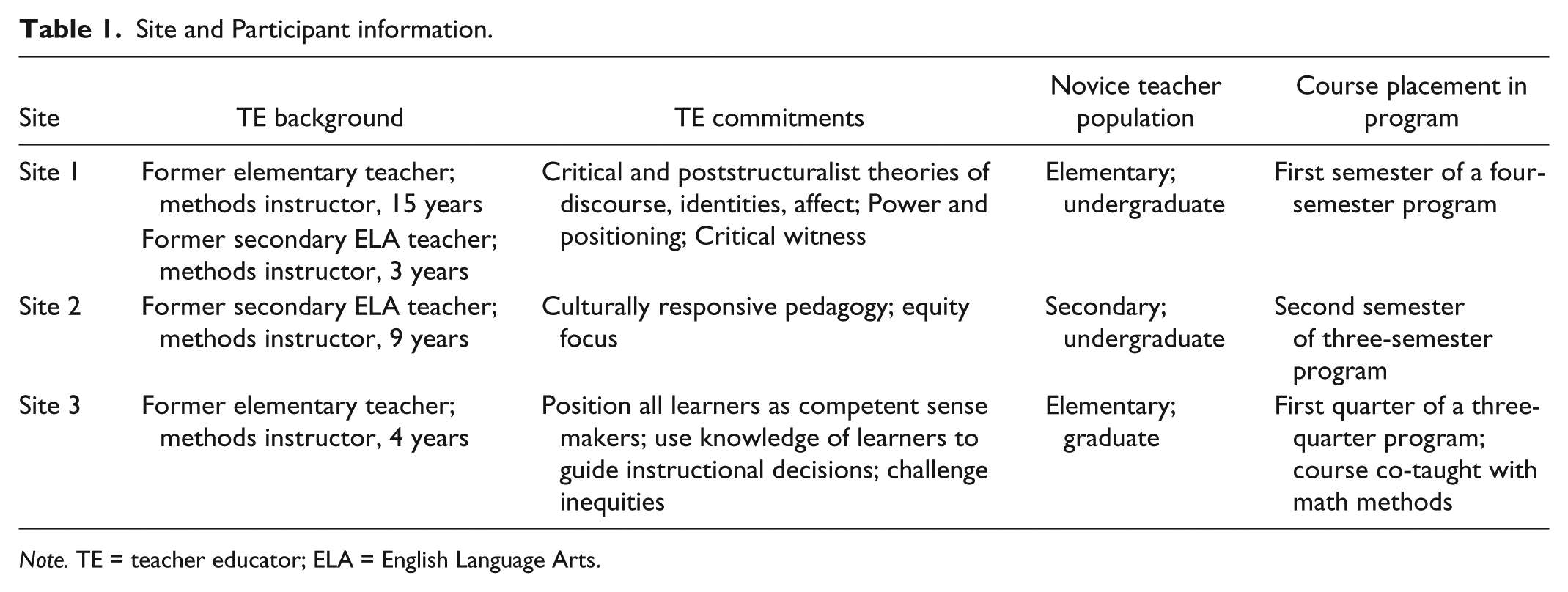
Note. TE = teacher educator; ELA = English Language Arts.
Site 1 was a writing methods course co-taught by two TEs in an undergraduate elementary teacher education program (TEP). The program consists of three 15-week semesters of course work and one semester of student teaching. The course studied was one of two literacy methods courses taken concurrently in the first semester of the program. The other literacy methods course focused on reading methods. All methods courses in the TEP at Site 1 include a substantive practicum component consisting of 6 to 7 hr per week. One of the goals of the writing methods course was for novices to take up pedagogies that centrally engage vulnerability, affect, and emotion with the aim of fostering community, commitments to social justice, and critical interrogation of power and positioning in schools related to race, class, gender and sexual diversity, and language (Dutro & Cartun, 2016; Kumashiro, 2015). The methods course included locating the course at a school, collaboration with one teacher that followed a “flooding” model of practicum, the presence of TEs as coach and mentor, and a practice-centered approach that took up the learning cycle of apprenticeship of observation, planning, rehearsal, enactment, and debrief of Instructional Activities (Lampert & Graziani, 2009; McDonald, Kazemi, & Kavanagh, 2013). The guiding frameworks of the course include sociocultural theories of learning, critical and affective theories and pedagogies, and the related ideas of reciprocal testimony and critical witness in classrooms (Dutro & Cartun, 2014).
Site 2 was a secondary undergraduate ELA methods course offered during the second semester of a three-semester program. It is the second course focused on literacy methods. Both the disciplinary literacy course—taken in the first semester—and the English methods course, span 13 weeks and have a substantive practicum component, consisting of 8 hours per week in the field and a weekly 2-hr seminar. The secondary methods course is focused on PBTE and TE modeling to decompose practices and support novice teacher learning, enactment, and reflection (Grossman, Hammerness, & McDonald, 2009; Grossman & McDonald, 2008). The course uses the pedagogy of TE modeling where the TE includes “model lessons” that approximate what a secondary ELA teacher might do to demonstrate the core practices and illuminate a particular principle or aspect of teaching and learning. The class then engages in the metacognitive work of decomposing and investigating the instantiation of the practice followed by rehearsals, enactments, and reflections by the novices (Grossman, Compton, et al., 2009). A large part of the work as TE is supporting the novices’ metacognitive work to develop them as principled reflective practitioners, who understand the contingencies, disciplinary understandings, and theories of teaching, learning, and adolescent development behind different instructional practices. Within this work, the TE encourages novices to actively disrupt deficit ideologies of ways of speaking, reading, thinking, and being in classrooms (Lee, 2007).
The literacy course in Site 3 was taught in a three-course sequence. For the purposes of this study, data were collected during the first two courses. This elementary methods course is co-taught by a mathematics and a literacy instructor, alternating content each session. The literacy instructor is the TE participant for this study. The fall focuses on reading—engaging in two instructional activities: interactive read aloud and small group reading. Winter quarter addresses writing with four instructional activities: modeled writing, children’s literature as mentor text, writing conferences, and interactive writing. The course is part of an accelerated preparation program for current teachers of record focused on ambitious teaching (Lampert & Graziani, 2009; Lee, 2007). The ambitious teaching is driven by four program principles (position students as competent sense makers, know students, engage students in rigorous content, and challenge inequities) and seven core practices (teaching toward instructional goals, eliciting and responding to students, orienting students to each other, orienting students to the content and the content to the students, positioning students as competent, assessing students’ understanding, and creating a learning environment). The TEs engaged novices in learning instructional activities through the use of a learning cycle to focus in on their practice through video, lesson planning, enactment, analysis of video, and analysis of student work (McDonald, Kelley-Petersen, et al., 2013). The goal of using the learning cycle was to develop novices’ enactments of the core practices of ambitious teaching by couching practice within authentic and meaningful instructional activities where candidates engage in intellectually rigorous content with K-8 students.
Each methods course is part of an already developed TEP with established goals. The TEs from these sites had not previously worked together and brought slightly different stances to the work of preparing literacy teachers. It is in such “messy” settings, which mirror the contexts in which the work of developing shared specifications and language must happen, that we seek to understand what mediates attempts to develop shared ways of preparing teachers.
Specification of Discussion as a Practice
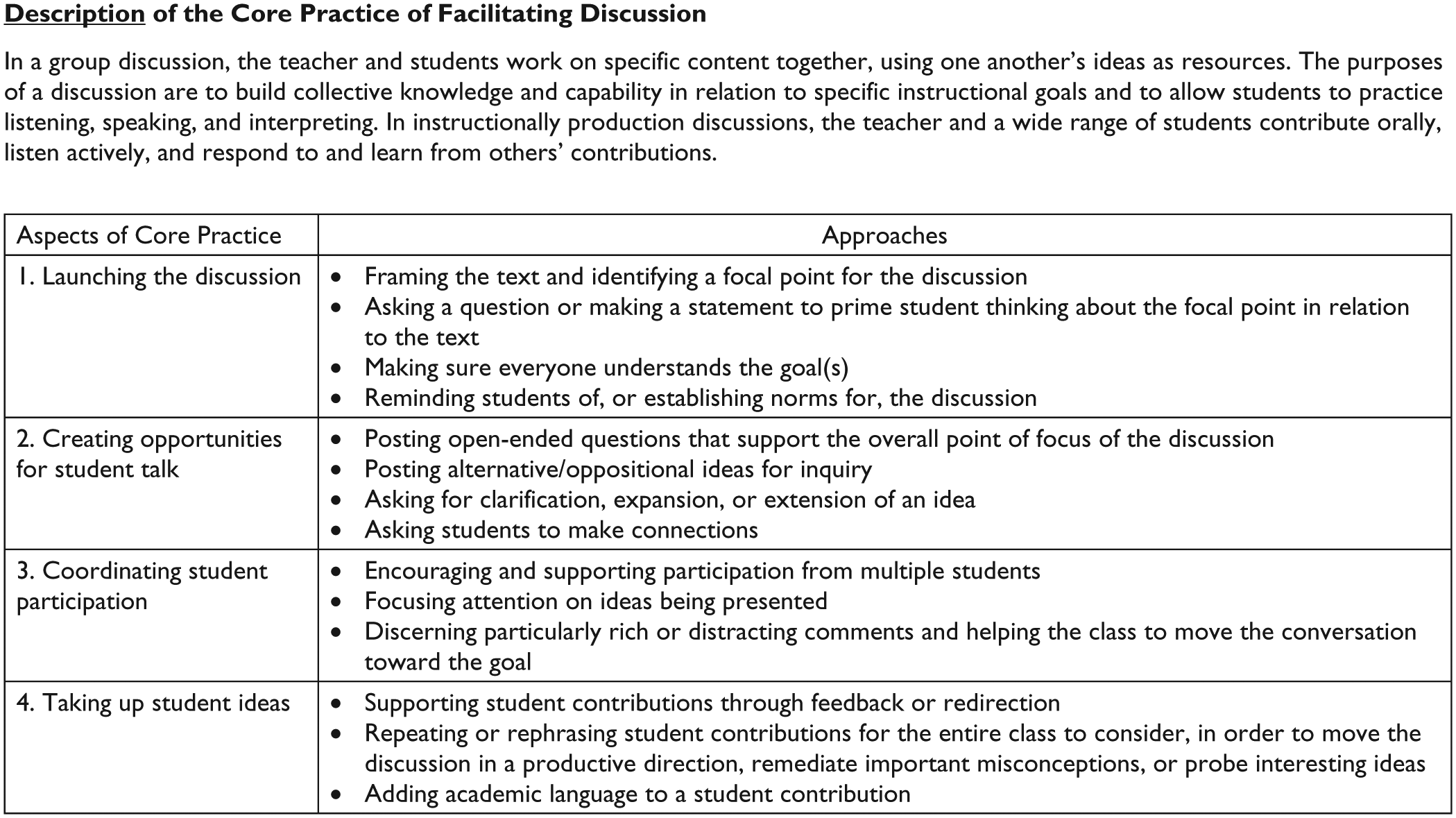
Leveraging the research on classroom discourse, we developed a specification of facilitating discussion. The specification tool uses Grossman, Greenberg, et al.’s (2009) secondary ELA observational protocol category “classroom discourse,” with its two subcategories: uptake of student responses and opportunities for student talk. The protocol defines rich discourse as having students engage in elaborated, coherent, and focused discussions in which the teacher and other students build on each other’s contributions and prompt each other to clarify and specify their ideas. The work of Kucan and Palincsar (2013), which focuses on elementary text-based discussions and provides language for teacher questioning, was used to elaborate and extend the specification tool. Based on this work, we specified classroom discussion as “opportunities for students to have extended interactions with the teacher and their peers around the content.” We articulated that the quality of a discussion hinges on the extent to which a range of class members engaged with the ideas presented by others with the goal of building collective knowledge and capability in respect to listening, speaking, and reading and interpreting text. Implied in our definition is that a primary goal of teaching and learning is to position students—their identities and ideas—at the center of the work and leverage those identities, backgrounds, and ideas to co-construct deeper, more nuanced understandings of the content, ourselves, and world. The specification was developed collaboratively and, thus, reflects a shared commitment to shifting the power dynamics during classroom discussions in ways that privilege student ideas. We decomposed the practice into aspects of the practice, and sub-practices and techniques that teachers generally use within that aspect of the work. Table 2 presents the decomposition of the practice we generated and used in our methods courses.
Aspects of the Practice and Subpractices in English Language Arts.

Methods and Data Analysis
Each TE agreed to use the specification to inform their work with novice teachers. This article draws on three primary data sources: video and field notes of course sessions in which facilitating discussion was introduced and taken up, TE interviews, and artifacts related to the (a) goals and structure of the course (e.g., syllabi) and (b) specification of facilitating discussion (e.g., slides, agendas, handouts) to understand what variations emerge in implementation across the three sites and what might account for those variations. There were two video-recorded class sessions per site, approximately 6 hours per course, in which the TEs focused on the practice of discussion. A researcher, a member of CPC but not one of the participating TEs, took open-ended field notes to accompany the video record of each class session. The researcher also conducted semi-structured TE interviews: initial, pre- and post-observation, and final interviews. Each interview was audiotaped and transcribed. Interview questions were designed to uncover information about the TEs’ understanding of discussion and how the practice was taught in their course (e.g., “How do you understand the core practice of discussion in your context?”).
Analysis included inductive and deductive coding using the codes created and honed iteratively, first by the whole research team and then by smaller groups (Yin, 2003). The coding scheme was based on our specification of practice which drew for prior research conducted by Grossman, Greenberg, et al. (2009) and Kucan and Palincsar (2013). The research team, including the four TEs in this study and three other ELA TEs in the consortium, first collaboratively coded a subset of data across all three sites leveraging the specification of practice to develop the initial codebook. Initial codes which included codes for aspects of the discussion, such as launching, establishing norms, and coordinating participation, are pulled directly from the specification of practice. The initial codes helped to see how the tool was used in each context, yet did not illuminate how and why instantiations varied across contexts. Additional codes, listed in Table 3, were developed through a second round of coding focused on the contextual factors that influenced the ways that TEs were leveraging the specification tool in their context. From this process, codes for local language, TE commitments, and rationale for TE moves were developed, as these were the points where we noted variation in instantiation of the specification tool. These additional codes are critical to understanding the contextual factors at work in the variation produced across contexts given our goal of noting what contributed to the variation in instantiation of the commonly designed specification tool. For example, if a TE said in a post-observation interview that they selected a particular text to help the novices consider expanding the canon to include books that represented a range of students, this would be coded as culturally relevant/responsive pedagogy under TE Principles/Commitments. To refine the codebook, the four TEs individually coded a subset of data across sites, compared the coding, and came to agreement through discussion in places where our coding was not aligned. We used this process with each type of data—video recordings, interview transcripts, and course artifacts—to develop a robust set of codes for our work. These multiple data sources allowed for triangulation (Merriam, 2009).
Example Parent and Child Codes.

Note. TE = teacher educator; ELA = English Language Arts.
Once the codebook was refined, the data were divided across researchers, with researchers not coding data from their site; coding was then member checked by the TE. Fifteen percent of all data sources were double coded to ensure consistency in interpretation. High levels of agreement were established through discussion.
Results
Even when TEs have shared understandings and tools, use of those understandings and tools are situated in local contexts and modified according to local demands. In what follows, we focus on factors that influenced variation across three contexts and the ways the TEs worked to reach alignment amid variation. We first detail how program structures and grade level seem to influence variation in the language each TE used in their methods courses. Then we consider the TEs use of the specification of practice as a flexible tool that is both influenced by and influences TE commitments and local language
We contend that the variation noted was within alignment with the foundational principles of the specification of practice. We argue that the alignment amid variation that was reached by the three TEs in this study presents possibilities for alignment in teacher preparation. The alignment amid variation seen across the three sites has implications for how TEs might move forward in navigating the tensions around the need to both prepare teachers to work across settings as well as with specific children.
Implementation Across Sites
The specification tool reflects a shared commitment to shifting the power dynamics during classroom discussions in ways that privilege student thinking. In accordance with this shared commitment, each TE noted that they focused on supporting novices in “how to respond to the student” and “connect kids’ talk” through the specific moves being taught and practiced. In elementary, this was done through the use of “talk moves” where novices were encouraged to “pose some questions in their mini-lesson that allow for multiple kids to share. For them to enact the talk moves that connects kids talk.” In secondary, this manifested in the requirements that novices utilize three specific facilitation moves: pressing, revoicing, and posting. Although the language differed across sites, the commitment to privileging student ideas is an explicit thread in the instruction and language in all sites. Although there was a shared understanding and common tool, there were points of disjuncture in its use across contexts. Our analysis pointed to contextual factors, such as program structures, grade level taught, and local language, as points for disjuncture in the use of the tool. However, our shared understandings of the theories and orientations undergirding the tool allowed for congruence even with the noted variability.
Figure 1 offers our current conceptualization of the ways these factors interact in our work to develop novices’ capacity to facilitate discussion. At the center is local language, which we argue is the space through which other factors are filtered. We see local language as the space where the influences of program structures, grade level, TE commitments, and the specification of practice are negotiated. Given that the TEs were involved in the development of the specification of practice, we see a bi-directionality between the specification tool and local language with both being influenced by TE commitments.
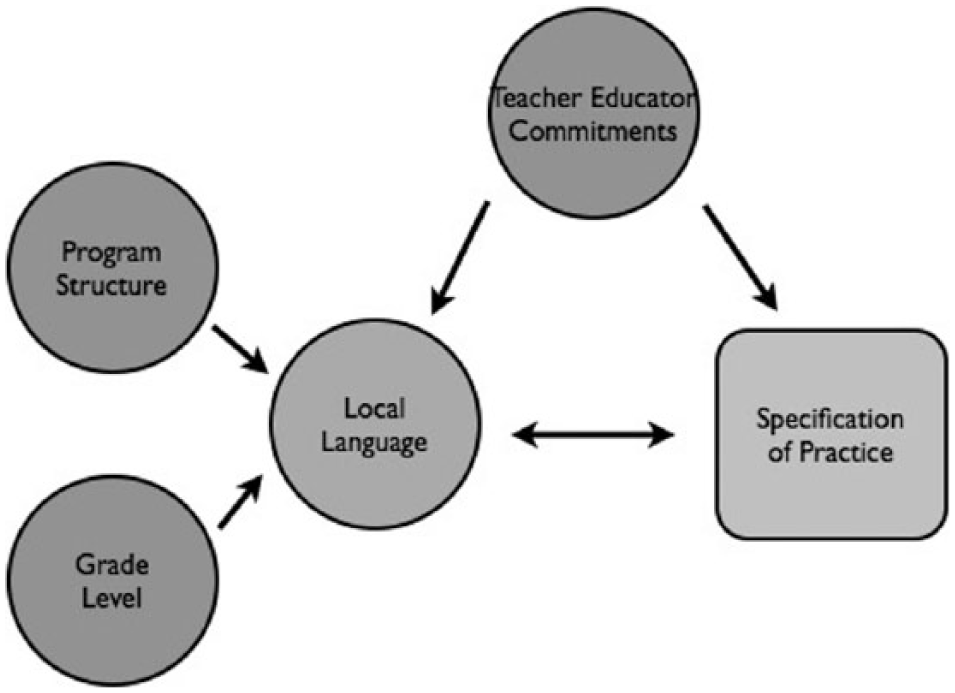
Variations in core practice instantiation.
In the following section, we detail how program structures and grade level seem to influence local language. Then, we consider the specification as a flexible tool that is both influenced by and influences TE commitments and local language. We see these variations, not as inherently problematic but both as a function of the work of teaching and learning and as a way of understanding how we might negotiate the tension around the need for shared understandings in teacher education as well as necessary responsiveness to the contexts in which we are teaching.
Program Structures
Each TE’s approach to teacher education was influenced by the nature of their TEP (e.g., undergraduate or graduate), design of practica, and how the methods course was situated in novices’ trajectory within the program (e.g., first methods course or final methods course prior to student teaching). In elementary teacher education, generalists are being prepared, with multiple content courses such as ELA, math, and science. This generalist preparation requires local language to preempt the specification language to support program coherence. For example, in Site 3, the literacy methods course is co-taught with mathematics, and instructors across the program utilize seven core practices. The TE noted, “It would be confusing if in literacy I was like, well, we’re going to use discussion but in math they’re doing ‘eliciting and responding to students.’” In the other two programs, the methods courses were also in conversation with other literacy methods courses in the program where specified local language had been established. We considered this use of local language as a necessary disjuncture for program coherence. That said, to integrate the language of the specification tool, TEs often coupled the language of the tool with local language. The TE in Site 2 connected the language of the specification with local language through parentheticals and definitions of terms to help novices understand more deeply the work of the facilitation move. Specifically, the TE in Site 2 elaborated press to be one way of “eliciting student ideas” and that one function of revoicing was to “extend a student’s idea.” The TEs in the other sites also worked to connect the language of the tool with the language that was being used in the program. These connections were ways in which the TEs attempted to bridge between local language and the language of the specification. We see this bridging as a form of alignment amid variation around the particular language being used to support novices.
Grade Level
In addition to program structures that accounted for variations, grade level considerations also suggested variation in language. An early divergence in language deeply connected to grade level concerns was the tension around what to call the core practice. Elementary TEs centered on facilitating “discourse” or “interaction” whereas the secondary TE considered the term facilitating “discussion” as more apt to describe the work we were preparing novice teachers to do. As one TE explained in an interview,
I would say that we have a core practice of discussion and we call it eliciting and responding to students and actually the other teacher educators and I, we have said in elementary literacy, we’re using the core practice of eliciting and responding to students.
This difference in language stems from the TE’s understanding regarding what counts as discourse or discussion. We found that the practice was bounded differently in relation to common activity structures in elementary and secondary classrooms. The bounding of the practice refers to differences in when and for how long the practice is used across grade level. For example, in elementary settings during interactive read alouds, the TE might model brief instances of eliciting and responding to students as she reads a common text. Alternatively, in secondary settings, the practice would likely be longer in duration, elicit more students’ thinking, and utilize a longer, or several texts, that students had read on their own.
One elementary TE noted,
It’s not like you have a group that’s read a shared piece and is coming together to talk about it. You’re helping make that meaning with the kids as you go through the text. The discussion has . . . there’s stopping points . . . you’re with the kids making that meaning, and talking about it, and thinking about it as you read it to them.”
In elementary, novices are often using an instructional activity such as interactive read aloud or literature as mentor text for writing as the context in which they are supporting interaction about a text. The elementary TEs drew on the work of Chapin, O’Connor, and Anderson (2009) using their five productive talk moves: revoicing, repeating, reasoning, adding on, and waiting (with some additions at each site) and worked to connect for novices the language of Talk Moves to the specification tool. For instance, a TE used a slide to visually represent the relationship, with “Talk Moves” and “Facilitating Discussion” dissolving into one another, and the individual talk moves surrounding both terms. The secondary TE utilized an “into, through, and beyond” lesson framework coupled with a small set of facilitation moves—pressing, revoicing, and posting—that encapsulated specific question stems that elucidated each facilitation move (Barker, 2015; Brinton & Holten, 1997). In each of these instances, the TEs worked to both meet the needs of their contexts and align the work with the specification tool.
Program and grade level differences necessitated variations in language use at the local level. Again, local language is the space in which variation across sites was manifest. The variation stems, in part, from programmatic and grade level differences. The TEs in this study worked to overcome these differences by making explicit bridges between their local language and the language of the specification to support novice learning. The ways in which the TEs used the specification tool allowed alignment in the operationalization of aspects of the practice if not in actual language. Each TE worked to bridge the differences by making explicit for novices both the ways language might be used differently but also, and we argue more importantly, by helping novices understand the purposes behind the talk and facilitation moves. These undergirding purposes, we argue, allowed for alignment in conceptual understandings amid variation in local language.
The Specification as a Flexible Tool: Finding Alignment Amid Variation
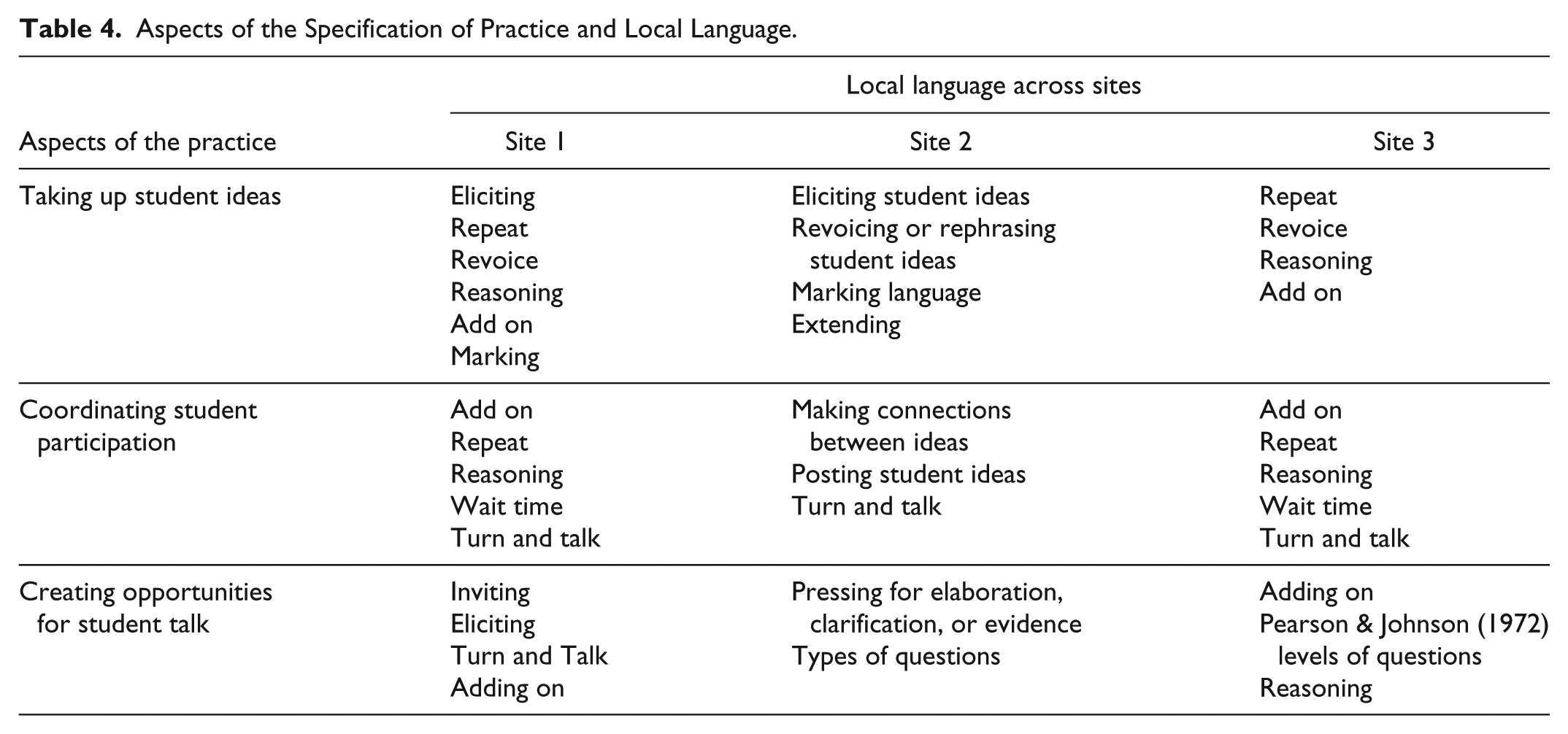
Although there were differences in how the specification was used, we found evidence that it was a grounding tool in some similar ways at each site. First, each TE addressed each aspect of discussion in their work with novices, but three aspects were emphasized more than others: taking up student ideas, coordinating student participation, and creating opportunities for student talk. These three aspects revolved around shifting the power dynamics in classrooms by privileging student voices and ideas. Given each TEs commitment to positioning students at the core of the work and the similar focus of the specification, emphasis on these three aspects of the practice is understandable.
Table 4 represents a catalog of the local language used across the three sites and how that language fits into the three emphasized aspects of the practice from the specification tool. The table illuminates the alignment amid variation across sites. Each TE focused on developing novices’ abilities to work within the same three aspects of the practice. What we saw across the data was each TE’s use of local language that addressed aspects of the practice and was in many ways synonymous across sites. For example, at each site, TEs focused on the idea of uptake: a teacher incorporating a student’s contribution into the class discussion in the form of a proceeding question asked. This concept of uptake is foundational to the ways the core practice has been defined. All TEs discussed with novices how to pose questions that support the overall focus of the lesson. The TEs explicitly modeled discussion moves for novices and worked to help them make linkages between the model and the specified aspects of the practice. We see this as creating alignment amid variation in which there is consensus around the decomposition of the practice and the purposes for engaging both novices and K-12 students in those practices, yet the language used to demarcate those practices varies in response to particularities within programs, grade level focus, teachers, students, and contexts.
Aspects of the Specification of Practice and Local Language.
Even though the TEs used different local language to describe and take up the practice, they each used the specification to support novices’ understanding of the practice in ways that suggest agreement on the aspects of the practice. All TEs used the specification in class in ways focused on inviting participation through explicit statements and implicit moves. Figures 2, 3, and 4 are artifacts from each site that leverage the specification tool to support novice learning of the core practice. In Site 1, the TEs used the CPC specification of practice as a tool to engage students in discussions in the methods class (Figure 2).
Site 1 Use of the specification tool.

Site 2 graphic organizer novices used to prepare for discussions.
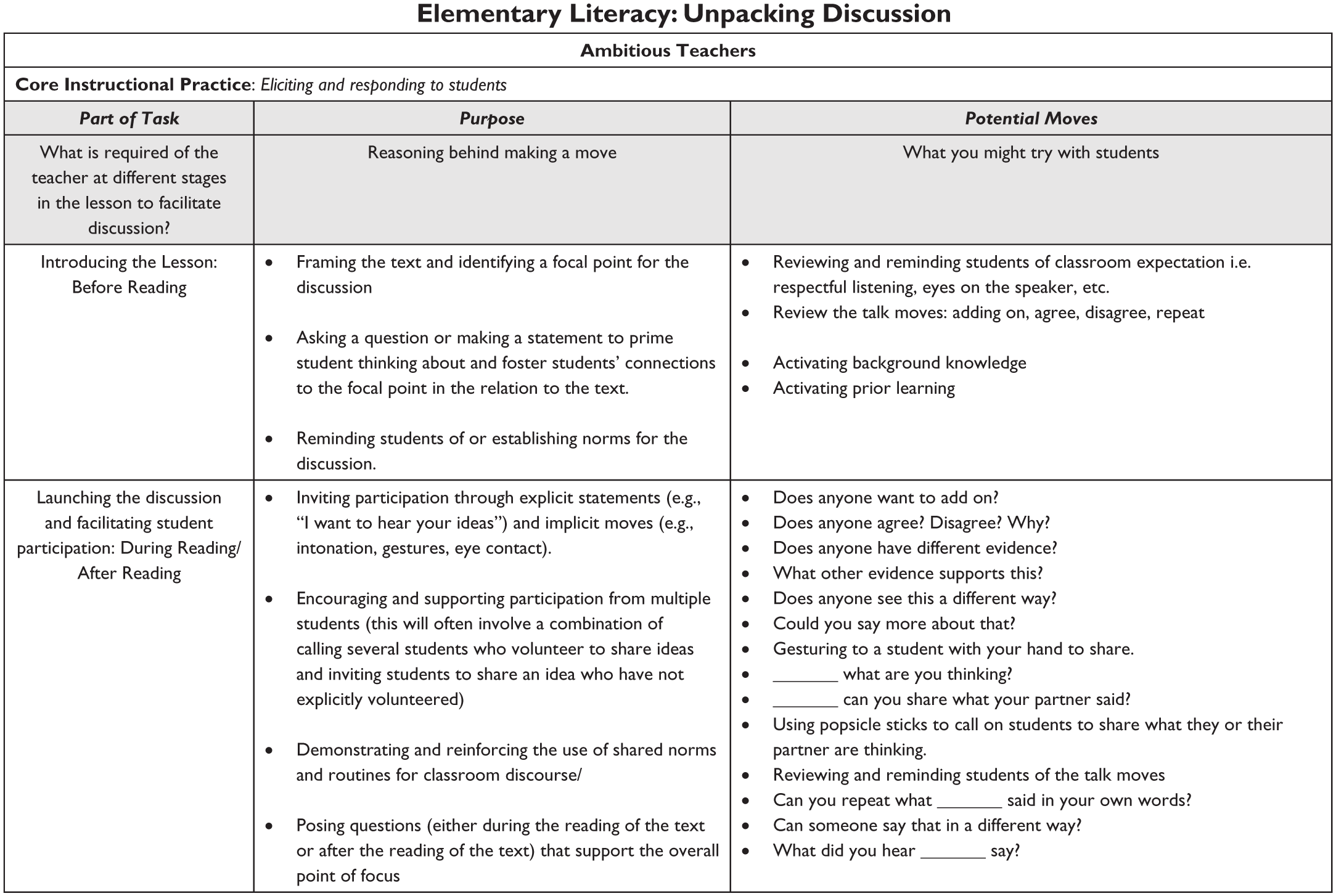
Site 3 graphic organizer for unpacking discussion.
In Site 2, the TE leveraged the specification in creating a graphic organizer (Figure 3) used by the secondary ELA novices as they planned to enact discussions. The graphic organizer mirrors the specification tool in that it focuses novices’ attention on the need to craft questions that create opportunities for student talk and that support students in elaborating on their own and their peers’ ideas—all key aspects of the specification.
In Site 3, the TE created a tool (Figure 4) which draws directly on the specification of practice to support candidates in understanding what is required of the teacher to facilitate a discussion, the reasoning behind the components of a discussion, and includes potential moves candidates might make with students using local language. What can be seen across each artifact is utilization of the specification to support novices as they planned and facilitated discussions.
Another way the specification tool grounded our work across sites is that it supported intentional reflection among the TEs. As a result of using a shared tool, TEs made a more conscious effort to make their teaching moves more explicit to novices. As one elementary TE (Site 3) expressed in her interview,
. . . the discussion document really talked about to the purpose of why you’re doing those things, so it really pushed me . . . I would say to novices, “Why do you think I did that?” I think that that document helped me really think even more about explicitly naming the purpose for them. I think before, I was more implicit about that. One of the reasons I think that was because of the way it framed it out, with, “Here, you have your launch, then you have this.” Then, going even further, with, “I asked that question, but then I also made all these moves under it. What was the purpose to that?
The secondary TE (Site 2) also spoke about the ways in which the specification encouraged her to reflect “intentionally” and “mark” her instruction around the practices more explicitly to support novices in deeper understanding and use of the practice.
Let’s step back from your teaching a little bit. What have you learned from participating in the CPC?
I’ve learned to think more about grain size and intentionally thinking about how I’m explicitly marking things in my teaching. I thought I was good at that, but I think there is always work to be done in marking things for my students so that they can see the practices. The language has been really helpful. Thinking about using the same language and focusing on that, being intentional about marking things for them has been helpful.
At Site 1, one TE explicitly modeled the use of the specification of practice as a facilitation tool during a whole class discussion with novices. Following the discussion, novices used the specification to guide a reflection activity on what they had noticed related to each aspect of the practice.
Although the TEs do not use the same language across programs, or mirror exactly the language of the CPC specification, the ways the practices are taken up and instantiated across contexts align with the ultimate goal of the specification. Our shared goal was for novices to understand and enact the practice in ways that allow K-12 students to engage with one another, that shift the power dynamic, illuminate students’ thinking and sense-making abilities, and allow for deeper, co-constructed understandings. In other words, a common specification of the practice of facilitating discussion grounded in shared understandings and goals for the work seemed to support each TE in modeling and engaging the practice with novices in ways that would be recognizable across grade levels and local contexts, but proved highly adaptable and did not appear to restrict how the practice was situated within important local contexts.
Influence of TE Commitments
All TEs shared a sociocultural view of learning that influenced the content TEs used to model the practice as well as how the specification of practice was introduced and used. Other framing lenses central to their work as TEs and researchers also influenced the ways each TE utilized the specification of practice. TE commitments also varied in relation to the needs of the specific K-12 student population and novices being taught. These commitments included preparing novices for the diverse needs of the student population through attention to trauma, culture, and/or issues of equity. For instance, at Site 1, the course encompassed a guiding concept of “critical witnessing,” that connected to the TEs’ grounding in critical and poststructuralist theories, and emphasized challenges to binary language and the paired necessities of teachers sharing vulnerability in classrooms while engaging in active and ongoing critical analysis of issues of power and positioning (Dutro, 2013). In the session focused centrally on introducing the practice of discussion, the TEs explicitly defined the course session around a content goal of delving more deeply into critical witnessing and a process goal of honing the practice of facilitating discussion. In the lesson plan for the session, the lead TE wrote,
Signal that specification of practice document will come into play after discussion of the text. Remind about the goals and two hats [student discussing the article and teacher learning to facilitate discussion] and how the ideas in this essay connect to our crucial commitments that are both beyond, of course, any specific “practice” of teaching and intimately embedded in the practices we can learn and hone in our teaching. In this way, our two goals for today, content and process, are inextricably linked.
The collaborating TE, then, modeled facilitating discussion through a whole class discussion of an article on critical witnessing with novices. This is one example of how TE commitments produced variation in the instantiation of the practice.
At the other two sites, a focus on cultural relevance and equity through careful selection of content for discussions were ways in which the TE’s commitments were manifest (Lee, 2007). In Site 3, the TE discussed how she selects content for discussions with novices to model the ways they should consider content and the facilitation needed to support students’ engagement with that content. She states, “In the interactive read aloud, I purposely selected a text that they would teach with students at the beginning of the year, when we’re also focusing in on teaching those talk moves, and so the topic isn’t as sensitive.” Later in the course, the TE selects texts that
. . . represent kids, sometimes we’ll just read a book that they might see themselves in, and really be able to make strong text-to-self connections. Sometimes you might read a book that they see themselves in but also talks about a big Civil Rights issue. Like Wilma Unlimited, which talks about how she could only see one doctor. What that means and those differences in conversations and for candidates to be aware that you have to build community to have productive discussions around sensitive topics. There are some moves you might make that are a little bit different, to check in and make sure everyone’s felling comfortable.
Here there is evidence of ways the TE’s commitments to expanding the canon, of inclusion of other voices, is layered onto the specific practices or talk moves novices need to facilitate discussion among students. In Site 2, novices read, participated as students in an explicit model of a discussion facilitated by the TE, and facilitated discussions concerning access to education as a function of race using Frederick Douglass’s narrative. The discussion facilitated by the TE and those facilitated by the novices in the course were structured to map onto aspects of the specification of practice while also emphasizing commitments to equity and justice. In each of these examples, the TEs are working to pull together in coherent ways the content, their commitments, and key aspects of the practice from the specification tool to support novices in learning to facilitate discussions that privilege student voices.
Discussion
A current goal for some in teacher education is to seek a common language to better support teacher learning. Our study was to investigate what could be shared and common, what would vary, and what factors might account for the commonalities and variations. Our results suggest that program structures and grade level differences, as well as TE commitments, influence local language in ways that created variation in the instantiation of the specification tool. We suggest that even with these variations in local language, there were important ways in which the TEs found agreement that superseded variations in program structures, grade level, and local language; we call this alignment amid variation and argue that this stance toward the field’s push for commonalities would be beneficial to efforts to ensure that children receive equitable learning opportunities.
Most fundamentally in the alignment amid variation noted in our work, there was alignment among the TEs that facilitating discussion was a crucial practice across grade levels in ELA. In addition, the TEs agreed that children and their ideas should be valued and heard in classrooms. There was also alignment in commitments to issues of equity and social justice. We believe the alignment around these orientations to children and teaching and learning even with variation in local language is a fruitful space to consider what shared specifications and language can develop even across quite different local contexts. We argue that our alignment amid variation developed as a function of our collaborative work developing the specification; similar stances toward students, emphasized in the specification; and working intentionally and reflectively to incorporate the specification into an already established program. Seeing the specification as collaborative, as a flexible tool to support ongoing work, and as something that at its heart held similar orientations to teaching and learning allowed for this alignment. A noted critique of PBTE is that candidates are prepared to implement a specific type of instruction that does not consider contextual influences (Zeichner, 2012). Alignment amid variation illustrates that agreement on and inclusion of a core practice can and must attend to the layered contexts in which the practice is taken up. These understandings have implications for the ways the field might progress as we work to address the tensions around the need for consensus to support all students while also attending to important differences in teachers, students, content, and contexts. Our work also points to how the process of specifying, honing, and studying a core practice across very different sites created opportunities for conversations about the complexities of a practice and the changes needed to successfully leverage the specification of practice within already established TEPs. We feel that these conversations deepened our understandings of and practice with facilitating discussions, and hopefully by extension, the practice of the novices in our courses.
Implications
Our findings suggest ways of collaborating across sites to begin to work toward alignment amid variation. The variations across contexts reflect important differences in the field in how TEs and institutions frame and pursue their work that must be taken into account. However, our analysis suggests collaboratively developing a specification can support generative conversations that lead toward alignment around core principles amid variation in local language. In particular, it suggests that focusing on the key aspects of a practice and the shared goals for work with children can generate deep alignment in the ways teaching and learning are conceptualized. This alignment is seen in the thinking and instruction of the TE if not in their specific language used with novices. In essence, we see this work as pushing our thinking and focus away from a concern with variation in language necessarily, and more on how we might reach alignment in understandings and orientations toward children and their learning amid variations due to local contextual needs.
Furthermore, developing, honing, and studying a specification of practice across sites of teacher preparation allows TEs to learn from one another’s expertise, approaches, and emphases. In other words, the specification process surfaced tensions and disjunctures. By working toward alignment amid variation, we approached those tensions and disjunctures as opportunities to hone our practice and extend shared understanding rather than as moments that needed to be fixed. Alignment amid variation is not, then, a step toward an ultimate goal of full alignment; rather, we are finding that the alignment amid variation we found in our study captures a space of dynamic learning that represents a desirable goal for TEs and novices. We see it as the continuous process of deepening our shared understandings and holding ourselves accountable for equitable learning opportunities for children within variation. Given what we see as alignment amid variation, our questions then are, is alignment amid variation sufficient for novice teacher learning; how do we assess the alignment and learning; and, if this type of alignment is sufficient, productive, and equitable, how do we support other TEs and programs who are interested in incorporating core practices into their program make a similar journey toward alignment amid variation.
Footnotes
Declaration of Conflicting Interests
The author(s) declared no potential conflicts of interest with respect to the research, authorship, and/or publication of this article.
Funding
The author(s) declared the following financial support for the research, authorship, and/or publication of this article: This study has been conducted as part of the work of the Core Practices Consortium ( ) and builds on the contributions of its members. This collective work has been supported by the Bill & Melinda Gates Foundation under Grant #OPP1089179 and the Spencer Foundation under Grant #201600110. Any opinions, findings, and conclusions or recommendations expressed in this material are those of the author(s) and do not necessarily reflect the views of the funders.
Author Biographies
References
Supplementary Material
Please find the following supplemental material available below.
For Open Access articles published under a Creative Commons License, all supplemental material carries the same license as the article it is associated with.
For non-Open Access articles published, all supplemental material carries a non-exclusive license, and permission requests for re-use of supplemental material or any part of supplemental material shall be sent directly to the copyright owner as specified in the copyright notice associated with the article.
