



Abstract
Family partnerships should be a central component of teacher preparation. Although research provides family engagement strategies, little research offers teacher educators guidance from the perspectives of families themselves. The purpose of this convergent mixed-method study was to begin to fill the void in the literature by investigating family perspectives of theirs and their children’s experience in 10 reading clinic/literacy lab literacy specialist preparation programs across the United States and Canada. Through analysis of survey ratings (N = 132) and responses to structured interviews to (N = 84), this study found that families valued clinic/lab tutors building relationships with them, responding to their children’s strengths and needs, promoting self-efficacy, and working together as partners. Methods used in this study can provide a useful model for how teacher educators can intentionally seek input from families. Findings have implications for teacher educators advocating for and centering family engagement in teacher preparation.
Keywords
For nearly a century, university reading clinics/literacy labs, providing one-on-one or small group literacy instruction to K-12 students under the supervision of an expert mentor, have been intensive clinical experiences in literacy teacher preparation (Dozier & Deeney, 2013; Hoffman et al., 2019; Morris, 2011; Pletcher et al., 2019). Clinics/labs can also be prime spaces to foster teachers’ engagement with families, as families seek these programs for their children’s literacy learning. Historically, university teacher education programs have provided few opportunities for candidates to engage with and learn from families, particularly families who are culturally and linguistically diverse (de Acosta, 1996; Flores, 2017; Kirmaci, 2019). Teachers, therefore, are often underprepared to collaborate with families as partners in their child’s education (Amaro-Jimenez, 2016; Amatea et al., 2012; González et al., 2005; Ishimaru, 2019; NAFSCE, 2022; Sleeter, 2008).
As a result, many have called for an increased focus on families in teacher preparation (Darling-Hammond, 2010; Dugan, 2022; Evans, 2013; International Literacy Association [ILA], 2018; Reyes et al., 2016; Risko & Reid, 2019; Souto-Manning & Swick, 2006). Recently, the National Association for Family, Schools, and Community Education (NAFSCE, 2022) highlighted core competencies for educators developing and maintaining family partnerships: respecting, honoring, and valuing families; embracing equity; building trusting reciprocal relationships with families; co-constructing learning opportunities with families; leading alongside families; taking part in lifelong learning; and advocating for systems change (pp. 14–16). As reading clinic/literacy lab teacher educators, we heed these calls to improve clinical experiences and to address teachers’ engagement with families by situating our clinics/labs as spaces where teachers work intensively on both literacy instructional practices and building relationships with families (Dozier et al., 2006; Rogers & Brefeld, 2015; Rogers et al., 2023). In the nested structure of clinic/lab experiences (directors teach tutors, who tutor children, and all learn from families), clinic/lab literacy teacher preparation programs can “shift the centre of gravity . . . in a way that includes dialog and collaboration with parents” (Sleeter, 2008, p. 1954). Families bring funds of knowledge that can and should provide insights into children’s learning (Moll et al., 1992).
In this study, we (16 clinic/lab directors and instructors from 10 university clinic/lab programs) sought family perspectives on clinic/lab literacy instructional practices, and how families felt teachers engaged with them as partners. Findings from this study offer family voices to extend the dialog of the role of families in teacher preparation and provide a window into what matters most to families who seek literacy support for their children outside of the school setting.
Theoretical Perspectives
Clinics/labs are complex communities of practice (Wenger, 1998) where instructors, tutors, students, and families all learn together in “an orchestrated assisting environment for all. . .members” (Tharp & Gallimore, 1988, p. 91). In clinic/lab preparation, tutors influence, and are influenced by, the clinic/lab instructor and instruction, colleagues, the child, the child’s family, and other children in the program. Therefore, our clinics/labs are centered in ecological systems theory (Bronfenbrenner, 2005), where individual learning and development occur within nested spheres of influence. The first layer of influence, the microsystem, includes those who have direct relationships with an individual. For example, the child in their family is one microsystem; the child’s classroom is another; the lab/clinic becomes yet another microsystem. Tutors need to come to understand that the microsystem in which they function (the clinic/lab) is not the sole system influencing the child’s learning. Families are the child’s primary microsystem and children come to the clinic/lab microsystem bringing family funds of knowledge (González et al., 2005; Moll et al., 1992). Therefore, clinics/labs function within mesosystems—the interrelationships of these microsystems. To successfully navigate the mesosytemic settings, tutors must come to know each individual child and family and their multiple ways of knowing. Through this lens, clinics/labs focus on learning from families about their lives and goals (Kugler, 2011), so that, tutors honor family funds of knowledge and create meaningful learning experiences that support academic success and encourage self-efficacy (Bandura, 1997; Qarooni, 2022). Because clinic/lab tutors teach and learn alongside children and families, teachers can be guided in their preparation programs to confront their own unconscious discourse models of deficit and disability (Fennimore, 2017; Ladson-Billings, 2009; Lazar et al., 2012) and begin to build more equitable environments to benefit the learning of all (Abrego et al., 2006; Mapp & Hong, 2010).
Background on Clinics/Labs
Reading clinic/literacy lab programs, grounded in research-based principles and practices, fulfill the clinical experience requirement for literacy preparation programs (ILA, 2018). Clinics/labs maintain the dual goals of educating both literacy practitioners and students (Atkinson & Colby, 2006; Carr, 2003; Cuevas et al., 2006; Deeney et al., 2011; Dunston, 2007; Hoffman et al., 2019). In clinics/labs, learning is an active and constructive process taking place within the nested structure (Vygotsky, 1978; Warford, 2011), where clinic/lab instructors serve as the more knowledgeable others for tutors, who then scaffold student learning. Because clinics/labs operate independently of school-based systems, they can create teaching and learning opportunities for tutors to “engage in practices that may not be dominant (or even present) in current literacy teaching” (Hoffman et al., 2019, p. 246). Clinics/labs typically have a low supervisor/tutor ratio and one-on-one tutor/student instructional dyads, enabling supervisors to provide intensive mentoring and ongoing input (Ortlieb & Pearce, 2013). An overarching goal of clinic/lab preparation then is that through fostering meaningful experiences that center on the diverse needs and perspectives of students and families, learning for all (tutors, students, and families) becomes self-extending and transfers beyond lab/clinic contexts (Bransford & Schwartz, 1999).
Clinic/lab research suggests that through their own teaching, teacher educators modeled the very practices they hope teachers will use in their own classrooms (Dozier et al., 2006). In addition, the intensity of the one-on-one format has supported tutors to investigate instructional practices more deeply (Morris, 2011; Pearce et al., 2007; Puryear, 2015) while focusing thoroughly and thoughtfully on the strengths and needs of one student (Dozier et al., 2006). Teaching practices explored in labs/clinics then transferred to classrooms and schools (Carr, 2003; Deeney et al., 2011; Dozier & Rutten, 2005; Oslick & Lane, 2014).
Although research has revealed common elements of clinics/labs, programs vary with respect to attention paid to families (Ortlieb & Pearce, 2013). The clinic/lab teacher preparation programs featured in this study center families in the nested clinic/lab space. In this way, our clinic/lab instruction includes developing tutors’ dispositions toward and engagement with families. Our clinics/labs are grounded in four research-based guiding principles informed by theory and scholarship: relationship building, responsive teaching, self-efficacy and agency, and family engagement. These interconnected principles are designed to help tutors support students’ literacy learning and build from student strengths, which necessitates including families as central to clinic/lab experience.
Research-Based Principles Underpinning Clinics/Labs in This Study
Responsive Teaching
One of the primary goals of clinics/labs more generally, and our programs in particular, is developing responsive teachers (Dozier et al., 2006; Hoffman et al., 2016; Lazar et al., 2012). Responsive teaching involves working within students’ zones of proximal development (Dozier et al., 2006; Vygotsky, 1978), understanding students and how they learn (Moll et al., 1992), choosing and aligning learning and instructional practices (Hoffman et al., 2019), and reflecting on dispositions toward students and families (Schön, 1983). In past clinic/lab research, tutors developed responsive instruction (Atkinson & Colby, 2006; Carr, 2003; Cuevas et al., 2006; D’Abate et al., 2018; Helfrich & Bean, 2011; Nickel & Chadwick, 2022), grew to thoughtfully choose, use, and flexibly adapt assessment and instructional practices (Hoffman et al., 2016), learned to build on student strengths and interests (Atkinson & Colby, 2006; Nickel & Chadwick, 2022), supported student engagement (Deeney et al., 2011), and reflected on their practice (Dozier et al., 2006).
Relationship Building
The unique nested structure of clinics/labs creates spaces for building co-learning relationships (Tuten & Jensen, 2008) through tutors and instructors engaging in joint productive activities (Tharp & Gallimore, 1988) and collaboratively constructing new learning. Research has shown that clinic/lab programs helped tutors understand the relational aspect of teaching (Hoffman et al., 2019), value these relationships (Abrego et al., 2006), and build strong relationships with students (Pletcher et al., 2019). Yet, research has also attested to the difficulty tutors face in developing co-learning relationships (D’Abate et al., 2018).
Self-Efficacy and Agency
Given clinics’/labs’ dual focus on tutor and student learning, clinics/labs seek to create communities in which all involved gain confidence and self-efficacy (Bandura, 1997; Hoffman et al., 2019; Nickel & Chadwick, 2022). Learners who attend clinic/lab programs have often experienced challenges in school, therefore, tutors must move beyond deficit thinking (Dozier et al., 2006; O’Neil & Chambers, 2013) to emphasize learner strengths. For students, this means coming to view themselves as readers and writers and advocating for their learning (Ahmed, 2018; Fredricks, 2011; Johnston, 2004; Sargent et al., 2006). Research suggests that within clinic/lab communities of practice, tutors came to realize the importance of student success and their responsibility for this success (Atkinson & Colby, 2006). Through tutor support, students in clinic/lab programs increased their self-concept as readers and writers (Dunston, 2007), showed positive change in affect and confidence toward reading and writing (Tuten & Jensen, 2008), and used language to articulate their learning (Atkinson & Colby, 2006).
Family Engagement
Research on family engagement in clinic/lab teacher preparation programs has revealed a variety of ways programs communicate and engage with families. Most clinics/labs provided families written reports, held parent conferences, and organized end-of-program celebrations (Pletcher et al., 2019). Some also provided family workshops (Laster, 1999) and/or arranged initial meetings between tutors and families (Atkinson & Colby, 2006). These studies highlighted structures that clinics/labs used to share information, instructional ideas, and potential resources to families. We still need to understand how tutors and families work together for the benefit of children, tutors, and families.
Learning From Families in Labs/Clinics
There is some research that has provided insights into what clinic/lab tutors learned when they engaged with families. For example, preservice teachers in a clinic/lab program that emphasized family engagement came to value working with families, built relationships, and saw the importance of teacher–family partnerships (Abrego et al., 2006). Assaf and Lopez (2012) noted that through family communication in a yearlong in-school tutoring program, most preservice teachers articulated benefits of working with families and moved beyond deficit views. In our own research (Deeney et al., 2011), clinic/lab graduate literacy professionals identified working with families as an experience that most impacted their practices. Yet, some felt family engagement was initially uncomfortable, as they were unaccustomed to building family partnerships within their schools, a finding of Peña’s (2000) school-based research as well.
A few studies have investigated how families perceived lab/clinic experiences with respect to their own or their children’s engagement. Sargent et al. (2006) found that families felt their children improved in literacy and gained confidence/self-esteem through the clinic/lab program. Puryear (2015) found that families appreciated a structured family-tutor communication log designed to help families support children. Unfortunately, it remains a challenge for many directors to ensure family engagement in clinic/lab preparation, as research (Ortlieb & Pearce, 2013) found clinic/lab directors ranked family engagement last, noting the “difficulties related to adding another element to the host of duties and responsibilities of a clinic director” (p. 391).
The paucity of studies focused explicitly on family voices prevents us from understanding how families perceive their experiences in clinic/lab communities of practice. While in prior research (Ortlieb & Pearce, 2013) clinic/lab supervisors viewed efforts to learn from families as an additional time-intensive endeavor, our research group believes learning from families matters and will help us strengthen our practice, encourage family engagement, and inform us as we seek to better prepare literacy professionals. Therefore, in this study, to understand family perspectives and address gaps in the literature, we explored two research questions:
Method
We used a convergent mixed-method strategy (Creswell & Creswell, 2018), collecting and analyzing both survey and interview data to investigate family perspectives. We chose a mixed-method design to understand more broadly family ratings of their experiences, and more deeply their experiences as expressed through their own voices. In this section, we focus on contextual information regarding the 10 clinic/lab programs. We then move to study design and findings.
Contexts for the Study
This study included 10 university lab/clinic programs in seven U.S. states (Illinois 1, Illinois 2 [three locations], Maryland, Montana, North Carolina 1, North Carolina 2, New York, Rhode Island, Virginia) and one Canadian province (Ontario). Programs consisted of seven graduate (IL1, IL2, MD, NY, NC1, NC2, and RI), two combined undergraduate and graduate (VA and CAN), and one undergraduate program (MT).
Sites were school-based (IL2—one location, NY, VA), university-based, (IL2—two locations, MD, MT, NC1, NC2, RI, CAN), and online (IL1). RI and two IL2 locations were suburban and IL1 was rural; all others were urban. Programs were offered for one semester (IL1, MD, NC2, NY, MT, VA, CAN), year-long (RI), or over the summer (IL2, NC1, NY).
The 16 university clinic/lab supervisors in these programs were 81% female, 19% male; 94% White, 6% Black African American, primarily monolingual (94%), ages 30s to 60s, and with 5 to 20+ years of experience. Tutors in the programs were predominantly White females (80% or greater), with one urban program (NC2) being more diverse (50% Black female).
As a group of clinic/lab supervisors, we met routinely to co-construct the guiding principles discussed earlier that formed the foundation for our clinic/lab teacher preparation programs. We now highlight specific learning experiences within our clinics/labs to support tutors to enact these research-based guiding principles.
Learning Experiences to Support Responsive Teaching
As in many other clinic/lab programs (Hoffman et al., 2019; Pletcher et al., 2019), our clinic/lab instructors supported tutors to prepare weekly lesson cycles (planning, feedback, revision, enactment, reflection, and feedback) to ensure tutors planned for and engaged within their student’s zone of proximal development (Vygotsky, 1978). Instructors asked tutors to intentionally plan several possibilities within the lesson to prepare to follow the child’s lead (Hoffman et al., 2019). Instructors also created reflective engagements (e.g., video-recorded session reflections, behind-the-glass teaching) for tutors to interrogate their own practices, language, and dispositions (Schön, 1983). During sessions, supervisors provided in-the-moment mentoring, scaffolded tutor’s instruction, and modeled a strengths-based focus and intentional language choices. During accompanying seminars, supervisors facilitated reflective conversations about student learning and interactions, responsive instruction, dispositions, and how these intersected with course readings.
Learning Experiences to Support Relationship Building
Instructors modeled interactions that supported developing trusting relationships with students and families using strengths-based language and adopting a co-learner stance (Hoffman et al., 2016; Lazar et al., 2012; Rogers et al., 2023; Souto-Manning & Swick, 2006; Tuten & Jensen, 2008). For example, instructors showed tutors how to welcome children and family members by their names, invite families to join the tutoring space, inquire about families’ lives, and listen to and learn from families (Moll et al., 1992). If tutors seemed reluctant or tentative to engage with families, instructors intervened in the moment and facilitated generative conversations. Instructors insisted that tutors sit side-by-side with students as co-learners. They asked tutors to keep anecdotal notes on student and family engagement as a source of reflection on insights that lead to instructional adjustments (Schön, 1983). Instructors set the tone for relationship building by continuously modeling reflective thinking about their own dispositions and engagements.
Learning Experiences to Support Self-Efficacy and Agency
Instructors modeled how to identify learner strengths and asked tutors to specifically name strengths in weekly lesson reflections. They scaffolded tutors and students in naming how clinic/lab learning transferred to home and school contexts (Bransford & Schwartz, 1999). Instructors also modeled helping students use language to explain their learning (Atkinson & Colby, 2006), apply new-found confidence (Dunston, 2007), and envision possibilities as readers and writers, in this way supporting tutors in teaching students to advocate for themselves.
Learning Experiences to Support Family Partnerships
Instructors acknowledged that families come to clinics/labs with goals and intentions for their children’s experiences and required that tutors inquire about these goals. To prepare tutors for these conversations, instructors helped tutors generate questions/conversational prompts to learn from families. By insisting that tutors ask families what mattered to them, instructors helped tutors make connections with families and center family voices from the start. Instructors also fostered partnerships through ongoing, routine, and informative communication pathways. For example, across sites, tutors touched base with families at drop-off and pick up, communicated via email, texts, or phone calls, provided a written case or progress report, and held an end-program family celebration. Five programs also held orientations (IL1, IL2, MD, NC2, and CAN). Instructors insisted tutors ask for families’ communication preferences and follow families’ leads. When tutors and families did not share a common language, instructors sought translators. Through ongoing discussions with families and children, instructors helped tutors recognize and build on family funds of knowledge to plan learning experiences. Thus, instructors assisted tutors in engaging families as members of the community of practice.
Participants
Participants in this study were 178 family members (parents, grandparents, and caregivers) of students in Grades 1 to 10 who attended one of the 10 clinic/lab programs across two school years. Families discovered or were recruited for programs through word of mouth/advertising (MT, NC2, and RI), or were recommended by school/community personnel (IL1, IL2, MD, NC1, NY, VA, and CAN). Participating families in five sites were predominantly White, middle-income, English speaking (IL1, IL2 two locations, MT, RI, and CAN). Families in six sites (IL2 one location, MD, NY, NC1, NC2, and VA) were predominantly families of color, low-income, and English speaking (NC1, NC2, MD, and NY), with two of these sites (IL2 and VA) predominantly Spanish speaking.
Data Sources
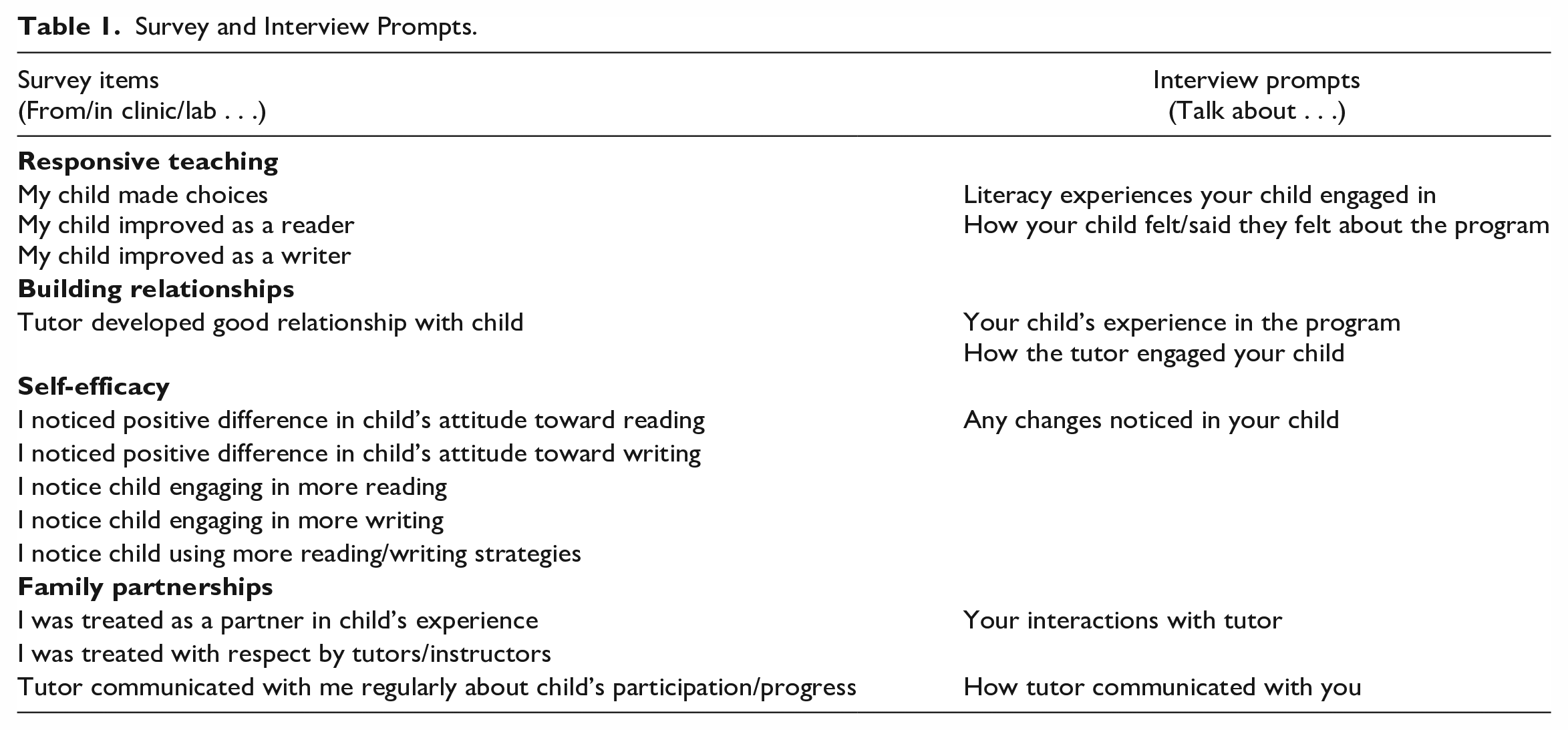
We adhered to university-approved procedures for human subjects’ research and gathered data through surveys and interviews (see Table 1).
Survey and Interview Prompts.
Surveys
We first sought quantitative family ratings related to the four research-based clinic/lab guiding principles (see Table 1). In consultation with our group and other experts, we designed survey items formatted in a forced-choice Likert-type scale (1 = NO!, 2 = mostly no, 3 = somewhat no, 4 = somewhat yes, 5 = mostly yes, 6 = YES!). We piloted the survey at four clinic/lab sites (58 families), reviewed data with the group and outside experts, and then revised items, expanding from 10 to 14 items to disentangle ratings of reading from ratings of writing. To collect data for this study’s participants, instructors asked a family member to respond to a paper survey toward the end of program completion and provided support when asked. Translators or dual language speakers assisted when needed. We entered all survey data (N = 132) into an open access data analysis program, jamovi (Version 2.3) (The jamovi project, 2021); the overall reliability score (ɑ = .849) suggested high internal consistency of the 14-item set.
Interview Protocols
To deepen our understanding of family perspectives, we created a structured interview protocol (Seidman, 2019) to parallel the survey data (Table 1). In addition to the prompts in Table 1, we included prompts for goals and recommendations for improvement. As with the survey, we created the protocols in consultation with experts in the field and piloted the protocol with two clinic/lab sites (17 families) and clarified language throughout. Toward the end of each program’s completion, instructors conducted in-person one-on-one audio-recorded interviews with families who agreed to and were available (N = 84). Each director transcribed interviews from their site, identifying family member role (e.g., parent, grandparent), child grade level, and site.
Data Analysis
Quantitative Analysis
Using jamovi (The jamovi project, 2021), we generated descriptive statistics for each survey item and compared means between program type (graduate, combined, and undergraduate) through analysis of variance (ANOVA) to understand any differences in survey responses by level of tutor. As we found no differences in items between program types, we provide group means and standard deviations in our findings.
Qualitative Analysis
We aligned qualitative analyses with the research questions using a deductive, a priori method related to our areas of interest (four clinic/lab guiding principles, family goals, and family recommendations). We conducted analyses manually in three cycles (Strauss & Corbin, 2008). First, we read through the transcripts several times to understand the content of data. Working in pairs, researchers collated data from interview prompts designed to address an area of interest (see Table 2). Each pair then identified any text within the remainder of the transcripts that related to that area of interest.
Examples of Coding System.
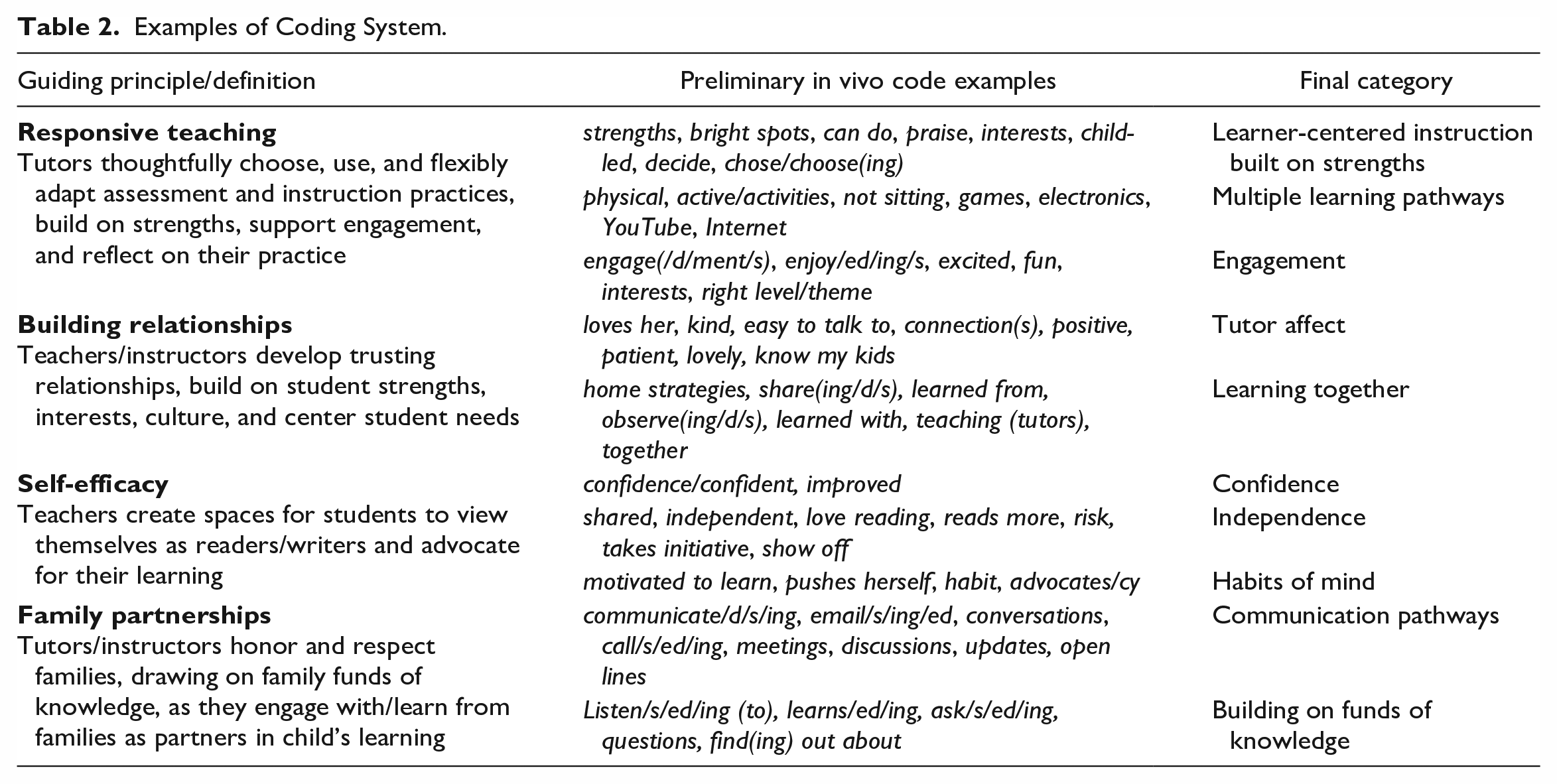
In the second cycle, the first two authors created initial in vivo codes to represent ideas in the data and collapsed these into representative categories. They created category definitions and maintained notes, including comments about assumptions and prejudices to discuss with the team throughout the process (Ryan & Bernard, 2003). They repeated this with a second site’s data, listing initial codes, reducing codes into like categories or further dividing codes into separate categories. In the third cycle, the first two authors worked with two additional members of the research team to code a third site’s transcripts using cycle two codes and categories, discussing and resolving discrepancies, and clarifying and refining category definitions and descriptions (Table 2). These four members then divided the remaining seven sites’ data and coded them independently.
To address trustworthiness (Lincoln & Guba, 1985), two additional members of the research team collated coded data across all sites into separate matrices of the six areas’ codes and categories (Miles & Huberman, 1994). These members reviewed the matrices to ensure data fit identified categories, bringing discrepancies to the larger group for discussion. Once satisfied, additional members of the research team reviewed the final category matrices to judge the soundness of category descriptions.
Findings
In this next section, we first present our survey results. Then we present interview results concerning family goals and our four guiding principles. With respect to recommendations the vast majority of families offered, “I can’t think of anything,” “nothing invaluable,” and “I don’t know what to say, she loved it all.” A few families shared recommendations, which we will embed throughout the interview findings.
Quantitative Results
Analysis of quantitative data showed that family members had high ratings overall. For items designated to rate responsive teaching, families indicated their children made choices about their learning (M = 5.85, SD = .45), and improved in reading (M = 5.59, SD = .69) and writing (M = 5.40, SD = .87). In relationship building, families reported tutors developed strong relationships with their children (M = 5.89, SD = .37). Family ratings in self-efficacy showed families felt their children engaged in more reading (M = 5.24, SD = 1.03), writing (M = 5.09, SD = 1.05), and strategies (M = 5.44, SD = .85), and displayed positive differences in attitudes toward reading (M = 5.56, SD = .81) and writing (M = 5.50, SD = .87). With respect to family partnerships, families rated communication as positive (M = 5.9, SD = .27) and indicated they felt respected (M = 5.96, SD = .19) and were included as partners in their children’s learning (M = 5.71, SD = .70).
Qualitative Results
Family Goals for Enrolling Children in Clinics/Labs
Analysis of interviews suggested families looked to clinics/labs to provide additional literacy support, and deliberately sought more individualized instruction to meet their children’s learning needs. A mother (Grade 4 CAN) stated, “[child] learns better within that one-on-one environment versus the group environment . . . because they’re allowing him to go at his own speed.” Families felt one-one-one instruction offered “less interruptions and attention is focused solely on the one student” (mother, Grade 7, IL1). Families also sought help for their children to “improve more so in reading” (mother, Grade 4, MT), in specific literacy areas (e.g., fluency, comprehension, writing, spelling), and with strategies for independence. For example, a mother (Grade 6, CAN) “wanted [child] to learn strategies and stuff that are going to help him to move forward, things that he can use when he’s in school and he’s stuck.” Families also wanted their children to “build[ing] confidence” (mother, Grade 1, VA), “become more secure,” (mother, Grade 3, NY) and develop positive attitudes by “learn[ing] that reading can be and is fun” (mother, Grade 2, NC1).
Family goals also centered on family attempts to balance their dual role of caregivers and teachers. A mother of a seventh grader (MD) noted, I was not trained to [teach my child]. I didn’t have the skill set to do it and she couldn’t differentiate mommy disciplining her as opposed to mommy trying to help her. So . . . [help] is coming from someone else and their approach was different, so she was able to receive it.
Similarly, the mother of a fifth grader (CAN) shared, I tried working with him and it was a fight . . . at home, he wanted just to be at home, doing at-home things. So tutoring, coming here was a way to get that extra help, but also, it’s fun and he wasn’t fighting with mom and dad.
What Mattered to Families in Responsive Teaching
Families named responsive teaching practices that resonated with them: tutors’ learner-centered instruction built on strengths, high levels of engagement, and multiple pathways to learning.
Learner-Centered Instruction Built on Strengths
Families appreciated that tutors provided learner-centered instruction. The mother of a seventh grader (CAN) stated, “They’re letting the child lead the session, in a sense. They [children] develop the curriculum . . . It’s more of a child-led type of session.” To do this, tutors, “listened to interests and created programs that were at the right level with the right themes and topics” (mother, Grade 4, IL2), and “customized learning based on [child’s] interest” (mother, Grade 2, IL1). A mother commented, “[child] gushes about the program every day. It amazes him how much focus his teacher and everyone dedicates to his interests” (Grade 4, NC1). Families also focused specifically on their children choosing topics or projects. A mother of a third grader (RI) shared, “One of the most memorable things, I think, was the special project she worked on, the research project.” Although families appreciated learner-centered instruction, one mother (Grade 1 IL2) wished for more alignment between clinic/lab and school, “Even though [tutors] target kids’ interest, sometimes they should target what’s going to be learned in school.”
As part of this learner-centered instruction, families noted that tutors focused on their children’s strengths and encouraged their children. The mother of a fourth grader (IL2) said her child’s tutor was “positive and motivating, praised him a lot.” Another mother (RI, Grade 6) noted that the tutor, “highlight[ed] the bright spots,” while another mother (Grade 3, IL1) noted, [tutor] quickly bonded with [child] about sports and had such an infectious positive attitude about reading; [tutor] always prompted him to add needed details and praised him for his efforts. He always left each session with a little spring in his step and a feeling of accomplishment. She was so positive and affirming, but yet also knew how to challenge him when he needed it.
Engagement
Families routinely commented on students’ high level of engagement in clinic/lab spaces. A mother (Grade 3, RI) stated, “I just thought that [tutor] was extremely engaging with [student] and with myself, as well.” A grandmother of a first grader (NY) stated, “[Child] loved the program to the point where she asked at the beginning of the year, ‘am I going back?’” A mother (Grade 1, IL2) explained, “First day of class [tutor] made a special board with things he likes. It engaged him immediately, made a connection with the teacher.” Some families did not expect their children would be engaged. A grandmother of a fourth grader (NY) stated, “I was worried she wouldn’t want to come, and she loves it! I didn’t think she would want to stay for the long day, and she always asks if today is the day.” Another commented, “It’s not a punishment. Reading can be fun. So, that’s what she was exposed to, and that’s what she discovered here” (mother, Grade 9, MD).
Multiple Pathways to Learning
Families spoke of multiple ways tutors helped learners approach and share learning. The mother of a ninth grader (MD) stated, “she experienced different styles of learning . . . different techniques, different strategies.” Another parent of a fourth grader (CAN) mentioned, “she was able to . . . use gross-motor activities. [Tutor] was outside with him and getting him to run around while learning.” A mother of a fifth grader (RI) commented on the ways students learned to present orally, “[with] the plays [reader’s theater] . . . It wasn’t just, stand up and do a presentation. They had these [scripts] to practice . . . it’s different than the research presentation, but it was still standing up as a group reading stuff together.”
What Mattered to Families in Relationship Building
Families spoke of relationships developed during the clinic/lab experience. A mother of a fourth grader (CAN) expressed, “I would say the main thing I have seen definitely is just the relationship that the teacher is building, that rapport with that child.” Another family member echoed, “I thought you guys built the relationship up, which is important for him and for us . . . every time we walked in, you knew all the kids’ names and how happy you were to see them there” (mother, Grade 5, RI). Another mother noted, “These tutors reach children when other teachers can’t” (Grade 1, VA). Within families’ discussions of relationships, we identified two broad ways clinic/lab tutors developed trusting relationships: affect and learning together.
Tutor Affect
Families expressed that tutors built relationships with their children through positivity, patience, and openness. The grandmother of a first grader (NY) pointed out, “I noticed [tutor] never gets frustrated with [student]. She always encourages her.” Another mother said, “I absolutely love [tutor]. You guys couldn’t have matched her with a better person as far as their personality . . . She engaged her, number one . . . She was very approachable, very soft, very patient” (Grade 7, MD). Families also recognized tutors’ non-judgmental nature toward their children, “He doesn’t feel he’s being judged by [teacher], really appreciates that” (mother, Grade 3, IL2). This nonjudgmental stance extended to families as well, “I felt a very good vibe with [tutor]. She never made me feel dumb . . . she always encouraged me to continue to encourage [child]” (mother, Grade 7, MD).
Learning Together
Families appreciated and named that tutors and students learned together; learning relationships were bi-directional. The mother of a third grader (RI) stated, “It’s a win–win situation for both. They’re teaching [child] different strategies, but [child’s] also teaching them what it’s like to be a child [who] struggles.” Families also enjoyed learning alongside their children and tutors; “I learned from [tutor] different techniques, so it’s like she was teaching my daughter, but she was [also] teaching me how to . . . get things, how to get her to understand, how to teach her to go back” (mother, Grade 7, MD). Families spoke of being welcomed into and joining instructional spaces, “I could kind of watch what they were doing. I would come in and they were working on reading something, and I would observe a little bit . . . And it seemed like [tutor] welcomed that” (mother, Grade 3, RI). Another mother (Grade 6, CAN) noted the power of observing her child’s session, “Honestly, the last [tutor] told me how he was doing this stuff, but it wasn’t until I actually sat in on that last session that I saw how he was doing it [that it made sense].”
What Mattered to Families Relative to Self-Efficacy and Agency
Families spoke to their children gaining confidence, independence, and habits of mind as learners.
Confidence
Families highlighted shifts in confidence. A mother (Grade 2, IL2) noted that her child is “always excited to wake up and come. It boosted her confidence.” Another mother (Grade 5, RI) found both she and her son gained confidence, “His confidence level went up by going there. Our confidence level went up.” Several families focused on confidence transferring to home. For example, a mother (Grade 3, IL2) stated, “The confidence . . . now she believes she can do it all. She was always afraid of trying things, trying to read. Now she wants to read bigger books.” Another family (Grade 5, IL1) spoke of confidence transferring to school, “[the lab/clinic] helped her build confidence which helped her at school.” Families also noted that students’ classroom teachers identified gains in confidence. One mother (Grade 6, IL1) stated, “His teachers at conferences this fall expressed he has more confidence, and they can see the progress he’s made.”
Independence
Families reported noticing changes in their children as readers and writers. A mother of a second grader (CAN) shared her child was excited to share his learning with his family, “Now he actually takes the initiative to read [at home] . . . He wants to do that, he wants to almost show off some of his skills.” Another mother said her child now takes risks she did not normally take, “She takes chances, tries to challenge herself, reading billboards and things while riding in the car. She carries a book around with her. She reads. She writes in a daily planner at home” (Grade 5, IL2). The mother of third graders (IL2) shared, “Now they are apt to pick[ing] up a book more on their own. At [park] they like to bring their own books.”
Families commented on improvement in their children’s reading and writing, sharing that their children read more fluently, used more details in their writing, and engaged with more challenging books. Children also transferred strategies from clinics/labs to home. A mother of a seventh grader (MD) shared that her child now adjusted her reading pace and self-monitored, stating, “She’s definitely slowed down because before she read with no understanding. She approaches her homework totally differently. I love how she [put] those pink Post-its on ‘I don’t know this word.’ She loved that.”
Habits of Mind as Learners
Families found that students began to see themselves as readers and writers. A mother of a second grader (NC1) noted, “He has gained a new stronger love for reading and discovered how amazing it can be.” The father of a first grader (RI), whose son did not like to read, said, “I think he needs to see value in it before he’ll dedicate mental energy to it. I think it helped in that sense . . . It’s almost like a habit or a tendency if you will.” A mother (Grade 6, RI) felt her daughter’s confidence gained through her time in clinic/lab led to articulating her needs as a learner, “She’s much more confident, somewhat about reading, but also in herself, advocacy. She is a stronger advocate for herself at school.”
What Mattered to Families for Family Engagement
Families’ comments led us to identify two central ways tutors fostered family engagement: Communication pathways and building on funds of knowledge. Families appreciated being asked for feedback, “Thank you so much for caring to ask about our feedback” (mother, Grade 4, NY). Family recommendations suggested families’ disappointment in programs ending, requesting “longer” programs, “more” sessions, “extended time,” and “multiple years” of instruction. A mother, concerned about losing the partnership at the end of the program, said, My concern is how do I keep this momentum going? I’m a 57-year-old single mother with two jobs. I’m a hard worker, having just completed a master’s degree myself, but there is only so much time in a day. I recognize I need help, but the trouble is trying to find good help. I’m sad that this program is ending, as is [child]. (Grade 5, IL1)
Communication Pathways
Families appreciated multiple communication pathways in clinics/labs, including emails, texts, phone calls, and written reports, “They have open lines of communications, give us their numbers. I can contact them with concerns. They can contact me as well” (mother, Grade 2, IL2). Families also commented on informal conversations, “After each session [tutor] communicated what [child] was working on and doing during the sessions. She also communicated with me by texting when necessary” (mother, Grade 7, IL1). Families valued the specificity of tutors’ communication, noting that tutors shared more detailed information than they received from schools, “So it’s nice to hear . . . what they worked on versus, ‘Great day’ .. . You want to know what they’re doing” (mother, Grade 4, CAN).
Although most families discussed positive communication, a few families who spoke Spanish stated they “had no interactions” (mother, Grade 2, IL2) or had “limited interactions” with the tutors (mother, Grade 3, IL2). Lack of a shared language left families out of existing clinic/lab communication structures. A mother (Grade 5) stated, “I did speak with the tutor, [but] they spoke English and I don’t. I would find out everything through my daughter.” Another mother also discussed this difficulty, “If I knew more English . . . there was a lot of vocabulary, but I didn’t understand what they said . . . even though they speak slowly for me” (mother, Grade 1, MD).
Several families asked for “more communication,” and “more consistent communication.” A mother (Grade 3, IL1) discussed gaps in communication, “Throughout the past four weeks I haven’t received anything about progress.” In addition, a few families wanted tutors to, “send home some things that they’re working on. (Child) tends to make more gains when we go over it at night at home” (Grade 2, IL2). A mother of a first grader (VA) commented, “Maybe have an at-home project with student and family so they can incorporate what they are learning at home.”
Building on Funds of Knowledge
Families commented on the importance of tutors listening to and learning from them and their children and building instruction around that knowledge. A mother of first grade twins (VA) noted the tutors, “really connect to [children’s] interests and you really get to know my children’s passions . . . comics, adventure, video games. I was so pleased with each interaction.” A mother shared, tutors “ask[ed] questions about things we were doing, trips, movies, etc. [showing] genuine interest in the lives of kids” (Grade 3, IL2). Another commented, “[tutor] got some pointers from me [and] actually created her own bond with her . . . That’s how she engaged her by finding out what her interests were and . . . could relate that into getting her excited about reading” (mother, Grade 7, MD). The mother of a fourth grader (IL2) was pleased that her daughter’s tutor built on her family background, “She was learning about cultures and especially on the culture of Mexico and that made me happy because it was something I wanted her to learn.” A few families wished for professional development opportunities. For example, a mother (Grade 3, RI) recommended “I would love to know more about what the [tutors] are learning. So for me as a parent . . . I can start to expand my knowledge.”
Discussion and Implications
In our labs/clinics, we have sought to develop programs that prepare teachers to engage with families as an embedded practice, rather than as an “add-on” (Dozier et al., 2006; NAFSCE, 2022; Ortlieb & Pearce, 2013; Rogers et al., 2023). While earlier research drew attention to factors that act as barriers to family involvement (Hornby & Lafaele, 2011), this study intentionally sought to add families’ perspectives to the literature on teacher preparation efforts to engage with families as partners. Families in this study echoed the importance of specific educator competencies recommended by NAFSCE (2022), namely, stances that respect, honor, and value families; connections that lead to trusting, reciprocal relationships; and collaboration leading to co-constructing learning experiences that draw on family funds of knowledge. Our findings both confirm research recommendations and impress upon us elements that mattered to families in teacher preparation.
Families valued relationships built in clinics/labs, noting these as different from what they experienced in schools. Thus, the supervised clinic/lab setting offers a unique opportunity to directly mentor teachers to adopt family-focused lenses and to build relationships with families. Yet, this work can be time-intensive and challenging for both tutors and teacher educators (Foote et al., 2013; Ortlieb & Pearce, 2013; Peña, 2000), especially if tutors’ initial attempts to engage with families did not meet with success (Deeney et al., 2011). Engaging with families does naturally expand the role of teacher educators. As Ortlieb and Pearce (2013) noted, clinic/lab directors can feel that engaging with families adds another dimension to their already intensive role as they simultaneously support tutors (literacy knowledge and practice, attitude toward and reflection on their learners, interactions with learners and colleagues) and children (attitude, learning, self-efficacy). Yet, families in this study reinforced that the one-on-one nature and nested structure of clinics/labs are powerful spaces to teach teachers to engage with families for the joint goal of every child’s learning. The added effort to build a mesosystemic bridge across home and clinic microsystems is seen by and matters to families (Rogers et al., 2023).
From families in this study, we have drawn implications for those advocating for, designing, and reflecting on the nature and substance of engaging with families in clinic/lab teacher preparation. We now suggest how family voices from this study can inform teacher educators who seek to re-imagine family engagement in their programs.
Seek Input From Families
Creating opportunities for teachers and teacher educators to learn from families is critical in beginning a collaborative effort to meet the needs of all participants in the nested community. Families’ insights benefit both learners and teachers when teachers actively ask and listen (Qarooni, 2022). Methods employed in this study and in our clinic/lab practices provide one model for how teacher educators initiate collaboration. By offering explicit invitations for families to voice their perspectives using both surveys and interviews, we actively sought input from families to find out what matters to them relative to both features that research suggests are important and how clinic/lab programs might improve. Because we asked, we learned about families’ goals, opinions, and knowledge, as they advocated for their child’s learning (Rogers & Brefeld, 2015). By asking families and children about their hopes and dreams, tutors and teacher educators can co-construct a vision for learning (Kugler, 2011; Rogers et al., 2023) and establish a collaboration with families to improve experiences for tutors and families within teacher education.
Build Reflective and Responsive Lab/Clinic Practices
Families in this study discussed tutors engaging their children, building on their interests and funds of knowledge, and developing instruction based on knowledge of and experience with families and children. This level of responsive teaching, noticed by families, came about through intentional design within the lab/clinic microsystem. Teacher educators thoughtfully created lab/clinic requirements that promoted reflection and responsiveness, including cycles of planning, implementing, and reflecting (Hoffman et al., 2019) and seminar discussions debriefing engagements with families (Rogers et al., 2023). Supervisors then scaffolded learning immediately and directly in every session. Through these intentionally crafted experiences, teacher educators supported tutors to reflect on their own practices and their engagement with children and families.
Establish Bi-Directional Communication Structures
Traditionally, family involvement has followed hierarchical school-to-family communication and activity structures (letters home, parent–teacher conferences, back-to-school nights), which are insufficient in building family engagement (Souto-Manning & Swick, 2006). Clinic/lab programs like ours, which occur outside of these entrenched practices, can shift this dynamic. Families in this study valued what they experienced as bi-directional communication where families and tutors learned from and with one another through phone calls, texts, emails, check-ins before or after tutoring sessions, and more formal meetings. Therefore, teacher educators must establish multiple pathways to intentionally foster bi-directional communication. Yet, this study helped us see that despite intentionally designed structures, communicating with families, particularly whose language was other than English, required even more vigilance. Unless we engage with families in modes and languages they prefer (Qarooni, 2022), we risk teachers’ opinions continuing to be influenced by White, middle-class ideals (Amatea et al., 2012; Ladson-Billings, 2009), where families who are less involved are viewed as deficient (Fennimore, 2017). We are then not preparing teachers to educate for equity and to honor the whole child (Hornby & Lafaele, 2011).
Co-Construct Learning Opportunities With Families
In our clinics/labs, we have sought to create a nested community of practice where everyone learns from everyone, so that together, families, teacher educators, and tutors can become more expert on children and their learning. In line with previous work, we found that families’ positive perceptions of being invited into the learning space and to partner in their child’s learning contributed to families’ engagement (Hornby & Lafaele, 2011). Peña (2000) argued, “to increase parent involvement, teachers must first change their attitudes regarding parents and recognize the advantages of parents and teachers working collaboratively” (p. 52). Yet, we find it is through working directly with families that teachers come to change their attitudes, with the teacher educator as central in bridging and scaffolding tutor and family co-construction. Without a structure in which to be guided in co-constructing knowledge, teachers’ attitudes may not change; they may remain fearful and be less inclined to see the value in collaborating with families (Lazar et al., 2012).
Build From Learners’ and Families’ Strengths
In this study, we learned that families appreciated tutors’ specificity in naming what children could do, and were doing, rather than what children could not do (Dozier et al., 2006; Dugan, 2022). We learned that our efforts to ensure strengths-based language mattered. Strength-based conversations created learning possibilities many families had not yet imagined, and which they felt led to their children’s willingness to engage as readers and writers (Fredricks, 2011). Although adopting a strengths perspective is cited as a key component of family engagement (Souto-Manning & Swick, 2006), this does not come easily to tutors, who may initially focus on what is wrong and seek to fix it (Lazar et al., 2012). We know tutors can enter preparation programs with a deficit view of families (Hornby & Lafaele, 2011). Family voices reaffirm the importance of educating teachers to explicitly identify and build from students’ strengths (Johnston, 2004). Despite the challenges of ensuring a focus on strengths, it does matter.
Limitations
Data from this study are specific to our 10 clinical preparation programs where we focus intentionally on engaging families. When asked for recommendations to strengthen clinic/lab practices, families offered few suggestions. Our roles as both directors and interviewers may have inhibited negative comments, or families may have been concerned about sharing critiques in fear of jeopardizing much-needed support. However, anonymous survey responses were also highly positive, suggesting families held positive perspectives. The current study focused on retrospective perspectives of families’ lab/clinic experiences. To more fully examine the complexities and nuances of family engagement within clinical teacher preparation, teacher education researchers should investigate methodologies that capture interactions and family engagement in the moment.
Future Directions
In this study families named specific ways tutors engaged with them and their children in clinics/labs. Through family voices, we learned that the intentional structures created to foster family engagement mattered. While the clinics/labs in this study created spaces for teachers to live and center family engagement, we recognize transferring family engagement practices to classrooms and schools is not automatic (Dozier & Rutten, 2005; Bransford & Schwartz, 1999). Now that we have learned from families, we need to investigate three issues related to transfer. First, we must explore whether and how clinic/lab experiences explicitly prepare teachers to transfer family engagement practices and to advocate for improved family partnerships in their school contexts. Second, we must explore how clinic/lab graduates are engaging with families in their school and district contexts. Finally, we must understand how clinic/lab teacher preparation addresses obstacles to family engagement teachers report experiencing in their schools, and how teacher educators can help teachers address barriers, deficit thinking, and structural inequities in these contexts.
Although we have taken active steps in our clinic/lab programs to center family engagement, we have much more work to do to advocate for and ensure larger systems’ changes with respect to family engagement (NAFSCE, 2022). To achieve this, teacher preparation must institutionalize family engagement across the curriculum. We also need to interrogate practicum and residency practices, ensuring collaboration with districts holding a strong family engagement vision that not only benefits teacher candidates’ professional learning but also leads to more equitable family engagement practices within schools.
Footnotes
Correction (August 2024):
The surname of the first author was incorrectly spelled in the Nichel & Chadwick (2022) reference. It has been corrected in the article.
Declaration of Conflicting Interests
The author(s) declared no potential conflicts of interest with respect to the research, authorship, and/or publication of this article.
Funding
The author(s) received no financial support for the research, authorship, and/or publication of this article.
