



Abstract
This study examines 10 preservice teachers’ use of Freiberg’s Person-Centered Learning Assessment (PCLA), a self-assessment measure. The PCLA serves as an individualized resource for educators to assess their classroom teaching and learning particularly in the affective domain. Study findings indicate that the 10 student teachers identified future pedagogical changes as a result of utilizing the PCLA, with eight student teachers specifically identifying changes in their classrooms prior to completion of the study. As explored in this study, self-assessments seem to provide novice educators with a unique form of feedback and have the potential to lead to deeper levels of pedagogical self-reflection and resulting changes.
Keywords
Introduction
Successful novice teachers need formative assessment to build their professional repertoire and enhance their content and pedagogical knowledge (Seely, Fry, & Ruppel, 2011). They also need ongoing feedback to inform them of what they are doing well and what they need to improve (Hattie, 2009; Marshall, 2009). However, administrators can only observe and evaluate a teacher a limited number of times, if at all. Likewise, a university can only hire so many assistants and retired administrators to provide feedback to student teachers, many of who may not be adequately equipped to give productive guidance. Given these limitations, what else can be done to improve teacher development?
Self-assessment gives the teacher the ability to have formative assessments without depending on outside administrators. However, not all self-assessment resources are created equal. Most are based exclusively on the teacher’s own perceptions, in the form of teacher questionnaires, checklists, diaries, or goal reflections. Although useful, something else exists that can further enhance self-assessment: student feedback.
The purpose of this study is to explore a pedagogical self-assessment resource that incorporates student feedback, called the Person-Centered Learning Assessment (PCLA; Freiberg, 1994-2017). It does so in the context of preservice student teachers. As explained in the “Method” section, the PCLA is different from most current self-assessment practices. It is not a static assessment created by administrators or supervisors based purely on a teacher’s self-perceptions. Instead, it is a teacher-directed, multistep, dynamic process that incorporates external sources, in the form of digital audio recordings and student feedback. Essentially, the teacher first chooses areas to examine (called Descriptors, from a list in a resource called the Learning Framework) and defines Observable Indicators that detail what an observer would see being utilized in his or her classroom. The teacher then audio records a lesson, self-assesses his or her own effectiveness based on the Descriptors and Observable Indicators, collects anonymous student feedback, and then compares the self-assessment with the feedback. Finally, the teacher takes this analysis (PCLA I), repeats the entire process with a new lesson (PCLA II), and compares the results.
Ultimately, the PCLA enables teachers to get closer to answering this vital question: How am I doing in the classroom? As Rogers and Freiberg (1994) explained, “Knowledge is power, but knowledge about self is the greatest power” (p. 119).
Background of the Study
The origin of this study came about during my (Snead) seventh year of teaching, while I was also a graduate student in a class taught by Freiberg. At the time, my district had stopped requiring me to complete formal evaluations because of many successful administrative appraisals. This is a common practice in many school districts in the state in which this research occurred (Allen, 2017). I did not receive formal feedback about my classroom management, lesson delivery, or student–teacher interactions. As a result, I continued to teach in the manner I believed worked best.
However, this subsequently changed while I was a graduate student in Freiberg’s class, in which the PCLA was a key element. I utilized the PCLA to assess my teaching, using both student feedback and audio recording of the same lesson. It was during this experience where I realized that my students did not always perceive my lessons in the way I intended. For example, I believed that I was differentiating learning to meet the varying needs of my students, but their feedback showed otherwise. For the first time in my career, I realized that I lacked the ability to sufficiently self-evaluate and improve my teaching. The PCLA helped fill these gaps and provided insights into what I needed to change.
Theoretical Perspectives
Understanding the PCLA requires a brief examination of four principles of theoretical research: self-reflection, assessment, self-assessment, and person-centered learning. These theories form a foundation for the PCLA.
Self-reflection is the review of an individual from within (Dewey, 1910). It began with John Dewey in the early 1900s and continued in later years with Donald Schon (Feiman-Nemser, 2001; Goh & Matthews, 2013). It provides an opportunity to examine one’s motives, feelings, and truth, providing a perspective that might otherwise go unnoticed (Dewey, 1910; Goh & Matthews, 2013; Schon, 1983). When given opportunities to self-reflect, student teachers have the potential to gain skills to take their teaching to more advanced levels (Goh & Matthews, 2011; Rodman, 2010). Rodman (2010) found that “structured reflection as related to field based placement, increases the understanding and application of various educational theories for pre-service teachers” (p. 32).
Since the creation of U.S. public education, stakeholders have been concerned with student learning and teacher proficiency (Arends, 2006a). As a result, teacher assessment practices have evolved to include summative and observational assessments manifesting in the form of checklists, forms, rubrics, and rating scales (Arends, 2006b; Brookhart, 2009). Current teacher assessment practices are generally external evaluations and often limit educator self-reflection.
Self-assessment is the process in which self-evaluation and self-examination occur (Anderson & Freiberg, 1995). They can serve as a resource to aid in educator self-reflection. Self-assessment is a formative assessment used to improve teaching and is a “powerful technique for self-improvement” (Ross & Bruce, 2007, p. 146).
Person-centered learning builds upon humanistic psychology and Carl Rogers’ (1951) theory of client-centered therapy. It became instrumental first in the fields of psychology and counseling before its development in the field of education. Person-centered learning relies on an expectation between the learner and the educator that each individual involved in the learning process is valued, important, and engaged in all stages of learning (Freiberg & Driscoll, 2005; Rogers & Freiberg, 1994). This theory creates a balance between the needs of the teacher and the learner, providing a voice for both in the classroom (Freiberg, 2013; Freiberg & Lamb, 2009; Purkey & Aspy, 1988). Rogers and Freiberg (1994) underscore the importance of a person-centered classroom focusing on trust, individual learning, student input, self-discipline, and freedom of choice.
Review of Related Literature
It is important to look at both past and present as it relates to this study. This section will first address selected historical self-assessments and then discuss current teacher education practices.
Selected History of Self-Assessments
Limited studies exist that examine the effectiveness of self-assessments for student teachers in the classroom. The studies that do exist are generally dated and usually do not involve student teachers. One of the primary reasons for this study is to fill these research gaps by providing data with preservice teachers. Table 1 provides an overview of selected self-assessment measures with preservice and inservice teachers.
Selected History of Self-Assessments.
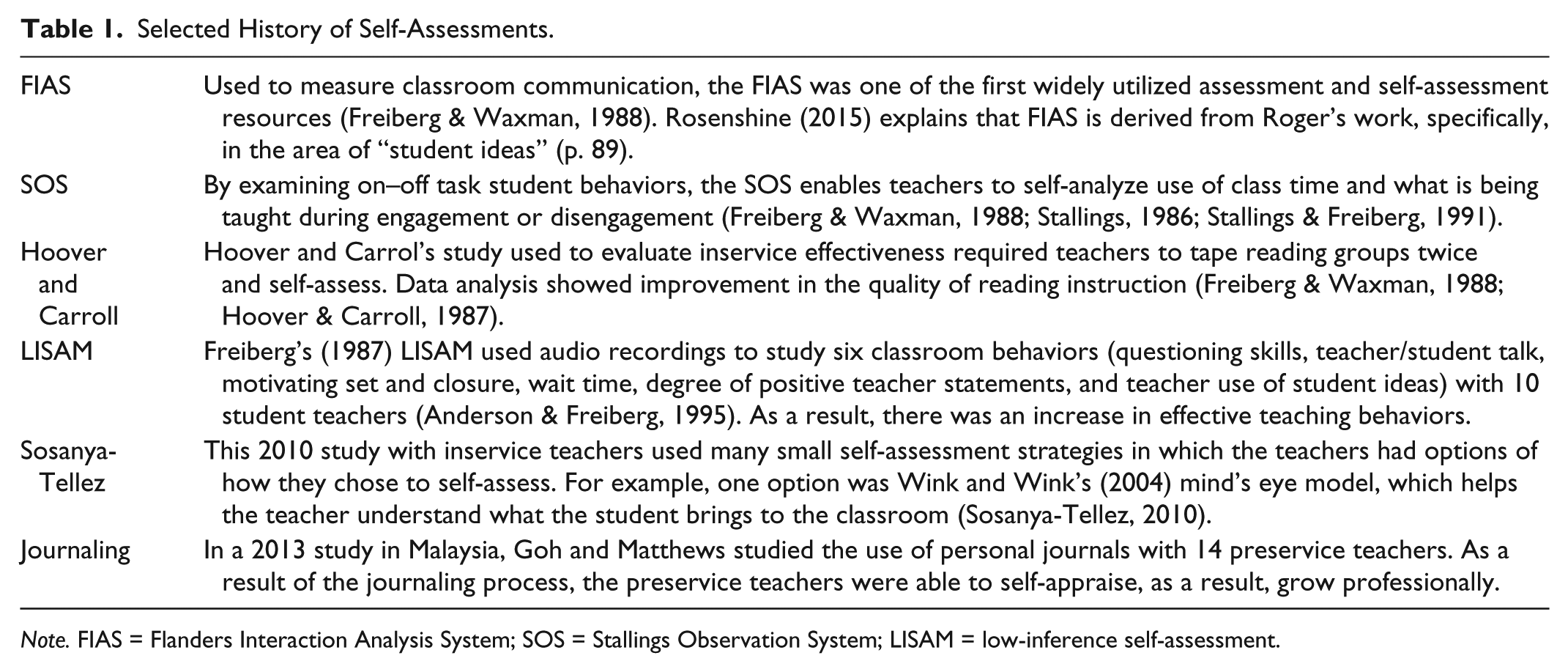
Note. FIAS = Flanders Interaction Analysis System; SOS = Stallings Observation System; LISAM = low-inference self-assessment.
Ross and Bruce (2007) conclude that the use of self-assessments can serve as an “enabling factor in professional growth” (p. 153). However, current research is needed to continue the discussion on self-assessment and its potential impact on teaching and learning.
Current Practices in Student Teacher Feedback
The National Council for the Accreditation of Teacher Education (NCATE), now replaced by The Council for the Accreditation of Educator Preparation (CAEP), supports multiple avenues for evaluating preservice teachers including portfolios, content knowledge evaluations, student teaching assessments, and lesson plans (Wiens, Hessberg, LoCasale-Crouch, & DeCoster, 2013) while making “product and performance” (Potter, 2016, p. 6) a main focus. Student teachers receive this feedback from two main sources: university supervisors and cooperating teachers. Student teachers often view university supervisors as possessing an assessment role rather than an assistance role as they assign grades (Borko & Mayfield, 1995). Conversely, student teachers often view mentors, such as cooperating teachers, as a main source of feedback and assistance (Crichton & Gil, 2015). Both provide a valuable perspective to the student teacher experience. The PCLA is not a substitute for these areas of feedback, but rather another resource in providing student teachers with skills for improvement.
Method
This section describes the design and methodology used in this exploratory study of the PCLA with 10 student teachers from a major university in the Southwestern United States. It begins with the research questions, followed by an overview of the research context, data collection, and analysis process.
Research Questions
This study examines the following three research questions:
The Research Context
This study included 10 secondary student teachers who taught in a large, urban city in the Southwestern United States from February to May 2014. While in their second semester of student teaching, they were invited to participate at a regularly scheduled workshop. Participation in this research replaced the semester’s final project. The student teachers taught within three different content areas (mathematics, social studies, and English) and gave no indication they had prior teaching experience. Additional participant information is described below in Table 2.
Research Participants.

Data Collection
The PCLA contains three primary components that form a Triangle of Feedback. The components, which can be seen in Figure 1 below, include (a) student feedback, (b) digital audio recordings of two lessons, and (c) the educator’s self-assessment after analyzing PCLA data and the audio recordings of the PCLA lessons.
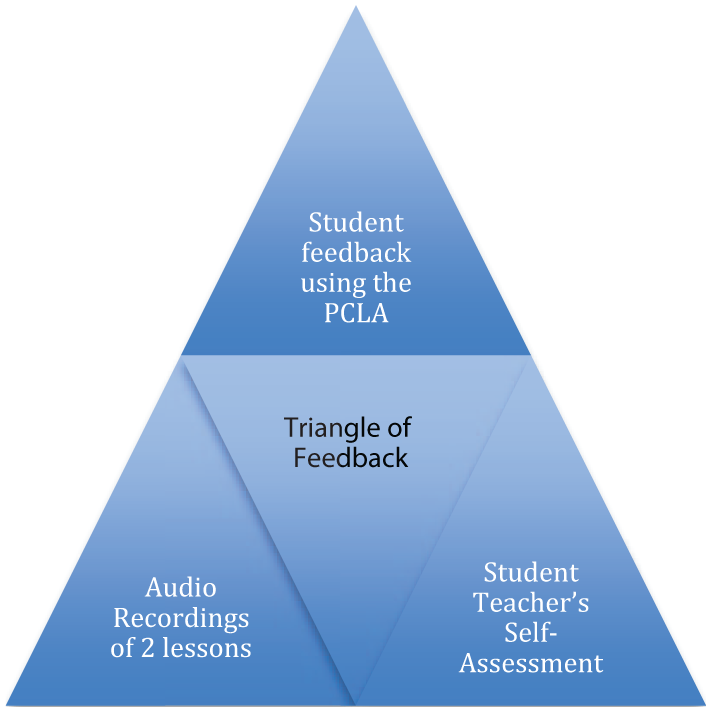
The PCLA triangle of feedback.
PCLA
The PCLA is designed to provide teachers, from preservice to veteran, the resources to self-evaluate and reflect. As noted above, the PCLA is not a substitute for the traditional areas of feedback, including the cooperating teacher and the university supervisor, but complements the current system. The salient characteristic of the PCLA is that it serves as an individualized self-assessment that expands the spectrum of feedback. The data points include audio taping of lessons, student feedback, and the student teachers’ self-assessment based on the first two data points. In this study, the student teachers conducted the PCLA process twice (PCLA I and PCLA II) with the same group of students.
The PCLA process used in this study is based on Freiberg’s (1994-2017) Learning Framework, consisting of 37 Descriptors from the following categories: educator, learner, resources, and curriculum. The categories were derived from Freiberg and Driscoll’s (2005) Universal Teaching Strategies, Freiberg’s (1976) Teacher Effectiveness Questionnaire, and the low-inference self-assessment (LISAM; Freiberg, 1987). Their categories of learner, content, and context were further refinements from the 2003 National Board of Professional Teaching Standards. Freiberg added the educator category to form a self-assessment focus. He used his coaching of new middle school teachers, including the Free School for Teachers (Wade, 1972), public school teaching, and teacher education to form the foundation of the PCLA. He also drew upon the frameworks of Flanders (1970) and Rogers (1951, 1969, 1982).
The process is multifaceted. The PCLA begins with student teachers reflecting on strengths and weaknesses based on prior classroom learning, initial practice teaching experiences, and feedback from their university supervisor, cooperating teacher, and other teacher educators. Student teaching in the fall built a foundation for their ability to reflect by revealing their areas of growth.
PCLA Descriptors are areas of classroom interactions that support both affective and cognitive learning domains. Each student teacher in this study selected eight to 10 Descriptors from the Learning Framework, which provided the student teachers with a manageable number of classroom indicators to assess. In addition, the student teachers were required to choose at least one Descriptor from each category to form a balanced self-assessment. Using their selected Descriptors, the student teachers developed an Observable Indicator for each of their chosen Descriptors, conferring with the researcher as needed. The Observable Indicators describe what an observer would see in a classroom to determine whether the Descriptors are operational. For example, one student teacher in this study used the Descriptor: “The educator interacts with individuals and small groups of learners most of the time.” She developed the corresponding Observable Indicator to state, “The teacher walks around the classroom and stops to talk to students most of the time.” Further examples of the category, Descriptor, and Observable Indicator are found in Table 3.
Example of Descriptor and Observable Indicator.

Note. PCLA = Person-Centered Learning Assessment.
Once PCLA Descriptors and Observable Indicators are completed, the student teachers placed them on a continuum from “not effective” to “effective,” ranging from 1 to 4 on a Likert-type scale. They also added a comments section to each Descriptor. One of the core facets of the PCLA is the ability to gather student feedback, and the comments section provided students with an anonymous opportunity to give a rationale for their chosen PCLA score. One example of student feedback was “The material presented today made me think.” Educators are not always aware of what their students are thinking about a lesson. The PCLA may provide an opportunity for student opinions and perceptions to be heard. Student feedback is anonymous and student responses have no impact on grades. With the chosen Descriptors, completed Observable Indicators, Likert-type scale, and comments section completed, the PCLA was ready for classroom distribution. A sample PCLA is provided below in Figure 2.
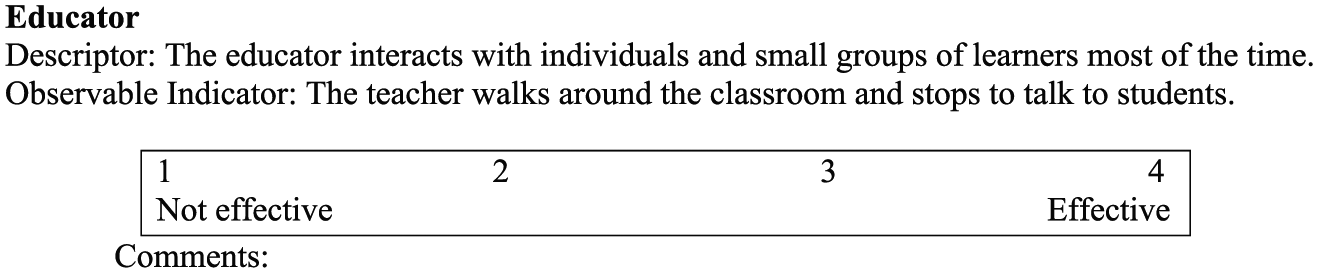
Partial sample of the Person-Centered Learning Assessment.
Using the finalized PCLA, after possible multiple drafts between the student teacher and the researcher, the student teacher presented a lesson to her class, audio recorded that lesson, and distributed the PCLA measure to students at the conclusion of the lesson. Before the student teacher looked at the student feedback results, the student teacher listened to the audio recording of the same lesson and completed the PCLA on himself or herself.
Gathering student feedback, although a rare and generally untapped resource, is a notable characteristic of the PCLA. It provides student teachers with a different opportunity to experience professional growth. This becomes evident in the student teachers’ responses about the importance of student feedback in their changes. For example, Matthew shared that, “The results that I received from the students, I think will help me become a better teacher” (Reflection I). He stated, “From these numbers I can see that I need to work on my question asking.”
The process of using student feedback for student teacher self-reflection has significant potential to change the way we think about teacher preparation. The importance of feedback has been recognized by John Hattie (2009) in his summary of 800 meta-analyses of teaching approaches. He states, “ . . . feedback was most powerful when it was from student to teacher . . . ” (p. 173). He further explained, “ . . . Feedback to teachers helps make learning visible” (p. 173). In addition, because the PCLA is a flexible framework, rather than a fixed assessment system of teaching methods, drawn from both affective and cognitive domains, it can evolve as the student teacher moves through the teaching process. Using the PCLA results, two main areas of the process were completed: PCLA reflections and interviews.
PCLA reflections
Using the PCLA data sources, the student teachers reflected by completing a written reflection after PCLA I and PCLA II. The first reflection included the following information:
the PCLA data chart from the first audio-recorded lesson, as seen in Table 4,
a discussion of the data received from the first lesson of PCLA surveys, including the student evaluations and the self-evaluation, and
a plan for instructional and classroom improvement.
PCLA Data Chart (Partial Sample).
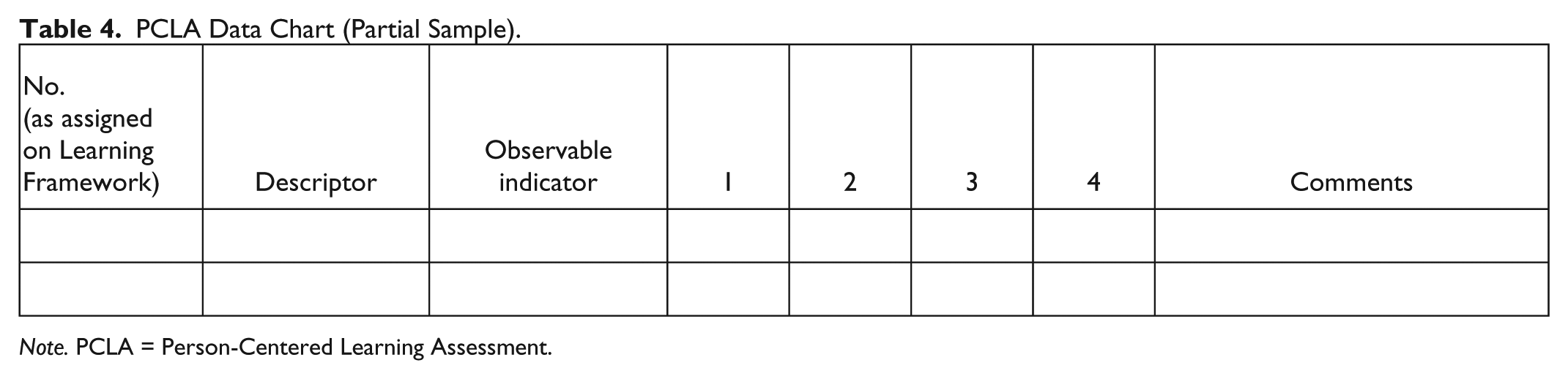
Note. PCLA = Person-Centered Learning Assessment.
The second PCLA reflection included all the above, along with a comparison of PCLA I with PCLA II.
Interviews
The researcher conducted two sets of interviews with each student teacher after PCLA I and after PCLA II. Each interview lasted between 14 and 35 min at either their field placement or at the university. Each of the interviews followed Carspecken’s (1996) interview protocol. This interview plan guides the interview and fosters meaningful conversation. It includes three parts:
topic domains—themes created from data received (e.g., developing the PCLA measure),
covert categories—themes the researcher hopes to discuss with the participant, but does not want to explicitly state (e.g., student teacher’s perception of the PCLA),
follow-up questions—created in anticipation of possible conversations during the interview (Carspecken, 1996; e.g., How did you decide on which Descriptors you chose?).
In summary, data collection focuses on the student teacher’s Triangle of Feedback. It included student feedback, audio recordings, and written reflections, together with researcher/student teacher interviews.
Data Analysis
Carspecken’s (1996) model of critical ethnography was chosen for this research because of its ability to analyze written and spoken words in depth. Three stages of his methodology were employed in the analysis: compiling the primary record through the collection of monological data, reconstructive analysis, and dialogical data generation.
The primary record was “Reflection I,” which was student teacher created using his or her reflections of the audio recordings, student teacher feedback, and self-feedback. The primary record was submitted after completion of PCLA I. In addition, another written record was submitted after PCLA II completion (Reflection II).
Reconstructive analysis creates meaning from the written reflections beyond what was explicitly stated. The researcher derived meanings, codes, tacit explanations, and topic domains from the records. Reconstructive analysis was conducted on all reflections and all interviews.
Dialogical data generation creates dialogue between the researcher and the participants. This stage was seen through the 20 interviews. Each student teacher participated in two interviews, one after PCLA I and one after PCLA II. Each interview was transcribed. The researcher again conducted reconstructive analysis on the transcription.
One of the main facets of this methodology involved making connections among data. Therefore, reconstructive analysis was a continuous and ongoing process conducted throughout the research, and at the completion of all data collection. For example, as a result of reconstructive analysis, it became apparent that communication was a main theme seen throughout the data, so the researcher went back to preliminary reflections and interviews to dig deeper into the theme of communication.
Through analysis of interviews, PCLA data, and PCLA reflections, the researcher conducted an exploratory study regarding the use of the PCLA. Freiberg’s self-assessment instrument (PCLA I and II) was the data source that incorporated Carspecken’s (1996) model of ethnographic methodologies to explore the impact (if any) to answer the research questions established for this study.
Findings
How Does Using the PCLA Modify the Student Teacher’s Self-Assessment From the First to the Second Lesson?
Research Question 1 explores whether the participants actually made modifications or changes to their teaching as a result of using the PCLA. Through their students’ feedback, student teacher self-reflection, written reflections, and interviews, the participants highlighted a number of areas of potential growth and change. Whereas eight student teachers discussed areas of modifications made from PCLA I to PCLA II, all student teachers discussed areas of modifications they planned to make beyond the student teacher experience. The discussion below examines these areas of modifications focusing on the following three themes observed throughout the research process: future pedagogical changes, pedagogical improvements from PCLA I to PCLA II, and student teacher needs regarding the PCLA.
Future pedagogical changes
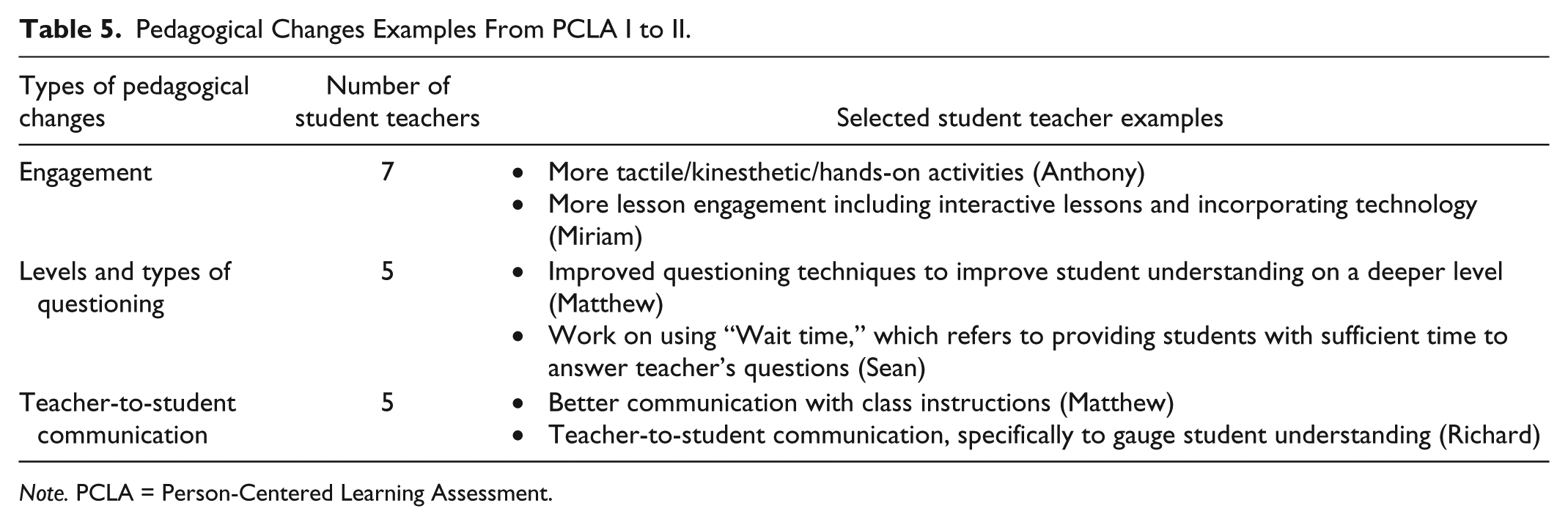
The student teachers discussed a desire for future pedagogical changes in both their reflections and interviews, with examples shown in Table 5. Listed are the three most common pedagogical areas of change: engagement, levels and types of questioning, and teacher-to-student communication.
Pedagogical Changes Examples From PCLA I to II.
Note. PCLA = Person-Centered Learning Assessment.
Seven of the 10 teachers discussed the need to improve engagement, five discussed questioning, and five discussed communication as areas of needed modifications.
Engagement
Fredricks, Blumenfeld, and Paris (2004) define engagement within three areas: behavioral, emotional, and cognitive. By tapping into the affective domain of the classroom, the student teachers expressed a need for greater emotional engagement with their students, which Fredricks et al. (2004) refer to as dealing with interest, boredom, and affective reactions. For example, four participants stated that they wanted to incorporate more hands-on activities. Elizabeth indicated this need as a result of student comments regarding their specific learning styles. She explained, “I found this to be extremely interesting especially the fact that some recognized their learning styles and implied that is the main reason they would prefer certain activities” (Elizabeth, Reflection I). Elizabeth indicated she values student input, but it also shows her new understanding of her students’ comments. Other student teachers wanted to learn more strategies to improve interest level, and therefore, emotional engagement. Examples included note taking and extended focusing strategies. Others were simply looking for increased excitement and, as a result, keeping students engaged. Participants described their need for engagement using words such as, “fun,” “interesting,” “exciting,” and “enjoyable.” The student feedback served as a catalyst for the student teachers’ direction toward more classroom emotional engagement.
Questioning
Smart and Marshall (2013) describe teacher questioning as a potential piece to “effective classroom discourse” (p. 250). As a result of working with the PCLA, half of the student teachers discussed their desire to incorporate better questioning techniques to facilitate better instruction. This theme, associated with Descriptor number 2 on the PCLA Learning Framework, continued to surface in reflections and interviews with student teachers. They wanted deeper questioning, a higher level of Bloom’s Taxonomy, and simply better questioning techniques all around. Miriam explained that she wants, “to ask more questions that push [the students] to think more deeply about [the] topic at hand” (Miriam, Reflection I). Sean wanted to focus on the questioning skill of wait time. In short, as a result of using the PCLA, five student teachers have decided to modify their teaching with better questioning techniques.
Communication
Half of the participants discussed a need for improved communication in teaching. Some referred to student–teacher communication, whereas others referred to a needed improvement in lesson delivery. Amy described her need of improved student–teacher communication by “talking to students in a more encouraging tone” (Amy, Reflection I). With respect to lesson delivery, Natalie said she wants to slow down in her communication (Reflection I).
In summary, the student teachers indicated that the PCLA process gave them an opportunity to receive feedback from their students and self-assess their own classroom by providing a resource that engaged the affective domain. Throughout this process, the student teachers self-discovered and identified their need for specific modifications to their classroom teaching methods. As a result of these plans for modifications, many student teachers made improvements in their PCLA II.
Pedagogical improvements from PCLA I to PCLA II
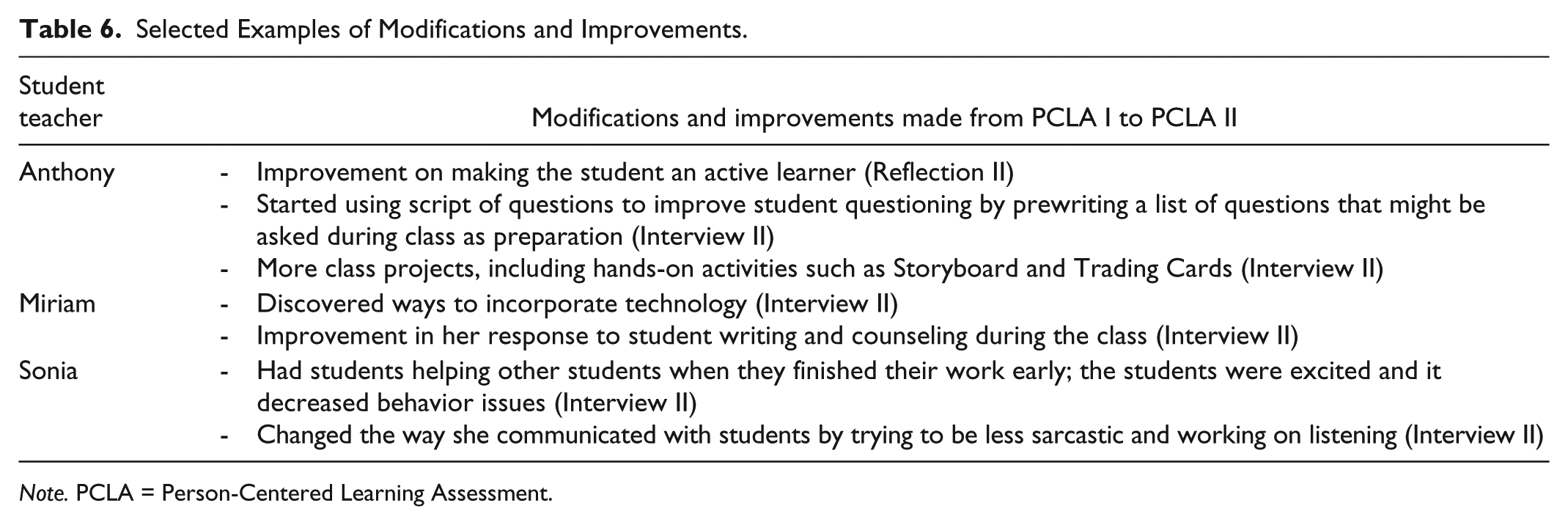
Sean stated in an interview: “I made some changes [on] the next lesson according to their comments. I’m trying to adjust to the new lesson and I want [to] see the results to see what they say after this new lesson [was] taught” (Interview II). Eight of the 10 student teachers discussed specific improvements made as a result of modifications in teaching strategies between the PCLA I and PLCA II self-assessments. For example, Sean, said he “had to look at the feedback and incorporate what [he] need[ed] to do to improve” (Interview II). Sean explained that, although this process increased the time he lesson planned, he reflected and altered his lesson based on engagement and interest level. He reflected, “If it’s not interesting to them, then they’re not going to spend more time thinking about that process.” Selected reflective examples of changes derived from student teacher interviews and corresponding PCLA analyses are shown below in Table 6.
Selected Examples of Modifications and Improvements.
Note. PCLA = Person-Centered Learning Assessment.
Eight of the 10 participants discussed specific improvements in their PCLA II results. However, two student teachers, Amy and Natalie, did not identify improvements. Amy said that PCLA II did not provide her with new information and felt that PCLA I information was repeated. Although Natalie attempted to modify areas of need, her PCLA II results showed that she still had not made those changes. As a result, she did not specifically discuss improvements from PCLA I to PCLA II. Overall, with the eight student teachers who discussed improvements, the two most frequent areas were (a) teacher communication and (b) classroom management.
Communication
Five student teachers discussed communication as an area of change from PCLA I to PCLA II, ranging from communication regarding questioning to the overall delivery of student-to-teacher communication. Sonia said that through the audio recording, “I caught myself noticing what I was saying . . . ” (Interview I). Sonia explained that she wanted to facilitate more positive communication, as opposed to the sarcastic communication she previously used, whereas Pamela was able to work on student–teacher relationships through more student discussion. Similarly, Richard stated that he felt that his “communication with the students was great and better than before” (Reflection II). The PCLA provided an opportunity to self-reflect on the impact of teacher–student communication.
The digital audio recordings that the student teachers listened to of each PCLA lesson gave the student teachers an important perspective of their communication in the classroom. As a result, student teachers introspectively looked at their classroom communication in a different way.
Classroom management
Student teachers expressed a change in their approach to classroom management, making this the second most frequent area of modifications made in the PCLA II lesson. Elizabeth explains in Interview II that her improvement in classroom management meant becoming “firmer” (Interview II) in leading the class. Others improved their classroom management by decreasing off-task behavior. Sonia encouraged students that finished classwork early to help other students with their work, resulting in a decrease of off-task behavior. Classroom management is a frequent concern for beginning teachers and many times teachers feel unprepared in classroom management issues (Aloe, Amo, & Shanahan, 2014). The PCLA provided three student teachers with an opportunity to practice, reflect, and modify their classroom management.
Student teacher needs regarding the PCLA
The student teachers valued student input and strived to maximize this input by using the PCLA as best as possible. As a result, all student teachers discussed their perceived needs regarding the actual PCLA resource focusing on student comments, instructions, and the PCLA document. A selection of quotes reflecting the three areas taken from data reflections and interviews are shown in Table 7.
Selected Examples of Student Needs Regarding the PCLA.

Note. PCLA = Person-Centered Learning Assessment.
During PCLA I, student comments ranged from one comment to 57 comments, with an average of 19.8 comments per student teacher and a median of 12. During PCLA II, data showed a somewhat lower number of student comments, ranging from zero to 48, with an average of 18.1 comments per student teacher and a median of 10. Students ranged from seventh grade to 12th grade, which made them generally capable of expressing themselves in written words. It is possible that the quantity of comments decreased in PCLA II due to fewer, yet more descriptive comments. For example, Matthew, a student teacher, asked for more honest, constructive comments, and in turn, he received well-thought out, informative student comments.
This discussion for greater quantity and quality of written student comments surfaced throughout the PCLA process. As a result, five student teachers explained that they made an intentional effort to discuss comments during the instructions before distributing PCLA II. However, only two student teachers discussed an improvement in quality or quantity of student comments during PCLA II. In light of the data, it is apparent that students provided comments. However, students may not be providing what student teachers consider constructive comments they could later use to improve their teaching. For future administrations, it is helpful to continue to encourage more student comments and perhaps teach students how to provide constructive feedback in an effort to facilitate a complete understanding of the student perspective.
Three student teachers felt that they did not communicate effectively with their students about the PCLA. For example, as seen in Table 7, Anthony wondered whether students fully understood some of the indicators. The student teachers’ perceived inability to communicate resulted in questioning the reliability of student feedback data.
Finally, a need for a change in the PCLA document surfaced with most student teachers. However, only Sonia and Elizabeth changed their PCLA Descriptors or Observable Indicators in an effort to make them clearer and to avoid redundancy. As an exploratory study, these areas of student teacher needs are important for further research and improvement in future distributions of the PCLA.
Why Do the Student Teachers Choose Their Particular Indicators as Part of the PCLA?
The PCLA provides an opportunity to create a personalized assessment. The student teachers had the freedom to design an instrument that would serve their purposes and be appropriate for their classes. As a result, each student teacher designed a PCLA tailored to their needs. Research Question 2 attempts to discover why each student teacher designed his or her PCLA in his or her chosen individualized manner.
The student teachers chose their eight to 10 Descriptors and wrote their corresponding Observable Indicators with the help of the researcher as needed. Although the student teachers had the freedom to choose the Descriptors they wanted, a trend is seen throughout the distribution of Descriptors chosen. Descriptors 1, 26, and 30 were the most frequently chosen. They described the following three classroom behaviors: (1) the educator interacts with individuals and small groups of learners, (26) the resources pertaining to any one subject are available on several levels of learning, and (30) learning for enjoyment and enrichment is emphasized. The data show that the top three Descriptors chosen were areas in which potential student feedback would focus on educator led areas of the classroom. Table 8 provides selected examples of reasons for choosing specific Descriptors.
Selected Examples of Reasons for Choosing Descriptors.
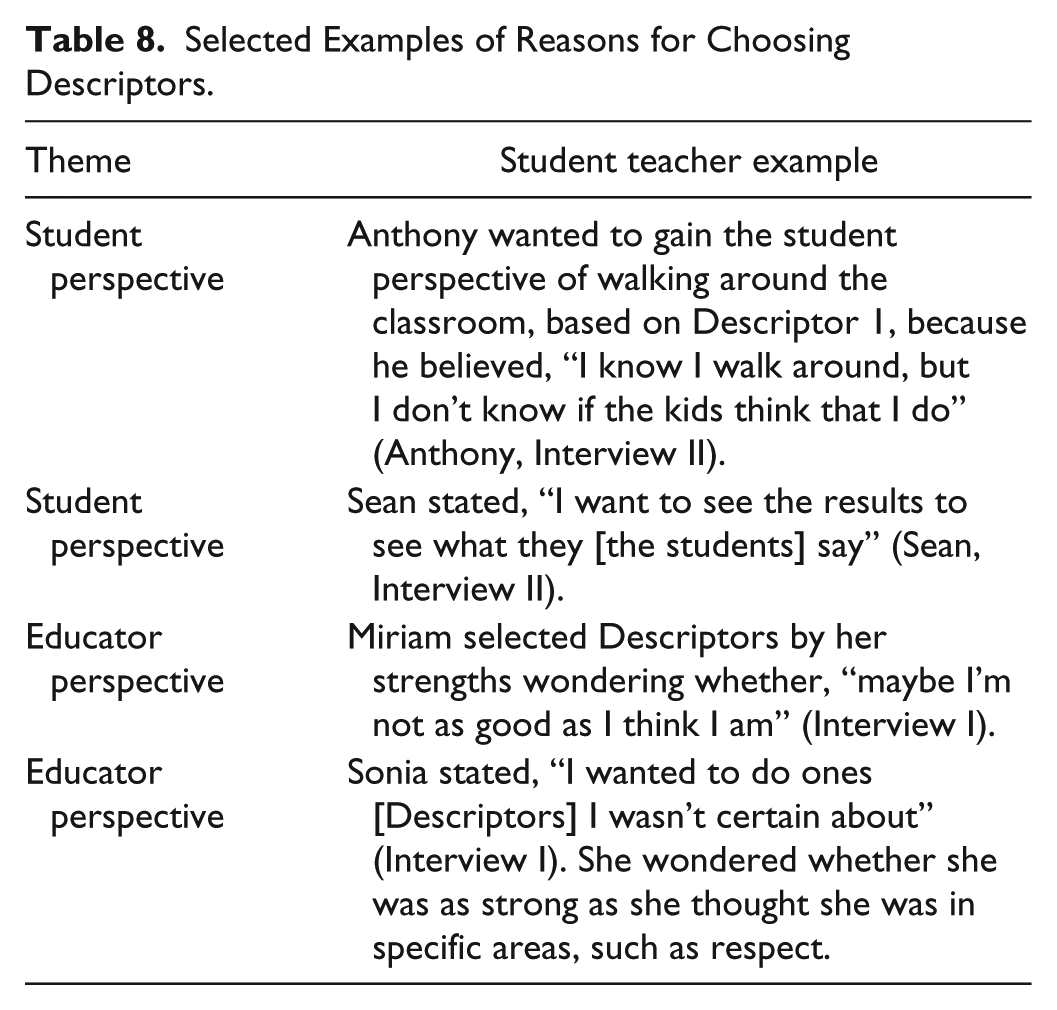
Generally, the student teacher’s reasons for choosing specific Descriptors can be categorized as either
descriptors chosen for understanding the student perspective—giving the students a voice and understanding that voice better or
descriptors chosen for understanding the educator perspective—understanding what the educator is actually doing in the classroom.
Student perspective
Amy stated, “I do want to know how they perceive me because I think I do it this way, but how did they perceive me?” (Interview II, April 29). Amy, like many others, wanted to know more about the student perspective. For example, in Interview II, Richard wanted to specifically investigate student cooperation and communication: “I was interested in seeing how they felt about that, how they felt about their group work and communication with each other because sometimes it seems lacking in the classroom.” Similarly, Miriam, Sonia, and Elizabeth wanted their PCLA Descriptors to give students a voice. Nine out of 10 student teachers designed the PCLA in an effort to provide students with a place to give their opinions and perspectives and, as a result, worked toward improving the affective domain.
Educator perspective
In addition to a desire to understand the student perspective, nine out of 10 student teachers expressed a need to understand the teacher perspective in their classroom as the reason for choosing certain Descriptors. These student teachers wanted to know more about their teaching, what they could gain from this experience, about their strengths and weaknesses, and ultimately what they needed to know to become a better teacher. Within the educator perspective, the following categories describe how student teachers chose their Descriptors: by perceived weak areas, by perceived strong areas, by current teaching practices, uncertain areas in need of more information, and achieving an overall perspective of teaching. Based on interview data, it is apparent that student teachers benefit from a systematic way to provide student voice and to become better informed of their role as teacher.
How Does Student Feedback of the Student Teacher’s Lessons on the PCLA Change From Lesson 1 to Lesson 2?
So I think that was the best thing to see was that you don’t realize that the students will take notice of certain things, but they do realize that you were trying or not trying. So then, it was nice to see that there was a positive growth for some students. (Anthony, Interview I)
Research Question 3 attempts to explore whether change in student feedback from PCLA I to PCLA II occurred. It is interesting to note that in hundreds of pages of interview transcripts and PCLA reflections, student teachers rarely spoke of specific comparisons between PCLA I and PCLA II ratings. Attention to ratings, reasons for ratings, and plans for changes were overwhelmingly discussed more frequently, as can be seen in Research Question 1. There are 16 instances in which student teachers discussed an improvement in student feedback based on an increase in ratings or positive comments between PCLA I and II. Three student teacher statements emphasized a decline in student ratings. For example, Matthew encouraged his students to be honest on PCLA II and as a result, believes he received more “critical” feedback that included lower ratings. Only Anthony and Sean went into depth about comparisons between PCLA I and PCLA II. Anthony shared eight instances in which he compared results among Descriptors. For example, he discussed his perceived small gain in student ratings of Descriptor 4, which deals with behavior management. The lack of depth in student teacher rating comparisons may be due to student teacher focus on reasoning behind each score and not on overall comparison throughout the semester.
Due to the nature of self-assessment, change from PCLA I to PCLA II was based on student teacher perception of their student feedback data. Therefore, it is necessary to look at student teacher perceptions of high and low student ratings. Because the PCLA is an individualized self-assessment, the desire to change came directly from the student teachers. The researcher did not tell them what should be an impetus for change, but rather the student teachers made their own decisions regarding their student feedback.
When student teachers encountered high student ratings or ratings higher than the student teacher’s self-assessment for the same lesson, two categories existed. Teachers either felt distrust for their excessively high ratings or confirmation of their effective teaching. Teachers explained that this distrust came from a lack of confidence. Being more critical on herself than her students, Miriam, such as others, seemed to lack the confidence to perceive herself as her students did. However, throughout the research, student teachers became more comfortable with their feedback and trusted the ratings more.
As a result of learning to value student input, the student teachers in this study paid special attention to low ratings. Generally, student teachers looked at the low student ratings as an area of growth and needed improvement. For example, after receiving low scores of questioning techniques, Pamela realized that she was a novice teacher and will continue to try to improve classroom questioning. In very rare cases, student teachers provided reasons for the low scores and did not necessarily feel that this area needed improvement. For example, Anthony not only looked at his low scores as areas of possible improvement but also wondered whether the reasoning for low ratings was due to a culture or language issue.
The student teachers’ view of change in student feedback depended on their perception of student feedback. What some may consider “high” ratings may have been “low” ratings to others. What some considered “change” may not have been substantial “change” worth discussing to others. Differentiation for each teacher’s needs is a main component of the PCLA. This differentiation is also revealed in the way that each student teacher perceives student feedback and, as a result, some student teachers focused on change in feedback more frequently than others, and in different way than others.
Discussion
This evaluation reminded me that I cannot be perfect every time, but I should strive to teach to the best of my ability and with the resources provided me. I have learned much, both about teaching and learning. (Miriam, Reflection II)
The opportunity to work with Freiberg’s PCLA gave student teachers the resources to look deeply into their classroom and teaching in a nonevaluative environment, from both their own perspective and that of their students. The participants shared their experiences and came away from this research with new insights into their classroom. The researcher simply facilitated conversation throughout this process, but the student teachers became the inquisitors of their own secondary classroom teaching. The student teachers drew their own conclusions about their strengths and weaknesses and made decisions about what their classroom data said about their teaching and classroom climates. This process is different from the typical student teaching experience, in which the cooperating teacher and university supervisor provide the primary or sole sources for feedback. Although self-reflection strategies exist in teacher education programs, emphasis generally lies on external evaluations. The PCLA can support those strategies by providing a systematic self-assessment approach.
As seen through Miriam’s quote above, working with the PCLA provided opportunities to learn about teaching through student numeric and narrative feedback, audio recording, and self-reflection, resulting in greater classroom affect. Two main themes were seen as a result of the findings: (a) student teachers value student feedback and (b) self-assessments encourage student teacher reflection about teaching and needed changes.
Student Teachers Value Student Feedback
Freiberg and Driscoll (2005) describe students as the greatest, yet rarely used data source. Although this type of feedback may exist in classrooms, little research explores the feedback from student to teacher (Polek, 2010). This study provided student teachers with a structured avenue for gathering valuable student feedback about their teaching.
Self-Assessments Encourage Student Teacher Self-Reflection
Self-assessments in education provide resources for self-reflection of classroom teaching and learning (Dewey, 1910; Houston & Warner, 2000). The Flanders Interaction Analysis System (Freiberg & Waxman, 1988), Stallings Observation System (Freiberg & Waxman, 1988; Stallings, 1986), Hoover and Carroll (1987), and the LISAM (Freiberg, 1987) have set a precedent for the power that self-assessments can have in education. This study of student teachers’ use of the PCLA is timely. It provides a fresh look at self-assessments. In a time when teacher evaluation is at the forefront of discussions (DeMonte, 2015; Levine, 2006), the PCLA could provide a new avenue for educator self-reflection.
The results of the study show the benefits of student teachers taking the time to self-reflect on their teaching and classroom learning. The PCLA provided student teachers with a format and intentional process for self-assessing their instruction and classroom climate.
Recommendations
In 1969, Francis Fuller studied student teacher concerns. She found that at the beginning of the semester, student teachers were largely concerned with themselves; toward the end of the semester, they were largely concerned with the students. Decades later, research continues to study preservice teacher perceptions and concerns (Cooper & He, 2012). DeMonte (2015) continues the discussion as part of the Education Policy Center. Her focus is on improving teacher education and the student teaching experience, with a synthesis of recent teacher preparation research. DeMonte (2015) argues that most teacher preparation programs (from university to alternative programs) are not sufficiently preparing teachers. She states that 1.5 million new teacher hires will go into our schools in the next 10 years, but asks, will they be ready for the job?
Teacher preparation has room for growth (Levine, 2006) and the PCLA serves as one avenue to start addressing these concerns. The PCLA provides student teachers with multiple sources of data to improve their practice of lifelong reflective skills they can use throughout their teaching career.
As a result of the literature review and this study, three recommendations for teacher preparation programs are provided. Teacher preparation programs should provide opportunities for the following:
Receiving student feedback—although the PCLA gave student teachers an opportunity to listen to their lesson (via audio recording) and an opportunity to assess their own classroom, the student teachers continually discussed feedback from their students. Generally, their perceived areas of strengths and weaknesses directly resulted from student feedback. In light of this helpful source of feedback, it is important to give student teachers multiple opportunities for receiving student feedback in their teacher preparation program that is uniquely their own. In addition, the student feedback will become even more powerful with appropriate coaching in helping students provide constructive and effective feedback.
Self-reflection using multiple sources of data—a major theme in the PCLA and in this study is student teacher self-reflection. In today’s teacher preparation programs, student teachers are constantly observed, evaluated, and graded. They often wait for someone else to tell them how they are doing and what to do (Freiberg & Driscoll, 2005). With this type of external evaluation practice, student teachers learn to rely on what others say they need to do. However, this study shows that student teachers gain a wealth of information if they have the opportunity to self-reflect. This pedagogical awareness becomes particularly helpful with student teachers in performance-based assessment programs, such as edTPA. Using multiple points of data for self-reflection, student teachers can see growth in their learning. Using the PCLA, student teachers use self-reflection to take their professional growth to higher levels. When given strategies for self-evaluation, teachers acquire more ownership and take charge of their learning (Freiberg & Driscoll, 2005; Rogers & Freiberg, 1994; Sosanya-Tellez, 2010).
Engaging the student teacher in developing a self-assessment measure—the PCLA provides educators with an opportunity to create their own individualized self-assessment measure. Allowing the student teacher to be part of the self-assessment creation process gave the student teachers skills and knowledge of how to gather classroom data, receive student feedback, and assess their classroom. This process provided the student teachers with skills that are transferable to their future classrooms. Even if they do not use the PCLA in its formal design, student teachers will still have the skills to receive student feedback and self-assess—skills not always taught in teacher education programs.
One could argue that the student teachers may not have the experiential level to make the decisions regarding which Descriptors they should make their focus. However, this study would indicate that is not the case. By the time preservice teachers reach student teaching, they have acquired appropriate skills and adequate knowledge of teaching to prepare them for going through the PCLA process (Cornelius-White, 2007; Hattie, 2009).
Limitations to the Study
It is important to note three research limitations from this study. First, the small sample size was limited. Although this worked well with this first exploratory study, future research would benefit from a larger sample of student teachers. Second, although the research showed many benefits to the use of self-assessment, this type of self-assessment is not designed for use as an external evaluation measure. More research is needed to study the effectiveness of preservice teacher evaluation using the PCLA. Finally, this research only looked at secondary classrooms. Additional research and possible PCLA adaptations would need to be looked at with elementary populations.
Further Research
This study serves as the first exploratory research using the PCLA as a resource for informing student teachers about their practice. Although many interesting and positive findings arose, this study was a beginning for research using the PCLA. Teacher preparation is part of the ongoing national discussion and this self-assessment has distinctive characteristics to potentially help create more effective educators. Using the PCLA with a larger sample of student teachers and with inservice teachers may provide additional trends and further self-assessment research. Additional research connecting the student teachers, university supervisors, and cooperating teachers could potentially provide a deeper level of feedback for the student teachers from a variety of sources.
Conclusion
In 2009, Hattie published meta-analyses including more than 50,000 studies related to student achievement. Serving as a prominent study in education, Hattie (2009) describes feedback as “among the most powerful influences” (p. 173). He continues by describing feedback as most powerful when it comes from the student to the teacher. The PCLA is a resource that reflects this need for feedback by gathering feedback from the student to the teacher (Hattie, 2009). The PCLA provides a structure and a system for receiving these data and analyzing what it means for the classroom.
Hattie (2009) also explains that effective feedback provides answers to three areas:
Feed up: Where am I going?
Feed back: How am I going?
Feed forward: Where to next?.
It appears student teachers using the PCLA would be able to self-reflect on each of the above three questions based on their students and self-assessments. The ability to self-reflect enables educators to truly contemplate about where they have come from, what they have done, and where they plan to go in the future (Goh & Matthews, 2013). Self-improvement, ownership, and empowerment are just a few of the many advantages of self-reflection. The PCLA serves as an influential resource for educator self-reflection with the ability to create an individualized self-assessment. Each of the student teachers came away with a number of areas of strengths, weaknesses, and improvements reflected in their PCLA data. It has the possibility to aid in both teacher preparation and educator professional development.
Supplemental Material
734535 – Supplemental material for Rethinking Student Teacher Feedback: Using a Self-Assessment Resource With Student Teachers
Supplemental material, 734535 for Rethinking Student Teacher Feedback: Using a Self-Assessment Resource With Student Teachers by Lauren Oropeza Snead and H. Jerome Freiberg in Journal of Teacher Education
Supplemental Material
734535sp – Supplemental material for Rethinking Student Teacher Feedback: Using a Self-Assessment Resource With Student Teachers
Supplemental material, 734535sp for Rethinking Student Teacher Feedback: Using a Self-Assessment Resource With Student Teachers by Lauren Oropeza Snead and H. Jerome Freiberg in Journal of Teacher Education
Footnotes
Authors’ Note
This research was based on the first author’s dissertation study, which was supervised by the second author.
Declaration of Conflicting Interests
The author(s) declared no potential conflicts of interest with respect to the research, authorship, and/or publication of this article.
Funding
The author(s) received no financial support for the research, authorship, and/or publication of this article.
Author Biographies
References
Supplementary Material
Please find the following supplemental material available below.
For Open Access articles published under a Creative Commons License, all supplemental material carries the same license as the article it is associated with.
For non-Open Access articles published, all supplemental material carries a non-exclusive license, and permission requests for re-use of supplemental material or any part of supplemental material shall be sent directly to the copyright owner as specified in the copyright notice associated with the article.
