



Abstract
As student populations become culturally and linguistically diverse, mismatches between students and the mostly White teaching force create challenges for schools and teacher education programs. This article—drawing from the Coaching With CARE project and building on research valuing the role of cooperating teachers (CTs) in supporting critical, socially just teaching—examines c/Critical conversations between CTs and preservice teachers (PTs) to highlight ways CTs may bring critical understandings into mentoring work. Findings show that using tools like retrospective video analysis (RVA) and responsive critical discourse analysis (CDA) helped provide space for some CTs to engage in critical discussions of traditional power hierarchies within the classroom, the roles they and their students assume in societal power structures, and ways those understandings may affect their classroom teaching. The examples also demonstrate the challenges facing teacher educators who hope to engage in similar work and importance of professional development for CTs that includes critical reflection on their own identities and power.
As student populations in the United States become more culturally and linguistically diverse, the most recent statistics on teacher characteristics show that over 80% of teachers are White (Snyder, de Brey, & Dillow, 2016). At the same time, neoliberal reforms have worked to standardize and script curriculum (Crocco & Costigan, 2007; Genishi & Dyson, 2009; Sleeter, 2012). Cultural mismatches between teachers and students along with this standardization make it difficult for educators to create space to meet the needs of and be responsive to their diverse students (Bergeron, 2008; Skerrett & Hargreaves, 2008; Sleeter, 2008). With this situation as a complex backdrop, many scholars argue teacher education must include preparing teachers for humanizing, sociopolitically conscious, socially just, and culturally relevant and sustaining instruction (e.g., Berchini, 2017; Brown, 2013; Cochran-Smith et al., 2009; Dyches & Boyd, 2017; Ladson-Billings, 2006; Whipp, 2013).
Also situated within a practice-based turn, teacher education must look beyond isolated courses at universities to integrate these goals across field experiences (e.g., Valencia, Martin, Place, & Grossman, 2009). One model that may provide opportunities for supporting preservice teachers (PTs) in taking on socially just teaching practices is Coaching With CARE (Mosley Wetzel, Hoffman, & Maloch, 2017). The Coaching With CARE model positions cooperating teachers (CTs) and PTs as inquiry partners who dig into their teaching experiences together. Based in experiential learning, the goals of using this model include fostering critical, appreciative, and reflective skills and dispositions teachers can take forward into their teaching. Specifically, the “C” in CARE includes thinking about social justice being conscious of the ways our teaching might “negate opportunities for historically marginalized groups” (Mosley Wetzel et al., 2017 p. 44). This article draws from the larger Coaching With CARE project to examine how CTs and PTs engage in sociopolitically conscious reflection within their conversations about teaching. Results suggest CTs have potential to be important partners in critical teacher education.
Practice-Based Learning and CTs
Because of the emphasis on practice-based, field experiences in teacher education, researchers have begun looking closely at those experiences and the tools and communities mediating them. Most studies looking at CTs’ role(s) highlight the lack of preparation they receive before going into this work (Clarke, Triggs, & Nielsen, 2014; Hoffman et al., 2015). Other studies, looking at CTs’ mentoring practices, have found CTs may tend to monopolize discussions (Crasborn, Hennissen, Brouwer, Korthagen, & Bergen, 2011) and rely on evaluative, technical feedback, often focused on classroom management or instructional activities rather than reflective inquiry into practice, beliefs, and philosophies about teaching (Bradbury & Koballa, 2008; Clarke, et al., 2014; Crasborn et al., 2011; Edwards & Protheroe, 2004; Hoffman et al., 2015; Valencia et al., 2009).
In their 2010 study of CTs’ dialogue, Crasborn and colleagues (2011) examined transcripts of 20 different mentoring conversations. Their analysis showed CTs initiated most topics within discussions and took on a directive role in the discussion: CTs “focus[ed] on teaching performance by pointing out as right or wrong elements in what student teachers [did] during their lessons and that they provide[d] them with tips and suggestions to make improvements” (p. 327). Valencia et al. (2009) investigated the mentoring relationships between PTs, their CTs, and their university supervisors. Noting an overall lack of observations and debriefing conversations, Valencia and her colleagues found that the vast majority of the few conversations that did take place were often superficial and centered on classroom management and procedures rather than learning or sociopolitical considerations.
There is also some evidence to suggest participating in training may affect CTs’ mentoring dialogue, including becoming less directive and more open-ended or problem-posing (Erbilgin, 2014; Hennissen, Crasborn, Brouwer, & Korthagen, 2010; Mosley Wetzel, Taylor, & Vlach, 2017). For example, Mosley Wetzel, Taylor, and Vlach’s (2017) examination of pre- and post-conferences between a PT and her CT, also a participant in a graduate program focused on mentoring, showed that across the year, those discussions included more instances of reflection, co-construction, and thinking toward future teaching. While these studies (Crasborn et al., 2011; Erbilgin, 2014; Hennissen et al., 2010; Mosley Wetzel et al., 2017; Valencia et al., 2009) offer several insights and examples of tools or strategies CTs might use as teacher educators, they are among the very few studies that have studied the dialogue between CTs and PTs. Even less attention has been given to close examinations of CT/PT talk that highlight tools and strategies for developing critical, socially just teaching.
Socially Just Teaching and Teacher Education
Many education scholars have discussed humanizing, socially just teaching practices that push back against sociopolitical hierarchies that marginalize particular students’ cultures, languages, and histories inside schools (e.g., Brown, 2013; Cochran-Smith, 2010; Kumashiro, 2002; Ladson-Billings, 2006; Paris, 2012). While each pedagogical framework or theory includes distinguishing characteristics, there is overlap among their arguments. In this piece, I use “critical, socially just teaching” to refer to education that appreciates students’ differences as strengths, works toward academic success for all students, and includes consciousness of power, sociopolitical discourses, and teacher/student positions within those constructs. Teacher education programs should use principles like these to guide their decision making about PT recruitment policies, curriculum and pedagogical practices within university coursework, and partnerships with schools and community organizations that challenge dominant ideologies and respect cultural differences (Cochran-Smith, 2010; Villegas & Lucas, 2002).
Much of the research on preparing critical, socially just teachers examines isolated activities or courses at the university while others suggest the importance of program-wide attention to this kind of teacher preparation (e.g., Durden & Truscott, 2013; Kumar & Hamer, 2013; McDonald, 2005; Sleeter, 2008; Whipp, 2013). These studies often focus on including multicultural content in curriculum while neglecting other aspects of socially just teaching (Berchini, 2017; Ladson-Billings, 2006). Beyond traditional and critical content knowledge (e.g., counter-hegemonic disciplinary instructional materials), Dyches and Boyd (2017) argued teachers must also build social justice knowledge and social justice pedagogical knowledge. In Dyches and Boyd’s framework, teachers learn strategies for classroom management and instruction that support students in accessing their own cultural knowledge and in developing agency and critical consciousness. Teacher education must provide space to engage with social justice theories; examine ways language perpetuates injustice; consider their roles within larger systems, histories, and discourses; and find ways to take action against injustice in classrooms and beyond (Dyches & Boyd, 2017).
Some scholars argue these ideas must also be embedded in field experiences (e.g., Anderson & Stillman, 2011; Sleeter, 2008), yet little research examines what this work might actually look like or how CTs might play a role in helping mentor PTs into critical, socially just teaching. Findings from Bates and Rosaen (2010) and Vass (2017) suggested PTs often mirror ways their CTs (do not) take up critical pedagogy and reflection. Yet, Lane, Lacefield-Parchini, and Isken (2003) showed PTs may hold onto their values about culturally relevant and social justice teaching, sometimes even impacting their CTs’ beliefs: “Rather than being co-opted by the ‘grain,’ [these PTs] changed the ‘grain’” (p. 62). These two examples highlight the complexity of CT/PT relationships and the uptake of critical teaching; however, neither these nor any other studies examined actual conversations taking place between CTs and PTs or ways to open up space for critical reflection. So while this relationship may be an important space for supporting more critical, socially just teaching, the current body of literature is not clear about ways CTs and PTs might engage in critically conscious conversations about teaching.
Looking closely at CT/PT conversation to better understand this important yet understudied teacher education space, this study looks at how CTs and PTs use tools to support them in developing or sustaining critical, socially just teaching, particularly by reflecting on issues of power in individual classrooms and beyond. The following research question guided this analysis:
Method
This article draws from data collected within a longitudinal, multi-phase study of developing mentoring practices. The larger design-based study explores how CTs learn to be mentors, leaders, and teacher educators, as they take on roles within a university teacher education program.
Context
Three cohorts of classroom teachers participated in a master’s program, focused on developing practices in mentoring, teacher leadership, and professional development, at a large university in the southwestern United States. Each participant completed coursework, including learning about the Coaching With CARE model, while also serving as a CT for the same PT across one academic year. The Coaching With CARE model revolves around cycles of reflection. While these may happen informally across the year as well, each semester, the professor leading the course asked each CT to video-record three formal coaching cycles—each including a pre-conference, the actual teaching, and a post-conference. Pre-conference conversations took place quickly, right before PTs began teaching and asked them to visualize the upcoming lesson, discuss goals for students, and outline data they wanted CTs to collect while observing. Post-conference conversations typically took place a day or two after teaching and asked PTs to reflect on their teaching. While CTs were advised to create a “road map” for facilitating these conversations, ultimately the PTs’ concerns and celebrations drove these discussions.
This article draws primarily from data collected during the third cohort’s Classroom Discourse and Teacher Research (CDTR) course in spring 2015. The course was designed as “a collaborative, critical examination of teacher research, particularly in relation to exploring classroom talk” while “inquiring into our coaching practices” (course syllabus, 2015). Reading about teacher research, discourse, and discourse analysis, the CTs used the questions “what are these texts telling us about issues of language, power, and social justice?” and “how are we better understanding the ‘everyday language practices’ of our students and ourselves?” to guide discussion (course fieldnotes, January 27, 2015). The CTs in this course collected and analyzed language samples from their classrooms (using critical discourse analysis [CDA], narrative, and multimodal analysis methods) and created a teacher-research proposal based on their discussions about disrupting patterns of classroom discourse, understanding linguistic diversity, and facilitating student talk about social issues. Positioning both discourse and teaching as explicitly political, the faculty instructor also built connections between their discussions, the CTs’ classrooms, and larger sociopolitical events such as the rise of the Black Lives Matter movement.
One recurring conversation focused on defining the term “critical.” Initially, some CTs aligned “critical” with analytical and evaluative thinking while others came with definitions related to critical pedagogy (e.g., Freire, 1970). The CTs and instructor drew on their understandings of p/Politics (Janks, 2010) and d/Discourse (Gee, 1996) to develop a distinction between little c, critical and big C, Critical. Just as p/Politics and d/Discourse are distinguished by scale (e.g., discourse as local use of language and Discourse as ways of being and enacting larger ideologies), c/Critical proved to be helpful in imagining a continuum from a local, interpersonal level to a global, sociopolitical level. Little c, critical, was then used to think about individual differences and disrupting power dynamics at the classroom level. This type of “critical” sparked questions like whose voices were heard or not heard in classrooms and how power could be shared among teachers and students. Big C, Critical conversations centered on differences between groups in and beyond the classroom. This type of “Critical” included questions about race, gender, class, religion, sexuality, language, and other macro-level distinctions at play within classrooms and society.
In this course, CTs were invited to use retrospective video analysis (RVA) as a tool for facilitating reflection with their PTs (Mosley Wetzel, Maloch, & Hoffman, 2017). Using videos of PTs’ teaching, RVA invited CTs to build on strengths, naming and appreciating strategies PTs were already employing while focusing on students’ responses. In an RVA post-conference, a PT’s teaching was video-recorded, the CT and PT watched the video separately and selected interesting sections, and then they sat down together to closely review portions of the video and discuss.
While not named until late in the semester, many of the CTs also began using responsive CDA as a tool for connecting the critical thinking about language, identity, and power in their course with the mentoring work they were doing with their PTs. Responsive CDA, like larger CDA traditions, primarily seeks to deconstruct the ways in which language plays a role in power and domination within social relations (Fairclough, 2004). It is based on the assumptions that the form, content, and positioning in each piece of semiotic data actively works to maintain, resist, or change hierarchical power dynamics and that through close analysis of what was said and how it was said, we can uncover how power works within an interaction. Responsive CDA—unlike traditional CDA where data are removed and analysis typically conducted long after the event—can work as a tool for teachers to examine day-to-day interactions, informing immediate teaching decisions about redistributing power in the classroom (Rogers & Mosley Wetzel, 2014a). Paired with the use of video (RVA), many CTs began using responsive CDA as a tool for looking closely at multimodal semiotic data within PTs’ teaching videos and for describing the ways that data positioned teachers and students in ways that maintained or disrupted traditional power hierarchies within and beyond the classroom.
The CTs read about and discussed both RVA and responsive CDA (e.g., Mosley Wetzel, Hoffman, & Maloch, 2015; Rogers & Mosley Wetzel, 2014a, 2014b) during the course and were asked to engage in RVA as part of their three recorded post-conferences. After each recorded RVA post-conference, the CTs brought their videos in to share, reflecting together on what moves they were making as coaches that stimulated PT reflection. Before the final coaching cycle, the professor entreated all of the CTs to “move into critical conversations [with PTs]…about race and linguistic diversity and about the aspects of teaching we all think are important but are very hard to think about” (course fieldnotes, March 31, 2015). After seeing and reflecting on the CTs’ final post-conference videos, the course instructor later named what many of them were doing as responsive CDA (course fieldnotes, April 29, 2015).
Participants
The 10 CTs in this cohort were all female; three identified as Latinas while the other seven were White. They worked full-time as elementary teachers, with between 3 and 18 years of experience, and ranged from working with their first PTs to having worked with multiple student teachers across their careers. The CTs came into the program with varying experience discussing c/Critical issues related to schooling and larger social systems. Mia, for example, was comfortable talking about issues of race, class, and gender from the beginning of class. Many other CTs seemed less eager to engage in these discussions—both in the course and/or in their interactions with PTs.
The PTs paired with these CTs were all students in the university’s undergraduate elementary certification program. Across the program, PTs and CTs took classes, where they read about and discussed sociocultural influences on learning and developed instructional approaches for drawing on all students’ linguistic and cultural resources, with the same faculty. As with the CTs, PTs in this cohort came into this semester with different levels of comfort in talking about c/Critical issues. Renee and Jasmine, for example, actively engaged in these topics in classes or coaching conversations from the beginning of the semester.
Data Collection
Data collected in the course and analyzed for this article included class fieldnotes and audio-recordings, interviews, and video-recordings both of coaching conversations and CTs’ reflections on those videos during class meetings. Detailed fieldnotes were taken by a research team member during each CDTR course meeting. Audio-recordings of each class were also available for consultation when attention to specific language in a particular conversation was needed for analysis (e.g., discussions where c/Critical was brought up in class). Interviews with each participant took place at the beginning, middle, and end of the 2014-2015 school year. Each lasting between 20 and 55 min, these audio-recorded, semi-structured interviews focused on teaching contexts and histories with mentoring, their evolving philosophies and practices as a coach and in building relationships with their PTs, and factors influencing those philosophies and practices. Final interviews also included questions about using RVA and having critical conversations. Of the 10 CTs, eight made all videos they collected for the course available to the research team for analysis. Additional data included video-recordings of CTs watching and discussing their coaching videos during their class meetings. Using CDA for my own analysis, I used data from the course and interviews with CTs as context for grounding the coaching conversations. Because I was most interested in what conversations looked like when CTs and PTs engaged in c/Critical reflection, the video-recordings of RVA post-conferences between CTs and PTs were the main data source for this analysis.
Data Analysis
After taking descriptive fieldnotes on each post-conference video to create a written record of verbal and nonverbal content (Erickson, 2006), I used first cycle, descriptive coding (Miles, Huberman, & Saldaña, 2014) to locate parts of post-conferences where teachers attempted to have conversations around power in or beyond the classroom. In this first phase, I relied on the aforementioned a priori definitions developed within the spring CDTR course to identify examples, examining data for instances of both classroom-level, “critical” and macro-level, “Critical” topics within their coaching. While explicit examples of these c/Critical conversations were marked through direct naming, implicit discussions about power were sometimes more ambiguous. For example, in one post-conference, the CT pauses the video and asks the PT to rehearse other possibilities for her language: “When Isabella said that, what could we have told her in that moment to help you get an idea of where she is coming from?” When the PT responded that she did not hear Isabella’s comment because she was focused on “the kids who were rolling around on the floor,” the CT talked to her about general ways to facilitate discussion to limit her own voice and include more students rather than framing this incident in terms of hierarchical classroom discourse patterns. After discussing this example with a critical peer group, including research team members and those unfamiliar with the data, this example was included in the bounded cases because while not explicit, the conversation was implicitly about decentering the teacher’s voice and paying attention to whose voices are heard and whose are silenced in the classroom.
During a second phase, I transcribed (see the appendix for conventions) examples and analyzed them turn by turn. Through multiple and iterative passes through the data, I used Fairclough’s (2004) framework of genre, discourse, and style to guide my analysis. This framework is a useful tool for examining all the elements of semiosis—focusing on not only what is said but also how it is said. Throughout this analysis, several patterns emerged, showcasing similarities and differences across examples of c/Critical discussion. Despite substantial overlap between categories and levels of analysis, overall, codes that came up in the genre analysis category (about cohesion, intertextuality, and coaching moves) were similar across all examples. Interactions between PTs and CTs featured collaborative talk (Mercer, 2000) and highlighted how they used language in ways that built on or maintained their relationships. All CTs and PTs strategically used video to support their reflection and analysis, each conversation kindled by attention to teachers’ and students’ specific language, body positioning, and/or movement. For example, in one post-conference, a CT and PT paused the video multiple times, paying close attention to students’ body positioning, control of materials, and talk to think about the power dynamics between students as they worked together in pairs.
Codes that came up in the discourse (about content and word choice) and style (about positioning, tense, and evaluation) categories set the c/Critical discussions apart. Some conversations were categorized as implicitly c/Critical: still about power—either within the classroom or within larger society—but without directly naming those aspects. In addition, implicit examples were sometimes characterized by not connecting classroom interactions to issues of local or global power dynamics. In other examples, participants explicitly named power or social issues connected to global Discourses about groups and power (e.g., race, class, gender, etc.). A clear link between what was happening in classrooms to ways of thinking about power also was important in this type of talk: just mentioning the word “Latinx” or “heterosexual” did not inherently make a conversation explicit.
Across c/Critical conversations, differences emerged among how CTs and PTs positioned themselves and each other. Some examples, coded as shared inquiry, included using language to build meaning together. Cues signaling this positioning included markers of content coherence (like picking up and using words or an idea the other has used) and matching footing (like both as vulnerable or both working toward understanding rather than one having a ready answer). In the remaining examples, marked as uneven, one participant appeared to be more invested in the conversation. This sometimes looked like one speaker offering her own vulnerability without being reciprocated. Uneven conversations were also often marked by attempts by one party to stop at easy answers or to leave the issue as unanswerable.
After this round of coding, I went back through all 24 post-conferences, identifying any additional examples or counter-examples. I recorded a description of the 13 identified c/Critical conversations (see Table 1). In describing these examples, several patterns appeared as continuums rather than binaries, so I also plotted examples on two axes (based on their c/Critical and explicit/implicit nature). Figure 1 provides this visual analysis of the examples in relation to each other and these main distinctions that emerged.
Description of 13 c/Critical Discussions Found Within 24 Total Coaching Conversations.

Note. CT = cooperating teacher; PT = preservice teachers; RVA = retrospective video analysis; ELA = English Language Arts.
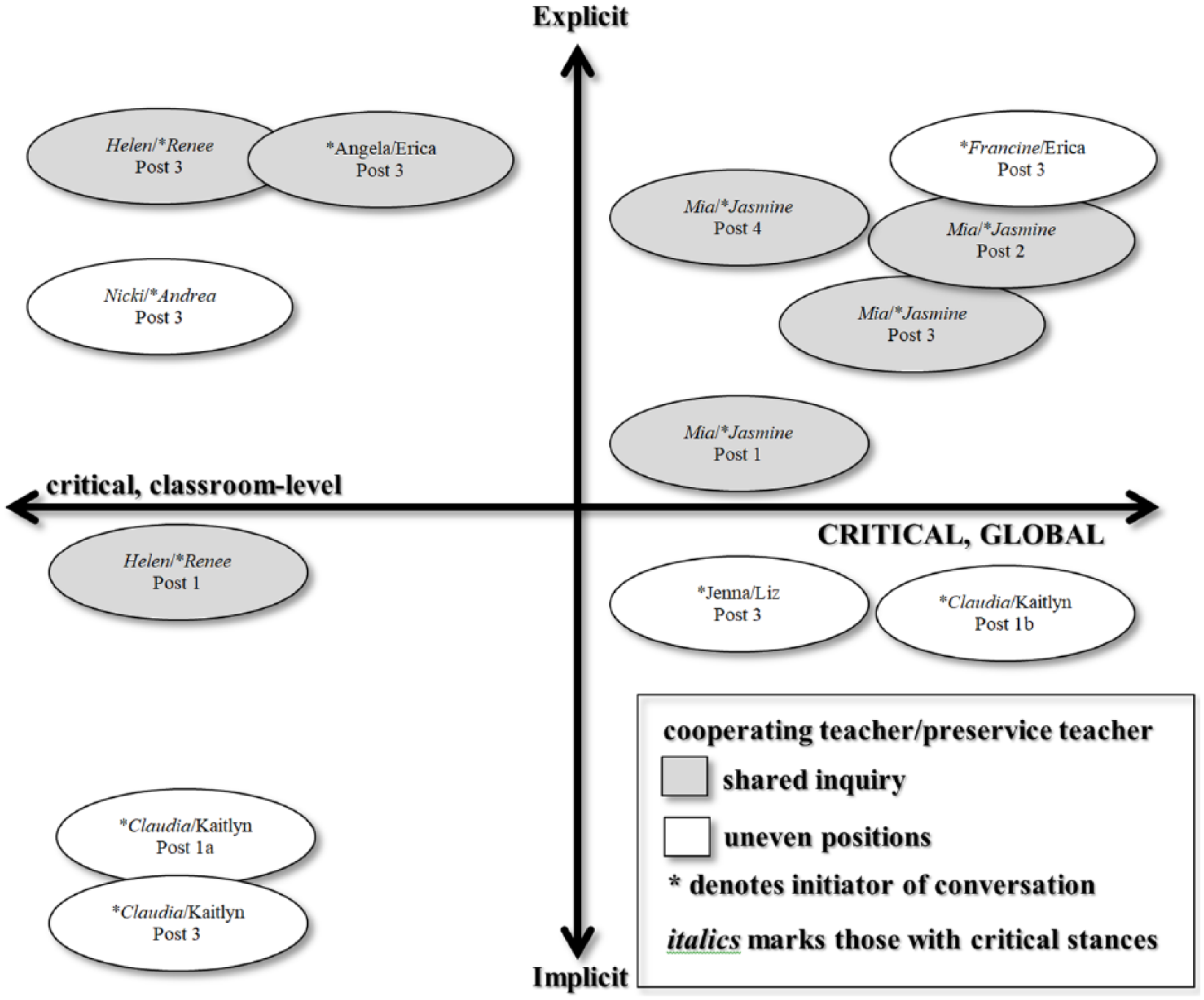
Map of 13 examples of c/Critical conversations found within RVA post-conferences.
Findings
Because of the relevance to the immediate teaching context and the space it provided for analysis of talk and activity, the use of video served as a medium for viewing teaching as text for the participants to analyze together across the post-conferences. The video held classroom interactions still, which may have otherwise been fleeting or gone unnoticed, and staying up close to these interactions provided data that supported multiple coaching strategies like paraphrasing PT talk, directing PTs to student data, and naming PTs’ teaching moves (see Mosley Wetzel et al., 2017, for more examples of the types of coaching moves often found in Coaching With CARE discussions). When CTs and PTs also took up elements of responsive CDA as a tool for their analysis, they created opportunities for PTs to think critically about their teaching and how the talk and activity in their classrooms resisted or reproduced social inequities. In reflecting on this work, one of the CTs, Mia, noted that the videos provided “a little bit more distance” for helping her “see the interactions and see the power dynamics a little better” (course fieldnotes, March 11, 2015). Francine commented on how using the videos helped her and her PT “go back to what actually happened, what was actually said, what did things actually look like” rather than relying on their impressions, so she could try to bring attention to language and power into her mentoring work. The CTs were never specifically asked to reflect on their use of responsive CDA in interviews, yet responses like these and the actual coaching conversations showed that, for some of the CTs, responsive CDA became a thinking tool, a way of deconstructing power through attention to what was said and how it was said, if not a formalized research method. While RVA provided the space for this work, it was the CTs’ exposure to and practice with CDA that pushed many of them to not just look closely at language and physical positioning but to think about the power dynamics inherent within that data.
However, even in this context where both PTs and CTs were exposed to tools and c/Critical curriculum in university coursework, not every post-conference included explicit or even implicit references to power or sociopolitical Discourses. While only one CT/PT pair, of the eight who shared their videos, did not engage in any c/Critical discussions, it is notable that 8 of the 13 identified conversations took place in the third RVA post-conference, after the CDTR professor invited them to try c/Critical conversations. Four CT/PT pairs only engaged in c/Critical discussions after this direct invitation, and only one pair, Mia and Jasmine, took up these topics in all of their RVA post-conferences. The few c/Critical conversations found in the first or second post-conference appeared linked to teaching content, like during literature units about segregation (i.e., Mia and Jasmine, Claudia and Kaitlyn), or seemed to come from coaches and PTs who both came into the semester with critical mindsets (i.e., Mia and Jasmine, Helen and Renee). Having RVA and responsive CDA available as tools did not, on their own, make CTs more critical, but instead helped CTs who were thinking about c/Critical issues mentor their PTs in that work. One CT described them as tools for “actually engaging] in that work out-loud rather than just wrestling through it in my head” (Francine, end-of-year interview, June 02, 2015).
As the descriptions in the “Data Analysis” section suggest, there was significant variation across the c/Critical conversations. Just over half of these discussions were either explicitly or implicitly connected to sociopolitical Discourses of race, gender, or class. The other six examples stayed at the classroom level, examining the ways that power was distributed among the teachers, students, and materials. In the rest of this “Findings” section, I focus on two conversations, drawing on nuanced attention ways CTs connected c/Critical reflection to their mentoring work. While particular to the context of each pairs’ teaching, these two examples illustrate features other conversations also shared—including explicitly referencing power or social Discourses, closely examining semiotic data from the video, building on each other’s talk in ways that show trust and care, asking questions to emphasize student feedback and stimulate reflection, and appreciating PTs’ and students’ strategic moves. Highlighting two different conversation types—a shared, critical and an uneven, Critical—I chose to lift up these specific examples not as perfect models of critical coaching but because they show a range of possibilities for what might happen when CTs take on the role of mentoring PTs in critical, socially just teaching through discussions of power in and beyond the classroom.
“They Have the Power”: A Critical, Explicit, Shared Conversation
Helen (CT) and Renee (PT), both White female teachers, taught first grade in a public school that primarily served a working-class, Latinx community. In her beginning of the year interview, Helen described how, after reading Freire (1970) the previous summer, she was thinking a lot about oppression in schools and questioning how her decisions in that space were related to power and oppression. Helen later explained she and Renee both held social justice as a major aim in their classroom teaching, helping them feel “comfortable having those critical conversations” (end-of-year interview, June 5, 2015). She went on to describe multiple curricular units focused on issues ranging from communities to racial inequality to the environment.
Going into their third RVA post-conference, Helen explained that she and Renee agreed to focus on “balancing power” between teachers and students in writing conferences and between student writing partners during their pre-conference (class video, April 21, 2015). Helen’s open-ended prompt to start (“. . .what have you been thinking about. . .?”) opened space for Renee to lead the conversation; Renee then continues their discussion about “balancing power” as she begins reflecting on this particular teaching event.
So, we’re gonna get together and talk about the writing activity from yesterday. So let’s think, um, what have you been thinking about since, since writing yesterday?
Um, I’ve been thinking a lot about the partners and like the power dynamics within the partnerships.
Mmhmm.
And also like the way I, like, the power dynamics between me and the students.
Okay.
Um, and I felt like it was really difficult, like really challenging for me to try and, first of all for me to try and like pull my hands off the, their books. Um, and actually in the, a lot in what you didn’t see videotaped because of the, the thing, um, I feel like I was doing pretty good about not touching their books and like having them, but I think I kind of slacked a little bit towards the end and was like, like with, um, Kate and Aaliyah especially I was touching their book, kinda trying to get them focused back on it, you know? Um.
So when you said, like elaborate more when you said you think you were doing good at one point. Like what were you doing, what were your actions, what were the students’ responses?
So yeah I wasn’t touching their books. I was like, “So what are you thinking about, like where did you look, or where could you look” instead of like, you know, there’s a couple points where I wanted to grab their book and be like, “Oh, well, were you looking here?” And like, kind of like, but instead I was like, “You show me,” and I felt like that went, that was um, gave them more power you know?
Mmhmm.
In the situation.
And how did they handle the conversation when you gave them that power?
In this part of the conversation, Renee looked at the video closely for seemingly small details, like who is physically controlling the learning materials, as evidence of hierarchical positioning and power between teachers and students in the classroom. Helen built on Renee’s explicit use of “power,” but prompted Renee to explain what she meant by “doing good.” This move, along with Helen’s later question about the students’ response to the teaching move, kept their discussion close to the actual discourse and physical positioning in the video and what those specific multimodal data revealed about the balance of power between Renee and the students.
As they continued, Renee provided details about the work Makayla and Desi did. In their research, the two students had come across a diagram showing the moons’ phases and were initially confused. On their own, they ended up finding and comparing another resource to answer their question, “Why are there eight moons?”
That’s so interesting. So then by pulling together those resources. We—you had the resource. Okay, so the kids are talking about 8 moons, and you know, that there are not 8 moons. (Renee laughs.) But you didn’t say anything about [there not being 8 moons=
[Yeah. Exactly.
= You wanted them to be the ones deciding or realizing that. So instead of you saying something, you let the resources speak for themselves.
Mmhmm, mmhmm.
That’s really interesting. So how does that make, what does that make you think of in terms of your, like the power that you hold within a conversation with a student and how to navigate//
//I feel like them having that discovery was like they have the power, [like they learned that.
[Mmhmm.
Like they figured that out on their own.
As Renee replayed student data in response to Helen’s earlier question (“And how did they handle the conversation when you gave them the power?”), she reinforced reflection based on student data rather than her opinion about the teaching. In this way, both were positioned as fellow inquirers, digging into Renee’s language (“So what are you thinking about, like where did you look. . .” and “you didn’t say. . . ”) and the students’ physical, verbal, and written responses to uncover who had power. Helen’s coaching moves here—paraphrasing Renee’s retelling, questioning, and focusing on student data—all supported Renee first describing and then analyzing how her language and positioning shifted the balance of power to be more student-led rather than teacher-controlled.
Renee and Helen then analyzed writing the students produced during the video-recorded lesson after learning there were not eight moons, but instead eight different ways the moon appears from Earth.
Also, their final answer right here was, um, (reading from student work) “The illustrator put 8 moons to show us the different sides to see.” So (slight laughter)//
// That’s so clear. I feel like they should be teaching the phases of the moon (both laugh)
I know! And so I just thought the illustrator, first of all like referencing [the illustrator too.
[Mmhmm.
Like, they were thinking, “Who made that diagram?” The diagram just didn’t exist there.
Mmhmm.
So I think that’s even more critical thought. Like “Who put this here, and why? Like what is this supposed to show us?”
Through this close analysis of students’ language, Renee exposed another power relationship, beyond teacher-to-student and student-to-student dynamics. Here, Renee saw evidence of the students’ recognition that the book itself was not some all-knowing authority, but a product of a fellow writer/illustrator’s design choices. While perhaps a small move in the first graders’ writing, this way of thinking about text is important for critical literacy. Helen’s coaching moves earlier in the post-conference—pointing Renee to look back at students’ actual responses (“what were their responses?” and “how did they handle. . .?”), paraphrasing and naming teaching work Renee did (“So instead of saying. . .”) and prompting Renee to think about her power within these interactions based on her talk and movement (“elaborate more when you said. . .” and “what does that make you think of in terms. . .”)—created spaces for Renee to reflect on how she was disrupting traditional power hierarchies in this moment of teaching and how that affected her students.
While this example does not explicitly move beyond the classroom level to connect with larger sociocultural Discourses that may be at play, Helen and Renee used RVA and elements of responsive CDA as tools to support their re-thinking of restrictive classroom structures and discourse patterns and moves toward “agency-inciting pedagogies” (Dyches & Boyd, 2017) with their working-class, Latinx and African American students. As other studies have shown (e.g., Adair, Colegrove, & McManus, 2017), schools serving working-class communities of color often do not assume instructional approaches that support student agency and autonomy, instead relying on teacher-centered, banking-model (Freire, 1970) approaches to instruction and enforcing traditional hierarchies between students, teachers, and institutionalized knowledge. Using RVA and responsive CDA provided a context for analyzing and naming how power was circulating in their classroom and helped Helen support Renee in deconstructing a moment to think about how they were enacting critical, socially just teaching.
“Some Really Deep Dark Places of Being Racist”: A Critical, Explicit, Uneven Conversation
Francine (CT) and Erica (PT), both White female teachers, taught math and science in a departmentalized fifth grade. Francine described the school where she worked as “a more middle- to upper-socioeconomic class” where “almost 80-90% of the students are White” (beginning-of-year interview, September 11, 2014). Francine spoke a lot in class and in interviews about how this master’s program was opening up lots of questions about her own “whiteness and white privilege” and “about myself as someone who has a race and what kind of implications that has.” She also noted that she did not think that Erica was in the same place as her in regard to doing this kind of critical self-reflection, explaining “when we enter into these conversations, we’re all maybe coming at it from a different place and having done different types of work” (end-of-year interview, June 02, 2015). Taking advantage of the instructor’s charge to engage in c/Critical discussions during their third RVA post-conference, Francine turned their conversation to one explicitly about race and its impact on their teaching.
Specifically, Francine attempted to think with Erica about how their Whiteness may be affecting how they responded to an African American boy based on their normalized, assumed expectations for behavior. Erica initiated the discussion by stopping the teaching video to point to the student who, lip-syncing and dancing at that moment, appeared to be distracted by music playing during that part of the lesson. Notably, while it does not come up in their post-conference conversation, when discussing this video in class, Francine mentioned Gabriel was not the only student who seemed distracted by the music at different times during the lesson; he happened to be seated directly in front of the camera early in the video, and he was also the only African American student in the class. Erica framed this discussion with what she called the “big question”: “At what point do you take [the music/the fun activity] away from the rest of the class” “to help that one student”?
How do you, how do you know?
Yeah. And I mean I think like that even opens up this other really big thing like [Gabriel being the only African American boy [in our classroom=
[It’s a hard question. [right, right
=And I, [I don’t, I don’t know that that//
[yes //I don’t want him to feel like I’m picking on him because I’m not=
[Exactly.
[=I think Gabriel’s great. I went to his house. I mean it’s great, you know, um=
[Right. And I//
[=It’s just so hard. [It’s a hard line=
[Yeah.
=Like where do you? I don’t know how you decide, like you know? Do you say no? Do you put him outside? But that’s awkward because then you’re putting him outside. [You know? Like=
[(***)
=It’s —Maybe like walking by him more frequently would’ve helped? But I mean me, as a kid, the computer sitting there knowing it was for me, like for the teacher, would’ve made me nervous. It would make me focus really hard, [knowing it was//
[Sure. [Sure.
[You know what I mean. So like? I don’t know if that really bothers him. But I mean, like, watching later on, like, I don’t know the exact places, but you can watch them. He’ll be—It was so funny. I was watching him like sing, and the moment I walk by, his head goes down. (Francine smiles.) So, I don’t know, is he really doing anything? I mean that’s a (***) [I don’t know.
[right
But you know? It’s just so hard to know.
Viewing and then stopping to think about this particular moment in the teaching, Erica and Francine had concrete classroom data to analyze and reflect on. Francine attempted to model the type of analysis responsive CDA asks researchers to do, to dig below the surface to reveal how the PT’s and the students’ language and actions might reproduce or resist power inequalities within the classroom and larger social disparities connected to race and identity.
Yet as soon as Francine offered up an alternative question focused on Gabriel’s race, Erica continued legitimizing her original question, resisting Francine’s reframing. Before Francine could move into the specific semiotic data in the video, Erica took a defensive position, moving quickly to show her concern with care and equal treatment, with statements like “I don’t want him to feel like I’m picking on him” and “I think Gabriel’s great.” Erica also repeated the word “hard” (“It’s a hard question.” “It’s just so hard.” “It’s a hard line.” “It’s just so hard to know.”). This move, along with what she offered up as alternatives she had already thought about (“Do you say no? Do you put him outside?”), implied assurance that she had also thought about all possibilities while providing a pessimistic, but easy out for both her and Francine to leave it as “just hard” and move on. During this part of the conversation, Francine yielded to Erica’s talk, extending polite affirmations (e.g., “exactly,” “right,” and “sure”), signaling agreement, and preserving a level of comfort.
Later, Francine continued to push Erica to think with her about how race may be affecting their work in the classroom.
I don’t know. It’s just a//
//I think, as like a critical issue for us as teachers. Like what do we do when we have a student who is like (pause) clearly like (pause) like, clearly the [minority. And like//
[Right.
(laughs) And like, you know like, especially African American boy who has so many negative stereotypes [that he’s working against=
[Oh my gosh, I know.
=And how many are we putting back on him.
(Erica nods) It’s hard. And like I try not to. You know, like? Do I give him extra attention? Do I walk by him more regularly? Or do I not? But then, if I don’t, is he going to totally not get it? Like, I don’t know. [It’s a hard balance.=
[Mmhmm
=And I feel like that’s anywhere. I think that’ll be in any classroom that we’re in. (Francine nods.) You know? There’s always a minority in the classroom.
Unlike earlier, Francine acted more assertively, interrupting Erica’s further attempt to end the talk by naming it “just hard” and bringing race back into the conversation. Francine also switched to using plural pronouns (“. . .as like a critical issue for us as teachers. . .what do we do. . .”) including Erica as a subject and inviting Erica to think with her. Erica responded with questions that may show evidence of this invited thinking. However, her moves in the last turns (“It’s a hard balance” and “I think that’ll be in any classroom. . .”) seemed to function as an attempt to end the conversation, reiterating the difficulty of this work and shifting the topic from the present to future.
Francine, again, sidestepped Erica’s attempt to end the conversation, this time switching back to the singular pronoun, “I,” to share a personal example of her own struggle with Gabriel.
Yeah. I think that for us to be aware, first of all, you know, like I do notice, like just to put myself really, really out there, like I do notice sometimes with him, like, I do feel this greater sense of control. Because I’m like, “Buddy, like, you’re not, like”//
Right.
Like one day he was eating fruit roll-ups in here. (Erica laughs.) And I asked him to spit it out. And he didn’t. And I really had to watch myself in that moment because that really upset me.=
[Right.
[=But, that was a disproportionate amount of (pause) upsetness that I felt.
(laughs) That’s a good word. I thought the same word.
And I had to really like think about that and think about where is that coming from?=
[yeah
[=And that’s probably coming from some [really deep dark places of (pause)=
[No, absolutely. Absolutely.
=being racist. [I mean, I don’t know.=
[Yeah. I know. [I know.
[=It’s like, it’s super scary, and I’m so glad that you brought this up because I think just to be//
In this segment, Francine further positioned herself as a vulnerable teacher, attempting to grapple with how her own race may be affecting how she viewed and responded to this student’s behavior “not really looking like how we expect it to look like.” In introducing an example from her teaching, Francine used the emphatic verb “do” (“I do notice. . .” and “I do feel. . .”) which further stressed her strong, active, and current location in this work. She not only offered up this clear example of her inappropriate response to Gabriel’s behavior, but she went even further, confessing this reaction could be related to race or deep-seated racism.
Through this present-tense, active positioning (“being racist”), Francine also offered this as an available subject position for her PT; however, Erica did not choose to take it. Erica’s affirmations overlapping Francine’s talk seemed to be an attempt to magnify her alignment without actually having to take up any of the difficult thinking or talk. For example, throughout the entire conversation, not just this segment of the transcript, Erica never said the words “race,” “racism,” or “African American.” Instead, Erica continued to agree on a purely general level.
You’re not alone. (***)
Yeah. Just to be aware of it. And I think like//
//I think anybody saying that doesn’t exist in them is lying.=
[Yeah
[=Because, I think everybody has a little piece in them—somewhere. And they don’t want to admit it, and they don’t think they do. There’s just that little bitty tiny piece somewhere deep down inside.=
[yeah
[=I mean, like, you know. I don’t know. It’s just. [It’s a very hard line.
[So, yeah, so I guess like you brought this to the table, and I mean, we’ve just, I don’t know. What do you think? Moving forward? Like what will, what will you do next year? What will you do this year when you’re total teaching? I mean, what, or what, I guess what can we do because I’m really workin’//
While Erica’s comments in response to Francine’s admission (“You’re not alone” and “anybody saying that doesn’t exist in them is lying” and “everybody has a little piece in them—somewhere. And they don’t want to admit it”) seemed to show some uptake of Francine’s confession, the lack of first person pronouns distances her from the same kind of vulnerable positioning. At the end, in line with Coaching With CARE’s model and the responsive part of responsive CDA, Francine invited Erica to think forward to concrete solutions. Here Francine shifted back to the plural “we” in the end of this last turn (“I mean. . .what can we do. . .”) to position herself alongside Erica in this work. Francine continued that positioning as they co-constructed some ideas and tried out potential language for working with this particular student in their classroom.
Learning about RVA and responsive CDA gave Francine tools and confidence for trying to bring her thinking about critical, socially just teaching into her work with Erica. In her final interview, Francine described this discussion and the professor’s invitation into it: . . .it provided us a very specific time and place to have that conversation. . .[which] can be uncomfortable and difficult and emotional. And it’s hard in your busy day-to-day to make time for that. . . And even an excuse for myself, right? I taught this kid for ten months, and I didn’t talk to any of my colleagues about this uneasy feeling that, “Hey, I’m wondering what we need to be doing differently with this kiddo knowing that he is up against some serious prejudices in our all white school.” (end-of-year interview, June 2, 2015).
Throughout this conversation, Erica did not engage in responsive CDA with Francine to critically reflect on her language and actions in this specific interaction and the ways that discourse may reproduce the “negative stereotypes” and other societal Discourses about African American boys in particular, instead deflecting to easier questions that her current understandings of race and teaching allowed her to engage with. Yet, Francine attempted to provide a model for the critical reflection Erica may hopefully take up later in her practice.
Discussion and Implications
The current study shows ways in which c/Critical conversations can happen in coaching between CTs and PTs and how those reflections on practice provided opportunities for supporting PTs in exploring how power affected teaching and learning. Because these conversations happened in the same classroom, not removed and confined to a university class activity or a researchers’ postliminary analysis, talk was grounded in day-to-day teaching. Drawing attention to power and oppression at play in classrooms could be important for developing dispositions needed for critical, socially just teaching. This study also provides insight into concrete tools that may help teacher educators, and particularly CTs, in this mentoring work.
Tools like RVA and responsive CDA were useful in supporting c/Critical conversations. By allowing them to stay close to both language and activity in actual teaching, video produced concrete data to analyze. Without this data, interesting moments in teaching—like who is controlling the learning materials, how students are responding to materials or environments, or how teachers are responding to particular students or groups of students—may go unnoticed and unexamined in the bustle of the day-to-day work in classrooms. Making data and analysis tools like RVA and responsive CDA available to CTs created occasions to sit and think together about the actual language and movements in the classroom, which in turn opened up space for some critical, sometimes vulnerable discussions about voices, identity, and power to be grounded in concrete rather than abstract examples.
While potential benefits seem clear, the variation across this study’s data highlights the complexity and difficulty of having c/Critical conversations about teaching. In many ways, data for this study came from an ideal situation: CTs, unlike most who are assigned this role, received specific preparation and ongoing support for coaching new teachers, and they were taking courses, at the same university as their PTs, that addressed sociopolitical influences on teaching and provided practice in analyzing classroom discourse. In this case, besides reading and thinking about issues of language and power all semester, the professor even directly entreated them to have c/Critical conversations in their final post-conference. This direction provided CTs with space and in some ways, as Francine pointed out, the excuse to think about issues of power and oppression. Even still, analysis revealed that while all of the CTs and PTs used RVA to look closely at teaching moves and student responses, not all of them engaged in any level of critical discussion—based in specific CDA analysis or not—and many did not move beyond the level of classroom interactions to connect their teaching practice to larger sociocultural Discourses (see Table 1). While there are several potential implications, this finding may suggest that CTs, even in this ideal situation, may have needed more practice with responsive CDA as a tool for analyzing classroom practice and power, especially in situations where the content of the teaching is not explicitly about Critical topics.
Helen and Renee’s example shows how having discussions about disrupting traditional power structures within classrooms supported them in noticing and appreciating specific critical, socially just teaching moves. While choosing instructional methods that offer students more agency, autonomy, and rigor are important for all students, this shift is especially powerful in settings, like Helen and Renee’s school, where students of color and students of working-class families are often subjected to more restricted and fragmented curriculum (Adair et al., 2017; Genishi & Dyson, 2009). However, making explicit connections to the larger sociopolitical Discourses that made their moves so important are also imperative in these spaces as well as in White-dominated schools, like Francine’s and Erica’s (Bartolomé, 2004; Dyches & Boyd, 2017). The move between local classroom interactions and larger, global Discourses—for both new PTs and experienced CTs—may require even more practice or scaffolding before Critical conversations can become a routine part of their reflective work around teaching practice. Just as more research is needed to see if PTs who engaged in explicit, Critical conversations continue that work in their own classrooms, follow-up studies of PTs’ early careers and CTs’ future mentoring are needed to explore whether discussions of power at the classroom level continued and/or planted seeds that developed into Critical reflection.
The CTs who did have multiple critical conversations or who took on explicitly Critical work all showed evidence in their interviews and CDTR class participation of coming into their coaching with critical perspectives already. In fact, Mia and Jasmine, the only pair to have multiple examples of shared inquiry into explicitly Critical issues, both came with critical perspectives and regularly included Critical content in their curriculum (e.g., issues of segregation and racism). Other discussions, like the one highlighted between Francine and Erica, showed how either the PT or CT may be more invested in this kind of talk than the other. This highlights the importance of teachers’ critical examination of their own identity and power before conversations can move into explicit, Critical shared inquiry spaces. Investigations into one’s own identity and power may happen in teacher education programs, yet moving beyond surface levels in White-dominated spaces of teacher education is difficult and does not often happen (Berchini, 2017; Haviland, 2008). These discussions also tend to be isolated within one course and disconnected from concrete examples of teaching practice (Sleeter, 2008; Villegas & Lucas, 2002).
Research in teacher education has told us time and again about mismatches in values and approaches between university teacher preparation programs and classroom teachers (e.g., Feiman-Nemser & Buchmann, 1985). Typically offering little to no preparation for CTs, university teacher educators’ knowledge about the CTs’ past experiences is very limited, and with current cutbacks in educational funding, creating quality, sustained professional development opportunities for CTs in coaching and critical reflection may be difficult. Further research is needed to better understand how universities might provide opportunities for this kind of inservice education and/or create partnerships with CTs who are already critical, socially just teachers. This study, though, highlights how practice with tools like RVA and responsive CDA can help those CTs begin conversations that connect critical perspectives with day-to-day classroom work and strengthen links between the university and field experiences.
Footnotes
Appendix
Transcription Conventions.

| What was marked | Example of marking |
|---|---|
| Overlapping speech | M: Mmhmm. (pause) Ay. (pause) J: |
| Nonverbal communication | M: But like, |
| Elongated vowels | J: |
| Interrupted speech | E: I don’t know. A: |
| Latched speech, speech with no pause between | H: R: [Yeah H: |
| Inaudible speech | E: I mean that’s a |
Declaration of Conflicting Interests
The author(s) declared no potential conflicts of interest with respect to the research, authorship, and/or publication of this article.
Funding
The author(s) received no financial support for the research, authorship, and/or publication of this article.
