




Abstract
This study investigated what happened during the implementation of a co-teaching model for student-teaching from a relational perspective. When analyzed through the theoretical framework of care ethics, teacher-candidates and their mentor-teachers developed caring relationships, acknowledged and negotiated differential power dynamics, and described cultivating a caring climate through dialogue and modeling.
A Collaborative Co-Teaching Mentorship
Co-teaching has recently been put forward as a collaborative approach to the student-teaching practicum at the center of teacher preparation (Bacharach, Heck, & Dahlberg, 2010). Put simply, co-teaching is defined as two or more teachers planning, instructing, and evaluating together (Bacharach et al., 2010). The traditional model of student-teaching has remained the same since its inception in the 1920s; rather than collaborating, teacher-candidates observe a mentor-teacher until they teach independently with little to no collaboration (Fraser & Watson, 2013). (To clarify, mentor-teacher refers to credentialed teachers mentoring teacher-candidates during teacher preparation; I will refer to the children whom they teach as students.) While collaboration may occur in the traditional model, it is not the principle organizing approach and some argue that the complexity of learning to teach in the current context demands collaboration: “Given the increasing diversity of today’s schools and the prevalence of teacher accountability issues . . . learning to teach in isolation should no longer be an unquestioned practice” (Bacharach et al., 2010, p. 3). In a co-teaching model of student-teaching, a mentor-teacher and teacher-candidate teach together, practicing strategies requiring shared authority, consistent engagement from both teachers, and collaboration over planning, instruction, and assessment, toward gradual assumption of the role of solo teaching (Bacharach et al., 2010).
Co-teaching derives from collaboration between special and general education teachers to support mainstreamed students in the 1980s (Friend, 2014, 2015; Friend, Cook, Hurley-Chamberlain, & Shamberger, 2010). Over this time, the research on co-teaching between certified teachers has revealed benefits for student learning (Friend, 2015; Pisheh, Sadeghpour, Nejatyjahromy, & Nasab, 2017; Saylor, 2017; Silverman, Hazelwood, & Cronin, 2009; Walsh, 2012). Co-teaching allows for dividing students into ability groups, for example, which affords smaller teacher-to-student ratios and opportunities to learn concepts in various ways. Co-teaching can encourage student participation, open opportunities for students to receive feedback, and support critical thinking as co-teachers model dialogue (Friend, 2014; Kohler-Evans, 2006; Patel & Kramer, 2013). Given the recency of the application of co-teaching to a mentorship context we do not know whether and to what extent these benefits might transfer.
Current interest in co-teaching as a mentorship model stems from the larger movement to improve our schools as collaborative learning environments (Baeten & Simons, 2014; Fraser & Watson, 2013). Collaboration, the defining feature of co-teaching, is co-creation; collaborators both contribute, neither merely executes, and have opportunities to learn (Bacharach et al., 2010; Patel & Kramer, 2013). Research on certified teachers’ collaboration in general education—in which teachers have their own classrooms but engage in the co-planning and co-assessing aspects of co-teaching—has shown increases in student learning outcomes (Gallimore, Ermeling, Saunders, & Goldenberg, 2009; Goddard et al., 2010; Ronfeldt, Farmer, McQueen, & Grissom, 2015; Vescio, Ross, & Adams, 2008). Furthermore, the relationships that teachers form when they collaborate have served as powerful protective factors that promote resilience (Benard, 2004). One meta-study found “(t)eachers whose schools have strong collaboration report dramatically higher satisfaction . . .” (Bill & Melinda Gates Foundation, p. 8). This is promising given the need to slow the tide of high attrition rates, which we know are exacerbated by uncollaborative teaching environments (Baeten & Simons, 2014; Bill & Melinda Gates Foundation; Boe, Cook, & Sunderland, 2008).
Given the promise of preparing teachers who have experience collaborating, many teacher preparation programs have shifted to a co-teaching student-teaching practicum (Bacharach et al., 2010). As a teacher educator at a large urban university, our program’s service area partners, superintendents and principals, encouraged us to prepare our teacher-candidates to collaborate. I was charged with leading a co-teaching initiative in my elementary education department. Using the lens of care ethics, this 3-year study explored what happened as co-teachers developed their collaborative relationships with one another.
Lack of Collaboration in Traditional Mentorship
The traditional mentorship model does not interrupt the current status of teachers’ environments for collaboration, which unfortunately are often found to be competitive, unsupportive, and isolating (Baeten & Simons, 2014; Fraser & Watson, 2013; Friend et al., 2010; Hargreaves, 2002). Traditionally, a mentor-teacher gradually releases responsibility until a teacher-candidate teaches independently (Fraser & Watson, 2013; Patrick, 2013). In this gradual release model, teacher-candidates and mentor-teachers alternate teaching responsibilities rather than reflect on their teaching to improve practice through collaboration (Darling-Hammond & Baratz-Snowden, 2007; Feiman-Nemser, 2001). Traditionally, mentors guide candidates’ socialization into existing beliefs and structures; candidates are expected to replicate what they see thus preserving the status quo rather than critiquing structures to transform them (Dewey, 1904/1965; Feiman-Nemser, 2001).
Since the conception of the traditional student-teaching model, Dewey (1904/1965) critiqued its lack of reflective and transformative learning. While student-teaching could be organized so that candidates contribute from current educational research and innovations encountered in their programs, and mentors contribute years of experience to helping candidates implement and critique innovations, the gradual release model of teaching in isolation fails to leverage these resources. For example, at my university, mentors were not explicitly involved in observing and sharing feedback in structured ways; they only participated through completing a multiple-choice summative assessment of teaching performance expectations.
Dewey (1904/1965) argued that reflection on practice, not practice itself, is the site of learning. Unfortunately, research shows that teacher-candidates assume planning, instructing, and assessing for entire disciplines in isolation without reflection over mentor feedback (Edwards & Protheroe, 2003; Feiman-Nemser, 2001). Absorbed by their own survival, candidates struggle to find time to reflect on practice and this undermines their own learning; little bandwidth is left for their students’ learning (Edwards & Protheroe, 2003; Feiman-Nemser, 2001). Likewise, the potential for mentors learning with their candidates—from reciprocal observations of each other’s teaching, feedback, and reflection—goes untapped.
Not surprisingly, Achinstein and Barrett (2004) found candidates experienced “practice shock” as they faced the complexity of teaching. They struggled with relational aspects of teaching, such as classroom management and they often defaulted to an authoritarian and control focus (Rabin & Smith, 2016; Weinstein, Tomlinson-Clarke, & Curran, 2004). Arguably, candidates and mentors would benefit from student-teaching as an opportunity to learn from teaching—not just for the candidate to learn for teaching (Darling-Hammond & Baratz-Snowden, 2007; Feiman-Nemser, 2001). Perhaps a more collaborative mentorship model could afford more support and thus more reflection toward learning from teaching.
Co-Teaching Mentorship
Initial research reveals that co-teaching as a mentorship model contributed to increases in student learning outcomes (Bacharach et al., 2010) along with perceived benefits for both mentor-teachers (Goodnough, Osmond, Dibbon, Glassman, & Stevens, 2009; Murphy, Carlisle, & Beggs, 2009) and teacher-candidates (Goodnough et al., 2009; Kroeger, Embury, Brydon-Miller, Laine, & Johnson, 2012; Larson & Goebel, 2008; McHatton & Daniel, 2008; Murphy et al., 2009; Scantlebury, Gallo-Fox, & Wassell, 2008; Siry, 2011). In one 4-year study with 35,000 elementary students, the students in co-taught mentorship classrooms outperformed their solo-taught peers in reading and math (Bacharach et al., 2010). Mentors involved in co-teaching reported increased confidence in their capacities, learning from candidates in science and technology and perceiving student learning increases (Goodnough et al., 2009; Murphy et al., 2009). Teacher-candidates described more support in co-teaching structures (Goodnough et al., 2009; Siry, 2011), confidence in their classroom management skills (Larson & Goebel, 2008), and ability to meet students’ diverse needs (Kroeger et al., 2012; McHatton & Daniel, 2008). Candidates’ perceptions of strong relationships with co-teaching mentors co-related positively with their sense of teaching efficacy; they deemed the mentorship relationship the most critical in their preparation (Edgar, Roberts, & Murphy, 2011).
The Relational Nature of Co-Teaching and Collaboration
The collaborative aspects of co-teaching render it a relational model (Murawski, 2009). In fact, co-teaching collaborations between certified teachers have failed when relationship building was neglected (Carter, Prater, Jackson, & Marchant, 2009; Friend et al., 2010), parity was not achieved (Pratt, 2014), or relationships were unsupportive and judgmental (Damore & Murray, 2009; Jurkowski & Muller, 2018; Murawski, 2009; Murawski & Dieker, 2013). Relationships between collaborators need to be developed for teachers to engage successfully in co-teaching strategies, such as reciprocal observations in which teachers give one another feedback and learn from teaching (Darling-Hammond & Baratz-Snowden, 2007; Feiman-Nemser, 2001).
Furthermore, in co-teaching relationships in a mentorship context, mentor-teachers and teacher-candidates face a power imbalance; one is experienced and responsible to evaluate the other. Thus, not only do these pairs find parity elusive (Stang & Lyons, 2008) but also candidates endeavor to be seen as “real” teachers (Bacharach et al., 2010). This struggle for parity in collaboration reflects issues with power dynamics well documented in the mentoring literature; teachers fail to share substantial feedback during collaborations characterized by “contrived collegiality” (Hargreaves, 2002) and superficial politeness belying underlying tensions (Brown & Levinson, 1987; Strong & Baron, 2004). Innovation is stifled and practice stagnates (Bill & Melinda Gates Foundation, 2015; Hargreaves, 2002). Co-teaching without attention to teachers’ relationships may not suffice to interrupt isolating school environments for teachers.
A Care Ethics Perspective
Co-teaching works in the context of relationships that are robust enough to sustain the creative process (Friend et al., 2010). But how and when do teachers learn to develop and nurture those relationships given the context of school environments where isolation may be the norm? As Friend et al. (2010) put it, “Much of the current teaching workforce has had little preparation for co-teaching roles” (p. 20). Teacher-candidates are no exception; research showed that prior experience did not prepare them to collaborate (Faraclas, 2018). The argument here is that co-teaching in student-teaching may create that opportunity for candidates and mentors.
Care ethics provides a conceptual framework through which we can examine the nature of co-teaching relationships as well as their cultivation in the student-teaching context (Noddings, 2002). In care ethics, relationships are considered the impetus and medium for moral learning (Noddings, 2002). We learn to relate with care based on an innate desire to be in caring relationships.
Given growing recognition of the importance of social, relational, and emotional dimensions of education, teacher preparation programs have begun to address the ethical dimensions of teacher development, particularly under the larger umbrella of social and emotional learning (SEL; Mahoney, Durlak, & Weissberg, 2018). These programs seek to develop candidates’ capacities for caring relationships as well as dispositions to care (Rabin & Smith, 2013; Sanger & Osguthorpe, 2013; Schussler & Knarr, 2013). These are complex relationships, and even as teacher education programs increasingly attend to SEL, it is a rare program that prepares candidates to develop professional relationships with other teachers (Murawski, 2009; Murawski & Dieker, 2013; Sanger & Osguthorpe, 2013). When teacher education addresses caring dimensions, candidates learn not only to develop meaningful relationships with one another but also to help students develop relationships (Pang, 2005; Rabin, 2019).
Within care ethics, learning to care is a primary purpose of education. Educators orient themselves toward modeling and cultivating reciprocal, responsive, and enduring relationships (Noddings, 2002). Unlike traditional moral education where virtues are taught didactically, care ethics focuses on experiences of caring as the medium through which we learn to care. Caring entails engrossing oneself in another’s concerns enough to understand their experience and undergo motivational displacement to respond to their needs. The one-caring discerns between assumed and expressed needs. Caring occurs when the cared-for receives or recognizes caring; caring does not happen in a vacuum. Noddings (2010) explains engrossment as receptive attention: In a caring relation, the carer is first of all attentive to the cared-for, and this attention is receptive; that is, the carer puts aside her own values and projects, and tries to understand the expressed needs of the cared-for. (p. 391)
In care ethics, relationships are recognized as the medium through which experiences of schooling create habits of mind.
Noddings’ (2002) approach to cultivating caring centers on open-ended process-oriented practices: modeling, practice, dialogue, and confirmation. A teacher models caring relations, creates opportunities for practicing caring, and confirms other’s best intentions. Among these, dialogue is salient for uncovering thoughts and concerns (Noddings, 2002).
Dialogue in care ethics
In care ethics, interlocutors focus on valuing one another over and above the argument (Noddings, 2002). Dialogue serves “to establish and maintain caring relations” (Noddings, 2002, p. 18) through reflecting on the consequences of our behavior. This relational focus departs from the traditional role of dialogue as a medium through which agents develop, defend, and reason over moral decisions (Noddings, 2002). Dialogue challenges dividing constraints of hierarchy to balance power (Freire, 1970) and connects and sustains caring relationships (Noddings, 2002). Dialogue serves as an authentic search through which interlocutors’ engrossment leads to understanding the context to determine each other’s needs, respond, and develop a relationship.
Co-teaching may provide an opportunity for teachers to cultivate collegial, caring, and collaborative relationships. In turn, these relationships could serve as models of caring relationships for students. What can we learn about co-teachers’ relationships with each other from the process of introducing a co-teaching model to student-teaching through the lenses of a care ethic?
Method
Context
This qualitative case study took place over three academic years in one large urban Elementary Education teacher preparation program. As part of a joint Masters–credential program, teacher-candidates enrolled in two 15-week-long practica. SEL was a central program focus as faculty undertook a 7-year project integrating SEL throughout our coursework (Swanson et al., in press). To share one example, candidates encountered SEL in a multicultural foundations course in the context of a care ethics perspective, a focus of this study.
The following excerpt from candidates’ first semester foundations course learning objectives points to theories explored and related aims: Students will learn to: understand and confront structural inequities in schools (Anyon, 1980; Freire, 1970; Tatum, 2007); understand social and emotional implications of their pedagogy and content (Dewey, 1938; Moll, 1992); cultivate caring relationships in schools (Noddings, 2002); create transformative educational experiences with continuity, interaction, and ends-in-view for diverse students (Dewey, 1938); and, consider how these educative experiences can contribute to democracy.
The candidates encountered care ethics first by discussing the chapter, “What is Moral Education?” in Noddings’ seminal work, Caring. Candidates explored care ethics in practice through ethical dilemma cases from Richert’s (2012) What Should I Do? Candidates composed their own cases using Richert’s models and discussed them in a conference format (Rabin & Smith, 2013). The case conference provided a supportive context for teachers to grapple with tough pedagogical questions. They practiced speaking their perspective and listening to others. Co-teaching was introduced the semester following this course; thus, candidates were predisposed to understand and value relationships in education. Although 10 to 12 mentors yearly were program graduates, less was known about mentors’ backgrounds, including their familiarity or lack thereof with care ethics.
Participants
Over 3 years, co-teaching was introduced to 241 participants in six workshops per year (described below). One hundred seventy-one participants were teacher-candidates; 70 were mentors, 40 of whom served twice and seven of whom served 3 times. A field placement director paired mentors with candidates in 12 local districts based on their needs to draw new teachers. Principals recommended names to human resources representatives working with the placement director. Mentors met one qualification: they had to have taught with cleared credentials for at least 3 years in public elementary schools. At the practicum’s end, candidates and field supervisors recommended whether a mentor continue serving. No memorandum of understanding with districts articulated program requirements or aims for mentors. More than half the mentors served repeatedly, indicating that significant issues were not reported to the placement director. All participating mentors had between 3 and 20 years teaching experience and 2 and 18 years prior mentoring in the traditional mentorship model. To meet university credentialing requirements, our candidates served at least one semester placement in a Title One school; 75% of our placement schools were designated as such. To learn the co-teaching model and attend co-teaching workshops, mentors received an extra US$200 per semester, more than doubling their university compensation.
Data Collection
Qualitative methodology allowed for examination of multiple perspectives and an iterative data collection process (Merriam, 1998/2007). Data gathered influenced the development of the co-teaching program. Data included recorded and transcribed co-teaching observations, surveys, and interviews. Twenty videos of self-nominated co-teachers’ lessons were collected and transcribed, offering a window into practice. Those who were video-ed completed 15-min recorded and transcribed debriefs. Twenty-nine 30-min interviews with self-nominated co-teachers (16 candidates and 13 mentors) supplemented an understanding of co-teaching practices and uncovered interviewees’ perspectives.
Co-teachers who self-nominated represented a narrower window of years of experience teaching (3-14) and experience mentoring (2-10). Self-nominators were willing to share co-teaching practice. To glean broad perspectives by emboldening participation from less confident or eager co-teachers, I explicitly invited those who struggled to participate so we could learn from their processes to overcome them. More co-teachers than I had bandwidth to involve volunteered, suggesting that they felt comfortable to participate. Co-teachers could revoke access to their video and interview transcripts at any time. No co-teachers did, but over time more agreed to participate. All first-year volunteers shared less-than-perfect vignettes of challenges with co-teaching. Overall eight out of 13 volunteers described various co-teaching struggles. Co-teachers knew that if we viewed their video clips in workshops, they would be involved in co-teaching during that workshop; for example, we co-composed discussion questions and co-taught. (See workshop description in the following.)
The workshop and survey data served to garner varied perspectives and disconfirming evidence. Twelve workshops, including small groupwork, were audio-recorded and transcribed verbatim. At each workshop, co-teachers were surveyed for their co-teaching experiences and feedback on six co-teaching workshops per year. For example, one question asked, “How does co-teaching support or hinder your efforts to either mentor a candidate or to be mentored?” (See Appendix for survey and interview protocol).
Co-teaching workshops
Workshops centered on Friend and Bursuck’s (2009) classic model of co-teaching strategies, dialogue over collaboration and videos of co-teaching, and planning time. Co-teachers’ surveys provided feedback, requests for specific issues to be addressed at future workshops, and their perceptions and stories of co-teaching.
Workshop topics included the following: facing contextualized collaboration constraints (time and candidates’ strengths and needs); coaching through questioning and low-inference observations; and developing co-teaching relationships (see analysis below for further description). Prior to procuring video data of co-teaching, we viewed teaching clips (from my own practice and online sources) and discussed questions such as, How could a candidate co-teach to support this mentor and these students? What might go wrong? How could co-teachers respond? In the second semester when data became available, we viewed co-teaching videos and discussed requested topics (gleaned from surveys), such as how to involve candidates in meaningful ways and what preparation might be necessary. Video-ed co-teachers co-led discussion with co-composed questions for discussion such as, “What preparation would have been necessary for this co-taught lesson?” and “How could we have collaborated more effectively?”
Analysis
I describe the analysis in some detail since initial findings generated program developments that led to other findings. Throughout the 3 years, interpretations were member-checked with all participants through both verbal and written feedback solicited twice yearly during workshops. I sought a priori and emergent themes in efforts to understand the co-teachers’ relationships. In the first semester, I noted any reference co-teachers made to relationship or related words such as “together” or synonyms such as “partnering.” I also searched for a priori themes related to Noddings’ explication of caring, searching for overarching categories of care, through the word, care, or synonyms, and related words such as attention, response, or concern. I examined the data for Noddings’ conceptions of moral education: modeling, practice, dialogue, and confirmation. For example, during coding, I noted not only the word, dialogue, and its synonyms, such as discourse, conversation, or talking, but also reflections of any aspect of Noddings’ definitions (as I understand them).
I found co-teachers frequently referred to their relationships in terms of “partnership” “marriage,” “friendship,” and “learning together.” They wrote and described how co-teaching relationships rely on teachers’ “rapport,” “trust,” “care,” “empathy,” “sharing,” and “openness.” When asked in workshop surveys, “What makes co-teaching work, if and when it does?,” the co-teachers repeatedly named relational factors and time to develop relationships as critical, confirming research on major impediments to co-teaching among teachers in both certified and mentoring contexts (for example, Carter et al., 2009; Friend et al., 2010; Murawski, 2009).
By the end of first semester, initial codes were categorized under relationship and finally thematized into co-teachers’ developing caring relationships. By the second semester, I designed activities for subsequent workshops focused on co-teachers’ requests to develop their relationships. When asked for feedback on how “to improve implementation of co-teaching,” the co-teachers cited the relationship-based activities as critical. I included workshop discussions on addressing methods of effective communication with questions such as, “How do you like your feedback (for ex., black coffee or milk and sugar)?” To expose inconsistencies, I noted participants’ dissenting perspectives, which primarily addressed challenges in their professional relationships.
From second semester data onward, co-teachers’ descriptions of processes to cultivate their relationships continued to surface. Codes related to the category of power-sharing emerged; successful co-teaching appeared linked with sharing “control,” “the need to let go,” “reciprocity,” and “equal say.” Reading and re-reading participants’ descriptions of power-sharing led to the following themes: acknowledging power dynamics and sharing teaching power. Confirming these themes’ salience, a re-reading of the data revealed that those who did not collaborate did mention the importance of co-teaching relationships, but also did not undertake these processes. Based on these findings, workshops included opportunities for teachers to develop relationships, co-plan, and reflect to problem-solve over impediments to collaboration. These efforts addressed typically overlooked aspects of collaboration in teacher preparation (Murawski, 2009; Murawski & Dieker, 2013; Sanger & Osguthorpe, 2013).
To respond to the need to learn to collaborate, I wrote brief case-scenarios based on co-teachers’ descriptions of challenges (from interviews and workshop transcripts) so that the co-teachers could learn from reflecting on collaborative solutions to real problems. The scenarios elicited reflection over issues related to differing teaching and communication styles, personalities, values, and experience levels, to make targeted plans to collaborate. For example, one case included a candidate trying an innovation that the mentor deemed impractical. The co-teachers discussed honoring a mentor’s insights while not squelching the candidates’ need to innovate; collaboration requires both participants to contribute to lesson-planning (Bacharach et al., 2010; Patel & Kramer, 2013). Data analysis of co-teaching observations, interviews, and surveys substantiated findings concerning the tenor of their relationships.
Toward the end of the first year and throughout the second and third, data revealed co-teachers’ perceptions of relational processes, including the dimensions of moral education from a care ethics perspective (introduced above): modeling, practice, dialogue, and confirmation. Specifically, in the context of co-teachers’ descriptions of relationships, modeling and dialogue appeared repeatedly. Initial codes included “teacher talk,” “discussion,” and “dialogue,” along with “modeling,” “community,” and “partnering.” In discussion over co-teaching videos, co-teachers repeatedly described noticing the potential of engaging students through teacher dialogue. Many drew on dialogue to model relating to one another.
Results
Many co-teachers described switching successfully to a co-teaching model (87% = 209 out of 241; I describe what happened for the 13% who did not). While co-teachers who adopted the new model did not always co-teach, they learned from attempts when they did. They found that co-teaching required facing hierarchical dynamics in relationships and sharing power. Sharing power was critical to developing caring relationships; when they did not share power, relationships were strained. Fraught relationships impeded co-teaching, confirming research on the centrality of teachers’ relationships for co-teaching in both certified and mentoring contexts (Friend et al., 2010; Murawski, 2009). In strong partnerships, co-teachers described modeling caring relationships for students explicitly through dialogue, a critical dimension of care ethics (Noddings, 2002). See Figure 1 for a summary of findings. Their experience reveals how caring collaboration played out.
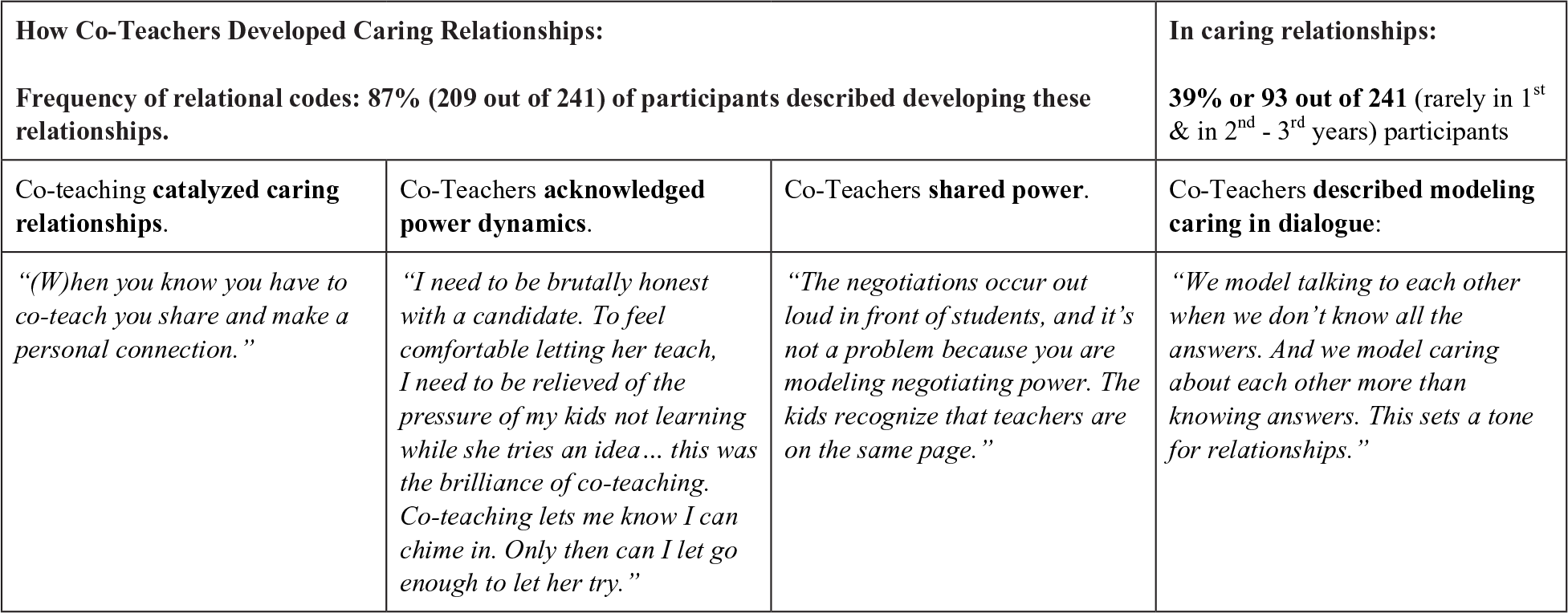
Results.
How Co-Teachers Developed Caring Relationships
The increased shared teaching tasks and attendant reliance with co-teaching gave many co-teachers the opportunity to practice a care ethic. (Counter stories are addressed.)
Co-teaching served as catalyst to care
Within care ethics, reciprocity and mutuality characterize caring relationships (Noddings, 2002). Relationships are the center of a care ethic; through relationship, we learn how to care (Noddings, 2002). Co-teachers consistently described that co-teaching required they be “more engaged,” “trusting,” “responsible,” “closer,” and “connected” to their co-teacher. This surprised candidates. Despite having learned about care ethics the semester prior to student-teaching, candidates held preconceptions of teaching free from complicated relationships with colleagues and students. “I think of movies where teachers triumph and kids listen and adore them, like the pied piper. It’s not like that.” Co-teaching involved unpacking unrealistic criteria of effortless relationships (Friend et al., 2010; Murawski & Dieker, 2013). The difficulty of developing caring relationships challenged candidates’ preconceptions: “The relationships you build in the field take much more effort than I knew. There is a presence you have to bring. How would you know about it prior?” Another candidate added, “If I knew it was about getting to know my mentor and students, I would have put more energy into that from the beginning.”
Mentors described depending on candidates in co-teaching more than they did in the traditional model and this contributed to practicing caring. In one mentor’s interview, when asked what distinguished the co-teaching model, she pinpointed relationships: “I’ve had many candidates over the years, but when you know you have to co-teach with them you are going to share more and make more of a personal connection.” In her interview, another mentor said, “My candidate becomes my partner versus my student. Part of it is my seeing her that way. . . I give her more responsibility, expect more of her, treat her this way in front of students . . . ” A candidate’s perspective revealed her perceiving responsibility to and engaging with her mentor: I was responsible for their (students’) learning. When I wasn’t co-teaching I wasn’t as responsible. . . She’d (mentor-teacher) ask (when co-planning), ‘How do you think this’ll work? Do you think they are ready for that?’ She treated me as a trusted voice.
When asked to “describe co-teaching,” one mentor wrote in a survey: “we are an extension of each other. . .” A candidate stated in an interview that her strong co-teaching relationship involved her assuming responsibilities: “Having co-teaching from the beginning where I wasn’t just observing, she felt comfortable having a more equal relationship . . . She gave me responsibilities from the beginning and we developed that trust.” The engagement these co-teachers described reflects the relational aspects of collaboration and co-teaching (Friend et al., 2010; Murawski, 2009).
When the co-teachers described developing robust relationships in which they practiced caring—they learned to address taken-for-granted power disparities in the student-teaching practicum.
Co-teachers acknowledged power dynamics
Co-teaching relationships in student-teaching demanded recognizing power dynamics. Given the hierarchical nature of their context, the co-teachers repeatedly described needing to navigate power to develop relationships. As stated above, mentors evaluate their novice candidates. Power dynamics in mentoring contribute to collegial competition and isolation (Friend et al., 2010), contrived collegiality (Brown & Levinson, 1987; Hargreaves, 2002), and the lack of feedback required to learn from collaboration (Strong & Baron, 2004). What we know about power-sharing is that it is rare.
Unsurprisingly, candidates who reported struggling to find opportunities to co-teach also described failing to address power to develop a co-teaching relationship. Approximately two pairs yearly or ~7% in all (11 co-teachers or six pairs over 3 years) reported having not co-taught at all due to time and relational restraints. Co-teachers characterized these strained relationships as “formal,” “distant,” and “inflexible.” One explained, “As much as my mentor is open . . . she feels that little power thing. It gets to her to have to share the students with me.” Another said, “I felt like if I added ideas or anything I’d step on her toes.” The candidates described their mentors as “unwilling to share their power” and lacking in “openness.” A close examination of these cases—through surveys and interviews—revealed that candidates reported needing time to develop expertise and encouragement to engage. Mentors described their “hesitancy” and “discomfort” in intervening, reflecting the traditional mentorship model in which mentors are less involved.
Analysis revealed one pivotal way co-teachers connected and developed strong relationships—through facing their power imbalance. Candidates described negotiating power as required by increased involvement (required to co-teach). In a survey when asked to “describe co-teaching,” a mentor contrasted co-teaching with a straightforward power-down model of mentor-candidate: “It’s (co-teaching is) anti-hierarchical cause you are negotiating power, sharing teaching together.” One wrote in a survey: “I’m not sitting in the back and watching—I’m teaching 90% of the time. We have to work out sharing power together while teaching.” Video-ed observations of co-teachers show both teachers engaged. Notably, they also do not reveal particularly able candidates, which arguably could pave a smoother path to parity. Instead, what distinguished these co-teachers was their approach to the power dynamic.
Co-teachers repeatedly described needing to “break through” and “get real” before they could relate with care, or “find a mode of response that will . . . maintain the caring relation” (Noddings, 2012, p. 772). In this characteristic interview comment, a mentor described naming the power dynamic and ascribing power based on needs: First, you must break through. The candidate needs to feel safe to tell you their limits. You need to push them so they see they can do it. It doesn’t help them to drown—just like your students. The candidate is also your own responsibility.
Here, caring entailed “pushing” candidates so they develop their capacity. The mentor appears to assume responsibility for poising the candidate to take teaching risks and succeed. Another mentor shared how she needed to be “brutally honest” with her candidate: I need to be brutally honest with a candidate. For me to feel comfortable letting my candidate teach, I need to be relieved of the pressure of my kids not learning while the candidate tries an idea . . . this was the brilliance of co-teaching. Co-teaching lets me know I can chime in. Only then can I let go enough to let my candidate try. It’s also going to help me when she acknowledges that she’s not perfect and can learn from me.
Both co-teachers described needing to acknowledge teaching challenges and express willingness to learn from the other. One mentor admitted, You see, teachers are alone in their rooms and here comes this young person who wants to teach perfectly. They are going to sit in the back and judge you. We have to discuss it. It takes both of us getting real about that.
Another expressed, Candidates come thinking teaching is easy and get discouraged. If you are going to co-teach you need to get real with how hard it is and what you both can learn. There’s never going to be perfection in teaching. We take a learning stance in co-teaching.
Being “brutally honest” about the unrealistic criteria of perfection in teaching and the hierarchical dimensions of co-teaching relationships interrupted “contrived collegiality” (Hargreaves, 2002) and paved the way for teachers to share power.
Co-teachers shared teaching power
Co-teachers revealed vulnerability to share teaching power. Disclosing their vulnerabilities poised co-teachers to learn from meaningful feedback, a lost opportunity when teachers fail to collaborate (Strong & Baron, 2004). Mentors welcomed candidates’ feedback and new ideas: “We all have blind spots and that’s what co-teaching lets you see. So, I am going to give tough feedback to a candidate and I’m going to hope I can get some, too.” Candidates often explained needing to overcome a fear of “not being cut out for teaching” that undermined their willingness to try new things and made them less open to feedback, as in this case: “I had to tell her about how scared I was of failing and we had to make a realistic plan.”
Candidates engaged in co-teaching when mentors engrossed themselves in candidates’ particular teaching challenges. In video examples, co-teachers achieved parity in caring collaboration by balancing candidates’ lack of experience with their innovative ideas; mentors helped with differentiating and pacing, while candidates tried new ideas from which mentors learned. In debriefs, candidates described welcoming mentors to chime in while they taught with a “supportive and helpful tone”; mentors in turn shared areas for growth. For candidates, this involved taking feedback while teaching. “When you co-teach you develop secret signals that mean ‘I need help here!’” Mentors explained this instilled their trust to “let go and let her try, knowing that with co-teaching I can still help our students.”
Mentors often shared how they poised themselves as learners; for example, one said, While a teacher-candidate may not be able to do complex teaching moves like pacing, she can actually observe how I’m doing it—it’s easier to observe than do. So, she’s learning to do it and I’m getting to learn from having her in my room.
From the mentor’s perspective, this involved “letting go of my vice grip on my classroom and caring about both my students’ and my teacher-candidate’s learning.” In an interview, a mentor revealed that “letting go of control” was not automatic and required compromise from both teachers: “The negotiations occur out loud in front of students, and it’s not a problem because you are modeling negotiating power. The kids recognize that teachers are on the same page.” Asserting that “it’s not a problem . . .” hints at her underlying struggle and mistrust; it reveals her surprise to discover they could share power. Awareness of this struggle as part of a process to develop critical co-teaching relationships could help co-teachers cultivate parity.
Many co-teachers described the necessity for students to perceive each teacher as having power and authority, as in this mentor’s interview: “I’ll say, I’m going to ask what Miss Jenny said to you about that. Or, Jenny, what do you think I should say? Along with saying that Jenny is a teacher too, I’m proving it.” One candidate revealed her discomfort in the process: “In the beginning, the power balance . . . trying to establish yourself, I didn’t like it. Then I got used to it. I notice students notice a balance of power.” Co-teachers learned to balance responsibilities explicitly under students’ watchful gazes to confirm parity: A lot comes from students’ perceptions. They suss it out. They are so observant of how we treat each other. It’s in all the tiny things. My mentor says, “What did Miss H say?” First there’s a lot of that mom/dad stuff.
Rather than withholding power, this mentor referred students to her candidate, modeling shared authority. Another candidate described initial discomfort and then realized benefits for both students’ and her learning: “First I thought, ‘Oh no, I didn’t plan accordingly. I’m not right.’ I realized it was fine actually. The students got a different perspective. I could be learning as I was teaching.”
The following mentor’s description of her hesitancy to give her candidate feedback shows the need for an explicit goal to share power: In co-teaching I now see that it could be okay for me to step in. My approach before this workshop was, I want kids to see her as the teacher, so when she teaches I don’t interrupt; I don’t want to say, “Ms. P you are doing it wrong.” I would never say it like that. If the whole relationship is more equal, then maybe it would be okay for me to do that. It would not ruin her authority.
Another mentor described how she orchestrated a dialogue in co-teaching with her candidate. She said she “invited” her candidate to chime in when she taught and with time their dialogue became spontaneous and authentic. At the workshop, she modeled her invitation, “I am going to ask questions when teaching . . . and I’d like you to do so too. That’s how I’m going to ‘invite’ you into teaching and then over time we’ll get more seamless.” Facing the discomfort to share power and give feedback while teaching led to co-teachers leveraging dialogue to model caring.
Dialogue and Modeling in Caring Co-Teaching Relationships
Many co-teachers noticed the power of their dialogue to model caring (39% or 93 out of 241 co-teachers). These findings emerged among several teachers who shared their experience at co-teaching workshops.
Within care ethics, teachers model caring and engage in nonteleological dialogue toward understanding; interlocutors share power and value one another over the content of their discussion (Noddings, 2002). “Perhaps most significantly of all. . . our partners in conversation are more important than the topic” (Noddings, 2002, p. 127). At the end of the first year during workshops, when asked to share “their attempts to co-teach,” several co-teachers described practicing spontaneous dialogue “by accident.” More cases of modeling caring through dialogue emerged. By the end of the second year, co-teachers described dialoguing to model relating with care across their differences with “respect” and “interest.” Dialogue emerged when co-teachers “interrupted” one another while teaching; this led to teachers intentionally modeling dialogue. A mentor referred to this as, “co-teaching on the fly”; others said they engaged in “welcoming interrupting.” Several co-teachers described how “you bounce off each other’s ideas.” One mentor explained in her interview, It’s like a dialogue. If one of us is instructing and your partner finds a teaching moment and you’ve set up a relationship where you bounce from teacher-to-teacher, it’s natural. Students aren’t confused. You build that from the beginning so students are comfortable and they get more out of it because they hear multiple connections bouncing off their prior knowledge. They can respond to your conversation.
The co-teachers served as interlocutors interrupting the hierarchy between mentor and candidate. They modeled dialoguing over various perspectives and perceived that this emboldened their students to voice their perspectives.
The following characteristic example shows how co-teachers discovered that their dialogue harnessed students’ attention. While one teacher read a story, she paused and turned from her students to face her co-teacher. They disagreed over a word’s meaning. Both assumed they had distracted their students; instead, they enthralled them: It was interesting, we (co-teachers) looked at each other (discussing the word’s meaning). They (students) were suddenly all with bated breath watching us having a real conversation about real vocabulary. “Look, adults are having to figure it out!” How do you plan for that? I called miss M in on it. We started doing that on purpose.
Having discovered students’ engagement over spontaneous authentic exploration, co-teachers began deliberating over interpretations—modeling appreciating their differences and sharing interpretive power. While theatrical discussion between co-teachers is touched on in co-teaching professional literature, it is considered a distraction. From a care ethics perspective, dialogue is relevant to cultivate relationships, which matters when we consider education’s larger purpose to cultivate caring citizens. Noddings (2002) writes, “(C)onversations in classrooms are important in themselves. Their occurrence . . . is a sign that relationships of care and trust are being established” (p. 145).
The co-teachers described modeling valuing interlocutors more than the content, reflecting the critical feature of dialogue within care ethics (Noddings, 2002). In her interview a mentor said, “We model talking to each other when we don’t know all the answers. And we model caring about each other more than knowing answers. This sets a tone for relationships.” In a video lesson debrief, a mentor indicated how one student spoke in class for her first time. She attributed her student’s courage to her and her candidate’s modeling dialogue reflective of care ethics, where speakers are valued over their comments.
In interviews, co-teachers described perceiving positive changes in their classroom community. The data do not include students’ perspectives, and not all co-teachers described this. Still, many perceived positive shifts in students’ relationships when they co-taught and modeled caring relationship. For example, one mentor began modeling close listening to her co-teacher. She noticed her students “practiced paying attention to what each other said” and interestingly, “made more personal connections in classroom conversation.” Noddings’ recent explication of the caring relationship in education highlights the criticality of listening: “Receptive listening (attention) is at the heart of caring for human others. . .” (Noddings, 2012, p. 775). In a workshop when asked, “What do you wish you knew at the beginning of implementing co-teaching?,” a mentor explained, With co-teaching the most exciting thing for us really is seeing how we can model caring and we see our students practice it. If we had known that we’d have this impact we would have done this more intentionally from the beginning.
One mentor described how increased connections strengthened teacher–student relationships as well as student-to-student relationships. “Seeing us (co-teachers) go back-and-forth encourages students to work together, to view each other as equals in groupwork. Modeling that kind of relationship is changing things. This involvement makes my relationship so much stronger with my students.” The mentors attributed stronger more reciprocal relationships to modeling caring through dialogue with candidates: “When you (mentor) share more with them (mentee), then you’re making more personal connections in teaching, too and these come out in instruction. I really think this modeling of relationship impacts the classroom environment, (making it) safer.”
Several co-teachers drew on the medium of their co-teaching relationship to elicit their own and their students’ differences of gender, culture, age, and so on to appreciate them. “In a rich learning environment, (dialogue is) likely to increase engagement, enhance cultural literacy, and contribute to the construction of relations of care and trust” (Noddings, 2002, p. 146). As one mentor put it in an interview, “When they see two teachers arguing over how to describe a concept or instructions they see difference and argument is okay and how to respect difference.” Another mentor said, “We see things differently and students get the feeling it’s okay to be different, like we are.” One candidate described modeling drawing a connection to her experience of another culture. One student then shared about her own cultural background, My mentor was reading about a Native American tribe in Washington. I go there a lot and so I jumped in and started telling them about my Native American background. The students get so excited, ‘That’s a real place? You’ve been there? Do you have pictures?’ Then they start to bring their experiences in. One girl moved from Mexico. We noticed she started talking about her family and her background and then participating more in general.
The candidate noticed that when she modeled sharing connections from her cultural background, her student also shared. The co-teachers described how unplanned dialogues over cultural connections spurred students’ sharing. The co-teachers invited each other to share interpretive authority over making sense of text. Here, they modeled talk moves for listening, supporting, and appreciating differences: We are reading Sadoko and the 1,000 Paper Kranes. I lived in Japan so I have experience with the culture, so my co-teacher looks at me, like, can you tie in something (I do that with her a lot, too). We were talking about gestures for, “Can you give me money?” In America, you rub your fingers together; in Japan, you put your thumb and index finger together like a coin . . . little things like that just happen and it makes students more interested . . . we tie in prior knowledge. It makes our cultural differences more accepted so they can come out and share.
Co-teachers modeled caring across cultural differences and they perceived that this supported students to elicit cultural connections and insert more of themselves into their classroom community. This study only begins to show the possibilities.
Limitations
These co-teachers described developing caring relationships in the context of a program focused on SEL and care ethics (as explained in the methods). This orientation toward care ethics could have led them to perceive and value caring relationships and focus particularly on developing them. This predilection may have contributed to the tendency to agreement or groupthink (Maher, 2005). Thus, given their program’s stated focus on caring, co-teachers may have over-inferred the importance and existence of caring relationships. They also may have just felt emboldened to notice and value caring relationships. Interview and observation data represented self-nominated co-teachers likely to be interested in learning to co-teach; thus, the data may reflect those who undertook this learning. To search for disconfirming evidence, participants were asked to share honestly about co-teaching struggles through multiple forms of data collection (including workshop discussion and anonymous survey). Ultimately, it was in co-teachers’ interest to share their challenges—because impediments could impede teacher-candidate credentialing. Their reported issues and counter narratives helped to broaden and underscore the findings.
Perhaps the prior focus and understanding of care ethics and SEL did lead to openness to the value of caring relationship and a penchant to try to learn to care. Given the complexity and importance of developing co-teaching relationships, perhaps this study shows that collaboration would require such an orientation toward relationship’s worth. For despite candidates’ prior knowledge of care ethics, they still reported surprise at the centrality of the role of relationships and the challenge or “presence” that collegial collaboration demanded.
We cannot assume that any experience described here will transfer into candidates’ practice as novice teachers or that the mentors will continue to develop strong co-teaching relationships in future mentoring or in the larger school context. Further research is needed to investigate the possibilities for transfer, sustenance, or impediments to developing caring relationships in which co-teachers can collaborate.
Implications
This study expands the application of care ethics in the context of teacher relationships in which power needs to be shared. Co-teaching between teacher-candidates and mentor-teachers presents a power differential, and thus, these processes inform co-teaching in a teacher preparation context. That said, power is at play in co-teaching relationships in both mentoring and certified teaching contexts (e.g., Carter et al., 2009; Friend et al., 2010). When power differentials in relationship go unacknowledged, they contribute to dynamics that interrupt collaboration, such as contrived collegiality and superficial politeness (Brown & Levinson, 1987; Hargreaves, 2002). In such cases, co-teachers struggle to achieve parity (Pratt, 2014) and share feedback toward mutual learning (Strong & Baron, 2004). Thus, these co-teachers’ stories may inform teacher collaboration in general and teacher preparation specifically. Co-teachers acknowledged and mitigated hierarchy to develop strong collaborative relationships. Experience in caring collegial relationship occurred.
Co-teaching serves as a relational model in the formation of a teacher-candidate’s teaching practice. Candidates have an opportunity to learn from sophisticated moves in professional collegial relationship, such as acknowledging hierarchical roles and establishing parity intentionally, for example, by a candidate sharing an innovation and a mentor seeking feedback. From this perspective, the traditional model where a candidate might flail without a mentor intervening would hardly cultivate caring collegial relationships; rather it seems a set up to perpetuate competitive and isolating environments (Friend et al., 2010) where growth stagnates (Hargreaves, 2002; Strong & Baron, 2004). In contrast, the co-teachers described creating conditions to learn from one another.
In co-teaching teacher preparation, mentor-teachers and teacher-candidates gain experience working together in caring collegial relationships. Rather than just put teachers together and hope that collaboration happens, a practice that Friend et al. (2010) warn against for certified teachers, co-teachers’ mentoring demonstrated the necessity of methods of sharing power. In this study, the mentors and candidates balanced teaching power in front of students, asking one another to share alternate interpretations of ideas. For example, a mentor described her habit to ask her candidate, “Could you share another interpretation of this concept (or term or way to solve a problem)?” Instead of wielding power by correcting one another with disregard for another’s attempts to teach and learn, these co-teachers opened avenues for each other to share alternate explanations and ways to solve problems.
The co-teachers described drawing on their dialogue to model caring and they perceived that their students reflected their actions to cultivate caring classroom climates. Mentors modeled engaging with and finding value in candidates while they learned to teach. For example, mentors modeled appreciating candidates’ efforts and co-teachers modeled close listening to one another’s perspectives. Co-teachers developed signals between them to invite one another to share alternate angles on issues and to help each other with complex teaching tasks, such as pacing and differentiation. In dialogue, co-teachers responded to each other’s needs as they arose in the midst of teaching challenges.
Research has shown that co-teaching between teacher-candidates and mentor-teachers may contribute to candidate, mentor, and student learning; this study points in particular to potential for candidate and mentor learning. In responsive reciprocal relationships when co-teachers give each other feedback, they both have opportunities to learn from teaching (Darling-Hammond & Baratz-Snowden, 2007; Feiman-Nemser, 2001). Co-teaching brought mentors new ideas as candidates tried innovations from their university coursework with mentor support. Often university-based innovations are dismissed as unfeasible and impossible by mentors and candidates (Achinstein & Barrett, 2004); mentors made candidates’ new ideas translate into practice so that both parties experience teaching innovations. One mentor said, “It’s the candidates who bring the new ideas. We need that.” Candidates brought fresh perspectives and mentors provided critical support to put ideas into practice. When mentor-teachers shared why they mentored in the co-teaching model, they described reconnecting with their reasons for teaching. One said, “Co-teaching gives me an opportunity to think deeply about what we do and why.” Many mentors echoed this appreciation for candidates. When one mentor felt overwhelmed by intractable issues in her school, mentoring her teacher-candidate reconnected her to her professional commitments: I was thinking about leaving the profession because I was just overwhelmed. But the candidates come in with enthusiasm and ideas. The mentor-teachers get a chance to be part of what’s happening in research in our field.
Reflecting the research on how teacher relationships contribute to resilience (Benard, 2004) and career satisfaction (Bill & Melinda Gates Foundation; Boe et al., 2008), the mentors described how caring collaboration helped them renew their commitment to teaching.
Co-teachers’ caring relationships represent promise for teacher preparation that can interrupt competitive and isolating climates that hinder teacher learning. Successful co-teaching creates and models ethical relations. This enactment of care opens the possibility of positioning caring as a primary purpose of education.
Footnotes
Appendix
Declaration of Conflicting Interests
The author(s) declared no potential conflicts of interest with respect to the research, authorship, and/or publication of this article.
Funding
The author(s) received no financial support for the research, authorship, and/or publication of this article.
