




Abstract
In recent years, institutions have responded to changing school populations by preparing teachers for the growing number of emergent bilingual learners (EBLs). But this preparation largely focuses on supporting students’ academic learning and language development, despite enhanced attention to social-emotional well-being in wider educational circles. This comparative case study seeks to understand whether and how teachers are prepared to facilitate this integral component of student learning in five schools with linguistically diverse populations and varied program models to serve EBLs. We first probe how teachers draw from various facets of their preparation to support EBLs’ social-emotional well-being, including teacher education, professional development, collaboration with colleagues, and personal experiences. We then consider teachers’ and students’ perspectives on the requisite expertise to facilitate well-being in classrooms. Findings provide insight for university, district, and school stakeholders seeking to enhance teacher preparation as a means to improve the educational experiences of EBLs.
As cultural and linguistic diversity in schools increases, so does the presence of emergent bilingual learners 1 (EBLs) in classrooms spanning grades, disciplines, and programs. EBLs come to school with competencies in other languages but continue to develop proficiency in English-medium listening, speaking, reading, and writing while learning content (García, 2009; Linquanti & Cook, 2013). Recent data indicate that students labeled as English learners (ELs), the institutional label commonly used that prioritizes English over bilingualism, comprise approximately 10% of students in U.S. schools (National Center for Education Statistics, 2021). Representing myriad home languages and cultural backgrounds, EBLs are often of immigrant origin, meaning they have at least one foreign-born parent (Suárez-Orozco et al., 2015). State and local stakeholders service these richly diverse students in various ways depending on the context, selecting and implementing different program models in English as a Second Language (ESL), bilingual, and general education to mediate students’ learning, development, and achievement.
With large and growing numbers of EBLs spanning schools, classrooms, and programs, more teachers require preparation for this population, which has subsequently garnered attention in the research literature (e.g., Heineke & Giatsou, 2020; Lucas et al., 2008; Solano-Campos et al., 2020). At many universities, teacher educators have embraced the need to prepare preservice teachers for EBLs, focusing on (a) fostering positive and inclusive perceptions of students and families and (b) scaffolding and modifying content-area instruction for students’ developing language (Villegas et al., 2018). In Kindergarten-through-12th-grade (K–12) schools, teachers’ professional learning often centers on teaching EBLs via content-area curriculum and instruction, using students’ cultural backgrounds and language proficiency to enhance academic and language learning (Lucas et al., 2018). A readily apparent theme across studies of teacher education for EBLs is the prioritization of language development and academic achievement; in other words, the goal is to prepare teachers who can provide access to rigorous content curriculum while scaffolding for language. In our systemic review of the literature spanning academic databases and EBL-focused journals, we discovered only a handful of studies explicitly touching upon the social-emotional component of EBLs’ experiences, including foci on engaging future teachers in language immersion to empathize with EBLs (Medina et al., 2015; Settlage et al., 2014) and one-on-one work with students to learn about their daily life experiences and challenges (Bollin, 2007; Fitts & Gross, 2012).
This lens on social and emotional learning (SEL) is important, considering the significant traction and increasing presence of SEL initiatives in schools with the overarching aim to bolster academic success (Jones & Kahn, 2017). In efforts to create affirming, inclusive environments for all learners, schools have adopted SEL goals that exist alongside traditional academic goals like graduation and college attendance, emphasizing predefined competencies such as self-awareness, self-management, social awareness, relationship skills, and responsible decision-making (Ashdown & Bernard, 2012). To attain these goals and competencies, educators are often prompted to focus on SEL for a predetermined amount of time during the school day using a district-adopted, scripted curriculum such as the widely used Second Step® (Low et al., 2015). But scholars have critiqued the appropriateness of standardized SEL programs for students from culturally and linguistically diverse backgrounds, questioning the extent to which these programs can truly be universal in nature given the unique and diverse experiences of children and adolescents (Cramer & Castro-Olivo, 2016; Graves & Blake, 2016). With SEL standards and curricula designed by and for the so-called mainstream population, the experiences and needs of EBLs may be neglected within these larger efforts.
The apparent disconnect between initiatives to support EBLs and SEL is problematic, with previous research indicating this diverse student population has unique experiences and social-emotional needs that may differ from so-called mainstream students. Whereas EBLs do indeed have experiences that are common among all children and adolescents, such as maintaining various family and peer relationships and maneuvering school-based challenges like keeping up with homework, they also have distinct experiences tied to their language acquisition and immigrant origins. For example, students may experience the stress of learning a new language, developing interethnic relationships, learning to maneuver new cultural norms while abiding by family cultural values, and trying to navigate a school system that may situate them as outsiders (Conchas, 2006; Kang et al., 2014; Rishel & Miller, 2017; Rosenbloom & Way, 2004). Newcomers may have experienced interrupted schooling or have trauma histories and family separations as a part of their migration (Birman & Tran, 2015; Hos, 2020; Juang et al., 2018; Suárez-Orozco et al., 2011). Others may be influenced by chronic stressors related to documentation status of family members or questions about their own long-term security (Davila et al., 2020; Zacarian et al., 2017). These unique factors must be prioritized in any efforts to support students’ social-emotional well-being in schools.
The purpose of this study is to understand teachers’ preparedness to support EBLs’ social-emotional well-being. As explored above, EBLs have unique experiences and needs that impact well-being and subsequently influence academic achievement (Niehaus & Adelson, 2014; Niehaus et al., 2017). Nonetheless, extant literature on EBL teacher preparation focuses largely on language development and academic learning without explicit attention to social-emotional components (Lucas et al., 2018; Villegas et al., 2018). In this way, we seek to merge two pertinent but often separate fields of study in the teacher education literature. Drawing from data collected from students and teachers at five Kindergarten-through-eighth-grade (K–8) schools offering various program models for EBLs, this study probes (a) how teachers of EBLs perceive their preparation (or lack thereof) from a social-emotional lens and (b) what students and teachers pinpoint as pertinent facets of expertise to promote well-being in classrooms. The study’s findings serve to inform future efforts in preservice and inservice teacher education.
Framework
The movement to prioritize social-emotional components of learning stems from the premise that schools play an integral role in developing the whole child by attending to children’s social and affective needs (Darling-Hammond, 2015). Seeking to operationalize this general idea, SEL initiatives center on a set of competencies considered to be fundamental for life effectiveness, including self-awareness, self-management, social awareness, relationship skills, and responsible decision-making (Ashdown & Bernard, 2012). But scholars argue that these competencies fail to account for cultural difference, as variables such as race, ethnicity, class, and language influence the definition, development, and importance of these predefined SEL skills (Hecht & Shin, 2015). With this study’s focus on EBLs from culturally and linguistically diverse backgrounds, we explore the related construct of social-emotional well-being, which more broadly considers “how good one feels about the self in a world of others” (Bauer & McAdams, 2004, p. 114). Well-being influences how individuals function, maneuver, and recover from experiences and challenges in daily life (Denham et al., 2009).
To understand the facets of expertise needed to support EBLs’ well-being, we draw from the prism model for bilingual learners (Collier & Thomas, 2007). Reflecting the above-described focus on the whole child, this framework conceptualizes EBLs’ learning as multifaceted, where sociocultural, linguistic, cognitive, and academic development dynamically occur in schools. Although not explicitly named in the original framework, social-emotional well-being plays a central role to students’ experiences. Collier and Thomas (2007) contend that (a) daily life experiences influence students’ learning in schools, (b) experiences in schools influence emotional responses such as self-esteem and anxiety, and (c) social issues such as prejudice, discrimination, and subordination impact kids both inside and outside of schools. In this way, well-being both influences and is influenced by EBLs’ learning in schools (see Figure 1).

Emergent bilingual learners’ social-emotional well-being.
This conceptualization of multiple dimensions of students’ learning supports our understanding of how well-being interconnects with daily work in schools (Collier & Thomas, 2007). The sociocultural dimension involves students’ experiences in homes, communities, and society, which might include trauma histories, family separations, or documentation concerns (Birman & Tran, 2015). The cognitive dimension considers cultural influences on learning, such as how students maneuver and grapple with cultural norms and understandings while learning and interacting in schools (Juang et al., 2018). The linguistic dimension probes students’ language development, which involves affective factors like stress and anxiety (Krashen, 1982). The academic dimension focuses on school experiences and outcomes spanning disciplines, including how students navigate potentially unfamiliar school systems and curricula (Conchas, 2006). Across dimensions, these factors can positively impact students’ learning in schools given a “socioculturally supportive environment” (Collier & Thomas, 2007, p. 335).
Integral to this supportive environment is the classroom teacher, the central mediator of EBLs’ school-based learning (Levinson & Sutton, 2001; Ricento & Hornberger, 1996). In this study, which seeks to understand teachers’ preparation to support EBLs’ social-emotional well-being, we utilize Rogoff’s (1995) framework for observing sociocultural activity on three planes. In sociocultural theory, the unit of analysis is the activity, such as teachers’ daily practice of supporting EBLs’ holistic development (Collier & Thomas, 2007; Darling-Hammond, 2015). To make meaning amid the complexity and dynamism of this activity, we foreground one plane while the others remain in the background of our analysis (Rogoff, 1995). In this way, the framework allows for investigation into particular facets of teacher preparation that shape and inform teachers’ daily practice with EBLs (Heineke et al., 2018).
The three planes of analysis correspond to community, interpersonal, and personal processes influencing development (Rogoff, 1995). On the community plane, individuals engage with others in “culturally organized activity” (Rogoff, 1995, p. 142) with the goal to apprentice them into participation in that community. In teacher education, the community plane involves apprenticeship into the (a) broader norms and practices of the profession and (b) particular priorities, activities, and cultures within school communities. The interpersonal plane centers on communication and collaboration between individuals that guide participation and development, such as educators supporting one another during shared practice in schools. On the personal plane, individuals develop via involvement in varied activities, which subsequently prepare them for future activities (Rogoff, 1995). This plane probes teachers’ appropriation of ideas and understandings, as they use previous experiences to shape their current practice and inform future teaching. Using these three intersecting and mutually constituting planes, we can probe various factors influencing teachers’ work with EBLs.
With this study, we seek to understand how teachers draw from various planes of their professional preparation (Rogoff, 1995) to understand and support the intersecting components of EBLs’ learning centered on social-emotional well-being (Collier & Thomas, 2007). With teacher preparation for EBLs traditionally prioritizing linguistic and academic components (Lucas et al., 2018; Villegas et al., 2018) and SEL initiatives in schools focusing on universal experiences and competencies (Cramer & Castro-Olivo, 2016; Graves & Blake, 2016), this research seeks to connect these integral topics within the context of teacher preparation. The following research questions guide our investigation:
Method
We utilized comparative case study design (Merriam, 1998) to understand teachers’ preparation and practice to promote the social-emotional well-being of EBLs spanning an array of program models and teaching approaches.
Context
We strategically selected five suburban Illinois schools serving students from culturally and linguistically diverse backgrounds in K–8 settings, each utilizing a distinct program model to serve EBLs (see Table 1). Two schools utilized two-way immersion programs to promote Spanish-speaking EBLs’ and English-dominant students’ bilingualism and biliteracy: Excelencia enacted two-way immersion in every classroom spanning K–5, whereas Honore had a single strand with one bilingual classroom per grade level. Dunlap used transitional bilingual education, where one classroom per grade level housed labeled EBLs and incorporated students’ home languages when possible to achieve English language proficiency. Acadia utilized ESL programming for their linguistically diverse student body, with ESL resource teachers pushing into general education classrooms to collaboratively support EBLs. Middle also used ESL programming, but instead provided EBLs with one class period per day of ESL resource support apart from general education teachers and students.
Focal Schools.

Note. ESL = English as a Second Language.
Participants
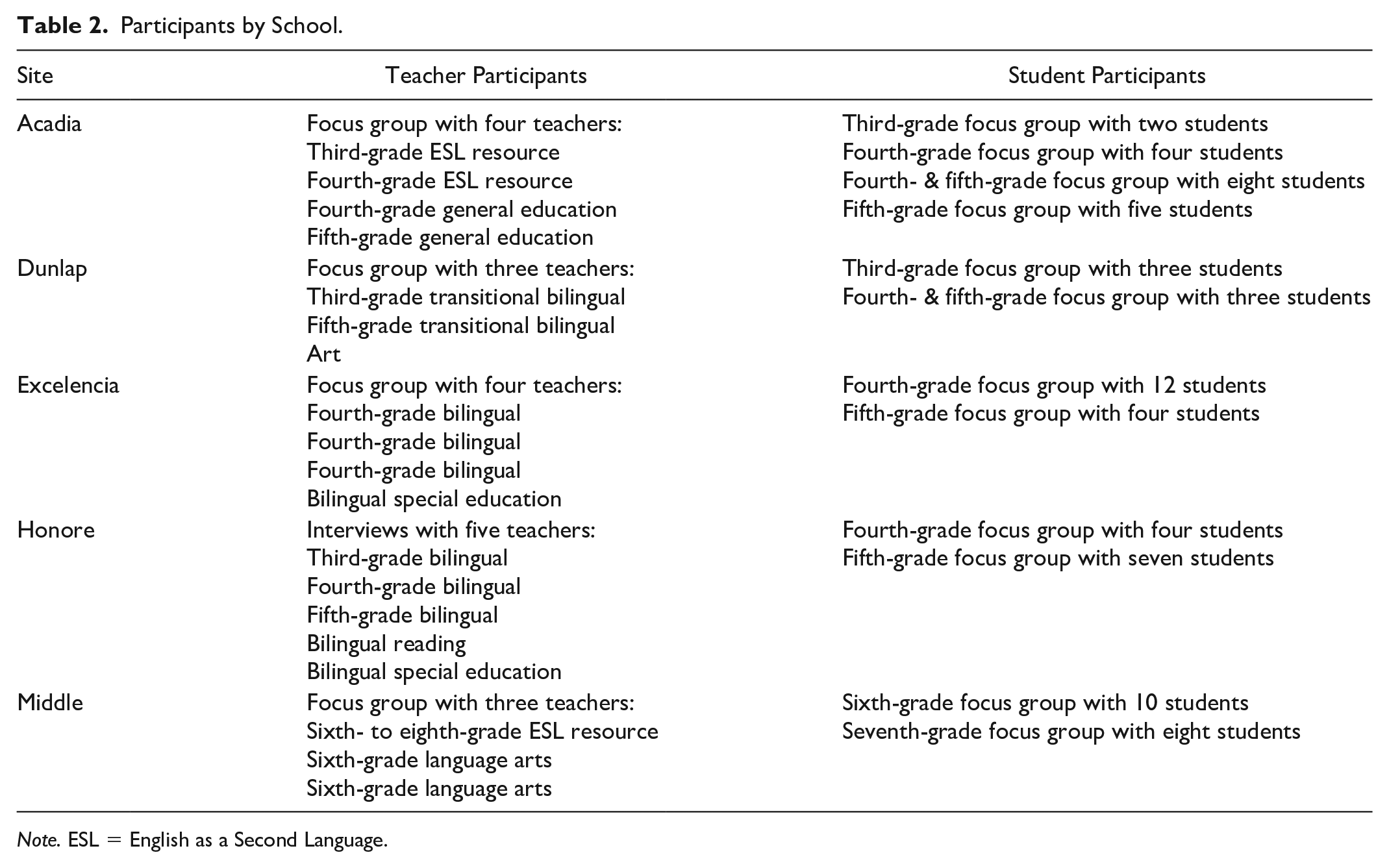
We chose to focus on third through eighth grade, recognizing that older students in these K–8 settings would be more likely to reflect on their social-emotional well-being and related supports from teachers. We worked with district and school administrators to contact all teachers in focal schools who worked directly with EBLs in these grade levels. This resulted in an array of teacher participants across the study, including bilingual teachers and specialists from two-way immersion programs and bilingual, ESL, general education, and special area teachers from other sites (see Table 2). Twenty teachers participated across the five schools, all of whom identified as female, including 14 White and six Latina teachers. Teachers had varying years of classroom teaching experience: three in their early years of teaching, six with less than 10 years, and 11 with more than 10 years of experience.
Participants by School.
Note. ESL = English as a Second Language.
In addition to teachers, we sought the perspectives of students within the targeted grade levels. We worked with school administrators and participating teachers to distribute recruitment materials to all third- through eighth-grade students labeled as EBLs at the time of the study. We invited the participation of students who returned parental consent forms in advance of data collection. Across the five schools, 70 students participated in the study, spanning third through seventh grades (see Table 2). Approximately 55% of participants identified as male and 45% as female. Sixty percent of student participants indicated using Spanish at home, with the remaining 40% of students denoting use of other languages such as Urdu, Hindi, Arabic, Russian, Ukrainian, Lithuanian, Tagalog, and Portuguese.
Data Collection
We utilized qualitative methods to glean the perspectives and experiences of participants within focal cases (Merriam, 1998). Data collection centered on individual and focus group interviews. For teachers, we offered options for individual interviews or focus groups at each school site, depending on participants’ preferences and availability. For students, we organized focus groups based on the number of participating students and the school’s bell schedule, typically resulting in students grouped by grade level. Across schools, we conducted a total of 12 student focus groups, four teacher focus groups, and five teacher interviews (see Table 2).
Predrafted protocols guided data collection in focus groups and interviews, which we audio recorded and later transcribed. We facilitated focus groups in English and provided the option for participants to respond in other languages as desired. For the purposes of this article, we drew upon students’ responses to one question in the larger focus group protocol: What do you wish that the teachers at this school knew about students learning English? One section of our interview protocol focused on preparation, prompting teachers to consider the following questions: What preparation have you received to support the social-emotional well-being of EBLs? Where do you see the need to develop expertise? What professional learning opportunities would support you to enhance the social-emotional well-being of EBLs?
Data Analysis
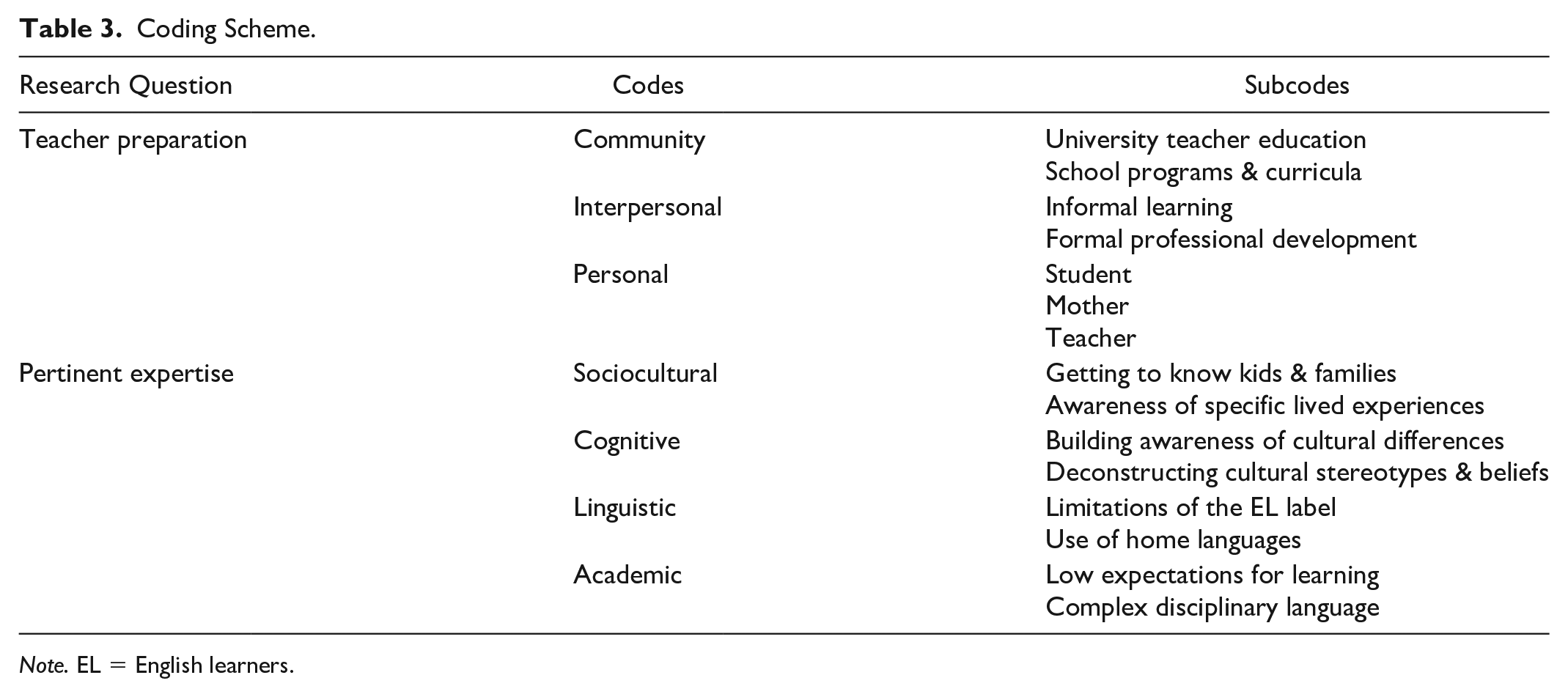
Data analysis centered on coding transcripts from interviews and focus groups using N-Vivo software. We first engaged in inductive coding using the conceptual framework to respond to the first research question on educator preparation across planes (Rogoff, 1995) and the second research question on pertinent expertise regarding EBLs’ multiple components of learning and development in schools (Collier & Thomas, 2007). We then used deductive coding to pull out the pertinent themes within each larger code, with these subcodes serving to fine-tune our analyses and presentation of findings (see Table 3). The authors and three graduate assistants analyzed and member checked data as a means to enhance validity and trustworthiness of findings, which are shared in the next section.
Coding Scheme.
Note. EL = English learners.
Findings
We organize the findings by research question. The first subsection corresponds to the first research question, which probes teachers’ reflections on their preparation, learning, and professional development spanning preservice and inservice contexts. The second subsection responds to the second research question, outlining what teachers and students assert as the pertinent facets of expertise to promote the well-being of EBLs.
Probing Teachers’ Preparation
In this subsection, we use Rogoff’s (1995) framework for observing sociocultural activity on three planes to probe teachers’ perceptions of how different facets of teacher preparation influenced their daily work to support EBLs’ social-emotional well-being. Overall, we found that lacking community processes to support development around this topic—both in university preparatory programs and in schools—resulted in teachers drawing from interpersonal networks and personal experiences. We explore the three planes below.
The community plane: Institutional apprenticeship
Preservice programs serve as the primary locale to apprentice teachers into the profession; however, teachers in this study consistently noted the lacking emphasis on SEL, both broadly conceived and specific to EBLs. With 20 participants ranging in licensure areas (i.e., elementary, secondary, special education, ESL, bilingual) and time since completing university programs, only one recalled focusing on EBLs’ social-emotional well-being during their initial preparation—a recent graduate of an urban bilingual teacher education program. Some teachers thought the omission occurred due to regional location, reflecting the demographics of the community surrounding the university. One White middle-school teacher recollected, “Formal training, I would say definitely not. I was in a White neighborhood in Wisconsin for university.” But others, who attended urban and suburban colleges and universities in culturally and linguistically diverse communities, echoed the lack of preparation.
In the focus group at Excelencia, where three Latina teachers and one White teacher reflected upon their preparatory experiences, participants posited the impact of both location and licensure area studied during initial teacher preparation:
I have a classmate that went to [urban university] and she has all of this background with urban studies and like more social and emotional things. I went to [rural university] in the special ed program, and there was nothing.
Maybe [the difference is] city schools versus non-city schools?
And also her program, she went to school for bilingual ed and leadership. I went to school for special ed, which is a very White space versus bilingual ed.
For this Latina teacher who studied special education at a rural university, she recognized the “very White space” of special education as the reason that her preparation did not prioritize EBLs. Nonetheless, nine of the 10 participants in this study with bilingual licensure recalled no preparation specific to supporting EBLs’ social-emotional well-being.
Following initial preparation programs, teachers moved into school settings, where their apprenticeship into the profession continued. Despite SEL being an initiative at all school sites, teachers recalled no related preparation to support students in classroom. When prompted to share preparation at their schools, all participants asserted a void in SEL-focused professional learning opportunities within school or district communities, either broadly conceived or specific to EBLs. Even so, teachers described district mandates to use SEL curricula without professional development or formal supports to enact in practice. A teacher at Dunlap asserted, “There was no PD that came with it [Second Step]. We were encouraged to go check out the videos that came with it on our own.” When asked about the preparation to teach the SEL curriculum at Acadia, the four White teachers responded with laughter:
Is that a joke question?
We call it the [district name] way. It’s, “Go and and do it! Here you go!”
I was given a binder.
Same!
In addition to lack of preparation from the district, teachers agreed that the scripted program felt inauthentic and forced, particularly with EBLs who often grappled with unique and complex issues specific to immigration, documentation, cultural differences, and language learning.
The interpersonal plane: Collaborative professional learning
Recognizing the lacking preparation for EBLs’ well-being in preservice and inservice settings, teachers looked to one another for interpersonal support when situations emerged in their classrooms. Participants listed various colleagues who provided guidance in maneuvering particular events or circumstances, including other teachers within grade-level teams, ESL and bilingual resource teachers, and school social workers. Teachers at Dunlap described the collaborative culture of the school that facilitated helpful communication about students. One White transitional bilingual teacher shared, It’s part of our school community to go to your [human] resources. Go talk to the social worker, go talk to your teammates, [to see] if they have ever experienced something like that in the past. So it’s very open—everyone is open to problem-solve with each other.
Despite using a single-strand transitional bilingual program, which resulted in only one bilingual teacher in each grade level, this teacher felt connected to the colleagues on her team, as well as the fourth- and fifth-grade social worker. Teachers explained that Dunlap employed three social workers for 560 students, with each social worker assigned to two grade levels to directly support teachers and students.
Collaboration and interpersonal supports varied by school. At Honore, which housed the single-strand, two-way immersion program, bilingual teachers described feeling disconnected from grade-level teams, other bilingual teachers, and the part-time social worker serving the school of 500 students. One Latina elementary teacher shared, “We need to, as teachers, to collaborate more and talk about our kids as like, this is what I see going on in this pattern. What can we do as colleagues, as a group?” She called for regular opportunities to collaborate with bilingual teachers across grade levels to prioritize the social-emotional needs of EBLs, providing a place to discuss teachers’ observations and students’ experiences to problem-solve and make changes in practice. Across schools, teachers recognized the value of interpersonal supports among colleagues but noted lacking institutional supports for these collaborations.
In addition to these informal networks, participants at two of the five schools described formal interaction via professional development that touched upon social-emotional components of EBLs’ learning. At Acadia, a school with a large Indian American population that had grown significantly in recent years, teachers described a workshop to learn about facets of what they referred to as “Indian culture.” An ESL teacher recalled, “We had a maternity sub who was half Indian, and she did a brief little PD at a staff meeting about Indian expectations slash home life slash what some of the things that we see sometimes [in classrooms].” The four White teachers found this “brief little PD” to be helpful in building initial awareness of how the Indian culture influenced students in schools.
But Latina teachers did not circle around this approach, which situated people of color as responsible for facilitating the learning of their colleagues. One Latina elementary teacher at Honore shared her perspective on educators of color being forced to expose their social-emotional experiences as a means to enlighten White colleagues. She expounded upon a recent interaction with district workshop facilitators who asked her to publicly share personal experiences with discrimination. She responded, You know you’re putting me on display, right? So that, I’m sorry, so that White people can see that shit really happens to people, and you’re asking me to constantly and continuously rub salt on wounds . . . You’re using us for your benefit . . . Why do you have to know my story?
Having just experienced racial discrimination while trying to purchase a home and after multiple occasions in her career of being called upon to relive painful stories in the name of professional development, she challenged the institutional tendency to situate educators of color as responsible for mediating the learning of their White colleagues.
The personal plane: Teachers’ experiences
Amid the overall sense of ill-preparedness within universities, districts, and schools, teachers described using personal experiences to shape responses to students’ social-emotional needs in classrooms. Five participants tapped into experiences as mothers, connecting their own children’s emotions and experiences and those of their students. After being asked about the preparation she received to support EBLs’ well-being, one White middle-school teacher responded, “Being a mom. It’s just that intuitive thing of helping kids.” A White teacher at Acadia similarly asserted, “I’m a mother. That’s my preparation.” In addition to drawing from parenting, participants reflected on how they used prior professional experiences to support kids socially and emotionally. Whereas most connected to previous teaching experiences, such as recalling their response to a student in a similar situation, one White middle-school ESL teacher tapped into her work as a missionary, specifically “walking people through the trauma of adapting to culture [and] language learning.”
A smaller subset of teachers tapped into personal experiences as language learners. Three teachers, all Latinas working in two-way immersion programs, described childhood experiences that informed daily work in classrooms. One Excelencia teacher asserted, They [teacher educators] didn’t prepare me for it. Life prepared me for it. Because [of] my own life experiences, I was one of those kids. My socioeconomic status was low. We were free-and-reduced lunch. My mom was on WIC.
2
From my own experiences from growing up being in the bilingual program myself and understanding those kids. And then I come from a big family. I’m one of six siblings, and each of my siblings have had their own experiences in school, so I’m like, “That kids reminds me of my older brother because he so-and-so,” or “that girl reminds me of my sister because she’s so shy.” So my own life experiences have helped me understand.
A Latina teacher at Honore, who had attended the Honore two-way immersion program as an elementary student, empathized with her EBLs facing similar stigmas based largely on socioeconomic differences between White and Latinx students. After explaining the lack of out-of-school friendships between EBLs and non-EBLs in her classroom, she reflected, “Having been in a similar situation, friends weren’t allowed to come to my house because I lived in an alley.” For these teachers, awareness of students’ potential social-emotional needs came from having similar circumstances and experiences as children.
Defining Pertinent Expertise
In this subsection, we use the prism model for bilingual learners (Collier & Thomas, 2007) to respond to the second research question regarding teachers’ and students’ perceived areas of expertise to nurture students’ well-being. Overall, we found that teachers tended to generalize expertise related to cognitive and linguistic dimensions, whereas students centered on the need for awareness of the unique and nuanced sociocultural experiences influencing their social-emotional well-being. We explore these findings by intersecting dimensions below.
Understanding cultural influences on schooling
When asked about pertinent expertise to support EBLs’ well-being, teachers at the four elementary schools asserted the need to develop understandings about cultural backgrounds of student populations that had grown in recent years. A White teacher from Dunlap shared, I keep going back to cultural differences but being able to recognize those. Maybe learning about some of them. And since we do have such a diverse population of students here, like that would be helpful. To know, like okay, in most Indian households this is how this [situation] would be handled. Or in Spanish-speaking households, this is how it would be handled. So understanding that aspect [of students].
This consistent request across schools focused on the cultural processes influencing students’ learning and participation in classrooms, inferring the pertinent need for teachers to understand EBLs’ cultural backgrounds to provide appropriate social-emotional supports.
In addition to the lens on students’ cultures, certain teachers recognized the need to look critically at their perspectives and biases. In a focus group of four White teachers at Acadia, they engaged in reflection on their previous and desired professional development, making similar suggestions to the Dunlap teachers, such as learning more about the Indian population which comprised almost half of their student body. A push-in ESL teacher revealed, If you look at our staff, most of us look like us, who are White. And we have a very diverse population here. And everyone comes into work with their own thoughts and feelings and beliefs about other people . . . They need to look at themselves and kind of break that down first, before that they can understand other cultures and other groups of people. And we don’t have, we’ve never had that kind of training here.
As a teacher bilingual in Spanish with ESL-focused preparation, she recognized the need to focus on culture but noted her dearth in knowledge for supporting all students’ holistic development in this culturally diverse school. Drawing from her daily observations of general education teachers, she saw this need magnified on the wider school level.
Latina teachers also highlighted the role of race and ethnicity, honing in on where White teachers needed to build expertise. A Latina teacher at Honore, where White women comprised half of the bilingual teachers, asserted, “We have teachers that speak Spanish beautifully but they’re not so much aware of their [students’] cultural backgrounds and they don’t understand where these kids are coming from.” This recognition was not limited to Latina teachers; at the middle school, students noted the negative impact of having White teachers who lacked cultural and linguistic connections to them. One seventh grader of Ukrainian origin shared, At this school, most of the teachers were born in this country and only have lived in this country, never been pretty much anywhere else. They don’t know your culture or language, and so they try to explain something to you but you have never heard of it in your culture, or sometimes they have stereotypes. You have to do that [stereotypical activity], but it is not true and they believe it.
As a part of her daily interactions with teachers at the middle school, she observed teachers’ use of cultural stereotypes that influenced their perceptions of her as a learner.
Probing academic expectations related to language
Students also recognized teachers’ assumptions based on language proficiency, which influenced their social-emotional well-being as learners. Students at all five schools contended that teachers made assumptions about their linguistic and academic abilities due to the EL label ascribed to them. A Brazilian fourth grader at Dunlap explained, I do know how to speak English and I do understand English, so when they [teachers] know I speak Portuguese they say things really slow and loud and it makes me mad because I do know how to speak English but I am not really good at it.
As a part of her daily experiences in school, she discerned how teachers assumed limited English proficiency and simplified their language use, which negatively influenced her emotions and self-perception in the classroom. But other students observed that teachers did not scaffold their language use. Situated at the middle school where students received ESL support during one period of the school day, one sixth-grade Latino student contended, “It is hard for us to read and know what the teachers are saying sometimes because it is really hard vocabulary.” This sentiment spanned grades and program models, with students in bilingual settings also describing teachers using difficult words without definitions, which made them feel lost and frustrated.
Teachers concurred with the need to understand students’ language backgrounds and experiences as tied to well-being. In a focus group at Excelencia, two Latina bilingual teachers probed how the changing community affected subsequent expertise for EBLs:
And ELLs aren’t only Spanish speakers. Like our whole district is a lot–
It’s a quarter ELLs.
And I feel like sometimes people, when they think of ELLs, they only think of Spanish-speaking kids. Or Latino kids.
Well just in [community name] alone, since I grew up around here, it’s changed dramatically within a short amount of years.
And I think it’s understanding that and not stereotyping those kids like oh, they’re ELL.
Well even us too, we need our eyes opened about all the different languages we have here.
True.
The languages these kids speak. I’d love to know more about that. I don’t even know how to pronounce some of them.
These teachers’ collaborative reflection corresponded with students’ observations of teachers making faulty assumptions based on the EL label. They called for district-wide professional development to build awareness and understanding of EBLs’ linguistic and cultural diversity.
Building awareness of students’ lived experiences
Previous subsections have indicated teachers’ and students’ agreement regarding expertise to support social-emotional well-being in classrooms, centered on deconstructing stereotypes and developing understandings about EBLs’ cultural backgrounds and linguistic competencies to support learning in academic settings. But findings demonstrated that students’ perceptions varied distinctly from those of teachers in one important regard: the sociocultural dimension emphasizing students’ unique and nuanced experiences in homes, communities, schools, and society (Collier & Thomas, 2007). Whereas teachers sought generalizable knowledge about particular cultural groups prevalent in their schools, students wanted teachers to (a) get to know them and their family members as individuals and (b) be aware of specific events influencing their social-emotional well-being. This insistence that teachers needed to better understand students and their lived experiences came through in every student focus group ranging from third to seventh graders spanning ESL and bilingual program models.
Across the 12 student focus groups, when asked what they wished teachers at their school knew about students learning English, students’ responses prioritized one key facet of pertinent teacher expertise: Teachers needed to get to know them and their families. As reflected in the data excerpts shared in Table 4, students at all schools believed that teachers did not understand kids or their families. They saw this lack of personalized expertise about students’ home lives as a detriment to the social-emotional support that teachers provided in classrooms. A fourth-grade Latina student at Excelencia recounted a story of a teacher telling her to ask her dad for help on a particular subject, to which she despondently responded, “But I don’t have a dad.” Students provided other examples of their home lives that teachers ought to know, such as being unable to concentrate in school or do homework because of family obligations or circumstances.
Students’ Perspectives on Teachers’ Needed Expertise.

In addition to wanting teachers to get to know them, their families, and their circumstances outside of school, students noted the need to build awareness about adverse in-school experiences as EBLs. Described at length in another manuscript, students recounted experiences in schools that negatively influenced their well-being, such as discrimination, exclusion from social groups, and bullying and name-calling. Building from these stories, they wanted teachers to (a) know of these occurrences and (b) mediate positive interactions among students. When asked what he wanted his teachers to know, one Indian-origin student at Acadia shared, “Sometimes people get picked on if they don’t know something in the other classes, and they get made fun of.” A Latino student at Honore succinctly responded, “We are getting made fun of by the other kids,” notably White, monolingual students outside of the bilingual program. Another Honore student added, “Some of the kids in school have bullies, and they have to go back to them. You tell teachers what is going on and they don’t tell their parents. They keep it to themselves. The teachers don’t say things.” From these students’ perspectives, teachers needed to first acknowledge the divisive and harmful school context and then develop repertoires to intervene in support of EBLs’ social-emotional well-being.
Discussion
With this study, we sought to understand teachers’ preparation to promote EBLs’ social-emotional well-being spanning an array of program models. This comparative case study involved teachers and students at five suburban K–8 schools and centered on (a) teachers’ preparation to support EBLs’ well-being and (b) teachers’ and students’ perceptions of pertinent expertise to facilitate well-being in classrooms. Findings indicated that teachers lacked formal preparation on EBLs’ social-emotional needs and relied upon previous personal experiences and informal interactions with colleagues. Teachers desired formal professional development to understand the diverse cultural backgrounds of their changing communities. Students wanted teachers to get to know them and their families to understand their unique experiences and circumstances inside and outside of school. Despite the increasing presence of EBLs and emphasis on SEL in schools, these fields have rarely merged, thus bolstering the significance of our findings regarding teachers’ preparation and expertise to promote EBLs’ well-being.
Overall, teachers in our sample described lacking institutional preparation to support EBLs’ social-emotional well-being and relied instead upon interpersonal connections and personal experiences inside and outside of schools. Using Rogoff’s (1995) apprenticeship framework, we pinpointed how these planes of sociocultural activity influenced teachers. Regarding the personal plane, findings indicated that participants used prior experiences and roles to inform their work, particularly mothers (James, 2010) and former EBLs (Ramírez et al., 2016; Varghese, 2008; Varghese & Stritikus, 2005). The interpersonal plane also emerged as integral, with teachers describing informal collaboration with colleagues as guiding their SEL-related decisions and actions (Martínez, 2016). Most notably, findings demonstrated that participants tapped into these informal networks and personal repertoires due to the absence of formal preparation on the community plane. Teachers asserted lacking preservice and inservice preparation and professional development, indicating the need to prioritize social-emotional well-being when apprenticing teachers of EBLs into the norms and practices of the profession at universities and schools (Heineke et al., 2018; Rogoff, 1995).
As universities have increasingly prioritized teacher preparation for EBLs, our findings uncovered a potential hole in preservice curricula. Extant literature has centered on fostering positive and inclusive perceptions of EBLs, as well as scaffolding and modifying instruction (Villegas et al., 2018). Research has probed approaches to develop candidates’ asset-based beliefs about EBLs, such as one-on-one work to learn about kids’ daily experiences and challenges (Bollin, 2007; Fitts & Gross, 2012). Despite the value of future educators getting to know kids, these efforts have largely focused on academic instruction without an explicit lens on social-emotional well-being (Collier & Thomas, 2007; Villegas et al., 2018). Perhaps this gap has stemmed from the widespread use of the Standards for Initial Pre-K-12 Teacher Preparation Programs (TESOL International Association, 2019), which has no explicit social-emotional lens in its five standards focused on knowledge of language and culture and the subsequent use of instruction, assessment, and professional development to support language in academics. Mirroring trends in EBL teacher preparation, SEL has been exposed as lacking in preparatory programs across licensure areas, resulting in teachers feeling ill-prepared to support students’ social-emotional well-being in classrooms (Main, 2018; Schonert-Reichl et al., 2015).
As evidenced from our findings, the lacking emphasis on SEL in preservice preparation carried over to inservice practice, contributing to teachers’ sense of unpreparedness to support EBLs’ well-being. Similar to research in preservice teacher education, literature on inservice teachers has tended to focus on language and academics, specifically teaching EBLs in content areas by tapping into background knowledge and scaffolding for language proficiency (Collier & Thomas, 2007; Lucas et al., 2018). Although not specific to EBLs, Martínez (2016) found that teachers needed professional development specific to SEL, as well as ongoing collaboration and schoolwide support to enhance implementation of SEL initiatives. Our study, which spanned five culturally and linguistically diverse K–8 schools with various program models for EBLs, yielded similar findings. First, teachers desired collaboration with other colleagues directly serving EBLs, whether that be interaction with bilingual teachers spanning grade levels in single-strand programs or among disciplinary and ESL teachers in resource programs (Martin-Beltran & Peercy, 2014). Second, scripted SEL curricula without professional development did not foster teachers’ sense of preparedness. Paired with previous critiques of scripted SEL curricula, our findings suggested that schools and districts should provide collaborative professional learning opportunities to support SEL initiatives, aiming to develop culturally aware and responsive teachers who can implement curricula in meaningful ways in diverse classrooms (Cramer & Castro-Olivo, 2016; Graves & Blake, 2016).
In addition to recognizing their unpreparedness, teachers defined the pertinent expertise needed to effectively support students’ well-being in their classrooms. With the study design including students’ perspectives, findings demonstrated that both teachers and students recognized the importance of understanding learners’ cultural and linguistic backgrounds. Using the prism model for bilingual learners (Collier & Thomas, 2007), we probed how participants perceived expertise related to the interdependent components influencing EBLs in schools, including sociocultural, cognitive, linguistic, and academic. Although participants situated knowledge of students’ backgrounds as central to supporting EBLs’ well-being, teachers tended to focus broadly on cultural backgrounds while students emphasized nuanced experiences affecting well-being, such as experiencing discrimination or being bullied based on home language. Whereas teachers’ contributions aligned with extant literature on facets of culturally responsive pedagogy (e.g., Gay, 2018; Villegas & Lucas, 2002), students’ perspectives yielded novel and significant findings to inform teachers’ preparation and practice.
For students, teachers’ professional development needed to center on getting to know kids, their families, and their experiences. Starting with students has been recognized as an integral facet of culturally responsive practice for over two decades, with scholars asserting the importance of acknowledging, respecting, and sustaining cultural heritages in schools (Gay, 2018; Ladson-Billings, 1995; Paris & Alim, 2017). In addition to getting to know them and their families, students in this study wanted teachers to be aware of social interactions and experiences influencing their well-being. Extant research has demonstrated the unique social-emotional circumstances for EBLs and immigrant-origin youth, such as the stress of learning a new language or trauma from migration (e.g., Davila et al., 2020; Hos, 2020; Juang et al., 2018). Whereas previous studies have uncovered the experiences of recent immigrants, our findings yielded the perspectives of established students who grappled with teachers’ stereotypes and students’ bullying due to their ethnicity, EL label, and subsequent program placement. In their eyes, teachers needed to understand them, empathize with their experiences, and recognize the potentially harmful events and environments occurring in schools.
Whereas students’ responses centered on their lived realities as individuals, teachers generalized across learners from particular cultural and linguistic backgrounds and indicated desire to learn about predominant communities within schools. In this way, teachers emphasized the importance of cultural processes (Collier & Thomas, 2007), thinking about how cultural difference manifested in classrooms and shaped students’ actions. Findings aligned with previous research in multicultural settings in Taiwan, where educators used broad cultural stereotypes when confronting the complexity of diverse classrooms (Chou et al., 2018). In Taiwan and elsewhere, teacher educators have found efficacy in using culturally responsive teaching as a framework to support practitioners in deconstructing biased, homogeneous, and deficit-based viewpoints of students from diverse backgrounds (Chou et al., 2018; Gay, 2018; Ladson-Billings, 1995; Parhar & Sensoy, 2011; Parker et al., 2017). Rather than situating culture as broad, static, and potentially stereotypical, culturally responsive practice has emphasized culture as complex, dynamic, and multifaceted, where teachers embrace, respond, and validate students’ unique cultural heritages, communities, and homes (Gay, 2018; Moll & González, 1997). Findings from this study bolstered the need to develop teachers’ nuanced understanding about students within a culturally responsive framework, maintaining the lens on culture without diminishing the unique backgrounds and experiences of individual students.
Recommendations for teacher education center on explicit attention to EBLs’ social-emotional well-being in coursework and fieldwork. Teachers in all licensure areas should complete programs with confidence in their ability to support the holistic development of all children, including EBLs from diverse cultural and linguistic backgrounds. To accomplish this, teacher educators should analyze programs to determine whether and how candidates learn about EBLs and SEL, as well as develop repertoires of practice to discern and support EBLs’ well-being in classrooms (Solano-Campos et al., 2020). Candidates’ coursework should include explicitly defined opportunities to read, discuss, and explore social-emotional components of learning, both broadly for all students and specific to EBLs. In addition to academic readings that detail generalizable information on SEL (e.g., Oberle & Schonert-Reichl, 2017), faculty might use children’s books that capture the nuanced lives, experiences, and circumstances of EBLs and spark candidates’ discussions about social-emotional well-being (Heineke, 2014). While reviewing programs and designing learning opportunities, faculty may determine the need for related professional development, potentially using a common text to mediate collaborative learning and application (e.g., Asgedom & Even, 2017; Zacarian et al., 2017).
Whereas coursework lays the groundwork for developing expertise, fieldwork must be thoughtfully incorporated for candidates to recognize and discern students’ unique and nuanced backgrounds, families, and experiences (García et al., 2010). By providing frequent opportunities for candidates to engage directly with EBLs in schools and communities, teacher educators can consistently reinforce the need to get to know students as individuals, including their identities, experiences, and circumstances that may influence social-emotional well-being. Within the context of fieldwork, we recommend using research-based strategies for candidates to learn from students and families, such as one-on-one interviews with students (Fitts & Gross, 2012) and home visits with families (Moll & González, 1997). Although these direct interactions have become difficult to facilitate in teacher education programs amid the COVID-19 pandemic, faculty and cooperating teachers can connect candidates with students and families via Zoom or other technology. Given the myriad challenges that have emerged for immigrant families during the recent pandemic and struggles for racial justice, it is more important than ever to encourage these conversations as a means to promote social-emotional well-being.
But the work to prepare teachers is not limited to initial teacher education. School stakeholders share in the responsibility to equip teachers with multifaceted expertise and supports to positively influence EBLs’ social-emotional well-being. Findings from this study suggest the need for district, school, and teacher leaders to critically consider EBLs’ experiences in their classrooms and schools, particularly from a social-emotional lens with regard to discrimination, marginalization, and exclusion. They must interrogate school structures and programs to collaboratively determine the needed professional development, instructional supports, and schoolwide services to improve practice (Martínez, 2016). Rather than relying on one-size-fits-all SEL curricula written broadly for so-called mainstream students, stakeholders’ efforts should tap into the various human resources at the school to hone supports for their unique population of students (Cramer & Castro-Olivo, 2016). Given the time and flexibility in their daily practice, teachers, social workers, and other educators can support one another via sustained collaboration that specifically targets the social-emotional well-being of EBLs.
Limitations of this study center on the case study design, as findings from these five suburban schools in the Midwestern United States may not be generalizable across settings (Flyvberg, 2006). Nonetheless, findings from case study research can ring true in other settings and prompt critical consideration and reflection on practice (Hodkinson & Hodkinson, 2001). In this way, despite the small sample of 20 teachers and 70 students in one metropolitan area, readers can use the findings to critically consider whether and how they prepare teachers to support students’ social-emotional well-being. Furthermore, despite strategic selection of cases to reflect an array of program models (e.g., ESL, transitional bilingual, two-way immersion), community demographics (e.g., predominantly Latinx and Spanish-speaking, culturally and linguistically heterogenous), and grade levels spanning K–8, this study did not involve all possible contexts, such as schools using co-teaching models or high schools serving older students. We also relied on teachers’ and students’ self-reporting in interviews and focus groups, rather than including observations of practice in classrooms and schools. Future research might address this study’s limitations through larger survey-based studies of teacher preparedness, extended sites beyond K–8 suburban schools, and multifaceted data collection to capture daily work and experiences.
Considering the dearth in literature on teachers’ preparation for EBLs’ social-emotional well-being, we contend that this research provides a starting place for university, school, and district stakeholders to consider how they prepare and support teachers, as well as for researchers to take this important lens in future studies on teacher education and professional development. Previous research has demonstrated the correlation between EBLs’ social-emotional well-being and academic achievement (Niehaus & Adelson, 2014; Niehaus et al., 2017), which elevates the importance of this topic. With the multiple challenges facing individual and collective well-being in today’s world, this pertinent facet of teacher expertise demands attention in teacher education. As we seek to prepare educators for EBLs as a means to enhance the educational experiences of this large and growing population in schools, we must prioritize students’ social-emotional well-being alongside academic learning and language development.
Footnotes
Declaration of Conflicting Interests
The author(s) declared no potential conflicts of interest with respect to the research, authorship, and/or publication of this article.
Funding
The author(s) received no financial support for the research, authorship, and/or publication of this article.
