




Abstract
This study investigated the underexplored topic of teacher preparation program admissions processes by interviewing faculty and analyzing program documents. We investigated how 31 K-12 mathematics and science teacher preparation programs (MSTPPs) and faculty attend to diversity, equity, inclusion, and social and racial justice (DEIJ). Specific foci included applicant recruitment and selection, components of applications (e.g., forms, essays, and interviews), and how applicants’ DEIJ-related information and orientations factor into admissions. We found that all MSTPPs participating in the study collected information related to DEIJ (e.g., applicants’ ethnoracial backgrounds, citizenship), and all interviewed faculty expressed an interest in increasing the diversity of applicants and admitted students. Faculty expressed preferences for applicants who evidenced positive DEIJ orientations, such as recognizing social and ethnoracial injustices, but at the same time, differences were evident in how MSTPPs and faculty attended to DEIJ. Considerations, implications, and dilemmas for teacher preparation programs and faculty are discussed.
Keywords
Between slavery and settler colonialism and. . .the structures that have followed since then, obviously, there’s a moral imperative for teacher education programs to prepare teachers. . .to address issues of racial injustice. . . If we’re only focusing on. . .what’s the best way to teach. . .exponential functions and. . .the structure of a cell, [then] we’re really missing the point on what’s going on in the world. (Faculty Participant)
Diversity, equity, inclusion, and social and racial justice (DEIJ) are a matter of considerable discussion and concern for teacher education (Carter Andrews, Brown, et al., 2019; Carter Andrews, Castro, et al., 2019; Gay, 2018; Goldhaber et al., 2019). Teacher preparation programs (TPPs) are key gatekeepers on the path to becoming a teacher; hence, they play an important role in influencing the diversity of the teacher workforce. Unfortunately, prior research shows that increasing labor market opportunities for women and people of color over the last 50 years, while clearly beneficial to society at large, had the unintended consequence of reducing interest in teaching among these groups that had historically constituted the vast majority of public-school teachers in the United States (e.g., Corcoran et al., 2004; Hoxby & Leigh, 2004). Moreover, recent research documents declines in students’ interest in traditional routes to the teaching profession over the past decade, particularly among high-performing college students (Bartanen & Kwok, 2022) and Black and female college students (Kraft & Lyon, 2022). While the specific mechanisms for these declines remain unclear, college students of color are considerably less likely than white students to become K-12 teachers, and correspondingly, the diversity of the teacher workforce fails to reflect the diversity of K-12 students (Goldhaber et al., 2015; National Academies of Sciences, Engineering, and Medicine [NAS], 2020).
Teachers with diverse backgrounds positively influence students’ learning, identity, and access to education (Carter Andrews, Castro, et al., 2019; Carver-Thomas, 2018; Childs et al., 2011; Sleeter & Milner, 2011). Evidence suggests they serve as role models, supporting students through common cultural knowledge and worldviews (Carver-Thomas, 2018; Childs et al., 2011; Sleeter & Milner, 2011). A growing body of evidence shows that students of color benefit from same-race teachers, with outcomes that include improved test scores, grades, high school graduation rates, college enrollment rates, and reduced absenteeism (Blazar, 2022; Gershenson et al., 2021; NAS, 2020). However, these benefits may not be attributable exclusively to ethnoracial commonalities; the orientations and practices of teachers also play a role (Edmonds, 2022). Given the role of TPPs in influencing who becomes a teacher, understanding how TPPs attend to diversity is important.
Purpose and Research Question
This study investigated a critical part of the pathway to teaching mathematics and science—the admissions process for mathematics and/or science teacher preparation programs (MSTPPs 1 ). The purpose of this study was to examine how university-based K-12 MSTPPs attended to DEIJ in admissions. 2 We consider DEIJ to include a range of factors including, but not limited to, identities related to ethnicity, race, gender, language, sexual orientation, disability, and faith. However, as will become apparent, the data and, correspondingly, our findings focused most on ethnoracial diversity. Our guiding research question was: How do participating MSTPPs and faculty attend to DEIJ in admissions processes?
A Framework to Explore How MSTPPs Attend to DEIJ in the Admissions Process
For this exploratory study, we conceptualized a framework for the admissions process based on research, theory, and policy in teacher education. We began with Childs and Ferguson’s (2015) definition of the admissions process as, “The process by which a program decides which of the individuals who apply may attend. . . involving well-defined steps and numerous individuals in formal roles” (p. 421). We built on this definition in two ways. First, we expanded admissions to include recruitment, as we found that MSTPPs often viewed recruiting as part of admissions. Second, as shown with nested circles in Figure 1, we framed admissions as including three related aspects: (1) practices (e.g., applicant recruitment and selection); (2) application components (e.g., forms, essays, interviews, and transcripts) and applicant information garnered from these components (e.g., GPA, test scores, and prior coursework), and (3) information specific to applicant orientations (i.e., attitudes, beliefs, dispositions, knowledge, experiences, and values that could contribute to an applicant’s future teaching). Consistent with other research on orientations in teacher education, we consider orientations 3 to encompass applicants’ attitudes, beliefs, dispositions, and values that prospective teachers (PSTs) and teachers develop and use in teaching (Foote et al., 2013; Suh & Park, 2017). Given the importance of orientations for DEIJ, we highlight this type of applicant information with its own circle.

An Exploratory Framework to Examine How MSTPPs Attend to DEIJ in the Admissions Process.
Factors That Influence Admissions
We identified factors that potentially influence admissions processes, represented as rectangles in Figure 1, and discuss each of these factors below.
State and National Policies, Recommendations, and Teacher Preparation Routes
All states have requirements for individuals to become certified to teach in K-12 public schools; the state in which this study occurred required a bachelor’s degree and passing basic skills and content area tests. 4 As is typical, these tests were based on national-level professional standards for MSTPPs, and these standards include attention to DEIJ in teacher preparation (Association of Mathematics Teacher Educators [AMTE], 2017; Morrell et al., 2020). The participating MSTPPs admission and/or certification requirements incorporated these standards.
Teacher preparation routes for this study are similar to other states in the United States. The five participating universities are located in a state that has undergone significant changes over the past decades in terms of the preparation routes of recently credentialed teachers, like many states in the country. For example, data from Title II (2022) show that the proportion of recently credentialed teachers from online and alternative programs in this state has more than doubled over the last 5 years. The diversity of students enrolled in TPPs at the five universities participating in this study has also increased substantially over the same time period, with students of color representing 17% of enrolled students in 2015 to 2016, compared to 27% of enrolled students in the most recent 2020 to 2021 data. Yet, substantial increases are still needed to reflect the diversity of K-12 student populations.
University Policies
Universities usually serve as initial screeners for MSTPP applicants. In our early work for this study, we found that applicants may be required to meet a minimum test score and/or GPA to be admitted to the university prior to applying to an MSTPP. Universities may also collect information related to an applicant’s background and social markers (e.g., ethnoracial identifiers, gender, income, and parents’ education level). Notably, in some states, universities must follow legislative mandates supporting or barring affirmative action. Collectively, this information indicated that we needed to investigate admissions requirements at the university level, in addition to MSTPPs’ admissions processes, to understand how university policies might influence who is eligible to apply to MSTPPs.
Faculty Perspectives and Values and MSTPP Policies
Teacher educators shape and provide direction for TPPs, and TPPs embody faculty perspectives to varying degrees. As Feinman-Nemser (1990) explained, TPPs have “conceptual orientations,” as follows, A conceptual orientation reflects a coherent perspective on teaching, learning, and learning to teach that gives direction to the practical activities of education teachers. In reality, conceptual orientations in teacher education do not have uniform or explicit positions or well-developed practices. Still, it is possible to summarize. . .and to illustrate how these ideas have been expressed in programs and components. (p. 2)
Feinman-Nemser (1990) described four primary (not mutually exclusive) forms of conceptual orientations: academic, personal, critical, and technological. Of these orientations, academic and critical orientations are particularly relevant to admissions processes. An academic orientation focuses on disciplinary and pedagogical knowledge for teaching. A critical orientation “combines a progressive social vision with a radical critique of schooling” (p. 6) and focuses on the role of teachers and schools in creating a more just society.
In a study related to a critical orientation, Chang-Bacon (2022) studied teacher educators’ discursive practices as they participated in interviews focused on race and racism in TPP courses. They found that participants’ discourses ranged from “race-evasive” to “race-intentional” (Chang-Bacon, 2022, p. 15). Race-evasive discourses omitted race from course discussions and material or use “racial proxies,” such as “language” and/or “culture,” without naming race (Chang-Bacon, 2022, p. 15). In contrast, participants who used race-intentional discourses “nam[ed] the topics of race and racism as relevant” (p. 16). Together, this research indicates that faculty perspectives and values can shape and influence MSTTP admissions practices and policies related to DEIJ.
The Admissions Process and Opportunities to Attend to DEIJ
Although we considered the above factors that influence admissions, this study focused primarily on the nested circles in Figure 1, described in the literature below.
Admissions Practices
In reviewing TPP selection processes, Klassen and Kim (2021) found that countries that performed well in education tended to focus on recruitment and selection processes to encourage the most promising applicants to enroll in teacher preparation. They argued that understanding and improving TPP selection processes is promising for improving teaching but also concluded that little research has been conducted in this area.
In addition to improving TPP admissions processes, Childs and Ferguson (2015) identified a set of problems that TPP admissions processes are meant to solve. These included filtering out applicants with inadequate knowledge, skills, and/or potentially problematic attitudes (i.e., orientations) and improving the diversity of the teaching workforce (Childs & Ferguson, 2015). However, it remains unclear whether admissions processes attend to these espoused goals for recruiting and identifying effective prospective teachers, with even less research on how DEIJ is a focus of admissions (Klassen et al., 2020; Klassen & Kim, 2021).
Application Components and Applicant Information Collected
Admissions processes typically collect information about applicants in three primary areas: background (e.g., degrees, grades, and relevant experiences), cognitive domains (e.g., subject area and pedagogical knowledge), and non-cognitive domains (e.g., personality, interpersonal communication skills, and orientations; Childs & Ferguson, 2015; Klassen & Kim, 2021). In discussing licensure tests as a measure of knowledge, Carter Andrews, Castro, and colleagues (2019) stated, “A number of historical and contemporary features of teacher education programs have had a screen-out effect on prospective [teachers of color]” (p. 8). Focusing on non-cognitive domains, Helm (2006) identified dispositions that might be included in admissions including several related to DEIJ such as a sense of community, high expectations for students, and appreciating cultural diversity and social justice. Our study focused on orientations to DEIJ, part of the non-cognitive domain.
Applicant Orientations to DEIJ
Emerging research has focused on PSTs’ and teachers’ orientations toward DEIJ. Kinamen and colleagues (2019) conducted a survey in Finland to evaluate PSTs’ and teachers’ preparedness to enact culturally and linguistically responsive practices. They found that PSTs and teachers held generally positive orientations (i.e., they aligned with culturally and linguistically responsive practices), including “orientation to culture, orientation to language, and orientation to affirming identities” (p. 44). Teachers’ orientation to identity had the highest mean (significantly higher than orientations to culture and language), viewing identity as the most relevant for teaching. Kinamen and colleagues (2019) argued that TPPs should attend to culturally and linguistically responsive pedagogy to support teachers in improving a commitment to all three orientations. Their description of positive orientations aligns with current U.S. recommendations for MSTPPs, such as valuing diversity and recognizing social and ethnoracial privileges and injustices (AMTE, 2017; Morrell et al., 2020). Hereafter, we use positive DEIJ orientations to represent these values and practices.
In the United States, Battey and Franke (2013) described how deficit views of students of color in urban settings were associated with instruction that focused on fact acquisition, and this form of instruction contributed to lower achievement in mathematics. They argued that shifting teachers’ deficit views and directly addressing race and racism supported improvements in instruction. Similarly, in a study of PSTs preparing to become K-8 teachers, Foote and colleagues (2013) studied PSTs’ orientations toward students’ families and communities with diverse cultural, racial, and linguistic backgrounds. They found that PSTs recognized the importance of understanding home and community practices to support students’ mathematical learning; however, these PSTs also evidenced perspectives reflecting a deficit orientation about students and families, with most demonstrating a mix of contradictory views. Teacher educators are in the position of supporting PSTs in becoming aware of their orientations, reorienting deficit perspectives, and reconsidering resources and experiences diverse students bring to school (Foote et al., 2013).
Theoretical Perspectives
A significant body of research focuses on the importance of sociocultural and situated perspectives in teacher preparation (Darling-Hammond et al., 2005; Grossman et al., 2005; Lave & Wenger, 1991). We view PST development as a sociocultural activity that should be situated in the problems and authentic contexts of schools, classrooms, and interactions with students and educators. PSTs become members of “social learning spaces” (Wenger-Trayner & Wenger-Trayner, 2020, p. 13) in their courses and as interns in K-12 classrooms.
Related to these perspectives is a focus on culturally responsive teaching that builds on students’ ethnoracial and cultural practices, languages, and lived experiences (Carter Andrews, Brown, et al., 2019; Gay, 2018; Ladson-Billings, 1994). Carter Andrews, Brown, and colleagues (2019) conceptualized a “humanizing pedagogy for teacher education. . . committed to cultivating the development of asset-, equity-, and social justice-oriented preservice teachers” (p. 2). Yet, they contend that PSTs often enter programs with deficit views on students and families and long-held biases. In addition, they question whether a single course can affect change and call for teacher education programs to critically reflect on program structures, curriculum, and instruction (Carter Andrews, Brown, et al., 2019).
These theoretical perspectives underlie our framework (Figure 1) and inform our study. These perspectives are also embodied in U.S. national standards for teaching (AMTE, 2017; Morrell et al., 2020), standards influencing most TPPs in the United States (shown in the top rectangle in Figure 1). We see sociocultural, situated, and culturally responsive perspectives as complementary, overlapping, and important to the design of MSTPPs. As we studied admissions processes with attention to DEIJ, we also considered ways MSTPPs and faculty embodied these perspectives. For example, when MSTPPs espoused views related to culturally responsive teaching, we investigated how this focus was represented in the admissions practices (e.g., evaluating applicants’ strength- and/or deficit-based orientations, the smallest circle in Figure 1). A description of how these perspectives informed our analytic methods follows.
Method
We focused on MSTPPs at five universities in a northwestern region of the United States. Each university had multiple MSTPPs aimed at preparing mathematics and science teachers for different grade bands for teaching (e.g., elementary and secondary) and undergraduate or graduate levels. Some universities had multiple campuses, with campus-based differences in admissions. Given these differences among programs, we decided to analyze data for each MSTPP at each campus for each of the five universities. In total, 31 MSTPPs participated in this study. We applied qualitative methods to understand patterns and complexities of practices in MSTPPs’ admissions processes and social systems (Miles et al., 2020; Saldaña, 2021).
Data Collection
This study included two primary data sources: (1) documents associated with the program descriptions and admissions process for each MSTPP and (2) interviews with selected mathematics and science faculty associated with MSTPPs. College-level leaders at each university (e.g., deans, department chairs, and program directors), along with additional MSTPP faculty and staff, provided admissions documents. Document-based data sources included program information (in print and/or from university websites), application forms, admissions records sheets (e.g., spreadsheets to compile applicant information), applicant essay and interview prompts, and scoring rubrics. Applicants had to be admitted to the MSTPP’s university (either prior to or concurrent with MSTPP admissions), so we also collected relevant documents and information at the university level (e.g., university application forms, information collected from the university such as test scores, GPA, and demographic data).
We conducted semi-structured interviews with 20 professors, using prompts based on research on teacher preparation and our initial analysis of MSTPP documents. We selected four professors from each of the five universities who taught MSTPP content courses in mathematics or science and/or education courses in mathematics or science pedagogy. These 45- to 60-minute interviews provided information on professors’ backgrounds and roles in MSTPP(s) at their universities, their admissions process, their role in the admissions process, and their perceptions and values regarding admissions. Specific to DEIJ, we asked faculty to describe their perspectives and values regarding diverse applicants, applicants’ experiences working with diverse students and/or in diverse communities, and applicants’ orientations related to DEIJ.
Data Analysis
We analyzed admissions documents and faculty interviews through multiple cycles. We used data matrices (Miles et al., 2020), analytic memos, and multiple forms of coding (e.g., open coding, in vivo coding, axial coding; Saldaña, 2021). We conducted data collection and preliminary analysis concurrently, so that document review informed prompts for interviews. We began with hand-coding to gain a sense of the data and later used qualitative data analysis software. Below, we describe three key phases of analysis.
Phase 1: Overviewing Application Processes and Influencing Factors
In our preliminary analysis of the document-based data, we conducted content analysis (Boreus & Berstrom, 2017), creating a series of content analytic summary tables (Miles et al., 2020). These displays brought together related data about admissions for exploratory analysis. We distilled this information in Table 1, which displays information by type of MSTPP (the inner circles in Figure 1).
Application Components, Information Collected, and Focus on DEIJ by Program Type.

Note. DEIJ = diversity, equity, inclusion, and justice; MSTPP = mathematics and science teacher preparation programs; UG = undergraduate; GPA = grade point average.
Concurrent with document-based analyses, we began preliminary analysis of the faculty interviews. Following each interview, interviewers wrote analytic memos (Corbin & Strauss, 2015) describing information professors provided about their MSTPP admissions processes (including information not revealed in documents) and their perspectives and values. Next, we compiled all memos from interviews into “summary memos” for each university (Corbin & Strauss, 2015, p. 122). These memos, referred to as Program Summaries, described each MSTPP’s admissions process. We focused on how (or whether) MSTPPs attended to DEIJ in information collected (i.e., information about social markers such as citizenship status, parents’ level of education, and home language) and DEIJ-related prompts for essays and interviews. In the process of reviewing DEIJ-related information, we found that MSTPPs explicitly attended to DEIJ in their admissions and decided that this pattern merited a focused and systematic analysis in Phase 2. Slavit and colleagues (2023) provide additional details about Phase 1 analysis.
Phase 2: Exploring Attention to DEIJ in Interview Transcripts
In Phase 2, three researchers independently coded faculty interview transcripts. Each hand-coded transcript using preliminary a priori codes based on prior research, content analysis of documents, analytic memos, and Program Summaries (see Table 2). We also used open coding to highlight topics and perspectives not identified in the a priori codes (e.g., see the “Flags” section of Table 2). After independent coding, we met to continue drafting the codebook, discussing code definitions and decision rules. For example, we decided that a stanza, a unit of text for coding (Saldaña, 2021), consisted of an interview prompt, the faculty response, and follow-up probes and responses on the same topic. After repeating this process until the codebook was stable, we shifted to coding with qualitative data analysis software (Atlas TI).
Categories and Codes Focused on DEIJ Used With Interview Transcripts.

Note. TPP = Teacher preparation programs; MSTPPs = mathematics and science teacher preparation programs.
Using Atlas TI, we engaged in a consensus coding process, with a pair of researchers independently coding each transcript in sets of two to three transcripts and then meeting to compare codes and reconcile differences. This iterative process of coding, reconciliation, and further coding allowed researchers to share questions and interpretations of the data while coding. The meetings supported consistent use of the codes and helped avoid drift (i.e., codes taking on different meanings over time). Through this process, we established an intercoder agreement of 92%.
Phase 3: Identifying Ways MSTPPs and Faculty Attended to DEIJ
During Phase 3, we focused on how participating MSTPPs and faculty attended to DEIJ in admissions processes. We analyzed DEIJ-related text in units of: a prompt for applicant essays or interviews, a component of a rubric for essays or interviews, or a stanza from a faculty interview (Saldaña, 2021),
Document Analysis
We conducted finer-grained content analyses (Boreus & Berstrom, 2017) of essay and interview prompts that related to DEIJ. Informed by Chang-Bacon’s (2022) findings on race-intentional and race-evasive discourses and extending their analysis to text in documents (as a form of discourse), we created a coding scheme to classify each DEIJ-related prompt or component of a rubric as one of the following:
1. Explicit: A race-intentional (Chang-Bacon, 2022) reference to one or more DEIJ-related words (i.e., diversity, equity, inclusion, justice, race, and ethnicity) or topics listed in the code description for DEIJ (see Table 2). If an explicit prompt was part of a list of options (i.e., a response was not required), then we coded it as “Potential.”
2. Potential: DEIJ was not explicitly mentioned; however, a prompt or rubric included one or more references to DEIJ-related topics with terms that could be racial proxies (Chang-Bacon, 2022) such as families, communities, language, attention to “all” learners, etc.
3. No Evidence: Prompts or rubrics did not offer the potential for an applicant to respond with a DEIJ-related topic, aligning with a race-evasive discourse (Chang-Bacon, 2022).
4. Not Used: An essay, interview, or rubric was not used in the application process.
We created an analytic summary table with each MSTPP represented in a row of the table. The columns included essay, interview, rubric, and notes, and we recorded one of the above codes in each cell. Although we considered “No Evidence” as a possible classification, no data fit this code. Next, we distilled the data in the analytic table by type of MSTPP (see Table 3). Given that the prompts and rubrics were used together by interviewers, we reported the data in each of the possible pairs (e.g., “Explicit-Potential” represents an explicit prompt paired with a rubric coded as potential). Although more than six combinations of codes were possible, Table 3 shows only the pairs that existed in the data.
Focus on DEIJ in Essay and Interview Prompts and Corresponding Rubrics by Program Type.
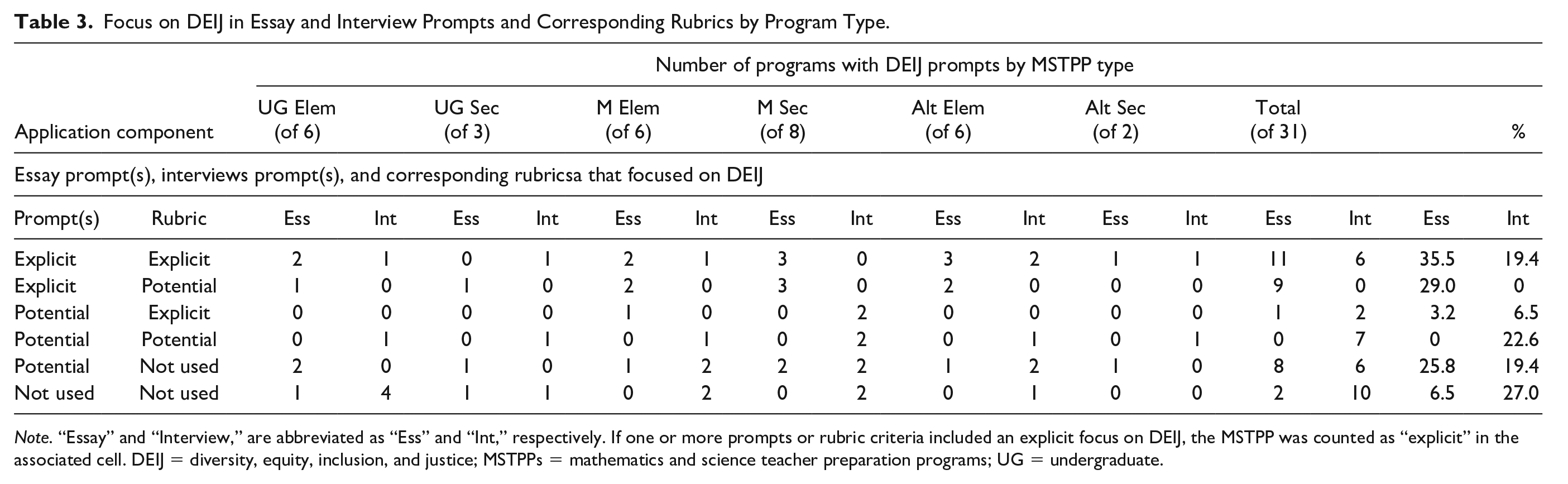
Note. “Essay” and “Interview,” are abbreviated as “Ess” and “Int,” respectively. If one or more prompts or rubric criteria included an explicit focus on DEIJ, the MSTPP was counted as “explicit” in the associated cell. DEIJ = diversity, equity, inclusion, and justice; MSTPPs = mathematics and science teacher preparation programs; UG = undergraduate.
Faculty Interview Analysis
We explored the range of faculty perspectives and values relating to DEIJ in admissions, focusing on three primary themes:
Valuing diversity in applicants’ backgrounds.
Considering applicants’ DEIJ orientations.
Attending to diversity in their MSTPP admission process.
To investigate these themes, we ran a series of queries and reports in Atlas TI for relevant codes (see Table 2) and text searches (e.g., “diverse” and “application”) to ensure that we considered all relevant stanzas. We then examined data from one professor at a time with the goal of classifying their perspectives and values for each of these three themes. To gain a full sense of the context and meaning, we re-examined relevant stanzas within each full transcript.
For the first theme, we analyzed responses related to recruiting and/or selecting diverse applicants for admission. We used binary codes of “yes” if a professor expressed a value for diverse applicants or “no” if a professor did not express a value for diverse applicants. Informed by Chang-Bacon’s (2022) findings that teacher educators’ discourse provides a window into their perspectives on racism, we also noted whether professors used race-intentional discourse or race-evasive discourse.
For the second theme, we investigated how faculty discussed applicants’ orientations related to DEIJ. Faculty often expressed a connection between an applicants’ DEIJ orientation and their MSTPP’s orientation, reflecting the role of DEIJ in their MSTPP’s admissions practices and policies. To analyze both faculty discourse and MSTPPs’ orientations, we continued to apply Chang-Bacon’s (2022) constructs for race-intentional and race-evasive discourses, and we also drew on Feinman-Nemser’s (1990) academic and critical orientations for TPPs. For each of the following three categories, the alignment with Chang-Bacon’s (2022) discourses and Feinman-Nemser’s (1990) TPP orientations is indicated in parentheses, respectively.
Red flag: Professor stated that they did not want to admit applicants who evidenced deficit or uniformed DEIJ orientations (race-intentional, critical).
Yellow flag: Professor stated they had concerns about admitting applicants who evidenced deficit or uniformed DEIJ orientations, but they did not link these concerns to admissions decisions (race-intentional, critical).
Desired Positive orientations: Professor desired positive and informed orientations, but they did not view applicants’ orientations as an important factor in admissions (race-evasive, academic).
For the third theme, we considered both how professors discussed DEIJ and the implications for their MSTPPs’ DEIJ-related policies. Again, we drew on Chang-Bacon’s (2022) discourses and Feinman-Nemser’s (1990) orientations, as indicated in parentheses for each of the following four categories.
MSTPP needs more focus on DEIJ: Professor stated that their MSTPP needed more focus on DEIJ in recruiting and/or selecting applicants (race-intentional, critical).
MSTPP focuses on DEIJ: Professor appreciated their program’s focus on DEIJ and described specific efforts of their MSTPP (race-intentional, critical).
Mixed views for importance of DEIJ: Professor expressed mixed views in that they valued DEIJ, but they did not want it to overshadow academics in the admissions process (race-intentional, mix of academic and critical).
No opinion: Professor did not express an opinion about their MSTPP’s attention to DEIJ or was unaware (race-evasive and academic).
Note that for Categories 1 and 2, professors might also have valued academic background, but when responding to prompts about DEIJ, they did not compare a focus on DEIJ to academics, as will be shown with examples later. Throughout the process, we remained open to different perspectives emerging, but we found that all 20 professors aligned with one of the above categories.
Findings
All participating MSTPPs attended to DEIJ in their application processes, but we found differences in the components and DEIJ-related information collected. All faculty indicated that they valued diverse applicants; however, the importance they placed on diversity varied. We discuss examples to illustrate commonalities and differences in how MSTPPs and faculty attended to DEIJ.
Attention to DEIJ in Application Forms and Related Influential Factors
As shown in Table 1, all 31 MSTPPs collected the following documents and information: GPA, high school and/or college transcripts, test scores, ethnoracial identities, and citizenship. Most MSTPPs collected additional documents including essays (29), documentation of teaching experience and/or work with students (28), and letters of recommendation (27). A majority of MSTPPs asked about parents’ education level (28), immigrant status (25), and applicant multilingualism (18). Twelve MSTPPs asked applicants about whether they were first-generation college students. Most MSTPPs conducted interviews (21).
Attention to DEIJ in Essays, Interviews, and Rubrics
Essays and interview prompts often attended to DEIJ by asking applicants to share information involving diverse aspects about their: identities, personal histories, experiences, perspectives, interactions with students, and/or work in communities. All MSTPPs that conducted interviews used interview prompts. Applicants participated in individual and/or in small-group interviews, with groups of three to four applicants. Applicant interviews were conducted by admissions staff, faculty, graduate students who taught in the program, and/or field supervisors. Some MSTPPs maintained an explicit focus on DEIJ in both their prompts and rubrics, other MSTPPs used prompts with an explicit focus on DEIJ but did not focus on DEIJ within their rubrics, while other MSTPPs did not use a rubric at all. Table 3 lists the combinations found in the data, and examples are discussed next.
Explicit-Explicit Example
Seventeen MSTPPs, representing all types of programs, had an interview or essay with the explicit-explicit combination (i.e., explicit prompts and rubric). For example, University C conducted small-group interviews and used the same process for both their undergraduate elementary and secondary MSTPPs. Two professors and/or graduate students conducted the interview, and three to four students from the elementary and/or secondary MSTPPs discussed a prompt. Admissions staff selected one prompt for each group from a list of several prompts, which the applicants received just prior to the discussion. All prompts included a focus on some aspect of DEIJ (e.g., race/ethnicity, gender identity, and diverse family structures). The interviewers asked the group to discuss the prompt and then asked follow-up questions. Two prompts were:
You walk into your high school classroom as students are settling in. These students are surrounding a Mexican American student and chanting, “Build the wall!” How would you handle this situation?
Recent research has found that white teachers are more likely to reprimand or chastise Black students than non-white teachers. In addition, black students who receive negative feedback from their teacher tend to show steeper declines in academic performance than their white counterparts. As a future teacher, how do you think this information should influence the classroom?
Both prompts explicitly described racial injustices and reflected race intentionality (Chang-Bacon, 2022), thereby soliciting applicants’ orientations to racial injustices. The rubric also focused on applicants’ orientations toward DEIJ (Figure 2). For two indicators, “Assets/Strength-based approach” and “Stance towards equity,” raters could score applicants higher if applicants demonstrated “assets/strengths-based thinking” and “knowledge and thoughtfulness” about equity. Alternatively, applicants could be scored as “Unacceptable” for referring to “deficits of learner, children, and/or communities” or for not demonstrating awareness of “issues related to education and equity.”

University C’s Undergraduate Elementary and Secondary Interview Rubric
Other MSTPPs in this category explicitly named “racial equity” and “educational justice,” as exemplified in the below prompt from an alternative route MSTPP at University D: [The MSTPP is] committed to racial equity. What does racial equity mean to you? What racial equity work have you done (and/or do you know you need)? How has your experience and background prepared you to be successful working with students furthest from educational justice? What challenges do you anticipate?
Explicit-Potential Example
Nine MSTPPs, representing most types of programs, provided essay prompts with an explicit focus on DEIJ, but their corresponding rubrics did not focus on DEIJ; no interviews reflected this combination (see Table 3). Prompts in this category reflected race intentionality to some extent in that they referenced scenarios involving ethnoracial injustices and/or named associated constructs (Chang-Bacon, 2022). Two of three required essay prompts for an undergraduate secondary program at University E illustrate this combination:
How might an educator’s unacknowledged biases or taken-for-granted assumptions affect their ability to create a safe, inclusive, and culturally responsive learning environment?
Describe your experiences with academic courses that have provided you with knowledge of multicultural and social justice issues and challenges. How does this knowledge and experience prepare you to be an effective teacher?
The rubric included a row for each essay and a column for scorers to indicate their rating from 0 to 4, but it did not include descriptions for rating the essays. We categorized this rubric as potentially focusing on DEIJ, given that the rubric did not provide specific indicators for DEIJ, although scorers could comment on the applicants’ orientations to DEIJ.
Potential-Explicit Example
Three MSTPPs, one Masters-Elementary program, and two Alternate Route-Elementary programs, had an interview or essay with the potential-explicit combination (see Table 3). For example, each applicant to University A’s Masters-Elementary MSTPP met with each member of the MSTPP’s admissions committee (one at a time) for approximately 1 hour. Prior to the interview, the MSTPP mailed applicants a letter that described the interview process and included the “Question Pool” of possible questions, as well as a rubric (see Figures 3 and 4). In this question pool, some prompts provided an opportunity for applicants to discuss DEIJ but did not explicitly prompt them to do so. For instance, Item 8 asked about a “relationship between a teacher and student,” and Item 9 asked applicants to describe an “extraordinary teacher.” For both items, an applicant may focus on DEIJ; however, applicants could also respond without attention to DEIJ. Item 15 in the question pool included an explicit DEIJ focus: “. . .define diversity, and describe your experiences working with diverse populations” (Figure 3). However, as one item in a pool of possible questions, an applicant might not be asked to respond to this prompt.

University A’s Masters Interview Question Pool

University A’s Masters Interview Rubric
Unlike the prompts, the rubric included an explicit focus on DEIJ (see Figure 4). Interviewers rated applicants on a scale for “Respect for Diversity and Individual Worth” that ranged from “Professional” to “Unacceptable.” Applicants received the rubric prior to the interview. Hence, although applicants might not receive a DEIJ-related prompt, the rubric encouraged applicants to prepare a DEIJ-related response. In addition, prompts and rubrics in this category used racial proxies Chang-Bacon’s (2022), such as “culture” and/or “all learners” (Figure 4, second row). These terms contrast with race-intentional phrasing used in the two prior categories (Chang-Bacon, 2022).
Faculty Perspectives About Applicants’ DEIJ-Related Backgrounds and Orientations
Next, we present findings from faculty interviews with a focus on applicants’ backgrounds and DEIJ orientations.
Faculty Perspectives and Values About Applicants’ Backgrounds
To compare faculty perspectives with characteristics commonly requested on applications, we asked faculty about their MSTPP’s application process and their own values regarding applicants’ backgrounds. The interview question was: I am going to list several background characteristics that applicants might indicate they have on an application. Please tell me which characteristics are highly important to consider in recruiting and/or selecting applicants, and why you feel they are important.
A. Has a military background.
B. Is a first-generation college student.
C. Is or has been an English language learner.
D. Is bilingual or multilingual.
E. Is from an underrepresented/minoritized background.
F. Other characteristics you are free to describe. (Faculty Interview protocol).
All 20 professors interviewed indicated that they value diverse applicants. All professors except one explicitly mentioned one or more of the options C, D, or E, characteristics related to DEIJ, and they used race-intentional discourse in explaining why these characteristics are important. The below example is representative of the 19 race-intentional responses: I think the most important ones from that list for me are underrepresented or minoritized background and English language learners. . . Education [and] science often privileges perspectives from the dominant culture, white people, and the only way that we’re going to change that is to have more people in the profession from other backgrounds. I can reflect and read and learn all I want to, . . ., but I will never have the knowledge and experience that somebody from an underrepresented group does. And I’ll never be able to model being a scientist or a teacher. . . from one of those groups for my students, so I think that is really important. (Professor E-Science
5
)
The professor who was an exception said “all” were important, indicating that diversity is among several important characteristics for admissions and evidencing race-evasive discourse (Change-Bacon, 2022). Thus, all faculty valued applicants with diverse backgrounds, and all but one expressed these values with race-intentional discourse (Chang-Bacon, 2022).
Faculty Perspectives and Values Regarding Applicants’ DEIJ Orientations
To varying degrees, faculty indicated that they thought it was important to focus on applicants’ orientations to DEIJ in admissions. DEIJ orientations aligned with one of three perspectives: “red flag,” “yellow flag,” or “desires positive orientations” (see Table 4).
Faculty Perspectives Related to Applicants’ DEIJ Orientations.
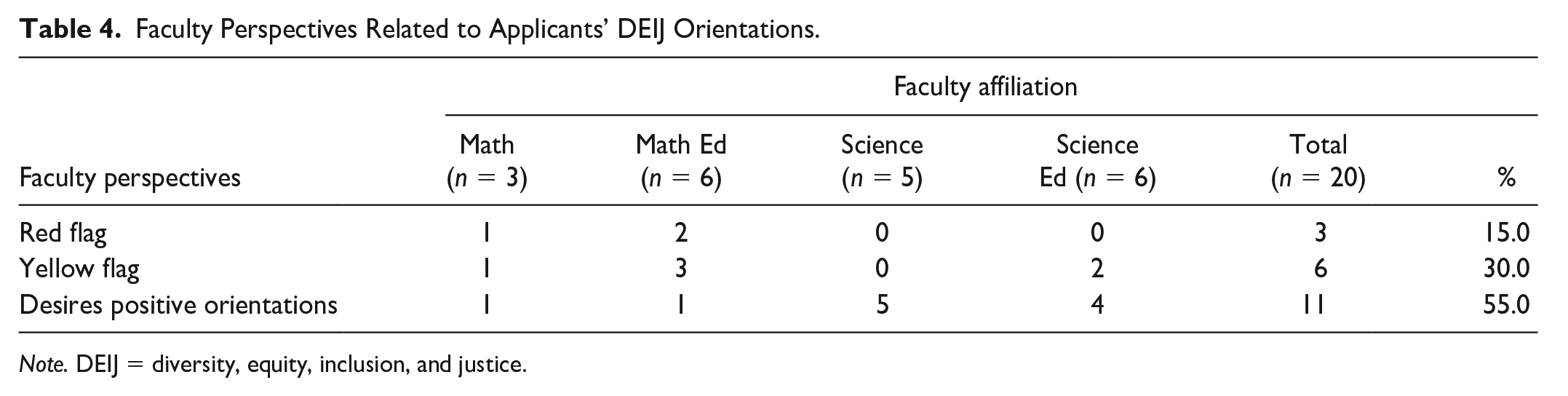
Note. DEIJ = diversity, equity, inclusion, and justice.
Red Flag Perspective
Three professors felt so strongly about applicants’ DEIJ orientations that they did not want to admit applicants who expressed deficit views or prejudice (e.g., racism and anti-gay rhetoric) or were uninformed (e.g., unaware of racial inequities, white supremacy). These professors’ responses used race-intentional discourse (Chang-Bacon, 2022) and emphasized the role of teachers and TPPs in creating a just society, a critical orientation (Feinman-Nemser, 1990). To illustrate, when asked to describe important criteria for selecting applicants, Professor C-MathEd explained that they did not expect applicants to have well-developed orientations to DEIJ; however, they were “not interested in” admitting applicants who demonstrate a lack of knowledge about racism in society: It’s on questions of social justice. . ., people aren’t going to come fully formed. . . around certain. . . kinds of ideologies and practices. . .The whole point is we’re going to . . .teach them—right? . . .On the other hand, . . . I’m not interested in [admitting] people who just don’t even recognize that white supremacy is a problem.
Yellow Flag Perspective
Six faculty expressed concerns about applicants who do not have positive DEIJ orientations. Professor B-MathEd’s response represented this perspective: I think teachers of color would have a much better understanding . . . of students’ backgrounds. So. . .it’s really important, central for me. . . If we’re going to talk about anti-racist education as something that’s reachable, I think having a more diverse teaching force is probably top priority. . . If [applicants] don’t think [diversity is] important, if they haven’t thought about it, if it’s not their concern, I really worry about them to be teachers in the first place.
This statement reflected common views regarding both valuing applicants with diverse backgrounds (as discussed previously) and a concern about applicants who do not demonstrate positive DEIJ orientations. Similar to the red flag perspective, professors expressing a yellow flag view used race-intentional discourse (Chang-Bacon, 2022) and aligned with a critical orientation (Feinman-Nemser, 1990). However, they did not indicate that a positive DEIJ orientation was necessary for admissions.
Positive Orientations Perspective
The remaining 11 professors (a slight majority) expressed views indicating that they valued positive orientations to DEIJ, but a focus on DEIJ should be one among several characteristics considered, and it is not a priority over other considerations. For example, Professor B-ScienceEd explained: At the end of the interview process. . .we’re looking [at] things like how you participated, how you communicated with each other, the content connections that you were able to make about the case study, or the guiding principles [of our program], your professionalism. Those are some of the things on our rubric. There isn’t anything on the rubric specifically about diversity. I think [diversity is] important to consider, [but] I don’t want it to be the prime reason that you admit or don’t admit a candidate.
Faculty holding these views often used racial proxies (e.g., “diversity” without naming race; Chang-Bacon, 2022) and aligned primarily with Feinman-Nemser’s (1990) description of an academic orientation in that they prioritized disciplinary and pedagogical knowledge for teaching when considering applicants.
Faculty Perspectives on Their MSTPP’s Attention to Diversity
In interviews with faculty, we asked professors about their perspectives on their MSTPP’s orientation to DEIJ to understand both faculty perspectives and the extent to which MSTPP’s aligned with critical orientations (Feinman-Nemser, 1990). Faculty expressed a range of views including: calling for their MSTPP to focus more on DEIJ, appreciating their MSTPP’s focus on DEIJ, expressing mixed views, or not being aware.
Calling for MSTPP to Focus More on Diversity
We found that 10 of the 20 professors wanted their program(s) to focus more on diversity in recruiting and/or selecting applicants. For example, Professor B-Science contended that their program needed to focus more on increasing the number of students of color in the MSTPP and critiqued the admissions process as perpetuating racism: I think we’ve been failing by not developing a more racially diverse [group of applicants and PSTs]. . . . It’s a disservice to our schools, to the teachers that work in them, and to the students. . . . It just continues to promote white supremacy, which is sort of embedded in our systems already. Where’s the racism in the college admissions process? . . . I think there are huge access issues, there are probably biases built into the interview process and the essay process as well that perpetuate white supremacy. . . I think there are a lot of really good people trying to do good as a part of a system that is still pretty racist.
Professors sharing this perspective used race-intentional discourse (Chang-Bacon, 2022) and aligned with a critical orientation (Feinman-Nemser, 1990).
Appreciating MSTPP’s Focus on Diversity
Five professors demonstrated appreciation for their program’s focus on diversity. They described specific MSTPP efforts including hiring recruiters focused on diversity, faculty outreach activities, and scholarships for diverse applicants. Similar to the previous group, professors holding this perspective used race-intentional discourse and aligned with a critical orientation. However, between these two groups, their perspectives on whether their MSTPPs held a critical orientation differed, with the previous group calling for change.
Holding Mixed Views for the Importance of DEIJ
Two professors held mixed views in that they agreed with the MSTPP’s focus on DEIJ in admissions, but they wondered if their MSTPP placed too much emphasis on it. For example, when asked, “Do you see your own values priorities and perspectives represented in the process your teacher education program uses to select future teachers,” Professor E-ScienceEd responded, Yes and no. We put a high commitment on critical race theory and some theoretical frameworks that many of our science and math candidates have not encountered. . . Some of those conceptual frameworks are brand new to them, and we really privilege those frameworks over, let’s say, having a profound understanding of evolution, as a theoretical understanding. So, I think, I would like to think that we could have both.
Professor E-ScienceEd expressed a view that DEIJ should be a focus and used race-intentation discourse (e.g., “critical race theory”; Chang-Bacon, 2022), but they also contended that disciplinary frameworks and understandings should be valued more, reflecting an academic orientation, or perhaps a mix of academic and critical orientations for TPPs (Feinman-Nemser, 1990).
Not Being Aware of MSTPP’s Orientation to DEIJ
The remaining three professors did not share clear views on whether their MSTPP should focus more or less on DEIJ. They taught mathematics or science content courses and were not as involved in teacher education admissions. While indicating that DEIJ was important, they were not aware of whether DEIJ was a focus of admissions. Their responses aligned with race-evasive discourse (Chang-Bacon, 2022) and an academic orientation (Feinman-Nemser, 1990).
Discussion and Implications
This study provides a conceptual framing of the admission process with a specific focus on the role of DEIJ in TPP admissions, as represented by circles in Figure 1. We found that all participating MSTPPs and faculty saw a need for diverse applicants and attention to DEIJ in their admissions processes and practices (the outer two circles of Figure 1), indicating that their values aligned with a critical orientation (Feinman-Nemser, 1990). However, the extent to which MSTPPs and faculty acted on these values depended on what application components and information MSTPPs collected and how MSTPPs and faculty attended to applicants’ DEIJ orientations in admissions (the inner two circles of Figure 1). Moreover, we uncovered cases where MSTPPs’ admissions processes did not align with the DEIJ-related perspectives of some faculty, such as Professor B-Science’s statement that their MSTPP was, “failing by not developing a more racially divers[ity].” In addition, not all faculty were aware of the role of DEIJ in admissions. Thus, not all faculty were influencing their MSTPP’s admissions processes (represented in the bottom rectangle in Figure 1).
Below we highlight key findings from the participating MSTPPs to discuss considerations for TPPs to actualize their values for DEIJ in recruiting, selecting, and preparing teachers, as called for in professional standards (e.g., AMTE, 2017; Morrell et al., 2020). We end with three dilemmas facing TPPs that surfaced from this study. When discussing considerations and dilemmas, we refer to TPPs because we view these considerations as applicable to TPPs more generally, extending beyond MSTPPs.
Considerations for Attention to DEIJ in Application Forms
Participating MSTPPs collected substantial information from application forms related to social markers, even though some applicant background information collected seemed superfluous to the admissions process, including information not required by the state (e.g., citizenship and immigrant status). This information might have been collected because all faculty expressed a desire to recruit and/or select more diverse applicants, consistent with research on the benefits of a diverse teaching workforce (Blazar, 2022; Edmonds, 2022), or to track progress toward increasing diversity. In addition, this information might be important to identify applicant eligibility for financial aid.
Despite reasonable intentions, collecting these data might have unintended consequences, such as discouraging applicants who are ethnoracially marginalized or who lack documentation of citizenship from applying. These applicants might wonder if providing this information would be disadvantageous or make them vulnerable to deportation. Further research on applicant perceptions and reactions to questions about social markers would inform the field of the costs and benefits of asking about applicants’ social markers and background.
Considerations for Attention to DEIJ in Applicant Orientations
Despite faculty stating that they value diversity and desire applicants with positive DEIJ orientations (Kinemen et al., 2019), MSTPP documents and professors’ responses did not consistently reflect a critical orientation in admissions processes (Feinman-Nemser, 1990). Essays and/or interviews provide the potential to learn about applicants’ DEIJ orientations. But even when these essays and interviews were used, we found differences ranging from not attending to applicants’ DEIJ orientations (limiting the potential of these components) to using race-intentional discourse (Chang-Bacon, 2022) that explicitly solicited applicants’ DEIJ orientations.
These findings highlight ways TPPs can make applicants’ DEIJ orientations visible in admissions processes. Primarily, TPPs should not only consider including essays and interviews, but TPPs and their faculty should examine the language used in their prompts and rubrics. Specifically, if TPPs use race-intentional language (Chang-Bacon, 2022) in essay and interview prompts and rubrics, applicants will be prompted to share experiences and orientations related to DEIJ. An additional benefit is that these interview and essay prompts can communicate a TPP’s critical orientations (Feinman-Nemser, 1990), informing applicants early in the application process that DEIJ is a focus of a program. Similarly, if TPPs’ rubrics use race-intentional language, scorers will be prompted to focus on DEIJ. Our findings indicate that TPPs should use and create explicit-explicit combinations of prompts and rubrics to achieve goals related to DEIJ. Future research could further examine specific prompts and rubrics, along with applicants’ responses and scorers’ use of rubrics, to gain more insights into characteristics of prompts and rubrics that support TPPs in learning about applicants’ DEIJ orientations.
Dilemmas for TPPs
This study surfaced three vexing dilemmas for TPPs:
Should TPPs’ admissions processes screen out applicants who evidence deficit or unaware views regarding DEIJ, as a way to promote anti-racist and culturally responsive teaching?
In what ways might TPPs admissions (unintentionally) reproduce structural inequities and racism by screening out applicants of color?
What recruiting models or approaches should TPPS consider or develop to focus more on diversity?
These dilemmas relate to two problems that Childs and Ferguson (2015) identified for TPPs to address for the teaching workforce: filtering out applicants with potentially problematic attitudes and preparing more PSTs of color to diversify the teaching workforce.
For the first dilemma, we found three professors whose responses suggested that TPPs should not admit applicants with deficit views or who were uniformed about racial injustices. In efforts to develop a culturally responsive teacher workforce, should TPPs deliberately screen out applicants who do not evidence positive DEIJ dispositions, as these professors suggest? An alternative strategy might be to identify concerns about applicants during admissions, and then provide support for developing positive DEIJ orientations (Carter Andrews, Brown et al., 2019; Kinamen et al., 2019). One factor in a TPP’s approach to this dilemma might be the duration of their program. For example, alternative route programs in this study often were shorter in duration, with reduced coursework and opportunities for professors to create experiences to shift orientations. Future research might explore whether, in what contexts, and how TPPs can support PSTs in developing positive DEIJ orientations. These findings could inform TPPs in deciding whether to focus on screening out applicants or supporting PSTs to develop positive DEIJ orientations.
For the second dilemma, we found that participating MSTPPs required applicants to submit test scores and GPAs, and they collected information about social markers. Testing requirements can screen out teachers of color (Carter Andrews, Castro, et al., 2019), and we wonder whether social markers discourage students from applying to programs, as discussed above. These findings suggest that TPPs should carefully examine the information they and their universities collect from applicants. Specifically, for information collected in admissions, TPPs should ask: What is important to know about applicants in relation to becoming a teacher? How might specific requests or requirements inadvertently screen out students from applying or being selected? To inform what we collect from applicants, future research might explore connections between characteristics of applicants who are selected and their later success in teaching, as well as investigating who might be interested in teaching but not apply to TPPs due to admissions requirements (e.g., GPA and test scores).
For the third dilemma, we found that half of the faculty interviewed voiced a need for an increased focus on diversity in recruiting and a sense that the current system is inadequate. This perspective is consistent with Carter Andrews, Castro, and colleague’s (2019) call for TPPs’ explicit attention to recruitment of applicants of color, and in particular, TPPs might consider early recruitment programs involving university partnerships with high schools.
The framework (Figure 1), findings, considerations, and dilemmas provide opportunities for TPPs and faculty to reflect on their own practices, orientations, and programs regarding attention to DEIJ in admissions. As we develop more intentional admissions processes focused on DEIJ, future research can explore the effects of specific aspects of these processes on enrollment, on TPPs’ orientations, and on supporting the development of PSTs.
Footnotes
Declaration of Conflicting Interests
The author(s) declared no potential conflicts of interest with respect to the research, authorship, and/or publication of this article.
Funding
The author(s) disclosed receipt of the following financial support for the research, authorship, and/or publication of this article: This research was supported by the National Science Foundation, DUE# 1950030. The findings do not necessarily represent the views of NSF or the organizations with which the authors are affiliated.
