



Abstract
Forensic post-mortem toxicological data provide valuable information for the elucidation of cause of death. However, this is still not routine practice in Brazilian laboratories. This study investigated the presence of illicit and prescription drugs, pesticides and metabolites in 111 post-mortem blood samples from cases investigated by the Forensic Medical Institute of the Federal District, Brazil. Quantitative analysis was performed for 14 analytes using a validated programmed temperature vaporisation-large volume injection-gas chromatography–mass spectrometry method, which was also used as screening (qualitative analysis) for an additional 19 substances of forensic interest. At least one analyte was found in 61.2% of the samples, of which 34 were related to homicide, 15 to accidental death and 10 to suicide cases. The victims were 14–72 years old. The benzodiazepines diazepam, midazolam and 7-aminoflunitrazepan were detected in 46% of the positive samples (0.02–1.12 µg/mL; midazolam only qualitative). Cocaine was found in 34% (0.02–4.07 µg/mL), associated with substances commonly used as cocaine adulterants (e.g. caffeine, lidocaine and phenacetin). Three suicide cases involved the illegal rodenticide chumbinho, residues of which were found in the gastric content, and blood samples showed the presence of terbufos (0.03 and 0.04 µg/mL) and carbofuran (27.3 µg/mL). These results are discussed, along with autopsy and crime-scene information.
Introduction
Drugs (prescription or illicit) and pesticides are commonly found at crime scenes and are among the leading causes of human intoxication worldwide.1–4 In 2017, poisoning was the second most used method for suicide in the UK, 5 and psychotropic drugs were the most used substances in such cases in New Zealand from 2000 to 2012. 6
Data from the Brazilian Mortality Information System showed that 54.3% of all fatal poisonings that occurred in the country from 2009 to 2013 involved drugs/medicaments or pesticides. 4 In the Federal District, where the country’s capital is located, these chemicals accounted for 83.3% of the 288 cases reported to the System. Forensic reports of the Forensic Medical Institute of the Federal District (IML-DF) found additional cases that could be identified as fatal poisoning, but a conclusion could not be reached due to a lack of additional information, including toxicological analysis. 4
Indeed, forensic post-mortem toxicological analysis provides valuable data in forensic science, and forensic toxicologists are often the first to alert authorities and the scientific community on outbreaks of new substances of abuse.7,8 The application of appropriate analytical methods provides the basis for the correct interpretation of toxicological findings, and when integrated with the autopsy and police reports, including crime-scene information, these data will assist in the determination of the causa mortis.9–11 Furthermore, the data are useful to improve the epidemiological information used by government authorities as a management tool to prevent fatal poisonings.
The objective of this study was to apply a previously validated analytical method – programmed temperature vaporisation-large volume injection-gas chromatography-mass spectrometry (PTV-LVI-GC/MS) – for the quantitative analysis of 14 drugs, pesticides and metabolites in post-mortem blood samples obtained from real forensic cases investigated by the IML-DF. Additionally, the method was used for the qualitative investigation of another 19 analytes of forensic interest. The cases are discussed, along with autopsy results and crime-scene information whenever available.
Methods
Post-mortem samples
In total, 111 post-mortem blood samples were provided by the IML-DF for analysis. The samples were from cases of violent death (i.e. homicide or suicide), accidents or natural/undetermined causes that occurred in the Federal District between June 2017 and February 2018. Corpses were stored at 4–8°C, and the necropsy was performed within 12 hours, when the post-mortem samples were collected from the femoral vein or cardiac cavity and kept at –50°C with no preservatives until analysed. The time elapsing between sampling and analysis was <15 days. Information on the cases (including circumstances of death, sex and age of the individual and cause of death) were obtained from the forensic reports, which are available in the IML-DF online system.
Chemical and reagents
A total of 14 substances of forensic interest were quantitatively analysed, and 19 other analytes were screened (qualitative analysis) in the post-mortem blood samples. Haloperidol, diazepam, carbamazepine, bromazepam, phenobarbital and amitriptyline hydrochloride were kindly donated by the Brazilian Pharmacopeia (Rio de Janeiro, Brazil); 3,4-methylenedioxymethamphetamine hydrochloride (MDMA), cocaine hydrochloride,7-aminoflunitrazepam (7-AF), ketamine, tetrahydrocannabinol and cannabinol were provided by the United Nations Office on Drugs and Crime; carbofuran, carbaryl, methiocarb, pirimicarb and terbufos were purchased from AccuStandard (New Haven, CT). Paracetamol, lidocaine, phenacetin, benzocaine and caffeine were obtained from Sigma–Aldrich (St Louis, MO). Standard solutions of 1 mg/mL diazepam-d5 and cocaine-d3 (internal standards, IS) were purchased from Cerilliant (Sigma–Aldrich). Standard solutions of tramadol, oxycodone, flunitrazepam, propofol, levomepromazine, sertraline, bupropion, dipyrone and midazolam were prepared from bulk materials seized by the Civil Police of the Federal District that had their identity confirmed by mass spectrometry and infrared spectrometry. Acetonitrile (ACN) LC-MS grade was obtained from Scharlau (Barcelona, Spain). Supelclean primary and secondary amine (PSA), magnesium sulphate anhydrous (MgSO4) and sodium acetate (NaOAc) were purchased from Sigma–Aldrich.
Sample extraction and PTV-LVI-GC/MS analysis
The PTV-LVI-GC/MS analytical method used in this study was previously optimised and validated for 14 substances by our research group. 12 In summary, 1 mL blood was mixed (vortex) with the IS diazepam-d5 and cocaine-d3 (50 ng/mL), 2 mL ACN and 500 mg of a mixture of anhydrous MgSO4:NaOAc (4:1), and the tube was further centrifuged. The supernatant was transferred to a 2 mL microtube containing 50 mg PSA and 150 mg anhydrous MgSO4. The microtube was vortexed and centrifuged, and the supernatant was analysed by gas chromatography–mass spectrometry (Agilent 7890A gas chromatograph equipped with a programmed temperature vaporising injector for large-volume injection and coupled to an Agilent Technologies 5975C mass spectrometer Triple Axis detector; Agilent, Santa Clara, CA). DB-1 MS column (30 m × 0.25 mm I.D., 0.25 µm film thickness; Agilent) was used. The method was set to Selected Ion Monitoring (SIM mode). The quantification was performed in SIM mode, and the method was validated (recovery ≥80% and precision ≤20%) at a limit of quantification (LOQ) of 0.02 or 0.03 µg/mL12 (Table 1). Validation results showed recovery <50% at all fortification levels (0.08, 0.8 and 4 µg/mL) for bromazepam, and recovery <60% at the two highest levels for phenobarbital, which were enough only for semi-quantitative analysis. 12 Quality-control post-mortem blood samples (free of any analyte) fortified with 7-AF, carbaryl, carbofuran, cocaine, diazepam and methiocarb at two concentrations (0.5 or 0.8 µg/mL; n=3) were included in each batch as an internal quality control, showing satisfactory accuracy, with recoveries ranging from 95.4% (carbaryl) to 105% (diazepam), and precision, with RSD from 2.5% (cocaine) to 12.7% (for carbaryl).
Substances investigated by the PTV-LVI-GC/MS method using the quantitative (SIM) and screen (full scan) modes.
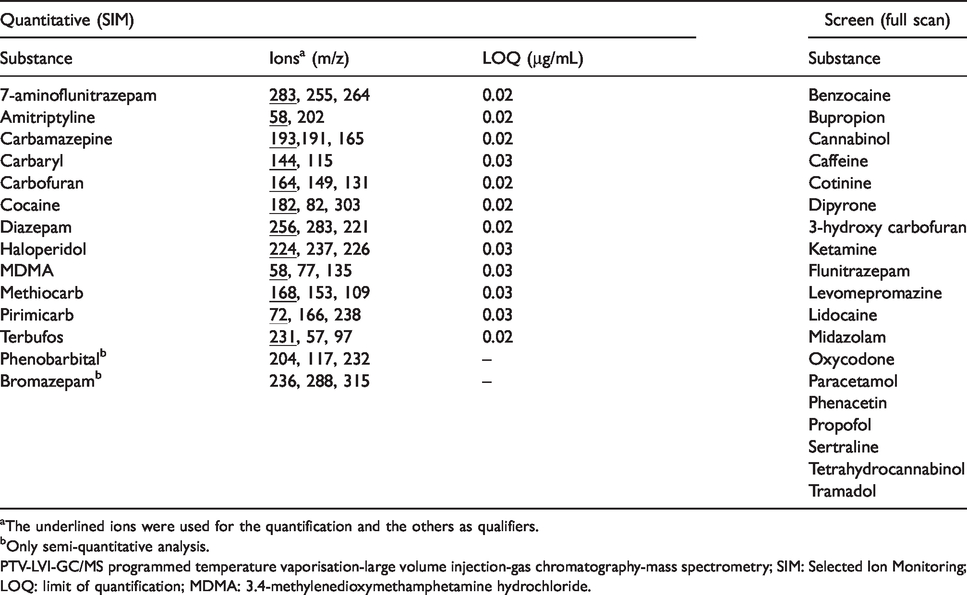
aThe underlined ions were used for the quantification and the others as qualifiers.
bOnly semi-quantitative analysis.
PTV-LVI-GC/MS programmed temperature vaporisation-large volume injection-gas chromatography-mass spectrometry; SIM: Selected Ion Monitoring; LOQ: limit of quantification; MDMA: 3.4-methylenedioxymethamphetamine hydrochloride.
In the same injection of the quantitavive method, 19 other substances were screened in the full scan mode (m/z 50–450; Table 1). The fragmentation and the retention times were confirmed by comparison with analytical standards, bulk materials seized by the police and the mass spectral libraries (NIST, SWGDRUG, Cayman). No standards or seized materials were available for 3-hydroxycarbofuran and cotinine, and confirmation relied only on mass spectral libraries.
Results and discussion
The analytes included in the validated quantitative method 12 were selected based on epidemiological data of chemical fatal poisoning in the Federal District of Brazil, 4 and information obtained by the Civil Police of the Federal District, including seized material and evidence found at the case scenes. Additionally, another 19 substances were detected in the qualitative full scan mode. Almost half of the 111 post-mortem samples available for this study (49.6%) came from homicide cases, 18% from accidental cases (work accident, drowning, vehicle–pedestrian collisions and driving under the influence) and 16.2% were suicide cases. The ages of the victims ranged from 12 to 79 years (median 36 years), and 85.6% were male.
At least one substance was detected in 68 of the samples (61.2% of the samples analysed). The victims involved in these positive cases were 14–72 years old (median 32 years), and 86.8% were male. Figure 1 shows the distribution of the positive cases according to the circumstance and class of substances detected in the samples (pesticides, illicit or prescription drugs). Half of the samples were from homicide cases. A total of 16 drugs and three metabolites (7-AF, cotinine and 3-hydroxycarbofuran) were detected. Cotinine is a specific biomarker of nicotine exposure, 13 and 3-hydroxycarbofuran (3-OH CBF) is a carbofuran metabolite. 14 Benzodiazepines (diazepam, midazolam, flunitrazepam and/or 7-AF) were the main prescription drugs detected in the samples (46% of the positive samples), and cocaine was the main illegal drug that was found. All cases involving pesticides were suicide cases, and in 74.2% of homicide cases, the deceased had taken prescription drugs.
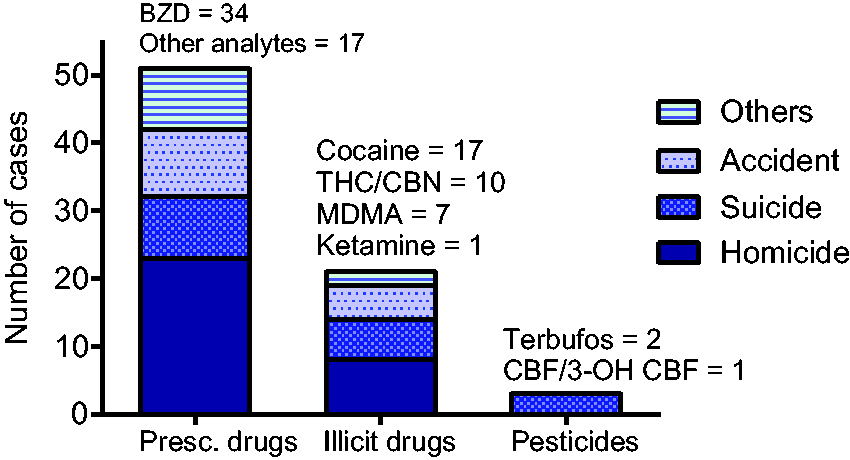
Distribution of the 68 positive case samples, considering Selected Ion Monitoring (SIM) mode (quantitative) and scan mode (qualitative) analysis, by classes of substances and circumstances. One sample could have more than one analyte. Others: natural and undetermined cause of death. BZD: benzodiazepines; THC: Δ9-tetrahydrocannabinol; CBN: cannabinol; MDMA: methylenedioxymethamphetamine; CBF: carbofuran; 3-OH CBF: 3-hydroxycarbofuran. Other analytes: 7-aminoflunitrazepam, tramadol, oxycodone, midazolam, flunitrazepam, propofol, levomepromazine, sertraline and bupropion.
Table 2 shows the SIM (quantitative analysis) and/or full scan (qualitative analysis) results of all 68 positive post-mortem blood samples, and Figure 2 shows a chromatogram of a sample in the SIM and scan modes. The results of 10 of the positive samples were reported previously 12 and are indicated in Table 2. Fifty (73.5%) of the positive samples contained one of the 14 analytes that were quantitatively investigated; six of these analytes were not detected in any sample analysed (bromazepam, carbaryl, haloperidol, methiocarb, phenobarbital and pirimicarb). The LOQs established for the substances analysed quantitatively (0.02–0.03 µg/mL) 12 were adequate, since the blood concentrations found in poisoning cases are generally higher (0.05–0.5 µg/mL). 15
Sixty-eight positive samples/cases classified by type of event, age, sex, substance quantified in SIM with the concentration found and the substances detected in scan mode (screening, qualitative analysis).

aFerrari and Caldas. 12
M: male; F: female; H: homicide; A: accidental; S: suicide; N: natural death; U: undetermined. 7-AF: 7-aminoflunitrazepam; AMI: amitriptyline; CBF: carbofuran; CBZ: carbamazepine; COC: cocaine; DIA: diazepam; MDMA: methylenedioxymethamphetamine; TER: terbufos; THC: Δ9-tetrahydrocannabinol; –: not detected/quantified.
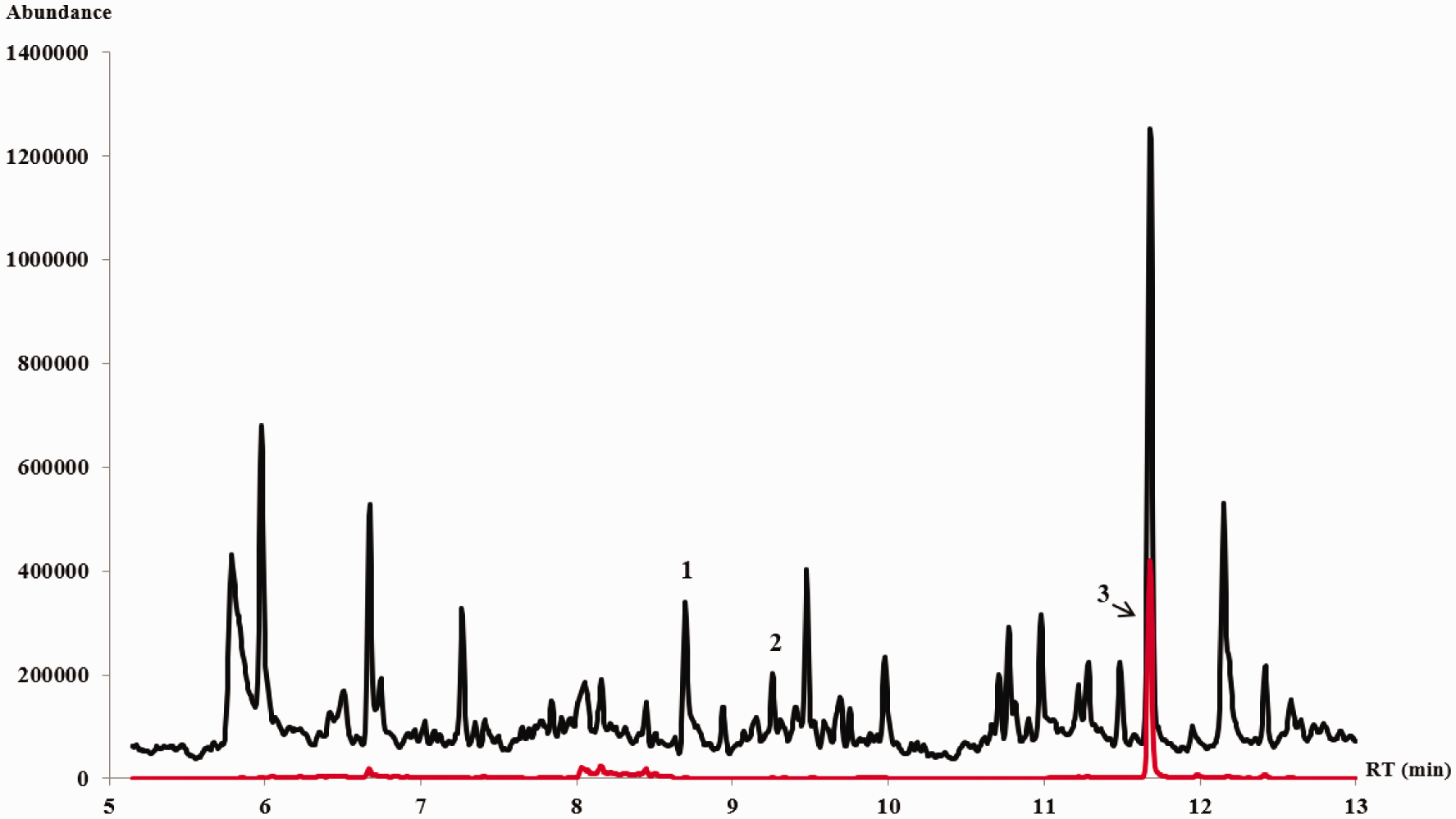
Gas chromatography–mass spectrometry chromatograms of the case 13 sample in scan mode (black line) and SIM mode (red line). Scan mode: (1) caffeine at 8.7 minutes and (2) lidocaine at 9.2 minutes; SIM mode: (3) cocaine at 11.7 minutes. The overlaid chromatograms were obtained in a single run. Caffeine and lidocaine were not included in the SIM mode validated method.
In addition to benzodiazepines, other prescription drugs detected were opioids (tramadol and oxycodone), antipsychotics (levomepromazine), antidepressants (amitriptyline, sertraline and bupropion) and antiepileptic drugs (carbamazepine; Table 2). The use of these drugs leads to psychomotor and/or cognitive impairment, 16 and is often associated with intoxications and driving-under-the-influence accidents.16,17 The concentrations of carbamazepine (0.08–0.98 µg/mL), 7-AF (0.04–0.31 µg/mL), diazepam (0.03–0.36 µg/mL) and amitriptyline (0.14–0.21 µg/mL) found in the samples were compatible with therapeutic/subtherapeutic plasma concentration. 15 In case 5, the 7-AF post-mortem blood concentration was compatible with a flunitrazepam overdose. 18
In the Federal District, Brazil, prescription drugs were involved in over 40% of the intoxication cases that occurred from 2009 to 2013, mainly after intake of benzodiazepines (including clonazepam and diazepam), carbamazepine, phenobarbital, haloperidol and amitriptyline. 3 Medicaments and drugs were involved in 49.4% of the 338 fatal poisoning cases in the region, including amitriptyline, clonazepam and diazepam. 4
Cocaine was detected in 17 samples at concentrations ranging from 0.02 to 4.07 µg/mL (M =0.60 µg/mL, median 0.08 µg/mL), with half of them being found in homicide cases. Caffeine, lidocaine, benzocaine and phenacetin, adulterants normally found in seized cocaine and frequently detected in biological samples, 19 were also found with the screening method in some samples (Table 2). Although we did not have information to correlate possible adulterants detected with cocaine abuse, at least one of these substances was detected in 64.7% of the cocaine positive samples. Magalhães and Caldas 4 reported 20 fatal cases (6.3% of all cases) involving cocaine abuse, the only illicit drug involved in the Federal District cases from 2009 to 2013.
MDMA was the only other illicit drug quantified with the SIM method, and was found in seven samples at levels ranging from 0.04 to 1.48 µg/mL (M =0.30 µg/mL, median 0.09 µg/mL), four of them associated with other drugs (cases 19, 29, 4 and 9; Table 2). THC was detected by the full scan method in 10 samples, and four of them also contained cannabinol, another cannabinoid present in Cannabis sp. In one sample (case 52, homicide), ketamine, benzocaine, caffeine, lidocaine, dipyrone, THC and cannabinol were detected with the full scan. Ketamine is a N-methyl-D-aspartate receptor antagonist that has been used as a drug of abuse, also in association with cocaine. 20 There is evidence that liver toxicity may be increased by the increased formation of norcocaine, a cocaine metabolite, due to P450 induction by ketamine. 21
About 36% of the post-mortem blood samples from homicide cases analysed in this study contained at least one illicit drug (Table 2). For example, in case 13, a 35-year-old man was the victim of multiple stabbings and had a cocaine blood concentration of 2.26 µg/mL, compatible with a fatal dose,17,22 although the cause of death in the forensic report was not poisoning. The cocaine contaminants caffeine and lidocaine were also detected when the sample was analysed in the screening mode (Table 2). Case 15 relates to a 21-year-old man killed by gunshot wounds, with a MDMA blood content of 1.48 µg/mL, also consistent with fatal cases due to MDMA ingestion.11,23 In 77 fatal cases reported in Canada in which MDMA was detected in biological fluids, the drug was considered the cause of death in 13 cases, with blood concentrations ranging from 0.478 to 53.9 mg/L. 11 The author pointed out that lethal concentrations of MDMA and other stimulant drugs, such as cocaine, may overlap at concentrations considered non-fatal, and the determination of cause of death requires an integration between previous reports, autopsy and toxicological findings.
The relationship between illicit drugs and crime has been demonstrated. 24 Illicit drug abuse increases the risk of the user becoming the victim or perpetrator of violence, and cocaine and/or amphetamine-like stimulants are the main drugs involved in violence worldwide. 25 Abdalla et al. 26 investigated the association of alcohol and cocaine with urban violence in the Brazilian population (n=4607). Perpetration of violence was reported by 6.2% of the interviewers, and the use of cocaine and alcohol increased the chances of being an aggressor by almost four times.
Half of the 10 suicide cases that tested positive for any analyte investigated in this study involved females (15–36 years old) – a much higher proportion than when all circumstances are considered (13.2%). Suicide cases with pesticides are commonly reported in Brazil3,4 and elsewhere.2,6,27 In the previous study conducted in the Federal District, pesticides were the second main agent involved in fatal poisonings (29.9%), ingested by 53.5% of the individuals who committed suicide. 4 When only the IML information was considered by the authors (n=101), pesticides were involved in 35.6% of the cases. 4 In the present study, 30% of the positive suicide cases involved pesticide ingestion.
In the three suicide cases involving pesticides, terbufos (an organophosphorus) or carbofuran (a carbamate) and its 3-OH metabolite were found in the post-mortem blood samples (Table 2), and greyish granules of chumbinho were detected in the gastric content of the victims. Chumbinho is an illegal rodenticide widely sold in Brazil, which contains mainly carbamate and/or organophosphorus pesticides. 28 In case 31, a 32-year-old man was found alive by paramedics at his home but died later. Flasks containing chumbinho were found at the scene, and terbufos was found in the blood at a level of 0.04 µg/mL, in addition to cocaine (0.08 µg/mL; Table 2) and alcohol (0.47 g/L, data now shown). Bloody foamy secretion in the upper respiratory tract of the victim was observed during autopsy, which is characteristic of intoxication with the acetylcholinesterase inhibitors organophosphorus and carbamate pesticides.29,30 Although the terbufos blood concentration was relatively low in the victim, this compound has a high acute toxicity, and other authors have reported fatal poisoning by terbufos due to occupational exposure (dermal and inhalation) and a blood level of 0.01 µg/mL. 30 The ingestion of carbofuran in fatal poisonings was reported in Asia, mainly suicide cases, with blood concentration ranging from 0.3 to 18 µg/mL.31,32
In the suicide case 9, a 31-year-old woman was found at home with a catheter inserted, and four empty vials of propofol were found at the site. Propofol was detected in the post-mortem blood by full scan, and MDMA and diazepam were quantitatively determined in the blood (0.28 and 0.13 µg/mL, respectively). Propofol is a GABA agonist and a potent intravenous anaesthetic agent that induces sedation, hypnosis and unconsciousness. 33 At autopsy, oedema and pulmonary haemorrhage were observed – signs also reported in other propofol overdose cases. 34 Although the crime-scene information, autopsy findings and toxicological analysis suggest that the cause of death was respiratory depression due to propofol, quantitative blood analysis would be necessary to conclude the case.
Future improvement of the method used in this study should include the so-called new psychoactive substances, such as cathinones, phenethylamines and synthetic opioids, which have been involved in recent intoxication cases in Brazil and elsewhere.35,36
Conclusion
Quantitative investigation of 14 analytes in post-mortem blood from 111 real forensic cases that occurred in the Federal District of Brazil was performed using a validated PTV-LVI-GC/MS method. Additionally, the samples were qualitatively screened for other 19 substances and metabolites of forensic interest. Data obtained in this study, along with autopsy and crime-scene information, helped to elucidate suicide cases involving carbofuran, propofol and terbufos and a cocaine overdose case. These laboratory data are essential for reducing underreporting of fatal poisoning cases, providing more reliable epidemiological data and robust legal evidence for the forensic reports.
Footnotes
Acknowledgements
The authors thank the Forensic Medical Institute of the Federal District of Brazil (IML-DF) for providing the post-mortem samples and the Forensic Analysis Laboratory of the Criminalist Institute, Federal District of Brazil (SPAL/IC-DF) for supporting this study.
Declaration of conflicting interests
The authors declared no potential conflicts of interest with respect to the research, authorship and/or publication of this article.
Funding
The authors received no financial support for the research, authorship and/or publication of this article.
