



Abstract
Active music listening is a creative activity in that the listener constructs a uniquely personal musical experience. Most approaches to teaching music listening emphasize a conceptual approach in which students learn to identify various characteristics of musical sound. Unfortunately, this type of listening is rarely done outside of schools. This article establishes a framework for teaching music listening as creative by maximizing students’ individual and diverse ways of listening.
How can music educators engage their students’ creative thinking when listening to music? Let us imagine a new app for your phone called ListeningCheck. It is able to read your mind when you listen to music and will buzz you when you listen to music incorrectly. You are at an orchestra concert and are delighting in the mournful oboe melody in a somber passage. Suddenly ListeningCheck buzzes loudly and tells you that the woodwind you are listening to is an English horn, not an oboe. Embarrassed, you slip out of your seat and head for the exit. As you drive home, you are listening to a country radio station, tapping your thumb to the beat on the steering wheel. You think, “I love these sad minor songs.” ListeningCheck buzzes louder, drowning out the music. The app tells you that the song is in in Dorian mode, not minor, and that you missed tapping that last hemiola. Regrettably, you turn off the radio to avoid making further mistakes. Thank goodness, there is no such app as ListeningCheck.
When children begin schooling, they already know how to listen to music. Studies have shown that music listening begins in the womb and that newborns can even retain a memory of the musical themes heard before birth. 1 Children as young as nine months are active music listeners and can develop clear preferences for some types of music and not for others. 2 The value that children place on music listening is evidenced by the amount of time they spend doing so as they grow older. American students between the ages of eight and ten listen to music about one hour per day, and this increases to about three hours per day for fifteen- to eighteen-year-olds. 3 On any given day, 81 percent of American teens spend time listening to music. 4
Adolescents choose to listen to music to satisfy a variety of personal and social needs. Recent research suggests that listening to music serves an important function in adolescence by helping to relieve tension and stress, cope with personal difficulties, and develop personal and social identities. 5 Given the value of music listening in the lives of young people, one would think that music educators would find students highly receptive to lessons that enhance their listening skills.
NAfME is glad to offer one hour of professional development recognition to you for reading this article. Please follow the link below and complete a short quiz to receive your certificate of completion.
However, many music educators find that listening is one of the most difficult and elusive musical skills to teach. This article proposes that the teaching of music listening could be enriched by regarding listening as a creative endeavor, one in which the listener’s creativity shapes the meaning and value of the experience. The purposes of this article are to (1) examine traditional approaches to teaching music listening, (2) review some of the existing research on creative listening, and (3) propose an approach for fostering and assessing students’ creative listening skills.
Music Listening and Concept Development
One difficulty in teaching listening is that listening is a covert behavior 6 in that the activity takes place inside a person’s head and is not observable to others. A student sitting quietly during a music listening lesson could be focusing intently on the music or thinking about something entirely different. Jody Kerchner, an associate professor of music education at Ohio’s Oberlin College, points out that there is “no empirical way of observing, describing, measuring, or evaluating the listener’s mental representations of the quality of their listening experience.” 7 Teachers must find ways of making the covert behavior overt by asking students to translate a mental, musical operation into something observable, like words, movements, or drawings. All of these ways, including the ones proposed later in this article, transform the music listening experience into an overt behavior to convey students’ understanding of the music to the teacher and others. Until a means to read students’ minds is available to teachers—not a pleasant thought—it must be understood that the ways students communicate their music listening to teachers is only an approximation of their covert musical experience.
Many traditional approaches to teaching music listening are based on concept development—a phrase used widely in the 1960s and 1970s but much less frequently today. A concept is a learned generalization or abstraction of something developed through multiple experiences and interactions. For example, we have concepts of “dog” and “the color red.” We know whether an animal we encounter is a dog or not and whether a color we see is red or not. We develop concepts over time, and they continue to change and be refined as we grow. These concepts then enable us to organize our thoughts and make sense of a complex world.
Music concepts are musical characteristics or syntactic qualities such as “the sound of a trumpet” or “the sol-mi pattern.” A traditional approach to teaching music concepts is to provide students, either through listening or performance, with multiple examples of music exemplifying the concept. For example, teachers can guide students to sing and listen to music with various examples of the sol-mi pattern. Students then come to identify sol-mi within the context of the music. Such an approach to teaching listening presupposes that one’s experience of music is dependent on one’s correct identification of its perceptual features. As shown in the fictional “ListeningCheck” vignette, listening to music concepts in an objective way is not necessarily pleasurable.
Concepts do enable people to make sense of musical and structural qualities in musical sound. The problem is that the type of focus on music concepts as taught in traditional lessons is rarely experienced outside of the music classroom. For example, when listening to music for pleasure, people do not typically take dictation, as they would in a collegiate aural skills class. Nor do they think “piano–crescendo–fortissimo–decrescendo–pianissimo,” as they might when learning the names of various dynamic levels. Rather than focus on a single dimension of music, listeners in real-world settings create their own experience by shifting attention among a variety of simultaneous aspects of music as directed by their knowledge, mood, and context. In effect, listening to music is an act of creation, and the listener’s unique experience is the resulting product.
Creative Music Listening
Considering music listening to be a creative activity is not a new idea in music education. An article in the 1930 Music Supervisors Journal stated that “creative listening should be the basis of all [learning] developments.” 8 In 1954, author E. T. McSwain noted in Music Educators Journal that “Creative listening is an important part of a balanced curriculum.” 9 Saul Feinberg, a high school music teacher in Philadelphia, in 1974 wrote that “a creative approach to perceptive listening involves the setting up of problem-solving situations in which the listener can function as both a thinker (a problem-solver) and a learner (a gainer of knowledge).” 10
Researcher Robert Dunn, who has studied students’ ability to draw visual representations of music while listening, described creative listening in this way:
Creative listening: (1) is an active process that involves unique, individual cognitive and affective responses to music, (2) allows individuals . . . to become co-creators of the musical experience, (3) involves both objective and subjective, including imaginative, response, (4) can involve extra-musical references . . . , (5) is directly affected by individual feelings . . . , (6) enables us to create holistic, inner perceptual structures of the music, the creative product . . . , (7) involves “thinking in sound,” (8) involves reflection-in-action . . . , (9) is an authentic natural process, and (10) can be influenced by education.
11
Another framework for understanding creative listening was proposed by Canadian music professor Eila Peterson, 12 who based her work on ideas borrowed from philosophers, composers, music psychologists, and creativity researchers. Peterson described the listener as an active, creative music-maker, one who constructs a unique perception of music. This is done by attending to various aspects of the music and organizing the mental representations of the music in accordance with the listener’s skills, background knowledge, attitudes, and goals. The listener, therefore, makes creative choices in the moment as to how to listen to music.
As shown in the theoretical work of Dunn and Peterson, when one listens to music, one creates a personal experience of the music. Musical experience is as dependent on the listener as it is on the sound of the music. A listener’s mental representation of the music is, in essence, the music for that individual.
Two Types of Thinking, Four Types of Creativity
Over the years, the field of psychology has provided music educators many ideas to enhance instruction (e.g., sound before symbol). Psychologists have identified two types of problem solving that may be applied to the understanding of music listening. Convergent thinking is a form of problem solving that results in a single correct answer. Divergent thinking results in multiple correct answers. In Peter Webster’s model of creative thinking in music, both convergent and divergent thinking are necessary in the production of a created musical product. 13
Most formal education and most approaches to teaching music listening encourage students’ convergent thinking. The following questions all require convergent thinking, or convergent listening:
Is the song in major or minor?
Which instrument plays the melody?
Does the rhythm pattern repeat?
Convergent thinking, or convergent listening, allows for objective assessment of learning because a teacher can easily determine whether a student’s answer is right or wrong.
However, authentic music listening is highly divergent, and each listener creates a unique music experience. Some questions that would cultivate divergent thinking, or divergent listening, are:
What do you find most interesting in this piece?
How could you move to this music?
What images come to mind when you listen to this music?
Divergent thinking does not result in right or wrong answers because there are no models of correctness.
Traditional approaches to teaching music listening emphasize convergent listening. The problem is: How can educators teach students to improve their divergent listening? How can we teach something that everyone does differently, and how do we assess student learning?
The solution may be to consider that convergent listening lessons teach what to listen for, and divergent listening lessons teach ways of listening. Once again, concepts borrowed from psychology help to clarify our thinking. Four concepts from the psychology of creativity can be applied to the teaching of divergent listening: fluency, flexibility, elaboration, and originality.
Fluency
A fluent thinker is able to think of many possible answers in response to a question, problem, or situation. For example, a fluent thinker, when asked where to go for lunch, might think of eight possible restaurants instead of one or two. When this concept is applied to music listening, a fluent listener is able to hear, think of, or feel many things while listening to music.
To teach fluency in listening, a teacher can ask students to listen to a piece of music and while listening write a list of things that they hear, think of, or feel. For each new thought, a student writes a new item in the list. After the listening, the teacher then can ask students to share the items on their list with each other. The sharing can be done with students in pairs or small groups, or the teacher can ask students to share one item from their list with the whole class.
When students learn of the various items that other students have written, their own understanding of the music is enriched. A student may not have heard something, thought of something, or felt something that a fellow student heard, thought, or felt. At that point, the students are ready to listen to the music again, this time mindful of what the other students heard. It is the diversity of student responses that enable students to learn new ways of listening from each other.
In Figures 1 and 2 are excerpts from listening lists created by students while listening to the first movement of Bartok’s Concerto for Orchestra. The lists in Figure 1 are by two fifth-grade students in a general music class, and in Figure 2 are lists from two college students in a music appreciation class for non–music majors.
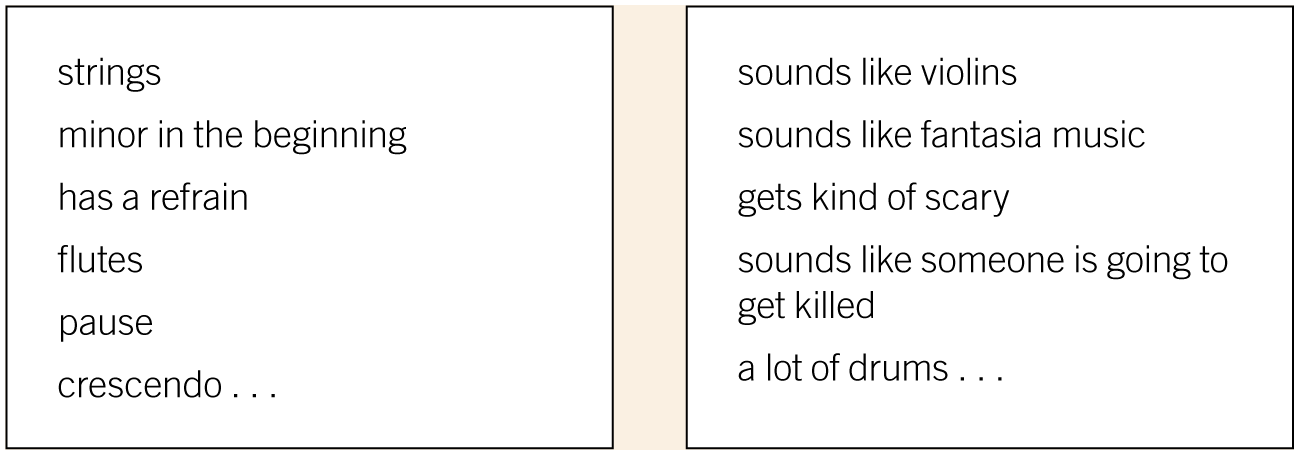
Two Excerpts of Listening Lists from Fifth Grade Students
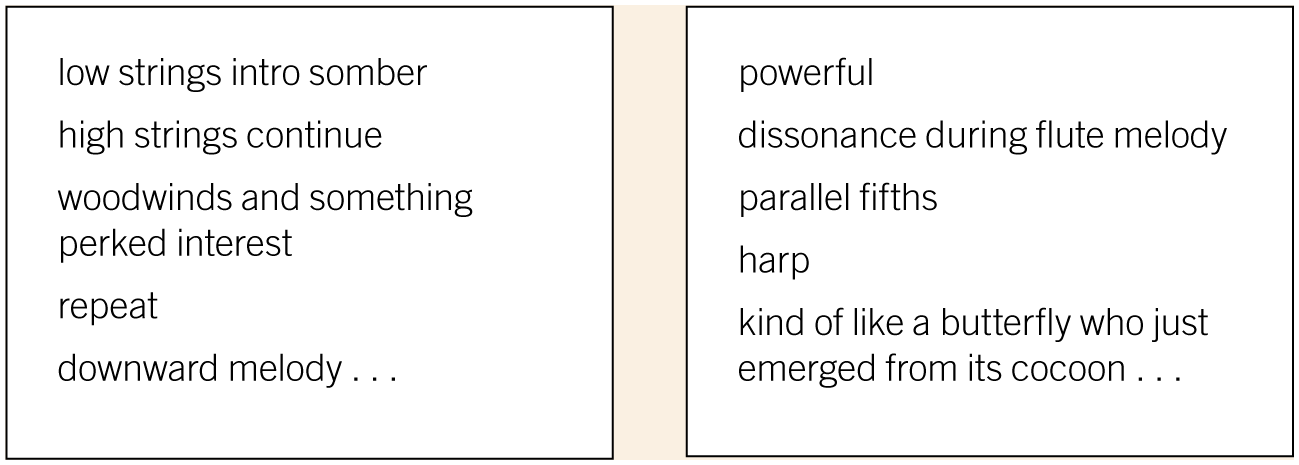
Two Excerpts of Listening Lists from College Students
All four students are fluent listeners in that they were all able to generate many items in their lists. Although there are some similarities among the lists, each student wrote about different aspects while listening, indicative of their unique musical experiences.
Listening lessons in fluency can encourage students to delve more deeply into music and listen to a greater number of aspects. Over time, the teaching of fluency can be sequenced by asking students to increase the minimum number of items in their lists from, say, at least five to seven to ten or more. The teacher can also vary the music’s style and increase the length of the piece.
Flexibility
A flexible thinker is able to think of many different kinds of possible ideas in response to a question, problem, or situation. To contrast flexibility with fluency, consider the following example. A fluent thinker, when asked where to go for lunch, might think of five possibilities, but they might all be hamburger joints. A flexible thinker, when faced with the same question, might think of Mexican, sushi, pizza, BBQ, and vegan restaurants. A flexible listener is able to hear, think of, and feel many different kinds of things while listening to music.
In the first example in Figure 1, the fifth-grade student was able to shift attention among timbre (“strings” and “flutes”), harmony (“minor”), form (“beginning” and “refrain”), and dynamics (“pause” and “crescendo”). The second student’s list in Figure 1 illustrates a similar degree of flexibility: timbre (“violins” and “drums”), style (“fantasia”), emotion (“scary”), image (“someone[’s] going to get killed”), and texture (“a lot of . . . ”).
In Figure 3 is a list of twelve characteristics of music or responses to music. I developed this list by analyzing listening lists created by hundreds of students in elementary school, high school, and college. I found that all the items students list could fit one of the categories in Figure 3.
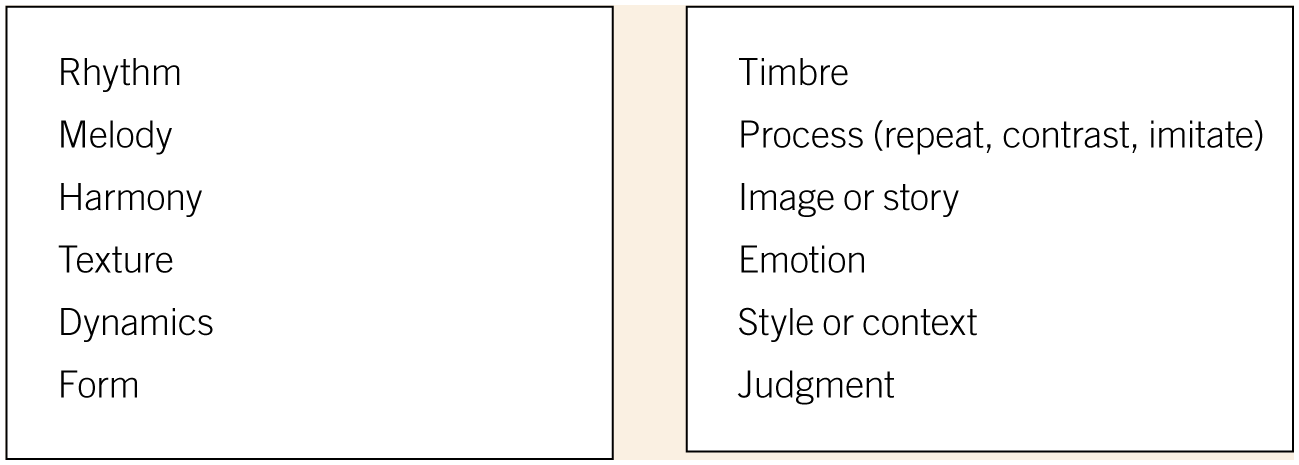
Categories for Flexible Listening
To teach flexibility in listening, a teacher can ask students to listen to a piece of music and write at least one thing that they hear, think of, or feel in several of the categories in Figure 3. For example, the students could be asked to write at least one thing they notice about the rhythm, one thing they notice about the timbre, and one image or story they imagine. Note that the directions for teaching flexibility do not lead to right or wrong answers. Students are not asked to identify the meter or the specific timbres they hear; rather, they are asked to note something about the categories of rhythm and timbre. Regarding the rhythm, for example, one student might notice that the music is fast, another might notice that the music has a steady beat, and another might notice that it would be fun to dance to. After the listening, the teacher can ask students to share what they heard with each other and then provide students with the opportunity to listen again.
Listening lessons in flexibility help students to engage the music they listen to on many different levels. For example, a student who only listens to music in terms of its lyrics or program can learn to listen for other musical aspects as well. Most collegiate aural skills classes focus students entirely on pitch and rhythm, two musical characteristics that can be notated, but flexible listening lessons would encourage students to engage more fully with other aspects of music. To develop students’ flexibility further, teachers can increase the number of categories that students list, use different styles of music, and ask students to choose the categories.
Elaboration
An elaborative thinker is able to embellish, expand, or notice combinations of ideas. To return to the previous lunch example, an elaborative thinker could provide a variety of reasons for going to a particular restaurant (e.g., the menu, the service, the location). In applying this concept to music listening, an elaborative listener is one who can hear, think of, or feel combinations of simultaneous aspects while listening to music. For example, the phrase “loud trumpet sounds scary” indicates that a student is listening to the dimensions of dynamics, timbre, and emotion at the same time. It is this aspect of simultaneity that distinguishes elaboration from fluency and flexibility.
Evidence of students’ elaborative listening can be found in the items that they write that combine multiple musical categories. In the first example in Figure 2, the student’s first comment, “low strings intro somber,” illustrates a high degree of elaboration by combining four different categories of music: pitch (“low”), timbre (“strings”), form (“intro”), and emotion (“somber”). Two other items on this list are elaborative: “high strings continue” (pitch, timbre, and process) and “woodwinds and something perked interest” (timbre and emotion). The second list in Figure 2 includes only a single elaborative item: “dissonance during flute melody” (harmony and timbre).
One way to encourage elaborative listening is to select music with contrasting sections and then ask students at the point of the change to write as many simultaneous changes that they hear, think of, or feel. For example, students might note that between the verse and chorus of a song, the music gets louder, changes the melody, has more instruments, and feels more powerful. After the listening, the teacher then asks students to share what they heard with each other. To help students progress as elaborative listeners, the teacher can use music with subtler changes and in varying styles.
Originality
An original thinker is able to think of unique ideas in response to a question, problem, or situation. When faced with the question of where to eat lunch, the original thinker might suggest getting animal crackers and eating at a zoo. An original listener is able to hear, think of, or feel unique aspects while listening to music.
In applying this concept to a music class, the uniqueness of a student’s idea is determined by its uniqueness within the context of the other students of the class. One way to encourage original listening is to ask students while listening to music to write at least one thing that they hear, think of, or feel that they think no one else in the class will write. Students can then be asked to share their ideas with the rest of the class to find out how original their ideas are. This type of thinking stimulates the opposite of convergent thinking, in which a single correct answer is the desired result. In Figure 2, the image of a butterfly emerging from a cocoon would have likely been unique among the students in the class.
The teaching of music listening as a creative activity encourages students to listen to music in deeper, more complex ways. It does so by focusing on various process-oriented ways of listening through the development of fluency (more ideas), flexibility (different kinds of ideas), elaboration (ideas in combination), and originality (unique ideas).
Assessing students’ creative listening is a matter of examining the processes that students use while listening rather than the correctness of their answers: For fluency, how many ideas can a student generate when listening? For flexibility, how many different musical categories (Figure 3) can a student use when listening? For elaboration, how many simultaneous changes can a student perceive while listening? For originality, how unique are a student’s ideas when listening? Each student has a unique listening profile, employing some creative processes more than others.
Teaching creative listening requires the same sort of finesse as nurturing student composers or improvisers. When students share with the class something they thought of while listening, they are imparting a unique piece of themselves. If a teacher were to correct a student response or ask a student to explain or defend a response, it is likely that the student would cease to contribute, just as the listener in the “ListeningCheck” vignette tuned out. The teacher’s role in teaching creative listening is vital in encouraging deeper, more complex ways of listening but not necessarily in serving as a fact-checker. In education, there is a time for correct answers and a time for the free rein of imagination.
Pedagogical Considerations
There are many advantages to teaching creative listening; here are a few:
Creative listening allows for multiple student outcomes, with all students able to achieve and demonstrate learning at their own level.
Creative listening rewards student diversity rather than uniformity. When students share their various ideas with each other, their future listening is enriched by the multiplicity of other ideas that their classmates had.
Creative listening employs higher-level thinking skills. In effect, each creative listening activity presents a problem to be solved, and students develop their own unique strategies to solve the problem.
Creative listening provides for a more authentic listening experience.
Regardless of these advantages, the teaching of music listening requires both convergent and divergent listening. Students cannot think creatively unless they have concepts to think about. In Figures 1 and 2, words like woodwinds, dissonance, and crescendo are learned concepts, taught through convergent listening lessons. Creative listening experiences enable students to combine these concepts in personally meaningful ways.
Perhaps our best guide to the teaching of music listening comes to us from more than two centuries ago. The famous eighteenth-century philosopher Immanuel Kant wrote that our judgment of beauty in works of art is based on the free play between understanding and imagination. 14 He said that understanding is a matter of developing concepts (e.g., convergent listening) and that imagination is a means for personally combining concepts (e.g., creative listening). Both understanding and imagination complement each other and are necessary components in our understanding and valuing of works of art. In our own time, the teaching of music listening has focused on conceptual development and has been missing a crucial piece. The teaching of imaginative, creative listening is the missing element.