




Abstract
Previous studies have not examined whether (personal) political ideology influences how trusters perceive of immigrants and refugees as a threat. Our contribution to the literature builds on theories of motivated reasoning and hypothesizes that political ideology weakens the ability of social trust to reduce perceived (ethnic) outgroup threat. Indeed, analyses show that the relationship between social trust and perceived outgroup threat is considerably weaker among rightists than among leftists. Although social trust does relate negatively to perceived outgroup threat across the ideological divide, political ideology has a constraining influence that cannot be ignored. Social trust is also a political phenomenon. We apply a fixed-effects regression, and analyses are based on the 2014-European Social Survey, including 21 countries and 32,175 individuals. In the concluding section, we discuss the full implications of our findings for theories of social trust in an era of increasing flows of immigrants and refugees that go beyond the usual gateway nations.
Keywords
Introduction
Incoming flows of immigrants or refugees cause social, cultural, and economic changes in numerous contemporary nations. Among wealthier nations, these changes stimulate political responses, referring to negative threat-based reactions among right-wing segments, and the opposite reactions among left-wing persons. In particular, the success of so-called right-wing populism reflects the transitions toward more ethnically diverse societies (Semyonov et al., 2006). In view of these social changes and concomitant ideological strife, the harmonious consequences of social trust appear to be increasingly important (also Herreros and Criado, 2009). It is the purpose of this study to understand how these political pressures related to increasing globalization influence the positive outcomes of social trust.
To be sure, many studies conclude that social trust is a vital source of positive outcomes for a society, as it means a readiness to think well of the so-called “generalized unknown other” (e.g. Bjørnskov, 2015; Brehm and Rahn, 1997; Nguyen and Bernauer, 2018; Uslaner, 2011; Welch et al., 2005). Social trust is a moral belief, ordering friendliness and generally pro-social behavior (Uslaner, 2004, 2011). Consistent with this conception, several studies have found an association between social trust and positive reactions toward ethnic outgroup members, including reduced perceived outgroup threat (e.g. Citrin and Sides, 2008; Ekici and Yucel, 2015; Herreros and Criado, 2009; Rochelle and Erickson, 2009; Rustenbach, 2010; Sides and Citrin, 2007). This specific type of reaction refers to the fear of harmful social, economic, or cultural consequences of immigration/flows of refugees (González et al., 2008; McLaren, 2003; Stephan et al., 1998).
Most importantly for our purposes, however, the theoretical understanding of social trust in the academic community is remarkably apolitical. With the notable exception of Rosenberg’s (1956) classic contribution, contemporary scholars tend to approach social trust as a belief that operates independently of ideological orientations (Barceló, 2016; Berning and Ziller, 2017; Chang and Kang, 2018; Ekici and Yucel, 2015; Herreros and Criado, 2009; Jung et al., 2017; Justwan, 2015; for a literature review, see Nannestad, 2008; Newton et al., 2017; Uslaner, 2002, 2017; Welch et al., 2005). Is this approach adequate? While arguing that social trust generates positive outcomes across the ideological divide is one thing (and ample empirical evidence supports this claim), it is quite another to claim (or assume) that the capacity of social trust to reduce perceived outgroup threat is equally powerful among leftists and rightists. We believe this claim to be implausible.
Accordingly, we contribute to the relatively sparse amount of research on the positive consequences of social trust. To advance knowledge, we claim that the capacity of social trust to reduce perceived outgroup threat varies across the ideological divide due to the occurrence of motivated reasoning at the mass level. We are the first to bring the theory of motivated reasoning into research on social trust. This theory is relevant because it emphasizes the role of a strong psychological propensity, triggering highly selective information processing meant to defend one’s key ideological values (Kunda, 1990). The average citizen is a biased (rather than neutral) judge of social developments. Applied to the case of immigration and inflows of non-Western refugees, social trusters likely respond differently to these social developments in contemporary nations. While all social trusters are more positive than distrusters, rightist trusters may feel more threatened by immigration and refugees because they value tradition and conformity more than leftists. The latter category typically values change and pluralism. Building on these theoretical considerations, we hypothesize that the ability of social trust to reduce perceived outgroup threat is considerably weaker among rightists than among leftists. Along these lines, (right-wing) political ideology may serve as a key condition capable of constraining the inclusionary implications of social trust.
We examine our hypothesis in a comprehensive fixed-effects regression analysis of 32,175 individuals nested in 21 different nations. The data are from the European Social Survey fielded in 2014, as this provides theoretically adequate measures. The empirical analysis supports our ideological constraint hypothesis. We discuss the full implications of our findings for theories of social trust in the concluding section.
Social Trust
The object of social trust is the generalized and unknown other (Delhey and Newton, 2005; Dinesen and Sønderskov, 2012; Rothstein and Uslaner, 2005). Specifying its substance, some scholars emphasize that social trust is a positive (and unprejudiced) belief about other people that is not based on personal experiences or interactions with them (Ahn and Ostrom, 2003: 20). Consistent with this claim, numerous studies have concluded that social trust fosters positive reactions toward (unknown) ethnic outgroup members (e.g. Bahry et al., 2005; Berning and Ziller, 2017; Côté and Erickson, 2009; Herreros and Criado, 2009; Sides and Citrin, 2007; Uslaner, 2010).
But does social trust always foster positive reactions toward ethnic outgroup members irrespective of other values and attitudes? This question has received surprisingly little attention in the social trust literature; in fact, there would appear to be two different perspectives on the efficiency of social trust across political and ideological values. We will distinguish between the inclusionary and exclusionary perspectives (Bahry et al., 2005). We expand on both below.
The Inclusionary Perspective
The essence of this perspective originates from an oft-quoted definition of generalized social trust as a positive view of other people who remain unknown and are most likely different from oneself (Uslaner, 2010). Trusters will be most friendly toward their own group members, but they will also be positive toward unknown ethnic outgroup members (Bahry et al., 2005; also Herring et al., 2005). To explain this “generous” inclusiveness, Uslaner (2002: 2) argues that social trust is an inherently optimistic belief that others are honorable (also Ahn and Ostrom, 2003: 19–20). Indeed, Uslaner (2000) relates social trust to the notion of a moral foundation (“moralistic trust”). In turn, this foundation implies that trusters are convinced that other (unknown) people have high moral integrity—they are generally honest and caring rather than dishonest and ruthless (Uslaner, 2002: 2–3). It follows from this that serious conflicts between majority and ethnic outgroup members are much rarer in nations with high levels of social trust (Uslaner, 2010).
The Exclusionary Perspective
A number of studies emphasize that the positive implications of social trust may be limited (Alesina and La Ferrara, 2002: 231; Dinesen and Sønderskov, 2012; Glaeser et al., 2000; Hooghe et al., 2007; Putnam, 2007). According to this perspective, most people instinctively see members of their own group as more trustworthy than others. Such in-group favoritism relates to the important role that closeness and confidence plays in human interaction as “… most individuals are less inclined to trust those who are different from themselves, because familiarity breeds trust …” (Alesina and La Ferrara, 2002: 8). Alesina and La Ferrara (2002) assume that the average person opposes “too much” diversity, which might also explain why social trust is generally higher in more ethnically homogeneous countries (also Nannestad, 2008; Putnam, 2007). Although the diversity–trust relationship remains debated in the academic community (see Dinesen and Sønderskov, 2015, 2017), the argument among some scholars is that those who share language, history, culture, morals, and traditions are better able to predict each other’s behavior and reactions (Leigh, 2006). Yamagishi et al. (2007) argue that trust relates to shared norms, which in turn foster generalized interdependence (also Yamagishi et al., 2009). In any event, the proponents of this perspective conclude that it is natural for people to be more trusting of persons from their own group; ultimately, trust may relate to important constraints, such as values or norms (Freitag and Traunmüller, 2009).
Trust and Motivated Reasoning
Even so, both perspectives are rather apolitical, as scholars relate social trust neither to partisan motives nor to ideological values (for literature reviews, see Kramer, 2017; Nannestad, 2008; Uslaner, 2017; Welch et al., 2005). Social trust is conceptualized as an exclusively social phenomenon among those who study its positive consequences (see, for example, Barceló, 2016; Berning and Ziller, 2017; Chang and Kang, 2018; Ekici and Yucel, 2015; Jung et al., 2017; Herreros and Criado, 2009; Rustenbach, 2010). In order to introduce a more politics-centered approach, we wish to expand the exclusionary perspective, as this does emphasize that social trust may rest on important conditions. More specifically, there is a need for introducing political ideology as a key condition of social trust—considering the fact that social trusters also necessarily harbor (different) ideological values.
What is political ideology then? Political ideology connotes particular beliefs and values acquired early in life (Alford et al., 2005; Rico and Jennings, 2016). Beliefs are perceptions of the social world, including assumptions about human nature, whereas values define what the world should look like (Federico, 2012). Both components suggest that ideology has an evaluative function, as social phenomena are considered good or bad according to pre-existing beliefs and values. It is also common to distinguish between left-wing and right-wing values as referring to opposing ideological positions. Leftists typically value diversity, change, and social equality, whereas rightists value conformity, stability, and the maintenance of inequalities (Jost et al., 2003; Knutsen, 1998; Thorisdottir et al., 2007). Likewise, conservatism would appear to be strongly related to psychological needs for reducing uncertainty and threat (Jost, 2009).
Our aim is not to identify all the specific values and beliefs of political ideology. Based on previous research, we take for granted that a self-reported leftist has greater acceptance of left-wing values than right-wing values, and the opposite applies for self-reported rightists (Jost et al., 2003; Knutsen, 1998; Rico and Jennings, 2016). Rather, our interest concerns the ability of political ideology to provoke distinctly different responses to social developments or groups (Federico, 2012). Thus, leftists may see greater ethnic and religious diversity in society as harmless, valuable progress, whereas rightists may consider them an indicator of cultural disintegration and excessive social spending. Supporting these suggestions, Jost and Amodio (2012) found a strong, positive relationship between resistance to change and political conservatism.
Ideology has a cognitive function according to this perspective, as it provides a heuristic with which social changes can be interpreted in terms of their causes and consequences (Jost et al., 2003). In turn, this means that political reasoning is usually governed by “directional motives,” referring to “partisan goals” or ideological values (Jost et al., 2003; Kunda, 1990; Leeper and Slothuus, 2014; Taber and Lodge, 2006). Scholars on motivated reasoning emphasize that once prior values crystallize, persuasion becomes difficult because the individual manages information very selectively (Lahav and Courtemanche, 2012; Taber and Lodge, 2006). On average, motivated reasoning is a strong psychological force because it protects one’s identity. For example, rightists who believe that the transition to a multicultural society is negative eagerly welcome empirical evidence supporting this conclusion and discount evidence to the contrary (Taber et al., 2001). Similarly, leftists who consider immigration to be good tend to reject negative information about this phenomenon.
Because of motivated reasoning, majority members are the most likely to defend their beliefs and values when observing inflows of immigrants. If true, this means that immigration may stimulate an ideological asymmetry, as this phenomenon necessarily relates to broader issues, which in turn challenge right-wing rather than left-wing values. Expanding on this point, rightists have stronger preferences for conformity and tradition (Jost et al., 2008), and yet immigration and the expansion of ethnic minority groups inevitably bring about social and cultural changes in any democratic society. Relatedly, Jost et al. (2008) found that leftists (“liberals”) have stronger preferences for remedying social injustices, whereas rightists are more inclined to endorse system justification. Again, inconsistent with rightist preferences, the inflow of low-skilled and often vulnerable immigrants and refugees most likely accentuates the need for more generous social policies aimed at protecting these groups.
Deriving a Hypothesis
If the inclusionary perspective is correct, the impact of social trust on perceived outgroup threat should be uniform across the ideological divide. In contrast, a non-uniform role is more consistent with the exclusionary perspective, although the influence of political ideology remains unaddressed within this framework. Moreover, our extension of the exclusionary perspective is predicated on the assumption that increasing ethnic diversity stimulates so-called confirmation bias capable of increasing negative sentiments among those rightists who face the greatest challenges from changes in the social environment (also Kunda, 1990). To be sure, leftists will also observe modifications of national cohesion and culture, but their ideological predispositions may prevent them from having negative implications in terms of greater perceived outgroup threat. According to the inclusionary perspective, social trust is therefore a much stronger impulse than motivated reasoning, whereas the exclusionary perspective questions this conjecture.
This leaves two motivational forces triggering completely opposite reactions: social trust relates negatively to perceived outgroup threat, whereas political ideology relates positively to this perception. In addition to the values referred to previously, rightists are the most suspicious of human nature, as they emphasize the dangers of free riding behavior, laziness, or lack of compliance with social norms (Lakoff, 2002). It is hardly a coincidence that welfare fraud has been a major concern among right-wing circles in many countries since the 1980s (Heywood, 2007). Following Rosenberg (1956), social trust and political ideologies intersect in implicit or explicit assumptions about human nature. The combination of distinct values and beliefs about human nature may imply that political ideology is sufficiently powerful to constrain the impact of social trust on perceived outgroup threat. Building on this theoretical rationale, we advance the following hypothesis:
The ideological constraint hypothesis: Social trust relates negatively to perceived outgroup threat; however, the relationship is considerably weaker among rightists than among leftists.
Data, Measures, and Model Specification
To examine our ideological constraint hypothesis, we utilized the 2014-European Social Survey (round 7), because it contains cross-national data on social trust, self-reported political ideology, and perceived outgroup threat. This data source is widely regarded as being of high quality due to the strict standards guiding the survey design and data collection process. The respondents were sampled from the residing population in each country (aged 15 or older), with an average response rate of about 53%. Further details concerning the sampling procedure and fieldwork can be found in European Social Survey (2014). As our theory exclusively addresses the contact between natives and immigrants, all non-native residents were excluded from the analysis, resulting in a sample comprising 32,175 individuals from 21 countries (those reporting that they belong to an ethnic minority were excluded). The average per country effective sample size is 1532, with a maximum of 2717 (Germany) and a minimum of 887 (Slovenia) (see Table 1).
Descriptives of Ethnic Outgroup Threat, Social Trust, and Political Ideology, by Country.

Source: 2014-European Social Survey (round 7).
M = mean; SD = standard deviation.
Inspired by previous studies (e.g. McLaren, 2003; Scheepers et al., 2002; Schneider, 2008), we chose six items to measure perceived outgroup threat. More specifically, they address the perceived cultural, economic, and social costs. Their exact wording is as follows: (1) “Would you say that people who come to live here generally take jobs away from workers in [country]? Or do they generally help to create new jobs?” (2) “Most people who come to live here work and pay taxes. They also use health and welfare services. On balance, do you think people who come here take out more than they put in or put in more than they take out?” (3) “Would you say it is generally good or bad for [country]’s economy that people come to live here from other countries?” (4) “Would you say that [country]’s cultural life is generally undermined or enriched by people coming to live here from other countries?” (5) “Is [country] made a better or worse place to live by people coming to live here from other countries?” (6) “Are [country]’s crime problems made worse or better by people coming to live here from other countries?” Responses to the six items were turned into an index by averaging responses, conditional on two valid responses (resulting in a sample loss of 0.62%). The reliability of the index was acceptable, as indicated by Cronbach’s alpha, which ranges from 0.739 to 0.889 across countries and equals 0.845 for the pooled sample (see Table 1). The index was subsequently rescaled to vary from 0 to 1, higher values indicating greater perceived outgroup threat (see Table 1). Table 1 also reveals how perceived outgroup threat varies considerably across the sampled countries. Perceived outgroup threat is lowest in Sweden, Germany, and Finland, whereas it is highest in the Czech Republic, Hungary, and Austria. These items are attractive for our purposes as they inevitably stimulate the respondent’s immediate perception of rather abstract sociotropic costs (rather than personal costs, vulnerability, or contact experiences). The key issue is what type of (positive or negative) associations the unknown ethnic outgroup member triggers in the mind of the average majority member. Generalized trust should certainly reduce this type of threat perception.
Building on the work of Reeskens and Hooghe (2008), social trust is an index comprising three standard items: (1) “Generally speaking, would you say that most people can be trusted or that you can’t be too careful in dealing with people?” (2) “Do you think that most people would try to take advantage of you if they got the chance or would they try to be fair?” and (3) “Would you say that most of the time people try to be helpful or that they are mostly looking out for themselves?” All items range from 0 to 10. Responses were averaged conditional on valid responses to at least two items. The index was subsequently rescaled to vary 0–1, higher values indicating greater social trust (M = 0.548; SD = 0.179; α = 0.747). Most of the academic community prefers this three-item scale (rather than only the first item), as it works well cross-nationally, it reduces measurement error (compared to one item), and it obviously allows for greater differentiation. Uslaner (2002) argued that the two additional items tap into personal experiences too much. This may be true, but they do correlate strongly with the first item, indicating a similar latent construct (the correlation between the three items varies between 0.478 and 0.568)—as also concluded by Dinesen (2011) in his detailed scale analysis.
Consistent with a number of previous studies, we measured our key interacting variable – political ideology – using the following item: “In politics, people sometimes talk of ‘left’ and ‘right’. Where would you place yourself?” The raw measure varies from 0 to 10 (= right) but was subsequently rescaled to vary between 0 and 1, higher values indicating a right-wing position (“don’t know” responses were excluded). Left–right self-placement is a composite and rough measure but has been utilized in public opinion research since the early 1960s. Although “left” and “right” are highly symbolic labels, previous research has found a clear relationship between self-reported ideology and policy preferences. Self-identified “rightists” or “leftists” hold policy preferences consistent with their ideological labels (Treier and Hillygus, 2009). Most important for our purposes, numerous studies have found that self-reported rightists also tend to have more negative attitudes toward immigration and immigrants (Sides and Citrin, 2007). Furthermore, Table 1 indicates that the mass-level average of ideology falls rather close to the midpoint of the scale in all 21 samples. This suggests that the very meaning of the “left” and “right” labels changes little from one country to the next. Relatedly, the next column shows that the standard deviations around the means of ideology are not very far apart. In other words, the analyses do not include countries with extreme polarization or extreme left-wing or right-wing political cultures.
We know from previous research that social trust and attitudes toward immigration relate to various demographic characteristics (e.g. Glaeser et al., 2000; Sides and Citrin, 2007). In order to reduce the likelihood of spurious associations, we include a range of standard controls at the individual level: (1) gender (male as reference category), (2) age (in years), (3) education (in years), (4) economic satisfaction (“no satisfaction” as the reference category, and “don’t know” responses were excluded), (5) labor market status (“outside the labor market” as reference category), (6) residential area (countryside as reference category), and (7) intergroup contact was measured as an index summating self-reported scores on friendship and the frequency of residential contact. This variable was rescaled to range from 0 to 1, higher values indicating greater contact (“don’t know” responses were excluded).
The empirical analyses include no controls at the national level, as we apply a fixed-effects regression analysis specification. This choice of statistical modeling reflects the fact that the specified hypothesis relates exclusively to the individual level of social interaction, which makes it all the more urgent to ensure that macro-level confounders have no influence on the estimated individual-level relationships. The fixed-effects regression specification explicitly deals with omitted variable bias. In our case, this means that macro-level influences are eliminated by controlling for country dummies, thus leaving controlled estimates at the individual level. In other words, the country dummies explain all of the variance at the country level, implying that there is no variance left to be explained by additional country-level variables (Allison, 2009). Consistent with conventional guidelines, the country dummy coefficients are not reported.
Naturally, a final issue relates to endogeneity. We are unable to show that social trust necessarily governs perceptions of ethnic outgroup threat rather than the other way around. This endogeneity issue cannot be solved on the basis of the present data. However, previous studies support the assumption that social trust most likely precedes perceptions of threat. First, Uslaner (2008) concluded in a comprehensive analysis of different ethnic groups that social trust is an enduring belief that is transmitted from one generation to the next. Trust becomes a legacy. Second, and consistent with this result, Stolle and Hooghe (2004) reported that trust levels at age 17 strongly related to trust levels at age 34. Both studies indicate that pre-adult socialization processes strongly influence the formation of social trust at the individual level. Even more, Petersen and Aarøe (2015) reported from the analysis of register data that social trust also relates to birth weight (greater birth weight predicted greater social trust). In combination, social trust is able to influence perceptions of ethnic outgroup threat. In contrast, the ability of perceived outgroup threat to reduce or spur social trust appears limited—at least when the average individual is not experiencing extreme (and frequent) changes in their immediate environment. In this context, it may also be noteworthy that the present data were collected prior to the so-called 2015 refugee crisis.
Empirical Results
We start by showing the uncontrolled zero-order correlations between all of the variables in subsequent analyses. It is important that the correlations between the key variables of interest (social trust, political ideology, and perceived outgroup threat) are of moderate strength, as this would indicate the possibility of tautological statements. Table 2 shows that social trust is moderately related to perceived outgroup threat (r = −0.342), whereas political ideology is weakly related to this variable (r = 0.086). Social trust and political ideology are very weakly related (r = 0.030), although the relationship is statistically significant. Table 2 also reveals that two controls are particularly important in order to eliminate their confounding influence. First, education relates to both social trust and perceived outgroup threat. Second, financial hardship is also clearly related to both perceived outgroup threat and social trust. More generally, Table 2 does not report any extreme correlations between the variables included in the analysis, which indicates sufficiently unique variance.
Zero-Order Correlations between Dependent and Independent Measures.
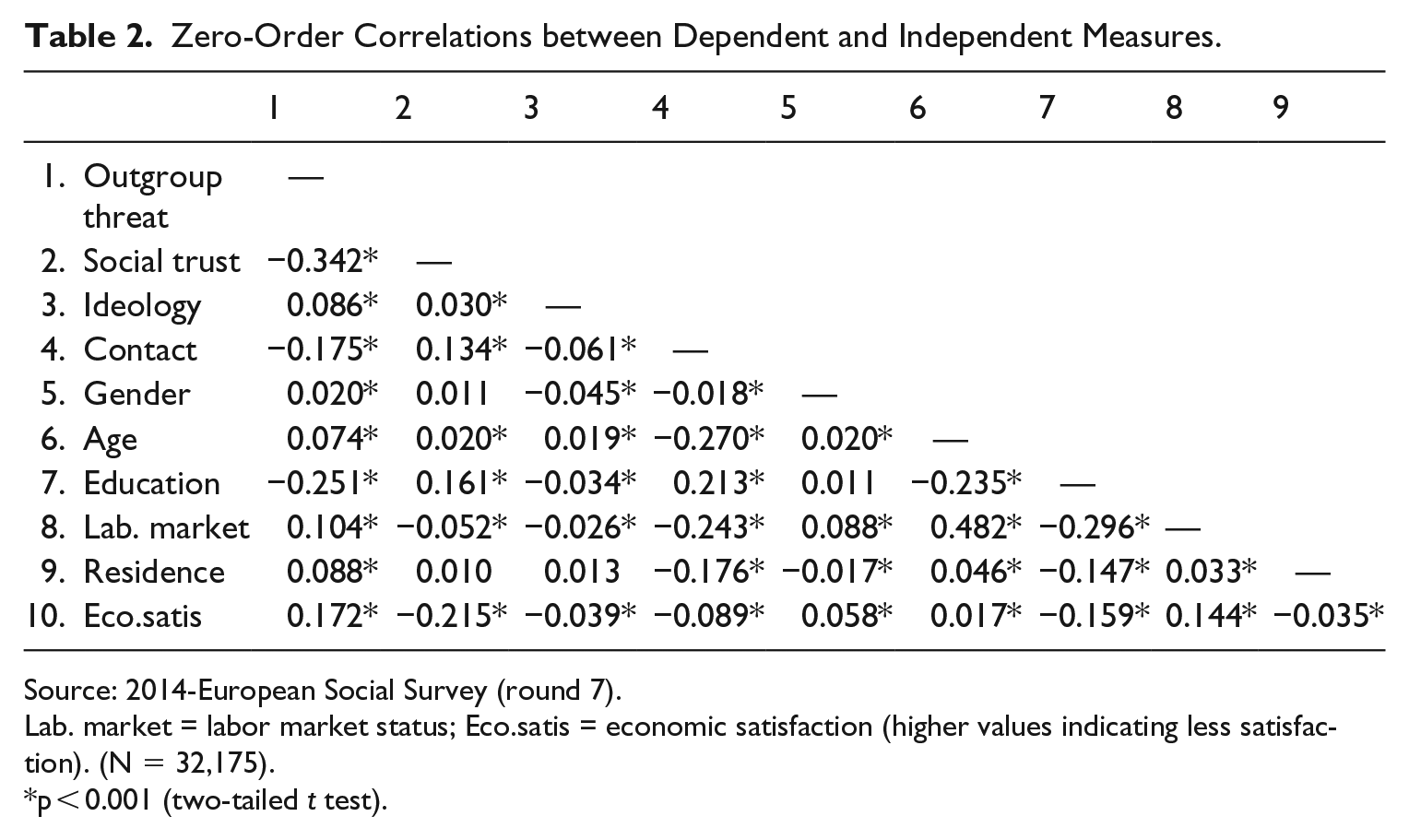
Source: 2014-European Social Survey (round 7).
Lab. market = labor market status; Eco.satis = economic satisfaction (higher values indicating less satisfaction). (N = 32,175).
p < 0.001 (two-tailed t test).
Table 3 tests our hypothesis and is organized into two columns, distinguishing between Models 1 and 2. Model 1 shows the effects of social trust and political ideology while assuming that their effects are uniform across social and dispositional characteristics. Social trust is significantly and negatively related to perceived outgroup threat. When shifting from maximum distrust to maximum trust, perceived outgroup threat is reduced by −0.269 scale points—this effect covers more than a quarter of the dependent scale. Political ideology is also significantly related to opposition to immigration, but its coefficient is positive in sign: When shifting from extreme left to extreme right, perceived outgroup threat increases by 0.076 scale points. Consistent with our argument, social trust and political ideology thus relate to perceived outgroup threat in diametrically opposed ways.
The Relationship between Social Trust and Ethnic Outgroup Threat, Including the Interaction Term between Social Trust and Political Ideology.
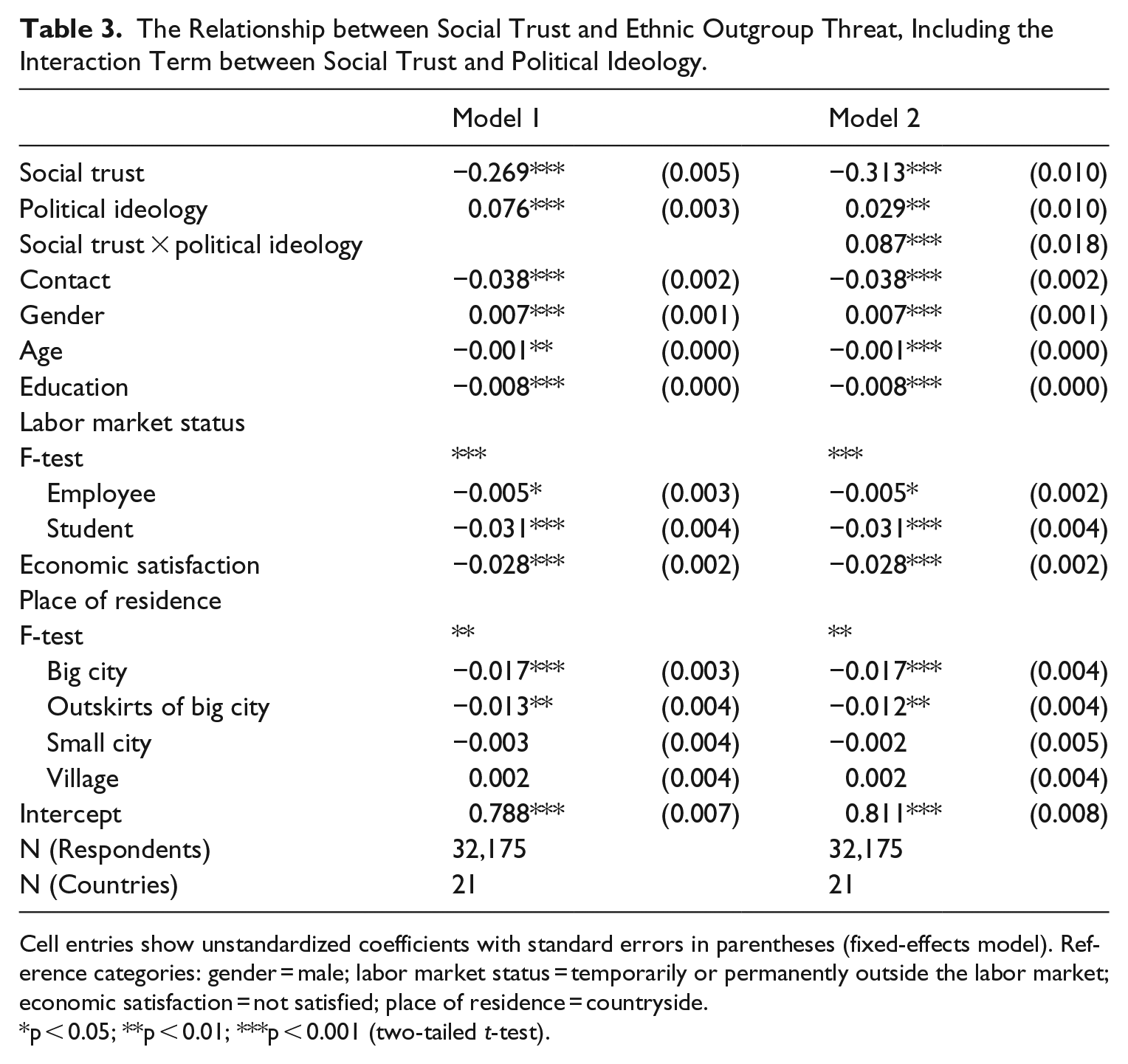
Cell entries show unstandardized coefficients with standard errors in parentheses (fixed-effects model). Reference categories: gender = male; labor market status = temporarily or permanently outside the labor market; economic satisfaction = not satisfied; place of residence = countryside.
p < 0.05; **p < 0.01; ***p < 0.001 (two-tailed t-test).
Model 2 provides the test of our hypothesis by showing the relevant multiplicative term or interaction coefficient (social trust × political ideology). The interaction coefficient is statistically significant and positive in sign (0.087), whereas the coefficient of social trust is negative in sign (−0.313). Recall that the effect of social trust in Model 2 is mathematically tied to the minimum value of political ideology (0 = leftists). In other words, when social trust shifts from distrust to trust, perceived outgroup threat is reduced by −0.313 scale points specifically among leftists. On the contrary, the interaction coefficient (0.087) informs that the effect of social trust becomes less negative when political ideology shifts from its minimum to its maximum value (1 = extreme rightists). Indeed, the effect of social trust is reduced by 0.087 (i.e. perceived outgroup threat increases) among rightists compared to leftists. Taken together, the manner in which social trust relates to perceived outgroup threat varies greatly across the scores on political ideology.
As we are interested in observing how social trust relates to the dependent measure across a broader range of political ideology values, we present the marginal conditional effects of social trust in Figure 1. Consistent with Table 3, the predictive capacity of social trust is specified as a mathematical function of political ideology. The marginal effect size of social trust at fixed values of political ideology appears on the solid line and can be read off the y-axis, whereas the values of the moderator (political ideology) appear along the x-axis. Thus, the essential idea behind this post-estimation design is to observe the extent to which the marginal effect of social trust changes as different values of political ideology are held constant (see Kam and Franzese, 2007).
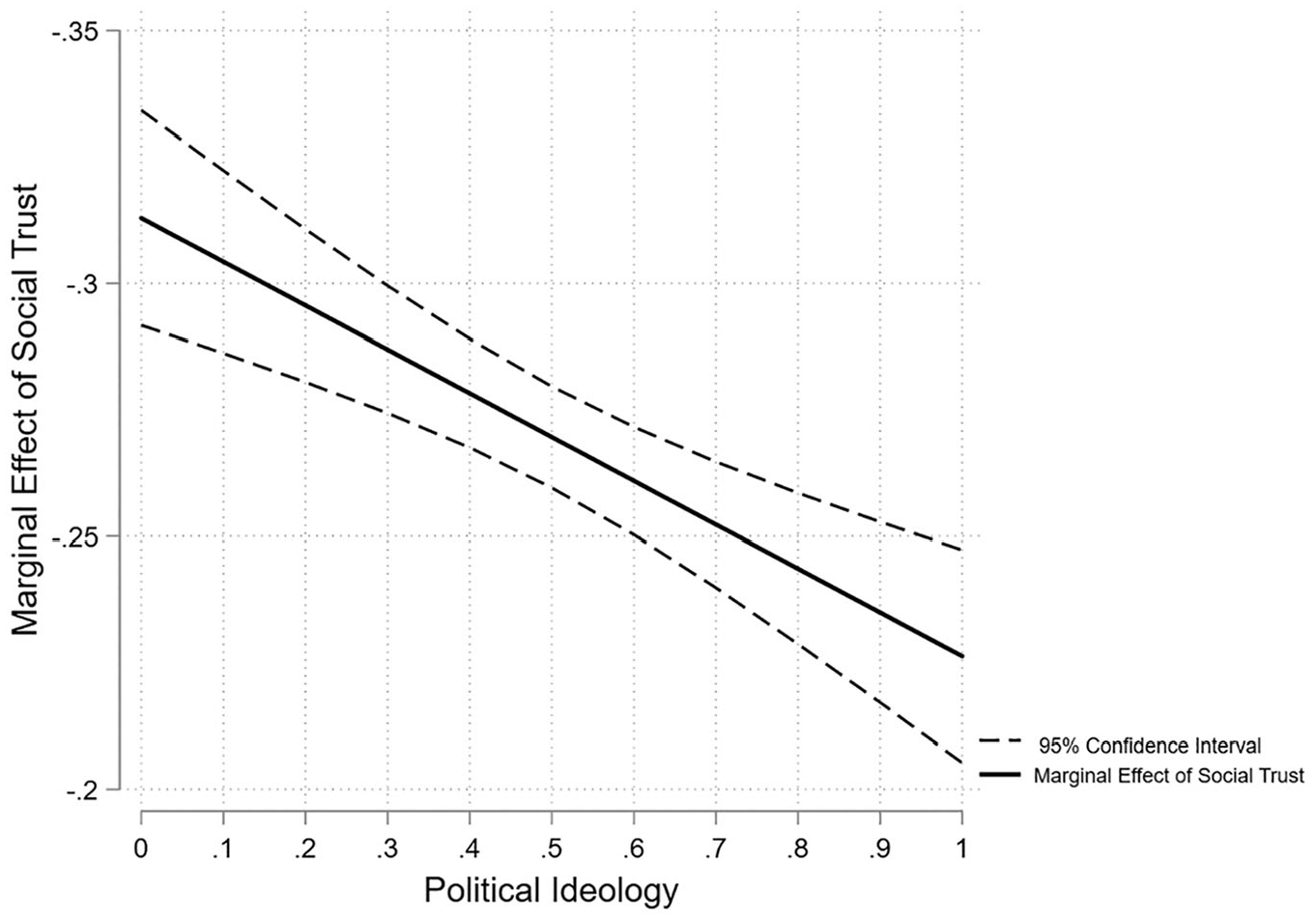
The Marginal Effect of Social Trust on Ethnic Outgroup Threat, Conditional on Political Ideology.
In substantial terms, the association between social trust and perceived outgroup threat is certainly constrained by political ideology: The marginal effect of social trust on perceived outgroup threat becomes increasingly smaller across the range of values of political ideology. In fact, the marginal effect of intergroup contact on opposition to immigration is estimated to be reduced at a rate of 0.087 scale points for a one-unit increase in political ideology (when political ideology shifts from 0 to 1). Specifically, we know from Table 2 that the marginal social trust effect among leftists is −0.313, from which it follows that the marginal social trust effect on perceived outgroup threat among rightists is −0.226 (−0.313 + 0.087), as shown in Figure 1. Thus, the capacity of social trust to predict perceived outgroup threat is reduced by about 28% when shifting from the category of leftists to that of rightists. Although the association between social trust and perceived outgroup threat is clearly constrained by ideology, Figure 1 also informs that social trust relates negatively to perceived outgroup threat at any value of political ideology. This observation derives from the fact that the 95% confidence intervals around the solid line, which represents the marginal effect of social trust on perceived outgroup threat, nowhere includes zero; in fact, the marginal effect of social trust varies between −0.313 and −0.226 (as shown above). In sum, analyses clearly support our ideological constraint hypothesis. 1
In order to check the robustness of our results, we need to address the so-called ideological value dimensionality issue. For decades, political scientists have concluded that political preferences map onto two different left–right dimensions in modern society, one economic and one non-economic (e.g. Flanagan, 1987; Kitschelt, 1994; Treier and Hillygus, 2009). Both dimensions reflect latent ideological values among the mass public. As the two dimensions only correlate moderately among the mass public, it follows that some individuals are both governed by left-wing and right-wing values when forming policy preferences about specific economic and non-economic issues. In contrast, others will offer consistently right-wing or left-wing responses to issues on both dimensions. Certainly, this line of reasoning differs from our measure of left–right self-placement, which is by definition unidimensional (a person is either right-wing or left-wing according to this measure). Accordingly, how sensitive are our results to the dimensionality issue—does it hold true that right-wing trusters are generally more skeptic toward immigration than left-wing trusters? To answer this important question, additional analyses applying alternative measures of ideological values are all reported in the Online Supplemental Appendix. First, the data set offers a measure of attitudes toward reducing income differences (a traditional indicator of the economic dimension). 2 Traditionally, rightists tend to oppose income redistribution. Second, the data set also taps attitudes toward the importance of sharing the same cultural traditions and homosexuality (i.e. traditional indicators of the non-economic dimension). 3 Rightists usually emphasize compliance with cultural traditions and dislike homosexuality. For the same reason, the non-economic dimension is often labeled the libertarian-authoritarian scale, indicating that authoritarians generally support assimilation and conformity (Flanagan, 1987). As far as the results are concerned, the additional analyses show that a rightist view on social redistribution reduces the impact of social trust on perceived outgroup threat (Supplemental Table 1A, Model 4, Supplemental Figure 1B). This interaction effect (0.053**) is somewhat weaker than the interaction effect we report in the main text. Moreover, authoritarian views on traditions and homosexuality also reduce the impact of social trust on perceived outgroup threat (see Supplemental Table 1A, Model 2, Supplemental Figure 1A). This interaction effect, however, is clearly the strongest of the three ( 0.124***). These observed differences in the magnitude of the multiplicative terms may suggest that trusters evaluate both the economic and non-economic consequences of immigration: however, non-economic issues—“cultural matters”—remain the most important for right-wing trusters in particular. 4 Summing up, despite some sensitivity toward the exact indicators of ideological values, all additional analyses support our hypothesis, claiming that right-wing (economic and non-economic) values constrain the ability of social trust to foster approval of ethnic outgroup members. 5
Finally, recall that some scholars argue that social trust should be measured by the standard Rosenberg item. To be fair toward those who disagree with the three-item solution (Uslaner, 2000), we also show our results with the one-item solution in the Online Supplemental Appendix (Table 2A, Model 2, Supplemental Figure 2A). The results are only marginally different, meaning that the one-item solution also supports our hypothesis. 6
Discussion and Conclusion
The key source of inspiration for the present study was a quote from Rosenberg (1956: 694) where he argued that, “… the way a man looks at people has a bearing upon the way he looks at certain political matters.” To expand on this important claim, we have reported a comprehensive analysis of 21 nations and 32,175 individuals, in which we have shown that social trust relates strongly and negatively to perceived outgroup threat. This result is fully consistent with previous studies, although most of them have used alternative measures of negative reactions toward ethnic minority members (e.g. Herreros and Criado, 2009; Rochelle and Erickson, 2009; Rustenbach, 2010; Sides and Citrin, 2007). Unlike previous studies, however, we also showed that the ability of social trust to reduce perceived outgroup threat is not uniform across the ideological divide. To be sure, our findings are not inconsistent with Uslaner’s (2000) claim that the moral community can co-exist with ideological differences; however, our analyses do show that the moral community is not ideologically innocent, as right-wing trusters have a more pessimistic view of the consequences of non-Western immigration than their left-wing counterparts.
We are the first to show this result—and it implies more generally that political and ideological values shape some of the real-life consequences of social trust. Inconsistent with the implications of the inclusionary perspective, social trust appears unable to overpower the constraining influence of political ideology (and motivated reasoning). In psychological terms, this may suggest that social trust and political ideology with respect to reactions toward immigration constitute an important type of cross-pressure among specific segments of the citizenry: social trust implies extensive solidarity with immigrants and refugees, whereas right-wing values call for more exclusionist policies in order to protect national cohesion and distinctiveness. More generally, such important psychological ambivalences are undoubtedly indicators of the complexities and challenges of contemporary globalization processes.
In terms of contributions, our main finding speaks to a long-standing debate about the inclusiveness of social trust (see, for example, Delhey et al., 2011; Welch et al., 2005). Most scholarship sees trusters as persons who are tolerant toward increasing ethnic diversity and significant social transitions in their environment. There are many sources of conflict related to such processes, but social trust is certainly not one of them. Rather, social trust helps to reduce or even prevent deep divisions of opinion in a given society. However, there are immediate observations that do not support this inclusive and apolitical view of social trust. For example, it is well-established that the Nordic nations—Denmark, Norway, and Sweden, in particular—have the most trusting populations in the world (Delhey et al., 2011; Svendsen and Svendsen, 2015). Nonetheless, immigration and refugees have become deeply divisive political issues in Denmark and Norway in recent decades—here, we find some of the most influential radical right-wing parties, and traditional right-of-center parties have also become more opposed to immigration (Jensen and Thomsen, 2011). This is merely to suggest that we need more knowledge about factors that constitute the boundaries of social trust. Expanding on this important “boundary” issue, many scholars appear to emphasize the role of specific negative experiences with other people (e.g. Hardin, 2002). Such experiences may weaken the “good will” among trusters toward specific groups (Uslaner, 2000). This is a plausible proposition invoking some notion of instrumental rationality, but it also leaves a central question: Must trusters necessarily have personal experiences with a particular group to form an opinion about it? Our answer is negative, although we do not reject the importance of personal experiences. The point is that the influence of motivated reasoning does not necessarily hinge on any direct personal experiences with ethnic outgroup members, as its psychological processes include primarily principled responses to changes in the social environment. More specifically, the average truster can either see in their immediate environment or observe through media stories that incoming non-Western immigrants or refugees differ from the majority group in terms of habits, norms, or values (see Sniderman and Hagendoorn, 2007). The average truster is also capable of recognizing that a continuous inflow of new citizens from different cultures does not leave society unaffected in the long term; indeed, all well-established democratic societies must accommodate increasing ethnic diversity at many different institutional levels to some extent (see Thomsen and Olsen, 2017). In other words, these social and cultural changes disproportionately challenge trusters with right-wing orientations because they value tradition and conformity.
All studies have weaknesses, including ours. We have applied theories of motivated reasoning in order to indicate why left-wing and right-wing trusters react differently toward ethnic outgroup members. The key explanation is that values cause biases in human cognition processes. However, we were unable to test the central claims of theories of motivated reasoning. Instead, it might be sufficient to apply the theory of basic individual values, which does not explicitly address the role of various cognition biases. This theory proposes that more or less universal values exist, such as security, conformity, tradition, benevolence, and universalism (Schwartz and Bilsky, 1987). Schwartz et al. (2012) argue that such basic values influence people’s experiences and everyday decisions. Values represent goals and priorities—and goals are often in conflict (i.e. they are incompatible). Although we do not have various measures of values, the present data support the idea that some of these values are important across numerous European countries. It certainly appears that the debate about the consequences of (non-Western) immigration relates to—and activates—opposing clusters of values, referring to pluralism versus conformity, modernity versus tradition, and intolerance versus tolerance. Thus, social trust seems to operate in tandem with important clusters of values. Accordingly, we conclude that previous accounts of social trust as self-interested behavior (Hardin, 1993) or moral beliefs (Uslaner, 2000) are clearly relevant but insufficient. They both ignore the ideological component.
A final weakness relates to our data, which do not allow for strong causal inference, although it seems most likely that social trust influences perceived outgroup threat rather than the other way around. After all, negative opinions about a specific group (of non-Western immigrants) may have limited impact on people’s views of the human race in general, although this may not hold true over longer time periods, witnessing substantial social changes. Likewise, the role of political parties remains unsettled as regards the influence of political ideology on the relationship between social trust and perceived outgroup threat. It is well-established that the average citizen is inattentive and ill-informed regarding most political issues (Sniderman and Hagendoorn, 2007). They have limited cognitive capacity, meaning that political parties become important informants as regards issues about which the public should be concerned. In that manner, the nature of the messages offered by the political parties also becomes important. In Europe, right-wing political parties have focused intensively on the negative consequences of immigration and inflows of refugees in recent decades (Arndt and Thomsen, 2019; Cole, 2005). Future research will have to examine whether negative political messages stimulate some trusters’ ideological biases against ethnic outgroup members. Meanwhile, we conclude that social trust as a belief is inextricably linked to ideological values, confirming the need for integrating theories of social trust and motivated reasoning.
Supplemental Material
PSX862751_Supplemental_material – Supplemental material for Ideological Biases Weaken the Impact of Social Trust on Ethnic Outgroup Threat
Supplemental material, PSX862751_Supplemental_material for Ideological Biases Weaken the Impact of Social Trust on Ethnic Outgroup Threat by Jens Peter Frølund Thomsen and Arzoo Rafiqi in Political Studies
Footnotes
Funding
The author(s) received no financial support for the research, authorship, and/or publication of this article.

Supplemental Material
Additional supplemental material may be found with the online version of this article.
Notes
Author Biographies
References
Supplementary Material
Please find the following supplemental material available below.
For Open Access articles published under a Creative Commons License, all supplemental material carries the same license as the article it is associated with.
For non-Open Access articles published, all supplemental material carries a non-exclusive license, and permission requests for re-use of supplemental material or any part of supplemental material shall be sent directly to the copyright owner as specified in the copyright notice associated with the article.
