




Abstract
This study investigates how motherhood and foster care records of their children influence women’s transitions into the labor market after incarceration. Our fixed effects models examine the relative progress of incarcerated mothers in earnings and employment after incarceration, accounting for the difference between mothers and women without children and controlling for time-constant individual characteristics. Our analysis indicates that incarcerated mothers make impressive progress in quarterly employment during the second and third year after incarceration. Most of these increases are from mothers whose children started, but did not resolve, foster care before incarceration.
Introduction
The increasing incarceration of women during recent decades requires special attention because a large proportion of incarcerated women are mothers and, more likely than incarcerated men, to have been living with their children prior to incarceration (Glaze & Maruschak, 2010; Mumola, 2000). At the same time, the foster care placements of incarcerated mothers’ children have drawn additional attention because foster care caseloads increased substantially, starting in the 1980s. Notably, this increase has been associated with an increase in female incarceration and reductions in cash welfare benefits (E. Johnson & Waldfogel, 2002; Swann & Sylvester, 2006). Despite the timely importance of motherhood and children’s foster care placements in women’s incarceration histories, it is rare to see a quantitative study that investigates how motherhood and the foster care placement of their children influence women’s reentry after incarceration.
One of the major goals of prison reentry initiatives is to integrate returning prisoners into the labor force (I. M. Johnson, 2014; O’Brien, 2006). High levels of employment and earnings after prison could be viewed as an indicator that these initiatives were successful and that these women were in the process of making the transition from prison to self-sufficiency (Bergseth, Jens, Bergeron-Vigesaa, & McDonald, 2011). There have been some noticeable studies that emphasize different characteristics of mothers and childless women in prison (Michalsen & Flavin, 2014). However, little is known about post-prison labor force transitions for women, and even less is understood about how these transitions vary when children are involved, including cases where children are in foster care when their mothers are paroled from prison. We find only one empirical study on this issue. Studying incarcerated women in Illinois state prisons, LaLonde and Cho (2008) report that women with four or more children have the best and most long-term increases in employment after incarceration. Although their study is an important benchmark for our research, it did not go further to examine whether mothers’ labor market outcomes depend on the foster care records of their children. Also, they did not examine women’s incarceration by race and drug addiction, which are important factors in women’s imprisonment (Bergseth et al., 2011; O’Brien, 2006). Thus, a rigorous empirical study is desirable to learn how well mothers with children in foster care integrate into the community, and how this is affected by race and drug addiction.
In theory, connections to the child welfare system could help or impede reentry of incarcerated women. There is no compelling rationale for believing women with children in foster care would do better or worse in the labor market than their counterparts whose children never spent time in the child welfare system. Having a child in foster care and losing parental rights may indicate a lower level of life skills and be associated with very poor labor market outcomes. In this case, prison authorities and operators of reentry programs could use children’s foster care placements as an indicator of their mothers’ likely labor market success. Alternatively, having a child in foster care while in prison may provide women with an incentive to work in a legitimate job after prison so as to facilitate being reunified with their children. Under these circumstances, employment outcomes for women whose children were in foster care while they were in prison may be better than those of other incarcerated mothers. Thus, empirical studies are required to answer this line of research questions.
First, our study investigates whether mothers have more earnings and higher employment rates after incarceration, using childless women as the comparison group. Then, it investigates whether mothers’ labor market outcomes depend on the foster care records of their children. This study does not attempt to identify the causal relationship, but rather investigates the association between women’s statuses as mothers while in prison and their employment outcomes afterward. Our population of interest is incarcerated women in an Illinois state prison, who have had multiple contacts with the criminal justice system, and often were their children’s only custodial parent prior to their incarceration. Instead of relying on survey data, our study is based on matched administrative records from (1) the Illinois Department of Corrections (IDOC), (2) the Illinois Department of Children and Family Services (DCFS), and (3) the Illinois Department of Employment Security (IDES). The analysis sample consists of about 4,000 female prisoners who were admitted and released from their first incarceration between January 1997 and June 2002, and 84% of whom have at least one child, and 20% of whom had at least one child in the foster care system before their first incarceration.
We find that incarcerated mothers’ earnings and employment are lower than incarcerated women without children during the 2 years prior to incarceration. Particularly, the difference in pre-incarceration employment rates is considerable and statistically significant. Our fixed effects (FE) models examine the relative progress of incarcerated mothers in earnings and employment after incarceration, accounting for the pre-incarceration difference between mothers and women without children and controlling for time-constant individual characteristics. Our analysis suggests that incarcerated mothers make impressive improvements in quarterly employment during the second and third year after incarceration. Most of these improvements are from mothers whose children started foster care before incarceration but did not resolve their foster care before the mothers’ incarceration. Thus, our findings seem to support a theory that having a child in foster care while in prison may give women a strong incentive to work in a legitimate job after prison to be reunified with their children.
The remainder of this article is organized as follows. In the next section, we describe our data and present the descriptive statistics and longitudinal labor market outcomes of our analysis sample before and after incarceration. In the section “Empirical Strategy,” we propose an empirical model to analyze whether motherhood and children’s foster care records are associated with post-incarceration earnings and employment. The section “Regression Results” presents the empirical results. In the final section “Discussion and Conclusion,” we discuss the implications of our findings.
Matched Administrative Data
We start with a data set of incarcerated women. The IDOC provided us with women’s prison admission and exit records for each fiscal year starting July 1, 1989 (the start of the fiscal year in Illinois) and continuing until June 30, 2003. This data set contains information on each woman’s criminal offense, whether she reported a substance abuse problem at the time of her admission to prison, and the entry and exit dates of each period of incarceration. The data set also includes demographic information on the inmates’ race, birth date, schooling attainment, county from which they were sentenced to prison, marital status, reported number of children ever born, and social security numbers.
The prison data set was matched to administrative data from the DCFS and the IDES. 1 The DCFS’s child welfare data include information on the timing of all children’s entry and exit dates into foster care, their placements, and whether and how their foster care spells were resolved by the end of the sample period. These foster records cover the years from 1975 through 2002. As a result, we can identify whether incarcerated mothers had children in foster care before entering prison. The IDES’s quarterly wage records contain, for each calendar quarter, the total wage and salary earnings that these women received from Illinois employers in jobs covered by the state unemployment insurance system. These are formal jobs in which the employer pays the premiums for their employees’ unemployment insurance (UI). Although this is a limitation, it seems reasonable to focus on formal sector earnings given that they are more likely to represent legitimate, law-abiding (and taxable) earnings behavior. Also, according to Kornfeld and Bloom (1999), impact estimates based on UI and survey data tend to be comparable, whereas on average, survey-reported earnings tend to be higher than UI-reported earnings. The quarterly wage records cover the period from January 1, 1995 (first quarter of 1995) through June 30, 2003 (second quarter of 2003).
The outcome variables of this study are earnings and employment rates of incarcerated women before their first admission into prison, and after their release. Thus, we construct the analysis sample to maximize the pre- and post-incarceration quarters that have quarterly earnings from the IDES. At the same time, we also keep as many women with different incarceration lengths as possible. As a result, our analysis sample consists of female prisoners who were admitted to and released from their first incarceration between January 1997 and June 2002. Our analysis sample allows us to follow about 4,000 women’s employment histories in formal jobs for 2 years before their admission to prison and for 3 years after their release from prison. 2
Descriptive Statistics
As shown in Table 1, individual- and foster care-related variables as well as offense- and incarceration-related variables, for mothers and women without children, reveal the following. First, about 14% of incarcerated mothers have a child in foster care while they are in prison. As shown by the first five rows of the table, about 16% of all the women in our sample (N = 3,874) report having no children, about 64% of women have at least one child, but no child in foster care before their first incarceration, and about 12% of incarcerated women (or about 14% of the incarcerated mothers) have children who are in foster care while they are in prison. An additional 8% of incarcerated women have at least one child who started and ended foster care before their first incarcerations. Out of this 8% of women, about one third reunified with their children before being incarcerated, and about two thirds lost custody of their children, usually to adoption or subsidized guardianships, prior to prison. 3
Descriptive Statistics of Incarcerated Women.

Mothers lost custody due to adoption or subsidized guardianship.
Illegal drug includes cocaine, marijuana, and heroin.
Second, on average, the education level of all incarcerated women is about 11 years, and their age at release from their first incarceration is about 33 years. There is little difference in education between mothers (N = 3,260) and women without children (N = 614). In contrast, women without children are younger at their release by about 5 years than mothers. Third, about 67% of incarcerated women are African American, while 27% are White. Only 5% are Hispanic or Other race. We also find that mothers are more likely (by about 15 percentage points) to be African American than women without children. Regarding marital status, about 11% of incarcerated women are married, with mothers being more likely to be married (12.1%) than women without children (7.3%).
Fourth, the length of the first incarceration is about 0.62 years (about 7.5 months), which is slightly higher among women without children than mothers. 4 About 62% of women were sentenced to their first incarceration from Cook County 5 ; this rate is higher for mothers (63.4%) than for women without children (56.5%). Finally, about 50% of incarcerated women were sentenced for drug offenses, while 34% and 11% of women were sentenced for property and person-related offenses, respectively. 6 Drug-related offenses are more concentrated among mothers (52.2%) than women without children (43.8%). Self-reported drug addiction rates at the time of admission to prison were modestly higher for mothers (58.6%) than for women without children (about 49.5%). 7 Our descriptive statistical finding of mothers and childless women are mostly consistent with what Michalsen and Flavin (2014) address in their comparison of these two groups.
Quarterly Earnings and Employment by Motherhood Status
Figure 1 presents the longitudinal comparisons of the average quarterly earnings and employment of incarcerated women by motherhood before and after their first incarceration. Panel A presents the average quarterly earnings during 2 years before admission to state prisons and 3 years after release. First, we observe that women who are incarcerated in state prison have extremely poor earnings histories. Even women without children, those with the highest earnings we study here, have average quarterly earnings of only US$600 per quarter or about US$2,400 on an annual basis during the eighth quarter before their first incarcerations. Second, contrary to what is cited in the popular press, incarceration is apparently not associated with lower earnings afterward compared with before. We find that for both groups in Panel A, quarterly earnings after prison are about US$250 higher (or US$1,000 on an annual basis) than they were before. This increase holds steady through the first 3 years following these women’s incarcerations. Third, we see that childless women earn about 20% more than their peers who are mothers both before prison and afterward.
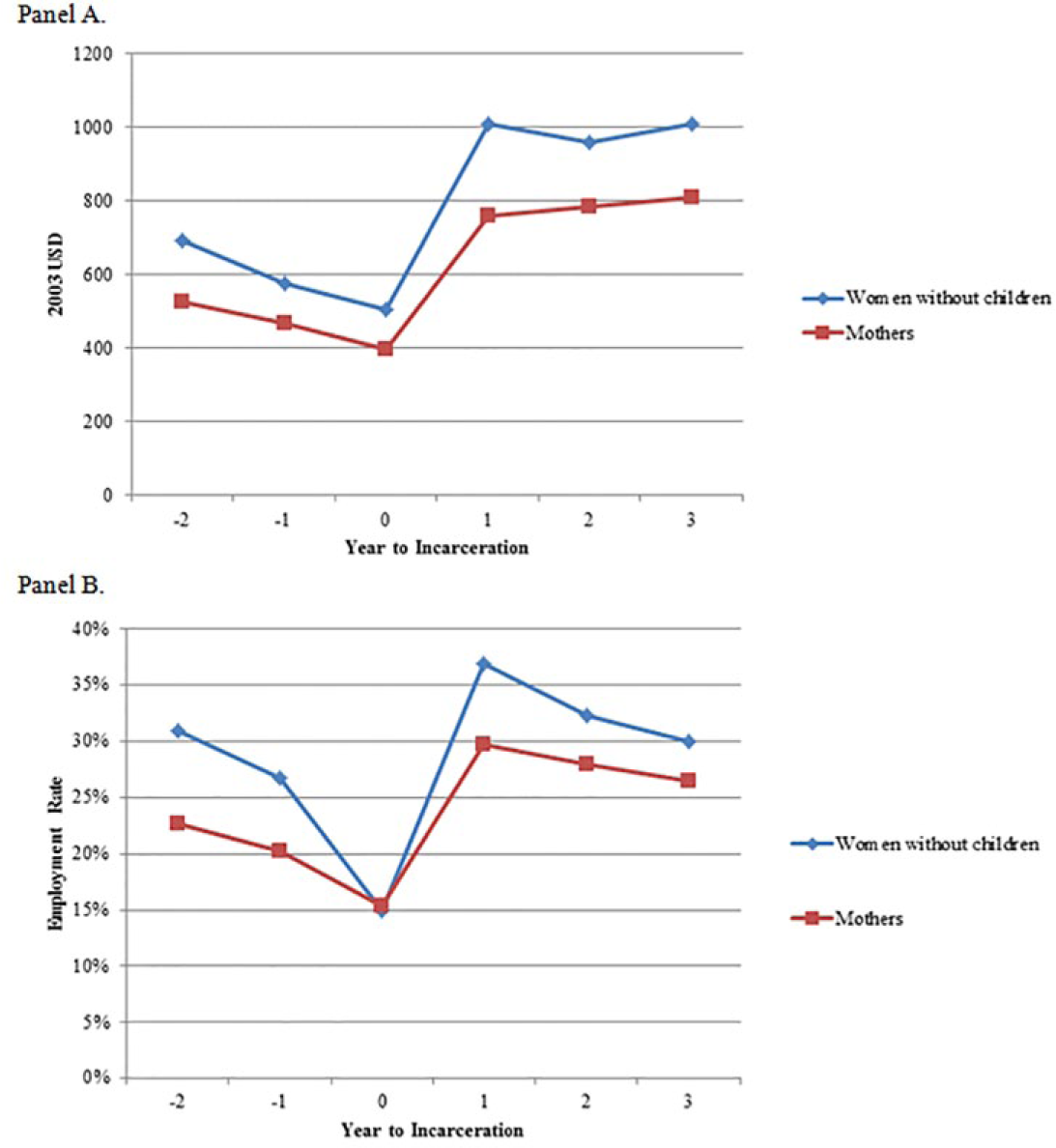
Average quarterly earnings and employment of incarcerated women by motherhood.
We observe that the average earnings of incarcerated women declined during the 2 years before incarceration. This pattern is very similar to Ashenfelter’s Dip observed in the pre-training earnings of job training participants. The earnings of these women reach their lowest level of US$200 per quarter during the “0” quarter, which includes the quarters that these women are incarcerated, and the quarters that they were admitted and are paroled from prison. 8
The decline in their pre-prison earnings is not due solely to these women’s incarcerations in state prison. As is clear from the figure, their limited labor prospects are deteriorating even before they go to prison. Among those who are working, this decline might result from job loss, which in turn is associated with more illegal activity, or alternatively, it results because of rising addiction among women (Andrews et al., 2012; Holtfreter & Cupp, 2007; Reisig, Holtfreter, & Morash, 2006). In this vein, the fact that these women’s earnings bounce back after prison may result from the prison giving these women an opportunity “to clean themselves up” through programs during incarceration (Hall, Prendergast, Wellisch, Patten, & Cao, 2004; Mosher & Phillips, 2006).
The average earnings of mothers are lower by about US$150 per quarter than for childless women before incarceration. This difference widens to US$200 or more after incarceration. Considering women without children as a benchmark group, mothers do seem not to make a good progress in earnings after incarceration.
The patterns that we observe for earnings are also observed for incarcerated women’s employment rates. As shown by Panel B of Figure 1, before prison, the loss of labor market earnings can be seen as caused by a decline in employment. During the first year after they are paroled from prison, these women’s rising earnings can be explained by the sharp rise in their employment rates. However, after the first year following their paroles from prison, the employment rates of these women fall back to levels similar to the 2 years before their first prison spells. One explanation for the pattern is recidivism; in our data, about 33% of these women return to prison within 3 years after they are paroled.
In a comparison between mothers and women without children, Panel B in Figure 1 suggests that the average quarterly employment rates of women without children are about 7 to 8 percentage points greater than those for mothers during 2 years before incarceration. The employment rates hit the lowest level, about 15%, during year 0 (including admission and release quarters and any quarters in state prisons) and bounce back after incarceration. 9 Even after incarceration, childless women were more likely to have jobs by 4 to 7 percentage points than mothers. In summary, Panel B suggests that mothers make post-prison improvement in employment rates compared with women without children.
In Figure 2, we examine how quarterly earnings and employment of incarcerated women change by motherhood and their children’s foster care records. We find that having a child in foster care and losing parental rights is associated with poor labor market outcomes. As shown in Panel A, the average earnings of all groups fall before incarceration and bounce back after incarceration. It is clear that the average earnings of women without children are higher than any groups of mothers before and after incarceration. Mother Group 1 (no children in foster care) shows the second highest earnings before and after incarceration. The earnings of Mother Group 3 (at least one child started foster care and reunified before incarceration) is second but close to Mother Group 1. Mother Group 2 (at least one child started, but did not resolve, foster care before incarceration) is in third place in average quarterly earnings before and after incarceration. The last place group in average quarterly earnings is Mother Group 4 (at least one child started foster care and ended with non-reunification before incarceration), which implies an association between losing parental rights and poor labor market outcomes. We find that this order among these groups’ average quarterly earnings during the 2 years before incarceration remains the same during the 3 years after incarceration.

Average quarterly earnings and employment of incarcerated women by motherhood and foster care records.
Panel B of Figure 2 shows the comparisons of the average quarterly employment between women without children and four types of mothers based on their children’s foster care status. The order among groups in employment rates is different before and after incarceration, which reflects that earnings and employment are not perfectly aligned for these groups. During the 2 years before incarceration, there was a clear order in the average quarterly employment rates. Women without children have the highest employment rate. Mother Group 3 (at least one child in foster care started and ended with reunification before incarceration) follows as the second highest. Mother Group 1 (no children in foster care), Mother Group 4 (at least one child started foster care and ended with non-reunification before incarceration), and Mother Group 2 (at least one child started, but did not resolve, foster care before incarceration) follow in the third, fourth, and fifth places.
However, during the 3 years after incarceration, women without children have the highest employment rate in the first year but are exceeded by Mother Group 3 (at least one child in foster care started and ended with reunification before incarceration) in the second and third year. Mother Group 2 (at least one child started, but did not resolve, foster care before incarceration) also makes impressive advance in the average quarterly employment from the last place before incarceration to the third place after incarceration. It seems that Mother Group 2’s effort to get their children back from foster care is shown at least in terms of post-incarceration employment. Mother Group 1 (no children in foster care) competes for third place with Mother Group 2 after incarceration. Finally, Mother Group 4 (at least one child started foster care and ended with non-reunification before incarceration) shows the lowest employment rate after incarceration, which implies that having a child in foster care and losing parental rights is associated with poor employability.
Empirical Strategy
The FEs models are constructed to estimate the relative progress of incarcerated mothers compared with incarcerated women without children, as shown in Figures 1 and 2. 10 Such a model also controls for time-invariant, unobserved characteristics that are correlated with whether the women have children and whether they have children in foster care. The first model estimates the relative progress of mothers compared with childless women.
The model is as follows;

yit is either real quarterly earnings or quarterly employment status for person i in calendar quarter t. Real quarterly earnings include positive and zero earnings. Quarterly employment equals 1 for positive quarterly earnings and 0 for zero earnings. αi is an individual FE, and yt is an indicator variable for calendar quarter t with the year of 1995 as the reference period. Diτ is a time dummy variable for τ = 1, 2, and 3, indicating the first, second, and third year immediately after release from state prisons. Thus, the model controls for the earnings or employment change after incarceration, with 2 years before incarceration as a reference period. Xiτ includes age, age squared, and demographic/criminal characteristics.
Mi is the indicator variable of incarcerated mothers, and it is interacted with Diτ Thus, θτ is the Difference-in-Differences (DID) estimator at year τ; θ1, θ2 and θ3 capture the relative progress in earnings and employment of mothers compared with childless women during the first, second, and third year after release, accounting for the difference in earnings and employment between two groups during 2 years before the incarceration. To control for different incarceration lengths among women, we control for Pi indicating the length of first imprisonment and its interaction with Diτ. Thus, δτ summarizes the effect of imprisonment length for period τ.
The second model is modified from model (1) to estimate the relative progress of the four groups of mothers compared with women without children:

Most of the dependent and independent variables are the same as in Equation (1) except that
Two key assumptions for the consistently estimated progress of incarcerated mothers or different groups of mothers compared with women without children are as follows: (1) the selection into being mothers or different groups of mothers is only correlated with time-invariant unobserved characteristics and (2) the differences in pre- and post-imprisonment labor market outcomes between mothers and women without children would have been the same if there were no incarceration. Huber-White robust standard errors are used due to the panel structure of the data with relatively large n and small T, to account for serial correlation and heteroscedasticity in the error term (Wooldridge, 2002). Estimation results from the pooled ordinary least squares (OLS) model are presented along with estimates from the FE model to see the direction and size of the bias caused by time-invariant unobserved characteristics. This pooled OLS model also includes Mi in Equation (1) indicating mothers and
Regression Results
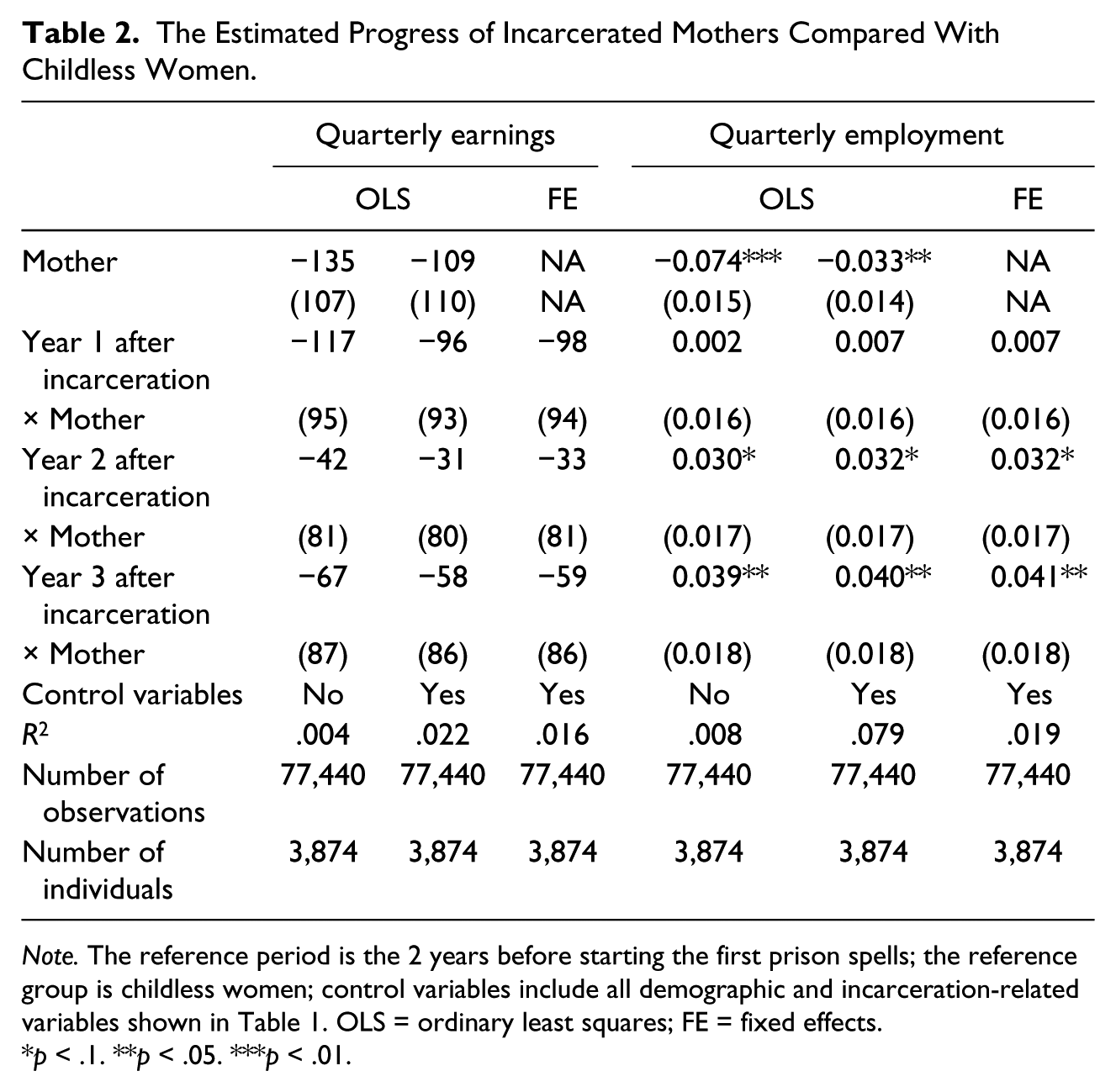
Table 2 presents the estimated relative progress of mothers compared with childless women using the OLS (with and without control variables) and FE models. The first to third columns are for regression results of quarterly earnings, and the fourth to sixth columns are for regression results of quarterly employment. The estimated coefficient of the mother indicator by OLS models suggests that the average quarterly earnings and employment of incarcerated mothers during the second year before incarceration are lower by US$138 to US$109 (statistically insignificant) and 7.4 to 3.3 percentage points (statistically significant) than women without children. These estimates imply that the labor market outcomes of mothers were poorer than women without children before incarceration, which is consistent with what we found in Figure 1.
The Estimated Progress of Incarcerated Mothers Compared With Childless Women.
Note. The reference period is the 2 years before starting the first prison spells; the reference group is childless women; control variables include all demographic and incarceration-related variables shown in Table 1. OLS = ordinary least squares; FE = fixed effects.
p < .1. **p < .05. ***p < .01.
The estimated coefficients during years after incarceration indicate significant progress of incarcerated mothers in quarterly employment during the second and third year after incarceration. With and without controlling for observed characteristics in OLS models and time-constant unobserved characteristics in the FE model, incarcerated mothers improve their employment by about 3 to 4 percentage points (statistically significant at p < .05 or p < .1). This is impressive because the average post-incarceration employment rate of incarcerated women is only about 30%.
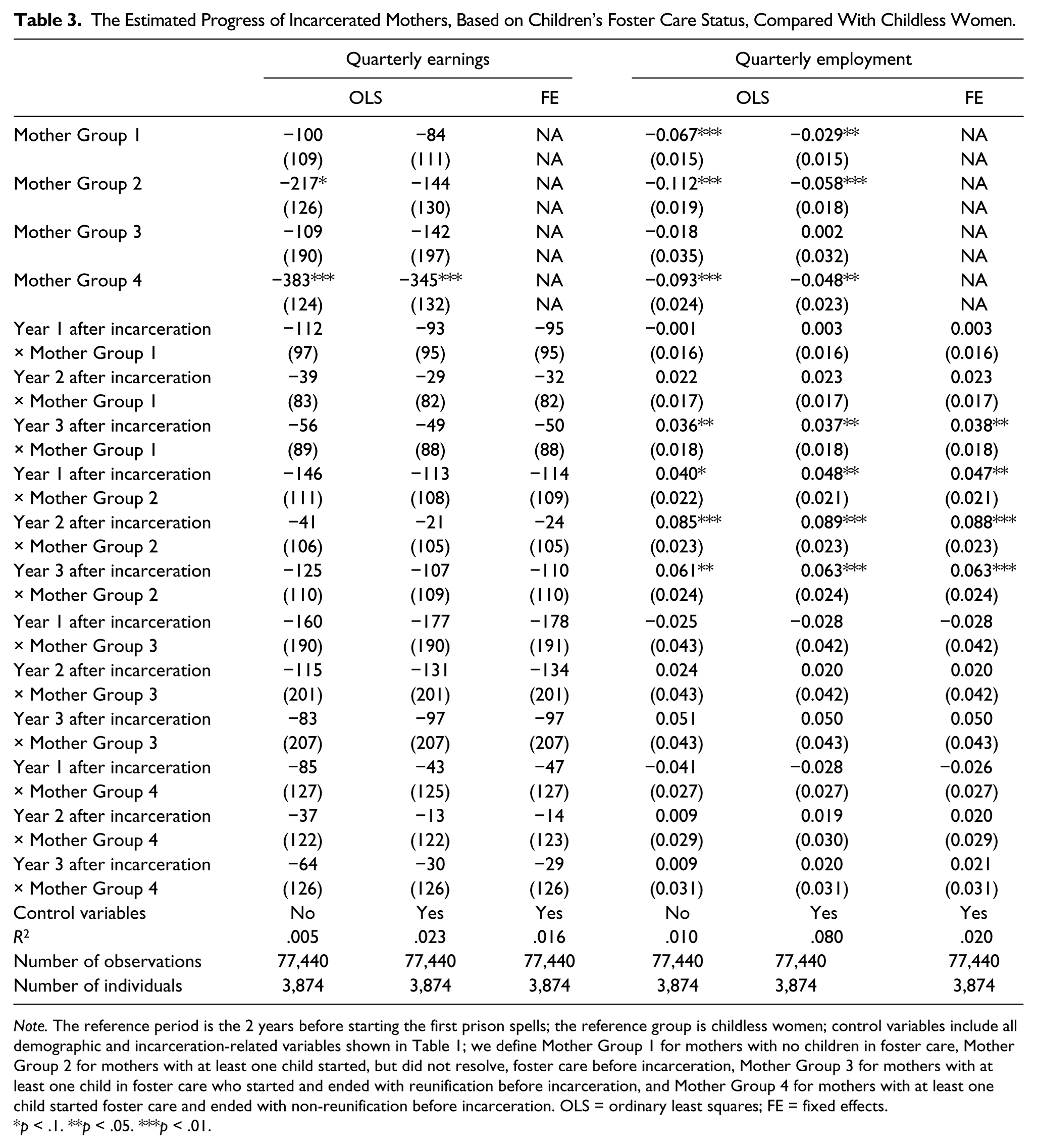
In Table 3, we split incarcerated mothers into four groups of mothers based on their children’s foster care status: Mother Group 1 (no children in foster care), Mother Group 2 (at least one child started, but did not resolve, foster care before incarceration), Mother Group 3 (at least one child in foster care started and ended with reunification before incarceration), and Mother Group 4 (at least one child started foster care and ended with non-reunification before incarceration). The OLS estimated coefficients of four dummy variables for the four groups of mothers suggest the difference between one group of mothers and women without children during the 2 years before the incarceration. The FE model does not estimate these coefficients because these dummy variables are time-constant characteristics. When controlling for observed characteristics, Mother Group 4 is statistically lower in quarterly earnings by about US$350 than women without children while Mother Groups 1, 2, and 4 are statistically lower in quarterly employment by about 3 to 6 percentage points than women without children.
The Estimated Progress of Incarcerated Mothers, Based on Children’s Foster Care Status, Compared With Childless Women.
Note. The reference period is the 2 years before starting the first prison spells; the reference group is childless women; control variables include all demographic and incarceration-related variables shown in Table 1; we define Mother Group 1 for mothers with no children in foster care, Mother Group 2 for mothers with at least one child started, but did not resolve, foster care before incarceration, Mother Group 3 for mothers with at least one child in foster care who started and ended with reunification before incarceration, and Mother Group 4 for mothers with at least one child started foster care and ended with non-reunification before incarceration. OLS = ordinary least squares; FE = fixed effects.
p < .1. **p < .05. ***p < .01.
For each mother group, we focus on interpreting the estimated coefficients from the FE model because it is a more sophisticated model to control for observed characteristics and time-constant unobserved characteristics. The FE estimates show that each mother group made different progress after incarceration. It is noticeable that Mother Groups 1 and 2 made significant progress in quarterly employment during years after incarceration. The quarterly employment rates of Mother Group 1 increased by 3.8 percentage points (statistically significant at p < .05) during the third year after incarceration. In other words, mothers with no children in foster care made good progress in employment after incarceration. Such progress in quarterly employment is much larger for Mother Group 2: 4.7 percentage points (statistically significant at p < .05), 8.8 percentage points (statistically significant at p < .01), and 6.3 percentage points (statistically significant at p < .01) for the first, second, and third year after incarceration, respectively. Mothers in Mother Group 2 are those who have at least one child that started, but did not resolve, foster care before incarceration. Thus, this implies that such mothers did their best to take their children back, at least in terms of their employment effort. In sum, results in Table 3 suggest that most of progress by incarcerated mothers in quarterly employment shown in Table 2 is from Mother Groups 1 and 2.
To examine whether race and drug addiction are important moderators of incarcerated mothers’ labor market outcomes, we run separate FE regressions for White and African American women as well as women with and without drug addiction. Table 4 reports the relative progress of incarcerated mothers compared with childless women. We found significant progress in quarterly employment for women without drug addiction. Their progress is about 4 (statistically insignificant) and 4.6 percentage points (statistically significant at p < .1) for the second and third year after incarceration, respectively. White and African American women, as well as women with drug addiction, seem to improve quarterly employment by about 3 percentage points during the third year after incarceration, but they are not statistically significant. However, mothers with drug addiction have lower quarterly earnings by US$222 during the third year after incarceration.
The FE Estimated Progress of Incarcerated Mothers Compared With Childless Women by Race and Drug Addiction.

Note. The reference period is the 2 years before starting the first prison spells; the reference group is childless women; control variables include all demographic and incarceration-related variables shown in Table 1. OLS = ordinary least squares; FE = fixed effects.
p < .1. **p < .05. ***p < .01.
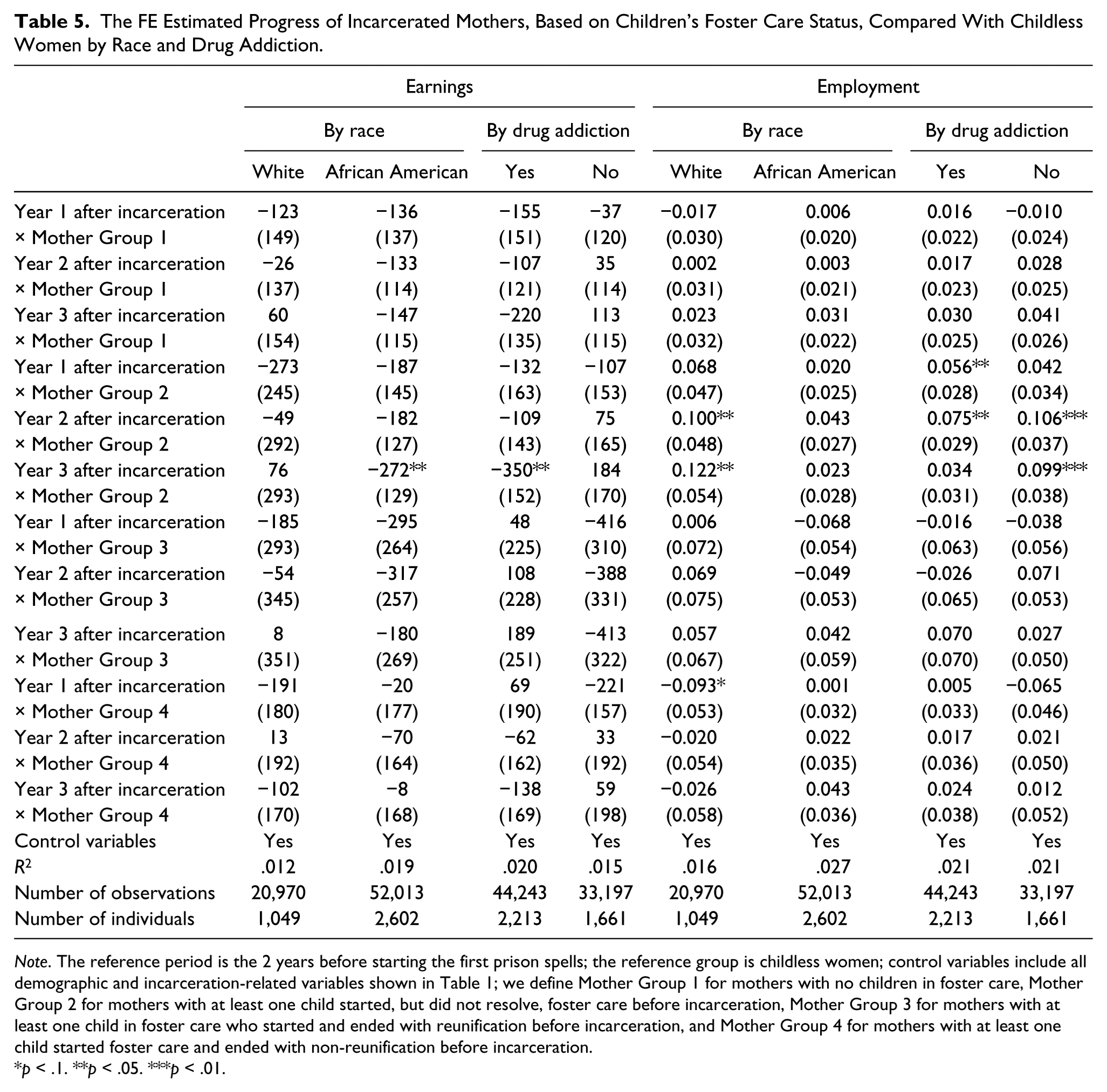
Table 5 also presents the relative progress of incarcerated mothers based on their children’s foster care status by race and drug addiction status. As in Table 3, most of the progress is shown on employment rates of mothers in Group 2 (at least one child that started, but did not resolve, foster care before incarceration). Among such mothers, particularly, White mothers made a significant increase in quarterly employment by 10 percentage points (statistically significant at p < .05) during the second year after incarceration and 12.2 percentage points (statistically significant at p < .01) during the third year after incarceration, respectively. Also, both mothers with and without drug addiction have higher employment rates after incarceration. Mothers with drug addiction made progress by about 5.6 and 7.5 percentage points in quarterly employment during the first and second year after incarceration; they are statistically significant at p < .05. Such an improvement in quarterly employment is much higher for mothers without drug addiction in Group 2. Their quarterly employment rates are about 10.6 and 9.9 percentage points higher during the second and third year after incarceration; they are statistically significant at p < .01. It seems that even drug addicted mothers at the time of prison entrance work their best to take their children back from foster care, at least by working more often. However, African American women and women with drug addiction among mothers in Group 2 show a negative progress in quarterly earnings by US$272 and US$350 (statistically significant at p < .05) during the third year after incarceration.
The FE Estimated Progress of Incarcerated Mothers, Based on Children’s Foster Care Status, Compared With Childless Women by Race and Drug Addiction.
Note. The reference period is the 2 years before starting the first prison spells; the reference group is childless women; control variables include all demographic and incarceration-related variables shown in Table 1; we define Mother Group 1 for mothers with no children in foster care, Mother Group 2 for mothers with at least one child started, but did not resolve, foster care before incarceration, Mother Group 3 for mothers with at least one child in foster care who started and ended with reunification before incarceration, and Mother Group 4 for mothers with at least one child started foster care and ended with non-reunification before incarceration.
p < .1. **p < .05. ***p < .01.
Discussion and Conclusion
A steady increase in female incarceration in recent decades requires more attention to women’s incarceration and its consequences as most incarcerated women are mothers from disadvantaged backgrounds. Incarcerated mothers are also more likely to have children in foster care than women without incarceration, not because their incarceration leads to their children’s foster care, but because traumatic events in those mothers’ lives lead to their children’s foster care and their incarceration (E. Johnson & Waldfogel, 2002; Myers, Smarsh, Amlund-Hagen, & Kennon, 1999). Although labor market outcomes are considered important measures to reflect the post-incarceration progress of incarcerated mothers, there have been few studies on how post-incarceration earnings and employment are related to motherhood and foster care status.
Matching three data sets from the Illinois IDOC, the Illinois DCFS, and the Illinois IDES, this study investigates whether mothers have more earnings and higher employment rates after incarceration than women without children. Furthermore, it also examines whether mothers’ labor market outcomes depend on the foster care records of their children. Our study finds that incarcerated mothers’ earnings and employment are lower than incarcerated women without children during the 2 years before incarceration. Particularly, the difference in pre-incarceration employment rates is considerable and statistically significant. Our FEs models examine the relative progress of incarcerated mothers in earnings and employment after incarceration, not only accounting for the difference between mothers and women without children but also controlling for time-constant individual characteristics. Our analysis suggests that incarcerated mothers make impressive progress in quarterly employment during the second and third years after incarceration, which is aligned with findings in LaLonde and Cho (2008). Most of this progress is from mothers whose children started foster care before incarceration but did not resolve their foster care before mothers’ incarceration. It seems that such mothers did their best to take their children back, at least in terms of their employment effort.
Our subsample analysis based on race and drug addiction suggests that a significant amount of the progress of mothers in quarterly employment is concentrated among mothers without drug addiction. Particularly, White mothers among mothers in Group 2 (at least one child started, but did not resolve, foster care before incarceration) improved by about 5.6 and 7.5 percentage points in quarterly employment during the first and second year after incarceration; they are statistically significant at p < .05. Such an improvement in quarterly employment is also shown among mothers in Group 2 regardless of drug addiction, although the progress is much higher for mothers without drug addiction.
We cannot pinpoint why mothers or some mothers with children in foster care have better progress in post-incarceration employment compared with childless women. As discussed earlier, it is plausible that having a child in foster care while in prison may provide women with an incentive to work in a wage and salaried job after prison to have their children back from foster care. Also, we may have these findings because those mothers have more services during incarceration to improve their marketable skills and suppress their drug addiction reported right before incarceration. Reviewing evaluations of programs for incarcerated mothers, Young and Smith (2000) argue that motherhood may provide encouragement to participate in prison programs during incarceration. Glaze and Maruschak (2010) also find that incarcerated mothers are also more likely to participate in social programs within the prison such as work, prerelease, and education. Future research is required not only to study possible mechanisms but also what prison programs are more effective for mothers’ successful reentry upon release.
In summary, we find that incarcerated mothers improve quarterly employment during the second and third year after incarceration, when accounting for the difference between mothers and women without children. In other words, the employment gap between mothers and women without children is reduced after incarceration. Most of this relative progress in employment is from mothers whose children started foster care before incarceration but did not resolve their foster care before incarceration. However, incarcerated mothers are still lower in earnings and employment than women without children in absolute comparisons in any periods before and after incarceration. Thus, incarcerated mothers are still disadvantaged in terms of labor market outcomes than women without children. As a result, motherhood and foster care contact are valuable indicators that policy makers and program operators can use to predict the different reentry outcomes among incarcerated women. Also, mothers will require more services during incarceration and upon release because their successful integration is critical for their children (I. M. Johnson, 2014).
Footnotes
Authors’ Note
We have benefited from comments by Henry Brady, Robert M. Goerge, Susan George, Marilyn Moses, and Anne Powell, participants in the Center for Human Potential and Public Policy, the Incarcerated Women and Their Children workshops at the University of Chicago, and participants at the National Institute of Justice Conference, July 17 to 19, 2006 in Washington, D.C. The views expressed in this article are those of the authors and do not reflect the views of the National Institute of Justice or any agency of the state of Illinois. The authors are responsible for all errors.
Declaration of Conflicting Interests
The author(s) declared no potential conflicts of interest with respect to the research, authorship, and/or publication of this article.
Funding
The author(s) disclosed receipt of the following financial support for the research, authorship, and/or publication of this article: This research has been supported by the Chicago Community Trust, the National Institute of Justice, the Russell Sage Foundation, the Open Society Foundations, and by Grant 02-DB-BX-0017, awarded to the Illinois Criminal Justice Information Authority by the Bureau of Justice Assistance, Office of Justice Programs, U.S. Department of Justice.