




Abstract
Canadian prison-based arts and other programming are limited at best. Even the country’s Correctional Investigator, or prison-ombudsperson, has critiqued the lack of meaningful options in which prisoners can engage. Those programs that do exist tend to be focused on the logic of penal rehabilitation, with the end goal of reducing recidivism. In this article, we showcase the evaluation of a 9-week arts program in a women’s prison, the aim of which was to build community and foster artistic engagement, thus running counter to normative carceral logics.
Introduction
Arts programming in Canadian prisons, especially in women’s facilities, is limited; consequently, so is the literature on this subject. We aim to address this gap by reflecting on an evaluation of a carceral arts program that ran from June to August, 2018, in a minimum-security unit of one of Canada’s women’s prisons. We also draw on and engage with the broader arts evaluation literature. The program was facilitated by a group of artists, including the second author, who works with justice-involved and marginalized peoples in both carceral and community contexts. The artists developed a series of weekly workshops over a 9-week period, culminating in an arts-based evaluation of the program. In the following, we focus on the evaluation process and results, illustrating a successful and innovative qualitative approach to carceral research. Our study is unique in that it is one of only a very small number of evaluations that have been conducted to examine a carceral arts program (for another example, see Gussak, 2007).
To set the stage, we begin with an introduction to the literature on federally incarcerated women in Canada, focusing specifically on their access to programming while in prison, or lack thereof. Next, we survey the literature related to prison-based arts programs and unpack the institutional logics that tend to inform them. We then turn to arts-based evaluations, discussing how they can be particularly useful in carceral contexts, before introducing the arts program itself. We document how the program unfolded over the summer months of 2018, providing detail about the evaluation’s findings and showcasing participants’ feedback. These results suggest a high level of program engagement and success, while also instigating new discussions around prison programming and research, and the challenge of disengaging with the institutional focus on rehabilitation and recidivism reduction.
Federally Incarcerated Women and Access to Programs
Canada is home to six federal women’s prisons, spread across the country in British Columbia, Alberta, Saskatchewan, Ontario, Quebec, and Nova Scotia (Correctional Service of Canada [CSC], 2017a). There are also two regional psychiatric centers which women can access—one in Saskatchewan and one in Quebec—that ‘primarily serve as inpatient mental health facilities or psychiatric hospitals’ (Zinger, 2018, p. 21). Each of these facilities is operated by the Correctional Service of Canada (CSC), the federal government agency responsible for administering court-ordered sentences of 2 years or more; sentences of less than 2 years are under the jurisdiction of the provinces and territories. There are, on average, 700 women in CSC’s federal custody, a 30% increase from a decade earlier (Zinger, 2017). During the same period, the number of Indigenous women has increased by an alarming 60%, now totaling approximately 36% of the carceral populace (Zinger, 2017). This makes women, and Indigenous women in particular, the fastest growing prisoner population in the country.
Notably, while the number of incarcerated women is increasing, they still account for only around 5% of those in federal custody overall (CSC, 2017b). This limited number has created a unique challenge for CSC. That is, while the total number of women in federal prison is relatively small, their needs are great: 51% have an identified mental health issue, while the number of those ‘who present with challenging and complex mental health needs, including increasingly serious, chronic and near lethal forms of self-injurious behavior, continues to rise’ (Sapers, 2016, p. 62). Related to colonization, most incarcerated Indigenous women also have histories of physical and sexual abuse and substance-use dependencies (Sapers, 2016). Federally incarcerated women are also younger, less likely to have completed high school, and are more likely to be unemployed than the general population (Comack & Balfour, 2014). Indeed, CSC (2014) has reported that 24% of women in prison have no history of employment.
That Canadian prisons are filled with women who have been disadvantaged can be traced, in part, to neoliberal policy reforms that feminized and criminalized poverty. Such reforms seek to de-fund and privatize social provisions as well as ostensibly reduce the size of government. For women, this reduction of public services creates increasingly precarious working and living conditions. As poverty-mitigating public provisions, such as government-funded treatment centers, affordable housing, and secure employment become less and less accessible, poverty instead becomes ‘managed through privatized and coercive social relations’ (LeBaron & Roberts, 2012, p. 46). The gendered dimensions of neoliberalism are perhaps most clear in carceral settings: The majority of women in prison have been charged with crimes related to poverty alleviation, including non-violent offenses such as shoplifting, sex work, and theft or robbery, with the most common being theft under $5,000 or fraud (Pollack, 2008; see also StatsCan, 2017).
While the neo-liberal government cuts funding to support women’s wellbeing in the community, it simultaneously spends, on average, $200,000 to incarcerate one women in a federal correctional institution for one year (Sapers, 2016). This demonstrates that neoliberalism does not, in fact, reduce the size of government, but instead shifts its function from that of a welfare state to a carceral one (LeBaron & Roberts, 2012). Interestingly, this carceral state is often presented as having gendered benefits, with the ‘prison system appear[ing] to hold the promise of therapeutic support for criminalized women’ (Pollack, 2008, p. 14). Indeed, CSC (2019, n.p.) states that it offers ‘a continuum of care, which provides women with support from their admission through to the end of their sentences.’ The government agency further describes its approach as ‘women-centered’ and ‘designed to address problems that are specific to women and use a modern, holistic approach’ (CSC, 2017b, p. 1). In reality, however, programs for incarcerated women focus almost entirely on ‘correcting’ their behavior, in particular using cognitive behavioral therapy to build women’s capacity to make more ‘rational’ and ‘logical’ decisions, while ignoring the social, political, and economic contexts within which these behaviors occur (see Pollack, 2004).
Under the guise of women-centered programming, concepts such as ‘empowerment’ have been used to assert that women should ‘take responsibility for the consequences of their choices’ (Comack & Balfour, 2014, p. 168). Within this, women’s law-breaking is seen as a result of them having ‘low self-esteem and being poor copers and bad decision makers’ (Pollack, 2003, p. 462), thereby pushing unrealistic expectations of ‘rehabilitation’ while responsibilizing women for the impacts of neoliberal policy reforms. As Pollack (2008, p. 32) writes, we must ‘question and challenge imprisonment as a response to gendered and racialized realities such as poverty, immigration, homelessness, mental health difficulties, violence against women and addictions. Prisons are not and should not be treatment centers.’ Conceptualizing prisons as a place of therapy and healing legitimizes the neoliberal divestment from community supports in favor of criminalization.
Once in prison, women are faced with limited meaningful programming options (van der Meulen et al., 2018). Those that do exist tend to emphasize gendered vocational training—which can include sewing blankets for the Department of National Defence (Sapers, 2016, p. 64) or underwear for male prisoners (Zinger, 2017, p. 65) as well as some educational, therapeutic, or recreational options. Arts-based prison programming in Canada is ‘extremely underdeveloped’ (Merrill & Frigon, 2015, p. 296), however there are some arts programs functioning intermitently in various institutions, such as Theater of the Beat. The most established and certainly longest-running theater program is William Head on Stage, which is based at the men’s William Head Insitution in British Columbia. For nearly 38 years, William Head on Stage has offered consisent theater-based activities, with a yearly run of performances that are open to the public. Perhaps most encouraging, the incarcerated men run the program, choosing and hiring the professional director and actors who collaborate with them each year (Hansen, 2014). To date, there have been no consistent and long-term theater or arts-based programs offered to incarcerated women in Canada (for examples of international prison theater programs see Biggs, 2016; Keehan, 2015; Lucas et al., 2019).
While all women in prison would benefit from increased programming options, those incarcerated in minimum-security units (MSUs) in Canada usually face even greater barriers, as these facilities tend to be stand-alone buildings that are not physically connected to the main, multi-level institution. Women in MSUs are supposed to be housed in the ‘least restrictive environment possible’ and should have ‘equal opportunity. . . to access the community in a safe and timely manner’ (Sapers, 2016, p. 63). However, with a combined rated capacity of only approximately 115 nation-wide, MSUs are often left behind when it comes to meaningful programs. Over the last several years, the Office of the Correctional Investigator, Canada’s prison ombudsperson, has received numerous reports that women in MSUs face ‘ongoing tedium in routine with few opportunities to leave the unit’ (Sapers, 2016, p. 63). CSC claims to give women in MSUs access to a variety of programs, volunteer, and vocational opportunities—including some in the community—but many of these options are actually located in the main facility, to which MSU women do not have access.
Instead, MSUs more often host ‘make-busy’ activities, such as a ‘walking program’ (Sapers, 2016, p. 63). Yet, even then a lack of volunteer facilitators and institutional approvals means that these programs can sometimes exist in name only. As a result, some women are taking what the Correctional Investigator describes as the ‘extraordinary step of opting to re-enter general population (i.e., higher security units) in order gain access to vocational training, social programs, and work opportunities’ (Sapers, 2016, p. 63). In light of this, the Correctional Investigator has recommended that CSC enhance partnerships with community groups and organizations to deliver programming, opportunities, and activities for women residing in MSUs in particular. The arts program we examine below attempted to fill precisely this gap.
Rejecting the Institutional Logics of Arts Programming
With the carceral system’s stated emphasis on and commitment to the logics of rehabilitation and reducing recidivism (within a neoliberal and fiscally austere context), it is perhaps unsurprising that most prison programs, even those delivered by community organizations, aim to likewise reflect these values. As we found in the literature, this is even the case for arts-based programs. Keehan (2015, p. 215), for example, writes, ‘a repeated theme in the discourse on theater practice in prisons over the last 20 years can be summarized as follows: theater and drama projects have a positive effect on those incarcerated and may contribute toward rehabilitation.’ Cheliotis (2012, p. 32) similarly notes that artists working in prisons tend to draw on a rehabilitative approach to justify the value of the programs, suggesting that ‘offender rehabilitation through the arts has been increasingly tied to the tangible and highly appealing goal of recidivism reduction’ (see also Johnson et al., 2011). We even note that scholars in evaluating prison arts- and wellness-based programs, in this case a yoga and creative arts project, express regret at their inability to tie their results to recidivism rates, stating: ‘Although we would very much like to speak to the impact of this curriculum on recidivism, we simply did not have the resources or the access to conduct a community follow-up’ (Middleton et al., 2019, p. 44S).
Many artists who facilitate prison programs have aligned their work with the distancing theory of crime. In brief, distancing theory posits that a reduction in recidivism results from a change in lifestyle, related in particular to an individual’s maturation or ‘growing up and out of crime’ (Albertson, 2015, p. 278). Thus, as one’s social relationships evolve and ‘become more positive,’ they begin to establish a ‘non-offending identity’ (ibid.). O’Keefe and Albertson (2016, p. 497) argue that in order to create a sense of ‘distance’ between one’s self and crime, one will need to develop certain skills and social awareness, such as an ‘increased self-esteem, improved social skills, enhanced relationships, taking increased responsibility for offending behavior, and positive changes in self-perception.’ Prison arts programs are seen to be able to help with precisely these individualized skills. Lacking from this analysis, however, is attention to the systemic and institutional factors that place people in conflict with the law in the first place. We suggest that without attention to broader systemic barriers, social injustices, and neo-liberal contexts, prison arts programs can perpetuate and uphold simplistic and individualized understandings of criminal justice involvement while also lending credence to the false narrative that prisons should or can be a place for healing.
Some arts organizations have further sought to legitimize their work by ‘advertising how many tax dollars are saved by successful arts intervention programs’ (Balfour & Poole, 1998, p. 217). A 2012 report commissioned by the National Criminal Justice Arts Alliance in the United Kingdom, for example, sought ‘to explore whether the value of the arts in criminal justice could be shown through economic analysis’ (Johnson et al., 2011, p. 2). By researching three prominent UK-based arts charities working in the criminal justice system, the report’s authors suggest that arts programming can result in reduced government spending, as such programs help curtail re-offending. The underlying ideology of the report, and more generally with studies that likewise locate the benefits of carceral arts activities in relation to reduced state resources (see Arizona State University College of Liberal Arts & Sciences, 2013; Brewster, 1983), is that the government should be spending less money on people in prison.
This discourse fits squarely within the neoliberal logic that valorizes austerity and decreased social spending that disproportionately affects already-marginalized peoples (Clarke, 2017; LeBaron & Roberts, 2012). As Cheliotis (2012) warns, when artists advance the goals of cost-savings and reducing recidivism, they are ignoring the fact that arts programming cannot actually address precursors to criminal justice involvement, such as unemployment and lack of access to housing or education, to which we also add systemic racism, classism, sexism, ableism, homophobia, transphobia, and more. Indeed, ‘so long as these precursors continue to go unaddressed by state policy, ex-prisoners will be effectively forced back into crime and arts-in-prisons programmes will have taken upon themselves a heavy load of undeserved blame’ (Cheliotis, 2012, p. 32).
That many prison arts programs have come to reflect carceral (and, at times, neo-liberal) logics may be indicative of a shared ethics between the artists and the institution—or at least an uncritical acceptance of the institution’s value and goals. This is undoubtedly also linked to increasing pressure on artists to demonstrate concretely the value of their work to the public, to the institution, and to funding bodies (O’Keefe & Albertson, 2016). Such external pressures can result in an instrumentalist focus (Woodland, 2016), and can serve to shift the agenda of arts programming toward that of the institution (McKean, 2006). And so, artists working in corrections must find a balance between their own objectives, the desires of the participants, the funding requirements, and the expectations of prison administrators.
If artists need to articulate the value of their work (and they often do) to representatives of the state or the penal institutions in which they work, we argue in favor of doing so without making promises of rehabilitation and recidivism reduction that serve to uphold individualized and pathologized understandings of crime, and which invisibilize myriad salient social factors. If there is, as Johnson et al. (2011, p. 10) suggest, a ‘fundamental disconnect between the work being done by arts organizations and the measures of success within the criminal justice system,’ then perhaps artists should cease evaluating their program successes through such measures. Rather, there is a need to investigate alternative signs of success that demonstrate the value and benefits of artistic programming in and of itself, and without compromising artistic ethics. This was particularly important for the artists who ran the 9-week program in the MSU that we evaluated (see Figures 1 and 2 for some of the art projects). Like Woodland (2016, p. 225), the artists were ‘interested in the potential for [their] practice in prisons to move away from an explicitly rehabilitative agenda.’
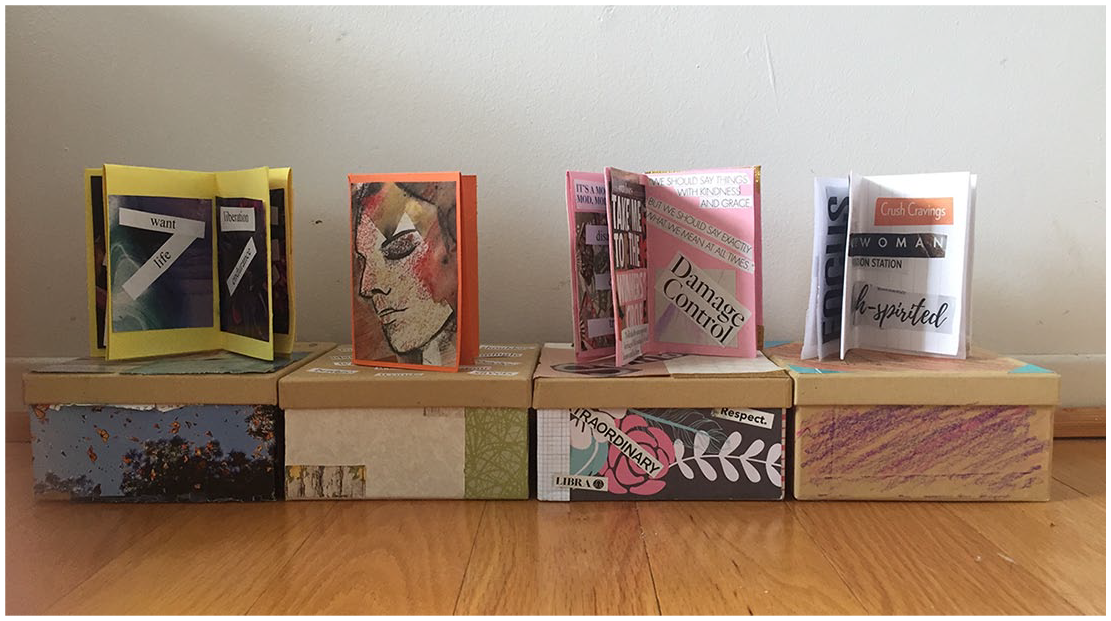
Poetry zines and collaged boxes made during the arts program.
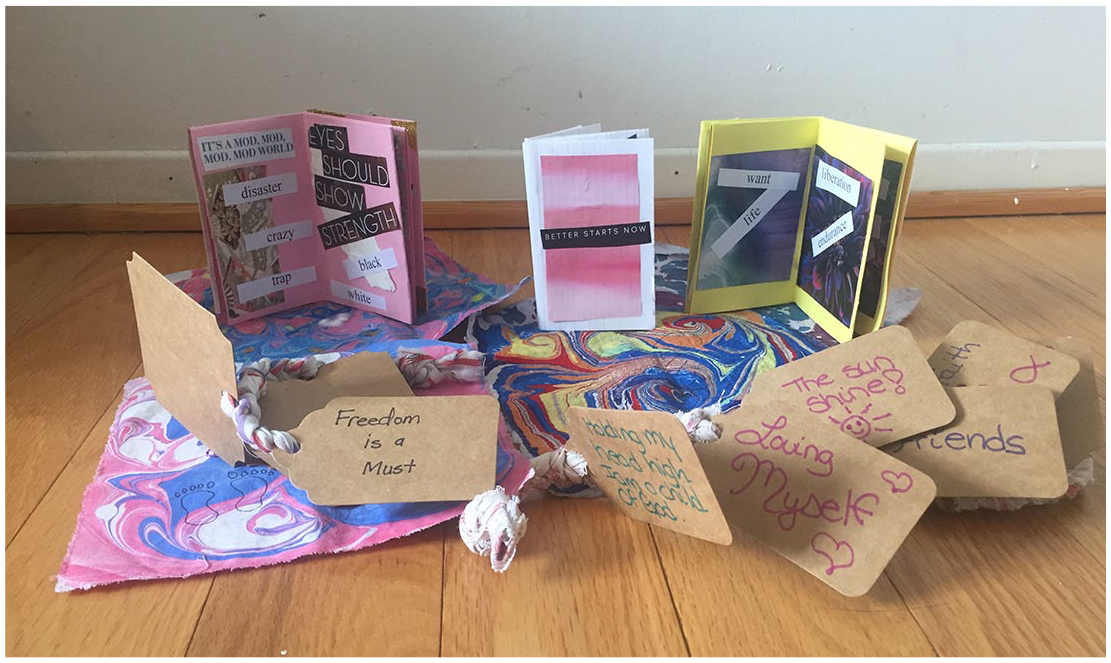
Poetry zines, and marbled fabric, and braided signs.
Conducting a Carceral Arts-Based Evaluation
Arts-based evaluation (ABE) refers to ‘the use of creative arts in the process of designing, conducting, analyzing, and disseminating evaluations’ (Simons & McCormack, 2007, p. 292). Those who conduct ABEs recognize that, ‘the arts are powerful catalysts for unearthing different kinds of knowledge and moving people to participate more fully in the knowledge production process’ (Barndt, 2008, p. 354). In this way, ABE is about ‘opening up new ways to think about knowledge building: new ways to see’ (Leavy, 2015, pp. 290, 291; see also Barone & Eisner, 2012; Finley, 2017). As such, the evaluative questions and approaches that are suitable in ABE may differ from other evaluations research.
Julliard et al. (2000, p. 188) suggest that in order to develop appropriate ABE questions, we might ‘begin with freeing ourselves completely from the mode of thinking imposed by Likert scales and instead [look] at both the questions we might best answer using art and the ways to gain information naturally from the artwork.’ By using ABE, then, evaluators can encourage multiple modes of expression and allow space for complex ideas and feelings to emerge. Part of this is made possible because ABEs express value primarily through metaphor, which can be communicated through a range of artistic mediums, including theater, visual art, poetry, music, and photography (Charlton, n.d.; Jumblies Theatre, 2013). The distance inherent in metaphor—that meaning is not explicit, but rather implicit through symbols, images, and comparisons—enables those providing feedback during the evaluation to explore ‘concepts and ideas that might be difficult or uncomfortable to communicate in other ways’ (Charlton, n.d., p. 4). The nature of the data collected through ABE is thus unique, often times relying on the artist/researcher’s interpretation of the resulting artwork (Julliard et al., 2000). With ABE, researchers can further disrupt the scholar-participant dichotomy in ways that challenge ‘the idea of knowledge creation as value-free, recognize the importance of the co-construction of knowledge with research participants, offer new ways to make meaning of the human condition, emphasize reflexivity, and embody great potential for consciousness raising and critical dialogue’ (Osei-Kofi, 2013, p. 137).
ABE approaches have become increasingly common for evaluations of community-based programs or those in health care settings (see Boydell et al., 2012; Frost & Burns, n.d.; Kontos & Naglie, 2007). In our case, we utilized ABE methods to evaluate an arts-based program; it is somewhat less common to use arts methods to evaluate arts programs, though far from unheard of (Chilton, 2014). Where ABE seems to be rarely utilized is in the prison setting. Nevertheless, we wanted to employ this approach as we found it to be the most appropriate and feasible for our evaluation of the women’s art program. ABE was especially useful for us because, as noted, it acknowledges the researchers’ involvement, not just in the collection of data, but in its generation and creation (Finley, 2014; Julliard et al., 2000; Leavy, 2015). Within this framework, ABE researchers can focus on cultivating a ‘disciplined subjectivity’ (Simons & McCormack, 2007, p. 298). That is, a subjectivity that requires self-reflexivity, transparency, and dialog, including with and among program participants. With ABE, we aimed to keep the voices of the participants intact, even while respecting their privacy as well as the institutional and ethical requirements for anonymity. By highlighting the program activities, evaluation process, key results, and both challenges and limitations, we contribute to the literature an innovative approach to qualitative and arts-oriented evaluation research.
Program Activities
The weekly arts program in the MSU of a women’s federal prison comprised a series of activities and workshops that drew on different artistic mediums. The artist facilitators began each 2-hour session by offering prompts that inspire affirming, open-ended self-reflection. Through fun, multi-step activities, participants weaved individual reflections into collective creations. The artistic mediums explored included songs, embroidery, marbling fabric, beading and braiding, collage, and poetry zine making. Of note, in response to considerable participant interest, many of the workshops focused primarily on song writing and singing. Cohen (2019, p. 108S) describes group singing in prison as ‘provid[ing] a space for symbolic interpretations and social and emotional connections’ where singers can ‘develop bonds with one another.’ To initiate the collaborative song writing process, the artist facilitators would present prompts, including, ‘My power comes from. . .,’ ‘I am powerful when. . .,’ and ‘I am. . .’. Participants were then given time to write their individual responses and complete the sentences. It is common for prison arts programs to require participants to disclose their criminal charges or tell deeply personal stories in order to encourage them to take responsibility for their actions as part of the rehabilitation process (Biggs, 2016; Fraden, 2004; Lucas, 2013). In contrast, the prompts in the arts program here were designed to offer space for self-determination and affirmation, and were never explicitly about the women’s prison sentences. The creation process was also designed to respect participants’ agency, enabling them to respond in whatever way they chose and to only share what they felt comfortable.
Following time for individual responses, the artists facilitated the collective creation process. While this process was slightly different each week, participants usually began by sharing one line that they wanted included in the song. The artists would then ask questions about the desired style and mood of the song and work with the women to develop a melody. As the song began to take shape, participants would offer additional lyrics and/or rework the structure of the song. Once the song was complete, the entire group would practice together, adding additional instruments, harmonies, and effects as desired (see Figure 3). At the end of this collaboration, there would be one song that included the words of most participants and would be sung by the entire group. In this way, even though some participants’ individual responses were deeply personal, the collective nature of the final product worked to resist the individual confessional aesthetic that tends to pervade other prison arts programs.
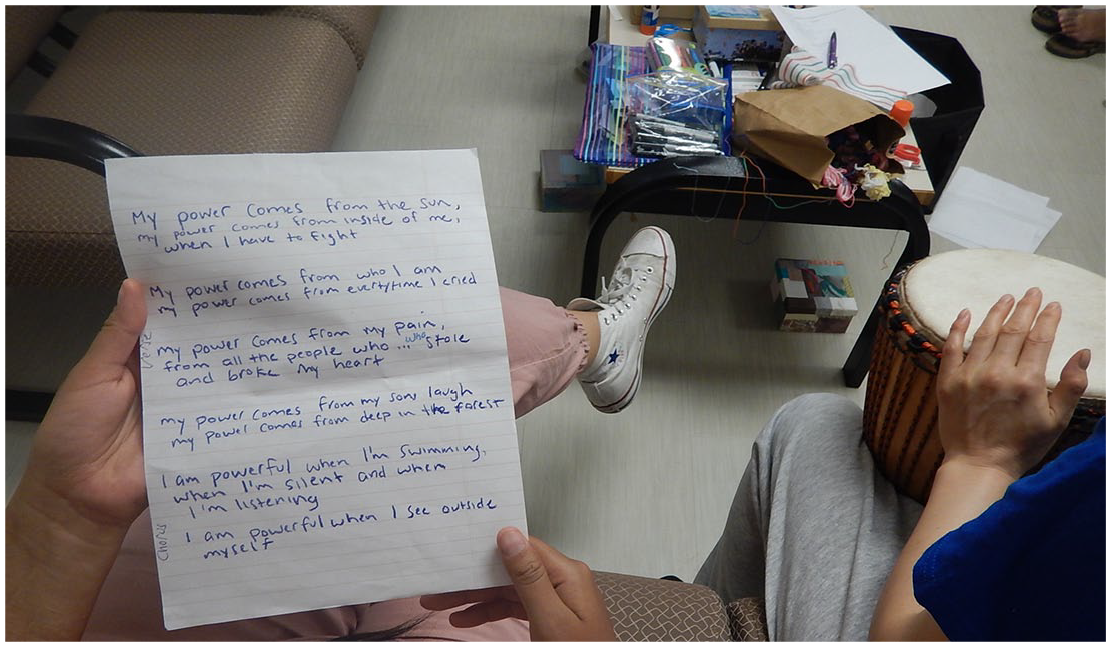
Collaboratively developed song lyrics.
Evaluation Process
Since rehabilitation was not a stated goal of the arts program, our evaluation similarly did not include rehabilitation or recidivism as indicators or measures. Instead, our aim was to explore the participants’ experiences, in particular emphasizing community building and artistic engagement. Three sources of data were gathered. The first were a series of meeting notes from the artists’ debriefing sessions held at after each of the weekly prison visits. These notes provide insight into who was in attendance (i.e., which artists facilitated, which prison staff supervised, and which incarcerated women were present), the activities that were conducted, highlights and challenges, and any salient quotes from the participants. An average of nine incarcerated women attended each session (trans women inclusive), with a total of over 30 individuals over the course of the program, representing roughly three-quarters of all women prisoners in the MSU. The majority of the participants were racialized.
The second dataset was collected during the final evaluation session where we employed poetry and collage. There were 12 women present during this session, although not all stayed for the duration or completed all evaluation activities. Faulkner (2018, p. 210) describes using poetry in research as. . .
a way to tap into universality and radical subjectivity; the poet uses personal experience and research to create something from the particular, which becomes universal when the audience relates to, embodies, and/or experiences the work as if it were their own.
In this way, poetry is well aligned with ABE methods and approaches. During the evaluation session, women were given a variety of poetry prompts designed to help them reflect on their experiences over the previous weeks of the program. They were able to choose the prompts to which they wanted to respond, arranging the prompts and responses as desired on a blank piece of paper. These included:
I am learning that. . .
When I sing our songs, I feel. . .
When we started together, I was. . .
Then I was. . .
Now I am. . .
Still I am. . .
When we started together, we. . .
Then we were. . .
Now we are. . .
Still, we are. . .
Next time, I hope. . .
Together, we will. . .
The third and final dataset drawn upon, and which was similarly developed during the final evaluation session, is that of a collaborative metaphor mural/collage. The approximately three-foot-by-five-foot mural was of a nature scene comprised of small images to represent different areas of participant feedback: trees represented topics about which women were interested in learning in the future arts sessions; boats characterized future hopes and desires; mountains signified challenges faced over the duration of the program; sunbeams were for program highlights; and water was for general reflections (see Figure 4). The background and image cut-outs were prepared prior to the evaluation session. Participants wrote their thoughts and feedback on the corresponding cut-outs and then affixed them to a large landscape mural.
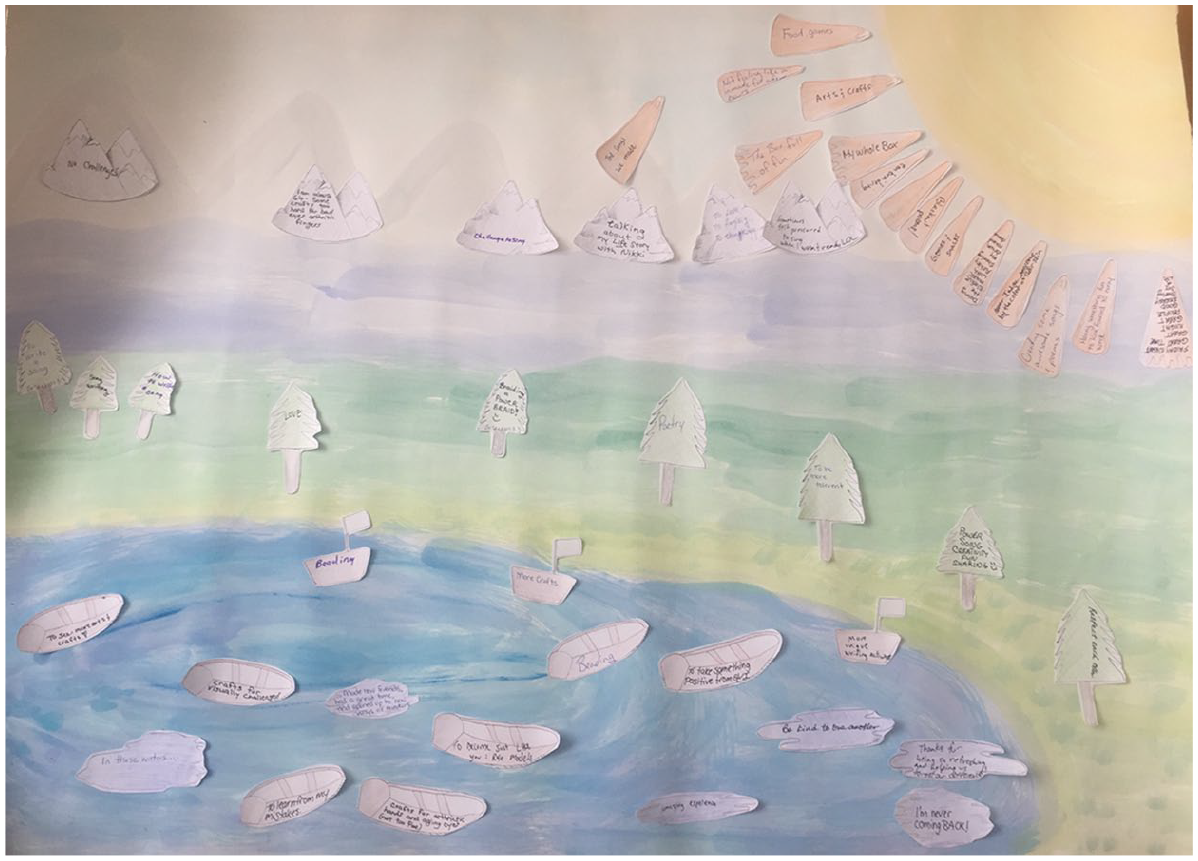
Metaphor mural, created during the final evaluation session.
Evaluation Results
With these datasets, we centered our evaluation of the arts program on two key areas: community building and artistic engagement. To begin, we considered whether the program was successful in achieving a greater sense of community between and among the women participants. As noted, programming for incarcerated women tends to underscore individual responsibility, insisting on a neoliberal ideology of self-reliance and individual empowerment (Comack & Balfour, 2014). By creating a space where incarcerated and non-incarcerated women—that is, prisoners and community-based artists—could come together and support one another, the arts program fostered collaboration and interdependency. And, according to the respondents, the experience was successful in disrupting the isolation and dehumanization of institutionalization, or as one woman noted on a sunbeam: ‘not feeling like an inmate for a few hours’ (see Figure 5).
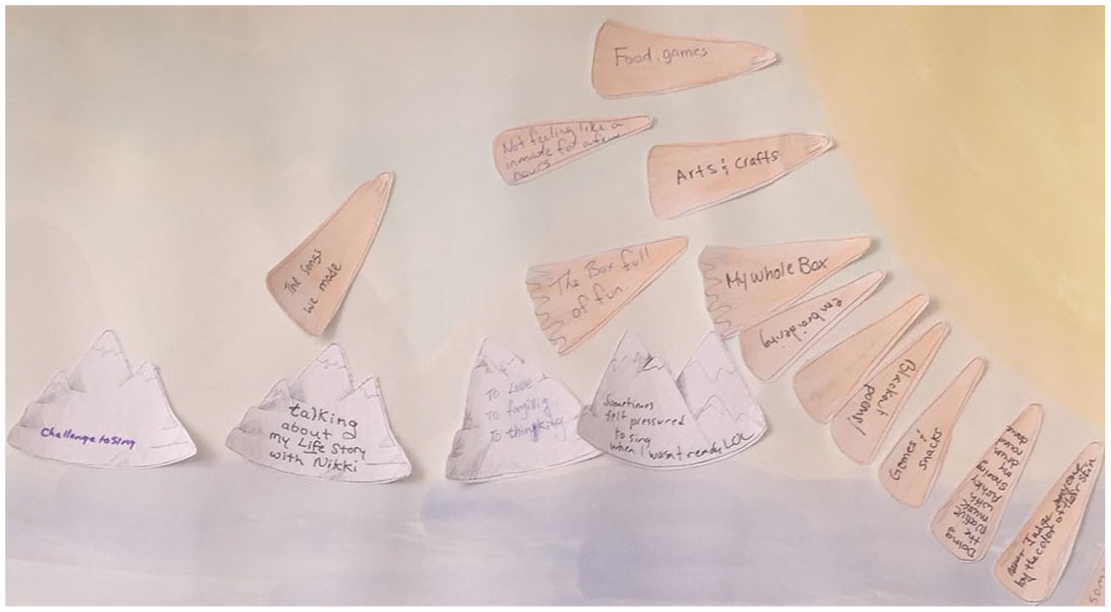
Close-up of the metaphor mural—mountains and sunbeams.
Our examination of the data suggests that the program was certainly successful with regard to community building. One participant wrote: ‘When we started together, I was. . . / Lonely and sad / Now, I am. . . / Learning that. . . / It’s time to be happy / Together, we will. . . / Become one’. Another expressed: ‘When I sing our songs, I feel. . . Included’. Both responses indicate that the program helped to develop feelings of unity and inclusion among the group. Indeed, the majority of responses spoke to increased feelings of mutual respect and kindness; the women wrote that the program helped them learn to ‘love’, ‘be more tolerant’, ‘respect each other’, ‘be more accepting and work together’, and ‘be kind to one another’ (see Figure 6). One participant thanked the artists for ‘helping us forget our differences’.
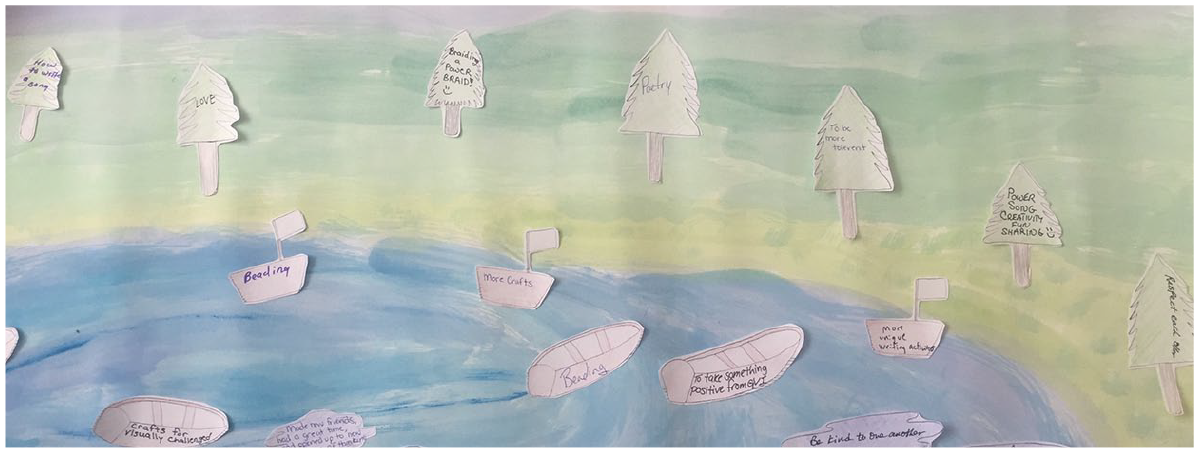
Close-up of the metaphor mural—water, trees, and boats.
While many of the comments spoke to community enhancement among the incarcerated women, some also spoke about the connections that developed between them and the artists. One woman, for example, wrote about how she was able to share her life story with one of the artists. An Indigenous participant wrote that a highlight was being able to sing traditional songs and share her drum with one of the artist facilitators who was also Indigenous. Neither of these moments of connection were part of the planned program activities; rather, they were conversations that emerged out of genuine connections of shared experiences and identities.
Further on community building, the evaluation data indicate that engaging in the program enhanced the lives of the women, giving them ‘something fun to look forward to every week’. Seven of the respondents used the words ‘happy’, ‘happiness’, or ‘joy’ in relation to the program, and another four described some part of it as ‘fun’. Or, as one participant wrote, ‘FRIDAY NIGHT, GREAT TIME, GREAT NIGHT, GREAT PEOPLE, GOOD ENERGY’. Our interpretation of this comment is that the gathering helped to disrupt the usual routines and ways of relating to one another that are prescribed within a prison setting. This sentiment—which was articulated several times during the summer activities—along with the rest of the evaluation data, suggests that the program contributed to a greater sense of community and ameliorated the lives of the women, if only for one evening a week.
Regarding the second area of the arts-based evaluation—artistic engagement—we wanted to consider the value of arts activities in and of themselves. In so doing, we aimed to counter the practice of much carceral arts programming where ‘prisoners are often characterized as the objects of their own art rather than the agents who created it’ (Lucas, 2013, p. 135). Lucas (2013, p. 157) reminds us that art is sometimes about ‘making beautiful things for the sake of their own beauty’ and encourages artists working inside prisons to focus ‘on the craft of art making [. . .] honing skill sets that enable more complex and multifaceted types of expression in the arts.’ A key feature of artistic engagement, then, is women’s self-expression, which can include self-determination, individual and collective exploration, and articulations of selfhood–all rare in carceral settings.
Participants’ engagement with art activities is reflected in all areas of the metaphor mural. Indeed, songwriting, poetry, and crafts (specifically, embroidery, and collage) were featured prominently in the learning/trees and the highlights/sunbeam sections. Further, in one evaluation poem, a participant wrote: ‘I arrived here on Thursday night and the second night you arrived and we wrote that song and I was the second line.
It was like we wrote the song from my words.
I wanted to call my family and tell them about it.
It was so cool’.
These data suggest that the women enjoyed learning new artistic skills, feeling ownership and pride in the work they created. They also reported their strong desire to continue to learn new artistic mediums and build on those they already possess. For example, their future desires/boats in the mural included: ‘more arts & crafts’, ‘more unique writing activities’, and ‘beading’. Several also connected artistic creation with community building, expressing pride in the ‘songs we made’, thus suggesting that while artistic engagement did contribute to new individual artistic skills, the arts activities further served as a broader community building tool, as noted above.
Participants’ feedback also drew our attention to an area for program improvement, particularly around accessibility. Two of the mural’s future desires/boats documented a lack of attention to physical challenges that some were experiencing: ‘crafts for visually challenged’ and ‘crafts for arthritic hands and aging eyes.’ The artist facilitators had received this feedback earlier in the arts program as well, and had modified the sessions to include more activities that require less fine-motor skills. Given this feedback, however, there is clearly more work that needs to be done in this regard. In Canada, the federal prison system is experiencing growth in the number of senior and aging prisoners, with 15% now over the age of 50 (Sapers, 2016). Offering more craft-based activities that are accessible to this aging population—and to those younger with similar physical challenges—will be beneficial for future arts programs to ensure more inclusive artistic engagement.
Challenges and Limitations
While we suggest that our use of arts-based methods to conduct an evaluation of an arts-based program comprised an innovative process which yielded informative results, there are also challenges and limitations worth considering. During the final evaluation session, for example, two participants offered feedback that could be interpreted as aligning with the institutional rhetoric of rehabilitation. One wrote that she was ‘Learning new behaviors and attitudes’; another remarked that a future desire was to ‘learn from my mistakes’. Unclear from these comments is whether the women are referring to their hopes for future arts-based programs, or if they are indicating what they want to achieve over the duration of their prison sentence. In either instance, the sentiments are congruous with neoliberal rhetoric about personal responsibility and making ‘rational’ and ‘logical’ choices, thereby evoking further reflection about the difficulty of disengaging with rehabilitative carceral logics.
Although it may appear somewhat contradictory, we also see the overwhelmingly positive and enthusiastic participant responses to be a potential limitation. It is certainly possible that the consistently favorable feedback is an accurate reflection of their program experiences, especially given the limited activities to which women in MSUs typically have access. However, given the complexity of and power relations embedded within prison/community collaborations, it is also possible that the women were reticent to divulge critical or negative commentary, other than requesting more activities that take into consideration various physical challenges. We wonder if they limited themselves to commenting almost exclusively on the program strengths out of a desire to please the artists and/or help ensure the program’s continuation. Indeed, they were aware that the artists traveled several hours weekly to get to the prison, and that they are under no obligation to create a new program or offer other future arts-based sessions. Similarly, the prison itself is not required to ensure the program continues. Although it was mentioned at the evaluation session, in retrospect it would have been beneficial to have a more direct and fulsome discussion about the helpful nature of constructive criticism, thus possibly encouraging a range of opinions and recommendations for program improvement.
Finally, we experienced a number of logistical and practical challenges that are somewhat inherent to working inside a prison, not the least of which is the transient nature of those who are incarcerated within MSUs. Several of the women were released into the community or transferred to another prison over the duration of the program, and new participants joined throughout, including during the evaluation itself. Moreover, because the program was not a mandatory component of the women’s sentences, sometimes the participant group would be entirely different from one week to the next. Women’s engagement with the arts program, therefore, varied considerably. Our evaluative datasets, too, are limited, as we were not granted permission to bring in equipment to record the final evaluation session, nor were we allowed to conduct or record informal evaluative one-on-one interviews with participants or prison staff.
Conclusion
The results of our arts-based evaluation demonstrate that the carceral arts program was successful in two key areas of assessment: community building and artistic engagement. These data are encouraging for those who seek to express the value of arts programming outside of institutional logics. However, they would likely do little to enhance prison administrators’ support of arts-based programming. There remains an incongruity between, as Lucas (2013, p. 157) notes above, ‘making beautiful things for the sake of their own beauty’ and the values of the neo-liberal prison system. And when artists’ clearance can be revoked at any time, developing a carceral program that does not readily adhere to institutional priorities is potentially risky. In our case, the evaluation (and the arts program itself) was funded entirely by non-CSC grants, thus allowing a greater freedom and flexibility in program design, implementation, evaluation, and even results dissemination.
Participant feedback highlighted the many successes of the program, suggesting that their carceral experience were ameliorated, at least on Friday evenings, through their engagement in arts-based activities. Specifically, the incarcerated women noted that the program offered them something joyful and fun to look forward to each week. That it was successful in achieving these outcomes indicates that the value of carceral arts programming can, and we argue should, be articulated outside of the institutional logics of rehabilitation and reducing recidivism. That said, notions of personal responsibility and individual decision-making were still sometimes communicated by participants. The persistence of this rhetoric, even when trying to avoid and negate it, shows its deep entrenchment in the carceral context.
Footnotes
Declaration of Conflicting Interests
The author(s) declared no potential conflicts of interest with respect to the research, authorship, and/or publication of this article.
Funding
The author(s) disclosed receipt of the following financial support for the research, authorship, and/or publication of this article: The Social Sciences & Humanities Research Council of Canada Institutional Grant (SIG) Program and Ryerson University.