



Abstract
Grit, defined as passion and perseverance for long-term goals, predicts success in a number of social domains. The present two studies examined grit and its subscales, and how these relate to both adaptive and maladaptive personality traits pertaining to success. For Study 1, based on data from 249 participants, results indicated that grit was correlated positively with proactive personality, personal growth initiative, and competitiveness, and the perseverance subscale also was correlated positively with self- and other-oriented perfectionism. The findings of Study 1 led us to further explore the dark aspects of grit in Study 2: based on data from 222 participants, results indicated that grit was correlated negatively with Machiavellianism, hypercompetitiveness, and most forms of narcissism but positively correlated with adaptive grandiose narcissism. Collectively, results reveal grit to be a positive, adaptive trait but raise questions regarding the perfectionistic tendencies of gritty individuals and the unitary nature of the construct.
Introduction
Grit, defined as passion and perseverance for long-term goals, is often characterized as an adaptive trait that enables individuals to better utilize their knowledge, skills, and abilities because they are less discouraged by setbacks and less distracted by short-term goals (e.g., Duckworth, 2016; Meriac, Slifka, & LaBat, 2015). Duckworth, Peterson, Matthews, and Kelly (2007) presented evidence that grit predicted success in a number of social domains including military training, educational attainment, and ranking in the National Spelling Bee. However, other personality characteristics that focus on personal success fall along a continuum ranging from adaptive traits, such as proactive personality (Bateman & Crant, 1993), to dysfunctional characteristics like hypercompetitiveness (Ryckman, Hammer, Kaczor, & Gold, 1990). Despite growing interest in the application of grit to predict and facilitate success (e.g., Steinmayr et al., 2018), scant research has explored whether or not grittiness comes with hidden costs or is linked to undesirable traits. To address this gap in the research literature, this investigation explored the bright and dark aspects of grit by examining the conceptual and empirical linkages between grit and adaptive and dysfunctional individual difference variables that pertain to personal success.
The association between grit and other trait variables
Much of the research examining the relationship between grit and other personality traits has focused on the global traits comprising the Five-Factor Model. In a recent meta-analysis of 73 grit studies, Credé, Tynan, and Harms (2017) found that grit was strongly related to conscientiousness and moderately related to agreeableness, emotional stability, extraversion, and openness. In addition, the study found positive relationships between grit and self-efficacy, mental toughness, self-control, positive affect, gratitude, and hope. Grit was negatively related to depression. While empirical findings linking grit to other personality traits offer a generally positive view of grit, the scope of these studies tend to be quite limited and focused on broad trait measures. Furthermore, these studies often treat grit as a higher order construct composed of two lower order facets, the consistency and perseverance subscales (Credé et al., 2017), which can be combined into an overall grit score. However, meta-analytic evidence indicates the grit-perseverance subscale better predicts performance than either the grit-consistency subscale or overall grit. This confusing pattern of results argues for examining the two subscales separately, in addition to summing the subscales to form a composite grit score. Accordingly, a great deal remains unknown about how grit, as a composite and as a two-factor construct, relates to other individual difference variables associated with personal success.
Study 1: The bright and dark aspects of grit
Over the last three decades, researchers have identified a number of ostensibly adaptive and maladaptive personality traits and individual difference variables associated with personal success. Based on the (1) conceptual linkages with the construct definition of grit and (2) gaps in the empirical literature investigating these linkages, we examined how grit and its component parts related to four of these variables: proactive personality, personal growth initiative, competitiveness, and perfectionism.
Conceptual links between grit and individual difference variables of success
Proactive personality represents a relatively new personality trait characterized by the active identification of problems and solutions as well as perseverance in the pursuit of meaningful change (Bateman & Crant, 1993). While this trait is particularly relevant to organizational settings, like grit, it is linked to success and should generalize across social domains. According to Bateman and Crant (1993), proactive individuals fully assess their environment and consistently work to locate and resolve issues. They focus on influencing their surrounding environment rather than reacting or adjusting to environmental influences. This action-oriented behavior that characterizes individuals with proactive personality may also be linked to the perseverance for long-term goals that defines gritty individuals.
Indeed, a meta-analysis of by Fuller and Marler (2009) found that proactive personality positively correlated with self-efficacy in jobs, perseverance, and career success. These findings suggest that, similar to gritty people, proactive individuals formulate goals, work through problems, and persevere in order to achieve desired outcomes. However, a distinguishing characteristic of proactive individuals may be their focus on goals relating to constructive change in their environment rather than simply the pursuit of personal goals and individual success.
An important skill for adapting to changing social environments and initiating self-improvement efforts, personal growth initiative (PGI) is defined as intentional engagement in changing and developing as a person (Robitschek, 1998). PGI enables individuals to seek and seize new opportunities over time and to develop strong interpersonal relationships and to learn new skills (Robitschek et al., 2012). Furthermore, people in diverse contexts who demonstrated high PGI also exhibited more adaptive coping skills in dealing with the challenges and pressures of life, including higher levels of emotional, social, and psychological well-being and lower levels of psychological distress compared with those with lower PGI (Blackie, Jayawickreme, Forgeard, & Jayawickreme, 2015; Weigold, Porfeli, & Weigold, 2013
Based on achievement motivation research, Helmreich and Spence (1978) defined competitiveness as the desire to win in interpersonal situations. Competitiveness is linked to a number of adaptive characteristics and aspects of success including need to achieve (Smither & Houston, 1992) as well as self-efficacy, conscientiousness, and performance (Brown, Cron, & Slocum, 1998). Recently, Neneh (2018) found that competitiveness mediates the process of opportunity recognition and action taking that is associated with success and achievement. While several lines of inquiry support the conceptual link between grit and competitiveness, research by Dugan, Hochstein, Rouziou, and Britton (2019) provides empirical evidence linking competitiveness and grit, finding they are positively correlated and both predict higher sales performance.
Perfectionism is generally defined as setting excessively high-performance standards for oneself and striving for flawlessness accompanied by critical self-evaluations and concerns regarding others’ evaluations (Flett & Hewitt, 2002; Frost, Marten, Lahart, & Rosenblate, 1990). While some researchers argue that perfectionism can play an important role in achieving success and elite performance (Stoeber, Haskew, & Scott, 2015), perfectionism is also associated with a variety of psychological disorders, such as depression (Hewitt, Mittelstaedt, & Flett, 1990) anxiety (Flett, Hewitt, & Dyck, 1989), eating disorders (Laessle, Kittl, Fichter, & Pirke, 1988), and personality disorders (Wonderlich & Swift, 1990).
Although little research, if any, exists on the relationship between perfectionism and grit, conceptually the two constructs both incorporate goal setting in the pursuit of success. While grit leaves open the nature of the long-term goal, the individual is passionately committed to achieving, perfectionism, by definition, involves unrealistically high goals. Research by Lucas, Gratch, Cheng, and Marsella (2015) found that grittier individuals were less likely to give up when failing and more willing to suffer monetary loss to persist in failing efforts. Similarly, Kalia, Fuesting, and Cody (2019) observed that grit-perseverance indirectly predicted increased effort on a very hard Sudoku puzzle (a low-constraint condition) through reduced cognitive flexibility. These findings suggest that the perseverance component of grit may be a liability when faced with insolvable problems or insurmountable obstacles, especially if these become unattainably high goals. However, before considering the relationship between grit and perfectionism, it is important to recognize that perfectionism is often conceptualized as a multidimensional construct containing both personal and social dimensions (Hewitt & Flett, 1991). Accordingly, perfectionistic behavior patterns may represent (1) self-oriented perfectionism reflecting a striving for perfection in one’s own pursuits, (2) other-oriented perfectionism involving setting unrealistic standards for others, and (3) socially prescribed perfectionism stemming from a perceived need to attain standards prescribed by significant others.
Using this conceptual framework, the gritty participants in the Lucas et al.’s (2015) study appeared to demonstrate self-oriented perfectionistic tendencies when persisting on tasks despite accruing monetary loss. Conversely, this pattern of gritty perseverance in the face of failure is more difficult to link with social dimensions of perfectionism since the laboratory task did not incorporate significant others. In theory, gritty individuals should be able to utilize their skills and knowledge by focusing on long-term success and not allowing themselves to become discouraged by minor setbacks and failures (Duckworth et al., 2007). Nevertheless, empirical findings leave open the possibility that grit may be associated with at least some aspects of perfectionism. Paralleling research findings on grit, studies by Hill, McIntire, and Bacharach (1997) and Stoeber, Otto, and Dalbert (2009) found personal-oriented perfectionism strongly correlated with conscientiousness. Given the controversial status of perfectionism and its component facets with regard to success, this study did not consider perfectionism as an adaptive trait, but one warranting further investigation.
The research reviewed indicates that grit is an adaptive personality characteristic that is strongly related to conscientiousness, predicts success in multiple domains, and is conceptually similar to other individual difference variables of success. The research also raises questions as to whether the persistent pursuit of long-term goals can have drawbacks for some individuals. Therefore, in Study 1, we tested whether there were adaptive and maladaptive aspects of grit by examining its association with proactive personality, PGI, competitiveness, and perfectionism. Accordingly, we proposed the following hypotheses:
Method
Participants
A total of 249 undergraduate students (190 women and 59 men) at a liberal arts college with both traditional and nontraditional degree programs participated in Study 1. Participants ranged in age from 18 to 48 years with a median age of 19 years. The ethnic breakdown of the sample was 3.5% Asian, 6% African American, 69% Caucasian, 19% Hispanic, 1.5% Other, and 1% no response.
Measures
Grit
Participants completed the 12-item Grit Scale (Duckworth et al., 2007) to assess passion and perseverance for long-term goals. This self-report instrument contains two subscales which measure perseverance and consistency in pursuing goals. While the grit-perseverance subscale includes items about success in facing obstacles such as “I have overcome setbacks to conquer an important challenge,” the grit-consistency subscale contains questions about maintaining goal focus such as “I often set a goal but later choose to pursue a different one.” All scale items use a five-point Likert-type scale to measure responses, where 1 = not at all like me and 5 = very much like me. In this study, the composite grit scale and its subscales all showed adequate internal consistency (grit α = .81, perseverance α = .81, and consistency α = .82).
Proactive Personality Instrument
Participants completed the Proactive Personal Instrument (PPI), a six-item self-report measure of personal initiative behavior (PPI; Li, Fay, Frese, Harms, & Gao, 2014). The measure uses a five-point Likert-type scale, varying from 1 (strongly agree) to 5 (strongly disagree). Examples of items include “I take initiative immediately, even when others don’t” and “I am particularly good at realizing ideas.” Internal consistency for this measure in this study was high (α = .84).
The Personal Growth Initiative Scale-II
Participants completed the Personal Growth Initiative Scale (PGIS-II), a 16-item self-report measure which assesses perception and behavior involved in personal growth (PGIS; Robitschek et al., 2012). The PGIS-II uses a six-point Likert-type scale with items rated from 0 (disagree strongly) to 5 (agree strongly). Examples of items include “I set realistic goals for what I want to change about myself” and “I look for opportunities to grow as a person.” Internal consistency for this measure in this study was high (α = .94).
The Revised Competitiveness Index
Participants completed the Revised Competitiveness Index (CI-R; Houston, Harris, McIntire, & Francis, 2002), a 14-item self-report measure of general competitiveness designed to assess the desire to win in interpersonal situations. The CI-R uses a five-point Likert-type response scale anchored by 1 (strongly disagree) and 5 (strongly agree). Examples of items include “I get satisfaction from competing against others” and “I often try to outperform others.” Internal consistency for this measure in this study was high (α = .91).
The Multidimensional Perfectionism Scale
Participants completed the Multidimensional Perfectionism Scale (MPS), a 45-item self-report measure of self-oriented perfectionism, other-oriented perfectionism, and socially prescribed perfectionism (MPS; Hewitt, Flett, Turnbull-Donovan, & Mikhail, 1991). The MPS uses a seven-point Likert-type scale, ranging from 1 (strongly disagree) to 7 (strongly agree). Examples of items include “One of my goals is to be perfect in everything I do” and “It makes me uneasy to see an error in my work.” Alpha reliabilities for the subscales of the MPS in this study varied from .79 to .95.
Procedure
All participants completed an online questionnaire hosted on the Qualtrics® website and containing measures of grit, proactive personality, PGI, competitiveness, and perfectionism as well as demographic questions on gender, age, and ethnicity. After receiving a link to access the survey via e-mail, participants completed the measures unsupervised on their own time, and received course credit in exchange for their participation.
Approximately midway through the data collection process, researchers became aware that the response format for the MPS was incorrectly entered on the Qualtrics online survey. After correcting the problem, data collection resumed resulting in 132 usable MPS scores. However, the 117 unusable MPS scores were deleted from the data file. Accordingly, analyses were based on 249 cases except for analyses involving MPS subscales.
Results
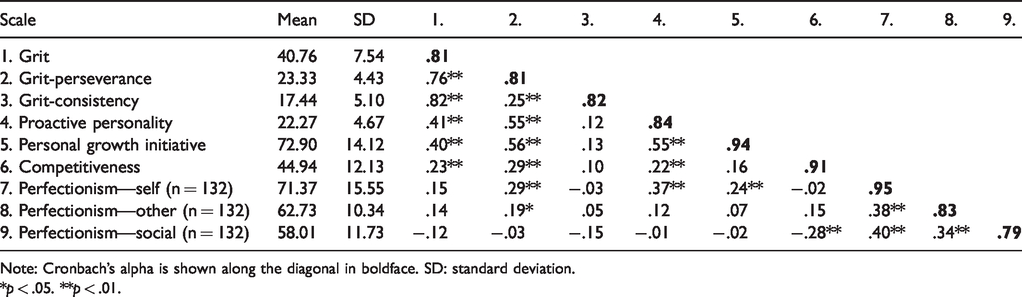
To investigate the relationship between grit and its component subscales (grit-perseverance and grit-consistency) with proactive personality, PGI, competitiveness, and the subscales of perfectionism, we conducted a series of correlational analyses. As Table 1 indicates, grit was positively related to competitiveness (r = .23, p < .001), proactive personality (r = .41, p < .001), and PGI (r = .40, p < .001). While the grit-perseverance was positively correlated with self-oriented perfectionism (r = .29, p = .001) and other-oriented perfectionism (r = .19, p = .03) and showed a similar pattern of associations as grit, the grit-consistency subscale was not related to any of the other variables.
Descriptive statistics and Pearson correlation coefficients of the main variables for Study 1.
Note: Cronbach’s alpha is shown along the diagonal in boldface. SD: standard deviation.
*p < .05. **p < .01.
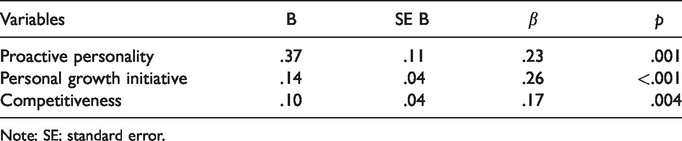
To assess the unique variance accounted for in grit by the other variables, those variables that were significantly correlated with grit, proactive personality, PGI, and competitiveness were entered into a multiple regression using the standard method. A statistically significant model emerged: F(3, 245) = 25.15, p < . 0001. As Table 2 shows, proactive personality (β = .23, p = .001), PGI (β = .26, p < .001), and competitiveness (β = .17, p = .004) were significant predictors of grit and together accounted for 23% of the variance in grit (adjusted R2 = .23).
Multiple regression analysis predicting grit from proactive personality, personal growth initiative, and competitiveness in Study 1.
Note: SE: standard error.
In a separate analysis, all variables significantly correlated with the grit-perseverance, including proactive personality, PGI, competitiveness, self-oriented perfectionism, and other-oriented perfectionism, were entered as predictors into a multiple regression using the standard method. The analysis produced a statistically significant model, F(5, 126) = 29.07, p < .0001. The model explained 52% of the variance in perseverance (adjusted R2 = .52) with proactive personality (β = .40, p < .001) and PGI (β = .35, p < .001) both positive significant predictors. Competitiveness, self-oriented perfectionism, and other-oriented perfectionism were not significant predictors of grit-perseverance. Since no predictors were significantly correlated with the grit-constancy, this precluded multiple regression analysis of this criterion variable.
Discussion
In general, the findings provide strong support for Hypothesis 1 that the composite grit scale is positively related to the adaptive individual difference variables proactive personality, PGI, and competitiveness. Consistent with the previous research (e.g., Duckworth et al., 2007), the pattern of results indicates a positive view of grit as a healthy and adaptive trait. Individuals with high levels of grit described themselves as taking a proactive approach to problems, enjoying competition, and actively working to improve themselves. As predicted, grit was associated with competitiveness, proactive personality, and PGI. Multiple regression results indicated that proactive personality, PGI, and competitiveness all accounted for unique variance in grit. Although these results highlight the bright aspect of grit, the findings regarding the perseverance subscale of grit also beg the question—Is there a dark aspect of grit in the pursuit of success?
The findings provided only partial support for Hypothesis 2 which predicted that grit and its subscales would be positively related to self-oriented perfectionism but not related to other facets perfectionism. While the grit-perseverance was positively related to self-oriented perfectionism and other-oriented perfectionism, the composite grit score was not associated with any dimension of perfectionism. These results indicate that individuals high in grit-perseverance tend to hold themselves and others to unrealistically high standards. These findings suggest a potential maladaptive or dark side to grit that may pose a psychological obstacle for gritty individuals and those who work with them.
Supplemental analyses indicated that grit-perseverance was positively related to both the adaptive individual difference variables and self- and other-oriented perfectionism. However, multiple regression findings indicated that only proactive personality and PGI were significant predictors of grit-perseverance. While the positive relationship between grit-perseverance and self-oriented perfectionism is consistent with experimental findings linking grit with costly persistence (Lucas et al., 2015), the positive relationship between self-oriented perfectionism and proactive personality and PGI adds to the controversy surrounding the adaptive or maladaptive nature of perfectionism and its implications for understanding grit.
Surprisingly, grit-consistency was not associated with any of the adaptive individual difference variables and was only weakly correlated with grit-perseverance. In light of recent research findings indicating that grit-perseverance and grit-consistency are related but independent constructs (Tyumeneva et al., 2019), this study raises some fundamental questions about the unitary nature of the grit construct. In addition, this study’s findings regarding positive associations between grit-perseverance and perfectionistic behavior patterns that represent unrealistic standards for one’s self and others support further exploration of the dark aspects of grit and its component facets in the pursuit of success.
Study 2: A further look at the dark side of grit
Based on the findings in Study 1, we further investigated the dark side of grit and its relationship with success-oriented individual differences by focusing specifically on maladaptive personality traits in Study 2. Although grit is conceptualized as an adaptive trait, researchers have only investigated grit’s relationship to a very narrow range of maladaptive personality characteristics. Accordingly, Study 2 explores the general research question, “Is there a dark side of grit?” by focusing on the relationship between grit and the maladaptive personality traits Machiavelliansim, grandiose narcissism, vulnerable narcissism, and hypercompetitiveness.
Conceptual links between grit and “dark” traits of success
The concept of a Machiavellian personality is drawn from Niccolo Machiavelli’s books The Prince (1531/1985) and The Discourses (1531/2003) which argue that obtaining and maintaining political power requires the use of manipulative and amoral methods when dealing with others. More than four centuries later, Christie and Geis (1970) proposed that this approach to social situations represents a personality syndrome characterized by a cynical worldview, pragmatic ethics, and the use of duplicitous tactics. Individuals high in Machiavellianism (high Machs) reported having an unmitigated focus on achievement and a desire for winning at any cost (Ryckman, Thornton, & Butler, 1994). While this intense emphasis on achievement and winning may seem similar to the “passion” for goal achievement that forms the core concept of grit, Duckworth (2016) argued that purpose, defined as “the intention to contribute to the well-being of others” (p. 143), is a key component of gritty passion. This proposition that gritty people are concerned about others is consistent with empirical findings by Meriac et al. (2015) indicating that grit and its subscales were positively associated with measures of morality and ethical behavior. Given that high Machs reported engaging in antisocial behaviors including bullying (Sutton & Keogh, 2010), withholding information for economic gain (Sakalaki, Richardson, & Thépaut, 2007) and scholastic cheating in the form of plagiarism (Williams et al., 2010), grit, in many ways, appears antithetical to Machiavellianism. It should also be noted that Machiavellianism is associated with a range of negative personality characteristics such as narcissism and psychopathy forming the “Dark Triad” (O’Boyle et al., 2012), and spitefulness (Marcus et al., 2014).
Narcissism remains a complex and challenging psychological construct, as it is multidimensional and exists on a continuum from adaptive to pathological manifestations. Adaptive or normal narcissism involves striving for self-enhancement and success that does not present difficulties in well-being and relating (Pincus & Lukowitsky, 2010); however, pathological narcissism causes significant distress and impairment in the pursuit of unrealistic or unobtainable goals. Research on narcissism has evolved to include the heterogeneity of the construct, including grandiose and vulnerable subtypes. These two subtypes have separate nomological networks (J. D. Miller et al., 2011), with vulnerable narcissism represented by insecurity, inferiority, and a deflated sense of self-worth, and grandiose narcissism represented by self-aggrandizement, entitlement, arrogance and an inflated sense of self-worth (e.g., Caligor et al., 2015). However, both of these concepts, and therefore narcissism in general, are linked by excessive need for admiration from others, a dependency on external sources of self-definition (Caligor et al., 2015) and interpersonal antagonism (J. D. Miller et al., 2017). Those with narcissistic pathology lack the ability to accurately evaluate themselves, often leaving them dependent on a reality that is constructed to support their need for positive regard in all situations. Therefore, adaptive narcissism would have relationships with attributes that are considered positive and self-enhancing, while pathological narcissism in both forms would be associated with maladaptation, distress, and difficulties in self-regulation (Ackerman et al., 2011).
The personality construct hypercompetitiveness derives from research by Karen Horney (1937) who defined hypercompetitiveness as a dysfunctional form of extreme competitiveness linked to neurosis and representing an indiscriminate need to win at all costs. In contrast to “normal” competitiveness discussed in Study 1, hypercompetitiveness is associated with heightened self-worth fluctuating with underlying low self-esteem, high levels of neuroticism, decreased need for others, and interest in admiration and recognition from others (Ryckman et al., 1990, 1994). Despite the neurotic need to win, hypercompetitiveness generally does not predict success or academic performance (Bing, 1999). Accordingly, the short-term focus on winning at all cost may hinder the strategic pursuit of long-term goals and interfere with gritty responses to obstacles and setbacks. Hypercompetitiveness is also related to a broad spectrum of unhealthy behaviors and social interactions including eating disorder symptoms (Burckle et al., 1999) and problematic romantic relationships and relationships with peers and family (Thornton et al., 2011). In combination, these features make hypercompetitiveness a maladaptive trait.
Based on the above literature review, we propose the following hypotheses:
Method
Participants
A different sample of 222 undergraduate students (165 women and 57 men) recruited from the same small liberal arts college as Study 1 participated in Study 2. Participants ranged in age from 18 to 61 years with a median age of 20 years and reported their ethnicities as 4.5% Asian, 5.5% African American, 62.5% Caucasian, 17% Hispanic, 7% Other, and 1% no response.
Measures
Grit
Participants completed the same 12-item Grit Scale (Duckworth et al., 2007) used in Study 1 to assess passion and perseverance for long-term goals. Internal consistency for this scale in this study was moderately high (α = .81).
Machiavellianism
To assess agreement with Machiavellian beliefs, participants completed the Mach IV (Christie & Geis, 1970). This 20-item inventory uses a six-point Likert-type response format ranging from 1 = strongly disagree to 6 = strongly agree. Sample items include “It is wise to flatter important people” and “It is safest to assume that all people have a vicious streak and it will come out when they are given a chance.” The Mach IV is correlated with measures of narcissism and psychopathy (O’Boyle et al., 2012) in addition to hypercompetitiveness (Mudrack, Bloodgood, & Turnley, 2012). Internal consistency for this scale in this study was acceptable (α = .71).
Narcissistic Personality Inventory
Grandiose narcissism was assessed using the Narcissistic Personality Inventory (NPI; Raskin & Terry, 1988), a 40-item forced choice self-report measure of trait narcissism. Sample statements include “I am more capable than other people” and “I can make anyone believe anything that I want them to.” Based on the importance of differentiating adaptive from maladaptive grandiose narcissism (Ackerman et al., 2011), three subscales were used instead of the global NPI score: adaptive grandiosity measured by leadership/authority (L/A; α = .76) and maladaptive grandiosity measured by grandiose exhibitionism (G/E; α = .77) and entitlement/exploitativeness (E/E; α = .43).
Hypersensitive Narcissism Scale
Vulnerable narcissism was measured using the Hypersensitive Narcissism Scale (Hendin & Cheek, 1997), a 10-item scale with a five-point response format ranging from not at all true of me to very true of me. The instrument includes items such as “When I enter a room I often become self-conscious and feel that the eyes of others are upon me” and “I easily become wrapped up in my own interests and forget the existence of others.” Internal consistency for this scale in this study was moderately low (α = .72).
The Hypercompetitive Attitude Scale
Participants also completed the Hypercompetitive Attitude Scale (Ryckman et al., 1990), a 26-item scale that assesses unhealthy competitiveness and uses a five-point response scale ranging from 1 (never true of me) to 5 (always true of me). The scale includes items such as “I find myself turning a friendly game or activity into a serious contest or conflict” and “Failure or loss in competition makes me feel less worthy as a person.” The scale is correlated with measures of general competitiveness (Houston et al., 2002) as well as neuroticism (Ryckman et al., 1996). Internal consistency for this scale in this study was moderately high (α = .86).
Procedure
Following the same procedure as Study 1, all participants in Study 2 completed an online questionnaire hosted on the Qualtrics® website and containing measures of grit, two measures of narcissism, hypercompetitiveness, and Machiavellianism as well as demographic questions on gender, age, and ethnicity. After receiving a link to access the survey, participants completed the measures unsupervised on their own time and received course credit in exchange for their participation.
Results
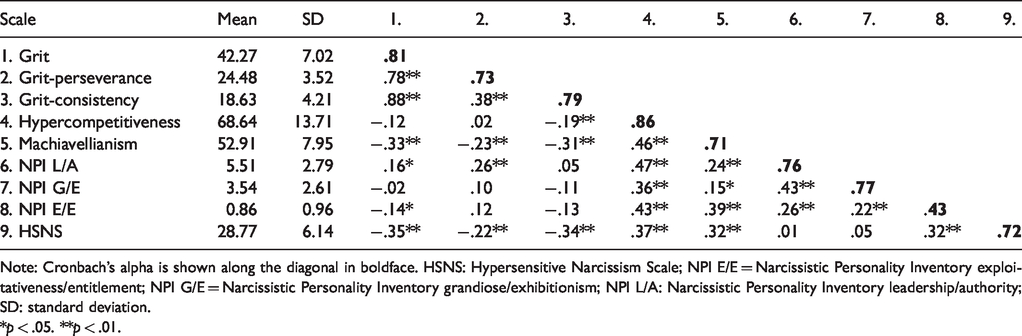
A series of correlational analyses were conducted to examine the relationship between grit, grit-perseverance, and grit-consistency and the maladaptive personality variables, Machiavellianism, hypercompetitiveness, vulnerable narcissism, leadership narcissism, grandiose narcissism, and exploitive narcissism. As Table 3 indicates, grit was negatively related to Machiavellianism (r = −.33, p < .001), vulnerable narcissism (r = −.35, p <.001), and E/E narcissism (r = −.14, p = .034) and positively related to L/A narcissism (r = .16, p = .015). The correlations between grit-perseverance and the maladaptive personality traits followed a similar pattern as grit with the exception of no correlation with E/E narcissism. Grit-consistency showed a somewhat different pattern of correlations and was negatively related to Machiavellianism (r = − .31, p < .001), vulnerable narcissism (r = −.34, p < .001), and hypercompetitiveness (r = −.19, p = .006).
Descriptive statistics and intercorrelations among scales in Study 2 (N = 222).
Note: Cronbach’s alpha is shown along the diagonal in boldface. HSNS: Hypersensitive Narcissism Scale; NPI E/E = Narcissistic Personality Inventory exploitativeness/entitlement; NPI G/E = Narcissistic Personality Inventory grandiose/exhibitionism; NPI L/A: Narcissistic Personality Inventory leadership/authority; SD: standard deviation.
*p < .05. **p < .01.
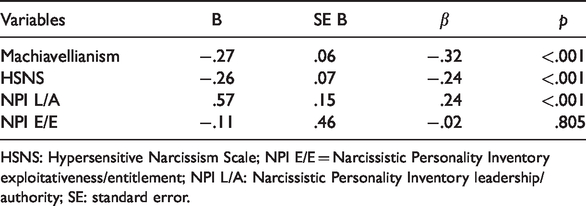
To investigate the unique variance accounted for in grit by the other personality variables, those variables significantly related to grit, Machiavellianism, vulnerable narcissism, exploitative narcissism, and leadership narcissism were entered into a multiple regression using the standard method. Due to multicollinearity concerns, exploitative narcissism was excluded from the analysis. A significant model emerged: F(3, 215) = 22.29, p < . 001. As presented in Table 4, Machiavellianism (β = −.33, p < .001), vulnerable narcissism (β = −.24, p < .001), and L/A narcissism (β = .24, p < .001) were significant predictors of grit and together accounted for 24% of the variance in grit (adjusted R2 = .23). Exploitive narcissism was not a significant predictor.
Multiple regression analysis predicting grit from Machiavellianism, hypersensitive narcissism, leadership/authority narcissism, and exploitative/entitlement narcissism in Study 2.
HSNS: Hypersensitive Narcissism Scale; NPI E/E = Narcissistic Personality Inventory exploitativeness/entitlement; NPI L/A: Narcissistic Personality Inventory leadership/authority; SE: standard error.
An additional analysis was conducted to assess the unique variance in grit-perseverance accounted for by the other personality variables. Using an inclusion criteria based on significant zero-order correlations with grit-perseverance, Machiavellianism, vulnerable narcissism, and L/A narcissism were entered into the multiple regression using the standard method. The analysis yielded a significant model: F(3, 215) = 15.35, p < . 0001. Machiavellianism (β = −.28, p < .001) and L/A narcissism (β = .32, p < .001) were significant predictors of grit-perseverance and together accounted for 17% of the variance in grit (adjusted R2 = .17). Vulnerable narcissism was not a significant predictor.
Finally, to examine which personality variables accounted for unique variance in grit-consistency, the significant zero-order correlates of consistency, Machiavellianism, hypercompetitiveness, and vulnerable narcissism were entered as predictors into a multiple regression using the standard method. A significant model emerged: F(3, 215) = 14.76, p < .0001. Machiavellianism (β = −.24, p < .001) and vulnerable narcissism (β = −.27, p < .001) were significant predictors and together accounted for 16% of the variance in grit-consistency (adjusted R2 = .16). Hypercompetitiveness was not a significant predictor.
Discussion
In this study, grit was negatively related to Machiavellianism, vulnerable narcissism, and E/E narcissism, which partially supports Hypothesis 3 that proposed that grit and its subscales are negatively related to maladaptive traits of success. It should be noted that the internal consistency of the E/E narcissism subscale is quite low (α = .43) which poses some psychometric concerns. Accordingly, caution should be exercised in interpreting results associated with this measure. However, contrary to Hypothesis 3, grit was not inversely related to hypercompetitiveness or maladaptive grandiose narcissism. These results spotlight the conceptual differences between grit and hypercompetitiveness and maladaptive grandiose narcissism and indicate that these personality traits do not play a significant role in gritty patterns of behavior.
The findings partially support Hypothesis 4 which predicted that grit and its subscales are positively related to the adaptive trait leadership narcissism. In light of the results of the multiple regression indicating that Machiavellianism and vulnerable narcissism were negative predictors and leadership narcissism was a positive predictor of grit, these findings provide further support for the conceptualization of grit as an adaptive trait that is associated with healthy levels of belief in one’s leadership capabilities.
Furthermore, analyses investigating the relationship between the component facets of grit and the other personality traits indicated a pattern of results that show distinct differences between grit-perseverance and grit-consistency. Although both of the grit subscales were negatively related to Machiavellianism and vulnerable narcissism, only grit-perseverance was positively related to L/A narcissism. In addition, only grit-consistency was negatively related to hypercompetitiveness. While multiple regression results found that Machiavellianism and L/A narcissism were the only significant predictors of grit-perseverance, vulnerable narcissism and Machiavellianism were the only significant predictors of grit-consistency. These findings underscore the related but distinct characteristics of the grit subscales and raise similar concerns as Study 1 about the unitary nature of the grit construct.
General discussion
Overall, the two studies provide new evidence that grit is an adaptive trait that is generally related to healthy individual differences and negatively related to unhealthy personality traits. While these studies provided evidence for the adaptive or bright side of grit, some questions remain about the potential dark side of grit. More specifically, the positive relationship between the grit-perseverance and self- and other-oriented perfectionism in Study 1 is consistent with experimental findings (Kalia et al., 2019; Lucas et al., 2015) indicating that grittiness, in some situations, may lead to overinvestment of time and effort in unsolvable problems or unobtainable goals or unrealistic expectations for others’ performance.
While the results of these studies provide important new information about grit, both studies have limitations that should be acknowledged. Mindful of the potential limitations of self-report survey research, including systematic response distortions, method variance, and monomethod bias (L. A. Miller & Lovler, 2020), it is also important to recognize that grit scores in these studies represent self-perceptions of grittiness rather than objective measures of gritty behavior patterns. Despite more than a decade of research on grit, the construct explication of grit remains incomplete since the behaviors related to the construct as well as other constructs related to grit are still being identified. Although the results of the studies provide new convergent and discriminant validity evidence for grit as an adaptive success-oriented personality trait, the cross-sectional nature of the studies precluded longitudinal analysis of grit over time. Future longitudinal research focusing on goal-setting behaviors in the pursuit of long-term goals is needed to complement the retrospective analysis of accomplishment records of successful people provided by Duckworth (2016). This research strategy may also be helpful in exploring why some gritty individuals are not successful.
Another potential limitation in both studies involves the use of samples of convenience from a single collegiate institution. Since this sampling strategy may reduce the representativeness of the sample, it may also limit the generalizability of some of the results, particularly as they relate to different socioeconomic groups and cultural settings. However, the distributional properties of grit scores in both studies were comparable to those in noncollegiate samples reported by other researchers (e.g., Duckworth et al., 2007).
The results from these studies highlight the positive characteristics of grit but also point to a potentially hidden weakness of gritty people in the form of perfectionistic tendencies as well as a previously unrecognized strength related to skills for personal change. Both of these findings have important practical applications for gritty individuals. First, if we accept the premise that grit is a personality trait, by definition, it should remain relatively stable over time and across situations. Consequently, attempts to significantly change an individual’s grittiness may ultimately be quixotic. However, because perfectionism is associated with a number of negative and destructive outcomes (e.g., Blatt, 1995; Flett et al., 2014), the tendency for gritty individuals to have perfectionistic characteristics that can lead to unattainably high personal goals and unrealistically high standards for others may benefit from increased awareness of these tendencies and therapeutic intervention to address barriers to success. Furthermore, since individuals high in grit also tend to have the skill set represented by PGI, gritty individuals can potentially leverage their grit by honing their change skills and developing adaptive strategies for managing their perfectionistic tendencies and achieving their long-term goals.
In sum, our findings overall are consistent with an understanding of grit as a healthy, adaptive trait (e.g., Duckworth, 2016). Passion and commitment for long-term goals were associated with taking a proactive approach to problems, actively seeking personal growth opportunities, and a healthy enjoyment of competition, all characteristics associated with success in the workplace and other interpersonal realms (e.g., Seibert et al., 2001). Consistent with this positive view, grit was also positively associated with a healthy belief in one’s capabilities as a leader and authority figure and negatively associated with Machiavellianism, vulnerable narcissism, and entitlement/exploitativeness. Our findings offer a novel contribution to the burgeoning literature in challenging the notion of grit as a unitary construct. While the pattern of results for grit-perseverance looked similar to those for the composite grit scale, grit-consistency was either weakly or not correlated with the other adaptive individual difference variables. In addition, our findings regarding the positive associations between grit-perseverance and self- and other-oriented perfectionism suggest that being gritty may come at a cost for oneself and others. Future research attempting to uncover a more complete understanding of grit will benefit from further exploring these associations.
