




Abstract
Research has provided direct and indirect evidence of associations between trust beliefs and social-perceptual theory of mind (ToM) and between social-perceptual ToM and interpersonal communication competence during childhood and adolescence. This research (a) developed a scale for evaluating trust beliefs in young Italian adults (Study 1) and (b) examined how social-perceptual ToM mediates the relationship between emotional trust beliefs and interpersonal communication competences such as assertiveness and empathy (Study 2). In Study 1, a sample of 168 university students (M = 23.3, SD = 3 months) completed the Italian Adults’ Generalized Trust Beliefs (AGTB) scale and two second-order false beliefs tasks. In Study 2, 318 Italian university students (M = 22.96 years, SD = 2 months) completed the AGTB scale, the Experiences in Close Relationships-Revised questionnaire, the Reading the Mind in the Eyes Test, and items measuring assertiveness and empathy. As expected, the AGTB scale exhibited acceptable internal consistency, structural validity, and construct validity. Furthermore, path analysis confirmed the existence of the hypothesized paths between adults’ emotional trust beliefs, social-perceptual ToM, assertiveness, and empathy. This study also identified the effects of gender on the other variables, but sex did not moderate the relationships between variables.
Keywords
Introduction
Interpersonal communication competence (ICC) is defined as a person’s ability to manage interpersonal relationships (Rubin & Martin, 1994) and allows individuals to interact flexibly with others (Spitzberg & Cupach, 1984). Many authors recognize several personal and social abilities, such as assertiveness and empathy, as components of ICC (Anders & Tucker, 2000; Fetro et al., 2010; Norton & Warnick, 1976; Rubin & Martin, 1994; Rubin et al., 1993). ICC is a class of skills with many benefits across a range of social spheres, from the enjoyment of high-quality personal relationships to rich educational experiences, career progression, and successful participation in complex communicative environments (Burleson, 2007; Morreale & Pearson, 2008). It should be noticed that there is a lack of research on the psychological dimensions that contribute to the high ICC.
This study aimed to address the gap mentioned above in the literature by investigating theory of mind (ToM) as a mediator between trust beliefs and assertiveness and empathy, in a group of young adults. Because the participants were young Italian adults, the research involved the development and validation of an Italian measure of trust in others that would be comparable to those used with Italian children and in English-speaking countries.
The conceptualization of interpersonal trust
In this study, interpersonal trust was conceptualized in terms of the three bases, three domains, and two targets (BDT) framework developed by Rotenberg (2010). The three bases are reliability, the fulfilment of words or promises; emotional trust, the belief that others refrain from causing emotional harm and criticism and respect the confidentiality of personal information; and honesty, telling the truth. The three domains are cognitive\affective, comprising an individual’s beliefs and feelings that others act as for the three bases of trust; behavior-dependent, the extent to which an individual relies on others to display the behaviors that underlie the three bases of trust; and behavior-enacting, the extent to which an individual demonstrates the behaviors underlying the three bases of trust. Finally, the bases and the domains can be characterized in terms of two target dimensions: familiarity (e.g., ranging from slightly to highly familiar) and specificity (ranging from general to specific others). The BDT framework emphasises that interpersonal trust is a reciprocal phenomenon (Betts et al., 2014; Rotenberg & Chase, 1992).
It has long been recognized that trust is crucial to adjusted psychosocial functioning (Simpson, 2007) and the formation of healthy human relationships (Bridges, 2003; Mitchell, 1990). There is a growing body of evidence that interpersonal trust across the life span is linked to physical health (Barefoot et al., 1998; Petrocchi et al., 2019; Petrocchi, Labrie, & Schulz, 2020; Rotenberg & Petrocchi, 2018), cognitive functioning (Harris, 2007), social functioning (Rotenberg, 2010; Rotenberg et al., 2004, 2005; Rotenberg, Petrocchi, Lecciso, & Marchetti, 2015; Rotter, 1980), and the development and maintenance of close relationships between adults (Holmes & Rempel, 1989).
Theory of mind
ToM, which is an essential topic of research in psychology and neuroscience, is the ability to make inferences about the cognitive and emotional states of others, e.g., their beliefs, perspectives, intentions, emotions, and feelings) and to predict other people’s behavior (Schneider et al., 2017). ToM is regarded as crucial to social adaptation (i.e., formation and maintenance of social relationships; Bosacki & Astington, 1999; Kokkinos et al., 2016; Lecciso, Levante, Baruffaldi, & Petrocchi, 2016; Petrocchi, Levante, Baruffaldi, & Lecciso, 2017; Lecciso, Petrocchi, & Marchetti, 2013; Petrocchi, Rotenberg, Levante, & Lecciso, 2017; Moore & Frye, 1991; Ractcliffe, 2007; Suway et al., 2012) and development of ICC (Bora et al., 2006; Devine et al., 2016; Kokkinos et al., 2016; Lawrence et al., 2004; Lerner et al., 2011; Morrison & Bellack, 1981).
According to the Tager-Flusberg and Sullivan’s (2000) model of ToM, a social-perceptual component can be distinguished from a social-cognitive component. The social-cognitive component reflects the traditional conceptualization of ToM as a representational system (Tager-Flusberg & Sullivan, 2000). In contrast, the social-perceptual component involves the ability to infer the mental states of others from their facial expressions, verbal language, and body language (Tager-Flusberg & Sullivan, 2000). Prototypical measures of the social-cognitive component of ToM include first-order false belief tasks (Wimmer & Perner, 1983) and the Strange Stories paradigm (White et al., 2009).While prototypical measures of the social-perceptual component of ToM (recognized as an advanced ToM ability; Andrzejewska et al., 2017; Bora et al., 2008) include recognition of facial expression tasks (Brüne, 2005; Gao & Maurer, 2009; Schiffenbauer, 1974) and the Reading the Mind in the Eyes Test (RMET; Baron-Cohen et al., 2001).
There has been extensive investigation of both components of ToM in children but less research on ToM in adolescence and adulthood (see Hughes, 2016). The majority of adult studies have compared clinical conditions (e.g., autism, affective disorders, brain injury, frontotemporal dementia) with neurotypicality, and one of the most widely used tool for measuring ToM is the RMET (Andrzejewska et al., 2017; Baron-Cohen et al., 1997, 2001; Bora et al., 2008; Oakley, Brewer, Bird, & Catmur, 2016). Vellante et al.’s (2013) study confirmed the convergent and discriminant validity of the revised Italian version of the RMET, demonstrating that young women had higher RMET scores than young men. They also explained that the Italian RMET showed the one-factor structure similar to the original one.
Relationships between trust beliefs, ToM, and ICC and the supporting evidence
This study was guided by the expectation that the emotional basis of trust in others (see Rotenberg, 2010) would be related to individual differences in social-perceptual ToM, which, in turn, would be associated with assertiveness and empathy, as forms of ICC.
Several studies on children (Chandler & Hala, 1991; Maas, 2008; Peskin & Ardino, 2003; Polak & Harris, 1999; Talwar, Gordon, & Lee, 2007) or adolescents (Kerr & Stattin, 2000; Kerr et al., 1999; Smetana et al., 2006; Weber & Carter, 1998) have provided indirect support for the existence of an association between ToM abilities and trustworthiness. Research (Chandler & Hala, 1991; Talwar, Goldon, & Lee, 2007; Maas, 2008; Peskin & Ardino, 2003; Polak & Harris, 1999; Talwar et al., 2007) found that better performance in ToM tasks was linked to ability to keep a secret or promise, to not lying or deceiving others and to asking for help (i.e., aspects of the behavior-enacting domain of trust; Rotenberg, 2010).Other studies (Ereky-Stevens, 2008; Ruffman et al., 2002; Symons et al., 2006) yielded evidence that disclosure of personal information to family members (corresponding to the emotional basis of the behavior-dependent domain of trust; Rotenberg, 2010) is associated with higher scores in ToM tasks. Weber and Carter (1998) found a similar pattern of relations in a group of adolescents. Specifically, they observed that discourses among family members contribute to their perspective-taking, which is a form of ToM ability.
Direct support for an association between emotional trust and ToM has been provided by authors (Rotenberg et al., 2015), who demonstrated an association between children’s emotional trust in others and their ToM ability. In this study, the authors proposed that children’s emotional trust in others predisposes them to disclose personal information to others. The latter is reciprocated by family members and exposes children to a wide range of others’ internal states (i.e.,beliefs, thoughts, affect, and emotions), and thus to a better ToM.
Turning to the relation between social-perceptual ToM and ICC, there have been studies assessing the associations between social-perceptual ToM abilities and social functioning (Andrzejewska et al., 2017; Bora et al., 2006; Caputi et al., 2012) and ICC (Bora et al., 2006; Morrison & Bellack, 1981). ICC is defined as a person’s ability to interact openly and flexibly with others in an interpersonal context (Rubin & Martin, 1994; Spitzberg & Cupach, 1984). Bora et al. (2006) found a positive relationship between RMET score (a measure of the social-perceptual component of ToM) and social functioning (index of ICC). These authors proposed that the ability to infer a person’s mental states from cues in his or her gaze is related to emotional aspects of empathy (a component of ICC), and there are sex differences in this capacity. The ICC has several components (see Rubin & Martin, 1994), but in line with our aims, we opted to assess assertiveness (the ability to express one’s thoughts, opinions, and feelings openly and to communicate frankly and appropriately with others; Bar-On, 1997) and empathy (awareness and understanding of others’ feelings or emotional states; Bar-On, 1997).
In line with the evidence mentioned above, we proposed to provide direct evidence for the existence, in young adults, of an association between emotional trust beliefs and ICC that is mediated by social-perceptual ToM. As reported by Siegel (2014), individuals base their relationships on their understanding of their own and others’ feelings and emotions. During the transition from adolescence to adulthood, adolescents and young adults find themselves having to deal with various developmental tasks and with emotional volatility, which means that others easily influence their affective states. It is, therefore, essential for young adults to be able to understand each other’s intentions and emotions, to avoid social misunderstandings. Establishing healthy and lasting relationships and connections with others is among the primary developmental tasks facing young adults (Siegel, 2014). Their success in reaching this goal will depend on the development of communicative social skills, such as assertiveness and empathy.
Hypothesis and issues examined in the current study
This research provides the first empirical examination of the relationships between adults’ emotional trust in others, social-perceptual ToM abilities, and ICC (measured as assertiveness and empathy). The paper is composed of two studies. As we investigated adults, in the first study, we translated the Italian Adults’ Generalized Trust Beliefs (AGTB; Randall et al., 2010) scale, and we tested structural validity, construct validity, and stability. We expected the AGTB scale to have a three-factor structure (reliability, emotional trust, and honesty), acceptable internal consistency, stability over time, and construct validity via associations with ToM. In the second study, the aim was to retest the structural validity and construct validity of the AGTB scale by calculating its correlation with ToM and the quality of attachment. The secure internal working model (Armsden & Greenberg, 1987) is associated with positive relationship experiences (Hazan & Shaver, 1987; Priel & Shamai, 1995) and a sense of trust (Armsden & Greenberg, 1987; Dwyer, 2005; Sakai, 2010). So we anticipated that greater belief in other people’s reliability, emotional trust, and honesty (i.e., the three AGTB scale bases) would be associated with low levels of anxiety and avoidance. Second, we hypothesized that adults’ emotional trust belief in others would be positively associated with their social-perceptual ToM abilities measured by RMET, as a further demonstration of construct validity. Third, we expected that social-perceptual ToM abilities predicted better ICC in the form of assertiveness and empathy.
Research has found that girls show greater trust than boys (Betts & Rotenberg, 2007; Rotenberg et al., 2004), perform better in ToM tasks (Preti et al., 2011; Vellante et al., 2013; Walker, 2005), and show more assertiveness (Bourke, 2002) and empathy (Chapman et al., 2006; Preti et al., 2011; Riggio et al., 1989; Vellante et al., 2013).In Study 2, we examined whether these sex differences were replicable in young adults and whether sex moderated the relationships between variables.
Study 1
Methods
Participants
The sample comprised 168 university students (79 males; Mage = 23.3 years, SD = 3 months). All participants were Italian citizens with European White background. No participants had a certified cognitive deficit or genetic syndrome. Forty participants (25 males) completed the scale a second time three weeks later.
Procedure
The participants completed the questionnaires individually in one testing section. The AGTB scale was administered first. All participants signed informed consent, and no incentives were given for their participation. The 24 original items of the AGTB scale were subjected to a back-translation. The scale was translated into Italian by one of the authors and then into English by an English mother tongue translator who is also fluent in Italian. The two different English versions, the original one and the backward translation, were compared to check any difference, and a final Italian version of the 24 items was derived. The Italian AGTB scale replicates the content of the English scale.
Measures
Trust beliefs
The 24 items of the AGTB scale (Randall et al., 2010) evaluate beliefs about other people’s reliability, emotional trust, and honesty. Each item describes an interaction between an adult and a target (a parent, a friend, or romantic partner) in which the former demonstrates an expectation that the target will keep a promise (i.e., demonstrate reliability; n = 8 items), keep a secret or confidence (i.e., demonstrate emotional trust; n = 8 items), or act honestly (n = 8 items). Participants were asked to imagine that they were the protagonist of the story. They had to indicate, using a 5-point Likert scale, from 1 (very unlikely) to 5 (very likely), the likelihood that the target person would demonstrate the relevant basis for trust. Average scores for each basis of trust were calculated, with higher scores indicating greater beliefs in the reliability, emotional trust, or honesty of others.
Theory of mind
This construct was assessed by the Look Prediction (Astington et al., 2002; Perner & Wimmer, 1985), which evaluates the second-order false belief understanding. The false belief understanding was measured in the form of the participant’s ability to consider what a character of the story will predict a second character will do according to the first character’s false belief. Each question was codified attributing 1 point for a correct answer and 0 points for the wrong answer. To avoid including randomly correct answers, if participants had given a wrong answer to one or more control questions, we would have rejected their responses to the false belief and justification questions even if correct. The final score varied from 0 to 3, with higher scores indicating higher second-order understanding.
Statistical analyses
To provide an estimation of the internal consistency of the AGTB scale, we calculated Cronbach’s alpha coefficients and interitem correlations. Items that did not exhibit adequate interitem correlations (r > .20) were removed. Correlations were calculated between trust beliefs and ToM. These analyses were conducted in SPSS v. 25. Exploratory factor analysis and confirmatory factor analysis (CFA) were computed in MPLUS v. 7 to explore and confirm the factorial structure of the AGTB scale (Maximum Likelihood (ML) estimation).
Results
Structure of the scale and validity
None of the participants omitted to reply to any item or changed their answers. The item analysis was performed on the 24 items. Two items measuring reliability trust in peers showed interitem correlations lower than .20. Therefore, all the six items measuring trust in peers were excluded from the subsequent analysis to keep consistency among the bases and the targets. The final scale was composed of 18 items, 6 items for each basis. The Cronbach’s alpha values were, respectively, α = .62 (rs > .20) for the reliability subscale, α = .74 (rs > .22) for the emotional subscale, and α = .63 (rs > .20) for the honesty subscale.
A principal axis factoring with Promax rotation was carried out with the resulting 18 items (2 items per basis and target). The analysis yielded the expected three factors (reliability, emotional, and honesty) that had eigenvalues of 4.3, 1.5, and 0.9, respectively, and accounted for 17.8%, 6.2%, and 3.9% of the variance.
The CFA on the 18 paired item of the AGTB scale showed a good fit of the data for the three-factor structure, χ2 (51) = 58.9, p = .30, the comparative fit index (CFI) = .98, and the root mean square error of approximation (RMSEA) = .02. As recommended by Kline (2005), all the regression weights loaded on the factor with a value of .30 or higher. Moreover, the three bases were correlated with each other. See Figure 1 for details.
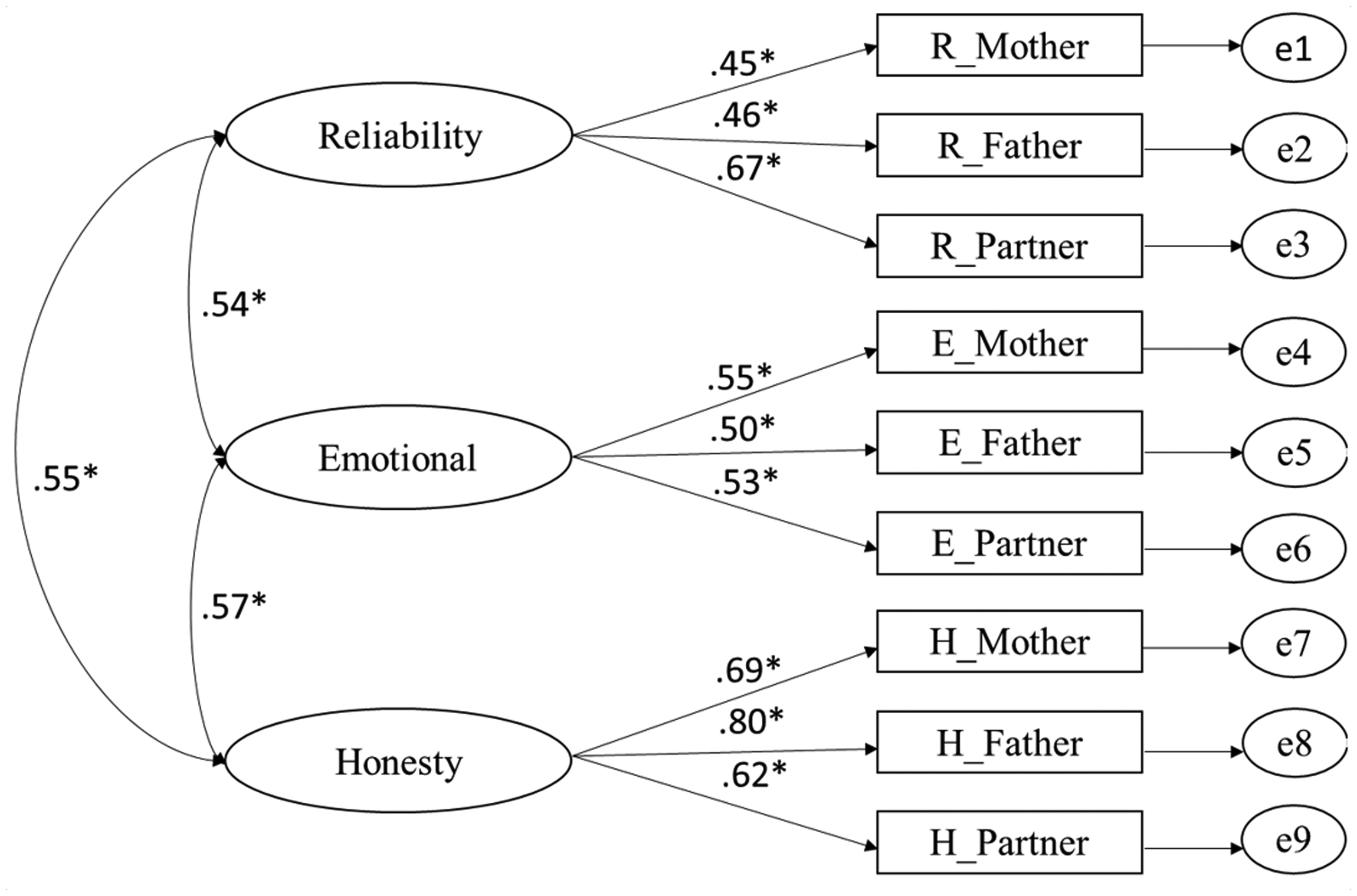
The three-factor structure of the AGTB scale as estimated in Study 1. All the factor loadings are significant at p < .05.
A randomly generated two-factor and a one-factor solutions were estimated. Both these alternatives showed worse fit indices compared to the three-factor structure—χ2 (54) = 365.8, p < .001, CFI = .35, and RMSEA = .18 for the two-factor solution and χ2 (54) = 144.3, p < .001, CFI = .65, and RMSEA = .099 for the one-factor solution. There were significant correlation between the scores of the two testing sections for the total AGTB scale, r = .78, p < .001, the reliability basis, r = .60, p < .001, the emotional basis, r = .58, p < .001, and the honesty basis, r = .56, p < .001.
Discussion
The AGTB scale demonstrated reliability, internal consistency, factorial validity, and construct validity.
Study 2
Methods
Participants
An a priori power analysis applying G*Power 3.1.9.4 (Faul et al., 2007) was conducted to determine the sample size (with an estimated correlation between predictors of r = .23, Rotenberg et al., 2015, and the estimated correlation between predictors and outcomes of r = .16). The estimated sample size was of 100 participants. The final sample comprised 318 university students (68 males) aged between 18 and 30 years old (Mage = 22.96 years, SD = 2 months) with no reported history of neuropsychiatric disorders enrolled in two universities in southern Italy. Participation was voluntary, and participants did not receive any compensation.
Procedure
Participants completed all the measures (AGTB scale, RMET, Experiences in Close Relationships-Revised (ECR-R) questionnaire, and questions on ICC) in a single session administered by a female researcher. All participants provided written, informed consent before completing the questionnaires. The AGTB scale developed in the previous study was applied here.
Measures
Quality of attachment
The ECR-R (Fraley et al., 2000) questionnaire assesses the quality of attachment in adulthood. It consists of 36 items divided equally between Anxiety and Avoidance scales. Participants read the items and indicated their agreement with each using a 7-point Likert scale ranging from 1 (strongly disagree) to 7 (strongly agree). Average scores for each scale were calculated; higher scores indicate greater anxiety or avoidance (i.e., a less secure attachment style).
Social-perceptual component of theory of mind
The RMET (Baron-Cohen et al., 2001) was administered to evaluate the social-perceptual component of ToM. The test is based on the assumption that mental state can be inferred from a person’s gaze. Thirty-six black-and-white photographs of men and women, showing the expression in their eyes (see Baron-Cohen et al., 2001), were presented one by one. Four descriptors of complex mental states were displayed at the corners of each picture. The participants’ task was to select the word best describing the mental state expressed by the gaze of the person shown in the picture. In each case, there was only one correct answer, with the other three descriptors being distractors. An average score was calculated, with higher scores indicating higher ToM ability.
Interpersonal communication competence
ICC was assessed using questions taken from the Emotional Quotient Inventory (Bar-On, 2006). Assertiveness was evaluated using seven items and empathy using eight. Participants read sentences and indicated the extent to which each sentence applied to them using a 5-point Likert scale ranging from 1 (not at all true of me) to 5 (definitely true of me). Average assertiveness and empathy scores were calculated, with higher scores indicating greater assertiveness or empathy.
Statistical analyses
To provide a measure of the internal consistency of the instruments, we calculated Cronbach’s alpha coefficients and interitem correlations. Items that did not exhibit adequate interitem correlations (r > .20) were removed. These analyses were conducted in SPSS v. 25. Confirmatory factor analyses (CFAs) were computed in MPLUS v. 7 to assess the factorial structure of the AGTB scale (ML estimation) and RMET (Weighted Least Square Mean and Variance (WLSMV) estimation). According to the modification indices, some error terms of the items were allowed to correlate. Only errors within items of the same subscale were allowed to correlate. Items that did not load significantly on the target factor were removed from the models. MPLUS v.7 (WLSMV estimation) was also used to compute path analysis for the entire model.
Results
Internal consistency and confirmatory factor analyses
Cronbach’s alpha coefficients for beliefs in the three bases of trust showed moderate consistency: reliability, α = .57, rs > 20; emotional trust, α = .71, rs > 22; and honesty, α = .53, rs > 20. The RMET had good internal consistency (α = .88, rs > 24).
The factorial structure of the AGTB scale was examined as suggested by the authors (Randall et al., 2010). As the aim was to create a reliable scale across the three bases of trust, the items referring to trust in peers were excluded from the model because their factor loadings for reliability were not significant (p > .05). The final model had an adequate model fit (see Figure 2): χ2 (22) = 41.063, p < .001; CFI = .95; RMSEA = .052 (90LO% = .026, 90HI% = .077); PCLOSE = .41. All factor loadings and covariance estimates were significant (p < .05).
CFA of the 36 RMET items confirmed its single-factor structure (see Figure 3). Nevertheless, Items 3, 7, and 35 were removed from the model because their factor loadings were not statistically significant. The final model had an adequate model fit: χ2 (495) = 543.33, p = .065; CFI = .98; RMSEA = .018 (90LO% = .000, 90HI% = .026); PCLOSE = 1. The internal consistency of the 33 items of the RMET was good (α = .89, rs > .25)

The three-factor structure of the AGTB scale as estimated in Study 2. All the factor loadings are significant at p < .05.
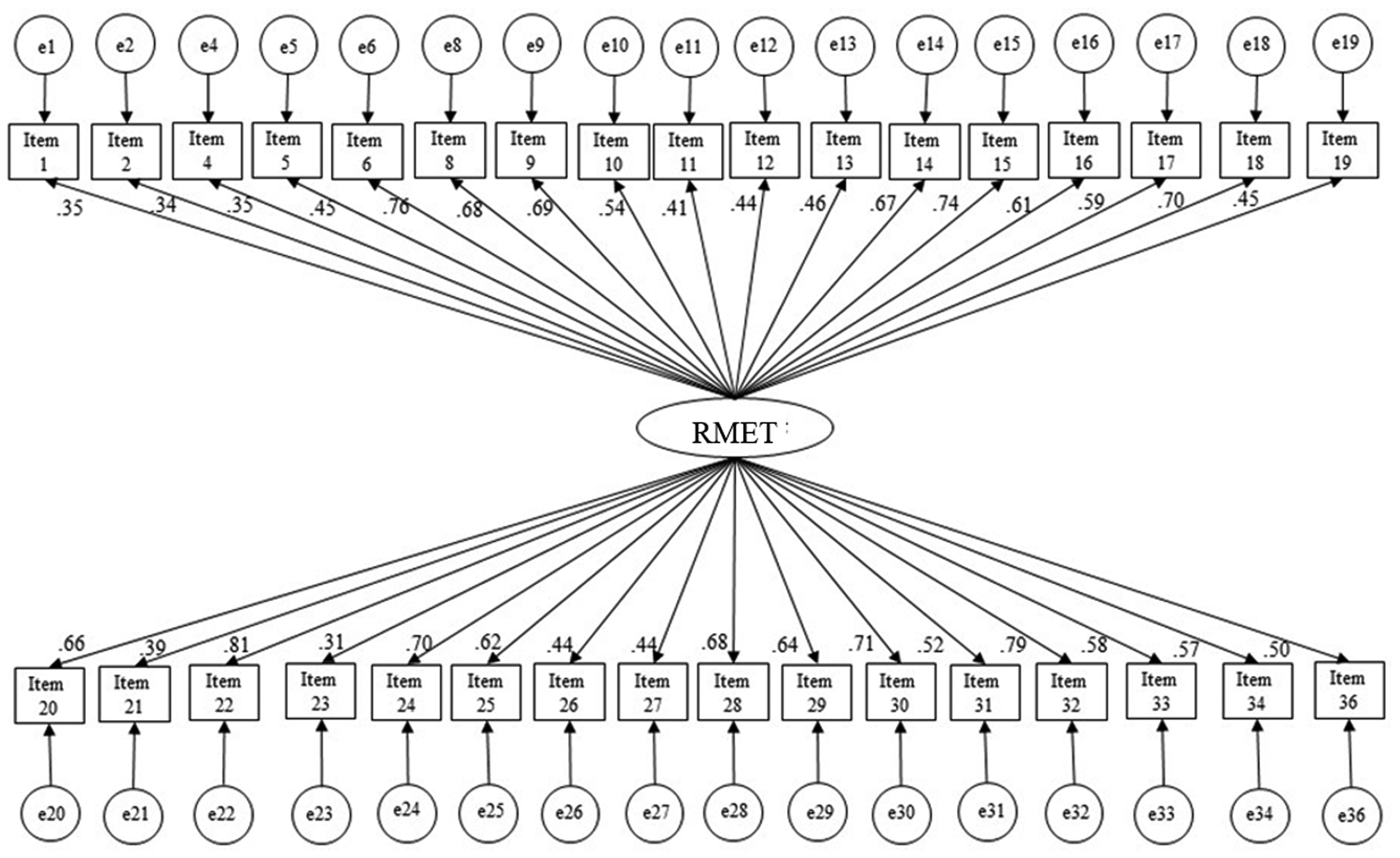
CFA for the Reading the Mind in the Eyes Test. All the factor loadings are significant at p < .05.
Correlations and path analysis
Table 1 reports the correlations between variables. As expected, there were significant correlations between beliefs in the three bases of trust (reliability, emotional trust, and honesty) and ToM ability (RMET). RMET score was positively correlated with assertiveness and empathy. There were negative correlations between beliefs in the three bases of trust and anxiety and avoidance.
Correlations between the variables of Study 2.
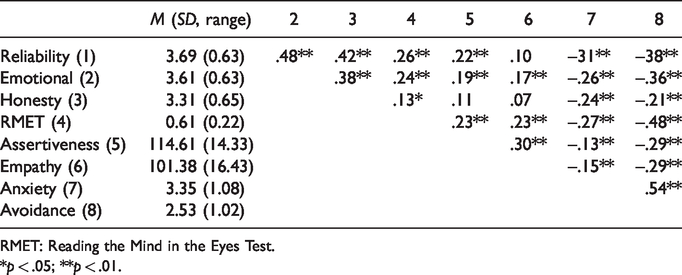
RMET: Reading the Mind in the Eyes Test.
*p < .05; **p < .01.
Path analysis showed the hypothesized associations between RMET score and scores for emotional trust, assertiveness, and empathy. All paths were statistically significant (see Figure 4). The estimated model had good fit indices: χ2 (3) = 6.67, p = .08; CFI = .983; RMSEA = .06 (90LO% = .000, 90HI% = .1299); PCLOSE = .29.

Path analysis between emotional trust beliefs, social-perceptual ToM, assertiveness, and empathy. All the paths are significant at p < .01.
Sex differences
The Mann–Whitney tests revealed sex differences in the variables investigated. Women had higher average scores on the RMET (U = 5504.00, p = .000; women Mdn = 23, men Mdn= 15.5) and showed more assertiveness (U = 5948.50, p = .000; women Mdn = 119, men Mdn = 107) and empathy (U = 6072.50, p = .002; women Mdn = 106, men Mdn = 95). Women demonstrated greater belief in other people’s reliability (U = 5685; p = .002; women Mdn = 3.83, men Mdn = 3.50) and emotional trust than men (U = 5134.00, p = .000; women Mdn = 3.67; men Mdn = 3.33). In descriptive terms, women also reported a greater belief in other people’s honesty (women Mdn = 3.80; men Mdn = 3.33), but this difference did not reach significance.
Hierarchical regression analyses (HRAs) were carried out to examine whether sex moderated the observed relationships. Sex was dummy coded in these analyses. The predictors were entered as follows: Step 1: the predictor measure centered (i.e., score on the emotional basis of trust or RMET score); Step 2: sex; Step 3: predictor × sex term. None of the HRAs yielded a predictor × sex interaction, so we concluded that sex did not moderate the observed relationships.
Discussion
We hypothesized that adults’ emotional trust beliefs would be positively correlated with their advanced social-perceptual ToM abilities, as captured by the RMET. We also expected that social-perceptual ToM ability would be a positive associated with two aspects of the ICC, namely the assertiveness and the empathy (see Study 2). As we were analyzing a sample of adults, we developed an Italian version of the AGTB scale and evaluated its psychometric and validity properties (see Study 1).
Examination of the psychometric properties of the AGTB scale yielded satisfactory results, with one exception. In both Study 1 and 2, as expected, we found that (a) the AGTB scale had a three-factor structure (with the factors corresponding to the three bases of trust: reliability, emotional trust, and honesty); (b) the AGTB subscales were reliable in that they demonstrated moderate internal consistency and structural validity; and (c) the three subscales also had construct validity because scores were correlated with quality of attachment and ToM. Contrary to expectations, however, the data from items designed to measure reliability trust in peers were not a good fit to the model, and this aspect of the scale warrants further examination.
We also found sex differences in trust beliefs; women demonstrated greater general trust in others, reliability and emotional trust, as measured by the AGTB scale. These sex differences were very similar to those observed in Italian children (Rotenberg et al., 2015) and English children and adults (Betts & Rotenberg, 2007; Betts et al., 2009; Imber, 1973; Rotenberg, 2010; Rotenberg et al., 2005). This evidence reflects girls’ greater tendency, compared to boys, to form intimate bonds, establish friendships, and offer prosocial support (Berndt, 1982; Hussong, 2000).
Our findings confirm that the Italian version of the AGTB scale has a similar structure to the other comparable measures (Betts et al., 2009; Randall et al., 2010; Rotenberg et al., 2005; Rotenberg et al., 2015), except for the items relating to reliability trust beliefs in peers. The development of the Italian AGTB scale addresses the lack of instruments for measuring trust in significant others in young adults from non-English-speaking countries and cultures. Our findings provide evidence of the utility of Rotenberg’s (2010) BDT as a conceptual framework for assessing trust beliefs across cultures. Finally, the development of an Italian version of the AGTB scale contributes to the fulfilment of the goal of establishing scales that can be used across multiple cultures to determine the extent to which social functioning is universal (Erkut, 2010; Knight & Zerr, 2010).
The path analysis confirmed the existence of the expected associations between emotional trust, ToM, and ICC (measured as assertiveness and empathy). Thus, our results extend knowledge about trust, ToM, and ICC found in childhood (Rotenberg et al., 2015) to young adulthood and establish the role of ToM as a mediator of the association between interpersonal trust beliefs and ICC.
Our research highlights that trust is associated with intra- and interpersonal functioning and well-being (as already shown in children by Qualter et al., 2010) and that these associations are mediated by ToM (Mellick et al., 2015). The antecedent of the ToM ability is interpersonal trust. Trust has been recognized as a precondition for the formation of healthy human relationships (Mitchell, 1990) and as a product of interactions among intimate partners. Furthermore, ToM is a predictor of the ability to express feelings and thoughts and defend one’s interests without being overwhelmed by others (Bora et al., 2006; Morrison & Bellack, 1981). It is through having a relationship of trust with others that individuals are able to observe their perspective and understand their own and others’ emotional and mental states. Thus, having a ToM allows individuals to develop functional, fulfilling relationships with others and improve aspects of ICC, such as assertiveness and empathy.
As suggested by the literature, we found that, compared with men, women had higher ToM abilities (Preti et al., 2011; Vellante et al., 2013; Walker, 2005), were more assertive (Bourke, 2002), and had greater empathy (Preti et al., 2011; Riggio et al., 1989; Vellante et al., 2013). However, our analyses confirmed that sex did not moderate the relationships between ToM and emotional trust or ICC.
Our study has three main limitations. First, the design was cross-sectional; a longitudinal study would be required to assess the causal relationships between variables. Second, the model of the AGTB scale did not provide an adequate fit to the data from items measuring reliability trust in peers. The scale should be tested again once these items have been reformulated. However, even without the items on trust beliefs in peers, the relationships between variables remain significant as expected. Third, we focused on just two aspects of ICC, assertiveness and empathy. Future research should extend our results by analyzing other aspects of ICC.
In summary, our study has demonstrated the validity of the Italian AGTB scale and highlighted the role that ToM plays as a mediator of the relationship between trust beliefs and ICC. Future research should examine how these relationships change across the life span, starting from the early infancy, and how their temporal course could be altered, to develop techniques for improving individuals’ ICC to impact the quality of their relationships, their career progression, and ability to contribute in complex communicative environments (Burleson, 2007; Morreale & Pearson, 2008).
