



Abstract
This article provides a review and analysis of current research examining the connection between teacher language proficiency and their self-reported beliefs about their pedagogical abilities. Generally speaking, (English) language teachers require an advanced level of proficiency in order to be successful language teachers, but pedagogical skills are also necessary for effective instruction. However, examining the relationship between language proficiency and pedagogical skills is not straightforward given the nature of language teaching in which language is both the content and medium of instruction, issues with defining language proficiency (for teaching), and disagreement regarding effective teaching skills in different social contexts. One approach has been to focus on teachers’ self-efficacy beliefs about their abilities to enact specific classroom tasks in certain contexts and potential relationships with teachers’ reported language proficiency. The analysis provided in this article highlights how these constructs have been measured in the literature and if/how they are connected to one another across different studies. Overall, teachers’ self-efficacy beliefs regarding their pedagogical abilities do correlate with language proficiency, but results are at times weak and/or inconclusive with inconsistent results across studies and contexts.
Introduction
Content knowledge and pedagogical (content) knowledge are key components of a teacher’s knowledge base. With regards to language teaching, target language proficiency and teaching ability are the two most significant aspects of teacher competence. Proficiency in the target language allows teachers to maximize their language use in the classroom, which in turn provides opportunity for the required second/foreign language input crucial to second language learning (Turnbull, 2001). However, there is no agreed upon level of proficiency for language teachers. Different contexts have different definitions of proficiency and proficiency requirements are not the same across contexts (Dogancay-Aktuna and Hardman, 2012). Furthermore, high proficiency in a language alone does not make one an effective teacher. Teachers need to develop effective communication and pedagogical skills (Coelho, 2004; Faez, 2008). While there are several assertions on the importance of target language proficiency for language teaching (e.g. Faez, 2011a; Pasternak and Bailey, 2004; Salvatori, 2009), there is little known about their relationship. How does target language proficiency impact teachers’ instructional abilities in the classroom? This is not an easy investigation and there are several challenges associated with researching this relationship including:
Language teaching is different from other subject matter teaching in that language is both the content and medium of instruction.
Measuring teacher language proficiency and language teaching abilities is difficult and contentious due to validity issues, among other concerns.
Issues of ownership of English, English as a Lingua Franca, World Englishes, and Native/Non-native speaker 1 issues all further complicate the matter.
Looking at studies that focus on language teacher (self-) efficacy and language proficiency, this report provides a review and analysis of current research that has attempted to investigate the relationship between teachers’ confidence in their classroom abilities and their (self-reported) language proficiency.
Teacher (Self-) Efficacy
In general education, teacher efficacy research has generally followed two conceptual strands: 1) Locus of control which focuses generally on teachers’ abilities to affect outcomes, and 2) Sociocognitive perspective developed by Bandura (1977; 1986; 1997) which looks at teachers’ confidence in their abilities to enact certain tasks in specific contexts (Tschannen-Moran et al., 1998). While this division has been noted by researchers, the two concepts are often confused with one another causing uncertainty and methodological incongruence (Klassen et al., 2011). The issue appears, at times, that researchers claim to measure self-efficacy, but instead base items on teachers’ general abilities to impact the outcomes of events, which would pertain to teacher efficacy. Bandura (1977; 1986) initially outlined his sociocognitive self-efficacy perspective that pertained to a person’s ability to enact tasks, but many focused on the different locus of control construct. Bandura (1997) attempted to clear up the confusion by reaffirming his sociocognitively based self-efficacy and noting its difference to outcome expectancy, but studies still confuse the two concepts (Wyatt, 2014) leading authors to label efficacy as an ‘elusive construct’ (Tschannen-Moran and Woolfolk Hoy, 2001).
One of the major contributors to the confusion surrounding efficacy work is the use of the Teacher Efficacy Scale (TES) created by Gibson and Dembo (1984). Prior to the TES, numerous efficacy scales were created to investigate efficacy in general education, but the majority of the scales were never used outside of their original studies (Tschannen-Moran et al., 1998). The TES was different however and was adapted by numerous studies to measure teachers’ (self-) efficacy. The TES contains two subscales measuring: Personal Teaching Efficacy (PTE) and General Teaching Efficacy (GTE). Conceptual issues have been noted as while PTE (somewhat) measures self-efficacy, GTE is more focused on the locus of control construct and teachers’ abilities to influence outcomes. On its own, this is not an issue, but Gibson and Dembo (1984) claim to follow Bandura’s self-efficacy framework and many studies have used the TES as a measure of self-efficacy in the Bandurian sense, which is not appropriate (Klassen et al., 2011). This incongruence has led some authors to conclude that the results from studies that use the TES may be invalid (Dellinger et al., 2008; Klassen et al., 2011). Thus, while measuring General Teacher Efficacy is appropriate in its own right, misconstruing it with self-efficacy is conceptually inaccurate. This is significant because self-efficacy is a more powerful construct. People’s beliefs in their abilities to enact tasks are greater predictors of behaviour than their belief to enact outcomes (Bandura, 1997). Even if they desire a certain outcome, if they do not believe they can carry out the necessary task, it is likely that their behaviour will not drastically change (Bandura, 1997).
To alleviate the methodological issues created by the use of the TES, researchers at Ohio State University created the Ohio State Teacher Efficacy Scale, later referred to as simply the Teacher Sense of Efficacy Scale (TSES) (Tschannen-Moran and Woolfolk Hoy, 2001). The TSES was created for use in general education and, for many researchers (e.g. Dellinger et al., 2008), solved the conceptual issues surrounding self-efficacy and teacher efficacy (although see Wyatt, 2014). The scale is grounded in Bandura’s sociocognitive self-efficacy theory and has both a short form version consisting of 12 items, and a long form version with 24 items (Tschannen-Moran and Woolfolk Hoy, 2001). It consists of three subscales: 1) Efficacy for Instructional Practices, 2) Efficacy for Student Engagement, and 3) Efficacy for Classroom Management. Within these three factors, it provides simple questions for teachers to assess their self-efficacy regarding a specific ability. For example, from the Efficacy for Instructional Practices subfactor, one item asks: ‘To what extent can you craft good questions for your students?’ (Tschannen-Moran and Woolfolk Hoy, 2001: 800). Some studies alter these questions into statements, but the general content of the item remains the same. The authors use the terms teacher efficacy and self-efficacy interchangeably, which is somewhat misleading as the scale is focused on self-efficacy in the Bandurian sense, not general teaching efficacy, but the TSES quickly became a highly used efficacy scale.
The TSES has been widely accepted in efficacy research (Dellinger et al., 2008), but issues surrounding the specificity of the scale remained. In efficacy research, how specific to make survey items is an issue of continuing contention as researchers attempt to find the right balance. Bandura (2006) makes the point that scales that are too general do not provide adequate measurement of self-efficacy, but on the other hand, scales that are too focused will not have general use. Pajares (1996) notes that self-efficacy scales need to measure context specific tasks; general scales and even domain specific scales are often inadequate. This issue is prevalent when discussing how to use the TSES for other contexts. To alleviate this issue, researchers have created their own subject-specific scales for their own areas, for example the Science Teaching Efficacy Belief Instrument (STEBI) (Riggs and Enochs, 1990) or adapted the TSES for their own context matter. Many studies have adapted the TSES and the TES to investigate (English) language teachers because, until recently, no (English) language teaching specific scale existed.
Measuring Proficiency and (Self-) Efficacy
As efficacy research began in the foreign/second language teaching context, considering the importance of language proficiency, researchers began to investigate the relationship between (self-) efficacy and proficiency. However, the issue of how to measure proficiency and self-efficacy is still unclear. Self-efficacy research measures teachers’ efficacy beliefs about pedagogical capabilities in specific contexts (Dellinger et al., 2008; Tschannen-Moran and Woolfolk Hoy, 2001), but content knowledge such as language proficiency, should not be included (Choi and Lee, 2016). With this perspective, many studies measure teachers’ self-reported proficiency with separate scales (e.g. Chacon, 2005; Choi and Lee, 2016; Eslami and Fatahai, 2008). Some of these self-report proficiency scales are developed by the researcher (e.g. Chacon, 2002; 2005; Shim, 2001), while others adopt scales from other studies (e.g. Eslami and Fatahi, 2008), the most common of which appears to be the proficiency scale developed by Butler (2004). However, the line between distinguishing language as content knowledge and as a pedagogical skill/capability is not clear. Language is content in the language classroom, but it can also be the medium of instruction and can be deemed a pedagogical capability. This blurred division has led some studies to measure proficiency as part of self-efficacy. For example, Swanson (2010; 2012), on the Second/Foreign Language Teacher Efficacy Scale (S/FLTES), seemingly investigates language proficiency items under Content Knowledge. As an example, one item asks participants to assess their ability to ‘fully understand a movie that only uses the language(s) you teach?’ (Swanson, 2012: 87). Clearly, this can be construed as an assessment of listening proficiency. Choi and Lee (2016) argue that proficiency and efficacy are interdependent, but independent constructs, and thus argue against the inclusion of proficiency items on self-efficacy scales. However, drawing such clear distinction appears difficult. Still, most studies do differentiate between the two and use separate scales.
Furthermore, for the most part, studies use self-report measures to assess language proficiency. While these do not measure teachers’ actual proficiency, many researchers have noted that teachers’ assessments of their own proficiency are often close assessments of their actual ability (Blanche and Merino, 1989; LeBlanc and Painchaud, 1985; Ross, 1998). However, some researchers would dispute this and question the objectivity of self-assessments (Denies and Janssen, 2016). Teachers may compare themselves to native speaker models and feel inadequate in comparison, which could impact their language confidence and potentially how they assess their own proficiency (Hodgson, 2014). Yet, measuring actual proficiency is also fraught with difficulties. Elder (2001) notes the difficulty in measuring actual teacher proficiency and the potential issues (further elaborated on below). For this review, only one study was found that measured actual proficiency through a language test (Sabokrouh, 2014) and how it affected teachers (self-) efficacy regarding their classroom abilities and skills. The remaining studies all used self-reported proficiency assessments.
Methodology
This article embarked on a review of past literature regarding the relationship between (English) language teacher proficiency and teacher (self-) efficacy. As a starting point, an initial search for literature began with a keyword search using phrases including ‘efficacy’ or ‘self-efficacy’, ‘proficiency’, and ‘language teacher’. Various combinations were used on a university library site with access to major educational databases (e.g. ERIC, Proquest et al.). Journal articles, books and theses were all scanned and potentially relevant resources were noted after reading the titles and abstracts. To be included in the review, resources needed to look specifically at language teacher (self-) efficacy along with language proficiency in some capacity. There are numerous studies that focus on some aspect of (English) language teacher (self-) efficacy, and many studies address the issue of proficiency, but this review sought only studies that investigated the relationship between these two factors. Many studies specifically address proficiency using various scales, but some focus on comparing native/non-native speaking language teachers. Despite not specifically referring to proficiency, these studies were included because it was decided that their different scale of measurement (native and non-native) was a methodological choice, and still in-line with this review’s inclusion criteria of focusing on the interaction between teacher efficacy and proficiency. An initial group of studies was accumulated and the reference lists of these studies were reviewed to add any further resources that were not found during the library searches.
After these initial searches, a total of 13 studies were accumulated. All of the studies found were either quantitative (e.g. Eslami and Fatahi, 2008) or mixed methods (e.g. Lee, 2009) in nature. Similar to Basturkmen (2012), this review followed an inclusive approach as advocated by many research synthesists in the field of Applied Linguistics (Ortega, 2015; Plonsky, 2016). With such an approach, any study that fits the criteria for inclusion, in this case measuring the relationship between teacher (self-) efficacy and language proficiency, is included. In an inclusive approach, both published (e.g. journal articles) and unpublished works (e.g. doctoral dissertations) are included. Utilizing an inclusive approach, there is the possibility of including research that may be considered ‘low quality’, but in line with Norris and Ortega (2006), this review treats ‘methodological quality as an empirical matter’ (2006: 19). While concern over research quality is certainly justifiable, if judgment about study quality is left to only those who carry out the research review, certain hidden biases may result, which could equally impact the quality of the review in a negative way. Furthermore, in regards to published versus unpublished work, an unpublished work (e.g. dissertation) can be ‘of equal or better quality than many published ones’ (Norris and Ortega, 2006: 20). Considering the studies were all quantitative or mixed methods, the risk of publication bias was also considered as studies that do not report statistically significant results are often deemed not publishable (Norris and Ortega, 2006; Ortega, 2015). Thus, both published and unpublished work were considered and the quality of research was left to be analysed as part of the review. With this consideration, two of the initial 13 studies included master level theses, but these were excluded due to potential concerns regarding limited library resources, leaving the final number at 11 studies.
As mentioned, in total, 11 studies fit the above criteria and are used for this review. Six of these are doctoral dissertations (Chacon, 2002; Crook, 2016; Lee, 2009; Liaw, 2004; Praver, 2014; Shim, 2001), and six are from academic journals (Chacon, 2005; Choi and Lee, 2016; Eslami and Fatahi, 2008; Ghasemboland and Hashim, 2013; Sabokrouh, 2014; Yilmaz, 2011). The above list contains 12 citations, but because Chacon (2002; 2005) draw from the same data, they are considered as one study, thus making the final number 11. All of the studies focus on English language teaching contexts except for Liaw (2004) who focuses on foreign language (e.g. Chinese, Italian) teachers in the United States. Most studies specifically measure self-reported language proficiency with some form of a scale, but two studies (Liaw, 2004; Praver, 2014) compare native and non-native speaking teachers and do not use any specific proficiency scale. Sabokrouh (2014) is also unique as this study measures actual language proficiency instead of self-reported proficiency.
A handful of studies were found that investigated language teacher (self-) efficacy, but did not fit the narrow criteria to be included in the review. The work of Swanson (2010; 2012; 2014) falls under this category. Swanson (2010) developed the Foreign Language Teacher Efficacy Scale (FLTES), later adjusted to the Second/Foreign Language Teacher Efficacy Scale (S/FLTES) (Swanson, 2012). The creation of the S/FLTES (Swanson, 2010; 2012) was one of the first efforts to create an efficacy scale that was specifically aimed at foreign/second language teaching. The initial scale consisted of ten items across two factors: Teacher as Facilitator and Content Knowledge, but a third factor was added, Cultural Instruction, when it was realized that culture was a unique factor for language teaching. Swanson’s work was excluded because although it focuses on language teacher self-efficacy, it does not address any links with language proficiency. For example, looking at Spanish language teachers in the United States, Swanson (2010) notes a correlation between teacher self-efficacy to teach beginner level students and teacher attrition. Looking at foreign language teachers in the United States and French as a Second Language (FSL) teachers in Canada, Swanson (2012) notes a correlation between Efficacy for Classroom Management and Cultural Instruction and teacher attrition. Later, Swanson (2014) investigates the impact of teacher self-efficacy on student achievement. Focusing on Spanish teachers in the United States, Swanson divided teachers into groups based on their efficacy scores, and notes that students whose teachers had the highest efficacy scores had higher scores on the National Spanish Examination (Swanson, 2014). This serves as an initial study linking language teacher efficacy with student achievement. To reiterate, while these studies are insightful, they do not examine links between proficiency and self-efficacy, and were thus, excluded from the overall review.
Summary of Reviewed Articles
Table 1 (below) provides a general overview of the studies included in this review. The results show that the vast majority of studies show a positive correlation between language proficiency and teacher (self-) efficacy. Only one study (Shim, 2001) found (almost) no relationship between the two elements. Shim (2001) was one of the earliest studies to focus on (English) language teacher self-efficacy, and the first of the Ohio State theses (more on these below) to focus on English language teacher efficacy. As mentioned, the TSES was developed in a graduate seminar at Ohio State and reached publication in 2001 (Tschannen-Moran and Woolfolk Hoy, 2001), but Shim (2001) used the TES scale by Gibson and Dembo (1984). The issues with the TES have been discussed, but concerns with Shim’s (2001) study also pertain to scale specificity. None of the items on Shim’s (2001) survey were specific to English language teaching, which is one potential reason why few correlations were found between proficiency and self-efficacy (Lee, 2009).
Summary of Articles included in Review.
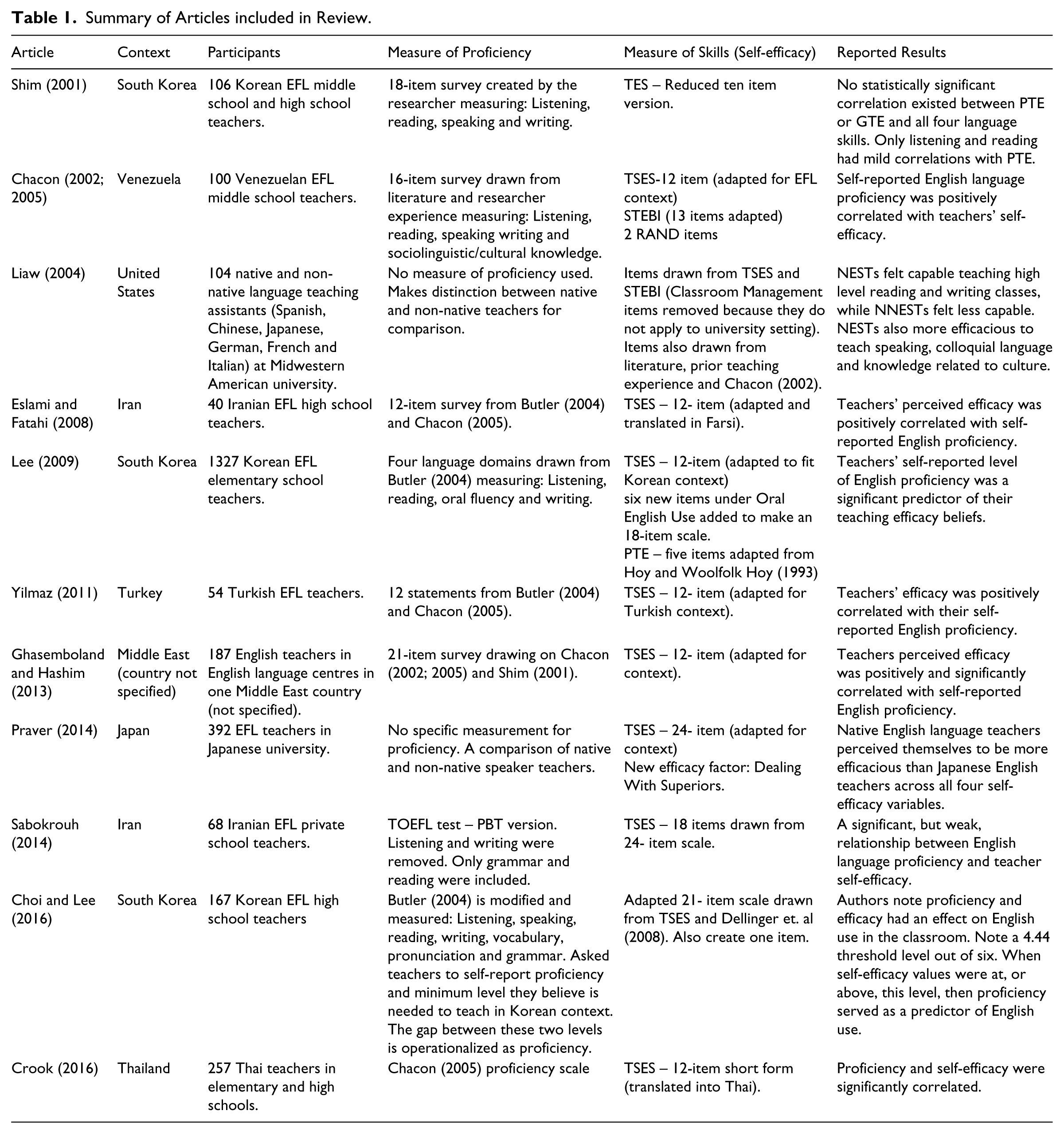
Noting Shim (2001), a closer look at the doctoral dissertations that emerged from Ohio State University (e.g. Chacon, 2002; Lee, 2009; Liaw, 2004) is useful. The dissertations are interesting as they stem from the same conceptual base at Ohio State, where the TSES was created and the studies show a methodological progression as to how proficiency and self-efficacy are measured. As mentioned, Shim’s (2001) study was the earliest of these dissertations and used the general, and conceptually incongruent, TES. Chacon (2002) was next and used the TSES, but only altered the scale slightly for the Venezuelan EFL context leaving the TSES largely intact for her study. Liaw (2004) is the next dissertation and shows some progression in terms of scale development as this study is one of the first attempts to include language teaching specific efficacy items. Along with including some modified items from Chacon (2002), Liaw draws on past literature and teaching experience to create some efficacy items for the study. Finally, Lee (2009) shows an even greater methodological progression as this dissertation includes a new efficacy factor, Oral English Use. Scanning the Ohio State dissertations, the scales gradually go from very general (Shim, 2001) to more (English) language teacher relevant with Lee’s (2009) study.
Liaw (2004) and Praver (2014) are somewhat comparable as they focus on nativeship and its correlations with self-efficacy. Looking at foreign language instructors at an American university, Liaw (2004) found native-speakers to be more efficacious in their abilities to teach high level reading and writing classes, while non-native speaking teachers felt less capable. Native-speakers also rated themselves higher on ability to teach speaking, colloquial language and knowledge related to culture compared to non-natives. In Japan, the native-English speaking teachers reported higher levels of self-efficacy compared with non-native English-speaking Japanese instructors (Praver, 2014). However, cultural issues are noted as a potential reason for this, specifically Japanese humility. Self-efficacy scales are often phrased with ‘I can’ statements, and Praver (2014) argues that Japanese collectivist culture and modesty likely impacted self-efficacy scores somewhat. For all studies in this review, the teaching context also needs to be added as a consideration.
Comparison of the other studies was not as straightforward as they used either different analysis or different scales. For example, Choi and Lee (2016) do not use self-reported proficiency alone like most studies, but rather, use the gap between teachers’ self-reported language proficiency and the minimum level they believe is needed to effectively teach English in the Korean context. They report that minimum threshold levels exist for both language proficiency and self-efficacy and only beyond minimum threshold levels, there is a positive association between the two attributes. They note a significant positive correlation between the language proficiency gap and self-efficacy beliefs about pedagogical capabilities, but a weak one (0.18). Sabokrouh (2014) only measures grammar and reading proficiency, but uses a measure of actual proficiency instead of self-reported proficiency. Similar to Crook (2016), she measures an overall score of proficiency with efficacy, noting a significant but very low correlation (0.16). Finally, although Crook (2016) uses the TSES, individual subscale data pertaining to the TSES subscales and individual language skills (e.g. listening etc.) is not reported. However, the study does report an overall positive and significant relationship between teacher self-efficacy and proficiency (0.39). Thus, while the studies mentioned are insightful, the methodological differences make comparison difficult.
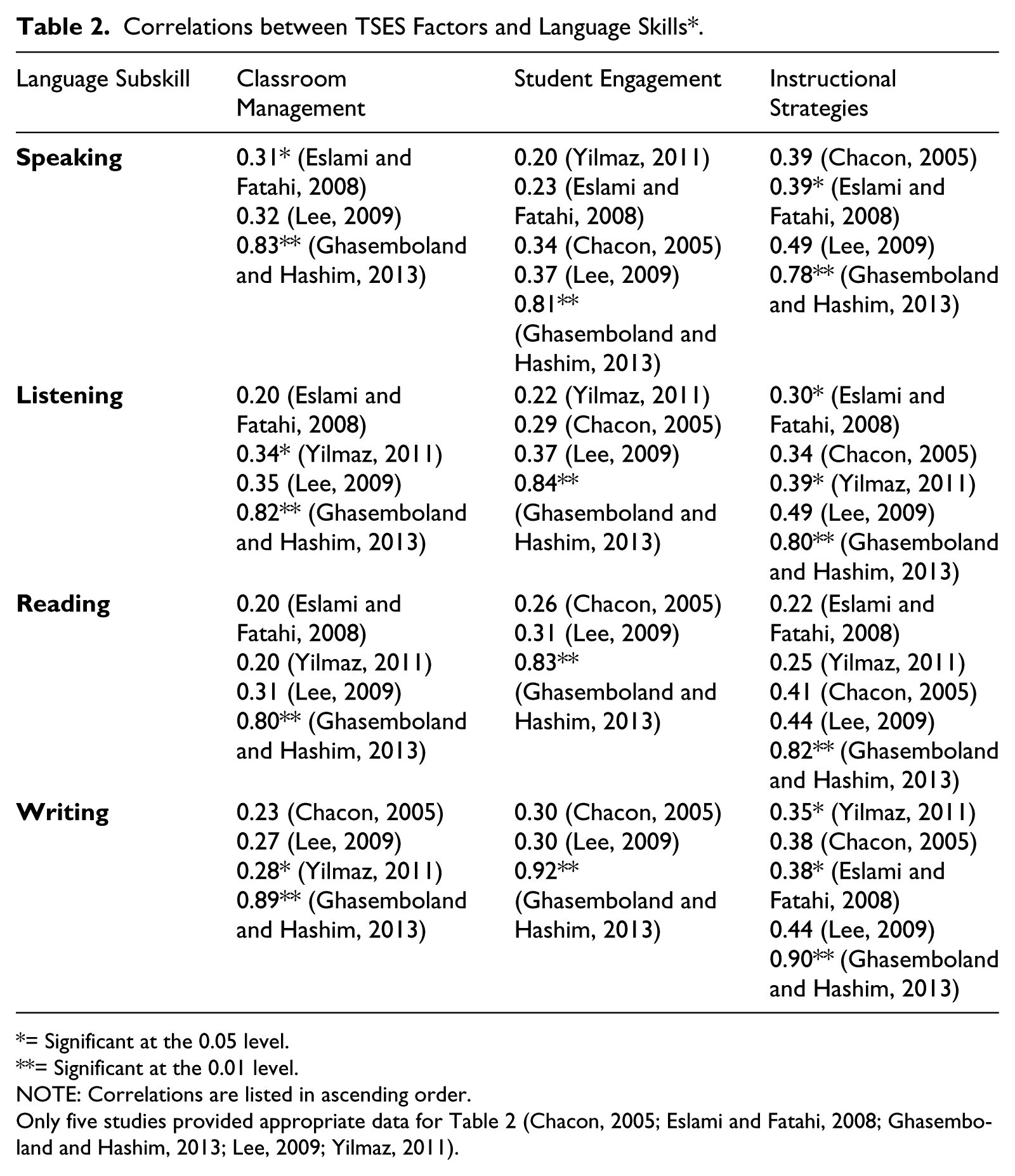
One advantage of numerous studies using the TSES is that it allows for simple comparison. Table 2 shows the correlation results for self-reported proficiency in four language subskills (listening, reading, writing, and speaking) with the different TSES efficacy subscales (Classroom Management, Instructional Strategies, and Student Engagement) from five studies (Chacon, 2005; Eslami and Fatahi, 2008; Ghasemboland and Hashim, 2013; Lee, 2009; Yilmaz, 2011). While many of the studies use the TSES, these five studies draw correlations between at least the above mentioned four language skills and the individual TSES subscales. Any correlations below 0.20 were not included in Table 2. Depending on the definition, correlations between 0.20–0.35 are considered as ‘very slight relationships’ (Cohen et al., 2011: 636), or generally, a threshold of 0.30 is a weak correlation. As can be seen from Table 2, many of the studies report very weak correlations (e.g. Chacon, 2005; Eslami and Fatahi, 2008). None of the correlations in Chacon (2005) or Eslami and Fatahi (2008) go over 0.40, and Chacon (2005) reports no significant correlational data. Lee’s (2009) correlations are somewhat stronger, but still are only in the mid-range. Yilmaz (2011) reports some significant correlations between Classroom Management and listening and writing, along with Instructional Strategies and listening and writing, but the correlations are low and very weak correlations are reported on the other factors. Ghasemboland and Hashim (2013) report the strongest correlations. Across all four language skills and the three efficacy subscales, they report strong and significant correlations, but they offer little indication as to why this may be. Thus, the results appear somewhat inconclusive, and although there are some positive correlations, they are often weak and not statistically significant.
Correlations between TSES Factors and Language Skills*.
= Significant at the 0.05 level.
= Significant at the 0.01 level.
NOTE: Correlations are listed in ascending order.
Only five studies provided appropriate data for Table 2 (Chacon, 2005; Eslami and Fatahi, 2008; Ghasemboland and Hashim, 2013; Lee, 2009; Yilmaz, 2011).
Discussion
Ten out of 11 studies reviewed in this article reported a positive correlation between language proficiency and teachers’ confidence in their classroom abilities. Based on these studies, in most cases, teachers who perceived themselves to have higher target language proficiency also had more confidence in their instructional abilities. In looking closer at the data of the studies, rather than what authors have reported, the correlations reported in most of the studies (e.g. Chacon, 2005; Eslami and Fatahi, 2008; Lee, 2009; Yilmaz, 2011) are not particularly strong; in fact, they are moderate/low (between 0.2–0.4). A high correlation (between 0.7–0.9) was reported in just one study i.e. Ghasemboland and Hashim’s (2013). There are also few studies that report that the correlation is statistically significant (Eslami and Fatahi, 2008; Ghasemboland and Hashim, 2013, Yilmaz, 2011) and this information is missing from other studies (e.g. Chacon, 2005). As noted before, this may partly be due to the measures used to assess teachers’ language proficiency and teaching efficacy. Only one study used an actual language proficiency test (Sabokrouh, 2014), and there were no studies that used a (validated) performance-based (Douglas, 2000; Elder, 2001) measure of language proficiency. The other studies all used self-reported proficiency measures.
Elder (2001) refers to the ‘blurred boundaries’ in attempting to assess language proficiency of teachers and highlights challenges associated with characterizing teacher proficiency as:
Specificity (defining the domain of teacher proficiency and separating it from other areas of professional competence)
Authenticity (eliciting real teacher-like language)
Inseparability (the role of non-linguistic factors such as strategic competence or teaching skills).
The studies reviewed have predominantly used a self-reported scale of teachers’ abilities in the four language skills (listening, reading, speaking and writing), and while others may gather information regarding other language skills, proficiency is operationalized as an overall score (Crook, 2016) or as a gap between reported and minimum levels (Choi and Lee, 2016). More importantly, due to construct validity issues, the use (and relevance) of general teaching efficacy scales such as TSES for measuring teacher efficacy in language teaching is problematic. The TSES is a validated and widely used measure of teacher efficacy for mainstream classrooms. The three factors in TSES include Efficacy for Instructional Strategies, Classroom Management and Student Engagement. There is more to language teaching than these factors combined. The intricacies of language teaching, such as teaching pronunciation and vocabulary or providing form-focused instruction and corrective feedback, for example, are not captured by general teaching efficacy scales. In some studies, there have been attempts to adapt the TSES for use in specific contexts. For example, Chacon (2002; 2005) altered some statements on the TSES to make them more specific to the Venezuelan ELT context. Liaw (2004) drew on literature and teaching experience to add new items alongside the TSES scale. Lee (2009) and Praver (2014) added new factors to the TSES to make the scale more specific to the Korean and Japanese contexts where their studies were conducted. These have been worthwhile attempts, but they do not address the task-specific measures needed of self-efficacy scales (Pajares, 1996), but rather convert a general scale to a domain specific scale that still lacks task specificity. The complexities of language teaching are still not investigated with these broader scales.
There have been recent attempts to address this issue. Because the TSES is a general education scale, researchers have sought to create (English) language teacher specific scales that focus on the specific skills and knowledge required of (English) language teachers. Swanson’s (2010; 2012) S/FLTES has already been discussed. More recently, Akbari and Tavassoli (2014) created a 32-item English language teacher efficacy scale that is partially influenced by the TSES. It differs from other language teacher efficacy scales in that it uses vignettes drawn from Ashton, Olejnik, Crocker and McAuliffe’s (1982) work to present the items. Generally, the vignette approach is not as ideal as ‘can do’ statements proposed by Bandura (2006) which can tap into one’s confidence in their abilities to accomplish a certain task. Also, the vignettes and the scale items appear specific to the Iranian context and may not align with areas recognized for teaching English in other contexts. While the authors outline the scale development and validation, no studies have been found that actually use the scale. Rezvani and Amiri (2013) also created an ELT-specific efficacy instrument in Iran, and Shim (2006) for the Korean context, but again, no studies were found to have used these scales either.
Efficacy research is predominantly quantitative and dominated by self-reports using Likert-scale items. The development of validated instruments for assessing English proficiency and English language teaching efficacy are certainly steps in the right direction but at best, the accuracy of beliefs, elicited through self-reported instruments is a major concern (See Wyatt, 2014 for a similar discussion). For various reasons, teachers may over or under-estimate their abilities in language or teaching skills. Triangulation, using mixed-methods, including in-depth interviews and observations, can provide new insights and help with interpretation of quantitative data. In a qualitatively oriented study, Faez (2010) reported that some NNESTs stated that language proficiency was a major concern for them and believed that their level of language proficiency affected their instructional ability in the classroom. The purpose of this study was not to compare the relationship between language proficiency and instructional ability, therefore it is not included in this review, but instead the purpose is to examine the experiences of teachers from diverse linguistic and cultural backgrounds as they prepare to teach in diverse multilingual classrooms. However, in light of the inconsistent findings of some of the studies reviewed in this article, this study shows the significance of qualitative data coupled with quantitative findings.
Qualitative data can also help add new information regarding contextual issues. As noted at the beginning, there is no agreed upon standard of proficiency and each context requires different types of proficiency in order to teach (Dogancay-Aktuna and Hardman, 2012). For example, Lee (2009) noted weak correlations between speaking and Classroom Management, but the interview data revealed that much of classroom management was carried out in Korean and did not require English. Also using interviews, Chacon (2005) found the Venezuelan EFL teachers in her study did not feel proficient enough to use communicative language teaching strategies, instead opting for more grammar-based methods that emphasized grammatical accuracy over fluency. These studies show that incorporating qualitative data can reveal the contextual intricacies not found in quantitative data and provide a more nuanced look at how proficiency and teachers’ beliefs in their own ability may interact, and even impact classroom behaviour.
The other issue, not particularly addressed in the studies reviewed in this report, but worth noting, are issues pertaining to the use of English as a Lingua Franca and/or as an International Language. While a discussion on the origin and controversy around these terms is beyond the scope of this review (see Faez and Taylor, 2017), it is perhaps important to note that in a world in which multiligualism is the norm and its users employ many different mother tongues (L1s) and a variety of ‘Englishes’, measures of language proficiency and teacher efficacy should reflect the context-specific norms and standards.
Conclusion
Language proficiency is generally perceived to be one of the most important qualifications of a language teacher by experts and non-experts. The review of studies presented in this article lends support to this position. The analysis showed that generally there was a positive correlation between teachers’ self-reported language proficiency and instructional abilities. One caveat to this conclusion, however, is that the correlations were generally not strong and not all studies reported whether they were significant or not. This article discussed several issues with the measures teachers used to appraise their proficiency and instructional ability. Converting general efficacy scales (like the TSES) for use in (English) language teaching contexts has its limitations and future studies will need to consider the specific tasks required of (English) language teachers. In combination with different measures of proficiency, both actual and self-reported, such research could add further details about the interaction of language teacher proficiency and teachers’ (self-reported) pedagogical abilities.
Footnotes
Funding
The author(s) received no financial support for the research, authorship, and/or publication of this article.