




Abstract
Thailand has seen several English language curriculum reforms over the last 20 years, all of which were found to have failed to lift Thai students’ standard of English language proficiency across all levels of study. In 2014, the Thai Ministry of Education announced the introduction of the Common European Framework of Reference for Languages (CEFR), in combination with Communicative Language Teaching (CLT), as its latest policy to improve the standard of English learning and teaching in Thailand’s schools. The establishment of the ASEAN Economic Community (AEC) in 2015 and concerns about the economic competitiveness of the Thai labour force were provided as the underlying rationale for this policy change.
This case study, using Grounded Theory Methodology combining semi-structured in-depth interviews, a questionnaire and document analysis, addresses the question of how this education policy change was experienced and perceived by English language teachers at state secondary schools across four provinces in the south of Thailand. A marked divergence in individual teachers’ knowledge and appreciation of the policy plans was observed, with the majority of respondents displaying indifference to and ignorance of the policy. The Ministry had in 2015 tested all civil servant English teachers in a CEFR-referenced online placement test, where 94% had failed to reach the targeted proficiency level of B2. Consequently, the framework was perceived primarily as an English proficiency test for teachers, a European assessment scale which had been applied to them, but which had had no further application to either classroom teaching or student assessment. These findings are framed in the wider context of curriculum reform and English language teaching in Thailand. Comparisons with other English curriculum reform policies based on the CEFR are made, and the emphasis on testing teachers’ language proficiency is reflected upon through the wider debate on language teacher proficiency.
I got A2, is that good?
A2 is normal.
This conversation between two English teachers was overheard by the researcher in May 2015 as the teachers were leaving a test centre – a school computer lab in a provincial school in the South of Thailand – where they had just taken an online placement test of their English language proficiency, measured by the Common European Framework of Reference for Languages (CEFR) scale. The Office of the Basic Education Commission (OBEC) in Bangkok had ordered all civil servant English school teachers in the Kingdom to undergo this assessment, and A2 was indeed the score achieved by the majority. For most teachers surveyed for this research project, the online placement test had also been their first encounter with the acronym CEFR.
One year earlier, in April 2014, the English Language Institute (ELI), a branch of the Ministry of Education (MoE) overseeing English language teaching in Thailand, had announced a policy of basing all aspects of English language curriculum reform on the CEFR framework. There was, though, a distinct disjuncture between the text of the policy documents from the Ministry in Bangkok and observable awareness of this policy on the ground, i.e. by provincial education authorities and schools. Curriculum reforms, across the globe, have often met with resistance from teachers, and English as a Foreign Language (EFL) has been no exception (Datnow, 2012; Yu, 2001). Readers might therefore ask what would warrant yet another study of teachers’ curriculum change perception.
The introduction of the CEFR to the Thai school education system was the latest in a series of curriculum changes, and the reaction from English teachers on the whole appeared passive. For most this took the form of indifference or resentment rather than resistance or support based on ideological agreement or disagreement. An almost complete absence of explanations to or consultation of teachers by the authorities during the early roll-out stages of this policy may have been a contributing factor to teachers taking such a stance. This series of events suggested a curriculum change which was in danger of failure from the outset, and therefore a relevant area of study.
Background
The Status of English and Curriculum Change in Thai Schools
English is taught as a foreign language in Thai state schools, and is one of the compulsory core subjects taught during the 14-year period of free basic education (pre-school to key-stage 12). The current national curriculum of 2008 uses the general term ‘foreign language’ throughout, mentioning only once that the compulsory foreign language is indeed English:
The foreign language constituting basic learning content that is prescribed for the entire basic education core curriculum is English, while for other foreign languages, e.g., French, German, Chinese, Japanese, Arabic, Pali and languages of neighbouring countries, it is left to the discretion of educational institutions to prepare courses and provide learning management as appropriate
The fact that the state claims control over this subject suggests that English language skills are of national importance. The 2008 curriculum, like the two preceding curricula of 1996 and 2001, provide globalization as their key rationale. Many Thai Master’s and PhD theses investigating the state of English in Thailand invoke the notion of English as a global language, citing authors and models such as Kachru’s concentric circles of English (see Bhatt, 2001), or Crystal’s English as a Global Language (2003) as their opening gambit. The trope of globalization is present in both academic and national discourses, but in the case of the latter it is framed in terms of educating a workforce fit for competition in a twenty-first century global economy, and government publications frequently articulate English language with ICT skills as being essential for a knowledge-based economy.
Earlier changes to the English language curriculum in Thai schools have been deemed ineffective in improving Thai students’ standards of English, with researchers, policymakers and commentators pointing to the continually low student scores in national standardized exams as well as Thailand’s consistently low ranking in regional and global English proficiency league tables as evidence. All three previous English language curricula had contained prescriptions for the use of Communicative Language Teaching (CLT) activities in the classroom. Analysis of those curricula and their implementation (Fitzpatrick, 2011; Kulsiri, 2006; Nonthaisong, 2015; Thongsri, 2005) suggests that CLT had not been adopted more widely due to the following factors:
Raising English Proficiency with CEFR and CLT
The MoE’s 2014 announcement of its ‘English language teaching reform policy’ articulated a nexus between CEFR as a framework and CLT as a teaching method. While CLT was being given a relaunch, CEFR was indeed new to English language teaching policy in Thailand:
The European Council’s framework of reference for language proficiency (CEFR) shall be the key conceptual framework for teaching and learning English in Thailand, including curriculum planning, learning and teaching development, exam design, assessment, teacher development, and the setting of learning targets (English Language Institute, 2015: 1).
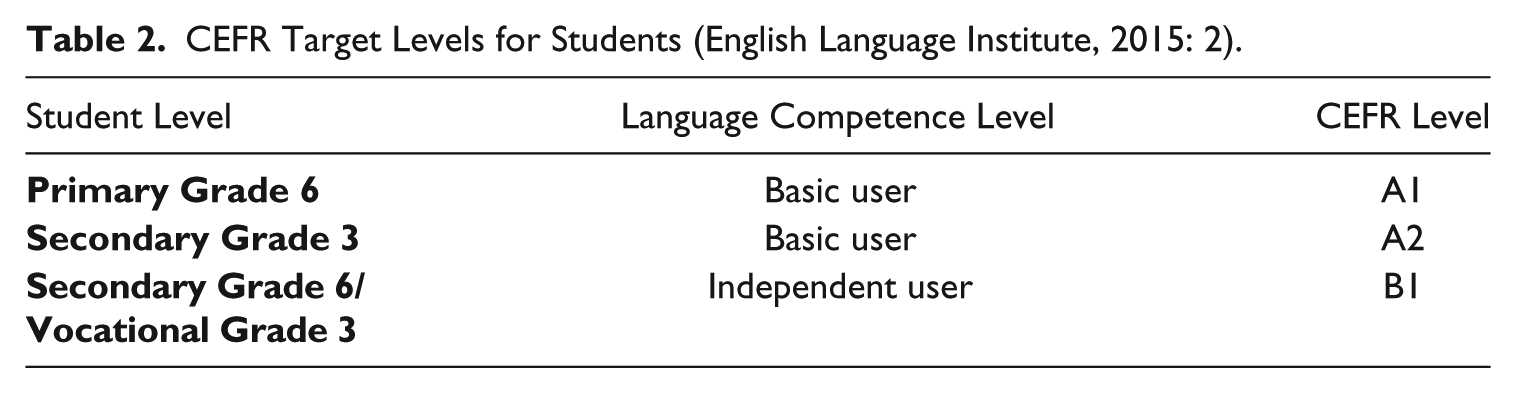
The CEFR reference levels (A1 to C2) feature prominently in the Thai policy documents, and proficiency targets for basic education students were set by the MoE as follows:
Other reform measures mentioned are the alignment of national exams with the framework, use of CLT in language teaching, utilizing online distant learning technologies, and the assessment and further development of English teachers’ proficiency and teaching skills.
CEFR was developed by the Council of Europe (CoE) over a period of two decades with the aim of having a descriptive standard which allowed the comparison of proficiency in different languages, a relevant consideration in the European Union with its internal labour market and 27 official languages. CLT as an approach emerged coevally with the development of the CEFR, but CoE documents and CEFR developers state that the framework is not wedded to any particular teaching method (North, 2008). And while social-constructivism is still the dominant paradigm in international EFL teacher training programmes, there have been voices in academic EFL discourse (Block, 2002; Canagarajah, 2005) who question the suitability of exporting wholesale the communicative and task-based approach to countries with varying cultural contexts. Not so in Thailand. Thai politicians display a strong sense of nationalism and parochialism in many fields, but Thai education policy discourse has questioned neither the importance of English language skills, nor the suitability of communicative teaching approaches advocated by English examination and tuition providers such as the British Council. The arrival of the ASEAN Economic Community (AEC) in 2015, with its nascent internal labour market and English as its sole ‘working language’, focussed policymakers’ minds, raising concerns about the nation’s economic competitiveness. The adoption of CEFR and subsequent contracting of the British Council to deliver a CLT-based training programme for Thai English language teachers were presented as a solution to Thailand’s English language problem (Mala, 2016).
As Kulsiri (2006) and Sae-Lao (2013) have shown in their analyses of education reform, such policy borrowing is a well-established practice in Thai education. In this case, Thailand was rather late in joining a global trend of countries embracing CEFR to reform their English language curriculums and assessment mechanisms, with Japan and Vietnam being two prominent Asian examples. Japanese academics between 2006 and 2012 developed CEFR-J, a standard to suit the Japanese EFL context by re-mapping the can-do statements and sub-dividing the lower proficiency levels A and B by adding six further sub-levels to allow for more differentiation at the levels relevant to the majority of Japanese learners (Tono, 2012). The Government of Vietnam in 2008 ratified ‘Project 2020’, a 12-year plan to improve English language proficiency by basing reform efforts around CEFR, prescribing student proficiency targets identical to the Thai ones shown in Table 2, and B2 as a provisional target level for its English teachers. Inspired by CEFR-J, the government in 2014 established CEFR-V, a six-level framework, to facilitate ‘teaching of English under Vietnamese conditions in accordance with European standards’ (Chung, 2014).
The Study
Rationale and Objectives
This article is based on a thesis research project conducted by the first author, a European mature student, under the supervision of the second author, a Thai professor. The study set out to investigate Thai English teachers’ cognition with regard to CEFR, particularly how it related to their professional practices and identities. Due to the way in which most Thai English teachers first became aware of CEFR, it is treated here as a phenomenon, an acronym which is polysemic and whose meanings are underdetermined by the policy statements which introduced it. The research question focussed upon here is:
‘What do Thai state secondary English teachers understand the CEFR to be, and what impact do they perceive it to have on them and their teaching?’
As mentioned by Fitzpatrick (2011) and Kulsiri (2006) amongst others, it is the teachers in the classrooms who have to implement changes to the curriculum, and it is also the teachers who tend to be blamed for the failure of any such changes (Nonthaisong, 2015).
Research Methodology
The researcher’s exposure to CEFR and Thai English teachers’ encounters with it predated it becoming the research topic for a Thai graduate degree course. Grounded Theory Methodology (GTM) was deemed a suitable research method due to its attention to ongoing processes and their contextual analysis through constant comparison. GTM itself has developed into different (sometimes contradictory) strands, and it is the constructivist approach by Charmaz and Bryant (Bryant, 2017; Charmaz and Bryant, 2007; Charmaz, 2006) which has informed the methodology of this study. Memo-writing, iterative coding of the data from incidents to emerging concepts to themes, the use of visualizations, and a constantly reflective approach were applied as heuristics.
Research Area and Sampling
Purposive sampling for this study was based on the following criteria:
a representative mix of school sizes; 1
schools under administration of different Secondary Educational Service Area Offices (SEA);
schools in rural as well as in urban areas;
English Resource and Instruction Centre (ERIC) schools and non-ERIC schools. 2
The research area covered four provinces in the south of Thailand, with 72 state secondary schools employing 323 English language teachers of civil servant status under the administration of two SEAs. 3 For the questionnaire distribution, a 40% sample size was chosen to reliably accommodate the above-mentioned selection criteria: 129 teachers at 28 schools, with 60 students enrolled in the smallest, 3500 in the largest school, and the number of civil servant English teachers at each school ranging from 1 to 18. The administration of the questionnaire and the interviews took place in December 2016 and January 2017. Informed written consent was obtained from the interview participants, and all research participants were informed of their rights, the research purpose, and assured of their anonymity. One hundred and twenty (93%) of the 129 questionnaires were returned completed.
Formal Research Instruments
Semi-structured interviews and a questionnaire, contextualized by policy document analysis, were chosen as the formal research instruments. Many informal conversations with teachers and administrators, as well as the observation of teacher training events, had taken place prior to the more structured, official, research phase, and were recorded in pre-fieldwork notes. The development of both the interview framework and the questionnaire items were based on the categories which had emerged from coding those field notes. Findings from an initial literature review (e.g. those summarized in Table 1) did also inform the instrument development, but, following Charmaz’ (2006: 166) advice, the researcher attempted to bracket them out during the data collection and analysis phase in order to remain open to codes and concepts emerging from the data. Both instruments were piloted outside the sample area and amended accordingly.
Factors Preventing Curriculum Implementation.

CEFR Target Levels for Students (English Language Institute, 2015: 2).
Interviews
Semi-structured interviews lasting between 40 and 70 minutes were conducted with 10% (12 teachers) of the sample population. The interviews were conducted at teachers’ schools, using Thai, English, or a mix of both languages, depending on respondents’ preference, and were audio-recorded for translation, transcription and coding. Visiting schools across four provinces, three field trips were made, and the interview framework adapted following a review of the first and second phases. Selected policy documents were employed by the researcher as elicitation tools to probe teachers’ awareness of and attitudes to both the documents and the policies they referred to.
Questionnaire
The instrument was initially drafted by the researcher in English, retaining key Thai phrases used by teachers and in policy statements, then translated dialogically with the help of a Thai native speaker (NS) schoolteacher. It was further refined by two lecturers in EFL at Prince of Songkla University and piloted with 40 teachers. The final questionnaire consisted of five parts, moving from teachers’ general background to more specific questions about CEFR and policy change. Questionnaire items were labelled according to their part and item number (e.g. P2Q01 = Part 2, Item 01):
Part 1. About yourself and your school (demographics)
Part 2. Teaching English in your school (8 items: P2Q01 – P2Q08)
Part 3. The CEFR online test for teachers (6 items: P3Q01 – P3Q06)
Part 4. CEFR and its implementation in Thailand (5 items: P4Q01 – P4Q05)
Part 5. Education policy and English language curriculum changes
(8 items: P5Q01 – P5Q08)
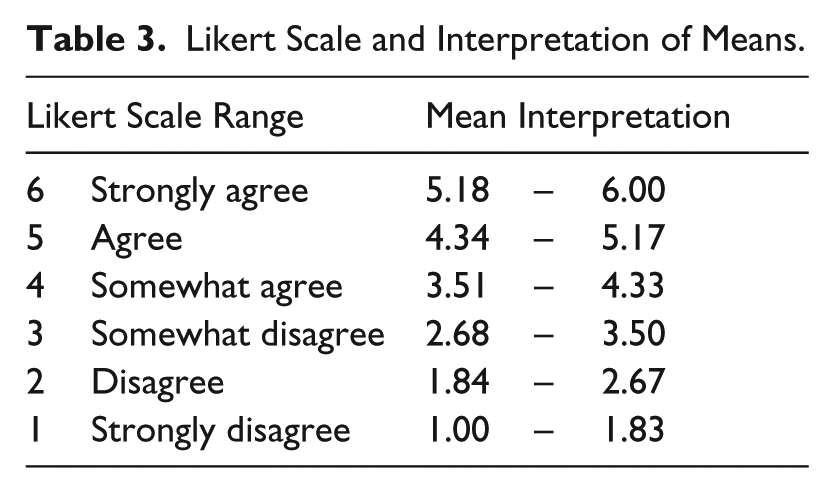
A six-point Likert scale (Table 3), was devised for these 29 items, avoiding a neutral mid-point due to concerns about the reliability of such scales, particularly in Asian cultures where researchers have observed a tendency towards non-commitment (Dörnyei and Taguchi, 2009). The questionnaire data was subjected to factor and correlation analysis, though only descriptive statistics for the items pertaining to the research question will be drawn upon here.
Likert Scale and Interpretation of Means.
Findings
The demographics of the sample population were as follows: of 120 teachers who completed the questionnaires, 109 (91%) were female, 11 (9%) male. Their age ranged from 23 to 59, the average being 45 years, and their average teaching experience was 20 years. Ninety-seven percent of the teachers had graduated as English majors, and 33% also held a Master’s degree (43% in English, 35% in Educational Administration).
In the online placement test for teachers, 57% had scored either A1 or A2 on the CEFR scale, and 43% B1 and above (Figure 2). A comparison with the national results (Figure 1) shows that the sample score distribution was in fact slightly higher than the national average, but in both groups the majority of teachers had failed to achieve the pass level of B1, and their proficiency level was therefore below that expected of their students (Table 2).
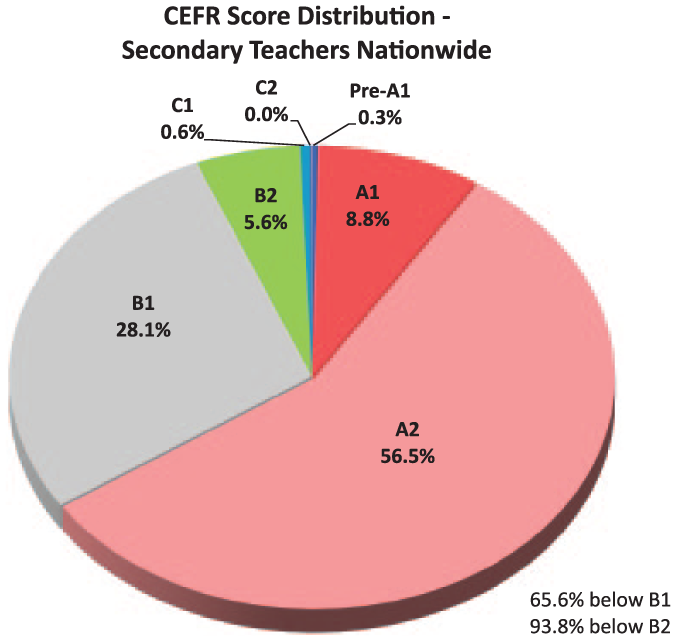
CEFR Score Distribution: Secondary Teachers Nationwide.
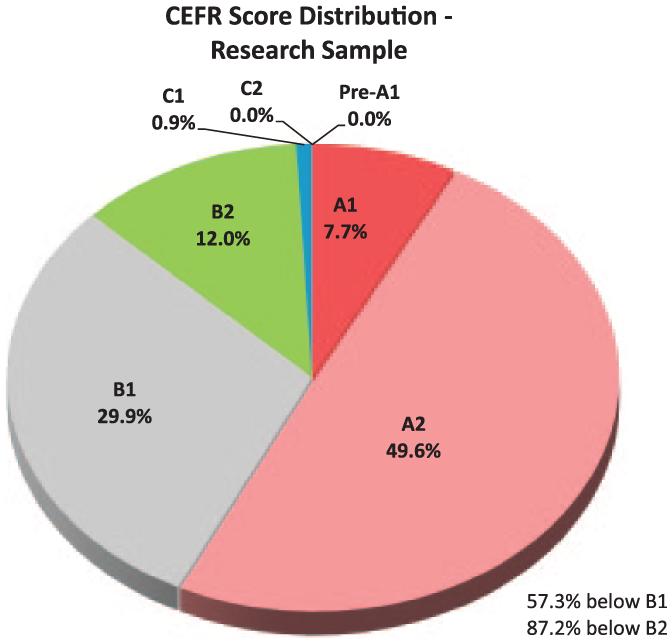
CEFR Score Distribution: Research Sample.
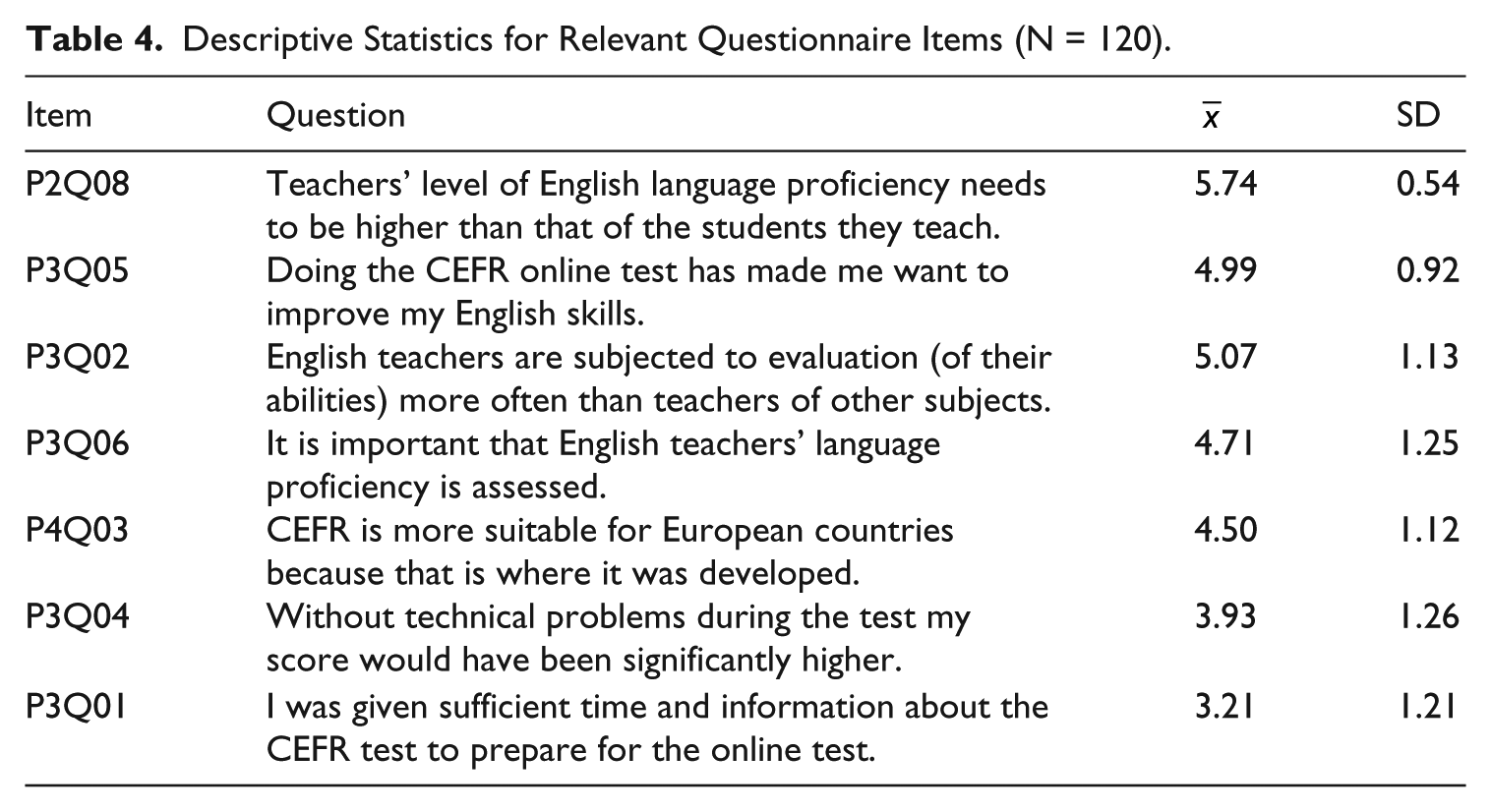
From the GTM analysis of the qualitative data, four main themes addressing teachers’ associations with CEFR emerged, and they are presented below, with a quantitative dimension added from the questionnaire results. Response percentages and descriptive statistics for the Likert-scale items drawn upon in this article are summarized in Figure 3 and Table 4, with the interpretation of item mean values shown in Table 3.
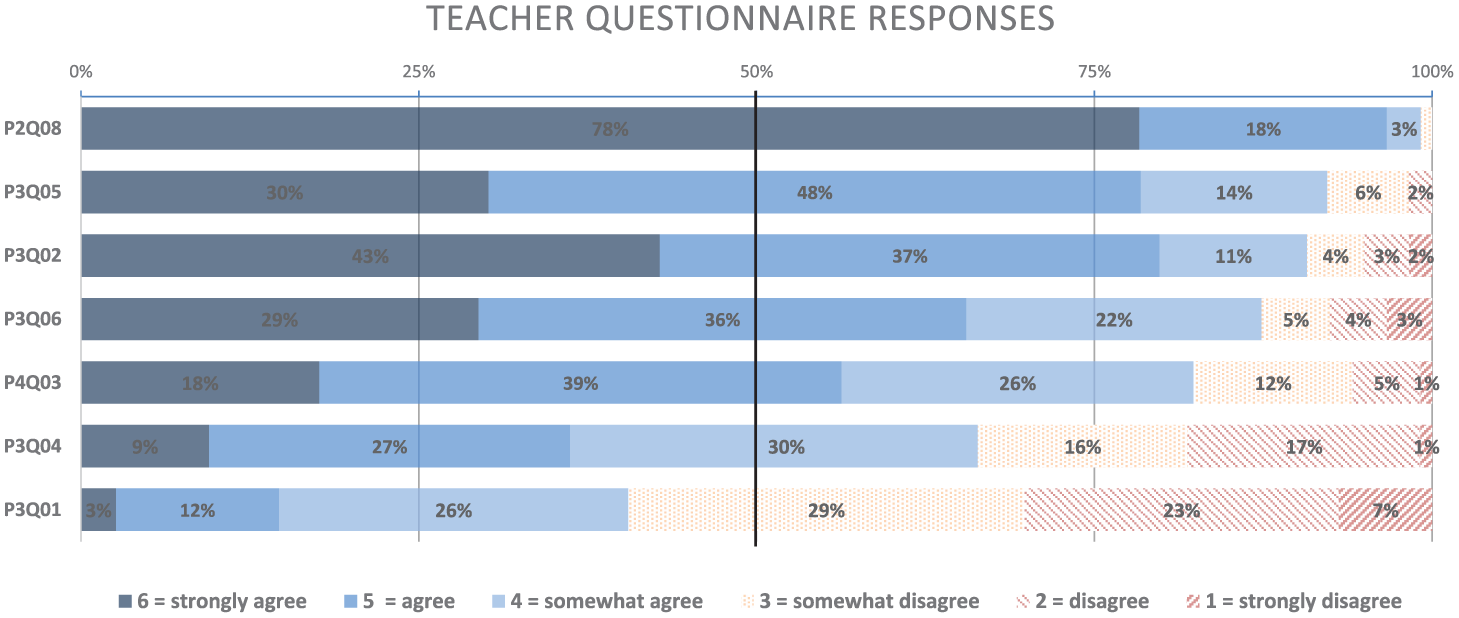
Visual Representation of Relevant Questionnaire Responses.
Descriptive Statistics for Relevant Questionnaire Items (N = 120).
CEFR Is a Test
When the researcher visited schools to introduce himself and the research project, the mention of ‘CEFR’ often elicited an almost-identical response: ‘CEFR? The test we had last year?’ which was often followed by: ‘Oh, I failed’ and a chortle. In those situations, the researcher then steered the conversation to other matters, couching CEFR in the wider context of policy reform in an attempt to distance the acronym from the 2015 online test. But association of CEFR with that test was strong and kept returning in conversations. The policy information presented above had passed by most English teachers surveyed, and CEFR to them was first and foremost a test. An open-ended, optional questionnaire item regarding the CEFR online test for teachers received the highest number of comments (39 of a total 49), predominantly about difficulties encountered with the test. The most common complaints were about problems with internet connectivity, poor sound quality and noisy colleagues compromising the listening part, an unfamiliarity with the test format (online, adaptive), and the lack of information and time provided to prepare for the test.
The CEFR test was, in fact, an online placement test from either Cambridge or Oxford exam boards, chosen by the regional SEA officer and administered at one test centre in each province. As can be seen in Figure 4, in three out of four provinces more than 50% of teachers surveyed were dissatisfied with the time and preparation they were given for the test (P3Q01 reversed), and in all four provinces more than half felt that they would have performed significantly better if they had not encountered technical difficulties (P3Q04).
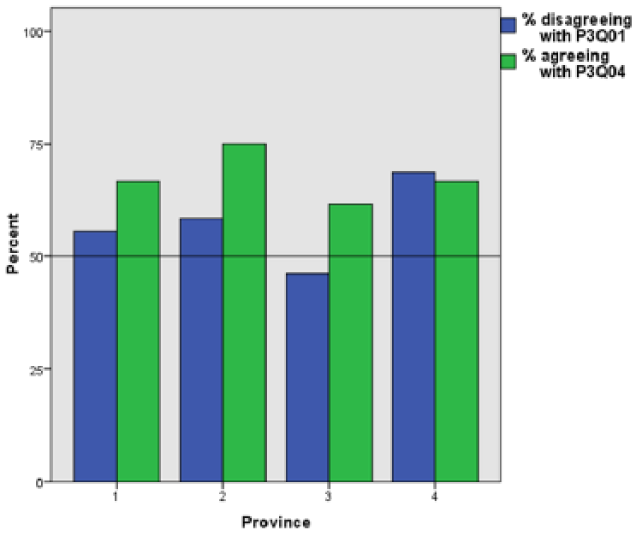
Placement Test Problems by Province.
One might expect test-takers to blame their poor performance on extrinsic factors rather than themselves, but the researcher had the opportunity to observe the administration of the online test in three different locations, and the technical and environmental problems mentioned above were all apparent in varying degrees. Also, Figure 5 shows that unhappiness with the administration of the online test was not limited to levels A1 and A2. Only those who had scored B2 were mostly content with the online test. 4

Placement Test Problems by Score.
This placement test had not been the first time that in-service English teachers were assessed for their English language and/or teaching knowledge, and there was a widespread feeling that they were being singled-out unfairly, as shown in the very strong and homogeneous response to item P3Q02. ‘Why do English teachers have to be evaluated all the time? Why not test science or Thai teachers too?’ Questions such as these were examples of how this sentiment was repeatedly expressed. When asked why they thought they were exposed to a higher level of scrutiny than their colleagues, English teachers offered the following hypotheses:
English is a twenty-first century skill;
other subjects do not have a dedicated supervisory body such as the ELI;
English language proficiency in Thailand is often criticized as being too low;
English as a subject differs from other subjects in that a language other than Thai is needed to teach it.
To some teachers who had gone through a series of exams related to Cambridge English’s Teaching Knowledge Test (TKT) about five years earlier, the order to sit another exam was seen as the MoE breaking a promise, as this interview with two experienced teachers (Teacher C, in her mid-fifties, and teacher D, the Head of Foreign Languages, in her late forties) at a large urban school, shows: 5
Because we had taken Cambridge ESOL before, the TKT test, modules 1,2,3, […] and the MoE had promised us that if we passed that exam, the TKT exam, we would not have to undergo another test again. […]
But when the CEFR came along we were flabbergasted – being tested again, are they assessing us again? What will happen if we don’t pass this time?
When asked by the researcher what had been tested in the CEFR online placement test, the common answer was: ‘English language proficiency’. There had been little reflection by teachers on the scope of the test: 6
TKT by Cambridge ESOL had been a written test, but this one came with a lot of listening… so it looked like it covered 4 skills …
I see… Four skills in the CEFR online test?
Yes, CEFR. Therefore …
Four skills in total?
No, no, there weren’t four skills,
just reading and listening …
== reading and listening … but when we wrote -
== we had no speaking, no speaking -
== but we wrote when we read …- Oh, no no. Yes, right - no speaking.
== no speaking. And there was no writing.
== yes, no speaking, right.
== also no writing.
English teachers did not object per se to being tested (P3Q06), and most also said that they wanted to improve their proficiency (P3Q05). There was near-unanimous agreement that teachers’ level of English needed to be higher than that of their students (P2Q08). For teachers with scores below B1 this meant that in the eyes of the MoE they were deemed unqualified to teach. As civil servants their jobs were secure, but they nevertheless felt embarrassed, and teachers frequently asked the researcher whether there would be another test for them so that they could rectify that image of poor proficiency.
CEFR-T = ‘Cambridge English Framework for Testing’
Another theme which emerged from conversations with teachers and was reflected in the widespread agreement to questionnaire item P4Q03, was of the CEFR being more suitable for European countries because that was where it had been developed. However, none of the respondents were aware of plans for developing a localized version of the CEFR proficiency bands, termed CEFR-T. When shown a press release by the MoE from September 2016, teachers generally approved of the idea, although for a range of reasons:
CEFR being too difficult for countries in which English was not a ‘second’ but an ‘other’ language;
CEFR-T might be better aligned with the current curriculum and exam regime;
having a national English proficiency exam would cut costs.
Although anecdotal and not quantifiable, when asked what the ‘T’ in CEFR-T stood for, ‘Test’ and ‘Thailand’ got near-equal votes. Similarly, and on separate occasions, when asked to spell out the acronym CEFR in full, ‘Cambridge’ and ‘Communication’ were repeatedly cited for the letter ‘C’, and ‘English’ was more often cited for the letter ‘E’ than the actual ‘European’. These examples are not given to ridicule respondents, but to illustrate the notions which underlie CEFR and the way it was understood by the teachers interviewed: it is a test, and it is foreign, more specifically ‘English’, not only in terms of the target language, but also in terms of its origins (= Cambridge). For many, CEFR-T would therefore translate into ‘Cambridge English Framework for Testing’ – quite a plausible interpretation, given the context of its implementation. 7
CEFR Has No Impact on Classroom Teaching
Asked whether CEFR had found its way into teaching at their school, teachers interviewed answered in the negative. Since the online test in 2015 they had not heard any further announcements about the introduction of CEFR. Two respondents pointed to the course books they used in their teaching, saying that they were aligned with CEFR, but that this had not made a difference to the curriculum at those schools. To most teachers, the introduction of CEFR was just one more in a long line of policy announcements which would fizzle out quickly. Teachers whose understanding went beyond the online test and proficiency levels, and who were aware of how the government policy articulated the combination of CEFR and CLT, were a distinct minority. Teacher A, in her mid-forties, working in a small, rural school as the only full-time English teacher, appreciated how using CLT could help her students gain confidence in using English:
I would very much like to use CEFR [in my teaching], because it is useful and not very difficult. But what we encounter is O-NET/Admission. […] The ministry wants us to use communicative language teaching, right?, but they also want the children to pass the admission exam. With only two lessons per week I don’t know how I can do that (Teacher A).
Echoing previous research summarized in Table 1, the negative washback from the Ordinary National Educational Test (O-NET), a national, standardized, multiple-choice test all students have to take in years 6, 9, and 12 (the same stages identified in the CEFR policy, see Table 2), was given by teachers as the primary reason why they could not employ communicative techniques. They felt that, as long as O-NET in its current form remained central to evaluation of both students and teachers, they had to teach to the test and, with limited contact hours, could not successfully implement policies such as CEFR/CLT.
CEFR Scores Determine Teachers’ Development Opportunities
In contrast with classroom teaching, CEFR in the form of the online placement test scores did have an impact on teachers – their reputation and development prospects. OBEC had used the results to structure its professional development programme for in-service English language teachers and allocate training opportunities. When taking the CEFR online test in 2015, teachers were told by SEA staff and ERIC managers that those who ‘failed’ the test would be ordered to attend a five-day workshop. Subsequent training opportunities however were on a voluntary basis, made available only to the higher performers in the online test, notably a six-week ‘Boot Camp’ run by British Council trainers in March-April 2016 for 350 primary and secondary school teachers under the age of 40 who had scored B2 or higher (Mala, 2016). The ELI also selected a new generation of ‘Master Trainers’ from those participants. In October 2016, the MoE expanded the ‘Boot Camp’ approach by again contracting the British Council to run CLT micro-teaching workshops at four Regional English Training Centres. Initially only teachers with an online test score of B1 or higher could apply. Crucially, it was not communicated to the majority of English teachers, who had received scores of A2 or lower, whether or when they would be given a chance to attend these intensive three-week training courses conducted by what the MoE press releases called ‘English native speaking experts’.
Discussion
Answering the research question with these four themes emerging from the GTM analysis, it can be concluded that English teachers in this study understood CEFR to be primarily a test, a test which was more suitable for European learners, and which the majority of teachers had ‘failed’, causing them a loss of face. The policy had not made an impact on the English curriculum yet, which teachers saw to be in line with other reform initiatives. As that placement test was so central in teachers’ perception of CEFR, the discussion will reflect upon the findings through the lens of teacher assessment and teacher language proficiency discourse.
Relying only on summary CEFR levels (rather than the actual scores) obtained via a poorly administered placement test which merely examined listening and reading skills, the validity and reliability of such an assessment of teachers’ English language proficiency, as well as any subsequent decisions based upon it, have to be doubtful.
Teachers in this study were not happy about the way they had been tested, but did, on the whole, not question the validity or assumptions underlying the CEFR online test. One explanation for why Thai English teachers were not more outspoken in rejecting the judgement passed on them by a test they found unfair might lie in the Thai education system itself. The O-NET exams for their students are also perceived as unfair and lacking validity, and yet those results continue to be the basis for teacher and school evaluation, project appraisals, and policy planning. As for the format, the CEFR scale was perceived as a higher standard more suitable for Europeans, and associated with adaptive online testing as opposed to pencil-and-paper tests. Such an association of test format and proficiency level was theorized by Watson Todd and Shih (2013). Mapping different types of examination to Kachru’s concentric model of World Englishes in ASEAN, they found a correlation between exam style and general English proficiency levels, with higher proficiency, outer circle countries like Singapore primarily assessing language use with open-ended items, whereas expanding circle countries with lower English proficiency like Thailand tended to measure language knowledge, relying on multiple-choice items.
Shohamy (2006), drawing upon Foucault, Bourdieu and Spolsky, provides another explanation for the tacit acceptance of test regimes and their popularity with policymakers:
Tests offer great temptation for decision makers to use them as mechanisms of language manipulations. They are viewed by the public, especially parents, as authoritative. […] The power of tests is derived from the trust that those who are affected by tests place in them (Shohamy, 2006: 112).
For Shohamy, language tests are instruments of power, deployed to exert social control and perpetuate native-speakerism. Fulcher (2010) suggests that the global spread of CEFR has been facilitated by a reification of the framework, the illustrative descriptors turning into prescriptive targets (B1/B2) in the hands of policymakers and consultants. Thai policymakers did indeed use the results of the online placement test to justify their plans and apportion blame for the poor results, while teachers succumbed to the authority of the institutions administering the test, and to the supremacy of native-speaker-like proficiency. By its introduction as a test, CEFR had been reduced to a test in the eyes of most teachers.
A comparison between the Thai CEFR policy and Vietnam’s Project 2020 shows many similarities: ambitious target levels for students and teachers, British Council consultancies, centralized decision-making. But they also differ in some respects: in Vietnam, the assessment of teachers’ proficiency was in the early stages (2008–2012) not compulsory. However, the target levels for Vietnamese secondary teachers were set even higher than Thailand’s at B2/C1, with the sobering result being that over 90% of teachers were found to be underqualified. Vietnam’s Education Minister in 2016, four years before its completion, declared Project 2020 a failure for not having achieved its targets (Luong, 2016).
As for the Thai test results: even if the placement test for teachers had been better administered and covered more than just the receptive skills, A2 might still have been the ‘normal’ score. But what evidence is there to suggest that an increase in teachers’ proficiency will translate into an increase for their students too? Additionally, what other teacher competencies have an impact on their students’ English language ability? North (2009) developed a profiling grid for language teachers for the non-profit organisation, Evaluation and Accreditation of Quality Language Services (Eaquals). In this profiling grid, inspired by the CEFR, language proficiency is a prominent, but not the sole assessment criterion. The Vietnamese Project 2020 had generated the very similar English Teacher Competency Framework (ETCF) where language proficiency was the basis, but not the be-all and end-all of teacher professional development. In this study, teachers who had participated in the TKT training and test five years earlier, found it to have been more useful for their teaching practice than the CEFR placement test. As the fourth theme presented above showed, the linkage of the 2015 test with professional development opportunities had not been communicated effectively by the Thai policymakers and administrators.
Tsang (2017), in a recent special issue of the RELC Journal dedicated to the construct of English teachers’ language proficiency, concluded for his research on Hong Kong teachers of English that ‘having a native-like or a high proficiency does not equate to successful teaching’, and that ‘once ESL/EFL teachers reach a certain level of proficiency, factors other than proficiency may play a more important role’ (2017: 112). Freeman (2017) noted that CEFR was often implemented against its intended design: ‘the view that language fluency equates to teaching competence simply replaces the outmoded notions of native-speakerism by privileging those who are more fluent in general English’ (2017: 11). In this Thai case study, the implicit equation of language proficiency and assumed teaching skills was, on the whole, not challenged by the teachers, and 99% of the respondents agreed that teachers’ proficiency should be higher than the level they teach. However, as this discussion has shown, questions about how much higher, complemented by which other competencies, and measured on how localized a scale, are subject to debate.
Limitations
The utility of the questionnaire instrument was compromised, as teachers were found to have conferred with colleagues when responding to factual knowledge items regarding CEFR policy in a researcher-not-present situation. The general lack of policy information meant that quantification of teachers’ responses to most items in Part IV of the questionnaire proved inconsistent with the qualitative data. However, using the constant comparative approach postulated by GTM, the results of the questionnaire were contextualized and interpreted through the lens of the qualitative research data.
Conclusion
Research on previous English language curriculum changes in Thailand had found that they had to a large extent not been implemented. During this study, several policy announcements were made which prompted the researcher, taking them at face value, to think that the premise for his study had changed. Most teachers and administrators who took part in the study, however, did not pay much attention to such announcements, taking, based on their previous experience with policy changes, a longue durée approach instead.
The way in which the CEFR/CLT policy had been introduced led many teachers to associate it with the framework’s proficiency scale, testing, and personal inadequacy, amplifying what Freeman (2017) called a ‘deficit view’ of their teaching abilities. The opportunity for a wider debate about the purpose of teaching English in basic education, the language and didactic skills required of teachers, or to explore alternative forms of (self-)assessment as postulated by the developers of the CEFR, had been missed. But the (flawed) 2015 online placement test had also sparked a positive development with in-service teacher training: the MoE seemed committed to continue funding the regional ‘Boot Camps’ until all primary and secondary teachers had passed through them. Teachers who had attended these three-week training courses appreciated the practical focus on CLT activities which they could apply in their classrooms. The emphasis here was not on improving teachers’ English language proficiency as measured by a standardized test. Instead, English was used as a medium of instruction to improve their teaching skills.
Footnotes
Funding
The author(s) declared the following potential conflicts of interest with respect to the research, authorship, and/or publication of this article: This work was supported by the Thailand Higher Education Commission - TEH-AC Higher Education Research Promotion Fund.