



Abstract
With the largest number of English learners in the world, the influence of the English language teaching (ELT) reform in China cannot be underestimated. This article explores the implications of the actual use of English in China’s workplace for ELT reform in the context of English as a lingua franca (ELF). On the basis of cross-validated data (questionnaire survey and focused interview) collected from 2495 participants, we argue that ELT reform in China should be geared towards using English communicatively in ELF settings –that is, firstly, ELT curriculum and pedagogies should focus more broadly on improving students’ communication skills instead of narrowly measuring whether they have successfully adhered to lexico-grammatical accuracy pertaining to Standard English norms. Secondly, the native-speaker-based pedagogical model of ELT in China should be enriched with judiciously selected indigenized variants as long as meaning is not adversely affected. Last but not least, for ELT reforms to bear fruit, it is absolutely crucial to ensure a steady supply of properly trained and resourceful ELT teachers.
Keywords
Introduction
“Think globally, act locally.” To borrow a popular phrase originally used to describe environmental issues, this article intends to draw relevant stakeholders’ (e.g. policymakers, researchers, teachers, parents, and students) attention to China’s English language teaching (ELT) reform against the background of English as the leading global lingua franca (ELF). Being the most populous nation in the world, China has the largest number of learners of English who, to excel or survive as they climb up the education hierarchy from primary to tertiary, must invest a tremendous amount of time, energy, and money into coming to grips with the language, and yet the effectiveness is hardly commensurate with their learning efforts (He, 2013, 2015, 2017). Critical voices pleading for ELT reform at the national policy level are thus not uncommon (Wen, 2012). As language “both represents and construes reality” (Mahboob, 2010: xiii), use of English in the real world (i.e. the professional world) must be taken into consideration when re-fashioning the curricula, pedagogies, and general direction of ELT reform. Unfortunately, in reviews and deliberations of ELT reform to date, the arena of professional practice in China has suffered from serious neglect (e.g. Wang, 2016; Zheng, 2016). Kramsch (2014: 296) has underscored the significance and necessity of grounding ELT reform initiatives in local professional practices as well as how language is used in various employment sectors: [T]here has never been a greater tension between what is taught in the classroom and what the students will need in the real world once they have left the classroom. In the last decades, that world has changed to such an extent that language teachers are no longer sure of what they are supposed to teach nor what real world situations they are supposed to prepare their students for.
Kramsch’s (2014) critique is reminiscent of a gap and mismatch between the needs for English in the workplace and how English is taught and learned in the classroom. Apart from providing empirical evidence for such a mismatch, this study will also discuss various options how the gap may be closed. It is our wish that the insights thus obtained may have some reference value for other ELT contexts (e.g. the South East Asian region).
Critical Issues in ELT in China
Although English has been taught in China for more than 60 years and teaching reforms have been continuously carried out by the Ministry of Education (MoE) (e.g. the introduction of College English Curriculum Requirements in 2004, the Standard of English Curriculum for Senior Secondary Schools in 2017), there are a myriad of tricky problems, long-standing or newly emerged, associated with ELT practices nationwide. We will begin by elucidating some of these recurrent problems.
First of all, students are tired of their “test-driven English” and “dumb English” (yăbā yīngyŭ; Guo and Yin, 2014; He, 2018, 2020; He and Li, 2009). Both popular sayings reflect a widely perceived learning outcome whereby passing multifarious English examinations with flying colors proves much easier compared with expressing oneself fluently and spontaneously with confidence (Zheng, 2010). One reason for this problem is that ELT in China has long been examination-oriented with a focus on the native-speaker-based standard and lacked any tolerance for the slightest deviation from the norms (He and Miller, 2011; Wen, 2012). Consequently, few Chinese learners of English manage to attain fluency for fear of making mistakes which, following the mainland’s native-speaker-based norms of speaking assessment, may cost them a good grade. Such an obsession for grammatical correctness generates tremendous anxiety before they even open their mouth, thereby stifling any attempt or opportunity to make meaning spontaneously in English. All this fuels a vicious circle, with insufficient speaking practice as a result as well as the root cause of unidiomatic-sounding verbal outputs, be they assessed or otherwise.
Secondly, the ELT curricula cannot satisfy students’ diversified needs (Li, 2019a; Wen, 2012). Students at schools learn English as a subject in classes with mixed levels of English proficiency. Although most of the university students are grouped into different classes according to their English proficiency to learn the language, increasingly more universities adopt the practice that those who have passed College English Test Band-4 (CET-4) do not need to learn English as a compulsory module, nor are they obliged to receive any advanced English or ESP (English for Specific Purposes) training. The current College English Curriculum Requirements introduced in 2004 specify three levels for university graduates: general, higher, and advanced. It is at least the general level that all graduates should arrive at in all the five skills including English listening, speaking, reading, writing, and translation (Chinese and English), which is believed to be both impractical and unnecessary, especially for those who are not good at English learning and/or do not need all these five skills in their future career (Wen, 2012).
Thirdly, English teachers’ language proficiency and teaching performance need to be enhanced so as to cater for the needs of ELT reform in China (Zhang, 2020; Zheng, 2010). China’s overseas direct investment exceeded her foreign direct investment for the first time in 2014 (ChinaIRN, 2015). Well into the 2020s, China is exerting global influence not only economically but also in many other realms including culture and education. China has now become the third largest exporting country of cultural products after the UK and US (Wan, 2011) and the third most favored nation by international students after the US and UK (Chhapia, 2014). However, along with China’s continuing economic development and increasing global influence comes also the tremendous demand for English-proficient professionals, especially in the fields like international law, international trade, and tourism, and the shortage of such talents has become an obstacle for the country’s further economic development (Luo et al., 2014). For example, according to a national survey carried out between 2009 and 2010 with 5636 urban residents in China, 22.3% and 35.7% of the participants needed foreign languages (mainly English) and needed to re-learn foreign languages (mainly English) in their work, respectively (Lu and Zhang, 2012). In this regard, China’s English teachers are expected to contribute intensively to the training of such talents in need. Nevertheless, the cohort of English teachers need to improve their own language proficiency and teaching capacity in the first place, especially in the face of knowledge explosion in an increasingly information-technology-mediated context of language learning, teaching, and use (Zhang, 2020). Take, for instance, the 61 English teachers who reached the final round out of nearly 10,000 fellow teachers in a national College English Teaching Contest in 2010 – it was reported that many demonstrated various types of deficiency in their English skills and teaching practices (Shu, 2010).
Fourthly, the assessment system is problematic (He and Zhang, 2010; Tuerdahong, 2019; Zheng, 2010). To date, ELT in China’s junior secondary schools is focused on the senior secondary school entrance examination, and ELT in the senior secondary schools then targets the university entrance examination, and ELT at universities then takes CET-4/6 as its goal since most potential employers still regard CET-4/6 grades as a reference for university graduates’ English proficiency. In other words, the entire ELT infrastructure and its ecology in the education sector (including after-school tuition practices) are heavily examination-oriented. Although many students can pass these examinations, some even with high grades, they are unable to meet the threshold demand for workplace English, especially in terms of speaking and listening (Zheng, 2010).
The abovementioned issues concerning China’s ELT are no doubt glaring, among other critical issues. Almost none of the previous studies in ELT reviewed here were carried out in the context of the professional world, except for Lu and Zhang (2012), which focused on the need of foreign languages (mainly English) in their participants’ work rather than the actual use of English in the workplace. It is believed that curriculum design or reform of language teaching can only be effective when the actual needs analysis in the country/region is taken into consideration (West, 1994).
Research Question
Against the backdrop of the critical issues summarily reviewed above, the current study addresses the research question: what implications does the actual use of English in China’s workplace have for ELT reforms, especially in multilingual contexts involving ELF speakers, whether or not so-called “native speakers” are involved?
Methods
Data Collection
Data were collected using two methods: questionnaire survey and individual interview. The questionnaire was modeled on the one used by Evans (2011); it was adapted to suit the macrolinguistic workplace context of China (online Appendix I). The questionnaire was designed so as to elicit context-specific information on the frequency of the use of English in the workplace, the respondents’ self-rated ability in English, as well as their perceptions of the relative significance of English across a wide range of communication channels (written versus spoken) and genres (e.g. letter, email, website, text messaging). Prior to the main study, a pilot had been successfully administered to 30 Chinese professionals; the pilot results were then analyzed and used to revise and finalize the questionnaire. Cronbach’s alpha coefficients of the pilot results ranged from 0.81 to 0.89 across different sections, suggesting that the internal reliability of the questionnaire was robust (cf. George and Mallery, 2003). To cross-validate and triangulate the questionnaire findings, individual interviews were carried out. A total of 44 questionnaire respondents accepted our invitation to be interviewed online (43 via WeChat and one via QQ because he did not use WeChat). All the interviews were conducted in Putonghua, the preferred language that the interviewees felt more at ease and comfortable with while expressing their opinions and speaking their mind. All interviews were transcribed and translated into English for detailed content analysis.
Participants
The questionnaire was administered to 2935 professionals working at different levels in various job types in China with the help of 425 student assistants at two key universities, one in Shanghai and the other in Guangzhou. Both key universities accept students nationwide. Due to COVID-19, we could not collect data physically or in a face-to-face manner. Therefore, in order to reach out to as many working professionals as possible, we adopted a method similar to the “friend of a friend” approach: the student assistants were instructed to make available the questionnaire to their parents and relatives in two modes: soft copy via email and a web-enabled version online. After completing the questionnaire, these target participants were further requested to approach their colleagues and friends and invite them to participate in the survey. Through this method, we were able to collect a variety of reliable workplace-specific data from different parts of China. A total of 2935 completed questionnaires were received: 230 soft copies and 2705 online. Of these, 2495 were deemed to be valid, yielding a success rate of 85.0%.
Of the 2495 respondents, 1306 (52.3%) were female and 1189 (47.7%) male. Their age distribution shows a good balance of working professionals in their late 40s (25.9%), late 20s (20.2%), early 40s (16.4%), early 30s (13.3%), and age 24 or below (12.6%) (see Figure 1). In terms of the number of years of English learning experience, apart from those who had learned English for “more than 15 years” (16.1%), the majority had “6 to 10 years” (41.3%) or “11 to 14 years” (25.4%); the rest had “less than 5 years” (17.2%). When it comes to the highest level of educational attainment, Bachelor’s degree accounted for well over half (55.5%), followed by Master’s degree (19.6%) and higher diploma (15.1%). Those reporting the lowest or highest education level together accounted for less than 10%: senior high school or equivalent (5.9%) and doctoral degree (3.8%). In other words, the absolute majority of the respondents were well-educated as gauged by the number of years of English learning experience and highest level of education achieved.

Age distribution of participants.
As shown in Figure 2, up to 44.3% of the respondents had worked for 10 years or less, but the survey included a lot of seasoned professionals as well. As for the three-tier ranking of the respondents’ job positions, those who ticked the “middle” rank accounted for the biggest group (39.9%), followed by “junior” (36.3%) and “senior” (23.8%). A total of 35 professions 1 were represented nationwide, with the respondents working in one of three types of organization – namely, corporate enterprise (58.7%), public service unit (31.2%), and government (10.1%).

Years of working experience.
Results
The questionnaire data were analyzed using SPSS. The overall frequencies of the items were first generated. Correlational analyses were then undertaken to explore the relationships among participants’ overall means of the frequency of English use, their self-rated English ability, and the importance of English. The questionnaire results were then triangulated with the interview findings.
Frequency of the Use of English in the Workplace
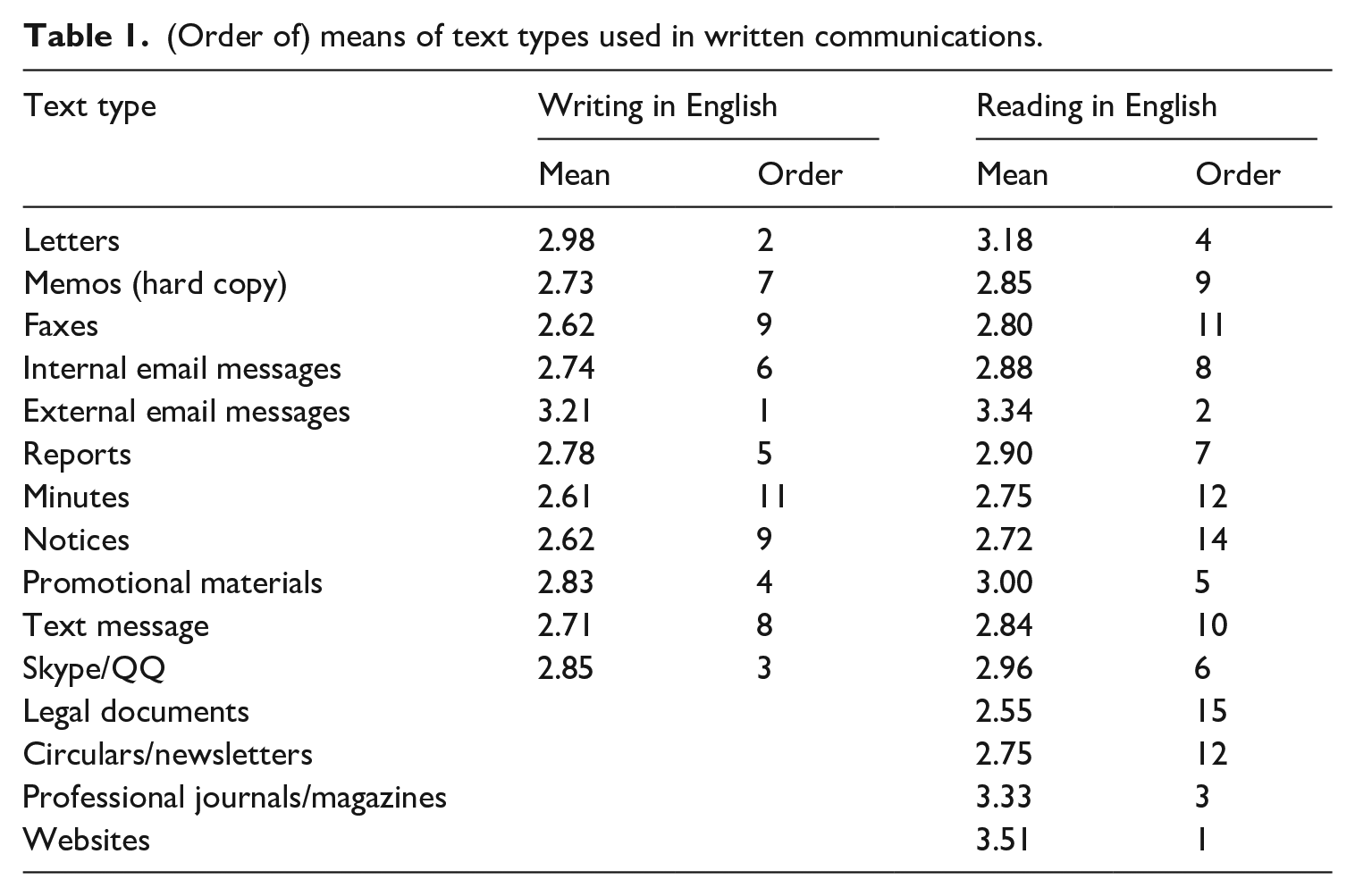
The participants were asked to indicate how often they used English for various professional purposes on a six-point Likert scale (please see online Appendix 1 for more details). Table 1 shows the means of the commonly used text types in the workplace when writing and reading in English and the rank orders of these texts in terms of the means as well. The means of English writing ranged between 2.61 and 3.21 while those of reading between 2.55 and 3.51, all showing a value below or around 3, which suggests that they used each of these text types in English once/twice every four months. Given the fact that the participants were using English in a Chinese-dominant society, these means indicate that they still used some English in their work. The most frequently used text types while writing in English are external emails, letters, Skype/QQ 2 (a Chinese instant messaging software service), promotional materials, and reports; whereas those for reading in English are websites, external emails, professional journals/magazines, letters, and promotional materials. Hence, for written communications, external emails, letters, and promotional materials are the three most commonly and frequently used text types for professionals in China.
(Order of) means of text types used in written communications.
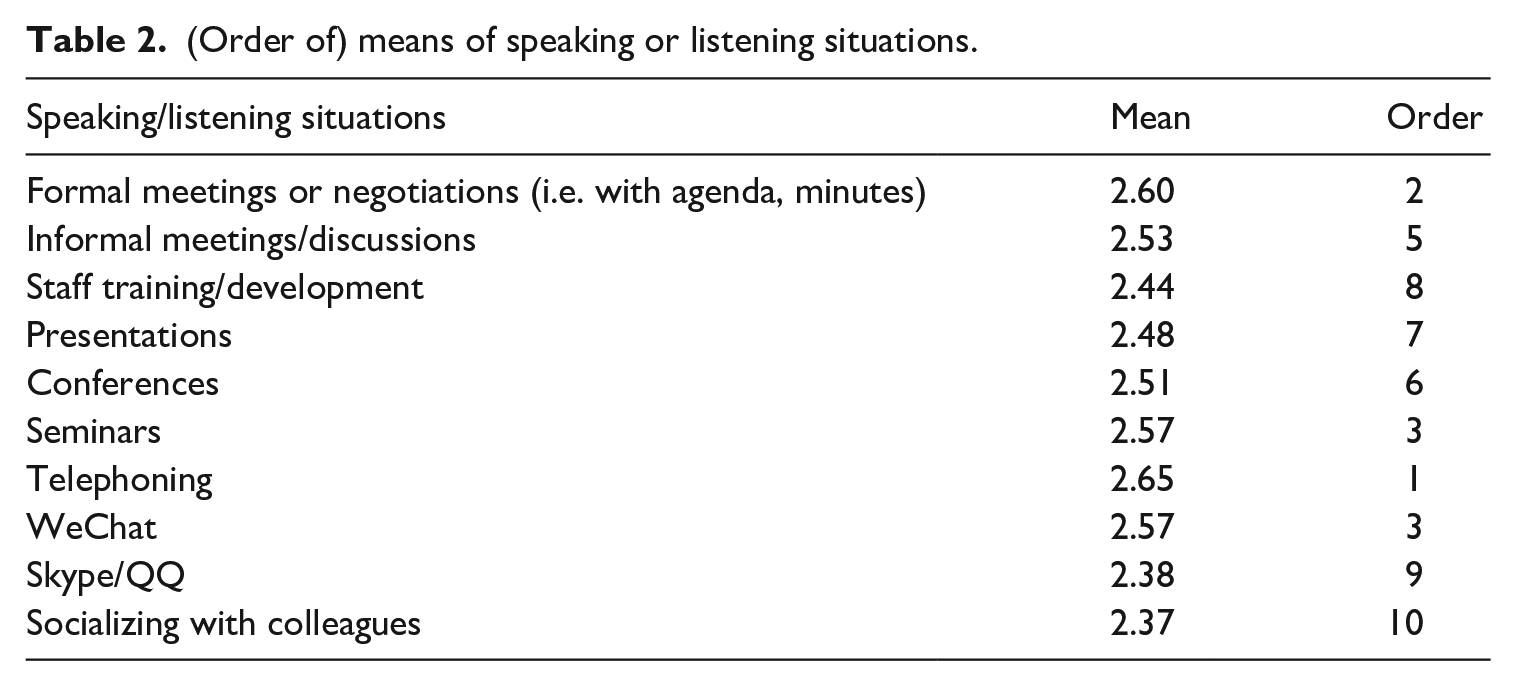
With regard to spoken communications, 10 speaking or listening situations in the workplace were considered. The means and related rank order of English use in these situations are displayed in Table 2. The same six-point Likert scale as depicted above was used. The means ranged from 2.37 to 2.65, which shows that the participants used English less frequently in spoken communications as compared to written communications, but still more than once/twice a year in each of the 10 situations. The top five speaking or listening situations are: telephoning, formal meetings/negotiations, seminars, WeChat (a Chinese software like WhatsApp), and informal meetings/discussions.
(Order of) means of speaking or listening situations.
Correlational Analyses
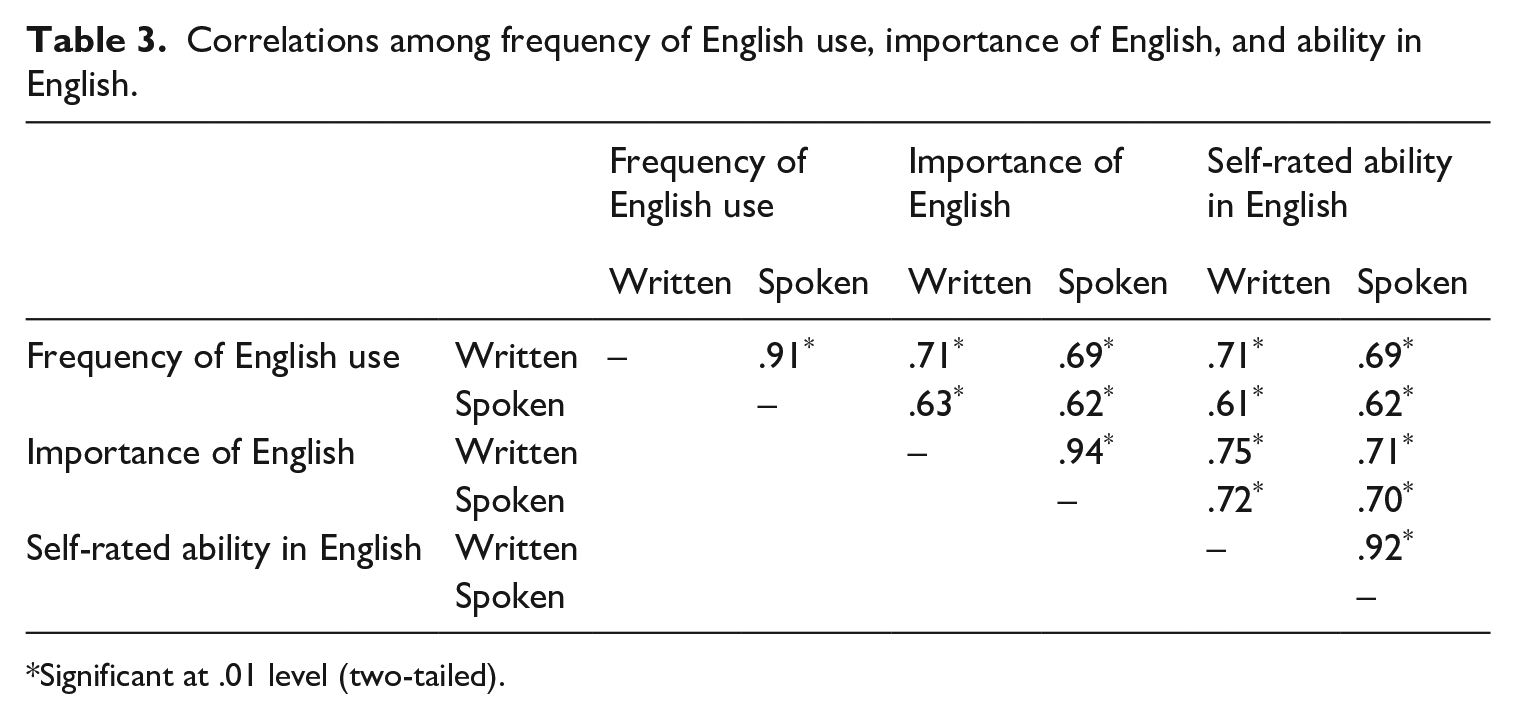
Pearson correlation coefficients were used to determine whether there were statistically significant relationships among the overall means of the frequency of English use, the importance of English, and the self-rated English ability. These three aspects all included both written and spoken communication. The frequency of English use in written communication was computed based on the 26 items in Sections 3.1 and 3.2 as shown in the online Appendix, while its use in spoken communication on the 10 items in Section 3.3. The means of the importance of English were obtained from items 78 and 79, and those of the self-rated English ability from items 84 and 85. Table 3 shows their correlations.
Correlations among frequency of English use, importance of English, and ability in English.
Significant at .01 level (two-tailed).
From the coefficients shown in Table 3, it can be seen that there are significant positive correlations among the frequency of English use, the importance of English, and the self-rated English ability. That is to say, the more frequently the participants use English in their work, the greater importance they attach to the language, which, in turn, predicts better ability in the language. Within each of these three variables, the written and spoken aspects are very significantly and positively related to each other with coefficients above .9, suggesting that both aspects co-vary and are likely to be mutually supportive of each other. Particularly noteworthy of mention is that although on average these participants had learnt English for six to 10 years, only less than half of them (43.6%) self-rated their spoken English as “good”, “very good”, or “excellent”, while very much the same may be said of their self-rated written English (46.4%). This suggests, we believe, that the teaching and learning of English in China have not prepared them for the bilingual professional workplace so well.
Interview Findings
The interview consisted of two questions; they are designed to elicit the interviewees’ perceptions of how important English is to their work life, and what suggestions they would make to improve the effectiveness of ELT in China. The qualitative data obtained from the interviews thus complements the questionnaire findings by enriching our understanding of the relationship between the perceived significance of English in the bilingual workplace on one hand, and effective needs-driven ELT measures on the other.
Question 1 asks: Has English become more important in your work? Why or why not? To this question, 29 of the 44 interviewees (65.9%) indicate that English is becoming more important in their work. This view is exemplified by three excerpts as follows: M-22-SE-C
3
: Following rapid economic development and change in lifestyle, more and more Chinese people want to have a look at the rest of the world, so traveling abroad has become more popular than ever before, and English is the most commonly used language of communication in most of the foreign countries. (Example 1) F-3-SW-J: English has become more and more important in my opinion. I am working in a China-foreign joint venture, and some of my foreign colleagues are English speakers, so the working language with them is English. (Example 2) F-7-YaR-F: Yes, English is becoming more and more important in my work. You know, I am working in a foreign-owned company, and the working language in our company is English since some of my colleagues speak English as their first or second language. There is also a need for us to keep up-to-date with the latest technologies through English. (Example 3)
In addition to the reasons mentioned above, some other reasons – in decreasing order of significance – include: English is a required medium of communication at work or in the higher education domain (e.g. medium of instruction at some universities); English is the international language for academic publishing; English is crucial for gaining access to foreign knowledge and information; and there is an increasing need to communicate with foreigners in English.
On the other hand, 10 of the interviewees (22.7%) indicate that English has become less important since they seldom use English or do not use English at all in their work. Another five interviewees (11.4%) said they feel “unsure” because the importance of English has not changed much in their work.
Question 2 asks: According to your work experience, what suggestions would you give to improve the effectiveness of ELT in China? Some interviewees have provided a few rather insightful comments and practical suggestions. For example: M-2-EC-P: I think we should pay more attention to the practical use of English in classroom teaching, especially at university level. For example, as a university teacher, we need to publish academically. Even if you just publish an article in Chinese, you still need to write an abstract in English. So we should teach and better prepare our university students for good academic writing in English. Besides, previously, all the modules in my discipline were offered in Chinese. The MoE earlier required that we offer some core content modules in English, so a lack of practice in oral English is another big challenge for some of my colleagues now. When I was a university student, our English teaching focused too much on various written exams; we did not have much oral practice. (Example 4) M-22-SE-C: We use English quite a lot in our work, but it seems that our English teaching has little to do with how we use English in the workplace. So my suggestion is that students majoring in tourism should have their internship in the first semester of their third year instead of in the fourth/final year. In this way, they will realize what kind of English language skills they will need and have more time to get prepared for their future career. University English teaching should also shift from being exam-oriented to use-oriented. (Example 5) F-1-NC-F: I am now working in a foreign-owned finance company. From the beginning of my appointment I had to learn nearly all the English texts required for my work since all those core modules in my major program were taught in Chinese. So I wish I had learnt those modules in English with proper English textbooks, which would have saved me a lot of trouble at work. However, I doubt whether the teachers could teach them in English. I am lucky that my English is good, but I did not learn much from my university English classes, since those were mainly focused on tests and the teachers would follow the textbooks literally line by line most of the time. I had been one of the debating team members at my university for three years. It was really a good experience in terms of sustaining my English learning motivation. (Example 6)
As shown in Examples 4, 5, and 6, the interviewees are appealing for a number of needs-driven changes in the ELT curriculum:
1) rather than keeping students busy preparing for written examinations, ELT in China (especially at tertiary level) should help students anticipate and meet the needs of English in real-life workplace contexts across a wide range of professions depending on their major programs, putting equal if not greater emphasis on speaking skills development compared with writing;
2) it is advisable for some selected core modules to be offered in English;
3) ELT pedagogies should be diversified and student-centered, taking into account students’ future professional needs in the real-life workplace;
4) internship, as an integral part of a given undergraduate program, should take place earlier (no later than year three of a four-year normative program) so that students can have more time getting prepared and equipped for the kinds of English that they would need in the workplace; and
5) university teachers should make a greater effort to sharpen up their English proficiency with a view to better serving their students’ needs for what may be termed “English for profession-specific purposes”.
Three other suggestions alluded to by five interviewees are no less instructive:
6) a system of user-friendly, transparent, and scalable rubrics reflecting discrete performance indicators is needed to gauge students’ competence in practical English communication skills; such an assessment system will be a useful reference for all stakeholders concerned: teachers, students and prospective employers;
7) students whose perceived needs for English in their future career are minimal should have the option of not studying English as a subject at university; and
8) the teaching of spoken English should place a stronger emphasis on successful communication of meaning rather than being overly concerned about lexico-grammatical correctness.
Most of these interview findings are consistent with the results in our questionnaire survey summarized above. Like the interviewees, most of the questionnaire respondents also indicated that the use of English, spoken or written across a wide range of professions, is becoming more and more important in China.
Discussion
Our findings adduced from 2495 completed questionnaires and 44 individual interviews clearly have implications for ELT reform in China, especially in the direction of strategic changes in ELT curricula and pedagogies. Li and Baldauf (2011: 793) propose that the emphasis of ELT should shift “from linguistic knowledge and skills to communicative language competence”. However, as shown in our interview findings, the ELT teaching pedagogies at China’s universities tended to focus on structural approaches, linguistic knowledge, grammar translation, and pedagogies characterized by audiolingualism rather than communicative language teaching. And, as revealed by the questionnaire results in this study, the respondents’ comparatively low self-rated ability in both spoken and written English suggests that ELT in China has hardly prepared its students for their real-life communicative needs in the workplace after graduation. In other words, ELT in China should be reformed to gear towards upskilling students’ professional development as well as meeting societal needs.
The College English Curriculum Requirements issued by China’s MoE specified clearly that one of the teaching targets is to enable university students to communicate efficiently in both spoken and written English as an integral part of preparation for their future career and social interaction with others. While the data from the current study indicate that the present ELT cannot secure the realization of this target. Moreover, as shown in this study, China’s continuing development in an increasing global environment requires university graduates to be good at both Chinese and English. Therefore, for ELT to better serve the development of the country, we need to provide university students with a curriculum that is more conducive to their English learning – for example, to teach some of their core modules in English, which can help improve not only their professional knowledge but their English capacity as well, given that they will have more opportunity to make use of English in their study. The questionnaire results in this research also help to support that the more frequently students use English in their learning and everyday life, the higher ability they will achieve in the language and the greater importance they will attach to it. In other words, rather than keeping a narrow curricular focus on Standard English grammar and privileging grammatical accuracy as the most heavily weighted criterion of assessment, ELT will better meet the needs for English in the workplace in China when students are taught how to interact with others fluently and effectively in English, regardless of whether English is their “native” language. Nonetheless, at present, English as medium of instruction (EMI) is adopted merely by the nine international joint venture universities (e.g. University of Nottingham Ningbo China) and in a few core modules of some top universities in China. Of course, bilingual teaching also means that a properly trained ELT workforce who can teach bilingually should be in place, which is still a big challenge in China’s ELT profession (Zhang, 2018; Zhang and Deng, 2020; Zheng, 2010). The more exposure to the way English is actually used by proficient Chinese speakers of English, the easier it will be to promote their lexico-grammatical preferences and interaction styles – which may or may not converge with those in “Standard English” – in the ELT curriculum as alternative role models for mainland students to emulate. At the level of classroom teaching and learning, the “voice” of such alternative ELF role models should have a place in, for example, listening materials and other ELT exercises and activities, alongside the dominant “voice” of English first-language (L1) speakers. Provided an ecology exists for proficient Chinese speakers of English to make meaning naturally in university campus environments, be they teachers or students, the so-called “non-native” accents so characteristic of Chinese speakers of English will have legitimate space to grow and, over time, be normalized and accepted as their preferred English pronunciation patterns. When this happens, Chinese graduates will find it easier to fit into the real-world workplace demand for English in an increasingly bilingual business environment in China.
Considering EMI, the new language policy adopted by the Education University of Hong Kong as illustrated by Kirkpatrick (2014) can serve as a reference for the development of EMI in China’s universities. The policy specifies the following three guidelines. Firstly, it requires “students to reach exit standards in all three languages” (i.e. English, Cantonese, and Putonghua; Kirkpatrick, 2014: 11). Secondly, it distinguishes between medium of instruction (i.e. module outline and assessment) and classroom language (i.e. teacher–student and student–student interactions in the classroom like lectures, tutorials, labs, etc.) and allows for code-switching in the latter. Thirdly, it specifies the following factors to be considered when determining the medium of instruction for a specific module: (a) the nature of the discipline; (b) the usual language of the workplace for graduates of a particular program; (c) how comfortable the lecturer is and the students are in using Chinese (Cantonese/Putonghua) or English; (d) students’ and staff members’ proficiency in English, Cantonese, and Putonghua; and (e) mixed class, with different L1 backgrounds, including Cantonese-dominant local students, English-dominant international students, and Putonghua-dominant non-local Chinese (primarily Mainland Chinese) students. (Xu, 2014: 218–219)
The guidelines and factors are concrete and practical, which either underpin the establishment of language policy or influence the implementation of the policy to a great extent. We believe such a medium-of-instruction policy definitely has some reference value for ELT reformers in China – for example, when tailoring their EMI teaching guidelines to meet the particular requirements and features of China’s teaching context (Li, 2019b; Li and Li, 2013).
Cook (2016: 188) argued that we should encourage our English learners to see themselves not “as failures always trying to be like native speakers” but “as successes, achieving things as L2 users that are out of the reach of monolinguals”. However, the findings from the present study as well as those from previous research (He, 2011; He and Zhang, 2010; Li, 2007; Xu et al., 2017) indicate that ELT in China still adopt native-speaker-based models – principally the US or UK – as the only pedagogic norms and assign more weight to lexico-grammatical correctness compared with fluency and appropriacy of communication in context. In a world where English is increasingly functioning as the global lingua franca, it is doubtful what good it would bring to unduly privilege the “native speaker” norms, when so-called native speakers are already outnumbered by bilingual users of English worldwide. While English for Academic Purposes (EAP) norms should still be upheld in formal written communication in both the education and employment sectors, it is high time that Anglo-American accents and sociopragmatic norms of interaction (e.g. politeness strategies) should give way to patterned innovations (rather than errors) in a glocalized workplace context such as China (Clyne, 2012; Li and He, 2021). For this to happen, nothing short of top-down re-engineering in the direction of glocalization of locally relevant ELT norms, standards, and pedagogies is needed, or else learners may worry too much about the correctness and dare not to speak or use English due to the debilitative effect of language learning anxiety (He, 2018).
In other words, as long as intelligibility is not compromised, students should be encouraged to take pride in speaking the localized variety of English (e.g. China English) rather than shunning it for fear of social stigma, since the language is no longer the exclusive property of its so-called native speakers; rather, English is now within the plurilingual repertoire of much larger numbers of bilingual users of English worldwide. One way to popularize such a sense of pride is to cultivate an international perspective by offering modules like “English as a lingua franca” and “World Englishes”. It is no accident that modules with such titles have been offered in many other nations/regions, including various parts of Asia and continental Europe, but also traditional Anglophone countryside like the UK, the USA, and Australia. Even native speakers of English are encouraged to “develop the knowledge and skills necessary for intercultural communication” so as to avoid the “one-way communicative burden imposed on the WE [world Englishes] speakers” (Kubota, 2001: 47). In this regard, ELT in China, especially at the tertiary level, should provide similar opportunities for students to develop an awareness of world Englishes and the use of English as an international lingua franca. This is the only sure way to turn vast numbers of passive learners of English into active users. Crucial to this critical change in mindset is a firm belief, to be inculcated through systemic adjustment in the ELT curriculum and pedagogies from primary to tertiary levels, that apparent deviations from lexico-grammatical norms of “Standard English” should no longer be indiscriminately dismissed as errors (Li and He, 2021; Murata, 2019). Instead, they should take pride in seeing globalized lexico-grammatical features as innovations, which are naturally shared among Chinese ELT learners and users when making meaning locally that are lingua-culturally relevant to their lifeworld (Cao, 2019; Li, 2018).
Conclusion
Graddol (2006: 82) once argued that [t]here is no single way of teaching English, no single way of learning it, no single motive for doing so, no single syllabus or textbook, no single way of assessing proficiency and, indeed, no single variety of English which provides the target of learning.
Our findings in this study point to the need for ELT reform in China to be geared towards using ELF communicatively in an increasingly globalized world – that is, the ELT curriculum and pedagogies should be refashioned in such a way as to focus more broadly on boosting and assessing students’ communication skills rather than narrowly measuring how successful they are in adhering to lexico-grammatical accuracy as defined in Standard English or native-speaker-based EAP. As for the pedagogical model of ELT in China, given the dim prospect for EFL learners of English in China to approximate native-like competence of English as native language (ENL) speakers, EFL assessment in China should realistically reflect widely shared and well-attested usage patterns of acrolectal Chinese EFL speakers and writers (Li and He, 2021). In other words, we believe the native-speaker-based model should be enriched with judiciously selected indigenized variants where there is minimal risk of meaning being adversely affected (the invariant question tag isn’t it? so popular and prevalent in ELF interaction comes to mind). Last but by no means least, for such reform measures to bear fruit, the availability of properly trained and resourceful ELT teachers is an absolutely crucial precondition, which is why the development of rigorously designed ELT training programs should be among the first steps to consider in ongoing deliberations on ELT planning and goal setting. To sum up, in the ELF context, ELT reform in China should take into consideration the ways English is used in different parts of the world beyond the traditional “native speaker” countries, hence “glocalizing” as stated in the title of this article. Given the ELF context, especially the situation reported by Graddol (2006) as reviewed at the beginning of this paragraph, it is our belief that “glocalizing ELT reform” may also apply to South East Asian nations, where English is the only official language for the most influential Association – ASEAN – in this region (Kirkpatrick, 2010).
Like other empirical studies of a similar nature, this study suffers from one limitation in our data collection method. Although we have tried our best to include participants from different regions and professions in China, and despite the snowballing nature of our data-collection method adopted against the current COVID-19 situation, our participants cannot be said to be a representative cross-section of a well-defined sample with regard to English-using populations in China. It is our wish that such a shortcoming could be overcome in future research towards the goal of informing curricular reforms by collecting workplace English data from frontline professionals across a wider range of job types and positions.
Supplemental Material
sj-pdf-1-rel-10.1177_00336882211018499 – Supplemental material for Glocalizing ELT Reform in China: A Perspective from the Use of English in the Workplace
Supplemental material, sj-pdf-1-rel-10.1177_00336882211018499 for Glocalizing ELT Reform in China: A Perspective from the Use of English in the Workplace by Deyuan He and David CS Li in RELC Journal
Footnotes
Acknowledgements
We are very grateful to the participants of this study. We would also like to thank Dr Qunying Zhang and Dr Lindsay Miller for their insightful comments on earlier versions of this article.
Funding
The authors received no financial support for the research, authorship, and/or publication of this article.

Supplemental Material
Supplemental material for this article is available online.
Notes
References
Supplementary Material
Please find the following supplemental material available below.
For Open Access articles published under a Creative Commons License, all supplemental material carries the same license as the article it is associated with.
For non-Open Access articles published, all supplemental material carries a non-exclusive license, and permission requests for re-use of supplemental material or any part of supplemental material shall be sent directly to the copyright owner as specified in the copyright notice associated with the article.
