



Abstract
The relationship of receiving college and university training within the state vocational rehabilitation (VR) program to pre-VR consumer characteristics was investigated with a multiple direct logistic regression technique. A model containing 11 pre-VR characteristics predict the reception of college and university training for a multidisability set of consumers who received VR services (R2 = .11). Characteristics represent both intrinsic and extrinsic properties of consumers associated with the outcome variable. A second analysis on the relationship between college and university training and competitive employment was conducted with a simple logistic regression technique. Consumers were less likely to secure employment following the reception of college and university training (R2 = .00). Results are discussed in the context of plausible explanations and implications for career counseling.
Keywords
College and university training, a service offered by the state vocational rehabilitation (VR) program, is an intervention rehabilitation counselors may implement with consumers from within multiple theoretical frameworks of career counseling. Frank Parsons (1909) established that individuals need to have knowledge of the self and the work environment to reason whether the person–environment fit would lead to preferable outcomes such as positive work performance, job satisfaction, and reduced stress. Hershenson and Liesener (2003) linked collegiate experience to Parson’s model by stating that a VR consumer enrolled in college may acquire
information about one’s self, the world of work, the opportunities that exist, and one’s cultural context . . . . The interaction of these learnings with the messages obtained from the environment results in the individual’s career-related self-efficacy and outcome expectations. (p. 308)
Hershenson and Liesener (2003) noted that most career counseling theories contain the same concepts developed by Parsons (1909). Therefore, several theoretical approaches to career counseling may influence the decision to provide college and university training with consumers.
Beyond the development of career self-efficacy, there are other benefits to postsecondary experience for the general population and VR consumers. College graduates are more likely to have stable employment, career mobility, and higher wages than nongraduates (Pascarella & Terenzini, 1991). After investigating the state VR program, Boutin and Accordino (2011) discovered that consumers with psychiatric disabilities were 33% more likely to become competitively employed after receiving college and university training than similar consumers who did not receive this service. Several positive vocational outcomes are associated with experiences in higher education.
The decision to include college and university training into a consumer’s plan for employment requires a careful consideration of several factors. Rehabilitation counselors review data obtained from a comprehensive evaluation of consumer’s personal characteristics to determine whether college and university training is needed. Such characteristics may include degree of physical functioning, educational and vocational experience, psychosocial aspects, extent of economic independence, and vocational choice (Rubin & Roessler, 2008). The Rehabilitation Services Administration’s (RSA) definition of college and university training is as follows:
Full-time or part-time academic training above the high school level leading to a degree (associate, baccalaureate, graduate, or professional), a certificate or other recognized educational credential. Such training may be provided by a four-year college or university, community college, junior college, or technical college. (RSA, 2008, p. 24)
What separates college and university training from all other RSA training services is the academic focus leading to a credential (RSA, 2008). The evaluation process enables rehabilitation practitioners to determine the likelihood consumers will learn and develop work self-efficacy after receiving academic training leading to an educational credential.
Consumer Characteristics
Intrinsic
Researchers have found that intrinsic factors such as gender, age, as well as race and ethnicity are sometimes associated with VR processes and outcomes. For example, male consumers with visual impairments and who secured competitive employment earn more than females with the same disability and outcome (Estrada-Hernandez, 2008). However, gender is not commonly found to significantly contribute to VR outcomes (e.g., Catalano, Pereira, Wu, Ho, & Chan, 2006; Schaller & Yang, 2005). While considering age, Wilson (2005) found consumers identifying as non-Hispanic African Americans were less likely accepted for VR services if they were between 51 and 60 years of age. Rosenthal, Ferrin, Wilson, and Frain (2005) concluded that African American consumers are less likely accepted for VR services over European American consumers after conducting a meta-analysis of 10 published studies spanning 9 years of RSA data. Some intrinsic characteristics of consumers and VR can be interrelated.
Extrinsic
Extrinsic factors such as level of education, severity of disability, and source of support are also related to VR processes and outcomes. For example, Cavenaugh, Giesen, and Steinman (2006) reported consumers with visual impairments were 2 times more likely accepted for VR services for every 2-year increment in level of education. In addition, consumers with significant disabilities were found 28 times more likely accepted for VR services (Cavenaugh et al., 2006) and less likely to secure competitive employment (Hill, 1989). Wilson, Alston, Harley, and Mitchell (2002) implemented a stratified random sample of race and ethnicity from a national data set to determine whether source of support is related to acceptance. The findings reported that consumers were less likely accepted for VR services if they were receiving support from family, friends, and other sources at the time of application. Apparently, access to VR services and degree of VR success could be impacted by extrinsic characteristics of consumers.
Receiving College and University Training
Published literature on the VR program is inadequate on the extent preservice characteristics will predict whether consumers receive college and university training. However, some evidence reflects associations between race, ethnicity, and disability to the reception of college and university training. Feist-Price (1995) analyzed consumer records from the RSA-911 database to determine differences in rehabilitation processes for consumers who identified as European American or African American from a southeastern state. A chi-square analysis was used to conclude European Americans as more likely to receive college and university training over African Americans. Robinson and Klein (2008) also used the RSA-911 database but investigated a national sample of consumers dual-diagnosed with mental illness and substance abuse disorders. Once again, a chi-square analysis was used to conclude that consumers identifying as European American received more college and university training than those classified in a group identifying as African American, Asian, Native Hawaiian or Pacific Islander, and Hispanic. In considering disability, Gilmore and Bose (2005) stated that 35% of consumers with orthopedic impairments received college and university training; however, fewer consumers from all other impairment types received college and university training. Elmore Williams (2008) reported in a dissertation that VR consumers identifying as African American with specific learning disabilities were less likely to receive college and university training than similar consumers who identified as European American. Very little evidence exists on the relationships between consumer characteristics and their reception of college and university training.
Several personal characteristics of consumers are associated with various aspects of VR processes and outcomes. However, evidence on predicting college and university training is based on nonparametric statistical techniques and non-peer-reviewed literature. In addition, participants in the only published study in which a national sample was used to predict this VR service were restricted to those with a dual-diagnosis. Rehabilitation counselors need to know the personal characteristics of consumers that predict their reception of RSA’s college and university training to assist in the development of rehabilitation plans. Counselors also need evidence on the efficacy of college and university training for consumers with vocational goals. Knowledge of personal characteristics predicting enrollment might help practitioners identify possible barriers and enablers to accessing college training.
The current study differs from previous studies predicting college and university training by using a multivariate statistical analysis and a national sample of VR consumers unrestricted by type of disability. In addition, the current study attempts to assess the value of college and university training for consumers also unrestricted by type of disability. The purpose of the study is to test the following hypotheses:
Hypothesis 1: Relationships exist across consumer personal characteristics and reception of college and university training within the VR program in the United States.
Hypothesis 2: A relationship between college and university training and competitive employment exists for consumers from various disability types in the United States.
Method
Participants
All data from this ex post facto study were obtained from the publically available RSA-911 database during the 2009 fiscal year (FY). State VR agencies across the United States and some of its territories annually forward to the RSA information on more than 100 variables for consumers whose cases were recently closed (RSA, 2008). Each variable is listed and defined in the Reporting Manual for the Case Service Report. The manual stems from a RSA policy directive on coding instructions for VR practitioners and staff who input consumer information to the database. Information coded on the FY 2009 database reflects cases closed from October 1, 2008, through September 30, 2009.
The population consisted of 588,818 cases from which eligibility criteria for the study were applied. Only consumers eligible for the VR program and receiving VR services were included in the study. Cases coded as consumers identifying with multiple racial groups (e.g., both Asian and European American) were deleted to determine whether race is predictive to receiving college and university training. In addition, missing cases from all variables were removed prior to analysis.
The final sample includes 300,278 consumers (a) determined eligible for VR services, (b) receiving VR services, (c) identifying with one racial group, (d) whose status for each variable of interest is recorded, and (e) whose cases were closed during the 2009 FY. Consumers were primarily male (55%), and 58% of the sample was 30 years of age or older (M = 35, SD = 14.95). Most of the consumers identified as European American (74%), followed by those identifying as African American (24%), American Indian or Alaska Native (1%), Asian (1%), and Native Hawaiian or Other Pacific Islander (<1%). See Table 1 for demographic characteristics of the sample.
Sample Characteristics Across Dichotomous Variables (Y = 1)
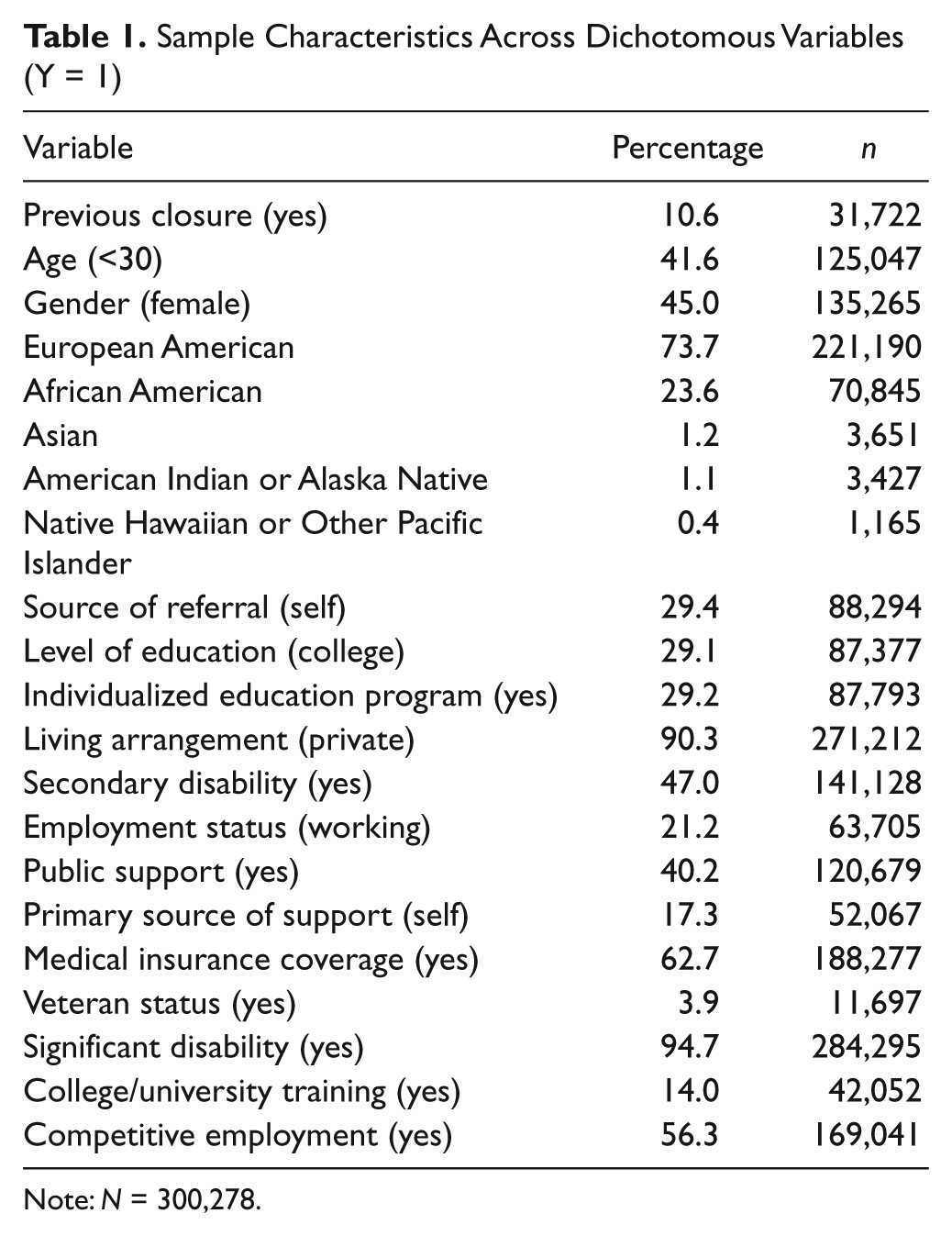
Note: N = 300,278.
Variables
The following 19 independent/predictor variables for the first hypothesis reflects pre-VR consumer characteristics obtained from the RSA-911 database. That is, most of the following characteristics are determined at the time of application.
Previous closure
Previous closure is a nominal variable reflecting a dichotomy (i.e., yes, no) of whether a consumer “had a previous service record closed by the State VR agency within a 36-month period prior to the most recent application for services” (RSA, 2008, p. 6).
Age
Age is a nominal variable reflecting a collapsing of continuous numerical values into two groups. Dichotomous levels of age reflect consumers younger than 30 years and those 30 years and older because 74.1% of undergraduate students with disabilities during the 2007–2008 academic year were 29 years old and younger (U.S. Department of Education, National Center for Education Statistics, 2009a).
Gender
Gender is a nominal variable reflecting male and female levels of measurement.
Race
Race comprises five nominal and dichotomous variables, including European American, African American, American Indian or Alaska Native, Asian, and Native Hawaiian or Other Pacific Islander. Each race variable has two levels indicating whether a consumer identifies as belonging to any particular racial group. Although RSA (2008) noted that consumers may identify with more than one race, only consumers identifying with a single racial group were retained for the study. RSA requires consumers identifying as Hispanic or Latino to also identify as one of the racial groups. Therefore, Hispanic or Latino was not considered an independent variable because it would otherwise be impossible to separate Hispanic from the racial groups.
Source of referral
Source of referral is a nominal variable reflecting a dichotomy (i.e., self, others) of whether a consumer self-refers to the state VR agency. Referrals from others would include educational institutions, medical personnel, and agencies such as state or local welfare, community rehabilitation programs, one-stops, and those under the Social Security Administration.
Level of education
Level of education is a nominal variable reflecting a dichotomy (i.e., college, no college) of whether a consumer has postsecondary experience prior to acceptance to the VR program.
Individualized education program (IEP)
IEP is a nominal variable reflecting a dichotomy (i.e., yes, no) of whether a consumer “ever received services under an IEP in accordance with the provisions of the Individuals with Disabilities Education Act” (RSA, 2008, p. 11).
Living arrangement
Living arrangement is a nominal variable reflecting a dichotomy (i.e., private, not private) of whether a consumer resided in a private residence at the time of application for VR services. Nonprivate living arrangements include community residential/group homes, rehabilitation or mental health facilities, nursing homes, correctional facilities, halfway houses, substance abuse treatment centers, and shelters.
Secondary disability
Secondary disability is a nominal variable reflecting a dichotomy (i.e., yes, no) of whether a consumer has a “physical or mental impairment that contributes to, but is not the primary basis of, the impediment to employment” (RSA, 2008, p. 12).
Employment status
Employment status is a nominal variable reflecting a dichotomy (i.e., working, not working) of whether a consumer is working at the time of application for VR services.
Public support
Public support is a nominal variable reflecting a dichotomy (i.e., yes, no) of whether a consumer, at the time of application for VR services, received Supplemental Security Income, Social Security Disability Income, temporary assistance for needy families, general state or local assistance, veterans’ disability benefits, workers’ compensation, or other public support.
Primary source of support
Primary source of support is a nominal variable reflecting a dichotomy (i.e., self, others) of whether a consumer was self-supported with personal income at the time of application for VR services. Source of support from others include family and friends, public support, and all other sources such as private disability insurance or private charities.
Medical insurance coverage
Medical insurance coverage is a nominal variable reflecting a dichotomy (i.e., yes, no) of whether a consumer, at the time of application for VR services, received insurance coverage from Medicaid, Medicare, public insurance, or private insurance.
Veteran status
Veteran status is a nominal variable reflecting a dichotomy (i.e., yes, no) of whether a consumer “served in the active military, naval or air service, and was discharged or released under conditions other than dishonorable” (RSA, 2008, p. 42).
Significant disability
Significant disability is a nominal variable reflecting a dichotomy (i.e., yes, no) of whether a consumer “was considered an individual with a significant disability at any time during his/her VR program” (RSA, 2008, p. 42). A consumer with a significant disability reflects an individual with a specific physical or mental disability, whose impairment poses limitations to at least one functional capacity, and who is expected to receive multiple VR services for an extended period of time (RSA, 2008).
College and university training
The dependent/outcome variable for the first hypothesis is college and university training and is a nominal variable reflecting a dichotomy (i.e., received, did not receive) of whether a consumer received college or university training during their VR program.
College and university training is the independent variable for the second hypothesis with two levels of measurement (i.e., received, did not receive) of whether a consumer received college or university training during their VR program.
Competitive employment
The dependent/outcome variable for the second research question is competitive employment and is a nominal variable reflecting a dichotomy (i.e., yes, no) of whether a consumer achieved employment “in an integrated setting, self-employment or a state-managed Business Enterprise Program (BEP) that is performed on a full-time or part-time basis for which an individual is compensated at or above the minimum wage” (RSA, 2008).
Data Analysis
A multiple direct logistic regression (LR) technique was used to determine the extent to which pre-VR consumer characteristics are related to receiving college and university training. Multiple LR is useful when one binary dependent variable and two or more independent variables are investigated (Agresti, 2002; Huck, 2004; Neter, Kutner, Nachtsheim, & Wasserman, 1996). Neter et al. (1996) suggested validating the LR model by using comparison data to check the model’s predictive ability. Therefore, the data were randomly split into halves, and separate LR analyses were run on each subsample. For model-building and validation subsamples, likelihood ratio tests were then used to determine equations that best predict the reception of college and university training (Neter et al., 1996). A full model (i.e., all predictors) was repeatedly compared with 15 reduced models (one for each usable independent variable), each with a different predictor removed. Changes to a chi-square statistic for each reduced model were then compared with a chi-square critical value. A decrease in a chi-square statistic greater than the critical value represents an independent variable that significantly improves the model (Neter et al., 1996). Only variables statistically significant across both model-building and validation sample groups were considered to predict reception of the VR service (Cohen, Cohen, West, & Aiken, 2003).
Simple LR was then used to determine whether college and university training was related to competitive employment. Using the randomly split data, likelihood ratio tests were used to determine whether the reception of college and university training predicts competitive employment. SPSS version 19 software was used to conduct all statistical analyses. Probability values were set at .01 for all analyses.
Results
American Indian or Alaska Native, Asian, Native Hawaiian or Other Pacific Islander, and veteran status variables were excluded from the analysis because more than 95% of consumers did not identify with each of these characteristics. All assumptions of LR were met for model-building and validation sets.
Prediction of College and University Training
Model-building set
A direct LR technique was used on college and university training (Y = 1) as outcome and 15 consumer characteristics as predictors for the model-building set. An analysis of 150,506 cases confirms that a model including all consumer characteristics predicts the reception of college and university training better than a model that only includes the constant (−2 log likelihood [−2LL] = 111,808.16; χ2 = 9,574.64; df = 15; p = .000; Nagelkerke R2 = .11). Therefore, the null hypothesis for the model-building set was rejected.
Differences in the chi-square statistic exceeded the critical value 6.63 (df = 1, α = .01) for 11 independent variables (i.e., previous closure, age, gender, race, source of referral, level of education, IEP, living arrangement, public support, primary source of support, medical insurance coverage) that contributed to the model (Δχ2 range = −4,749.11 to −7.64) and were retained. The final model is logit (college and university training) = −3.049 − 0.595(previous closure) + 1.282(age) + 0.270(gender) − 0.540(African American) + 0.050(source of referral) + 0.697(level of education) − 0.672(IEP) + 0.486(living arrangement) − 0.224(public support) − 0.549(primary source of support) + 0.290(medical insurance coverage).
Validation set
A direct LR technique was also used on college and university training (Y = 1) as outcome and 15 consumer characteristics as predictors for the validation set. The analysis of 149,772 cases confirms that a model including all consumer characteristics predicts the reception of college and university training better than a model that only includes the constant (−2LL = 111,980.50; χ2 = 9,885.01; df = 15; p = .000; Nagelkerke R2 = .12). Therefore, the null hypothesis for the validation set was rejected.
Differences in chi-square exceeded the critical value 6.63 (df = 1, α = .01) for the same 11 independent variables that contributed to the model as found in the model-building set (Δχ2 range = −4,726.78 to −11.85) and were retained. The final model is logit (college and university training) = −3.010 − 0.652(previous closure) + 1.272(age) + 0.306(gender) − 0.558(African American) + 0.063(source of referral) + 0.699(level of education) − 0.663(IEP) + 0.529(living arrangement) − 0.234(public support) − 0.596(primary source of support) + 0.301(medical insurance coverage).
Consumers were more likely to receive college and university training if they (a) were younger than 30 years, (b) were female, (c) self-referred to the state VR program, (d) had collegiate experience, (e) lived in a private residence, or (f) had medical insurance coverage. Conversely, consumers were less likely to receive college and university training if they (a) had received prior VR services, (b) identified as African American, (c) had an IEP, (d) received public economic supports, or (e) were self-supported with personal income.
Prediction of Competitive Employment
A simple LR technique was used on competitive employment (Y = 1) as outcome and college and university training as the predictor for model-building and validation sets. The analysis of 150,506 cases in the model-building set (−2LL = 206,130.61; χ2 = 38.93; df = 1; p = .000; Nagelkerke R2 = .00) and 149,772 cases in the validation set (−2LL = 205,305.27; χ2 = 25.36; df = 1; p = .000; Nagelkerke R2 = .00) confirms that models including college and university training predicts competitive employment better than models that only includes the constant. Therefore, the null hypothesis for the second hypothesis was rejected. Consumers were 9% less likely to become competitively employed following the reception of college and university training. Table 2 contains coefficients and exp(B) values for both LR analyses.
Summary of Logistic Regression Analyses
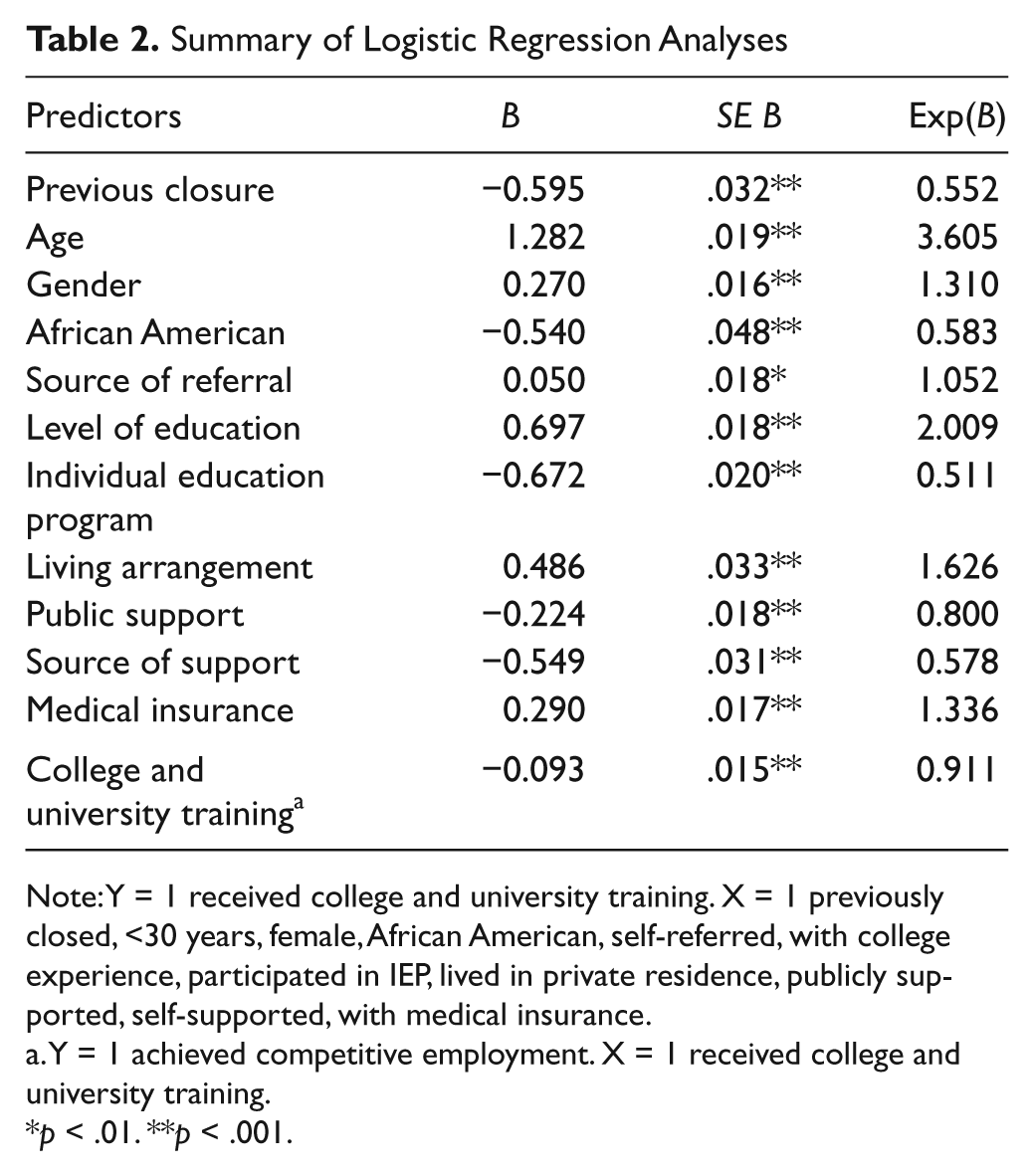
Note: Y = 1 received college and university training. X = 1 previously closed, <30 years, female, African American, self-referred, with college experience, participated in IEP, lived in private residence, publicly supported, self-supported, with medical insurance.
Y = 1 achieved competitive employment. X = 1 received college and university training.
p < .01. **p < .001.
Discussion
One purpose of this study was to identify consumer characteristics that predict the reception of college and university training. Consumers were more likely to receive college and university training if they were younger than 30 years, had collegiate experience, lived in a private residence, had medical insurance coverage, were female, or self-referred to the state VR program. However, consumers were less likely to receive college and university training if they participated in an IEP, were previously closed from the VR program, identified as African American, were self-supported with personal income, or received any type of public economic supports. The first hypothesis was supported.
The importance of collegiate training for younger individuals is also emphasized in career counseling strategies. Herr, Cramer, and Niles (2004) suggested that career counselors help younger adults to broaden their career awareness and explore the world of work. Higher educational institutions facilitate students’ career exploration and conceptualization, development of self-knowledge in relation to strengths and weaknesses, understanding of the occupational structure, and decision-making skills (Herr et al., 2004). Herr et al. also notes that older adults are more likely to require a narrowing of career alternatives rather than a broadening of career awareness. What is unknown is whether career counseling strategies are responsible for the implementation of college training for younger consumers or whether other factors such as ageism or even personal choice might explain the results. When developing employment plans, practitioners may want to determine the extent of consumers’ career awareness regardless of age while recognizing and reducing biases. Practitioners should also consider life stage differences when planning postsecondary education because young adults are mainly dealing with new levels of independence whereas older adults will most likely have family obligations impacting decision making (Herr et al., 2004).
In the current study, odds favored that consumers with prior collegiate experience would receive additional college training in their plans for employment. College students tend to acquire knowledge and develop skills when they are academically involved such as by studying and meeting with faculty (Tinto, 1987, 1997). In the VR program, the acquisition of skills is centrally important to consumers in their quest to become employable (Rubin & Roessler, 2008). For instance, initial interviews may yield consumer educational information signifying undeveloped skills that may be applied vocationally. Therefore, rehabilitation counselors and consumers might be planning college and university training services when consumers have previous collegiate experience so that consumers may complete the development of their skills. What remains important is the need for a thorough and accurate evaluation of consumer interests, abilities, as well as academic and vocational skills.
Level of independence and economic need might also partially explain the results of the current study. RSA (2008) qualifies only private residence as a type of living arrangement in which the applicant is “independent, or with family or other person” (p. 11). What is implied is that applicants are less independent if residing at any of the other types of living arrangements (e.g., group home, mental health facility). Brodwin, Parker, and DeLaGarza (2003) stated that independence is a key ingredient to the rehabilitation potential of persons with disabilities. Living independently involves risk taking (e.g., enrolling in college) and requires adequate support services and the reduction or removal of environmental barriers (Rubin & Roessler, 2008). Early identification of barriers to consumers’ independent living may help practitioners determine strategies for enhancing their appropriateness for college training. From an economic perspective, persons with disabilities and low incomes may be eligible to receive medical insurance coverage through Medicaid (U.S. Department of Health and Human Services, 2011). People involved with the independent living movement had to fight to receive benefits such as health care (DeJong, 1979). The demonstration of economic need is related to increased opportunities to access federal programs and education. Therefore, living at a private residence or having medical insurance coverage at the time of application for VR services may reflect a level of independence necessary for success in college or an economic need for college and university training. Improving consumer access to college training may require rehabilitation counselors identify and reduce barriers to independence and address economic need.
The finding that female consumers were more likely to receive college and university training may be a reflection of national trends. Growth in full-time college enrollment for the general student population between 1997 and 2007 favored females (29%) over males (22%) at degree-granting institutions (U.S. Department of Education, National Center for Education Statistics, 2009b). More female undergraduate college students with disabilities (58%) were enrolled during the 2003–2004 academic year than male students with disabilities (42%), and this proportion is identical to that found with the general undergraduate population during the same academic year. Moreover, the gender difference is greater at the graduate level where female graduate students with disabilities (62%) outnumbered males (38%) during the 2003–2004 academic year (U.S. Department of Education, National Center for Education Statistics, 2009b). Adebayo’s (2008) explanation to the gender gap in college is that females are broadening their career interests to majors typically sought by males such as criminal justice and management, whereas males have not branched out to majors typically sought by females such as nursing and social work. Therefore, it is plausible that rehabilitation counselors are discovering more female consumers willing to explore a wider range of career interests than males, and rehabilitation practitioners are using college and university training as the mechanism to facilitate career awareness and self-efficacy with this population. Male consumers may need assistance during career counseling to dispel any myths regarding jobs associated with females. Although Heppner and Heppner (2009) concluded that it remains unclear why males pursue nontraditional careers, they advise career counseling practitioners to recognize the possibility of personal biases impacting attitudes and behaviors related to consumer gender and career choice.
Although source of referral contributed to the model predicting the reception of college and university training for people who referred themselves to the state VR program, the level of college and university training had the smallest odds predicting the dependent variable. Nonetheless, an argument could be made that people who self-refer could possibly be more independent than people referred by other means. Similar to people living in private residences, people who refer themselves for VR may be independent and have the skills to succeed in a college training program. Additional research is needed to investigate relationships between source of referral and VR processes and outcomes.
A key component of IEPs is transition planning and involves the planning of services to assist youth with disabilities transition from secondary education to postsecondary education, employment, or adult living (Woods, Sylvester, & Martin, 2010). However, some researchers are concerned that transition services are inadequate. For example, Hitchings, Retish, and Horvath (2005) investigated 110 secondary students with disabilities, of which, 77% expressed interest in attending college while in the 10th grade. After 3 years, interest in college dropped to 47%, only 4 students had 4-year transition plans for college, and most students had not taken college preparatory classes (Hitchings et al., 2005). Complicating matters is that students with intellectual disabilities are less likely than students with other disabilities to have postsecondary goals (Grigal, Hart, & Migliore, 2011). Perhaps VR consumers who participated in IEPs and received ineffective transition planning services could possibly have been unprepared for postsecondary training and therefore less likely to receive college and university training within the current study. Rehabilitation counselors may want to join transition teams early enough to ensure that students with disabilities have measurable postsecondary goals and, when possible, take the required preparatory classes. Grigal et al. (2011) also suggested that practitioners maintain high academic expectations for all students regardless of disability label.
RSA (2008) clarified that case closures may occur at various points in the VR process such as from an order of selection wait list, before determinations of eligibility, during extended evaluations, between eligibility and planning, between planning and service delivery, and after service delivery with or without employment outcomes. The dichotomizing of the previous closure variable prevents a more detailed analysis of how previous closures within 36 months from the most recent application for services impact the reception of college and university training. For example, it would be helpful to learn whether consumers who had been previously closed without employment outcomes were more or less likely to receive college and university training in their latest attempts to reach their goals. What is known is that consumers who have repeatedly been in the system were found less likely to receive college training. Any relationships between VR recidivism and service delivery should be further investigated.
Consumers who identified as African American were found more likely not to receive college or university training in the present study. Although there are many reasons why African Americans with disabilities are not likely to receive college or university training in the VR system, one reason could be because of possible discrimination as reported by several research teams looking at VR outcomes (Wilson, 2000; Wilson & Gines, 2009). It is difficult not to acknowledge that most of us have concerns with groups that do not like what we do, because of enculturation that may influence how consumers who are “othered” are dealt with once in contact with the VR system. The aforementioned is more apparent when we consider that most VR counselors and administrators in the United States are European American, as reported by Whitney-Thomas, Timmons, Gilmore, and Thomas (1999). Although there are several reasons why receiving college and university training is more likely for European American than African Americans, one conceivable reason among other reasons is discrimination toward African American consumers within the VR system.
To support the findings of the present study that African American consumers are not likely to receive college and university training in the VR system, Schaller and Yang (2005) found that higher percentages of European Americans received college and university training than African Americans. Another reason why African Americans may be less likely to receive college or university training is the possibility that African Americans may come into the VR system with the focus on assistance to receive a vocation as soon as possible because they are likely to have less resources at the time of application when compared with European Americans with disabilities in the United States. Wilson et al. (2002) reported that European American come to the VR system with more resources than African Americans and that African Americans are also likely to need more monitory resources once they enter the VR system when compared with European Americans with disabilities (Wilson et al., 2002). Although the reasons African Americans receive less college and university training may vary, meeting the immediate needs for African Americans may necessitate acquiring a job as being more important than seeking college or university training, if given a choice.
The combined results that consumers who either were self-supporting or received public supports were less likely to receive college and university training reflect consumers who may have not demonstrated an economic need for assistance in paying for college training. RSA (2011) noted that increasing tuition costs partially explains a decrease in the number of consumers who achieved employment outcomes since the 2001 FY. Additional resources spent on tuition reduce the availability of resources for other services. Average per case VR agency expenditures for consumers who attend 4-year colleges and universities (US$4,771) and 2-year community colleges (US$1,570) outweigh overall per case costs (US$845), according to data collected between 1995 and 1999 (Hayward & Schmidt-Davis, 2003, 2005). Therefore, it is not surprising rehabilitation counselors might consider the extent consumers have the economic ability to support their postsecondary education when developing plans for employment.
A second purpose of this study was to determine whether receiving college and university training was related to becoming competitively employed for VR consumers. Although the second hypothesis was supported when college and university training was found to negatively predict competitive employment, reception of this VR service accounts for absolutely zero variance in competitive employment, thereby rendering the results of this analysis almost meaningless. Menard (2002) cautioned that large samples may yield statistically significant relationships but with nonsubstantively significant effects and has little importance. Still, the current finding supports a study by Gilmore, Schuster, Zafft, and Hart (2001) who reported that college and university training had no impact on whether consumers achieved competitive employment. In fact, vocational outcomes of consumers were compared for those who received college and university training, business and vocational training, both college and business training, and no postsecondary education. Gilmore et al. found that the lowest percentage of consumers in competitive employment were those who received college and university training. However, Boutin and Accordino (2011) found that VR consumers with psychiatric disabilities were 33% (1.3 times) more likely to secure employment after receiving college and university training. Therefore, the prediction of competitive employment from the reception of college and university training may be disability specific and difficult to determine when aggregating the various disability types found in the VR program. Rehabilitation counselors should understand college training can be beneficial for many consumers but additional research is needed to clarify the relationship of this service to successful closures.
Limitations
Several of the limiting factors relate to the use of a secondary data set. First, the design of the study does not allow for cause and effect. Only relationships were detected and not predetermined factors causing a consumer to receive education training. Second, reception of college and university training does not imply quality or duration of the VR service. What is unknown is the extent consumers received college training but dropped out without receiving a credential. Third, only variables documented on the database are available for analysis with this population. A possibility exists that nonmeasured consumer characteristics more accurately predict the reception of college training than the variables on the database. Fourth, a stratified approach to sampling would have allowed a more diverse set of consumers. The exclusion of consumers identifying from racial groups other than European American and African American might have had an impact on the findings. Fifth, counselors and staff who input data into the RSA-911 system may code in error and collectively impact the results of the study. Finally, ambiguities associated with the variables are unaccounted for and could have influenced the results. For example, RSA (2008) allowed rehabilitation counselors to make a “best assessment of the customer’s race and Hispanic ethnicity” when customers refuse to reveal it themselves (p. 8).
Conclusion
Personal characteristics of people with disabilities are related to whether they receive college and university training as part of their individual plans for employment within the state VR program. Consumers are more likely to receive college training if they are either younger than 30 years, female, self-referring to state VR, with prior collegiate experience, living in a private residence, or with medical insurance coverage. Otherwise, consumers are less likely to receive college training if they are either a prior VR consumer, are identifying as African American, had an IEP, receive public support, or are self-supporting.
Rehabilitation counselors must recognize the importance of pre-VR characteristics when planning for service delivery within the framework of career counseling theory. College training is neither a necessity nor appropriate for all consumers but may become a component in plans for employment following careful decision making. Perhaps it is no surprise that data gathered as part of a thorough evaluation is crucial to supporting case management decisions. Evaluation data can be reviewed in the context of possible reasons for the findings such as the influence of national trends, level of independence, skill development, economic need, discrimination, or transition experience. Facilitating a person–environment match leading to consumer learning and work self-efficacy requires attention to these characteristics and contextual influences. Within the VR program, the dynamic interaction of the person and environment is critical when deciding who is going to college.
Footnotes
The author(s) declared no potential conflicts of interest with respect to the research, authorship, and/or publication of this article.
The author(s) received no financial support for the research, authorship, and/or publication of this article.