




Abstract
The demand for breathable waterproof products has increased with the need for functional sportswear. However, these membranes have a major weakness in the loss of performance over time. The self-healing polymer has attracted much attention as a solution to this problem. In this research, a bio-based self-healing polymer from furan-based polymer was synthesized to produce a sustainable waterproof membrane.
The furan-based self-healing polymer was synthesized from poly(butylene furanoate) and bismaleimide via a Diels–Alder reaction and blended with bio polyurethane. Poly(ethylene glycol) was also blended to obtain nonporous breathable waterproofness. These synthesis processes were identified by spectroscopy analysis. To investigate the self-healing ability of the polymer, a film sample was sliced and reattached. These self-healing processes were observed and verified by morphological and mechanical analysis. These self-healing polymer films were successfully healed in 24 h. The polymer was coated on a polylactide fabric using a doctor blade. The self-healing ability of the membrane was investigated by breathable water repellency analysis and it was maintained after the coating process. The waterproofness and vapor permeability were also measured, and these results identified that the fabricated membrane has a possibility as a breathable waterproof fabric. Environmental performance was confirmed by the enzymatic degradation test.
Keywords
Following the increased awareness of health and widespread growth in the leisure culture, the sports industry has seen rapid developments, especially with steady growth in the high-functional sportswear market. 1 The outdoor brands are now shifting gear to focus on eco-friendly functional materials, including breathable windproof and waterproof fabrics. Despite their dual advantage in breathability and waterproofness, their waterproof function deteriorates over time as the plasticizer evaporates or external forces impose damage on the membrane. Thus, more study on sustainable materials is needed for better performance.2–8 In this research, breathable waterproof fabric was fabricated with polylactide fabric as an eco-friendly material and biomass-based self-healing polymer.
Self-healing polymer can fix itself by simple treatment, for example just leaving particular conditions such as heat and light. There are many kinds of self-healing principles, which all have advantages and disadvantages. Firstly, the microcapsule type is one of the traditional self-healing methods that uses microcapsules containing healing agents and catalysts. However, this method can cure only once and incurs a high cost in preparing catalysts. Another method, the supermolecular attraction type, was also suggested. This is a type of supermolecular attraction, such as ionomer, π-π stacking, or hydrogen bonding, and has the advantage of repeatable healing. However, self-healing polymers with this method are rubbery and exhibit poor mechanical properties.9–14 Therefore, research on using a covalent-bonding-based self-healing mechanism that shows repeatable healing ability and enough properties has been investigated.15,16
The use of self-healing polymers could be a new solution to another problem, depending on what the material entails. Nowadays, the environmental problem is one of the important issues in the materials market. Therefore, the biomass-based self-healing polymer could be the best material due to its eco-friendly features. The nonfood characteristic of the base material also increases the value of research as a solution to food problems. In addition, the chosen material should shows unique functionality with high level of performance to compete against other polymer composites and organic matter.17–20 Furan materials are botanical compounds that can be extracted from biomass, with eco-friendly properties and nonfood characteristics. They also have many kinds of functional groups to synthesize various materials. 21 Among them, studies of bis(hydromethyl) furan or furandicarboxylic acid (FDCA) from cellulose have been made because of their possibility to be a source of environmentally friendly polyester, which can be a substitute for existing polyester, polyethylene terephthalate, or polybutylene terephthalate by reacting with other dicarboxylic acids or diols. 22 The main purpose of this study is to develop sustainable textiles through using these eco-friendly materials as well as enhancing the durability of materials. The self-healing ability of materials is related to their durability and biodegradability, which is related to environmental issues.
In this research, furan-based self-healing polymer was synthesized by the reaction between the biomass-based furan material, poly(butylene furanoate) (PBF), and bismaleimide. Castor oil-based bio polyurethane (BPU) was used as a reinforcing agent to improve the polymer’s low viscosity, elasticity, and mechanical properties.23–26 Then, the self-healing polymer was blended with poly(ethylene glycol) (PEG) to gain hydrophilic functional groups for the nonporous breathable waterproofness. The scheme of nonporous breathable waterproofness is shown in Figure 1. The inner hydroxyl group of PEG helps small water particles to penetrate the polymer and maintain waterproofness. In addition, this polymer was coated on polylactide fabric to produce a self-healing breathable waterproof fabric.27–29 The change of mechanical properties, waterproofness, and vapor permeability with the ratio of PEG was studied. The effect of added PEG on the self-healing ability was investigated by the waterproofness test as well as morphological analysis. The biodegradability of coated polylactide fabrics was also measured by the enzymatic degradation test to confirm that this polymer will not cause an environmental problem.
Scheme of nonporous breathable waterproofness.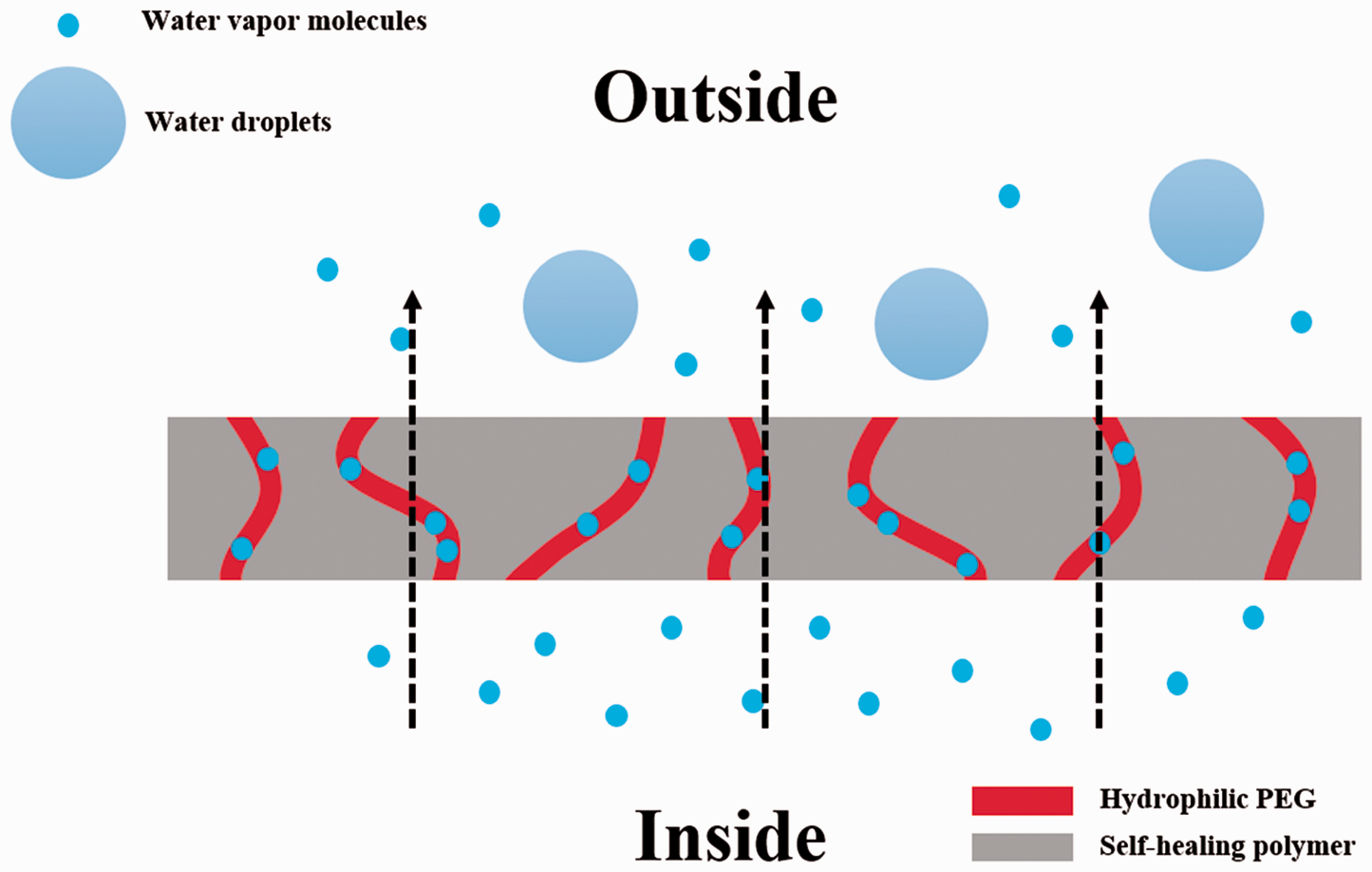
Experimental details
Materials
FDCA, 1,6-bis(maleimido)hexane (MH), trifluoroacetic acid (TFA), and titanium (IV) n-butoxide, which were used as reacting materials for the preparation of PBF, 1,1,1,3,3,3-hexafluoro-2-propanol (HFIP), as a solvent of the coating solution, and PEG, as an additive, were purchased from Tokyo Chemical Industry Co., Ltd, Japan. Butane diol (BD) was obtained from Junsei Chemical Co., Ltd, Japan.
Castor oil, poly(caprolactone diol) (PCL, Mn = 2000), 4,4’-diphenylmethane diisocyanate (MDI), and dibutyltin diluarate (DBTDL) for the synthesis of BPU were purchased from Sigma-Aldrich Co., LLC, Korea. The N,N-dimethylformamide (DMF) as a solvent was obtained from Duksan Co., Korea.
Synthesis of PBF and the PBF-MH polymer
A three-neck flask fitted with a magnetic stirrer was filled with FDCA (1.57 g, 0.01 mol), BD (4.50 g, 0.05 mol), and titanium (IV) n-butoxide (0.034 g, 0.01 mol). The reaction mixture was heated at 160℃ for 6 h and then continuously stirred at 200℃ for 2 h to increase the molecular weight. Upon cooling to room temperature, 2 mL 1,2-dichlorobenzene was added, and the resulting mixture was then heated to 200℃. The trace amount of BD was removed with 1,2-dichlorobenzene by azeotropic distillation.22,30
The PBF-MH polymer (PBF/MH weight ratio of 6/1) was prepared as solution cast from the TFA solution. It was cast into a polytetrafluoroethylene mold at room temperature. After solvent evaporation in air, the PBF-MH polymer was vacuum dried for one day at room temperature. 26
Synthesis of BPU
The preparation of castor oil/PCL-based polyurethanes was performed in a four-necked round bottom beaker as a reactor. Castor oil (1.592 g, 0.002 mol), PCL (90 g, 0.045 mol), and BD (4.506 g, 0.05 mol) were placed in a reactor under a nitrogen atmosphere. The oil was melted in DMF at 80℃ for 1 h. Next, MDI (25.025 g, 0.1 mol) and DBTDL (0.03 polyurethane wt%) were added and reacted with the mixture for 3 h. The polyurethane film was prepared by solution casting using DMF as the solvent. After solvent evaporation in air, the polyurethane film was vacuum dried at 30℃ for two days.31,32
Fabrication of the self-healing polymer coated polylactide fabric
Mixtures of PBF-MH and BPU (PBF-MH/BPU with weight ratio of 1/2) were prepared as films cast from the 10, 20 wt% TFA solution. After solvent evaporation in air, the PBF-MH/BPU polymer was vacuum dried at room temperature for at least one day. The self-healing polymer solution was prepared as 10, 20 wt% HFIP solution (with various PEG/BPU ratios of 0/100, 5/95, 10/90, and 20/80). These solutions were coated on polylactide fabric at 0.05 mm thickness using a doctor blade. 27
Characterization
The molecular structure of self-healing polymer was examined using proton nuclear magnetic resonance (1H NMR) and Fourier transform infrared spectroscopy (FT-IR, Nicolet iS50). A hydrophilic functional group of added PEG was observed by analyzing the FT-IR spectra.
To investigate the self-healing ability of polymer films, each sample was slit with a razor blade and was healed in a specific environment (50℃, 24 h). The healing ability of damaged films was observed by polarized optical microscope with 100× magnification after healing. The mechanical properties of healed films were also investigated using an Instron 4465 universal tensile testing machine equipped with a 10 N load cell according to the ASTM D638 standard. Tensile tests were performed at an elongation speed of 1 mm/min at room temperature. Damaged samples were retested after self-healing to measure the self-healing efficiency.
The vapor permeability was measured using coated fabric covered vials according to the ASTM E96 standard. The evaporation process was performed in a limited environment.33,34 To examine the water repellency of coated fabrics, the water contact angle of fabrics was analyzed. To compare the result of each sample, the change of water contact angle over 5 s was studied. To analyze the self-healing ability of coated fabrics, waterproofness was examined according to the ASTM D751 standard. Each sample was damaged by folding and scratching, and retested after self-healing to measure the self-healing efficiency.
Enzymatic degradation was performed using lipase from wheat germ. Samples were cut into 1 × 1 cm2 size. Each sample was placed in a test tube filled with 5 mL 0.5 M phosphate buffer solution (pH = 7.2) with 40 units/mL lipase. The test tubes were incubated at 37 ℃ and shaken at regular intervals. The samples were removed from the solutions after scheduled periods of time, washed with distilled water, and vacuum dried at room temperature.35–37 The surface of degraded fabrics was observed using a field emission-scanning electron microscope (FE-SEM) with 1000 times magnification.
Result and discussion
Synthesis of the self-healing polymer
The self-healing polymer was composed to create a material that was eco-friendly and capable of producing functional products. Among the many basic ingredients of the self-healing polymer, PBF was chosen as an eco-friendly material. PBF was used to synthesize the self-healing polymer via a Diels–Alder (DA) reaction between furan and the maleimide group. Mechanisms of the DA reaction and the retro-DA reaction are shown schematically in Figure 2.
26
When this self-healing polymer was damaged, the furan–maleimide linkages in the wounded section were broken and restored repeatedly by this reversible reaction. A self-healing polymer with enough elasticity can effectively reveal its healing ability. To make sure that the polymer was well synthesized, 1H NMR spectra of PBF and PBF-MH were analyzed. As shown in Figure 3, the proton peak of furan appeared at 7.45 ppm (a) and the one of ester appeared at 4.6 ppm (b) can be found in both spectra of PBF and PBF-MH. However, the proton peak of maleimide at 6.94 ppm (d) and that of the bonded furan–maleimide section at 1.45 ppm (e) appeared only in the spectrum of PBF-MH. These results demonstrate that the PBF-MH was synthesized successfully.
Scheme of Diels–Alder (DA) and retro-DA reactions between poly(butylene furanoate) (PBF) and 1,6-bis(maleimido)hexane (MH). Proton nuclear magnetic resonance spectra of polymer: (a) poly(butylene furanoate) (PBF); (b) PBF-1,6-bis(maleimido)hexane.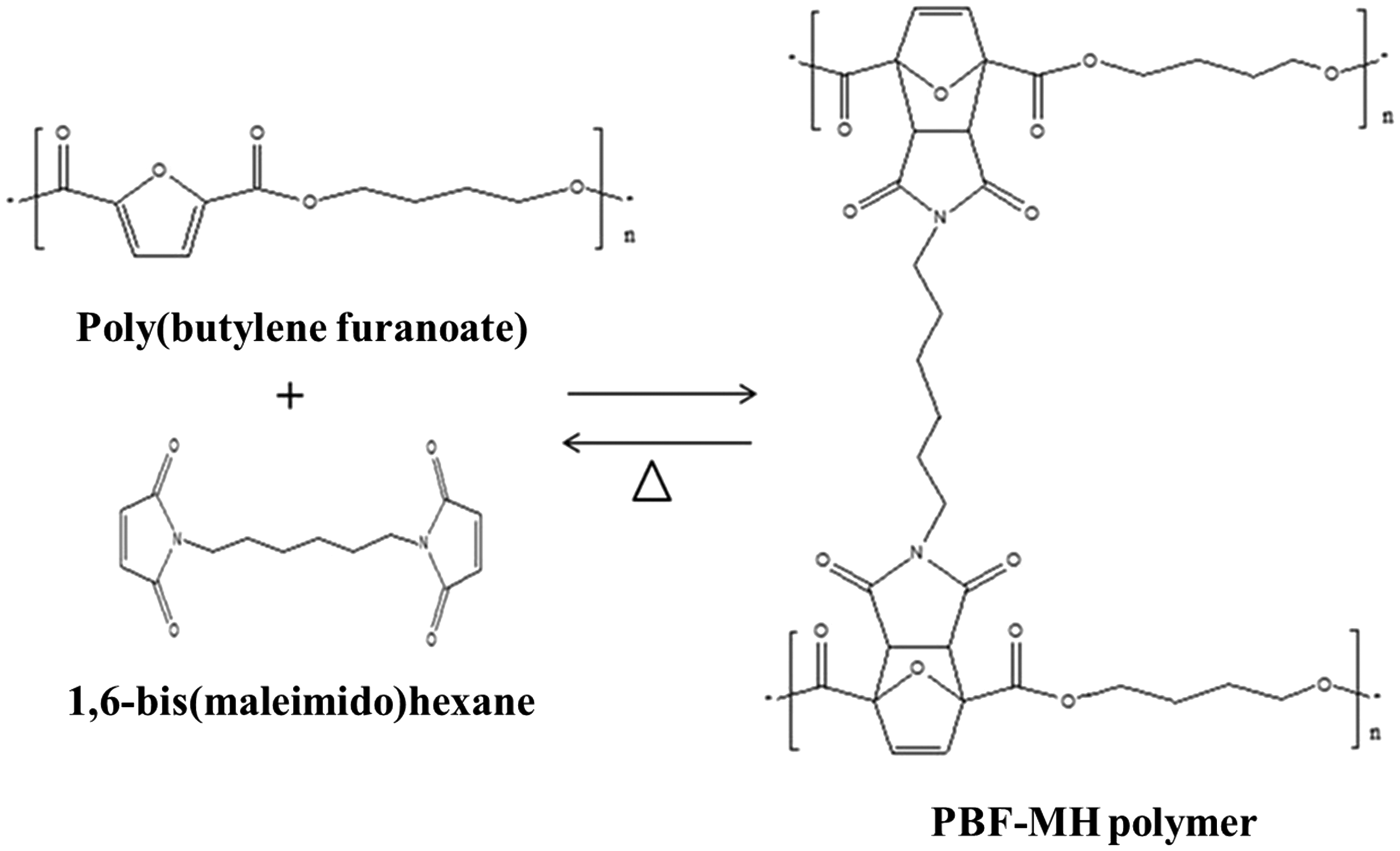

In the next step, novel self-healing polymer was prepared by blending the synthesized PBF-MH with BPU to improve the self-healing ability as well as mechanical properties. The 1H NMR spectra of BPU and PBF-MH/BPU are presented in Figure 4. The proton peak of BPU appeared at PBF-MH/BPU and that of PBF-MH also appeared at PBF-MH/BPU. This result proves that the BPU was successfully blended.
Proton nuclear magnetic resonance spectra of polymer: (a) bio polyurethane (BPU); (b) poly(butylene furanoate)-1, 6-bis(maleimido)hexane/BPU.
Composition of the self-healing polymer (SHP) at various ratios of poly(ethylene glycol) (PEG)/bio polyurethane (BPU)

MH: 1,6-bis(maleimido)hexane.

Fourier transform infrared spectra of self-healing polymers (SHPs) with different poly(ethylene glycol) ratios.
Self-healing ability
The self-healing ability is the most important property of self-healing polymers. The self-healing behavior of PEG blended self-healing polymer should be examined by various means. According to Figure 6, polarized optical microscope images of each PEG ratio show that the self-healing ability was not harmed by the addition of PEG. All damaged samples were self-healed after 24 h at 50℃.
Polarized optical microscope images (×40) of the damaged self-healing polymer (SHP) film before and after self-healing for 24 h, 50℃.
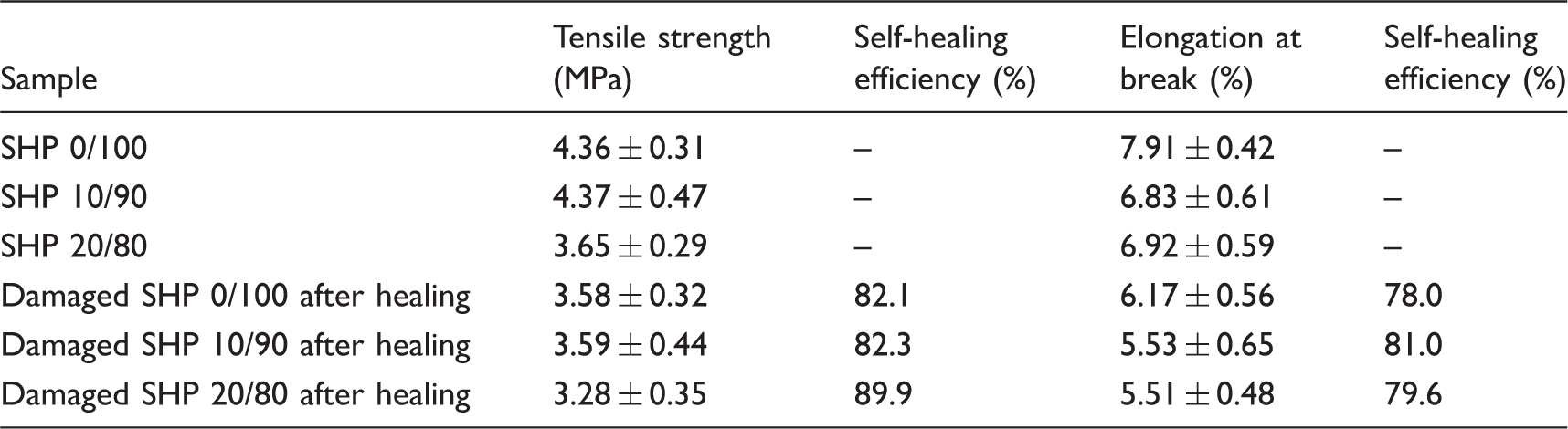
The effects of PEG insertion on the mechanical properties of self-healing polymer film were investigated with different PEG ratios. The difference in tensile strength and elongation at break before and after self-healing showed the healing efficiency of these samples. According to Figure 7 and Table 2, the self-healing material without PEG maintained 82.1% of its tensile strength and 78.0% of the elongation at break after self-healing for 24 h. On comparing the mechanical properties of PEG ratios, tensile strength was not changed with 10% of PEG (comparing SHP 0/100 and SHP 10/90), and 20% of PEG shows 12% decreased tensile strength (comparing SHP 10/90 and SHP 20/80). These were the same after self-healing. On the other hand, elongation at break was decreased 15% with 10% of PEG and it was not changed at 20% of PEG. It was also the same after self-healing. However, all ratios showed high healing efficiency at tensile strength (80–90%) and elongation at break (80%). These results confirm that the addition of PEG does not affect the self-healing efficiency, despite a slight reduction in mechanical properties.
Stress–strain curves of self-healing polymer (SHP) films before and after self-healing for 24 h, 50℃. Mechanical properties of the self-healing polymer (SHP) films before and after self-healing for 24 h, 50℃
Breathable water repellency of the self-healing polymer coated polylactide fabric
Research of the breathable waterproof fabric by the self-healing polymer coating and its characteristics were studied. Self-healing polymer solutions (10, 20 wt%) were coated on the polylactide fabric, which is known as a biomass-based material. Cross-sections of these fabrics were measured by FE-SEM analysis to compare coating thickness with change of concentration, as shown in Figure 8. In order to provide sufficient waterproofness, the remaining experiments were performed with 20 wt% solution-coated fabrics to test properties and functionalities.
Field emission-scanning electron microscope images (×250) of the cross-section of uncoated and self-healing polymer (SHP) coated fabrics with different SHP solution concentrations.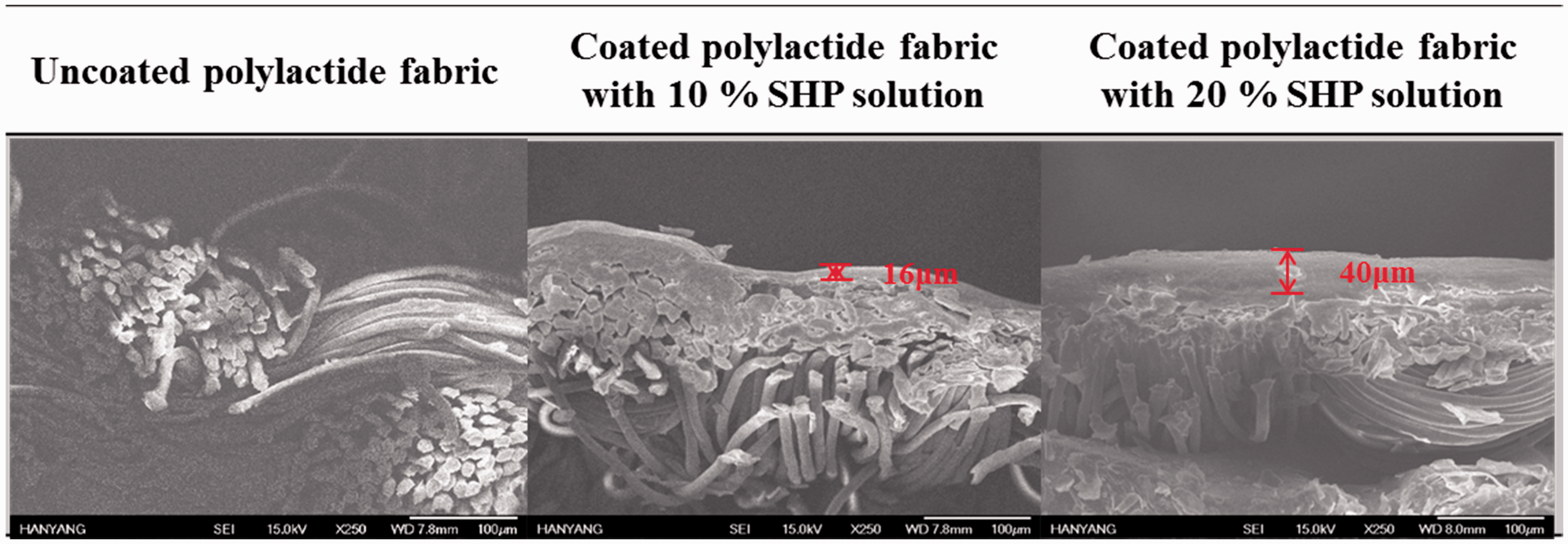
The water contact angle was measured to analyze the effect of added PEG on water repellency. According to Figure 9, uncoated polylactide fabric absorbed a water drop in just 1 s. However, SHP 0/100 maintained 82° of water contact angle after 5 s; PEG-added fabric, SHP 10/90 also shows 80° after 5 s and SHP 20/80 has 78° of water contact angle after 5 s. These results demonstrate that the increased hydrophilicity by the addition of PEG reduces water repellency slightly, but it still maintains a high level.
Water contact angle of uncoated and self-healing polymer (SHP) coated polylactide fabrics with different poly(ethylene glycol) ratios.
Fabricated fabric needs not only water repellency but also vapor permeability for clothing comfort. According to Figure 10, the vapor permeability of uncoated polylactide fabric is 10,958 g/(m2ċday). After the fabric was coated with SHP 0/100, vapor permeability of the coated fabric reduced to 2574 g/(m2ċday), which is less than generally required at the vapor-permeable fabric level (4000–8000 g/(m2ċday)). On the other hand, the vapor permeability of coated fabrics was increased with an increase of PEG content. Coated fabrics with SHP 10/90 and SHP 20/80 have sufficient vapor permeability of 4298 and 4839 g/(m2ċday), respectively. Considering that these coated fabrics are nonporous, these results mean that the inner hydrophilic functional groups acted properly.
Vapor permeability of uncoated and self-healing polymer (SHP) coated polylactide fabrics with different poly(ethylene glycol) ratios.
Self-healing ability of the coated fabric
Waterproofness of the 10/90 coated polylactide fabric before and after self-healing for three days, 50℃

SHP: self-healing polymer.
Biodegradability
The biodegradability of the self-healing polymer coated fabrics was studied by the intensive enzymatic degradation method. Fabrics coated with SHP 0/100, SHP 10/90, and SHP 20/80 were decomposed over 15 days by lipase
24
and the surface morphology changes were examined by FE-SEM. As shown in Figure 11, FE-SEM images show that the surfaces of polylactide fabrics coated with SHP 0/100, SHP 10/90, and SHP 20/80 were readily decomposed within 7 days and polylactide fabric itself started to decompose after 15 days. These results prove that fabricated self-healing polymer coated polylactide fabric is an eco-friendly material.
Field emission-scanning electron microscope images (×1000) of the enzymatic degradation progress of uncoated and self-healing polymer (SHP) coated polylactide fabrics with different poly(ethylene glycol) ratios.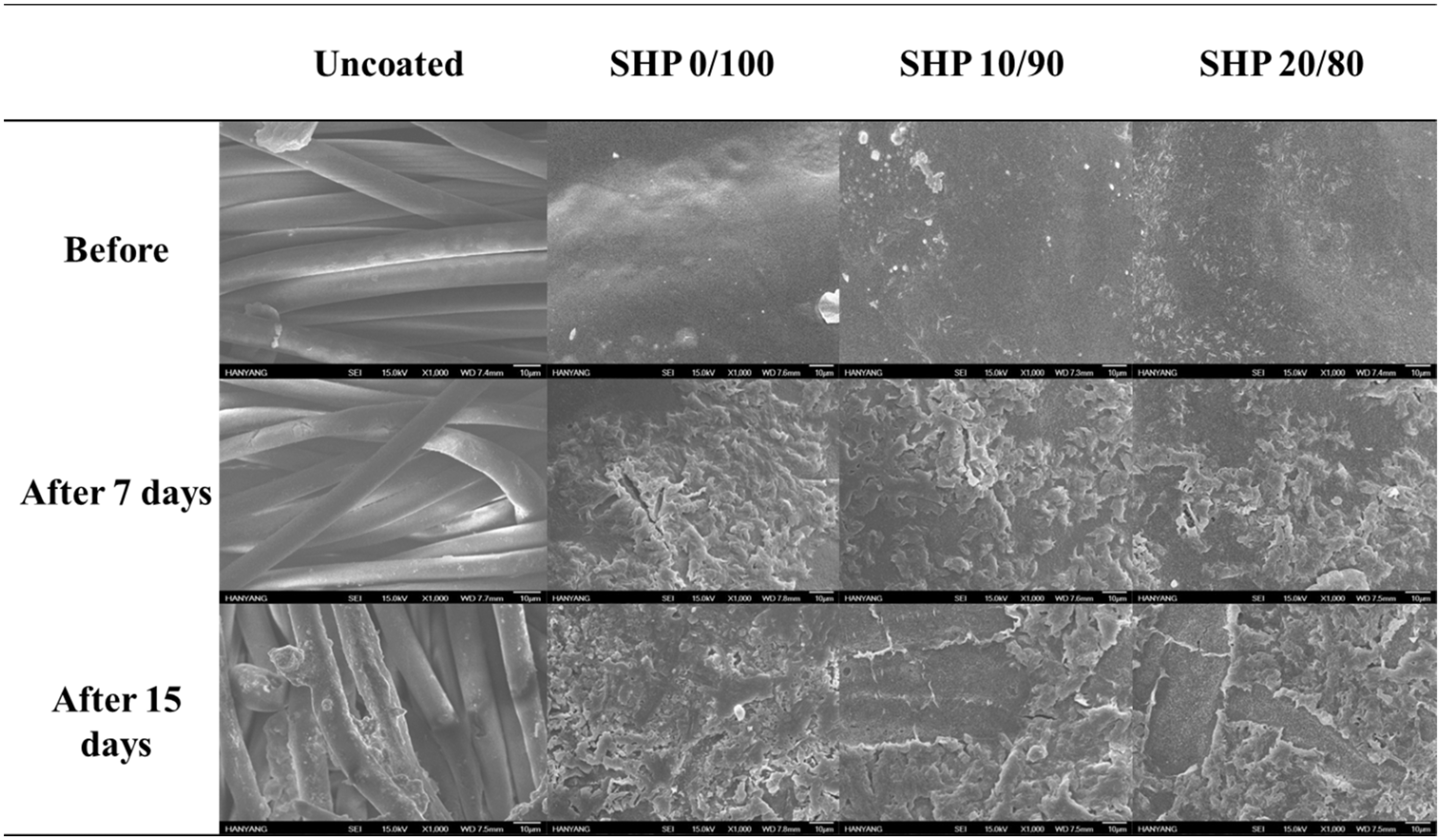
Conclusion
Multifunctional fabric was fabricated by coating of furan-based SHP on polylactide fabric. PEG was added to gain nonporous breathability and its effects on the self-healing ability and morphological and mechanical properties were examined.
The performance of breathable self-healing polymer coating on polylactide fabric was investigated by analyzing vapor permeability, water repellency, and waterproofness. The coated fabric showed a vapor permeability of more than 4000 g/(m2ċday) and exhibited 80° level of water contact angle. These results were confirmed to be sufficient for a breathable waterproof product. The self-healing ability was studied by waterproofness analysis and showed 90% level of self-healing efficiency. A biodegradation test indicated that self-healing polymer coated polylactide fabric was an eco-friendly and sustainable material.
This work suggests that furan-based self-healing polymer and PEG-added breathable polymer have good potential in terms of processability and competitiveness as multifunctional materials.
Footnotes
Declaration of conflicting interests
The authors declared no potential conflicts of interest with respect to the research, authorship, and/or publication of this article.
Funding
The authors disclosed receipt of the following financial support for the research, authorship, and/or publication of this article: This research was supported by the Basic Science Research Program through the National Research Foundation (NRF) of Korea funded by the Ministry of Science, ICT & Future Planning (NRF-2017R1A2B4005315).