



Abstract
Indigo is one of the most widely used dyes in history, but its application is currently greatly limited due to the lack of clean and efficient reduction methods. Aimed at the long-term consumption of traditional bio-reduction of indigo and the ecological problems existing in the application of chemical reducing agents, a high-efficiency indigo dyeing method based on pH-controlled bio-reduction of Saccharomyces cerevisiae under an aerobic environment at normal temperature was constructed. The results showed that the reduction ability of the bio-reduction system and its effect on dye reduction was closely related to the growth and metabolism of cells and the pH of the system. It is worth noting that a suitable alkaline environment is a key to improving the reduction capacity and shortening the reduction time. Under the dyeing pH condition of 10, the K/S of the fabric could reach 6.2 and exhibited the greatest color strength with good fastness after dyeing for 4 days. A pH-controlled bio-reduction strategy with whole-cell biotransformation was designed to construct an indigo green dyeing system with high efficiency and less environmental pollution.
As a result of global consumer demand, textiles play a major role in the global economy, and the textile industry provides a huge employment for the population across the world. Environmentally friendly processing is now becoming a vital factor for sustainable production in the textile industry.1,2 Currently, the interest in greener and cleaner approaches has increased in the textile industry mainly because of the environmental problems generated in the dyeing and finishing process. 3
Vat dyes are a sort of well-known dye due to their excellent fastness properties for dyeing cellulosic material in the textile coloring industry. 4 Indigo is the oldest known vat dye, and was an extensively used natural source of blue dye in the world by almost all the ancient civilizations until the late 19th century. Natural indigo can be obtained from the leaves and stems of indigo-bearing plants such as Indigofera, Polygonum tinctorium, and Isatis tinctoria, cultivated in Asia, Europe, and Africa. 5 Polygonum tinctorium was one of the most important indigo-bearing plants in China. Even now, various places in China still have the tradition of planting bluegrass and making products of natural indigo.
However, as indigo is insoluble in water, it has no affinity for fabric. It needs to be converted into a water-soluble leuco-indigo by a reduction process and then diffused into the fabric (Figure 1).

Reduction mechanism of indigo.
Therefore, a large number of reducing agents is required in the dyeing process. Currently, the most widely used reducing agent for industrial indigo dyeing is sodium dithionite (Na2S2O4) because of its powerful reduction power. However, the use of sodium dithionite may cause certain engineering problems, as it is flammable, explosive, and very unstable. 6 At the same time, the large amount of sodium sulfate and sulfite produced in the production process will lead to ecological problems and increase the cost of wastewater treatment. Furthermore, its use may leave harmful residues in the fabric. 7
For these reasons, attempts have been made to replace the use of chemical reduction agents with more environmentally friendly alternatives, such as upgraded chemical approaches,8–11 electrochemical reduction techniques,12,13 and biodegradable organic compound-based methods14–16 and bio-catalyst approaches,17–19 which have been used to achieve a clean indigo dyeing process. However, up to now, the industrial use of these new techniques to replace chemical reductants in indigo dyeing is relatively limited. Although environmentally friendly indigo reduction methods are being developed to replace the existing chemical methods, efficiency improvements are required for a wider commercial application.4,20
The fact that microbes are able to reduce indigo using conventional techniques provided the basis for the development of a clean indigo reduction process that could replace current chemical methods. In recent years, whole-cell biocatalysts have been proposed as a competitive alternative to enzymes because of the important advantage of simple and low-cost catalyst preparation.10,21–23 It is believed that the use of biological methods for dye reduction is an effective method, especially with the advantage of less contamination compared with chemicals and the lower temperature required. Indeed, from time immemorial, the reduction of indigo has also been affected by the use of ripe fruit, stale urine, or rice wine, together with wood ash or lime as an alkali, after an extended overnight fermentation. 24 In the traditional fermentation and dyeing process, rice wine and indigo are added to a large vat and kept sealed for one month. After fermentation, the fabric is added to the vat for dyeing. However, as a spontaneous biological process, the complexity of the bacteria involved in the process is relatively high, and the process cannot be monitored during the dyeing process, resulting in the entire reduction dyeing process taking up to a month, and the quality of the dyed product being random and uneven.25–27
The aim of this study was to develop a green dyeing process for indigo which was an efficient, low-cost, and high-quality whole-cell biotransformation method based on pH control. The strain of Saccharomyces cerevisiae was applied as a whole-cell biocatalyst for bio-reduction in the dyeing of cotton fabrics. During the process, the potential and reduction effect in the whole-cell reduction process were monitored, and the dyeing capability was evaluated by the apparent color yield of dyed fabric. A sustainable, environmentally friendly dyeing method has been developed based on pH control (Figure 2).

Schematic diagram of dyeing with indigo based on pH-controlled microbial reduction.
Experimental
Materials
The S. cerevisiae ATCC 9763 strain was obtained from the Beijing Baiou Bowei Biotechnology Co., Ltd. The indigo used in the research was purchased from Tianjin Kemiou Chemical Reagent Co., Ltd., China. The scoured and bleached cotton fabric (weight 106.6 g/m2; warp 133 yarns per inch; weft 72 yarns per inch; thickness 0.21 mm) was bought from Tianyi printing and dyeing company in Tianjin, China. Chemicals (sodium hydroxide (NaOH), sulfuric acid (H2SO4), and methylene blue were of analytical reagent grade. Yeast powder, peptone, and glucose were of biological reagent) used in the research were purchased from Tianjin Kemiou Chemical Reagent Co., Ltd., China.
Preparation of reduction solution
The S. cerevisiae was cultivated in seed culture media containing 10 g/L yeast powder, 20 g/L peptones, and 60 g/L glucose at 30°C for 24 h. Then 10 mL above seed culture solution was added into a 500 mL Erlenmeyer flask containing 200 mL liquid medium, whose composition contained 20 g/L peptones,10 g/L yeast powder, and 60 g/L glucose. The culture media was cultivated in a shaking incubator at 30°C and 250 rpm for 12 h.
Dyeing procedure
The pH of the prepared reduction solution was adjusted to 9–13, and 2 g/L of indigo dye was added to the reduction solution. After 12 h of reduction, cotton fabric was added and dyed with a bath ratio of 50:1 (volume of dye bath to fabric weight). After dyeing at 30°C for 4 days, the fabric was taken out, washed with water, and dried (Figure 3).

Dyeing process flow chart.
Measurements
Growth monitoring of S. cerevisiae
The OD600 of S. cerevisiae solution was measured by a Lambda 750 UV/Vis/NIR spectrophotometer (Perkin Elmer, USA). The changes in glucose content in the medium during S. cerevisiae growth were determined by a biosensor analyzer (BBTC, China), each value was measured three times and averaged.
Measurement of the leuco-indigo content in the reduction system
A vortex shaker was used to shake the dye solution in the reduction process evenly and the solution was centrifuged at 2000 r for 10 min, the supernatant was measured by a Lambda 750 UV/Vis/NIR spectrophotometer (Perkin Elmer, USA), and each value was measured three times and averaged.
Determination of indigo dye uptake in fabrics
The dyed fabric was dissolved with concentrated sulfuric acid, and the solution was measured by a Lambda 750 UV/Vis/NIR spectrophotometer (Perkin Elmer, USA), each value was measured three times and averaged.
Measurement of system redox potential
The reduction potential of the S. cerevisiae culture process and dyeing system were measured by an oxidation-reduction potential platinum electrode and the Ag/AgCl reference electrode with KCl electrolyte, connected to a pH meter (Metter Toledo, Inlab) and recorded in (mV), each value was measured three times and averaged.
Characterization of dye distribution and morphology in the dyeing process
After the dye solution was mixed evenly with a vortex shaker, samples were taken under an ultrafine three-dimensional (3D) microscope (Keenes, China) to observe the dye situation in the dye solution, then pictures were taken.
S. cerevisiae cell activity and morphology characterization under different pH conditions
After the S. cerevisiae cells were cultured to the plateau stage, 6 mol/L of sodium hydroxide was used to adjust the pH to 9–13, methylene blue was added dropwise to the solution for staining, the S. cerevisiae cells were observed under an ultrafine 3D microscope (Keenes, China), and pictures of its shape were taken. The S. cerevisiae cells adjusted to different pHs were centrifuged at 3000 r for 10 min, washed with sterile water, stored in an ultra-low temperature freezer at –60°C for 12 h, and then dried with a vacuum freeze dryer (Lichen, China) for 24 h. The surface morphology of S. cerevisiae cells was realized by scanning electron microscopy (SEM).
Color characterization of dyed fabrics
The color strength (K/S value) and CIE L*, a*, b*, C*, h* of dyed fabrics were measured by a Datacolor 600 spectrophotometer (Datacolor Company, USA) under illuminant D65, by a 10° standard observer. Six consecutive tests at different positions for each sample were summarized to obtain the final results.
Cross-section observations of dyed fabrics
The cross-section of the dyed fabric was observed with an optical microscope to evaluate the dye penetration of the fabric visually. With the help of a Hastelloy microtome, the cross-section section of the dyed fiber was prepared by the collodion coating method, and the distribution of fiber cross-sections was observed by an ultrafine 3D microscope (Keenes, China).
Color fastness test of dyed fabrics
The rubbing and washing color fastness of dyed cotton were based on ISO 105-X12. The washing fastness of dyed fabric was carried out as per ISO standard 105-C10:2006 (E) test no. A (1). Conditions for each washing cycle were: detergent concentration, 5 g of standard soap per liter of water; fabric to liquor ratio, 1:50; washing temperature, 40°C; time of washing, 30 min; stirring speed, 40 rpm. After washing with soap, the fabric was thoroughly rinsed with fresh water 10 times and then dried at room temperature.
Results and discussion
Preparation of bio-reduction system
A sufficient reduction power is a prerequisite for the reduction of vat dyes. In this study, the reduction potential was used to characterize the reduction ability of the bio-reduction system. The strain of S. cerevisiae was cultivated for 2 days and the reduction potential, biomass, glucose content, and pH value in the microbial reduction system were monitored (Figure 4).

Biomass (blue scale), reduction potential (green scale), pH value (orange scale), and glucose content (pink scale) of the whole-cell bio-catalytic reduction system of Saccharomyces cerevisiae during batch fermentation.
In the cultivation of S. cerevisiae, glucose was added as a carbon source. As glucose is also a reducing substance, the presence of glucose may be considered as one of the origins of the ability to reduce. Therefore, it is necessary to explore whether the glucose in the medium is depleted before the system is started for reduction. However, it was shown in this study that glucose has been exhausted after 12 h of fermentation. At this time, the reduction potential of the system was still decreasing. Therefore, glucose was not the source of reduction ability in this bio-reduction system.
It can be seen from the result of Figure 4 that the pH of the fermentation liquor varied with time during the cultivation of S. cerevisiae. It showed that the pH of the culture solution declined rapidly in the initial stage of fermentation, but after 12 h, the pH began to rise slowly. This may result from the production of organic acids, such as acetic acid, along the cellular metabolism. 28 When glucose in the medium is exhausted, the organic acid is consumed as a carbon source, which causes the rise of the pH value.28,29
It should be noted that oscillatory fluctuations of the reduction potential have been observed in the whole-cell catalytic system of S. cerevisiae. This indicated the complication of bio-reduction with a whole-cell catalyzer. It is believed that the concentration of metabolites in the S. cerevisiae oscillates periodically, which was caused by the metabolic regulation of the differential expression of intracellular genes. 30 The variety of metabolites may cause the oscillating fluctuations of the reduction potential.
In the whole-cell bio-reduction system, biological growth determines the progress of subsequent dye reduction. When exploring the growth of microorganisms, OD600 is generally used to represent its density. 28 To investigate further the effect of cell growth and metabolism on the reducing ability of bio-reduction, we selected three S. cerevisiae systems with different growth concentrations and monitored their reduction potential during growth, the results of which are shown in Figure 5.

Reduction potential of whole cell bio-catalytic reduction system with different concentrations of biomass.
The results showed that there were obvious differences in the reduction potential of the microbial reduction system with different concentrations of biomass. In the process of bio-reduction, the main factors that play a role in reducing the potential are enzymes and various cofactors secreted by cells.4,24,26 The higher the initial OD600 of the microbial reduction system, the larger the peak value of the reduction potential. This demonstrated that there was a strong reduction ability in the fermentation of S. cerevisiae with a high cell concentration. However, as the S. cerevisiae concentration in the solution increases, the solution will also become viscous, resulting in the dye being unable to be decomposed well in the solution and reducing the reduction efficiency. Therefore, the S. cerevisiae solution with OD600 of 16 was chosen as the better reduction system.
It can also be seen in the results in Figure 4 and Figure 5 that the reduction potential decreased rapidly at the early stage of cultivation and then climbed gradually. Moreover, the phenomenon of oscillatory fluctuations of the reduced potential has also been found in this case. These results demonstrated that there was an obvious correlation between the reduction potential of S. cerevisiae cultures and cell growth. 28
Although the mechanism of bacterial indigo reduction is still unknown, it is believed that electron transport is involved in bio-reduction. 31 However, limited information is available on the nature of the interaction between bacteria and dye. Direct interactions between bacteria and indigo particles have been reported, yet there was also evidence to support the existence of intermediate redox mediators in electron transportation. 25 It was demonstrated that in the presence of cofactors such as nicotinamide adenine dinucleotide, reduced form (NADH), the reductase was able to reduce the dye. 24 Employing whole cells as biocatalysts has the advantage of having the cofactors necessary for enzymatic bio-reduction.32,33
Although the mechanism of the biotechnological indigo-reduction process still needs further study, the ability to generate redox potential in the S. cerevisiae system is the reason that the whole-cell bio-catalysis system is capable of indigo reduction.32,33 It has been proved in this investigation that the ability of microbial reduction was related to the growth and metabolism of the cells of S. cerevisiae.
Considering that the pH value is an important processing parameter in the chemical reduction of vat dyeing, the influence of pH in the bio-reduction system has been regulated (Figure 6).

Reduction potential of whole cell bio-catalytic reduction system at different pH values.
The result showed that the reduction potential of the system is dramatically descending with the increase of the pH of the culture solution. However, vat dyes such as indigo are reduced only when the reduction potential of the reduction system reaches the immediate reduction potential of the dye. 27 Therefore, maintaining a low reduction potential is essential for the bio-reduction of indigo, and choosing the correct pH value for a whole-cell bio-reduction system is an important issue.
Bio-reduction of indigo
In order to study the bio-reduction process with the whole-cell catalysis system, the pH of the culture solution was adjusted after 12 h of culture, and then the dye was added. Changes in the reduction potential and pH during bio-reduction have been studied (Figure 7).

Changing process of (a) reduction potential and (b) pH value in the bio-reduction of indigo.
It can be seen from Figure 7(a) that the changes of reduction potential in the system with different initial pH are different. For the reduction systems with a relatively low initial pH, the reduction potential did not fluctuate much during the whole reduction process. However, for the systems with relatively high initial pH, the reduction potential fluctuated significantly, and the upward trend with the initial pH of 13 was particularly severe.
The enzymatic reducing substances produced by cells during the bio-reduction process reduce the reduction potential of the system.26,34 However, the organic acid produced by yeast cell metabolism and the leuco acid formed by the reduction of dyes will consume the hydroxide ions of the system, thereby increasing the reduction potential.22,24 The reduction potential of the final system should be the result of these two interactions. In the system with an initial pH of 13, the lower initial reduction potential was mainly due to the contribution of hydroxide ions and the dissociation of intracellular enzymes.26,35 Therefore, in the whole reduction process, the reduction potential of the system with a higher initial pH value showed a rapid upward trend.
However, the high pH of the culture medium may constrain growth or even cause cell death. The result in Figure 7(b) showed that the pH value of the system was not changed when the initial pH value was too high, such as pH 13. This indicated that the metabolism of the strain was very weak and the cells may even be dead in high pH conditions. 36
To explore further the effect of pH on the viability of S. cerevisiae, we stained S. cerevisiae under the pH of 9–13 with methylene blue, observed them with an ultrafine 3D microscope, and took SEM images of S. cerevisiae at the corresponding pH conditions (Figure 8).

Saccharomyces cerevisiae cells stained with methylene blue under the pH of 9–13 (a–e) and SEM images of S. cerevisiae cells under the pH of 9–13 (a′–e′).
Methylene blue can be used to test the activity of cells. When cells are active and growing well, methylene blue cannot enter the cell to stain them. 37 However, when cell activity is impaired, the permeability of the cell membrane changes. This leaves the cell unable to resist the entry of external substances,34,38 so methylene blue can enter the cell and dye the cell blue. As can be seen from Figure 8, S. cerevisiae cells became blue and aggregated with the increase in pH. This signified that the cell might die under high pH conditions. At the same time, it can be seen from the SEM image that with the increase in pH, the morphology of S. cerevisiae changes. When the pH exceeds 11, the S. cerevisiae cells undergo large-scale morphological changes and cell breakage, which further proves that excessive pH conditions will have a great influence on the activity and cell morphology of S. cerevisiae.
The biomass of S. cerevisiae was also tested in culture media with different pH values to assess the effect of an alkaline environment on cell growth (Figure 9).

Biomass in the reduction system at different pH values.
As can be seen from Figure 9, the OD600 of culture liquid decreases with the increase of pH. When pH was 13, the OD600 of fermenting liquor no longer fluctuated with the growth and metabolism of the cell, and was always on a downward trend. Therefore, with the increase in pH, the growth of S. cerevisiae in the bio-reduction system may be restrained, which was consistent with the results in Figure 8.
In order to monitor the reduction of indigo dyes in the bio-reduction process, dye dispersion was observed under an optical microscope during the course, as shown in Table 1.
Dye distribution in the bio-reduction process


As a water-insoluble dye, indigo often exists in a solid state in solution. When the reduction proceeds, the indigo dye will be reduced to a water-soluble leuco-indigo form. 13 Thus, the indigo particles in the dye liquor will gradually decrease.
As can be seen from Table 1, in the first 24 h of dyeing, the indigo granules in the dye liquor under different pH conditions gradually became smaller as the dyeing progressed, indicating that the dye was gradually reduced to a water-soluble leuco-indigo form. After 48 h, the indigo particles in the pH 9, 11, and 12 systems re-aggregate in large areas. Combining with Figure 7(b) and Figure 8, it is speculated that when the pH value of the system is 9, the S. cerevisiae cells have better activity and can still metabolize and produce acid. A lower pH value is not conducive to indigo reduction, 30 resulting in the re-oxidation of indigo and aggregation. When the pH was 11 and 12, the activity of S. cerevisiae had been affected to a certain extent. With the extension of reduction time, the activity of S. cerevisiae became lower and lower, resulting in the oxidation and re-aggregation of leuco-indigo in the reduction solution.
When the pH was 10 and 13, the indigo particles in the dye liquor were always in a relatively dispersed state as the reduction progressed, and there was no re-aggregation of the dye particles with the extension of time. Combined with Figure 7(b) and Figure 8, it is speculated that when the pH was 10, the system always maintained pH conditions that were more suitable for the reduction of indigo. At the same time, the activity of S. cerevisiae was relatively good, providing continuous reducing power for the reduction system. When the pH was 13, the activity of S. cerevisiae cells was almost completely lost, the cell membrane was ruptured, 27 the cell shape changed, and a large number of intracellular enzymes in the S. cerevisiae dissolved, which made the system have a strong reducing ability. 26 The degree of reduction was always high, with fewer solid-state indigo particles in the dye liquor. 33
In order to determine the effect of the bio-reduction of indigo, the degree of reduction was estimated. First, a standard curve of leuco-indigo was drawn to measure the absorbance of leuco-indigo (Figure 10).

Leuco-indigo standard curve.
The linear equation and related coefficient were obtained. Then the reduction rate was obtained according to the standard curve (Figure 11).

Reduction rate during bio-catalytic reduction.
It can be seen from Figure 11 that the content of leuco-indigo is the highest in the reduction system with a pH of 13, followed by the system with a pH of 10. However, after 48 h of dyeing, the content of leuco-indigo in the reduction system with a pH of 13 decreased significantly, but it was still higher than the leuco-indigo content of several other pH systems. At the same time, the content of leuco-indigo in five different pH systems tended to decrease after 48 h. The reason may be that after 48 h the biological cell activity in the bio-reduction system decreased, the metabolites became fewer reducing substances and the leuco-indigo content reduced, which is consistent with the conclusion in Table 1.
From the above results, it can be concluded that under different pH conditions, when the pH is 10 and 13, the reduction effect of the system is better. The results of this study showed that alkalinity plays a crucial role in the bio-reduction of indigo dye. It was found that the reduction power of the fermentation system increased with the rise of pH value. However, persistence and resilience were impaired in strongly alkaline conditions. Thus, the regulation of appropriate pH is significant for maintaining the indigo-reducing ability for an extended period.
Dyeing of leuco-indigo
The ultimate goal of the whole-cell bio-reduction of indigo is to dye fabric. The K/S value was applied as an evaluation index to examine the dyeing effect of the whole-cell bio-reduction system, 36 and take pH 10 as an example to explore the effect of dyeing time on the K/S value (Figure 12).

K/S values of cotton fabrics dyed with indigo by bio-reduction.
It can be seen from the result that enough dyeing time is essential for improving the K/S value of the dyed fabric. In the first 2 days, the K/S of the fabric was very low. Then, the K/S value increased rapidly 2 days later. The reason may be that in the early time there was not sufficient leuco-indigo in the culture. Therefore, only along with bio-reduction, if there is enough leuco-indigo in the fermentation culture, the dyeing can be carried out better.
However, it was found that if the dyeing time was too long, the K/S value also declined instead. This indicates that if the dyeing time is too long, with the exhaustion of electron donors in the system, the leuco-indigo will be oxidized by air, resulting in a decrease in the concentration of leuco-indigo. The leuco-indigo adsorbed on the fabric will also undergo desorption, leading to a decrease in the K/S value of the fabric.4,26
Considering the effect of the pH value on the reduction capacity of the bio-reduction system, the result of dyeing at different pH values was investigated. The apparent color, K/S value, and colorimetric parameters of dyed cotton are shown in Table 2.
The color eigenvalue of dyed cotton with bio-reduction under different pH conditions
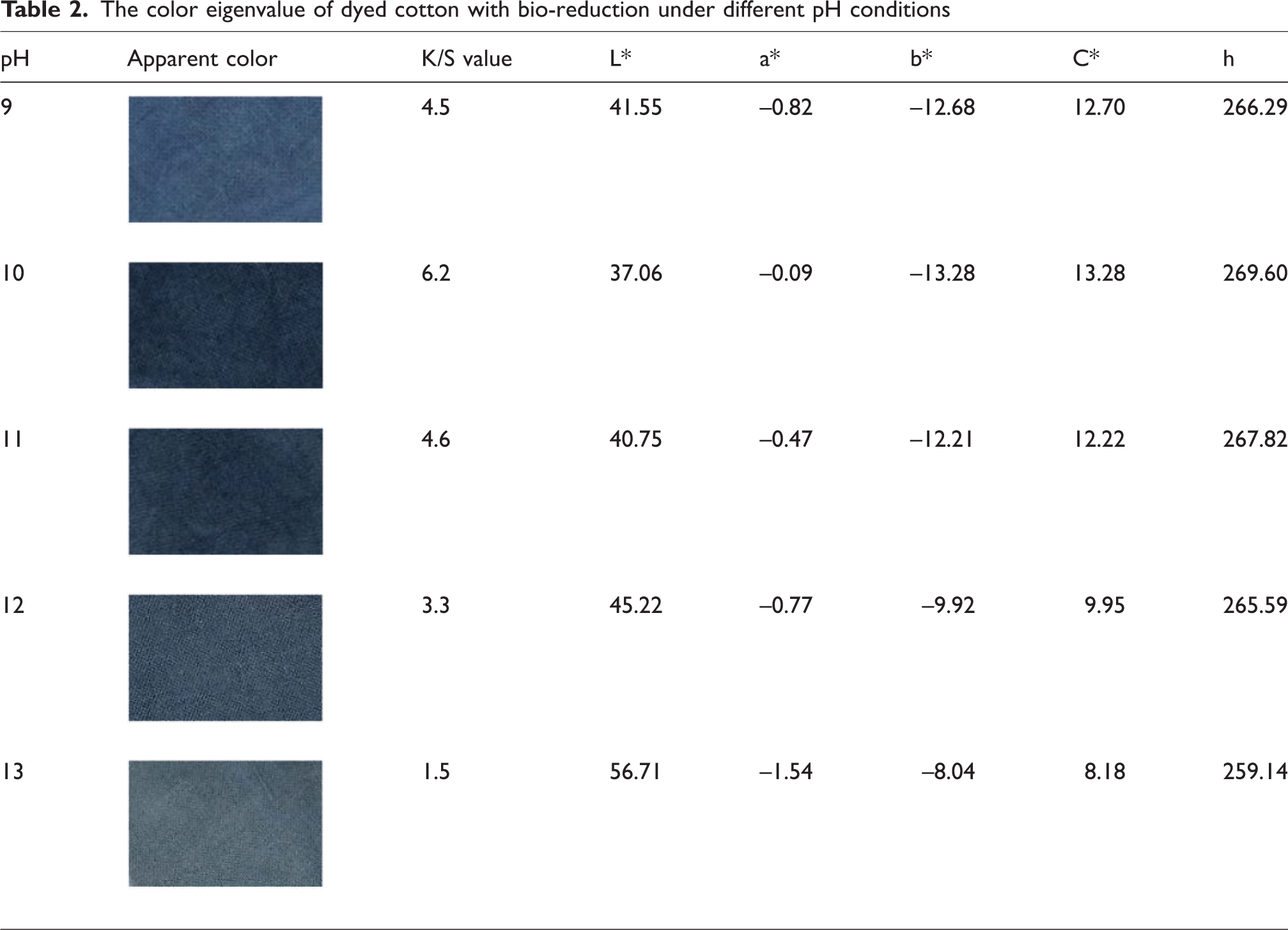
As a result, it was found that the biggest K/S appeared in the fabric dyed under pH 10. The results indicated that when the pH was 10, it was more suitable for indigo whole-cell bio-reduction dyeing.
Fastness was another characteristic of the dyeing result. The fastness of cotton fabric dyed with indigo by bio-reduction at different pH values was measured (Table 3).
The color fastness of cotton fabric dyed by indigo with bio-reduction at different pH conditions
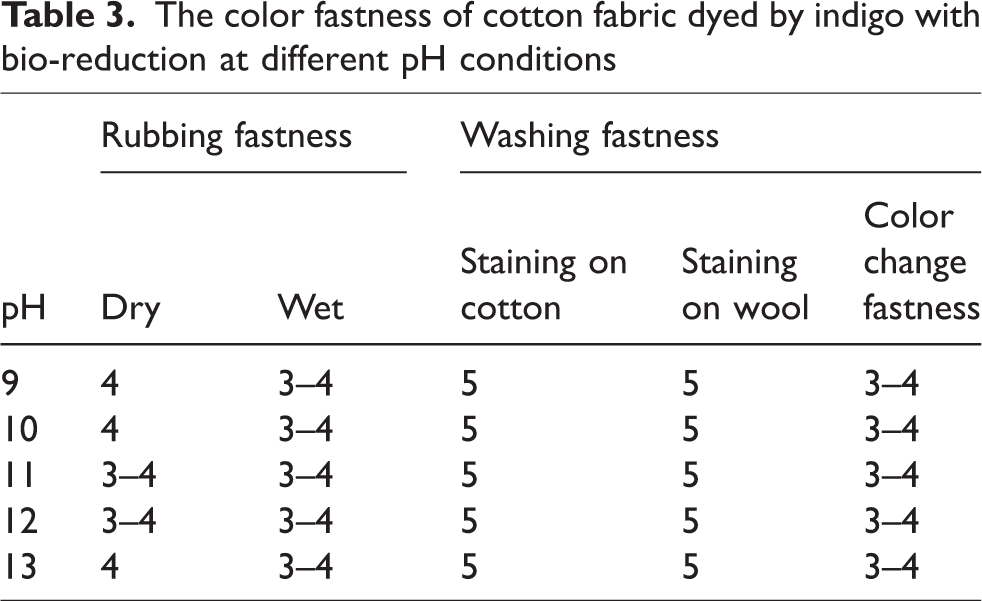
The results showed that the fabric dyed with indigo by biological reduction at different pH values has acceptable color fastness. When the pH was 10, the fastness to dry rubbing reached 4, and the fastness to wet rubbing reached 3–4. The color change of the fabric after washing was small, which can reach 3–4. It demonstrated that there was good dye penetration in the dyeing process, which contributes to color fastness.
Besides the effect on dye reduction efficiency, the pH of dye liquor also affects the form of reduced indigo. The distribution of indigo in cotton fiber dyed with the bio-reduction method at different pH values was observed with morphology images of fiber slices (Figure 13).

Morphology images of fiber slices dyed by indigo with the bio-reduction method at different pH values.
It can be seen from the section diagram of fiber that the reduction system with a pH of 10 has the best dyeing effect. As the pH value of the reduction system increased, the dyeing effect gradually became worse and the color became lighter.
In the dyeing of indigo, alkalinity plays a crucial role in the solubility and the adsorption of the leuco-indigo molecules onto the fiber. In the reduction process, the acid leuco-indigo was transformed into a monophenolate ion and then into a biphenolate ion finally. 39 It was found that at the pH of 10–11 there was a high frequency of the monophenolate ion. When the pH was above 11, leuco-indigo was transformed into biphenolate ion form, the solubility of the biphenolate ion state was greatly increased, and it was easier to penetrate into the fiber. 26 At the same time, cellulose began to ionize, and the ionization properties of hydroxyl groups on indigo molecules were similar to the ionization properties of alcohol hydroxyl groups on cellulose, both of which have negative charges. Therefore, electrostatic repulsion is generated between the indigo dye in the biphenolate ion state and the ionized cotton fiber. 39 As a result, the affinity of the leuco-indigo in the biphenolate ion state to the cotton was reduced, and the dyeing effect was poor. This is also the reason why in Figure 11 when the pH was 13, the indigo content in the dye liquor was the highest, but the dyeing effect was poor.
To determine further the amount of indigo dyed on cotton fiber, the standard curve of indigo-concentrated sulfuric acid was developed (Figure 14) and the dye uptake of indigo was obtained (Figure 15).

Indigo-concentrated sulfuric acid standard curve.

Dye uptake of different pH values.
It can be seen that the fabric dyed by the reduction system with a pH of 10 has the deepest color. This is consistent with the previous K/S value and other results. Therefore, we can conclude that pH plays a very important role in the bio-reduction dyeing process of indigo. Appropriate pH adjustment can make bio-reduction dyeing in the direction of high efficiency and high quality.
Conclusions
The pH of the reduction system is essential for improving the reduction capability and shortening the reduction time of the whole-cell bio-reduction system. In this study, the dyeing of indigo on cotton fabric was achieved by whole-cell bio-reduction in an aerobic environment at normal temperature. After the culturing of S. cerevisiae for 12 h, the pH of the system was adjusted to 10 and 2 g/L of indigo was added. Then, after 12 h of reduction, the fabric was added to dyeing for 4 days. The K/S of the final dyed fabric can reach 6.2, and the color fastness to wet rubbing and washing reaches 3–4 grades. A clean and efficient indigo dyeing process was developed, free of high-risk chemicals and strong reducing agents such as sodium hydrosulfite, which can cause pollution to the environment. With this technology, the dyeing process for indigo has become safer, cleaner, and cheaper. At the same time, this approach upgrades the spontaneous stochastic dyeing method to a controllable and efficient whole-cell bio-reduction method compared with conventional fermentation dyeing. In addition, the S. cerevisiae used in this study was aerobic, which is more convenient to operate and can be easily carried out in industrial production.
Footnotes
Acknowledgements
The author(s) want to express their gratitude to Dr. JK Wang of Tiangong University for his assistance in measurements; they also thank X Li, XR Qiao and L Fang for their enthusiasm help and encouragement.
Declaration of conflicting interests
The author(s) declared no potential conflicts of interest with respect to the research, authorship, and/or publication of this article.
Funding
The author(s) disclosed receipt of the following financial support for the research, authorship, and/or publication of this article: This research was financially supported by the National Key Research and Development Project Foundation of China (2016YFC0400503-02), the Research Fund of the National Advanced Printing and Dyeing Technology Innovation Center (ZJ2021B02), the Xingtai Key R&D Program Special Fund (2022zz002), the Tianjin Postgraduate Innovation Program (2021YJSB238), the Xinjiang Autonomous Region Major Significant Project Foundation (2016A03006-3), the Tianjin Natural Science Foundation (18JCYBJC89600) and the Science and Technology Guidance Project of China National Textile and Apparel Council (2017011).
