



Abstract
The yarn specific work of rupture is a comprehensive index to characterize the resistance of yarn to mechanical destruction. For blended yarn, it is closely related to the blended ratio of the components. This paper established a model to express the quantitative relationship between the specific work of rupture and the blended ratio in blended yarn. This model was obtained by analyzing the breaking process of blended yarn and summarizing the empirical data. Then, the experimental data were used to verify the established model and a good agreement between the calculated and experimental results was found. According to this model, the curve of the specific work of rupture against the blended ratio can be obtained by simple plotting. Consequently, this work can be used to predict the specific work of rupture for blended yarn with various blended ratios.
Keywords
Blended yarn has received much attention for a long time. Blending can achieve special yarn appearance, cost reduction and property compensation or reinforcement between fibers. Two-component blended yarn is spun from blends of two different fibers and is the most common blended yarn variety on present market. Its most important characteristics technically, tensile properties, vary significantly with the blended ratio. 1 Therefore, to predict the properties of blended yarn, it is necessary to study the relationship between the tensile properties and the blended ratio of the components in blended yarn.
The tenacity, breaking extension and specific work of rupture are always used to specify the tensile properties of yarns, including blended yarns. The main interest in studies of tensile properties for blended yarns has concentrated on tenacity and breaking extension for many years. Researchers have been dedicated to predicting the tenacity or breaking extension for two-component blended yarn using the properties of the component fibers, such as Hamburger, 2 Koritskii, 3 Vanchikov, 4 Monego, 5 Gupta and El Shiekh, 6 Pan 7 and Ryklin, 8 or using the properties of pure spun yarns, such as Kemp and Owen, 9 Owen, 10 Birenbaum, 11 Zurek, 12 Ratnam et al., 13 Yan and Li 14 and Yu et al. 15 Among their prediction models, the commonly used one was put forward by Hamburger, 2 and this model’s accuracy was further improved after the correction by Gupta and El Shiekh. 6 Yu et al. 15 obtained the conclusion, which is consistent with Gupta and El Shiekh, by analyzing the breaking process of blended yarns. Then, Yu et al. 15 also derived the expression of breaking extension for two-component blended yarn, which is simple but accurate, and therefore is widely used. It can be seen that a great deal of work has been done on the tenacity and breaking extension for blended yarns. In contrast, fewer studies have focused on the relationship between the specific work of rupture and the blended ratio. In fact, the specific work of rupture is a comprehensive index of tenacity and extension, which is used to evaluate the toughness, durability 16 and axial impact resistance 17 of yarn. The specific work of rupture for blended yarn, defined as the energy needed to break a unit weight (1 tex, 1 mm) of blended yarn, is given by the area under the curve of specific stress against strain. Duckett et al.18 and Goswami et al. 19 established an expression of the specific work of rupture for cotton/polyester blended yarn. It was obtained based on the simplification of the stress–strain curve of pure spun yarn and the assumption that cotton and polyester do not interact. However, in their expression, the measured breaking extension of blended yarn should be known, which means the expression cannot be used to predict properties. If the expression of breaking extension deduced by Yu et al. 15 was introduced into Duckett et al.’s model, the prediction ability can be achieved. However, this expression will inevitably have large errors due to the assumption mentioned above, and it is not simple enough to be widely used.
In order to achieve convenient and accurate prediction for the specific work of rupture of two-component blended yarn, this paper proposed a new model. This new model was obtained by analyzing the breaking process of blended yarn without the simplification of the stress–strain curve of pure spun yarn, which is different from Duckett et al.18 In addition, an empirical method was also used to avoid complicated problems regarding the interaction between two blended components and to ensure the model still has good accuracy. Then, data from the experiments and previous literature were used to verify the model’s accuracy.
A model of specific work of rupture for blended yarn
Assume the component with smaller breaking extension of pure spun yarn is component A and the component with larger breaking extension is component B. Then let SA, εA and WA represent the tenacity, breaking extension and specific work of rupture of pure A yarn. Let SB, εB and WB represent the tenacity, breaking extension and specific work of rupture of pure B yarn. In particular, we define SB′ as the specific stress on pure B yarn at the extension of εA, 15 and WB′ as the specific work done by the external force in the process of stretching the pure B yarn from extension of 0 to εA. The weight proportion of component A in the blended yarn (i.e. the blended ratio) is termed a, and the weight proportion of component B in the blended yarn (i.e. the blended ratio) is termed b = 1–a. The stress–strain curves of pure A yarn and pure B yarn are shown in Figure 1.
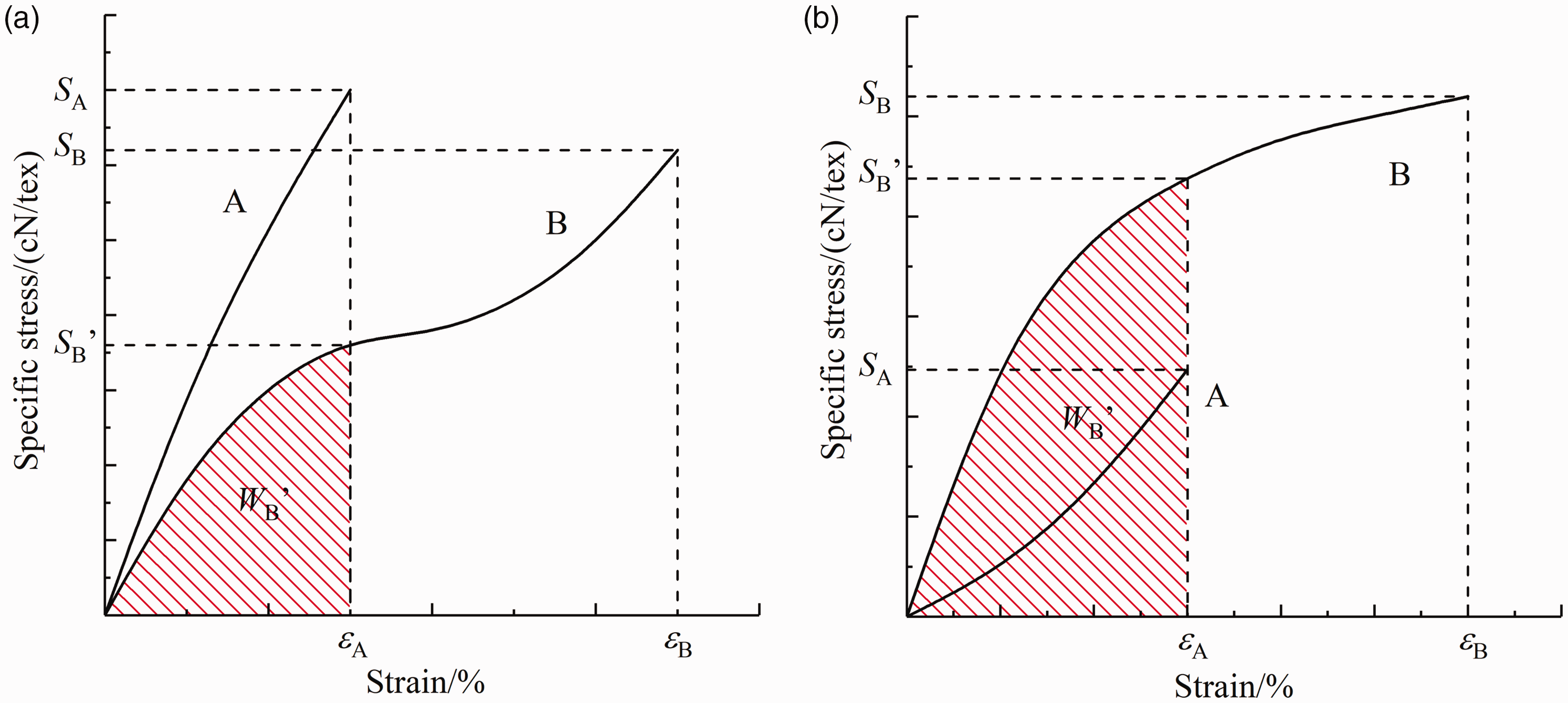
Stress–strain curves of pure A yarn and pure B yarn: (a) case of WA > WB′ and (b) case of WA < WB′.
The study of Yu et al.
15
shows the trend that tenacity and breaking extension vary with component B's blended ratio shifts near a specific value, which is named the “critical blended ratio,” bC. It is determined by the tensile properties of two kinds of pure spun yarns and is given by the following:

The specific work of rupture is a comprehensive index of tenacity and breaking extension. Therefore, the trend that the specific work of rupture for blended yarn varies with the blended ratio possibly also shifts near bC (i.e. the critical blended ratio). Then, this was verified by a large volume of empirical data.5,20–28 Hence, in the following, the blended ratio is divided into two parts (i.e. b ≤ bC and b > bC) to discuss its relationship with the specific work of rupture.
The case of b ≤ bC
Analyzing the breaking process (i.e. rupture mechanism) of blended yarn is an effective method to discuss the specific work of rupture. In the process of stretching blended yarn, two components bear the load together and stretch until reaching the breaking extension of component A. The remaining component B cannot support the load alone in further extension due to its small blended ratio (i.e. b ≤ bC). Therefore, blended yarn breaks at the breaking extension of component A, εA. In the whole stretching process, the specific work done by the external force on component A is equal to its specific work of rupture aWA. However, since component B has not yet extended to its breaking extension, the specific work done by the external force on component B is less than its specific work of rupture bWB. The value of this can be obtained from the stress–strain curve of component B and is equal to bWB′ (WB′ is shown as the shaded area in Figure 1). Therefore, the specific work of rupture for blended yarn can be expressed as follows:

It can be seen that in case the of b ≤ bC, there is a linear relationship between the specific work of rupture and the blended ratio for blended yarn.
The case of b > bC
When the blended ratio of component B is higher than bC, the surviving component B can support the load alone in further extension after the breakage of component A. However, component A continues to contribute to the resistance of blended yarn after its breakage, because the lateral pressure in the yarn can grip the broken fiber segments. 29 The tensile behavior of broken component A in blended yarn, which is related to the interaction between blended components, is always a complex issue.30–33 This makes it difficult to analyze the specific work done by external force on each component.
However, it is found from experience and a large number of experimental data that the trend of specific work of rupture varies around bC, and for different blend combinations, the specific work of rupture–blended ratio curves both show increasing trends in the range of b > bC. Therefore, for simplicity of the model, this part is simplified as a linear increase by referring to the method of breaking extension study,
13
as shown in Figure 2. Then, the relationship between the specific work of rupture and the blended ratio could be expressed as follows:

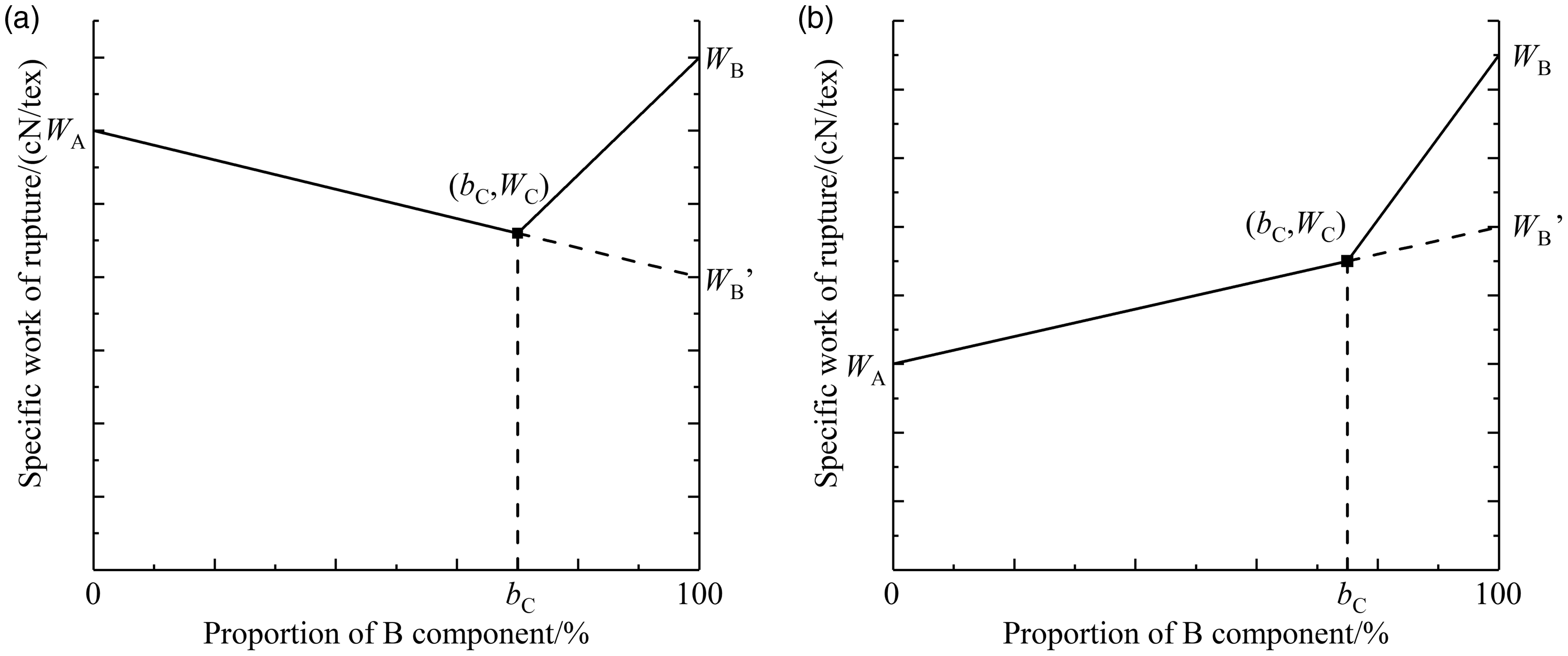
Specific work of rupture–blended ratio curve of blended yarn: (a) case of WA > WB′ and (b) case of WA < WB′.
By synthesizing Equations (2) and (3), the relationship between the specific work of rupture and the blended ratio for two-component blended yarn can be given by the following:

This model shows that the trend of specific work of rupture shifts at the critical blended ratio bC and there is a linear relationship both before and after the trend shifts. According to the model, the curve of the specific work of rupture against blended ratios can be simply plotted using the following method: in the coordinate system of the component B proportion against the specific work of rupture, firstly, a straight line is determined from the points (0,WA) and (100,WB′), which intersects with the line b = bC at the point (bC,WC). After linearly connecting point (bC,WC) with point (100,WB), the whole specific work of rupture–blend ratio curve is obtained. It is shown as the solid line in Figure 2. When the stress–strain curves of pure A yarn and pure B yarn are similar to those of Figures 1(a) and (b), the relationship between the specific work of rupture and blended ratio is as illustrated by Figures 2(a) and (b).
Verifications of the model
Experimental verification
In order to verify the accuracy of the above model, cotton/viscose fiber blended yarns of 25 tex and 355 twist factor were spun in six blended ratios of 100/0, 80/20, 60/40, 40/60, 20/80 and 0/100, respectively. Then the yarn-tensile properties were tested on a YG061F tensile tester according to the requirements of the ASTM D2256-02 standard
34
at gage length of 500 mm. Figure 3 shows the stress–strain curve of pure spun yarns. The tensile properties of pure spun yarn are shown in Table 1, where component A is the component with the smaller extension, cotton, and component B is the component with the larger extension, viscose. In this paper, the parameter of Equation (4), WB′, was obtained by the MATLAB image processing method: the region under the stress–strain curve was filled with black color and binarized, then the pixels of regions with the black color can be calculated. After that the ratio named r of the pixels of the image occupied by WB′ and WB was obtained. The actual value of WB′ is the product of this ratio r and the measured value of WB, that is,
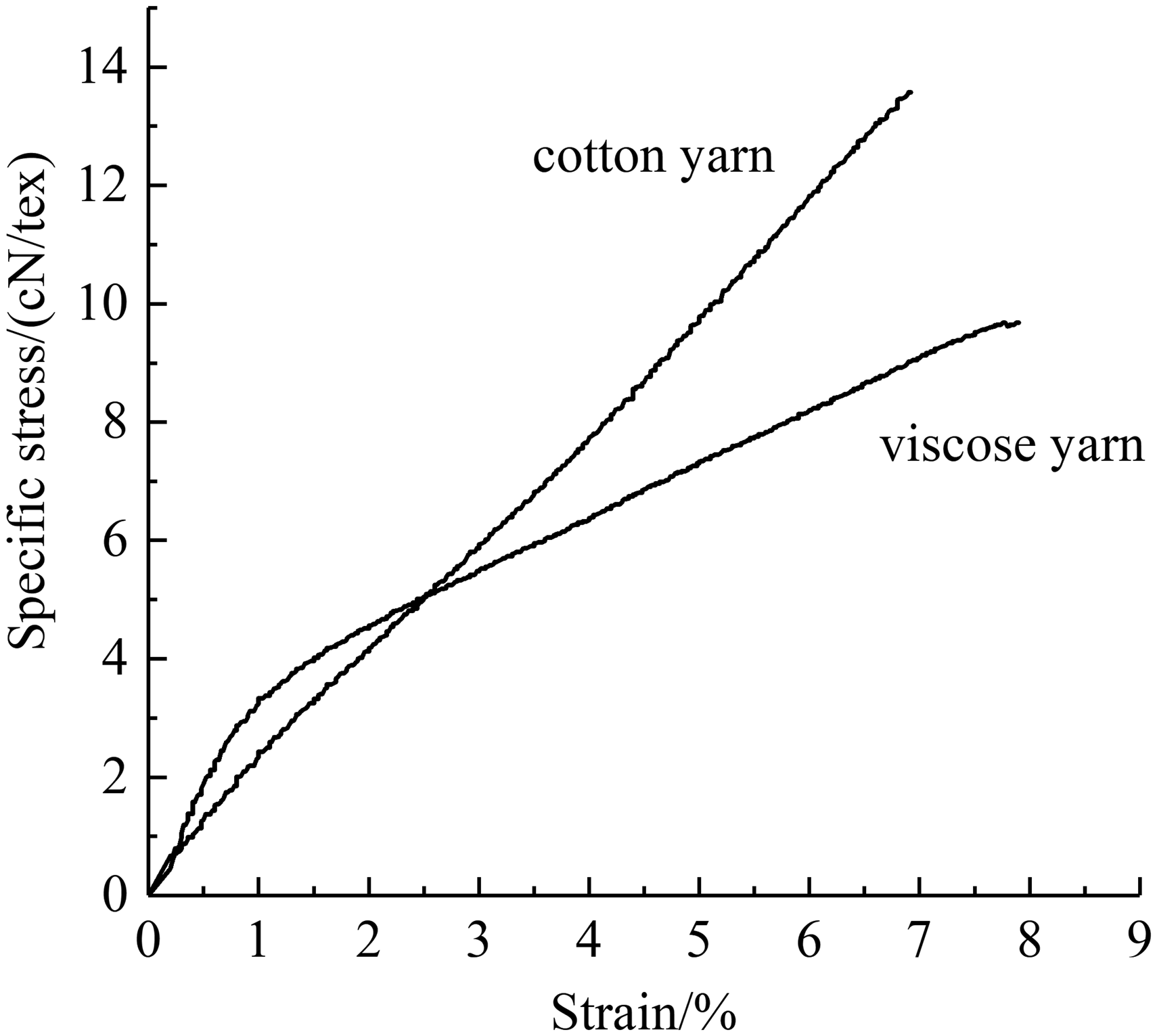
Stress–strain curves of cotton yarn and viscose yarn.
Tensile properties of pure cotton yarn and pure viscose yarn

The predicted values of the specific work of rupture were calculated according to Equation (4) and compared with the experimental results. The results are given in Figure 4. It can be observed that as the blended ratio of viscose increases, the specific work of rupture declines gradually until it reaches the critical blended ratio; thereafter, it increases gradually. The prediction errors for the six blended ratios are 0%, 1.25%, 6.02%, 4.18% 11.98% and 0%, respectively. The mean of middle four values is 5.86%. The correlation coefficient R between the predicted and experimental results is also presented in the Figure 4. It is evident that the difference between the predicted and the experimental values is very small.
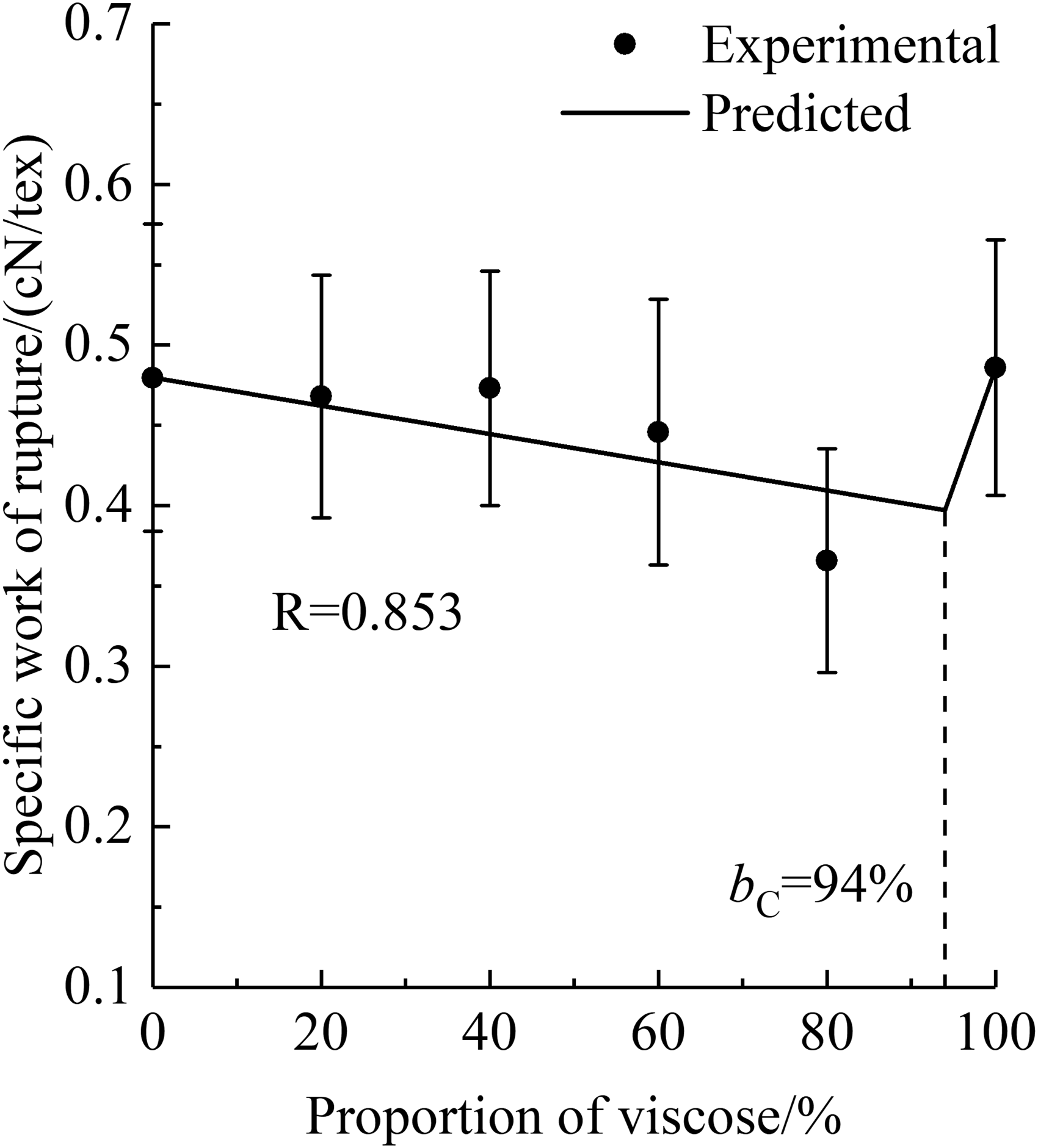
Specific work of rupture of cotton/viscose blended yarn. Error bar indicates standard deviation (n = 50).
Verification by literatures data
In order to further verify the accuracy and applicability of the model, the data in the literature5,20–26 (as shown in Table 2) were used to calculate the predicted value of the specific work of rupture, and then compared with the experimental value. For the convenience of discussion, the original data of the work of rupture in some of the literature was converted into specific work of rupture according to the following equation:


Tensile properties of pure A yarn and pure B yarn from the literature
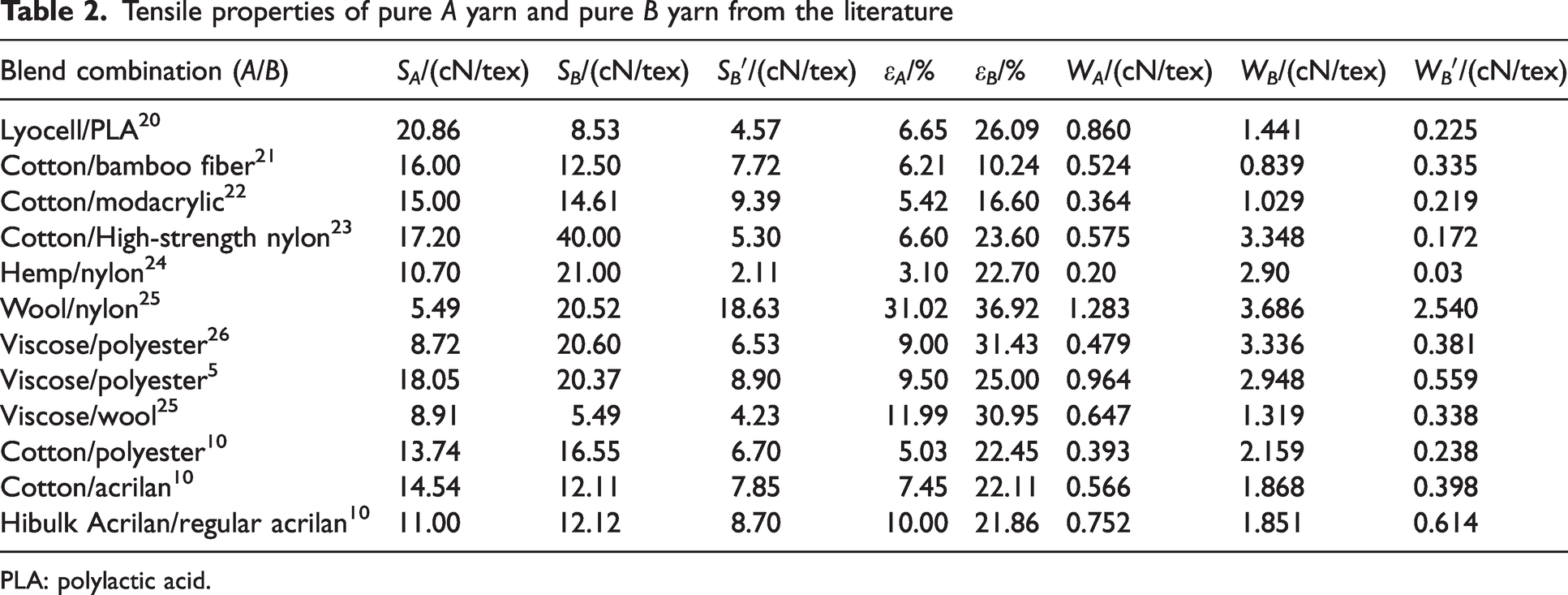
PLA: polylactic acid.
Figure 5 shows a comparison between the predicted values and the experimental ones obtained from lyocell/polylactic acid (PLA) yarn, 20 cotton/bamboo fiber yarn, 21 cotton/modacrylic yarn, 22 cotton/high-strength nylon yarn, 23 hemp/nylon yarn, 24 wool/nylon yarn, 25 viscose/polyester yarn, 26 viscose/polyester yarn, 5 viscose/wool yarn, 25 cotton/polyester yarn, 10 cotton/Acrilan yarn 10 and hibulk Acrilan/regular Acrilan yarn. 10 The average relative error (ARE) and correlation coefficient R were calculated to evaluate the prediction accuracy. For most blended cases, the ARE is below 15% and the R is higher than 0.96. This means a good agreement between the predicted and experimental results for most blend cases.
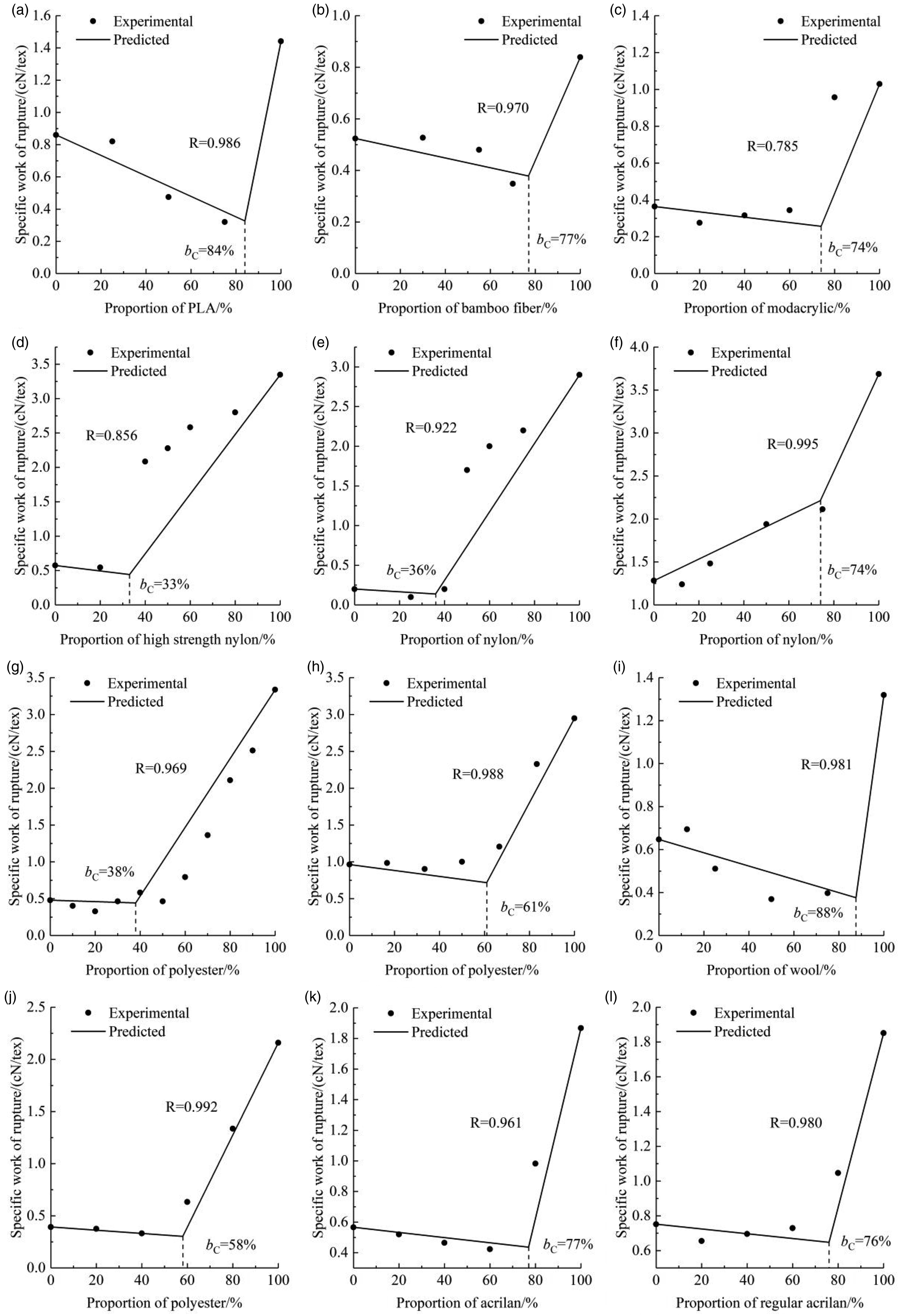
Specific work of rupture of various blended yarns: (a) lyocell/polylactic acid yarn; (b) cotton/bamboo fiber yarn; (c) cotton/modacrylic yarn; (d) cotton/high-strength nylon yarn; (e) hemp/nylon yarn; (f) wool/nylon yarn; (g) viscose/polyester yarn; (h) viscose/polyester yarn; (i) viscose/wool yarn; (j) cotton/polyester; (k) cotton/Acrilan yarn and (l) hibulk Acrilan/regular Acrilan yarn.
In the cases of cotton/modacrylic yarn, cotton/high-strength nylon yarn and hemp/nylon yarn, the prediction error is small in the range of b ≤ bC, and the ARE is essentially less than 11%. However, the specific work of rupture of blended yarn sharply increases and locates above the predicted curve when component B's blended ratio exceeds bC, as shown in Figures 5(c)–(e). This error is inevitable because the part of b > bC in the model is a simplified empirical result. However, such cases are in the minority.
Conclusions
In this paper, a model was established to investigate the relationship between the specific work of rupture and the blended ratio in blended yarn. It was obtained by analyzing the breaking process of blended yarn and summarizing the empirical data. This model indicates the trend that specific work of rupture varies with blended ratio shifts near the critical blended ratio bC, and there is a nearly linear relationship both before and after the trend shifts. Then, experimental results confirmed the good accuracy of the model and its applicability for most blended cases. By means of this model, the curve of the specific work of rupture against the blended ratio can be obtained by simple plotting. As a result, this work can be used to predict the specific work of rupture for blended yarn with various blended ratios.
Footnotes
Declaration of conflicting interests
The author(s) declared no potential conflicts of interest with respect to the research, authorship and/or publication of this article.
Funding
The author(s) disclosed receipt of the following financial support for the research, authorship, and/or publication of this article: This work was supported by Modern textile frontier basic science research base, Donghua University, Shanghai, China.
