




Abstract
Critical Civic Inquiry (CCI) is a transformative student voice initiative that engages students in critical conversations about educational equity and inquiry-based learning to increase student voice and promote civic action. A quasi-experimental study was conducted to assess if participation in CCI increased the psychological empowerment (as measured through ethnic identity and civic self-efficacy) of high school students. Students who participated in CCI pedagogy reported increases in ethnic identity and civic self-efficacy. These findings indicate the importance of supportive adult relationships, inquiry-based learning, and critical conversations about social and educational inequities in promoting the psychological empowerment of marginalized students.
A study of the educational literature yields numerous programs that aim to empower marginalized youth (Ozer & Schotland, 2011)—students of color and students from low socioeconomic status (SES) background. Unfortunately, few of these programs outline the process of or essential elements for promoting empowerment. Even fewer provide empirical evidence of their programs’ efficacy in reaching the goal of empowerment for marginalized youth. As such, educators are left with limited knowledge on how to facilitate the empowerment of the marginalized youth.
Empowerment is a significant construct for marginalized youth, particularly students of color. In ethnic minority students, empowerment is related to psychological well-being (Molix & Bettencourt, 2010). In addition, youth empowerment contributes to academic engagement and academic performance (Ozer & Schotland, 2011) and is thought to increase youths’ belief in their abilities to be social change agents (Tamanas, 2010). Based on these positive outcomes, there exists a need in the field of education to identify programs and strategies that promote the empowerment of marginalized students.
In this article, the authors address a major gap in the education literature by introducing and providing empirical evidence for interventions that foster the empowerment of marginalized youth. The reader is introduced to the process of psychological empowerment and key strategies for fostering psychological empowerment in marginalized youth. The authors also introduce Critical Civic Inquiry (CCI), a program that seeks to, in part, promote the psychological empowerment of marginalized youth. In addition, empirical evidence is provided to document how participation in CCI increases the psychological empowerment (as operationalized through ethnic identity and civic self-efficacy) of marginalized students. Implications for educators in promoting the psychological empowerment of marginalized students are discussed, including the importance of supportive adult relationships, inquiry-based learning, and critical conversations about social and educational inequities.
Psychological Empowerment
Though numerous scholars discuss empowerment, the definition of empowerment remains vague (Ozer & Schotland, 2011; Peterson, Hamme, & Speer, 2002; Zimmerman, 1995; Zimmerman & Warschausky, 1998). Most definitions of empowerment share the common features of individual, community, and social change (Tamanas, 2010); there is debate as to whether empowerment should be conceived of as a process or an outcome. Many theorists place emphasis on the process of empowerment, specifically on an individual’s perception of power and self-efficacy in creating change (Zimmerman, 1995; Zimmerman & Warschausky, 1998). A major critique of empowerment as process is that self-perception does not equal ability to affect one’s sociopolitical context. In response to this critique, scholars have focused on empowerment as an outcome. Carr (2003) asserted that the goal of empowerment for marginalized communities should be sociopolitical liberation—marginalized communities having a major stake in controlling and governing their communities. We endorse the definition of empowerment as “the process of increasing personal, interpersonal, or political power so that individuals, families, and communities can take action to improve their situations” (Gutierrez, 1995, p. 229). This definition captures the importance of empowerment as a process while acknowledging the desired outcome of sociopolitical liberation.
The lens through which we view empowerment comes from the tradition of community psychology, which is by nature interdisciplinary, looking at the relationships between individuals and community/society. This view requires, then, that we understand ecological systems and how individuals make sense of their lived experiences. As such, we must both examine the individual ways that people make sense of their worlds (a psychological view of empowerment) and the ways that groups of people construct meaning and take action to rectify unjust situations (a sociological approach to action and change).
For the purpose of this study, we focus on empowerment at the personal level—psychological empowerment. Psychological empowerment entails a “perception of personal control, a proactive approach to life, and a critical understanding of one’s socio-political environment” (Zimmerman, 1995, p. 581). In youth, psychological empowerment is positively related to psychological well-being, as it diminishes feelings of powerlessness and enhances internal locus of control (Molix & Bettencourt, 2010). In addition, psychological empowerment contributes to academic engagement and academic performance (Ozer & Schotland, 2011) and is thought to increase youth’s belief in abilities to be effective social change agents (Tamanas, 2010). Unfortunately, there is a dearth of empirical research on the psychological empowerment process.
Few scholars have proposed models for the process of psychological empowerment. Carr (2003) and Gutierrez (1995) described the process of psychological empowerment as the development of critical consciousness, developing positive identity, and taking social action. The following sections will explore these processes in more detail.
Critical Consciousness
Critical consciousness describes an understanding of how sociopolitical, cultural, and historical constructs affect the lives of individuals (Watts, Abdul-Adil, & Pratt, 2002) and an awareness of oppression in society and the sociopolitical consequences of being oppressed (Gutierrez, 1995). Perception is key to the development of critical consciousness: The ability to accurately perceive sociopolitical context and to reject the propaganda disseminated by the dominant society that diminishes the perception of inequality in society is essential to critical consciousness (Author, 2007; Hanna, Talley, & Guindon, 2000). Furthermore, it is believed that critical consciousness inspires members of marginalized communities to seek psychological empowerment (Carr, 2003; Gutierrez, 1995). In addition, critical consciousness is thought to improve youth’s belief in the ability to be change agents (Tamanas, 2010; Watts et al., 2002): a notion that was supported by Diemer and Li’s (2011) finding that youth with greater critical consciousness were more likely to be civically engaged. Given the importance of critical consciousness to the empowerment process, it is vital to identify practices that facilitate the development of critical consciousness (Diemer & Li, 2011). Thus, this study examines how the critical conversations, which seeks to foster critical consciousness, associated with the CCI curriculum facilitates the psychological empowerment of marginalized youth.
Positive Identity
The identities of marginalized communities, particularly those of communities of color, are often devalued by dominant society (Molix & Bettencourt, 2010). Dominant discourse in the United States privileges White, male, heterosexual, Judeo-Christian, able-bodied, upper SES identities. As such, communities of color must “discover” their identity and come to appreciate their existence, not in reference to the dominant culture but for its own merit (Carr, 2003; Duran & Duran, 1995). People of color require an empowering identity, one that gives validity to their existence and inspires work to improve the sociopolitical circumstances of their community (Hipolito-Delgado & Lee, 2007; Tamanas, 2010).
Although positive identity, as conceived in psychological empowerment, is not synonymous with ethnic identity, for communities of color, the development of ethnic identity is linked to empowerment. In fact, research indicates that for youth of color, ethnic identity is a predictor of psychological empowerment (Molix & Bettencourt, 2010; Tamanas, 2010). Furthermore, Tamanas (2010) found that the link between ethnic identity and psychological empowerment was particularly important for males of color—ethnic identity was the strongest predictor of psychological empowerment. Though ethnic identity is not equivalent to positive identity, given the strength of the relationship between ethnic identity and psychological empowerment in youth of color and our sample that was predominantly students of color, ethnic identity was used as an indicator of psychological empowerment in this study.
Social Action
It is argued that the most important aspect of psychological empowerment is social action (Carr, 2003). Social action refers to activism and advocacy efforts to gain greater sociopolitical control over an individual’s and community’s environment (Hanna et al., 2000; Potts, 2003; Zimmerman & Warschausky, 1998). To facilitate psychological empowerment, marginalized youth should be encouraged to participate in community groups, social advocacy groups, and political rallies (Hipolito-Delgado & Lee, 2007). For the purposes of this study, marginalized youth’s interest in and ability to engage in social action is measured through civic self-efficacy.
Facilitating Psychological Empowerment
Despite the plethora of educational programs that aim to promote the psychological empowerment of marginalized youth, there is limited empirical research outlining successful strategies to facilitate psychological empowerment. The existent literature on youth empowerment indicates that supportive adult and peer relationships, encouraging youth’s questioning and information seeking, and participation in critical conversations on inequities are important components for fostering empowerment in youth.
Supportive Adults and Peer Relationships
Research on youth of color indicates that feeling support from adults (parents and teachers) and from peers facilitates perceived sociopolitical control and psychological empowerment. Diemer and Li (2011) found that parental and peer support was directly related to youth’s perceptions of sociopolitical control and participation in social action. Similarly, Tamanas (2010) found that social support from peers, friends, family, and other important adults was directly related to psychological empowerment and that social support mediated the relationship between perceived neighborhood problems and psychological empowerment. In addition, Ozer and Schotland (2011) found that youth with higher levels of psychological empowerment reported having more caring relationships with adults at school and more support from peers at school. Though it is unclear what these adults and peers did to communicate their support for youth empowerment, it appears that supportive adult and peer relationships are an important precondition for psychological empowerment. Within CCI, teachers intentionally build classroom communities that share power and voice with marginalized students by engaging in real, critical conversations about issues that matter to the students and by facilitating learning experiences that are student centered. In addition, CCI students interact with research assistants (doctoral students) and university professors who support the students in the research process. CCI students also engage in conversations with other adults in their schools and community about the issues they are learning about in the classroom. As such, CCI students experience various supportive adult relationships.
Inquiry-Based Learning
Considering the importance of critical consciousness to psychological empowerment, it stands to reason that encouraging youth to question and seek information would foster psychological empowerment. In describing a psychoeducational group to foster critical consciousness and psychological empowerment in African American youth, Watts et al. (2002) emphasized that youth should be encouraged to think about their sociopolitical circumstances and to seek information to answer their own questions. Furthermore, Watts et al. (2002) stated that indoctrination must be avoided—that youth cannot be told how to think. In addition, Tamanas (2010) found that the ability to perceive problems in one’s environment was positively linked to the development of psychological empowerment for youth of color. It should be noted that inquiry-based learning is a critical component of the CCI curriculum—As part of CCI, students work together to identify a problem that affects them in their schools, design and carry out a research project to explore that problem, and then engage adults in their school in conversations about a proposed solution to their problem.
Critical Conversations
Critical conversations are those that broach difficult topics (like racism, oppression, and social inequities) and that might be challenging and frightening to participants. Many civic engagement and service learning programs seem to actively avoid critical conversations and controversial topics like social inequities (Kahne & Westheimer, 2006). In addition, Diemer and Li (2011), in their study of youth of color, found that teachers did not engage youth in conversations about issues of social inequities. Youth, especially those from communities color, need to understand their sociopolitical context (Kahne & Westheimer, 2006). To foster the psychological empowerment, issues of social inequities need to be brought to the forefront of the curriculum (Hipolito-Delgado & Lee, 2007) and teachers must possess critical consciousness and awareness of their power and privilege (Watts et al., 2002).
Gutierrez (1995) promoted the consciousness-raising group as a method to improve the psychological empowerment of Latina/o youth. Consciousness-raising groups are designed to engage participants in critical conversations surrounding topics such as sexism, racism, and oppression. Gutierrez (1995) found that youth who participated in consciousness-raising groups demonstrated increased critical consciousness and psychological empowerment. A primary goal of CCI is to engage youth in critical conversations that explore social and educational inequities. Critical conversations are the first step of the CCI inquiry-based learning process, such that teachers facilitate conversations using data (such as achievement gap or drop-out rates), news articles (on topics such as immigration or racial profiling), or articles that showcase student voices (like the “Testimonios de Inmigrantes: Students Educating Future Teachers”; Gonzalez, Plata, García, Torres, & Urrieta, 2003). Through discussion of educational inequities, CCI students develop powerful relationships with their teachers and peers, explore issues of oppression, and use this knowledge to identify a problem affecting students in their school.
CCI
CCI is a partnership between university researchers and three urban school districts in the Rocky Mountain region of the United States. CCI seeks to engage students in inquiry-based learning that fosters critical consciousness, ethnic identity, and civic self-efficacy. Participating teachers engaged in a yearlong training designed to assist them in redesigning their curriculum and pedagogical approaches to create space for critical conversations, action research, and sharing power and voice. In addition, the yearlong training provided teachers with resources on how to utilize pedagogical frameworks, including culturally responsive pedagogy (Gay, 2010), critical pedagogy (Duncan-Andrade & Morrell, 2008), problem and/or inquiry-based learning (Chung & Chow, 2004), and youth participatory action research (Cammarota & Fine, 2010). CCI teachers adapted these approaches to teach their individual subject area. The CCI courses then, while meeting state academic standards for content, fostered critical consciousness through awareness of educational inequities—simultaneously providing the “encounters” with racial difference that Helms (1995) argued advances ethnic identity.
Participating students reflect, as part of a specialized course, on their educational experiences, identify a problem experienced by students, investigate said problem systematically and, together with school personnel, devise strategies to address the problem. Students recruited to participate in CCI in Year 1 were predominately sophomores from three comprehensive high schools, who school personnel at each site identified as not college bound or at risk for exiting before graduation—based on criteria such as grade point average (GPA), attendance, and course taking. As part of CCI, students were enrolled in a specialized course and participated in two cross-site meetings: one to introduce them to CCI and the research process and a second to share lessons learned and the results of their inquiry projects. This research study focused on the critical consciousness phase of CCI, when students were engaged in critical conversations about educational and sociopolitical inequities.
Method
The aim of this study is to examine if participation in CCI increases the psychological empowerment of marginalized students. Based on theories of psychological empowerment, it is hypothesized that participation in activities during the critical consciousness phase of CCI will lead to increased psychological empowerment (as measured by ethnic identity and civic self-efficacy) of marginalized youth.
Participants
Participants in this study were recruited from three metropolitan high schools in the Rocky Mountain region of the United States. These three high schools were chosen because they are official “partnership schools” of the institution of the authors. These schools were also chosen to obtain an ethnically diverse sample of student participants. School A was selected as it is located in a predominately Latina/o neighborhood and has a predominantly Latina/o student population. School B was selected as it is located in a historically African American neighborhood and has large Latina/o and African American student populations. School C was selected as it is located in a historically White neighborhood and has a large White student population. In each school, two classrooms were sampled—six in total—one classroom where students were provided the CCI pedagogical approach and one classroom where students did not receive the CCI pedagogical approach. The six classrooms that were sampled in this study were selected because the majority of students in these classrooms had low GPAs (less than 3.0) and were deficient in credit hours.
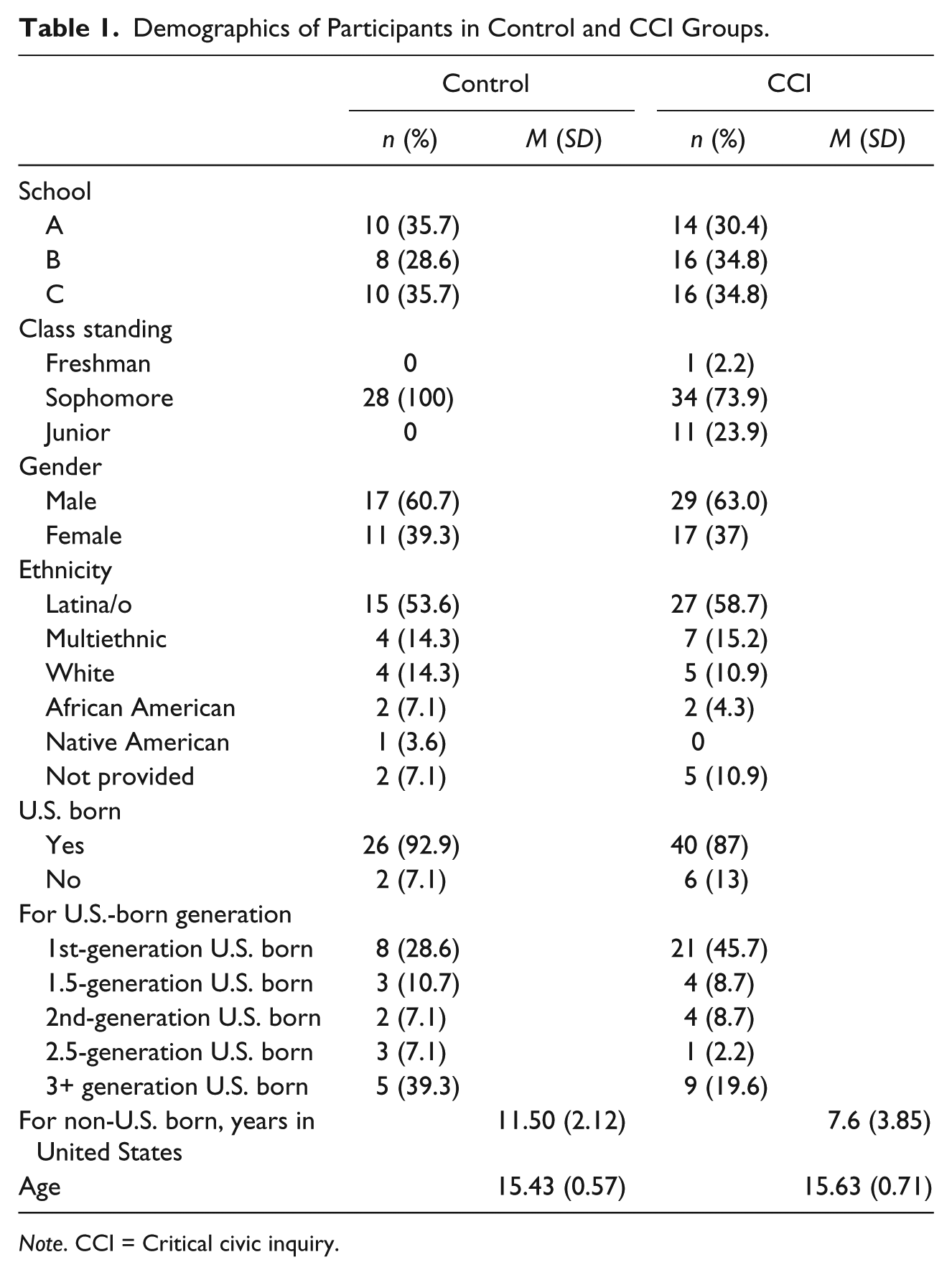
A total of 111 students were enrolled in the six classrooms that were sampled, 64 were in the CCI class and 47 in the control classroom. A total of 74 students completed both surveys—providing a participation rate of 66.67%. Only the results of students who completed both surveys are included in this study. Table 1 provides the demographic composition of student participants in this study, which are disaggregated by group. There were 46 participants in the CCI group and 28 in the control group. Students in both groups were predominately sophomore in class standing—100% of the control group and 73.9% of the CCI group were sophomores. Males composed 60.7% of the control group and 63.0% of the CCI group. Latinas/os were 53.6% of the control group and 58.7% of the CCI group. The vast majority of participants were U.S. born: 92.9% of the control group and 87% of the CCI group were U.S. born.
Demographics of Participants in Control and CCI Groups.
Note. CCI = Critical civic inquiry.
Procedures
Prospective participants received a classroom presentation from research assistants affiliated with the CCI project, explaining the nature and purpose of this study. Students were given the opportunity to ask questions regarding research in general and about the specifics of this study. Students were informed that their participation was voluntary and that their information would remain confidential. All prospective participants were provided with a student assent form and a parent consent form. An envelope was left in the classroom so that students could drop off completed assent and consent forms. Only data from students who had assented and whose parents consented were included in this study.
Participants in this study completed surveys at two time periods, at the start and end of the critical consciousness phase of the CCI curriculum (September and February, respectively). All survey instruments were completed through an online website. All research was conducted in compliance with the procedures of the Human Subjects Review Board.
Instruments
Demographic Questionnaire
A demographic questionnaire was used to identify background characteristics of participants in the study. Participants were asked which high school they attended, class standing, gender, age, country of origin, years living in the United States, and U.S.-born generational status.
Multigroup Ethnic Identity Measure–Revised (MEIM-R)
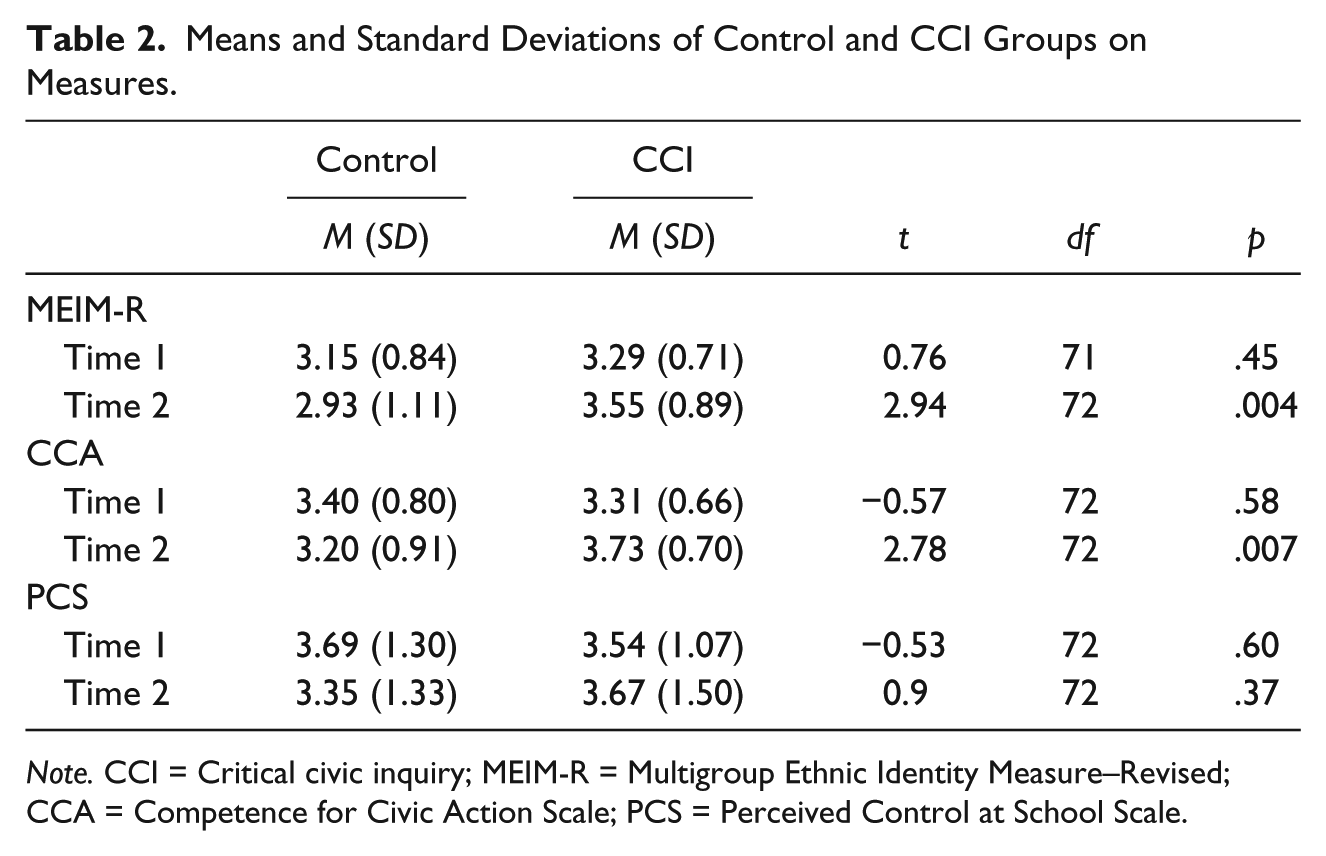
Ethnic identity was measured using the MEIM-R (Phinney & Ong, 2007). The MEIM-R consists of one open-ended question asking participants to identify their ethnic heritage and six items using a 5-point Likert-type scale from 1 (strongly disagree) to 5 (strongly agree). Sample items of the MEIM include “I have a strong sense of belonging to my own ethnic group” and “I feel a strong attachment towards my own ethnic group.” For the purposes of this study, the composite score was examined with higher mean scores representing higher levels of ethnic identity. In measuring the internal consistency of the MEIM, Phinney and Ong (2007) reported a Cronbach’s α = .81 and in this study a Cronbach’s α = .90 was detected, both of which indicate adequate reliability. The validity of the MEIM was indicated through confirmatory factor analysis, χ2/df = 1.91, p < .001, adjusted goodness-of-fit index (AGFI) = .96, comparative fit index (CFI) = .98, and root mean square error of approximation (RMSEA) = .04 (Phinney & Ong, 2007). Mean scores on all instruments at each time point for each group are provided in Table 2.
Means and Standard Deviations of Control and CCI Groups on Measures.
Note. CCI = Critical civic inquiry; MEIM-R = Multigroup Ethnic Identity Measure–Revised; CCA = Competence for Civic Action Scale; PCS = Perceived Control at School Scale.
Competence for Civic Action Scale (CCA)
Civic self-efficacy was measured in part through the CCA (Flanagan, Syvertsen, & Stout, 2007). The CCA begins with the prompt
If you found out about a problem in your school that you wanted to do something about (e.g., illegal drugs were being sold on campus or students of color are treated unfairly), how well do you think you would be able to do each of the following?
Participants are then asked to identify their perceived competence in performing nine civic actions using a 5-point Likert-type scale from 1 (definitely can’t) to 5 (definitely can). Sample items of the CCA include “Create a plan to address the problem” and “Organize and run a meeting.” In measuring the internal consistency of the CCA, Flanagan et al. (2007) reported Cronbach’s αs of .90 and .92. In this study, a Cronbach’s α = .92 was detected, which indicates adequate reliability. The validity of the CCA was indicated through confirmatory factor analysis, χ2 = 325.28, df = 27, p < .001, CFI = .96, and RMSEA = .08 (Flanagan et al., 2007).
Perceived Control at School Scale (PCS)
Civic self-efficacy was measured in part through a modified version of the PCS (Adelman, Smith, Nelson, Taylor, & Phares, 1986). The PCS was modified to reduce the total number of items—The original scale includes 16 items. The modified PCS uses 6 items to asks participants the percentage of the time they have a say in their educational experience using a 7-point Likert-type scale from 1 (never) to 7 (always). Sample items of the PCS include “You are able to change something if you don’t like it” and “Your words and/or actions could persuade a principal or administrator to consider your views of the policy.” In this study, a Cronbach’s α = .89 was detected. No information on the validity of the modified PCS currently exists.
Results
A quasi-experimental design was used to assess the influence of CCI on marginalized high school students’ psychological empowerment (operationalized as ethnic identity and civic self-efficacy) over two time periods. A quasi-experimental design was selected for this study as the researchers would be working in classroom settings where random assignment of participants was not possible. In this quasi-experimental design, the students in the CCI classroom represented the experimental condition and students in the non-CCI classroom represented the control condition. To assure that both groups were statistically similar on the dependent variables, a baseline measurement and a series of t tests were conducted. After the second measurement, split-plot ANOVA and MANOVA were utilized so that researchers could assess if difference in the dependent variables existed between the groups over time (the interaction effect).
All assumptions related to t tests, ANOVA, and MANOVA were met for this study. Univariate normality was assessed using the skew and kurtosis for each dependent variable and multivariate normality was assessed by way of the bivariate scatter plot for each combination of dependent variables. These methods indicated the existence of univariate and multivariate normality. To assess for homogeneity of variance, Box’s M test was conducted and yielded nonsignificant results: for the ANOVA analysis, Box’s M = 4.49, F(3, 130909) = 1.45, p = .23, and for the MANOVA analysis, Box’s M = 16.40, F(10, 15209) = 1.53, p = .12. IBM SPSS 20 was used for all statistical analysis in this study.
At the start of the academic year, and prior to beginning the CCI curriculum, a series of t tests were conducted to assure that the CCI and non-CCI groups were statistically similar based on the dependent variables—Table 2 presents the results of these tests. At Time 1, no difference was detected between the CCI and the non-CCI group on the MEIM-R, t(71) = 0.76, p = 0.45; CCA, t(72) = −0.57, p = 0.58; or PCS, t(72) = −0.53, p = 0.60. Based on these results, it can be said that both groups were statistically similar at the start of this study.
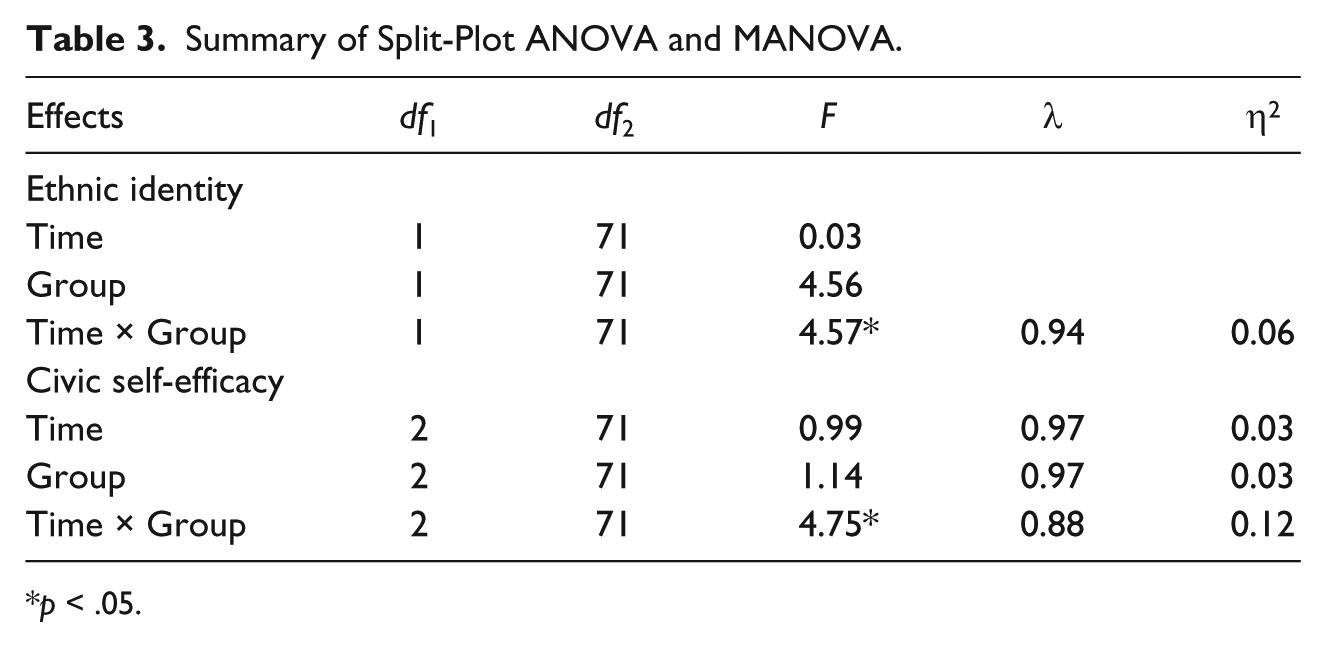
At the end of the critical consciousness phase of CCI, a second assessment was conducted of all participants. A split-plot ANOVA was used to examine if differences in ethnic identity existed over time between a control group and the CCI group. Table 3 presents a summary of the split-plot ANOVA and MANOVA findings. For the purposes of this study, only the interaction effect was examined. Results of the split-plot ANOVA indicated a statistically significant difference over time between the control group and the CCI group in terms of ethnic identity, Wilks’s λ = .94, F(1, 71) = 4.57, p = .04,
Summary of Split-Plot ANOVA and MANOVA.
p < .05.
A split-plot MANOVA was also conducted to assess if differences in civic self-efficacy existed over time between the control group and the CCI group. A split-plot MANOVA was selected over conducting two additional split-plot ANOVAs to protect against Type I error and increase power (Stevens, 2009; Tabachnick & Fidell, 2013). As recommended by Tabachnick and Fidell (2013), Wilks’s lambda was used to assess the statistical significance of MANOVA results. Civic self-efficacy was assessed using the CCA and PCS. The results of the split-plot MANOVA indicated a statistically significant difference between the control group and the CCI group in terms of civic self-efficacy, Wilks’s λ = .88, F(2, 71) = 4.75, p = .01,
Discussion
Despite the small sample size associated with this study, some important conclusions can be drawn from the findings. Carr (2003) and Gutierrez (1995) argued that psychological empowerment consists of critical consciousness, positive identity, and social action. In this study, marginalized high school students who participated in the critical consciousness component of CCI reported statistically significant increases in ethnic identity and civic self-efficacy—as compared with a control group. Given the theories of Carr (2003) and Gutierrez (1995) and the findings of this study, we argue that CCI participants experienced psychological empowerment. This finding is significant given that it is one of the few empirical studies to demonstrate the efficacy of an intervention designed to foster psychological empowerment in marginalized students.
Furthermore, the findings of this study seem to indicate that supportive adult relationships, inquiry-based pedagogy, and critical conversations promote psychological empowerment. Through their involvement in CCI, marginalized high school students experience a supportive relationship with the CCI teacher who shared power in the classroom, created a classroom culture of peer support, and adopted student-centered learning practices. In addition, the CCI participants enjoyed a supportive adult relationship with the graduate assistants who were members of the CCI research team. As part of CCI, marginalized students also experience critical conversations regarding social and educational inequities. CCI pedagogy also utilized an inquiry-based model—that entailed identifying a school-based issue that affected youth and working with adults to develop a solution to said problem. Although the research methodology employed in this study is unable to detect the impact of each of these individual practices on the psychological empowerment of marginalized students, the findings, as a whole, seem to support the literature and indicate that these methods, in concert, foster the psychological empowerment of students.
Though this was not an identified area of examination associated with this study, the findings from the control group appear to indicate that their educational experience might have been disempowering to these marginalized students. Freire (1970) argued that schooling was disempowering to marginalized populations. The findings of this study seem to support this notion. Although the exact curriculum, pedagogy, and learning practices that occurred in the control groups were not studied, students in the control group reported decreases in ethnic identity and civic self-efficacy over the 6 months of this study. What is more, the control group initially reported higher levels of ethnic identity and civic self-efficacy than the CCI group. However, by the end of this study the control group reported significant decreases in ethnic identity and civic self-efficacy.
Implications
The findings of this study appear to indicate that promoting critical consciousness in marginalized youth fosters their psychological empowerment. Though the relationship between critical consciousness and psychological empowerment might not be ground shaking, it seems important to begin to focus our work on exploring and understanding this connection—a connection most civic engagement and service learning programs avoid. Students in the CCI course actively considered issues of social and educational inequities and were engaged in critical conversations about racism, classism, and other forms of oppression. Though there was no direct measurement of students’ critical consciousness, CCI students did report gains in ethnic identity and civic self-efficacy—variables that are predictive of psychological empowerment. Thus, it is likely that critical consciousness fosters psychological empowerment in marginalized youth.
The findings of this study also indicate the importance of supportive adult relationships that include sharing power and voice, and engaging in critical conversations, in fostering the psychological empowerment of marginalized youth. Most curriculum and pedagogy is teacher centered: The teacher is assumed to be infallible and students are passive observers (Freire, 1970). In teacher-centered instructional models, the teacher takes on a role of communicating knowledge to students, often using lecture and other unilateral styles of communication. Teachers in this mode elaborate on a body of knowledge, rather than co-constructing knowledge with students (Mascolo, 2009). In this study, students in the control group, who likely experienced more teacher-centered practices, reported declines in their civic self-efficacy and ethnic identity. However, students in the CCI groups who experience student-centered curriculum, instructional practices, and supportive adult relationships reported increases in their ethnic identity and civic self-efficacy. It is important to note that doctoral students were a regular presence in the CCI classrooms—The presence of a second adult in the classroom was not available in control condition. As a result, students in the CCI group might have had additional opportunities to experience supportive adult relationships.
Additional research is needed to clarify the findings of this study. A qualitative investigation of CCI curricular practices and pedagogy might shed light on the elements of student-centered learning and supportive adult relationships that fosters the psychological empowerment of marginalized students. It would also be prudent to examine if critical conversations and inquiry-based learning affects the critical consciousness of marginalized high school students. Future research on CCI would do well to include a measure of critical consciousness.
Limitations
There are a number of limitations associated with this study. The first is related to the sample size. Given that only six classrooms were sampled, not all students and parents in these classrooms consented to participate, and not all consented students completed both surveys, the sample size of this study is relatively small. Due to the goals of this study and the small sample size, the authors felt it unwise to disaggregate data—as such potential distinctions between ethnic groups and based on age are not addressed in this article. Future research should examine CCI practices in a larger number of classrooms and with more students.
In addition, limitations existed in the research methods of this study. No information of the validity of the modified PCS exists. This measure was selected due to the lack of measures assessing the civic self-efficacy of marginalized youth. Research is needed to verify that the PCS is a valid measure of civic self-efficacy. Another limitation is the lack of a measure for critical consciousness. The researchers were unable to locate a measure that assessed the critical consciousness of students. Furthermore, this study did not control for experiences outside of the classroom or for the fidelity of CCI implementation—both of these factors might have affected students’ psychological empowerment. Finally, the researchers did not study the classroom practices in the control condition—Therefore, we are unable to adequately describe the pedagogy and educational experiences of the control group.
Conclusion
Though additional research is necessary to validate the outcomes of this study, this preliminary evidence appears to indicate that participation in CCI fosters the psychological empowerment of marginalized students by focusing the pedagogical strategies of teachers on sharing power and voice, facilitating critical conversations about social and educational inequities, and supporting inquiry-based learning approaches to exploring school-based problems. Although there is a research available on each of these three elements (and an abundance on the third element of inquiry- or problem-based learning), none appears to link the three in ways that the CCI process does, nor do they focus on the outcomes of increased ethnic identity, civic engagement, and empowerment. It appears that the combination of supportive adult relationships and participation in critical conversations about social and educational inequities facilitates the development of ethnic identity and civic self-efficacy in marginalized youth. These findings should encourage educators to consider the current structure of school classrooms and the critical role that relationships with teachers who support sharing power, engaging in critical conversations, and working together on inquiry around problem areas can have on promoting the psychological empowerment of marginalized students.
Footnotes
Declaration of Conflicting Interests
The author(s) declared no potential conflicts of interest with respect to the research, authorship, and/or publication of this article.
Funding
The author(s) disclosed receipt of the following financial support for the research, authorship, and/or publication of this article: This research study was supported by a grant from the Spencer Foundation Initiative on Civic Learning and Civic Action (Proposal No. 0609.12.1177B).