



Abstract
This paper underscores the centrality of individual technological devices, particularly mobile phones, in structuring contemporary social interaction in public spaces. It illustrates the need to re-think the relationship between information and communications technologies and practices of sociability in public spaces. Based on surveys of users of mobile phones (basic mobile phones and smartphones), we explore the practices and actions of subjects in public spaces. Empirical analysis shows that the use of mobile phones and, particularly, smartphones, is gradually modifying the normative constraints associated with place and social codes, simultaneously enhancing both a sense of freedom and estrangement. Based on our findings, the paper suggests the concept of portable private-personal territory to better understand the personal space individuals develop with the support of technology. Finally, the paper concludes with a reflection on the future implications of portable private-personal territories for public spaces and cities.
Introduction
Smartphones expand our spheres of communication. When walking in a park, one is engaged in juxtaposed spheres: ongoing emails, news sources, work affairs, private conversations, and social networks. By temporarily disregarding one’s physical environment and ignoring the people around, it is expected that the device will take attention and focus. This condition raises questions: how does this state of mind influence social interactions in a place? How does this dynamic shape behaviour in public spaces? These queries are related to an ongoing debate about the relationship among social interactions, information technology, and the built environment. Of the vast body of knowledge on this theme, we focus on two ongoing, related discussions in urban studies as the basis for addressing these queries: 1) the role of public spaces in contemporary cities; and 2) the relation between information and communication technologies (ICTs) and people’s daily routines in cities.
Beginning with the discussion on public and publicness, one can identify four key trajectories of thinking: 1) a liberal–economic version, in which the public is defined by the state and administrative functions; 2) a republican virtue model, in which the public sphere is conceptualised as pertaining to community, the polity, and citizens; 3) a model rooted in practices of sociability, in which the public refers to symbolic displays and self-representation; and 4) a Marxist–feminist model, in which ‘public’ refers to the state and economy (Weintraub, 1995). Although scholars conceptualise public differently (Staeheli and Mitchell, 2007), they tend to agree that the current concept of public should be understood through the ascendancy of a market-based paradigm and the provision of public goods (Madanipour, 2010: 3). Studies have shown that as a result of a reduction in the size and scope of the state, urban development has been transferred to the private sector (Boyer, 1992; Miller, 2007; Mitchell, 1995; Zukin, 1995). However, beyond these processes of the privatisation of publicness, it is acknowledged that the social nature of public space is changing, in part due to feminist and gay liberation movements and to wider access to media, television, and immigration movements (Watson, 2006). In particular, it has been argued that with the massive growth of cities, public spaces become more impersonal and transient, playing a functional and symbolic role at best (Madanipour, 2010: 5; Sennet, 1976). Technology adds to these changes another layer that modifies the dynamic of encounters and their varied forms. On the one hand, these changes turn public spaces into venues surveyed and controlled by authorities; on the other, they enhance the flexible use of personal devices by individuals. In fact, the reliance of cities on technology has made them inseparable in the sense that the development and evolution of both is co-dependent.
A situation in which cities would be affected and radically transformed by ICTs was predicted in the early 1990s by scholars such as Manuel Castells (1989, 1996) in social sciences, and William Mitchell (1999) in architecture. These authors particularly emphasised the way telecommunications would modify and change the hierarchy among cities worldwide, defining new relationships between states and cities globally (Sassen, 1998). Their predictions came true, and in many societies today, technological systems are becoming the ‘ordinary’ socio-technical world. Responding to this state of affairs, researchers have studied the impact of these systems on our daily lives, paying special attention to mobility, service systems, and physical spaces (Berry, 2010; De Souza e Silva and Frith, 2012; Hampton, 2010; Jensen, 2009; Shariful, 2010). Yet, parallel to the ongoing fascination with ‘the way technology liberates society’, other voices have illuminated the dark side of technological devices, seeing ‘technology as a means of control’ (Graham, 2002, 2005). This view of technology as a disciplinary tool that re-structures space, time, and relations among activities has been promoted by scholars who have shown that technology is also a means of saturating and sustaining contemporary capitalist societies and deepening inequalities (Graham, 2002, 2005; Lyon, 2003; Thrift, 2004b).
Using these discussions as the background for this study, we aim to advance critical thinking on technology and space with particular attention to the daily practices of the individual subject (Massey, 2005; Thrift, 2004a). In particular, we address the way mobile phones influence our ‘interactions in public’ (Goffman, 1967) and the way they assist in constructing a multidimensional set of social and spatial situations. As Erving Goffman noted, social situations vary, and individuals’ reactions depend on how much the individual is obliged to be in connection with what is around him and the social context in which he is embedded (Goffman, 1963: 199). This argument is even more relevant today with the ICT revolution, which blurs the lines between physical and virtual space. It is important to remember that it is through both means simultaneously, not one or the other (De Souza e Silva and Frith, 2012: 46), that the individual has the power to construct his personal space with varied tools. In this sense, mobile phone users imagine themselves able to communicate beyond the crowd as well as with it, as argued by Vicente Rafael:
Unlike computer users, cell phone owners are mobile, immersed in the crowd, yet able to communicate beyond it. Texting provides them with a way out of their surroundings. Thanks to the cell phone, they need not be present to others around them. Even when they are part of a socially defined group – say, commuters or mourners – cell phone users are always somewhere else, receiving and transmitting messages from beyond their physical location. (Rafael, 2003: 405)
Following these ideas, particularly the notion of personal space as procedural (Iveson, 2007: 9), the premise of this paper is that technological devices influence our dialogical practices and joint actions between subjects as well as the spatial use of public space. Focusing on encounters in public spaces, we elaborate on the way mobile phone users (basic mobile phones and smartphones) act in public spaces. Our argument is twofold: first, mobile phones contribute to the development of what we call portable private-personal territory (PPPT), a personal space that individuals develop and that is characterised by a multidimensional set of social and spatial relationships. Second, this dynamic personal space modifies interaction rituals in public. As mobile technologies become an intrinsic part of people’s experience of space, they both enable empowerment and flexibility and create social estrangement. We understand the PPPT as a socio-spatial condition that releases the individual from normative constraints associated with place, and we argue that it modifies the role of public space.
To explore this argument, the paper begins with a theoretical discussion of public spaces and ICTs. It proceeds with an analysis of the empirical evidence collected by surveying users of smartphones and basic mobile phones, focusing on social conduct and behaviour in different typological places. Based on the findings, the paper develops the idea of portable private-personal territory. Finally, the paper concludes by reflecting on the future implications of this idea for public spaces and cities.
Beyond binaries and divides: Public spaces and ICTs
The public/private divide, perceived as two exclusive categories that together appear to account for all elements of life and experience (Collins, 2009), is one of the great dichotomies of western thought. Understood as opposites, public and private are also understood as inseparable, where the extension of one sphere necessarily implies a reduction in the scope of the other. Yet, the validity of this binary is not clear, especially with the ongoing ‘privatisation’ of material spaces as well as the growing appearance of virtual space in our lives. Clearly, mobile technology use in public spaces complicates traditional understandings of what it means to be in public, allowing people to bring previously private activities (chatting, reading, listening to music) into public spaces (De Souza e Silva and Frith, 2012: 51). Nevertheless, one of the reasons for maintaining these categories (even in their current blurred configuration) is because they contribute to and maintain the order of social life, promote collective concerns, and reduce conflicts. Thus, as evidenced by many studies, the public/private divide is a dimension that is constantly transforming and is influenced by the social, economic, and spatial lenses through which we observe and understand it.
Contemporary scholars have tended to see the public and the private as a range or a trajectory of spaces (Madanipour, 2003; Massey, 2005; Palen and Dourish, 2003). However, even when adopting a flexible approach to this divide, distinctions can be made. Thus, for example, Ali Madanipour argues that the most fundamental distinction between private and public is the distinction between the human subject’s inner space of consciousness and the outer space of the world (Madanipour, 2003: 227). Seeing body and mind as the most private spheres of the individual, Madanipour argues that they create the core of a personal space. Although the personal space finds expression in social encounters, it is also considered a protective bubble (Madanipour, 2003: 230).
In contrast to the personal and private sphere, public space is often perceived as a realm of contact and exchange among strangers – it is a realm of encounter. More precisely, sociologists have developed the notion of the public realm as an arena of interaction and visibility among actors by studying details of interactions and communication in public (Brighenti, 2010). To put it differently, the public is seen as a socio-spatial territory that facilitates and regulates interpersonal relationships (‘access’) (Sennett, 1976) and where individuals present their idealised selves following (or challenging) patterns of belief and behaviour (Goffman, 1959). Furthermore, the self exposed in public is a construct (which is, of course, culturally influenced) that human beings wear in social encounters to protect the self. Thus, being observed in public is a social ritual that entails assuming postures, ways of behaving, and expectations, if not ascribed roles (Brighenti, 2010; Joseph, 1998). Most importantly, encounters and performance occur in an institutional and material common world supported by manners and social order that provides balance and stability to exchanges among strangers.
The approach that supports social rules and boundaries in public spaces has been challenged by critics who note the way these norms and orders reduce agency and meaningful expression in public space, enhance unequal treatment of groups in space, and, as a whole, are dictated by political ideology (Loukaitou-Sideris and Ehrenfeucht, 2009; Low and Smith, 2005; Zukin, 1995). Although establishing public codes can be a means of providing balance and stability, these codes can also enhance surveillance and control practices, to which technology adds another layer.
Seeing contemporary technology as a means of control challenges the scientific fascination with ICTs as well as studies that analyse technology’s ‘impact’ on society and cities (Gershuny, 2003; Mei-Po, 2007; Pfaff, 2010; Ratti, 2006; Reades, 2009). In particular, this approach offers a perspective in addition to the one that celebrates technology as a means by which citizens have creative input in matters affecting their interests and concerns. This input may reduce unequal power structures and social groups (Mallan, 2010; Sarjakoski, 1998). Yet, the reality is more complex. As Andrea Brighenti has argued:
what the user actually gets is only one actualised possibility (a syntagm) within a larger matrix of possibilities envisaged and foreknown by engineers and programmers (a paradigm). Thus, what the users see is, in fact, only an epiphenomenon of the matrix. (Brighenti, 2012: 411, Manovich, 2001; Picon, 2008)
This statement implies a rather gloomy view of freedom, suggesting that nothing unexpected can be produced within new media. Brighenti is not alone; her critical perspective has been adopted by others who have argued that ICTs actually enhance social divisions and polarisation (Sheller, 2004; Wacquant, 2007; Young, 1999; Zureik, 2004).
With the aim of avoiding this binary picture of mobile technologies as either liberating or controlling, we suggest that the relationship between society and technology is not an either/or relationship but rather is far more complex and subtle: technology reshapes contexts and socio-spatial definitions over time. Thus, rather than looking at the tension between public and private as a divide or a dichotomy, we suggest tracking the shifting fluid and permeable boundaries between the two. To better understand these modifications, we suggest exploring daily life in places (Graham, 2005; Haythornthwaite and Wellman, 2002), shifting from the overestimation of ICTs’ abilities to mediate human relationships to a focus on the modified ritualistic dimension of human communications in place (Graham, 2005; Haythornthwaite and Wellman, 2002).
Research methods and context
In exploring this question, our analysis is based on an empirical study conducted in March–May 2011 at Tel Aviv University in Israel. The use of both Internet and mobile phones in Israel make this context an appropriate platform for the empirical study. For example, by the end of 2011, it was estimated that there were 10.055 million mobile subscribers in Israel, representing a growth of 1.5% over the year and a mobile penetration rate of 133%. Business Monitor International (BMI) forecasts that growth in the mobile market will continue, averaging 1.8% over the next five years until 2016 to bring the total to just over 11 million subscribers and a penetration rate of 134.5% (Israel Telecommunications Report, 2012). According to the same report, Israel has the highest rate of hours spent on social networking sites (an average of 11.1 monthly hours). In terms of the ratio of smartphone penetration, Israel is located in seventh place among all world nations (Meeker, 2011). Furthermore, in 2011, approximately 58% of phone sales were devices with Internet connections using 3G wireless networks. Thus, the majority of sales synchronise with our definition of a smartphone or a phone with high-speed Internet connectivity, independent application installation, graphical user interface, and messaging capabilities. We define basic phones as phones that provide only voice calls and text messaging.
Our analysis aims to identify correlations between the use of technological devices and the public experience. The study is based on participant observation in different locations on campus (i.e. public areas and study places) as well as a survey of students. The survey included 138 students divided into two equal groups: users of smartphones and users of basic mobile phones. The rationale for including these two types of users was the assumption that users of smartphones might differ from users of mobile phones due to more options for interacting in the virtual sphere. Thus, we assumed that more possibilities may alter social rituals and attentiveness to one’s immediate surroundings. The goal of this study was to map the public experience of both groups in space and then to track behavioural patterns, perceptions, and participants’ public experience. The study design reflects this objective and does not aspire to analyse the causes for the correlation, which may be related to the self-selection of the participants or personal tendencies.
As a whole, the profile of the participants in both groups was rather homogeneous in terms of age, education, gender, and the use of online social networks. The average age of all participants was 24 years (SD = 3.9), and the majority of the participants, 120 of 138, were undergraduate students. The focus on young people may create some bias because their lifestyle and in particular social life might differ significantly from adults. However, we assume that the normative changes in this group are crucial for the future development and understanding of the public realm and spaces. Generally, with the exception of owning a smartphone, the two groups share similar properties with regard to mobile technology use. The vast majority of users (all but five) were members of at least one online social network, with Facebook as the most popular by far. Most respondents were active users of online social networks, with an average of 363 relations in their social network for the basic phone users and 380 for the smartphone users (the difference was found to be insignificant [t-test, t = 0.35, p = 0.71]). However, financial differences were evident between the groups; 48% of regular phone users had used public transport, whereas only 34% of smartphone participants had used public (Chi-squared test, X2 = 13.086, df = 1, p = 0.0003) transport. Furthermore, 78% of basic phone users said that they did not need a smartphone, and 20% cited financial reasons for not obtaining a smartphone. A single participant stated that a smartphone was too difficult to use.
All participants were actively approached by a research assistant on the university campus, initially briefed about the study, and assigned an appropriate survey according to the type of phone they used (either a basic mobile phone or a smartphone). The survey was divided into four parts. Each part focused on a key typological space: public space, private space, study space, and transition (in-between) space. The focus on these four varied spaces aimed to challenge the private–public binary by examining different types of places with diverse features. For example, the study space could be seen as a private–public space (a space where only permitted students are allowed). Among the four types of spaces, the transition space was the most amorphous and was seen as the space experienced between two target points, which could be either public (e.g. a passage between buildings) or private (e.g. driving a car). To ensure that participants spent time in these different typological spaces, they were asked at the beginning of the study to recall their visitation patterns in the last 24 hours. The results were similar across the two groups of users: approximately 30% of participants had visited a coffee shop, 20% had visited a cafeteria, 20% had spent time on the university lawn, 20% of the participants had visited a university building’s lobby, and only 3% had reported visiting a public square or city urban space. Approximately half of the participants had spent at least two hours at home during the last 24 hours, approximately half at their own homes and half at their parents’ home.
The analysis in this study was based on relational investigation and focused on identifying the relations between the independent factors (the phone type and topological space) and a set of dependent factors reflecting the use of the space. As noted, the hypothesis was that basic mobile phone and smartphone users might be correlated with different patterns of behaviour in different typological spaces. In each part of the survey, a similar set of questions was asked about each key typological space to identify: 1) activities, with a focus on what people do in public spaces; 2) interactions, with an emphasis on the way people contact others; and 3) a sense of privacy, with an emphasis on normative constraints and conduct in public. The collected data were analysed and coded using: 1) binomial and summed chi-square statistical tests for assessing responses to Boolean questions (yes/no answer) and detecting differences and similarities between the conditions; and 2) Mann-Whitney U test and student t-test for Likert scale questions, with distributions specified by average, median, and standard deviation.
Mobile phone use and social conduct in public spaces
Activities: What do we do?
One of the distinctions between private and public is based on the conceptualisation of the public as a social–political platform distinct from both the private realm and administrative matters of government. This idea associates the public realm with discussion, deliberation, and decision making about issues of collective concerns. It also sees public space as a tool that contributes to active citizenship engaged with the production and circulation of rational debate. This distinction is based on the assumption that individuals perceive and thus act differently in public, where they expect to be more attentive to their surroundings as a prior condition for public participation. Yet, even before the survey, participant observations revealed a distinct picture of individuals physically located in public but highly engaged with their phones or laptops, with most observed individuals talking while walking (Hanany, 2010). This dynamic of intense engagement with the phone and laptop is reflected in the survey and is particularly evident among the users of smartphones.
Activities were divided into three categories: resting/reading, using phone/laptop, and talking with friends. The two groups differed significantly (chi-square two variable test, X-squared = 12.1776, df = 2, p = 0.002268). Smartphone users reported that they used their phones and laptops twice as much as basic phone users. In accordance with this evidence, basic phone users participated in resting and reading activities twice as much as smartphone users.
Figure 1 depicts the difference in the activities conducted in public spaces by users of the two phone types. Although talking with friends was performed in fairly similar proportions, smartphone users were twice as likely to use their phone or laptop as basic phone users and half as likely to rest or read. This result indicates that activities that traditionally took place in the private sphere are now taking place in public, replacing other activities associated with public, such as resting, gazing, and social, face-to-face interactions. This result suggests that the public realm as a ‘social territory’ (Lofland, 1998) is gradually being modified by individual use of technological devices (in all its forms). It is evident that the public realm, as a complex web of relationships, is being expanded to the virtual sphere and thus diminishes, to a certain extent, the person-to-place and person-to-person connections.
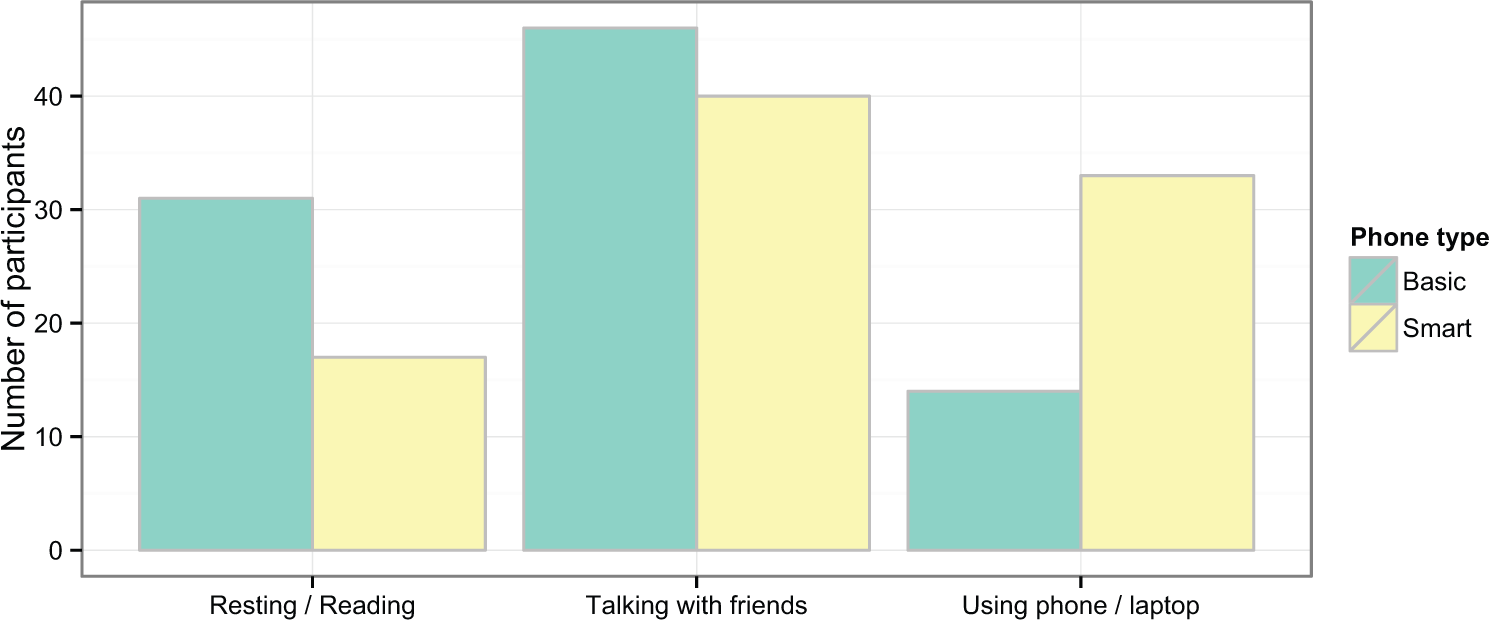
Number of participants in three categories of activities in public spaces.
Interactions: Is there anyone around?
One of the potential implications of this intense engagement with technological devices is a reduction in attention to the environment. Thus, when asked in the survey about occurrences that took place in each of the typological spaces discussed, the majority of participants in both groups had difficulty providing details. In both groups of participants, transition spaces were poorly described, with approximately two-thirds of participants not answering the question (61.4% of smartphone users and 71.4% of mobile phone users). As expected in both groups, participants were able to provide the most information about their private space (54.2% of smartphone users and 65.7% of basic mobile phone users). Again, in both groups, most participants tended to describe people, actions, or particular personal objects, with very few describing the physicality of a place or its amenities. We find that emotional attachment to the physical locale (Lofland, 1998) is weak, and focus is given to the concrete and virtual social territory defined by users.
This lack of attention to the environment is more evident when we examine social interactions among the different groups. As noted earlier in the text, one of the key elements associated with smartphones is the way they expand the spheres of interaction, modifying other interactions or activities by the user. By asking participants about different aspects of social interaction in different spaces, we found smartphone users to be more detached from their physical surroundings. This detachment included less social interaction (talking, observing) and less sensitivity to the social environment as a whole. The analysis shows that basic phone users were significantly more conscious of their surroundings than smartphone users in both public and study spaces. As depicted in Figure 2, when asked about their personal phone use in public and study places, basic phone users were more bothered than smartphone users by an average of 20%. These results are significant, with p-values of p = 0.006 for the public space and p = 0.009 according to an unpaired Wilcoxon Rank Sum.
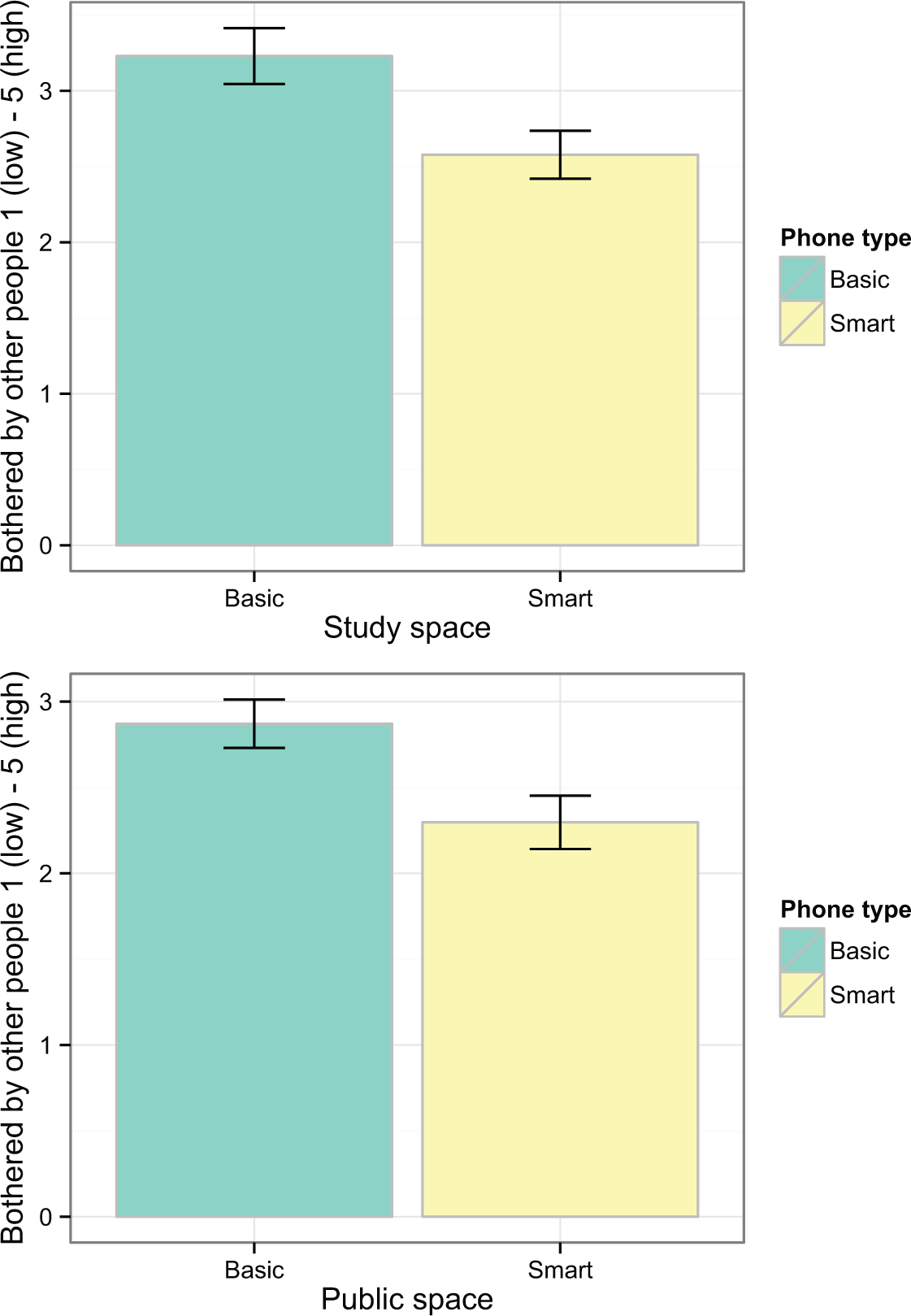
The extent to which participants are bothered by other people talking on their mobile phones.
One explanation may be that the ability of smartphones to provide personal visual and audio spaces (i.e. listening to music, writing messages) allows users to escape and ignore the actions of people around them. The increased isolation of smartphone users is also expressed in their perceived attitudes towards their own actions. Smartphone users are more likely to state that they would feel comfortable speaking on their phone in public and in study spaces than basic phone users. The result is significant according to a chi-square categorical test, with p = 0.038 and 0.006 for public and study spaces, respectively. Smartphone users’ enhanced activity on their phones is related to reduced attention to their surroundings as well as potential interactions with strangers, thus significantly modifying the activities of users in public. However, this reduced attention does not indicate disattention but rather new ways of addressing the sensory stimulation of the city and personal technological devices. It is a process of reconstituting a psychic state, reformatting attention by, in a sense, fragmenting space. This process facilitates the creation of a sort of filter between the sensory stimulation of the city (and personal contemporary devices) and the mind of the metropolitan individual (Lofland, 1998: 27).
Privacy: Are we alone?
Traditionally, public space differs from private space in terms of types of activities. If home is associated with intimate relationships, public is about social interactions with strangers and casual acquaintances – the hidden versus the open and revealed. This hidden/revealed relationship is a social construct and thus is dynamic and highly influenced by how we feel about our privacy and whether we feel comfortable exposing our intimate affairs in public. One of the most evident means by which an individual shows himself to be situationally present is through the disciplined management of personal appearance or a ‘personal front’, the complex of clothing, make-up, hairdo, and other surface decorations the individual carries on his or her person (Goffman, 1963: 25). Thus, if asked, an individual might say that he limits the noise that he makes out of consideration for the others present. By demonstrating this consideration, the individual is showing cognisance of persons by virtue of their presence in the situation, and in showing this, he demonstrates that he is open to and respectful of the gathering (Goffman, 1963). It is the demonstration of this committed ‘presence’ in the situation that others may want from the individual even more than the substantive value of the consideration itself (Goffman, 1963: 214).
This social code and its associated boundaries are becoming blurred with changes to the appearance and meaning of privacy in public. When examining individual privacy in association with physical space, the two groups of phone users differed significantly in their sense of privacy, comfort, and relationship with the outside environment. When reporting on the extent to which they believe their phone provides them with privacy (on a Likert scale), smartphone users answered in more positive terms than basic phone users. Figure 3 presents the average and distribution of the two groups across all spaces. The scale of the responses refers to the sense of privacy participants reported, ranging from 1 (not at all) to 5 (very much). In each of the different spaces about which the participants were asked, smartphone users believed that their phones provided them with better privacy than basic phone users. These notions were consistent and significant, ranging from a difference of 33% in the average value (in the transition space) to 12.5% (in the home space).
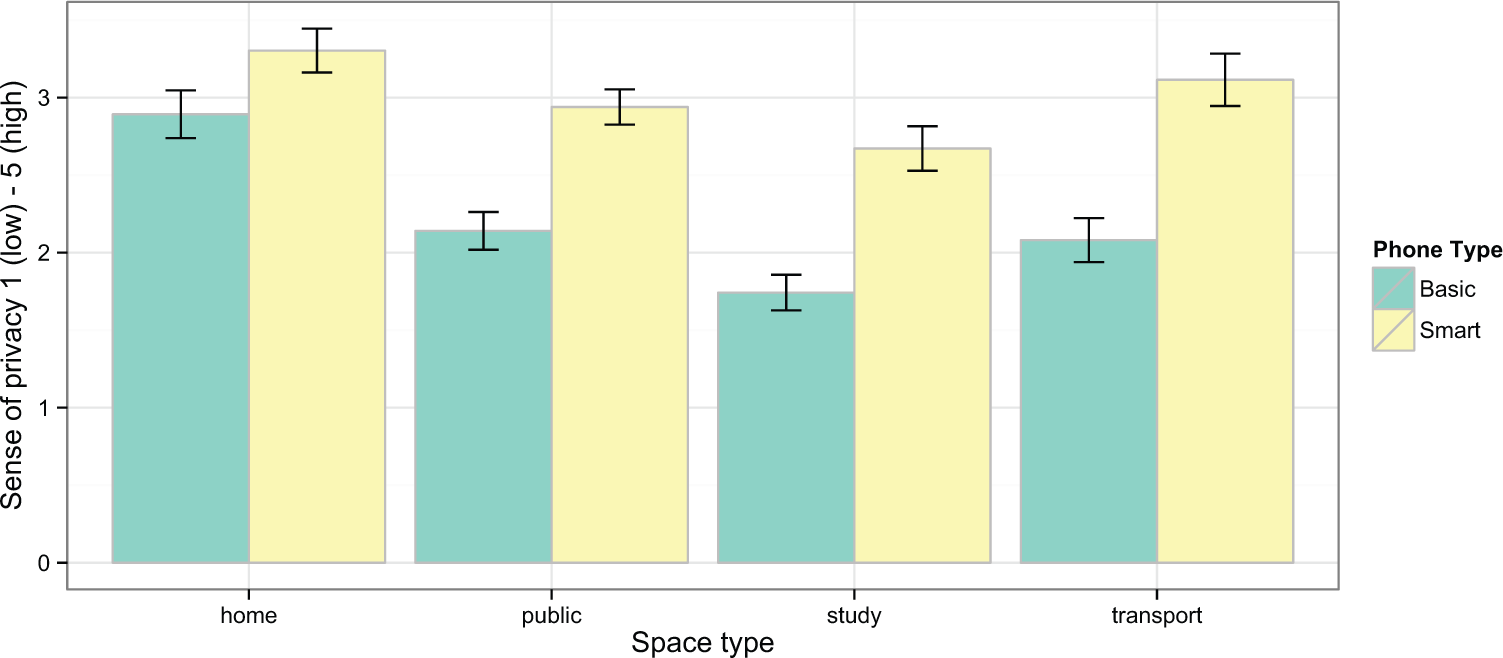
Sense of privacy in different space types and according to the type of phone. All differences are statistically significant: p < 0.05 for the home space, and p < 0.001 for the public, study and transport space (unpaired Wilcoxon Rank Sum test).
This growing sense of privacy also increases the dependency of users on their mobile phones (see Figures 4 and 5). When participants were asked to consider the possibility of spending a day without their phones because they forgot them at home, their answers highlight the importance of smartphones, particularly, to users’ daily lives. Smartphone users were twice as likely to feel out of date, 30% more likely to feel under pressure, and 30% more likely to feel lost than basic users. In addition, smartphone users were twice as likely to report negative feelings about being without their phones than basic phone users (p = 0.03, Binomial test with expected probability of 0.5).

Mean value for the sense of privacy for each space type.
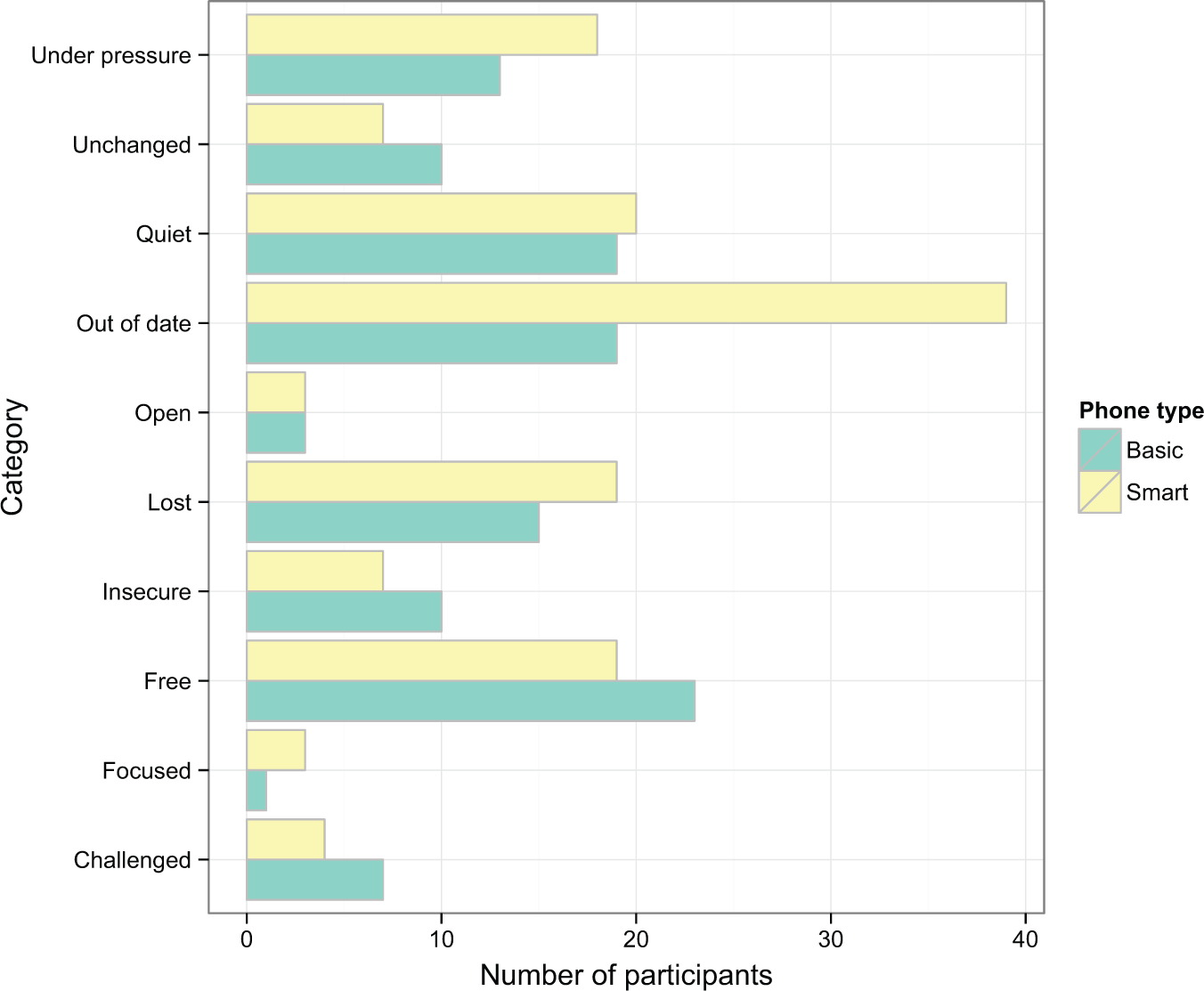
Participants indicate their feelings in response to forgetting their phone at home for a day.
In sum, as shown by mapping both groups’ patterns of behaviour in public spaces, the use of mobile technologies is shifting the way individuals exchange information and interact in public, multiplying the different spheres in which an individual can participate simultaneously. Mobile phones provide their users with unprecedented intensity of the user experience, providing pervasive, powerful communication and computing functionality. Users are within arm’s reach of their smartphone 50% of the time and are in the same room as their phone 90% of the time (Dey et al., 2011). Specifically, we see that both groups use mobile phones as a means to construct a dynamic personal space. Yet, it is clear that the group that uses smartphones has more tools for playing with this space, blurring the boundaries between the physical and virtual. In that sense, we see that public space definitions and norms, similar to the dictates of law and authorities, are being modified from below by private users, both consciously and unconsciously.
Conclusions: The emergence of portable private-personal territory (PPPT)
Based on these results, we suggest that both public and personal space can be seen as a social territory composed of locations and places. Indeed, the notion of location has often been subordinated to the idea of place and conceptualised as an aspect of a place, referring to an abstract point in an abstract place (Cresswell, 2004). The use of location-based applications and location-aware technologies contribute to individualising people’s perceptions of public spaces, and it is impossible to see place and location in hierarchical positions; rather, they are juxtaposed (De Souza e Silva and Frith, 2012: 8). Specifically, we observe that contemporary mobile technologies support the ability of the individual to participate simultaneously in multiple spheres of action and communication. This state of affairs creates what we have called a portable private-personal territory (PPPT): the space in which an individual, through the use of a technological device, can extend his personal space, creating a complex matrix (within programmatic limitations) of social spheres and interactions that is characterised by a multidimensional set of relationships defined by events and interactions. The PPPT is a social personal territory, the locus of a complex web of relationships that includes both person-to-person connections and person-to-space connections (Lofland, 1998: 51). Conceptually, the use of the word ‘territory’ to describe personal space expands the association of the personal space of the body to include virtual spheres as well as the concept of a territory as a complex set of spatial trajectories (either public or private). These varied personal territories are not just a way of describing the plurality of the social world we now inhabit; they are ‘integral to the (post)modern self, which is never complete and always fragmentary. Thus engagements in public arenas are also always temporary, contingent, partial, invented and reinvented, and open ended’ (Watson, 2006: 171). In this sense, we argue that the PPPT is a socio-spatial condition that contributes to the blurring definition of private–public, in which personal space is expanded to offer the individual the ability to navigate between the material and the immaterial. Paraphrasing Lyn Lofland’s definition of the public realm (Lofland, 1998: 12), the PPPT is a social, not a physical, territory; it is a social condition that comes into being by the individual in a space, in physical territories.
We conclude that as a social condition, the PPPT advances the following (see Figure 6):
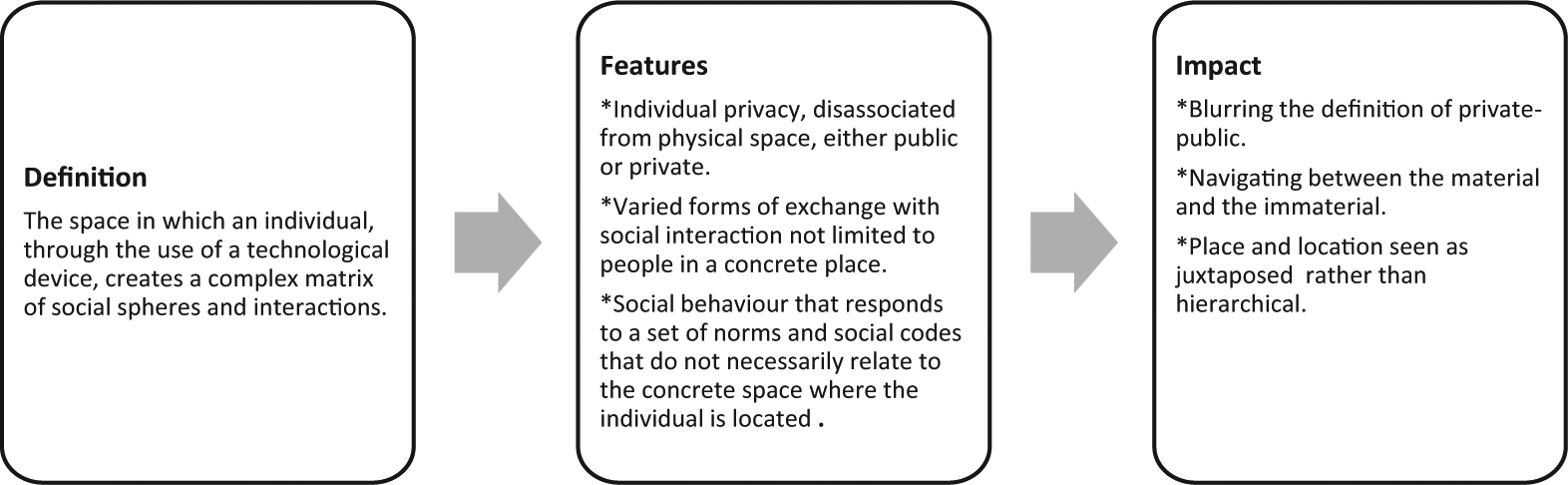
Portable private-personal territory: conceptual framework.
1. Varied forms of exchange with social interactions not limited to people in a concrete place
The physicality of space does not dictate social interactions; rather, it is one sphere among many. As argued by De Souza e Silva and Frith, mobile technologies reconfigure public space in two major ways: 1) they move practices previously confined to traditionally private space into the streets of the city; and 2) they give people a feeling of control and familiarity with public spaces typically associated with private spaces (De Souza e Silva and Frith, 2012: 186). This characteristic was supported by the empirical evidence, which indicated that with the support of smartphones and laptops, activities that traditionally took place in the private sphere are now taking place in public, enhancing multiple forms of exchange simultaneously (i.e. sitting with a friend while talking on the phone and checking email). This state of affairs, which expands social interaction and changes our perception of time, is blurring the distinction between the real and virtual and between the concrete and abstract.
2. Social behaviour that responds to a set of norms and social codes that do not necessarily relate to the concrete space in which the individual is located
This situation is a result of engaging with multiple spheres simultaneously, with the individual sometimes needing to respond to conflicting sets of norms and social codes. Here, as well, empirical evidence shows that mobile technology allows users to escape and sometimes even to ignore the actions of people around them. The increased isolation of individuals is also expressed in their perceived attitudes towards their own actions, particularly following accepted norms associated with a place. Yet, as Goffman has made clear, civil inattention is not disattention. The principle of civil inattention may require that one not be obviously interested in the affairs of the other, but it does not require that one not be interested at all. As such, it is fully compatible with the idea that inhabitants of the public realm act primarily as an audience to the activities that surround them (Lofland, 1998: 31). Thus, people do not use technologies to ‘withdraw’ from public space (De Souza e Silva and Frith, 2012: 36). Rather, they use mobile technologies to accomplish a goal similar to the blasé attitude: to interface their relationships with the other people and the space around them (De Souza e Silva and Frith, 2012: 27).
3. Individual privacy, disassociated from physical space, either public or private
Individuals can be connected to their private personal spheres everywhere. Thus, privacy becomes a portable state, disassociated from the physicality of space and associated with the notion of location. The popularisation of location-aware technologies contributes to the changing meaning of locations and their meaning in constructing the social personal territory. It is evident that people use different types of applications to access various types of information, which makes their perception of public space more filtered and personalised. The public space through which people move is perceived differently for those who do not possess location-based technologies or those who have technology but choose not to engage with it (De Souza e Silva and Frith, 2012: 11).
Based on the evidence, technological devices seem to support users’ belief that smartphones provide them with privacy. The question is not whether this is a false or true belief but rather what it means: that individuals disassociate privacy from the physicality of place and see their devices as a means of supporting privacy everywhere.
These conditions make mobile phones powerful devices in creating and maintaining individual personal space. Above all, they allow the individual to create elastic boundaries between the public and private and between the personal and the collective, modifying the ritual dimension of human communications in place. No doubt, formal knowledge, which tends to be easily accessible through ICT networks, is growing. However, as Stephan Graham suggests, ‘tactic knowledge’, which is often developed in trusting, face-to-face interactions, is gradually shrinking (2005: 574). As Amin and Thrift have suggested, technology is ‘becoming one of the chief ways of animating the city. They must not be allowed to take us unaware’ (2002: 128). What we see here is how the public realms of cities and the essential publicness is rapidly being ‘mass customised’, unbundled, commodified, individualised, and coordinated through networked technologies linking scales from the globe to the body (Graham, 2005). This state of affairs raises questions such as how these techniques influence identities, experiences, and perceptions of publicness. How do they shape the way we conceive the other? How are the social and normative judgements and inclusions that form the heart of public space altered in different sites and contexts? To state it differently, ICT extends human actions, identities, and communities; at the same time, it diffuses some of the rituals taking place in public. What are the implications of this condition? Given the limited space available here, we conclude by briefly highlighting two trajectories of questions raised by this discussion.
First, it is clear from this discussion that PPPT must be at the centre of any attempt to conceptualise the formation, maintenance, and experience of public spaces. A pressing imperative for planners and geographers, in particular, is to fully address and excavate the way technological devices redefine the relationships between material, virtual, and social dynamics in public spaces – more importantly, the way mobile technologies alter the definitions and correlations between the concepts of territory, place, and location. Instead of thinking about people detached from spaces or privatising them, mobile technologies can be viewed as interfaces to public space that enhance new interaction rituals (in Goffman’s sense) linked to personal socio-spatial territoriality. In this sense, we can argue that technological set-ups are not about isolation but rather are about multiple simultaneous territorialisation.
Second, it is evident that PPPT produces various spaces and times. It is a sphere through which the individual’s spatial and perceptional divisions are extended. Yet, we know very little about the complex composite of these extensions and the way they influence our engagement with public space. How can social programmes and policy address this dynamic? To what extent are policy makers, planners, and technology designers truly and critically aware of the effects of PPPT on material space? What policy instruments might best address these fast-moving devices that bring new standards, norms, and transparency to public spaces?
In sum, this paper has sought to underscore the centrality of individual technological devices, particularly the way mobile phones (basic mobile phones and smartphones) restructure social interaction in public spaces. It has also illustrated the need to re-think the relationships between ICTs and the role of public space in contemporary cities. Clearly, as suggested in this discussion, public/private cannot and should not be seen as a linear continuum but rather as juxtaposed spheres with different degrees of privacy and publicness. The question is not whether the private is becoming more dominant than the public but rather what the social consequences of this new technology are. In other words, what are the implications of the elasticity of boundaries, and what type of territories do people compose together? This is highly relevant if we think about the role of public space as a place of encountering the stranger, where modern technology allows users to reduce this interaction to a minimum. In the past, a stranger might stop for directions in a plaza, but these chance acquaintances rarely happen today. Nevertheless, we suggest that technology should not be seen as either liberating or controlling; rather, we should ask about the power and influence of technology for modifying social rituals. In reflecting upon this situation, societies face two different scenarios: 1) they can adopt technology without critically addressing its social consequences, particularly the interaction patterns, or 2) they can develop technology as an instrument as well as a socio-spatial tool, a juxtaposed site of the virtual and the material, that supports publicness. In addressing this task, tech entrepreneurs and programmers must change their priorities to consider the public good before capital gain. Moreover, municipalities must address transparency before control to see technology as a means of enhancing the qualities of publicness rather as a means of surveillance.
Footnotes
Acknowledgements
The authors are deeply indebted to the editorial staff at Urban Studies, in crafting the revised version of this paper, and to several anonymous reviewers for their input. In addition, we would like to thank our research assistant Carmel Hanany for collecting and organising the data of this study.
Funding
This research was supported by funds provided by the Vice President for Research, Tel Aviv University, Israel.