




Abstract
The paper deals with issues of corruption in the planning domain. It centres on thorough analysis of the case of Desio (Milan, Italy), where a recent judicial inquiry discovered several instances of corruption related to the drafting of the local master plan, in an environment characterised by the rooted presence of a mafia-type organisation known as the ’Ndrangheta. The study sheds light on the various types of corrupt practices that prevail in the field of urban planning, the main issues at stake, and the key public agents involved. General hypotheses about the main internal and external factors fostering corruption in the planning domain are presented and discussed.
Introduction: The illicit in urban development
Although illegal activities are the focus of a great many recent studies published in political science, sociology, and criminology, very few of these studies pay much attention to the spatial dimension and urban scale of these phenomena (Hall, 2013). In particular, the enquiries that pivot specifically on the problems of corruption in the domain of urban planning amount to a handful. This omission is somewhat bizarre given the extent of the phenomena in question. For instance, according to Transparency International (2011: 2–3), ‘Corruption in the land sector can be generally characterised as pervasive […] The government bodies which oversee the land sector are one of the public entities most plagued by service-level bribery’. In fact, several researchers have stated that corruption is particularly rife in the planning sector (Chiodelli and Moroni, 2015; Cullingworth, 1993; Gardiner and Lyman, 1978; Haar and Kayden, 1989; Murray and Frijters, 2016). According to these scholars, the amount of corruption in the planning domain is linked primarily to some constitutive features of traditional planning systems; but, in almost all these cases, this relation between certain characteristics of the planning system and the spread of corruption has been postulated in a deductive manner, without any in-depth case studies that could corroborate these theoretical statements and provide insights into the real mode of operation of corruption. However, ‘truly robust explanations of political corruption demand that research into the phenomenon progresses beyond purely abstract (theoretical) analyses’ (Lancaster and Montinola, 1997: 203). The present paper is an attempt to fill this gap. In particular, it conducts a detailed study on some recent instances of corruption in the field of urban planning in the municipality of Desio, close to Milan, Italy. These instances occurred in an environment characterised by the rooted presence of a mafia-type organisation. The analysis sheds light on the main issues at stake in corrupt transactions, the key public agents involved, and the stages of the planning process most vulnerable to corruption. This makes it possible to test some hypotheses about the main factors determining corruption in the planning domain (and about the role of mafia-type organised crime).
First, the main approaches to corruption in the public sector and the limitations of the current planning literature on this issue are analysed. Second, background details on the presence of organised crime in Desio and on the case study are provided. Then, the paper provides a detailed report on various instances of corruption related to the 2009 Desio local master plan. The subsequent section inquires into the specificity of corrupt practices which have taken place in the case studied. It also discusses hypotheses as to the factors determining corruption in the planning domain. The last section is devoted to concluding remarks.
The factors determining corruption in the public sector and in the planning field
The debate on different aspects of corruption in the public domain (e.g. definitions, types, approaches, causes and solutions) is huge and complex (see, among many others: della Porta and Vannucci, 2011; Heidenheimer and Johnston, 2009; Heidenheimer et al., 1989; Jain, 2001; Rose-Ackerman, 1999, 2006). It is not the main purpose of this paper to discuss all these aspects. It will therefore take certain of them for granted. This concerns, for instance, the definition of what constitutes corruption, which is identified as ‘behaviour which deviates from the formal duties of a public role because of private regarding […], pecuniary or status gains’ (Nye, 1967: 419). On the contrary, this section focuses on the debate about the main models explaining corruption, since this is crucial for the argument of this paper. In this regard, it is possible to identify three theoretical approaches: political-economic, socio-cultural and neo-institutional (della Porta and Vannucci, 2012).
The political-economic approach stresses the role of economic incentives, disincentives and opportunities for corruption. It maintains that corruption is an outcome of a rational calculation, and its spread is related to the expected costs and benefits vis-à-vis other alternatives. One of the main advocates of this approach is Klitgaard (1988), who stated that corruption equals monopoly plus discretion minus accountability. A revised version of this formula considers the role of confidential information as well: bribes can be paid also in order to gain access to this kind of information (della Porta and Vannucci, 1999).
The socio-cultural approach centres on cultural aspects: it explains the spread of corruption with reference in particular to cultural traditions, moral norms, civic culture and values that inform the moral preferences of individuals. It maintains that internalised values and social pressures push individuals toward corruption (see, for instance, Pizzorno, 1992). This approach stresses in particular the ‘moral costs’ of corruption. In short, individuals are less liable to corruption within a social system that supports respect for the law.
The neo-institutional approach goes beyond external variables such as moral costs or economic incentives to corruption, and considers internal factors such as the dynamics of networks and transactions.
The co-evolution of economic incentives and cultural values […] is path dependent. The heritage of corruption in the past produces increasing returns by neutralizing moral barriers, creating more profitable opportunities rooted in formal procedures and decision-making processes, providing organizational shields and mechanisms of protection against external intrusion by authorities, and reducing internal friction among corrupt actors. (della Porta and Vannucci, 2012: 136)
This third approach stresses in particular the role of the ‘legacy’ of corruption in a specific environment.
These three approaches emphasise different elements that foster corruption; however, they are not mutually exclusive and can be taken into consideration simultaneously. For instance, according to Vannucci and Sberna (2014), it is possible to combine the contributions of the three aforementioned approaches in a sort of ‘holistic viewpoint’, in order to identify six main factors fostering the spread of corruption within a given political-institutional system. These factors are: (1) the economic returns generated by a public decision; (2) the degree of discretion allowed to the public authority in creating, distributing and expropriating those economic returns; (3) the potential of reserved information available to public officers; (4) the degree of accountability within the public bodies; (5) the ‘moral weight’ of the illicit transaction; (6) the backlog of corrupt practices, and how this inheritance fosters further involvement in corrupt dealings. This ‘holistic viewpoint’ is particularly interesting in regard to research on corrupt practices in urban planning for several reasons. In fact, the (scant) planning literature on corruption in the planning domain usually assumes a political-economic approach (see, for instance: Chiodelli and Moroni, 2015; Gardiner and Lyman, 1978) which fails to consider the role of other elements, such as the moral costs and the legacy of corrupt practices.
To be stressed is that, although Italian research on corruption (and organised crime infiltration) in the planning field is comparatively richer than research on other Western countries, it suffers from similar problems. In fact, all the studies published in Italian on this issue have been unable to explain the specific and concrete operation of illicit practices in the field of urban planning. They have always limited themselves to theoretical analyses, which, in many cases, are not specific and in-depth. For instance, the role of general factors such as ‘deregulation’ (Donolo, 2001), ‘neoliberalism’ (De Leo, 2012), and ‘technical and moral weaknesses of planners’ (Lanzani, 2012) have been stressed. These studies provide no information on the real functioning of corrupt practices. On the contrary, this paper conducts empirical and detailed exploration of a true case, so that the specific and concrete functioning of illegal practices, the role of actors involved, and features of the planning process that favour illicit acts are disclosed (see section ‘The corrupt plan’). The paper thus contributes to the theoretical debate on the causes of corruption in the domain of urban planning by testing some general hypotheses formulated with reference to other sectors of the public administration (see section ‘Discussion: Forms and determining factors of corruption in the planning domain’). 1
The context: Illicit practices in Desio’s urban development
Since the 1990s several judicial investigations have brought to light the infiltration and settlement (Sciarrone and Storti, 2014) of mafia-type organised crime in various regions of northern Italy (Sciarrone, 2014). In particular, Lombardy has been infiltrated mainly by the ’Ndrangheta, a mafia-type organisation which originates in Calabria, the ‘toe’ of Italy (Sergi and Lavorgna, 2016). The ’Ndrangheta in Lombardy is conspicuously present in Milan, and in several boroughs of the city’s metropolitan area (Chiavari, 2011; Ciconte, 2010; Rossi, 2015; Storti et al., 2014).
The most extensive judicial investigation so far conducted on the ’Ndrangheta’s presence in Lombardy goes by the name of ‘Endless’ (Infinito). The investigation lasted several years, and in 2011 led to the conviction at first instance of around 160 individuals. The Infinito probe revealed the presence of various ’Ndrangheta cells 2 entrenched and operating in Lombardy. Among the various cells active in the Milan area, the one in Desio is particularly well established.
The municipality of Desio has around 40,000 inhabitants, and lies some 10 km north of Milan. It is situated in an extensively built-up area with many factories and production units, all closely connected with Milan from an economic and functional point of view. Desio was one of the first cases of ’Ndrangheta’s infiltration in northern Italy (Tribunale di Milano, 2010b). The Desio cell had begun its activities in the 1970s (Storti et al., 2014), extending its tentacles into various fields, both legal and illegal. Several profitable activities of the Desio cell have been made possible by close contacts with politicians and bureaucrats in the public administration (Tribunale di Milano, 2010b).
Following the publication of assorted material evidence linked to the Infinito investigation, in November 2010 most of the members of the Desio council handed in their resignations, causing the collapse of the local government. However, the troubles for the Municipality of Desio linked to judicial investigations did not end there. In fact, a subsequent inquiry (Tribunale di Monza, 2012) revealed widespread corruption in the field of urban planning and development in Desio. The corruption was particularly linked to the local master plan (Piano di governo del territorio, PGT) adopted in 2009. Among those involved in this system of corruption were politicians, municipal civil servants, and entrepreneurs.
Note that the inquiry into the PGT of Desio is separate from the Infinito investigation, and not explicitly linked to the activities of the ’Ndrangheta cell in Desio. There are two points, however, that should be stressed. First, the judicial inquiry on the PGT revealed that several key figures in the investigation were in touch in various ways with individuals linked to the ’Ndrangheta. One of them was the director-in-chief of the planning office of Desio Municipality. According to the judicial inquiry, he had been ‘leaned on’ by members of the ’Ndrangheta cell of Desio (Tribunale di Milano, 2010b: 697). Another was an eminent regional politician (who is also a local real-estate entrepreneur), who reportedly on several occasions ‘came into contact’ with members of the ’Ndrangheta in Lombardy (Tribunale di Milano, 2010a). More in general, as Ricchiuti observes (2013), ‘from the wiretaps, videos, and photographs, it has come clear that numerous political exponents and individuals in the administration have close relations with figures linked to the ’Ndrangheta’. Second, to be noted is that the cases of misconduct uncovered by the magistracy form part of an array of illicit dealings connected with Desio’s urban development (Lanzani, 2012). This context of widespread illegality is part and parcel of the climate of intimidation, omertà (code of silence) and impunity that the presence of the ’Ndrangheta has generated in Desio (Storti et al., 2014), whose existence, in fact, was well known to anyone living and working in Desio long before the Infinito inquiry was launched (D. Cassanmagnago, alderman for urban planning in Desio from 2011 to 2015, personal communication, 3 March 2016).
Research design and methods
The case in question was selected for substantive and practical reasons. First, the case itself is particularly interesting because of its complexity. Different phases of the planning process were engaged in corrupt practices – specifically when the local master plan was being drafted and implemented. Additionally, many actors were involved, including entrepreneurs, professionals, local and regional politicians and civil servants. Moreover, a mafia-type criminal organisation played a role in illicit practices in the area. Another reason why this case was selected is because it is one of the few recent and large cases in Italy in which the Italian magistracy has focused its inquiries specifically on the corruption occurring in the planning sector. Given the well-known methodological difficulties of studying corrupt practices (Ades and di Tella, 1997), the documents of the magistracy are therefore crucial: the wiretaps, interrogations, and reports made available furnish a detailed picture of the entire affair that would otherwise have been impossible to reconstruct from other sources. The printed versions of the judicial materials were made accessible to the author. They were thoroughly analysed and were used as the main source of fundamental research data on tactics, actors and the reasons for illicit practices that occurred during urban planning in Desio. The materials also provided research data that included suggested interview questions and potential situations to investigate during fieldwork (Bowen, 2009). 3
The copious judicial material was integrated with the fieldwork that was conducted from May 2015 to September 2016. During that time, the focus was on conducting interviews and collecting official documents that were related to urban planning in Desio. Overall, twelve face-to-face interviews were conducted. 4 Five interviews were in-depth, semi-structured and lasted approximately one hour. These interviews included two politicians, one professional who had been working at the master plan and two civil servants who were employed in the Municipality’s planning department. Each of these were recorded and transcribed verbatim to avoid any misinterpretation. The purpose of conducting these in-depth interviews was to explore various aspects related to the 2009 plan and to illicit practices that may have occurred in the field of urban development in Desio. Then, seven unstructured interviews were conducted – these included three local entrepreneurs in the field of urban development, two local architects and two local landowners. In the majority of the unstructured interviews, the interviewees asked not to be recorded and to remain anonymous. Because of the difficulties in approaching informants for such a sensitive topic, snowball sampling was used to identify the interviewees.
The results of the interviews were triangulated with the judicial materials and with the official materials that were collected during the fieldwork. The two main types of documents that were collected and analysed were the transcripts from all of the meetings of the local council and the planning commission that were related to the 2009 PGT, and all of the planning documents that are at the centre of the judicial investigation, which include the 2009 PGT and the related detailed schemes and planning agreements. 5
The corrupt plan
Instances of corruption related to the 2009 local master plan
In April 2014 the Monza court issued a judgement at first instance in the trial concerning several matters linked to the 2009 Desio PGT.
The judgement pivoted on three people sentenced in the first degree for corruption and several related crimes (such as malfeasance, misappropriation, and bankruptcy fraud) to several years in prison. At the time of the events, one was an important regional politician. Another was the alderman for urban planning in Desio. The third was director-in-chief of the planning office in the Desio municipality. In many cases, according to the Magistracy, the corruption mechanism worked as follows: the regional politician applied pressure on a local alderman for urban planning and on the director of the planning office so that certain decisions were taken in favour of specific people or companies, from whom he received various benefits (such as money for himself or funds for his political activities). Meanwhile, in exchange for their services, the local alderman and the director of the planning office obtained consultancy posts for both public bodies and private companies, together with money and material benefits of other kinds (Tribunale di Monza, 2014).
The most salient instances of corruption in the investigation concern similar occurrences whereby, broadly speaking, the 2009 PGT allowed building on land that had previously been assigned to agriculture, with various advantages accruing to the indicted trio or persons associated with them. An example is provided by the events regarding the so-called ‘Transformation Area No. 2’ (ATR No. 2) (see Figure 1). 6
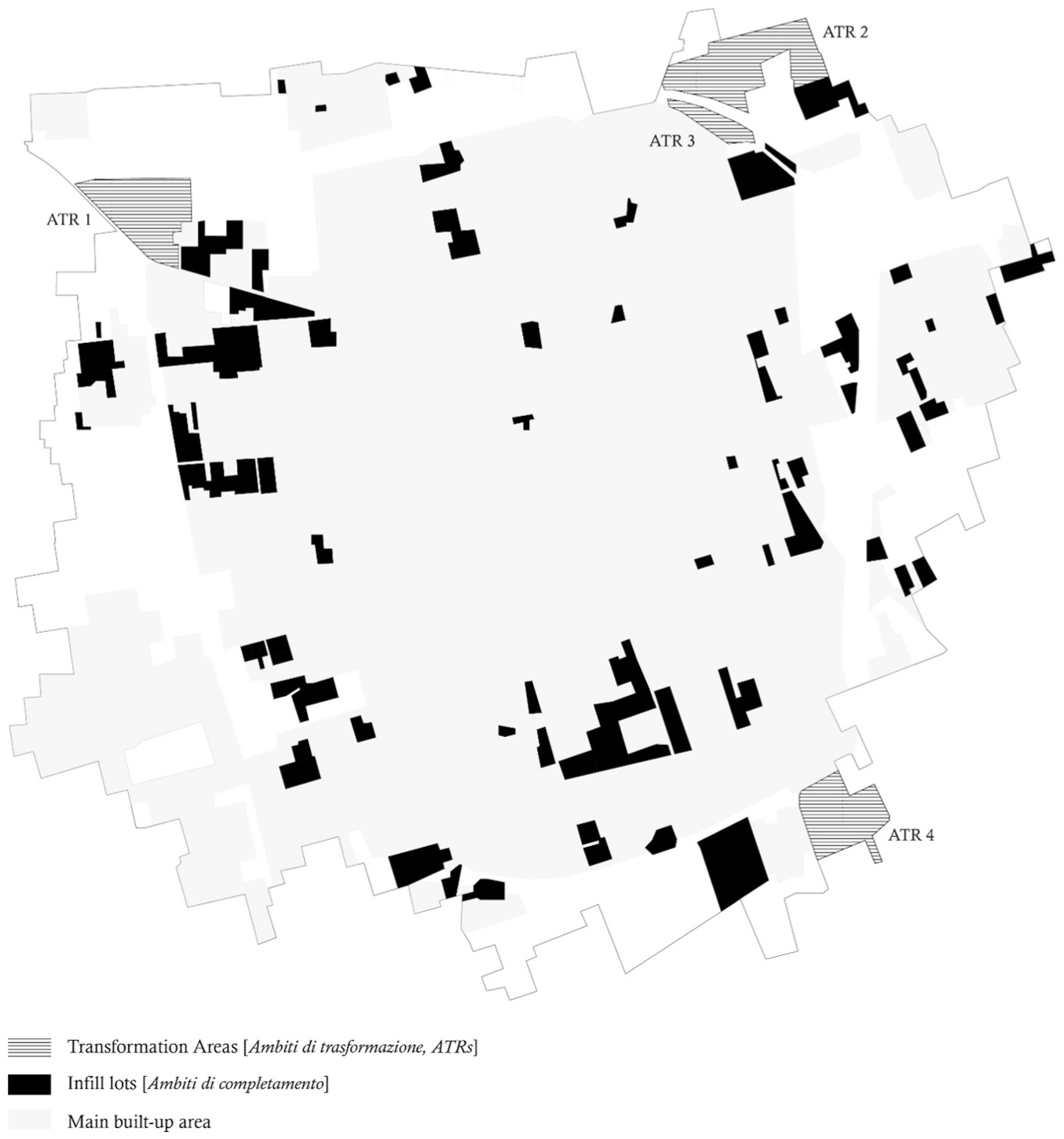
Areas of urban development (Transformation Areas and Infill Zones) envisaged by the 2009 Desio PGT.
The ATR No. 2 is an area in the northeast of Desio, which is prevalently farmland and hosts a rural hamlet dating to the 17th century with several historic buildings. The 2009 PGT envisaged a change in land use from farmland to development, for which two large building projects were proposed: a block of residential units next to the historic hamlet and a mixed shopping and office complex in the north-east segment of the area (Comune di Desio, 2009a: 183–184). The change in land use alone would have netted the owners 16 million euros (Tribunale di Monza, 2012: 97) – on top of which we can add the value generated by the sale (or rent) of the buildings constructed on the parcel of land in question.
The PGT authorised this transformation even though the same plan elsewhere acknowledged the unique value of the area as one of the very few remaining stretches of Desio’s territory with significant environmental and historical value (Comune di Desio, 2009a: 145–147).
The situations of the other three ATRs in the plan followed a similar pattern: the zones switched from farmland to residential, commercial, or tertiary areas. Overall, the value of the land of the four ATRs in question rocketed from 8.7 million euros before the PGT to 62.3 million after (Tribunale di Monza, 2012: 97). According to the judicial report, in all the cases the reasons why the local master plan allowed the building development of these agricultural areas can be traced back to corruption practices and illicit pressures.
That said, illicit behaviour and corruption were not exclusive to the manipulation of land use for these four areas. For instance, in the case of the Transformation Area No. 4, the areas ceded by the real-estate developer to the Municipality in exchange for the reallocation of end-use were less than the amount required (54,000 m2 instead of 72,000 m2); development levies were far less than those envisaged by law (2.7 million euros instead of 5.7 million euros); and the gross surface area of paving effectively awarded by the Municipality for development was around 3000 m2 more than the quota required. Note that these figures were not established in the PGT, but specified in the detailed scheme and in the planning agreement relative to the area in question (see note 5). To this back-story we should add that a portion of the area (amounting to around 2000 m2) was purchased by the real-estate company from the Municipality for a sum below the market price (i.e. 160,000 euros instead of the likely market value of around 400,000 euros); furthermore, certain bureaucratic problems regarding the ownership of the development area were sidestepped by the Municipality so as not to slow down the planning procedure (Tribunale di Monza, 2014).
The judicial inquiry uncovered further illegal business regarding other urban developments, albeit of less magnitude than those cited above. This concerns, for instance, some other cases of change of end-use ad personam: specific areas were assigned with building rights for the main purpose of benefiting specific landowners, who had ties with the three figures indicted in the trial. Another instance is the deliberate delaying of the necessary joint signing of a planning agreement between the Municipality and a developer so as to exert pressure on the latter to sell a building to one of the indicted parties for a lower price.
Generally speaking, all these operations were ‘openly in contrast with the principles of impartiality, standard procedures, and proper conduct of the Public Administration […]. The only logical explanation for such conduct lies in the presence of a set of private interests served by public officials, and in the relative “payoffs” that those public officials received in exchange’ (Tribunale di Monza, 2012: 70).
The rest of the plan
The judicial inquiry concerned a limited number of the land transformation cases envisaged by the PGT. And yet one gains the impression – despite the lack of substantiating evidence – that other sections of the PGT may also have been subject to illicit pressures. This impression is given by various factors.
The 2009 PGT foresaw the urban development of around 1.4 million m2 of council land. Only a small portion of these transformations (some 400,000 m2) concerned the four ATRs involved in the judicial inquiry; the rest regarded the so-called ‘Infill Zones’. These were lots which, on paper, ought to be fairly small in size and located within the built-up area, and which were hence presented as ‘filler’ schemes for the existing urban fabric (Comune di Desio, 2009b: 51). In practice, however, a fair number of these appointed infill zones included empty parcels of land outside the built-up area, some of considerable size, others in actively cultivated farmland (see Figure 1).
It is very unlikely that the decision to convert all these tracts of land into buildable areas took place without any form of illicit manoeuvring. Indeed, accusations of identifying building plots ‘on the basis of surnames’ were voiced on various occasions during City Council meetings on the PGT (Comune di Desio, 2009c, 2009d). Note, for instance, the words of a professional close to the municipal administration (D.C., personal communication, 17 May 2016): ‘rumor has it that in many cases the business of marking out areas for infill operations was done systematically: if you wanted a given plot to be zoned as a building area, you had to pay someone off. And, in fact, if you look at the plan, there are some glaring cases of atrocious decision-making’. Similarly, during the draft phase of the plan, there was widespread talk of property shifting hands, basically plots of agricultural land that soon afterwards were relabelled as buildable in the 2009 plan (R. Corti, Mayor of Desio from 2011 onwards, personal communication, 28 May 2015). Some of these rumours were confirmed by the judicial inquiry (Tribunale di Monza, 2014).
Moreover, the sheer size of the buildable areas inserted in the 2009 PGT is striking when seen in light of the fact that the Desio Council’s territory is already densely urbanised: in the year 2012 that area amounted to 67% of the council’s total surface (PIM, 2015). At the same time, within the town itself there are various pockets where revitalisation and densification projects are possible (Comune di Desio, 2015; A. Lanzani, urban planner, personal communication, 3 March 2016). The 2009 plan, in fact, makes repeated reference in the clearest of language to the importance of limiting the urbanisation of new land, and conserving the scant agricultural land still pertaining to the community: ‘the consumption of land has reached levels of serious alarm. [… We are facing a] process of ongoing assault and rampant consumption of the territory and natural amenities. […One] of the main issues that planning must tackle is the urgent need to retrieve, regenerate and conserve our agricultural land’ (Comune di Desio, 2009b: 137–138). In spite of such outspoken declarations of principle, the plan itself has enabled the urban development of 10% of the council’s entire territory, equal to one-third of its unbuilt surface area. Paradoxically, this choice was formally justified by its proponents by the need to protect green areas (Comune di Desio, 2009a, 2009d): in exchange for the building permits conceded, the Administration would have had the opportunity to obtain significant areas of land which it would subsequently safeguard or transform into greenspace amenities. However, in the eyes of the Monza Court, these justifications are hardly defensible (Tribunale di Monza, 2014). In fact, the conservation of unbuilt spaces of land may be easily accomplished through other planning choices (e.g. planning restrictions) without having to convert farmland into buildable land.
Discussion: Forms and determining factors of corruption in the planning domain
Forms of corruption
The analysis of the case of Desio reveals that the instances of corruption in Italy can concern two distinct phases in the planning process (see Table 1). The first is the phase in which the PGT is drafted and approved, and during which the crucial factor is the assignment of land-use and building quotas. What the corruptors want is to have specific areas designated for building development and to obtain high building quotas. Decision-making on the PGT is largely in the hands of the political branches of the Municipality and the planners assigned to drafting the plan. With reference to the case of Desio, according to the magistracy in this phase the person most involved in manoeuvring things behind the scenes was indeed the alderman for urban planning. Even the planners who drew up the plan admitted that many choices were largely expressions of political intent, and were not based on a specific technical rationale (Comune di Desio, 2008). 7 It must be stressed that, in all the instances cited in the previous section, the planning decisions followed the formal procedures to the letter: they remained within the legitimate bounds of political involvement, and were carried out in compliance with the procedures prescribed by the law. Nonetheless, the magistracy maintained that, despite the formal respect for the legal procedures, the decisions were made for illicit ends, that is, in favour of specific private interests, such as those of the owner of the land now re-assigned as developable, and those of the politicians who gained private rewards in exchange for their role in the decisions taken (Tribunale di Monza, 2014).
Phases, types, and parties involved in planning corruption.

A second phase of the corruption process can concern implementation of the general decisions taken in the master plan. In this case the situation is more complex than in the previous one, owing to the complexities of implementing a master plan decision in Italy. The stakes are also varied. The main technical documents involved in the illicit pressures are the detailed schemes and the planning agreements.
In some cases, illicit pressure is applied to obtain fraudulent benefits, such as a reduction of the standard development levies disbursed to the Municipality by the private developer. This kind of operation works by bending the interpretation of planning regulations or through outright fraud. This is made feasible by two factors. The first is the ambiguities of Italy’s planning regulations, which leave a certain margin for interpretation in several instances. The second is that those who deliberately bend these interpretations are probably well aware that the sheer mass of intricacies, complex procedures, and myriad technicalities that characterise the Italian planning system ensure that scrutiny is very difficult and the fraud will almost never come to light (L. Fregoni, the current director-in-chief of the planning office in Desio, personal communication, 8 April 2016). Although many planning decisions are in fact submitted to democratically elected bodies – such as the Local Planning Commission, the Executive Committee of the Municipality and the City Council 8 – their supervision covers only the basics of a given decision, and approval is often almost automatic. Indeed, the political bodies in question are either pressed for time or lack the qualifications necessary to assess the technical details of the planning procedures that they are required to vote upon. These technicalities are entrusted to the municipal planning office, and they are the responsibility of the office’s director-in-chief, who is therefore a key figure in the entire cycle of planning procedures.
In other cases, illicit forms of pressure take advantage of the margin of discretion legally permitted by the decision-making system. This can happen for instance during the negotiations of terms for a planning agreement. Here too it can occur that, as happened in Desio, formal procedures are not actually violated. However, according to the law, any public decision to make special concessions to a specific private citizen is unlawful if it is not ultimately in the public interest (witness the case above in which a parcel of public land in Desio was sold for far less than its market price). It is worth stressing that an illicit special treatment can also be geared to work against a private individual: for instance, the above-mentioned threat to delay a planning procedure was a form of illegal pressure exerted on a building developer. As in the preceding case, once again the director-in-chief of the municipal planning office is a key figure in all these cases, since he is directly in charge of these procedures.
The factors determining corruption in urban planning
According to the literature on corruption in the public domain, various factors can contribute to the spread of corruption. Some of them relate to the socio-cultural features of the context. Some others relate to the internal dynamics of networks and transactions. Then, there are also pull factors connected to the opportunities, incentives and disincentives offered by the specific institutional structure of a public sector.
What emerges from our study of the Desio case is that the presence of organised crime and certain features inherent to the planning system itself contribute in different ways to the spread of corruption.
The role of organised crime
In line with the literature on both the role of organised crime in corrupt practices and the governance mechanisms of corruption (della Porta and Vannucci, 2011), in our case the presence of the ’Ndrangheta appears to contribute to the proliferation of corruption in the planning field especially because of its influence on the moral costs and the mounting backlog of corruption. In fact, the ’Ndrangheta’s presence in Desio has fostered the spread of many kinds of illicit dealings within the council administration for several decades (Tribunale di Milano, 2010b), generating a climate of lawlessness and impunity in the town (Storti et al., 2014). In this way, the ‘moral cost’ of fraudulent behaviour in Desio decreased greatly (Fregoni, personal communication, 8 April 2016). At the same time, the ’Ndrangheta increased the weight of ‘inherited backlog’ of corruption by guaranteeing a certain stability, order and relative predictability within networks and practices of corruption in the field of urban development sectors, through its role of specialised broker and guarantor of illicit dealings. This is testified, for example, by Cassanmagnago (personal communication, 3 March 2016), who speaks of a well-tested mechanism to control and share out building programmes and real-estate operations in Desio: ‘There was a well-oiled mechanism in place whereby several political figures steered the planning decision-making processes, aided by technicians within the planning office and the collusion of estate agents’. Likewise, Fregoni (personal communication, 8 April 2016) mentions numerous shady deals in Desio’s planning sector over the past decades, particularly ones aimed at speeding up the issue of building permits, or reducing the risk of site controls. The presence of ’Ndrangheta always appears in the background of these illicit activities.
The features of the planning system
While the presence of organised crime weighs on the moral costs and the legacy of corruption, several pull factors, which are usually stressed by the political-economic approach to corruption in the public domain, are linked mainly to the specific characteristics of the planning system. These main factors are the following.
First, economic returns
In a great many cases, the economic returns generated by the planning field through public decision-making are considerable. A simple line drawn on a planning chart can determine whether or not a lot is developable, exponentially affecting its value. In the case of the four ATRs of the 2009 PGT for Desio, the mere identification of those areas as buildable land increased their value by over 50 million euros. A similar added value, obtained simply by the stroke of a (discretional) municipal decision, becomes a huge incentive for landowners to put pressure – legal or otherwise – on those within the public administration with clout in the decision-making process. As Ellickson (1973: 711) stresses, ‘the amounts of money at stake in switching parcels of land from one zone to another assure that zoning will continue to be an arbitrary and largely corrupt system’.
Second, discretional margin
These planning decisions, with their promise of huge returns, are characterised by a high degree of discretion. This is due to both ‘internal’ and ‘external’ reasons. One of the internal reasons is the fact that the technical rationale of planning is particularly weak; the consequences are that, in many cases, it is subordinated to a political rationale, meaning that the main reasons for many planning decisions are of a political nature (Alexander, 1981; Chiodelli, 2012; Flyvbjerg, 2002; Mazza, 1995; Reade, 1987). Put briefly, there is no decisive technical basis to the planning choice made; that is, there is no ‘natural necessity’ to determine whether a certain area is zoned as residential (and in what ratio) or left as farmable land. Obviously, this gives a great deal of discretional power to the decision-makers. As said, during the drafting phase of the Desio PGT, for example, the planners commissioned admitted that some of the crucial choices related to land use were of a distinctly political nature; for one, no technical factors were decisive in pinpointing the ATRs. Among the external reasons for the high level of discretionality in the planning domain is the fact that, at least in Italy, the public officials involved have few constraints in terms of their decisions on planning issues, for instance as regards land-use and building quotas assignations (Moroni, 2007). To this we may add the fact that in Italy – as in other Western countries – during certain phases of the planning process, urban planning regulations explicitly allow a margin of discretional negotiation between public and private (this refers, for instance, to the contents of the detailed scheme and planning agreement).
The Desio case reveals that there is also another type of discretionary power, which comes into play with the interpretation of the planning regulations: some of these norms allow a margin of discretion because they are either incomplete or ambiguous. Consider for example that the schedule for signing the planning agreement is largely at the discretion of the municipal officer in charge. This kind of broad margin can clearly be used in an unlawful manner, as indeed happened in Desio. To sum up, as Epstein (2005: 12) states, ‘the amount of discretion built into the [planning] system is simply inconsistent with the rule of law’.
Third, reserved information
For certain planning decisions, the municipal officials can use their inside knowledge of confidential details as bargaining chips for personal gain in the course of illicit transactions. For example, they may have information on which areas will be assigned as developable in a local master plan. Here too, the case of Desio is instructive: it was rumoured at the time that several properties changed hands in the run-up to the plan’s approval (Corti, personal communication, 28 May 2015). The judicial inquiry confirmed those rumours.
Fourth, accountability
The degree of accountability in planning matters is often remarkably low. It goes without saying that this meagre level of accountability for planning decisions in Italy is linked also to general factors, such as, for instance, the sluggish and inefficient judicial system. However, this is also the result of two factors inherent in the planning system.
The first is linked to the aforementioned fact that many planning decisions (e.g. land-use assignations) are not based on an ineluctable technical necessity, but they are the result of discretionary power of a political nature. It is therefore extremely difficult to wind back and determine whether such decisions were made by means of unlawful pressure, also considering the fact that they are often procedurally correct – what is illicit is the motive behind the decisions made. This is exactly the case of several instances reported in the judicial inquiry on the 2009 PGT. Again, it is hard to prove the true motive behind a given planning decision, and this can only come about through a lengthy and complex judicial investigation.
The second factor is tied to the fact that, in certain phases of the planning process, the issues at stake are highly technical and complex. Take for example the calculation of the fees owed for development, or the areas to be ceded to the public domain. It is therefore difficult, not only for the citizenry but also for the town councillors who vote on such decisions, to recognise choices that may have been made under illegal circumstances. Here the Desio case once again offers a useful yardstick: several choices cited regarding the detailed schemes for some of the ATRs turned out to be illegitimate; but, despite the fact that all these choices were submitted to the Local Planning Commission, which included several honest and scrupulous councilmen, nobody managed to detect the grave legal problems that were later detailed by the magistracy.
Concluding remarks: The illegal in the field of urban planning
Corruption exacts a heavy toll on the spatial development of a great many cities worldwide. Despite the gravity of this fact, there is a glaring lack of empirical study on this phenomenon, and how it affects the urban planning domain in particular. With this in mind, the present paper has started to fill this gap. The analysis of what took place in the town of Desio, Italy, has brought to light various aspects of how corruption manages to infest Italy’s planning machinery. In particular, the Desio case enables us to pinpoint the critical moments in the planning process in which illicit dealings take place, illustrates which are the main public actors involved and what in particular is at stake, and clarifies what are the main factors determining the spread of corrupt practices.
Generally speaking, the analysis of the Desio case reveals that some ‘institutional incentives’ to corruption, which have been identified with reference to other branches of public government, play an important role also in the specific field of urban planning. This is, for instance, the case of the existence of a high degree of public discretionality in decisions which have significant economic outcomes. The present paper has shown how these general features of planning take shape in the specific case of urban planning in Italy. At the same time, the research indicates that the presence of organised crime is a constant enabler of these illicit practices, for instance because it fosters a climate of basic impunity and exemption within the social, political and institutional spheres. However, it is probably not their main and direct cause, that is, it is not a necessary element fostering corruption in the planning domain. (In fact, organised crime is just one of the possible brokers and guarantors in illicit dealings; della Porta and Vannucci, 2012).
The above hypotheses require further in-depth study and verification. Indeed, as is well known, generalisation is not always possible from a single case study. However, this does not diminish the ‘force of the example’ (Flyvbjerg, 2006: 228), and the fact that relevant general suggestions arise from this research. We want to stress here two of them in particular, the first referring to cross-contextual elements, the second to context-specific elements.
Every planning system around the globe has its own specific features; despite this, we can state that, in many countries (e.g. in European and North-American countries) urban planning is built around the same basic characteristics of the Euclidean mode of planning (Alexander et al., 2012). This implies that many factors that emerged in the case of Desio as strong incentives for corruption are invariably present in many other countries as well. This is one possible explanation for the fact that corruption in the planning domain is not confined to a few (developing) countries, but also affects places deemed to be less open to corruption (Transparency International, 2013). This assumption, if true, provides critical input for institutional expedients (e.g. an overhaul of planning procedures) that may hopefully reduce the incentives that the current planning system offers to corruption (on this issue, see Chiodelli and Moroni, 2015).
At the same time, there are also important context-specific elements that influence the spread of corruption in the planning domain. They are mainly features of the socio-cultural environment which impinge on the moral costs of corruption and on its legacy. From this viewpoint, the presence of mafia-type organised crime is certainly a feature characterising Italy in particular (but, unfortunately, no longer Italy alone; see, for instance, Sergi and Lavorgna, 2016; Varese, 2011). However, generic organised crime plays an active role in the urban development of many cities around the world (see, for instance: Chiodelli et al., 2017; Gardiner, 1970; LeBeau and Leitner, 2011; Weinstein, 2008). From this viewpoint, the case of Desio, with its context deeply affected by the presence of ’Ndrangheta, should be considered not as an exceptional example, but as a ‘hyper-example’ of ordinary practices which occur in many other cities. A thorough empirical exploration of the role of organised crime in the spread of corruption related to the urban development of different cities around the world is absolutely needed in order to detail and test these hypotheses.
Footnotes
Declaration of conflicting interests
The author(s) declared no potential conflicts of interest with respect to the research, authorship, and/or publication of this article.
Funding
The author(s) received no financial support for the research, authorship, and/or publication of this article.
