




Abstract
Building on common identity theory and intergroup contact theory, this study sought to further understanding of people–place relationships by developing a holistic theoretical model to scrutinize place attachment as an antecedent of social distance, mediated by emotional solidarity and moderated by frequency of contact between tourists and residents. Visitor data analyzed with SEM revealed that place dependence is a significant predictor of social distance given it affects affinity positively and avoidance negatively, both of which are mediated by the three dimensions of emotional solidarity. Furthermore, the mediated relationships (via emotional solidarity) between place attachment and social distance vary by level of visitors’ frequency of interaction with residents. This study expands current theorization by examining the merits of emotional solidarity as an affective link in a tourist cognitive-behavioral model. From a practical standpoint, DMOs need to understand these construct linkages and include residents in their marketing strategies to increase repeat visitation.
Introduction
The success of a tourist destination is largely contingent upon the relationships between community’s residents and visitors. These relationships are considered a barometer of just how sustainable tourism can be within a particular community (Tasci and Severt 2017). The same principle may not apply to some exceptions like popular destinations such as Paris and all-inclusive Mediterranean resorts where the relationships between residents and visitors do not affect the overall success of a destination. However, the principle is well accepted for most destinations under normal conditions; if visitors do not feel they are welcomed or do not feel some degree of connection to the place and its people, the likelihood of returning may be drastically compromised (Ribeiro et al. 2018). One construct by which we can understand the relationships between residents and visitors of a destination is social distance. Originating within sociology, social distance was first conceived of by Emory Bogardus through the Social Distance Scale (Bogardus 1925, 1933) to measure a person’s willingness to engage in social contacts of varying degrees of intimacy or closeness with individuals from diverse social backgrounds. Bogardus (1947) purported that social distance is a function of the affective distance between individuals as he claimed, “in social distance studies, the center of attention is on the perceived reactions of persons toward other persons and toward groups of people” (p. 306). Since social distance is a critical outcome between visitors and residents, research on the possible antecedents of this construct is burgeoning in the tourism literature. One study demonstrated how European tourists’ perceived social distance was impacted by previous visits and close friendships with residents in Turkey (e.g., Yilmaz and Tasci 2015). Another work focused on the importance of interaction by scrutinizing the frequency and the nature of the interaction in influencing residents’ social distance and emotional solidarity toward visitors in the United States (e.g., Joo et al. 2018). One study also implied the distinct cultural and religious backgrounds can be potential root causes of social distance and consequently visiting the destination in Nepal (e.g., Nyaupane, Timothy, and Poudel 2015).
Despite existing efforts, other potential antecedents of social distance, particularly place-related concepts, have remained underexplored. As an important concept to illustrate the people–place relationship, place attachment explains “an individual’s cognitive or emotional connection to a particular setting” (Low 1992, p. 165). With its two major dimensions, place dependence and place identity (Kyle et al. 2004; Hwang, Lee, and Chen 2005; Gross and Brown 2008), place attachment has been considered as an important predictor for perceived authenticity, satisfaction, and behavioral intentions (Ram, Björk, and Weidenfeld 2016). Previous researchers have argued that place attachment entails an interactional process between visitors and destination offerings, which not only includes physical conditions and features but also extends to the local people and community (Turner et al. 1987). As a multifaceted people–place concept, place attachment carries emotional implications, motivating actions to preserve and promote the destination community such as its social capital (Chen and Dwyer 2017; Mihaylov and Perkins 2014). Since the predictive power of place attachment in explaining visitor–resident bonding (such as emotional solidarity) has been substantiated in past research (Woosnam et al. 2018b), it is possible that a person’s attachment to a place or community not only affects his or her felt emotional solidarity with the residents but also bridges social distance and promotes a better understanding between the two parties. This presumed link, only conceptually suggested (Tasci 2009; Woosnam and Lee 2011), yet empirically untested, could also be mediated by emotional solidarity, an emotional bond between residents and visitors that has been shown to be an antecedent of social distance (Joo et al. 2018).
Place attachment, emotional solidarity, and social distance have been popular concepts for explicating important phenomenon such as human–place bonding and host–guest relationships in a destination environment. Despite the existing research on place attachment (e.g., Chen and Dwyer 2017) and emotional solidarity (e.g., Woosnam et al. 2018b), and the growing attention to social distance (e.g., Joo et al. 2018), the three constructs are often studied separately and have never been considered in tandem in examining the perception of visitors toward a destination. Particularly, place attachment and social distance have rarely been linked empirically. Environmental psychology suggests that place-related constructs involve three theoretical components: cognition, affect, and practice (Low and Altman 1992). Cognition concerns place-related and self-referential perceptions, affect refers to emotional responses, and practice denotes behavioral commitments (Kyle, Mowen, and Tarrant 2004). Considering place attachment as a predictor of emotional solidarity (Woosnam et al. 2018), and emotional solidarity and both interaction between residents and tourists (i.e., frequency and the nature of interaction) are important antecedents of social distance (Joo et al. 2018), the complex relationships among these concepts need to be scrutinized in order to offer a systematic and connected explanation of cognitive, affective, and behavioral responses of visitors. Thus, the current study tests a moderated mediation model displayed in Figure 1 in order to (1) determine the role of place attachment and emotional solidarity in explaining social distance, (2) assess the mediator role of emotional solidarity on the relationship between place attachment and social distance, and (3) examine the moderator role of interaction on the relationship between emotional solidarity and social distance.
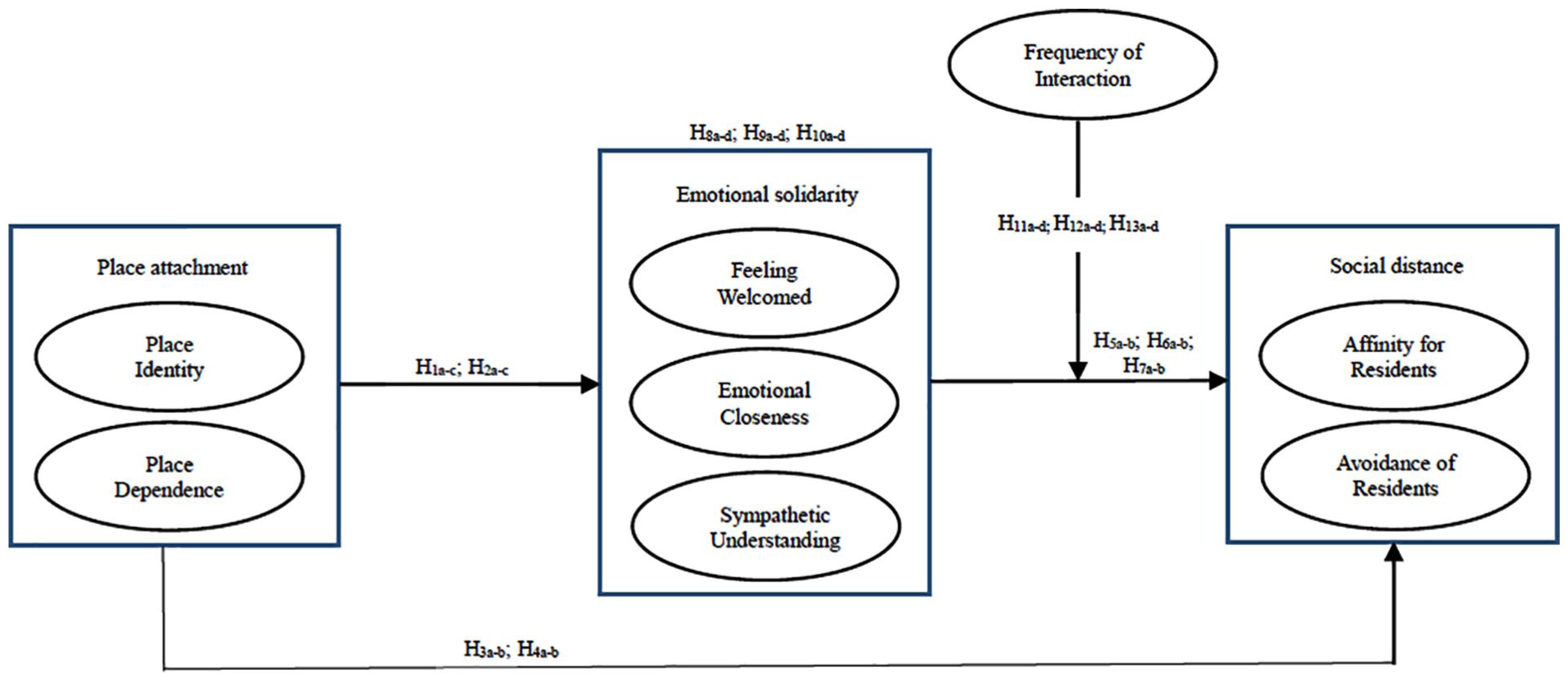
The model of place attachment, emotional solidarity, and frequency of interaction in explaining social distance.
This study represents a valuable endeavor by attempting to integrate various important concepts in a single conceptual framework. The proposed conceptual framework, tested in the context of a cultural and religious festival (whereby varying degrees of interaction and intimacy will likely be found) in Nigeria, contributes to the current knowledgebase of people–place relationships in several ways, thus informing destination marketing and management. First, it fills the literature gap by investigating the dynamics between place attachment and social distance, a link that has rarely been examined. Therefore, it responds to the call for more empirical research on the antecedents of social distance (Woosnam and Lee 2011); for a more thorough understanding of the host–guest relationship at destinations. Second, this study examines the potential mediating role of emotional solidarity between place attachment and social distance, which extends the line of research on emotional solidarity and social distance with new evidence. Although a recent study (Joo et al. 2018) tested the relationship between the two constructs, the work centered on residents’ perspectives of the relationship in a US tourism context. Furthermore, the mediated relationship between these constructs could vary with the frequency of interactions visitors develop with the locals, which furthers the understanding of the tested model with a very practical consideration. Overall, the findings are expected to provide a more integrated view for explaining visitors’ perceived social distance with residents. Last but not least, from a practical standpoint, this study would allow destination marketing practitioners and other industry stakeholders to more clearly understand the contributing factors of visitors’ social distance with residents and then more effectively design strategies and programs to increase positive feelings and reduce social distance toward residents within the destination.
Literature Review and Hypotheses Development
Place Attachment and Emotional Solidarity
Scholarly discourse on people–place relationships can be traced back to earlier theoretical discussions on a dynamic and complex relationship between a person and a particular place, represented by the notions of consciousness of place (Merleau-Ponty 1962), journey/dwelling (Jager 1974), and rootedness (Hummon 1992). The seminal work of Tuan (1977) postulates the concept of “topophilia” or “love of place,” arguing that a space becomes a place only when people interact within and attach meanings to it. Among other terms such as sense of place and environmental embeddedness, place attachment is one of the most widely used concepts to illustrate people–place relationships, signifying an affective bond or emotional link between people and places (Hidalgo and Hernandez 2001; Williams et al. 1992). It has been extensively examined in the fields of environmental psychology (e.g., Kyle et al. 2004), geography (e.g., Brown and Raymond 2007), leisure (e.g., Bricker and Kerstetter 2000; Green and Chalip 1997), natural resource management (e.g., Warzecha and Lime 2001), and the like to investigate the effect of a place on people’s psychological impressions.
As of late, place attachment has gained traction within the field of travel and tourism, in explaining the rationale for people’s preferences for a destination (e.g., Hwang, Lee, and Chen 2005; Gross and Brown 2008) as well as place branding (Chen and Dwyer 2017; Chen and Šegota 2015), and destination loyalty (Patwardhan et al. 2019). The early research on place attachment in tourism, which began in the 1980s, was largely exploratory in nature, followed by identification of typologies and measurements (e.g., Hwang, Lee, and Chen 2005). More recent studies have focused on examining the determinants and effects of place attachment (e.g., Gross and Brown 2008; Ramkissoon, Weiler, and Smith 2012). For instance, Prayag and Ryan (2012) focused on place attachment as an antecedent of tourists’ level of satisfaction and revisit and recommendation intentions. In a similar vein, Ramkissoon and Mavondo (2014) considered place attachment in explaining pro-environmental behavioral intentions and place satisfaction among tourists. Most recently, Chen and Dwyer (2017) have considered how place attachment along with place satisfaction serves to explain residents’ word of mouth, ambassador behavior, and participation in tourism planning for a destination. Just as place attachment is crucial from the vantage point of residents concerning involvement, it is equally vital for tourists since visitors’ emotional responses contribute to perceived authenticity, satisfaction, and behavioral intentions (Ram, Björk, and Weidenfeld 2016). A recent testimonial is that in the context of Thailand, Hosany et al. (2017) confirmed that tourists’ place attachment and satisfaction played mediating roles between their emotions and intention to recommend. The most recent contribution shows that place attachment and its dimensions are uniquely responsible for explaining individuals’ loyalty to destinations (Patwardhan et al. 2019).
Recent studies have confirmed that place attachment exists not only between people and a physical or concrete space, but also between people and intangible objects or situations (e.g., Yi et al. 2018). Events and festivals represent fitting environments to study this concept given the visitor experience is not only about consumption of the physical space but also interactions or emotional bonds between people and a place. There is a growing body of literature applying place attachment to events and festivals to understand the connection forged between attendees and such settings (Ouyang, Gursoy, and Sharma 2017; Yi et al. 2018). Employing in-depth interviews in a festival setting, Davis (2016) showed that place attachment and place identity were key factors in creating the festival environment. Lee, Kyle, and Scott (2012) found that festival visitors’ satisfaction led to their emotional attachment to the host destination, and then a sense of loyalty toward it. Among visitors to the 2012 London Olympic Games, Brown, Smith, and Assaker (2016) also found that venue attachment directly influenced event satisfaction.
As a psychological process of leisure experiences (Williams 2002), place attachment has been shown to encompass two distinct dimensions: place dependence and place identity (Kyle et al. 2004; Hwang, Lee, and Chen 2005; Gross and Brown 2008). Place dependence highlights the importance of a place in supporting consumers’ goal achievement and desired activities. From visitors’ point of view, place dependence refers to how a place’s physical characteristics or specific attributes satisfy tourists’ needs (Williams and Roggenbuck 1989). While place dependence is more of functional attachment to or reliance on the toured environment (Gross and Brown 2008; Yuksel, Yuksel, and Bilim 2010), place identity highlights the symbolic or emotional attachment to a place (Backlund and Williams 2003). It can be understood as an individual’s social identification of a place or the meaning the place has for him or her, which contributes to a feeling of attachment (Kyle, Graefe, and Manning 2005; Tsai 2012).
Hultman and Hall (2012) posit that the understanding of place attachment is impossible if the social interactions between visitors and residents are not taken into consideration. Ultimately, visitors’ attachment to a place plays an important role in explaining their perceived social ties with the local residents. A notable theory used to explain such ties is Durkheim’s ([1915] 1995) emotional solidarity. Though the origin of the construct dates back to the beginning of the 20th century, it has recently been examined and empirically tested in the tourism literature (Woosnam 2011; Woosnam and Aleshinloye 2013). Through both qualitative and quantitative investigations, this recent line of scholarship has established that solidarity, as an emotional bond between residents and tourists, arises from individuals who share beliefs and engage in similar behaviors as a result of social interactions.
The Emotional Solidarity Scale (ESS), developed by Woosnam and colleagues (e.g., Woosnam and Norman 2010), has demonstrated strong psychometric properties in assessing the degree of solidarity and closeness between residents and tourists. The antecedents and consequences of emotional solidarity have been tested in both international and domestic tourism contexts, from both residents’ and tourists’ perspectives (e.g., Joo et al. 2017; Woosnam 2012; Woosnam and Aleshinloye 2013). Emotional solidarity as a positive sociocultural phenomenon is likely to be explained by an individual’s attachment to a place or community. Few studies have thus examined place attachment in relation to emotional solidarity. As Woosnam et al. (2018b) substantiated, place attachment serves as a predictor of solidarity. Specifically, two dimensions of place attachment (namely place identity and place dependence) contribute to three emotional solidarity components (namely feeling welcomed, emotional closeness, and sympathetic understanding). In the setting of community festivals where social interactions and shared experiences occur extensively (Kyle and Chick 2007), it may be particularly true that the more attached one feels to the festival as a whole, the closer he/she perceives the bond with the community. Therefore, the following hypotheses are proposed.
Hypothesis 1a,b,c: Place identity positively impacts (a) feeling welcomed, (b) emotional closeness, and (c) sympathetic understanding.
Hypothesis 2a,b,c: Place dependence positively impacts (a) feeling welcomed, (b) emotional closeness, and (c) sympathetic understanding.
Place Attachment and Social Distance
Similarly, place attachment is expected to reduce social distance, another intergroup emotional concept to explain the complex resident–visitor relationship. Social distance is another intergroup phenomenon that emerged at the onset of the 20th century. In the early 1920s, Park (1924) first defined the concept of social distance as “the grades and degrees of understanding and intimacy which characterize personal and social relations generally” (p. 339). Later, Bogardus (1929) developed a scale reflecting an individual’s intimacy acceptance level from the least intimate or the most distant (i.e., 7 = excluding others from entry into individual’s country) to the most intimate or the least distant (i.e., 1 = accepting others to the circle of family/relatives through marriage).
Social distance has been widely discussed in the fields of sociology (e.g., Parrillo and Donoghue 2005) and psychology (e.g., Koulack and Tuthill 1972), in relation to prejudice, stigma, bias, and stereotyping of individuals or groups (Ahmed 2007; Albrecht, Walker, and Levy 1982; Kidwell and Booth 1977; Triandis and Triandis 1960; Yilmaz and Tasci 2015). Social psychology researchers have investigated the distance toward distinct other groups such as different races (Park 1924), males and females (e.g., Scheele et al. 2012), or heterosexuals and homosexuals (e.g., Gentry 1987). Also, a large number of studies investigated the role of social distance in public perceptions of and reactions to mental illness (e.g., Angermeyer and Matschinger 1997; Angermeyer, Beck, and Matschinger 2003; Angermeyer, Matschinger, and Corrigan 2004; Baumann 2007; Corrigan et al. 2001; Dietrich et al. 2004; Jorm and Oh 2009; Lauber et al. 2004; Link et al. 1999; Martin et al. 2007).
Tourism includes socio-psychological frames with high potential of prejudice, stigma, bias, and stereotyping, especially when distinct social and cultural differences exist between visitors and locals. Hence, the role of social distance explaining host–guest relations in the tourism context is high (Joo et al. 2018). Nonetheless, only a few studies have examined the significance of social distance in tourism.
In one of the early studies examining social distance in a tourism context, Thyne et al. (2006) asked New Zealand residents to state their level of acceptance of tourists with different characteristics such as nationality and age. Later, Thyne, Watkins, and Yoshida (2018) used the same scale to examine the influence of Japanese hosts’ social distance toward different visitor nationalities on their perceptions of tourism development. They identified social distance having a larger impact on perception of tourism development than the other host attributes included in the regression analysis. Similarly, Nyaupane et al. (2008) treated social distance as an antecedent of attitude change in students after study abroad programs; however, they used different nationalities as a proxy to social distance rather than using a social distance measure. Later, Nyaupane, Timothy, and Poudel (2015) used Bogardus’ (1929) scale to examine the role of social distance in explaining the relationships between people of different religions visiting religious sites. They found smaller distance among people of the same religion and higher for people of different religions. Tasci (2009) also used a modified social distance scale to examine social distance of students in the United States toward Turkish people in a quasi-experiment where they controlled the visual stimuli and country name. The results revealed smallest distance in the existence of visual information and the absence of country name the largest distance in the opposite case.
Later, Yilmaz and Tasci (2013, 2015) used a different social distance scale with factors of affinity and avoidance to measure the social distance between European guests and Turkish hosts. Yilmaz and Tasci (2013) tested the potential of the Internet in influencing European guests’ distance toward Turkish hosts and failed to find a significant relationship between the two. It was found that tourists who used the Internet as the primary information source about the host community did not differ significantly in their perception of social distance, compared to those using other information sources, even previous visit experiences. In a similar context, Yilmaz and Tasci (2015) reported that the perceived social distance toward people in Turkey was significantly reduced as a result of various forms of contact. While previous visitation alone failed to make a significant impact on social distance, for both residents and tourists who had close relationship with the other, social distance was significantly reduced, as shown in higher affinity and lower avoidance ratings.
More recently, Joo et al. (2018) used Yilmaz and Tasci’s (2013, 2015) scale with 12 items reflecting affinity and avoidance dimensions in order to investigate intergroup attitude of residents of a US destination toward domestic visitors. They looked into the complex relationship between the nature and frequency of interaction and social distance as well as emotional solidarity and social distance. In fact, they identified larger distance between the residents and hosts in this domestic tourism context than that identified by Yilmaz and Tasci (2015) in an international tourism setting. Their results also revealed influence of one activity (i.e., participating in festivals) and two dimensions of emotional solidarity (i.e., emotional closeness and sympathetic understanding) in increasing affinity whereas sympathetic understanding in decreasing avoidance.
No prior studies have investigated the linkage between place attachment and social distance. Nonetheless, it has been suggested that knowledge about destination offerings reduces the social distance toward the local community, minimizes prejudice and hostility, and promotes a higher level of intimacy and better understanding between visitors and residents (Tasci 2009). Common identity theory in social psychology also suggests that a common identity could increase prosocial acts such as favorable attitudes toward in-group members (Wit and Kerr 2002). In tourism research, it has been found that social identification, referring to the degree to which individuals feel attached to a group, can shape group dynamics such as perceptions and feelings toward in-group or outgroup members (Van Veelen et al. 2016; Xie 2006). Since place attachment entails a shared identity with the place, it could potentially lead to intergroup cooperation and foster positive attitude. Despite the scarcity of empirical evidence on social distance in festival settings, previous conceptual elaborations (e.g., Woosnam and Lee 2011) have called for attention to the antecedents of social distance, especially the constructs that illustrate interactions between visitors and the toured environment. It is inevitable that visitors come into contact with local residents in a festival setting where people with similar interests congregate in a finite time and space. Assuming a natural, negative link between visitors’ bonding with the place and perceived intergroup distance, this study considers that place attachment bridges the social distance between festival visitors and residents, decreases perceived differences, and instigates more inter-group interactions. Based on the discussion, we propose that the two dimensions of place attachment significantly influence those of social distance.
Hypothesis 3a,b: Place identity (a) positively impacts affinity and (b) negatively impacts avoidance.
Hypothesis 4a,b: Place dependence (a) positively impacts affinity and (b) negatively impacts avoidance.
Mediating Role of Emotional Solidarity between Place Attachment and Social Distance
In addition to the proposed relationships, we expect a mediating role of emotional solidarity between place attachment and social distance. First, the relationship between place attachment and emotional solidarity has only been recently studied. It has been suggested that the more an individual feels attached to a place, the more intimate he or she perceives the connection with the hosting community (Woosnam et al. 2018b). Second, as two intergroup attitudinal concepts of opposite nature, the increase in emotional solidarity is expected to reduce the negative concept of social distance, maximizing positive attitude such as acceptance and minimizing negative attitude such as hostility (Joo et al. 2018). Although previous studies have suggested some determinants and effects of social distance, including information source, destination image, and visit intention (Tasci 2009; Yilmaz and Tasci 2013, 2015), the link between emotional solidarity and social distance has only been recently considered. In a domestic tourism setting, Joo et al. (2018) provided empirical support for the direct link between the influence of residents’ emotional solidarity and their social distance toward tourists. The findings revealed that as emotional closeness and sympathetic understanding improved, affinity increased, while a higher welcoming nature and sympathetic understanding led to reduced avoidance.
Based on these findings, we propose that the three dimensions of emotional solidarity will significantly predict those of social distance.
Hypothesis 5a,b: Feeling welcomed (a) positively impacts affinity and (b) negatively impacts avoidance.
Hypothesis 6a,b: Emotional closeness (a) positively impacts affinity and (b) negatively impacts avoidance.
Hypothesis 7a,b: Sympathetic understanding (a) positively impacts affinity and (b) negatively impacts avoidance.
Tourists’ bonding with a place can enhance their perception of solidarity and closeness with the local residents (Woosnam et al. 2018a), which ultimately fosters a greater understanding, reduces prejudice and hostility, and leads to a higher level of acceptance of people of another group. The consideration of place attachment, emotional solidarity, and social distance in conjunction would provide more intimate insights to the host–tourist relationships at destinations (Woosnam and Lee 2011). In accordance with previous findings and conceptual propositions (e.g., Low and Altman 1992), this study considers place attachment as the starting point of the mechanism, and tests if emotional solidarity plays a mediating role between place attachment and social distance. Furthering previous hypotheses, we propose that the tourists’ solidarity with residents at a festival setting can explain the degree of the former groups’ perceived social distance.
Hypothesis 8a,b: Feeling welcomed (a) positively mediates the effect of place identity on affinity and (b) negatively mediates the effect on avoidance.
Hypothesis 8c,d: Feeling welcomed (c) positively mediates the effect of place dependence on affinity and (d) negatively mediates the effect on avoidance.
Hypothesis 9a,b: Emotional closeness (a) positively mediates the effect of place identity on affinity and (b) negatively mediates the effect on avoidance.
Hypothesis 9c,d: Emotional closeness (c) positively mediates the effect of place dependence on affinity and (d) negatively mediates the effect on avoidance.
Hypothesis 10a,b: Sympathetic understanding (a) positively mediates the effect of place identity on affinity and (b) negatively mediates the effect on avoidance.
Hypothesis 10c,d: Sympathetic understanding (c) positively mediates the effect of place dependence on affinity and (d) negatively mediates the effect on avoidance.
Moderating Role of Frequency of Interaction
On the basis of the aforementioned theories and arguments, it is expected that the frequency of interaction between visitors and residents has the potential to influence the relationships between place attachment, emotional solidarity, and social distance. Drawing from past studies, frequency of interaction was found to be an important determinant for place attachment (e.g., Woosnam et al. 2018a), emotional solidarity (e.g., Joo et al. 2018), and social distance (e.g., Joo et al. 2018). Consequently, conditional process models, or moderated mediation relationships, were tested in order to verify if significant mediated relationships uncovered via the proposed hypotheses testing (Hypotheses 8–10) varied systematically at different values of visitors’ frequency of interaction with residents or if these mediating relationships were relatively consistent across the values of the visitors’ frequency of interaction with residents. Based on the findings of the past research, hypotheses of moderated mediation are offered, such that the effect would be stronger for those with greater interaction:
Hypothesis 11a,b: The (a) indirect positive effect (via welcoming nature) of place identity on affinity and (b) indirect negative effect on avoidance will vary as a function of frequency of interaction.
Hypothesis 11c,d: The (c) indirect positive effect (via welcoming nature) of place dependence on affinity and (d) indirect negative effect on avoidance will vary as a function frequency of interaction.
Hypothesis 12a,b: The (a) indirect positive effect (via emotional closeness) of place identity on affinity and (b) indirect negative effect on avoidance will vary as a function of frequency of interaction.
Hypothesis 12c,d: The (c) indirect positive effect (via emotional closeness) of place dependence on affinity and (d) indirect negative effect on avoidance will vary as a function of frequency of interaction.
Hypothesis 13a,b: The (a) indirect positive effect (via sympathetic understanding) of place identity on affinity and (b) indirect negative effect on avoidance will vary as a function of frequency of interaction.
Hypothesis 13c,d: The (c) indirect positive effect (via sympathetic understanding) of place dependence on affinity and (d) negative indirect effect on avoidance will vary as a function of frequency of interaction.
Methods
Study Context/Setting
This study was undertaken at the annual Osun Osogbo cultural and religious festival held at the ancient Osun Grove located on the periphery of Osogbo—the state capital of Osun State, Nigeria. The festival is the largest event in the country dedicated to a traditional deity and has become an international tourist attraction, drawing thousands to witness the grandeur of the festival and give praise to the Yoruba goddess of fertility, Osun (Murphy and Sanford 2001). The 12-day festival occurs every August and is composed of prayers, rituals, dancing, and a grand possession on the last day to the Osun Grove (Jones 1997). Though the festival occurs throughout Osogbo with programs at local museums, street bazaars, musical performances, local artisan handicraft sales, etc., what many come to see are the ritualistic traditions. These include the “Iwopopo,” or traditional cleansing of the town, the lighting of the 500-year old 16-pointed lamp called the Ina “olojumerindinlogun,” the “Iboriade,” or the assemblage of all the crowns of past rulers (Ataojas) for blessings, and the procession led by the current ruler and votary maid (Arugba) to the Grove to pay respect to the Osun deity that signifies the close of the festival (Omojola 2011). Though some may be first-time visitors to the festival, the affordance of opportunities to interact with locals is widespread. This is the case given many visit the Sacred Grove and its river to be blessed with fertility.
The dense forest of the Osun Sacred Grove is one of the remaining remnants of primary high forest in southern Nigeria, regarded as the abode of Osun (UNESCO 2005). In 2005, UNESCO named the Osun Grove a World Heritage Site (only the second throughout Nigeria) given its unique cultural and geographic significance. Following UNESCO’s declaration of the Osun Grove as a WHS, greater emphasis has been placed on the symbolic nature and religious aspects of the festival highlighted by ceremonies in the Grove. As such, attendance has steadily inclined at the festival, reaching 121,000 participants at the 2018 festival most recently (CityVoice 2018). Attendees include primarily those from throughout Nigeria, other African countries, and African Americans in diaspora.
Data Collection and Sample Characteristics
Tourists to the ancient city of Osogbo (i.e., those who came from outside Osogbo) were intercepted in August 2015 during the festival at the Sacred Grove and at five other key tourist locations (e.g., the King’s Palace, Osogbo Museum, Isale-Osun, Oke-bale, and the Osun Cultural Center) throughout the city. Sampling of tourists was conducted with two forms of randomization in mind: time of day (i.e., the research team randomly selected hours to be in locations throughout the 12-day festival) and systematic intercepting of individuals as they approached a stationed research team member. As such, 23 unique hours during the festival were randomly selected. Once researchers were in place, they followed a systematic sampling strategy (with a random start), whereby every seventh individual that walked near the research team table was approached, asked if they were a visitor and if they were willing to participate in the survey. A total of 427 visitors were intercepted following the sampling strategy across all six locations and asked to participate by completing an on-site self-administered questionnaire. Of those, 92 declined the invitation (a 78.5% acceptance rate). Of the 335 accepted questionnaires, 309 were completed (a completion rate of 92.2%), yielding an effective response rate of 72.4%.
The profile of the respondents is presented in Table 1. The sample was composed of slightly more male visitors (56.3%) than female. Concerning the age, the vast majority of the visitors were rather young (61.2 % and 22.7% were between 18-29 years and 30-39 years, respectively); only 1.9% were 60 or older. Most of the visitors were single (53.4%), followed by those who were married (41.1%), divorced or separated (4.2%), and widowed (1.3%). Regarding education level, 32.5% and 26.2% of the visitors held undergraduate and postgraduate education, respectively. Only 1.0% (n = 9) of the sample studied up to the elementary education level. In terms of residence, a high proportion of the visitors were from different parts of Nigeria (88%) and only 12% lived abroad. Overall, only 34.6% of the respondents were first-time attendees.
Sample profile.

Measures and Preliminary Statistical Verification
To address each purpose of the study, concepts of place attachment (Williams and Vaske 2003), emotional solidarity (Woosnam and Norman 2010), social distance (Yilmaz and Tasci 2015), and frequency of interaction (Woosnam and Norman 2010) were adopted to examine Osun Osogbo Festival visitors’ relationships with Osogbo and its residents. Place attachment was measured by using Williams and Vaske’s (2003) 12-item scale of place attachment composed of two distinct factors: place identity and place dependence. Emotional solidarity was measured using the Emotional Solidarity Scale (Woosnam and Norman 2010), which includes 10 items across three factors: welcoming nature, emotional closeness, and sympathetic understanding. A third measure employed was the 12-item Social Distance Scale (Yilmaz and Tasci 2015) composed of two factors: affinity and avoidance. Each of these three scales included items presented on a 7-point Likert-type scale of interest (1 = would not like at all; 7 = would like very much). The final measure used was a five-item scale assessing frequency of interaction occurring at different times (Woosnam and Norman 2010), which was presented on a 7-point Likert-type scale (1 = never; 7 = all of the time). The major measurement scale has been adopted and tested in event and festival contexts, with confirmed validity and reliability (Joo et al. 2018; Ouyang, Gursoy, and Sharma 2017).
Structural equation modeling (SEM) was used to test the proposed direct effects in the model. However, to test the mediation and conditional indirect effects (moderated mediation), PROCESS macro (Hayes 2018) models 4 and 14 with bootstrap 95% bias-corrected confidence intervals (CIs) were used. Thus, before testing hypotheses, several preliminary statistical verifications were carried out to check the normality of the data and common methods variance (CMV). The normality of the data was assessed by examining the skewness and the kurtosis figures that are known to affect the analysis of variances and covariances when using SEM. These values are presented in Table 2. As recommended by West et al. (1995), values greater than 2 for skewness and greater than 7 for kurtosis indicate the presence of non-normality of data. The output of SPSS results showed that no item presented a skewness or kurtosis level higher than these thresholds, sustaining the normality condition that is fundamental for the use of maximum likelihood estimation in SEM. Given that a self-administered questionnaire was applied to on-site visitors who attended the Osun Osogbo Festival using the same instrument raised risks of CMV. In this sense, recommendations put forth by Baldauf et al. (2009) were followed. A single confirmatory factor analysis (CFA) was carried out to test whether one-factor model could account for all of the variance in the data. The 32 items were loaded onto a single-factor model and the results of the chi-square test showed that the single common factor model fits significantly worse than the proposed seven-factor model (Δχ2 = 4,849.47, df = 464, p <.001), consequently alleviating the CMV concern in this study.
Results of the Measurement Model: Reliability and Convergent Validity.

Note: CR = composite reliability; AVE = average variance extracted. Model fit indices: χ2 = 1179.95, df = 425, χ2/df = 2.78, Tucker–Lewis index = 0.94; comparative fit index = 0.93; root mean square error of approximation = 0.07; standardized root mean square residual = 0.04.
p < 0.001 level (two-tailed).
In AMOS, one loading has to be fixed to 1; hence, the t-value cannot be calculated for this item.
1 = strongly disagree, 7 = strongly agree.
1 = would not like at all, 7 = would like very much.
Results
Measurement Model
A two step-approach recommended by Anderson and Gerbing (1988) was used to undertake SEM. To assess the performance of the measurement model, CFA was performed on the data sample (N = 309) using AMOS 24.0, with the proposed seven factors using maximum likelihood estimation. The CFA fit the data well, resulting in a significant χ2 of 1179.95 (df = 425, p <.001) that is known to be highly influenced by sample size. The ratio of χ2 to degrees of freedom (χ2/df = 2.78) was less than the recommend threshold of 3.0 (Bagozzi and Yi 1988). Generally, the other measurement model indices showed good fit to the data (Tucker–Lewis index = 0.94, comparative fit index = 0.93, standardized root mean square error of approximation = 0.06, and standardized root mean square residual = 0.04). Thus, both reliability and validity of the model were further assessed. As summarized in Table 3, the model demonstrated reliability given the composite reliability (CR) for each variable ranged from 0.74 to 0.96, exceeding the recommended cut-off of 0.70 (Hair et al. 2014; Ribeiro et al. 2018). Construct validity of the model was assessed by measuring both convergent and discriminant validities. Convergent validity (Table 3) was assumed based, first on the statistically significant (p <.001) item loadings (Anderson and Gerbing 1988); and second, the AVE values of all constructs ranged from 0.59 to 0.83, exceeding the recommended threshold of 0.50 (Hair et al. 2014). These values demonstrate the evidence of convergent validity (Hair et al. 2014). Discriminant validity was verified by comparing all pairs of constructs in two-factor CFA models, where each model was assessed twice, with one constraining the correlation between the constructs to be one and the other allowing free estimation of the parameter. Discriminant validity is obtained if a significantly lower χ2 value is achieved for the unconstrained model (Bagozzi and Phillips 1982; Nunkoo et al. 2018). As summarized in Table 4, this prerequisite was achieved, providing support for discriminant validity.
Discriminant Validity Results.

Note: AV = avoidance.
Standardized Regression Weights for Structural Model.
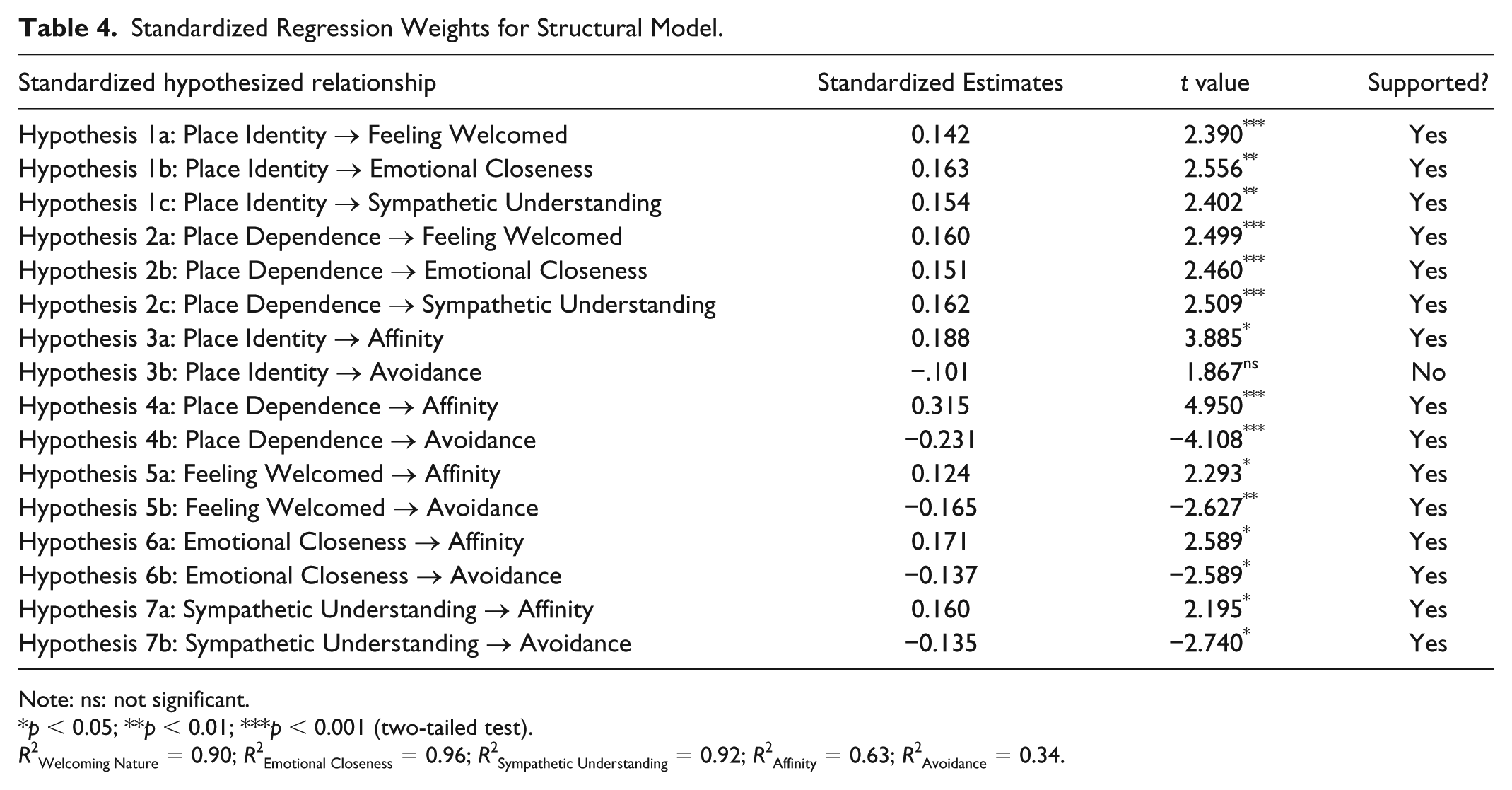
Note: ns: not significant.
p < 0.05; **p < 0.01; ***p < 0.001 (two-tailed test).
R2Welcoming Nature = 0.90; R2Emotional Closeness = 0.96; R2Sympathetic Understanding = 0.92; R2Affinity = 0.63; R2Avoidance = 0.34.
Structural Model
As presented in Table 5, the proposed structural model presented a good fit to the data collected during the Osun Osogbo Festival (χ2= 1251.60, df=432, χ2/df = 2.90, p < 0.001; Tucker–Lewis index = 0.93, comparative fit index = 0.93, root mean square error of approximation = 0.07, standardized root mean square residual = 0.04). Following this, the structural path coefficients of the proposed model were assessed, and 15 of the 16 hypotheses were significant.
The Mediation Effect of Place Attachment on Visitor Social Distance through Emotional Solidarity.

p < 0.05; **p < 0.01; ***p < 0.001.
Boots CI = confidence interval based on 10,000 bootstrap samples.
Hypothesis 1(a,b,c) proposing a significant positive impact of place identity on the three dimensions of emotional solidarity (hypothesis 1a: β = 0.142, p < 0.001; hypothesis 1b: β = 0.163, p < 0.001; hypothesis 1c: β = 0.154, p < 0.001) was supported. Place dependence was found to have a significant and positive impact on the three dimensions of emotional solidarity (hypothesis 2a: β = 0.160, p < 0.001; hypothesis 2b: β = 0.151, p < 0.001; hypothesis 2c: β = 0.162, p < 0.001), giving support to hypothesis 2(a,b,c). The effect of place attachment dimensions on social distance was tested in hypotheses 3 and 4. Results revealed that place identity had a significant positive effect on affinity (hypothesis 3a: β = 0.188, p < 0.05) but not on avoidance (hypothesis 3b; β = −0.101, p > 0.05), giving support to hypothesis 3a, while rejecting hypothesis 3b. By the same token, the findings showed that place dependence had a significant positive impact on affinity (hypothesis 4a: β = 0.315, p < 0.001) and significant negative impact on avoidance (hypothesis 4b: β = −0.231, p > 0.001, supporting both hypotheses 4a and 4b.
The relationship between emotional solidarity and social distance was tested through hypotheses 5, 6, and 7, and all were found to be statistically significant. Welcoming nature was found to have a significant positive impact on affinity (hypothesis 5a: β = 0.124, p < 0.05) and significant negative impact on avoidance (hypothesis 5b: β = −0.165, p < 0.01), supporting hypotheses 5a and 5b. Hypothesis 6a (β = 0.171, p < 0.05) and hypothesis 6b (β = −0.137, p < 0.05) were each supported since emotional closeness had a significant positive impact on affinity and significant negative impact on avoidance. Lastly, sympathetic understanding had a significant and positive impact on affinity (hypothesis 7a: β = 0.160, p < 0.05) and significant negative impact on avoidance (hypothesis 7b: β = −0.135, p < 0.05), supporting both hypotheses 7a and 7b.
Mediation model
Mediation analysis was then carried out, inferring that the effect of place attachment on social distance would be mediated by emotional solidarity with residents. To do this, a bootstrap method was employed to test whether the indirect effect was significantly different from zero. As per Preacher and Hayes (2008), a bootstrap analysis with 95% bias-corrected CIs and 10,000 resamples was used to test whether emotional solidarity was driving the results. Using PROCESS macro Model 4 (Hayes 2018), the relationship is significant if the CI for the mediating effect does not straddle zero.
As expected, the results summarized in Table 6 showed that the three dimensions of emotional solidarity mediate the effect of place attachment on social distance. Specifically, the results revealed that welcoming nature mediates the positive impact of place identity on affinity (hypothesis 8a: β = 0.272, p < 0.001) and a negative significant impact on avoidance (hypothesis 8b: β = −0.176, p < 0.001). Since the confidence intervals do not include zero, hypotheses 8a and 8b are supported. The results also reveal that emotional closeness mediates the positive impact of place identity on affinity (hypothesis 9a: β = 0.316, p < 0.001) and negative impact on avoidance (hypothesis 9b: β = −0.299, p < 0.001), therefore supporting hypotheses 9a and 9b. Sympathetic understanding also was found to mediate the positive impact of place identity on affinity (hypothesis 10a: β = 0.312, p < 0.001) and negative impact on avoidance (hypothesis 10b: β = −0.291, p < 0.001), giving support to hypotheses 10a and 10b since the bootstrap confidence intervals do not include zero.
Testing for Conditional Indirect Effects of Place Attachment on Affinity through Emotional Solidarity at Value of Frequency of Interaction.

Note: N = 309. CI = confidence interval; ns = not significant; SE = standard error.
p < 0.05; **p < 0.01; ***p < 0.001.
Similar results were revealed in the mediation analysis as it relates to place dependence. Welcoming nature was found to mediate the positive impact of place dependence on affinity (hypothesis 8c: β = 0.246, p < 0.001) and negative impact on avoidance (hypothesis 8d: β = −0.136, p < 0.001), thus supporting hypotheses 8c and 8d. Continuing, emotional closeness also mediates the positive impact of place dependence on affinity (hypothesis 9c: β = 0.291, p < 0.001) and negative impact on avoidance (hypothesis 9d:β = −0.281, p < 0.001), thus supporting hypotheses 9c and 9d. Lastly, the mediating effect of sympathetic understanding on the positive impact of place dependence on affinity (hypothesis 10c: β = 0.299, p < 0.001) and negative impact on avoidance (hypothesis 10d: β = −0.287, p < 0.001) was found to be significant, therefore supporting hypotheses 10c and 10d. These findings suggest that emotional solidarity exerts a significant bond between place attachment and social distance.
Moderated Mediation Model
In order to test the moderating effects of visitors’ frequency of interaction (FOI) with residents on the second-stage moderated mediation (path b = m → x moderated) model of the hypothesized indirect relationship (via emotional solidarity) between place attachment and social distance (hypotheses 8–10), PROCESS model 14 (Hayes 2018) was run to test whether these conditional indirect effects vary at the values of FOI (hypotheses 11–13). The coefficients of the moderated mediation model are summarized in Table 7.
Testing for Conditional Indirect Effects of Place Attachment on Avoidance through Emotional Solidarity at Value of Frequency of Interaction.
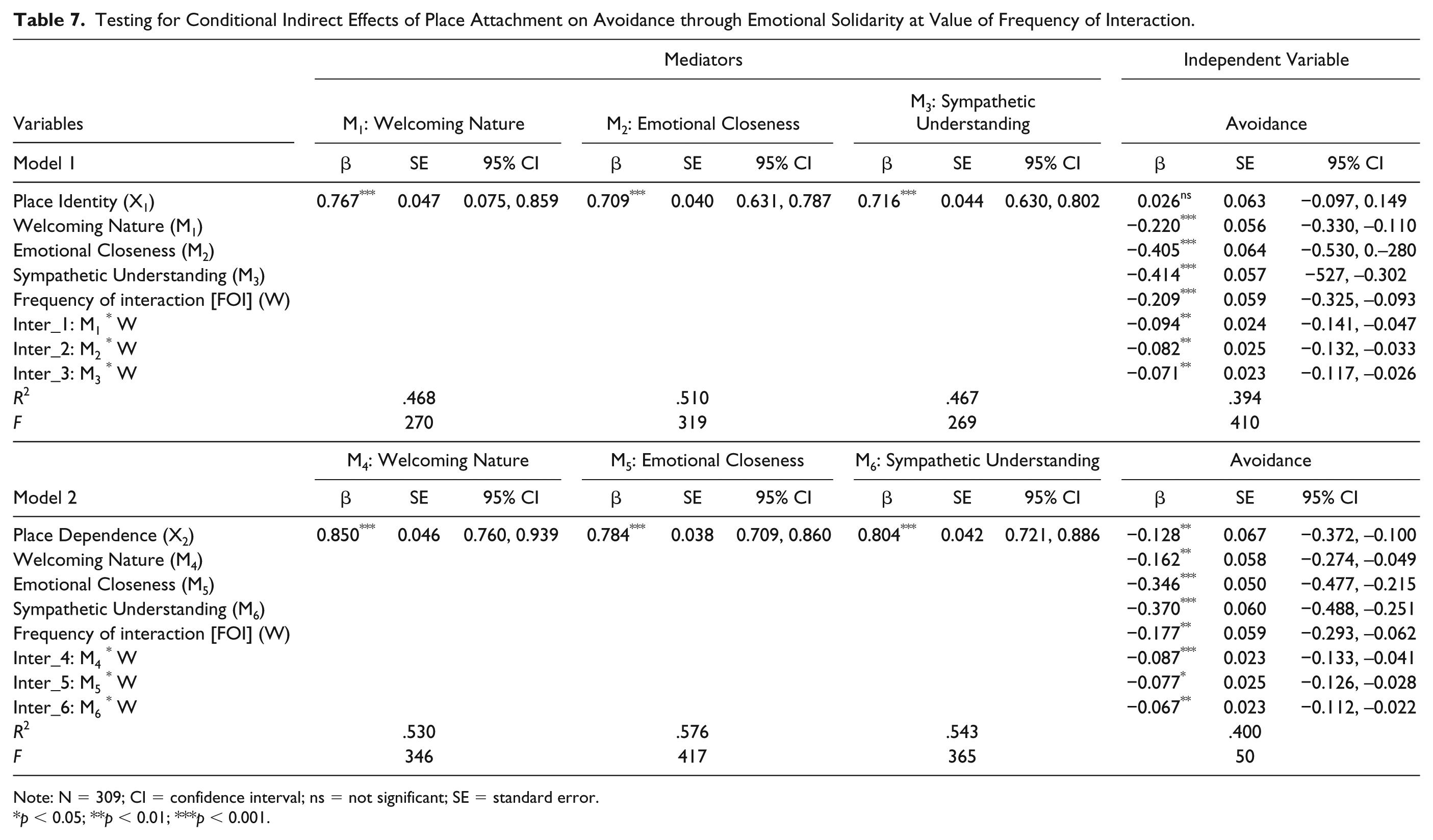
Note: N = 309; CI = confidence interval; ns = not significant; SE = standard error.
p < 0.05; **p < 0.01; ***p < 0.001.
Results revealed that FOI partially moderated the conditional indirect effect of place attachment on social distance (through emotional solidarity) since the bootstraps CI of some index of moderated mediation (IMM) models straddled zero (for more details about the IMM, see Hayes 2015, 2018; Hayes and Rockwood 2017). These results are depicted on Table 8. Specifically, hypothesis 11(a,b,c,d) posited that FOI moderated the positive indirect effect (via welcoming nature) of place identity (hypothesis 11a) and place dependence on affinity (hypothesis 11c) and the negative indirect effect (via welcoming nature) of place identity (hypothesis 11b) and place dependence (hypothesis 11d) on avoidance as none of the IMM included zero. Conditional indirect effects of place attachment on social distance were tested at two levels of FOI: ±1 SD below and above the mean. Thus, results showed that the positive indirect effect of place identity and place dependence on affinity were significantly higher when the level of FOI is high (PI=0.286, 95% CI = 0.213, 0.363; PD=0.267, 95% CI = 0.188, 0.344). Conversely, the negative indirect effects of place identity and place dependence on avoidance were only significant and higher at low levels of FOI (PI=0.290, 95% CI = 0.200, 0.380; PD=0.262, 95% CI = 0.158, 0.364). These results provide consistent support for hypothesis 11(a,b,c,d).
Results of the Index of Moderated Mediation Effect for Social Distance at Value of Frequency of Interaction.

Note: Arrows pointing to effects within parentheses indicate moderation of those effects. FOI = frequency of interaction.
The index of moderated mediation is the test of moderated (or conditional) mediation for each of the separate mediation paths (Hayes 2015, 2018).
Boots 95% CI: Bias corrected 95% confidence interval based on 10,000 bootstrap samples.
Hypothesis 12(a,b,c,d) stated that the conditional indirect effect (via emotional closeness) of both place identity (hypothesis 12a) and place dependence (hypothesis 12c) on affinity and the negative indirect effect (via emotional closeness) of both place identity (hypothesis 12b) and place dependence (hypothesis 12d) on avoidance are moderated by FOI. The CI of the IMM for hypotheses 12a and 12c contained zero meaning that the indirect effects of place identity and place dependence on affinity through emotional closeness do not vary at values of visitors’ frequency of interaction with residents, rejecting hypotheses 12a and 12c. In contrary, the negative indirect effects of place identity and place dependence on avoidance via emotional closeness were significant and higher at low level (PI=0.385, 95% CI = 0.289, 0.485; PD=0.372, 95% CI = 0.266, 0.479. Thus, hypotheses 12b and 12d were supported.
Likewise, hypothesis 13(a,b,c,d) specified that the positive indirect effect (via sympathetic understanding) of both place identity (hypothesis 13a) and place dependence (hypothesis 13c) on affinity and the negative indirect effect (via sympathetic understanding) of both place identity (hypothesis 13b) and place dependence (hypothesis 13d) on avoidance were moderated by FOI. Again, the CI of the IMM for hypotheses 13a and 13c contained zero, meaning that the indirect effect of place identity and place dependence on affinity via sympathetic understanding do not vary at any values of visitors’ frequency of interaction with residents, therefore rejecting hypotheses 13a and 13c. Contrary, the CI of the index of the negative indirect effects of place identity and place dependence on avoidance via sympathetic understanding did not contain zero and were significantly higher at low level of FOI (PI=0.383, 95% CI = 0.292, 0.483; PD=0.388, 95% CI = 0.287, 0.493), confirming hypotheses 13b and 13d. In a nutshell, when the index was positive and significant, the indirect effect of place attachment on affinity through welcoming nature increased in function of visitors’ frequency of interaction with residents. In contrast, when the index was negative and also significant, the conditional effect of place attachment on avoidance via the three dimensions of emotional solidarity were decreasing in function of visitors’ frequency of interaction with local residents.
Discussion and Implications
This study, grounded in the important research on place attachment (Hummon 1992; Kyle et al. 2004; Kyle, Graefe, and Manning 2005), emotional solidarity (Durkheim [1915] 1995; Woosnam and Norman 2010), and social distance (Bogardus 1929, 1933; Joo et al. 2018; Park 1924; Reisinger and Turner 2002; Tasci 2009), offers a deeper insight into visitors’ emotional bond with place and locals in light of their social distance with residents at different levels of interaction frequency with residents. The study was inspired by the notion that the social distance between visitors and residents is influenced by the emotional bond visitors develop with the place and the relationship developed between individuals and how those vary with the frequency of interaction visitors develop with locals—an aspect that has been widely ignored in past studies. Based on the data collected from visitors to the annual Osun Osogbo cultural and religious festival, it was found that place identity has a direct influence on affinity and an insignificant impact on avoidance. Place dependence was found to be a significant predictor of social distance since it affects affinity positively and avoidance negatively. It was also found that these relationships are mediated by the three dimensions of emotional solidarity. Furthermore, the mediated relationships (via emotional solidarity) between place attachment and social distance were found to vary by the level of visitors’ frequency of interaction with residents during the Osun Osogbo cultural and religious festival. However, these effects are stronger when visitors’ frequency of interaction are higher than when the level of frequency of interaction is at average or low levels. Together, the results offer numerous theoretical and managerial implications.
Theoretical Implications
On the theoretical front, this study makes several contributions to the tourism literature and is the first attempt to measure visitors’ social distance with residents through place attachment and emotional solidarity. First, it further extends visitors’ place attachment and emotional solidarity with residents as antecedents of social distance, considering one concurrent model. Overall, the model supports the sequence of cognition, affect, and behavior. It not only corroborates the findings of existing empirical studies on emotional solidarity and social distance, it also validates the dynamic between the three place-related constructs, which was largely based on conceptual propositions (e.g., Low and Altman 1992). In addition, this study is among the first to test and confirm the linkage between place attachment and social distance. By showing that place attachment plays a major role in explaining visitors’ social distance with residents, the current study offers direct supporting evidence for prior conceptual elaborations (e.g., Tasci 2009). Addressing previous calls for empirical assessment of possible antecedents of social distance (see Woosnam and Lee 2011), this study highlights the role of place attachment in reducing prejudice and promoting understanding and cooperation. Specifically, the findings suggest that place attachment is an important predictor of affinity. Avoidance, another dimension of social distance, was negatively influenced by only one dimension of place attachment—place dependence. The negative direct effect of place identity on avoidance was insignificant. There may be several explanations for this. It may be due to the fact that place identity is symbolic or represents an emotional bond to a festival (Backlund and Williams 2003), and attachment is expected to reduce social distance by increasing visitors’ affinity for residents through interaction with one another. Furthermore, other factors such as emotional solidarity (Woosnam and Norman 2010) may mediate the negative effect of place identity on avoidance of residents, complementing the studies developed by Woosnam et al. (2018b) and Joo et al. (2018).
Findings also showed that both place identity and place dependence significantly predicted emotional solidarity by explaining high degrees of variance in each of the three dimensions. This showcases that place attachment is one of the strongest factors in explaining visitors’ solidarity with residents. Also, this finding is in line with the pioneering study carried out by Woosnam et al. (2018a) linking place attachment and emotional solidarity. The authors found that when visitors create a bond with a place, this will foster a high level of interaction with residents and develop a more intimate emotional relationship between individuals. These findings may be in part attributed to the intricate nature of place and importance of social interaction among those attending the festival. To parcel out the role of place and social interaction, additional work may consider employing a measure of place attachment that encompasses items concerning social bonding (e.g., Ramkissoon and Mavondo 2014, 2015) in both a festival and nonfestival context.
Another implication of this study is that emotional solidarity was found to have a significant impact on social distance. Specifically, the results revealed that all three dimensions of emotional solidarity have significant positive impacts on visitors’ affinity for residents. Conversely, the same three dimensions of emotional solidarity negatively influenced visitors’ avoidance of residents. These findings contradict previous study carried out by Joo et al. (2018) who found that only emotional closeness and sympathetic understanding have significant positive impacts on affinity for residents and that avoidance to residents were affected negatively by welcoming nature and sympathetic understanding but not by emotional closeness. Specifically, the three dimensions of ESS explain both social distance dimensions by improving affinity and reducing avoidance. Visitors’ higher emotional solidarity with residents lead to higher affinity for residents, and higher negative ESS lead to lower avoidance to residents. These findings complement past studies (i.e., Joo et al. 2018; Woosnam 2012; Woosnam and Aleshinloye 2013) that found visitors with higher emotional solidarity with local residents evidence greater openness (i.e., affinity) and less aversion (i.e., avoidance) to them.
As expected, the findings revealed that emotional solidarity mediates the relationship between place attachment and social distance. Specifically, results show that three dimensions of emotional solidarity mediate the positive impact of the two dimensions of place attachment on affinity. Likewise, these three dimensions mediate the negative effects of the two dimensions of place attachment on avoidance. Previous studies found a link between place attachment and emotional solidarity (Woosnam et al. 2018b) and between emotional solidarity and social distance (Joo et al. 2018). In this sense, emotional solidarity maximizes the positive relationship between visitors and residents and minimizes the avoidance. Thus, the present study connected the dots between attachment and social distance through solidarity.
Last but not least, this study also offers a sound alternative data analysis technique to test moderated mediation models with multiple mediators and outcome variables by using PROCESS macro developed by Hayes (2018) to answer the calls from some scholars for the use of new methodologies and techniques in tourism studies (i.e., Nunkoo, Ramkissoon, and Gursoy 2013; Ryan 2018). Thus, the findings linking the moderated effect of frequency of interaction with the indirect effect of place attachment (via emotional solidarity) on social distance was mixed at best. Initially, the “pick-a-point” approach was used in this study to identify the effect of different levels of visitors’ frequency of interaction with residents on the mediated relationship (via emotional solidarity) between place attachment and social distance. While results show that mediated effects of the two place attachment dimensions (place identity and place dependence) on social distance through welcoming nature are positively significant for affinity and negatively significant for avoidance at all levels of frequency of interaction, mediated effects of place identity and place dependence on affinity via emotional closeness and sympathetic understanding are not significant. However, the mediated effect of both dimensions of place attachment on avoidance via emotional closeness and sympathetic understanding are negatively significant. Furthermore, these mediated effects are stronger for those visitors with low levels of frequency of interaction with residents. These results clearly propose that visitors’ high levels of frequency of interaction with residents might neutralize and decrease visitors’ avoidance to residents and increase the emotional affinity for residents. Those with greater interaction with residents will foster emotional relationships with such individuals and increase affinity and avoid social distance regardless of their emotional bond to the place. Such findings beg the question whether it is the frequency of interaction that may be the best mediator or form or quality of interaction that may actually mediate the relationships in the model. Future work using measures of interaction quality (Kirillova, Lehto, and Cai 2015) may aid in a better understanding of the relationships that exist between place attachment, emotional solidarity, and social distance. Theoretical perspectives that would line up well with such work could include the intergroup contact theory (Luo, Brown, and Huang 2015) or intimacy theory (Conran 2011; Trauer and Ryan 2005). In the interim, our work demonstrates that this elementary conceptualization of interaction (i.e., frequency) does serve as a significant moderator in influencing the mediated effect of emotional solidarity in the relationship between place attachment and social distance.
Practical Implications
From a practical perspective, this study makes several contributions and offers an understanding of the salient factors that influence visitors’ social distance with residents. First, findings suggest that beside place attachment, emotional solidarity and frequency of interaction are some of the most critical factors that can affect visitors’ social distance with residents in a religious and cultural festival context. These findings are critical for DMOs, practitioners, and marketers to thoroughly comprehend the significant roles each of these factors play separately and jointly in determining visitors’ affinity for and avoidance of residents.
Second, findings clearly show that place attachment is a significant predictor of social distance. Therefore, DMOs and practitioners need to understand the nature of attachment and how such attachment toward a place is formed. Likewise, DMOs and practitioners may need to understand how visitors perceive the physical environment of a place and how they develop their emotional attachment to a place when considering their policy and marketing strategy to attract more visitors. A thorough understanding of how visitors develop an emotional bond with a place may enable DMOs and practitioners to gain a better understanding of visitors’ social distance with residents. Furthermore, DMOs and practitioners responsible for destination management need to gain a thoughtful understanding of the significant evaluations in specific visitors’ emotional attachment that can provide them the chance to identify and foster affinity, as well as to decrease avoidance experienced toward residents.
Third, DMOs and practitioners should also recognize the value of visitors’ frequency of interaction with residents in increasing emotional solidarity with and affinity for residents and reduce avoidance between them. DMOs and practitioners can use the frequency of interaction as a segmentation instrument to cluster visitors into high-interaction, moderate-interaction, and low-interaction clusters and then create marketing strategies for each cluster that concentrates on that specific cluster’s concerns. Results reveal that generally, visitors with great interaction participate in more affinity compared to individuals with low interaction. Thus, DMOs and practitioners can launch marketing campaigns that focus on residents’ interaction with visitors to make them feel welcomed and develop affinity with tourists. However, these campaigns and strategies should be educational for residents to alerting them of the benefits that receiving visitors can bring to local community. Moreover, aspects of the economic benefits, social interaction, internationalization on the local culture and heritage that are closely associated with place identity, and culture of the local community can be highlighted in the marketing campaign in order to improve locals’ self-identification and make them feel proud of their culture and can motivate them to share it with visitors.
Lastly, as the findings reveal, the negative effects of visitors’ attachment via emotional solidarity with residents on avoidance are stronger and more salient for visitors with low frequency of interaction with residents equated to visitors with moderated or high interaction. These results can have critical consequences for destinations where the interaction between visitors and residents is especially low. DMOs and practitioners can conduct research to identify the most critical factors that can help them increase visitors’ frequency of interaction with residents. Based on the findings, DMOs and practitioners can develop specific marketing campaigns concentrating on those critical issues that target visitors with low frequency of interaction in order to reduce their distance (avoidance) with residents, which can result in increasing the affinity and reduce social distance (avoidance) with locals.
Limitations and Future Research
The study has some limitations that signal opportunities for future research. First, group differences based on sociodemographic characteristics were not assessed. Even though some researchers debate the effectiveness of sociodemographics in explaining consumer behavior, their potential power in predicting micro-level behavior was proposed and validated in past research (Sheth 1977). Sheth (1977) foresaw that “demographics are here to stay with us for projection, identification, and segmentation of the markets so long as the census data of the countries are limited to the socioeconomic-demographic profile of the citizens” (p. 136). Sociodemographics may define not only cognitive and affective, but also behavioral, responses of consumers. For example, information-processing strategies are known to be influenced by gender (see Wolin and Korgaonkar 2003 for extensive review of findings). Destination image, a complex construct inclusive of cognitive and affective components, is known to be influenced by age, gender, income, race, education, and nationality (Baloglu 2001; MacKay and Fesenmaier 1997; Tasci 2007; Tasci, Khalilzadeh, and Uysal 2017). Hence, Wei and Tasci (2017) identified differences between men and women in emotion-based and logic-based decision making in the tourism context. In another study, Tasci (2017) found gender differences in expectations for sustainable practices, while Tasci (2018) found similar differences in consumer-based brand equity including image value, quality, and loyalty. In consumption contexts such as destinations, events, and especially a large-scale cultural event such as the annual Osun Osogbo cultural and religious festival, visitor experience is intertwined with the intimate interactions with others; hence, sociodemographics may be powerful in explaining visitors’ cognitive, emotional, and behavioral responses. Therefore, group differences based on sociodemographic characteristics need to be identified in future research.
In addition, the current study included more domestic tourists than international visitors, which may be the cause of the high level of intimacy with the visited site and its locals, and thus positive ramifications in emotional solidarity and social closeness. Nationality includes both physical and cultural distance, which define the probability of contact and thus experience, familiarity, and subsequent cognitive, affective, and behavioral reactions. Therefore, future studies with comparable numbers of respondents between domestic and international visitors are needed to investigate if the results of the current study apply to different nationality groups. Another pertinent variable in such research then is cultural distance, which is also purported to define visitor behavior (Boylu, Tasci, and Gartner 2009; Tasci and Severt 2017). Other constructs that can be integrated to the model are satisfaction—trip satisfaction for visitors and job satisfaction for residents, as well as loyalty for visitors (i.e., revisit intention, word of mouth, and willingness to spend more, etc.) and support for tourism for residents, which are the ultimate goals that destination marketing organizations aim to achieve for optimizing tourism benefits.
Besides, the context of the current study, the annual Osun Osogbo cultural and religious festival, may be a special context where visitors’ propensity to have positive reactions may be higher than in other tourism contexts. For instance, we did ask individuals if they were visiting family or friends, which may potentially confound results. Therefore, the model needs to be tested in different tourism contexts, including theme park resorts, sea-sand-sun tourism, and sports event tourism. Also, the potential moderating impact of frequency of contact was tested for only on the mediating role of emotional solidarity between place attachment and social distance. Frequency of contact’s direct influence on place attachment, emotional solidarity, and social distance as well as its moderating influence on the influence of place attachment on emotional solidarity need to be tested in future studies. Finally, the model was tested on visitors; its validity in explaining resident behavior needs to be tested in future research.
Though our intent was to utilize the original place attachment scale developed by Williams and Vaske (2003) to reflect the acceptance of the scale with more than a decade of research, we acknowledge that alternative place attachment scales may contribute to a greater degree of variance in the construct. Work by Ramkissoon and Mavondo (2014, 2015) offer social bonding as an additional dimension to include as Chen and Dwyer (2017) (in addition to social bonding) include affective attachment as a fourth dimension of place attachment. Inclusion of these more recent place attachment scales in future models may offer a richer perspective of the social relationships between tourists and residents as it concerns emotional solidarity, frequency of interaction, and, ultimately, social distance.
Despite its limitations, the study provides substantial contribution to the theories of intergroup behavior in a tourism context. Even though social distance, emotional solidarity, place attachment, and frequency of contact have been studied individually or in a dual relationship with one another, no previous research has connected these concepts in one study. The current study tested the most likely relationships based on the past literature and provided directions to test other plausible relationships in future research. Continued research including the constructs of the current study in addition to other potential constructs such as cultural distance, satisfaction, loyalty, and support for tourism will connect the missing links and enable a more holistic theoretical base in explaining behavior of visitors and residents in tourism.
Footnotes
Declaration of Conflicting Interests
The author(s) declared no potential conflicts of interest with respect to the research, authorship, and/or publication of this article.
Funding
The author(s) received no financial support for the research, authorship, and/or publication of this article.
