In this article, first we obtained the correct mean square error expression of Gupta and Shabbir’s linear weighted estimator of the ratio of two population proportions. Later we suggested the general class of ratio estimators of two population proportions. The usual ratio estimator, Wynn-type estimator, Singh, Singh, and Kaur difference-type estimator, and Gupta and Shabbir estimator have been found to be members of the suggested class.
For the estimation of a population proportion of a character, Wynn (1976) proposed and studied an estimator using auxiliary information on some other character (in the form of known population proportion of auxiliary character) when the population is classified into two classes according to both main and auxiliary characters. Rao (1977) extended the results to the instance when the numbers of classes are equal according to the main and auxiliary characters. But, sometimes, the problem is that the ratio of population proportions is estimated instead of finding an estimate for any population proportion. For example, in a specified region, we may be interested in finding the ratio of the proportion of persons suffering from lung cancer and the proportion of persons suffering from some other disease. Such estimation of the ratio of proportions will give an idea about the extent to which one disease is spreading compared to the others in a specified region, wherein the effect of various causes like smoking, drinking, poor environmental conditions and standard of living, and so on, is taken into account. We also know that the incidence of tuberculosis infection is one of the indices for studying the epidemiology of tuberculosis in a community. Tuberculosis infection is defined as the proportion of newly infected individuals during a specified period among individuals exposed to the risk of infection during that period. A method for the first test is made in order to identify the uninfected persons called population exposed to the risk between the two tests, and these uninfected are then tested again to determine the number of newly infected during the observation period. Now estimating the ratio of proportion of newly infected persons and uninfected persons at the first test is a problem. For this reason, Singh, Singh, and Kaur (1986) have suggested the difference-type estimator. Later Gupta and Shabbir (2008) have suggested linear weighted estimator to estimate the ratio of population proportions. The objective of this study is to propose an alternative estimator of ratio of population proportions, which is more efficient and generalized than the existing estimators.
Consider a population subdivided into two variables y and x. The objective is to estimate the ratio of the proportions of population units falling in the two specific categories of variables y and x. We assume that an auxiliary variable z, which is strongly associated with both y and x is also available. For example, in epidemiology research, one may be interested in the prevalence of disease A relative to disease B using information provided by some auxiliary characteristics (such as the extent of smoking) that strongly associated with both A and B.
Let Ω = (Ω1, Ω2, …, ΩN) be a finite population of size N. Let A = (A1, A2, …, Aa), B = (B1, B2, …, Bb), and C = (C1, C2, …, Cc) be the partitions of Ω according to the characteristics y, x, and z, respectively; and (Ni00, N0j0, N00k are the numbers of population units in the (ith, jth, kth) subclasses Ai(i = 1, 2,…, a), Bj( j = 1, 2,…, b), and Ck (k = 1, 2,…, c), respectively, of Ω, such that . We draw a simple random sample of size n without replacement from Ω. Let ni00, n0j0, and n00k be sample quantities analogous to Ni00, N0j0, and N00k for y, x, and z, respectively. Let us also define Nij0 to be the number of population units that belong to Ai ∩ Bj. We can similarly define Ni0k, N0jk, and corresponding sample quantities. Let , , , , , , and , , , , , be the population and sample proportions, respectively, for (i = 1, 2,…, a), (j = 1, 2,…, b), and (k = 1, 2,…, c).
We are interested in estimating
for (i = 1, 2,…, a) and ( j = 1, 2,…, b) by using known value of P00k. We define the following terms:
such that
and to the first degree of approximation
where .
Known Estimators of Ratio of Proportions
In this section, we discuss about some existing estimators of ratio of population proportions R.
The Usual Ratio Estimator
The usual ratio estimator of ratio of population proportions R is defined as
The bias and mean square error (MSE) of , to the first order of approximation, are given by:
The Wynn-Type Estimator
Wynn (1976) has suggested difference-type estimator of the population proportion. Singh, Singh, and Kaur (1986) modified the Wynn difference-type estimator and called it Wynn-type estimator that estimates the ratio of two proportions. The estimator is defined as
To the first order of approximation, the bias and MSE of are given by
To the first order of approximation, the bias and MSE of are given by
The MSE of is minimized for
Thus, the resulting minimum MSE of is given by:
It is to be noted that the MSE expression of at equation (15) obtained by Gupta and Shabbir (2008) is not correct and thus the entire study carried out in the article by Gupta and Shabbir is erroneous except concerning the bias. Keeping this in view, we have proposed the generalized class of Gupta and Shabbir's estimator with its properties and obtained the correct MSE expression of Gupta and Shabbir estimator .
The Suggested Class of Estimators
We suggest the following generalized class of estimators of ratio of population proportions R:
where (α, βk) are suitably chosen constants and (ηk, δk) are suitably chosen scalars (k = 1, 2,…, c).
We assume that , , so that , , and are binomially expandable. Now expanding the right-hand side of equation (20), we have:
Now neglecting the terms of ξs with order greater than 2, we have:
or
Taking expectation on both sides of equation (21), we get the bias of suggested class of estimators to the first order of approximation as:
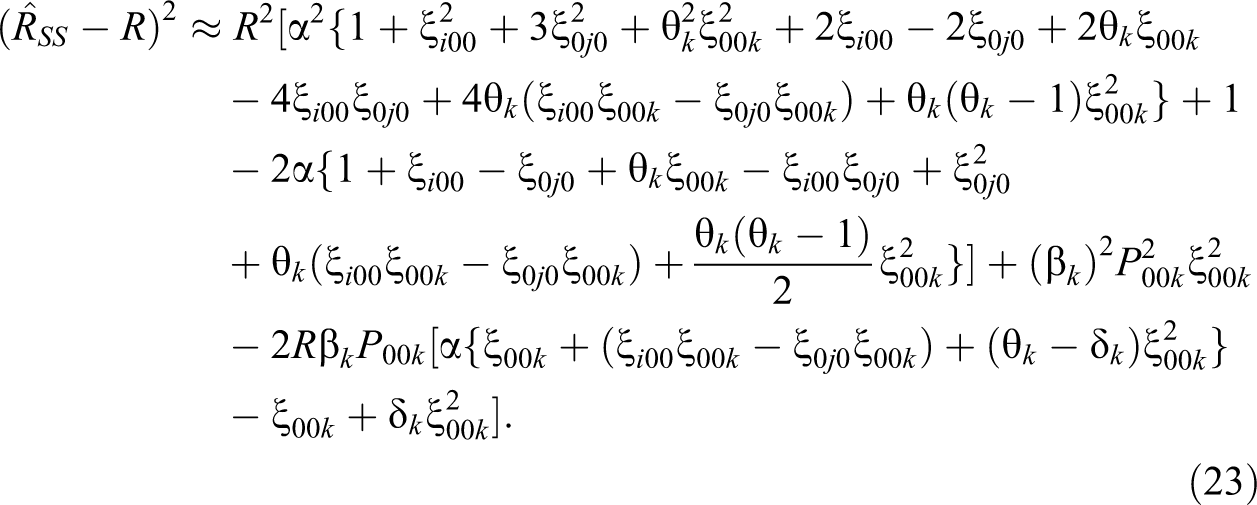
Squaring both sides of equation (21) and neglecting terms of ξs with order greater than 2, we have:
Taking expectation on both sides of equation (23), we get the MSE of suggested class of estimators to the first order of approximation as:
where
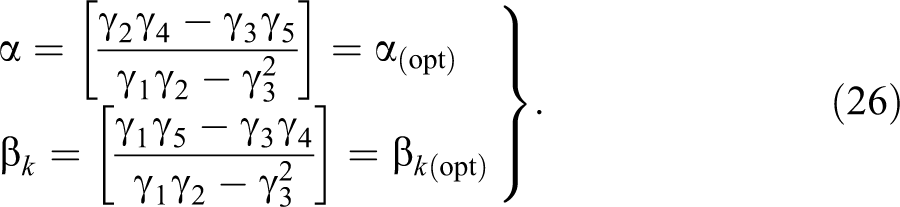
Minimization of equation (24) with respect to α and βk, we have the normal equation:
Solving equation (25) for α and βk, we get the optimum values of α and βk, respectively, as
Thus, the resulting minimum MSE of is given by
Remark 1
Equation (27) provides only an ideal optimum MSE since the optimum values of αk and βk, that is, α(opt) and β(opt) involve unknown parameters. In practice, one can use reasonable values of these parameters known from prior studies (see Lui 1990; Murthy 1967; Srivastava 1967).
In the following, we have considered three cases of suggested generalized class of estimators for different values of (ηk, δk).
Case I: When (ηk, δk) = (0, 0)
For (ηk, δk) = (0, 0), the suggested generalized class of estimators at equation (19) reduces to the following estimator of ratio of population proportions R as
To the first degree of approximation, the bias and MSE of estimator are easily obtained from equations (22) and (24), respectively, as
where
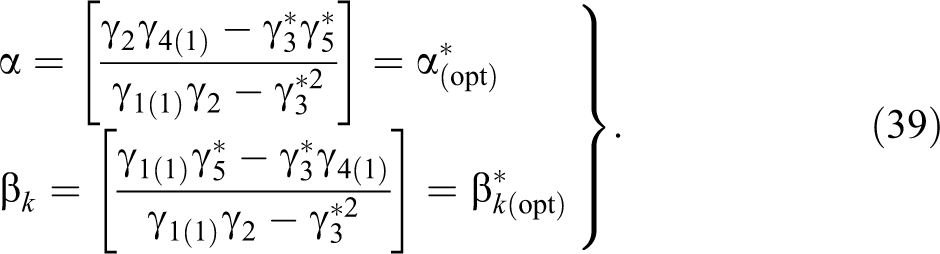
The MSE of estimator is minimized for
Thus, the resulting minimum MSE of estimator is given by:
Case II: When (ηk, δk) = (1, 0)
For (ηk, δk) = (0, 0), the suggested generalized class of estimators at equation (19) reduces to the following estimator of ratio of population proportions R as:
To the first degree of approximation, the bias and MSE of estimator are easily obtained from equations (22) and (24), respectively, as:
where
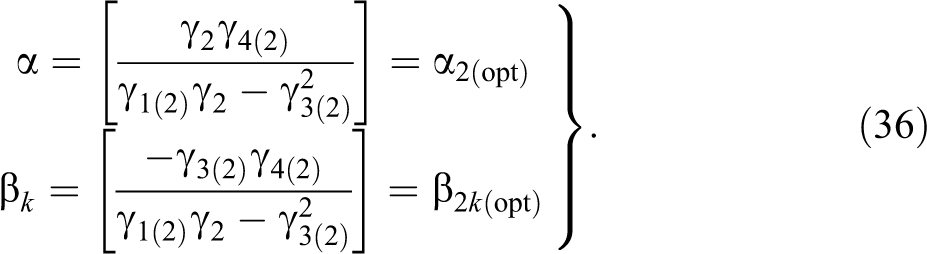
The MSE of estimator is minimized for:
Thus, the resulting minimum MSE of estimator is given by
Remark2: Corrected MSE of Gupta and Shabbir's estimator
To judge the merits of suggested class of estimators over the other competitors, we use the data set earlier considered by Gupta and Shabbir (2008). The descriptions of population data set are as follows:
y: Number of paralytic polio cases in “placebo” group.
x: Number of paralytic polio cases in “not inoculated” group.
z: Number of children in placebo group.
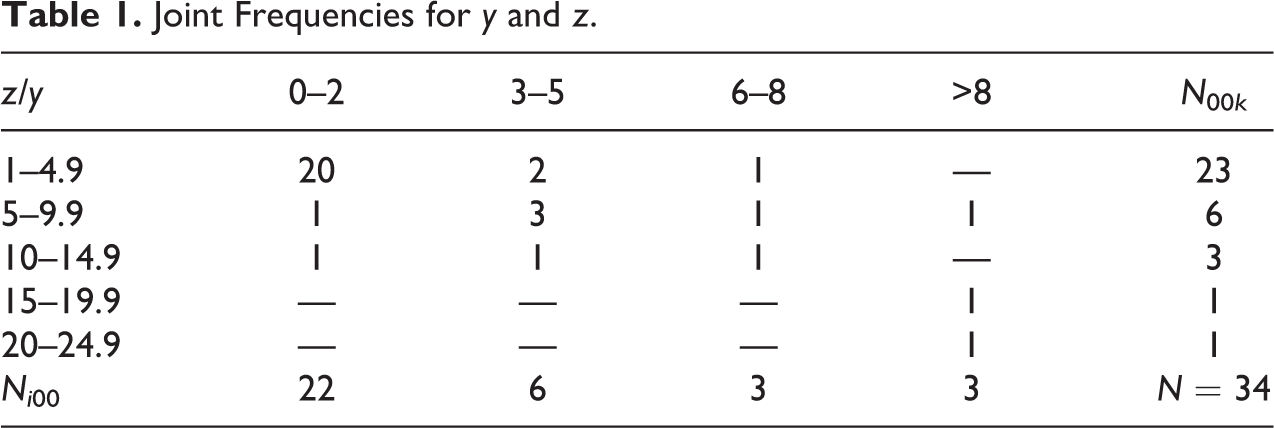
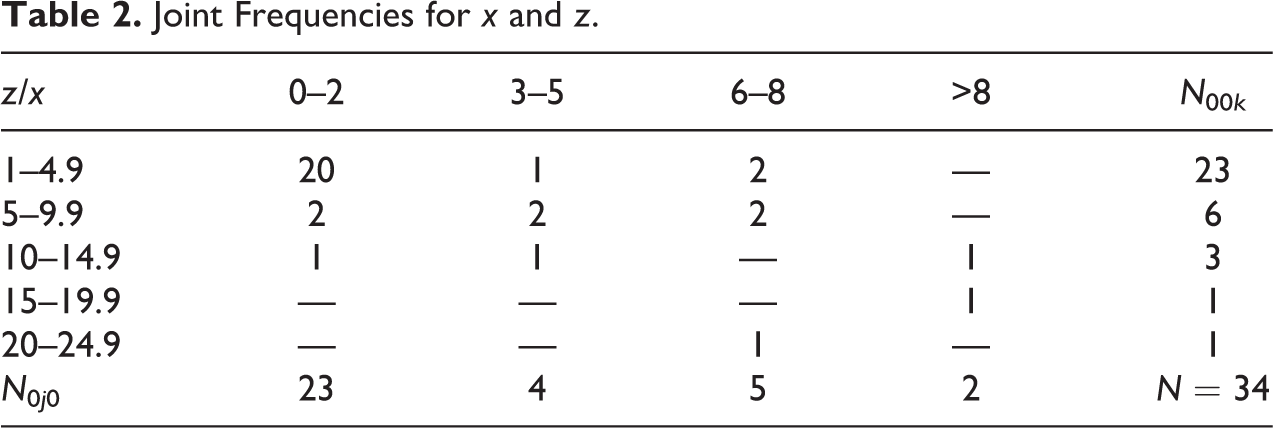
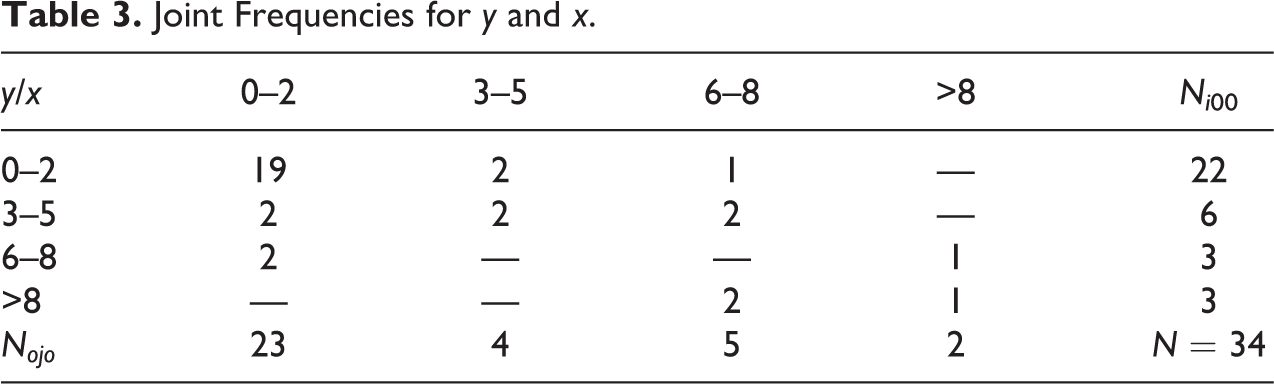
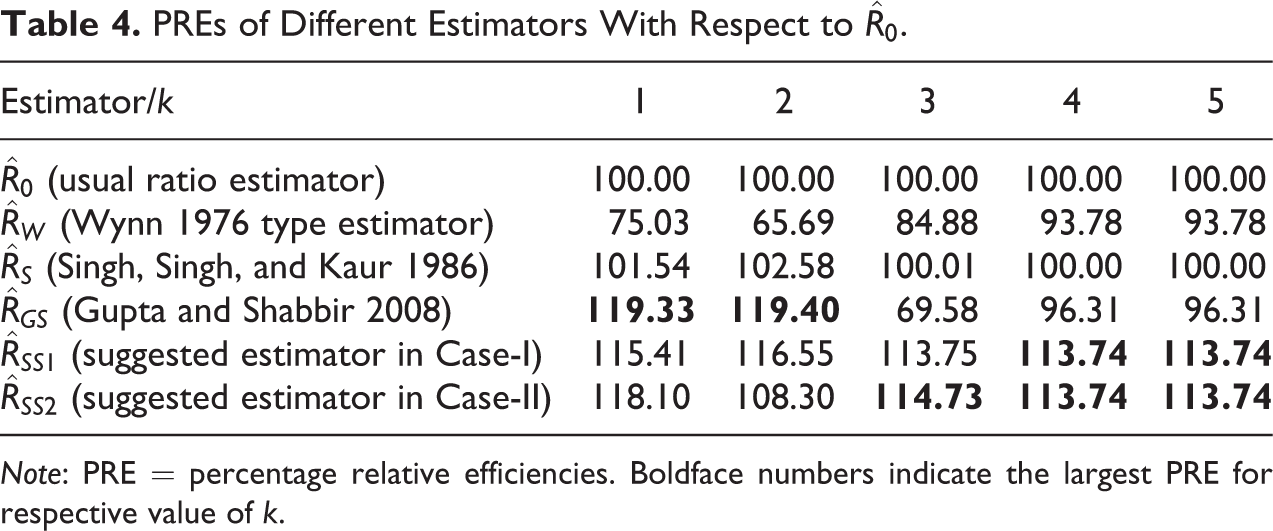
We have calculated the percentage relative efficiencies of , (Wynn 1976 type estimator), (Singh, Singh, and Kaur 1986 estimator), (Gupta and Shabbir 2008 estimator), , and with respect to based on the category (i = j = 1) and various choices of k. The joint frequencies for variables are given in Tables 1–3. The findings are summarized in Table 4.
Note: PRE = percentage relative efficiencies. Boldface numbers indicate the largest PRE for respective value of k.
Results in the Table 4 clearly show the gain in efficiency in using the suggested estimators and except the cases when k (= 1, 2). For k (= 1, 2), the Gupta and Shabbir (2008) estimator performed better than the other estimators. It is also noted that the efficiencies of the suggested estimators and are superior to the usual ratio estimator , Wynn (1976) type estimator , and Singh, Singh, and Kaur (1986) estimator for all values of k (= 1, 2,…, 5), but the performance of Gupta and Shabbir (2008) estimator is not consistent with all values of k (= 1, 2,…, 5).
Similarly we can find the results for other choices of i and j (i = 1, 2, 3, 4; j = 1, 2, 3, 4) with various choices of k (= 1, 2,…, 5).
The Generalization of Suggested Class
The suggested class of estimators at equation (19) can be generalized even more by making use of all of the known proportions in various categories relative to the auxiliary variable z. Thus, the more generalized class of suggested class is given by:
where (α, βk) are suitably chosen constants and (i = 1, 2,…, a), ( j = 1, 2,…, b), and (k =1, 2,…, c).
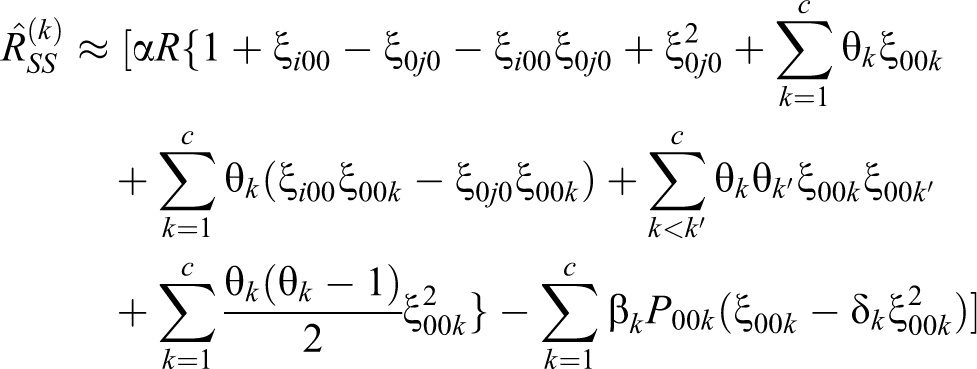
We assume that , , so that , , and are expandable. Now expanding the right-hand side of equation (42) and neglecting the terms of ξs with order greater than 2, we have:
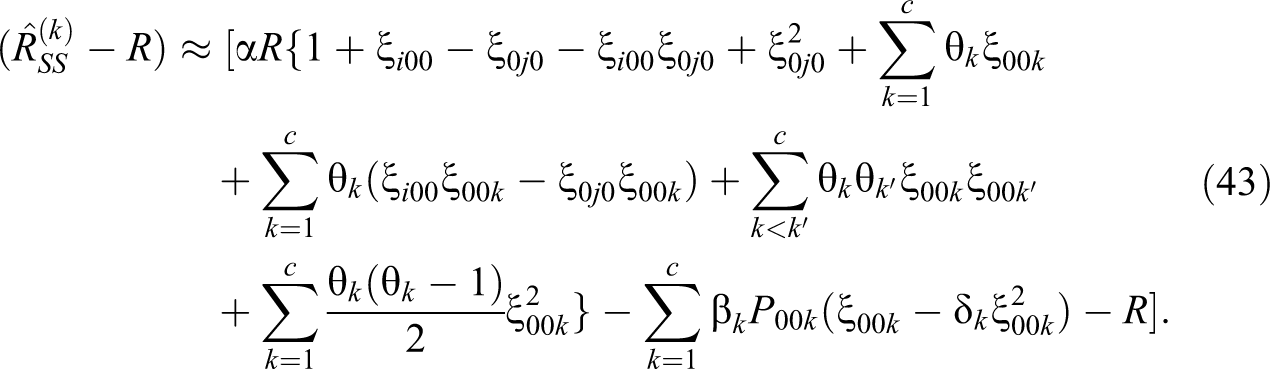
or
Taking expectation on both sides of equation (43), we get the bias of generalized class of estimators to the first order of approximation as:
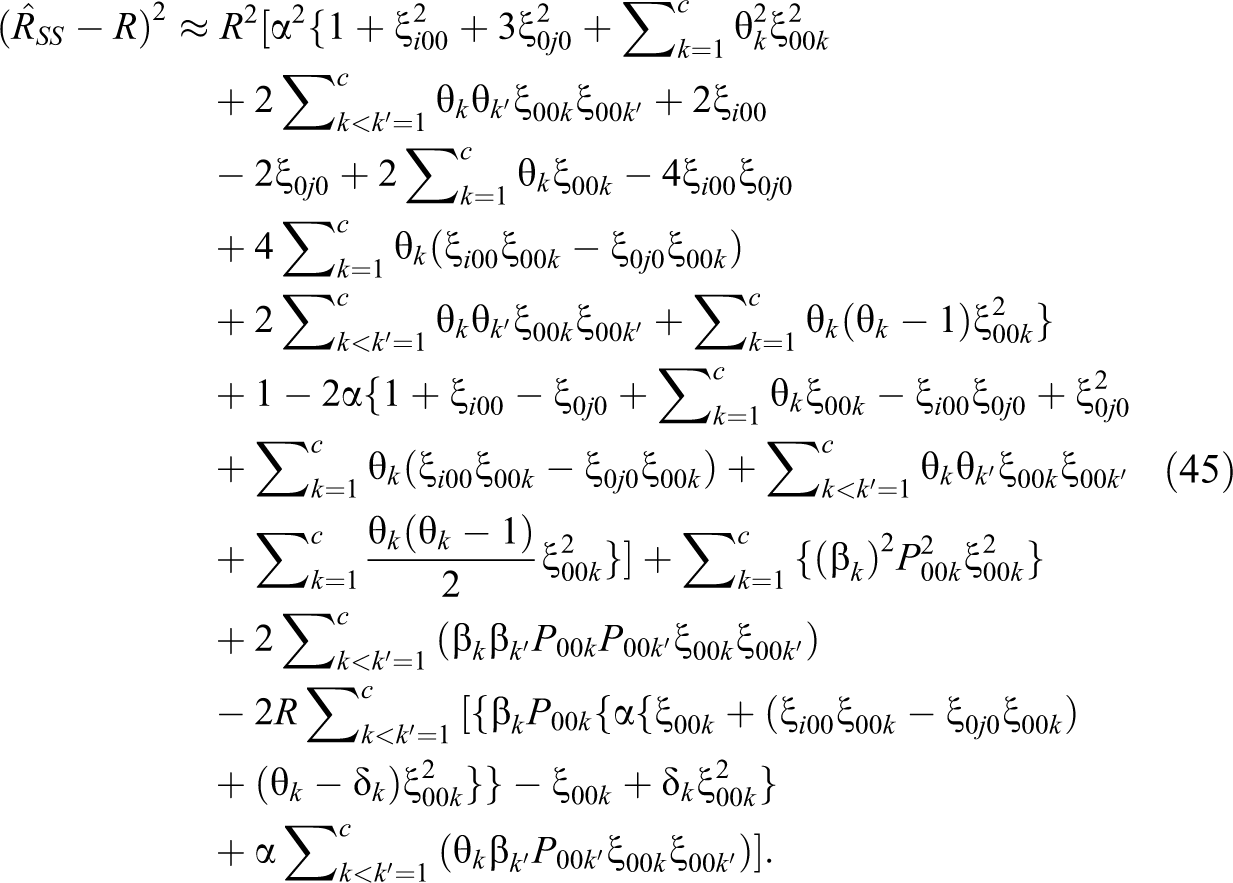
Squaring both sides of equation (43) and neglecting terms of ξs with order greater than 2, we have
Taking expectation on both sides of equation (45), we get the MSE of generalized class of estimators to the first order of approximation as:
where
Differentiating equation (46) partially with respect to α and βk, we get the following equations, respectively, as:
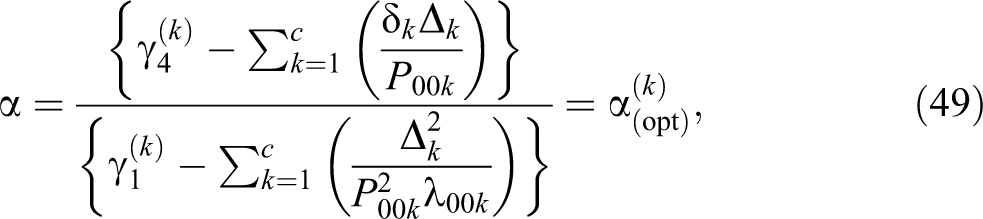
Solving equations (47) and (48), we get the optimum values of α and βk, respectively, as
Putting equations (49) and (50) in equation (46), we get the minimum MSE of generalized class of estimators to the first order of approximation as:
We suggest the general class of estimators of ratio of two population proportions. The usual ratio estimator, Wynn (1976) type estimator, Singh, Singh, and Kaur (1986) difference-type estimator and Gupta and Shabbir (2008) estimator have been found to be members of suggested class. We have also obtained the correct MSE expression of Gupta and Shabbir linear weighted estimator of the ratio of two population proportions. The merits of proposed class of estimators have been studied by the empirical study and found that the proposed estimators are superior to the usual ratio estimator, Wynn type estimator and Singh, Singh, and Kaur estimator but the performance of Gupta and Shabbir estimator is not consistent. The generalized version of proposed class has been also proposed.
Footnotes
Declaration of Conflicting Interests
The author(s) declared no potential conflicts of interest with respect to the research, authorship, and/or publication of this article.
Funding
The author(s) received no financial support for the research, authorship, and/or publication of this article.
References
1.
CochranW. G.1977. Sampling Techniques. 3rd ed. New York: John Wiley.
2.
GuptaS.ShabbirJ.. 2008. “On Estimating the Ratio of Proportions of Two Categories of a Population Using Auxiliary Information.” Journal of the Indian Society of Agricultural Statistics62:149–55.
3.
LuiK. J.1990. “Modified Product Estimators of Finite Population Mean in Finite Sampling.” Communications in Statistics–Theory and Methods19:3799–807.
4.
MurthyM. N.1967. Sampling: Theory and Methods. Calcutta, India: Statistical Publishing Society.
5.
RaoT. J.1977. “Optimum Allocation of Sample Size and Prior Distributions.” International Statistical Review25:173–79.
6.
SinghG.SinghR. K.KaurP.. 1986. “Estimating Ratio of Proportion Using Auxiliary Information.” Biometrical Journal28:637–43.
7.
SrivastavaS. K.1967. “An Estimator Using Auxiliary Information in Sample Surveys.” Bulletin/Calcutta Statistical Association Bulletin16:62–63.
8.
WynnH. P.1976. “An Unbiased Estimator in a Proportion.” The Statistician25:225–28.