



Abstract
We report a 46-year-old woman presenting with leprosy, HIV and active pulmonary tuberculosis (TB). It is advisable to screen for each one of TB, HIV and leprosy patients, especially when an extra feature emerges. Particularly in a leprosy case, if TB remains undiagnosed, the development of rifampicin resistance secondary to monotherapy in leprosy is a major concern.
Keywords
Background
Though leprosy and tuberculosis (TB) are prevalent in clusters in low- and middle-income countries, simultaneous occurrence in an individual is rare even in endemic settings. An increase of mycobacterial infections has been reported with HIV disease but the appearance of all three infections at the same time has hitherto not been reported to our knowledge. Leprosy and TB are the oldest mycobacterial infections reported in human history. Simultaneous occurrence of these two diseases in an individual is estimated at 2 per 10 million population. 1
Case report
A 46-year-old woman presented with severe refractory seborrhoeic dermatitis for two years’ duration. Examination revealed facial induration extending to the upper chest (Figure 1). A skin biopsy was performed as leprosy was considered likely; this revealed the evidence of borderline tuberculoid leprosy with type 1 reaction. She did not have commonly encountered leprosy lesions such as hypopigmented anaesthetic patches nor thickened peripheral nerves. She was commenced on multibacillary leprosy treatment with oral prednisolone for a presumed lepra reaction. Five months after commencing on treatment, she presented with fever of two weeks’ duration, loss of appetite, loss of weight and multiple abscesses over the lower limbs. A positive HIV antibody test and a CD4+ count at 57/µL confirmed immunodeficiency. Sputum for acid-fast bacilli was positive and Gene Xpert confirmed rifampicin resistance. Radiological evidence of active pulmonary TB was noted. The diagnosis of retroviral infection had been made five years previously when she had attended having tuberculous lymphadenitis treated over only six months with Anti tuberculosis therapy (ATT) but had then defaulted on both this and the retroviral treatment.
Erythematous indurated facial induration extending up to the upper chest on presentation to the dermatology unit.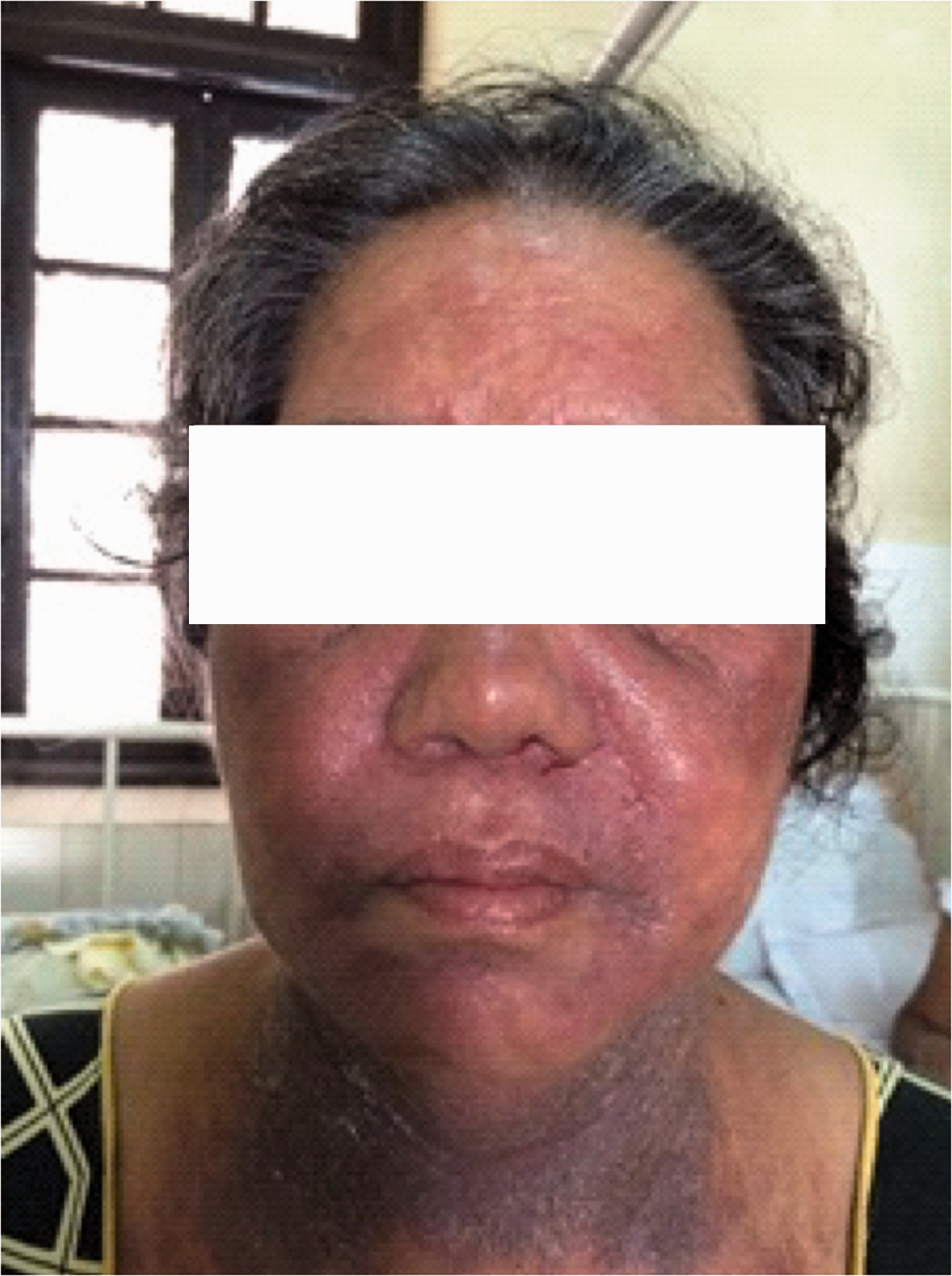
A multidrug regime for pulmonary TB, including intravenous kanamycin, and oral ethambutol, levofloxacin, isoniazid, ethionamide, cycloserine and pyridoxine was commenced. Repeated split skin smear was negative and so multibacillary leprosy therapy was continued, but without rifampicin, for one further year and prednisolone was gradually tailed off. One month after commencing ATT, she was also commenced on highly active anti-retroviral treatment (HAART), which included a combined pill of zidovudine, lamivudine and efavirenz. Her facial appearance improved and chest radiographic lesions resolved.
Written informed consent was obtained from the patient for publication of this case report and any accompanying images.
Discussion and conclusion
The global HIV pandemic has a massive impact on the epidemiology of TB. 2
HIV infection increases the risk of TB either as a primary progression or reactivation of latent infection. 3 However, the course of leprosy in co-infected patients seems not to be greatly altered by HIV. 4 Any immunocompromised status including HIV infection, diabetes and immunosuppressive drugs will make patients more susceptible to develop tuberculous infection. In our patient, both HIV with a low CD4 count and the use of steroids in the treatment of leprosy probably increased the risk of reactivation of TB, as is well known.1,5
In co-infected patients, if TB remains undiagnosed, the development of rifampicin resistance secondary to monotherapy in leprosy, is a major concern. 6 Concurrent treatment of HIV and TB in our patient was another concern. The optimal time to initiate HAART is after initiating TB treatment; multiple drug toxicities, multiple drug interactions and immune reconstitution syndrome (IRIS) were some of the complications feared in our patient. Rifampicin, which is used in both TB and leprosy, is a potent inducer of the cytochrome P450-3A4 enzyme, which is responsible for the metabolism of protease inhibitors. 7
Furthermore, establishing a diagnosis of leprosy in an HIV patient is also challenging. 8 Initiation of HAART may also exacerbate existing leprosy lesions. 4 IRIS can induce lepra reactions. Thus, our case highlights the advisability of screening for TB in both HIV and leprosy patients, especially if coincident respiratory or constitutional symptoms, a high erythrocyte sedimentation rate or an abnormal chest radiograph exist.
Footnotes
Declaration of conflicting interests
The author(s) declared no potential conflicts of interest with respect to the research, authorship, and/or publication of this article.
Funding
The author(s) received no financial support for the research, authorship, and/or publication of this article.