



Abstract
Ethnic achievement gaps are often explained in terms of student and school factors. The decomposition of these gaps into their within- and between-school components has therefore been applied as a strategy to quantify the overall influence of each set of factors. Three competing approaches have previously been proposed, but each is limited to the study of student-school decompositions of the gap between two ethnic groups (e.g., White and Black). The authors show that these approaches can be reformulated as mediation models facilitating new extensions to allow additional levels in the school system (e.g., classrooms, school districts, geographic areas) and multiple ethnic groups (e.g., White, Black, Hispanic, Asian). The authors illustrate these extensions using administrative data for high school students in Colombia and highlight the increased substantive insights and nuanced policy implications they afford.
Keywords
Ethnic achievement gaps, usually defined as the difference between the mean test scores of two groups of students (e.g., Black and White students), have been widely explored in education, psychology, sociology, and other behavioral sciences. This literature suggests these gaps are the result of differences in a wide range of variables defined at the student, school, and higher levels of the education system (Bidwell and Kasarda 1975; Coleman et al. 1966; Mohammadpour and Ghafar 2014; Rothstein 2004; Wenglinsky 2009). One way of addressing the challenge of finding the variables that potentially drive achievement gaps is to know where to start looking for them.
A natural approach is therefore to decompose the overall achievement gap into its separate component parts operating at each level of the education system. Once this has been achieved, variables at the corresponding levels (e.g., student, school, and school district characteristics) can be considered as potential explanatory variables of the achievement gap. For example, if most of the achievement gap is due to differences within schools, we might start with student-level variables, or if most of the achievement gap is due to differences between schools, we might prioritize school-level variables, including schools’ characteristics and composition. One might also examine how within- and between-school decomposition changes over cohorts and school grades and across regions and countries. Identifying the contribution of different levels of the education system to the achievement gap can also help prioritize policy efforts at specific levels and establish what level of the education system may be held accountable for disparities in achievement.
Prior work has proposed three competing methodological approaches to study the Black-White achievement gap in the United States. We refer to these as approach 1 (Cook and Evans 2000; Fryer and Levitt 2004, 2006), approach 2 (Hanushek and Rivkin 2006), and approach 3 (Page, Murnane, and Willett 2008; Reardon 2008). Authors applying approaches 1 and 3 argue that between-school differences explain at most 40 percent of the White-Black achievement gap in the United States (Cook and Evans 2000; Fryer and Levitt 2004, 2006; Page et al. 2008; Reardon 2008), whereas authors applying approach 2 argue that these differences explain 70 percent of the achievement gap (Hanushek and Rivkin 2006).
These approaches are limited in at least two ways. First, they do not consider the role of other levels of the school system, such as school districts. Second, they are restricted to a binary comparison, ignoring the role of other minority groups. Such omissions may hinder the pertinence and relevance of these gap decomposition analyses. For example, existing approaches might direct attention to school-level policies (e.g., providing teacher training), whereas a more relevant policy might focus on district-level interventions (e.g., reconsidering how resources are allocated).
The main contribution of this article is to extend the three current decomposition approaches to consider additional levels of the school system (e.g., districts) and multiple ethnic groups (e.g., White, Black, Asian, Hispanic) using mediation analysis as a framework to facilitate such extensions. We first show that the current achievement gap decomposition approaches are mathematically equivalent to a mediation problem. We then take advantage of this equivalence to extend the current decomposition approaches to consider additional levels of the school system and multiple ethnic groups. Note that we do not use mediation analysis in the traditional sense (Baron and Kenny 1986; Vanderweele and Vansteelandt 2009) but merely as a device to facilitate the effect decomposition. Hou (2014) proposed using mediation analysis as a general framework for effect decomposition. However, the use of mediation analysis as a methodological tool to extend ethnic achievement gap decomposition approaches has not been considered in the literature. Although this is not the only option to derive the extensions presented here (e.g., deriving the mathematical formulation directly is another option), it facilitates the presentation of these extensions. We apply these extensions to the three approaches to study ethnic achievement gaps in Colombia to illustrate the extensions and their importance.
Approaches for the within- and between-School Gap Decomposition
Reardon (2008) and Page et al. (2008) reviewed the three existing methodological approaches for the ethnic achievement gap decomposition and discuss their interpretation. We summarize these approaches from a mediation analysis perspective, in preparation for the extensions in the following sections, which present our main contribution. Here, we understand mediation analysis merely as a tool that allows us to decompose the effect of ethnicity (i.e., the ethnic achievement gap) into different components. Nonetheless, using the mediation analysis framework is not essential but a means to deriving the extensions we propose.
Consider the single-level linear regression model

where the dependent variable
The difference in average test scores between White and minority students within and between schools can be estimated using the hybrid-effect model 1 :

where
To translate the three achievement gap decomposition approaches into the mediation analysis framework, it is enough to consider a model in which the ethnic composition of each school
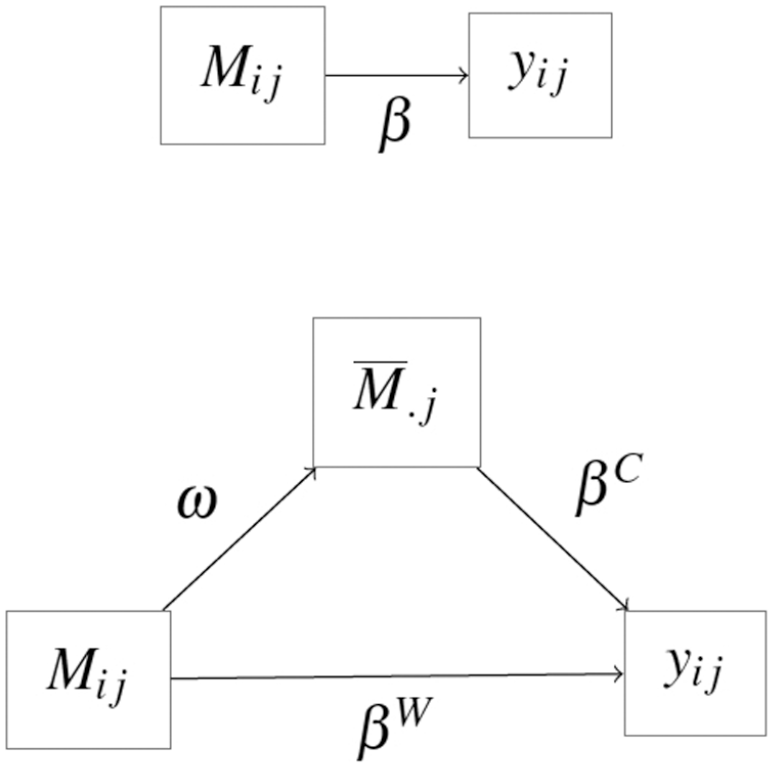
Model for the achievement gap decomposition into its within- and between-school components.
The upper part of Figure 1 describes the total-effect model (equation 1). The lower part of Figure 1 represents the outcome and mediation models. The outcome model is the contextual-effect model (equation 2). The mediation equation is

where the school proportion of minority students
In the mediation analysis context, the total effect

Here, the direct effect is the within-school gap
Different strategies can be used to derive confidence intervals for the direct and indirect effect, as well as for the different components of the gap, including bootstrapping and Monte Carlo methods (MacKinnon, Lockwood, and Williams 2004). For the application in this article, we estimate 95 percent, 99 percent, and 99.9 percent Monte Carlo confidence intervals for the proportion of the gap that each of its components represents. We implemented the confidence intervals via the approach of Selig and Preacher (2008). The advantage of Monte Carlo methods is that they only require the estimated parameters and their standard errors, which can be estimated using cluster-robust estimators to account for the nested nature of the data (Preacher and Selig 2012). The supplemental material includes R and Stata code to implement the proposed decompositions.
Approach 1: Cook and Evans (2000) and Fryer and Levitt (2004, 2006)
Cook and Evans (2000) and Fryer and Levitt (2004, 2006) used a version of the Kitagawa-Oaxaca-Blinder decomposition (Blinder 1973; Kitagawa 1955; Oaxaca 1973) that includes school fixed effects, allowing them to identify achievement gaps within schools, after considering differences in gender and parental education. This model can be written as

where
Therefore, the decomposition approach 1 is equivalent to equation (4), and Cook and Evans (2000) and Fryer and Levitt (2004, 2006) attributed
This statement is true in a scenario without segregation (
Approach 2: Hanushek and Rivkin (2006)
Challenging Fryer and Levitt (2004, 2006), Hanushek and Rivkin (2006) deduced a mathematical formulation to write the Black-White achievement gap as a weighted sum of differences within and between schools. As Reardon (2008) showed, Hanushek and Rivkin used the within- and between-school gaps, which can be recovered from the hybrid-effect model (equation 2). Reardon also showed that Hanushek and Rivkin’s formula is equivalent to

Then, Hanushek and Rivkin argued that the contribution of the within-school achievement gap
Translating this approach to the mediation analysis framework requires recognizing that differences between schools are the sum of differences within schools and the contextual effect of ethnicity. In other words, differences between schools arise not only because of the effect of studying with a larger proportion of minority students (
Recognizing this in equation (4) leads to equation (6). Accordingly, the ethnic achievement gap
Approach 3: Reardon (2008) and Page et al. (2008)
Trying to conciliate Fryer and Levitt (2004, 2006) and Hanushek and Rivkin (2006), Reardon (2008) argued that the overall achievement gap can be decomposed into three different components: one that can be attributed to differences within schools, a second one due to differences between schools, and a third that is a combination of both and therefore cannot be uniquely assigned to either of those. This decomposition is based on the contextual-effect model (equation 2).
This is equivalent to further separating the contribution of between-school differences to the overall gap, acknowledging that

Under Reardon’s (2008) interpretation,
To interpret the differences between approaches 1 and 2, Reardon (2008) and Page et al. (2008) proposed analyzing the type of policies that would be required to eliminate ethnic differences within and between schools. If eliminating a component of the gap requires a between-school intervention, it can be attributed to the between-school gap. Conversely, if it requires a within-school intervention, it can be attributed to the within-school component of the gap. Their argument is based on three policies:
Eliminating the within-school gap (
Eliminating segregation (
Eliminating the relationship between the school ethnic composition and its mean achievement (
Using these policy scenarios, Reardon (2008) and Page et al. (2008) argued that
Additionally, Page et al. (2008) combined Reardon’s (2008) approach with the Kitagawa-Oaxaca-Blinder decomposition to incorporate covariates in the model, including indicator variables for other ethnicities. They were the first authors to consider other ethnicities, but their approach did not acknowledge that the influence of other groups can be part of the between-school component of the Black-White achievement gap, as we will discuss. We now turn our attention to our application of interest.
Data and Initial Application
At the end of secondary education, all Colombian students take a standardized exam, called SABER 11. The compulsory nature of the exam means that the data resulting from its administration are effectively a census of 11th grade students (age 16 and 17 years) in Colombia, including those attending private and public (state-funded) schools. The nationwide educational authority in Colombia is the Ministry of Education, but smaller administrative divisions—districts or entidades territoriales certificadas—are responsible for the management of education within their geographic boundaries.
The main ethnic groups in Colombia are the White-mestizo group (European descendants who mixed with other ethnic groups, 85.9 percent of the population), Afrocolombians (10.6 percent), and the Indigenous (3.4 percent); other ethnic minorities account for 0.01 percent of the population (DANE 2007). Afrocolombian, Indigenous, and other minority students are grouped together for the applications presented here and in the application for the extension including multiple levels. Hence, the overall ethnic achievement gap is defined as the difference in average test scores between White and minority students.
We focus on the SABER 11 math test scores for 2011, which included 458,947 students, 8,039 schools, and 94 districts. Among all students, 6.7 percent self-identify as belonging to ethnic minorities. Only 34.9 percent of schools serve both White and minority students, and there is large variation in the proportion of minority students within schools, regardless of their size. The math test scores have been normalized to have a mean of 0 and a standard deviation of 1.
Page et al. (2008) suggested excluding schools in which all students belong to the same ethnic group (i.e., ethnically homogeneous schools), because these do not contribute to estimation of the within-school gap. However, in Colombia, this results in the exclusion of 236,794 students, or 51.6 percent of the observations. Therefore, an analysis based on a data set without ethnically homogeneous schools is unlikely to provide an accurate representation of differences between schools. However, the magnitude of the results presented here may be skewed toward the scores obtained by students in these schools.
The first model in Table 1 estimates the overall ethnic achievement gap, showing that minority students score, on average, 0.46 S.D. (
Estimation Results for the Models Underlying the Decomposition Approaches
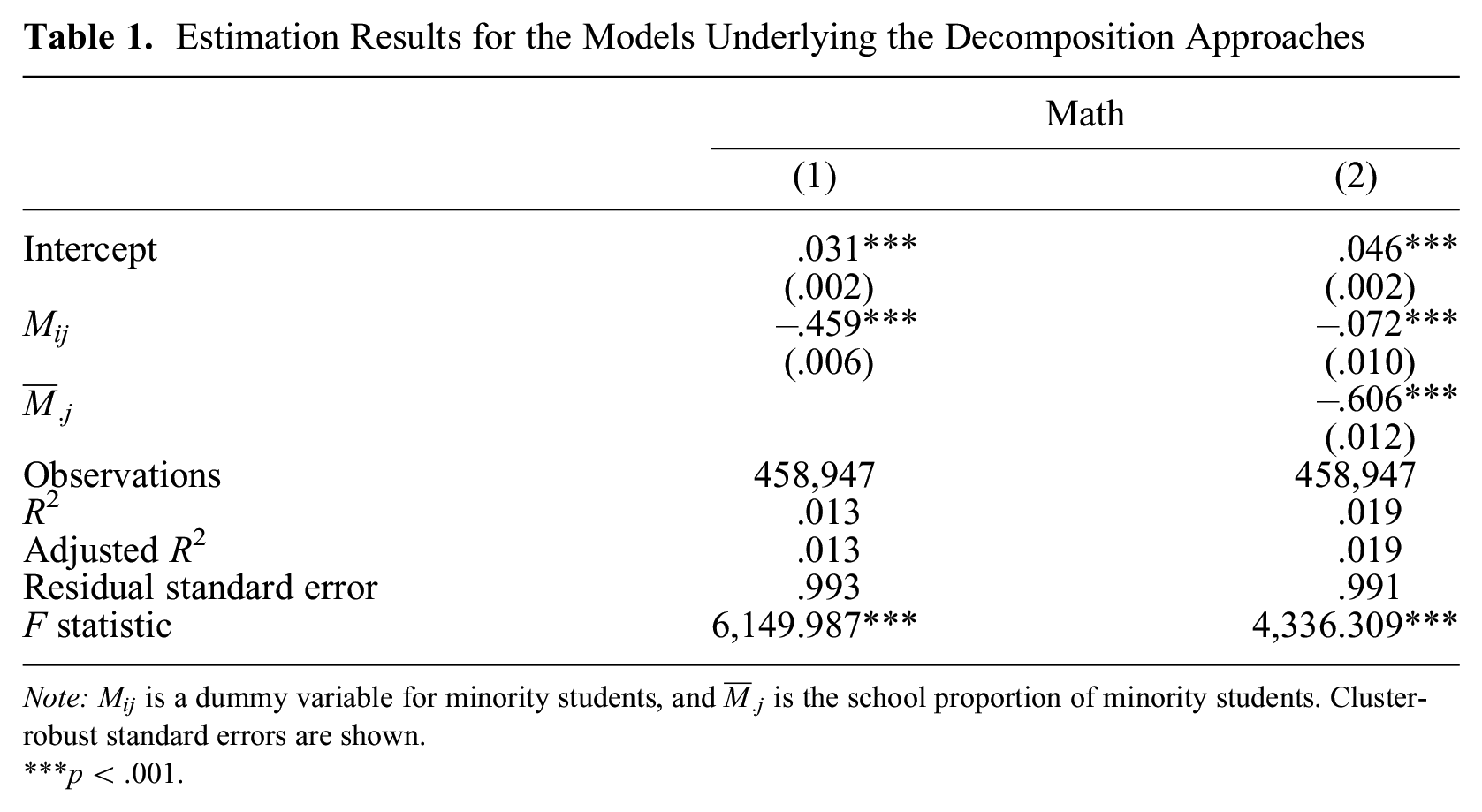
Note:
p < .001.
Estimation of the mediation equation (3), regressing
Earlier, we showed we can combine this information to decompose the overall ethnic achievement gap. Figure 2 presents the results of applying these different approaches. Under approach 1, the 0.46 S.D. overall gap is decomposed into the 0.07 S.D. within-school gap,

White-minority math achievement gap decomposition under the three different approaches using Colombian data.
Approach 2 decomposes the overall gap into the 0.03 S.D. that can be attributed to the within-school gap component,
In the Colombian context, differences within schools are very small, especially in comparison with those found in the United States. For that reason, unlike in the United States, in Colombia we can conclude that most of the ethnic achievement gap is related to school-level processes, regardless of the decomposition approach we use.
Considering Additional Levels
We now use the mediation analysis framework as a device to extend the current ethnic achievement gap decomposition approaches. This section focuses on incorporating additional levels, and the next section considers multiple ethnic groups.
To consider an additional level (i.e., school district) it is enough to consider a parallel multiple mediation model (Hayes 2017) in which the school and district proportions of minority students,

which is similar to equation (1), as
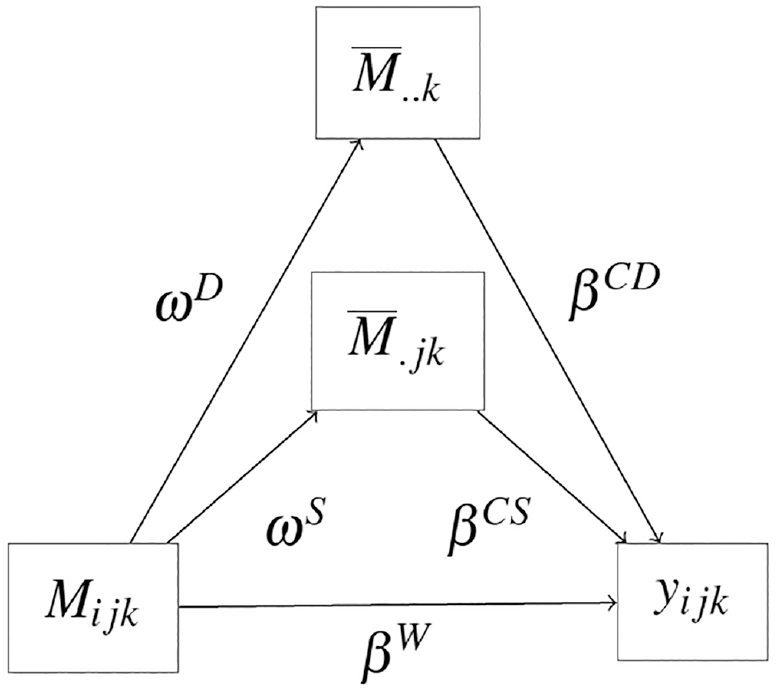
Outcome and mediation models for the achievement gap decomposition with an additional level.
The outcome model is the contextual-effect model

where
Because the model includes two mediators, there are two mediation equations

Again, we use equations (9) and (10) as devices to decompose the ethnic achievement gap, rather than as models with a particular interpretation. In this case, equation (10) allows us to estimate the between-school segregation index,
In a parallel multiple mediation model (Hayes 2017), given these relationships, the overall gap

where
We know that

where
The third approach further decomposes the between-school and between-district components of the gap, by recognizing that

where
The importance of considering additional levels of the education system when applying these three decomposition approaches will likely depend on the context. The following section illustrates how the implications for policy and practice can be better informed by providing more detailed evidence of the components of the ethnic achievement gap in Colombia.
Application
As shown in the first model in Table 2, when considering additional levels of the school system, the total-effect model remains the same as in the simple case shown in Table 1, which estimates an overall White-minority gap of 0.46 S.D. In turn, the outcome model (third model in Table 2) now includes the district proportion of minority students,
Estimation Results for the Models Underlying the Decomposition Approaches
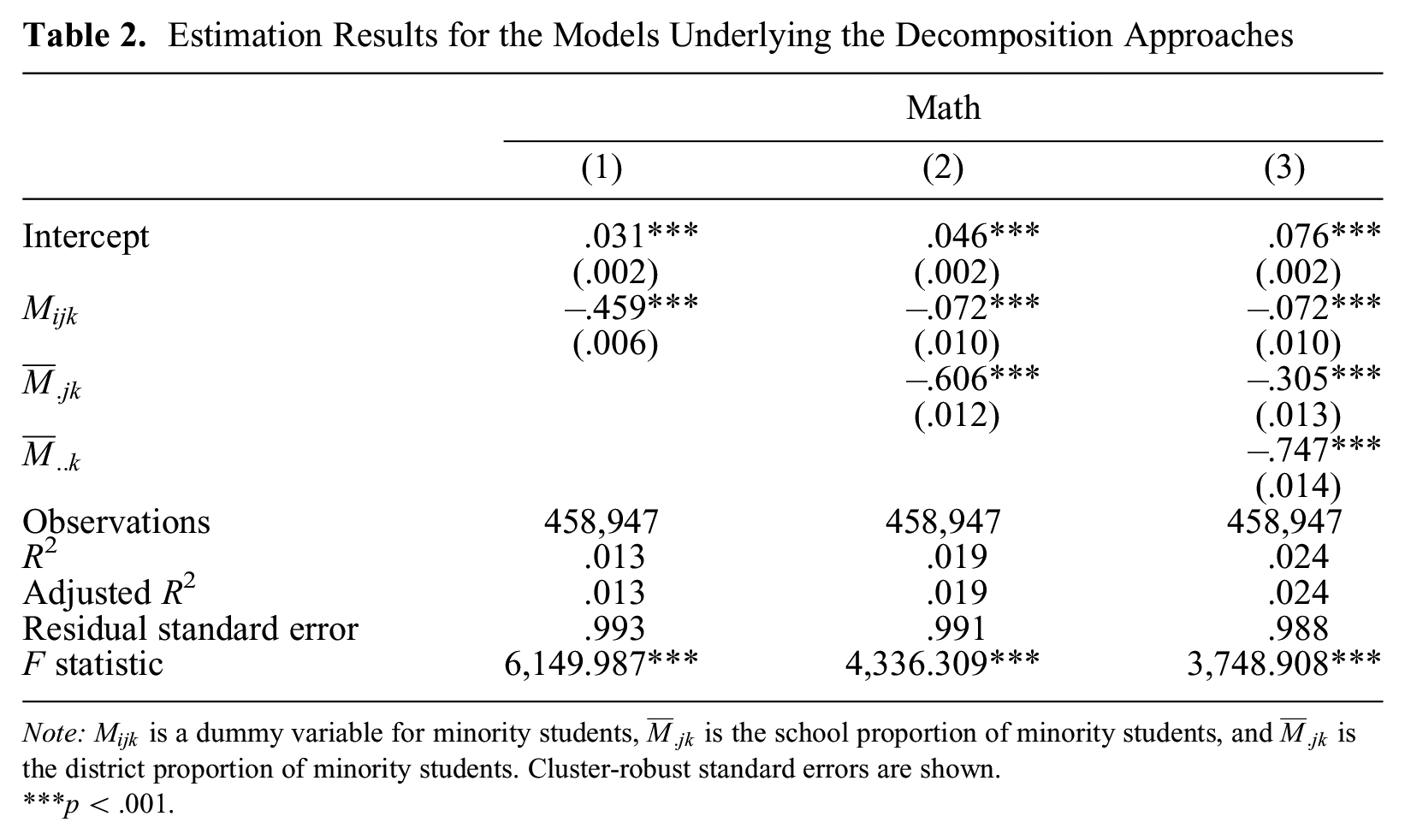
Note:
p < .001.
As shown in Table 2, including
The third model in Table 2 also shows that, within districts, schools that serve only White students score, on average, 0.38 S.D. (
The estimation of mediation equations (equation 10) shows that minority students attend schools and districts with 63.8 and 25.8 percentage points more minority students than do White students (
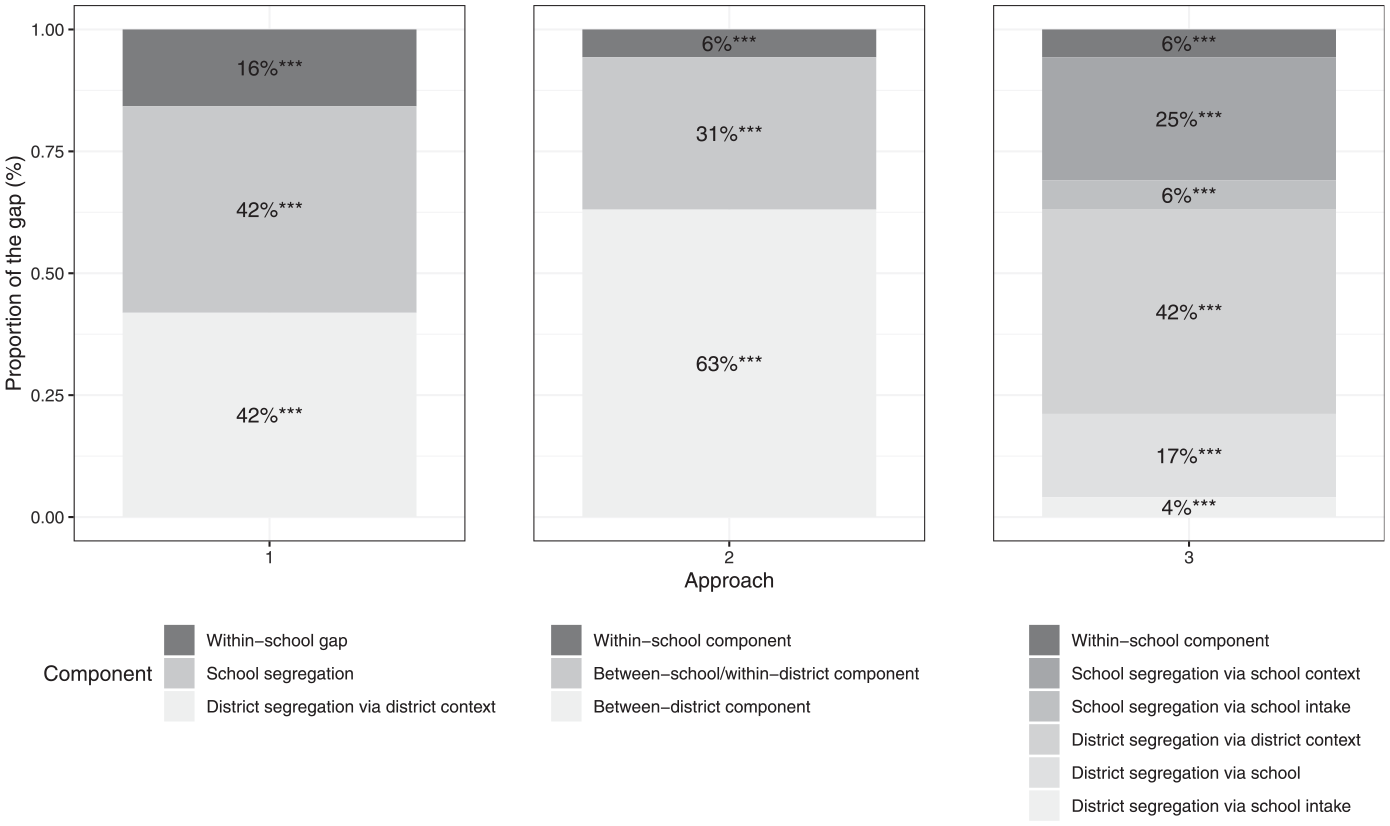
White-minority math achievement gap decomposition under the three different approaches considering districts.
Under approach 1, the 0.46 S.D. overall gap is decomposed into the 0.07 S.D. within-school gap,
Finally, approach 3 decomposes the gap into six different components. First, 0.03 S.D. (5.7 percent) attributed to the within-school component of the gap,
These three decomposition approaches provide different insights and levels of granularity about the role of various levels of the school system in the White-minority achievement gap in Colombia. Nonetheless, they all draw attention to the importance of differences between districts, with implications for research and policy. An analysis based on the original decomposition approaches would lead to recommendations focusing on schools, such as teacher training or upgrades in school infrastructure (e.g., Fryer and Levitt 2004, 2006). The results in this section, however, show that the district where a school is located is an important school-level characteristic that contributes to the ethnic achievement gap. Hence, policies tackling inequality among districts are as (if not more) important for narrowing the White-minority gap in Colombia. Extending the current decomposition approaches to incorporate the role of districts thus leads to better informed policy recommendations.
Considering Multiple Ethnic Groups
So far, we have assumed the gaps between all minority groups and White students are the same, and that the extent to which the gap can be attributed to differences between students, schools, and districts is the same for all ethnic groups. These assumptions are probably incorrect. An alternative decomposition that allows different gaps and components for each ethnic group may thus be more attractive. We now explore this extension, which can be combined with the extension discussed in the previous section to decompose the achievement gaps of multiple ethnic groups while considering additional levels of the school system (see the Appendix). To facilitate the explanation, we limit the presentation to a two-level case.
Again, mediation analysis can be used as a device to extend the current gap decomposition approaches to consider multiple ethnic groups. This time, it is enough to combine a mediation model with a multicategorical independent variable (Hayes and Preacher 2014) and a parallel multiple mediation model (Hayes 2017). For our illustration, we compare three possible ethnic categories with the White category, which is used as a reference: Afrocolombian (
The total-effect model, depicted in Figure 5, is

where
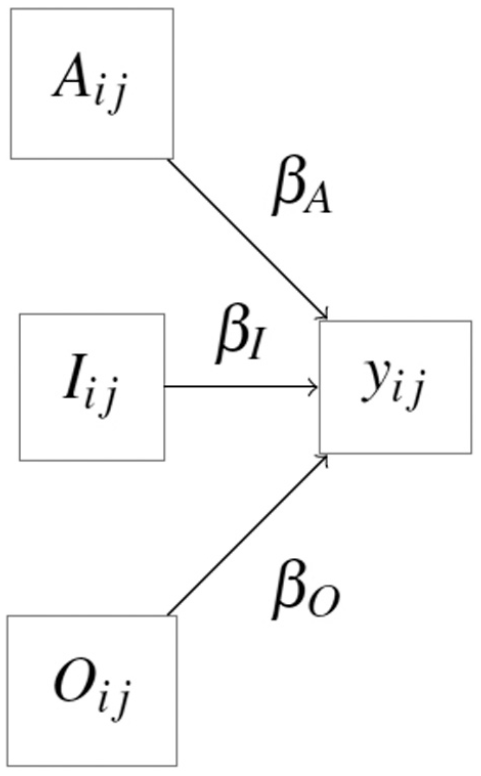
Total-effect model for the decomposition of the gaps for multiple ethnic minority groups.
Figure 6 shows the outcome and mediation models; besides having an explanatory variable for each minority group, there is also one mediator for each of them (Hayes and Preacher 2014). These mediators are the school proportion of students belonging to each of the minority groups,
6

where
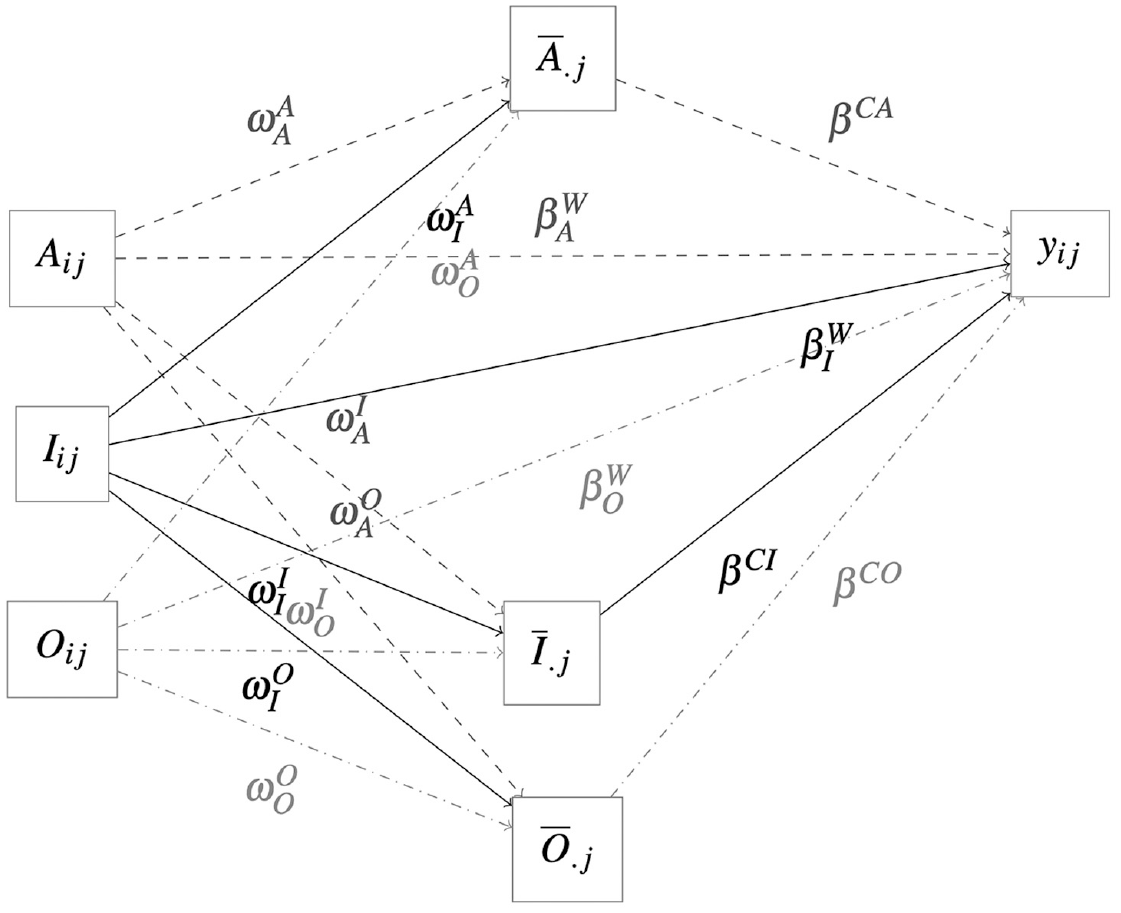
Outcome and mediation models for the decomposition of the gaps for different ethnic groups.
Following Hayes (2017), there is one mediation model for each mediator, and thus for each ethnic minority group, and each mediator is a function of the school ethnic composition in terms of all minority groups. As in the prior section, this is only a device to decompose the achievement gap for each minority group, which results in the models

Again, the mediation equations provide estimates of indicators of segregation, given by the differences in the mean school proportion of minority students, for each minority group and White students. For instance,
Following Hayes and Preacher (2014) and Hayes (2017), each gap can be decomposed into its relative direct and (specific and total) indirect effects analogously to equation (11). There is a relative direct effect for each ethnic minority, which corresponds to the within-school achievement gap. Each mediator contributes to the specific relative indirect effects, which add up to the total relative indirect effects for each ethnic group. Importantly, equation (16) implies that the achievement gap of each ethnic group is not only a function of its own contextual effect, but also a function of the contextual effects of other minority groups. For example, the overall ethnic achievement gap for Afrocolombians can be decomposed into the direct effect,

This shows that multiple-level decomposition of the overall ethnic achievement gaps for multiple ethnic groups is not possible without incorporating contextual effects of the other minority groups, which are weighted according to their relative (to that of White students) exposure to other ethnic groups. For example, the overall achievement gap for Afrocolombian students depends not only on the within-school gap and the school contextual effect of Afrocolombian students, but also on the contextual effects of Indigenous and other minority students. Empirical attempts to incorporate several groups into the analysis (Dustmann, Machin, and Schönberg 2010; Page et al. 2008; Quinn 2015) have not recognized the role of the remaining ethnic groups as part of a school-level element of the gap. The importance of this omission depends on how segregated minority groups are with respect to each other and how strong their contextual effects are.
As before, the school proportions of each ethnic minority (the mediators) can be correlated (Hayes 2017), but the model implies they are linked to academic achievement only through the contextual effect of each ethnicity (as opposed to, e.g., the school proportion of Afrocolombian students,
Under approach 1, equation (17) is equivalent to decomposing the overall gap into the within-school gap (e.g.,

where, for example,
Intuitively, the overall Afrocolombian-White between-school gap,
Approach 3 suggests we decompose the between-school component of the gap, recognizing that

where, taking the Afrocolombian-White achievement gap as an example,
Application
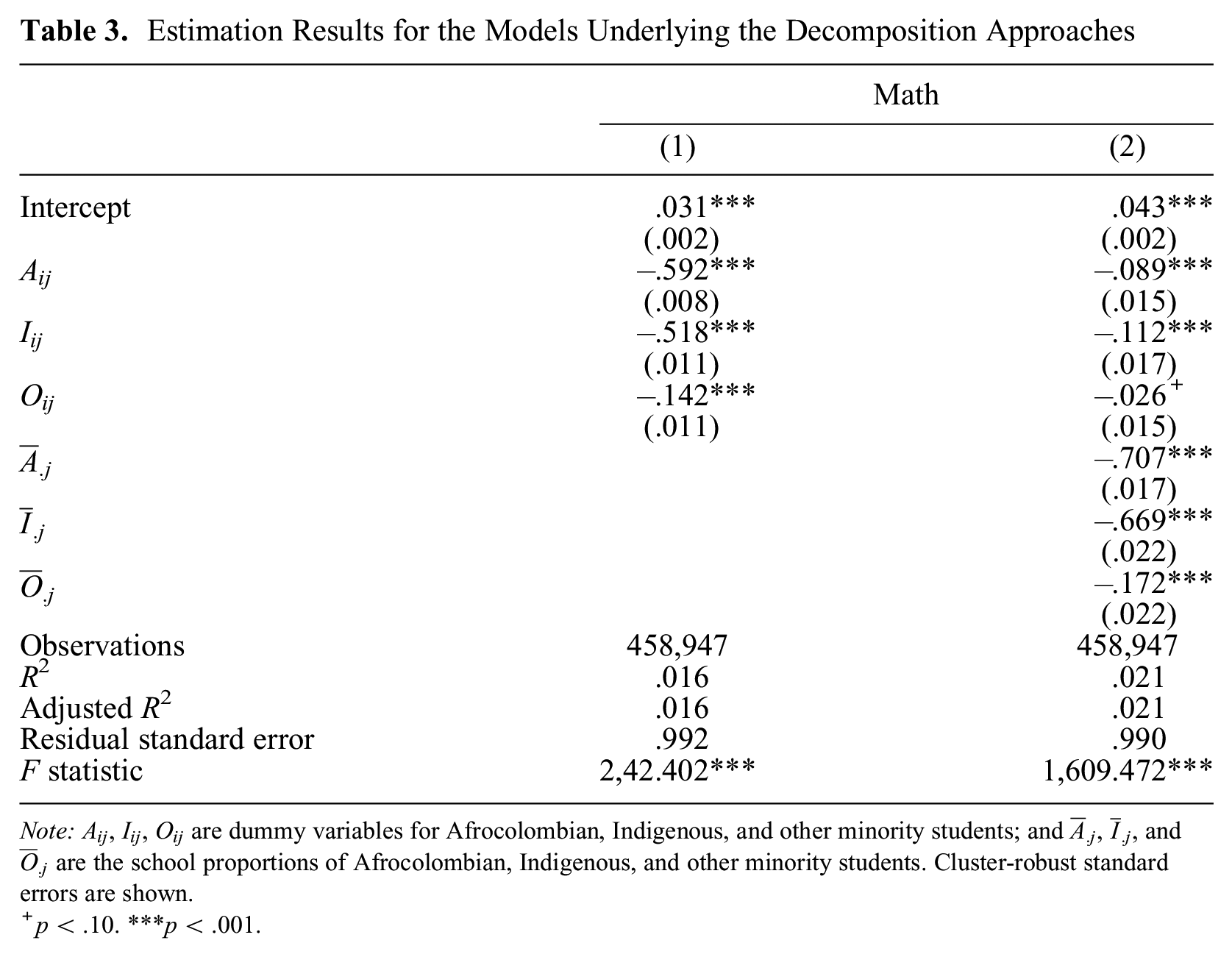
As discussed in the prior section, the multiple-ethnic-group decomposition uses the parameters of the total and outcome models presented in Table 3. As shown, the 0.59 S.D. White-Afrocolombian achievement gap,
Estimation Results for the Models Underlying the Decomposition Approaches
Note:
p < .10. ***p < .001.
Table 3 shows that within schools, Afrocolombian, Indigenous, and other minority groups score 0.09 S.D. (
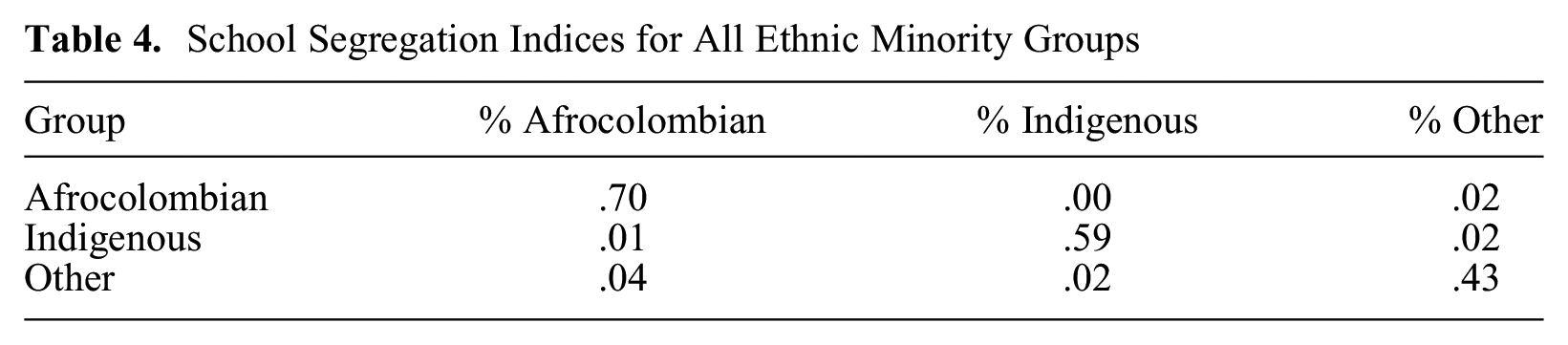
As discussed earlier, considering multiple ethnic groups requires considering differences in exposure to them. These differences are displayed in Table 4, which shows that minority groups are more exposed to other students of the same ethnic minority, in comparison with White students. For example, Afrocolombian students attend schools with an average proportion of Afrocolombian students 0.7 percentage points (
School Segregation Indices for All Ethnic Minority Groups
Each of the three decomposition approaches studied here result from the combination of these parameters. These results are shown in Figure 7. Taking the White-Afrocolombian achievement gap as an example, approach 1 attributes 0.09 S.D. (15.1 percent) of the White-Afrocolombian achievement gap to the within-school gap,
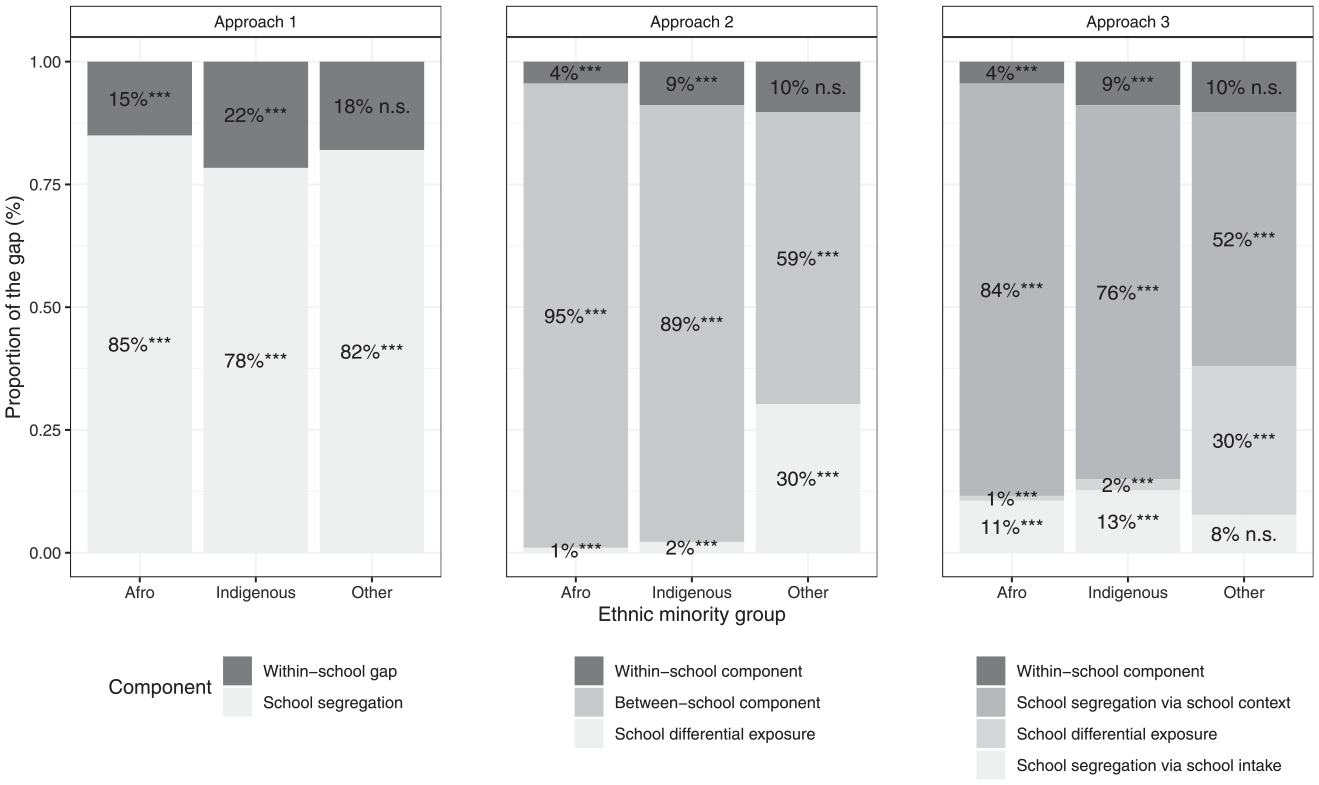
White-minority math achievement gap decomposition under the three different approaches considering multiple ethnic minorities.
Approaches 2 and 3 attribute 0.03 S.D. (4.5 percent) of the White-Afrocolombian gap to the within-school component of the gap,
Alternative decompositions can be accommodated. For example, if it is relevant to know which minority group contributes the most to the ethnic achievement gap, the school-level component of the gap can be further decomposed to analyze the individual contributions of the contextual effects of each minority group.
On Serial Multiple Mediation Models
As discussed in the prior sections, the extensions to the three existing gap decomposition approaches to consider multiple levels and multiple ethnic groups are based on a parallel multiple mediation model. An alternative model, the serial multiple mediation model, considers multiple mediations. We now explain why the extensions are not based on a serial multiple mediation model. We illustrate the discussion using the extension to include multiple levels, but a similar argument can be made about the extension to consider multiple ethnic groups.
The parallel multiple mediation model assumes school segregation and district segregation are correlated but separate processes. Alternatively, one could use serial multiple mediation models. Figure 8 adds a new path between the school proportion of minority students,
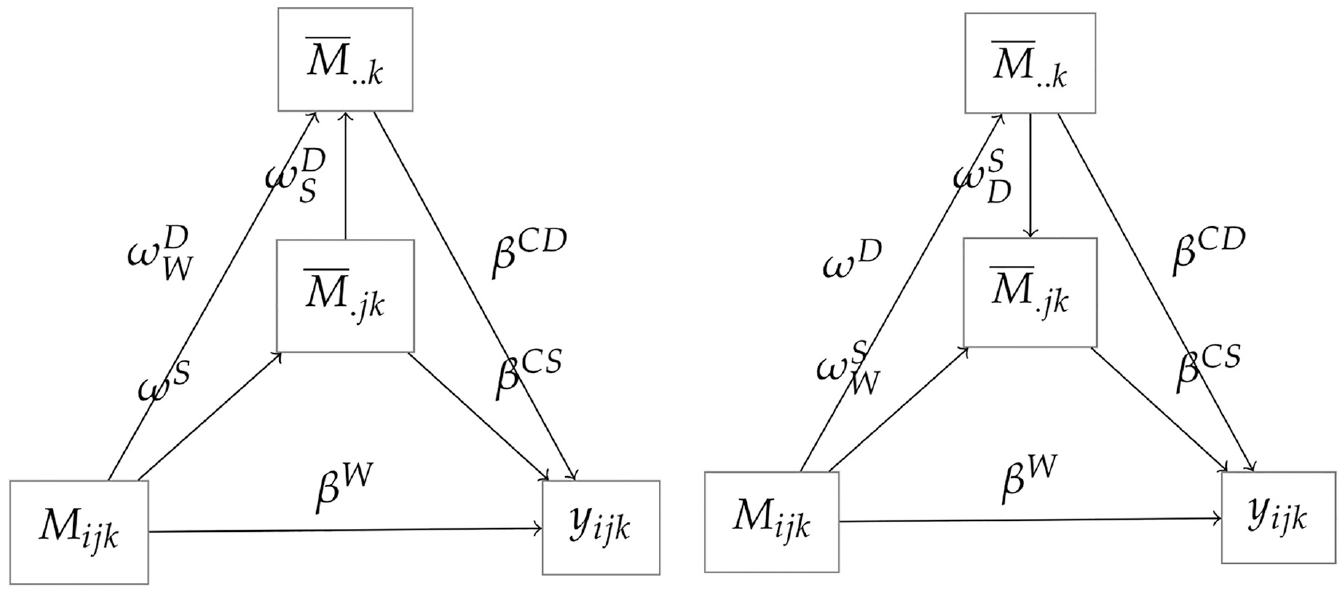
Outcome and mediation models for the achievement gap decomposition with an additional level using two alternative serial multiple mediation models.
The outcome model and the mediation equation for the school proportion of minority students,

However, it is not possible to estimate
The outcome and mediation equations for the district proportion of minority students,

In this case, it is possible to estimate the within-district school segregation parameter,

Note, however, that
Note, however, that the relation between the district and school ethnic composition is only deterministic when all districts have the same number of schools, and schools within these districts are the same size. In the more conventional situation in which schools within districts are different sizes, there is no deterministic relationship between these two; districts with the same proportion of minority students,
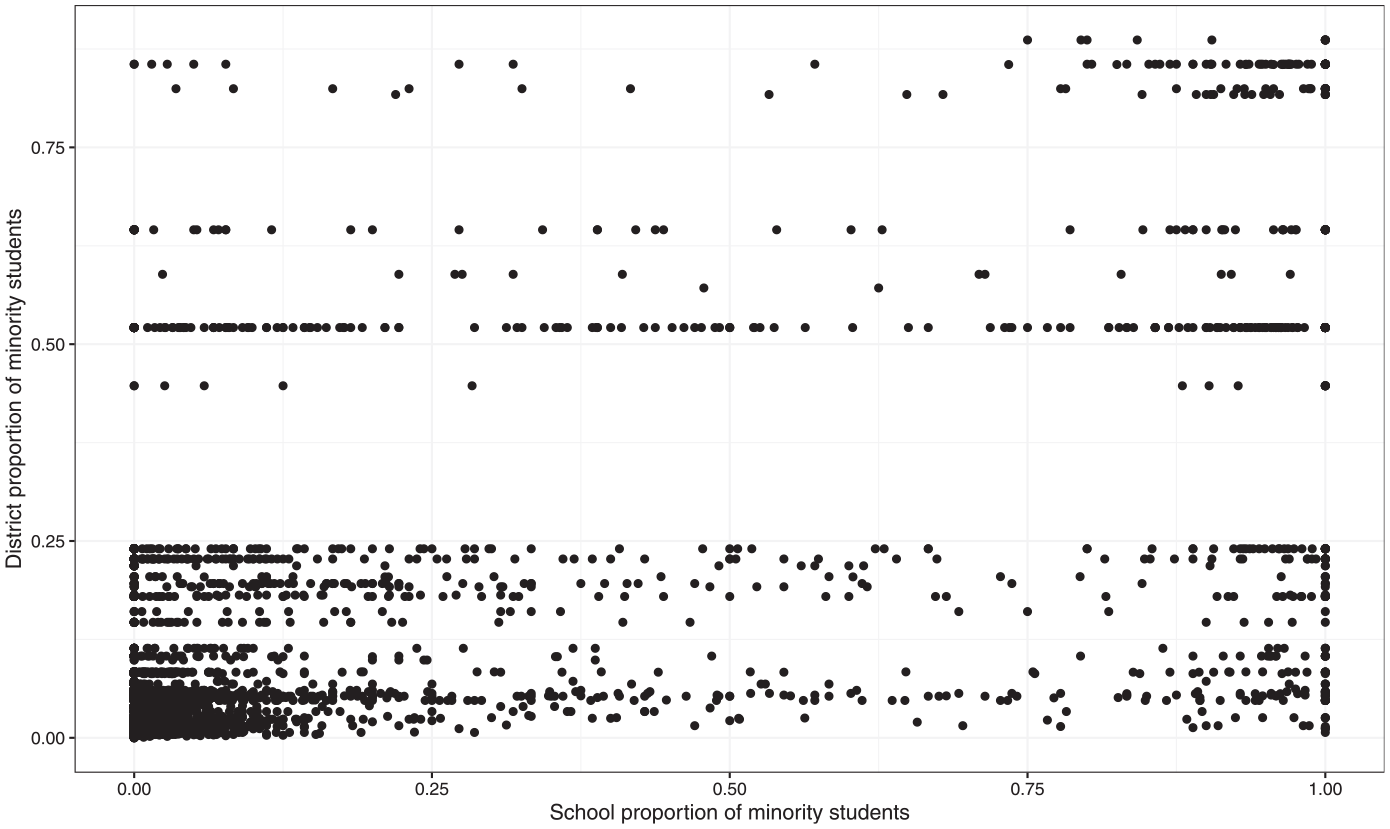
Relationship between the district proportion of minority students and the school proportion of minority students.
We encourage researchers to explore the potential extensions the mediation framework offers, using either parallel multiple mediation models or serial multiple mediation models as best suits their research context and research questions. If, in a particular context, there is reason to believe that district segregation patterns influence school segregation patterns, using serial multiple mediation models and reparametrizing the decomposition approaches accordingly might result in improved insights to the ethnic achievement gaps. Otherwise, extending the decomposition approaches using parallel multiple mediation models will likely provide enough insights about the contribution of within-school and between-school differences to the overall ethnic achievement gap.
Discussion and Conclusions
In this article, we examine three different approaches for a multilevel decomposition of the ethnic achievement gap. We argue that in approach 1, Cook and Evans (2000) and Fryer and Levitt (2004, 2006) decomposed the Black-White achievement gap into the within-school gap and the effect of segregation. In approach 2, Hanushek and Rivkin (2006) decomposed the gap into a part that is attributable to the within-school gap and a part attributed to the between-school gap. Finally, in approach 3, Reardon (2008) and Page et al. (2008) decomposed the gap into three parts: one that is attributable to the within-school gap, a second that is linked to the effect of school segregation through differences in student intake, and a third component attributed to the effect of school segregation through differences in school composition.
Each of these decomposition approaches is useful for different research questions and policy decisions. For example, if the debate is about school segregation, approach 1 provides a more direct way to analyze its potential effects on the achievement gap. If one’s focus is the within- and between-school components of the gap, approach 2 is appropriate. If one wants to examine the mechanisms behind the between-school component of the gap, approach 3 can be used.
The initial approaches are limited, however, in that they do not appropriately consider the role of additional levels of the school system (e.g., districts) or multiple ethnic groups (beyond the binary White-minority comparison), which restricts the kind of policy recommendations that follow from applying these methods. We address these limitations by extending the three decomposition approaches to consider multiple levels of analysis and for multiple ethnic groups.
The role of between-district differences (or school districts in the United States) has only before been considered using Cook and Evans’s (2000) method of including school (in this case, district) fixed effects into a Kitagawa-Oaxaca-Blinder decomposition. Arteaga and Glewwe (2019) proposed using this method to examine the extent to which the gap between Indigenous and non-Indigenous students could be attributed to community effects in Peru. Use of the Kitagawa-Oaxaca-Blinder (Blinder 1973; Kitagawa 1955; Oaxaca 1973) decomposition implies a different kind of decomposition than the one we explored here.
Similarly, Dustmann et al. (2010) considered different ethnic groups by using approach 1. Quinn (2015) used approach 3 to decompose the U.S. Black-White gap and includes dummy variables for other ethnic groups to ensure that all possible observations are included when comparing Black and White students (instead of Black and non-Black students). Nonetheless, these studies do not examine the role that other minority students play in explaining the Black-White achievement gap, as explained in the “Considering Multiple Ethnic Groups” section. Using Colombian data for illustration, we show that the importance of this omission depends on the magnitude of the contextual effects and the relative exposure to other ethnic groups. In Colombia, despite strong contextual effects of Afrocolombian and Indigenous students, the little differential exposure to other minority groups suggests this is a small component of the gaps.
This illustration also showed the potential of the two extensions to transform the discussion around ethnic achievement gaps. In our decomposition, we saw that districts play a role at least as important as schools. Therefore, it is worth incorporating districts into the discussion about ethnic achievement gaps. Similarly, considering multiple ethnic groups showed that important heterogeneity among ethnic minority groups is ignored when treating ethnic minorities as a single group. More important, the extension to the decomposition brings the discussion about segregation among minority groups to the forefront of the conversation about ethnic achievement gaps.
We show that the existing decomposition approaches are mathematically equivalent to a mediation problem, and we used this equivalence to extend these approaches. Our extensions consider multiple levels and multiple ethnic groups, but this equivalence can be used to consider a wider range of extensions. For example, extending the decompositions to understand if they are different in private or public schools could be modeled as a moderated mediation model. We also show that serial multiple mediation models offer the possibility to further extend these decomposition approaches in contexts where there is reason to believe that school segregation is influenced by district segregation.
Limitations
The methodological discussion about the ethnic gap decomposition is tailored to its substantive application to the Colombian context; this means we consider only three levels observed in the data—students, schools, and districts—and three ethnic minority groups. This restricts the detailed discussion of additional levels (e.g., cohorts and classrooms) and ethnic groups (which in England, for example, are often reported using many more categories than in Colombia or the United States). Nonetheless, the decomposition method can be generalized to these additional levels and groups.
The structure of the data may also be more complex than the hierarchical nesting of students within schools within districts studied here. For example, neighborhoods may be a relevant level to consider: students from multiple neighborhoods may attend the same school, yet not all students from the same neighborhood will attend the same school. If a cross-classified (like in the example) or multiple membership structure provides a better representation of ethnic achievement gaps, the decomposition in this article may overstate the contribution of schools and districts to the overall ethnic achievement gap (Browne, Goldstein, and Rasbash 2001; Goldstein 1994; Leckie 2013a, 2013b; Martínez 2012).
Another limitation of the method for decomposing the ethnic achievement gap, as presented here, is that it does not allow any interactions. Therefore, the models assume that the contextual effect of each minority group is the same for all ethnic groups or, equivalently, that within-school gaps are the same regardless of the proportion of minority students in the schools and districts. In the context of the Kitagawa-Oaxaca-Blinder decomposition, which Hou (2014) showed also fits under the mediation analysis framework, this is resolved by estimating separate equations for each group; this approach can be further explored to expand the decomposition approaches presented here. Additionally, potential equivalences with decomposition techniques that have been proposed for the analysis of segregation (e.g., Yamaguchi 2017) merit further analysis but are beyond the scope of this article.
We show that the current two-group two-level ethnic achievement gap decomposition approaches can be reformulated as a mediation problem. We use this equivalence to extend the existing decomposition approaches to consider multiple-group and multiple-level settings. These extensions have the potential to provide important insights, and hence policy implications, for the reduction of these gaps, as illustrated by the application to Colombian data. Mediation analysis provides a flexible framework to work within. We encourage researchers to incorporate the achievement gap decomposition as a descriptive step in analyses of ethnic achievement gaps and to take advantage of the unifying nature of the mediation analysis framework to tailor their own decomposition approaches.
Supplemental Material
sj-docx-1-smx-10.1177_00811750221099503 – Supplemental material for Decomposing Ethnic Achievement Gaps across Multiple Levels of Analysis and for Multiple Ethnic Groups
Supplemental material, sj-docx-1-smx-10.1177_00811750221099503 for Decomposing Ethnic Achievement Gaps across Multiple Levels of Analysis and for Multiple Ethnic Groups by Beatriz Gallo Cordoba, George Leckie and William J. Browne in Sociological Methodology
Footnotes
Appendix: Generalization of the Decomposition Approaches
Figures A1 and A2 show a generalized version of the model that allows decomposing the overall gap of
The overall gaps are given by
The outcome model is equivalent to the contextual-effect model
Therefore, the
and the
approach 1:
approach 2:
approach 3:
Acknowledgements
The comments and suggestions from the editors and three anonymous reviewers have greatly contributed to the improvement of the original version of this article.
Funding
The author(s) disclosed receipt of the following financial support for the research, authorship, and/or publication of this article: This work was supported by the Economic and Social Research Council (grants ES/J50015X/1; ES/R010285/1).

Supplemental Material
Supplemental material for this article is available online.
Notes
Author Biographies
References
Supplementary Material
Please find the following supplemental material available below.
For Open Access articles published under a Creative Commons License, all supplemental material carries the same license as the article it is associated with.
For non-Open Access articles published, all supplemental material carries a non-exclusive license, and permission requests for re-use of supplemental material or any part of supplemental material shall be sent directly to the copyright owner as specified in the copyright notice associated with the article.
