



Abstract
Personality traits of older adults and their contribution to life satisfaction and generative interest were assessed. A total of 342 older participants (66% women), mean age = 67.89 years old (SD = 6.52, range = 55–84 years old), who attended the University of the Experience in Salamanca (Spain), were evaluated. Information on sociodemographic data, perceived health and activity, personality traits, generativity, and life satisfaction was collected using self-reported questionnaires. Results confirmed a relation between personality traits, life satisfaction, and generativity. In addition, generative concern, neuroticism, extraversion, agreeableness, and conscientiousness predicted life satisfaction at this stage. Moreover, the role of personality on generativity was confirmed. Individuals with interest and agreeableness toward others, who are organized, persistent, and motivated, are more predisposed to generativity. These results open the way to develop intervention programs that enhance positive personality traits and generative interest to improve quality of life of older people.
What aspects of personality are related to a good life satisfaction in older age? Commonly, the term personality is understood as the group of features, attributes, and behaviors that allow explaining the adjustments of an individual to the environment. Although different researchers have tried to examine different dimensions of personality or the same attributes named with different labels, most of them conclude that personality may be understood as a function of five basic traits or dimensions: Neuroticism, Extraversion, Openness to Experience, Agreeableness, and Conscientiousness (Leszko, Elleman, Bastarache, Graham, & Mroczek, 2016; McCrae & Costa, 2008).
Neuroticism refers to the general tendency to experience negative feelings, such as fear, anxiety, melancholy, embarrassment, anger, and guilt. It also includes likeliness to psychological disturbances, a greater trend for irrational ideas, to be less able to control impulses and a worse coping with stress. Extraversion means a greater linkage to people and preference for group settings and meetings. They like excitement and stimulation, and tend to be happy, energetic, and optimistic. Openness to Experience means to be interested both for the interior and the exterior environment, be unconventional, and question authority, experiencing both positive and negative emotions in a deeper way and to be open to consider new ethical, social, and political ideas. Agreeableness is an interpersonal dimension. Agreeable people are basically altruistic, sympathize with others, are keen to help, and believe that others are equally satisfied of behaving in a similar way. Finally, Conscientiousness is an aspect of what we may name as “character” or will for achievement. It refers to the organization, efficiency, and reliability of a person. It includes attributes related to self-discipline, organization, and persistence of goal-directed behavior. The responsible person is willing and determined.
These five traits or features correspond to the dispositional perspective of personality and affect the psychological performance, which means a constitution of dispositions that may predict the likelihood of global life satisfaction, and that, according to some longitudinal studies (Maiden, Peterson, Caya, & Hayslip, 2003; Martin, Long, & Poon, 2002; Roberts, Walton, & Viechtbaver, 2006), could be slightly modified based on late life events. Thus, for example, individuals who are open to new experiences seem to be more aware of changes and more able to use novel coping strategies to adapt satisfactorily; extraverted individuals experience more positive affect, sociability, and self-confidence, a better management of loss and a great satisfaction with their aging; and people with high neuroticism experience more negative affect, are less able to manage stressful situations, and show lower self-control and more nonrealistic ideas (Halisch & Geppert, 2012; McAdams, 2014). Also, agreeableness and conscientiousness correlate with well-being, though their contribution is minor. Both are respectively associated with positive and negative affect (Cox, Wilt, Olson, & McAdams, 2010; Steptoe, Deaton, & Stone, 2015). Moreover, increasing evidence exists on how differences in personality traits may influence on health status, on the development of healthy or risky behaviors, and seem to be directly related to the initiation and development of disorders and diseases (Halisch & Geppert, 2012; Magee, Heaven, & Miller, 2013; Westerhof, Bohlmeijer, & McAdams, 2015). In fact, some developmental theories consider well-being in adulthood and old age as a developmental achievement that affects and is affected by personality development. Moreover, gender differences also need to be taken into consideration, as studies show that women seem to be more prepared to cope successfully with aging and more keen to readjust their goals and expectations in late life (Caprara, Caprara, & Steca, 2003; Leszko et al., 2016).
At this point, it is necessary to clarify that satisfaction with life is a cognitive indicator of subjective well-being. It is defined as the personal overall assessment of one’s own life, as a whole that is based in the comparison between aspirations and achievements (Richart, Reig, & Cabrero, 1999). However, the term well-being is usually contextualized as a mainly affective response (Fujita & Diener, 2005). In any case, though the distinction between both concepts is not clear, what seems to be clear, despite the term used, is that the judgments performed by individuals about their lives are a function of the discrepancies between what they possess and what they desire, what they have and what they deserve, what they have and what they need, and so on, and on these discrepancies, an important role is played both by cognitive and emotional factors (Corrigan, Kolakowsky-Hayner, Wright, Bellon, & Carufel, 2013; Vitterso, Roysamb, & Diener, 2002).
Because of that, in the recent 20 years, evidence has increased indicating that personality is related with well-being and health (Cox et al., 2010; Suldo, Devon, & Hearon, 2015; Weber et al., 2015), so that features of low conscientiousness may be clearly associated with behaviors that imply injuries to health (Kern & Friedman, 2008); neuroticism features may contribute to diseases because of the type of coping strategies used (Carver & Connor-Smith, 2010); and low agreeableness features are more directly associated with disease (Friedman, 2008). For example, on the one hand, neuroticism has been found to be negatively associated with physical health status of older adults (Charles, Gatz, Kato, & Pedersen, 2008; Magee et al., 2013). And, on the other hand, a high level of extraversion seems to be an advantage for the rehabilitation after a stroke and, more generally, to keep a good mood and a sense of well-being (Magee et al., 2013). According to Stephan (2009), although the role of neuroticism and extraversion in life satisfaction appears to be documented (with high levels of neuroticism being related to low life satisfaction, whereas extraverts can expect higher, sustained levels of life satisfaction as they age), further work is needed to identify the contribution of personality variables on older individuals’ life satisfaction. However, Herrero and Extremera (2010) emphasized the importance of the participation in intentional activities for life satisfaction. They found that social participation, community service activities, and use of mass communication predicted life satisfaction in late adulthood. These findings support the notion that intentional behaviors (which are easier to modify than personality dimensions), such as engagement in community activities, can improve our understanding of how life satisfaction can be enhanced. In other words, older people should be encouraged to develop new interests and social activities in order to gain satisfaction in their life. Their study has one fundamental advantage over the study of personality dimensions alone, because whereas personality dispositions are related to life satisfaction, other variables more related to intentional activities may play an important role in this relationship. It is appropriate to state that certain personality variables (such as extraversion and agreeableness) might lead people to participate in more daily life activities and that this participation might account for, to some degree, their increased level of satisfaction.
Among these intentional behaviors, the study of generativity can be of great interest. Personality traits are important to determine the way in which individuals adapt to life demands and tasks, such as generative tasks, and generativity is among the most variable aspects of personality, because it changes as a function of life experiences (Cox et al., 2010; Peterson, 2006). Previous studies found generativity was positively associated with the traits of Extraversion, Agreeableness, and Openness to Experience, and negatively correlated with Neuroticism (Peterson & Duncan, 2007; Van Hiel, Mervielde, & De Fruyt, 2006).
The concept of generativity was proposed by Erikson (1982) in his model about stages of personality. It is defined as the concern to guide and ensure the well-being of future generations with a component of personal development, growth, and maturity (Ehlman & Ligon, 2012; Villar & Celdrán, 2012). It is postulated as a relevant goal for the development in adult age. It is closely linked to generosity and altruism, and implies concern for others (Villar & Celdrán, 2012). This construct emphasizes the role of older adults in the family functioning, in the commitment with community activities, its role in intergenerational relationships, and so on. Within this same positive approach to aging, concepts such as active aging (World Health Organization, 2002) and successful aging (Rowe & Kahn, 1998) are similar to generativity to the extent that all these terms emphasize the participation and contribution of older individuals to society. However, contrary to these other concepts, generativity also comprises a component of personal development, growth, and maturity.
Evidence indicates that generative wishes and behaviors are a key component in multiple models of successful aging and are linked to a higher physical, cognitive, and social well-being in older age (Adams, Leibbrandt, & Moon, 2011). Being a generative individual provides satisfaction, desire to live, and a willingness to remain active, all of which are especially outstanding benefits when we talk about the aging process (Villar, López, & Celdrán, 2013; Warburton, 2014). Generative individuals tend to perform a more positive balance of their lives and seem to be in lower risk for institutionalization and death (Gruenewald, Liao, & Seeman, 2012; Villar, 2012). In addition, experiencing oneself as useful is a relevant component of generativity, and it is linked to health trajectories in adult life. This allows the older individuals to step out from their closest environment and to be able to learn new skills, thus broadening their social network and developing a new purpose of life; all these elements generate increasing levels of psychological maturity and personal growth (Kleiber & Nimrod, 2008; Schoklitsch & Baumann, 2012). Therefore, there are many studies linking high generativity concerns in adulthood to life satisfaction and well-being (McAdams, De St. Aubin, & Logan, 1993; Stewart, Ostrove, & Helson, 2001; Villar, 2012; Villar et al., 2013). Hence, for example, Vaillant (2000) supported the idea that being generative in the adulthood may promote successful coping with later life challenges. In his study, women who mastered generativity at the age of 60 showed better adaptation to older age when assessed 17 years later.
Although the majority of studies found significant positive correlations between satisfaction and generativity, others showed a negative correlation, especially in the context that implies a strong sense of obligation and concern about others (Ackerman, Zuroff, & Moscowiz, 2000; Cheng, 2009). More studies are necessary to clarify the relation between variables of personality, generativity, and life satisfaction in younger and older adult stages.
For this purpose, the current study aims to evaluate the impact of personality dimensions on life satisfaction and on the generative interest of a group of senior students. We start from the idea that Senior University Programmes (SUPs), like the one developed in the University of Salamanca where this study took place, respond to a series of social, cultural, educational, and personal goals (Serdio, 2015). From these perspectives, the need to confirm to what extent these type of educational initiatives help to develop generative attitudes and the personal and social identity of the older individual, and whether all these aspects influence to any extent in satisfaction with life at this stage must be highlighted.
The research goals proposed are: (1) to examine the constructs of personality traits and generative concern in older individuals registered to the Interuniversity Experience Program (IEP), and differences linked to gender and subjective health; (2) to determine the relative contribution of both constructs on life satisfaction at this life stage; and (3) to assess which personality traits promote to a higher degree generative wishes and behaviors. With regards to Goal 1, it is hypothesized that there will be differences between male and female older individuals with regards to personality traits, but not related to their generative interest, as found in other studies (Friedman, Kern, & Reynolds, 2010; Villar et al., 2013). With regards to Goal 2, it is hypothesized that personality traits and generative interest will show significant effects over life satisfaction (Sun, Kaufman, & Smillie, 2016; Villar et al., 2013). Finally, for Goal 3, it is expected that those personality traits that involve greater social commitment, interest for interpersonal relationships, and social participation (such as extraversion or Agreeableness) will contribute more to generativity than those traits that reflect a more individualistic attitude (Serrat, Villar, Pratt, & Stukas, 2017).
Method
Participants
The sample that participated in this study comprised an incidental sample of 342 older people registered in the IEP at the University of Salamanca (Spain), with a mean age of 67.98 years old (SD = 6.52; age range 55–89). Of them, 66% were women (220 participants) and 34% were men (122 participants). With regards to marital status, there was a prevalence of married (57%) and widows (22%), and a lower percentage of single (13%) and separated or divorced individuals (8%). Educational level ranged from 30.5% with primary studies to 39.7% with completed secondary studies and 29.8% with university studies. Most participants lived with relatives (65.5%), while 33.2% lived alone. In terms of attendance to the IEP, 60.1% have attended it for less than 5 years, 30% have attended between 5 and 10 years, and only 9.8% have participated more than 10 years.
Instruments
Personality traits were measured by means of the NEO-FFI Inventory (Costa & McCrae, 1992, validated to Spanish by Cordero-Pando, Pamos, Seisdedos-Cubero, & Costa, 1999) that comprises 60 items that evaluate five big personality traits—12 items per factor. Moreover, it includes three elements to verify the validity of responses. Subjects respond to each item using a Likert scale graded from 0 to 4, where 0 means “totally disagree” and 4 means “totally agree.” Cronbach’s α is 0.83.
Generativity was measured by means of the Loyola Generativity Scale (LGS; McAdams & St. Aubin, 1992, validated to Spanish by Villar et al., 2013) with the aim to examine the generative interest in adult population. It comprises 20 items (e.g., “I think that I will be remembered for a long time after I die,” “I have important skills that I try to teach others,” “People come to me for advice,” etc.) that represent a general disposition for generativity. Items are evaluated on a 4-point Likert scale (0 = never, 4 = almost always). Total score ranges from 0 to 60 points, with higher scores indicating a greater generative interest. Cronbach’s α of the LGS is 0.81.
Cognitive aspects of well-being were assessed using the Satisfaction with Life Scale (SWLS) developed by Diener, Emmons, Larsen, and Griffin (1985). It comprises five items related with the important aspects of life and the subject needs to indicate the degree of agreement or disagreement (e.g., “In most ways my life is close to my ideal,” “If I could live my life over, I would change almost nothing,” etc.). The five items integrate one unique factor. Participants responded using a Likert scale from 1 to 4 (1 = totally disagree, 4 = totally agree). The range of answers goes from a minimum life satisfaction (5 points) to a very high satisfaction (20 points). Cronbach’s α of SWLS is 0.68.
Additional information on sociodemographic data was obtained. Together with the registration of gender, marital status, and educational level, information on perceived health was collected. Participants were asked to assess their current health status with a Likert scale ranging from 0 to 4 (0 = very bad health, 4 = very good health) to the following question: “keeping your age in mind, would you say that you enjoy a (very bad/bad/regular/good/very good) health?” Questions to assess their level of involvement in volunteering activities in different institutions and associations were included.
Procedure
Data were collected by means of the individual self-application of questionnaires to participants older than 55 years attending the IEP. From 397 questionnaires administered, only 342 were collected. Prior to administration, all participants were informed about the study goals and signed a consent form.
Data Analysis
All data analyses were performed using the IBM Statistical Package for Social Sciences (SPSS), version 21 for Windows. Descriptive parameters were performed by means of frequency analysis and contingency tables based on gender. To know the effect size, Cohen’s d was applied for differences between two means, and η2 for k mean differences.
For the first goal of the study of (1) confirming differences as a function of gender and subjective health in personality traits and generative behavior, analyses of variance were performed. For the second and third goals, in order to (2) know the relative contribution of personality traits and generativity to subjective health and life satisfaction in older age and (3) to assess which personality traits promote to a higher degree generative wishes and behaviors, simultaneous multiple regression analyses were held. Criteria such as subjective health and life satisfaction were considered and, following the recommendations by Hosner and Lemeshow (1989), predictive variables were selected from those that significantly correlated with a level of confidence equal to or higher than 0.95.
Results
In relation to the personality profile of older adult students, Conscientiousness and Extraversion show the highest means (30.11 and 28.93, respectively), which, according to the scale, would imply that older adult learners appear to be self-disciplined, organized, and persistent in the achievement of their goals. Moreover, they would show attitudes of affect, sociability, activity, and firmness.
Descriptive statistics show little significant effects as a function of gender in measures of personality (dispositional and developmental).
Personality Traits, Generativity, and Gender.

Difference is significant at .01 level.
Personality Traits, Generativity, and Subjective Health.
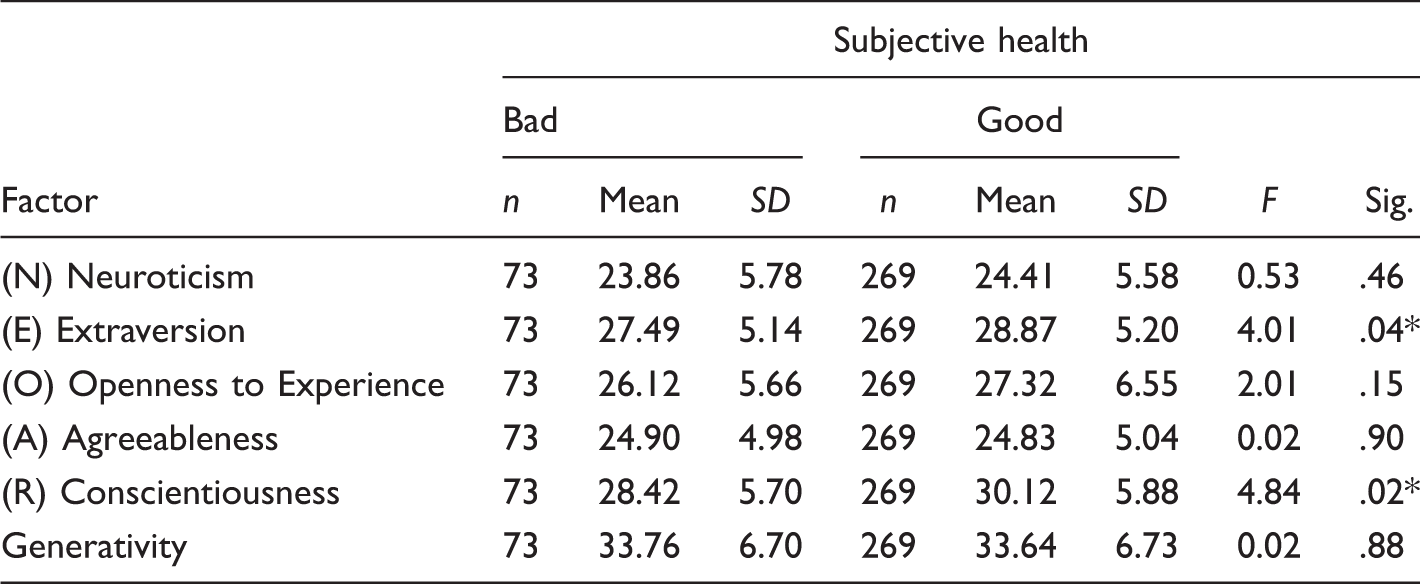
*Difference is significant at .05 level.
Pearson Correlations Between Variables.

Note. NS = not significant.
Difference is significant at .05 level.
Difference is significant at .01 level.
As illustrated, the correlation coefficients shown are moderate, with the highest score being 0.58. More specifically, correlation analyses indicate that Neuroticism is related in a significant and negative direction with the other big four traits and with life satisfaction. The highest negative correlations are between Neuroticism and both Extraversion (r = −0.47; p < .01) and Openness to Experience (r = −0.47; p < .01), and the lowest between Neuroticism and Life satisfaction (r = −0.12; p < .01). Extraversion is positively associated with Openness to Experience, Agreeableness, Conscientiousness, generativity, life satisfaction, and perceived health (p < .01). Openness to Experience correlates positively with Conscientiousness and generative interest (p < .01). Agreeableness and Conscientiousness are related positively with each other (p < .01). In addition, both traits relate to generativity and life satisfaction (p < .01). Separately, a positive association between generativity and perceived health (p < .05) is observed.
Regression Analysis Results for Personality Variables Over Life Satisfaction.
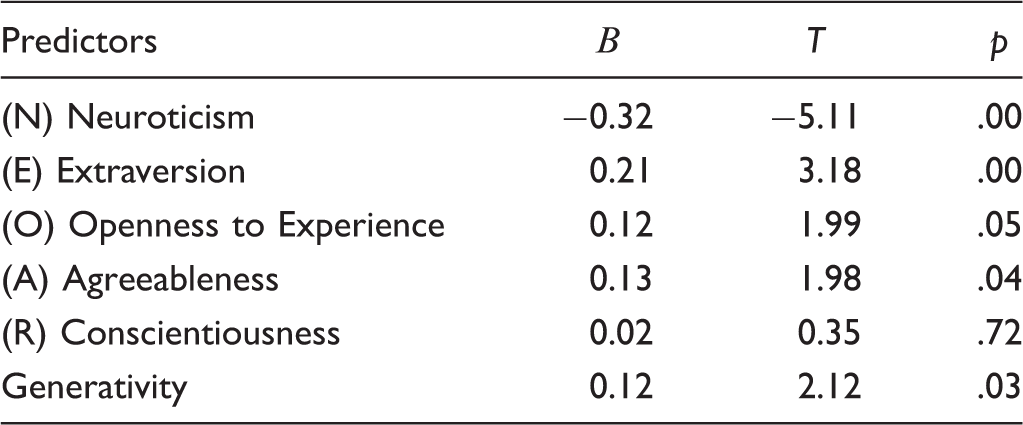
Regression Analysis Results for Personality Variables Over Generativity.

Discussion
The goal of this study was to examine personality traits and generativity in a sample of older students, as well as to identify the contribution of dispositional constructs of personality to life satisfaction and to assess which personality traits are the ones that promote a greater concern for generative issues.
With regards to the personality profile, it was confirmed that older adults show a good emotional stability, are sociable, organized, have difficulties to cope with unfamiliar events, and are suspicious to others’ intentions. Traits are stable features of an individual’s personality and constitute the basis for their behavior, with implications in different life domains of younger and older adults (Kandler, Kornadt, Hagemeyer, & Neyer, 2015; Soto, 2014).
Results also indicate that participants showed good attitudes and generative interest, that is, they seem to continue willing to provide with their experience and knowledge to different family and community settings in which they participate. Moreover, they appear to be a population group committed to contributing to the common benefit and social development. This result is similar to other studies with younger and older samples (Cheng, 2009; Villar et al., 2013).
This work highlights how personality variables and generativity contribute to life satisfaction in late life. As in previous works (e.g., Cox et al., 2010; Peerig-Chiello, Jaeggi, Buschkuehl, Stäbelin, & Perrig, 2009; Versey & Newton, 2013), older adults appear to be quite satisfied with their lives. This suggests that, in this stage of life, life satisfaction is not lower than in previous stages. In other words, older people are still able to adapt to changing life circumstances to maintain satisfaction with oneself and with life. Generative interest or concern, extraversion, conscientiousness, and neuroticism have shown their functionality in the maintenance of life satisfaction in older adults, a result that is similar to other studies that found that adequate levels of generativity were positively related to self-reported well-being and to psychosocial adaptation in middle age, while self-concern correlated negatively with physical and psychological well-being. That is, dispositional personality traits (within the Big Five taxonomy) and the adult developmental construct of generativity would explain a major part of the adaptation to aging (Leszko et al., 2016; Peerig-Chiello et al., 2009). Both aspects of personality are relevant for their contribution, not only in terms of benefits for others, but also as personal rewards that imply both greater satisfaction with life and well-being.
These results also suggest that those individuals who are more energetic and optimistic (i.e., higher in Extraversion), as well as more willing and determined (i.e., higher in Conscientiousness), show a greater predisposition toward generativity. According to the Bradley’s (1997) Generativity status model, we would be dealing with “generative individuals” who show high involvement in one’s own and others development, who are more aware of being a guide to others, and who feel the need to share their knowledge and experiences (Agostinho & Paço, 2012).
Limitations
The scope and generalizability of the results and conclusions of this work are limited by some issues. First, the lack of representativeness of the sample is one of them, because the method of selection of the sample prevents the results to be considered representative of the older adult population. On the other hand, the role that living alone or as a couple, or the level of education, can have on life satisfaction and generativity was not examined. Considering these factors and increasing the study sample would allow a more in-depth analysis of the value of the characteristics of older adults who participate in university programs as factors that enhance a satisfactory aging. Thus, having more knowledge acquired from university training can give the necessary competence to the person to feel able to provide with their experience and knowledge to future generations.
Conclusions
Despite the limitations, this study contributes to justify the necessity and pertinence of implementing educational intervention programs that have generativity as one of their developmental grounds, in which they can use all that generative interest toward other generations to allow them to be more satisfied with their lives. Older individuals attending the University of Experience are people involved in educational programs that wish to continue learning, are healthy and show an entrepreneurial attitude for new projects that bring them greater social prominence, and are involved in seeking a better future for future generations. Accepting the generative nature of older adults require that we, in our personal and professional environments, look forward to promote generativity in its most diverse forms. In this context, future studies may focus on factors involved in the achievement of “Generative Universities” in which a more active and critic participation of older individuals could facilitate the development of their abilities and their level of personal satisfaction (Tesien, 2014).
Footnotes
Declaration of Conflicting Interests
The authors declared no potential conflicts of interest with respect to the research, authorship, and/or publication of this article.
Funding
The authors received no financial support for the research, authorship, and/or publication of this article.